



Abstract
This study responds to recent calls for research on how and why ethical leadership is related to employee outcomes. Drawing on self-concept–based theory and substitutes-for-leadership theory, the study examines both the mediating and moderating role of work meaningfulness on the relationship between ethical leadership and work engagement. Using a sample of Egyptian public hospital nurses, the results of structural equation modeling (SEM) revealed that work meaningfulness partially mediated the relationship between ethical leadership and engagement. Furthermore, the results showed the positive relationship between ethical leadership and work engagement was stronger for employees who experienced lower rather than higher levels of meaningfulness. Thus, public sector organizations need to put emphasis on nurturing ethical leadership and stimulating employees’ sense of work meaningfulness. However, they need to be aware that, sometimes, they may not be able to get “double the benefits” when they invest in developing both.
Keywords
Introduction
In recent years, ethical leadership has received significant attention from public administration scholars (Belle & Cantarelli, 2017; Downe, Cowell, & Morgan, 2016; Hassan, Wright, & Yukl, 2014; Wright, Hassan, & Park, 2016). Ethical leadership is defined as “the demonstration of normatively appropriate conduct through personal actions and interpersonal relationships, and the promotion of such conduct to followers through two-way communication, reinforcement, and decision-making” (Brown, Trevino, & Harrison, 2005, p. 120).
Several studies have found a link between ethical leadership and desirable employee outcomes in the public sector such as job satisfaction, organizational commitment, and ethical behavior (e.g., Beeri, Dayan, Vigoda-Gadot, & Werner, 2013; Hassan et al., 2014; Wright et al., 2016). However, none of these studies has examined how or why ethical leadership is related to these outcomes. This study seeks to address this issue by examining the mediating and moderating role of work meaningfulness, which is the degree to which work assignments have positive significance and help achieve purposes that are in line with an individual’s values and principles (Demirtas, Hannah, Gok, Arslan, & Capar, 2017; Steger, Dik, & Duffy, 2012), on the relationship between ethical leadership and work engagement. Prior research findings suggest that leadership could derive its effectiveness from its influence on work meaningfulness (Wang & Xu, 2017). However, meaningfulness could also influence responses to leadership (May, Gilson, & Harter, 2004). This suggests that meaningfulness could act as both a mediator and a moderator of the ethical leadership–work engagement relationship and could, therefore, explain how and why ethical leadership is related to engagement.
Work engagement, the employee outcome and dependent variable in this study, reflects “an active state of psychological immersion in one’s work” (Demirtas et al., 2017, p. 5). In spite of its importance to all types of organizations, very limited attention has been given by public administration scholars to the organizational antecedents of work engagement in public service organizations. Disengaged employees are costly to public organizations and could negatively influence public service delivery (Andrews & Mostafa, 2017). Therefore, identifying the drivers of work engagement in the public sector is important. This study proposes that one important antecedent of work engagement in public organizations is ethical leadership. Specifically, the study proposes that, through their fair and caring treatment of employees, ethical leaders are likely to enhance work engagement (Engelbrecht, Heine, & Mahembe, 2017).
Drawing on self-concept theory of leadership (Shamir, House, & Arthur, 1993), this study also proposes that ethical leadership encourages work engagement through enhancing employees’ experience of work meaningfulness. Self-concept theory proposes that leaders’ ability to motivate followers depends on engaging followers’ self-concept in the mission articulated by them. The theory further proposes that followers will perceive their work as meaningful when leaders link the work to a larger moral purpose and clarify how it helps in the attainment of organizational objectives (Shamir et al., 1993). Moreover, drawing on substitutes-for-leadership theory (Kerr & Jermier, 1978), the study also proposes that meaningfulness could moderate and substitute for ethical leadership in influencing work engagement. Leadership substitutes theory posits that certain factors could provide followers with incentives that negate a leader’s ability to either impair or improve his or her attitudes and behaviors (Kerr & Jermier, 1978). Figure 1 depicts the conceptual model of this study.
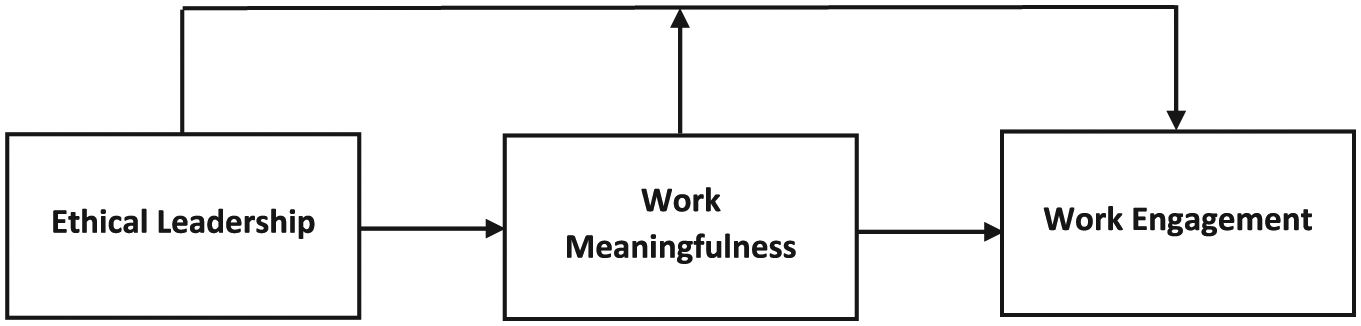
Conceptual model.
Overall, this study makes several contributions to the literature. First, there have been calls for research on the mediating mechanisms that link leadership behavior, in general, and ethical leadership, in particular, to employee outcomes (Brown & Mitchell, 2010; Wang & Xu, 2017). This study responds to these calls by examining the mediating role of work meaningfulness on the relationship between ethical leadership and work engagement. Second, the potential moderators of the relationship between ethical leadership and employee outcomes have “hardly been considered in research” (Kalshoven, Den Hartog, & De Hoogh, 2013a, p. 228). Moreover, scholars have been calling for research on the boundary conditions of ethical leadership (Gok et al., 2017). This study, therefore, contributes to the literature by proposing that work meaningfulness could act as a moderator of the ethical leadership–work engagement relationship. Third, even though research has shown that work meaningfulness is positively related to desirable employee outcomes, not much is known about the antecedent factors that contribute to its development (Demirtas et al., 2017; Wang & Xu, 2017). In particular, there have been calls for research on the relationship between leadership and work meaningfulness in both public and private organizations (Demirtas et al., 2017; Rosso, Dekas, & Wrzesniewski, 2010; Steger et al., 2012; Tummers & Knies, 2013). This study contributes to the meaningfulness literature by examining the relationship between ethical leadership and work meaningfulness in the public sector. Finally, most of the studies on the relationship between ethical leadership and employee outcomes have been conducted in Western contexts and Asia (e.g., Demirtas et al., 2017; Den Hartog & Belschak, 2012; Kalshoven et al., 2013a; Wang & Xu, 2017). Therefore, by using data based on a sample of Egyptian public hospital nurses, the study’s findings make an important contribution to the development of leadership theory as it increases the international breadth of empirical work on the ethical leadership–employee outcomes link (Whetten, 1989).
The article is structured as follows. First, the direct relationship between ethical leadership and work engagement is discussed, followed by an overview of how work meaningfulness could both mediate and moderate the ethical leadership–work engagement relationship. Following that, the research methodology employed in this study is described and the results of structural equation modeling (SEM) are presented. Finally, the implications of the findings for both theory and practice are discussed.
Ethical Leadership and Work Engagement
Before understanding the relationship between ethical leadership and work engagement, it is important to understand what work engagement means. Work engagement is a positive, motivational, work-related state of mind characterized by vigor, dedication, and absorption (Salanova & Schaufeli, 2008). Vigor refers to having persistence, high energy levels, mental resilience, and the willingness to exert effort into work tasks; dedication refers to feeling enthusiastic about one’s work and being highly involved in it; and absorption refers to concentrating fully and being engrossed in work (Schaufeli & Bakker, 2004). Because of its importance, there have been recent calls for research on the organizational factors that might contribute to work engagement, especially in the public sector (Andrews & Mostafa, 2017). This study considers the role of leadership, as an organizational factor, and proposes that it plays a significant role in shaping the work engagement of public sector employees.
Leadership is believed to be one of the “biggest factors” contributing to work engagement (Zhu, Avolio, & Walumbwa, 2009, p. 592). Studies have examined the influence of different positive leadership styles such as transformational and authentic leadership on engagement (Aryee, Walumbwa, Zhou, & Hartnell, 2012; Bamford, Wong, & Laschinger, 2013; Penger & Černe, 2014; Tims, Bakker, & Xanthopoulou, 2011). However, very few have considered the relationship between ethical leadership and work engagement especially in the public sector (Demirtas et al., 2017; Hassan et al., 2014). This is surprising, given the importance of ethics in public organizations and the significant role played by ethical leaders in the establishment and support of an ethical climate (Downe et al., 2016; Hassan et al., 2014).
Ethical leadership differs from other positive leadership styles because of its explicit focus on the ethical aspect of leadership (Wang & Xu, 2017). It has two main facets: the moral person and the moral manager (Brown & Trevino, 2006). As moral persons, ethical leaders are personally committed to moral values such as integrity, honesty, fairness, and altruism. As moral managers, they adopt proactive measures, such as communicating ethical standards and rewarding employees for ethical compliance, to promote ethical behaviors among followers. In general, ethical leaders use normative management to guide their followers based on moral motivations even in the absence of formal requirements from the organization (Yang, Ding, & Lo, 2016).
Social exchange theory (Blau, 1964) helps explain how ethical leadership is related to work engagement. The theory postulates that when people believe that someone has been good to them, they will feel obligated to reciprocate with positive attitudes and actions. Ethical leaders “have the best interest of employees in mind” (Mayer, Kuenzi, Greenbaum, Bardes, & Salvador, 2009, p. 4). Such leaders are fair and highly trusted by their employees. They also care for their employees and are supportive of them (Brown & Mitchell, 2010; Mayer et al., 2009). Employees, in turn, will be more likely to reciprocate by putting more effort into their work and becoming highly involved and more engaged in it (Engelbrecht et al., 2017). Recent private sector research provides support for these assumptions and suggests that ethical leadership is positively related to work engagement (Cheng, Chang, Kuo, & Cheung, 2014; Demirtas et al., 2017; Engelbrecht et al., 2017).
As mentioned before, there have been calls for research on the mediating mechanisms that link ethical leadership to work engagement (Demirtas et al., 2017). This study responds to these calls by examining the role of work meaningfulness as one such mechanism. The next section explains how work meaningfulness could mediate the relationship between ethical leadership and work engagement.
Work Meaningfulness as a Mediator of the Ethical Leadership–Work Engagement Relationship
Work meaningfulness refers to the value of a work purpose or goal judged in relation to an individual’s own standards (May et al., 2004; Spreitzer, 1995). It usually reflects intrinsic interest in a task and mainly involves a fit between work role requirements and an individual’s values and beliefs (Spreitzer, 1995). Perry and Hondeghem (2008) argue individuals usually seek employment in the public sector because of their desire to do meaningful work that could help contribute to society. Therefore, the study of work meaningfulness and the different means of enhancing it is “quite important” in public sector organizations (Tummers & Knies, 2013, p. 861).
Recently, it has been argued that “ensuring employees’ meaningful work is a moral responsibility of organizational management” (Wang & Xu, 2017, p. 2). Accordingly, it could be argued that ethical leadership is a main driver of experienced meaningfulness at work. Self-concept theory (Shamir et al., 1993) helps explain the linkage between ethical leadership and work meaningfulness. The theory postulates that the impact of leaders is based on their ability to connect or engage followers’ self-concept (i.e., how they would perceive themselves) in the mission articulated by them. The theory further postulates that followers will experience meaningfulness in their work when leaders clearly link the work to a larger moral purpose and elucidate how it helps in the achievement of the organization’s objectives (Shamir et al., 1993). Thus, followers will perceive that their work is significant because they understand how it supports the organization’s values and supports the achievement of its objectives (Aryee et al., 2012).
Meaningful work is generally viewed as an ethical issue, which requires moral management in the workplace and, therefore, as mentioned before, ethical leadership is an important source of meaningfulness (Wang & Xu, 2017). Ethical leadership is a “value-driven” style of leadership that influences the beliefs and self-concepts of followers and helps make their work more meaningful (Den Hartog & Belschak, 2012, p. 36). Ethical leaders display moral behavior and serve as role models for followers (Demirtas et al., 2017; Den Hartog & Belschak, 2012; Wang & Xu, 2017). They communicate to followers the value of behaving ethically and highlight the importance of their job in achieving socially responsible goals (Demirtas et al., 2017; Wang & Xu, 2017). Furthermore, through role modeling and the rewarding of ethical actions, ethical leaders hand over morals and principles to followers. They also provide a sense of identity where their ideas and values become part of the self-concept of followers’ (Den Hartog & Belschak, 2012). All this helps reinforce followers’ sense of purposefulness and promotes work meaningfulness. Recent research findings provide support for these assumptions and suggest that ethical leadership is positively related to work meaningfulness (Demirtas et al., 2017; Wang & Xu, 2017).
Self-concept theory also implies that experienced work meaningfulness is usually associated with increased levels of work motivation and, therefore, leads to increased levels of work engagement (Aryee et al., 2012; Scroggins, 2008). This is supported by previous research that has shown that work meaningfulness is positively related to work engagement (Aryee et al., 2012; Demirtas et al., 2017; May et al., 2004). As argued by Macey, Schneider, Barbera, and Young (2009), “People come to work for pay but get engaged at work because the work they do is meaningful” (p. 69). When employees perceive their work as personally impactful and making a difference to others, they will be dedicated to their work and enthusiastic about it (Aryee et al., 2012). The perception that one’s work has meaning for others “fuels the motivation to make a prosocial difference what in turn increases effort and persistence” (Sonnentag, 2017, p. 15). Meaningfulness has been identified by Kahn (1990) as one of three main psychological conditions (besides both safety and availability) that influence employees’ level of engagement in work. It has also been found to have the strongest effect of the three (May et al., 2004). Meaningfulness also helps satisfy a number of basic psychological needs such as the needs for belongingness and purposefulness. This further promotes work engagement (Wang & Xu, 2017). Overall, there is consensus that employees “who are in jobs that are personally meaningful are more engaged than those who are not” (Stairs & Galpin, 2010, pp. 161-162). Taken together, the above arguments suggest that, for employees who experience low levels of meaningfulness, ethical leaders could enhance work engagement through increasing their perceptions of the meaningfulness of their work. Accordingly, the following hypothesis is proposed.
Work Meaningfulness as a Moderator of the Ethical Leadership–Work Engagement Relationship
Drawing on substitutes-for-leadership theory (Kerr & Jermier, 1978), this study proposes that work meaningfulness could also moderate the ethical leadership–work engagement relationship. Substitutes-for-leadership theory posits that certain factors, including job characteristics, may diminish or substitute for a leader’s ability to influence employee attitudes and behaviors (Bottomley, Mostafa, Gould-Williams, & Leon-Cazares, 2016; Kalshoven, Den Hartog, & De Hoogh, 2013b). Therefore, in the presence of these factors, leadership tends to be unproductive and is viewed as “unnecessary” (Kerr & Jermier, 1978, p. 395). This means that substitutes for ethical leadership should be factors that could replace the influence that ethical leaders could have on followers. The present study proposes that work meaningfulness, a job characteristic, may act as a substitute for ethical leadership in the relationship with work engagement.
Work meaningfulness is a “necessary prerequisite” for work engagement (Albrecht, 2013, p. 243). When employees experience work meaningfulness, they usually find it easier to be cognitively available at work and become more absorbed and dedicated (Demirtas et al., 2017). Furthermore, lack of meaning in work is believed to cause “alienation” and “disengagement” from work (May et al., 2004, p. 14). As mentioned before, prior research has also shown that meaningfulness has a strong positive association with engagement (May et al., 2004). Accordingly, it is expected that work meaningfulness will play a major role in moderating the relationship between ethical leadership and work engagement. Specifically, ethical leaders will be more effective at enhancing work engagement when employees experience lower levels of work meaningfulness compared with those experiencing higher levels of meaningfulness.
Recent research findings support the view that certain job characteristics are likely to diminish the effects of ethical leadership on followers. For instance, Kalshoven et al. (2013b) found that the positive effects of ethical leadership on followers helping and initiating were reduced when the job provided enough guidance, and followers had small choice in work methods and tasks (low job autonomy). Thus, although work meaningfulness could act as a mechanism through which ethical leaders could enhance desirable employee outcomes (i.e., work engagement in the current study), it could also act as a substitute for ethical leadership and replace its influence on followers. Accordingly, the following hypothesis is proposed.
Sample and Procedures
The study data were collected from a sample of Egyptian public hospital nurses. A convenience sample was used because of the difficulties associated with collecting primary data in Egypt (Gould-Williams, Mostafa, & Bottomley, 2015). However, because of this, the results of the study will be less representative than results based on a random sample. To minimize the risk of social desirability bias, the nurses were contacted directly rather than through their hospitals and promised that their responses would be treated anonymously. A paper and pen questionnaire was used and was distributed during working hours on a face-to-face basis.
Of the 350 questionnaires distributed, 197 were returned, providing a response rate of 56.3%. Most of the respondents were female (94%). In total, 56% were between 20 and 30 years of age, 27% were between 31 and 40 years, and the rest were above 40 years old. Furthermore, 39% of the respondents had served in their hospitals for more than 15 years, 19% had served for between 10 and 15 years, and the rest had been serving in their hospitals for less than 10 years.
Measures
The measures used in this study have been widely employed and validated in previous research and have been shown to have good psychometric properties in different contexts (Demirtas et al., 2017; Den Hartog & Belschak, 2012; May et al., 2004; Wang & Xu, 2017). Furthermore, they were viewed by the researchers of this study as the most appropriate for the Egyptian context. To ensure the equivalence of measures, the English questionnaire was back-translated into Arabic and pretested by five public hospital nurses (Brislin, 1970). All questionnaire items were measured on a 7-point Likert-type scale ranging from strongly disagree (1) to strongly agree (7).
Ethical Leadership
Brown et al.’s (2005) 10-item scale was used to measure ethical leadership. This scale is the most widely used in the literature to measure ethical leadership (Den Hartog, 2015). A sample item is “My supervisor discusses business ethics or values with employees.” The scale’s alpha reliability is .905.
Work Engagement
Work engagement was measured using 12 items (four items per engagement dimension) from the scale developed by Schaufeli and Bakker (2003). This scale also represents the most widely used measure of work engagement in the academic literature (Fletcher & Robinson, 2013). Sample items are “At my job, I feel strong and vigorous” (vigor), “I am enthusiastic about my job” (dedication), and “I get carried away when I’m working” (absorption). The alpha coefficient for vigor, dedication, and absorption was .782, .720, and .664, respectively.
Work Meaningfulness
A three-item scale developed by Spreitzer (1995) was used to measure work meaningfulness. A sample item is “The work I do is meaningful to me.” The alpha coefficient for this scale was .743.
Controls
Initially, nurses’ gender, age, and organizational tenure were controlled for in the analysis. However, consistent with previous research (e.g., Demirtas et al., 2017), the initial analysis showed that these variables had weak or nonsignificant relationships with work engagement. Furthermore, the results were highly consistent with and without their inclusion. Accordingly, in the interest of parsimony and in line with the recommendations of Williams, Vandenberg, and Edwards (2009), the findings below are reported without controls.
Data Analysis
The analysis was conducted using SEM with AMOS 23. Anderson and Gerbing’s (1988) two-step approach was used, in which the measurement model was first validated and then the structural model was estimated. Two structural models were tested. The first assessed the mediating role of work meaningfulness on the ethical leadership–work engagement relationship and the second assessed the moderating role of meaningfulness on the ethical leadership–engagement relationship.
Results
Measurement Validation
To decrease the big number of degrees of freedom that could result in estimation problems, item parcels were used rather than original items as indicators of both ethical leadership and work engagement (Bandalos, 2002; Landis, Beal, & Tesluk, 2000). Parcels have more reliability than individual items and offer a more adequate representation of unobserved variables. They also help minimize Type 1 error as well as the probability of a priori model misspecification (Bagozzi & Heatherton, 1994; Hagtvet & Nasser, 2004).
For ethical leadership, parcels were formed by averaging the highest and lowest loading items sequentially. This helps build balanced parcels and minimize the residual covariance among them (Little, Rhemtulla, Gibson, & Schoemann, 2013). For work engagement, parcels were created by averaging the items measuring each dimension (i.e., vigor, dedication, and absorption). This helps maximize the internal consistency of the parcels and keep explicit the multidimensional nature of the construct (Little, Cunningham, Shahar, & Widaman, 2002). Accordingly, five parcels were formed for ethical leadership and three were formed for work engagement. This is consistent with previous studies (e.g., Aryee et al., 2012; Hassan et al., 2014; Kalshoven, Den Hartog, & De Hoogh, 2013a, 2013b; Piccolo, Greenbaum, den Hartog, & Folger, 2010; Salanova & Schaufeli, 2008), in which ethical leadership and work engagement were treated as more general, higher order constructs.
Then, a confirmatory factor analysis (CFA) was conducted to assess the reliability and validity of the study constructs. To assess model fit, three indices were used: the comparative fit index (CFI), the root mean square error of approximation (RMSEA), and the standardized root mean square residual (SRMR). A good fit is achieved when the CFI is 0.90 or more, the RMSEA is 0.08 or less, and the SRMR is 0.10 or less (Williams et al., 2009).
The fit of the overall measurement model was good, χ2(df = 41) = 85.285, p < .01, CFI = 0.961, RMSEA = 0.074, SRMR = 0.056. All constructs possessed high internal consistency where the composite reliability for each construct was above .70 and the average variance extracted was above 0.50 (Fornell & Larcker, 1981). Moreover, all constructs achieved discriminant validity, where, as shown in Table 1, the square root of the average variance extracted for each construct was more than the corresponding interconstruct correlation estimates (Fornell & Larcker, 1981).
Descriptive Statistics, Intercorrelations, and Reliability Estimates.
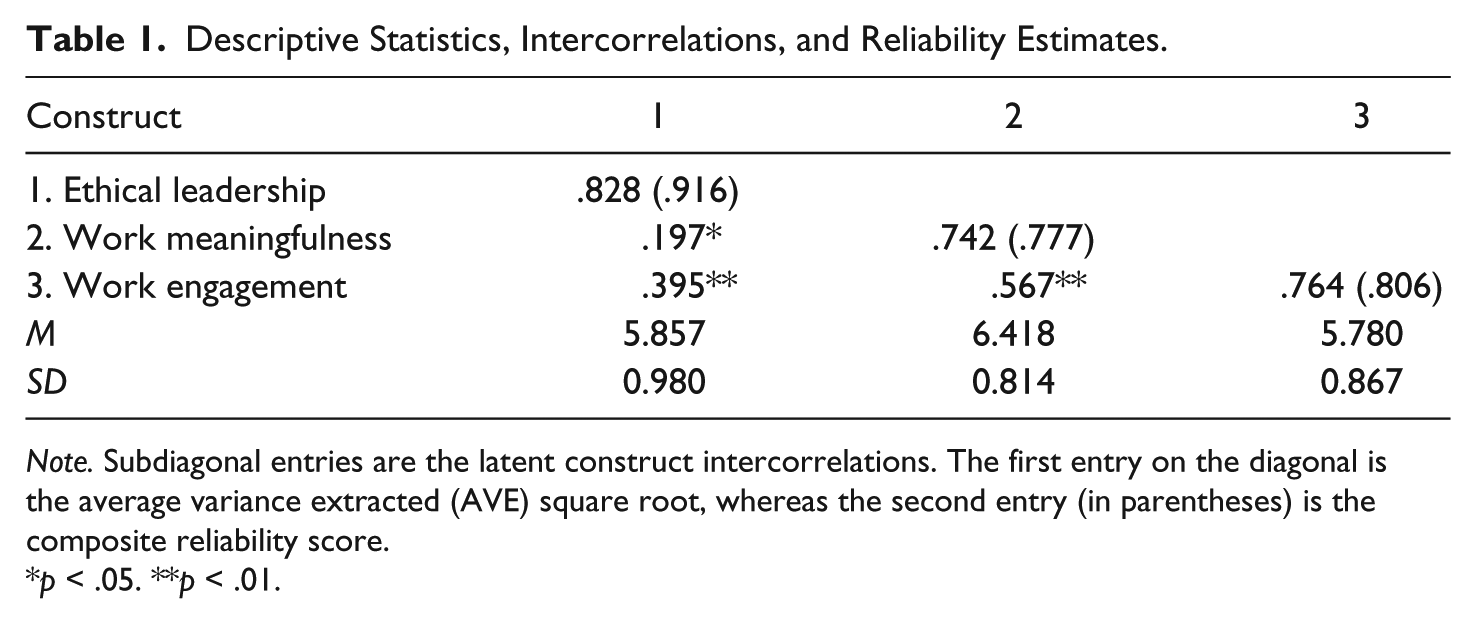
Note. Subdiagonal entries are the latent construct intercorrelations. The first entry on the diagonal is the average variance extracted (AVE) square root, whereas the second entry (in parentheses) is the composite reliability score.
p < .05. **p < .01.
Common Method Bias
To reduce the influence of common method bias, several procedural remedies were followed such as reducing item ambiguity and protecting respondent anonymity (Podsakoff et al., 2003, 2012). However, because data for all the study variables were rated by the same respondents at the same time, the possibility of common method bias influencing the direct relationships between the variables still remained. Accordingly, common method bias was tested for using the unmeasured latent method factor approach. Here, the measurement model was reestimated after allowing all items to load on both their theoretical construct and a common factor. The fit of this model was very good (χ2 = 39.959, df = 30.106, p < .01, CFI = 0.991, RMSEA = 0.041, SRMR= 0.022), but the variance extracted by the common factor was .175. This is much lower than the 0.50 threshold suggestive of a substantive construct (Fornell & Larcker, 1981). Accordingly, common method bias did not appear problematic.
Hypotheses Tests
Mediation hypothesis
To test the mediating role of work meaningfulness on the relationship between ethical leadership and work engagement, the fit of a partially mediated model was compared with a fully mediated model and a direct effects model. The partially mediated model includes a path from ethical leadership to work meaningfulness, a path from work meaningfulness to engagement, and a direct path from ethical leadership to engagement. In the full mediation model, there was no path from ethical leadership to engagement. Finally, in the direct effects model, there was no path from ethical leadership to meaningfulness but there were two direct paths from both leadership and meaningfulness to work engagement.
Table 2 provides the results of comparing between these three models. As shown in the table, the fit of the partial mediation model was better than the two other models and the difference in fit was statistically significant (Δχ2 = 16.465, Δdf = 1, p < .01, for the full mediation model, and Δχ2 = 6.594, Δdf = 1, p < .05, for the direct effects model). Therefore, the partial mediation model was retained as the best fitting model.
Structural Models Comparison.
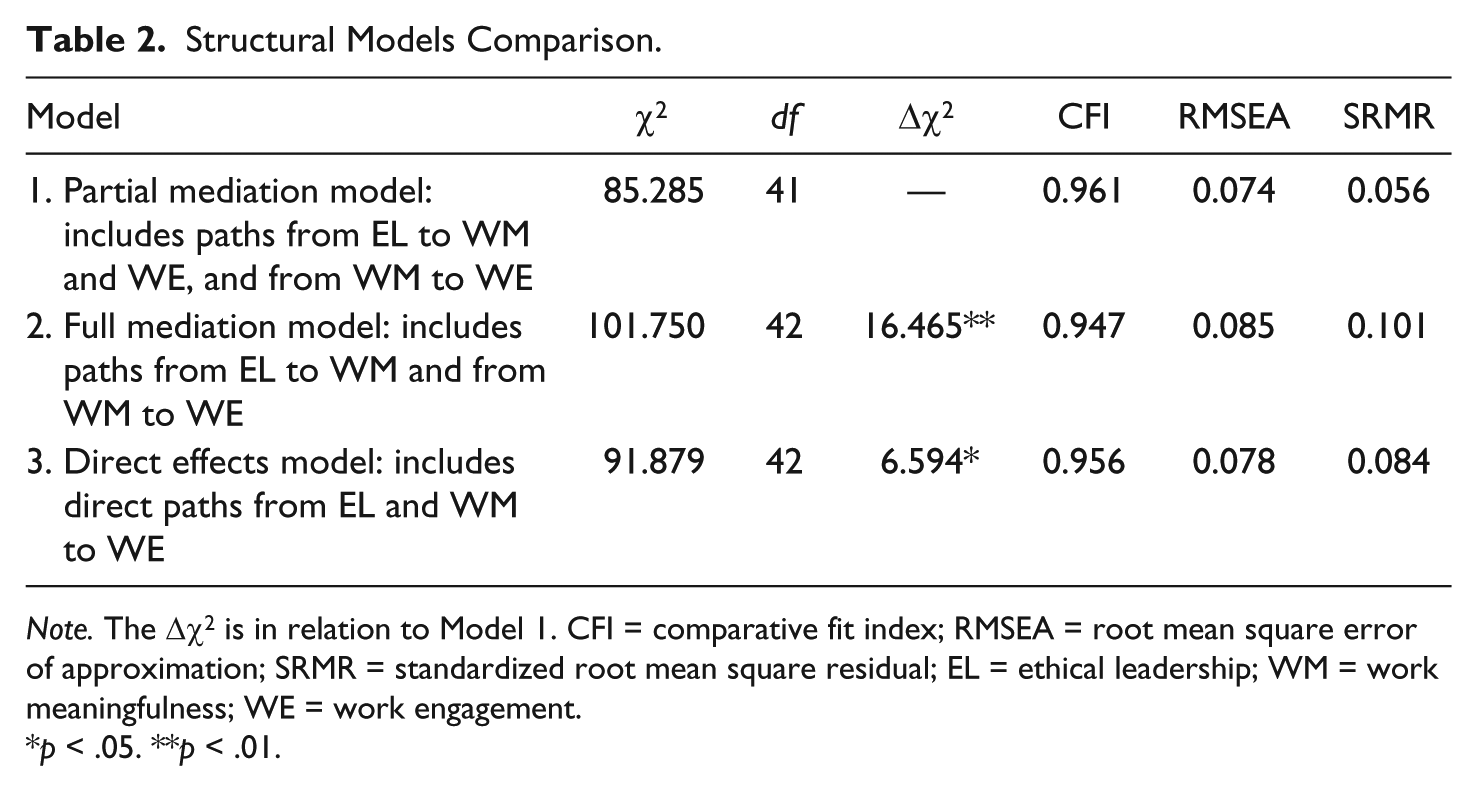
Note. The Δχ2 is in relation to Model 1. CFI = comparative fit index; RMSEA = root mean square error of approximation; SRMR = standardized root mean square residual; EL = ethical leadership; WM = work meaningfulness; WE = work engagement.
p < .05. **p < .01.
With regard to the path coefficients, ethical leadership was significantly and positively related to both work meaningfulness (β = .116, p < .05) and work engagement (β = .274, p < .01). Work meaningfulness was also positively related to engagement (β = .807, p < .01). Furthermore, the indirect effect of ethical leadership via work meaningfulness to work engagement was 0.09 (0.116 × 0.807) and was significantly different from zero (Sobel test = 2.19, p < .05). Together, these findings suggest that work meaningfulness partially mediates the relationship between ethical leadership and work engagement. Therefore, Hypothesis 1 was supported.
Moderation hypothesis
To test the moderating role of work meaningfulness on the relationship between ethical leadership and work engagement, Little, Bovaird, and Widaman’s (2006) orthogonalizing approach was used. Traditional techniques for testing interaction effects, such as standard multiple regression, have low power because they do not control for random and nonrandom measurement errors. However, the orthogonalizing approach corrects for measurement error and, therefore, has more power, and yields unbiased and more accurate estimates (Little et al., 2006; Steinmetz, Davidov, & Schmidt, 2011). This approach involves creating 15 product terms by multiplying the five indicators of ethical leadership with the three indicators of work meaningfulness. The 15 product terms are then individually regressed on the indicators of ethical leadership and work meaningfulness and the residuals of these regressions are retrieved. Then, in the structural model, these residuals are used as indicators of the latent interaction variable. In addition, correlated covariances are estimated between the residual variances of these indictors if the original cross product included the same first-order indicator. Because of the orthogonalizing procedure, both ethical leadership and meaningfulness are not allowed to correlate with the interaction variable (Little et al., 2006).
This model provided a good fit to the data, χ2(df = 250) = 403.643, p < .01, CFI = 0.970, RMSEA = 0.056, SRMR = 0.077. As in the previous model, both ethical leadership and work meaningfulness had a significant positive relationship with work engagement. However, more important, the interaction between ethical leadership and meaningfulness was significant and negative (β = −.074, p < .05). The negative interaction suggests that, as work meaningfulness increased, the association between ethical leadership and work engagement decreased. In other words, ethical leadership had less of an impact on engagement when employees experienced higher, rather than lower, levels of work meaningfulness. Thus, Hypothesis 2 was also supported. Figure 2 shows the moderating role of work meaningfulness on the relationship between ethical leadership and work engagement.
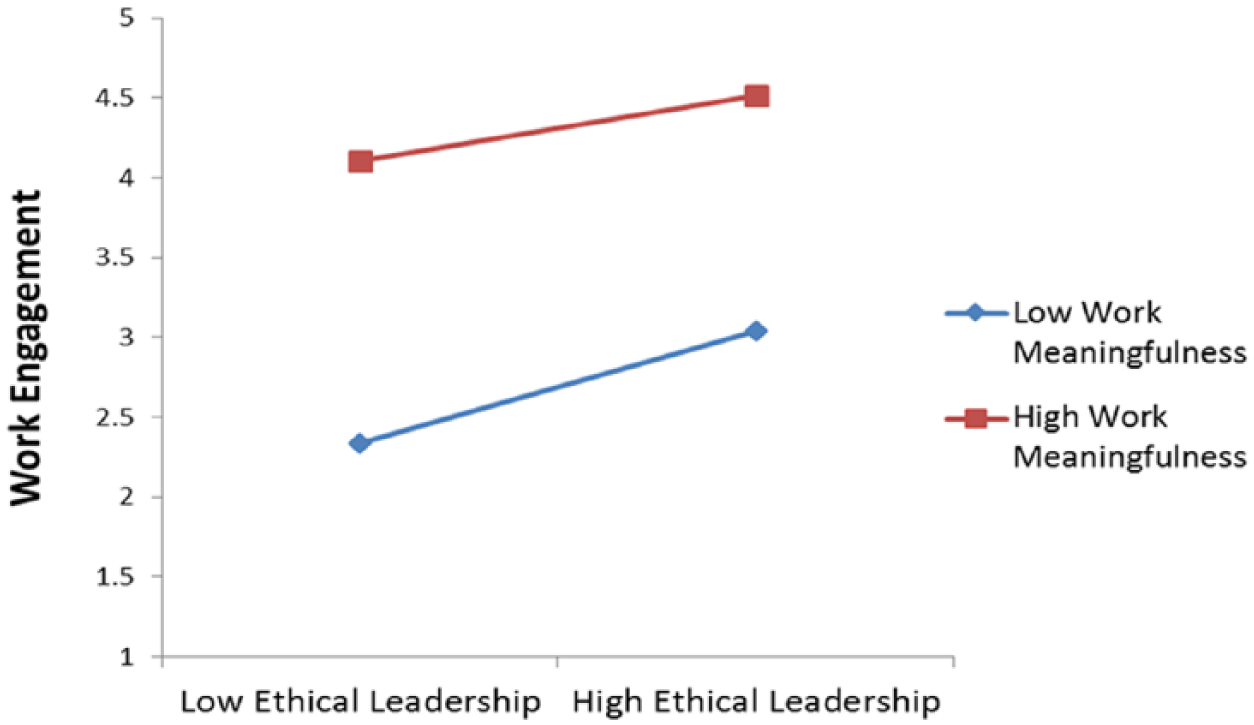
The moderating role of work meaningfulness on the relationship between ethical leadership and work engagement.
Discussion
There have been calls for research on how and why ethical leadership is related to employee outcomes. This study sought to address these calls by examining the mediating and moderating role of work meaningfulness on the relationship between ethical leadership and work engagement. Consistent with the proposed hypotheses, findings revealed that work meaningfulness acts as both a mediator and moderator of the ethical leadership–work engagement relationship.
Theoretical Implications
This study contributes to the literature in a number of ways. First, it addressed calls for research on the mediating mechanisms that link ethical leadership to employee outcomes. Consistent with self-concept–based theory, the study found that work meaningfulness mediates the relationship between ethical leadership and work engagement. This confirms that ethical leaders influence followers’ self-concept by clearly linking work to a larger moral purpose, which, in turn, increases work engagement through helping followers experience meaningfulness in their work. However, it is worth noting that the mediation is partial rather than full. This suggests that there are other mechanisms through which ethical leadership could enhance work engagement. Therefore, future studies could consider the role of other mediating variables such as different psychological conditions (i.e., safety and availability) or psychological states (i.e., experienced responsibility and knowledge for results) or core job characteristics.
Also, in line with prior research (Aryee et al., 2012; Demirtas et al., 2017; May et al., 2004), the study findings revealed that work meaningfulness is positively related to work engagement (β = .807). This confirms that work meaningfulness is a “necessary prerequisite” for work engagement (Albrecht, 2013, p. 243), and that when employees experience work meaningfulness, they usually find it easier to be cognitively available at work and become more absorbed and dedicated (Aryee et al., 2012; Demirtas et al., 2017; Sonnentag, 2017).
The study also addressed calls for more research on the relationship between leadership and work meaningfulness in the public sector. In line with recent private sector research (Demirtas et al., 2017; Wang & Xu, 2017), the study found that ethical leadership is positively related to work meaningfulness. However, the effect size of ethical leadership on meaningfulness is small (R2 = .04). This suggests that ethical leadership is a very weak predictor of work meaningfulness. Scholars argue that very little is known about the factors that contribute to enhancing work meaningfulness (Demirtas et al., 2017; Wang & Xu, 2017). However, besides ethical leadership, other factors are believed to augment employees’ sense of meaning in their work such as person–job fit and human resources management (HRM) practices (Albrecht, Bakker, Gruman, Macey, & Saks, 2015; Scroggins, 2008). Considering these factors together could be more substantial.
As argued by Kalshoven et al. (2013a), the moderators of the relationship between ethical leadership and employee outcomes such as work engagement have “hardly been considered in research” (p. 228). Therefore, this study also contributed to the literature by examining the moderating role of work meaningfulness on the relationship between ethical leadership and work engagement. In line with substitutes-for-leadership logic, the study found that work meaningfulness moderates the relationship between ethical leadership and work engagement in such a way that the positive relationship between both variables is stronger for employees who experience lower rather than higher levels of work meaningfulness. Thus, when employees experience work meaningfulness, the motivational influence of ethical leaders’ behaviors on work engagement is reduced. This finding is also in line with prior research, which has shown that certain job characteristics are likely to diminish the effects of ethical leadership on followers (Kalshoven et al., 2013b).
Finally, it is important to note that leaders, sometimes, may engage in unethical behaviors and display unethical leadership (Brown & Mitchell, 2010; Den Hartog, 2015). Research has shown that unethical leadership is negatively related to employee work engagement (Brown & Mitchell, 2010). This could be through the negative influence of unethical leadership on employee perceptions of work meaningfulness, especially when employees only experience low levels of meaningfulness. However, when employees experience high levels of meaningfulness, the negative influence of unethical leadership on work engagement is likely to be minimal. This assumption is made in line with the substitutes-for-leadership logic, where substitutes (high work meaningfulness in this case) negate a leader’s ability to either impair or improve employee attitudes and behaviors (Kerr & Jermier, 1978). Future public sector research should consider the role of work meaningfulness on the link between unethical leadership and work engagement.
Practical Implications
This study has important practical implications. The study findings revealed that ethical leadership enhances employees’ sense of meaning in their work and increases their work engagement. Therefore, public sector organizations need to put strong emphasis on nurturing ethical leadership through different strategies such as hiring ethical leaders and providing ethics training to existing leaders (Mayer et al., 2009). When hiring new leaders, public sector organizations may use, for example, interview questions that focus on ethical dilemmas or rely on integrity tests. Also, training programs for existing leaders may cover topics such as rewarding followers’ ethical behavior, communicating the importance of ethics, and handling ethical issues. This will help managers improve their ethical behavior and will more likely lead to positive employee outcomes.
The study findings also suggest that through increasing work meaningfulness, employees will become more engaged in their work. Therefore, public sector organizations need to also put emphasis on stimulating employees’ sense of work meaningfulness. Besides ethical leadership, this could also be achieved through a number of approaches such as (a) clearly communicating opportunities for meaningful work within the organization and drawing employees’ attention to tasks that could support the realization of their full potential as individuals, (2) redesigning jobs and involving employees in decisions that could make their work more impactful and useful to others, and (3) developing deeper social connections between employees and public sector clients, so that employees get a full understanding of their impact on others (Fairlie, 2011).
However, public sector managers need to realize that when employees experience high work meaningfulness, the motivational effects of ethical leadership could be reduced. Therefore, they should not always be expecting to get “double the benefits” when investing in the hiring and training of ethical leaders and the nurturing of work meaningfulness (Bottomley et al., 2016, p. 402).
Limitations
As with all research, this study has a number of limitations that open up avenues for future research. First, the cross-sectional design of this study prevents any conclusions regarding causality. For example, it is plausible that employees who are highly engaged in their work are more likely to perceive their work as meaningful. Similarly, it is possible that followers who perceive their work as meaningful are more likely to view their leaders as ethical. Future studies with experimental or longitudinal designs could help address this issue. Nonetheless, the causal directions proposed are in line with most of the previous studies (e.g., Aryee et al., 2012; Demirtas et al., 2017; Engelbrecht et al., 2017; May et al., 2004; Wang & Xu, 2017).
Second, common method bias may have enhanced the estimates of the main effects because single-source self-reported measures were used. However, it is worth noting that common method bias can “inflate or deflate” bivariate relationships, but cannot “inflate but does deflate” interaction effects (Podsakoff et al., 2012, p. 564). In fact, it has been argued that testing for interaction effects may help rule out common method bias because such effects cannot result from this type of bias (George & Pandey, 2017; Podsakoff et al., 2012; Siemsen, Roth, & Oliveira, 2010). Accordingly, common method bias does not seem to pose a serious threat to the study findings. Yet, future studies in which data are collected from different sources and at different points in time would be preferable to avoid any concerns related to common method bias.
Third, this study did not control for other leadership styles that share some similar characteristics with ethical leadership such as transformational, authentic, and spiritual leadership (Den Hartog, 2015). Future studies could include these leadership styles as controls to assess the additional unique variance that could be explained by ethical leadership.
Finally, the study results are based on a convenience sample of Egyptian public hospital nurses. Convenience sampling was regarded as appropriate in this study because there was no sampling frame and, as mentioned before, data collection in Egypt is very difficult. Egyptians are usually not used to filling in questionnaires and returning them back. Therefore, when collecting primary data in Egypt, other sampling approaches are unlikely to yield sufficient responses (Hatem, 1994; Leat & El-Kot, 2007; Mostafa & Gould-Williams, 2014). However, because of this, the study results cannot be generalized. Therefore, additional empirical evidence is needed to identify whether the results of this study apply in other contexts.
Conclusion
This study has shown that work meaningfulness is important in public organizations as it serves as both a mediator and moderator of the relationship between ethical leadership and work engagement. Findings revealed that work meaningfulness partially mediated the relationship between ethical leadership and engagement. Furthermore, the positive relationship between ethical leadership and work engagement was stronger for employees who experienced lower, rather than higher, levels of meaningfulness. The study, therefore, extends knowledge of how and under what conditions ethical leadership could influence work engagement and provides a better understanding of the links between leadership behaviors, the experience of meaningfulness, and psychological immersion in work in the public sector.
Footnotes
Declaration of Conflicting Interests
The author(s) declared no potential conflicts of interest with respect to the research, authorship, and/or publication of this article.
Funding
The author(s) received no financial support for the research, authorship, and/or publication of this article.