



Abstract
This study examines individual resilience as a central mechanism between work design and work-related outcomes in a context characterized by high demands and acute or prolonged adversity: child and youth welfare during an ongoing pandemic. Expanding on a survey of 602 German professionals, structural equation modeling is applied to analyze (1) the relationship between work design and individual resilience, (2) the relationship between individual resilience and work-related outcomes, and (3) the role of individual resilience as a mediator. The results reveal positive relationships between two work design factors (social impact and feedback) and individual resilience. Other work design factors that have been much debated in the context of the pandemic (i.e., working from home and client contact) were not related to individual resilience. In turn, individual resilience is favorably related to job satisfaction and emotional exhaustion. The results also confirm the mediating role of individual resilience.
Introduction
There are public services where the boundaries between working and coping become convoluted (Lipsky, 2010; Tummers et al., 2015). This may be especially true for the case of child and youth welfare. Jobs in these fields involve constant adversities, such as work overload, traumatizing events, and emotional demands under unfavorable working conditions (Frost et al., 2018; Russ et al., 2009; Vincent-Höper et al., 2020). In addition, the ongoing COVID-19 pandemic has intensified the demands of these jobs and placed additional pressure on the personnel (Calvano et al., 2021; Jentsch & Schnock, 2020; Liu et al., 2020). Therefore, the question arises regarding how these public servants cope with such adversities, continue working effectively, and even feel satisfied with their job. Answers to these questions may lie in the concept of individual resilience (Masten, 2001; McFadden et al., 2015; Seery et al., 2010; Truter et al., 2016).
Individual resilience can be briefly described as process of bouncing back from adversity (American Psychological Association, 2020). It represents a developable human strength of great relevance, especially in the workplace (Hartmann et al., 2020; Luthans, 2002). Nevertheless, there is still limited understanding of the concept and scholars from work psychology (Britt et al., 2016; Fisher et al., 2019), child and youth welfare (Molakeng et al., 2021; Truter et al., 2016), and, more recently, public administration (Franken et al., 2020; Plimmer et al., 2022) are calling for further research.
This study aims to contribute to the knowledge of individual resilience in the context of a demanding public service (i.e., child and youth welfare) during turbulent times (i.e., COVID-19 pandemic). Given the vast evidence of how work design affects a diverse set of outcomes, including individual health and job satisfaction (Humphrey et al., 2007; Parker et al., 2017), we examine the relationships between work design, individual resilience, and work-related outcomes, and explore individual resilience as a possible mediator. To do this, we follow Parker et al. (2017) in using an integrated and modern framework of work design theory. The analysis is guided by the following research questions: (1) Are core work design factors (social impact and feedback) and interpersonal work design factors (working from home (WFH) and client contact) related to individual resilience? (2) Is individual resilience related to the work-related outcomes of job satisfaction and emotional exhaustion? (3) Does individual resilience act as a mediator in the relationship between work design factors and work-related outcomes?
By addressing these questions, the study makes several contributions. First, our model increases understanding of the role of street-level public servants’ individual resilience in a context, where coping with adversity seems to be daily business (Jentsch & Schnock, 2020; Møller, 2021; Tummers et al., 2015). Second, we contribute to the growing literature in HRM research that moves away from individual deficits toward contextual and strengths-based approaches (Brunetto et al., 2020; Plimmer et al., 2022; Russ et al., 2020; van Woerkom et al., 2016). Third, our model offers viable paths in Parker et al.'s (2017) roadmap for further developing work design theory by considering a novel mechanism and apposite factors in a specific context. Fourth, our framework offers possibilities to integrate other work design factors (e.g., red tape or public values) or outcomes (e.g., PSM or extra-role behaviors).
Background
Work Context of Adversity—Public Service in Child and Youth Welfare
Child and youth welfare is a common public service example of street-level bureaucracy (Lipsky, 2010), where coping with high demands, conflicting goals, and non-voluntary clients under scarce resources generally prevail (Baviskar & Winter, 2017; Tummers et al., 2015). Child and youth welfare systems and thus the involved jobs vary by country, but three converging functions can be identified (Gilbert, 2012): child protection, family service, and child development. As a result, legalistic and investigative, therapeutic and need-based, as well as preventive and regulatory actions are required from the workers. A fundamental basis and central working tool of all these actions is the interaction and dialog with clients (Jentsch & Schnock, 2020). This involves collecting work-relevant information and in particular ensuring the crucial establishment of trusting and candid relationships.
Child and youth welfare research reveals that these jobs are related to (risks of) multiple health impairments (Griffiths et al., 2018), helplessness and PTSD (Steinlin et al., 2017), compassion fatigue (Molnar et al., 2020), and burnout (Leake et al., 2017). Additionally, personnel is likely to be victimized by psychological and physical violence (Kind et al., 2018; Lamothe et al., 2018). Nevertheless, public servants in this occupation draw on multiple resources (e.g., positive emotions, social support, social impact) that point to resilience and enable coping within this adverse work environment (McFadden et al., 2015; Stalker et al., 2007; Truter et al., 2016; Vincent-Höper et al., 2020).
The ongoing COVID-19 pandemic has elevated pressure on child and youth welfare workers to another level. Two mutually reinforcing reasons are involved here. First, evidence indicates that the pandemic and related measures are likely to have severe consequences for children and families (Chiesa et al., 2021; Liu et al., 2020; Million, 2022; Prime et al., 2020). For example, children have expressed lower health-related quality of life and mental health (Ravens-Sieberer et al., 2022). They are increasingly subjected to domestic violence or neglect (Calvano et al., 2021; Rodriguez et al., 2021) while access to help might be discontinued (Usher et al., 2020). In addition, novel tasks such as care or participation support were needed (Witte & Kindler, 2022). Second, occupational networks and established work processes were significantly disrupted by contact restrictions and lockdowns, which required radical changes to maintain services (Jentsch & Gerber, 2022; Jentsch & Schnock, 2020; Mairhofer et al., 2020). For example, evidence from Germany shows that the transition to digital work and contact options created application and information deficits (Jentsch & Schnock, 2020). Varying abilities at the client’s end further intensified and customized such issues. Hence, for (German) child and youth welfare workers the pandemic has led to further demands, more improvisation and tailoring of services as well as a constant balancing of child protection and infection prevention (Jentsch & Gerber, 2022). In sum, it appears that while child and youth protection was already ranked as one of the most stressful occupations out there (Kossek & Perrigino, 2016), the crisis-driven disruptions and events have made this public service even more straining. Therefore, we need to focus not only on the motivation or performance of individuals doing these jobs, but rather on their individual resilience.
Individual Resilience
Individual resilience is of growing interest in the fields of management and work psychology (Britt et al., 2016; Hartmann et al., 2020; Kossek & Perrigino, 2016), but still lacks definitive conceptualization (Aburn et al., 2016; Britt et al., 2016). It has been regarded as a trait, capacity, process, or a combination of those views (Fisher et al., 2019; Kossek & Perrigino, 2016). However, certain elements are essential to defining resilience (Hartmann et al., 2020; Masten, 2001): (a) the experience of adversity and (b) the positive adaptation by bouncing back to an a priori state. Recent research adds (c) the dynamic process as another element, thereby highlighting the dynamic and contextual nature of resilience (Fisher et al., 2019; IJntema et al., 2019). Hence, individual resilience may be best understood as “a dynamic process involving positive adaptation in the context of significant adversity” (Luthar et al., 2000, p. 543). Taken together, adversity, promoting factors, mechanisms, and outcomes of individual resilience are elements of this process (Fisher et al., 2019; Hartmann et al., 2020).
To address this complexity, the construct of individual resilience is thus not seen as a single phenomenon, but as “categories of variables that collectively encapsulate the phenomenon” (Fisher & Law, 2021, p. 646), a “class of phenomena” (Masten, 2001, p. 227), or a “multifaceted global meta-construct” (Kossek & Perrigino, 2016, p. 762). As a result, various options to measure individual resilience are available, but the one gold standard is absent (Fisher & Law, 2021; Hartmann et al., 2020). Based on distinct conceptualizations, Fisher and Law (2021) identify three categories of measures. First, the attribute/resources category focuses on the capacity for resilience, measured in personal attributes or situational resources in terms of protective factors. Second, the process category focuses on the enactment of resilience, measured in specific responses and strategies in terms of coping. Finally, the outcome category focuses on the demonstration of resilience, measured in positive adaptation after adversity in terms of bouncing back. While all categories can be appropriate, the outcome category seems to be the only one capturing the generic meaning of individual resilience, that is, bouncing back (Fisher & Law, 2021; Windle et al., 2011). Moreover, it allows investigating individual resilience in a nomological network without exposure and attachment to a unique adversity trigger and its resulting reactions. Recent literature also clarifies that the attribute/resource category does not capture resilience itself, as it only describes protective factors (largely personal traits or states) even without adversity (Fisher & Law, 2021).
Given its conceptualization, the alternative concept of employee resilience (Kuntz et al., 2016, 2017) seemingly falls into the attribute/resource category. Defined as the “capacity of employees to utilize resources in order to continually adapt and flourish at work” (Kuntz et al., 2016, p. 460), it is proactive and does not necessarily require adversity (Kuntz et al., 2016). In public management and human resource management (HRM) literature, two pioneering studies investigated individual-level resilience by applying the concept of employee resilience (Franken et al., 2020; Plimmer et al., 2022). However, two additional arguments support the use of the conventional concept of individual resilience. First, employee resilience deviates from the mainstream to such an extent that it is not even mentioned in leading systematic reviews of resilience (Fisher & Law, 2021; Fisher et al., 2019; IJntema et al., 2019). Second, given the nature of street-level bureaucrats’ daily work, the jobs are rarely characterized by “flourishing" and "growth,” but rather by “adversity” and “coping” (Lipsky, 2010; Tummers et al., 2015). Therefore, the positive and proactive view of employee resilience seems inappropriate for street-level public servants (in particular during crises), as it neither captures the reality of such demanding work nor the circumscribed core meaning of resilience.
There has been considerable interest regarding individual resilience in child and youth welfare research (Collins, 2017; McFadden et al., 2015; Russ et al., 2009). What stands out in this field is the relational and contextual openness in which individual resilience is understood (Hurley et al., 2013; Russ et al., 2020). Accordingly, studies in this field show that work design and HRM relevant factors such as value congruence and perceived control (i.e., work decisions, personal autonomy, and access to resources) (McFadden et al., 2018), next to job experience and qualifications affect individual resilience (McFadden et al., 2019).
Modern Work Design
Work design is “the study, creation, and modification of the composition, content, structure, and environment within which jobs and roles are enacted” (Morgeson & Humphrey, 2008, p. 47). The work design field has a tradition of more than a hundred years, highlighting its central role in management and human life (Parker et al., 2017). In general, work design theory traditionally follows a top-down perspective, in which jobs designed by the organization shape experiences, states, and behaviors of the employed individuals. Conversely, the bottom-up perspective focuses on how individuals reshape given work design factors (i.e., job crafting or self-undermining) (Bakker & Demerouti, 2017). These inverse cause-and-effect directions are not contradictory, but rather complementary, allowing to explain gain and loss spirals over time (Hobfoll, 2001, 2002; Lesener et al., 2019).
One of the most frequently used models is the job characteristics model (JCM) (Hackman & Oldham, 1975, 1976). Following a motivational approach, the model suggests that core job characteristics influence critical psychological states, which subsequently lead to multiple outcomes. Meta-analyses have supported the JCM and its extensions (Fried & Ferris, 1987; Humphrey et al., 2007). However, the JCM has also been criticized for being limited in focus and contextual openness (Humphrey et al., 2007; Parker et al., 2001; van Den Broeck & Parker, 2017). Consequently, the field has been enriched by other models, such as the job demands-resources (JD-R) model (Demerouti et al., 2001), which also covers aspects of demanding work environments and health or well-being. Further, Grant (2007) places the JCM in a relational setting to address work design in regard to the nature of social impact and prosocial motivation in human service.
Due to the complexity and transformability of work today, Parker (2014) has called for overcoming the motivational paradigm in work design. Parker et al. (2017) advocate for an integrative approach, where the historically evolved differentiation of work design models into quite separated research clusters should be overcome to generate new insights. Thereby, modern work design research should not only investigate new work design factors and outcomes, but alternative mechanisms and more specific occupational contexts (Parker et al., 2017). Taken together, the shift toward modern work design is about “exploring when, why, and how work design can help to achieve different purposes” (Parker, 2014, p. 15.11). We consider individual resilience of (public) human resources during turbulent times as one of the most outstanding purposes that work design may help to achieve.
Conceptual Model and Hypotheses
We propose a conceptual model situating individual resilience between work design factors and work-related outcomes (see Figure 1). This causal arrangement aligns with models of resilience research considering aspects of work design (Britt et al., 2016; Kossek & Perrigino, 2016), and with models of work design research considering mechanisms such as individual resilience (McFadden et al., 2018; van Den Broeck & Parker, 2017).

Conceptual model and hypotheses.
More specifically, the model is consistent with the JD-R theory (Bakker & Demerouti, 2017; Demerouti et al., 2001) and the conservation of resources (COR) theory (Hobfoll, 1989, 2001, 2002), which allow considering individual resilience as a personal resource. According to COR, “people strive to retain, protect, and build resources and that what is threatening to them is the potential or actual loss of these valued resources” (Hobfoll, 1989, p. 516). Therefore, individuals invest personal resources to adapt to adversity. The environment, thereby, serves as a resource pool to acquire, obtain, and accumulate further resources (Hobfoll, 2001, 2002). Thus, if the work design makes resources accessible and available, individual resilience might be related to resource acquisition and conservation (Kuntz et al., 2016), which results in positive outcomes. JD-R theory also suggests that personal resources function as a facilitator between job resources and positive outcomes (Bakker & Demerouti, 2017; Xanthopoulou et al., 2007). However, according to the challenge-hindrance theory (Cavanaugh et al., 2000; Crawford et al., 2010), job demands (given that they are challenge stressors rather than hindrance stressors) can also have desirable effects on outcomes. This is particularly apparent in terms of the mediating role of individual resilience (Crane & Searle, 2016), because the concept itself is constructed through adversity (Fisher et al., 2019; Masten, 2001; Seery et al., 2010).
Research on work design has proposed a variety of possible work design factors (Morgeson & Humphrey, 2006). Our model includes four work design factors, which represent two traditional categories (Hackman & Lawler, 1971): core work design factors (i.e., social impact and feedback) and interpersonal work design factors (i.e., WFH and client contact), and account for a balance between general work design factors (i.e., social impact and feedback) and contextual work design factors (i.e., WFH and client contact).
Following Parker et al.'s (2017) call, our conceptual model integrates two outcomes at once. On the one hand, this allows capturing attitudinal (i.e., job satisfaction) and well-being (i.e., emotional exhaustion) outcomes (Morgeson & Humphrey, 2008). On the other hand, both desirable and avoidable outcomes for employees and HRM are included (Hackman & Oldham, 1975). Furthermore, the model allows to illuminate the paradoxical co-existence of high job satisfaction along with high emotional exhaustion among public servants in child and youth welfare (Stalker et al., 2007). In the following, hypotheses are derived.
Work Design Factors and Individual Resilience
Social impact is “the degree to which employees are aware that their actions affect others” (Grant, 2007, p. 399) and, in prosocial terms, those actions benefit others (Grant & Campbell, 2007). Various studies have indicated the positive effects of social impact in the workplace (Bolino & Grant, 2016; Castanheira, 2016; Grant, 2008; Steijn & van der Voet, 2019), which seems to qualify it as a job resource (Christian et al., 2011; Zhang et al., 2015). In line with Hobfoll (2002), and considering prior empirical evidence on the relationship between other job resources and individual resilience (Meneghel et al., 2016; Shin et al., 2012), it can be assumed that social impact is positively related to individual resilience. However, van Loon et al. (2015) reveal that social impact does not always occur as a job resource but also as a job demand. This might be related to the fact that, depending on the context, it can be either a challenging or a hindering stressor, which results in fundamentally different effects (Cavanaugh et al., 2000). Considering the work context of child and youth welfare, several studies indicate a positive relationship between the beliefs in making a difference and individual resilience (Russ et al., 2020; Truter et al., 2016). Therefore, a positive relationship of social impact and individual resilience is assumed, even if the former may occur as a job demand (Crane & Searle, 2016).
H1a: Social impact is positively related to individual resilience.
Feedback is “the degree to which carrying out the work activities required by the job results in the employee obtaining direct and clear information about the effectiveness of his or her performance” (Hackman & Oldham, 1975, p. 162). The importance of feedback for positive personal and organizational outcomes is deeply rooted in goal theory (Locke & Latham, 1990) and has been supported in numerous empirical studies and their meta-analysis (see Humphrey et al., 2007). Feedback provides information on mission or goal achievement and, thus, meaning and motivation (Humphrey et al., 2007). Additionally, feedback serves as a source for learning about one’s own performance or about coping measures and adaption in adverse contexts or times. Therefore, a positive interplay between feedback (as a job resource) and individual resilience can be assumed according to the COR theory (Hobfoll, 1989, 2002). Empirical evidence has already confirmed a positive link between feedback and employee resilience (Kuntz et al., 2017). However, to our knowledge, the relationship between feedback and individual resilience has not yet been analyzed.
H1b: Feedback is positively related to individual resilience.
WFH is “a work practice that involves (. . .) to work away from a central workplace—typically principally from home—using technology to interact with others as needed to conduct work tasks” (Allen et al., 2015, p. 44). Although this kind of work used to be an exception, it has rapidly become the “new normal” (Mousa & Abdelgaffar, 2020; Schuster et al., 2020; Wang et al., 2021). Such a short-term forced transition can be seen as a severe demand for street-level bureaucrats and HRM in general (Carillo et al., 2021; Collings et al., 2021; Jentsch & Schnock, 2020). To our knowledge, no empirical evidence exists on the relationship between WFH and individual resilience. In addition, WFH has both positive and negative outcomes (Jamal et al., 2021; Oakman et al., 2020; Palumbo, 2020). Therefore, classifying WFH as a general job demand is difficult. Nevertheless, there are two reasons to assume a negative impact on individual resilience. First, any kind of positive social or relational context found at the central workplace, together with social support has been shown to contribute to individual resilience (Hartmann et al., 2020; Kuntz et al., 2017; McFadden et al., 2015). WFH implicates physical isolation and detachment from the organization, so it is conceivable that the quality of these positive aspects is diminished (Mele et al., 2021; Wang et al., 2021). Second, WFH may affect the quality of the experienced adversity, which is a constituent element of individual resilience (Masten, 2001). Physically detached and computer-mediated communication with clients could mitigate the experienced adversity (Jentsch & Schnock, 2020; Riva, 2002) and, thus, lower individual resilience. In sum, WFH appears to be a hindrance stressor that could have a diminishing effect on individual resilience (Crane & Searle, 2016).
H2a: WFH is negatively related to individual resilience.
A careful distinction should be made between WFH and client contact, as one does not exclude the other. Client contact is “the degree to which jobs are structured to provide employees with opportunities to interact with the people affected by their work” (Grant, 2008, p. 51). Client contact can be a great source of motivation, dedication, and performance (Grant, 2007; Grant et al., 2007; Grant, 2008) but also a significant source of adversity (Kind et al., 2018; Lamothe et al., 2018; van Den Bossche et al., 2013). Thus, in contrast to JD-R theory (Demerouti et al., 2001), client contact can represent both a job resource and a job demand. In terms of individual resilience, both interpretations implicate a positive relationship as a resilience-enhancing adversity trigger (Fisher et al., 2019; McFadden et al., 2015) and as an engaged job resource (Grant, 2007; Hobfoll, 2002). This double effect is mirrored in research on vicarious resilience (Hurley et al., 2013); it shows that individual resilience can be built through contact with clients who are coping with adversity themselves. Therefore, client contact could be seen as a challenge stressor (Cavanaugh et al., 2000): while it might cause resource depletion, it may simultaneously provide a source of individual resilience enhancement (Crane & Searle, 2016).
H2b: Client contact is positively related to individual resilience.
Individual Resilience and Work-Related Outcomes
Because individual resilience is a process of positive adaptation to adversity, it is (or should be) reflected in outcomes (IJntema et al., 2019; Masten, 2001). However, these outcomes ought not be considered individual resilience itself, but as its successful demonstration (Fisher et al., 2019; Hartmann et al., 2020).
Job satisfaction is a “pleasurable or positive emotional state resulting from the appraisal of one’s job or job experiences” (Locke, 1976, p. 1304). Multiple meta-analyses confirm the great relevance of job satisfaction to both the organization and the individual (Cantarelli et al., 2016; Faragher et al., 2013). Mastering a job marked by adversity through one’s ability to bounce back might be associated with a more positive appraisal of it. Along these lines, several studies have found a positive relationship between resilience and job satisfaction (Badran & Youssef-Morgan, 2015; Hudgins, 2016; Meneghel, Borgogni et al., 2016; Youssef & Luthans, 2007), albeit one study found no relationship (K. J. Smith et al., 2020). However, in line with the dominant body of evidence, we assume a positive relationship.
H3: Individual resilience is positively related to job satisfaction.
Emotional exhaustion is the key dimension of the burnout syndrome (Maslach et al., 2001). It is reflected in “feelings of being overextended and depleted of one’s emotional and physical resources” (Maslach et al., 2001, p. 399). Emotional exhaustion is a phenomenon that occurs predominantly and most obviously in human service (Guy et al., 2015; Maslach & Jackson, 1981). For this reason, the concept has received considerable attention in the literature of public administration (Eldor, 2018; Golembiewski et al., 1998; Hsieh, 2014; van Loon et al., 2015) and street-level professions (Finney et al., 2013; Frieiro Padín et al., 2021; García-Carmona et al., 2019). Individual resilience can be understood as a natural counterpart to emotional exhaustion. According to COR (Hobfoll, 2002), individual resilience is employed to cope with stress-induced depletion of one’s resources. Thereby, it is argued that with the loss of resources, the ability to adapt positively and bounce back to gain additional resources becomes more salient, which then results in emotional respite (Hobfoll, 2001, 2002). Several empirical findings support the negative relationship between individual resilience and emotional exhaustion (Anasori et al., 2020; Cooke et al., 2013; Harker et al., 2016; McFadden et al., 2018; Shoss et al., 2018; K. J. Smith et al., 2020; C. P. West et al., 2020).
H4: Individual resilience is negatively related to emotional exhaustion.
The Mediating Role of Individual Resilience
Theories such as resilience theory (Britt et al., 2016; Kossek & Perrigino, 2016), challenge-hindrance stressors theory (Cavanaugh et al., 2000; Crane & Searle, 2016), burnout theory (Leiter, 2008; McFadden et al., 2018), psychological capital theory (Luthans & Youssef-Morgan, 2017), resource theory (Hobfoll, 1989, 2001, 2002), and work design theory (Parker, 2014; van Den Broeck & Parker, 2017) imply that individual resilience may be a critical mediator between work design factors and work-related outcomes.
More specifically, JD-R theory suggests a mediating role of personal resources between job resources and work-related outcomes (Bakker & Demerouti, 2017; Xanthopoulou et al., 2007). Conceptualizing personal resources as a “unitary resiliency construct,” Xanthopoulou et al. (2007) identified their mediating effects. However, individual resilience traditionally arises from adversity (IJntema et al., 2019; Masten, 2001), which suggests that job demands could also result in desirable outcomes. Here, the challenge-hindrance stressors theory (Cavanaugh et al., 2000; Crane & Searle, 2016; Crawford et al., 2010) provides further insight. Crane and Searle (2016) demonstrated that individual resilience can act as a mediator of job demands. As such, challenging job demands increased individual resilience, which in turn lowered strain. Meanwhile, hindering job demands decreased individual resilience, which in turn raised strain.
This leads to the assumption that a work design factor has a favorable indirect effect on work-related outcomes, mediated via individual resilience only if the work design factor is a job resource and/or a challenging job demand. In contrast, hindering job demands might have negative indirect effects in contexts of adversity. Therefore, we assume that:
H5a: Individual resilience mediates the favorable relationship between social impact and work-related outcomes (job satisfaction and emotional exhaustion).
H5b: Individual resilience mediates the favorable relationship between feedback and work-related outcomes (job satisfaction and emotional exhaustion).
H5c: Individual resilience mediates the unfavorable relationship between WFH and work-related outcomes (job satisfaction and emotional exhaustion).
H5d: Individual resilience mediates the favorable relationship between client contact and work-related outcomes (job satisfaction and emotional exhaustion).
Methods
Participants and Data
There are currently 559 child and youth welfare offices (“Jugendämter”) in Germany (BMFSFJ, 2020). Due to its two-tier structure, a German child and youth welfare office is both a service provider and directly involved in local political decisions. It has a central position in the social system and workers perform a wide range of tasks such as child protection, parenting assistance, integration support, youth social work, counseling services, alimony advance, custody, child day care, youth work, family education and early assistance. These tasks usually result in a dual role of help and control for the workers (BMFSFJ, 2020). Thereby, workers have a high degree of community involvement and participation, a considerable amount of discretion, as well as strong relationships and permanent exchange with other public institutions (such as schools, health authorities, and the police) (BMFSFJ, 2020).
Data were collected using a cross-sectional online survey in February and March 2021. At that time, the second wave of SARS-CoV-2 infection prevailed in Germany, causing severe morbidity and mortality (Schuppert et al., 2021). Furthermore, at that time a (second) shutdown was already in place since November 2020, involving severe contact restrictions, WFH orders, and closures of schools and other public or social spaces.
All 559 child and youth welfare offices were approached in a two-stage process. First, the contact details of office heads were compiled. The 548 contacts that were identified were asked to participate in the survey. Second, snowball sampling was applied by asking these office heads to forward the questionnaire to their employees in charge of child and youth welfare services. However, in the survey cover letter we made clear that the responses of professional child and youth welfare workers from the respective office we contacted were required. This resulted in an initial convenience sample of 630 participants who completed questionnaires, and a final sample of 602 participants after data cleaning. Due to the cross-sectional nature of the survey, we followed several recommendations for ex ante remedies to protect against common method variance (CMV) and social desirability bias (Chang et al., 2010; Podsakoff et al., 2003). For example, we informed participants prior to the survey that anonymity would be guaranteed and there were no right or wrong answers.
Of the 602 participants, 70.1% were female, with an average age of 45.7 years (SD = 12.2) and an average tenure in public service of 17.3 years (SD = 12.8). Moreover, 70% of the respondents had a higher education degree and 40% of the participants had a managerial responsibility, including leadership and directive authority. To check whether the respondents are usually performing client-related services, we also asked about the pre-pandemic client contact. The result of 3.95 indicates that, on average, respondents were engaged in child and youth welfare activities with face-to-face client contact several times per week. Together, these sample characteristics closely represent the socio-demographic composition within German youth welfare offices (BMFSFJ, 2020) and those of a comparative study of child and youth welfare workers in Germany (see Vincent-Höper et al., 2020). Overall, we ensured through several means (e.g., direct contact with each office, survey cover letter, pre-pandemic client contact check) that we reached the targeted child and youth welfare professionals.
Measurement
Individual Resilience
Most suitable for the purposes of this study, we used an outcome-focused perspective to measure individual resilience (Fisher & Law, 2021). Here, the applied 6-item Brief Resilience Scale (BRS) by B. W. Smith et al. (2008) is the most recommended option (Fisher & Law, 2021; Windle et al., 2011). It has been validated as a German version for the general German population using representative samples (Chmitorz et al., 2018; Kunzler et al., 2018) and provides particularly high (content) validity (Cheng et al., 2020).
Social impact
To measure social impact, we used the 3-item (pro-)social impact scale developed by Grant and Campbell (2007). To cover a broader range of prosocial aspects (i.e., concerning problems in addition to people), we added one item of van Loon et al.'s (2015) societal impact potential measure. This resulted in a 4-item scale of social impact.
Feedback
We measured feedback with the well-established 3-item measure from the Work Design Questionnaire (WDQ) (Morgeson & Humphrey, 2006), validated as a German version (Stegmann et al., 2010).
WFH
To measure WFH, we adopted Steidelmüller et al.’s (2020) single-item measure of frequency, which originally came from the European Working Conditions Survey (EWCS) (Parent-Thirion et al., 2017).
Client contact
Client contact was measured using a single-item question of frequency. Measuring client contact in this manner is common practice (Mayer et al., 2009; van Den Bossche et al., 2013).
Job satisfaction
To measure job satisfaction, we relied on the Job Diagnostic Survey (JDS) measure (Hackman & Oldham, 1975, 1976). More precisely, we used the validated German version provided by van Dick et al. (2001).
Emotional exhaustion
To measure emotional exhaustion, we adapted a four-item instrument from the Maslach Burnout Inventory (MBI) (Maslach & Jackson, 1981). A similar adaptation was also used by Wittmer and Martin (2010). Although we originally aimed to use Guy et al.'s (2015) five-item instrument, labeled as “burnout,” but four of the items refer solely to emotional exhaustion. Hence, one item was excluded because it was more related to the depersonalization dimension, as reflected in a lower loading. All scales ranged from 1 to 5 (i.e., strongly disagree to strongly agree or never to daily) (see supplemental appendix A).
Controls
The questionnaire included the control variables of gender, age, and managerial responsibility.
Data Analysis
As Liston-Heyes and Juillet (2019) highlight, structural equation modeling (SEM) is becoming increasingly useful in public administration research, especially when it comes to the relationship between HRM or work design and employees’ psychological aspects. In this respect, SEM with latent variables was applied using Mplus version 8.8 (Muthén & Muthén, 1998). Unlike the use of SEM with factor scores, this method is based on full information, as all parameters are estimated simultaneously resulting in less biased estimates (Devlieger & Rosseel, 2017; McNeish & Wolf, 2020). However, to avoid misspecification and potential bias in the measurement model, we initially analyzed the measurement model via confirmatory factor analysis (CFA) before modeling and testing the structural model with the latents.
Both analyses address latent constructs related to observable indicator variables. Those indicator variables are measured by ordered categories (i.e., ordinal scales) and are therefore not continuous and, by definition, not normally distributed. Thus, those variables require close inspection in particular when it comes to normal theory-based estimation such as maximum likelihood (ML) (Sellbom & Tellegen, 2019). The measured variables of the present study cover sufficient categories as well as skewness and kurtosis have acceptable levels (see supplemental appendix B), which would justify (robust) ML estimation (Rhemtulla et al., 2012; S. G. West et al., 1995). However, several methodological studies suggest that the robust diagonal weighted least squares estimator (i.e., WLSMV in Mplus) or the robust unweighted least squares estimator (i.e., ULSMV in Mplus) are nevertheless superior, and thus, the preferable choice for ordinal variables (Li, 2016; Rhemtulla et al., 2012; Sellbom & Tellegen, 2019). Since the ULSMV estimator is regarded as slightly superior to the WLSMV (Savalei & Rhemtulla, 2013), the former was applied in the present analysis. Appropriately, model comparisons were tested using the DIFFTEST procedure by Asparouhov and Muthén (2010), which is seen as best practice (Pavlov et al., 2020).
Results
Measurement Validation and Descriptive Statistics
To assess the measurement model, we conducted CFA. Therefore, common fit indices such as the χ²/df ratio (<2 or 3), the comparative fit index (CFI, >0.90 or 0.95), the Tucker-Lewis index (TLI, >0.90 or 0.95), the root mean square error of approximation (RMSEA, <0.05 or 0.08), and the standardized root mean square residual (SRMR, <0.05 or 0.10) were used (Byrne, 2016; Hu & Bentler, 1999; Kline, 2016). The initial model including all items and all latent factors showed an acceptable model fit (χ²/df = 2.84, CFI = 0.94, TLI = 0.93, RMSEA = 0.055, SRMR = 0.045). Nevertheless, we made small modifications and removed one item due to lower factor loading and in conjunction with the theoretical rationale described above. This model demonstrated a good model fit (χ²/df = 2.19, CFI = 0.96, TLI = 0.96, RMSEA = 0.045, SRMR = 0.037), as well as decent factor loadings in the range of 0.57 to 0.93 (a figure of the CFA is shown in the supplemental appendix C). Using the DIFFTEST procedure (Asparouhov & Muthén, 2010), the five-factor model showed a significantly better fit (Δ χ²; p < .001) compared to four-factor models (e.g., feedback and social impact as one factor (χ²/df = 4.44, CFI = 0.90, TLI = 0.88, RMSEA = 0.076, SRMR = 0.062), individual resilience and emotional exhaustion as one factor (χ²/df = 5.38, CFI = 0.86, TLI = 0.84, RMSEA = 0.085, SRMR = 0.069) or emotional exhaustion and job satisfaction as one factor (χ²/df = 4.32, CFI = 0.90, TLI = 0.88, RMSEA = 0.074, SRMR = 0.060)).
Because all data were collected using one questionnaire, CMV may be a concern. Hence, Harman’s single-factor test (Harman, 1976) and common latent factor test (Podsakoff et al., 2003) were performed. Neither revealed any major signs of CMV (single factor: only 27% variance explained (<50%); common latent factor: only minor beta weight change (<0.2)).
Descriptives, correlations, and further validity measures are shown in Table 1. The internal consistency of all constructs was sufficient, as all values exceeded the common thresholds for Cronbach’s alpha and composite reliability (Bagozzi & Yi, 1988; Kline, 2016). All constructs had an average variance extracted above 0.5 and discriminant validity was fulfilled (Fornell & Larcker, 1981). Overall, we consider the reliability and validity of the measurement as given.
Descriptive Statistics, Intercorrelations, Reliability and Validity Estimates.

Note. M = average mean value based on item summary; SD = standard deviation value based on item summary; AVE = average variance extracted; α = Cronbach’s alpha; CR = composite reliability; WFH = working from home. Bold numbers display square root of AVE.
p < .05. **p < .01. ***p < .001 (two-tailed).
The mean values indicated a moderate level of emotional exhaustion (M = 2.50) and rather high satisfaction with the job (M = 4.15). As shown in Table 1, bivariate relationships were consistently significant, except for most relationships involving WFH and client contact. The strongest relationships were observed between emotional exhaustion and job satisfaction (r = −.554; p < .001), social impact and feedback (r = .450; p < .001), and emotional exhaustion and individual resilience (r = −.516; p < .001). This indicates that there were no issues concerning multicollinearity, as the coefficients did not exceed certain thresholds ( >0.7).
Hypotheses Testing
We tested our hypotheses using SEM with the latent and observed variables and considered three covariates (i.e., controls) on all dependent variables. The model showed an acceptable fit (χ²/df = 2.29, CFI = 0.91, TLI = 0.89, RMSEA = 0.046, SRMR = 0.071). For the results of the estimated relationships, see Figure 2.

SEM results (n = 602).
Regarding path coefficients, social impact (0.207, p < .001) and feedback (0.307, p < .001) were significantly and positively related to individual resilience. However, no significant relationships could be detected for WFH (0.031, p = .485) or client contact (−0.061, p = .155). Hence, the results support hypotheses H1a and H1b, but not H2a and H2b. Individual resilience shows a significant relation to both outcomes. More precisely, individual resilience is positively related to job satisfaction (0.486, p < .001) and negatively related to emotional exhaustion (−0.542, p < .001). This supports hypotheses H3 and H4.
Regarding controls, the findings suggest that being older is significantly positively related to individual resilience (0.142, p = .006) and job satisfaction (0.265, p < .001) as well as negatively related to emotional exhaustion (−0.103, p = .023). However, no further significant relationships are found for gender or managerial responsibility.
A two-step approach was taken to test the mediating role of individual resilience. First, the fit of models in which individual resilience comprehensively plays the role of (a) partial mediator (b) full mediator (c) no mediator was calculated and compared. As shown in Table 2, the partial mediation model, which includes both direct and indirect effects of the work design factors showed the best fit. Second, estimates of the direct and indirect effects as well as corresponding 95% confidence interval were calculated in the partial mediation model using bias-corrected bootstrap with 5,000 subsamples. The results are presented in Table 3.
Model Comparison for Partial, Full or No Mediation of Individual Resilience.
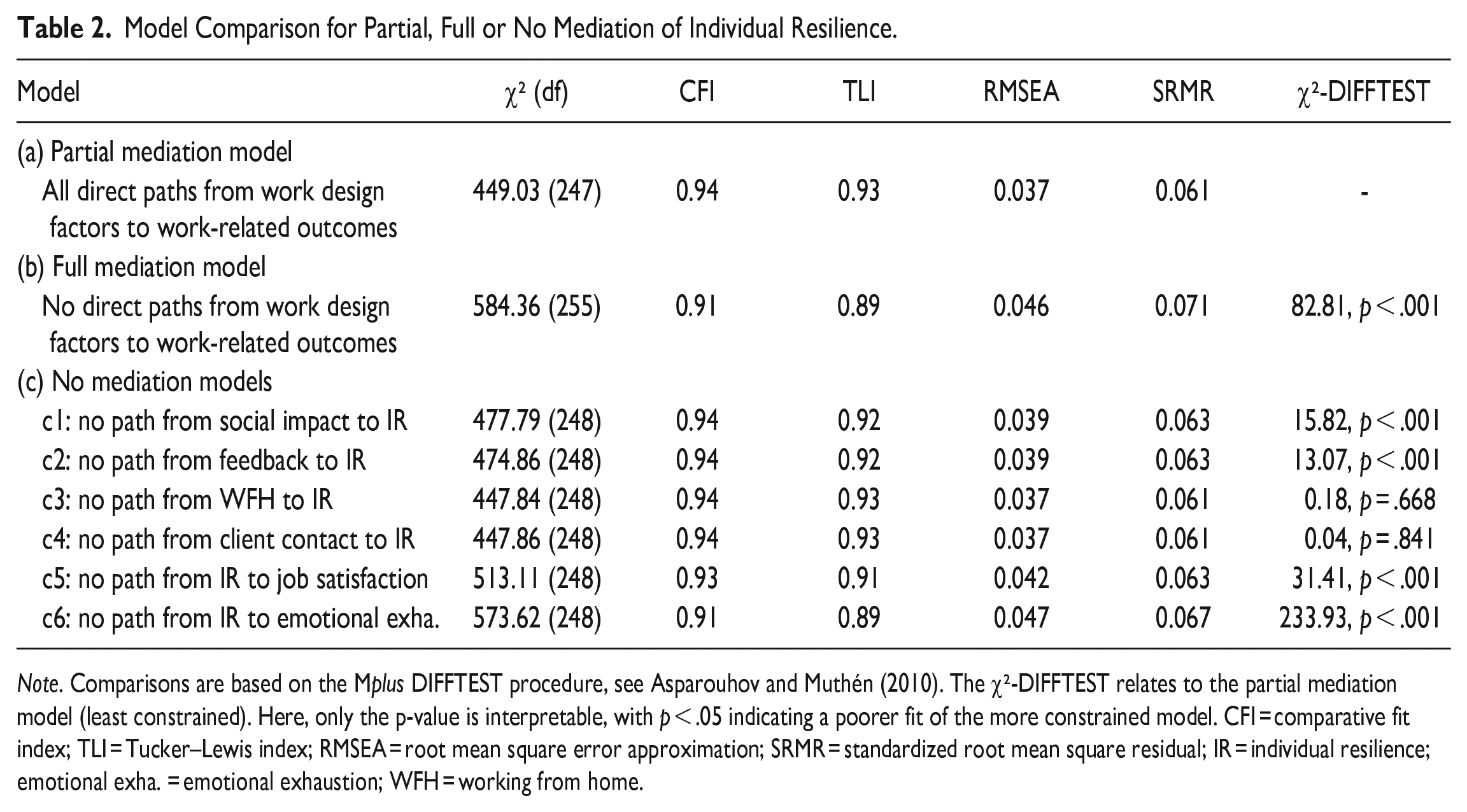
Note. Comparisons are based on the Mplus DIFFTEST procedure, see Asparouhov and Muthén (2010). The χ²-DIFFTEST relates to the partial mediation model (least constrained). Here, only the p-value is interpretable, with p < .05 indicating a poorer fit of the more constrained model. CFI = comparative fit index; TLI = Tucker–Lewis index; RMSEA = root mean square error approximation; SRMR = standardized root mean square residual; IR = individual resilience; emotional exha. = emotional exhaustion; WFH = working from home.
Bootstrap Results for Direct and Indirect Effects With 95% Confidence Interval (n = 602).

Note. Bias-corrected (BC) bootstrap (5,000 subsamples). Standardized effects are shown. Values in parentheses display 95% confidence interval. Bold numbers display significant coefficients. . WFH = working from home; Manag. resp. = managerial responsibility.
There are indirect effects of social impact and feedback on both outcomes. Thus, individual resilience mediates the positive relationship between social impact and job satisfaction (0.049, CI [0.019, 0.090]) and the negative relationship between social impact and emotional exhaustion (−0.090, CI [−0.155, −0.035]). In addition, individual resilience mediates the positive relationship between feedback and job satisfaction (0.048, CI [0.018, 0.092]) and the negative relationship between feedback and emotional exhaustion (−0.088, CI [−0.151, −0.031]). The results showed no significant indirect effects of WFH and client contact. In sum, we found supporting evidence for our mediation hypotheses H5a and H5b, but not for hypotheses H5c and H5d.
In line with the better fit of the partial mediation model, the work design factors had several direct effects alongside. These exploratory results revealed favorable direct effects of feedback on job satisfaction (0.231, CI [0.119, 0.331]) and emotional exhaustion (−0.185, CI [−0.285, −0.078]) as well as unfavorable direct effects of client contact on job satisfaction (−0.101, CI [−0.185, −0.035]) and emotional exhaustion (0.111, CI [0.049, 0.186]). Social impact showed a positive direct effect on job satisfaction (0.159, CI [0.056, 0.275]). However, besides the indirect effect of social impact on emotional exhaustion, no direct effect was found, indicating an indirect-only relationship (via individual resilience).
Discussion
Work design researchers have been called to consider new factors, mechanisms, and occupational contexts through integrative models (Parker et al., 2017). The present study follows this call as we consider individual resilience at the heart of work design in a context of adversity. We investigate (1) the relationship between various work design factors and individual resilience, (2) the relationship between individual resilience and different work-related outcomes, and (3) the role of individual resilience as a mediator.
The study offers several contributions. First, it expands on studies that consider resilience as crucial in work design (Kuntz et al., 2017; Xanthopoulou et al., 2007), but focuses on an occupational context of adversity. Beyond this, the study contributes to the limited evidence on the mediating role of individual resilience (Crane & Searle, 2016; Hartmann et al., 2020; Malik & Garg, 2020; Meneghel, Borgogni et al., 2016). Second, it contributes to the field of child and youth welfare, where positive management approaches to resilience are increasingly pursued (McFadden et al., 2015; Russ et al., 2020; Truter et al., 2016). Third, alongside the pioneering research on employee resilience in public administration (Franken et al., 2020; Plimmer et al., 2022), this study advances the topic by introducing a conventional resilience view that seems particularly apposite at the street-level. Finally, our study adds to the HRM literature that moves away from individual deficits toward contextual and strengths-based approaches (Brunetto et al., 2020; Russ et al., 2020; van Woerkom et al., 2016).
According to the research questions, our analysis reveals three main results. First, we discover a relationship between work design factors and individual resilience. Social impact and feedback (core work design factors) are positively related to individual resilience. However, no significant relationship between WFH or client contact (interpersonal work design factors) and individual resilience is revealed. This may lead to the conclusion that individual resilience is affected by factors relating to the nature of the work itself (Kossek & Perrigino, 2016) and not by factors related to the mode or environment in which this work is performed (Borst et al., 2019). This is remarkable given the broad evidence that points to the importance of the social environment and relational aspects for enhancing individual resilience (Hartmann et al., 2020; Kuntz et al., 2017; McFadden et al., 2015; Plimmer et al., 2022). Possible explanations for these divergent findings lie in the profound changes and reorganization due to the COVID-19 pandemic (Barrero et al., 2021; Kniffin et al., 2021; Wang et al., 2021). We assumed WFH would have an unfavorable impact on individual resilience (Crane & Searle, 2016), as it mitigates the quality of positive social aspects of the workplace and the intensity of adversity through changed interface with colleagues or clients (Jentsch & Schnock, 2020; Mele et al., 2021). This could happen to such an extent (e.g., full mediation) that no apparent relationship remains.
Even more complex is an understanding of remote work as a work design context in itself rather than as an independent variable (Wang et al., 2021). Consequently, concepts, meanings, and relationships per se can vary in such a context (Johns, 2006). WFH may not have been a hindering job demand under the circumstances of this crisis. Instead, it may have been the only and irreplaceable way to perform the job. The missing link of client contact (i.e., the job’s opportunities to interact with clients (Grant, 2008)) and individual resilience may be related to this issue. In the context of the pandemic, with state-enforced or self-initiated contact restrictions intended to protect the society, clients, or oneself, these “opportunities to interact” may vary substantially in their meaning and effects. Recent child and youth protection research suggests an ambivalent meaning in this context, in which client contact is simultaneously marked by avoidance due to self-protection and approach due to client protection (Jentsch & Gerber, 2022; Møller, 2021). The accompanying (perceived) dissonance may have caused that client contact in this study shows direct unfavorable relationships with both work-related outcomes, but none with individual resilience.
Second, our study reveals a relationship between individual resilience and both work-related outcomes. In brief, individual resilience relates to higher job satisfaction and lower emotional exhaustion. This is consistent with resilience theory, which suggests that increased favorable outcomes (as demonstrations of positive adaptation) arise from increased individual resilience (Fisher et al., 2019; Luthar et al., 2000; Masten, 2001) and with COR theory, which characterizes individual resilience as a personal resource employed to cope with adversity and to achieve favorable outcomes (Hobfoll, 1989, 2001, 2002). Furthermore, the results confirm prior findings on the relationship between individual resilience and job satisfaction (Badran & Youssef-Morgan, 2015; Hudgins, 2016; Meneghel, Borgogni et al., 2016) and emotional exhaustion (Anasori et al., 2020; Harker et al., 2016; Shoss et al., 2018; C. P. West et al., 2020) in a fairly unexplored context. Individual resilience does not play an upholding role in the paradoxical co-existence of high job satisfaction and high emotional exhaustion (Stalker et al., 2007), as it increases job satisfaction and decreases the emotional exhaustion. Overall, the results highlight the great importance of individual resilience for work design, as it is favorably related to attitudinal and desirable outcomes (job satisfaction) and avoidable outcomes concering well-being (emotional exhaustion) at the same time.
Third, individual resilience acts as a mediator. We assumed that a favorable indirect effect of work design on work-related outcomes occurs only when individual resilience is enhanced through job resources or challenging job demands (Crane & Searle, 2016; Xanthopoulou et al., 2007). This assumption is supported for social impact and feedback. Through individual resilience, social impact relates to higher job satisfaction and lower emotional exhaustion. Regarding emotional exhaustion, this happens to be an indirect-only relationship. Therefore, we can assume that individual resilience may have played a decisive role regarding the mixed evidence on the relationship of social impact and burnout (Caldas et al., 2021; Grant & Campbell, 2007; van Loon et al., 2015). Feedback reveals the same favorable indirect effects for both work-related outcomes. In sum, the results aligned with the COR (Hobfoll, 1989, 2001, 2002) and JD-R theory (Bakker & Demerouti, 2017; Xanthopoulou et al., 2007). Accordingly, individual resilience ensures favorable work-related outcomes by acquiring resources from the environment. Since neither WFH nor client contact is directly related to individual resilience, there are no indirect effects. As previously described, we suspect that these results are associated with the exceptional context of the pandemic.
Practical Implications
The key point is that work design plays an important role in street-level public services during crises, where resilient workforces are crucial alongside motivated ones. The study offers several recommendations for managers of these public services. First, because individual resilience is related to less burnout, it is essential for operational human capacity and the preservation of human resources. Moreover, it is related to higher job satisfaction, which is one of the most important predictors of individual and organizational performance (Cantarelli et al., 2016; Faragher et al., 2013). Therefore, HRM is advised to deploy effective resilience-building programs (IJntema et al., 2019; Vanhove et al., 2016). Second, individual resilience may be positively stimulated through social impact and feedback measures, leading to favorable work-related outcomes. One easy and cost-effective way to achieve this is to highlight the very nature of the work by providing information, signals, or cues about how, where, to whom, and the degree to which public servants can make a positive difference. Third, transforming the setting in which these public services are performed (i.e., WFH or client contact) seems to be a “minor issue” for individual resilience and other observed outcomes—at least in times of crisis. Despite the demanding changes for public servants, we recommend that transformations in work design continue to be implemented where they appear to be necessary, efficient, or reasonable. However, this should be done with caution and consideration, as there might be (hidden) negative consequences for servants and clients (Mele et al., 2021).
Limitations and Future Research
This study is not without limitations. First, the context and the specific sample should be considered while interpreting the results. Although all German youth welfare offices were addressed, this is a convenience sample. Thus, generalizability and managerial applicability are limited. However, surveying the issues and challenges that public servants currently face is crucial in response to the ongoing COVID-19 pandemic (Schuster et al., 2020). Moreover, generalizability requires replication. For this reason, we encourage future research to investigate individual resilience and work design among different street-level professions or in other countries. Second, this study follows a cross-sectional research design, whereby causality cannot be established. Although cross-sectional research is appropriate for relatively unexplored contexts and relationships (Spector, 2019), future research should also implement longitudinal designs. This applies in particular to the temporal issues of resilience (Fisher et al., 2019) and to the reciprocity of personal resources and job resources (Xanthopoulou et al., 2009). The latter belongs to the bottom-up perspective of work design, which is not the focus of this study, but offers important avenues for further investigation. For example, it is quite possible that individual resilience (re)shapes the examined work design factors through mechanisms such as job crafting or self-undermining (Bakker & Demerouti, 2017). Third, although we followed the recommended safeguards and found no major signs of CMV (George & Pandey, 2017; Podsakoff et al., 2003), the use of only one data source and self-reported data might still include bias. Future research may yield improvements through the use of multiple data sources (e.g., clients or colleagues) and observable data (e.g., record-based WFH or client contact).
In addition to these methodological points, we urge researchers to further explore the role of individual resilience in work design. In particular, the missing effects of interpersonal work design factors shaped by the pandemic context (such as WFH and client contact) deserve more in-depth investigations. Thereby, future research could explore to what extent these factors show situational and individual differences in meaning and how such differences moderate their relationship to individual resilience. The field of public administration could take a leading position in this research area. Not only does the public sector embed resilience in its institutional design (Hood, 1991), but street-level bureaucracy often represents a workplace of adversity (Lipsky, 2010; Tummers et al., 2015). With its very own personnel reforms and HRM (Leisink & Knies, 2018), and concepts such as red tape (Bozeman & Scott, 1996; Hattke et al., 2020), emotional labor (Guy et al., 2015), public values (Jørgensen & Bozeman, 2007), public service ethic and PSM (Brewer & Selden, 1998; Perry & Wise, 1990), public organizations are especially relevant to the study of work design beyond general motivation.
Conclusion
Today, work is characterized by rapid changes, complexity, high-level demands, and crises. This renders an excessive work design focus on motivational mechanisms or individual deficits insufficient (Parker, 2014; van Woerkom et al., 2016). Work design or HRM scholars ought to consider how individuals can cope with adversity, keep working effectively, and feel satisfied with their jobs. Our study addresses these aspects. It highlights individual resilience and increases understanding of its role as a mechanism between work design factors and outcomes in a work context characterized by high demands and acute or ongoing adversity. Our results show that individual resilience is a powerful human aspect that positively relates to job attitudes and well-being. It is responsive to work design through the core work design factors of social impact and feedback and mediates their impact on the work-related outcomes of job satisfaction and emotional exhaustion in a favorable manner. However, the results also indicate that this mechanism does not apply to the interpersonal work design factors of WFH and client contact. Our model offers viable paths following Parker et al.’s (2017) roadmap to further develop work design theory by considering the mechanism of individual resilience in an apposite context as well as future research avenues by integrating further work design factors or outcomes.
Supplemental Material
sj-docx-1-rop-10.1177_0734371X231162045 – Supplemental material for Individual Resilience at the Heart of Work Design: Public Servants’ Job Satisfaction and Emotional Exhaustion in a Context of Adversity
Supplemental material, sj-docx-1-rop-10.1177_0734371X231162045 for Individual Resilience at the Heart of Work Design: Public Servants’ Job Satisfaction and Emotional Exhaustion in a Context of Adversity by Max Wursthorn, Iris Saliterer and Sanja Korac in Review of Public Personnel Administration
Footnotes
Declaration of Conflicting Interests
The author(s) declared no potential conflicts of interest with respect to the research, authorship, and/or publication of this article.
Funding
The author(s) received no financial support for the research, authorship, and/or publication of this article.

Supplemental Material
Supplemental material for this article is available online.
Author Biographies
References
Supplementary Material
Please find the following supplemental material available below.
For Open Access articles published under a Creative Commons License, all supplemental material carries the same license as the article it is associated with.
For non-Open Access articles published, all supplemental material carries a non-exclusive license, and permission requests for re-use of supplemental material or any part of supplemental material shall be sent directly to the copyright owner as specified in the copyright notice associated with the article.
