



Abstract
Complementing discourse-analytic approaches, we develop C. S. Peirce’s semiotic theory to analyze how racism is enacted and countered in everyday interactions. We examine how the semiotic structure of racist encounters depends on acts of signification that can be deflected and that take shape in the ways actors negotiate interactions in situ. After outlining the semiotic apparatus Peirce pioneered, we trace the dynamic processes of generalization and specification in recorded racist encounters as specific forms of semiotic upshifting and downshifting. We demonstrate how attending to racist encounters and engaging the sociology of race sharpen key assumptions that pragmatist semiotics makes about the structure of signification, as it forces one to examine the interplay of marked and unmarked categories and identities in interaction, and to take the differential power to signify into account in shaping the potential effects of semiotic strategies.
A critical challenge in the study of racism is how to trace invidious forms of generalization—that is, how actors take specific phenotypical identity markers, behaviors, or experiences and make them stand for hierarchically imagined patterns or groups, and how they connect disparate worlds of meaning to assert inferiority and superiority. Generalizations occur throughout the social world (Natanson 1986; Schutz and Luckmann 1973), but they are crucial to the study of prejudice and stigma, encompassing a wide literature on cognition and classification (Fiske and Markus 2012; Massey 2007), framing of social problems (Snow et al. 2014), and labeling theory (Becker 1963; Link and Phelan 2001). Racial conceptualizations (Morning 2009) are not constructed only through processes of generalization: categorizations solder together hierarchical narratives, power structures, and generalizations. And yet, processes of generalization are necessary and constitutive elements of racism, as they are of all forms of prejudice (Allport 1954; Quillian 2006).
Considering the widespread lived experience of racism, however, scholars have paid less attention to the actual interactional work done at the level of meaning-making by individuals who engage in racist action and their targets. Such interaction is more than a place where existing prejudices are instantiated. Even under the threat of violence, generalizing ethnic, racial, gender, or other identity markers is not an interpretive result that automatically “sticks” based on pregiven cognitive categories, but a sign that can to some extent be deflected or resisted, and that takes shape in the ways actors negotiate interactions in situ. As conversation analysts have noted, membership categorizations are interactional accomplishments (e.g., Sacks 1995; Whitehead 2009). Moreover, understanding generalization as a mode of signification allows us to appreciate its inverse: despite important work on resisting stereotypes and social typecasting (Davis 1961; Lamont 2018; Lamont and Fleming 2005), scholars take the generalization of experience and groups as the phenomenon in need of explaining, largely overlooking the fact that in an already-social world, the opposite act of specification is no less collectively produced and negotiated.
We develop C. S. Peirce’s pragmatist semiotic categories as a generative analytic strategy to show how generalization and specification are produced. We focus on racist encounters—the marking of people as inferior or superior based on perceived phenotypical differences—to flesh out these processes. Using ethnographic work and illustrative recordings of racist rants, we complement the rich literature on the discursive formation of racism (Bonilla-Silva 2014; Morning 2009; van Dijk 1992) to demonstrate that a focus on actors’ meaning-making processes can help specify the social-semiotic mechanisms of racist categorization during interactions. We also draw on the race literature to show the limits of a semiotic approach that brackets preexisting institutionalized and situational power advantages.
After outlining Peirce’s semiotic categories and some of their modern-day developments, we make two complementary arguments: approaching racist encounters through semiotics lenses is a generative approach, and incorporating key insights from race scholarship to semiotics deepens and specifies semiotic analysis in crucial ways. First, we show how differences in the semiotic modes of generalization and specification differentiate unfolding interactional dynamics of racist encounters and their consequences. Complementing studies that emphasize generalization as a constitutive aspect of how prejudice is performed, we then demonstrate that attention to semiotic contestations allows us to see more clearly the equally social importance of what we call, following Peirce scholar Richard Parmentier (1994), “downshifting”—the process of making signs more indexical and specific rather than more general as a means to counter racism. Second, our analysis shows that the success of semiotic mechanisms depends, to a large degree, on preexisting power relationships and institutional resources. Different patterns of meaning-making in which actors rely on downshifting and upshifting in interaction depend on who does racism and to what institutional ends. Additionally, the relationship between marked and unmarked identity categories, developed in critical race theory and studies of whiteness but largely overlooked in pragmatist semiotics, is crucial for explaining how actors invoke cultural resources to defend themselves in racist encounters.
The pragmatist semiotic model thus allows us to closely trace how racial conceptualizations operate at an interactional level, getting us closer to the microdynamics of prejudice and what Morning (2009:1167) terms processes of racial conceptualization—notions of “what race is, [and] how racial groups differ.” More generally, we show the practical purchase of Peirce’s semiotic categories—a theoretical tool sociologists have largely ignored (but see Halton 1986; Menchik and Tian 2008; Timmermans 2017; Wiley 1994)—as well as further develop how semiotic modalities of upshifting and downshifting operate and are modulated by structural and discursive power (Reed 2013). Attending to the sociology of race propels us to deepen some of the assumptions of pragmatist semiotics.
An Outline of Pragmatist Semiotics
Sociology is in the midst of a pragmatist revival that engages its robust antireductionist theory of action, creativity, and habit (e.g., Gross 2009; Joas 1993; Reed 2011; Swedberg 2014; Tavory and Timmermans 2014; Whitford 2002). Focusing primarily on the thought of Dewey and Mead, however, relatively few sociologists have engaged Peirce’s theory of meaning—pragmatism’s most sophisticated and well-developed theory of signification (Halton 1986; Menchik and Tian 2008; Timmermans 2017; Wiley 1994). The fundamental purpose of such pragmatist semiotics is to understand how signification is achieved in an ongoing stream of activity. In contrast to the later division of the sign into signifier and signified (Saussure [1919] 1986), 1 Peirce devised a threefold semiotic partition.
In Pierce’s account, meaning-making consists of three interlinked parts. The first element is the sign—whether an arbitrary convention or a characteristic that is more intimately tied to the object. A sign points to some aspect of an object (e.g., its color, its “coolness,” its role). The sign does not exist on its own but is always in relationship to an object: it signifies or provides meaning about an object. A sign reveals some aspect of an object, and as such it is inevitably partial: it never fully captures the object. The second element is the object, that is, any entity about which a sign signifies—including actual things “out there” in the world (as well as we can know them) or ideas in our head.
Peirce’s most original insight in his tripartite division, however, was that meaning-making is a practical achievement. To capture this point, Peirce argued that every act of meaning-making includes an interpretant—the effect of the sign-object through which any act of meaning-making is completed. Simply put, we cannot talk of meaning-making unless it has some kind of effect upon actors—an emerging understanding, emotion, or action. With the interpretant, Peirce argues that future semiotic chains indicate whether a particular signification had an effect. To understand meaning, we need to follow the sequence of signification. Implicit in this image is the understanding that an interpreter necessarily brings her own habits of thought and action into the situation. We do not puzzle out our world from scratch every time we confront it; rather, we build on ever-developing habits of thought and action to make sense of the situations we face (Mead [1934] 1968).
The three elements of Peirce’s semiotic theory form an irreducible triad. A sign thus stands for, denotes, or represents an object and shapes an interpretant. It can do so, however, in different ways. When a woman hears her dog barking, for instance, she may become alarmed and wonder whether a stranger got into her yard. In this simple example, the barking is the sign, the thing the dog is barking at is the object, and the person’s assumption that there may be an intruder, as well as alarm at that prospect, is the interpretant. Following his threefold partition of sign, object, and interpretant, Peirce distinguishes three ways in which signification can work on each of these aspects. We focus first on the differentiation of signification in terms of the sign itself, next on the signification of the way the sign refers to its object, and finally on the relationship of the sign-object to the interpretant.
First, in terms of the sign itself, Peirce differentiated between what he called “tone,” “token,” and “type.” 2 A sign can denote the vague potential of something, an actual and specific thing in the world, or a general set of phenomena. The differentiation between token and type is particularly critical for our analysis. After all, the question of an object concerns what kind of sign it is—whether it signifies a specific and actual occurrence or a class of things. Typification, as an instance of generalization, is the work of turning tokens into types.
Second, Peirce distinguished categories of signs based on how the sign related to an object: icons, indexes, and symbols. An icon refers to its object based on resemblance (e.g., a father says “meow” to teach a baby what noises cats make; the color green for grass; a drawing of a face to signify a person). An index characterizes its object based on a contiguous relationship or, as Peirce put it, “a correspondence in fact” (e.g., a footprint in the snow to whoever went past; a wind vane on top of a house to the wind’s direction; a proper name to a person). Finally, a symbol stands for an object based on conventional reasons, regardless of the likeness or the actual relationship to the object (e.g., the word “horse”; the color black for mourning). Because it is based on convention, any symbol, in Peirce’s account, relies on a habitual (and, we would add, socialized) way of feeling, acting, or thinking (Nöth 2010).
Third, Peirce differentiated three modalities through which the interpretant could be related to the sign. These distinctions are critical for meaning-making because they highlight the active and creative role that an interpreter plays in signification. Much as signs are related to their objects and objects constrain possible signs, the same sign-objects can be taken up by interpretants in different ways. In this view, the interpretant could take an iconic sign as iconic (a modality Pierce called a rheme), as in the way a selfie picture is usually viewed as saying something about the person who took the self-portrait. An indexical sign, however, could also be enacted as an index (a dicent). For example, a wind vane indicating the direction of the wind (an index) can be understood in an indexical modality, but it can also be taken as a rheme if we focus on its gaudiness. In the latter case, something structured as a specific, contiguous relationship is taken up iconically. Similarly, a symbol could be understood as a rheme, a dicent, or a symbol (an argument). A U.S. flag flying at half-staff will likely stand for mourning, shared loss, and patriotism, but it can also be interpreted as indexing the wind direction (a dicent) or as a piece of beaten cloth (a rheme). Thus, the interpretant is part of the “play” of signification—it can align with the sign-object in a straightforward fashion (an icon as rheme, an index as dicent, a symbol as argument), but it can also creatively make it more or less general. 3
Across all three trichotomies, the different categories of signification range from low to high generality and conventionality (see Table 1). The triads offer a flexible framework to situate an act of meaning-making across various dimensions and over time as it unfolds interactionally. To continue with the dog example, when the woman walking her dog notices that the animal seems to lag on the leash, she may ask the dog to step up. This interaction can be characterized as a token (it is a singular instance of noticing the dog slowing down) or indexical (the dog pulling is contiguous to it wanting to continue sniffing a pole), resulting in a dicent interpretant (the owner’s request to keep up the pace). When, after the walk, the woman notices the dog is not interested in food and seems listless, she may conclude that the dog is out of sorts. The semiotics have shifted to a type of behavior, and while it is still indexical, it may lead to a dicent interpretant that the animal is not well. The shift from token to type in this example is highly relevant because it signals the difference between an isolated instance and a generalized abstraction of the dog’s condition. Specifying these semiotic shifts over time provides a granular way to trace how meaning changes.
Peirce’s Classification of Signification.
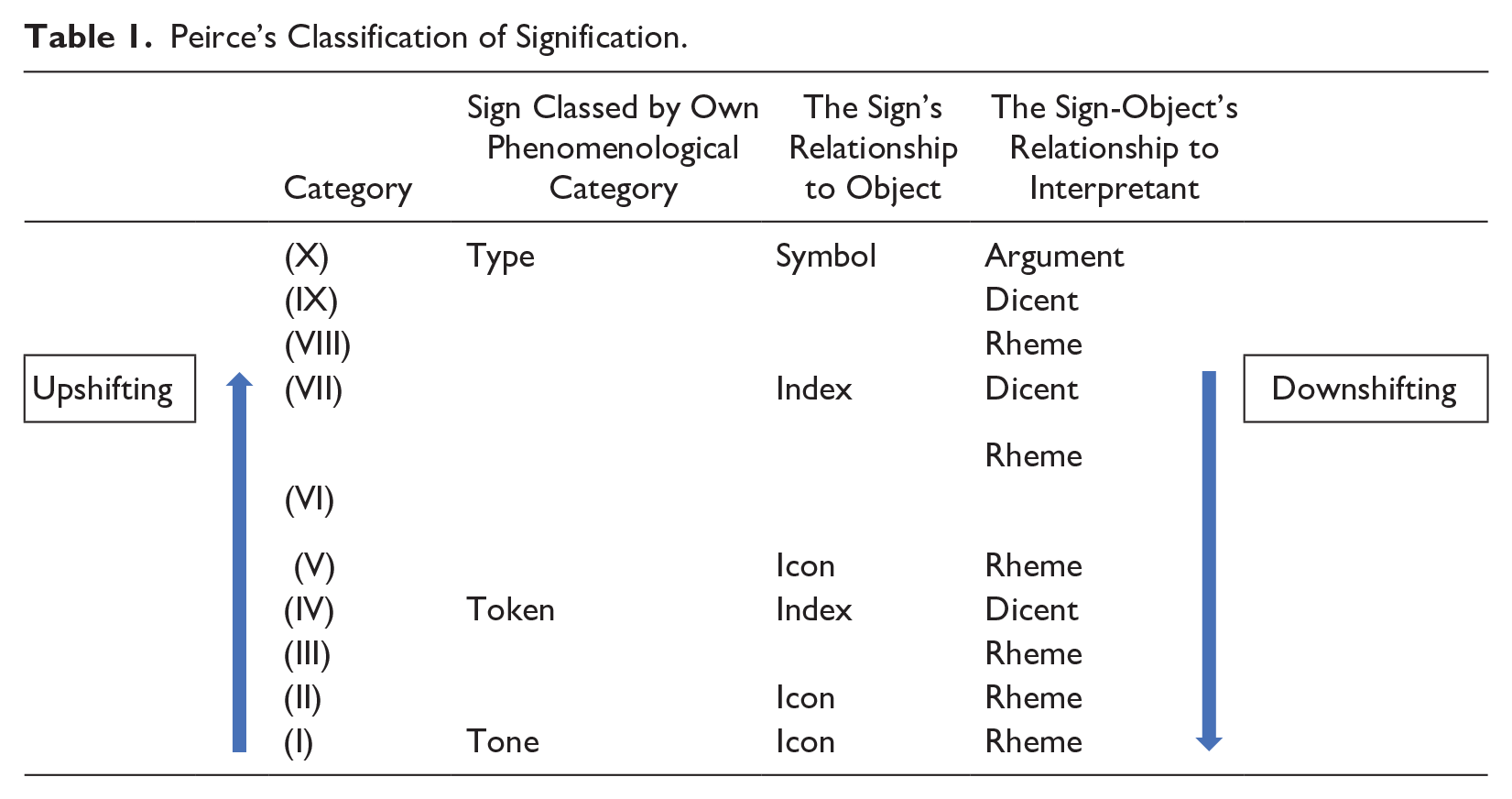
Peirce’s rudimentary semiotic distinctions can be leveraged for analysis of many sociologically relevant questions. Here, we focus on how the ordinal nature of semiotic modalities allows for what Parmentier (1994, 2009) termed “upshifting” or “downshifting” between sign categories over the course of an interaction. As shown in Table 1, combinations of modes of significations range from the least generalized and most imbued with potentiality to the most generalized. Upshifting, then, is a move “up” toward abstraction and generalization, and downshifting is a move “down” toward specificity and potentiality. As we will show, when a statement moves from being a marker of a specific act to become the sign for flawed personhood, it simultaneously moves from token to type, from index increasingly to symbol, and it may produce a rheme rather than a dicent—ending up with an upshifting of the sign (moving from the third category of signification modes to the eighth). Conversely, actors can take a symbol or type and downshift it by making signification more specific—for example, an employee arguing that he came late to work not because he is always tardy but because of traffic on that particular day. In this context, a token-index-dicent statement reflects a factual statement about a specific instance that is understood as such and could be considered neutral ground.
These distinctions may seem highly technical, and Peirce’s language was far from felicitous. Still, as we will show, these distinctions allow us to specify the semiotic mechanism and power dynamics of generalization and specification during racist rants. In that context, it is important to note that Peircean semiotics locates power dynamics within the semiotic context itself and brackets institutionalized power differences and resource inequities. As Parmentier (2009:145) noted, “anyone who manipulates or regiments the flow of interpretants thereby indexes social power.” This allows scholars to marshal semiotic insights for nonhuman actions (Kohn 2007) but, as we show drawing from the sociology of race, it tends to flatten and distort the process of meaning-making when actors have institutionalized and situational power advantages. Paying careful attention to preexisting power differences actually gives us additional analytic leverage to examine how up- and downshifting varies by social location.
Racist Encounters
As an especially poignant case, this article focuses on racist encounters—an important site in which racist conceptualizations are constructed and performed. A primary instance of racism at the interactional level, racist encounters are moments in which specific forms of prejudice based on perceived phenotypical differences are enacted (Banton 1967; Bonilla-Silva 2014; Emirbayer and Desmond 2015; Essed 1991; Feagin 2010; Mueller 2020; Omi and Winant 2015; Tilly 1998). To gain analytic leverage on these processes at the most abstract level, sociologists point toward the categorization and generalization tied to enactment of prejudice and discrimination (Bowker and Star 1999; Feagin 2010; Morning 2011; Wacquant 1997). Through these processes, everyday racist encounters are critical in cultivating and perpetuating unequal differentiation (Eliasoph 1999; Rawls 2000).
If categorization and generalization are critical modes of boundary maintenance and social closure, resisting these processes may require finding a common humanity or asserting specificity. Even when people targeted in racist encounters do not internalize their categorization, they still have to deal with the sweeping cultural and structural consequences of these labels (Collins 1990; Omi and Winant 2015). Thus, as a counterpart to the focus on generalization and categorization, researchers have paid attention to the social dynamics of resisting generalizations, racial or otherwise. Goffman’s (1963) classic analysis of passing and covering as stigma management strategies shows that people proactively aim to avoid confrontations with “normals” that may require an assessment of categorical differences. Similarly, Snow and Anderson (1987) observed how individuals engage in positive “identity talk” to disarm negative class-based stereotypes, and Thoits (2011) outlines how such attempts occur through confrontational challenges or deflections of stereotypes (see also Feagin and Sikes 1995; Lamont and Fleming 2005).
Some of the best interactional work on race similarly focuses on the consequences of living through categorical discrimination. The micro-sociological analysis of racist encounters in the U.S. context harkens to Du Bois’s ([1903] 1994) analysis of the lived cost of double-consciousness and subsequent role-taking cultivated by living in a racist society (see also Hunter 2013; Itzigsohn and Brown 2015; Jones 2015; Morris 2015). Du Bois was clear that the racial veil prevents recognition of the humanity of racialized groups, but racialized individuals could exert their agency through self-assertion, rebellion, self-segregation, and assimilation (Itzigsohn and Brown 2015; Rawls 2000). Thus, another interactionist stream of research shows how members of racialized groups perform race in interactions, as well as sustain solidarity in the face of racism (see also Jones 2017; May and Chaplin 2008; Stuart 2016; Venkatesh 2000).
In the post–civil rights era, sociologists have examined racist discourse ranging along different levels of explicitness. This work has focused on how racism is often denied and obscured, and less attention has been paid to the racist interactional back-and-forth within power relationships. To gain analytic leverage on oblique moments of race talk, sociologists often trace racism through discourse analytic methods, focusing on the structure and thematic content of racist tropes, and how they ebb and flow in writing and talk. In an influential set of writings, based on a discursive analysis of interview and survey data, Bonilla-Silva traces forms of “color-blind racism” (Bonilla-Silva 2014; Bonilla-Silva and Forman 2000; see also Feagin and O’Brien 2004; Schuman et al. 1998; van den Berg, Wetherell, and Houtkoop-Steenstra 2003; van Dijk 1987, 1992). Race talk, in this case, comprises a shared group of linguistic tropes, story lines, interpretive repertoires (Wetherell and Potter 1992), and rhetorical strategies that maintain white dominance by making denigrating generalizations about African Americans and other racial minorities while simultaneously downplaying the role of race and often explicitly denying racism. Other scholars have examined participants’ perceptions of racist encounters and microaggressions (e.g., Cockburn 2007; Evans and Moore 2015; Rengifo and McCallin 2017) and how speakers disaffiliate from racist interpretations (Whitehead 2015).
Complementing the thematic analysis of discourse analysts, we add a level of interactional granularity to the study of the processes of generalization and specification in such situations—the “classic” operations of racism and its resistance. We focus on the moments of “everyday racism” (Eliasoph 1999; Essed 1991; Mueller 2017) that permeate life in the United States; these are stark interpersonal moments in which race colors social interaction. Our analysis develops social mechanisms as “composed of aggregations of actors confronting problem situations and mobilizing more or less habitual responses” (Gross 2009:368), and we specify the causal social problem-solving mechanisms at the semiotic level of meaning creation (Tavory and Timmermans 2013).
Pragmatist semiotics specify mechanisms of everyday racist encounters, but the obverse is also crucial: the careful attention sociologists of race have paid to the intertwining of power and categorization, and especially their focus on how racial categories are differently marked and unmarked (Brekhus 1998; Frankenberg 1993; Matsuda 1991; Moore 2002; Zerubavel 2018), allows us to further push the pragmatist framework. As Moore (2002) shows in an ethnography of interracial interactions in a summer camp, black campers were often made to feel socially inconsequential, even while white campers were categorically unmarked. This invidious duality, where forms of invisibility are socially distributed to opposite effects, is mined in whiteness studies (Frankenberg 1993; Gabriel 1998; Perry 2001) and critical race theory (Matsuda 1991).
As we will show, attending to these aspects of racism deepens our analysis by positing an important challenge for any semiotic approach: how to attend to the role that culturally taken for granted, unmarked, racial categories play in interaction. Integrating marked and unmarked categories within the semiotic perspective, an unmarked racial majority category (e.g., whiteness) partly gains its power from its ambiguity: it simultaneously reflects a type and a token. It is a default classification of a majority group that requires little elaboration about its relevance as the default “general population”—thus making it a social “type.” But the ideological power of the unmarked is precisely in that it hides this typification, as members of an unmarked category are “just people.” In doing so, this process signals individualization as a “token,” in the sense that an unmarked category designates someone as an “average” or “normal” person. Such unmarking is an integral part of the conceptual matrix of racial domination, but this ambiguity can also be marshaled as a resource for attempts to resist prejudice in racist encounters.
Method
The primary social form we are interested in is one in which someone uses racial identity markers to provoke a set of broader negative associations. In semiotic terms, such incidents involve a contestation over different modes of signification. A semiotic relationship that for one party is token-indexical (a specific person going about their life) is turned by the other into an increasingly symbolic and general form of signification (a kind of person associated with negative characteristics)—a transformation the first party may actively resist. The semiotic outcome thus depends on whether and how the recasting will prevail as the operational definition of the situation.
We explore the semiotic mechanisms of upshifting and downshifting to explain the constraints in successfully signifying a situation. As we show, both upshifting and downshifting are collectively produced and are consequential for unfolding action. Anticipating the criticism that interactional analyses are often oblivious to preexisting power relationships, we further explore how actors backed by institutional and organizational power are more likely than others to prevail in downshifting over the course of interactions. Actors who have recourse to institutional semiotic resources, which anchor power, may use various semiotic mechanisms of downshifting to settle the definition of a situation. Other actors, with recourse to fewer resources, may need to rely on more fragile semiotic solutions to undermine prevailing interpretations. Semiotically, one important modality of social power is the ability to successfully up- or downshift signification in light of countervailing meanings to either precisely frame a problematic situation or to undermine a plausible prevailing interpretation. Thus, we connect semiotic questions to questions about symbolic power (Bourdieu 1991)—who can say what, and to what effect.
We demonstrate the added value of such a pragmatist semiotic analysis with a convenience sample of published ethnographies and publicly available video recordings of real-life situations (n = 54, collected from YouTube, LiveLeak, and Facebook). Both sources of data have limitations. Most importantly, taking a video recording of an interaction adds a dimension to the interaction itself—an imaginary audience that at least some interactants anticipate will see the video. Thus, in some clips, audiences to the racist episode look directly at the camera to nod reproachfully; in other clips, the racists themselves reference the recording or speak directly to the camera. Second, video recordings are taken specifically because such an episode is taking place, so they invariably miss the beginning of the interactional sequence, as well as failing to provide insight into participants’ biographies. Third, all the cases are relatively “strong” episodes of racist encounters—they were noted as racist, then filmed, and then posted on websites such as YouTube with keywords identifying them as racist encounters. Indeed, many of the interactions include expletives and the use of racial slurs. Yet, as we noted, sociologists have documented that much racism is oblique and implicit, marked by discursive telltales (Bonilla-Silva 2014; van Dijk 1992).
These limitations are important to acknowledge (Nassauer and Legewie 2018), but they do not invalidate the findings. First, although the camera is the focus of attention for some actors, the rants often continue unabated, with no indication the racists changed their interactions in relation to the camera. Indeed, people taking the videos are often bystanders who are removed from the interaction (and perhaps take the video precisely because they do not want to directly intervene in the encounter but want to do “something”). Second, because the interactions captured here are extreme, the danger of confusing racism as a category of practice versus a category of analysis (Brubaker 2012) is practically solved. As readers will appreciate, there can be general agreement that these episodes are, in fact, racist (Jackson 2008; Rawls and Duck 2017). Again, our primary analytic aim is to use these naturalistic examples to lay out the different semiotic structures of up- and downshifting and to explore how actors can use these modalities—this mode of analysis specifies and further unpacks notions of categorization and typification. Because of our analytic purpose, we do not generalize from our convenience sample but provide an in-depth analysis of a selection of cases.
We began our analysis by transcribing the recordings and then delineating the sequence of semiotic units: places where additional signs had the potential to change interpretive meanings. In each sequence, we distinguish object, range of signs, and potential interpretants. The subsequent turn or iteration in the semiotic chain reflects how the interpretant became a new sign of meaning-making: meaning becomes apparent through consequences. This is critical because it does not require us to “second-guess” or “pin down” how participants received a sign. We can observe how people act and respond, including if they ignore signs—the interpretant as manifested in the reaction to the sign reveals how the sign was interpreted. This stage of the analysis gives us a picture of the elementary units of evolving semiotic signification. Next, we specified each sign-object-interpretant according to Peirce’s triads. This required us to pay attention to the content of the sign. Comparing changes in, for example, indexicality or typification gives us insight into whether up- and downshifting was occurring and how it occurred. To qualify as up- and downshifting, not all aspects of signification need to change or even change in the same direction: as long as two elements upshift and one downshifts, the result would be upshifting (this matters because, as we will show, one instance of upshifting occurs through rhemization) (Parmentier 1994). Rather, the interaction needs to move from one category of signs to another, over the gamut of the ten categories depicted in Table 1.
Upshifting
Upshifting is not unique to racialized interactions; it is a common and necessary semiotic strategy in everyday life (Natanson 1986; Schutz and Luckmann 1973). Whenever someone abstracts, generalizes, or otherwise derives a broader conclusion from a specific instance, they upshift. Here, we are interested in situations in which a racial identity marker becomes the grounds for a set of generalizing negative associations to stereotype a person or behavior as typical of people of a certain race. Recordings of public racist rants are ubiquitous, and they follow a set of similar semiotic structures.
In an interaction recorded by a bystander, a woman is checking out at a JCPenney’s in Kentucky when another woman joins her and adds several shirts to the checkout. The woman standing next in line, a gray-haired white woman in a blue jacket, engages in a tirade.
4
She begins by yelling that the women should go “back to where they belong” and to the “back of the line,” which, spatially ambivalent, could be indexical because it suggests a specific place in the checkout line, apparent to everyone in the interaction. But, as she continues, the relationship between the specific and the general shifts back and forth within the space of seconds: The woman moves away from the counter. She says for everyone in line to hear: “You are a nobody. Just because you come from another country it doesn’t make you nobody. A nobody. As far as I am concerned. Probably on welfare.” Pointing at the groceries, she adds, “The taxpayers probably paid for all this stuff.” She turns around and talks to the people in line. “It’s true.” She points with her open hand at the two women: “We paid for every bit of that stuff. You know that. Probably all the food they get, and everything else. I am sorry but that’s how I feel.” One of the targeted women turns toward the woman and says: “I feel sorry too.” The woman responds, “That’s OK. You’re in America. Speak English. If you don’t know it, learn it.”
To simply note that the woman generalizes or imposes racist associations on the encounter glosses over the semiotic dynamics that constitute racism. The turn to upshifting becomes clear when the gray-haired woman thoroughly changes the semiotic references that existed only moments earlier and renders queue-jumping symbolic of foreigners taking unfair advantage. This exchange reveals a semiotic mechanism common to upshifting interactions: the woman not only moves from token to type in an act of “typification” or categorization (a particular woman in line becomes “they”), but she turns an everyday indexical reading of a specific apparel-buying practice into an increasingly conventional symbol. She interprets the entire situation as describing the “nature” of “those people” whom she semiotically conjures and thus aims for a rheme interpretant. Upshifting consists here of signifying from a token-indexical-dicent to a type-symbolic-rheme sign.
To unpack these semiotic moves, we can first observe the shift from token to type: the specific woman in front of her becomes an example of a “type” of people. She loses her specificity to become “a foreigner.” Second, and more interesting and revealing, is the ongoing oscillation between index and symbol. Jumping the queue stands for a behavior that signifies increasingly diverse problems with a particular kind of people. It is not only the shopper who loses her specificity, but each act is redescribed in general terms that are conventionally connected to “these kinds of people.” As the woman keeps shouting, each statement she produces becomes an interpretant in the next iteration, and with each iteration the woman moves along the continuum toward a conventionalized understanding of foreign profiteers jumping ahead of her in an imaginary line that has less and less to do with the concrete moment (see Hochschild 2016). Thus, the woman points to concrete evidence that is contiguously related to the object, but this relationship becomes increasingly abstract, so that the cumulative effect of the signs accomplishes symbolization.
Once the woman makes this symbolic move, the associations feed on themselves. The generalization from cutting in line to “nobodies,” to “welfare,” to purchases paid for by “taxpayers,” even to the “food,” are all symbolic elaborations that further upshift the situation. Perhaps the boldest semiotic move occurs as one of the attacked women says, in English, that she is “sorry” for the woman producing the racist tirade. But in the symbolic world constructed, where the here and now become generalizations unmoored from the situation, even this is resignified. The statement “Speak English. If you don’t know it, learn it” constitutes a poignant disjuncture between the observable indexicality of the responding woman’s linguistic interpretant, turned into symbol in the next iteration. The signs are abstractly postulated by playing on a coherent racist trope that equates being foreign-born with laziness and freeloading (Alexander 2006; Hochschild 2016). Once a thin bridge between index and symbolism has been constructed, more than any sensory cue in the interaction, the racist discourse itself becomes the grounds for signification.
Another element of upshifting occurs in the woman’s attempt to involve bystanders in her rant. Her appeal to the audience in line and behind the counter with “we paid for that” and “you know that” upshifts the situation by positioning it as common knowledge, generating a “we” of “[white] tax-paying people” against the (Latina) “takers.” This move turns the audience itself into an unmarked type of “we [white] Americans” who share the same perspective. 5
Finally, upshifting also depends on moving from dicent to rheme. This may seem to go against the grain of the analysis, as a rheme implies an intuitive sign-interpretant relationship. But, as Irvine and Gal (2000) note, it is exactly the intuitive kind implied in a rheme that is powerful in the overall upshifting of signification. Indeed, the semiotic prize the accusing woman is after is not a conventional agreement that the two women are inconsiderate, but a moral assessment of the kind of persons they are. From a semiotic perspective, the compounded effect is an upshifting of the original form of signification—making it more abstract and lawlike. 6
Many other racist rants in our dataset follow a similar upshifting format. Objects that triggered such rants include “road rage” incidents, displays of public affection, perceived disrespect, or simply being out of place. In all these cases, the insults change but the semiotic mechanisms remain. The interpretants escalate with little grounding in any kind of immediately actualized object. These actors do, however, make purposeful associations in which the target’s perceived race and the structure of the situation are deemed sufficient to trigger racism (Silverstein 2005). Importantly, even in the most extreme situations, these associations are not random “crazy” talk by “bad” people. Even as they become increasingly unmoored from the indexical registers, these actors fit within a readily available complex cultural repertoire of racialized expectations. A semiotic pragmatist analysis reveals the semiotic mechanisms of upshifting, distinguishing between different aspects of such upshifting that are usually bundled together under the aegis of generalization.
Downshifting and Unmarked Categories
Faced with the forms of upshifting we have outlined, targeted victims or bystanders may attempt to resignify the situation. In many racist confrontations, people offer only minimal response, they are either too shaken or choose not to engage. But when the targeted victims of such episodes do engage, they can respond through different semiotic registers. Downshifting occurs when people personalize or singularize events, actions, and emotions, leading to a respecification of both the situation and themselves. But, in the case of racist encounters, extracting oneself from one category almost necessarily implies asserting another category. To present themselves as individuals, targeted victims almost necessarily typify themselves as members of a different, unmarked, category.
Thus, in an example we will examine in greater detail in the next section, a white police officer searching a black pedestrian says: “Stay over there. We don’t want you here. All you do is weaken the fucking country.” To which the pedestrian responds: “How am I weakening the country? By working?” Here, the question “by working?” aims to counteract the typification. The mention of his actual employment status introduces a socially valued and productive self-identification into the interaction. It moves the pedestrian from one category to another—that of a productive citizen. But by moving to this unmarked category (Frankenberg 1993; Matsuda 1991), the pedestrian also individualizes himself and downshifts the interaction. Rather than being the “type of person” who freeloads, the victim asserts himself as simultaneously an individual and a “working man.” That is, even as the claim to being a “working man” can be understood as a claim about belonging to a type, the movement to an unmarked type allows the attacked pedestrian to simultaneously present himself as a token—thus downshifting semiotic registers.
This can be seen more clearly in situations in which downshifting occurs explicitly by replacing one type with another. This form of downshifting rests on the claim that the typification is wrong, and therefore the implied associations do not apply: that is, because a “bad” typification is replaced with a “good” typification, the action the racist refers to can only be understood as indexical rather than through a symbolic register. For example, in a video showing a confrontation in a supermarket in Queens, New York, the initiator shouts over and over: “You go back to your green card.” 7 The targeted person shouts back a series of statements: “This is my country. I took an oath to be here. You understand. I took an oath in this country, motherfucker. . . . I am an American. I am a citizen [unintelligible], motherfucker.”
In this instance, the repeated mention of the targeted man’s “Americanness” challenges the construction of him as “other.” Once again, a marked category is replaced by an unmarked one. As the grounds for the racist rant are revoked—the target is just a person in line—the action was indexical rather than symbolic. Again, by moving to an unmarked group, the type-symbolic-rheme is replaced with a type-indexical-dicent, an overall downshifting of the semiotic form.
Another means of downshifting operates reflexively by turning racism itself into a symptom. In the earlier example of the JCPenney rant, one woman standing in line turns to the camera as the racist woman hurls her insult. She raises an eyebrow and twirls her finger at her temples. Although she does not intervene in the racist rant, she signifies—to the person taking the video, and perhaps to its imaginary audiences—that the racist rant indexes mental illness. When one of the Latina women targets responded by saying “I feel sorry too,” also trying to transform the signification-moment, the entire rant becomes itself a sign—signifying the racism or mental instability of the woman producing the rant and effectively categorizing the categorizer (Sacks 1995:45). The semiotic structure of this response is pithy yet quite complex: by making the rant into an indexical symptom, both actions—the rant and the response—are downshifted. If the racist rant is a sign of a troubled person, then the upshifting is retroactively erased, and the everyday token-indexicality of action is reasserted.
Although not an exhaustive list of how countering racism can occur semiotically, downshifting in racist encounters is generally a semiotic move toward humanization and unmarked categorization. Rather than being a member of a marked type, the targeted victims assert they are “regular,” unmarked people going about their business. “Regular people” is itself a category that needs to be sustained in interaction (Sacks 1979), but such a move allows targets of racism to invoke an indexical register.
Finally, multiple semiotic mechanisms achieve such downshifting, but these examples also point to some of the challenges of downshifting when confronted with upshifting. In all three instances, anything the targeted person states is ignored or taken as further semiotic ammunition. An intended token or alternative type fuels further typification, and indexical sign-object relationships accelerate further symbolization. Downshifting and upshifting both appeal to broader cultural discourses, but downshifting is semiotically more difficult to pull off. As Goffman (1963) pointed out in a similar context, countering upshifting necessarily rests on the acknowledgment that a stereotype already exists. Downshifting, however, involves a double move: acknowledging, if implicitly, the underlying logic of upshifting even as one challenges the generalization. This can be seen most clearly in the move to the unmarked category we described—actors resist the racist upshifting of the situation through an implicit acknowledgment of the connotations of marked and unmarked categories. Upshifting, in contrast, feeds unencumbered into a cultural discourse, giving license to pile up more of the same symbolization, taking the slightest aspect of a situation as a prompt for generalization. Countering racism should be easy in an evidentiary world, but not in a world where signification is unencumbered by evidence.
Institutional Power and Up- and Downshifting
It is tempting to view downshifting as inherently a resistance strategy: a weapon of the weak to disarm and challenge stereotyping (Davis 1961; Lamont and Fleming 2005). However, as race theorists have poignantly pointed out (if in different terms), it matters greatly who downshifts, and when. Downshifting may also be an effective tool of the powerful to define situations. Building on the semiotic mechanisms of downshifting and upshifting, we focus on two interactions: one in which downshifting constitutes a reaction to the provocation of upshifting, and a second in which both parties downshift. Our examples so far have concerned up- and downshifting of racist confrontations between strangers who are, at least institutionally, social equals. We now want to highlight the ability of semiotic strategies to preserve and enact institutionalized power by contrasting the power difference between parties. Therefore, we turn to instances where police downshift in response to upshifting from community members, and then a situation where community members downshift when confronted with police officers’ upshifting. Our goal is to demonstrate that who does the upshifting-downshifting matters because institutionalized power changes the dynamic of downshifting—the relationship between the discursive and the structurally embedded forms of power (Reed 2013). When wielded by the powerful, downshifting becomes an effective semiotic move to justify discrimination.
We start with a typical racist situation where police officers upshift and their targets downshift, but the targets have mixed success in redefining the situation. As part of a stop-and-frisk policy, two white police officers stop two African American male pedestrians walking in Philadelphia, ostensibly because one of them greeted a suspected drug seller sitting on the sidewalk. The other pedestrian recorded his interaction with the officer, identified later as Philip Nace; the pedestrian put his phone in his pocket, so we have audio but little visual information for most of the interaction. 8 Already in the first turns of the interaction (not shown), Nace threatens to “split your wig open” if the pedestrian does not cooperate The pedestrian tries to downshift the interaction multiple times, which the officer uses as fuel for further upshifting:
What are you doing in fucking Philadelphia? Stay in New Jersey.
I have family here.
Stay over there. We don’t want you here. All you do is weaken the fucking country.
How am I weakening the country? By working?
No. Freeloading.
Freeloading off what? <radio static in background> [said softly] Freeloading, that hurt.
Do you. Doing what?
At the cross-country club.
Doing what?
I am a server.
A server? Serving weed?
Nace asks the pedestrian why he is in Philadelphia. The pedestrian answers this token-index-dicent question with a socially acceptable answer, pointing to his family who live in the neighborhood. This could have been a neutral move as it also constitutes a token-index-dicent conversational turn, but Nace ignores the answer and upshifts the interaction to a type-symbol-rheme by stating that the pedestrian is the kind of person who weakens the country. Using the vagueness of the pronomial “you” (Wagner-Pacifici 2010) to move from the singular to what appears to be the plural (in the sense of “you people”), Nace upshifts signification in mid-sentence.
The pedestrian again tries to downshift by inserting an indexical piece of information about working. As we noted earlier, asserting that he works is located between a type and a token—presenting himself as “working” positions him as a productive member of society and thus obliquely places him into a type. Yet, because this is an unmarked type, it allows him to turn his actions back to an indexical register. Nace ignores this, however, and simply asserts that he (and implicitly “his kind”) is a “freeloader.” Where the pedestrian signified the working comment as a token-index-dicent, Nace’s lack of acknowledgment leaves the interpretant ambivalent. Later, Nace seems to redirect the conversation back to indexical grounds when asking what work the pedestrian does, which could imply that the reference to working had its intended downshifting effect. Not so. The response will again be used as a prompt for upshifting. Latching onto the word “serving,” Nace produces another stereotypical typification of a black man selling drugs (type-symbolic-dicent). Much like the white woman in JCPenney who turns a response in English into a rant about immigrants needing to learn to speak English, any turn of talk becomes yet another resource for upshifting.
The Philadelphia example contains the common form of upshifting where responses fuel further generalization. The pedestrian repeatedly aims to downshift by asserting an unmarked categorical membership, which provides for both tokenness and indexicality as an employed person with family in the neighborhood. Downshifting seems a losing strategy, however, when an official with legal authority uses every utterance to symbolically fill in a devalued racial stereotype, and when the threat to “split your wig open” looms over each turn of talk.
Yet, the interaction of structural power relations with semiotic strategies can also lead to predictable reversals. In an ethnography of policing skid row in Los Angeles, Stuart (2011, 2016) joined a grassroots community organization that followed police officers with video cameras while they arrested people on the street as part of a crackdown on “lifestyle infractions.” The organization’s goal was to gather video evidence of systematic police abuse against impoverished citizens of color to create a set that would locate each instance as a type. To limit the interpretive flexibility of police officers’ post-factum narration, community activists asked officers to comment on their actions in front of the camera. Through their questions, activists pointed to specific instances caught on tape to generalize a broader picture of police abuse. Police, in turn, tried to downshift signification by claiming a token-indexical-dicent character for their actions. This dynamic is seen when the community organization confronts police officers involved in searching and frisking a black man spread out against a wall: One of the cameramen immediately moves over to the officers and launches a barrage of questions in their direction. “Why did you handcuff and search that innocent man? Is that how you treat everyone in downtown? Do you like harassing homeless black people?” Without hesitation one of the officers responds, “He was jaywalking in a high crime area. He might have been a drug dealer or might be a parole violator. We couldn’t tell until we put him against the wall first.” (Stuart 2011:329)
This sequence starts with a type-symbolic-dicent move. Seeing the search, the cameraman first holds that the person is “innocent”—the arrest cannot be explained away as resulting from a specific indexical action. Having prepared the ground, in the following two utterances, the cameraman further upshifts the action to a symbolic type, first to “everyone in downtown” and then to “homeless black people.” In response, the police officer is quick to downshift. By interjecting that the person was jaywalking in a high crime area, the officer explicitly downshifts the action into a token-indexical-dicent form. This specific person was jaywalking, and thus justifiably subjected to a search. The question is not of types, but of a specific person, who through suspicious behavior (itself a type-indexical-rheme) signals he may be a potential “drug dealer” or “parole violator.” The officer easily taps into a pregiven, and indexical, rationale for law enforcement behavior.
Juxtaposing a situation in which police officers downshift after being challenged by upshifting with a situation in which a pedestrian downshifts after a police officer’s upshifting challenge shows it is not only how actors semiotically recast their world that matters, but also who does the recasting. As Bourdieu (1991) noted in reaction to speech act theory (Austin 1962; Searle 1969), although some actions facilitate world-changing (e.g., “I now pronounce you husband and wife”), the ability to produce a change in the world through language is not equally distributed. One must be an ordained religious leader or government official for this particular utterance to have a practical effect in most U.S. states. The cameraman in Stuart’s vignette can protest the search and upshift the situation, but he has limited capacity to directly shape desired interpretants. Semiotic problem solving is intimately connected to the power to signify.
Yet, the semiotic approach developed here goes deeper than the Bourdieusian point regarding symbolic power. The unequal distribution of symbolic power relates to the semiotic resources actors can mobilize to cement a specific mode of signification. The differential effects of downshifting are critical: the pedestrian tried to downshift a potentially dangerous racist encounter, whereas the police officer confronted by community activists justified racial profiling by defining his actions as professionally appropriate. Even if the link to crime is tenuous (as it would be in jaywalking), when used by police this particular form of downshifting facilitates discrimination and profiling. The police are able to recast this situation from “harassing homeless black people” to being about legally sanctioned interventions prompted by token-indexical observable behavior. It is here that the evidentiary unmoored structure of upshifting that we discussed earlier changes its valence. As we saw, upshifting is hard to interactionally neutralize, because any act of signification can be turned into a symbol. But in a situation where one party has a monopoly on the legitimate use of violence, downshifting becomes extremely difficult to counter. When the officers point to the specifics of the situation, those who resist them need to recast the indexical ground yet not challenge their power too sharply.
A semiotic analysis shows how repeatedly indexicalizing signification can work as a powerful, and largely invisible, way to sustain systematic racial discrimination. An object resembling a gun, a blown taillight, or jaywalking overpower interpretive multiplicity. In light of officers’ ability to shape the flow of action, to intervene in many everyday situations qualifying as “just cause,” and to draw support from the formal semiotic requirements of arbitration institutions such as courts—that focus on the specifics of the case by institutional mandate—it becomes exponentially harder to confront such episodes in a more generalizable register. Symbolic power may, paradoxically, emerge through the ability to neutralize symbolization and impose an indexical interpretation on a situation. One of the micro-mechanisms through which racial discrimination is sustained is that of patterned downshifting, generating systematically ungeneralized phenomena.
Downshifting and Anticipatory Action
Finally, a pragmatist semiotic analysis further elucidates the way social power works by examining how upshifting and downshifting dovetail on broader structural power dynamics as these are distributed across institutions. One key way is by anticipating future semiotic use. Specific objects within a situation can be used in attempts to downshift to a token-indexical modality. Every social situation necessarily includes unique objects compatible with a broad range of signs, so downshifting through the specifics of a situation is always an available mode of denying any claims for its typical nature. Yet, the particular objects used as grounds for downshifting matter: some objects can be anticipated to lead to successful downshifting, whereas others may lead to weaker signification. Thus, in analyzing these episodes, we need to ask how actors try to anticipate a “correct” mode of signifying the world, and how these modes relate to the affordances of other institutions. To examine the different anticipated futures (Adams, Murphy, and Clarke 2009; Mische 2009; Tavory and Eliasoph 2013), we compare two independent attempts at downshifting regarding the same situation in the same social setting—a press conference that was one of the catalysts for the Black Lives Matter movement.
After community outrage over the killing of a thirteen-year-old black child, Tyre King, by the police in Columbia, Ohio, the chief of police, Kim Jacobs, convened a press conference. Trying to defend the killing of a child who, as in the police shooting of Tamir Rice a year earlier, was found to have had only a toy gun, the chief of police held the conference while holding a large picture of the toy gun:
9
So, we’re sent on an armed robbery last night and the witnesses and the victim say that a gun has been used. We found a gun at the scene near the suspect that we are trying to apprehend and this is what that gun looks like [she picks up a piece of paper with an enlarged picture of the gun and holds it up to the cameras]. In addition to this appearance, it also had a laser light attached to it right underneath the barrel. Our officers carry a gun that looks practically identical to this weapon. Our officers carry a flash light under the barrel of their weapons, not a laser light. This is not the weapon, this is an exact replica of the weapon that we have found at the scene last night. It turns out not to be a firearm in the sense that it fires real bullets but as you can see it looks like a firearm that could kill you.
10
Every statement is crafted to lay the groundwork for justifiable police action. The police chief is focused on moving the interpretation of events toward token-indexicality. Witnesses’ and the victims’ testimonial to use of a gun, the presence of the gun near the suspect, and the toy’s resemblance to a real gun reduce the entire interaction to the object of the gun. Thus, using an icon of an icon—the picture an icon of the toy gun, and the toy gun an icon of an actual gun—the police chief signifies the indexicality of the event. The shooting of a child holding such a gun, the police chief says in effect, cannot be a typical event, an instance of police profiling of black children. This press conference is not a reaction to a direct attempt at upshifting by community members (even though the community had been roiled by protests against police killings), but its performance is aimed at implicitly countering the act as police brutality, killing of a child, and racial profiling. Importantly, it works by insisting that what might be construed as a typical event is specific precisely by focusing on the relationship between sign and object—by mobilizing an icon.
In response, Tyre King’s family and the family of Henry Green, another young black man shot by an undercover police officer only months earlier in the same community, organized a press conference at the Urban League where they called for an independent investigation. Their downshifting takes what is now a familiar form: they present Tyre as both a token and an unmarked type. Against a backdrop of family members holding collages with pictures of Tyre and Henry, Tyre’s grandmother takes the microphone: I am here to let you know what Tyre was about. I called him my little crumb snatcher. My daughter has three children: two girls and Tyre. . . . Tyre was a mama’s boy, not in a bad way. Tyre was a protector of his mother. Tyre would not leave her. If she left the room, he was dead on her tracks. When he started school, they had a little issue with him because he did not want her to leave. He was crying and she was crying. As he grew, Tyre had lots of interests in many things. He was very talented, a very talented young man with a lot of skills, a lot of abilities. . . . The last time I saw Tyre was on the 12th. . . . He gave me my last kiss and told me “bye, bye Momma, I love you.” I thank God for this, that I had my last kiss from my grandson. . . . I know what my grandson meant to his mother and to his sisters. What we want, what we all want is justice for both of our families. This has been going on too long.
11
Where the police chief downshifts the situation by singularly focusing on the gun, Tyre’s grandmother downshifts by situating Tyre in a network of family relationships, pointing out his love for fun and mischievousness and his devotion to family. Tyre’s grandmother simultaneously produces an individualized token and an umarked “normal child,” thus conveying a picture of a loving and loved boy (token/type-indexical-rheme).
In this instance, both parties downshift. But they do so differently, and in anticipation of different outcomes. Tyre’s relatives work in a biographic mode (Timmermans 2005). Their downshifting draws from a memorial service trope where relatives remember the deceased with positive, normalizing, and humanizing anecdotes that focus on the richness of the life that has been lost. Even the picture collages are typical of U.S. memorial services. This exercise in downshifting is mobilized as a way to upshift the context of his killing—“this has been going on too long.” In the biographic framework of his type/token-indexical life, Tyre’s killing had to be a case of discrimination. And yet this character witnessing is weak “evidence,” not only because the deck is stacked against any challenge to the police, but because there remains an unresolved gap between the biographic and the situational indexicality of the context of his death. The grandmother jumps from the last kiss to the funeral service. The space in between remains open to signification.
The police chief, in contrast, constructs a narrow legal mode of downshifting by focusing exclusively on the iconic gun. Regardless of the pattern of shootings in the community and regardless of who pulled the trigger, as long as the replica resembles a real gun, this specific incident qualifies as justifiable police action. Her downshifting requires only a small jump from a bb gun to a real gun, focusing on the physical resemblance of the toy gun to a gun her officers are deeply familiar with. The downshifting hinges on a simple semiotic chain in which the key interpretive step is carefully demonstrated, culminating in the conclusion that the gun “looks like a firearm that could kill you.” The police case anticipates institutions such as the courts, which try cases as specific occurrences, thus aiding the interactional downshifting: the microcosm dovetails on a macrocosm that assigns it its place and boundaries and implies a dense web of interpretants beyond the local interaction (Keane 2003; Silverstein 2003). Semiotically, the police are already playing an institutional game by their own rules. Power, in this instance, relates to actors’ ability to locate themselves semiotically in anticipated institutional futures.
Conclusion
Drawing from pragmatist semiotics, this article unpacks a set of social-semiotic mechanisms through which generalization and specification unfold in racist encounters. Relying on the work of C. S. Peirce, we argue that signification depends on the degree of specificity of the sign itself, how it is related to the actual object in the situation, and how it is taken up in action. This last element, the real-time manifestation of Peirce’s interpretant, opens up opportunities for studying how meaning-making unfolds in interaction—how, from a plethora of possible meanings, a particular mode of signification prevails and becomes the impetus for the next round of signification.
As a core site in which prejudice is enacted, racist encounters are important for understanding how “power, operative in everyday situations, perpetuates ethnic and racial oppression” (Essed 1991:viii). Using discourse analytic tools, race scholars have made important strides in identifying these moments, which are increasingly veiled in color-blind form (Bonilla-Silva 2014; Bonilla-Silva and Forman 2000; van Dijk 1987, 1992). This literature has documented the range of racist manifestations, justifications, underlying ideologies, conceptualizations, and consequences of such discursive formations for self and group, but it is less attuned to how racism is interactionally performed, and to the unfolding dynamics of generalization and specification.
As we show, upshifting is difficult to counter in many racist encounters precisely because its symbolic character is unmoored from its objects. Symbolization, in such a situation, need only relate to broad preexisting racist tropes. Downshifting, in contrast, depends on establishing evidentiary grounds, and it is often brushed aside as any attempt to counter racism becomes fodder for yet another racist symbolization. From a semiotic perspective, all things kept equal, it is thus more effective in interactions to make generalizations than it is to counter them (Raymond 2019).
In many situations, however, things are not equal. As we show, in encounters between police and people of color, officers can successfully downshift their actions when community members attempt to categorize their acts as racially motivated by simply denying the racialized pattern of their actions. Community members, in turn, face a double semiotic burden: navigating within narrow institutional legal and evidentiary mandates, and a lack of professional authority that leads to epistemic and moral disadvantages. Indeed, if community members stray from these mandates, as when they act in a biographic framework, they are unlikely to overcome professional and institutional anticipation. Power predetermines semiotic manifestations and permeates interactional dynamics. How much of the world can be recast is intimately connected to the question of who does the recasting (Bourdieu 1991), introducing power and institutional affordances into the heart of the semiotic analysis and reinvigorating the question about the boundaries between the structural and the semiotic (Lamont and Molnar 2002; Sewell 1992).
Deepening semiotic analysis to take into account racialized power dynamics is also critical for understanding some common semiotic strategies. As we show through our analysis of specific cases, how actors upshift and downshift signification follows semiotic patterns of power relationships that we would easily miss if we ignored the sociology of race. Most importantly, in a context with constant tension between social invisibility and categorical unmarkedness, the question of type and token becomes problematized. Rather than resisting racist encounters through downshifting from type to token—as a semiotic perspective would lead us to expect—racist encounters require a more complex operation. When actors claim to be “just people,” “working,” or “a very talented young man,” they are positioning themselves in an unmarked category (Frankenberg 1993; Moore 2002)—something that is itself deeply racialized. That is, actors signify that they are individuals, but our analysis pushes us to see how individualization and claims to token-status flow through a form of unmarked typification.
This is only one of many possible contributions a pragmatist semiotic approach can offer the sociology of race. Our analysis, for instance, also reinforces the writing of race scholars who argue that whiteness itself is a form of historically sedimented capital that authorizes these acts with the presumption of impunity (Du Bois [1935] 1962; Harris 1993). In other words, racist rants are facilitated by the ways institutional and organizational power shields the white perpetrator (Lewis 2004). Not only is whiteness semiotically primed for upshifting, but the ease by which upshifting (and downshifting) perpetuates racial discrimination indexes this racial group’s position of domination in everyday interactions. 12
Finally, our analysis also makes a broader theoretical contribution. Sociologists have focused much attention on processes of generalization as the place where “the social” is made, but the semiotic approach we drawn on here shows that making something specific and indexical is no less social—and often no less patterned—than generalization. This perspective provides traction on some of the mechanisms that undergird important forms of social inequality at the interactional level, but it may also be useful in thinking about the construction of “social problems” on an even wider scale—from the constitution of “fatness” (Saguy 2012) to that of “drunk drivers” in traffic courts (Gusfield 1986). In all these cases, looking at the dynamics of upshifting and downshifting as they unfold may present an analytically nimble mechanism-based explanation for the flow of interaction.
Showing the use-value of Peircean semiotics provides leverage to think more broadly about the potential contribution of pragmatism to social science—as well as the recursive ways in which pragmatist notions need to be sharpened and changed as they are used to analyze the social world. The pragmatist revival in sociology over the past decade has been mostly located in methodological debates and metatheoretical arguments about the theory of action (with a few exceptions, see Daipha 2015; Jansen 2016). These debates have been productive, but the approach we present here shows the utility of pragmatism not only to claim that people should be conceived as “problem solvers” but also to demonstrate how they go about defining and solving the challenges they face in interaction.
Footnotes
Acknowledgements
We thank Gianpaolo Baiocchi, Mathieu Berger, Karida Brown, Daniel Cefaï, Neil Gong, Neil Gross, Eugene Halton, James Jones, Shatima Jones, Omar Lizardo, Jeff Manza, Ann Morning, John O’Brien, Richard Parmentier, Daniel Silver, Tanya Stivers, Forrest Stuart, Chris Winship, and the participants of multiple venues where we presented the work: the Pragmatism conference at Radcliffe; the 2016 ASA social theory session on abduction; the CLIC conference at UCLA; lectures at the EHESS, Paris; and the Signe Action Société in Brussels. The anonymous reviewers at Sociological Theory were incredibly helpful in pushing the argument forward. If they ever out themselves, drinks are on us.
Editor’s Note
This paper was submitted, revised, and accepted under the editorship of Mustafa Emirbayer.
