



Abstract
Virtual and immersive virtual reality, VR and iVR, provide flexible and engaging learning opportunities, such as virtual field trips (VFTs). Despite its growing popularity for education, understanding how iVR compared to non-immersive media influences learning is still challenged by mixed empirical results and a lack of longitudinal research. This study addresses these issues through an experiment in which undergraduate geoscience students attended two temporally separated VFT sessions through desktop virtual reality (dVR) or iVR, with their learning experience and outcomes measured after each session. Our results show higher levels of enjoyment and satisfaction as well as a stronger sense of spatial presence in iVR students in both VFTs compared to dVR students, but no improvement in learning outcomes in iVR compared to dVR. More importantly, we found that there exists a critical interaction between VR condition and repeated participation in VFTs indicating that longitudinal exposure to VFTs improves knowledge performance more when learning in iVR than through dVR. These results suggest that repeated use of iVR may be beneficial in sustaining students’ emotional engagement and compensating the initial deficiency in their objective learning outcomes compared to other less immersive technologies.
Keywords
Introduction
Virtual field trips (VFTs) are simulated journeys transporting students to real-world places (Woerner, 1999). Virtual field trips have been used for many years in higher education and training as a supplementary or alternative to more expensive and logistically problematic field-based activities (Hamilton et al., 2021; Tuthill & Klemm, 2002). While most VFTs use a combination of pictures, texts, videos, and hyperlinks (e.g., Cratnpton, 1999), the rising power of interactive 3D computer graphics enables educators to develop more engaging VFTs using virtual reality (VR) technologies (Han, 2021). Virtual reality has the potential to play an important role in learning and education, as realistic simulations that afford students an opportunity to visit, explore and engage in a believable environment (Klingenberg et al., 2020; Petersen et al., 2020). However, despite the promises, most evidence showing positive effects of VR is limited to single lab sessions (Klippel, Zhao, Jackson, et al., 2019; Lee & Wong, 2014; Legault et al., 2019; Zhao et al., 2020); there has been insufficient attention given to empirical research concerning its applied educational effectiveness and potential longitudinal effects (Luo et al., 2021; Makransky et al., 2020). It is pertinent to investigate how educational VR experiences can be transferred from lab environments and pilot projects into everyday teaching and learning using an evidence-based approach.
This article considers the use of VR-empowered VFTs within the context of undergraduate geoscience education. In our study, students in an introductory laboratory course participated in two temporally separated virtual trips to geological field sites as part of their regular curriculum. The rationale for this study comes from two points: (1) higher education instructors are currently facing challenges to develop their pedagogical practices of using VR on a regular basis; (2) owing to a lack of longitudinal research, very little is known about the real or long-term educational value of VFTs in improving student learning.
Since VR technology allows for experiencing VFTs through desktop screens or fully immersive head-mounted displays (HMDs), it is important to weigh benefits against constraints. Klippel et al. (2020) have proposed a trade-off between sensing capability and scalability of various VR systems: Greater sensing can create more enriching and realistic learning experiences, but at a cost of reduced scalability, that is, accessibility to fewer users or requiring substantial investments. Although lower-cost standalone HMDs such as the Oculus Quest have become readily available to many students, the use of VFTs with common desktop computers and web browsers is still the most accessible option (Luo et al., 2021). This consideration entered our experimental design as the first objective of this work, that is, to examine the outcomes of delivering VFTs through either immersive virtual reality (iVR) using an Oculus Quest HMD or desktop virtual reality (dVR) using a web browser. The results of our study can inform evidence-based recommendations for the integration of VR systems into place-based curricula.
Virtual reality can enhance students’ enjoyment (Makransky & Lilleholt, 2018; Parong & Mayer, 2018; Zhao et al., 2020) and learning achievements (Klippel, Zhao, Jackson, et al., 2019; Lee & Wong, 2014). However, most studies disregard longitudinal aspects by having participants experience only a single exposure to VR learning experiences. It is possible that the previously demonstrated advantages of VR learning environments could be an interim effect due to the novelty of the technology and therefore not sustainable over an extended period of time (Pande et al., 2021). If this is the case, conclusions based on single exposures may have misjudged the benefits of VR, making longitudinal factors a critical aspect for future research. Therefore, the second objective of this study is to investigate the possible changes in students’ learning experience and performance in VR over time. To achieve this objective, we had each group of students (iVR vs. dVR) participate in two different VFTs that were 2 weeks apart, and collected post-intervention data immediately after students’ experience with each VFT. We believe that such longitudinal research examining the educational value of VFTs is especially important given the novelty of the technology and the difficulty in revealing the real effect of VR on individuals’ learning over a single session.
The remainder of this article is organized as follows. First, we will summarize the theoretical framework that our work builds on. Next, we will briefly review the literature and provide testable hypotheses. The research methods will then be described. Finally, the implications of our findings will be discussed, followed by limitations and suggestions for future research.
Theoretical Framework
In our study, the preceding objectives were addressed through the theoretical framework of Biggs’s (1993) model of Presage, Process, and Product (the 3-P model). Briefly, in Biggs’s model, Presage factors include individual characteristics of the students such as age, gender, personality, prior knowledge, motivation, and expectations (Biggs & Moore, 1993), as well as the situational contexts which define the learning environment such as the curriculum content, teaching methods, assessment, and institutional procedures (Biggs & Moore, 1993). In terms of Process, the students’ response to a learning approach and their ability to cross contexts of learning would depend, inter alia, on the learning milieu such as teaching practices, course structure, assessments, and curriculum content. The students’ perceptions in turn derive from their individual characteristics such as their own preconceptions, motivations, and their ability to monitor, plan, and evaluate (Biggs & Moore, 1993). Finally, Product refers to the outcomes achieved. The quality of the outcomes is partially affected by the learning approaches employed by the learners. Outcomes can be categorized both cognitively and affectively. Cognitive outcomes refer to the acquisition of factual or conceptual knowledge and cognitive strategies associated with learning activities. Affective outcomes refer to how students feel about their learning (expressed satisfaction or specific perceptions of particular skill development), especially in situations of student evaluations (Lizzio et al., 2002).
Biggs’s model of Presage, Process, and Product particularly informed the design of our study through its emphasis on how the passage of time and repeated exposures to the intervention may influence outcomes. For example—in terms of Process—Gordon et al. (2001) have reasonably argued that students’ approaches to learning are influenced by their past success and failures. If an environment is perceived to be similar to those that students have encountered before, and if they have experienced success in that environment, it is more probable they will repeat those behaviors that they found helpful when they enter the new learning context. As a second example, in terms of Product, Biggs and Moore (1993) have argued that affective outcomes will remain with the students and are likely to have an effect on their future learning. They have elaborated that students’ perceptions of their learning experiences feed back into the system (the Presage and Process aspects of the model) and thus modify learners’ perceptions of future learning experiences in a continuous cycle.
In summary, we drew inspiration from Biggs’s characterization of Presage, Process, and Product, when considering the impact metrics of VR-based learning, namely user experience, learning experience, and learning outcomes, respectively. In our study, user experience was evaluated using two variables: perceived ease of use, defined as the extent to which system use is free from additional effort (Davis, 1989); and cybersickness, defined as an uncomfortable side effect experienced by users of virtual interfaces (Nesbitt & Nalivaiko, 2015). The learning experience was evaluated using three variables: spatial presence, defined as the illusion of being physically present at a virtual field site (Lee, 2004; Slater, 2018); field trip enjoyment, defined as students perceiving the VFT activity enjoyable (Davis et al., 1992); and satisfaction, defined as students’ overall pleasure and acceptance of the field-trip learning system (Liaw & Huang, 2013). Learning outcomes were measured in three different ways: perceived learning, defined as students’ perceptions of understanding and knowledge gained (Alavi et al., 2002); knowledge test performance, assessed using multiple-choice questions asked during the VFT; and lab grade, the grade achieved in the course lab assignment.
Literature Review and Expectations
Virtual reality can be classified into two major categories: dVR and iVR. dVR involves displaying and manipulating a 3D virtual space on a regular 2D monitor with a conventional mouse and keyboard. In contrast, iVR allows users to view a 3D environment in 3D via an HMD and provides proprioceptive interaction through controllers and position tracking (Hamilton et al., 2021). An HMD has typically a larger display field of view than a desktop monitor and presents each eye with a different image, creating stereoscopic vision in environments with 3D models (Riecke et al., 2010). Compared to dVR, iVR has a higher level of technical fidelity or what is also referred to as immersion, defined as the capability of a system to deliver a vivid and matching illusion of reality to the senses of a user while shutting out the physical world (Slater & Wilbur, 1997). Thus, iVR affords the creation of 3D spatial representations on 3D displays (Simpson, 2020), naturalistic mapping between physical walking and virtual movements, and one-to-one scale direct manipulation with objects in the virtual world (Klingenberg et al., 2020).
The role of immersion in learning has been investigated by numerous studies designed to compare the effects of iVR with less immersive systems such as dVR. Overall, results indicate that learning in immersive virtual environments can induce a strong sense of spatial presence (Buttussi & Chittaro, 2018; Makransky et al., 2017), which in turn leads to a positive effect on the affective and motivational aspects of student engagement with the course content (Makransky et al., 2020; Parong & Mayer, 2018). However, less consistent results have been found for objective learning outcomes: Although some studies have highlighted the effectiveness of iVR in this regard (Chittaro & Buttussi, 2015; Krokos et al., 2019), other studies did not find any differences in learning performance (An et al., 2018; Leder et al., 2019; Makransky et al., 2020) or even reported opposite results, showing a better performance while using non-immersive media (Makransky et al., 2017, 2020). These mixed results suggest that although iVR has a very powerful emotional impact, its actual learning effectiveness may depend on the nature of the task or knowledge domain (see Wu et al., 2020 for a review). The potential that iVR has to produce a feeling of spatial presence is a prerequisite for creating a sense of place (Turner & Turner, 2006). Sense of place is an authentic experience, which includes affective as well as cognitive relationships to the place (Najafi & Shariff, 2011). In place-based disciplines such as geosciences, biology, or geography, sense of place significantly contributes to the students’ understanding of the studied content (Fitzsimons & Farren, 2016; Stainfield et al., 2000). Hence, we predict that for students in geosciences, iVR would result in better experiences and learning outcomes than dVR.
In human-computer interaction, novelty is considered an important variable associated with user activity in response to new technology or intervention (Card et al., 1983). Virtual reality (both dVR and iVR) is still relatively new and not commonly found in educational settings (Jerald, 2016). This “newness” may raise the enjoyment and motivation of the students, which could potentially lead to increased engagement and learning gains. Importantly, the novelty effect is inherently transitory (Huang et al., 2020): As users gain experience with the technology, their engagement and enjoyment may gradually fade (Chwo et al., 2018; Clark & Craig, 1992); learning experience and performance may also decrease as novelty wanes (Huang et al., 2020).
While there has been little research on the novelty effect of VR in the field of education, such influences are likely given the evidence from longitudinal studies that focus on training and learning via serious games (Boot et al., 2008; Hanus & Fox, 2015; Luse et al., 2013; Tsay et al., 2018). Most of these studies have relied on desktop or web-based interventions to present information. For example, Luse et al. (2013) investigated how attitudes of users of the desktop virtual world Second Life varied over a 7-week period. Results showed that users’ interest in utilizing the technology decreased over time. Tsay et al. (2018) examined the effectiveness of a gamified web learning system in a two-semester online course. They found that students’ engagement and learning performance gradually diminished in each semester. Considering the potential impact of novelty for desktop-based virtual experiences, we predict that for dVR students in our study, their affective responses and objective learning outcomes would decrease from the first to the second VFT. With respect to the novelty effect in iVR learning simulations, a prediction is much more difficult because only two longitudinal studies have been published (Huang et al., 2020; Pande et al., 2021). Pande et al. (2021) described (without statistical analysis) that students’ perceived learning and enjoyment tend to persist over multiple iVR sessions in a study about learning in environmental biology. Huang et al. (2020) engaged 50 students in different parts of an iVR tour through the solar system three times within a month. The authors found that the motivation, spatial presence, and knowledge performance did not decline as students became familiar with the virtual environment.
Overall, the long-term impact of iVR on learning still needs to be explored and better understood, given the few studies devoted to this critical aspect. Following existing evidence, we hypothesize that iVR provides the learner with added novelty which should mitigate diminishing learning experience and outcomes compared to non-immersive media. Therefore, we further predict an interaction between level of immersion (iVR vs. dVR) and VFT (first vs. second VFT) with students’ affective responses and performance decreasing over time in the dVR condition while diminishing less in the iVR condition.
Methods
Participants
In the Fall of 2020, 144 undergraduate students were recruited from an introductory geoscience laboratory course at a large American University. We attempted to ease data collection while protecting students from COIVD-19 infections. Students were given an online pre-screening survey to help identify those who were interested in iVR experiences (N = 36). Due to the limited number of equipment units and time constraints, we chose a subgroup of students to participate in the iVR condition (N = 14) with the primary goal of maintaining a balance of gender and facilitating the headset pickup process. The selected students had to confirm their agreement to use iVR equipment and pick up Oculus Quests from the library at their own convenience (as a way to maintain social distancing). Each Quest had two pre-installed VFTs (see the next section for details). The remaining students in the course were assigned to the dVR condition (N = 130) participating in the same VFTs using their laptop or desktop computer. All participants were compensated with course credits.
Materials
The materials consisted of a VFT entitled Sedimentary Rocks: Transition from shallow water carbonates to siliciclastics—the Ordovician Salona Formation or simply the “Salona Formation” and a VFT entitled Observing changes in sedimentary environments: The Reedsville and Bald Eagle Formations or the “Reedsville & Bald Eagle Formations.” The VFT experiences were required exercises and created based on actual field trips currently not possible due to COVID-19 constraints. The Salona lab exposed students to an outcrop of the Salona Formation consisting of shallow water carbonates to carbonate siliciclastic rock interbedded with multiple bentonite layers deposited during large volume, explosive eruptions. The bentonites help document the tectonic setting of the region and allow for numerical dating of the stratigraphic units, and the stratigraphy documents the change in source of the sediment. The Reedsville VFT centered on the Reedsville and Bald Eagle Formations that document the transition from shelf to slope sedimentary sequences (Reedsville Formation) to terrestrial sandstones (Bald Eagle Formation) from the Upper Ordovician of central Pennsylvania, roughly 458–450 million years ago. The content and knowledge learned in the two VFTs are not dependent upon each other. Students in both labs investigated sedimentary rock types and depositional environments and were able to measure stratigraphic thicknesses and construct stratigraphic columns.
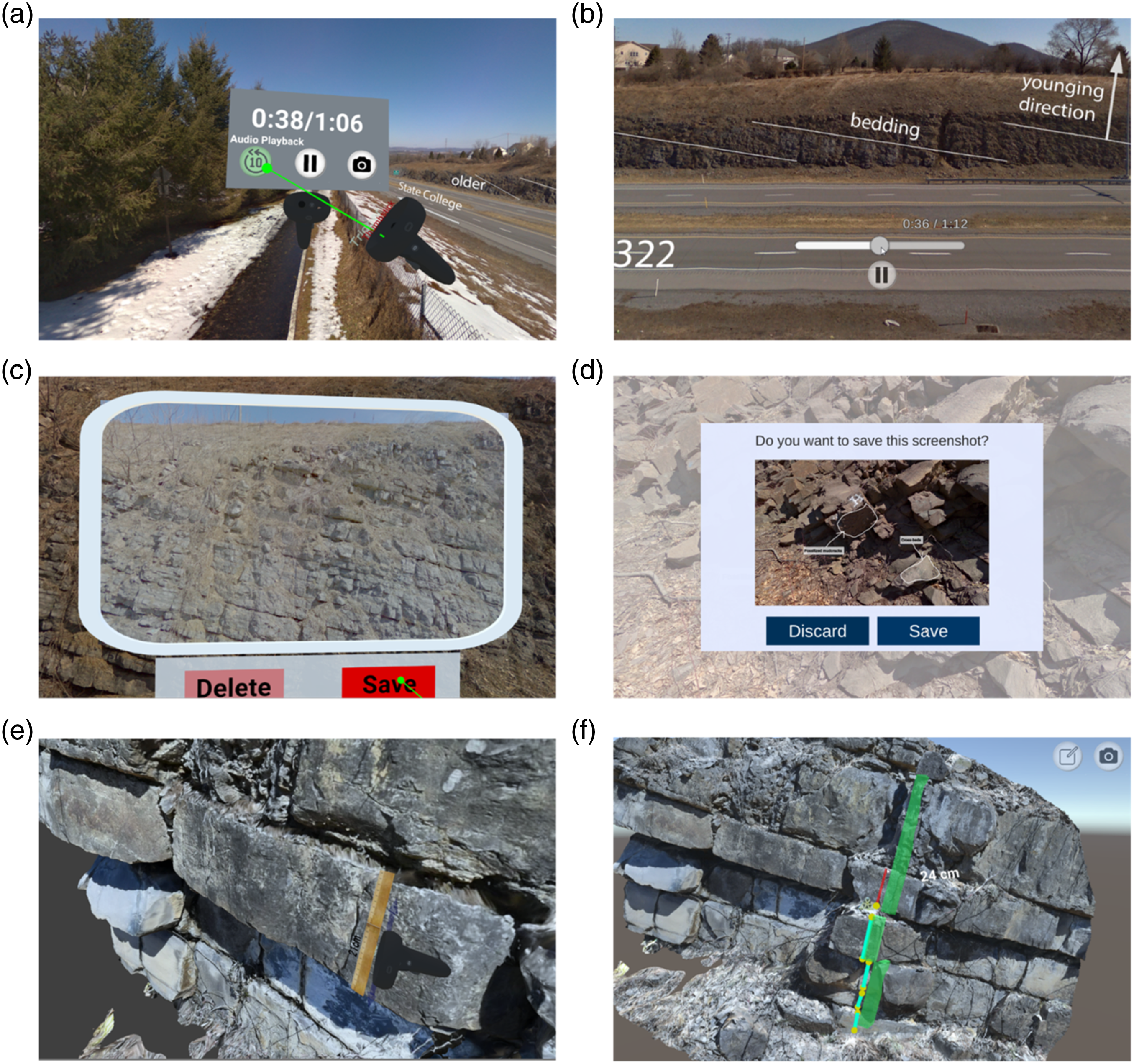
The two field trips focused on different field sites and learning goals, the designs of the VFTs, though, use the same user interface, interactions, and activities. In both VFTs, students experienced the field sites through a series of interactive 360° images. Each 360° scene included short text instructions that might ask students to make an observation or perform specific activities such as navigating to a new location (Figure 1(a)). Additionally, some 360° scenes included audio narrations explaining specific features of the outcrop, multiple-choice questions (Figure 1(b)), or highlighted icons with access to additional information that was derived from textbooks or high-resolution photos (Figure 1(c) and (d)). During the VFTs, students could observe the field site from a pseudo-aerial perspective (about 8 m above ground), control the playing of audio (e.g., pause and rewind; Figure 2(a) and (b)), and take pictures of interesting features of the outcrop (Figure 2(c) and (d)). As part of their practice of practical skills, students in each VFT were guided through a measurement activity using a 3D model of the outcrop (Figure 2(e) and (f)). The measurement results along with a screenshot of the outcrop model were sent to students after the virtual experience so that they could make a stratigraphic column as required for the lab assignment. Screenshots of students’ activities in the VFTs: (a) The students selected arrows on the ground to navigate through the 360° images; (b) multiple-choice questions were embedded in the VFT to assess content knowledge; (c) the students clicked on blue icons to open; and (d) additional information that illustrated key concepts or showed details of geological structures. Note. virtual field trips. Screenshots from iVR (left) and dVR (right): (a+b) audio control; (c+d) picture taken; and (e+f) stratigraphic measurement using a 3D outcrop model.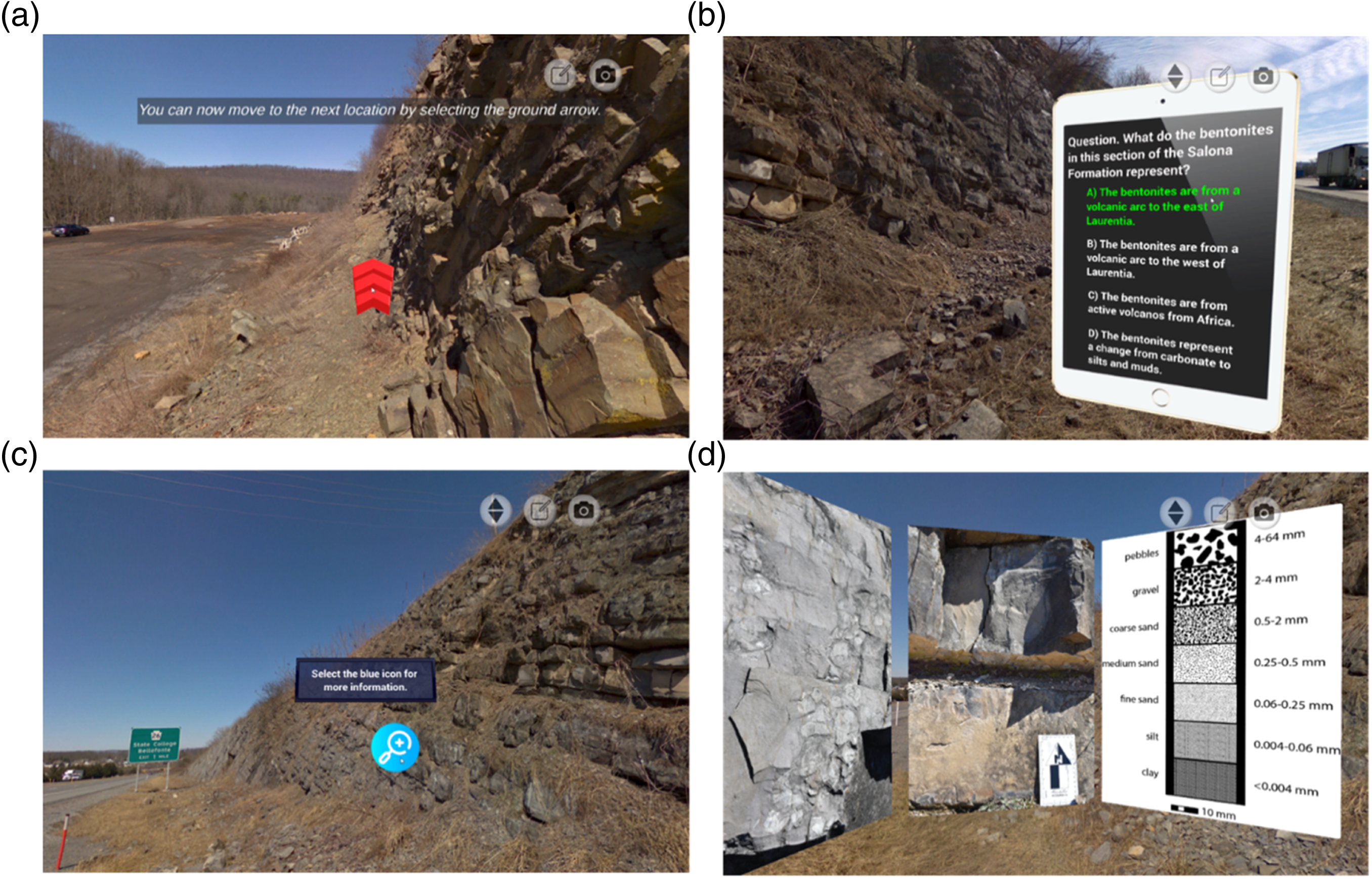
Leveraging the cross-platform capabilities of the Unity3D game engine, the Salona and the Reedsville VFTs were implemented as a dVR WebGL application that could run in a web browser, and as an iVR app experienced through the Oculus Quest VR headset. The Quest HMD has a field of view of 110°, with a refresh rate of 72 Hz, and a display resolution of 2880×1600 pixels.
In the dVR condition, students sat in front of a computer screen, clicked and dragged the mouse in a 360° image to look around, and pressed the left mouse button to interact with the virtual field site. In the iVR condition, students put on the Quest HMD, stood in the center of the tracking space, and used hand-held controllers to interact with the environment. The content, features, and storyline of each VFT were the same across both VR conditions. The measurement activity was designed differently in the two conditions. In the iVR condition students operated a virtual ruler attached to their hand controller with full freedom of movement (Figure 2(e)). In the dVR condition, students were placed in front of the outcrop model. To measure the thickness of rock layers, dVR students hovered the mouse pointer over the outcrop to add nodes on the rock surface; each pair of nodes was connected by a straight line segment for length computation (Zhao et al., 2020; Figure 2(f)).
Procedure and Measures
The two VFTs, including introduction, empirical data collection, and lab assignments, were spread out over a 4-week period (October 26–November 20, 2020). An overview of the procedure is provided in Figure 3. The procedure of the current study.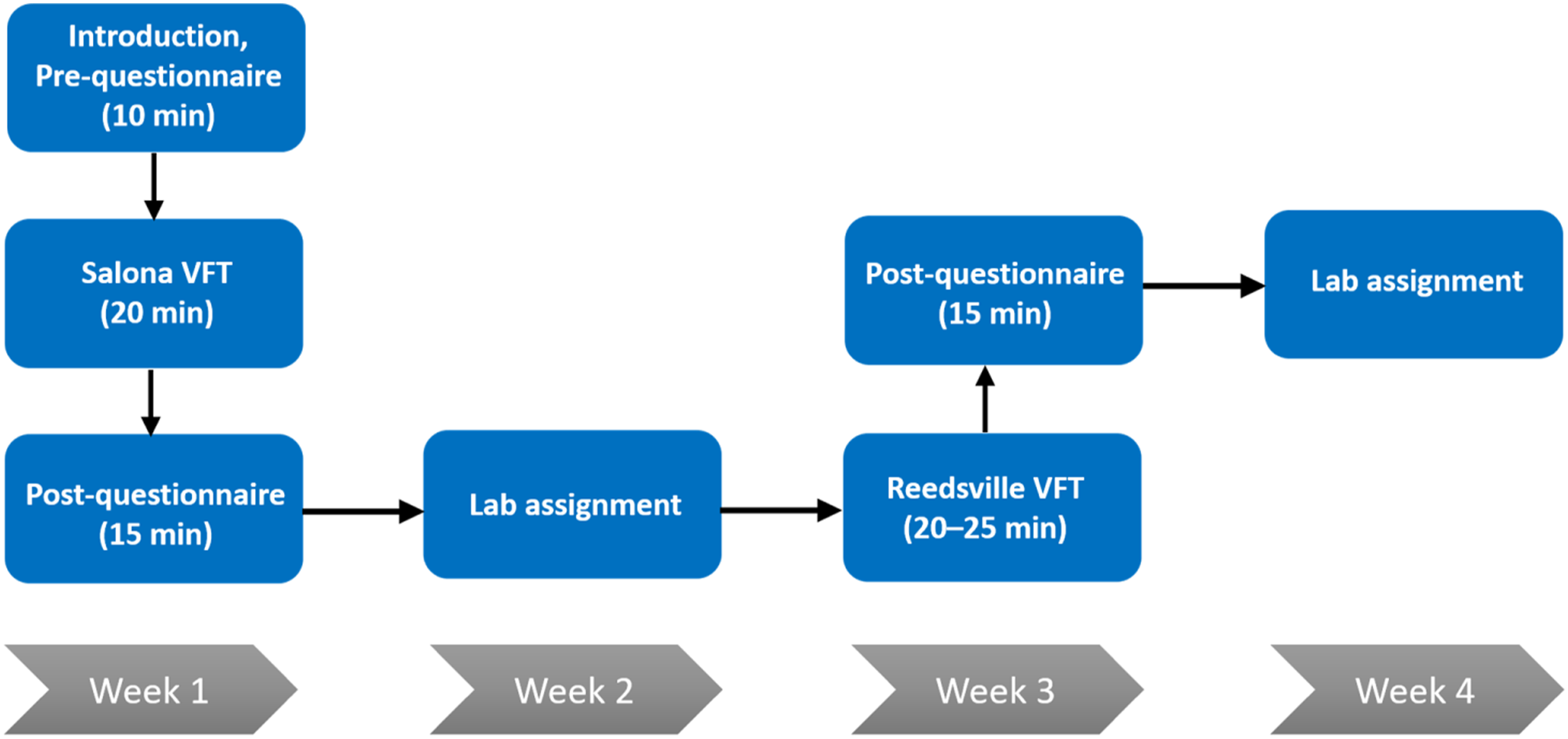
In the first week of the study, students were provided with a URL link to the Salona lab by their teaching assistants (TAs). The link opened a website that commenced with an introduction to the lab and the consent form, in which the nature of the study was explained to the students. After reading the form and checking a box to give their consent, students proceeded to the next page to enter a pre-questionnaire, in which they provided demographic information (gender, age, and academic year) and then completed self-report, 5-point Likert scale measures of spatial ability and technology enjoyment (see Appendix 1 for a list of items and sources). These basic characteristics can provide insights into the comparability of the dVR and iVR conditions.
After completing the pre-questionnaire, students went through a 20-min VFT to the Salona Formation (VFT 1) either in a web browser (dVR condition) or using the Oculus Quest headset (iVR condition). During the VFT, students interacted with a virtual lab pad where they received six multiple-choice questions (Appendix 2) related to field observations or the factual knowledge that they just learned from the audio narration (Figure 1(b)). Students were allowed multiple attempts for each question with explanatory feedback until they found the correct answer. The knowledge test performance was calculated as the average number of attempts students made per question. Thus, lower scores on this test were indicative of better knowledge gained from the VFT activities (minimum = 1).
The Salona VFT was followed by a post-questionnaire with a set of self-report, 5-point Likert scales to measure user experience (including perceived ease of use and cybersickness), learning experience (including spatial presence, field trip enjoyment, and satisfaction), and perceived learning. The list of items and sources is included in Appendix 1.
A complete lab session, including the Salona VFT and the pre- and post-questionnaires, took about 45 min in both VR conditions. Students who chose not to participate in the study were directed to the web version of the VFT without pre- or post-questionnaires. After the Salona lab experience, all students in the course were required to complete a lab assignment and return their work by the next lab period. The lab assignments were graded by the course TAs, and grades (scale 0–100) were recorded as a learning outcome variable to be evaluated in this study. The assignment asked students to report their observations of the outcrop, including a stratigraphic column, a sketch map showing the boundary between paleo-continents, and a written summary answering questions regarding depositional and tectonic settings.
In the third week of the study, students were instructed to participate in a VFT to the Reedsville & Bald Eagle Formations (VFT 2). The steps were similar to the Salona lab except that students skipped the pre-questionnaire if they had attended the previous VFT as a study participant; only those who consented to participate in both lab sessions were included for analysis. Once they had completed the Reedsville VFT, students filled out a post-questionnaire, which was identical to the one administered after the Salona VFT and were given a week to complete the lab assignment. The assignment used in the Reedsville lab consisted of a stratigraphic column, answers to specific questions regarding the depositional environment, and a written description drawing together the observations in a discussion about the paleo-environment (Klippel, Zhao, Jackson, et al., 2019).
Results
Summary of Demographic Differences Between the Desktop Virtual Reality (dVR) and Immersive Virtual Reality (iVR) Conditions.
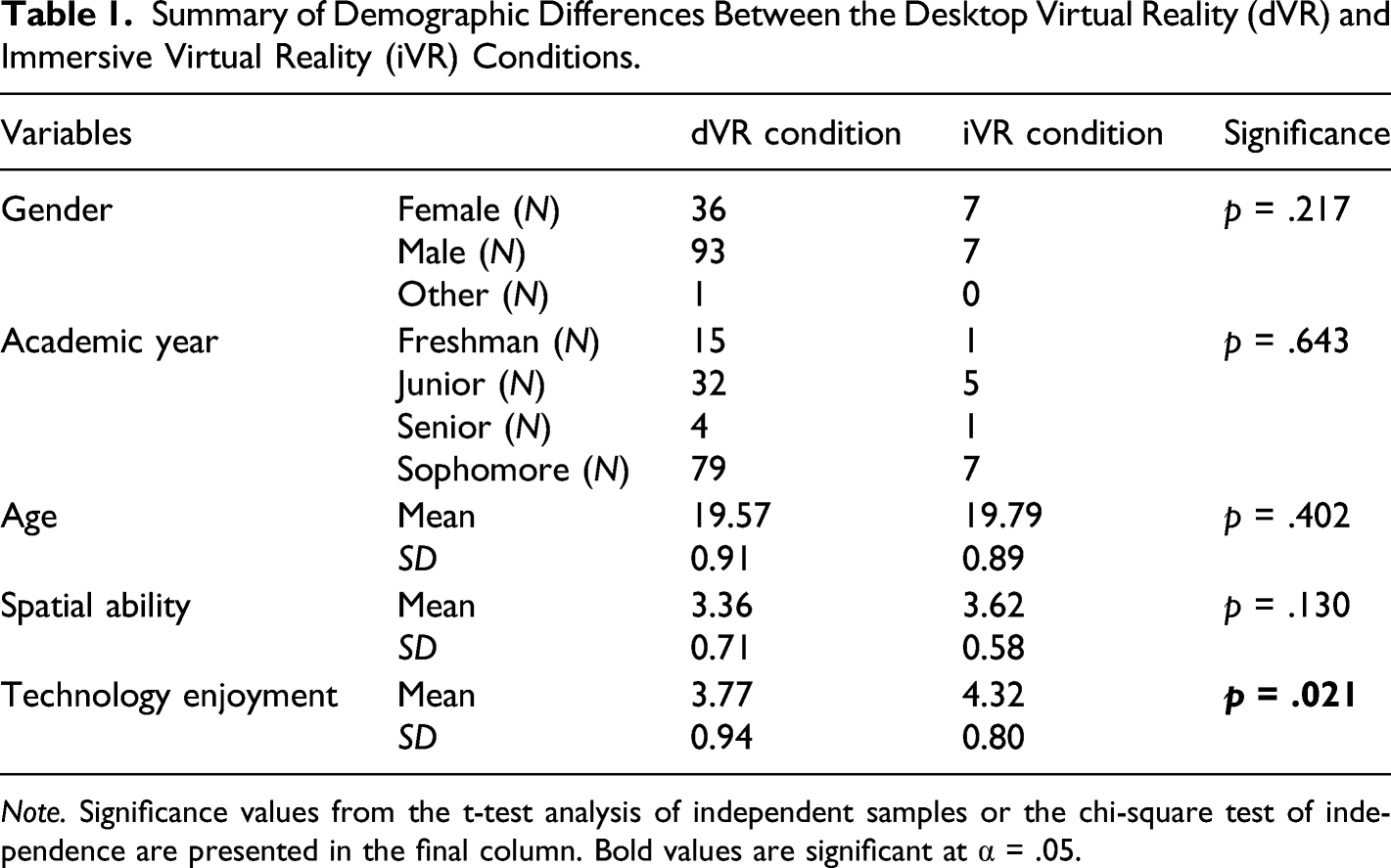
Note. Significance values from the t-test analysis of independent samples or the chi-square test of independence are presented in the final column. Bold values are significant at α = .05.
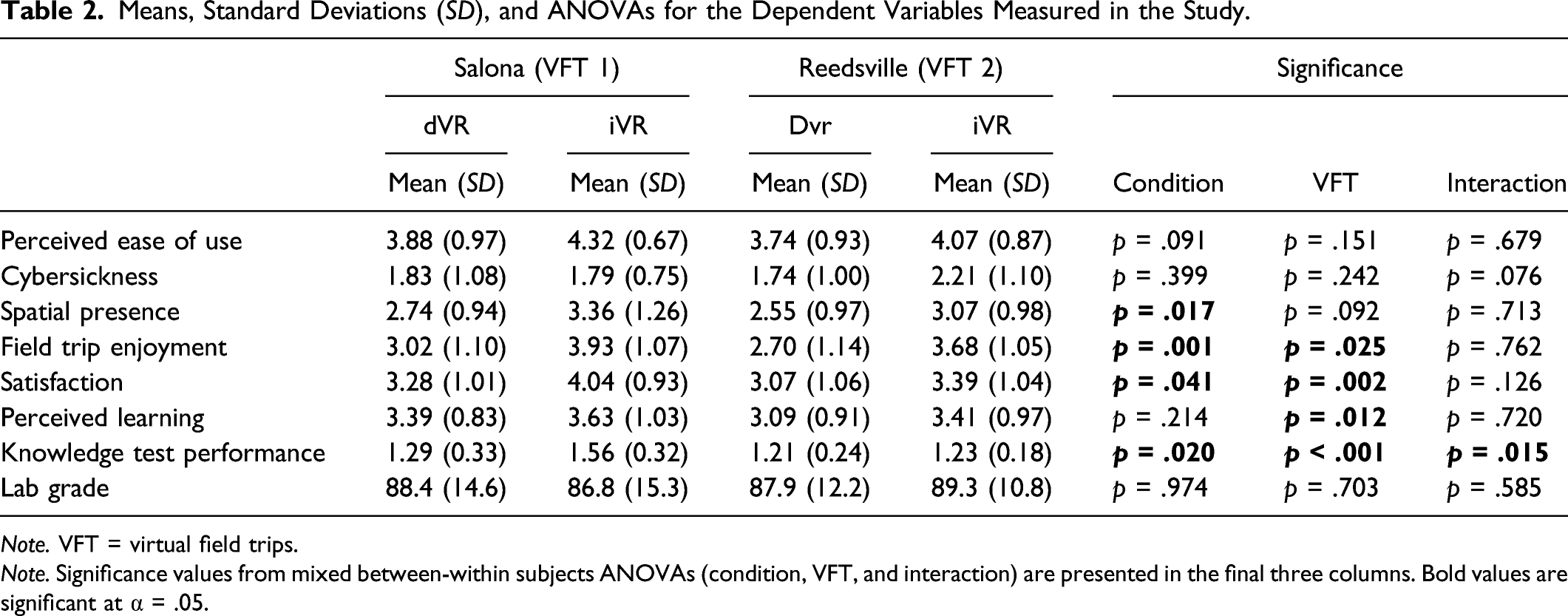
Means, Standard Deviations (SD), and ANOVAs for the Dependent Variables Measured in the Study.
Note. VFT = virtual field trips.
Note. Significance values from mixed between-within subjects ANOVAs (condition, VFT, and interaction) are presented in the final three columns. Bold values are significant at α = .05.
User Experience
For perceived ease of use, the first row of Table 2 shows that there was no significant main effect for condition (F(1,142) = 2.90, p = .091, η p 2 = .02) or VFT (F(1,142) = 2.09, p = .151, η p 2 = .01), or significant interaction (F(1,142) = 0.17, p = .679, η p 2 = .001). Similarly, for cybersickness the results in the second row of Table 2 indicate that there was no significant main effect for condition (F(1,142) = 1.38, p = .242, η p 2 = .01) or VFT (F(1,142) = 0.71, p = .399, η p 2 = .005), or significant interaction between condition and VFT (F(1,142) = 3.20, p = .076, η p 2 = .02).
Learning Experience
For spatial presence, a significant main effect for condition was observed (third row of Table 2), indicating that students reported a significantly higher level of feeling present when using iVR compared to dVR (F(1,142) = 5.86, p = .017, η p 2 = .04). The main effect for VFT (F(1,142) = 2.88, p = .092, η p 2 = .02) and the interaction (F(1,142) = 0.14, p = .713, η p 2 < .001) were not significant.
With regard to field trip enjoyment, row four of Table 2 shows that there were significant main effects for condition (F(1,142) = 10.86, p = .001, η p 2 = .07) and VFT (F(1,142) = 5.16, p = .025, η p 2 = .04) but not a significant interaction (F(1,142) = 0.09, p = .762, η p 2 < .001). These results indicate that students rated their enjoyment of the first (Salona) VFT higher than the second (Reedsville) VFT and enjoyed using iVR more than dVR.
For satisfaction, the results (row five of Table 2) indicate that students in the iVR condition were more satisfied with their lab experiences than those in the dVR condition (F(1,142) = 4.27, p = .041, η p 2 = .03), and for both conditions there was a significant drop in satisfaction from the Salona to the Reedsville VFT (F(1,142) = 9.53, p = .002, η p 2 = .06). There was no significant interaction between condition and VFT (F(1,142) = 2.37, p = .126, η p 2 = .02).
Learning Outcomes
For perceived learning (see row six of Table 2), the significant main effect for VFT (F(1,142) = 6.45, p = .012, η p 2 = .04) indicates that there was a decrease in perceived learning from the Salona to the Reedsville VFT for both VR conditions. The main effect for condition (F(1,142) = 1.56, p = .214, η p 2 = .01) and the interaction (F(1,142) = 0.13, p = .720, η p 2 < .001) were not significant.
For knowledge test performance, the results presented in row seven of Table 2 (with lower scores indicating better performance) revealed significant main effects for condition (F(1,142) = 5.12, p = .02, η p 2 = .04) and VFT (F(1,142) = 15.40, p < .001, η p 2 = .10), and a significant interaction between condition and VFT (F(1,142) = 6.01, p = .015, η p 2 = .04). Bonferroni corrected pairwise comparisons for each condition individually showed that there was a significant improvement in knowledge test performance from the Salona to the Reedsville VFT for the dVR condition (p = .023, g = .27) as well as the iVR condition (p < .001, g = 1.26). Furthermore, Bonferroni corrected pairwise comparisons at each time point individually showed that dVR students significantly outperformed iVR students in the first VFT (Salona; p = .004, g = −.82) but not in the second VFT (Reedsville; p = .807, g = −.07).
We observed a different pattern for lab grades (final row of Table 2; score range 0–100, with lower scores indicating poorer performance); there was no significant main effect for condition (F(1,99) = 0.001, p = .974, η p 2 < .001) or VFT (F(1,99) = 0.15, p = .703, η p 2 = .001), or significant interaction (F(1,99) = 0.30, p = .585, η p 2 < .003). Note that some of the students did not submit their lab assignments; the statistical analysis of lab grade was thus based on the data obtained from 91 students (39 or 30.0% removed) in the dVR condition and 12 students (2 or 16.7% removed) in the iVR condition.
Discussion
Before discussing the results of our objectives-oriented evaluation, we briefly consider the dVR/iVR-comparability of user experiences. An immersive interface should be natural to use and enable learners to interact with virtual objects and tools through body movements or gestures. Such embodied interaction, however, can be unfamiliar compared to mouse and keyboard. Additionally, research indicates that cybersickness may prevent students from learning with iVR simulations (Petri et al., 2020; Rebenitsch & Owen, 2016). In response to these concerns, we kept the virtual experience short (20–25 min), avoided extended locomotion, designed straightforward interactions (pointing and selecting), used 360° images (other than videos) to provide context information, and used textual annotations along with audio instructions to guide students through the learning process. We looked into user experience factors and found that students in the two conditions expressed high ease of use and little problems with cybersickness throughout the study. The results, while limited in scope, indicate that both immersive and desktop VFTs can provide students with an efficient and easy-to-use environment for place-based learning.
The first objective investigated whether immersion could lead to better learning experiences and outcomes. Consistent with previous research (see Section “Literature review and expectations”), our results indicate that students who experienced iVR reported significantly higher ratings of spatial presence, enjoyment, and satisfaction than students who experienced the same content through a desktop computer (dVR). Regarding learning outcomes, we predicted an advantage of learning with iVR over learning with dVR. However, the multiple-choice knowledge tests show that students in the dVR condition had a better (Salona VFT) or similar (Reedsville VFT) performance than those in the iVR condition.
At first sight, our findings seem to corroborate previous studies, which indicate that students like learning in immersive virtual environments and experience a stronger sense of spatial presence, but they have similar or even inferior learning performance compared to traditional media such as desktop computers (Makransky et al., 2017, 2020). This can be potentially explained by the cognitive theory of multimedia learning (Mayer, 2014), according to which multimedia learning is demanding and influenced by the cognitive load of learner activities (see also Petersen et al., 2020). This perspective is particularly relevant for learning in a highly immersive environment, where the perceptual realism and richness of sensory information can enhance emotional engagement and sense of presence but may create more extraneous cognitive load that distracts learners from processing essential materials (Parong & Mayer, 2018). In contrast, a desktop-based virtual environment presents 3D representations of field sites on a flat screen with very limited sensory stimuli, leaving ample cognitive resources for comprehension, observation, and recall of knowledge.
Not all of our measurements showed such a clear pattern of media effects on learning outcomes. There were no significant differences between the dVR and iVR conditions for lab-grade across both VFTs. As indicated in Section “Procedure and measures," students were given one extra week to complete the lab assignment, meaning that they did have some opportunity to use other resources in addition to the virtual field experience to help them with the assignments. Nonetheless, the mixed pattern of learning outcomes is consistent with a meta-analysis performed by Luo et al. (2021), who found an overall small effect size for the comparison between HMD and non-HMD interventions, and corroborates Spector’s (2020) argument that advances in educational technology do not guarantee improved learning.
Similarly, in both conditions similar ratings of perceived learning were reported, perhaps because both the desktop and immersive versions of each VFT presented the same teaching content and factual information. It is also possible that students’ perceived learning was influenced by the perceived difficulty of knowledge-related questions. In each lab, questionnaires about perceived learning were presented after the completion of the multiple-choice knowledge test and the VFT. Of the affective variables measured in the current study, perceived learning most closely relates to objective learning outcomes (Alqurashi, 2018). Thus, students’ performance in the multiple-choice test may have affected their perceptions of knowledge gain.
The second objective of this study was to investigate if and how VR-empowered field trip experiences affect student learning over time. From the Salona to the Reedsville VFT, we observed significant declines in field trip enjoyment, perceived learning, and satisfaction regardless of the medium. This result can be explained for the dVR condition, where students attended VFTs on their own computers with limited screen space and interaction modalities. Due to their familiarity with the hardware and software setups, the novelty of the virtual experience might have quickly faded. Consequently, in the second VFT, students were more likely to feel bored and less interested in learning with the application. Surprisingly, iVR students, too, significantly lowered their ratings of learning experience from the Salona to the Reedsville VFT. Users with the HMD often need more time and energy to become familiar with the interface compared to desktop users. Huang (2020) suggests that this familiarization process helps to maintain motivation and engagement with the learning content after novelty effects wear off. However, this may not be the case in the current study as students only needed to follow through a linear sequence of field activities with simple interactions. In fact, most students perceived the technology as easy to use without extra effort, which may, in turn, result in a decreasing novelty effect for affective measures in both the iVR and dVR conditions. Another possible explanation is that it is more challenging to excite and engage students toward the end of the semester (Ertmer et al., 1996). The Reedsville VFT (VFT 2) was taken 1 week before the university switched to remote instruction. During that time, academic and transition pressures may have added stress on our participants, especially among residential students, thereby reducing their motivation and interest for learning from the VFT method.
Despite the impacts of novelty and end-of-semester pressure on the learning experience, we found that students in the iVR condition reported significantly higher ratings of spatial presence, enjoyment, and satisfaction compared to those in the dVR condition across both VFT sessions. This finding indicates that even after novelty effects are diminished, learning through iVR is still perceived to be more enjoyable and satisfying than learning with dVR. Furthermore, there was a significant interaction between condition and VFT for performance in the multiple-choice knowledge tests. That is, iVR students had worse test performance than dVR students in the first VFT, possibly due to the cognitive overload associated with immersive technology use or the added distractions of new technological affordances; but this difference disappeared in the second VFT, with iVR students improving their knowledge test performance more than dVR students.
Taken together and viewed through the lens of Biggs’s (1993) model of Presage, Process, and Product (described in Section “Theoretical framework”), the results suggest that for learners with longitudinal exposure to VR simulations, there is an advantage of iVR over dVR with respect to fostering emotional engagement but not at the cost of learning effectiveness. iVR is often considered an overwhelming experience for students (Makransky et al., 2017; Pande et al., 2021; Parong & Mayer, 2018); our study corroborates this concern and further suggests that iVR learners may benefit specifically from longitudinal exposure to immersive virtual environments.
Some aspects are important for contextualizing these findings. First, the number of participants in the iVR condition is relatively small due to limited HMD equipment available for the class. Increasing the number of iVR participants should lead to more reliable conclusions, and put us in a better position to assess the learning effectiveness of VR at a fine-grained level (e.g., to identify the characteristics of learners that could predict the effective use of VFTs) rather than merely across the dVR/iVR distinction as a whole (e.g., Plechatá et al., 2019). Second, students in the iVR condition reported significantly higher technology enjoyment than those in the dVR condition. This may be because only students who were interested in immersive technologies would be likely to participate in the iVR condition (which is a quasi-experimental design). The fact that our iVR samples were self-selected could have introduced bias into the evaluation results (see Hauser et al., 2018 for an overview). The data reported in our previous VFT studies with voluntary (Klippel, Zhao, Oprean, et al., 2019) and mandatory (Klippel, Oprean, et al., 2019) student samples support this concern. Although employing a randomized controlled design would avoid self-selection issues, the practical value of quasi-experimental studies can be greater because they are usually conducted in more natural settings and, therefore, contribute to our knowledge of integrating iVR into formal education (Wu et al., 2020). Future quasi-experimental research that replicates our results with larger iVR samples in residential classroom settings is warranted to provide clarification on the generalizability and validity of findings from the current investigation. Third, while we have attempted to make the Salona and Reedsville VFTs as comparable as possible, some differences persist that may have contributed to the results. A repeated-measures design with the order of VFTs counterbalanced across conditions can help tease apart the effect of time from the effect of different VFTs. Fourth, our study examined VR immersion, subjective experience, and learning outcomes over two VFT sessions within 1 month. Although this approach is a valuable contribution, the number of sessions/checkpoints and the span of time are limited as compared to related longitudinal studies in the field of education (e.g., Tsay et al., 2018). A remaining research question is to ask how VR impacts learning over more sessions or a longer time period (i.e., in true longitudinal designs and timescales).
Conclusion
Evaluating the long-term efficacy of VR is challenging in educational research due to limited access to VR facilities and the laborious nature of repeated data collection. Its outcome can contribute to addressing the concerns of practitioners in using this innovative technology as a pedagogical tool in both traditional classroom and remote learning environments. Leveraging real-life educational settings, the current study investigated differences and trends in students’ learning experience and outcomes for two levels of immersion, dVR and iVR, and over two temporally separated VFT sessions. Despite the limited number of sessions and the small iVR sample size, this study is one of the first to examine the longitudinal effects of VR immersion on student learning in place-based disciplines. Our results are meaningful in several ways. First, they replicate previous research (e.g., Makransky et al., 2020) indicating that students’ first-time learning in iVR compared to dVR increases presence, enjoyment, and satisfaction but not learning outcomes. Second, learning in VFTs over two sessions led to improved knowledge test performance but at the cost of reduced learning experience and perceived learning in both VR conditions. Third, and most importantly, repeated use of iVR may be beneficial in maintaining student engagement and satisfaction and compensating the initial deficiency in objective learning outcomes compared to less immersive systems such as dVR. These findings highlight the necessity of such longitudinal approaches to investigate and better understand how emerging VR applications can best be designed and implemented as part of regular education programs.
Footnotes
Declaration of Conflicting Interests
The author(s) declared no potential conflicts of interest with respect to the research, authorship, and/or publication of this article.
Funding
The author(s) disclosed receipt of the following financial support for the research, authorship, and/or publication of this article: This material is based upon work partially supported by the National Science Foundation under Award No. OIA-1946391.

Measurements Used in the Pre- and Post-Questionnaires.
Variable
Item text
Source and reliability
Spatial ability
I am very good at giving directions
Source: Hegarty, 2002
Cronbach’s alpha = .86
I have a poor memory for where I left things (R)
My “sense of direction” is very good
I tend to think of my environment in terms of cardinal directions (N, S, E, W)
I very easily get lost in a new city (R)
I enjoy reading maps
I have trouble understanding directions (R)
I am very good at reading maps
I don’t remember routes very well while riding as a passenger in a car (R)
I don’t enjoy giving directions (R)
It’s not important to me to know where I am (R)
I usually let someone else do the navigational planning for long trips (R)
I can usually remember a new route after I have traveled it only once
I don’t have a very good “mental map” of my environment (R)
Technology enjoyment
I enjoy using technology
Source: Klippel, Zhao, Jackson, et al., 2019
Cronbach’s alpha = .71
I enjoy playing video games
Perceived ease of use
Learning to operate this type of computer program is easy for me
Adapted from Davis, 1989
Cronbach’s alpha = .79 (Salona) and .71 (Reedsville)
It is easy for me to find information with the computer program
Overall, I think this type of computer program is easy to use
Cybersickness
To what extent did you experience sickness during the virtual field trip?
Adapted from Helland et al., 2016
Cronbach’s alpha = .84 (Salona) and .84 (Reedsville)
How much general discomfort are you experiencing right now?
Spatial presence
I felt as though I was physically present in the environment
Source: Vorderer et al., 2004
Cronbach’s alpha = .90 (Salona) and .92 (Reedsville)
I felt like I was actually there in the environment
It seemed as though I actually took part in the action
It was as though my true location had shifted into the environment
Field trip enjoyment
I enjoyed using the virtual field trip
Adapted from (McAuley et al., 1989)
Cronbach’s alpha = .90 (Salona) and .92 (Reedsville)
Learning in the virtual field trip was fun
Perceived learning
The virtual field trip helps me to have a better overview of the content learned
Adapted from Lee et al. (2010)
Cronbach’s alpha = .91 (Salona) and .92 (Reedsville)
I was able to link new knowledge with my previous knowledge and experiences
I was able to become a better learner
I gained a good understanding of the basic concepts of the materials
I was able to summarize and concluded what I learned
Overall, I learned a lot from the virtual field trip
Satisfaction
I was satisfied with the teaching methods in the virtual field trip
Adapted from Chou & Liu, 2005
Cronbach’s alpha = .92 (Salona) and .85 (Reedsville)
Overall, I was satisfied with the virtual field trip experience
Questions and Options Used in the Multiple-Choice Knowledge Tests.
Virtual field trip
Question and options
Salona (VFT 1)
Looking across at the stratigraphy of the Salona Formation, what direction are the rocks dipping? (A) Left, (B) Right, (C) They are flat lying
Is the stratigraphy that comprises Mount Nittany older or younger than the rocks in the roadcut? (A) The rocks are older, (B) The rocks are younger, (C) The rocks are the same age
How thick are the beds? (A) They are cm thick, (B) They are meters thick, (C) they are mm thick
What does that imply about the environment of deposition? Were the rocks deposited in shallower water? Or were they deposited in deeper water? (A) The rocks were deposited in shallow water, (B) They were deposited in deep water, (C) They were deposited on land
How thick are the beds? (A) They are cm thick, (B) They are meters thick, (C) They are mm thick
Where are the bentonites coming from? (A) The bentonites are from a volcanic arc to the east of Laurentia, (B) The bentonites are from a volcanic arc to the west of Laurentia, (C) The bentonites are from active volcanos from Africa
Reedsville (VFT 2)
What is the orientation of the stratigraphy or bedding in the outcrop in front of you? (A) The stratigraphy is flat lying, (B) The stratigraphy is tilted, (C) The stratigraphy is vertical
Look again at outcrop and the stratigraphy, are the beds tilting toward your right or toward your left? (A) Right, (B) Left
When the rocks formed were they tilted like this? Or did the tilting happen later? (A) Yes, the layers were deposited tilted, (B) The layers were deposited horizontally, then deformed to be tilted like they are now, (C) Yes, the layers were deposited tilted, and later deformed to be horizontal
Is there a change in the stratigraphy from the right side of the outcrop to the left side of the outcrop? (A) No. All of the stratigraphy/rocks look the same, (B) No. The rocks are all the same color and bed thickness, (C) Yes. The stratigraphy or rocks are different across the outcrop
What observations do you need to make to construct a stratigraphic column? (A) Grain size, (B) Bedding thickness, (C) Color, (D) All of the above
You can see individual sediment grains in these rocks that comprise the Bald Eagle Formation. What does that imply about their depositional environment? (A) The sediment is coarse grained and was deposited by slow moving (low energy) wind or water, (B) The sediment is fine grained and was deposited by slow moving (low energy) wind or water, (C) The sediment is fine grained and was deposited by fast moving (high energy) wind or water, (D) The sediment is coarse grained and was deposited by fast moving (high energy) wind or water, (E) The sediment is coarse grained and was deposited by a glacier (low energy)