



Abstract
Immersive Virtual Environments can provide users with a sense of spatial presence and experience. But learners with Color Vision Deficiency cannot receive information entirely in the environments because they are difficult to distinguish some or all colors. This study selects learners with red-green color blindness as the sample, and designs three kinds of barrier-free Teaching Resources based on a color scheme and color contrast to explore their impacts on spatial cognition and learning experience. The experimental results show that the Color Adjusted Teaching Resources has significant differences both in learning satisfaction and technology acceptance, and the Contrast Adjusted Teaching Resources performs an important role in improving spatial cognition and technology acceptance. In addition, the Color and Contrast Adjusted Teaching Resources is significantly different from the Color Adjusted Teaching Resources in spatial cognition. Therefore, the findings indicated that the barrier-free color scheme and higher contrast of Teaching Resources can significantly improve spatial cognition, learning satisfaction, and technology acceptance of learners with red-green color blindness. To some extent, the research results can contribute to the design of barrier-free Teaching Resources about red-green color blindness.
Keywords
Introduction
The digitalization of education has been accelerated because of COVID-19, which also has extended the communication between teachers and students in time and space. A metaverse parallel to the real world has been constructed based on emerging digital technologies such as virtual reality (VR), geographic information system (GIS), and digital twins. The emergence of Immersive Virtual Environments (IVE) promotes great changes in learning environment. Compared with the real environment, IVE can digitally simulate the real environment and move it into the classroom through information technology, participants using displayed headwear can interact with the virtual environment and objects in multiple modes through gestures, voice, body movements, etc. Compared with VR, extended reality provides a mixed environment of virtual and real integration, the security of this digital environment will be controllable. Participants can carry out teaching and learning interaction in this environment, break through the boundary between virtual and reality, and gain an open interactive experience. This experience will greatly stimulate the interest and creativity of participants, at the same time, it can also avoid potential risks in the real environment, and achieve a balance between security and openness, repeatable and customizable. With the development and evolution of technology, various forms of IVE are gradually applied in teaching and arouse strong interest of users. Immersive Virtual Environment able to promote the transformation of abstract concepts into concrete experiences, and support them to carry out independent inquiries and collaborative learning (Badilla Quintana & Meza Fernández, 2015; Tilhou et al., 2020). In this way, they are more likely to construct knowledge systems and develop comprehensive skills as well as critical thinking in IVE.
An effective color scheme can enhance the visibility and interactivity of teaching resources. However, Color Vision Deficiency (CVD) has abnormal spectral color perception. They cannot recognize some or all colors correctly, which greatly reduces the effectiveness and comfort of their cognition and interactive operation in IVE. Congenital CVD affects as many as 8% of males and 0.5% of females (Simunovic, 2010). To address this issue, this study attempts to design barrier-free Immersive Virtual Environment Teaching Resources (IVETR) to help those with CVD overcome the obstacle of color differentiation. This way make them to receive the information transmitted by the teaching resources effectively (Rubin et al., 2009), get color experience similar to normal people. This obvious change in education will promote people to recognize CVD again. Color blindness is only a difference in color identity, and should not be included in the list of diseases of the WHO.
Literature Review
Color Vision Deficiency and IVETR
Color Vision Deficiency can be divided into three categories: total color blindness, partial color blindness, and color weakness (Ananto et al., 2011). Partial color blindness cannot recognize certain colors, compared with color weakness, which can recognize colors, and total color blindness, which cannot recognize colors. Examples of red-green color blindness is the most common CVD, people who recognize red and green as dark. Therefore, we constrained the subjects as learners with red-green color blindness to seek the beneficial impacts of barrier-free IVETR.
Learners with red-green color blindness need to use non-color factors (such as size, shape, and contour) to assist learning (Power, 2018), which causes many unnecessary troubles. To improve the experience of learners with CVD, designers are required to develop barrier-free teaching resources for them by adjusting color schemes, color contrast, or non-color factors (Fukuyama et al., 2022; Wang & Huang, 2017). It is difficult for most designers to develop the color barrier-free IVETR quickly because they don’t know the relationship between color scheme and contrast with teaching content, causing it hard for learners with CVD to recognize the information effectively (Stoianov et al., 2019). Therefore, based on color schemes and contrast, the study of color barrier-free IVETR is of vital importance to improve the learning experience of learners with CVD.
Color Perception and Spatial Cognition
A Color in IVE reflects the spatial characteristics of teaching resources and virtual objects, which can play the role of spatial guidance, object recognition, and operation instruction (Valdez, 1994). For example, a gradient color used in IVE forms a natural and directional color transition, which can attract learners' attention to certain content related to operation guidance (Xia et al., 2021). Some colors that are intrinsically related to object attributes can be used to optimize information transmission. Therefore, learners can have a better understanding of object information through colors (Kress & Van, 2002). Combination with obvious contrast, the color can be used to represent the current state of the operation object, forming an intuitive and strong visual impact, and also providing the learners with operational tips (Wan et al., 2022).
Spatial cognition is an important means for learners to acquire information, recognize directions, and operate objects (Morris, 2004), including the size of the objects and the layout of the background, as well as the concept, position, shape, and state of objects (Min & Lee, 2020). With the help of spatial cognition, people can focus on specific objects and process their attributes in the mind (Montello & Raubal, 2013). From the previous studies we know that vision is one of the most important ways for humans to perceive external information, including color and non-color these two independent neural channels. It’s found in studies that color and contrast can influence human spatial cognition (Livingstone, 1988; Min & Lee, 2020), and perform an important role in the transmission of visual information, which can present hierarchical spatial structure information and enhance learners' recognition of visual information (O’Connor, 2015). Compared with normal people, learners with CVD have lower recognition ability in color and contrast and are often at an obvious disadvantage while performing related tasks (Cole, 2004). For example, when color is used as an identifier for an object’s attribute, recognition is slow and unreliable for those with CVD. When contrast is used to organize a visual presentation, learners with CVD often find it hard to perceive the visual information conveyed by the color contrast of objects and words (Tanuwidjaja et al., 2014). Using Adobe Photoshop to simulate the visual effects of learners with red-green color blindness, it’s found that only blue and yellow could be recognized by them accurately, and it’s easier for them to discern the information transmitted by color combinations with high contrast (Wong, 2011). As a consequence, it is necessary to explore the design of barrier-free IVETR based on the color scheme as well as color contrast. And in IVETR its effects on spatial cognition of learners with red-green color blindness also need exploring.
Barrier-Free IVETR
The barrier-free design aims to compensate for defects of learners with CVD, and reduce or even eliminate color recognition obstacles during the learning experience. At the same time, it is also necessary to consider the need of the general for color information (Ichikawa et al., 2004), to ensure that users can completely and accurately recognize key objects or information. In IVETR, blue and yellow, which can be recognized by red-green color blindness, are used as the main colors. At the same time, according to the difference of background environments and operating objects in shape, size and frequency of use, the color contrast between them is appropriately increased to enhance visual comfort (Cha et al., 2020). Considering that there may be multiple objects with similar shapes or sizes in IVETR, a clear visual contrast can be formed to enhance the impact of spatial information by increasing the contrast between the color of the object and the background (Rahimi et al., 2018), which helps learners with red-green color blindness identify similar objects accurately.
Research Objectives and Questions
This study analyzed the effects of color scheme and contrast on spatial cognition of red-green color blindness, focusing on recognition and memory of size, layout, location information of objects in the barrier-free IVETR. To this end, some variables related to visual discrimination and visual memory are selected (Brown & Peres, 2018) from the Test of Visual Perception Skills–fourth edition (TVPS-4) as the measurement factors of spatial cognitive effect. The subjective evaluation of learners with red-green color blindness collected by questionnaire is used to explore the relationship between spatial cognition and color scheme as well as color contrast of barrier-free IVETR. In addition, we also analyzed how teaching resources affect the learning experience of learners with red-green color blindness, to have a more comprehensive understanding of the effect of barrier-free IVETR. Specifically, this study was guided by the following research questions: Research Question 1. Compared with the original IVETR, what is the impact of Color Adjusted Immersive Virtual Environment Teaching Resource (CLA-IVETR) on the spatial cognition and learning experience of learners with red-green color blindness? Research Question 2. Compared with the original IVETR, what is the influence of Contrast Adjusted Immersive Virtual Environment Teaching Resource (CNA-IVETR) on the spatial cognition and learning experience of learners with red-green color blindness? Research Question 3. Compared with the IVETR that only adjusts the color scheme, what effect does Color and Contrast Adjusted Immersive Virtual Environment Teaching Resource (CCA-IVETR) have on the spatial cognition and learning experience of learners with red-green color blindness?
Materials and Methods
Participants
Posters were released in two senior high schools in Wuhan and 38 volunteers from Grade 10 with abnormal color perception were recruited. These two schools have used IVETR to carry out teaching activities, and the teaching progress of the Chemistry courses in Grade 10 is consistent. To understand their types of CVD and their previous experience of using IVE, all subjects were required to fill in the questionnaire on IVE and the Ishihara Test which is a color blindness test (Ananto et al., 2011) for volunteers. The volunteer was asked to read the numbers seen on the test chart were held 35 cm away from them, and the answer was written down. The time given to recognize numbers on the chart was less than 3 seconds. Researchers set a tolerance value to reduce the error rate. That is, if they answer the questions incorrectly no more than 3 times in 25 times, they would be judged as red-green color blindness. Finally, a total of 31 eligible subjects were screened out, including 23 boys and 8 girls, ranged in age from 14 to 16 years old. All subjects have normal vision and no other eye diseases, only with red-green color blindness or vision correction and refractive error.
Research Design
This study adopted a comparative experimental design. The independent variable were the color scheme and color contrast of IVETR, and the dependent variable were the spatial cognition including visual discrimination and visual memory and the learning experience focusing on learning satisfaction, presence, and technology acceptance of the subjects.
Color and Contrast of IVETR
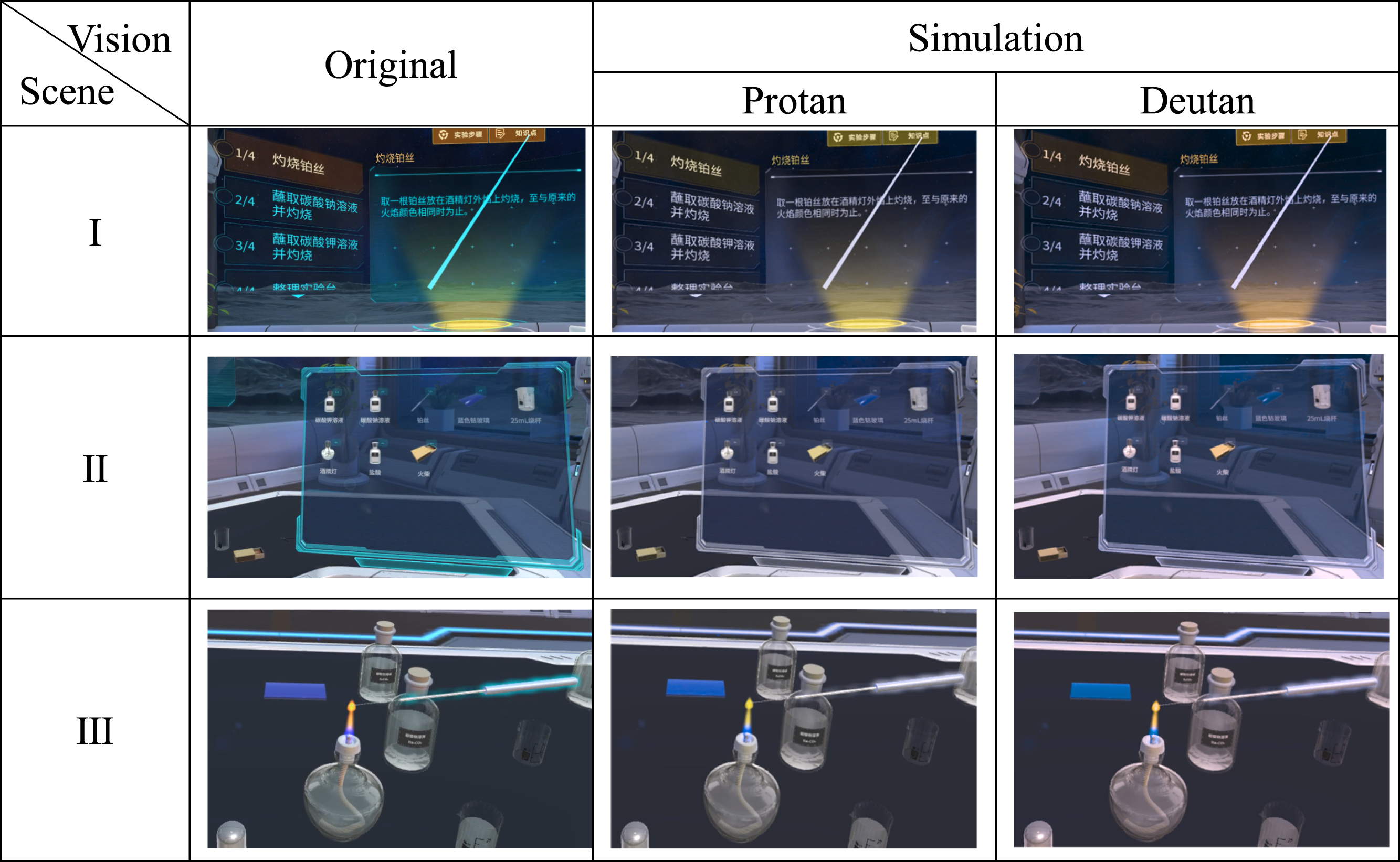
Visual Perception of Learners with Red-Green Color Blindness on IVETR.

Note. Protan is red color blindness, Deutan is green color blindness, Tritan is blue-yellow color blindness.
Based on the Colorblind Barrier-free Color Pallet (as shown in Figure 1) proposed by Masataka and Kei (2002), yellow was selected in this study to replace the unrecognizable bluish green, which is similar to the color style in the original IVETR and easy to be identified by learners with red-green color blindness. For example, the tip on the information panel and the halo appearing when the object is being captured, both can be adjusted to a barrier-free IVETR color scheme for subjects with red-green color blindness. Then adjust the contrast between the text and background image in the information panel according to the enhanced contrast standard recommended by WCAG 2.0. More specifically, the color contrast between the text and image shall be at least 7:1 according to Guideline 1.4.6 from WCAG 2.0 (W3C, 2019). For example, setting the text color in yellow to form a strong visual contrast with the bluish-black background, which helps solve the problem of color discrimination among subjects. On the basis of the original IVETR, we designed three kinds of barrier-free IVETR: CNA-IVETR, CLA-IVETR, and CCA-IVETR. The examples are shown in Figure 2. Colorblind barrier-free color pallet. Note. reference from Masataka and Kei (2002), Protan is red color blindness, Deutan is green color blindness, Tritan is blue-yellow color blindness. Examples of four kinds of IVETR. Note. (1) CNA-IVETR is Contrast Adjusted IVETR, CLA-IVETR is Color Adjusted IVETR, CCA-IVETR is Color and Contrast Adjusted IVETR. (2) Compared with the original IVETR, CNA-IVETR adjusted the contrast from 12.52:1 to 15.15:1. (3) Compared with the original IVETR, CLA-IVETR uses yellow (240, 228, 66) instead of bluish green (114, 235, 255). (4) Compared with CLA-IVETR, CCA-IVETR adjusted the contrast from 8.27:1 to 12.76:1.

Activity Design and Implementation
Two IVE autonomous learning activities were organized in our research. The specific research processes are shown in Figure 3. Initially, during the preparation, the subjects were randomly divided into two groups: 16 people in Group I and 15 people in Group II. One week before the activity, the subjects were organized to have a 2 hour training on IVE equipment operation to make them familiar with the elementary operations. Then, during the activity, all the subjects completed two rounds of learning activities under the guidance of the researcher. In Activity 1, Group I used the original IVETR, and Group II used CNA-IVETR. In Activity 2, Group I used CLA-IVETR, and Group II used CCA-IVETR. There was a 3-day interval between Activity 1 and Activity 2. The purpose of the learning activity is to test Sodium, Potassium, and their compounds by using the flame test. The learner burns the platinum wire rod dipped in the solution on the alcohol lamp and observes the color of the flame. Research process.
At the end of each activity, subjects exit the IVETR and finish questionnaires within 15 minutes. Subsequently, the researcher collected questionnaires and then counted and analyzed subjects' spatial cognition and learning experience.
Instruments
Experimental Resources
In this study, four types of IVETR were used to explore the problems, including the original IVETR, CNA-IVETR, CLA-IVETR, and CCA-IVETR. Before the activity, researchers connected HTC Vive which is a VR headset manufactured by HTC (Brown, 2016) to the computer with Windows 10 and started SteamVR which is the tool for experiencing VR content on special hardware to run a specific type of IVETR according to the requirements. The subjects wore HTC Vive and entered IVETR through the operating handles to complete the learning activities.
Ishihara Test
This is the most widely used color blindness test in the world now (Ananto et al., 2011). In this test, there is a booklet containing 25 test charts. Subjects completed the test under the guidance of the researcher, who were asked to say what they observed from the test chart.
Spatial Cognition Test
The spatial cognition test aims to measure the learning effect of the subjects using the barrier-free IVETR. In this paper, the two variables of visual discrimination (distinguishing shapes according to shape characteristics, for example, I can find the position of the object quickly) and visual memory (recognizing and recalling visual information, for example, I can recall the color of the flame when Sodium Carbonate and Potassium Carbonate burned) were selected as the evaluation factors for measuring spatial cognition. Combined with the actual teaching content, a subjective evaluation questionnaire was designed, including eight test items (see Appendix A for details), which had a Cronbach alpha value of 0.853. Using a principal component analysis to obtain factor analysis on the whole scale, the KMO value was 0.821. It is greater than 0.8, indicating good validity.
Learning Experience Survey
The learning experience survey was aimed at measuring the emotional experience of the subjects using the barrier-free IVETR. There were total of 17 questions in the three subscales (see Appendix B for details), including learning satisfaction, presence, and technical acceptance, and all items of those subscales were assessed using a 5-point Likert scale ranging from 1 (completely inconsistent) to 5 (completely consistent). More specifically, learning satisfaction refers to the extent to which subjects have a pleasurable experience, visual comfort, and interaction convenience when using IVETR, was measured by five items (e.g., the clear picture in IVETR makes me happy) from Richardson (2001) and had a Cronbach’s alpha value of 0.772. Presence refers to the degree to which learners perceive themselves as if they are in a real environment and interacting in real space, was measured with four items (e.g., I feel like I really touch a platinum wire rod) from Hartmann et al. (2016) and had a Cronbach’s alpha value of 0.714. Technology acceptance is designed to measure learners' acceptance of IVETR with eight items (e.g., I can operate IVETR and complete the flame reaction experiment skillfully), adapted from the Unified Theory of Acceptance and Use of Technology (UTAUT) scale developed by Venkatesh et al. (2003) and have a Cronbach’s alpha value of 0.764. A principal component analysis was used to obtain factor analysis on the whole scale. The KMO value was 0.805, greater than 0.8, which indicates good validity.
Data Collection Procedures
Two rounds of activities were organized in this study. After each round, basic information such as the age and gender of the students in Group I and Group II, as well as the spatial cognition and learning experience using different IVETR were investigated through questionnaires. A total of 31 questionnaires were collected. After eliminating the invalid questionnaires, a total of 30 valid questionnaires were obtained. Then the researchers coded the questionnaires and input the data into IBM SPSS Statistics 27 software to further analyze the data.
Experimental Results
Distribution of Subjects
Cross Tabulation of Class and Gender.

Results Analysis
Results for RQ1
Color Adjusted Immersive Virtual Environment Teaching Resource can improve the learning satisfaction and technical acceptance of learners with red-green color blindness markedly.
Mean, Standard Deviation and t-Test of Dependent Variables in Different Color Schemes.

Note. Bold values are significant at α = 0.05.
Results for RQ2
Contrast Adjusted Immersive Virtual Environment Teaching Resource can improve the spatial cognition and technical acceptance of learners with red-green color blindness prominently.
Mean, Standard Deviation and t-Test of Dependent Variables under Different Color Contrast.

Note. Bold values are significant at α = 0.05.
Results for RQ3
Compared with CLA-IVETR, CCA-IVETR can significantly improve the spatial cognition of learners with red-green color blindness.
Mean, Standard Deviation and t-Test of Dependent Variables Measured with Different Color Schemes or Color Contrast.

Note. Bold values are significant at α = 0.05.
Discussion and Conclusion
In this study, we discussed the influence of color scheme and color contrast of barrier-free IVETR on space cognition and the learning experience of students with red-green color blindness. The results demonstrated that color scheme of the barrier-free IVETR could significantly enhance learning satisfaction (p < .001) and technical acceptance (p = .008, < .05), increasing the color contrast of IVETR could significantly enhance spatial cognition (p = .009, < .05) and technical acceptance (p = .010, < .05), adjusting the color scheme and contrast at the same time significantly improved spatial cognition (p = .031, < .05) compared to adjusting the color scheme alone.
Increasing the color contrast of IVETR appropriately, can optimize the perception of the shape, position, layout, and spatial structure of the object. These visual details can enhance the visual effect of red-green color blindness, make up for its obstacles in color recognition, and correctly distinguish different objects (Wang et al., 2021). Adjusting the color scheme of IVETR, red and green is converted to perceptible yellow and blue that red-green color blindness can recognize. Modifying the colors that are easily confused, it can help red-green color blindness correctly recognize the object while ensuring the overall naturalness of vision (Tsekouras et al., 2021). Color plays an important role in cognitive emotion, can promote the generation of positive emotion, and enhance learning performance (Wang et al., 2023). Yellow and blue can stimulate positive emotions of CVD (Jonauskaite et al., 2020), and these emotions can help learners connect with their environment and learning content, and enhance their sense of exploration (De Araújo et al., 2020; Keltner & Cowen, 2021).
The latest research related to CVD mainly involves visual assistance in mobile or online learning environment, barrier-free color scheme and contrast model, emotional and social interaction (Hristov et al., 2022; Jonauskaite et al., 2021; Rezeanu et al., 2022; Wright, 2022), and less involves teaching and learning in new teaching environment. Immersive VR teaching resources can provide a safe learning environment and support problem-based or project-based inquiry learning (Molan et al., 2022), which is an important development direction of the future learning environment. This study provides a direction for the design of barrier-free IVETR for CVD. We should not only meet the basic visualization requirements, but also choose the color scheme and contrast that can meet the needs of spatial cognition and learning experience. When designing barrier-free IVETR, the color scheme and contrast of the main environment and objects should be adjusted to achieve the balance between visual interaction and learning experience. That is, on the premise of maintaining naturalness, ensure that the red-green blind can recognize key spatial information and interactive objects. With the emergence of more advanced optical materials and the maturity of intelligent color redrawing technology, barrier-free immersive teaching resources will develop more rapidly, serve more educated people, and promote more fair and sustainable development of education.
Limitations and Future Research
Future research directions are suggested based on the limitations of the current research. This study is to explore impacts of color scheme and color contrast on the spatial cognition and learning experience of learners with red-green color blindness in IVETR. Only self-reported questionnaires have been used to collect data, which is prone to subjective bias. In addition, to reduce the interference with the normal teaching order of the subjects, this study selected the IVETR with the same teaching content. Consequently, the validity of the research conclusions need to be further verified.
As for future research, here are three suggestions. The first one is to expand research samples and adopt a variety of methods to perform cross-validation on the conclusions. It’s recommended to combine the questionnaire with interview and observation to form a complementary advantage between the quantitative and the qualitative method, which can strengthen the effectiveness of the research conclusions.
The second suggestion is to improve the richness of barrier-free IVETR. For example, by exploring the use of barrier-free IVETR of different disciplines or stages to determine whether the same results can be observed in the learning project samples of other disciplines and stages, so as to verify the generalizability of the research conclusions.
The third suggestion is to study adaptive barrier-free IVETR. Due to physiological differences among different learners, the degree of CVD is different. Limited by the objective conditions, this study only focuses on the main groups with CVD - learners with red-green color blindness, which is not enough to cover all the people with CVD. From the perspective of Inclusive Education and educational equity, it is necessary to further explore the barrier-free IVETR design for people with different types of CVD.
Footnotes
Declaration of Conflicting Interests
The author(s) declared no potential conflicts of interest with respect to the research, authorship, and/or publication of this article.
Funding
The author(s) disclosed receipt of the following financial support for the research, authorship, and/or publication of this article: This project was funded by the National Natural Science Foundation of China (62277024) and The Central China Normal University of Research Projects of National Teachers’ Development Cooperation Innovation Experimental Base Construction (CCNUTEIII 2021-05).
Data Availability
The data that support the findings of this study are available from the corresponding author upon reasonable request.

Appendix A. Spatial Cognition Scale.
Variable
Item
Source and Cronbach’s Alpha Reliability
Spatial cognition
SC_1
I can perceive the position and distance between the object and me
Adapted from Brown and Peres (2018) Cronbach’s Alpha = 0.853
SC_2
I can find the position of the object quickly
SC_3
In IVE, I have a good sense of direction and won’t get lost
SC_4
I can operate IVE and its objects skillfully
SC_5
I can recall the overall appearance of IVETR.
SC_6
I can recall the color of the flame when sodium carbonate and potassium carbonate burned
SC_7
I can recall the experimental steps prompted in the information panel
SC_8
I can remember the position of the experimental instrument panel clearly
Appendix B. Learning Experience Scale.
Variable
Item
Source and Cronbach’s Alpha Reliability
Learning satisfaction
LS_1
I am very satisfied with the experience of using IVETR to carry out autonomous learning
Adapted from Richardson (2001) Cronbach’s Alpha = 0.772
LS_2
The clear picture in IVETR makes me feel happy
LS_3
I can complete the flame reaction experiment freely and easily
LS_4
The interactive design of IVETR enables me to carry out experiments flexibly
LS_5
I am very satisfied with the learning effect of using IVETR.
Presence
Pre_1
I feel that the alcohol lamp, test tube rack and other items are located on the side of my body
Adapted from Hartmann et al. (2016) Cronbach’s Alpha = 0.714
Pre_2
I feel I can walk freely in IVE.
Pre_3
I feel like I really touch a platinum wire rod
Pre_4
I feel that using IVETR to do experiments is like doing experiments in a real environment
Technology acceptance
TA_1
I am willing to use IVETR to carry out learning activities
Adapted from Venkatesh et al. (2003) Cronbach’s Alpha = 0.764
TA_2
I think IVETR is very helpful to my study
TA_3
I think it is more convenient to find prompt information by using IVETR.
TA_4
I think the knowledge points in IVETR are very comprehensive
TA_5
It’s easy for me to learn with IVETR.
TA_6
I can quickly find the required sodium carbonate, potassium carbonate, and other drugs in IVETR.
TA_7
The experimental steps and operation guidance shown in IVETR are clear and easy to understand
TA_8
I can operate IVETR and complete the flame reaction experiment skillfully