



Abstract
This paper brings together studies of civil war consequences and literature on military spending, introducing a novel mechanism for how civil wars adversely affect neighbors—through neighbors’ increased military spending. Military expenditures are important because they often inhibit development. Civil wars affect proximate states’ defense spending because the potential spillover threatens neighbors. Tests on developing countries from 1950 to 2006 suggest that bordering civil wars are associated with military spending levels, independently of arms races or civil war interventions. Analyses use measures of neighboring civil war that take into consideration whether or not the civil war zone reaches the shared border.
Studies in the economics literature suggest that higher levels of military spending can harm the economies of developing countries (e.g. Dunne, 2012), but determinants of military spending are debated (e.g. Quiroz Flores, 2011). Meanwhile, researchers from a number of fields seek to understand the consequences of civil war, including international effects (Bayer and Rupert, 2004; Chamarbagwala and Morán, 2011; Lai and Thyne, 2007; Murdoch and Sandler, 2002, 2004). This paper brings together these important topics, arguing that civil war leads to increased military spending in neighboring countries. States feel threatened by the potential for civil war spillover and augment military expenditures. Results suggest a novel mechanism for how civil war can adversely affect neighboring countries.
Beyond simply considering civil wars in neighboring countries, the paper also takes into consideration the location of a civil war within the neighboring country. A number of studies suggest the importance of considering the specific location of conflict within a country (e.g. Buhaug and Gates, 2002; Buhaug and Lujala, 2005). Geographic data are used to identify neighboring conflicts that reach the border of the country being analyzed. Conflict in a neighboring country might not be expected to have an impact if it is hundreds of kilometers away from the shared border (Gleditsch, 2007: 306). States should feel more threatened by the negative externalities of civil war if it is on their doorstep. Contrasting results across different measures of neighboring conflict show the importance of taking seriously proximity, and understanding that civil conflict is not necessarily a state-wide phenomenon. Disaggregating civil wars based on their proximity to neighbors helps determine the mechanism through which civil wars affect the military spending of neighbors.
The next section discusses extant research on consequences of civil war, and explains how increased military spending can have serious domestic economic consequences. I then argue that concerns about civil war spillover cause neighboring states to increase their military spending, but only if the nearby civil war reaches the shared border. Then the research design is discussed, which involves both country-year and dyad-year analyses. The results suggest that a country’s military expenditures are positively associated with a civil war in a neighboring country that reaches the shared border. There is no such positive relationship involving nearby civil wars that do not reach the border. Robustness checks attempt to rule out alternative mechanisms, and suggest that the relationship involving proximate civil wars is not conditional on the military spending of the civil war state—a neighborly arms race is not the cause. Additionally, the results occur independently of whether the state was intervening in its neighbor’s civil war. Together these findings show that nearby civil wars are related to military spending increases because of apprehension about potential spillover. The paper concludes with suggestions for future research.
Literature review and argument
In recent decades, civil wars have occurred with far greater frequency than inter-state wars, and tend to last longer (e.g. Fearon, 2004; Themnér and Wallensteen, 2013). The consequences of civil war are substantial. Ghobarah et al. (2003) show that nearly as many people are killed indirectly by civil war—from increased spread of disease, damaged infrastructure, etc.—than are killed by the actual combat. A few studies have shown that civil wars have substantial economic consequences for the countries in which they occur, in terms of capital flight (Collier, 1999) and loss of human capital (Chamarbagwala and Morán, 2011). Lai and Thyne (2007) find that civil conflict devastates national educational systems. Years after the conflict ends, post-conflict countries still face unique challenges to development (Flores and Nooruddin, 2009; Garriga and Phillips, 2014). Civil wars also have profound international consequences, such as reducing a civil war state’s international trade (Bayer and Rupert, 2004), and reducing economic growth in neighboring countries (Murdoch and Sandler, 2002, 2004). However, there are numerous ways in which civil war can adversely affect other countries, and only some have been explored. Overall, international connections between civil war and economic issues contribute to the regional nature of conflict and development processes (Collier et al., 2003; Gleditsch, 2002a).
Beyond the research cited above, few studies have examined the international economic consequences of civil war. This is a crucial area of study, as civil war countries’ neighbors are already often economically fragile, and adverse economic effects could put them further at risk for their own civil wars. Murdoch and Sandler’s research (2002, 2004) shows that civil wars lead to negative growth in civil war countries and nearby countries. They say that military spending could contribute to this because it diverts funds from roads and schools, but they seem to suggest that this only occurs in the country in which the civil war takes place (Murdoch and Sandler, 2002: 96; 2004: 139). They do not directly test explanations or consequences of changes in military spending. Murdoch and Sandler conclude that nearby civil wars lead to regional negative economic growth through uncertainty and direct disruption of economic activity. They do not find support for suggestions that nearby civil wars adversely affect growth through diluting human capital, enhanced population growth from migration, or substantial decreases in investment. What about military spending? The remaining uncertainty regarding the economic consequences of civil war on military spending in the region is one impetus for this paper.
Negative consequences of military spending
Military spending is an important area of study, especially as it relates to developing countries. Levels of military expenditures in poorer countries are generally negatively related to economic growth and investment, at least in the short term (Dunne et al., 2002; Dunne, 1996, 2012; Hou and Chen, 2013). 1 This negative impact occurs through a number of mechanisms. First, military expenditures can crowd out other spending, such as that on education, job training and health (Apostolakis, 1992). Second, increased military expenditures are often funded by increased money supply (Deger, 1986). The resulting inflation can be devastating. Third, and related to the previous point, developing countries also borrow to pay for military expenses. Increased military spending is associated with increased external debt (Smyth and Narayan, 2009). Fourth, a growing military generally requires labor. This can be partially advantageous as it provides new jobs and skills to recruits (Benoit, 1978). However, many skills are not transferrable to the civilian world, and the economy can be harmed if workers are pulled from other sectors (Deger, 1985).
Negative consequences of military spending are especially likely in developing countries. One reason that developing countries in particular are negatively affected by increased military spending is that lower-income countries generally do not produce their own armaments. This requires that more of the usually scarce foreign exchange goes to arms, instead of other goods. During the 1980s, for example, approximately 10% of all imports by developing countries were military-related (Grobar et al., 1990). As a result, developing countries miss out on one of the few advantages of defense spending: a boon to the (military) industrial sector. 2 An additional reason developing countries in particular are likely to face negative economic consequences is the lack of the ability to deficit spend without inflationary pressures. This means that increases in one area of spending necessarily come at the cost of other areas of spending. Therefore, cuts in social, infrastructure or other spending are even more likely in developing countries. Some studies find military spending to be positively related to unemployment—but only in developing countries (Tang et al., 2009).
Military spending, then, is important to understand in part because it seems to hinder the growth of developing countries. Yet what explains military expenditures? The literature suggests a number of factors, such as current involvement in a war, a history of war and neighborhood military spending (e.g. Collier and Hoeffler, 2007; Quiroz Flores, 2011). This paper argues that civil wars in neighboring countries also lead to increased military expenditures, depending on the location of the war in the country.
Civil war spillover fears and neighbors’ military spending
A country is likely to be concerned about a civil war in a neighboring state—particularly as the battle zone approaches the countries’ shared border. Proximity indicates a greater potential for spillover. Spillover in this context refers to the spread of violence and other security-related issues from the conflict country to its neighbors. 3 Spillover can include civil war contagion, but also comprises the spread of lower levels of violence and instability to neighboring states. This section focuses on three particular conduits of spillover discussed in the literature: refugees fleeing the conflict, rebels seeking shelter and state security forces pursuing rebels. These three phenomena need not actually occur to provoke military spending changes in neighboring countries. If the neighbors fear the possibility of any of these outcomes, however, the neighbors are then likely to increase their military expenditures.
Civil conflict often causes refugees to flee into neighboring states, as can be seen in cases throughout the world. Refugees are usually victims and not necessarily affiliated with militants, but they can nonetheless affect stability in the host country. Civil war refugees can challenge natives for jobs, lead to political crises or upset a sensitive ethnic balance, among other issues (Lischer, 2003; Weiner, 1992/1993). Refugees can pressure the host government to get involved in the conflict from which they fled, and provide resources to opposition groups in the host country (Saleyhan, 2009: 36). The very presence of refugees in a country is associated with an increased likelihood of civil conflict (Saleyhan and Gleditsch, 2006). Independently of whether a new civil war actually breaks out, the host country could be expected to increase military spending as refugees enter its territory, anticipating a potential domestic conflict or other security threat.
Another way proximate civil conflicts affect neighbors is when rebels cross the border. Foreign sanctuaries can be crucial for insurgents seeking to avoid the security forces of the state in which they normally fight (Salehyan, 2008). Indeed, when civil wars occur near borders, conflicts tend to last longer and be geographically larger, and this is argued to be at least in part because of the resource advantage provided by external bases (Buhaug and Gates, 2002; Buhaug et al., 2009). When rebel forces regularly cross the border, the receptor state might feel threatened and shift expenditures toward the security sector as result. This could be out of fear of the rebels attacking the host state or enabling local dissidents. If the host state permits the rebels to use its territory, perhaps it does not fear them, but it would be reasonable for the host state to expect retaliation from the government fighting the civil war. Whether rebels are trespassing or welcome in their cross-border refuge, then, the consequence is likely to be higher security spending for the host state.
Security forces from civil war states sometimes also cross borders, and the possibility of this is likely to encourage neighboring states to ready their defenses. Sometimes security forces chase rebels across the border in “hot pursuit”, raising a territorial sovereignty issue. One example of this is when Colombian troops crossed into Ecuador in 2008, claiming to pursue FARC members, and killed a number of people, including Ecuadorians. Ecuador responded with a mobilization of troops toward the Colombian border. Beyond intentional cross-border military action, civil conflict can also cause apprehension in neighboring states when munitions such as mortar rounds unintentionally cross the border. Incidents like these are part of the reason civil war near the border can provoke inter-state conflict between neighbors (Byman and Pollack, 2007; Salehyan, 2009: esp. chapter 3), and the potential for this is likely to affect decisions about military spending.
It is important to note that civil war reaching the shared border does not necessarily increase the likelihood of civil war in the neighboring state. In fact, research suggests that the actual diffusion of civil war seems to be conditional upon other factors, such as cross-border ethnic communities (Buhaug and Gleditsch, 2008). Nonetheless, the mechanisms discussed above suggest that a neighboring civil war is sufficient to concern a state, representing a serious security threat. Independently of whether the neighboring state experiences a civil war itself, it will want to prepare for this possibility, or the possibility of other threats such as violence below the threshold of civil war, or inter-state conflict with the civil war state.
Because a state is apt to be aware of the possibility of a nearby civil war leading to its own civil or international conflict, the state’s rational response would be to increase its preparedness for conflict. This probably would mean increased military spending, and other measures such as increasing training and shifting of security resources toward the border. Nonmilitary options might be pursued as well, such as attempting negotiations with the neighbor state, but given the self-help nature of the international system, it seems unlikely that states will invest all of their resources in negotiations. Indeed, the literature on military spending shows that states’ military expenditures are explained in part by whether they are currently involved in a civil war or international war (Dunne and Perlo-Freeman, 2003). Similarly, if a state faces a potential threat via civil war spillover, they will probably prepare for that as well.
Overall, countries bordering civil war zones have good reason to feel threatened, and are likely to respond to this with increased military spending. Actual transnational spillover of violence is not necessary for the military spending effect to occur; all that is necessary is that states fear such spillover. It is probable that states can more reasonably expect spillover when the civil war reaches its border. This suggests the following hypothesis:
The hypothesis suggests that a country’s location bordering a civil war zone, that is, when a civil conflict in a neighboring country actually reaches the shared border, is crucial to the effect on military spending. This is because the argument emphasizes preoccupation about the spillover of violence and instability, including through the physical movement of refugees, rebels and security forces across borders. Implicit in this notion is the idea that a state’s military expenditures should be more affected by a neighboring civil war that actually reaches its border than one elsewhere in the neighboring state. In other words, if a state is concerned about the possibility of spillover when a neighbor experiences civil war, the state should especially be alarmed when the violence of the civil war approaches its own border.
For example, the Peruvian civil war involving Sendero Luminoso was mostly in the center and east of the country. Violence did not occur not near the southern border with Chile, so Chile had less reason to worry about spillover. For this reason, we might not expect Chile to increase its military spending as a response to Peru’s civil war. Similarly, when Turkey fought the PKK, the conflict was mostly confined to the southeast of the country. As a result, Georgia (to the northeast) and Bulgaria (northwest) probably were not threatened by spillover from the Turkish civil war, and did not increase their military spending during war years.
Having argued that bordering civil war zones are likely to present greater threats than civil wars further away, it is still possible that the neighbor simply decides to increase its defense burden preventively in response to a nonbordering civil war. This could be done as a precautionary measure, in case the relatively distant civil war were to expand, reaching the border in the near future. While possible, this seems less likely than a bordering civil war to cause military spending increase. This is because any addition to the military budget generally comes at the cost of another part of the budget. As discussed in the section above on economic consequences of defense spending, developing countries in particular face tough choices with military budgeting. As a result, only the most serious, or at least potentially serious, threats can be responded to with increased security funds. A neighboring civil war not reaching the shared border could lead to preventative increases in defense spending, but because of the cost involved this is less likely than an increase based on a bordering civil war zone.
There are many ways in which civil wars can affect their neighbors, but the consequences are most likely to spill over—through refugees, rebels, state security forces, or other means—when the war zone reaches the shared border. To offer a more direct test of the spillover mechanism, and attempt to rule out alternative causal mechanisms between nearby civil war and military spending, I propose the following hypothesis:
The first hypothesis is the general argument that a country’s military spending should be positively affected by a neighboring civil war that reaches the shared border, while the other hypothesis attempts to discern the mechanism through which the higher levels of military expenditures are brought about. The second hypothesis suggests that bordering the conflict area is crucial. If the outcome of interest were simply a function of international dynamics such as the military spending in the civil war state, the location of the civil war should not matter. Possible alternative mechanisms are discussed at the end of the empirical section.
Research design and tests
The hypotheses are tested on a sample of all developing countries for which there are enough data, from 1950 to 2006. 4 Developing countries are defined as those that are not in the Organisation for Economic Co-operation and Development (OECD). Two types of studies are used: monadic country-year analysis and dyad-year analysis. Monadic studies are more commonly used in the military spending literature, so these tests demonstrate the results on a standard unit of analysis. Dyadic data are necessary to perform robustness checks and test alternative mechanisms: the neighbor’s military spending and whether the country intervened in the neighbor’s civil war. In the monadic studies, the unit of analysis is the country-year, and the number of observations in the sample is 5186 country-years. These models examine 135 countries. Dyadic studies examine a total of 19,213 dyad-years, including 575 pairs of contiguous states. Some models have fewer observations, depending on independent variable data. Descriptive data for the monadic data, the most easily interpretable, are shown in Table 1.
Descriptive statistics of data used in monadic sample
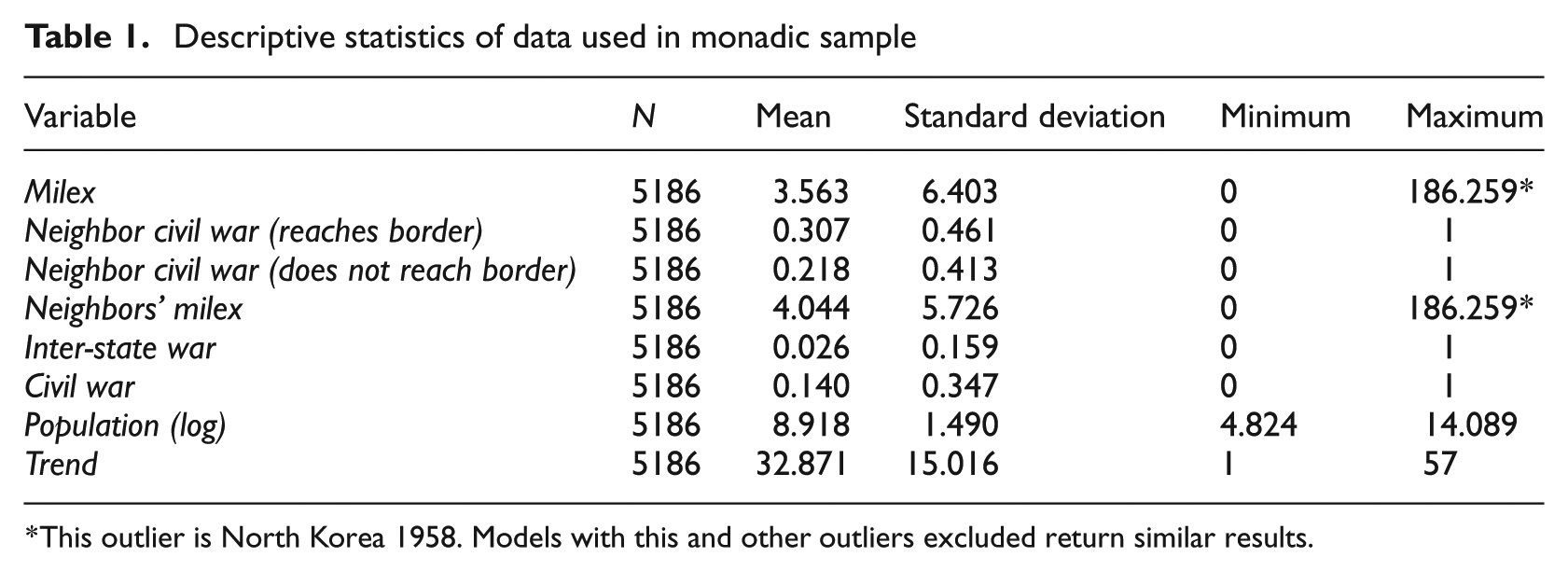
This outlier is North Korea 1958. Models with this and other outliers excluded return similar results.
The dependent variable is milex, which is military expenditures as a percentage of the country’s gross domestic product (GDP). 5 This is a standard measure of the defense burden (e.g. Albalate et al., 2012; Collier and Hoeffler, 2007; Quiroz, 2011). This measure makes sense for the present study as I am interested in the defense burden relative to a country’s wealth. The military expenditures portion of this variable comes from the Stockholm International Peace Research Institute. Data are accessed through both the Quality of Government project (Teorell et al., 2011) and the Correlates of War national material capabilities data (Singer and Small, 1972). The GDP data come from the Penn World Table Version 6.3 (Heston et al., 2009). Missing GDP data are filled in with Gleditsch’s (2002b) expanded version of the Penn data. The mean of milex is 3.563, although there is considerable variation. Most countries in the sample usually have military expenditures that are less than 5% of their GDP, with many below 1%. However, some countries have military spending rates in the double digits, particularly during war years.
The primary independent variable is neighbor civil war (reaches border). This is a dichotomous variable marked 1 when a civil war in a neighboring country has violence reaching the border of the state being analyzed. 6 For the monadic studies, this variable indicates such a proximate civil war in any of the neighbors, but in the dyadic studies the variable indicates a proximate civil war in state 2 of the dyad. Civil war is measured following the protocol of the Uppsala Conflict Data Program (UCDP)’s “civil war”, and has the following criteria: (a) the conflict must occur between the government of a state and internal opposition groups; and (b) there must be at least 1000 battle-related deaths in at least one year of the conflict (Gleditsch et al., 2002). 7
The ArcView 9.3 program for geographic information systems is used to determine which civil wars actually reach the border the two states share. To obtain the location of these conflicts, I use the Peace Research Institute Oslo (PRIO) data described in Buhaug and Gates (2002). These data plot the “midpoint” of the fighting area of each civil conflict, in longitude and latitude. Scholars determine the midpoint by first mapping all of the violence of the conflict that is reported, and then marking the center. The data also include information on the radius of the conflict area, so one may see the approximate area of the conflict. When this area, in a neighboring country, touches the border of the country under analysis, the country is coded for neighbor civil war (reaches border). A disadvantage of this measure is that the use of a midpoint to create a circular conflict area is a rough estimate of the actual conflict area; conflict zones are of course not perfectly circular. 8 However, the benefits of this method outweigh the disadvantages of the less precise approach of counting a neighboring civil war as any civil conflict in a neighboring country. Hypothesis 2 helps sort out to what extent relative location within the country matters.
The second key independent variable is neighbor civil war (does not reach border). This is a dichotomous variable coded 1 for each country that has a neighbor experiencing a civil war, but only if that civil war does not reach the border of the country being analyzed. Hypothesis 2 suggests that, if this variable is positively related to military spending, it should not have an impact as great as that of neighbor civil war (reaches border).
A number of other factors are likely to contribute to the explanation of a state’s defense burden. One control variable used in the country-year (monadic) analyses is neighbors’ milex, an average of the military spending (divided by GDP) of all states contiguous to the state being analyzed. Neighbors’ military expenditures have been shown to have a positive association with a country’s military spending (Albalate et al., 2012; Collier and Hoeffler, 2007). 9 Dyadic analyses use neighbor’s milex. The source of the military spending measure is the same as that which is used for the dependent variable.
Models also include inter-state war, which is a dichotomous variable measuring if the country under analysis is involved in an inter-state war. (In the dyadic data, this and other controls refer to attributes of state 1 unless otherwise noted.) This is coded according to the UCDP criteria of armed combat between at least two recognized countries resulting in at least 1000 deaths during at least one year (Gleditsch et al., 2002). As one might expect, international war is associated with increases in military expenditures (e.g. Dunne and Perlo-Freeman, 2003). Models also include civil war, which measures civil war in the country being analyzed, and otherwise follows the criteria described above for the neighbor civil war variables. Countries experiencing civil war often increase their military spending (Albalate et al., 2012).
Models also include a measure of population, because countries with larger populations tend to spend less on the military (Rosh, 1988). This is argued to be because of economies of scale. Population values come from the Penn World Tables and Gleditsch (2002b), and are transformed into natural logarithms. Models also include a year count variable, trend, to take temporal issues into consideration, such as a general decrease in military spending over time. All independent variables are lagged one year to avoid reverse causality issues and because changes in military budgeting take time to occur.
Dyadic models include one additional control variable. History of war with state 2 is a dichotomous variable coded 1 if the two states in the dyad have gone to war against each other within the past 10 years. To be clear, this variable is only coded 1 if the states have been on opposite sides of a conflict. With this variable and inter-state war, the measure of current involvement in a war, it is possible that inter-state dynamics are complicating the model, which attempts to understand a transnational phenomenon. However, if either or both of these variables are excluded, results for the hypothesized relationships remain.
The estimator used is an ordinary least squares regression (OLS), because of the continuous nature of the dependent variable. Models are estimated with country- or dyad-level fixed effects, because it seems likely that these effects explain a great deal of the variance in the dependent variable. Because countries or dyads are measured repeatedly over time, this would violate the OLS assumption that error terms are independent and identically distributed across observations. Models use fixed effects instead of random effects because a Hausman test shows that there is a systematic difference between the two types of estimation techniques, and that random effect results appear to be inconsistent. Random effects models, however, return similar results.
Another potential threat to the validity of OLS results is the assumption that data used for time-series cross-sectional OLS models are stationary. In fact, variables can have unit roots, suggesting temporal processes that can substantially affect inferences. However, Fisher tests, based on either Phillips–Perron or augmented Dickey–Fully specifications, suggest that we can reject the null hypothesis of unit roots associated with the data used in this paper. This is consistent with other studies of military spending in developing countries that have shown these data to be stationary (e.g. DeRouen and Heo, 2001; Lin and Ali, 2009) 10
Results
The empirical results for monadic tests are shown in Table 2. Models 1 and 2 show the primary independent variables without control variables. These models are important because control variables can complicate the interpretation of independent variables of interest, potentially producing misleading results. Generally, the possibility of omitted variable bias concerns scholars (Clarke, 2005), but important arguments have been made for parsimony in control variable inclusion (Achen, 2005; Ray, 2003). Showing models without controls seeks to address these concerns.
Fixed effect country-year regressions of military expenditures in developing countries, 1950–2006
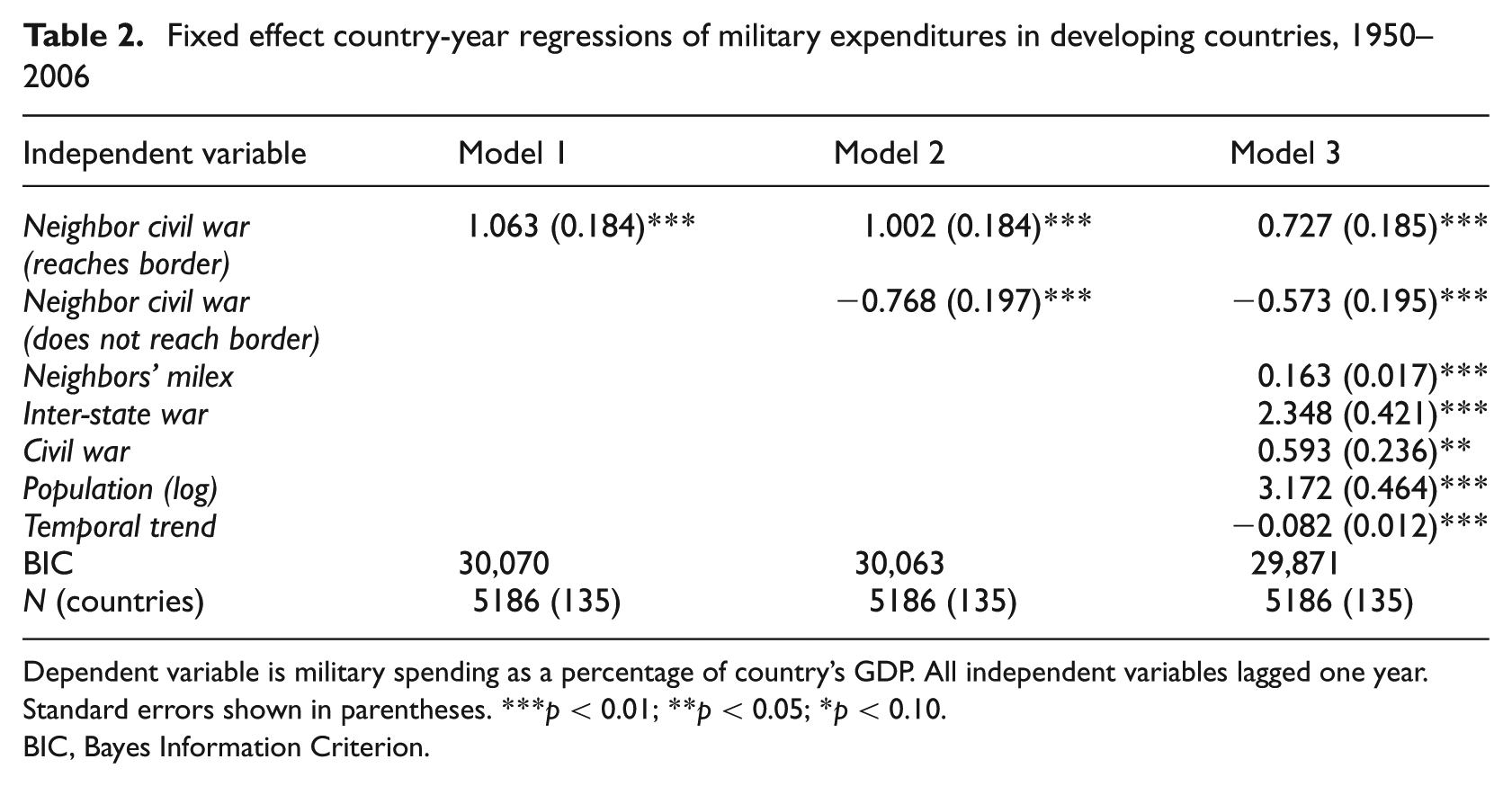
Dependent variable is military spending as a percentage of country’s GDP. All independent variables lagged one year. Standard errors shown in parentheses. ***p < 0.01; **p < 0.05; *p < 0.10.
BIC, Bayes Information Criterion.
In models 1 and 2, neighbor civil war (reaches border) is statistically significant and positive. This suggests that a country bordering a civil war zone is associated with a higher level of military expenditures than a country not in that situation. This is consistent with hypothesis 1.
Neighbor civil war (does not reach border) is statistically significant in both models, but is negatively signed. I did not have an expectation about this variable beyond its impact relative to the other primary independent variable, but a negative sign is surprising. The negative sign suggests that a civil war not reaching the shared border is associated with lower levels of military spending. It is possible that this is a result of the state under analysis reducing its military expenditures because its neighbor is distracted elsewhere, and therefore less of a threat. Perhaps states whose neighbors are experiencing civil war—as long as it does not reach the shared border—feel they can devote resources elsewhere, and cut military spending. Regardless of the negative sign, the difference in results provides support for hypothesis 2: civil wars in neighboring countries reaching the border have a greater positive impact on military spending than civil wars located further away in the neighboring country.
Model 3 includes the full set of control variables. Results for the neighbor civil war variables are consistent with the previous models. As far as substantive significance, the 0.727 coefficient associated with neighbor civil war (reaches border) suggests that if a typical developing country goes from no bordering civil war zone to having a bordering civil war, its military spending will increase from 3.56 to 4.29% of its GDP, other factors held constant. This is a 20% increase in military spending. It is about one-third the increase that a country sees when it is involved in an inter-state war, which is substantial.
The substantive significance of neighbor civil war (does not reach border) is less than that of neighbor civil war (reaches border). Consistent with the argument about spillover fears, the impact of a nearby civil war on military spending substantially depends on whether that civil war reaches the shared border.
The results for the control variables are largely in line with the literature. The coefficient on the variable associated with neighbors’ (or dyadically, the neighbor’s) military spending is positively signed and statistically significant. The neighborhood effect appears to matter. Inter-state war and civil war are positively signed and statistically significant, suggesting that involvement in either type of conflict leads to an increase in military spending. In the dyadic models, history of war with state 2 is statistically significant and positive, as expected. Population is positively signed and statistically significant, suggesting that, as a country’s population increases, it spends more of its wealth on the military. This is at odds with some studies (Rosh, 1988), but it is unclear why there would be a difference. If the variable is excluded, other results are unchanged. The temporal trend variable, trend, is negatively signed and statistically significant, suggesting that military spending generally decreases with time. This is consistent with previous research.
Robustness checks
Table 3 shows models using the dyad-year unit of analysis. Models 4–6 basically replicate the models in the previous table, and return similar results. The results for the control variables are similar to those in Table 2. One variable that is new in the dyadic models, history of war with state 2, is statistically significant and positive, as expected. (Models 7 and 8 are discussed below under alternative mechanisms.)
Fixed effect dyad-year regressions of military expenditures in developing countries, 1950–2006
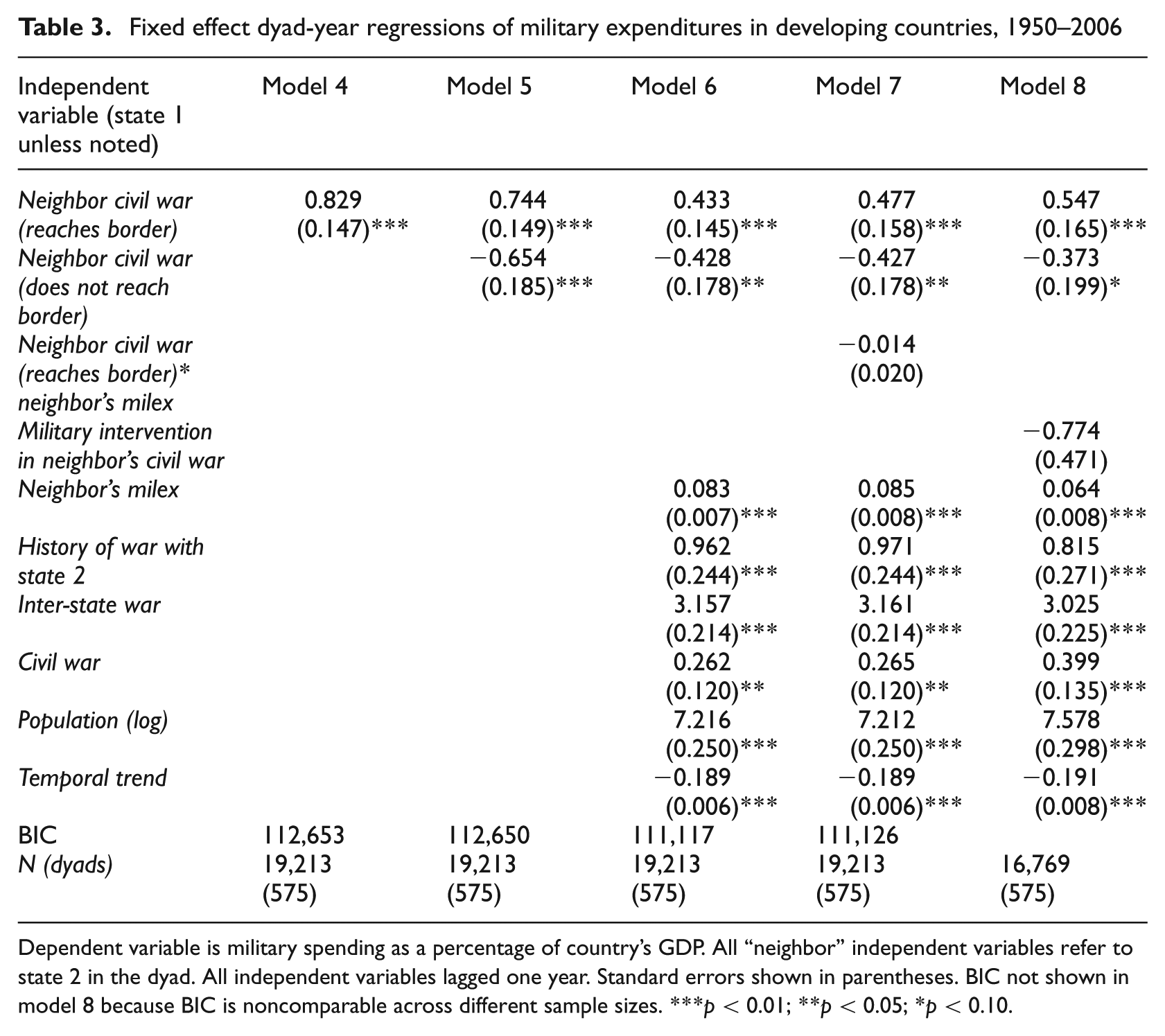
Dependent variable is military spending as a percentage of country’s GDP. All “neighbor” independent variables refer to state 2 in the dyad. All independent variables lagged one year. Standard errors shown in parentheses. BIC not shown in model 8 because BIC is noncomparable across different sample sizes. ***p < 0.01; **p < 0.05; *p < 0.10.
Table 4 includes number of additional robustness checks. In the interest of space, the table only shows replications of model 3, the primary test of hypotheses 1 and 2, but results are similar across other models. Model 9 indicates that removing outliers, the handful of observations where milex is reported to be greater than 50% of GDP, does not affect results. It was noted previously that inter-state conflict variables could be confounding the relationship between neighboring civil war and military spending. Model 10 excludes the inter-state war measure, and the results hold. Model 11 uses random effects and regional dummy variables (not shown), and the results are similar. 11 Model 12 substitutes independent variables measuring neighboring civil conflict (25 or more battle deaths in a year) instead of civil war. The model produces similar results, although the two neighbor civil war variables have slightly smaller coefficients, as we might expect because less deadly conflicts are included.
Robustness checks of model 3
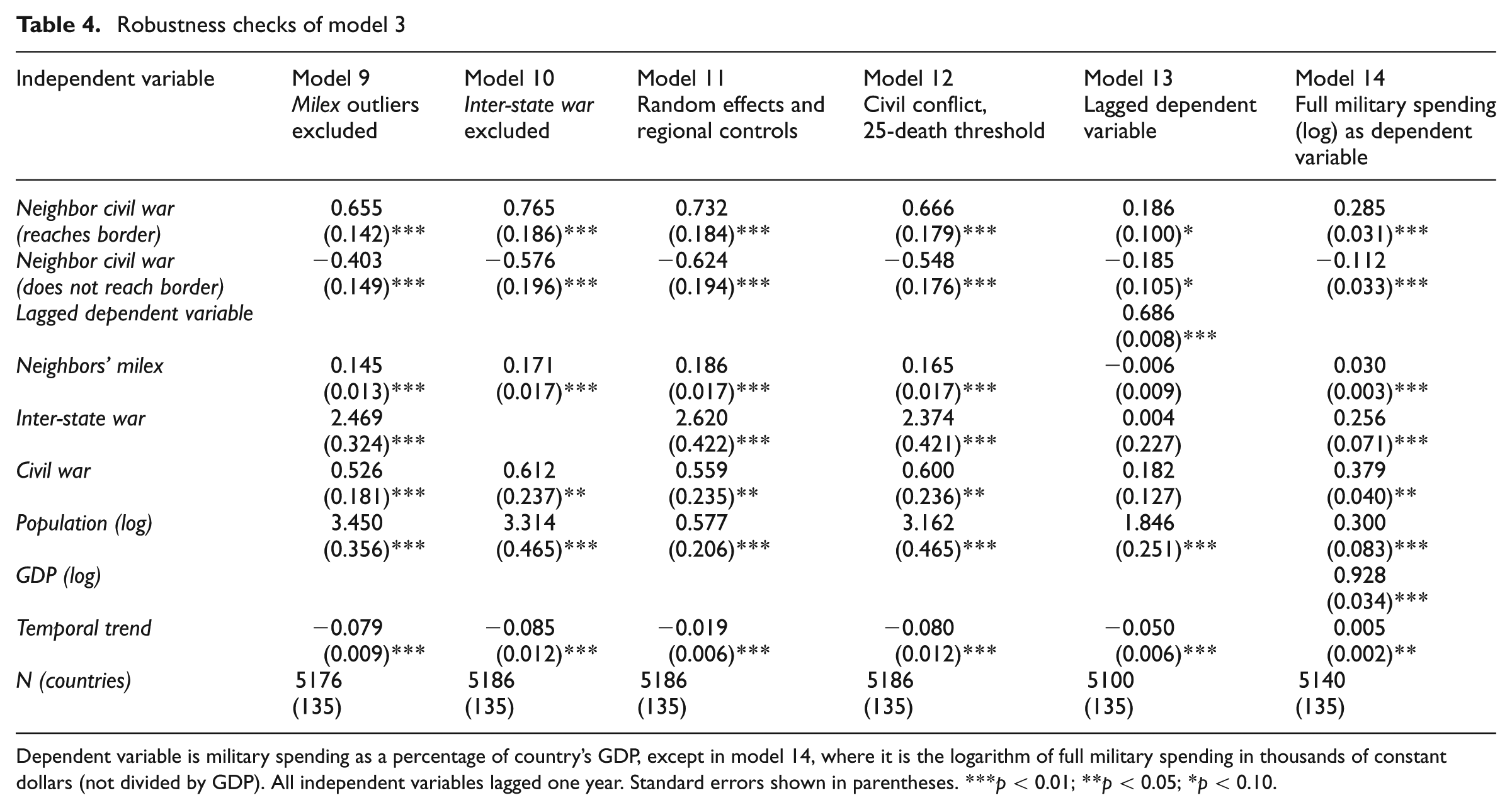
Dependent variable is military spending as a percentage of country’s GDP, except in model 14, where it is the logarithm of full military spending in thousands of constant dollars (not divided by GDP). All independent variables lagged one year. Standard errors shown in parentheses. ***p < 0.01; **p < 0.05; *p < 0.10.
Model 13 includes a lagged dependent variable, and the coefficients for hypothesis variables maintain their directions, but are only statistically significant at the p < 0.10 level. However, note that several control variables theoretically associated with defense burden lose their statistical significance in this model—the measures of neighbors’ military spending, inter-state war and civil war. This could be consistent with Achen’s argument that including a lag in some types of models can introduce multicollinearity and bias, suppressing some actual effects. 12
Model 14 uses an alternative measure of the dependent variable, a logarithm of full military spending in thousands of constant dollars (not divided by GDP). The model also includes a GDP measure, measured as a log of thousands of constant dollars, as is common in models where the dependent variable is not scaled by GDP (Dunne and Perlo-Freeman, 2003). Results from previous models are robust to the use of this dependent variable measurement.
Possible alternative causal mechanisms: arms race and intervention
Beyond the spillover argument presented earlier, there are other explanations for why neighboring civil war might be positively associated with military spending. One possibility is arms race and inter-state security concerns: this starts with the civil war state increasing its own military spending in an attempt to more effectively wage war against the rebels (Collier and Hoeffler, 2007; Dunne and Perlo-Freeman, 2003). As a response to the military spending increases in the civil war country, neighboring states increase their own military expenditures (Collier and Hoeffler, 2007). This neighborhood effect, contributed to by neighboring civil war, could be what drives military spending in countries bordering the civil war state. In other words, the effect of nearby civil war on a state’s military spending is conditional on the military spending of the civil war state.
Results in the models suggest this is unlikely. First, the difference in results between the two neighbor civil war variables in all of the models suggests that the location of the civil war matters to neighbors’ military spending. This should not be the case if the state’s military spending were being driven by the neighbor’s military spending. In an effort to further rule out this alternative story, model 7 directly examines if the impact of a neighboring civil war is conditional on the neighbor’s military spending. It is not. The coefficient for neighbor civil war (reaches border) has virtually the same substantive significance as in the unconditional model (model 6). This suggests that, even when state 2’s military spending is 0, the proximate civil war has about the same effect on military spending of the state being analyzed (state 1). Additionally, the coefficient for the interaction term is statistically insignificant. Tests using the lincom command in Stata suggest that there is no statistically significant difference between values of neighbor civil war (reaches border) at different values of the neighbor’s military spending. Increases in military spending associated with nearby civil war do not seem to be caused through an arms race mechanism.
A second possible alternative to the spillover mechanism is related to foreign intervention in civil wars. The apparent relationship between neighbor civil war (reaches border) and military spending could be a result of the country under analysis militarily supporting a side in the conflict. Higher levels of military expenditures in this situation would be the result of arms transfers, not fear of potential spillover. Intervention is common in civil wars; foreign countries or international institutions intervened in approximately two-thirds of civil wars in the second half of the twentieth-century (Regan, 2002). However, there are several reasons why international intervention in civil wars is insufficient to explain why there is a general relationship between neighboring civil wars and military expenditures.
First, analysis of Regan’s data suggests that fewer than 20% of interventions involve contiguous neighbors. 13 Many more interventions are by distant great powers, so it seems unlikely that the relatively rare neighborly involvement in civil wars generally affects military spending. Second, to empirically evaluate the importance of intervention to military spending levels, model 8 includes a control variable indicating if a country militarily intervened in its neighbor’s civil war. Military intervention includes supplying military equipment, sending troops or providing air support. The coefficient on this variable is statistically insignificant, and its inclusion does not substantively change the results of the neighboring civil war variables. 14 In other words, countries’ military expenditures are positively related to bordering civil war, even when taking into consideration that some of these countries might have intervened in the conflict.
Overall, Tables 2–4 show that civil wars affect nearby countries’ military expenditures. Civil war is only associated with higher levels of military spending in neighboring countries when the civil war zone reaches the border with the neighbor. This suggests that the geographic location of a civil war, within its state, has international implications. Finally, the effect of nearby civil war on countries’ military expenditures does not depend on the military spending of the neighboring civil war state, nor is it affected by the country’s possible intervention in the neighboring civil war.
Conclusion
What are the international consequences of civil war? This paper argues that nearby civil wars affect the military spending of neighboring countries, and finds support for the argument. This is important because increases in military expenditures have been shown to lead to severe economic problems in developing countries. This study adds to the literature suggesting that civil wars have serious international economic consequences (Collier and Hoeffler, 2004a; Murdoch and Sandler, 2002, 2004). Murdoch and Sandler (2004), for example, showed that civil wars have adverse economic effects on the region in which they occur, and they conclude that this is due to the economic activity that the wars disrupt and uncertainty they produce. The current paper suggests an additional mechanism. It also contributes to studies of the neighborhood or regional nature of conflict and development (Collier et al., 2003; Gleditsch, 2002a).
More specifically, the paper showed that the geographical location of the civil war zone within a country affects how neighbors’ military spending will be affected. States only seem to be threatened by nearby civil wars when those civil wars actually reach the border between the countries. This was argued to be because of fear of spillover effects, and empirical results suggest that this is likely to be the case. The impact of proximate neighboring civil wars occurs independently of increases in military spending in the civil war state, and regardless of whether or not the neighbor is militarily intervening in the proximate conflict. The results speak to the literature that considers the specific location of civil wars, instead of considering civil conflict to be a state-wide phenomenon (Buhaug and Gates, 2002; Buhaug and Gleditsch, 2008; Forsberg, 2008).
Future research can take a number of avenues. To further evaluate the relationship between civil war and neighbors’ military spending, case studies could provide important complementary analyses. Quantitative subnational studies, looking at state- or province-level variation, could offer micro-level evaluation of claims suggested in this paper. Are military resources re-allocated closer to the border when a civil war rages on the other side? Additionally, more detailed within-country civil conflict location data can indicate which neighbors should be affected to a greater extent. As data collection projects gather more specific information on battle location (e.g. Raleigh et al., 2010), micro-studies of civil war offer an additional way to understand the consequences of civil war.
The results suggest other possible research projects. Does the increase in military expenditures resulting from a nearby civil war actually damage a state’s economy? Literature on military spending suggests that this should happen, but this study did not directly test it. Furthermore, civil war onset is associated with weak economic development (Collier and Hoeffler, 2004b; Fearon and Laitin, 2003), so it is possible that increases in military spending could eventually increase the likelihood of civil war in neighbors of civil war states. If this were the case, this would offer an additional (although indirect) explanation for the geographic diffusion of civil war likelihood (e.g. Buhaug and Gleditsch, 2008; Salehyan and Gleditsch, 2006). A more directly related line of research could look at spillover effects of other types of violence. Do terrorism campaigns in one country result in increased security spending in neighboring countries? Are there other economic spillover effects of terrorism (e.g. Drakos and Kutan, 2003)?
Developing countries face a number of challenges as they attempt to improve their economic conditions. Civil war has long been known to hinder development, and this paper shows an additional way that growth can be impeded, at the neighborhood level. This is all the more reason why the international community should work to prevent civil wars from occurring, and attempt to decrease their duration when they do occur. We know that civil wars affect neighbors, but this paper shows how some neighbors are more affected than others.
Footnotes
Acknowledgements
I thank Ana Carolina Garriga, Kate Floros, Chuck Gochman, Glenn Palmer and the four anonymous reviewers for valuable comments, which substantially improved the manuscript. An earlier version of this paper was presented at the 2009 Midwest Political Science Association annual meeting, and participants provided insightful comments. I also thank Daniela Melisa Gómez Treviño for helpful research assistance.
Funding
This research received no specific grant from any funding agency in the public, commercial, or not-for-profit sectors.