




Abstract
This study investigates an observable implication of audience cost theory. Building upon rational expectations theories of voters’ choice and foreign policy substitutability theory, it posits that audience costs vary over the electoral calendar. It then assesses whether US presidents’ major responses in international crises reflect the variability in audience costs in an analysis of 66 international crises between 1937 and 2006. Using out-of-sample tests, this study finds that tying-hand commitment strategies were more frequent closer to presidential elections, as expected from audience cost theory. It also finds that the fluctuation of audience costs over the electoral calendar is non-linear.
Introduction
It is nowadays a staple of International Relations theory that domestic political institutions, in conjunction with the venerable imperative of staying in power, have a causal effect on state external behavior (Schultz, 2013). An extensive literature has shown that voters are attentive to incumbents’ foreign policy performance, perceive differences between the candidates, and take these factors into account when they cast their votes (Aldrich et al., 2006). US presidents, for their part, embody three different roles simultaneously: they are commanders-in-chief, executive leaders, and partisan agents, and combine those influences when they take foreign policy decisions (Ostrom and Job, 1986: 542). But while domestic and international politics closely influence each other, election years do not stand out as different. The evidence of the effects of electoral cycles on state behavior in the international arena is scantier and less compelling (Stoll, 1984; Ostrom and Job, 1986; James and Oneal, 1991; Hess and Orphanides, 1995; Fordham, 1998; Gowa, 1998; Gaubatz, 1999; Huth and Allee, 2002; Brown, 2014).
In this article, I show that audience cost theory provides a micro-foundation for an electoral–military cycle in the crisis behavior of democratic countries (Fearon, 1994; Smith, 1998; Schultz, 2001). In a nutshell, several models of electoral choice show that rational voters sift through the evidence available on their leaders and assess it in an efficient way. Events that occurred far away in time are discounted, while events that took place closer to election day are given greater leverage in the voting calculus. 1 Insofar as voters punish leaders that are unsuccessful at foreign policy (Trager and Vavreck, 2011), audience costs vary along the electoral cycle: they are lower after an election and higher before an election. The variability in audience costs induces a variability in democracies’ ability to credibly convey to other states that they have vital interests at stake, and that they are ready to fight if those interests are challenged.
The impact of audience costs on democratic states’ external behavior can then be detected by looking at democratic leaders’ bargaining choices over the electoral cycle. I contend that democratic states will be more likely to signal their resolve through costly actions, such as troop mobilization or gunboat diplomacy, early in the electoral cycle when audience costs are low, and will be more likely to resort to public statements of intent as new elections get closer because the higher levels of audience costs turn those declarations into costly signals.
In this article, I offer an empirical test of this proposition in the case of US presidents. This test has two main advantages: first, it avoids comparisons of audience costs across domestic political regimes. While several studies have attributed democracies’ performance in crisis bargaining to their higher audience costs (Partell and Palmer, 1999; Gelpi and Griesdorf, 2001; Prins, 2003) consistently with what Fearon (1994: 582) called “a plausible working hypothesis,” such a contention is nowadays called into question (Brown and Marcum, 2011; Snyder and Borghard, 2011; Trachtenberg, 2012). Weeks (2008), for example, shows that even autocrats make decisions under the shadow of audience costs. Similarly, using data designed to measure coercive threats, Downes and Sechser (2012) challenge the notion that the international threats issued by democracies are more credible because their leaders are vulnerable to domestic audience costs.
Second, the US electoral calendar is fixed, and known to all agents, both at home and abroad. Unlike in parliamentary systems, where the prime minister can manipulate election timing in anticipation of future conditions (Smith, 2004), variation in audience costs occurs exogenously over the course of the US electoral calendar, thus minimizing the problems of partial observability and strategic selection that beset the tests of audience cost theory (Schultz, 2001).
I find that, as predicted by audience cost theory, the electoral cycle affects the choice of major response in a crisis. Between 1937 and 2006, US presidents resorted to verbal and political acts more frequently when they could stake their political fate in front of their audiences. Using out-of-sample tests, I also find that the fluctuation in audience costs is non-linear and it reflects the interconnections between the presidential and the congressional calendars.
Elections and state external behavior
It is hardly surprising that anecdotes abound on state leaders who pursue their vision of the national interest while keeping a close eye on the electoral consequences of their actions (Gaubatz, 1999). Franklin Roosevelt, apparently, was keenly aware that there were seven million Polish-American voters in the United States when he was bargaining with Stalin over the political future of Poland because – in Gaddis’s (1972: 138) words –“as a practical man he did not wish to lose their vote.”
This is obviously a minor episode in the political life of one of the great leaders of the 20th century. But it could also be indicative of one of the most pressing concerns in the writings of realist scholars: the fear that partisan motivations might intrude in the foreign-policy decision making and undermine democracies’ ability to steer through the perilous waters of world politics (Kennan, 1951; Morgenthau, 1958). In their vision, the need to secure public support for foreign policy puts democracies at a disadvantage because “the conditions under which popular support can be obtained for a foreign policy are not necessarily identical with the conditions under which a foreign policy can successfully be pursued” (Morgenthau, 1958: 134). In this respect, a dilemma clearly arises for democratic leaders whenever the public’s demands are in contradiction with the international system requirements. Election time might exacerbate these tensions: for example, leaders in the US, Canada, and Britain in the period between the two World Wars were constrained in their ability to respond to the challenges of the international environment by the necessities of their electoral strategies (Gaubatz, 1999: 59–78).
But it would be misleading to conclude that democratic leaders ineluctably succumb to the dictates of mass opinion, and bring about all the nefarious consequences Kennan (1951: 61–62) envisions: waves of demagoguery sweeping across democratic institutions and decision-making paralysis. As Waltz (1967: 266) has asked, “If the democracies have erred consistently and disastrously as [Lippmann] says, have other types of government interpreted the world more reliably and acted more successfully upon their interpretations?” Given democracies’ greater rate of success in crises and wars (Gelpi and Griesdorf, 2001; Reiter and Stam, 2002), the answer should be negative.
This might depend on the fact that public opinion is by no means whimsical, but coherent and responsive to new information and changing circumstances (Page and Shapiro, 1992: 173). Knowing this, elected representatives try to anticipate the future opinions of their fellow citizens and to act accordingly. In doing so, they not only shape and lead current opinion (Zaller, 1994a,b), but they also seek to protect their political careers. Failure to support a successful war has often had a negative impact on the political fate of US representatives (Regens et al., 1995). Conversely, support of unsuccessful or costly wars has usually been associated with voters’ electoral retribution for US leaders (Cotton, 1986; Karol and Miguel, 2007). At the same time, the size of rally effects in approval ratings after major foreign policy events is usually small and of limited duration (Lian and Oneal, 1993; Oneal and Bryan, 1995; Eichenberg et al., 2006). This reduces the incentives to use military force to bolster domestic political fortunes (Meernik and Waterman, 1996) and, thus, it provides a compelling reason for why we usually do not observe an increase in the opportunistic use of force abroad in election years (Ostrom and Job, 1986; James and Oneal, 1991; Gowa, 1998). 2
In this link between foreign-policy outcomes and electoral results lies a portentous challenge to the skepticism of realist scholars about democracies in the international arena. Insofar as failures in the international arena can be exploited by the domestic opposition to obtain a change in leadership, political leaders pursue policies that enhance the security of the state out of their personal interest in staying in power (Bueno de Mesquita and Siverson, 1995: 853). This perspective comes close to an “invisible-hand” argument for International Relations theory: security-seeking behavior no longer epitomizes the self-abnegating spirit of the politicians who pursue the national interest – as is the case in Morgenthau (1958: 5) – but becomes the hallmark of the prudent leader who strives for as firm a grasp on power as possible. In this sense, competitive democratic institutions offer a micro-foundation to the search for security in the international arena. 3
The electoral cycle and the model of audience costs
International crises are public contests carried out in front of domestic and international audiences (Fearon, 1994). Political leaders initiate disputes, escalate, resort to force, or back down under the eyes of their principals, be they fellow democratic citizens or the members of the ruling coalition, and of their international opponents, be they actual or potential. Leaders who score international successes are rewarded with longer office tenure and greater reputation for competence. But those who back down after escalating a crisis are likely to be removed from office. Threats, declarations of intent, warning signals, and promises, therefore, come with a cost attached: the political punishment that befalls the leaders that are unable, or unwilling, to live up to the public stance they took.
The strategic implications of this insight are wide-ranging: the costs that foreign policy messages might entail enable leaders to communicate credibly their vital interests in crisis diplomacy. And the greater the costs associated with a retreat – in other words, the greater the ability of the relevant domestic audiences to remove unsuccessful leaders – the greater the credibility of the message. The logic of this argument resides in the discriminating process that audience costs imply.
Leaders who are unwilling to fight are less likely to stand firm and escalate a dispute, if they know that they will have to choose between two unpalatable options – going to war or backing down – should their bluff be called. Conversely, resolved leaders, who believe that it is worth fighting if their state’s interests are challenged, are willing to put their political future in jeopardy and escalate a dispute.
Leaders with high audience costs are certainly constrained in their foreign-policy behavior: for them, bluffing is a risky strategy, for the public would infer that their leaders are incompetent and deserving of electoral punishment if their bluffs are called (Guisinger and Smith, 2002). But in a Schelling-esque fashion, this constraint is also an source of bargaining advantage. As Fearon (1994: 577–578) writes, “the greater the domestic cost for escalating and then backing down, the more informative is the signal of escalation and the less escalation is required to convey intentions.” In line with this expectation, Baum (2004) finds that US presidents actively engage their audiences during a crisis whenever the salience of the issues at stake and the chances of success warrant the enhanced domestic political risks associated with such a strategy. Leaders with high audience costs, therefore, are able to conduct their affairs in the international arena effectively and peacefully.
In a democratic context, the enhanced political risks implied by the audience costs are made operative mainly by the electoral choices of the voters: election day is the day of reckoning for democratic leaders. Their performance in their term is assessed and votes are cast accordingly: incumbents who have suffered political humiliation in the international arena are defeated, and challengers will be given the chance to lead the country.
The voters’ decision-making calculus, therefore, becomes the key element that makes the model work: in this respect, the model of the audience costs is built upon an assumption of retrospective voting (Fiorina, 1978; Ferejohn, 1986; Alesina and Rosenthal, 1995). Rational maximizing voters gauge the leaders’ past international behavior to infer the best possible estimate of their future behavior. To do so, voters use all the information available in the most efficient way. This leads to a specific pattern in the assessment of events: events that occurred early in the election cycle are discounted, whereas events that occurred close to election time are given greater leverage in the voting choice, because they are deemed to be better predictors of future behavior. The specific form of voters’ retrospective voting is not specifically modeled. But insofar as we assume that the agents in the model behave rationally, we should also extend this assumption to voters’ behavior, if the model is to be consistent.
From this point, several implications follow: audience costs are no longer a country-specific, constant-over-time, characteristic, but become a time-variant property associated with the electoral calendar. 4 Backing down in an international dispute early in the election cycle does not bring about dire consequences for the state leaders: voters will not give excessive importance to those events. But while leaders face less harsh discipline at the beginning of their terms, and have larger freedom of choice, their policy declarations will also be discounted by their opponents.
This variability in the audience costs over the electoral cycle should be reflected in the pattern of state behavior in the external arena. It could be argued that democratic countries are more likely to be challenged in the early phases of the electoral cycle when the audience costs are supposedly lower. The difficulty in signaling resolve could be seen as a liability that opens up a window of opportunity for the foreign opponents. But this inference fails to acknowledge that the democratic leaders themselves are aware of the fact that their ability to convey resolve through threats and declarations is curtailed when they have just been elected. And insofar as they are rational agents, they should take measures to come to terms with this deficiency.
As Fearon (1997) has clarified, state leaders have two main strategies to commit themselves to a course of action in the international arena: these strategies go under the name of tying-hands vs. sunk-costs commitments. The tying-hands strategy is the audience cost mechanism: leaders resort to threats or declarations of intent, and from that moment on stick to that course of action because if they fail to do so, they will suffer an electoral defeat at the next poll.
Alternatively, leaders might take some costly actions up-front, such as troop mobilization or redeployment, and changes in levels of nuclear alert. These actions are usually financially and politically costly. Leaders that are not committed to the issue at stake should be less willing to spend valuable political capital to apportion the funds required, and obtain the support of the military and the nation. These costs might be seen as a manifestation of what Bueno de Mesquita and Lalman (1992: 153–154) have called the decision-making cost of the use of force.
An example of a tying-hand bargaining strategy is President Bush’s declaration, four days after Iraq’s invasion of Kuwait, “this will not stand, this aggression against Kuwait.” 5 The implications of that declaration were not lost on US audiences. In response, a New York Times editorial warned, “If Mr. Bush is blustering during an international crisis, he will be the one who ‘will not stand’” (Safire, 1990). President Bush’s troop deployment to Saudi Arabia in November 1990, on the other hand, pertains to the sunk-cost signaling mechanisms. At that point, the US had the capacity to launch offensive actions, which made it clear that it was ready to fight. But this move, which angered the Democratic leadership in Congress, also made it clear that President Bush was ready to exert his political influence to obtain the necessary political support (Zaller, 1994b: 252).
To recap, the choice of signaling mechanisms is dependent upon the anticipation of their effectiveness. Admittedly, not all leaders are equally resolved in all circumstances. But as they decide that a challenge warrants a response, why should they rely upon tying-hands commitments under political conditions that would make those messages less likely to be taken seriously, which would then force them to escalate even further, and run the risk of being locked in a path that leads to a military confrontation? As rational leaders, they will adapt their bargaining strategies accordingly, and will avoid inefficient strategies, whenever a more efficacious alternative is available.
Therefore, the variability of the audience costs along the electoral cycle should be reflected not in the involvement and outcome of international crises for democratic countries, but in the foreign-policy choices their leaders make. Potential challenges early in the electoral cycle are warded off by the recourse to costly sunk-cost signals. Later in the electoral cycle, however, when the audience costs start to bite again, democratic leaders should be able to commit their countries in the external arena by tying their hands through policy declarations of intent. The pattern of crisis involvement and outcomes, therefore, is likely to remain unaffected (Gowa, 1998). Threats are not necessarily more credible simply because they are made by a democracy (Downes and Sechser, 2012). As audience costs rise and fall over the phases of the electoral cycle, however, the foreign-policy choices of leaders should change accordingly.
This argument relies upon two assumptions: (a) the assumption of rational expectations on the part of all the agents involved (Sargent, 2008); (b) the assumption of efficient choice over alternative policies (Palmer and Morgan, 2006). The first assumption requires that choices are made rationally, and information is processed rationally as well. This point, however, should not be interpreted as the assumption of a perect predictive ability on the part of leaders and citizens alike. This assumption posits that agents do the best they can in forming their expectations and learn from their mistakes (Alesina and Rosenthal, 1995: 3). Therefore, if there is anything systematic that affects states’ crisis behavior in the international arena – in this instance, the variability of the audience costs over the electoral cycle – these factors are anticipated, and taken into account accordingly in the decision-making calculus. If leaders learn from their mistakes, the systematic impact of the audience costs is reflected in the choice of foreign policy tools. 6
The second assumption is one of the cornerstones in the theory of foreign policy substitutability (Palmer and Morgan, 2006: 113–114). It maintains that political leaders have at their disposal a set of policies to achieve their goals and, at any given time, choose the most efficient one. As the choice between sunk-cost and tying-hands strategies is directed at achieving the same goal of prevailing in an international crisis, the use of either strategy should be inversely related. This assumption also helps clarify the relationship between resolve and capabilities, two other major “ingredients” in coercive diplomacy. Greater resolve and larger capabilities allow leaders greater leeway in defending their states’ interests in the international arena. But once leaders have selected themselves in a crisis, resolve and capabilities metaphorically become water under the bridge and, therefore, they can no longer explain choices over alternative instruments (Fearon, 2002). As the theory of foreign policy substitutability illustrates, the choice of foreign policy tools then responds to their relative efficiency. Interestingly, Fearon (1997: 83) also articulates this logic in the case of authoritarian leaders: “sunk-cost signals,” he argues, “will play a more prominent role in the efforts of authoritarian leaders to signal in crises than they will for leaders in democracies.” The reason is that the former are less able to generate audience costs in the first place and, therefore, rely more heavily on sunk-cost signaling, consistently with the efficiency assumption from the theory of foreign policy substitutability.
To summarize, I hypothesize that:
democratic leaders will be more likely to signal their resolve through costly actions, such as troop mobilization or gunboat diplomacy, early in the electoral cycle, and will be more likely to resort to public statements of intent as new elections get closer.
Should this hypothesis fail to receive empirical support, we would then have yet another negative finding for the audience cost theory. Snyder and Borghard (2011), for example, claim that audience costs marginally affect the dynamics of international crisis bargaining because both leaders and publics operate on the basis of decision-making criteria different from the ones posited by the theory. In their perspective, leaders value flexibility and view the use of unambiguous threats as imprudent while the publics value policy substance more than the consistency, or lack thereof, between statements and actions (Snyder and Borghard, 2011). Similarly, after a thorough historical investigation of international crises, Trachtenberg (2012: 38) concludes that “It is hard, however, to point to a single great power crisis won by a democracy in which audience costs generated by public threats were an important factor.”
The empirical challenges raised by Snyder and Borghard (2011) and by Trachtenberg (2012) have generated intense debate (Gartzke and Lupu, 2012; Levy, 2012; Mercer, 2012; Schultz, 2012; Slantchev, 2012). The test pursued in this article joins that discussion by shifting the focus on the use of alternative policy instruments. And, in so doing, it investigates how elections, a fundamental institution of democracy, affect international strategic behavior.
Control factors
It is an easy guess that other factors might have a role in accounting for the pattern of US major responses in international crises. At the domestic level, I consider the partisan orientation and the lame-duck status of the president, as well as the status of the economy; at the international level, I consider US involvement in war, the issue disputed, the opponent’s strategy and power. What makes these factors relevant is the fact that there is a theoretical presumption that they are correlated with the electoral cycle as well as the dependent variable.
Lame-duck status
A key aspect of the audience costs argument pertains to the ability to seek reelection. Lame-duck, but still wily, presidents can no longer put their electoral fate at stake in crisis diplomacy. Therefore, they might have a harder time in conveying to their international counterparts what their state’s interests are (Haynes, 2012). As a consequence, lame-duck presidents might view tying-hand commitment strategies as a less effective foreign policy tool and resort more intensely to sunk-cost commitment strategies than first-term presidents. But while a personal electoral incentive is absent, second-term presidents are still interested in preserving the electoral chances of their own parties (Alesina and Rosenthal, 1995: 32–33). Insofar as they are partisan agents, they will avoid taking steps that can be exploited by the opposition parties at the next elections. This logic would then minimize the chances of detecting a difference in the bargaining choices of lame-duck and “still electable” presidents.
Party affiliation
In an elaboration of audience cost theory, Smith (1998) demonstrates that voters that view foreign-policy issues as a public good with limited distributive consequences would always punish the leaders who back down after an escalation. In that model, backing down after an escalation is a sign of incompetence. Still, it is also possible to conjecture that not all audiences might be equally keen on punishing leaders that back down. This is not just the fact that some audiences might be more indulgent. But it could be that the terms of what Fearon (1994: 581) calls the “wage contract,” the fundamental agreement between the leaders and their principals, varies depending upon the ideological orientation of the voters. Political parties have different goals because they represent the interests and values of different audiences (Hibbs, 1977; Alesina and Rosenthal, 1995: 16–42; Alesina and Roubini, 1997: 45–66; Fordham, 1998; Arena and Palmer, 2009). As a consequence, partisan leaders and their supporters have different orientations towards force and confrontation in the international arena. For example, Arena and Palmer (2009: 959) find that right-wing governments in developed democracies have a higher propensity to initiate international disputes than left-wing governments, a pattern they attribute to the fact that “left parties are generally more dovish and therefore face higher costs for the use of force than do right parties.”
In this vein, leaders that are supported by accommodationist constituents should be less able to generate audience costs (Trager and Vavreck, 2011). Therefore, they will have to rely upon sunk-cost commitments more extensively. Insofar as this is the way Democrats are perceived in the US political context (Zaller, 1994b; Trager and Vavreck, 2011), tying-hand commitment strategies should be more impractical for Democratic presidents. This argument, thus, leads to the hypothesis that Democratic presidents are more likely to signal their resolve through costly actions, such as troop mobilization or gunboat diplomacy, than Republican presidents.
Economic conditions
At the domestic level, bleak economic conditions might create conditions under which leaders engage in costly military maneuvers as a strategy to divert attention from other domestic failures (Fordham, 1998). As Hess and Orphanides (1995) argue, incumbents have the incentive to manipulate macroeconomic variables to signal the voters their level of competence, and maximize their election prospects. But, whenever – out of chance or sheer incapacity in handling the economy – they have to seek reelection during an economic recession, they might decide to avail themselves of their discretionary foreign policy powers and use force abroad: a good war-handling ability might induce citizens to revise their voting choice.
This perspective, however, discounts the political benefits that might accrue to the president should he stand firm, and engage his and his country’s reputation by taking a public stance on a crisis. For a leader who feels under political pressure, the chances to look presidential, i.e. in command and effective, might alter public perceptions much more than mobilizing troops or changing alert levels in some distant lands. After all, most of the uses of force as a political instrument are relatively minor events, do not attract much attention in the media, and have at best a trivial effect on presidential popularity (Lian and Oneal, 1993: 295–298). In this light, therefore, tying-hand commitments should be more likely when the status of the economy is poor than when it is prosperous.
Issue at stake
Audience costs entail risk and opportunity. US Presidents will, therefore, gauge whether to enhance the public profile of a crisis with tying-hands commitments depending on the issues at stake. On minor issues, the potential bargaining advantage of audience costs may not be worth the risk for their political future. When vital security interests are at stake, however, US presidents might be more inclined to use tying-hands commitments because, in so doing, they would “enhance [their] credibility and thereby increasing the likelihood of winning without a fight” (Baum, 2004: 612)
The opponent strategic choices
While leaders always have some leeway in responding a crisis, they might feel that their response is dictated by the first move of their opponent. For example, a violent action from their opponents would place a high premium on a similar response. Thus, whenever leaders experience some level of violence in a crisis, they might be more inclined to respond by mobilizing or using military force, regardless of the timing in the electoral calendar. When leaders experience no violence, on the other hand, they would assess the varying effectiveness of tying-hands vs. sunk-cost commitment strategies over the span of the electoral calendar.
This factor is particularly relevant because newly elected leaders might be seen as the appropriate targets for a challenge (Gelpi and Grieco, 2001). As a consequence, the use of costly actions, such as troop mobilization or gunboat diplomacy, might also be more frequent. Indeed, previous research has shown that whenever interstate confrontations are intense, presidents are more likely to rely upon the armed forces as foreign policy tool (Ostrom and Job, 1986). Thus, we should expect that leaders would respond with sunk-cost strategies if their opponents triggered the crisis using a military act, such as a show of force or a violent incident.
The opponent power status
The decision to resort to tying-hands commitments might be influenced by the power status of the opponent. Previous research has shown how US leaders prefer to raise the public profile of a crisis when they are more powerful and, thus, more likely to prevail (Baum, 2004). In a signaling logic, however, we would also need to consider the selection dynamics that generate a crisis (Fearon, 1997, 2002). If a minor power challenges the United States, its leaders would have likely discounted the power differentials. As a consequence, US leaders would need to respond with sunk-costs commitments rather than policy declarations to buttress the credibility of their intentions. In the case of major powers, however, tying-hand commitments would likely carry more weight. By raising the profile of a crisis, US presidents would stake their reputation in a confrontation against powerful opponents. In relative terms, therefore, tying-hands commitments strategies should be more likely when the adversary is a major or superpower.
War involvement
Finally, US involvement in war is an international level factor that affects presidents’ decisions on the use of force. It is simply more impractical for the national decision-makers to use the armed forces in crisis diplomacy when military manpower and reserves are actually employed in war fighting (Ostrom and Job 1986: 547; Fordham, 1998). Therefore, sunk-costs strategies should be less common whenever the United States is involved in an ongoing war.
Research design, data, and measurement
To test these hypotheses, I model US presidents’ choices of bargaining strategies in the 66 instances in which the United States was a crisis actor in the International Crisis Behavior (ICB) data by Brecher and Wilkenfeld (1997). 7 The data nominally cover the period from 1918 to 2007. Practically, however, the first instance of US crisis involvement in the ICB data occurs in December of 1937 when President Roosevelt had to respond to the crisis triggered by the sinking of the USS Panay near Nanjing; the last instance of US crisis involvement in the ICB data occurs in 2006 when President Bush faced a crisis triggered by a North Korean missile test. 8
An international crisis is a context in which US leaders have experienced a change in the international strategic environment that poses a threat to their country’s values and interests. As a consequence, decision-makers are under pressure to respond. The type of response is the dependent variable in this study. Specifically, I code the action that defines “the major thrust” of US bargaining behavior in the crisis. 9
The list of options available to decision-makers according to the ICB data matches the distinction between tying-hands vs. sunk-cost commitments from audience cost theory. Insofar as leaders resort to verbal or political acts, they run the risk of paying a price if they do not keep their work as the crisis unfolds. Conversely, if strategies that entail shows of force or military maneuvers have a commitment value, this property is reflected in the decision-making costs leaders have to pay up-front. Pure cases of sunk-cost commitments are hard to find, as Fearon (1997: 70) concedes, but violent and non-violent uses of the military come very close to the mark. Thus, I code US major response in a crisis as a dichotomous variable that distinguishes between tying-hands vs. sunk-cost strategies. Whenever the ICB data classify US major response as a (a) verbal act; (b) political act; (c) economic act; (d) other non-violent act, I code it as a tying-hands strategy; whenever the ICB data classify US major response as a (a) non-violent military act; (b) multiple including non-violent military act; (c) violent military act; (d) multiple including violent military act, I code it as a sunk-cost strategy. The dependent variable is, then, a dichotomous variable that takes on the value of 1 for tying-hands major responses and 0 for sunk-cost major responses. There are no cases where the ICB data coded US major response as “no-response/inaction.” 10
As an extensive literature has shown (Fearon, 2002), international crises reflect the prior beliefs of strategic agents about their opponents’ interests, resolve, and willingness to incur costs. The dynamic process through which international crises develop, therefore, creates a bias against finding evidence for audience costs (Schultz, 2001). Leaders who make decisions under the shadow of audience costs would be less likely to incur those costs in the first place, which would then militate against finding evidence of audience costs.
The empirical test pursued in this study, however, side-steps this problem because it does not compare the political fate of leaders that backed down in a crisis with the political fate of leaders who did not. Instead, it assesses a choice of alternative responses, given a crisis. In all instances under investigation, US presidents deemed the crisis relevant enough to warrant a response. The question, then, becomes whether the choice of response reflects the change in audience costs over the course of an electoral calendar that, in the US case, is exogenously determined. If that is the case, we would have evidence consistent with the expectation of audience cost theory. 11
Explanatory variables
Electoral cycle
US presidential elections are held every four years on the Tuesday after the first Monday in the month of November prior to the end of the president’s term. The length of the electoral calendar is, therefore, fixed. I measure the timing of US bargaining choices over the electoral calendar by dividing the number of days that have elapsed between the date of the election that gave power to the incumbent president and the date of the president’s response over the number of days of electoral calendar. Thus, for example, President Kennedy’s major response to the Berlin Wall crisis of 1961 occurred on 18 August, 283 days after the election that gave him the Presidency. In percentage terms, President Kennedy had been in power for about 20% of his constitutional term.
Figure 1 plots the distribution of the two types of responses US presidents might use in an international crisis. The frequency of troop mobilizations or use of military force, i.e. the sunk-cost strategy, is distributed fairly uniformly over the electoral calendar. Tying-hands verbal or political acts, conversely, are mostly concentrated in the first half of the electoral cycle, with a peak at the mid-point and a recurrence just before new presidential elections are scheduled.
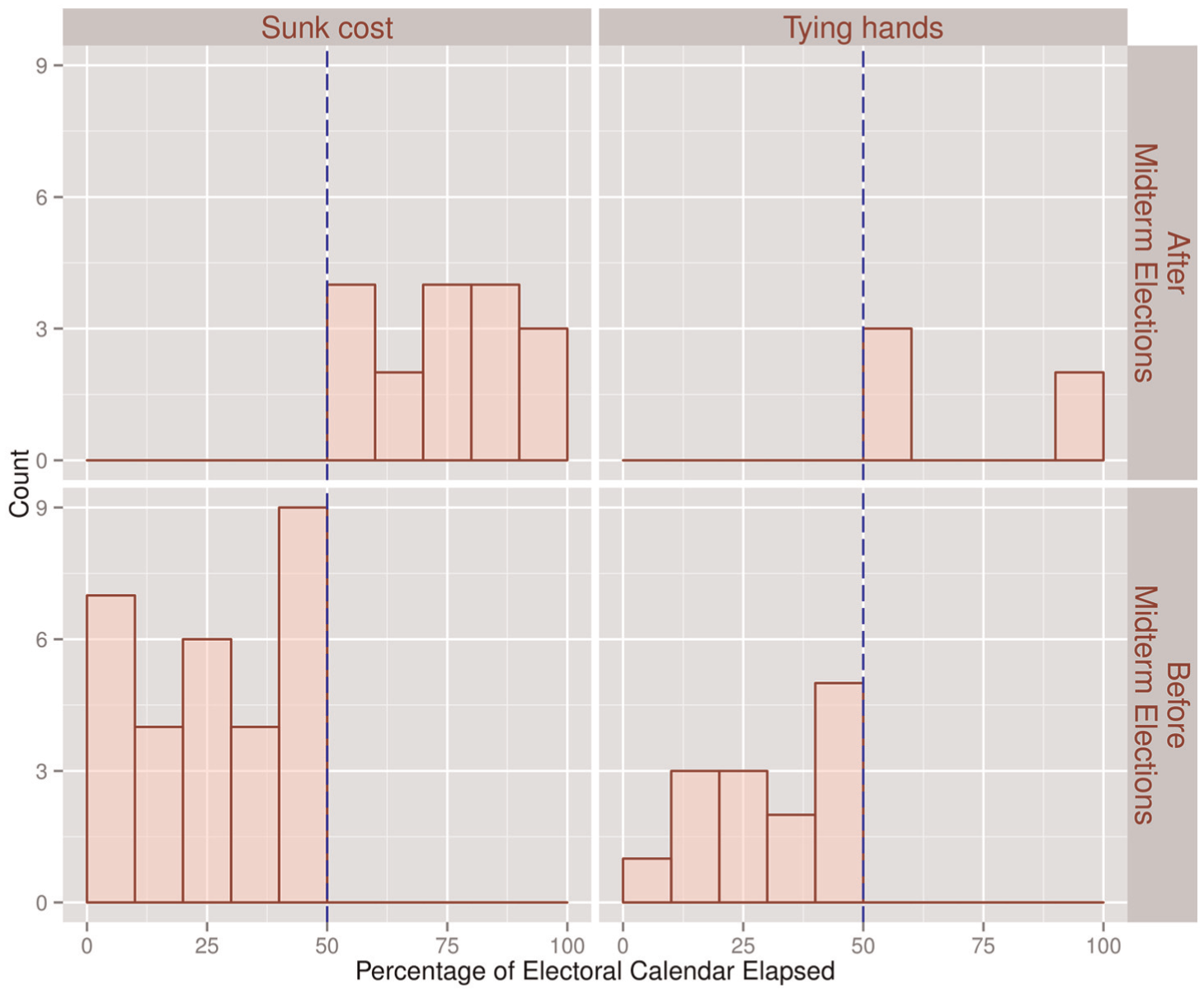
Distribution of tying-hands and sunk-cost commitment strategies over the electoral calendar.
At first glance, it appears that tying-hands strategies at most only partially respond to the electoral logic implied by audience costs. While there is an increasing number of tying-hands crisis responses as US presidents progress in their terms, their peak occurs around the time of the midterm congressional elections, and not close to the new presidential elections. To assess the fluctuations of audience costs over the electoral cycle, I will estimate a series of non-linear transformations of the electoral cycle variable and, as I explain in the next section, I will select the specification with the best out-of-sample predictive performance.
Lame-duck Presidents
This is a dummy variable that takes on the value of
Party affiliation
This is a dummy variable that identifies Republican presidents: Eisenhower, Nixon, Ford, Reagan, G.H.W. Bush, and G.W. Bush. The six Democratic presidents – Roosevelt, Truman, Kennedy, Johnson, Carter, and Clinton – serve as the reference category
Economic conditions
I measure the state of the economy using two variables that assess whether there had been significant increases in the levels of (a) unemployment and (b) inflation in the relevant period preceding the crisis. The reference category identifies either normal increases or decreases prior to the crisis. 12
Issue at stake
This is a dummy variable that takes on the value of
The opponent strategic choices
This is a dummy variable that is coded
The opponent power status
This is a dummy variable that takes on the value of
War involvement
This variable takes on the value of
Non-linear models and out-of-sample model performance
I estimate a series of non-linear logistic regression models: (a) polynomial regression; and (b) natural cubic spline regression. I compare models where the variable of interest, i.e. the percentage of time in the electoral calendar that has elapsed since the most recent elections, is included in the model with a power up to nine for the polynomial models and with a number of degrees of freedom up to nine for the natural cubic splines. The number of knots for the natural cubic splines models is equal to the degrees of freedom minus one (James et al., 2013: Kindle loc: 7215–7246). I place the knots in a manner that divides the electoral cycle variable at uniform quantiles; for example, (a) for the one-knot specification, the knot is placed at the median point of the electoral cycle variable; (b) for the two-knot specification, the knots are placed at the 33.3th and 66.6th quantiles, respectively; (c) for the three-knot specification, the knots are placed at the 25th, 50th, and 75th quantiles, respectively; and (d) for the four-knot specification, the knots are placed at the 20th, 40th, 60th, and 80th quantiles, respectively, and so on.
These models have the potential to capture the rising and falling of audience costs over the electoral calendar. The flexibility of non-linear models, however, is also its main drawback. Non-linear models might easily overfit the data: that is to say, they might mistake the inherent uncertainty in the data as a systematic feature of the data generating process.
To guard against this risk, I assess the out-of-sample performance of the models (de Marchi, 2005: 34–77). Models that fit their sample too well would perform poorly when used to predict out-of-sample observations (James et al., 2013: Kindle loc: 1111–1209). Specifically, I use a 10-fold Cross Validation approach whereby the data are divided into 10 samples of equal size, which are called folds. Each model is then estimated sequentially on nine of the folds (or 90% of the total number of observations in the data), while the remaining fold (or 10% of the data) is set aside as the out-of-sample test set (James et al., 2013: Kindle loc: 4916–4989). This procedure generates 10 estimates of the out-of-sample performance of a model, which are summarized by taking their average value. Given the stochastic nature of the cross-validation approach, I repeat the process of fold selection 200 times, which yields more stable estimates of model performance (Kuhn and Johnson, 2013: Kindle loc: 2384–2444).
I select the non-linear logistic regression model on the basis of two criteria. First, I evaluate the out-of-sample performance of the models on the basis of their cross-validation accuracy rates and ROC curve parameters, i.e. AUC (or Area under the Curve), specificity, and sensitivity. 17 Second, following Occam’s razor, I give preference to simpler models over more complex models. 18
Findings
The first step in the analysis is to determine the most appropriate specification for the electoral calendar variable in the logistic regression models. To this end, in Figure 2, I report the out-of-sample performance of polynomial and natural cubic splines logistic regression models. 19 As we can observe, polynomial models nearly always have better accuracy rates, larger AUCs, better sensitivity and better specificity than natural cubic splines models in this data. When one of the natural cubic splines model does better than the corresponding polynomial model, there is usually another simpler polynomial model yielding a better out-of-sample performance.
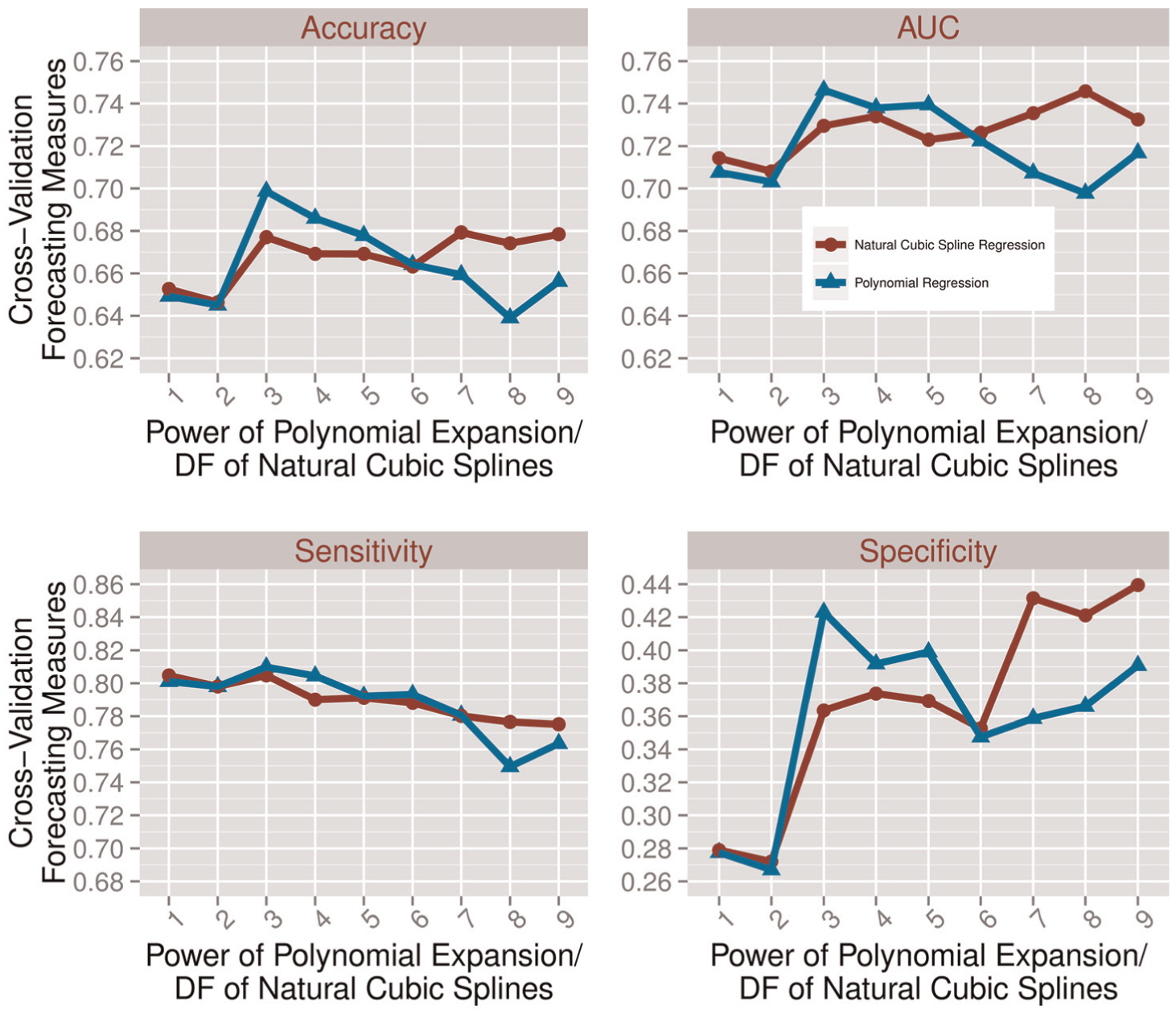
Repeated cross-validation out-of-sample performance.
But if polynomial models are superior to the natural cubic splines models in this data, which one of them should be selected? I contend that the cubic polynomial (i.e. the model with a power expansion to three) should be the preferred model. In particular, the cubic polynomial model outperforms the linear specification (i.e. the polynomial of power equal to one) on all four performance measures. Even though models with higher polynomials do not obtain better performance than the cubic polynomial, 20 I assess whether there are any statistical differences in out-of-sample performance by estimating a series of pairwise tests of the difference in accuracy, AUC, sensitivity, and specificity between the models with power expansion from one to six, estimated over the 200 repeated 10-fold cross-classification samples. The p-values for these tests are estimated using the Holm correction, a variant of the Bonferroni adjustment that yields more conservative tests to compensate for multiple comparisons (Abdi, 2010).
In Figure 3, I plot these tests for the measures of accuracy and specificity. 21 Starting from the Accuracy panel, the cross-validation accuracy rate for the cubic polynomial is larger and statistically different from the cross-validation accuracy rate of both the linear model and the quadratic models, while, for example, no statistical difference exists between the accuracy rate of the cubic polynomial model and the model with a polynomial of power four. In the case of the specificity measure, the best performing model is the cubic spline model with seven degrees of freedom. In this respect, accuracy and specificity give different verdicts. Faced with this tension, I therefore resort to the Occam principle and privilege the cubic polynomial model as the model that combines performance and simplicity. Substantively, this is an important result: using different data, this analysis yields a result similar to the one obtained by Carter and Signorino (2010) in their study of the effect of time in conflict processes. In both cases, cubic polynomial transformations of time proved superior to natural cubic splines. It is also interesting that the quadratic model is systematically outperformed by models with higher powers in the polynomial expansion. There is simply no parabolic relation between the electoral calendar and the US crisis bargaining strategies.

Pairwise tests of differences in out-of-sample performance.
The empirical footprint of audience costs
In Figure 4, I report the predicted probabilities of US presidents using tying-hands commitment strategies over the course of their terms in office. In the left panel, I plot the estimates of a logistic regression model that includes additively all the variables described earlier. The flat probability line indicates there is no relationship between the phases of the electoral calendar and the major response chosen by US presidents. If we were to stop the analysis at this point, we would reiterate the conclusion reached by Gowa (1998) that there is no connection between partisan/electoral politics and US strategic behavior in the international arena.
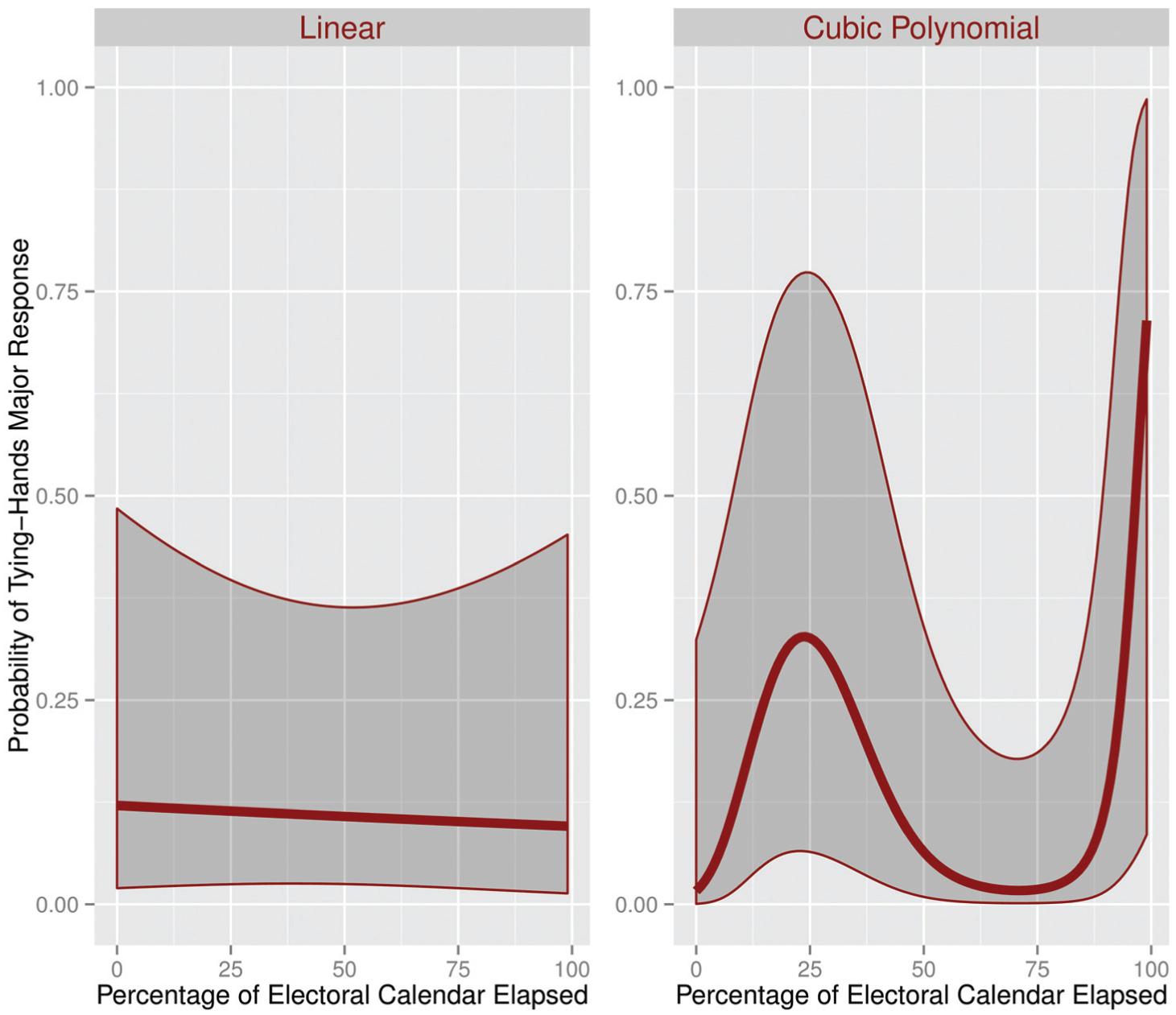
Predicted probabilities of tying-hands vs. sunk-cost strategies.
In light of the analysis of the out-of-sample performance of alternative polynomial models, however, such a conclusion is unwarranted. In the right panel of Figure 4, I report the estimated probabilities of using tying-hands commitment strategies over the course of the electoral calendar from the best performing non-linear regression model, the logistic regression model with a cubic polynomial. From that model, we derive a very different perspective on the choice of major response in a crisis. Substantively, US presidents are more likely to resort to tying-hands commitments as they move away from Election Day. The probability reaches its peak about after a year in office; it drops in the third year, and increases again as new elections approach. Conversely, sunk cost commitments are more likely in the aftermath of elections and become less common as the electoral calendar moves towards new elections. From the analysis of the out-of-sample performance of alternative non-linear logistic regression models, we derive an important finding. The dynamics of the electoral cycle affect the choice of US presidents. But the length of the electoral cycle that counts is not exclusively the four-year presidential term.
To probe further into this finding, I divided the electoral calendar into two halves with midterm congressional elections as the transition point. The finding from the out-of-sample models in Figure 4 points to a qualitative difference between the first and the second half of the presidential electoral cycle. As shown in Tables A-5 and A-6 (in the online Appendix), however, the cycle of congressional elections is uncorrelated to the crisis bargaining strategies of US presidents, even under an extensive battery of non-linear models. In and of itself, therefore, there is not a simple two-year cycle in the variability of audience costs. This means that voters do not use the congressional elections as a referendum on presidential performance. 22
We are, therefore, left with a conjecture. Anticipating a loss of support from moderate voters regardless of how they performed while in office (Erikson, 1988; Alesina and Rosenthal, 1995; Scheve and Tomz, 1999), US presidents discount the benefits of tying-hands commitments in the second year of their term. The recurrent fact of the midterm electoral loss decouples performance from electoral punishment, which is the underlying mechanism that gives credibility to tying-hands strategies. Only when a new presidential race starts to heat up again, and the president’s record is fully in the hands of voters, do tying-hands commitment strategies regain their appeal.
Control factors and robustness checks
Only two of the control factors are significantly related to the choice of commitment strategy: (a) rising unemployment, and (b) the opponent power status. Substantively, US presidents are more likely to employ tying-hand strategies when the economy faces rising unemployment and when confronting a major power. To convey the magnitude and the uncertainty of the effects, in Figure 5, I plot bootstrap estimates, with their 50%, 75%, and 95% bias-corrected accelerated confidence intervals, of the difference in the estimated probabilities of using tying-hands major responses for the two significant control variables.

Bootstrap estimates of difference in estimated probabilities.
While sample size affects the overall degree of uncertainty, at the 20% mark in the electoral calendar, the chances of tying-hands strategies are about 53.4% larger in times of rising unemployment than they are when the economy is in good condition; such a difference drops to 19.8% at the 80% mark. Similarly, the confrontation with a major power rather than a minor power raises the chances of tying-hand strategies by a comparable quantity.
The lack of significant results for the remaining control factors reflects the competing, and potentially offsetting, logics underlying them. For example, there are no differences in the extent to which Republicans and Democrats, on the one hand, and lame-duck and still electable presidents, on the other, use tying-hands strategies. In both scenarios, the change in the estimated probabilities is statistically indistinguishable from zero. Still, if we consider the distribution of cases in Figure 6, there are few instances in which a lame-duck president participated in a crisis: 13 (or 19.7% of the total). In these cases, US presidents chose a sunk-cost response eight times. There were five instances in which lame-duck presidents chose a tying-hands response, and only one instance in which that choice took place after the mid-point in their final constitutional term. 23 Interestingly, the lame-duck presidents that resorted to tying-hands major responses in a crisis were Republican: Eisenhower who chose that strategy three times, and George W. Bush who made that choice twice. This pattern points in the direction expected by audience cost theory, as it shows how lame-duck Presidents steer clear of tying-hands strategies, and of international crises in general, the closer they get to their final day in office (see also Haynes, 2012).
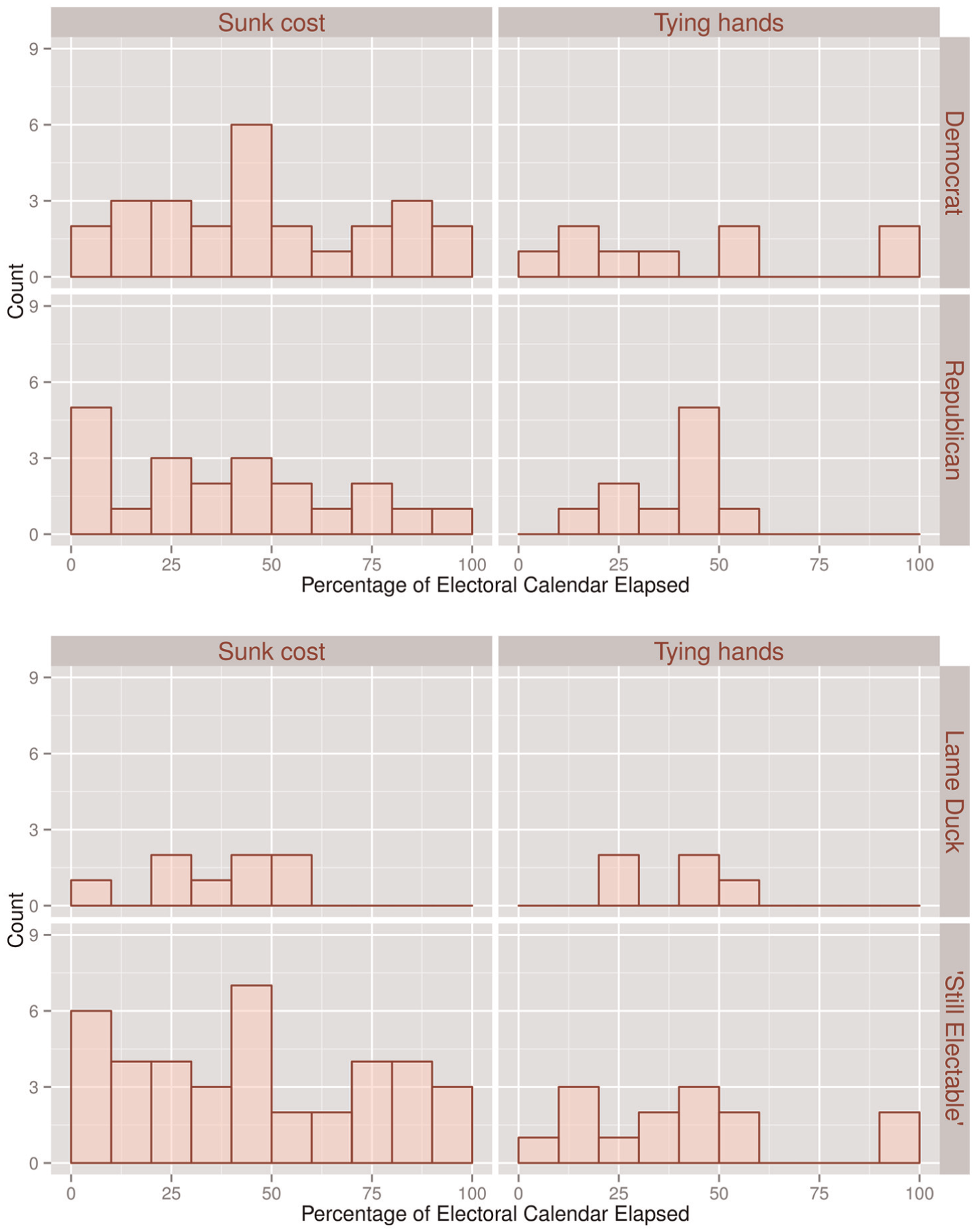
Conditional distribution of tying-hands and sunk-cost commitment strategies over the electoral calendar.
Robustness checks
The main results are robust to several alternative specifications, reported in the online Appendix. Specifically, I estimated models with: 24
Alternative measures of the dependent variable. In four of the cases, the major response was coded as an economic act. In Tables A-7 and A-8, I coded those cases as sunk-costs commitments rather than tying-hands commitments; in Tables A-9 and A-10, I dropped those four observations.
Alternative measure of crisis intensity. I also measured the degree of tension in an international crisis using a factor variable from the ICB data. 25 The variable identifies the level of violence experienced by a crisis agent and can take on four different values: (a) no violence; (b) minor clashes; (c) serious clashes; (d) full-scale war. In the sample of US crises, 48.5% of the events entailed no violence; 24.2% entailed minor clashes; 13.6% entailed serious clashes; and (again) 13.6% entailed full-scale war. The results are provided in Tables A-11 and A-12.
Controls for crisis location. I included dummy variables to identify the region of the crisis. Africa is the reference category. The results are provided in Tables A-13 and A-14.
Subsetting control variables. I estimated simplified models that include (a) the variable measuring the electoral cycle and no further controls; (b) the variable measuring the electoral cycle and the four domestic politics control variables; (c) the variable measuring the electoral cycle and the four international politics control variables; (d) the variable measuring the electoral cycle and each of the control variables by itself. The results provided are in Tables A-15 through A-36.
Conclusions
In this article, I investigated whether there is a discernible pattern in the choices US presidents make when they decide US major response in international crises. From the logic of audience cost theory, I derived an expectation about the relative frequency of verbal and political declarations of intent, which I called tying-hands strategies, over troop mobilizations or gunboat diplomacy, which I called sunk-cost strategies. The general hypothesis I develop claims that as audience costs vary over the electoral calendar, so should the ability to convey strategic information in a crisis by issuing public statements. Therefore, tying-hands strategies should be more common when the political fate of the president is at stake, which occurs before elections, rather than after elections.
I found that between 1937 and 2006, US presidents’ strategic choices during international crises reflected the electoral calendar. When election time gets closer US presidents’ coercive diplomacy gains credibility. I also found on the basis of out-of-sample tests that the variability of audience costs over the electoral calendar is non-linear. The probability of tying-hands commitments reaches a peak after the first year of the electoral cycle, declines as incumbent presidents anticipate the recurrent midterm loss, and rises again as the new elections appear on the horizon.
This study, therefore, illustrates a dynamic connection between elections and strategic behavior in the international arena. Far from being irrelevant, as many studies have contended, electoral politics has a sophisticated influence on coercive diplomacy. While future democratic leaders should not come away from audience cost theory believing that they can bluff their way to success in international crises, as Snyder and Borghard (2011: 455) warn, they should also have a clear appreciation of how elections give credibility to coercive diplomacy, above and beyond the capabilities and the interests at stake in a crisis.
Footnotes
Acknowledgements
I would like to thank Susan Allen, Carol Atkinson, Lionel Beehner, David Crow, Peter Feaver, R. Joseph Huddleston, Tom Long, Becca McBride, Gerardo Maldonado Hernández, Kim Nolan García, Glenn Palmer, Brian Phillips, Plamen Ralchev, Dragomir Stoyanov, and Robert Trager, as well as the CMPS reviewers, for questions, comments, and suggestions. Mistakes, omissions, and other assorted infelicities are my own responsibility. Data, replication files, and an online Appendix, which includes information on data, measurement, descriptive statistics, and robustness checks, are available at  .
.
Funding
This research received no specific grant from any funding agency in the public, commercial, or not-for-profit sectors.