



Abstract
The ethnic composition of state security forces is believed to have important effects on the dynamics of conflict processes, but data limitations have impeded our ability to test such hypotheses cross-nationally until now. To address this problem, the Security Force Ethnicity dataset provides time-series, group-level measures of the ethnic composition of military forces in the Middle East between 1946 and 2013. We draw on an extensive review of case studies and histories to produce unique ordinal codings for participation rates in the officer corps and in the rank and file. We demonstrate the utility of the data through empirical applications, examining the relationship between military ethnic composition and the incidence of coups and repression. Our findings illustrate the theoretical and empirical importance of disaggregating ethnic representation in the military from inclusion in other institutions of the state.
Introduction
Does ethnic representation in different kinds of state institutions matter in different ways for contentious politics? Much of the existing research about how ethnic representation affects conflictual outcomes like rebellion, military coups, and repression has implicitly assumed that different state institutions are equivalent or has addressed representation only in “the state” as a whole. In response, we argue for the need to disaggregate the state in order to understand the consequences of ethnic participation or exclusion, most importantly by distinguishing between representation in political and security institutions. The two have very different implications for how members of an ethnic group are able to secure their group’s interests. While political power allows influence over policy-making and access to patronage, this kind of power is qualitatively different than that granted by securing a foothold in the means of coercion, making it necessary to directly examine representation in the military as an essential arena where contests over intergroup politics are played out. 2
Despite the lack of recent attention from scholars of ethnic politics, especially recent quantitative research on the subject, an older tradition exists that gives pride of place to military representation in explaining ethnic competition and conflict (Adekanye, 1976, 1979, 1996, 2008; Dreisziger, 1990; Ellinwood and Enloe, 1981; Enloe, 1980a, b; Horowitz, 1985; Young, 1982). However, owing to the difficulty in gathering data on the ethnic composition of state militaries, this line of theorizing has fallen into disuse, and there has been little effort to systematically test these theories in the intervening decades, although the production of qualitative work, mainly by area specialists, has continued apace.
Occasionally, empirical studies have addressed the importance of military participation for ethnic politics, but these tend to proxy for military ethnicity using measures of political representation broadly. For example, Roessler’s (2011) study of the tradeoffs between coup risk and civil war risk and Brown et al.’s (2016) study of foreign policy substitution as a result of coup-proofing both use measures derived from Wimmer et al.’s (2009) Ethnic Power Relations (EPR) dataset, which captures only political representation. Ultimately, to satisfactorily test theories of the causes and consequences of military ethnic composition, direct measures are needed in order to capture the actual mechanisms proposed to be at work.
Ethnic competition and conflict play out in a dynamic process in both the political and military arenas. To adequately understand how that process takes place in one arena, we must take the other into account (Horowitz, 1985). For instance, split domination of these two institutions between two ethnic groups tends toward instability (e.g. Harkness, 2016). Focusing on ethnic conflict in and over the military allows us to understand fundamental tradeoffs that state leaders make in trying to manage ethnic conflict generally, as well as various types of threats to the security of the regime and of the state.
A few authors (Harkness, 2016; Koren, 2014; Petersen and Staniland, 2008; Tófalvi, 2012) have gathered measures of military ethnicity incident to specific research projects, but until now there has been no publicly available dataset on military ethnicity broad enough for more general scholarly use. Meanwhile, cross-national measures commonly used for the quantitative study of ethnic politics—e.g. ethno-linguistic fractionalization (Fearon, 2003), polarization (Garcia-Montalvo and Reynal-Querol, 2005), and cross-cuttingness (Selway, 2011)—are too blunt for testing theories specific to military dynamics, since these measures are confined to the state level, are temporally fixed, and do not capture the power relations between groups and the state. An alternative approach, the EPR dataset (Wimmer et al., 2009), addresses some of these issues, but EPR only captures ethnic groups’ relationship to the state as a whole, potentially obscuring variation between the security and political sectors that the qualitative literature suggests is so important.
The dataset that we present herein addresses these shortcomings by providing military-specific data that are cross-sectional and time-series in nature, disaggregated to the level of the ethnic group, and reflective of nested and overlapping ethnic structures. 3 We generate ordinal measures of each group’s representation in both the officer corps as well as the rank and file using separate indicators to code relative and absolute share. In addition, we disaggregate each country’s military by creating separate codings for the rank and file vs the officer corps. This approach acknowledges that representation can have very different meanings across ranks, as well as the potentially vital role that even enlisted soldiers can play in ultimately determining military-related behavior (e.g. Barany, 2016).
This initial version of the project is limited geographically to the Middle East and North Africa (MENA), ranging west-to-east from Morocco to Iran and north-to-south from Turkey to Sudan, with a temporal coverage of 1946–2013. Ethnicity tends to be politically salient across the region, and on a number of dimensions, including religion (as in Syria), language (as in Turkey), and race (as in Sudan), as well as others. The region also requires coding rules sufficiently robust to be able to handle a wide variety of situations, such as countries where ethnicity is less salient (e.g. Oman, Tunisia), countries where non-citizen permanent residents greatly outnumber citizens (e.g. most of the Gulf States), cases where militaries draw heavily from foreign advisers and mercenaries (e.g. Qatar), and cases of nested identities (e.g. Israel). Third, the region has figured particularly prominently in research on civil–military relations, with rich case-study work on topics ranging from coups d’état to civil war to non-violent revolution. Much of this work emphasizes the important role that military ethnic composition has played in influencing these outcomes, such as the divergent behavior of military organizations in the recent “Arab Spring” protests (e.g. Barany, 2011; Bellin, 2012; Koehler et al., 2016; Makara, 2013; Nepstad, 2013). 4
Below, we explain our procedures for identifying relevant ethnic groups, collecting reliable evidence from secondary sources, and generating codings. We present some overall descriptions of the data, illustrating trends in ethnic manipulation in Middle East militaries since the Second World War, and examining the relationship between military and political representation. We demonstrate the potential utility of this dataset with applications to coups and repression. Our measures of representation in the military correlate positively with coup attempts and negatively with repression, even when controlling for other group-specific factors such as size, access to political power, and political discrimination. Further, we find that the relationship between political status and coup attempts is conditional on representation in the officer corps of the military. These findings underscore the theoretical as well as empirical need to distinguish between political and military power in studies of ethnic politics. They also confirm the central role of ethnicity in shaping civil–military relations in the Middle East.
Ethnicity in the military and contentious politics
Up until now, the field has benefitted tremendously from comparative case studies on the subject, which have generated a number of interesting predictions and have formed debates that could be advanced through cross-national analysis using direct measures of military ethnicity. We briefly review some of those predictions here.
Ethnically skewed militaries have often resorted to force to overturn the state’s political leadership in coups d’état. Motives for doing so include protecting their institutional privileges within the military, preventing political turnover that would result in loss of power for their ethnic group, capturing the state to advance their group’s political position, or even, following ethnic security dilemma logic (Posen, 1993), pre-empting another group’s capture of the state (Ejiogu, 2007; Enloe, 1980a; Harkness, 2016; Horowitz, 1985: ch. 12; Jenkins and Kposowa, 1992; Roessler, 2011). Hence, regimes often attempt to maxmize the loyalty of the military by resorting to ethnic stacking, meaning over-recruiting soldiers and officers from groups expected to be especially loyal, in order to protect against coups (Makara, 2013, 2016; Quinlivan, 1999).
In the context of revolution, having broad-based representation from across society in its ranks may directly affect the military’s willingness to follow through on orders to turn its guns against society. Many have stated that the military’s defection from the regime is a necessary, if not sufficient, factor for any movement attempting to overthrow the ruling regime to succeed (Barany, 2011, 2016; Johnson, 1966; Nepstad, 2011b; Russell, 1974). Regimes often resort to ethnic stacking to create social distance between the military and would-be revolutionaries and to give those over-recruited ethnic groups a stake in the maintenance of the regime. This line of thought has particular application to studies of democratization (Bellin, 2004, 2012), mass protests and revolution (Barany, 2016; Louër, 2013; Lutterbeck, 2013; Makara, 2013; McLauchlin, 2010; Saha, 2014; Tófalvi, 2012), and non-violent conflict (Koren, 2014; Nepstad, 2011a, 2013). 5
Studies of repression and humanitarian protection have recently emphasized the need to account for civilian agency, including ability for self-defense, against state and non-state predation (Baines and Paddon, 2012; Chandler, 2012; Jose and Medie, 2015; Mégret, 2009, 2011). From the at-risk group’s perspective, representation in the military may provide its members with the arms, training, and organization needed to protect against or deter such predation. From the state’s perspective, an ethnically stacked military is generally expected to be more willing to follow through on orders to kill (Adekanye, 1996; Koren, 2014).
Previous research shows military service, particularly during war, functioning as a precursor and catalyst to obtaining full citizenship for out-groups, including immigrants and other low-status groups, since offering one’s life in service to the country can be portrayed as the ultimate sacrifice and demonstration of loyalty (Bredbenner, 2012; Goring, 2000; Jacobs and Hayes, 1981; Krebs, 2006; Ware, 2010; Wong, 2007). This generates the prediction that a rising share in the military for a politically excluded group, at least during wartime, should subsequently lead to a rising political status.
Especially where military participation is a symbol of membership in the nation, exclusion from the military may heighten the risk of civil war by deepening secessionist sentiments (Gaub, 2011: 14; Krebs, 2005). Officers removed from service in a military purge may be able to leverage their military experience to rally their co-ethnics and attract foreign funding to become rebellion entrepreneurs (Roessler, 2011). The duration and outcome of civil war may depend crucially on whether the state attempts to recruit the rebels’ own co-ethnics to fight in the military. Doing so can provide an information advantage to reduce the need for indiscriminate violence (Lyall, 2010) and facilitate ethnic defection to the state (Kalyvas, 2008), including by signaling that the rebel group does not speak for the ethnic group. The stability of post-conflict peace may also depend on whether and how well the state attempts to integrate former rebels into the military, both to provide reassurance that the process of disarmament, demobilization, and reintegration will not be used to as a step toward reprisal killings against former rebels and to provide former rebel soldiers with gainful employment (Gaub, 2011; Licklider, 2014).
Last, prior research has shown that recruiting and promoting on the basis of ascriptive traits like ethnicity that are meant to proxy for loyalty, rather than recruiting and promoting on the basis of skill and merit, tends to degrade military performance and therefore the state’s ability to win wars (Hoyt, 2007; McMahon and Slantchev, 2015; Talmadge, 2015). As a result, regimes may compensate through foreign-policy substitution, such as pursuing alliances or weapons of mass destruction, in order to secure themselves against foreign threats (Brown et al., 2016).
Dilemmas of military design
Our dataset also allows us to speak to questions about the conditions under which regimes will resort to ethnic stacking in the military and to highlight some fundamental tradeoffs that state leaders are thought to take into account in determining military recruitment and promotion policy.
The first of these is the tradeoff between securing the state and its leadership from internal threat vs external threat. State leaders weigh the need for coup-proofing, such as through ethnic-based recruitment, against the threat posed by foreign enemies (Hoyt, 2007; Talmadge, 2015). Enloe (1980a) uses the concept of “ethnic security maps,” theorizing that state leaders assess the political loyalty of each ethnic group in the populace and, under normal conditions, seek to exclude groups perceived as unreliable from access to power and access to the means of coercion. However, when military threats from foreign countries loom large, the regime is forced to broaden that access in order to meet the threat from abroad, suggesting that the logics of recruiting to counter internal vs external threat may sometimes clash.
Ethnic groups that appear to the regime as posing a “Trojan horse dilemma” may be especially likely to be excluded from the military when recruitment policy is politicized. These groups are not only politically marginalized at home, they also have ethnic ties to the state’s enemies. As a result, the state’s leaders fear that in the event of conflict with those enemies, these ethnic group members would defect to the other side (Peled, 1998). In reality such fears are generally unfounded (Hoyt, 2007; Khalidi, 2001). Peled (1998) argues for the need for military autonomy concerning recruitment policies, providing case-study evidence that militaries tend to be more willing than political leaders to integrate ethnic groups that pose Trojan-horse fears in order to recruit the manpower needed to respond to foreign threats.
Other authors examine the tradeoff between types of internal threat, especially the threat of coup vs the threat of rebellion (Horowitz, 1985: 519–520; Roessler, 2011). More broadly, this is the same dilemma that leaders of post-conflict countries face when considering integrating former rebels: whether to keep their domestic enemies close or at arm’s length. In addition, while coup-proofing may reduce the opportunity of the military or of specific ethnic groups to overthrow the regime, all coup-proofing tactics tend to exacerbate the problem of disloyalty in the long run by increasing resentment and therefore willingness to coup (Horowitz, 1985: ch. 13).
Promoting a unifying national identity has long been seen as the best way to resolve the ethnic security dilemma and ethnic conflict in the long run, but the process of getting there is fraught. The paradox here is that countries where ethnicity matters to the point of generating armed civil conflict are the ones most needing to “get over” the idea of ethnicity, but solutions targeted to that outcome tend to neglect vulnerable groups’ need for immediate security—or naively leave the political institutions at risk of overthrow by rebels and coup-makers who are still very much motivated by ethnic-based competition. For instance, Ghana’s Nkrumah was ideologically committed to replacing ethnic or “tribal” divisions within his country with a national Ghanaian identity, and he initially used universal military recruitment for political socialization to promote that identity, but in the end the (ultimately successful) threat of an ethnic-based coup from his domestic enemies forced him to retreat to the traditional strategy of ethnic stacking in the military (Adekanye, 1976). 6 Similarly, post-conflict countries often adopt ethnic quotas in the military to provide security assurances for former rebels, despite the reality that this solution may ultimately reinforce and reify those ethnic identies and thus lock the conflict into place for decades to come (Adekanye, 1979; Gaub, 2011).
Our data present a unique opportunity to push forward these debates and research agendas, both by providing a more systematic and cross-national accounting of the patterns of ethnic participation in the military and by allowing for hypotheses to be tested quantitatively.
Coding rules and procedures
Conceptualizing and operationalizing ethnicity
We use an expansive definition of ethnicity given by Wimmer et al. (2009: 325): “Following the constructivist, Weberian tradition, we define ethnicity as a subjectively experienced sense of commonality based on a belief in common ancestry and shared culture.” In doing so, we acknowledge that ethnic identities are fluid and subject to political manipulation, and the salience of ethnic identity varies widely from country to country as well as at the individual level. Furthermore, we follow Chandra and Wilkinson (2008) in distinguishing ethnic “structure”—the demographic distribution of ethnic attributes across a population—from ethnic “practice”—the way in which certain ethnic categories are activated in some contexts but not others. It is specifically the latter, ethnic practice, that we seek to capture in the specific institutional context of the military. While we would expect some parallels between the categories of ethnicity that are salient in social vs political vs military life, they are not always the same.
The result is an operationalization of the concept of ethnicity that simultaneously builds on the work of extant datasets such as the EPR dataset (Vogt et al., 2015) and the Minorities at Risk Project, 7 but breaks new ground in exploring a broader array of ethnic identities as well as accounting for nested and overlapping ethnic structures.
In most cases, we start with EPR’s list of ethnic groups that have been identified by country experts as “politically salient,” as those ethnic categories that are relevant in the distribution of political power are likely to inform patterns of inclusion and exclusion in the military as well. However, a foundational premise of this dataset is that patterns of ethnic representation in politics and in the military are not always identical; different identities may be activated in one context vs another. Tribal affiliation in countries like Iraq and Libya, for example, plays a much more important role in the officer corps of the military than it does almost anywhere else, even the military’s own rank and file. By contrast, while Sudan’s ethnopolitical structure consists of many different groups, a broader geographic cleavage between Northerners and Southerners is what drives military dynamics.
In practice, our process for identifying the final set of groups to code for each country’s military follows the logic of Bayesian updating. We start with EPR’s list of groups (our “prior”) and adjust when evidence gleaned from case-specific sources indicates that additional or alternative groupings are more salient in the military context. To help achieve an unbiased data-gathering approach, we generally attempted to find the following kinds of sources for each country, ordered from most to least specific: ethnicity in the military, military history, ethnic politics, and political history. We often supplemented this general approach with searches in Google Scholar and Google Books for specific ethnic groups who by that point (whether due to EPR or through general searches conducted so far) we had identified as politically or militarily salient. Hence, the final (“posterior”) set of groups tended to resemble the EPR prior, but to widely varying degrees, based on the extent to which the information we had uncovered portrayed a different picture than what we had started with.
In most cases, this approach results in collecting data on more, rather than fewer, groups (Sudan being a notable exception). As applied across cases, this approach also produced several systematic differences from EPR that are described below.
Consistent with our conceptualization of ethnicity “as practiced” in the military, we identify groups based not just on the most commonly used dimensions of ethnicity, such as language or religion, but also on tribal, national, and regional identity groupings when such data are available and when the evidence indicates that these identity markers are salient in the context of representation in the military. For example, in the case of Libya, our sources indicate that tribal divisions played an important role within the officer corps under the Qaddafi regime and that the Qadhadhafa, Warfalla, and Magarha tribes held especially privileged positions. The SFE dataset therefore includes these groups.
Furthermore, we define the population as all residents in the state, not just resident citizens, meaning that we take non-citizen groups into account. This is especially important in the Middle East, where in several countries expatriates make up a large proportion of the population and/or the military. For example, in Oman, British officers held a majority of the positions in the officer corps until the early 1990s. The rank and file, by contrast, was largely filled during the 1960s by mercenaries from the Baluchistan province of Pakistan. No accounting of the ethnic composition of the Omani military would be complete without inclusion of these expatriate groups.
Finally, we acknowledge the complex and contingent nature of ethnicity by accounting for the nested and cross-cutting structures of various ethnic identities. In Oman, for example, we include codings for expatriate Baluchis, nationalized Omani Baluchis, as well as Baluchis as a whole. We specify the relationship between these groups through a series of codings assigning “parent” and “child” relationships. 8
An implication of this nested and cross-cutting structure is that our set of ethnic groups is not mutually exclusive. As many applications of the dataset will require the use of mutually exclusive groupings (i.e. in order to not double-count groups), we include a dummy variable we call “DIVISION” to designate the set of groups that are mutually exclusive and as close to collectively exhaustive as possible, and that, based on our sources, are the most salient within the military. For the case of Oman described above, this variable designates Omanis and Expatriates. The cross-cutting group of Baluchis and its child groups expatriate Baluchis and Omani Baluchis are not designated by the DIVISION variable, even though we provide data on these groups. Additionally, we identify those groups that are equivalent to groups found in the EPR and MAR datasets for easy interoperability with the extraordinary data available through those projects. In fact, we demonstrate the utility of using SFE alongside EPR and MAR in the applications below.
Units and measures
This dataset seeks to provide time-series data on the ethnic composition of militaries in the Middle East from 1946 through 2013. However, it is not possible to obtain unique evidence for each and every year. Rather, consistent with disciplinary practice, we triangulate evidence to establish temporal periods relevant to patterns of ethnic representation in the military. Similar time periods employed by EPR served as a valuable first reference. However, in many cases, a change in political power relations will not result in any changes within the military. In others, notable changes occur in the military even when there is no change in groups’ access to political power. Timespans may be either periods of relative stability in the ethnic composition of the military, separated by moments of upheaval at which a notable shift occurs, or periods of more gradual transition. Whenever the available evidence allows for a longer timespan to be subdivided into smaller ones with more fine-grained and differentiated codings, we attempt to do so. However, it is perfectly possible for a single period to span the entire range of the dataset if there is no evidence of change in the composition of the military during that time. Turkey is just such a case.
Often, time periods will be demarcated by major historical events, such as Israel’s annexation of the West Bank in 1967 that brought in a new population of non-citizen Palestinians, or the Shia and Kurdish uprising in Iraq after the 1991 Gulf War that led to further purges of these groups from the military. In other cases, the availability of data at a specific point in time may be a deciding factor. For example, we create a new time period in Oman beginning in 1993 owing to a specific estimate that the share of Omani nationals in the officer corps passed 50% at this time.
For each group, for each period, and for each portion of the military (officer corps and rank and file), we assign two distinct codings of representation. We disaggregate the rank and file from the officer corps for two reasons. First, each may have different implications for theories of contentious politics. For example, when it comes to the prospect of military coups, it may be the ethnicity of the officer corps that is the most relevant, while for dynamics of repression it may be the ethnic composition of the rank and file soldiers who are actually being called upon to open fire.
Second, empirically we observe different dynamics in the regime’s tailoring of recruitment policy to each of these force portions. As will be illustrated in greater detail below, the officer corps tends to be much more skewed than the rank and file, often the result of deliberate policies to balance manpower needs with loyalty concerns. Turkey, for example, actively conscripts Kurds into the rank and file under the belief that military service will help spread nationalist loyalty, but it heavily restricts the promotion of Kurds to officer status. In other cases, such as Mizrahi Jews in Israel, language abilities serve as a less intentional barrier to inclusion in the officer corps.
The first measure that we apply to a group in both the officer corps and rank and file is a coding of how proportional the group’s military participation is, as compared with its population share. This ordinal measure takes a five-point scale with the following levels: (1) exclusion; (2) under-representation; (3) proportionate representation; (4) over-representation; and (5) monopoly. An “excluded” group is one that is legally prohibited from entering either the rank and file or officer corps of the military (e.g. legislation passed in Kuwait after the Gulf War prohibits Bedoons from holding the rank of officer—see Al-Najjar, 2004: 5). A group with a “monopoly” is the only group that is allowed to serve in the military, with at least one other group being excluded. 9
Under-, over-, and proportionate representation all follow the natural meanings of those terms and are often based on language found in the sources that is approximate to those words. For the purpose of translating occasional quantitative data into ordinal terms, we include the coding rule that representation is “proportionate” when the group’s share in the military falls between 0.8 and 1.2 times their share of the overall population. This definition was based on a process of induction and testing on cases where both natural language and reliable quantitative data were available, as will be discussed in further detail below. Under- and over-representation therefore apply to cases where qualitative assessments from our sources indicated such or numeric figures showed that the group’s share fell outside of the 0.8–1.2 range, but the group is neither legally barred from the military nor occupies a 100% share at the exclusion of another group or groups. To test the appropriateness of these thresholds and to assess whether the concepts of over- and under-representation were operationalized consistently, we turned to the case of Lebanon for which Barak (2006, 2009) offers detailed, time-series quantitative data at the level of individual officers. Comparing Barak’s figures with qualitative assessments, we are reasonably confident that (1) there is a generally consistent understanding in how scholars use and apply concepts of over- and under-representation in their qualitative assessments, and (2) the numeric thresholds we employed to deal with quantitative figures are generally congruent with this use.
The purpose of the relative-share measure is to examine whether group representation in the military deviates from what we would expect on the basis of the group’s size. It allows us to examine to what degree ethnic manipulation, or at the very least distortions, may be present in the military, and which groups these patterns favor. It may also be the best measure by which to assess the possibility of group grievance regarding status in the military, if we assume that groups might seek at least proportionate representation. Finally, this measure might be relevant for questions of battlefield effectiveness, if we were to assume that non-proportionality incurs costs in terms of manpower in the rank and file and competence in the officer corps.
The second variable set measures each group’s absolute share in the officer corps and in the rank and file in percentage terms. Because there is a high degree of uncertainty in such estimates, we provide upper and lower bounds rounded outward to the nearest 10%. For example, if we know based on records of military academy graduates that an ethnic group makes up 56% of the officer corps, that group will be assigned a lower bound of 50% and an upper bound of 60%. However, if all we know is that a group makes up a majority, that interval could range from 50 to 100%. Both of these are extreme cases as most of the time our evidence is neither that precise nor that vague. A plurality of our absolute codings comprises a 10% span (owing mostly to small groups with less than 10% of the officer corps and rank and file) and a majority comprises a 20% span or smaller. These bounds can easily be converted to a series of dummy variables representing certain thresholds (e.g. less than 10%, minority, majority, etc.), or to an ordinal scale (e.g. quintiles). One could also use just lower bounds, just upper bounds, averages of the bounds, or some type of multiple imputation strategy. We believe that absolute measures of a group’s share in the officer corps and rank and file might best represent the opportunity that military participation provides for instigating acts of contentious politics, such as coups. Alternatively, it may best assess the likelihood that soldiers will encounter co-ethnics in the context of repression, counterinsurgency, or inter-state war.
This selection of variables and their corresponding formats provide a great deal of flexibility for the user to apply the measures that best fit the theoretical argument being explored. Equally important, the absolute ranges in particular provide valuable information regarding the level of uncertainty surrounding the measure.
Transparency, validity, and reliability
Our dataset is built on secondary sources, as opposed to primary sources like government documents. In a subject area such as this, government-published data are extraordinarily rare, and when it exists, is often suspect given its politically sensitive nature. On the other hand, a vast wealth of country-specific studies that touch on the subject of military ethnicity, written by country specialists, scholars of ethnicity, and civil–military experts, is readily available. These largely single-country and case-comparison studies have benefitted from the expertise of researchers intimately familiar with the language, history, and politics of that country or those countries, allowing them to draw from archival material, in-person interviews, and historical works. The kinds of evidence that we are able to extract from these sources generally falls into three basic categories. The first and most common type of evidence is the author’s own estimate about a group’s current representation in the country’s military—generally a digested summary based on years of accumulated familiarity with the subject. The second is descriptions of state policies such as purges, conscription use, and explicit bans on participation. Finally, our sources sometimes provide explicit quantitative measures, such as the percentage of military academy graduates belonging to a group. We attempted to ensure that coding decisions were based on multiple, independent estimates by following citations to the original sources, treating works from a common author as only a single source, and minimizing the use of encyclopedic or other tertiary sources when possible.
We aim to be as transparent as possible regarding our sources, collections methods, and coding decisions. We include an explanatory narrative for each country summarizing how the available evidence was coded, including explanations behind any judgment calls made. We supplement our country narratives with three other means to achieve full transparency. These include publishing the complete references, including page numbers, for the sources used for every country; creating scores for source quality and quantity; and providing the full codebook used to generate the data. We welcome scrutiny of our coding decisions in the hope of increasing users’ confidence in the data, improving the precision of the measures over time, and facilitating further research on military–ethnic relations.
Finally, to check inter-coder reliability, each of the authors (who conducted all the coding for this version of the dataset) independently coded two countries, Turkey and Kuwait. Although there was little overlap in the set of sources that we each gathered for Turkey, the codes we each independently assigned for group representation in the officer corps and the rank and file agreed completely. Initial codings for Kuwait differed due to different interpretations of how groups should be nested. After resolving this issue, the codings were largely the same.
Regional trends in the ethnic composition of MENA militaries
Our data show that ethnic manipulation in the militaries of the Middle East is the norm, not the exception. Figure 1 shows a stacked area plot of the percentage of groups who fall into each of our categories of representation in the officer corps over time. 10 Across the entire temporal range of the dataset, only between 5 and 15% of groups are proportionately represented in the officer corps. More than half are under-represented or excluded in every single year.
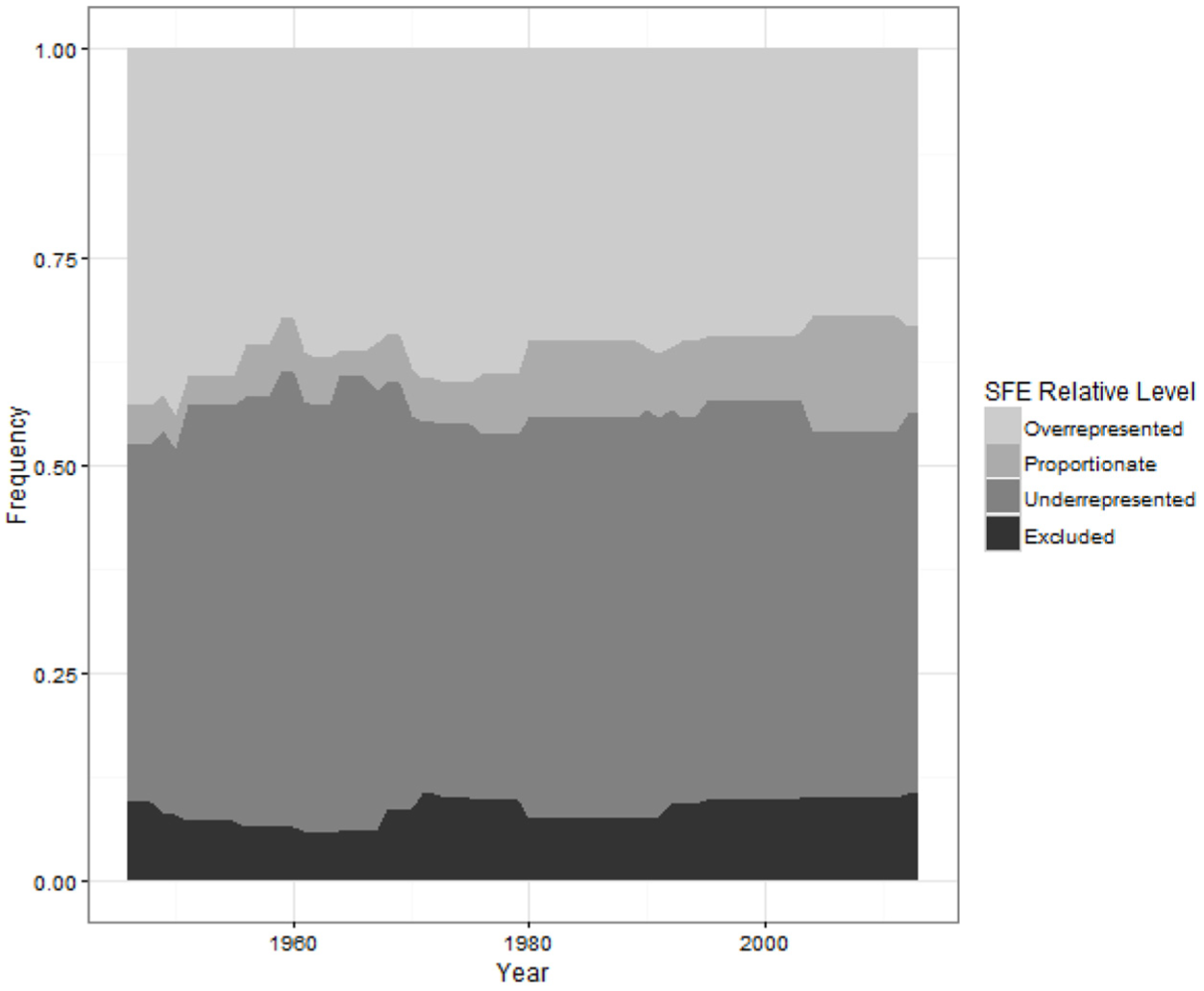
Ethnic manipulation in the officer corps: 1946–2013.
In contrast, Figure 2 shows that proportionate representation is much more common in the rank and file. States seem to be more willing to include potentially rival ethnic groups in the rank and file, possibly seeing it as a lesser threat, a necessary boost in manpower, and/or an opportunity for assimilation. Still, proportionate representation in the rank and file represents a minority of cases over the full temporal range of the dataset, and the frequency of proportionate representation is closer to 30% in recent decades. Furthermore, while changes over time do not appear to be dramatic, there does appear to be an overall increase in over- and under-representation. This observation would run counter to the idea that efforts by great powers to “professionalize” militaries in the region might lead to less ethnic favoritism. There also appears to be an increase in recent decades in the most extreme form of imbalance: complete exclusion. This largely comes from two countries: Bahrain, which enters the dataset in 1971 and excludes Shia, and Israel, which inherits the Palestinian Arab populations of the West Bank and Gaza in 1967.

Ethnic manipulation in the rank and file: 1946–2013.
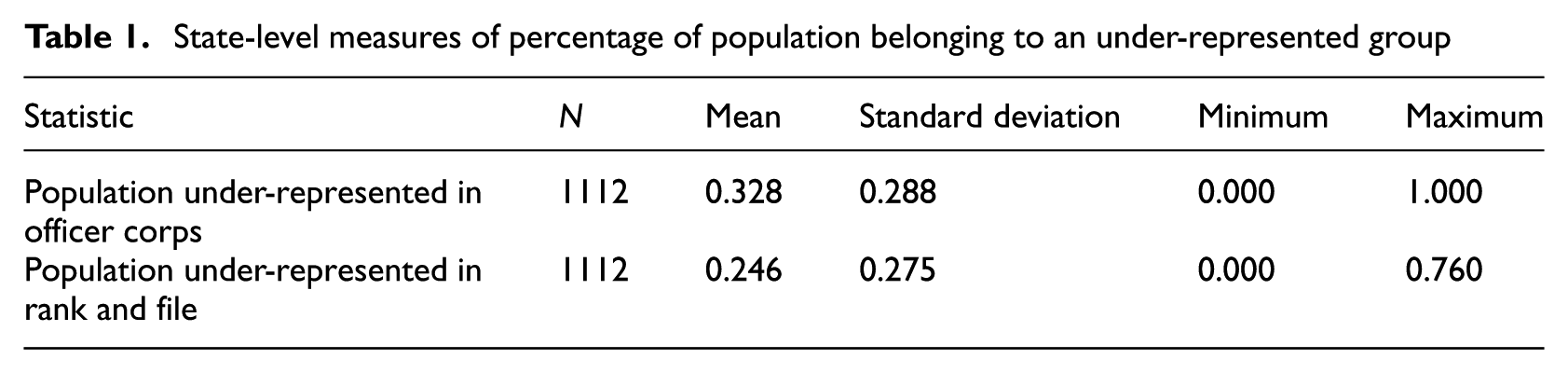
While the SFE dataset focuses primarily at the group level of analysis, in some cases, it may be helpful to have data at the country level depicting the extent to which ethnic manipulation is occurring in the military of that state. One approach to doing this is to calculate the percentage of a state’s population that belongs to groups that are under-represented in (or totally excluded from) the military. 11 Such figures can be calculated based on representation in the rank and file and in the officer corps. Table 1 shows some descriptive statistics for these state-level measures across the entire timespan of the dataset. The results largely parallel the group-level findings above. Substantial segments of the populations of Middle Eastern countries belong to groups that are under-represented in their states’ militaries. The average share of the population under-represented in the officer corps is 33% while the average share under-represented in the rank and file is 25%. There is also substantial variation in these figures, ranging from states where no groups are under-represented in either portion of the military to cases where the the officer corps draws heavily from expatriates, with all national groups under-represented.
State-level measures of percentage of population belonging to an under-represented group
To provide a sense of differences between countries, Table 2 provides a ranked list of Middle Eastern states based on the percentage of the population belonging to ethnic groups under-represented in the officer corps at two snapshots in time 50 years apart: 1963 and 2013. Yemen leads the list at both time points owing to the strong hold of the Hashid and Sanhan tribes on the officer corps, followed by Bahrain in 2013 where the majority Shia are completely excluded from the military. Israel’s relatively high placement on the list comes from the under-representation of Mizrahi Jews and Israeli Arabs, combined with the complete exclusion of non-Israeli Palestinian Arabs. Iraq and Lebanon show the most pronounced change between the two time periods. Lebanon’s military became more inclusive following that country’s sectarian civil war, while in Iraq the patterns of ethnic domination simply flipped from minority Sunni control of the officer corps to majority Shia.
States by percentage of population belonging to groups under-represented in the officer corps

Countries ordered by percentage of population under-represented in 2013.
Oman, Qatar, UAE, and Sudan omitted owing to lack of group population data.
Finally, our dataset also allows the unique opportunity to explore the relationship between political and military power. To do this, we compare ethnic groups’ representation in the military according to our dataset with their access to political power as measured by the EPR dataset. We plot the relationship in Figures 3 and 4 for our relative measures of the officer corps and rank and file, respectively, using fitted regression lines. Although military access and political standing are strongly correlated, there are several groups with substantial access to political power that are under-represented in the military. These include Arabs in Morocco as well as citizens in the former trucial states where the British and other expatriates continued to play a prominent role in the military after independence. There are even more groups that are excluded politically but are either proportionally represented or even over-represented in both levels of the military. Berbers in Morocco and Allawis in Syria before 1967 are two prominent examples. Interestingly, these are also contexts where we see frequent coup attempts.
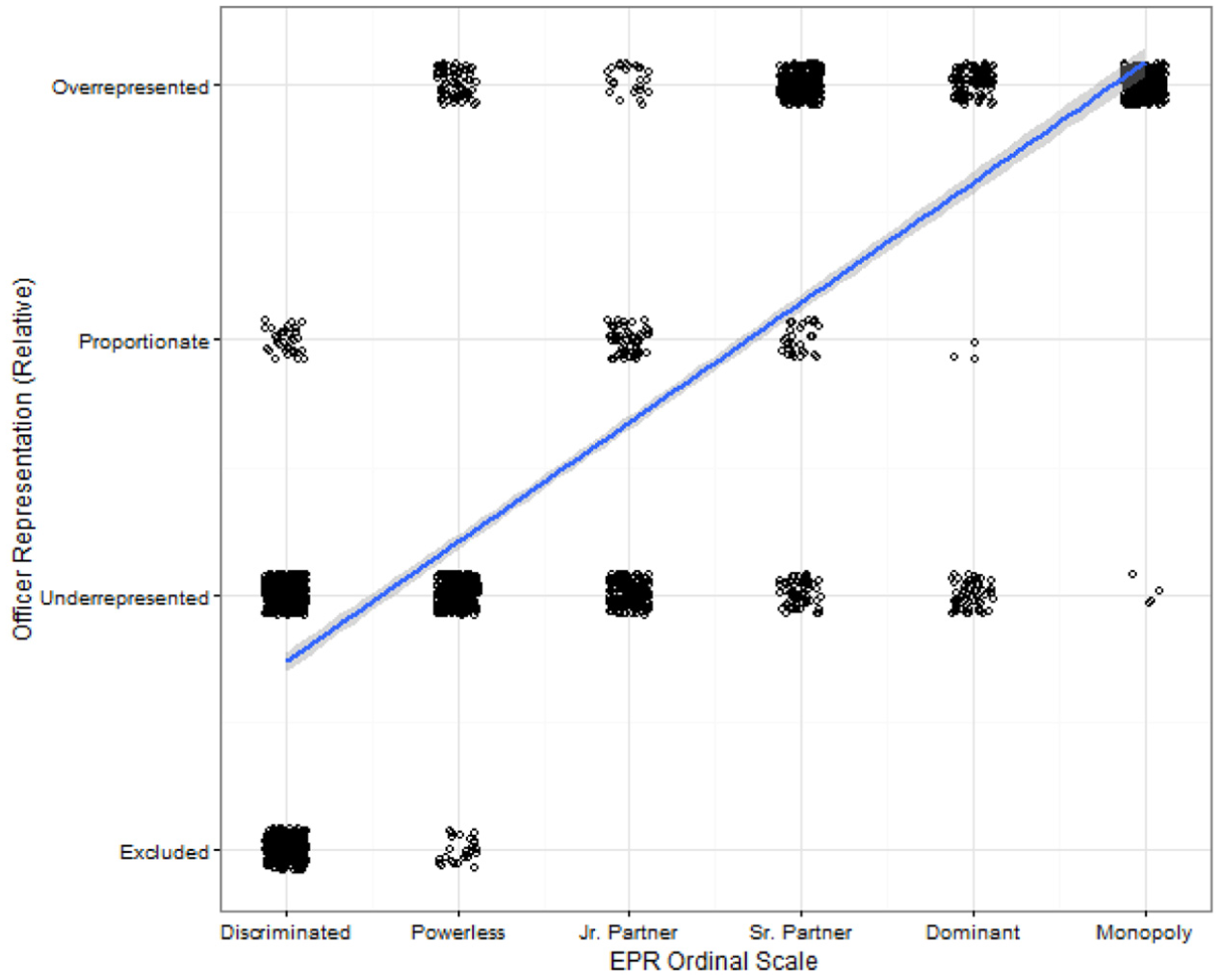
SFE relative officer corps measures vs EPR.
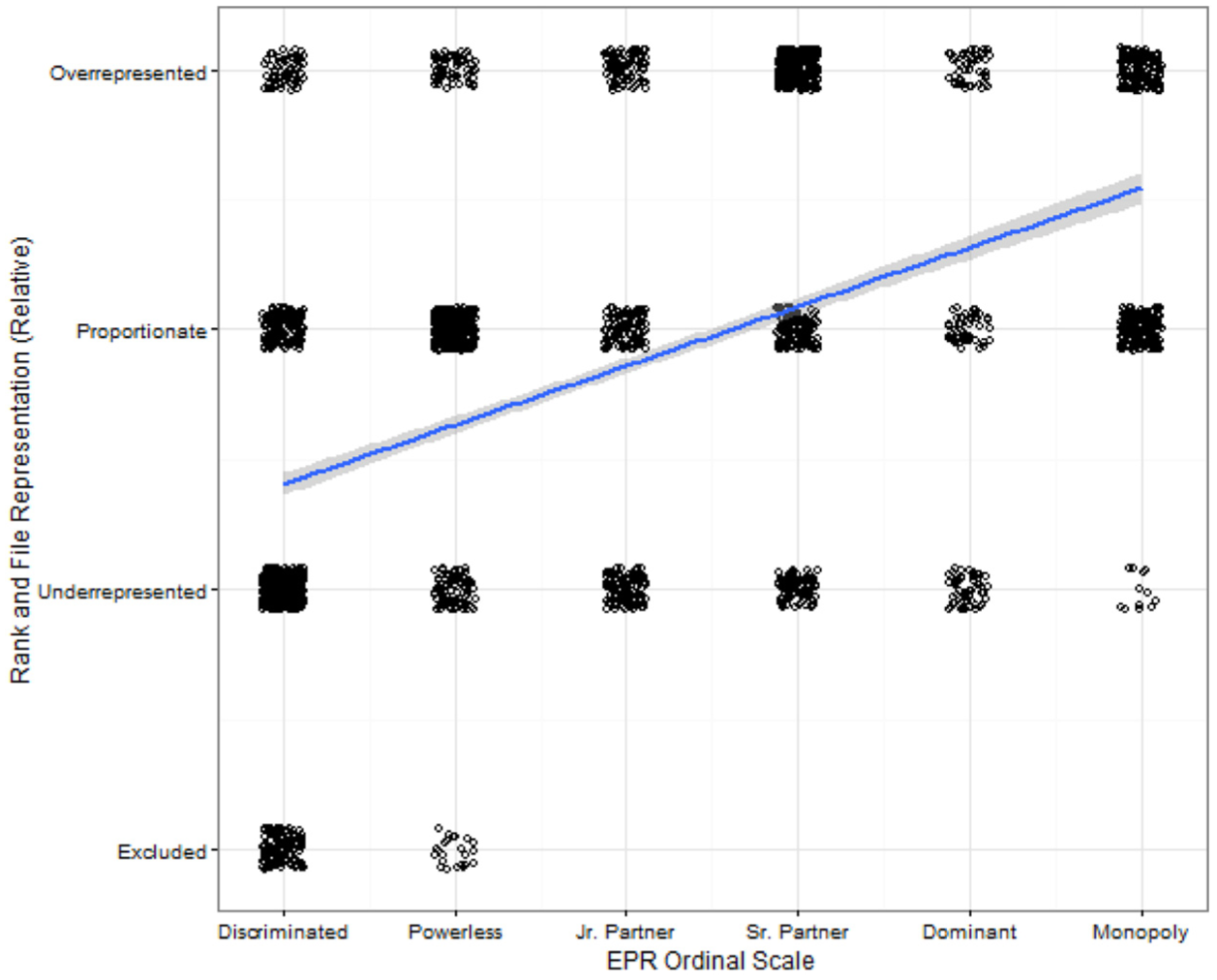
SFE relative rank and file measures vs EPR.
Because inclusion in the military does not necessarily mirror access to political power, and because these divergences may be especially important for contentious politics, our dataset offers the potential for new analysis of how the ethnic composition of the military affects important civil–military outcomes.
Applications
We next employ two brief empirical applications of the data, examining the role of ethnic military representation in determining the likelihood that groups will attempt a coup d’état and, separately, whether the group will be violently repressed by the state. 12
Military power, political power, and coups
Coups are one of the most visible and striking manifestations of inter-group conflict within the military. We theorize that to a would-be coup-plotter, no matter the underlying motivation for the conspiracy, co-ethnics appear more attractive than out-group members as potential co-conspirators. Hence, members of an ethnic group should be more optimistic about the potential success of a coup, and consequently be more likely to initiate a coup attempt, as their share in the officer corps rises. Still, not all coups, even in divided countries, are ethnic in nature. We theorize that coup attempts are the result of two kinds of motivations: (1) desire to improve the political standing of one’s group; and (2) desire to change policy in ways unrelated to the politics of representation. Consequently, the coup-inducing effect of a rising share in the officer corps for a given group should be mediated by a rising political standing for that group. To put it in different terms, we expect that coups will be far more likely to emerge from groups with a higher share of the officer corps, but that among those with a substantial foothold in the officer corps, groups with access to political power may have less desire to upend the status quo and hence be less likely to attempt a coup. In contrast, we predict that a group well represented in the officer corps but lacking commensurate political power would form a particularly acute coup-attempt threat. Such a group would have both political grievance and the military means to undertake a coup effort.
Our data for coup attempts by group come from the Cline Center’s Coup D’état Project, v. 2013. 13 For each attempted military coup, we hand-coded information about the ethnicity of the coup-plotters using secondary sources, treating cases of repeat coup attempts in the same year as a single attempt, and dropping cases of coup attempts where the ethnicity of the coup plotters could not be ascertained. 14
We draw our measure of political standing from EPR, using a dummy variable that codes group status as senior partner and higher (i.e. dominant or monopoly), meaning those who should be relatively satisfied with their group’s political standing. The baseline category represents those expected to be motivated to change their group’s political standing: discriminated, powerless, and junior-partner groups.
For the measure of representation in the military, we use the SFE absolute measures of officer corps share to create a simple dichotomous variable of whether a group holds an absolute majority (lower bound estimate of at least 50%). We believe representation in the officer corps to be most relevant to the dynamics of a coup d’état as described above, and that it is absolute share that matters in terms of a group’s perceived ability to carry out a coup.
Models 1 and 2 include only the EPR and SFE variables, respectively. Model 3 introduces an interaction term between the two that will allow us to assess the possibility of a conditional relationship.
Model 4 introduces several group-level controls drawn from the most recent EPR data (Vogt et al., 2015): 15 log group size, number of groups in the country, and number of groups included in executive-level power. In model 5, we add state-level population and GDP figures, 16 which come from COW’s NMC file (Singer, 1988; Singer et al., 1972) 17 and the Maddison Project, 18 respectively. In all models in Table 3, we use logistic regression with standard errors clustered by group and include, following Carter and Signorino (2010), a cubic polynomial of time since the last coup attempt by the group or since independence. The resulting sample contains 3524 group-year observations between 1946 and 2013 in 20 different MENA countries. 19
Effect of military and political representation on attempted coups

Note: *p < 0.1; **p < 0.05; ***p < 0.01.
Cubic polynomial for time not displayed.
GDP and population lagged 1 year.
(Robust standard errors clustered by group.)
Our findings show, as expected, that military representation is positively and significantly correlated with coup attempts. Meanwhile, the interaction term “SFE × EPR” is negative and significant, consistent with our expectation of a conditional relationship between military power, political power, and coups. The results remain substantively unchanged after controls are inserted, as shown in models 4 and 5.
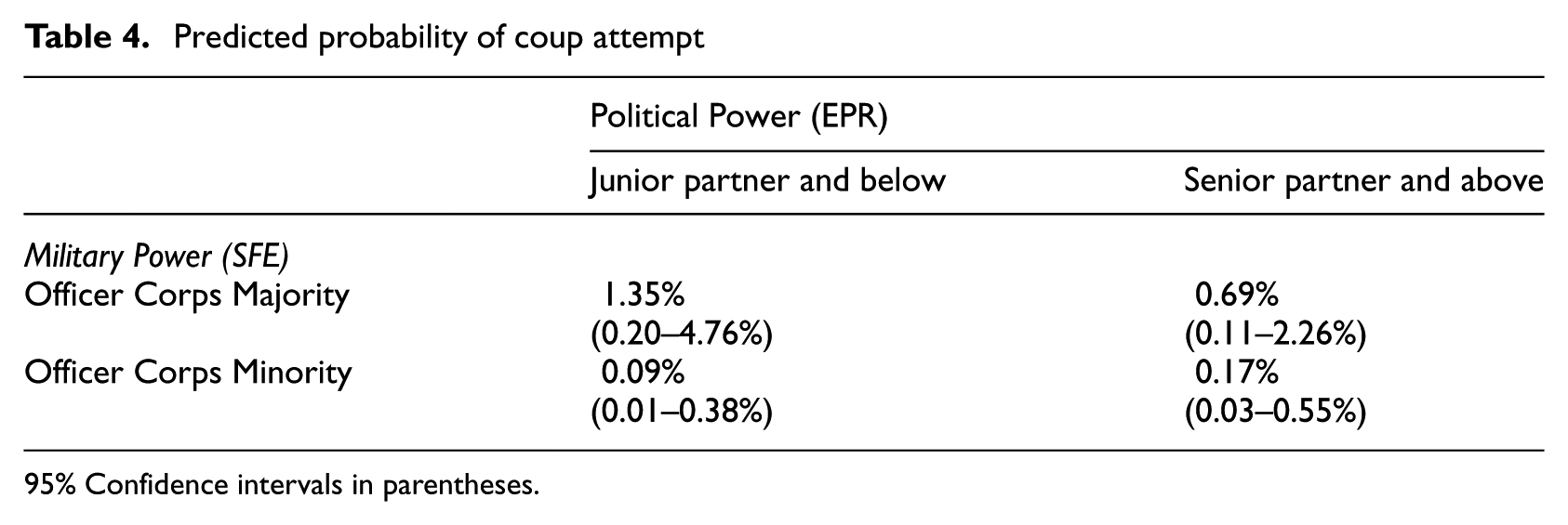
Using simulations based on model 5, we generate expected probabilities for coup attempts to show the substantive effect of changing levels of military representation. 20 These predicted probabilities are presented in Table 4.
Predicted probability of coup attempt
95% Confidence intervals in parentheses.
Consistent with our hypothesis that access to military power combined with lower political status makes coups especially likely, the predicted probability of a coup attempt in a given year under such conditions is the highest in the table, at 1.35%. In contrast, groups with similar majority status in the officer corps but who are coded by EPR as senior partners or higher in government only attempt coups at a predicted 0.69% rate. Both of these rates are much higher than the rates for groups that are minorities in the officer corps, which fall at 0.09% and 0.17% for the low and high levels of access to political power, respectively. This demonstrates that variation in access to military power has a more pronounced substantive effect on coup propensity than variation in access to political power.
It is interesting to note that while some extant work has posited that political inclusion of minorities increases the likelihood of coups generally (Roessler, 2011), our analysis indicates that the effect of political inclusion is in fact conditional on the role that such minorities play in the military. For groups with a minority in the officer corps, increased access to political power may slightly increase the likelihood of a coup, but for groups with a majority in the officer corps, the relationship is reversed as those with greater access to political power attempt coups at a lower rate.
We believe that both the substantive effect of a group’s status specifically in the military on coup propensity and the conditional effect this status has on the impact of access to political power underscore why it is important to conceptualize and measure ethnic power in the military and ethnic power in politics as distinct but interacting phenomena.
Repression of Minorities at Risk groups
A frequent argument in the literature is that regimes use ethnically manipulated security force units to repress members of other ethnic groups who may pose a threat to internal security (e.g. Horowitz, 1985: 447). As such, we should expect a negative correlation between a group’s representation in the military and the likelihood that they face regime repression.
We use the Minorities at Risk (MAR) dataset to generate measures of the repression of ethnic groups. MAR uses a series of ordinal variables to capture different forms of repression of groups between 1996 and 2006. For the sake of simplicity, we recoded these various measures into a simple dummy that takes a value of 1 if a group experienced armed repression by the state. 21
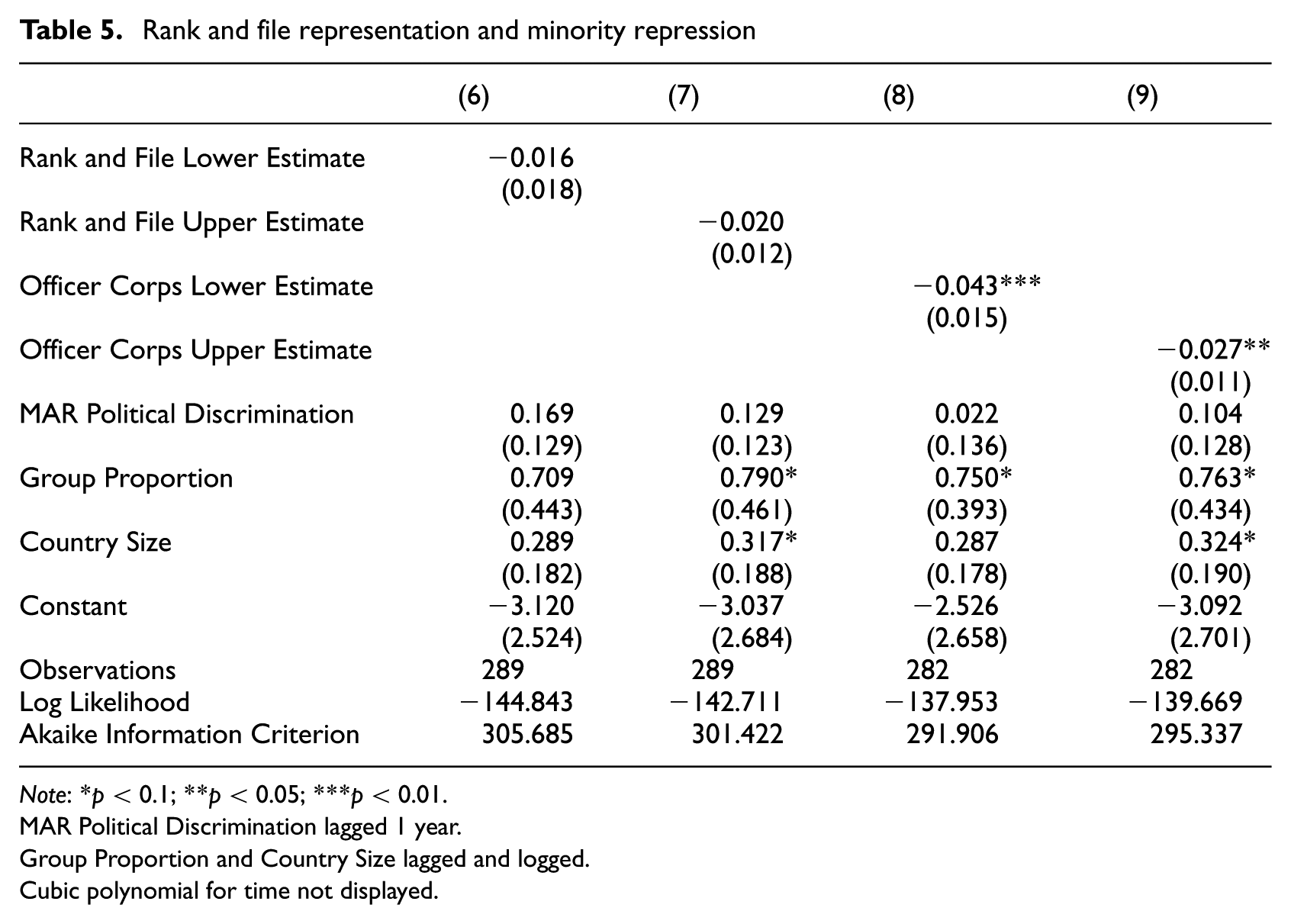
Using a logit model, we test for statistically significant differences in the likelihood of a group facing repression based on its level of absolute representation in both the rank and file as well as the officer corps of the military. We excluded units for which we did not have security force codings. The resulting dataset consisted of 289 minority group-year units for the rank and file and 282 for the officer corps. We run two models for each of the two force portions, one using our lower bound estimate and the other using our upper bound estimate. In all four models, we include lagged MAR measures of political discrimination, group size as a percentage of the total population, and country size. Both the group and country size measures are logged, and missing values were estimated via linear interpolation and extrapolation.
We find a significant negative correlation between a group’s representation in the officer corps and the likelihood that it faces armed repression (see Table 5). Our measures for share in the rank and file fall below conventional thresholds of statistical significance, but are still negative. Figure 5 reveals substantively large effects. Using the upper bound estimates, the expected probability of a group that is completely excluded (i.e. upper bound equals 0%) experiencing repression in a given year is 48%. However, that figure drops to 20% as the group’s share rises to half of the rank and file, and it drops further to only 10% as that share rises to 90%.
Rank and file representation and minority repression
Note: *p < 0.1; **p < 0.05; ***p < 0.01.
MAR Political Discrimination lagged 1 year.
Group Proportion and Country Size lagged and logged.
Cubic polynomial for time not displayed.
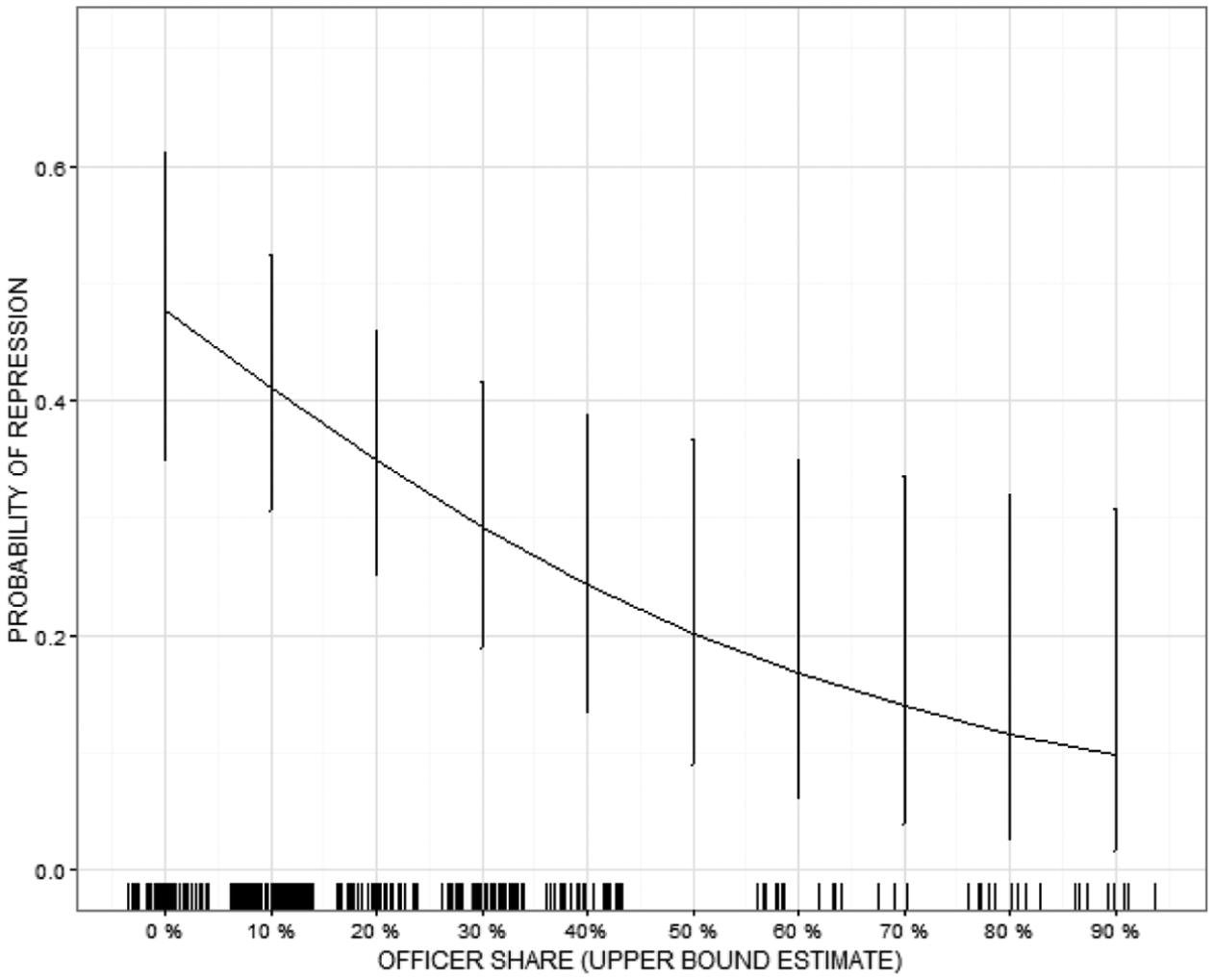
Estimated effect of officer corps representation on likelihood of MAR group repression.
Conclusion
This paper has introduced a new dataset providing direct measures for military ethnicity. Having collected data on a single region, the Middle East, we highlighted the advantage to be gained by using these measures with applications to two dependent variables of interest to the conflict studies community: coup attempts and armed repression. Additional possible applications include topics like civil war, genocide, and military effectiveness. Future collection efforts may expand coverage beyond the Middle East region as well as expand the focus to include ethnic-group participation in other state security forces, such as paramilitaries, police, and militias.
Although we have demonstrated the utility of this dataset for achieving greater causal understanding of the important role of military ethnicity in affecting a wide range of domestic and international outcomes, at this point, actors interested in making a difference for human rights might have a difficult time seeing any obvious policy implications. After all, control over military recruitment policy is one of the most tightly held prerogatives of any state, especially since a national military both is seen as a mark of full sovereignty and, more practically, is the force of last resort for protecting the regime from both domestic and foreign enemies. Even though we do not anticipate the international community to be able to influence the ethnic composition of strong, coherent autocracies, democratizing countries and recent post-conflict countries may be a different matter (e.g. Barany, 2012; Gaub, 2011; Licklider, 2014). A solid understanding of the causal implications of various ethnic configurations in the military and the tradeoffs for the regime in considering different recruitment patterns, as we hope our dataset will provide, may allow for forward-looking international intervention. This includes intervention in the demobilization, disarmament, and reintegration and security sector reform processes in order to facilitate turning the military into an institutional hindrance against human rights abuses and an aid to peace and democratic consolidation.
We expect that the theoretical framework that we have laid out for conceptualizing and measuring ethnicity in the military should travel to other regions outside of the Middle East. Many African and Asian countries inherited military forces created by colonial powers following the same “martial-race” pattern that was employed in Middle Eastern colonies (Enloe, 1980a: ch. 2; Horowitz, 1985: 445–449; Janowitz, 1964: 52–53), and in the context of salient ethnic divisions, military recruitment in those countries has tended to be politicized and operate as a second arena, alongside the political arena, in which ethnic conflict plays out (Adekanye, 2008; Enloe, 1980a; Horowitz, 1985). It is an open question how well this framework might apply to post-industrial, developed, and largely peaceful countries, such as in Western Europe, or to countries where political ideology has mattered at least as much or more for identity-based conflict, such as was the case for much of Latin America throughout the Cold War. Nevertheless, we expect that even in these cases, ethnicity will still be important to take into account in understanding military–societal, military–state, and intra-military relations.
Footnotes
Acknowledgements
The authors are grateful for useful feedback from three very helpful reviewers; also, from discussants, fellow panelists, and audience members at the 2014 and 2015 meetings of the International Studies Association; the 2014 and 2015 meetings of the Midwest Political Science Association; a workshop at the 2014 meeting of the Peace Science Society; and multiple presentations at the authors’ own departments. The authors would especially like to thank members of the Security Force Loyalty networking group for helpful comments and kind encouragement throughout the time this project has been in development. Any remaining errors are, of course, the authors’ own. Paul also thanks the US Air Force and US Strategic Command for making available a small number of working hours in order to finish this manuscript. Note: this manuscript was prepared by the authors in their personal capacity. The opinions expressed in this article are the authors’ own and do not reflect the view of the United States Air Force, US Strategic Command, the Department of Defense, or the United States government.
Funding
This research received no specific grant from any funding agency in the public, commercial, or not-for-profit sectors.
Notes
References
Supplementary Material
Please find the following supplemental material available below.
For Open Access articles published under a Creative Commons License, all supplemental material carries the same license as the article it is associated with.
For non-Open Access articles published, all supplemental material carries a non-exclusive license, and permission requests for re-use of supplemental material or any part of supplemental material shall be sent directly to the copyright owner as specified in the copyright notice associated with the article.
