



Abstract
How have rebel communication strategies been shaped by the increasingly social nature of the internet and the constant changes of information and communication technology in a Web 2.0 world? Rebel groups’ ability to disseminate a message has previously been constrained by the size of the audience they could reach through traditional technologies and the costs of those technologies. Emerging social internet platforms change this dynamic by providing rebel groups with new opportunities to build and communicate to an audience. Scholars have theorized about how rebel groups adapt to these new opportunities, but to date, little systematic analysis into the phenomenon has been conducted. In this project, we present a new dataset on rebel group Twitter use and use the data to examine how armed groups use social media to communicate, the topics contained in those communications, and the audiences that consume them. Through a richer understanding of the ways in which rebel groups communicate we are better able to measure the impact of new information technologies on armed conflict in the future.
Media occupies the greater portion of the battle today.
A rebel group’s communication strategy is a central component of its ability to mobilize, disseminate information to existing members and supporters, and signal the group’s intentions to domestic and international audiences. While there is an understanding in the rebel mobilization and governance literature that effective communication is essential for a group’s ability to overcome the free rider problem (Moore, 1995), communication strategies have traditionally been difficult to capture and measure in terms of goals and effectiveness. Furthermore, recent commentary on the emergence of Web 2.0 has suggested that these communication strategies, like so many other forms of social interaction, are being impacted by the explosion of social media.
The focus on the impact of social media for rebel communication has led to a range of new policies and tactics during armed conflict. For example, central to the US strategy to defeat ISIS has been a focus on destabilizing the social media messaging of the group. The ability of ISIS to mobilize an estimated 40,000 fighters from around the world has been attributed largely to the success of the group’s internet-based recruitment strategy (BBC, 2017). Similar arguments have been made about the mobilization strategies of Al-Qaeda in the Arabian Peninsula (AQAB) and the Taliban (Ward, 2018). At the heart of the United States’ decision to target ISIS-affiliated social media accounts is the contention that social media is impacting the way that rebel groups mobilize and share information, but is this actually true?
Extant literature suggests that new forms of user-driven, digital communication—Web 2.0—have and will continue to change the way rebel groups communicate and subsequently the ways in which civil wars are fought (Walter, 2017). Walter (2017) makes the argument that the growing popularity of social media and increased access to the internet and mobile devices have been effective in empowering low-capacity rebel groups, incentivizing these groups to frame their message in global terms, and subsequently providing new sources of financing and support. Furthermore, Web 2.0 has potentially increased the reach of rebel groups by making it possible for a greater range of individuals to generate content and project the rebel cause (Weidmann, 2015: 265).
Skeptics have largely tamped down broad claims about the impact of social media in major international events such as the Arab Spring (Alterman, 2011). Similarly, there is mixed evidence about the impact of modern forms of information and communication technology (ICT) on armed conflict suggesting that these impacts may not be as transformative as some have suggested (Rød and Weidmann, 2015). Often mobile and internet technologies are serving the same or similar functions to more traditional forms of communication such as TV and radio. In these cases, it is pre-existing social networks which are disseminating information and providing grounds for rebel recruitment regardless of the technology platform (Parkinson, 2013). Advantages in social media could also be outweighed by the state’s ability to monitor rebel groups through those media. In other words, the informational advantages of social media for low-capacity rebel groups may be undermined by the information transmitted to the state.
Before we can begin to adjudicate this debate and address the role that social media plays in the communication strategies of modern rebel groups, we must first develop an understanding of if and how rebel groups use social media. In this article we present new data on the use of Twitter by 55 rebel groups involved in an ongoing armed challenge against the government. We use these data to examine the ways in which rebel groups employ social media in their communication strategy. In particular, we focus on the messages which rebel groups communicate through Twitter as well as the audience for that information. To accomplish this, we examine the correlates of rebel group Twitter use and conduct topic modeling and content analysis on the text of rebel tweets to better understand the types of information and strategies which are being disseminated across the platform.
Contrary to previous assumptions about social media empowering relatively weak organizations to mobilize support, we find that social media use is more common among high-capacity and secessionist rebel groups, and that it is rarely used to make explicit calls to mobilize. Instead, rebel groups use social media to self-promote and report on their operations, often to a largely international audience. The results from these analyses are used to motivate a theoretical discussion on the research agenda about the use of new social media technologies by rebel groups and the potential goals and objectives for which they can be put to use.
Rebel communication 2.0
Rebel groups have historically communicated in a variety of ways. Political propaganda distributed through newspapers and flyers has often been used to advance a public message. For example, the Provisional Irish Republican Army’s (IRA) political wing Sinn Féin published An Phoblacht to report on political and military happenings during the conflict in Northern Ireland. Radio and TV broadcasting is also an effective means of disseminating a message. FARC in Colombia, for example, launched its own TV station—New Colombia News—to publicize information around the peace process. Alternatively, the CPN-Maoists in Nepal employed a less technical community education system which involved door-to-door communication with potential supporters through traveling “education cadres.” These strategies of rebel group communication have been used to recruit supporters (Hegghammer, 2013), gather information (Parkinson, 2013), inform followers of governance programs and military actions, and broadcast political messages across a given population (Klausen, 2014).
With the introduction of social media platforms in the mid-2000s, rebel groups have been able to take advantage of social mobilization and information technologies, such as Facebook, WhatsApp, Instagram, and Twitter, to disseminate information to their followers, would-be supporters, and other audiences. With the growth of these new media platforms, rebel groups have the potential to more widely disseminate their message across supporters and outside of their own national borders. Content on these platforms is also less costly to generate in terms of both the mobile technology needed to launch a new media campaign and the technical expertise needed to operate the platform. All that modern social media messaging requires is a cell phone and a free app. Yet the questions remains: if and how the advent of modern ICT, such as mobile phones, is interacting with user-driven, social media platforms (Web 2.0) to change the ways in which rebel groups design and deploy their communication strategies. While the news media has increasingly documented the proliferation of these social platforms by rebel groups and other non-state actors, scholars have yet to develop a systematic understanding of the uses of various media strategies across rebel groups.
Much has been written about the impact of the changing nature of communication technologies and its impact on social processes, facilitating political engagement (Carlisle and Patton, 2013) and coordinating collective action (Tufekci and Wilson, 2012). Less has been said directly about the impact of these “modern” technologies on political violence. In his introduction to a 2015 special issue in the Journal of Peace Research, Weidmann (2015) makes the argument that innovations in digital communication differ from older technological interventions in three ways. First, digital communication is more pervasive due to the decreasing costs of mobile telephones, and internet and cellular technology in general. This cost structure allows for changes in communication technology to impact a larger population across a broader geographic space. Second, digital communication has changed the nature of the information that can be transmitted. Unlike telephone or newspaper, digital communication allows for images and video to be widely and cheaply circulated. And finally, digital communications are changing the type of networks through which information is disseminated, making peer-to-peer communication more common (Weidmann, 2015).
Applied directly to rebel groups, assertions have been made about the ways in which Web 2.0 is changing the nature of rebel group mobilization. Walter (2017) makes the argument that rebel group use of social media has been effective in empowering low-capacity rebel groups to reach a broader audience with the necessity of fewer resources. Lower-capacity rebel groups are therefore able to frame their messages in global terms for an international audience potentially garnering greater international legitimacy and providing previously unavailable sources for financing and material support. Web 2.0 has had direct impacts on terrorist groups who are able to control their own terror message rather than relying on mainstream media (Klausen, 2014). Jihadist groups have been found to use the Internet to disseminate propaganda, gather and share information among participants, and attract supporters and sympathizers (Azman, 2014).
Weidmann (2015) suggests that the potential effects of ICT on armed conflict and political violence fall into four broad categories. First, changes in technology help groups to overcome collective action problems, fostering mobilization, and giving preexisting groups an easier mode for coordination. Second, it is possible that changing technologies make individuals and groups more difficult to censor, making their actions less prone to government interference. Counter to this, a third impact is the new opportunities ICT gives governments for intelligence gathering. And finally, for both government and non-state actors, changes in media technology increase the audience effect where events and “bad news” are reported faster and more widely, impacting possible conflict strategies and outcomes.
Yet the changing face of ICT tells us little about the patterns of adoption and use of these technologies across rebel groups. Before we can theorize the impact of Web 2.0 on conflict outcomes, we need first to understand if and how these technologies are being put to use by rebel groups. In the remainder of our article we address three interrelated research topics to help us better understand and theorize the impact of the spread of social media and ICT on rebel group communication. First, we address when and how rebel groups use social media. Second, given that we find variation in the rebel groups which do embrace these changes in ICT, we examine which messages are communicated across these platforms by groups which choose to employ social media. Finally, we examine the audience of rebel group social media communication to examine the balance between domestic and international audience and message framing.
The revolution will be tweeted
The universe of social media platforms is vast, and rebel groups around the world are faced with a myriad of options when selecting the components of their communications strategy. In addition to global platforms such as Facebook or Twitter, regionally focused sites have proliferated, with examples such as Vkontakte in Russia, or Sina Weibo in China drawing millions of active users monthly. In some regions, this platform specialization extends well below the national level. China alone, for example, has over 1,400 active small microblogging sites, largely associated with local internet service providers (King et al., 2013).
As a systematic study of rebel communications across every platform in this complex landscape is beyond the scope of the present study, we focus our analysis of rebel social media activity on the social media platform Twitter. First launched in 2006, Twitter is a popular microblogging platform where users post “tweets”: 140-character text messages that can be accompanied by other media content such as images, video clips, or links to other web pages. Tweets can be original posts, “retweets,” where users repeat an existing post either with or without additional commentary, or replies, where users respond to an existing post. Users on Twitter have a curated feed of tweets from other accounts they “follow,” but can also search outside of their immediate circle of connections to see what other users are posting. By default, all content on Twitter is publicly accessible, but tweets can be made more visible in searches by the inclusion of keywords, or “hashtags,” which link the post to larger conversations around a given topic.
There are several reasons we chose to look at Twitter for this study. First, since its inception, Twitter has consistently been one of the most widely used social media platforms in the world, and this ubiquity increases the likelihood that a rebel organization that has any kind of active social media communication strategy will have a presence on Twitter (Klausen, 2014). In particular, Twitter is specifically designed to be accessible even from basic cell phones, making the platform easy and inexpensive to use (Klausen, 2014: 1). Second, posts, interactions, and connections on Twitter are all public by default—a characteristic that is not true for many alternate social media platforms. According to Holman’s (2016) classification, Twitter can be seen as an “ideological aligned, overt, open access space” for communication. If we are interested in social media as a tool for mobilization and information dissemination, then a fully public platform is an ideal candidate for study, as its transparency and accessibility make it well-suited to these tasks. Finally, posts on Twitter are limited in length, making them an optimal vehicle for an organization to share information frequently and informally, and requiring such messages to be intentional and highly focused.
To study the role of Twitter in rebel groups’ communication strategies, we created an original dataset consisting of the full account history of rebel group active on Twitter between 2006—when Twitter was first launched—and July 2018. We began by referencing the UCDP/PRIO Armed Conflict Dataset, version 18.1 (Gleditsch et al., 2002; Pettersson and Eck, 2018) to extract a list of conflict episodes between states and non-state challengers from January 2006 to July 2018. This yielded a set of 155 unique organizations engaged in 477 conflict episodes over the 12-year period. From this list of organizations, we worked to identify each group’s official Twitter account, if one existed, referencing news articles, online search engines, organizational literature and websites, and Twitter itself. 2
We focus on official accounts containing a branded message from the rebel group and exclude the personal accounts of group members or supporters who claim to speak for the organization in order to ensure that we have content generated directly by the rebel group. In some cases, rebel groups’ supporters are trusted individuals who have been delegated the task of posting on social media, as Klausen (2014: 2) notes is often the case for the Islamic State in Iraq and Syria. But even when groups maintain centralized control over this kind of disaggregated communications strategy, voices can proliferate dramatically. In the second half of 2015, for example, Twitter identified and deactivated over 125,000 individual accounts associated with ISIS fighters or supporters during a crackdown on ISIS-related content. 3 The degree to which even a highly coordinated rebel organization can monitor and curate the messages contained in that volume of activity is unclear. Therefore, rather than trying to determine when individual supporters speak directly for the rebel organization and when they do not, we limit our focus to official group accounts which clearly represent the curated communication strategy of the group as a unit. 4
The process of account identification yielded a subset of 55 rebel groups with an active presence on Twitter as of July 2018. 5 Collectively, these groups control 76 distinct accounts and, in a number of cases, highly active groups were observed to maintain multiple accounts. 6 The FARC in Colombia, for example, has active accounts in both English and Spanish that largely post the same content. All told, these groups represent 77 different conflicts active in 51 different countries.
Groups that fail to appear in this subset of Twitter users primarily do so for one of two reasons. The first, and most common, is that we were unable to identify an official account associated with the group, indicating either that the group does not use Twitter at all, or that its use is minimal to the point of being undetectable in our searches. In either case, this means the group is not using Twitter to engage in the behaviors of interest to our study—the use of social media as a public, visible tool for information dissemination. While some of these groups are likely communicating through alternate social media platforms as discussed above, throughout our coding processes the majority of groups with an obvious presence on other major social media platforms appeared to also use Twitter, suggesting that in most cases, Twitter use serves as a reasonable proxy for a group’s broader social media strategy. 7
The second reason a rebel group might not appear in the subset of active Twitter users is that its account has been suspended or deactivated by Twitter. These cases, though few, are a more problematic omission for our analysis as relevant content clearly existed but has become inaccessible. Twitter reserves the right to deactivate accounts for violating its terms of service. These include prohibitions against depicting graphic violence, threatening violence, and engaging in illegal activities. Terrorist groups in particular, such as the Islamic State, have frequently violated these usage rules. Twitter has exercised its right in the past to deactivate some accounts associated with rebel organizations, but in general suspensions of high-profile accounts tend to be relatively rare. 8 Notable exceptions are the Islamic State, the Taliban, and al Qaeda, none of which appear in our sample due to deletions. Once a Twitter account is deactivated, its content is not available to the public and could not be accessed for this project. Nevertheless, given these limitations we have been able to collect a meaningful subsample of rebel groups’ social media activity.
Once the official accounts were identified for the 55 organizations, we collected the full history of each group’s accounts. This history included the full text of a total of 269,302 tweets along with relevant account metadata such as the date of original activation, followers, and reported location for each rebel group. 9
To tweet or not to tweet
Initial analysis of the data we collected on official rebel group Twitter use supports the idea that social media has become an increasingly central component of rebel groups’ communication strategies. Twitter was first released publicly in 2006, but did not gain widespread global prominence as a social media platform until early 2008. Since then, the use of Twitter by rebel organizations has increased steadily, and appears to be continuing to climb, as shown in Figure 1. Overall, 35% of rebel groups active since 2006 maintain or have maintained an active official Twitter account. Almost 70% of those accounts were created in 2013 or later.
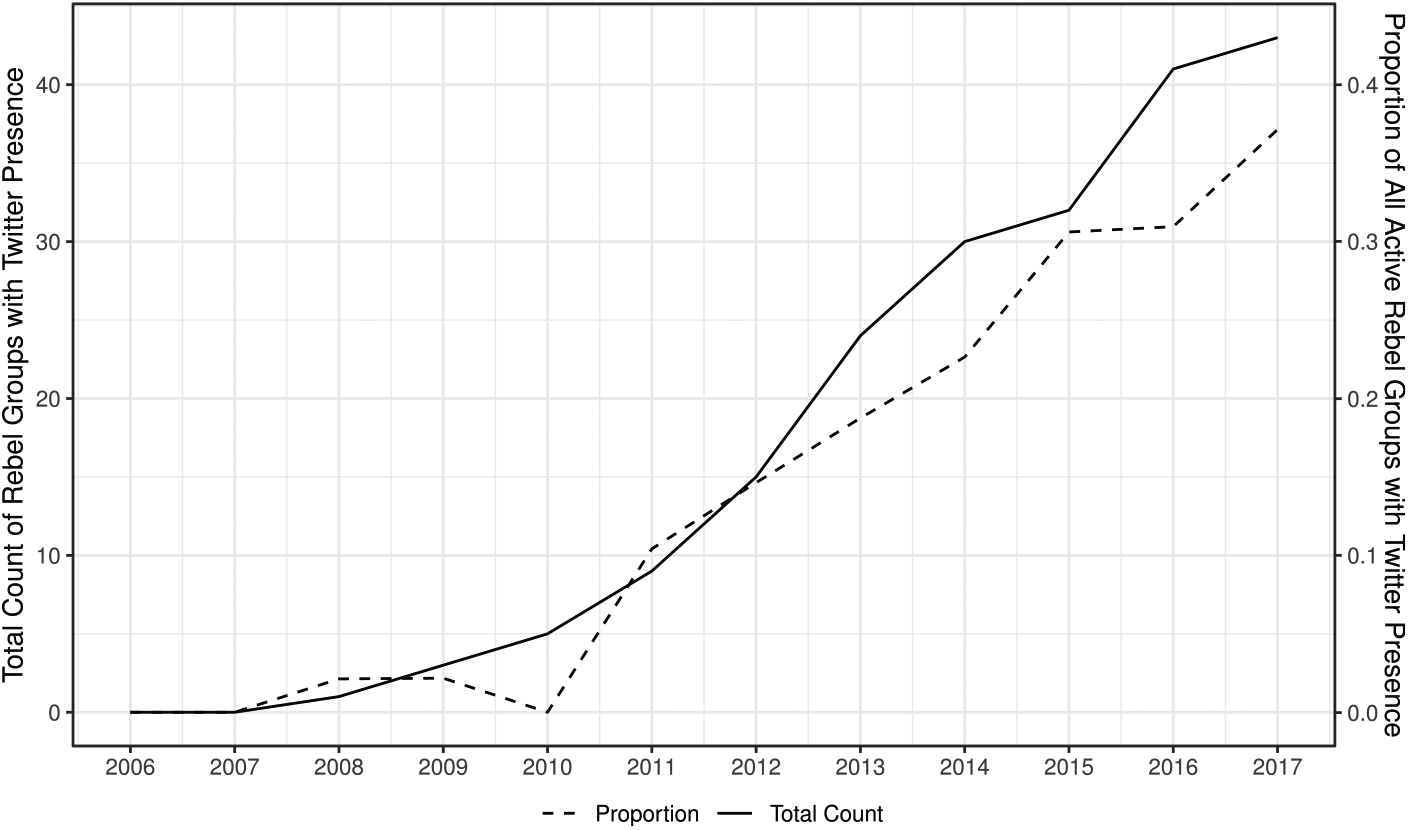
Rebel Twitter adoption over time.
Rebel group Twitter users display significant variation and diversity. Rebel groups in every region of the world have adopted Twitter into their communication strategies. These groups vary in the kinds of claims they make, in their ideologies, and in their capacity. We see extensive Twitter use from small guerilla organizations such as the ARSA in Myanmar, to large organizations with sophisticated political wings, such as the Donetsk People’s Republic in Ukraine or the FARC in Colombia. Figure 2 shows the geographic distribution of rebel groups using Twitter.
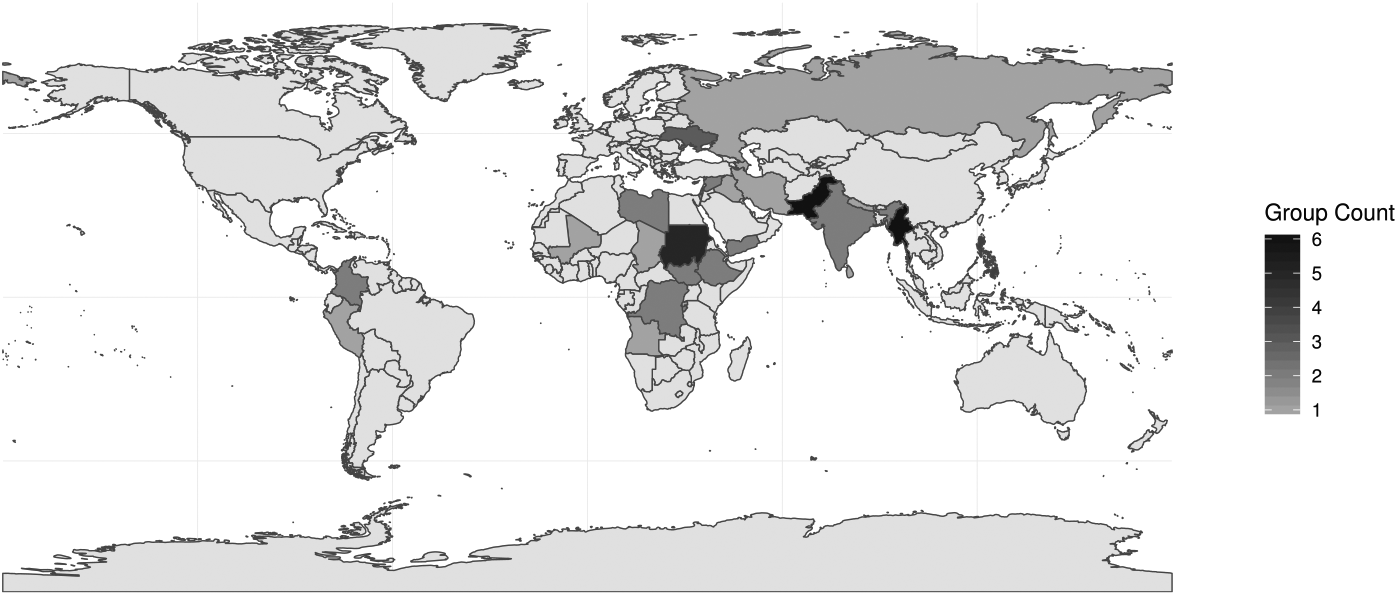
Rebel groups using Twitter by country.
Rebel groups that employ Twitter also vary substantially in the degree to which they choose to make use of social media. For some, Twitter serves as a near-constant stream of communication. The Fatah account, for example, has tweeted over 60,000 times since it was started in June 2011. Other groups make much more sparing use of social media, posting only a few dozen times over the life of their accounts. This creates a highly skewed overall distribution, as shown in Figure 3, where the average number of tweets for a rebel group in this dataset is 5,618, and the median group has 864.
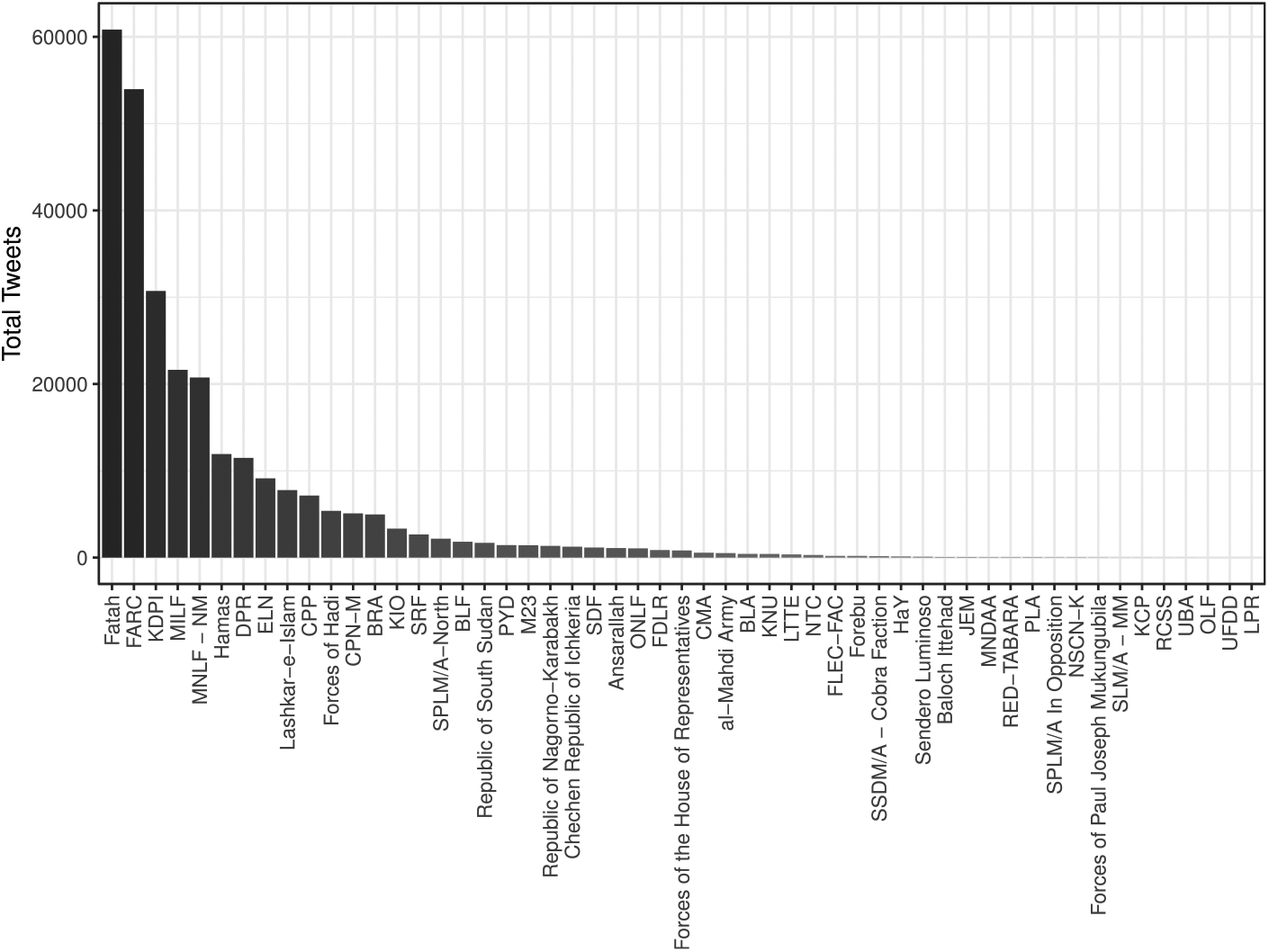
Distribution of rebel Twitter post activity.
Finally, rebel groups also differ substantially in the languages in which they tweet, with 48 different languages represented in the tweets we collected. Of all these languages, English is by far the most prevalent, with 40 of the 55 groups we identified tweeting in English, either as a primary or secondary language. 10
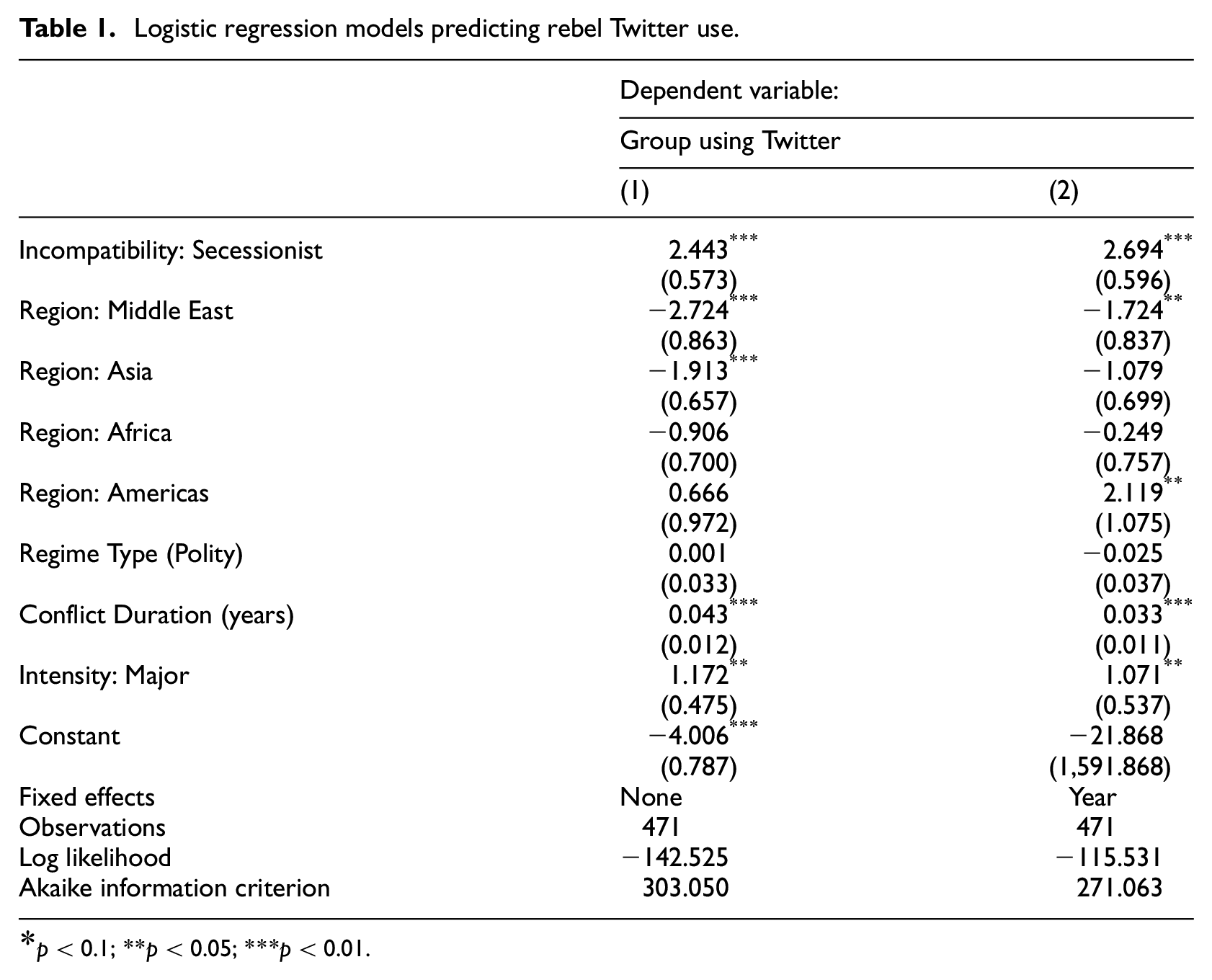
Group and conflict characteristics are important determinants for a rebel group’s likelihood of adopting a social media strategy on Twitter. Table 1 shows results from a set of binary logistic regression models predicting Twitter use in a given year for all rebel groups active between 2006 and 2018. Here we include as covariates the geographic region, duration, and intensity of the conflict as recorded in the UCDP/PRIO Armed Conflict Dataset (Gleditsch et al., 2002). We also look at the primary incompatibility of the conflict, which differentiates rebel groups making secessionist claims from those groups making claims on the governance of an existing state. Finally, we control for the regime type of the state against which the rebel group is engaged in conflict, using the Polity IV index (Marshall et al., 2017).
Logistic regression models predicting rebel Twitter use.
p < 0.1; **p < 0.05; ***p < 0.01.
In Model 1 all observations are pooled, while Model 2 includes year-fixed effects to account for the increasing adoption of Twitter over time. In both versions of the model, we see evidence that secessionist groups are over 10 times more likely to use Twitter than groups making claims on existing governments (p < 0.01). If we think about social media as promoting and accommodating the international framing of rebel groups’ goals and grievances, then this finding follows intuitively—secessionist claims rest on perceived legitimacy and international appeal. Secessionist groups also tend to have strong pre-established base constituencies which might serve as a compelling reason to use social media as a tool for communication.
Second, Model 1 implies a pattern of regional variation in rebel Twitter adoption, where groups located in Europe, the Americas, and Africa appear more likely to use Twitter than those in Asia or the Middle East. However, these effects shrink or disappear altogether with the inclusion of year-fixed effects in Model 2, suggesting that this might instead indicate regional variation in the relative timing of when groups adopt Twitter, but not necessarily whether or not they do so. A theoretical explanation for this finding is not immediately apparent, though it could partly be a result of the prevalence of alternate regional social media platforms. A systematic study of rebel social media use beyond Twitter would be required in order to provide a definitive answer.
Finally, conventional wisdom in the literature suggests that low-capacity rebel groups would stand to benefit most from social media use, as it provides them with a means to compensate for resource constraints and raise material support (Walter, 2017). However, if we consider conflict duration and intensity as proxies for a group’s capacity to challenge a government, we instead see that rebel groups engaged in conflicts with longer durations are more likely to have an official Twitter account, with the likelihood increasing by 3–4% for every year the conflict continues (p < 0.01). Likewise, the likelihood of Twitter adoption is over three times higher for groups engaged in high-intensity conflicts (defined as over 1000 battle-related deaths per year, p < 0.05). 11 Potentially challenging the conventional wisdom, this finding suggests that it may primarily be the higher-capacity, higher-profile rebel groups making substantial use of social media technologies at this time.
What’s the buzz? Tell me what is happening
Arguments about the impact of Twitter on rebel mobilization and operations assume rather than test the content of rebel social media messaging. Instead of focusing solely on messages of recruitment, mobilization, and fundraising (Berman, 2012), we find that rebel groups employ a wide variety of strategies across social media. These patterns vary both across groups and within groups. So the question becomes: of those rebel groups that do adopt social media into their communication strategy, what kinds of information are being communicated? We explore these patterns through a systematic analysis of the topical content contained in our Rebel Twitter Dataset.
One of the implications of Twitter’s length-limited post format is that tweets end up being highly focused units of communication—a given tweet generally conveys a single idea or message. The text of a tweet can therefore be classified into mutually exclusive topical categories based on the type of message it contains. 12 While a number of such classification schemes could reasonably be suggested here, we follow an established trend in the communications literature (e.g. Berman, 2012; Theocharis et al., 2014), and adopt a minimalistic three-category typology of social media messaging for rebel groups—mobilization, self-promotion, and operations, as outlined in Table 2.
Tweet topic classification.
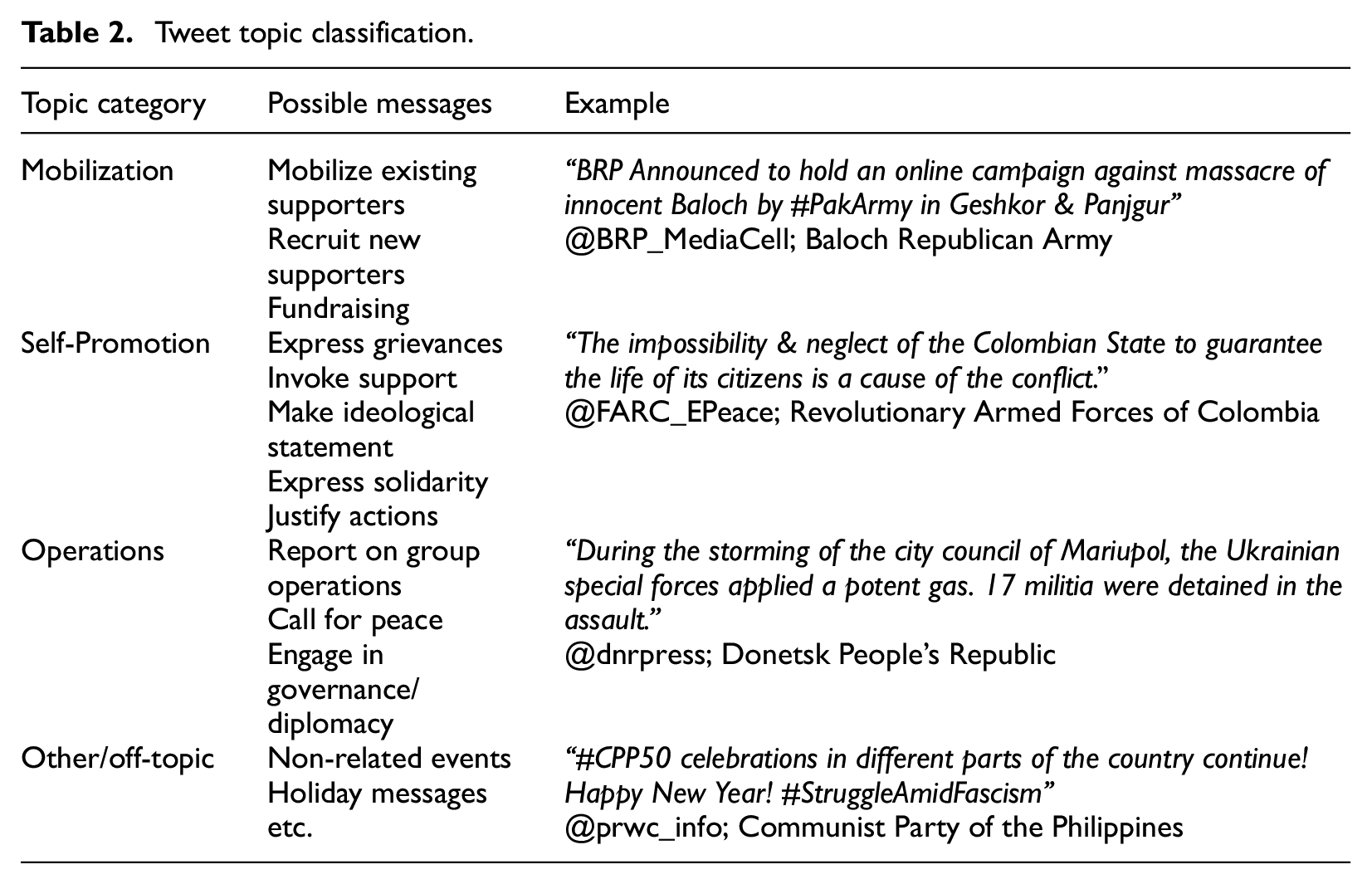
Tweets where groups make explicit appeals to raise funds, call existing supporters to action, or recruit new supporters are classified as containing a mobilization message. Tweets where the group expresses grievances or motivations for action, invokes mass support, makes broad ideological statements, or expresses solidarity with another group or movement are classified as self-promotion. Finally, tweets that report on battles, troop movements, or regular operations of the rebel group, or where the group engages in diplomacy or governance, are classified as operations. While these categories are mutually exclusive, they certainly do not exhaustively cover the universe of potential topics or messages that could be expressed over social media. Therefore, we also include an other or off-topic classification in our typology in order to accurately represent tweets that do not fit into any of our three primary categories.
In order to apply our classification scheme over the corpus of tweets in the Rebel Twitter Dataset, we employ a supervised machine learning approach for topic modeling. 13 This process began with a machine translation pass through the corpus to ensure all tweets were readable in English, using the Google Translate API. Then, a random sample of 10,000 tweets was selected from the full corpus and hand-coded according to the typology outlined above. Next, all tweets in the corpus were cleaned and preprocessed—all words changed to lowercase, punctuation stripped, common English stop words dropped, and tweets tokenized into stemmed unigram and bigram terms. As the training sample was randomly selected, yielding a non-uniform distribution of classes, we balanced the training data using the Synthetic Minority Oversampling Technique (SMOTE), which generates synthetic observations of underrepresented categories (Chawla et al., 2002). Finally, we trained a linear support vector machine on the balanced hand-labeled data, achieving an average accuracy score of 74.5% over 10-fold cross validation.
Figure 4 shows the relative weight the support vector classifier places on various terms in predicting each topic category. In line with our expectations, “call-to-action” terms such as “protest,”“donate,”“rally,”“march,”“register,” or “subscribe” are strongly predictive of mobilization, while self-promotion is predicted by terms referencing people as well as broader ideological terms like “martyr,”“evil,”“inspire,” or “convict,” and operations is predicted by terms such as “ceasefire,”“treaty,”“diplomat,” or “report.” It is worth noting that the other category has relatively few strong predictors and those that do appear do not seem to have a unifying theme, in line with what we would expect for a broad, off-topic category.
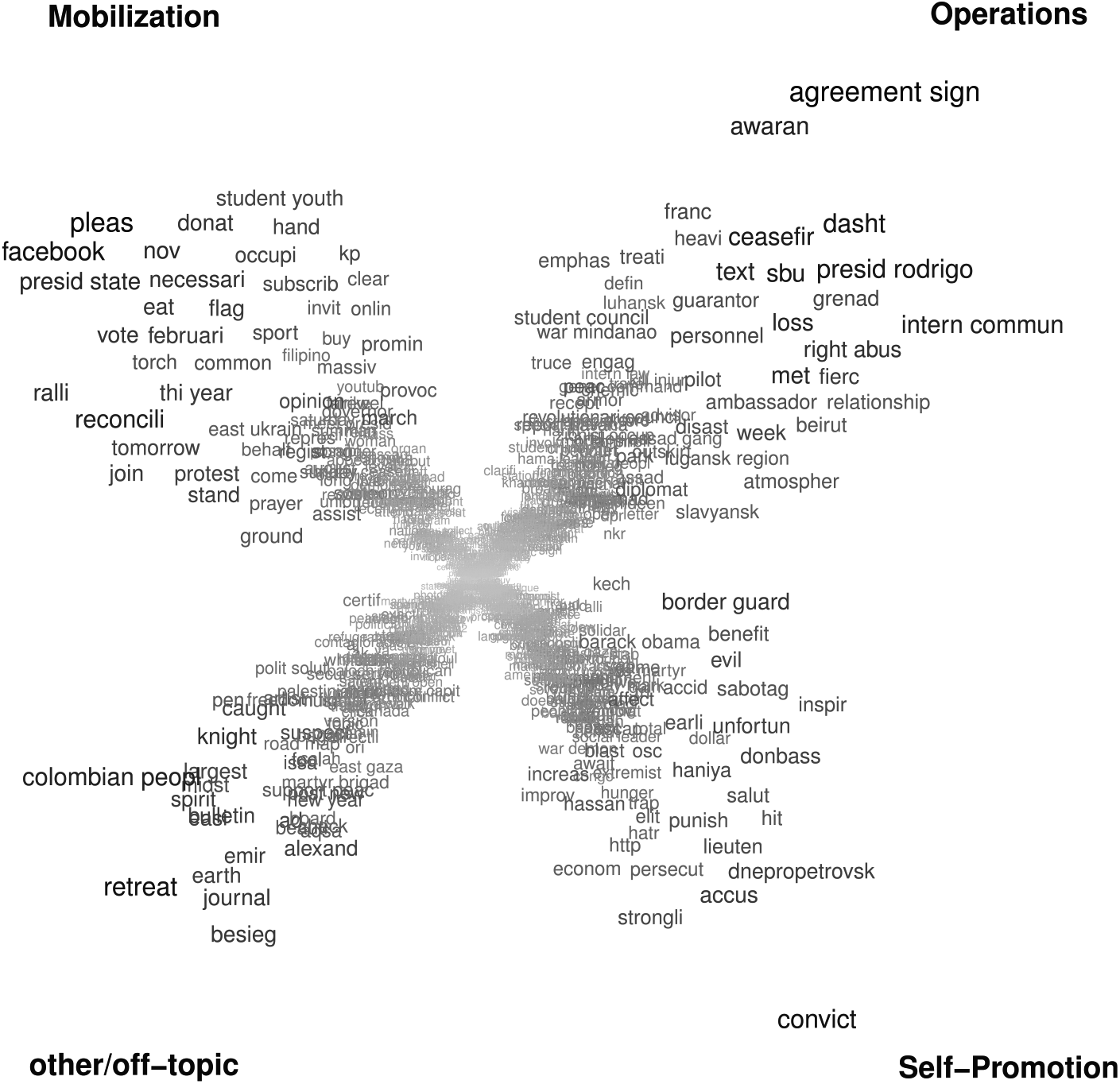
Most predictive terms: rebel tweet classification.
In addition to the content classification described above, we separately coded each tweet as having an international messaging frame if it referenced world powers, international institutions, or international norms (e.g. United Nations, UNHCR, human rights, the ICC). Framing refers to the context within which a given message exists—the individuals, organizations, and ideas with which it interacts. As such, we view framing as distinct from message content, as any topic can fit within a given frame. To categorize tweets as using international framing, we employed a simple dictionary method, where tweets are classified as internationally framed if they contain terms that appear in a short dictionary of relevant terms that we constructed. 14
The distribution of tweets into these categories is interesting and somewhat surprising, given speculation in the literature about social media’s importance to rebel groups as a tool for raising funds and recruiting support. As shown in Figure 5, we found relatively few instances of Twitter being used to directly call for mobilization. Much more common are self-promoting tweets and reports on the group’s operations. This finding challenges, but does not necessarily contradict, the idea that social media serves primarily as a mobilization tool for rebel organizations. It is possible that self-promoting and operations-reporting tweets function as indirect mobilization tools for these groups by drawing attention to their goals, actions, and ideologies. However, direct calls for mobilization occur very rarely in the corpus we studied. 15 This result is in line with other findings on this topic. For example, in Yemen, Elisabeth Kendall found that 56% of tweets by Al-Qaeda in the Arabian Peninsula are about rebel governance and community development projects (Ward, 2018). This suggests that the group is using social media to demonstrate a “viable and legitimate alternative to the Yemeni government” (Ward, 2018).

Rebel Twitter use: topic breakdown.
Second, Walter (2017) and others have proposed that the rise of Web 2.0 is facilitating the ability of rebel groups to communicate with an international audience. If this is the case, one implication we might expect to observe is a tendency for rebel groups to frame the content of their messages in international terms through references to institutions and norms. In aggregate, we find evidence in support of this idea. Tweets coded as having an explicit international frame according to our minimal dictionary are relatively rare, but still occur with some degree of regularity, making up about 6% of the average group’s tweets. This varies significantly from group to group, though, with some organizations invoking an international frame in as many as 26% of their tweets. The use of international framing also varies along with the topic of the tweet, as shown in Figure 6. Rebel groups are most likely to use an international frame with a self-promoting tweet, followed by one about their operations.

Rebel tweets employing international messaging frames.
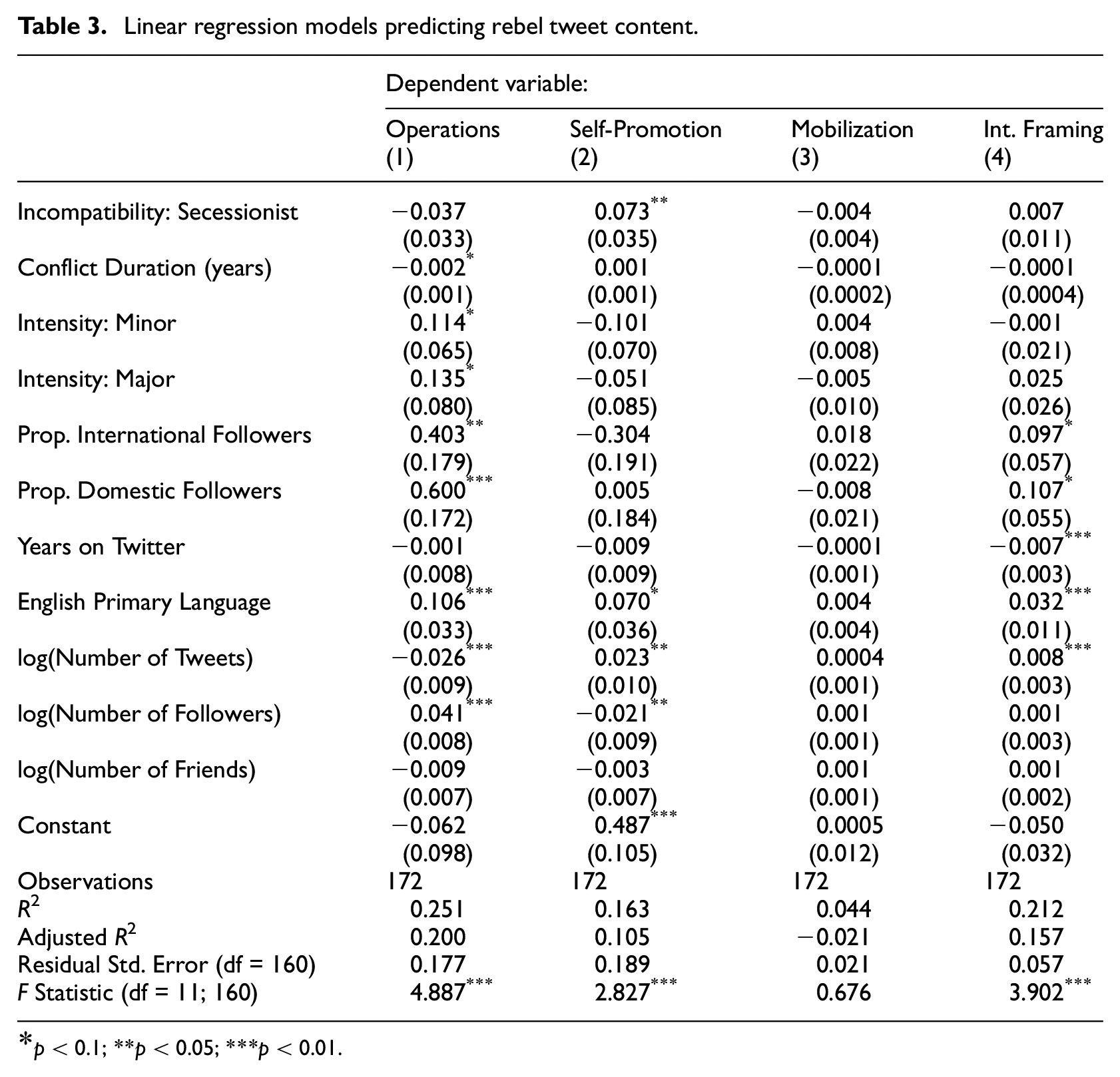
In addition to variation in the overall breakdown of rebel group communication strategies, there is variation across rebel groups. Table 3 shows a series of linear models predicting the proportion of a rebel group’s tweets that fall into each message category in a given year by the group’s characteristics, the characteristics of its Twitter account, and the characteristics of the conflict the group is engaged in. 16 We observe that rebel groups making secessionist claims post explicitly self-promoting tweets at a rate 7.3% higher than other groups (p < 0.05). In years where groups are engaged in active conflicts, those groups appear to tweet about their operations at a higher rate. The proportion of operations tweets increases by 11.4% in low-intensity conflict years (25–1000 battle-related deaths) and by 13.5% in high-intensity conflict years (greater than 1000 battle-related deaths) over years with no conflict, though in both cases these coefficients are only marginally significant (p < 0.1). Groups that make more extensive use of Twitter appear to tweet less frequently about operations in favor of self-promotion (p < 0.05), though this effect is substantively small. Conversely, groups with a greater number of social media followers tweet more about operations and less about self-promotion (p < 0.05), though the substantive size of this effect is similarly small.
Linear regression models predicting rebel tweet content.
p < 0.1; **p < 0.05; ***p < 0.01.
We want you!
One of the most impactful characteristics of social media is its ability to spread messages to wide and geographically diffused audiences in ways that would have been impossible under the inherent constraints of traditional media and communication technologies. With social media, rebel organizations have a powerful new set of tools to frame and target their message to global audiences. To explore the implications of these new capabilities further, we estimated the geographic distribution of each group’s Twitter followers—the identifiable core subset of their audience who are interested enough in what the group posts that they have elected to have those messages automatically delivered to them.
While Twitter’s detailed account analytics tools are only available to the owner of a given account, it is still possible to approximate the geographic breakdown of followers through publicly available data. Users on Twitter have the option of listing their physical location in their public user profile, so the geographic reach of a rebel group’s message can be estimated by examining the reported locations of that account’s followers. We used an automated process to collect and geo-verify the user-reported locations of the followers of each rebel account in our dataset. 17 With this information, we constructed measures of the proportions of each rebel account’s followers located domestically and internationally.
Existing research likewise relies on this user-reported location for a variety of tasks, ranging from estimating Twitter users’ political representativeness (Barberá and Rivero, 2015) to the early detection and location of disease outbreaks and natural disasters (Achrekar et al., 2011; Sakaki et al., 2010). In fact, researchers working to develop other methods of inferring Twitter user location will routinely make use of the user-reported location field as a ground-truth reference (Cheng et al., 2011). That being said, while measures constructed from user-reported locations on Twitter are among the most commonly used and reliable, they can be limited by missingness. Since the account location field is simply a text field with no specific requirements or verification, many users leave it blank or choose to enter something vague. For example, at the time of writing the official account for Twitter itself, @twitter, has its location listed as “everywhere.” In our particular use case, around 40% of the followers we examined were non-locatable, either because they left the location field blank or because they entered a vague or nonexistent location. Additionally, while account owners have access to historical data about their followers, the equivalent publicly available data are time-invariant, reflecting a snapshot of follower locations at the time of data collection—in our case, summer 2018.
The limitations inherent in user-reported follower location data can be mitigated through a realistic understanding of what information these data can and cannot provide. Missingness due to blank or vague answers matters less at higher levels of spatial resolution, so we aggregate the responses we have up to proportions at the national level, rather than trying to place each individual follower precisely. The data are time-invariant, so we conduct analysis at the account level, rather than trying to understand the evolution of follower distributions over time. These practices yield a reliable if imprecise measure of audience location that allows us to make some interesting general observations.
On average, rebel groups have a higher proportion of international than domestic followers, as shown in Figure 7. In the content classification models presented above, the proportions of both domestic and international followers appear to be marginally significant predictors of more tweets using international framing, though the substantive effect size is larger for the proportion of international followers. 18 It is unclear, however, how much confidence can be placed in marginally significant coefficients for imprecise, aggregated measures such as these. However, we also note that the majority of groups tweet primarily in English, and that in Table 3, model 4 this practice increases the proportion of tweets that feature an international frame by 3.2% (p < 0.01). Taken together, these findings lend support to the idea that rebel groups generally take advantage of social media’s ability to reach across borders in order to broadcast and frame their message to a broader global audience.

Distribution of rebel Twitter account follower locations.
Conclusion
It is argued that Web 2.0 will fundamentally shift the way in which rebel groups communicate and organize. While much is being written and speculated about the impact of information and communication technology on armed conflict, many of these arguments have not been substantiated with available data on social media trends. The next step in this critical research agenda is to leverage new sources of social media data to address these outstanding theoretical questions (Dafoe and Lyall, 2015). This article is a first step in using social media data to identify the main patterns in rebel group social media use to subsequently motivate new research questions and theory generation. Specifically, through examining new data on rebel group Twitter use we are able to address three interrelated research topics—which rebel groups use social media, which messages they communicate, and to what audience. Rather than confirm the contentions in the extant literature, our examination raises new questions and identifies additional areas for future research.
Regarding our three areas of inquiry, our analysis of the Rebel Twitter Dataset suggests the following. First, in contrast to the idea that social media serves as a substitute for capacity in providing rebel groups with a new tool for mobilization and information dissemination, we found reason to believe that it is actually the higher-capacity rebel groups—those able to engage in longer-standing, more intense conflicts—that are more likely to use social media. This raises a question about a potential threshold of capacity needed for a group to effectively engage with social media. It also suggests that a wider social media campaign may not be a first order priority of a rebel group, but rather a strategy that is employed later in the course of a conflict. Similarly, we note a stronger tendency toward social media use among rebel groups making secessionist claims. These groups, which are traditionally seen as relying on the support of local constituencies in their disputed territories yet whose success depends on appeals to international legitimacy, are on average 10 times more likely to have a social media presence than groups that are not making secessionist claims. It may be that a global social media message is more useful for certain types of rebel groups than for others, calling our attention to important constraining factors in our analysis of the impacts of social media on armed conflict.
Second, despite the fact that social media is commonly viewed as a platform for messages of mobilization and recruitment for rebel groups, we found that explicit calls to mobilize are quite rare. Rebel groups much more commonly use social media to self-promote or to report on their operations. In this way rebel groups are using social media to broadcast broader claims of grievances and calls for legitimacy which could potentially indirectly serve to mobilize their support base, but which do not directly call for action, participation, or support. This finding calls us to contextualize some of the prominent cases of social media mobilization, such as the use of social media as a recruitment tool by ISIS, as unique examples rather than indicative of greater patterns across rebel groups.
Finally, in line with the idea of social media as facilitating a broader global audience for rebel claims, we found evidence that the primary audience for rebel social media is, in fact, international. On average, rebel accounts had fewer followers from the country where the group was located, and the majority of the groups we studied posted primarily in English, often framing their posts in international terms. This pattern further challenges claims about social media used for internal mobilization and coordination, suggesting instead that the communication tool may be more outward facing.
There can be no doubt that Web 2.0 is changing the ways in which individuals communicate, groups organize, content is generated, and information is spread. The impact of these changes, however, may not be as straightforward for armed conflict as previously theorized. As new data sources are brought to bear on these questions, we are able to develop a stronger understanding of the impact of these technological changes leading to greater awareness of how rebel groups structure their communication strategies and what the groups themselves are trying to achieve.
Supplemental Material
analysis_script – Supplemental material for #rebel: Rebel communication strategies in the age of social media
Supplemental material, analysis_script for #rebel: Rebel communication strategies in the age of social media by Cyanne E Loyle and Samuel E Bestvater in Conflict Management and Peace Science
Supplemental Material
ISO_a3_countrycodes – Supplemental material for #rebel: Rebel communication strategies in the age of social media
Supplemental material, ISO_a3_countrycodes for #rebel: Rebel communication strategies in the age of social media by Cyanne E Loyle and Samuel E Bestvater in Conflict Management and Peace Science
Supplemental Material
rebel_twitter_group – Supplemental material for #rebel: Rebel communication strategies in the age of social media
Supplemental material, rebel_twitter_group for #rebel: Rebel communication strategies in the age of social media by Cyanne E Loyle and Samuel E Bestvater in Conflict Management and Peace Science
Supplemental Material
rebel_twitter_groupyear – Supplemental material for #rebel: Rebel communication strategies in the age of social media
Supplemental material, rebel_twitter_groupyear for #rebel: Rebel communication strategies in the age of social media by Cyanne E Loyle and Samuel E Bestvater in Conflict Management and Peace Science
Supplemental Material
RT_RandR_Appendix – Supplemental material for #rebel: Rebel communication strategies in the age of social media
Supplemental material, RT_RandR_Appendix for #rebel: Rebel communication strategies in the age of social media by Cyanne E Loyle and Samuel E Bestvater in Conflict Management and Peace Science
Supplemental Material
SVM_proportions – Supplemental material for #rebel: Rebel communication strategies in the age of social media
Supplemental material, SVM_proportions for #rebel: Rebel communication strategies in the age of social media by Cyanne E Loyle and Samuel E Bestvater in Conflict Management and Peace Science
Supplemental Material
topterms – Supplemental material for #rebel: Rebel communication strategies in the age of social media
Supplemental material, topterms for #rebel: Rebel communication strategies in the age of social media by Cyanne E Loyle and Samuel E Bestvater in Conflict Management and Peace Science
Footnotes
Acknowledgements
The authors would like to thank Molly Utter for research assistance on this project, as well as participants in the 2018 Peace Science Society International Meeting in Austin, TX.
Funding
The author received no financial support for the research, authorship, and/or publication of this article.

Supplemental material
Notes
References
Supplementary Material
Please find the following supplemental material available below.
For Open Access articles published under a Creative Commons License, all supplemental material carries the same license as the article it is associated with.
For non-Open Access articles published, all supplemental material carries a non-exclusive license, and permission requests for re-use of supplemental material or any part of supplemental material shall be sent directly to the copyright owner as specified in the copyright notice associated with the article.
