



Abstract
Democracy is one of the most consistent predictors of terrorism. Yet we know little about why there is an apparent relationship between terrorism and democracy. In this article, I argue that previous democratic breakdown is a significant predictor of terrorism. While democratic civil liberties increase the opportunity to carry out terrorist attacks, they do not explain why groups are motivated to use terrorism rather than legal means for implementing change. Democratic breakdown, however, creates grievances that motivate terrorism by excluding groups with full rights of participation from the political process. Such grievances, which persist over long periods of time, will lead to high levels of terrorism once the regime re-democratizes, since the motivation for political violence is combined with the opportunities provided by democratic civil liberties. Cross-national statistical evidence from 1970 to 2007 lends strong support for this argument. It further demonstrates that only democracies that have experienced democratic breakdown experience more terrorism than autocracies. Moreover, an extreme bounds analysis indicates that previous democratic breakdown is one of the most robust predictors of terrorism and the most robust among variables conceptually related to democracy.
No relationship in the terrorism literature is more thoroughly examined than the association between terrorism and democracy. A recent review affirms the robustness of this relationship and points to several mechanisms previously identified as possible explanations (Chenoweth, 2013). To single out but a few of the most prominent, democracies may experience higher levels of terrorism owing to democratic competition (Chenoweth, 2010), their vulnerability to coercion when civilians are targeted (Pape, 2003), or civil liberties such as freedom of association that lower the barriers to using terrorism (Eubank and Weinberg, 2001). Despite a thriving research program on terrorism and democracy, we still lack integrative theory and robust empirical analysis that allow researchers to make sense of competing explanations and to adjudicate among potential mechanisms.
In this article, I maintain that a history of democratic breakdown is one of the most consistent predictors of terrorism, including among democracies. Democracies, as scholars have argued for decades, are more likely to provide civil liberties that increase the opportunity to engage in terrorism (Eubank and Weinberg, 1994, 2001). I contend that this argument is theoretically sound but note that increased opportunity does little to explain the motivations behind terrorism. Even with greater opportunity to engage in terrorism, why would dissatisfied actors not pursue legal avenues for enacting policy change? Following a large body of research on the motivations for terrorism, I argue that grievances give rise to emotions such as anger and frustration that can motivate individuals and groups to adopt illicit tactics even when legitimate mechanisms to redress grievances exist (Crenshaw, 1981; Piazza, 2017; Walsh and Piazza, 2010). Democratic breakdown is one important factor that promotes such grievances, because it necessarily excludes from the political process groups that were once able to participate. Moreover, I argue that these grievances are persistent and thrive even after re-democratization: although democratic breakdown immediately creates the motivation for terrorism, its effects are most visible when these grievances are coupled with the civil liberties that increase the opportunity for terrorism.
I test my hypothesis that democratic breakdown leads to increased terrorism using a time-series cross-sectional dataset of all domestic terrorist attacks carried out between 1970 and 2007. In addition to finding support for this argument, the analysis demonstrates that the relationship between terrorism and democracy is driven by democracies with a history of democratic breakdown; democracies that have not experienced a democratic breakdown do not suffer from more terrorism than autocracies. One concern is that theories that posit the overriding importance of new variables to well-researched subjects are always suspect. How can we know whether democratic breakdown influences terrorism across large numbers of reasonably specified models, rather than merely a few with researcher discretion in choosing covariates (Lenz and Sahn, 2017)? Democratic breakdown is also related to a number of democracy-related variables, many of which have been posited as mechanisms connecting democracy and terrorism. To address these possibilities, I conduct an extreme bounds analysis to test the sensitivity of the relationship between democratic breakdown and terrorism across a large number of model specifications. I find that democratic breakdown is the most robust predictor of terrorism conceptually related to democracy and one of the most robust overall. While some democracy-related variables highlighted in the literature consistently predict terrorism, others receive limited support.
Democracy and terrorism
Research into the relationship between terrorism and democracy is now decades old, and a recent review article surveys this literature in greater depth than could be accomplished in shorter space (Chenoweth, 2013). I therefore concentrate on a few subsets of the literature relevant to my theory. 1
My point of departure is the civil liberties and organizational approaches to explaining why terrorism occurs more frequently in democracies (Chenoweth, 2013: 360–368). According to the former, democratic rights such as the freedom of association, movement, and expression provide opportunities for groups to engage in violent collective action (Eubank and Weinberg, 2001; Schmid, 1992). Other civil liberties, such as freedom of the press, can increase publicity for terrorism, thereby strengthening the incentive to carry out terrorist attacks (Hoffman, 2006). According to the latter approach, democracies are susceptible to mobilization that allows people to “magnify their voices in a seemingly uneven playing field of powerful competitors” (Chenoweth, 2012: 90). In other words, democratic competition provides an incentive for groups to outbid their competitors, and terrorism is one innovation that allows groups to gain an edge over their competitors (on outbidding and terrorism, see: Bloom, 2004; Kydd and Walter, 2006; Nemeth, 2014).
Note that these explanatory frameworks are easily reconciled: democratic freedoms create opportunities for mobilization, which includes violent mobilization and terrorist activity. In line with this reasoning, social movement theorists consider political opportunity an impetus for mobilization in general (Tarrow, 1994). Research exploring terrorism from a sociological perspective sometimes situates terrorism within the broader world of collective action and argues that political opportunity is also a cause of terrorism (Oberschall, 2004; Tschantret, 2018). I concur that democratic freedoms increase the opportunity for mobilization, which creates an environment in which terrorism is more likely due to relaxed barriers to committing terrorist attacks. Nevertheless, these approaches suffer from notable limitations. The civil liberties approach, for example, does not account for why terrorist groups “use violence” rather than “legal channels to pursue their interests,” and the organizational approach overlooks that mobilization and terrorism could be caused by shared unobserved factors (Chenoweth, 2013: 362, 368). In other words, the political opportunity that civil liberties afford terrorists cannot fully account for terrorism because it fails to address the motivation and willingness to use violence rather than alternatives. Similarly, while civil liberties constitute a set of background opportunity factors that influence mobilization and terrorism, the literature identifies few background factors that can explain the motivation for these actions.
Several studies that do not treat democracy as their primary concern address the motivational factors that inspire terrorism. One area, which draws theoretical support from the relative deprivation school of political violence (Gurr, 1970), argues that grievances increase terrorism (Lai, 2007: 303). For instance, states that commit physical integrity rights violations, a subset of human rights violations that involve inflicting arbitrary physical harm on individuals, see higher levels of terrorism in part because of their alienating effects on the population and domestic political movements (Walsh and Piazza, 2010: 556). Another study finds that states with high minority economic discrimination suffer from more terrorism (Piazza, 2011). Grievance-heightening factors such as these certainly explain the motivation to commit terrorism, and they can influence both violent and non-violent mobilization (Johnston et al., 1994). Yet there is reason to question whether these particular grievance-related factors account for the relationship between terrorism and democracy. 2 Democracies tend to violate physical integrity rights less than other regimes (Young, 2009). Moreover, physical integrity rights and terrorism are endogenous: some research indicates that terrorism increases physical integrity rights violations (Dreher et al., 2010). Lastly, horizontal inequalities may help explain one subset of terrorism, ethnic or separatist terrorism, but they are unlikely to account for revolutionary terrorism. 3 While understanding ethnic terrorism is undoubtedly important, revolutionary or centrist terrorism is also a primary concern of the field (Crenshaw, 1981).
Democratic breakdown and terrorism
Why use terrorism rather than legitimate means for pursuing policy change? This presents a puzzle for understanding terrorism in democracies, since the ability to shape policy through non-violent mechanisms is a hallmark of democracy. Li (2005: 280–281), in a study that successfully isolates constituent components of democracy to determine which facilitate and which inhibit terrorism, demonstrates that democratic participation reduces terrorism, which is attributed to the increased ability for citizens to redress their grievances. 4 If democracy alleviates grievances, and if the grievance-inducing factors identified in the literature are less common in democracies, then what explains the motivation for terrorism in democracies? I advance the argument that a state’s historical experience with democracy can increase grievances that persist even after the state democratizes again. My core contention is that previous democratic breakdowns are an important factor that inflames group grievances, thereby raising the likelihood that terrorism is used even when alternative strategies are available.
How does democratic breakdown generate grievances? To answer this question, we must turn to the period preceding democratic breakdown. Democratic competition, as scholars of democratization and war point out (Mansfield and Snyder, 1995, 2002), promotes nationalism and mass mobilization as elites compete amongst themselves to gain an electoral advantage. Once a democratic breakdown occurs, either when the military stages a coup or the executive suspends democracy (Maeda, 2010), the national identities, political allegiances, and potential for mobilization cultivated under democracy do not dissipate. Democracy is, after all, a stock variable whose history exerts continued influence on contemporary events, rather than having only contemporaneous effects (Gerring et al., 2005). National identities are among the most stable and can persist across generations (Smith, 1991), although there is evidence that political and other group identities are also strong and often transmitted generationally (Jennings et al., 2009). Many individuals will cleave to these identities even once the democratic conditions that produced them are overturned. In fact, the subordinate status that newly excluded groups obtain may strengthen ingroup identities (see Coser, 1956; Huddy, 2001: 130).
Democratic breakdown necessarily excludes groups that previously competed under and participated in democracy. In the minimalist, Schumpeterian conception of democracy, leaders are selected into office through competitive elections for the public’s votes (Boix et al., 2012; Przeworski et al., 2000; Schumpeter, 1942). If regimes are conceptualized as a complex of formal and informal rules that determine how leaders are selected and replaced, then autocracies are simply regimes in which leaders are not replaced through competitive state-wide elections (Debs and Goemans, 2010; Geddes et al., 2014: 317). Rather, in autocracies leaders are selected by much smaller groups. In Selectorate theory, for instance, autocratic regimes have smaller Selectorates (individuals who participate in selecting the leader) and Winning Coalitions (the part of the Selectorate from which leaders can come) than democracies (Bueno de Mesquita et al., 2005). Recent typologies of autocratic regimes similarly focus on the leadership groups that the leader relies upon to retain power; depending on the type of autocracy, these groups can include the military, a single political party, or the leader’s family and confidants (Geddes et al., 2014; Slater, 2003; Weeks, 2012).
One distinction between democracy and autocracy is thus clear: autocratic regimes, no matter how inclusive relative to other autocracies, exclude large segments of the population from influencing leader selection. Accordingly, autocratic leaders have little incentive to implement policy that favors excluded groups because they are unable to affect leader tenure. Outside the groups that select the leader, the only option excluded groups have to remove the leader is costly collective action, such as rebellion and revolution (Popper, 1963: 124). Autocrats recognize this dilemma and are thus likelier to carry out preventive repression against excluded groups to deter potential mobilization (Dragu and Przeworski, 2019). Of course, universal repression is uncommon even among autocracies. All regimes rely upon some combination of cooptation and coercion to deal with potential threats; autocracies, however, tilt more toward coercion than democracies (Wilson and Piazza, 2013). Some research also indicates that radical policy preference—meaning policy preferences that reside on the extreme left or right of the political spectrum—among key social and political actors predicts democratic breakdown more than economic variables (Mainwaring and Pérez-Liñán, 2013). Even when a popular uprising is a distant possibility, it is unlikely that radical leaders will treat their ideological outgroups charitably after suspending democracy. 5
Following the relative deprivation school of political violence, these features of democratic breakdown are expected to generate grievances. According to relative deprivation theory, which informs contemporary research on grievances and political violence (Cederman et al., 2011; Thomson, 2016), grievances arise when there is a perceived discrepancy between the conditions an individual or group feels entitled to and the conditions they feel capable of achieving; importantly, the standards by which individuals determine what they are entitled to often derive from past conditions (Gurr, 1970: 24–25). After a democratic breakdown, groups that were once included in the political process find themselves excluded and, quite frequently, new targets for state repression. I anticipate that these groups develop more pronounced grievances than otherwise similarly excluded groups that never had, and perhaps never expected, inclusion or representation in national politics.
Grievances, as argued in an extensive literature on the psychology of political violence, increase emotions such as anger and frustration that lower the psychological barriers to political violence (Cederman et al., 2011; Gurr, 1970; McDoom, 2012; Petersen, 2002). This is one direct mechanism through which relative deprivation created by democratic breakdown can increase terrorism. Moreover, group grievances create an environment in which extremists can use terrorism to achieve their goals without alienating their constituents (Piazza, 2017: 106). I depart from existing research on grievances and terrorism in focusing not on poor conditions, such as minority discrimination and human rights abuses, themselves but rather exclusion from a previously more equitable standard. Objective measures of inequalities are expected to matter less than perceptions—and this might partly explain why there is little evidence of a relationship between poverty and terrorism (see Sandler, 2014: 263)—and these perceptions often follow from historical benchmarks.
Grievance, opportunity, and terrorism across regime type
Grievances have long been considered a root cause of terrorism (Crenshaw, 1981: 383). However, quantitative research on grievances and terrorism highlights grievance-inducing factors such as physical integrity rights violations and minority discrimination that we know are less common in democracies (Piazza, 2011; Walsh and Piazza, 2010; Young, 2009). Along with research showing that democratic civil liberties increase the opportunity for terrorism, the existing literature thus implies that grievances are secondary to opportunities in explaining why democracies experience more terrorism. I nonetheless argue that grievance and opportunity jointly explain variation in terrorism across regimes. Accordingly, I conjecture that the highest levels of terrorism will be seen in democratic states with a history of democratic breakdown; these states have both the grievances and opportunities that facilitate terrorism.
If democratic breakdown increases grievances that motivate terrorism by excluding groups that could once participate in politics, then it follows that autocracies established through democratic breakdown will experience more terrorism on average than other autocracies. After democratic breakdown, groups that once could participate are excluded and this discrepancy between expectation and reality heightens grievances that increase the likelihood of these groups turning to political violence. Other research finds that autocracies with legislatures have less terrorism, presumably owing to institutional channels that allow for non-violent policy change (Aksoy et al., 2012). Interestingly, the logic may be reversed in democracies: when there are many veto players (i.e. actors whose agreement is necessary for a policy decision), the costs of participation are low and thus the likelihood of changing policy is also low and the incidence of terrorism high (Young and Dugan, 2011: 21–22). Existing evidence therefore suggests, irrespective of the mechanism involved, that foreclosing legitimate opportunities for legitimate policy change increases terrorism. I add that removing these opportunities where they once existed further increases terrorism through the grievances these changes produce.
Yet why should democracies with a history of democratic breakdown suffer more terrorism than other democracies? While democracy reduces grievances by opening legitimate avenues for participation (Li, 2005), re-democratization is unlikely to quickly alleviate grievances formed owing to exclusion after democratic breakdown. Groups that were previously excluded under autocracy are still predisposed to perceive themselves as disadvantaged relative to the status they would have retained had democracy never collapsed; the gap between expectation and reality created after democratic breakdown persists, in part because the disparities resulting from exclusion take a long time to remedy. Evidence that democracy reduces economic inequality, for instance, is at best limited (Timmons, 2010), and the disparities that serve as constant reminders of the status denied after democratic breakdown are similarly bound to persist after democratization. What matters for the grievances that can induce violence is not a reduction in absolute conditions, which democracy improves by allowing participation, but rather the perception that the group’s actual conditions do not align with the conditions to which the group feels entitled.
Moreover, the length of time passing between democratic breakdown and return to democracy should matter minimally. Grievances are not expected to naturally alleviate under prolonged autocratic rule following a democratic breakdown, since many individuals “carry the burden of profound grievances throughout their lives and pass them onto their children”; relative deprivation can thus “endure for a community almost indefinitely after its onset” (Gurr, 1970: 59, 83). When significant time passes before re-democratization, it is likelier that the second generation of excluded group members will take up terrorism for the simple reason that older individuals are less likely to engage in violent collective action. Second-generation group members are not only sensitive to the same disparities that began under the first generation, they are also more inclined toward frustration at foreclosed opportunity than the older generation whose life outcomes are established and unlikely to radically change (Moller, 1968, esp. pp. 241–244). Moreover, terrorism almost always arises from a long process of radicalization that begins with less extreme forms of contention. Terrorism scholars have long noted that it is “usually a second generation of radicals” that becomes the most excessive, for it is only after a process that involves experimenting with nonviolent tactics that groups turn to terrorism (Sprinzak, 1991: 56). Second-generation members are therefore likelier to turn to terrorism when the more limited tactics of previous efforts fail to close their perceived gap between expectation and reality.
I therefore hypothesize that only democracies with a history of democratic breakdown will experience more terrorism than autocracies. In these democracies, grievances that arose from democratic breakdown combine with the increased opportunities to engage in terrorism observed in a long literature on democracy and terrorism. While autocracies formed through democratic breakdown should experience more terrorism than other autocracies, in both cases the coercion typical in autocracies should suppress terrorism below the levels experienced by democracies with a history of democratic breakdown. Democratization is unlikely to alleviate grievances formed as a result of democratic collapse: the intergroup disparities that suspending the democratic process creates take time to remedy, and the perceptions that the group’s relative status is lower than its deserved status is likely to endure.
Anecdotal evidence from several important cases help illustrate these pathways to terrorism. Take, for instance, the Red Army Faction (RAF) and assorted leftist terrorists in 1970s West Germany. When Hitler suspended democracy in 1933, left-wing parties and organizations were clearly excluded from politics and often faced severe repression under the Nazi regime (Fritzsche, 1998: chap. 3). Post-war democratization did not undo these disparities. The political left remained weak into the 1950s—the Communist Party was banned in 1956—and in the 1960s several leftist organizations were formed that “operated outside of party politics and the electoral process” (Varon, 2004: 31). This tendency toward extralegal action culminated in the formation of the RAF and other left-wing terrorist groups in the late 1960s and early 1970s. According to my theory, one reason why part of the West German left embraced terrorism is frustration at political disparities that started under Nazi exclusion and were not fully remedied after democratization. Indeed, many officials from Nazi Germany continued to hold prominent government positions during the democratic era (Arendt, 1977). Frustrated with discrepancy between their actual and expected political influence, some leftist activists and most notably the second generation upset with the slow pace of reform turned to terrorism.
Spain’s history with terrorism tells a similar story. ETA, the notorious Basque separatist group, was formed in 1959 by university students dissatisfied with the relatively moderate Basque Nationalist Party, which suffered significant repression after Franco took power in a civil war that dissolved the Second Spanish Republic. Although ETA committed some terrorist attacks in the 1960s, it was the later and younger generation of ETA that consistently pursued violence even after Spain democratized; older ETA militants came to “despair of the endless cycle of violence” while a “new generation of young and unsophisticated activists would replace them and put their hopes in violence” (Preston, 1986: 24, 93). This narrative is consistent with the horizontal inequalities school of relative deprivation and violence, which maintains that inequalities among groups affect political violence through grievances (Cederman et al., 2011; Østby, 2008). While research on horizontal inequalities brackets the question of the origins of inequalities, noting that “ethnic groups find themselves in radically different situations for various historical reasons” (Cederman et al., 2011: 480), I argue that the ways in which inequalities are established matter. My argument is that in cases of ethnic terrorism, such as ETA, it is not the horizontal inequalities per se that matter, but that inequalities established through democratic breakdown exclude groups that were once included. Moreover, as the RAF case suggests, the theory is not relevant only to ethnic conflict: democratic breakdown can lead to revolutionary terrorism by political groups excluded from politics.
To summarize, there are two primary testable implications of this theory. First, it is anticipated that a history of democratic breakdown leads to more terrorism. Since democratic breakdown foments grievances that provide motivation for terrorism, it is expected to uniformly increase terrorism irrespective of regime type. Second, it is expected that only democracies with a history of democratic breakdown will experience higher levels of terrorism than autocracies. Other democracies provide opportunity for terrorism but lack what this article maintains is a key factor in generating the grievances that motivate individuals to use illegitimate violence.
Statistical analysis
The statistical analysis was performed with a time-series cross-sectional dataset covering 1970–2007; 6 the unit of analysis is the country-year. The dependent variable, taken from the Global Terrorism Database, is the number of domestic terrorist attacks committed in a country-year. 7 I restrict the data to domestic attacks since my grievance theory should apply specifically to terrorism committed by domestic groups that were excluded following democratic breakdown. Moreover, domestic and transnational terrorism have different underlying causes (Sanchez-Cuenca and de la Calle, 2009; Young and Findley, 2011).
The key independent variable is Boix et al.’s (2013) count of the number of democratic breakdowns a country has experienced in its history. The authors consider a country democratic when it “has competitive elections and has enfranchised a majority of the male population,” and a reversion from this standard is marked as a democratic breakdown (Boix et al., 2013: 1529). This variable is desirable because it captures qualitative transition in democracy, which proxies such as change in Polity score may not. It also provides a difficult test for the hypotheses, since most groups in states transitioning away from a low threshold of democracy presumably have lower levels of inclusion than social groups in consolidated democracies. At the same time, the qualitative distinction between competitive democratic elections and its alternatives (e.g. military or personalist rule) is unmistakable. Stripping citizens of their electoral rights, even when the “level” of democracy is low, is bound to spark grievances since for the groups that do not directly impact leader selection this removes the only means through which they can influence policy.
Empirically, the democratic breakdown variable ranges between zero and four democratic breakdowns within a single country history. Using the original count measure, rather than collapsing it into a binary variable, is appropriate for testing hypothesis 1: multiple democratic breakdowns should increase terrorism-fueling grievances, either by excluding new groups or repeatedly excluding the same groups. 8 Figure 1 depicts the global distribution of democratic breakdowns. Two key trends from this figure are worth noting. First, democratic breakdowns have occurred multiple times in every continent with the exception of North America. Thus, there is little concern that results from the statistical analysis are driven exclusively by one or two regions, such as sub-Saharan Africa and the Middle East, that could experience both frequent democratic breakdowns and terrorism. Second, there are several countries, particularly Iraq and Afghanistan, that experience high levels of terrorism but have not suffered from democratic breakdowns. This relationship is due to the fact that democratic breakdown and civil war are alternative mechanisms that lead to the same outcome (excessive terrorism). Democracy and civil war are perhaps the variables most frequently cited as causes of terrorism (see Chenoweth, 2013; Findley and Young, 2012). My argument is that democratic breakdown is the most important predictor of terrorism conceptually related to democracy; civil wars tend to dramatically increase terrorist attacks for alternative reasons, and civil wars occur infrequently in democracies (Hegre et al., 2001).
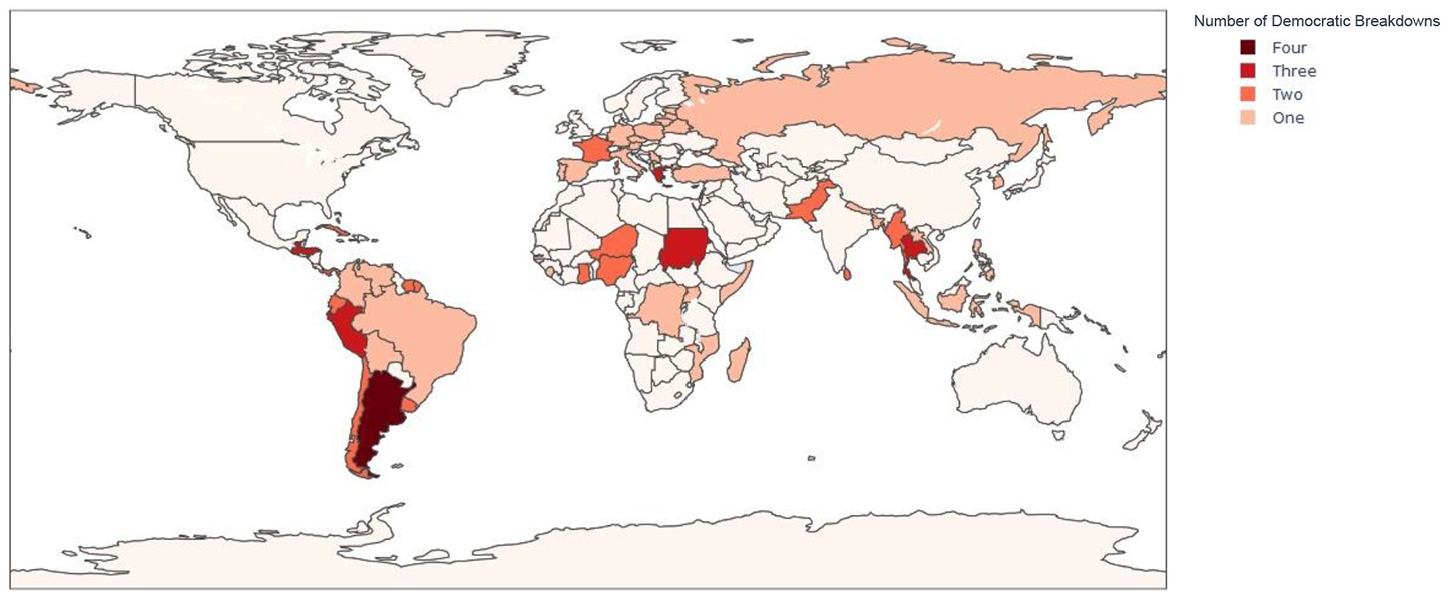
Number of democratic breakdowns by country.
A series of control variables that could possibly confound the relationship between democratic breakdowns and terrorism—civil war, Polity score, Polity squared, logged GDP per capita, logged population, and regime duration—are included in the statistical model. I deliberately restrict the covariates to the most theoretically relevant subset that most likely confounds the relationship of interest (Achen, 2005). Civil war is a binary indicator for whether the country is undergoing an intrastate conflict resulting in at least 25 battle deaths in a given year, taken from the UCDP. I also include the ordinal Polity score along with its squared value. The squared term is necessary to ensure that the results are not an artifact of the greater likelihood for intermediate regimes to experience both greater terrorism and democratic breakdowns (Chenoweth, 2013: 359; Gailbulloev et al., 2017). 9 GDP per capita and population, from which I calculate the natural log, are both taken from Haber and Menaldo (2011). Some models also include an ordinal measure of physical integrity rights violations (Cingranelli and Richards, 2010), since this could confound the relationship between democratic breakdown and terrorism (Walsh and Piazza, 2010). This variable extends back only to 1981, and thus it is not included in every model. 10 Lastly, I include Boix et al.’s (2013) count variable for regime duration, since the recentness of democratic breakdown or transition back to democracy could confound the primary relationship of interest.
Since the dependent variable is an event count with a high proportion of zeros, negative binomial regression is an appropriate estimation strategy (Hilbe, 2007). I therefore fit the following model:

where
Results
Table 1 presents the results from several negative binomial regression models. Model 1 is the base model specification and model 2 adds the ordinal measure of physical integrity rights violations. Models 3 and 4 replicate models 1 and 2 using fixed effects to account for unit heterogeneity. Democratic breakdown is statistically significant across models. Although the tables report statistical significance to the 1% error level (p-value < 0.01), democratic breakdown is statistically significant at above the 0.1% error level (p-value < 0.001) in every model. This finding is relevant given recent recommendations to redefine statistical significance to p-values lower than 0.005 (Benjamin et al., 2018). Moreover, the significant results in the fixed effects models suggest that democratic breakdown has a within-unit causal effect on terrorism. In line with existing research, states with higher Polity scores, intermediate levels of democracy, physical integrity rights violations and civil wars experience more terrorist attacks on average.
Democratic breakdown and terrorism.
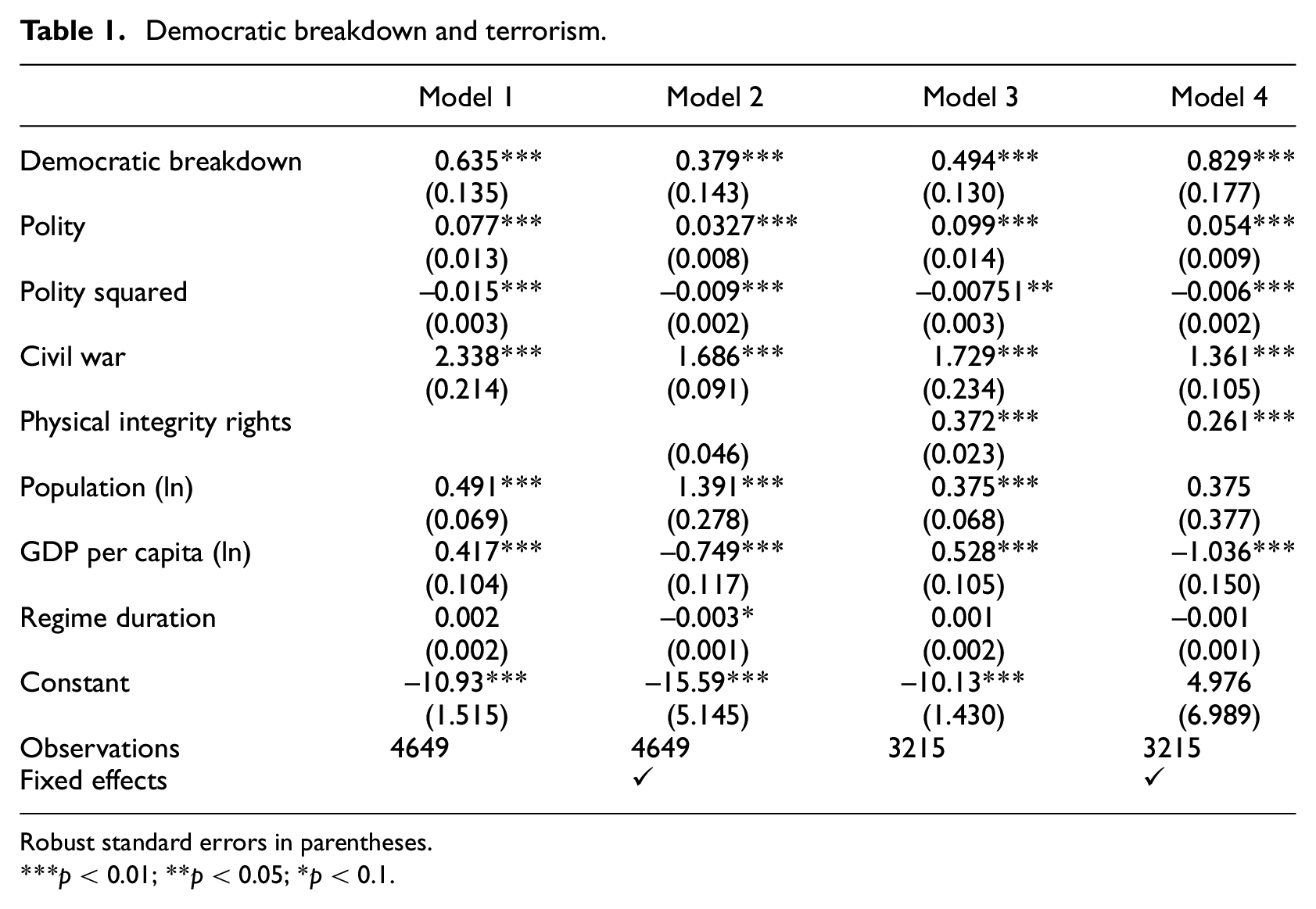
Robust standard errors in parentheses.
p < 0.01; **p < 0.05; *p < 0.1.
The historical legacy of democratic breakdowns on terrorism and democracy
According to the theory, democratic breakdown should largely account for the relationship between terrorism and democracy. To test this argument, I create two binary indicators: one for democracies that have experienced at least one democratic breakdown in their history and one for democracies that have never experienced a democratic breakdown. 12 Dichotomizing democratic breakdown is acceptable because the theory stipulates that the most significant distinction is between states that have experienced democratic breakdown and those that have not. Since these two dichotomous variables are indicators for whether the state is a democracy, the Polity score variables are omitted owing to collinearity. Fixed effects are also not used in these models because the relevant comparisons are across states rather than within them.
The results are conveyed in Table 2. As model 5 shows, the variable for democracy/democratic breakdown is statistically significant, whereas democracies that have not had at least one democratic breakdown are not more likely to suffer from more terrorism than autocracies (autocracy is the baseline category). One possibility is that states with past democratic breakdowns experience more terrorism irrespective of regime type. Model 6 addresses this by adding another binary indicator for whether the regime is an autocracy and has experienced a previous democratic breakdown, which means that the baseline category is authoritarian regimes with no history of democratic breakdown. All three regime types—democracies with and without a history of democratic breakdown, and autocracies with a history of democratic breakdown—have positive and statistically significant coefficients, indicating higher rates of terrorism relative to autocracies with no history of democratic breakdown. This fits with the theoretical expectations: these baseline autocracies have neither the opportunity nor systematic grievances that increase terrorism. Although both democracy variables are statistically significant, a Wald test reveals a statistically significant difference in these coefficient estimates (
Democracy, democratic breakdown, and terrorism.
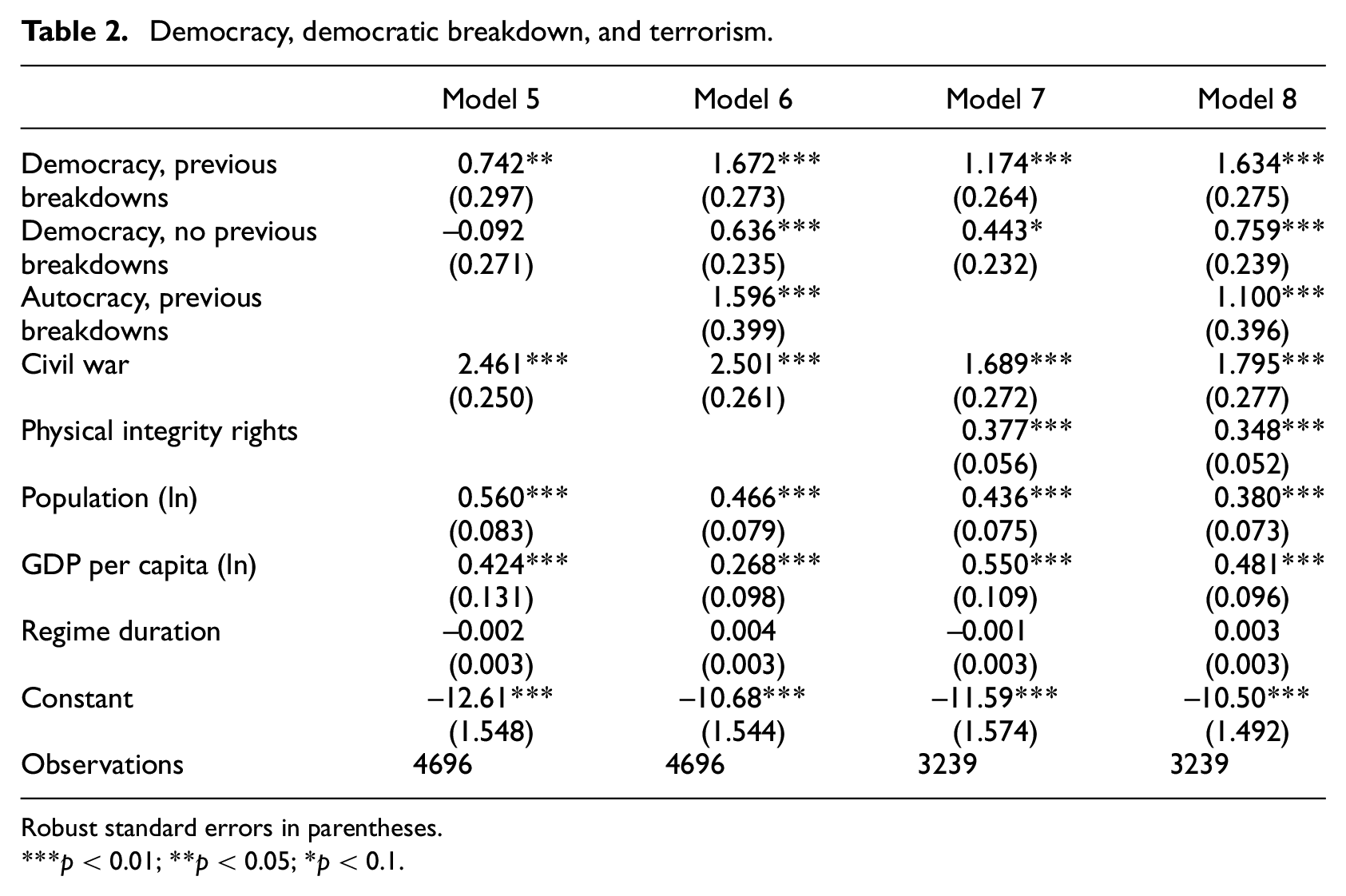
Robust standard errors in parentheses.
p < 0.01; **p < 0.05; *p < 0.1.
Robustness checks
It is theoretically possible that the causal relationship is actually reversed: terrorism could cause democratic breakdowns, and continued terrorist activity could create the erroneous impression that democratic breakdowns cause terrorism. Two additional tests, which are placed in Online Appendix section 1, are conducted to address this endogeneity problem. First, the model is estimated using only Western countries, which I operationalize to include Europe, Australia and New Zealand, Canada, and the USA. None of the democratic breakdowns in Western countries are recent: all but one precede 1970, when the data start, and many are traced back to the period leading up to the Second World War. It is therefore impossible for these democratic breakdowns to have been influenced by terrorism since 1970. If my argument about the persistent effects of democratic breakdown is sound, then we should expect the relationship to hold even in these cases. An additional benefit of estimating the model on this subset of the data is that observations are restricted to democracies, which helps ensure that results are not driven by autocratic states that experienced democratic breakdowns. Second, I conduct an instrumental variable analysis. While these approaches have limitations, as discussed in the Online Appendix, they improve confidence that a causal relationship exists between democratic breakdown and terrorism. A final robustness check is presented in Online Appendix section 2. The theory posits that the second generation of radicals is likeliest to adopt terrorism as a means of contention. An implication of this argument is that democracies that experienced a democratic breakdown in the recent past will have more terrorism than democracies with more distant democratic breakdowns. Results from several additional models provide support for this relationship.
Despite protecting against endogeneity, one might wonder whether important omitted factors are still confounding the relationship. Instead of presenting a few additional models with different covariates here, however, the paper carries out an extreme bounds analysis to examine the robustness of the relationship between democratic breakdown and terrorism across thousands of model specifications.
Sensitivity analysis
Several limitations arise when positing the importance of a new variable to a well-studied area, especially when that variable is conceptually similar to those already acknowledged as relevant. Is an association between democratic breakdown and terrorism an artifact of including discretionary covariates in the model (Lenz and Sahn, 2017)? Or are important confounding variables excluded from the model? Is democratic breakdown a consistent predictor of terrorism across most reasonably specified models? I address these limitations using extreme bounds analysis, a method previously used to examine nuclear proliferation (Bell, 2016) and civil war onset (Hegre and Sambanis, 2006). Extreme bounds analysis operates by estimating a model for every possible combination of covariates, rather than a small set of the total possible models with researcher discretion in choosing which to include. More specifically, extreme bounds analysis estimates a series of models with the following form:

where j indexes regression models, f is any focus variable for the analysis, R is a vector of required variables included in every model,
Admittedly, Leamer’s (1985) criterion is a stringent standard, since the estimates from a single regression model are sufficient for labeling a relationship fragile. In other words, coefficient

where
Extreme bounds analysis results
I use recently developed tools for conducting extreme bounds analyses to examine the sensitivity of different coefficient estimates to alternative model specifications (Hlavac, 2016). I transform the dependent variable into a continuous measure by adding 1 and taking the natural log for each observation. Although negative binomial regression would seem more appropriate, this approach is adopted to address another problem. Many variables in the models are conceptually related to democracy and therefore suffer from multicollinearity, which makes determining what measures are actually driving the relationships difficult and can yield unstable coefficient estimates. I therefore restrict analysis to models in which the variance inflation factor for a given coefficient does not exceed 7, where
Additionally, since I have an exploratory interest in uncovering the factors most consistently related to terrorism, I treat all doubtful variables Dj as focus variables f. The vector of required variables, R, includes two variables, GDP per capita and population, since these are standard covariates in the conflict literature and their exclusion almost certainly means a model is mis-specified. In addition to the variables from the preceding statistical analysis, the vector of doubtful variables includes several factors that have been posited as explanations for the relationship between terrorism and democracy, such as executive constraints (Li, 2005), judicial constraints on the executive (Findley and Young, 2011), political competition (Chenoweth, 2010), media freedom (Hoffman, 2006), policies that discriminate against social groups (Piazza and Walsh, 2010), physical integrity rights (Piazza, 2011), and various civil liberties (Schmid, 1992). The full set of variables is described in greater detail in Online Appendix section 3.
Figure 2 presents the results from the extreme bounds analysis graphically to ease interpretation. Each histogram depicts the distribution of coefficient estimates for each variable included in the analysis. In total, this includes the results from over 40,000 regression models, although it is important to recall that since every variable is not included in every model (with the exception of the two required variables), each variable features in over 4500 models. The red vertical lines in each histogram represent the parameter value under the null hypothesis, which in this case is zero, and the blue lines surrounding each distribution are kernel density functions, which convey a non-parametric estimate of the probability density function for each coefficient. These plots allow us to visually identify which estimates concentrate around points far from the null. Table 3 presents a more detailed picture of the extreme bounds analysis: it includes the lower bounds, upper bounds, percentage of models in which the variable reaches statistical significance, and whether the variable is robust according to Leamer’s (1985) criterion. This last feature is important since Leamer’s extreme bounds analysis is very unlikely to yield false positives (Plumper and Traunmuller, 2018), whereas Sala-i-Martin’s (1997) approach does tend to yield false positives (Hoover and Perez, 2004).
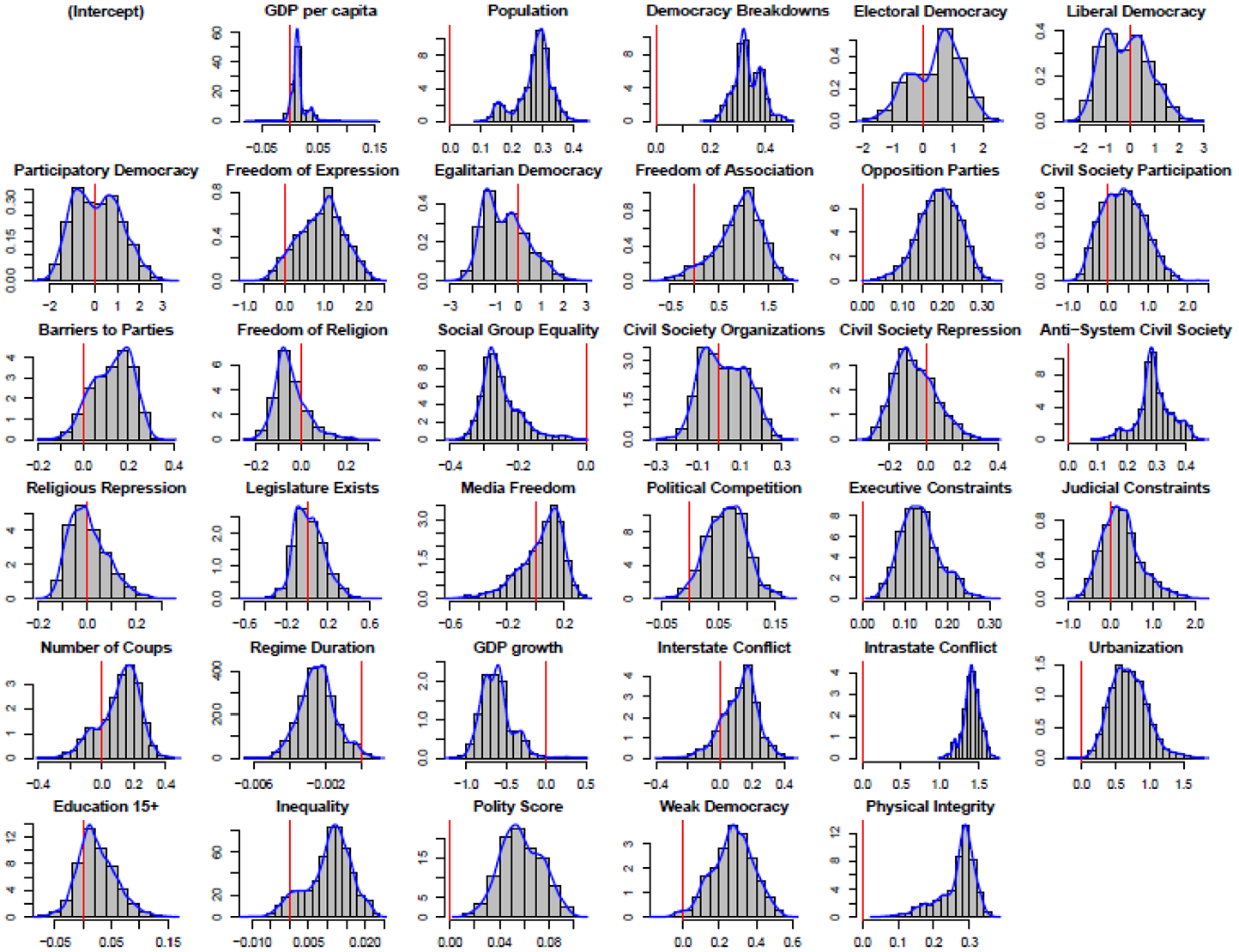
Results from the extreme bounds analysis.
Detailed results from extreme bounds analysis.
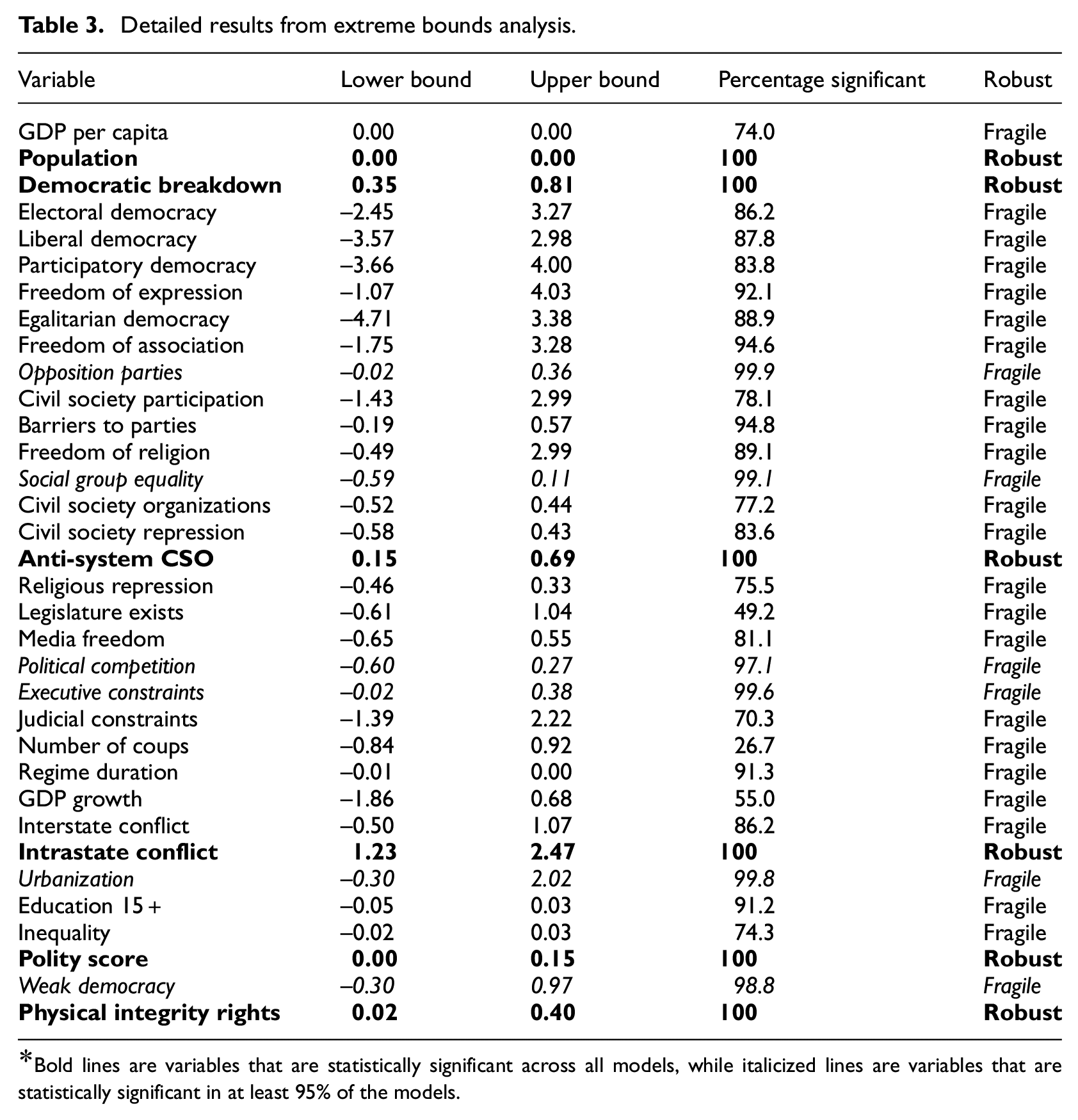
Bold lines are variables that are statistically significant across all models, while italicized lines are variables that are statistically significant in at least 95% of the models.
As shown, the estimates on democratic breakdown are concentrated far away from the null, and indeed this variable is statistically significant at the 5% error level or higher across every model. Other variables that are statistically significant in every model are population, civil war, anti-system civil society movements, opposition parties, physical integrity rights violations, and Polity score. Most of these additional results are unsurprising. Civil war (and anti-system civil society organizations, which are conceptually related to civil war) is well established as a predictor of terrorism and the two overlap considerably in time and space (Findley and Young, 2012). Several other variables related to democracy—such as weak democracy, political competition, and executive constraints—are statistically significant in at least 95% of the models in which they are included. In other words, these variables are fairly robust predictors of terrorism. Similarly, terrorism has long been associated with “urban warfare” and here is related to terrorism across most models (Laqueur, 1999: 8), although this result should be approached with caution given the urban bias in reporting political violence (Kalyvas, 2006: 38–48).
Online Appendix section 4 includes several other extreme bounds analyses. First, I replicate the analysis after excluding the measure for integrity rights violations since, as discussed in reference to the main analysis, these models are temporally truncated because this variable is available only from 1981 onwards. Since the results hold, all subsequent extreme bounds analyses are estimated without this variable. Second, the extreme bounds analysis is replicated when including democratic breakdown as one of the required variables (along with population and GDP). As shown, democratic breakdown retains its statistical significance when specified as a required variable across all of the approximately 40,000 models in which it is included. Third, the extreme bounds analysis is replicated using negative binomial regression on the untransformed count dependent variable rather than ordinary least squares. This strategy does not allow model restriction based on the VIF, meaning that multicollinearity is probably a problem in many models. However, the results are nearly indistinguishable from those presented above. And, fourth, I carry out the extreme bounds analysis after excluding country-years in which there is an ongoing civil war that reaches at least 1000 battle-deaths. This ensures that outliers that experience high terrorism counts owing to civil war—such as Iraq, Pakistan, and Afghanistan—are not driving the results. Results are the same here as well.
Based on these results, it is reasonable to conclude that democratic breakdown is among the strongest predictors of terrorism that is conceptually related to democracy. Other potential mechanisms, such as judicial constraints on the executive, are highly model dependent and thus their effects on terrorism should be treated with skepticism. Note that these results do not indicate unsound methodological practices on the part of scholarship positing these variables as important predictors of terrorism. Most research is dedicated to estimating a small number of models that are carefully specified according to theory. Rather than discarding “fragile” variables, a sensible way forward is to refine theory and carefully examine the conditions under which these variables might affect terrorism. On the one hand, extreme bounds analysis allows us to discover which variables consistently predict an outcome and relationships that hold under most conditions. On the other hand, variables that are inconsistent predictors can be approached as puzzles to stimulate further research. Instead of concluding that fragile variables are irrelevant, it is more theoretically interesting to ask why a variable apparently induces an outcome in certain conditions rather than others.
Conclusion
Research explaining the cross-national variation in terrorism constitutes a thriving literature. Not only is there evidence that democracies experience more terrorism, but recent studies aim to account for the substantial variation in terrorism across autocratic regimes (Aksoy et al., 2012; Wilson and Piazza, 2013). Despite significant progress, one limitation mars research on the effects that regime type has on terrorism: studies almost exclusively theorize how different regimes create opportunities to engage in terrorism. What is missing from many discussions is the motivation to use terrorism. The civil liberties approach to explaining the association between terrorism and democracy, for instance, can account for the opportunities to use terrorism, but it poorly explains why groups use terrorism rather than legal means to pursue their interests (Chenoweth, 2013: 362).
This study argues that one factor associated with regime history, democratic breakdowns, affects the motivation to engage in terrorism. Democratic breakdown generates profound grievances by excluding groups that were once able to participate in the political process. Counterintuitively, it is when the regime recovers from democratic breakdown that terrorism is most likely, since the discrepancy between reality and expectation that provides the motivation for terrorism is coupled with the opportunity afforded by democratic freedoms. This study, which finds that much of the relationship between democracy and terrorism is explained by democracies with a history of democratic breakdown, provides support for these claims. This finding is especially relevant given the rise of populist movements in democracies which are at risk of democratic backsliding (see De la Torre and Lemos, 2016). Although this study pertains only to complete democratic breakdown, the theory suggests that these countries are at increased risk of terrorism should they move to exclude certain groups from politics. And while I do not test what specific facets of democratic liberties increase opportunity the most (as the theory does not prioritize any specific feature), future research could explore the intersection between opportunity and motivation in greater depth. An extreme bounds analysis further reveals that democratic breakdown is positive and statistically significant across each one of over 40,000 model specifications, indicating that the relationship is highly robust. Indeed, it is one of the few variables that is statistically significant across all model specifications and the most robust predictor of terrorism conceptually related to democracy.
Lastly, this study aspires to reorient and refocus research on terrorism and democracy. Not only do I find that democratic breakdown is the most consistent predictor of terrorism, but the extreme bounds analysis indicates a way forward for future research. Several variables already highlighted in the literature, such as executive constraints and political competition (Chenoweth, 2010; Li, 2005), are also highly robust. Moreover, consistent with the theory that democratic breakdown affects terrorism through the grievances it generates, the most robust relationships posited in previous studies include those related to grievances, including physical integrity rights violations and social group equality (Piazza and Walsh, 2010; Piazza, 2011). However, many of the variables related to civil liberties are surprisingly fragile. My models suggest that one reason for these results is that the opportunities that civil liberties provide for terrorists are insufficient for explaining political violence absent motivating factors. I have only scratched the surface of the potential complex relationships between important characteristics of democracy and terrorism, and additional research is needed to examine the conditions under which democracy makes terrorism more likely. Having a fuller picture of the variables that consistently predict terrorism and those that I theoretically anticipate to increase terrorism but do not should serve as a useful starting point for exploring precisely when and where terrorism will arise.
Nevertheless, this study does have limitations. Although several steps are taken to establish a causal relationship, including fixed effects and an instrumental variable analysis, this article suffers from the same inability to definitively mitigate heterogeneity as other cross-national statistical analyses. Additionally, while one key mechanism is tested in the Online Appendix, further research is needed to explore the causal mechanisms linking democratic breakdown to terrorism. Future research should examine fine-grained, microlevel patterns of terrorism within countries to better estimate causal effects and test causal mechanisms. The sensitivity analysis in this article paves a way forward for such studies: while the large cross-national literature finds that many variables are related to terrorism, the extreme bounds test indicates that only a few are robust predictors. By uncovering which variables are robust predictors of terrorism in a cross-national setting, this study highlights several key concepts that scholars interested in examining subnational variation in terrorism might explore further.
Supplemental Material
Supplemental_Material – Supplemental material for Democratic breakdown and terrorism
Supplemental material, Supplemental_Material for Democratic breakdown and terrorism by Joshua Tschantret in Conflict Management and Peace Science
Footnotes
Acknowledgements
I want to thank Brian Lai, Elizabeth Menninga, Christopher Junk, participants at the 2019 Minnesota Political Methodology graduate conference, and editors Caroline Hartzell and Scott Wolford and the anonymous reviewers at Conflict Management and Peace Science for their extensive helpful feedback on previous versions of this manuscript.
Funding
The author received no financial support for the research, authorship, and/or publication of this article.

Supplemental material
Notes
References
Supplementary Material
Please find the following supplemental material available below.
For Open Access articles published under a Creative Commons License, all supplemental material carries the same license as the article it is associated with.
For non-Open Access articles published, all supplemental material carries a non-exclusive license, and permission requests for re-use of supplemental material or any part of supplemental material shall be sent directly to the copyright owner as specified in the copyright notice associated with the article.
