



Abstract
Recent studies suggest that a lack of judicial independence increases the risk of violent action, diminishing the incentives to solve disputes peacefully. However, violent action is not the only option when judiciaries are under the control of the executive. I argue that individuals become refugees in countries with non-independent judiciaries, losing their hope that violations of rules by the executive or privileged groups will be tried fairly. Using data from 181 countries over the 1976–2015 period, I find evidence that the lack of judicial independence leads countries to produce more refugees than others.
According to the latest Global Trends on Forced Migration report released by the United Nations High Commissioner for Refugees (UNHCR, 2020), 26 million of the world's displaced population consists of refugees, a refugee being defined as a person who “owing to well-founded fear of being persecuted for reasons of race, religion, nationality, membership of a particular social group or political opinion, is outside the country of his nationality and is unable or, owing to such fear, is unwilling to avail himself of the protection of that country; or who, not having a nationality and being outside the country of his former habitual residence as a result of such events, is unable or, owing to such fear, is unwilling to return to it” (UN, 1951). As illustrated in Figure 1, by the end of 2019, many countries had produced forcibly displaced people seeking safety abroad while the number of these people varies across countries.
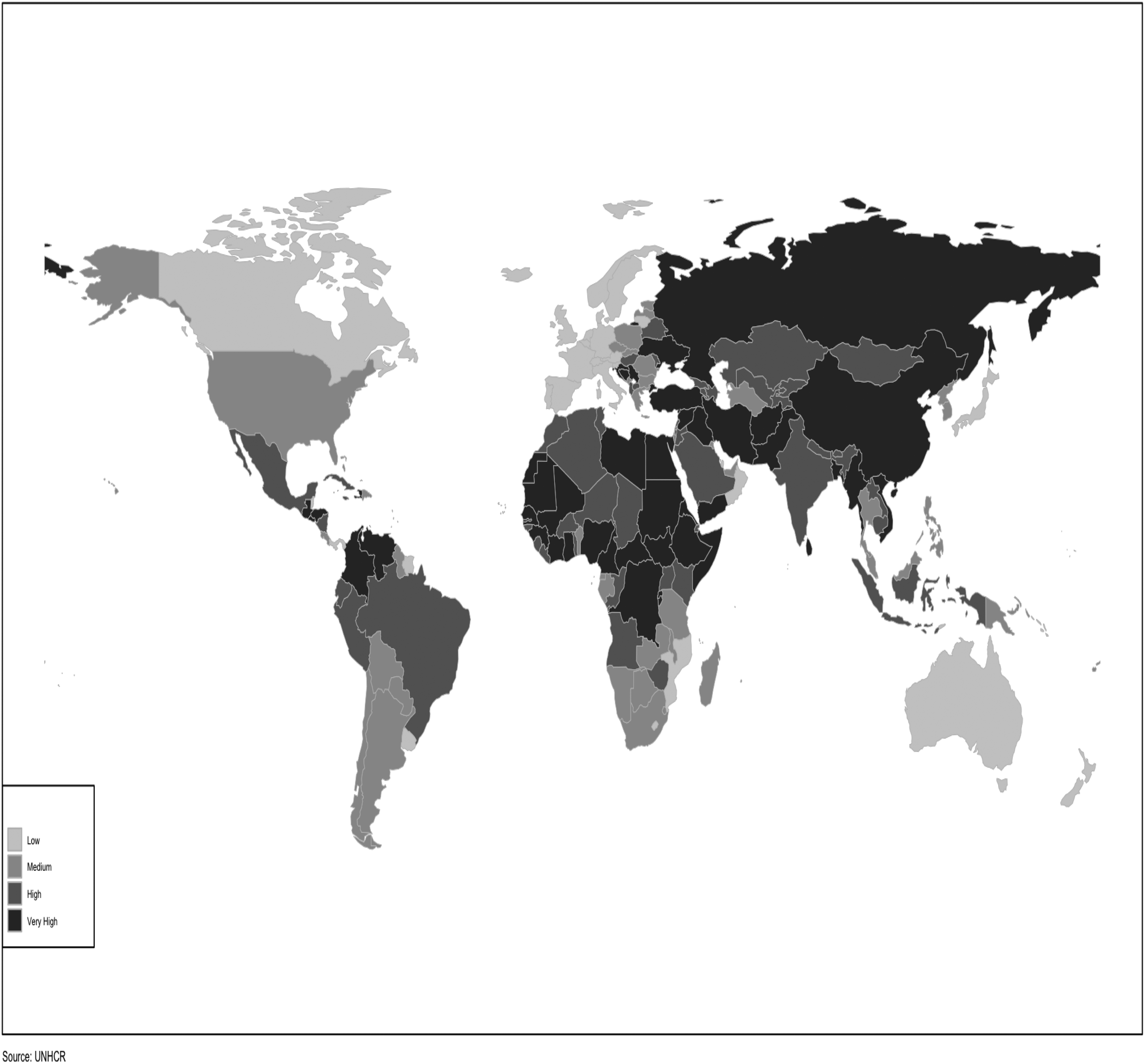
Refugees by country of origin at the end of 2019.
Over time, not only the number of refugees worldwide but also the average length of stay in the host countries have increased. The recent Global Trends on Forced Migration states that 85% of refugees live in developing countries that are proximate to conflicts and 77% of them are in protracted situations which are defined by the UNHCR as refugee situations in which “25,000 or more refugees from the same nationality have been in exile for five consecutive years or more in a given host country” (UNHCR, 2020: 22). Nevertheless, the number of refugees who have moved from developing countries in the Global South to the rich countries in Global North has increased recently (UNHCR, 2020). For instance, in 2015, Europe experienced the largest refugee crisis since the Second World War, when many people fleeing conflicts in Syria, Iraq and Afghanistan risked their lives by taking small boats to cross the Mediterranean Sea (UNHCR, 2018). Unfortunately, thousands either died or went missing trying to reach Europe (UNHCR, 2018).
Although the international community showed its will and ambition by creating a global refugee system to protect refugees through the 1951 Convention Relating to the Status of Refugees (hereinafter 1951 Convention) and its 1967 Protocol, the latest refugee crises have clearly demonstrated that the system needs to be improved (Betts and Collier, 2017). Starting from 2016, 1 owing to the scope, scale and complexity of refugee situations, many governments, international and regional organizations have come together to develop a comprehensive refugee response framework. In order to provide better protection and assistance to refugees as well as support host countries and communities, the Global Compact on Refugees was adopted by the United Nations General Assembly on 17 December 2018. As the Global Compact on Refugees primarily focuses on the protection of refugees and burden- and responsibility-sharing for the refugee protection, it also acknowledges the importance of preparedness for future refugee movements and emergencies. Seeking to contribute to the recent comprehensive refugee response framework as well as forced migration literature, this paper examines determinants of the numbers of refugees that states generate.
Why are some states producing more refugees than others? Recent large-n analyses have investigated factors such as economic development, regime type and political violence, and they have found evidence that threats to physical security are important in explaining refugee displacements (Moore and Shellman, 2004; Rubin and Moore, 2007; Schmeidl, 1997; 2003; Uzonyi, 2014). Conducting micro-level studies, Engel and Ibáñez (2007); Czaika and Kis-Katos (2009) and Adhikari (2012, 2013) confirm the link between physical security and displacement while showing that the decision to flee varies based on socioeconomic factors. Building upon this literature, I seek to advance research on the determinants of forced displacement by exploring the effect of judicial independence on refugee flights. I argue that a lack of independent judiciaries increases the number of people who would cross internationally recognized borders to find safety abroad by intensifying fears of insecurity. Extant research has demonstrated that a lack of judicial independence increases the risk of violent action, failing to protect people against unlawful acts and decreasing their expectations of finding peaceful ways to solve their problems (Findley and Young, 2013; Simati, 2020; Taydas et al., 2010). I contend that violent action is not the only option when people lack access to justice for protection through independent judiciaries. They can also choose to flee their home countries, fearing for their safety. Here, I claim that in countries without credible jurisdiction, people perceive that their security is at risk, and thus they will go abroad to find safety.
Statistical analysis of global data including 181 states for a period from 1976 to 2015 reveals that a lack of independent judiciaries is significantly associated with the creation of refugees. The results are robust to a number of alternative modelling specifications. Apart from facilitating the advance of existing knowledge on refugee exodus, those findings also have policy implications. The results of this study imply the importance of considering the effect of judicial independence when attempting to develop early warning systems to predict future refugee movements and emergencies.
This paper, which seeks to contribute to the literature on forced migration by explaining the security-related causes of refugee flights, proceeds as follows. In the first section, I discuss the relevance of judicial independence to the extant literature, studying the determinants of refugee migration. Next, I define the concept of judicial independence and give the details of my argument about how independent judiciaries influence refugee flights. Then, I describe the research design employed in this study. In the fourth and fifth sections, I discuss the empirical results from the analyses. In the sixth section, I provide an illustrative case to detail the mechanism behind my argument. In the seventh and final section, I conclude with a discussion of the implications of the findings for further research and for policy makers.
Institutions and refugee flights
Contemporary studies have highlighted the significant effect of judicial independence on political phenomena ranging from the stability of regimes (North et al., 2000; Reenock et al., 2013) to government respect for human rights (Hathaway, 2007; Keith, 2002; La Porta et al., 2004; Powell and Staton, 2009). As illustrated by seventeenth-century England, generating a politically independent judiciary increases the ability of governments to credibly commit to their promises, reducing the arbitrariness around their decisions (North and Weingast, 1989). Credible commitments that are established through institutions limiting national governments are essential to the endurance of political and democratic rights (La Porta et al., 2004; North et al., 2000). As a significant institution providing legal constraints on state power, independent judiciaries that are capable of enforcing laws offer an effective mechanism to reduce violation of human rights (Keith, 2002). Effective domestic legal systems that are “capable of imposing penalties for right violations” lead states to comply with international human rights treaties and thus provide strong protection to individuals against state torture (Powell and Staton, 2009: 154).
Furthermore, judicial independence significantly reduces the probability of democratic regime failures, assisting leaders to credibly commit to respect rights (Reenock et al., 2013). Judicial institutions that are independent from political environment are able to enforce law and consolidate democratic rule (Larkins, 1996). Keeping governments from exceeding their power, credible judicial institutions enable countries to consolidate democracies. As a major source of instability in newly democratic states, post-election violence has also been attributed to the deterioration of judicial independence. Simati (2020) argues that post-election violence is higher in countries with partially independent judicial institutions. Violence as a result of manipulation of elections to favour one party at the expense of others is lower in countries with strongly independent legal institutions (Simati, 2020). Similar to their stimulating effect on post-electoral violence, ineffective judiciaries are also associated with civil wars and terrorism because they are unable to constrain executives from using violence arbitrarily and prevent individuals from expressing their demands through violent channels (Findley and Young, 2013; Taydas et al., 2010).
Despite the lack of attention to the systematic relationship between judicial independence and refugee flights to date, recent studies have explored the relationship between refugee exodus and political institutions. Discussing the effect of institutional design on the decision to flee, one line of argument focuses on governments’ abilities to restrict citizens within their borders. Zolberg et al. (1989) argue that autocratic countries are able to take repressive measures including closing borders to restrict the freedom of citizens to leave. Congruent with this view, Rubin and Moore (2007) suggest that “a government's ability or willingness to repress its citizens” influences people's decision to leave (p. 90). Another strain of argument links political institutions with forced migration through their effects on threat perceptions of citizens (Davenport et al., 2003; Weiner, 1996). Associating the existence of democratic institutions with the rule of law and more freedom, this argument stresses that democratic countries create fewer refugees since people “share their political views with others without fear of retribution” (Moore and Shellman, 2004).
While political institutions have been associated with refugee flights owing to their influence on government abilities and the freedom of citizens, independent judiciaries have received less scholarly focus from the forced migration literature. Extant studies have already argued that independent judiciaries significantly improve citizens’ rights since they offer peaceful ways to solve disputes and also constrain governments. However, to date, they have overlooked the relationship between judicial independence and the number of people who seek safety abroad. In order to fill this gap and contribute to the study of forced migration, this study seeks to explore whether the lack of judicial independence leads people to flee their home countries. In particular, I develop a theoretical model suggesting that judicial independence is an important predictor of refugee migration. In the next section, I will detail my argument and derive a testable hypothesis.
Judicial independence and refugee flights
Why do some states send more refugees than others? I contend that a lack of independent judicial institutions causes refugee flights. In order to discuss how independent judiciaries affect refugee migration, I first need to explain what it is meant by judicial independence. 2 While defining the term has been challenging since we cannot directly observe it, a common tendency in the literature is to distinguish between de jure and de facto judicial independence when it comes to conceptualization. De jure judicial independence consists of official rules (such as budgetary autonomy or fixed tenure for judges) that promote autonomy by protecting judges from excessive pressure (Rios-Figueroa and Staton, 2014: 107). On the other hand, de facto judicial independence exists when “judges resolve cases in ways that reflect their sincere preferences” and “these decisions are enforced in practice even when political actors would rather not comply” (Rios-Figueroa and Staton, 2014: 107).
Rather than focusing on a set of formal rules implying insulation from state power, this study adopts the definition based on de facto judicial independence since it is a behavioural concept (Rios-Figueroa and Staton, 2014). Although de jure independence signals isolation from the political environment, its components, budgetary autonomy or fixed tenures, on their own, do not guarantee impartial decision-making. In countries establishing constitutional guarantees for judicial branch, judges can still make rulings that favour the executive or its allies (Ramseyer and Rasmusen, 2001). On the other hand, de facto independence exists when judges have the power to enforce their decisions and thus constrain other political actors. Since refugees are people who abandon their countries “based on well-founded fear of being persecuted because of their religion, race, nationality, membership of a particular social group or political opinion” (UN, 1951), conceptualization of judicial independence built on judicial power (de facto independence) that could restrain other political actors makes it feasible to explore whether or not the effectiveness of legal systems influences citizens’ decision to flee.
Based on the definition adopted, I argue that a lack of judicial independence aggravates citizens’ fear of being a victim of arbitrary state power and thus leads them to leave their countries to seek shelter abroad. Although states have the sole right on the “legitimate” use of and means to use coercion (Weber, 1919), institutions that provide the relevant credible commitment against possible offenders can reduce the risk that one group uses the state apparatus against others and increase trust among people (Weingast, 1998: 173). In this regard, democratic political institutions strengthen citizens’ ability to hold their leaders accountable for their abusive actions (Davenport, 1999; Hathaway, 2007; Keith, 2002; Poe and Tate, 1994). Since democratic political leaders who use excessive power against their citizens can be removed from office through elections, they are less inclined to violate fundamental rights (Davenport, 1996, 1999; Davenport and Armstrong, 2004; Poe et al., 1999; Poe and Tate, 1994). However, representative democracies are not able to totally prevent the executive from using violent means against their citizens (Davenport et al., 2007).
The possibility of using arbitrary state power will be less likely in states that credibly commit to constrain the executive branch that has the power to control the means of coercion (Davenport, 1996, 1999; Findley and Young, 2013; La Porta et al., 2004). States with independent judiciaries will credibly restrain the executive power (North et al., 2000). Independent judiciaries serve as a means of weakening the ability of government authorities to use arbitrary state power against their citizens, protecting their freedom of opposition (Hathaway, 2007; Keith et al., 2009; La Porta et al., 2004; Powell and Staton, 2009). If the judiciary is ineffective, then governments can criminalize the political dissent, and government opponents could face arrest, exile or financial penalties based on dubious charges. Therefore, judicial independence will ensure that state authorities will not be able to penalize their citizens through repressive means just to put down potential threats to their power (La Porta et al.., 2004; Powell and Staton, 2009).
Independent judges guarantee to properly protect citizens from aggression of others regardless of their status (Larkins, 1996: 608). Hence, “dominant members of the populace are not able to manipulate to law to serve to their own ends, as any aggrieved citizens can obtain relief by presenting his or her case to an independent judge” (Larkins, 1996: 608). Accordingly, citizens will be more likely to bring allegations before courts if they believe that courts are “willing and capable of imposing penalties for rights violations” (Powell and Staton, 2009: 154). When judicial institutions are not independent from political control, individuals whose rights are violated might not want to take their cases to courts in order to seek justice (Abouharb et al., 2013; Powell and Staton, 2009; Simmons, 2009).
In countries where the judicial institutions are heavily affected by the politics, it is possible that citizens lose their trust in the current political system and prefer to express their dissatisfaction through violent channels (Taydas et al., 2010). While taking violent action is one way to express dissatisfaction in countries with ineffective judicial institutions (Findley and Young, 2013; Simati, 2020; Taydas et al., 2010), I contend that in such environments individuals are likely to flee their countries because taking political action is costly. Participation in political action can cause severe punishment from the government, including killing, wounding, imprisonment or torture (Tullock, 1971). Equally important, mass political action is subject to the free-rider problem. As introduced by Mancur Olson (1968), the free-rider problem occurs when goods benefit everyone regardless of their action. Since everyone benefits from the results regardless of their participation in the process, rational individuals do not like to bear the costs of participation in collective action unless there are selective incentives (Olson, 1968; Tullock, 1971).
Ultimately, I argue that when judges are unable to decide impartially and enforce their decisions, they will not be able to prevent the executive from intimidating, censoring and prosecuting the citizens. If judiciaries are not free from political interference, they cannot provide a shield against arbitrary government action and consequently governments’ respect for citizens’ rights deteriorates (Abouharb et al., 2013; Keith, 2002; Powell and Staton, 2009). In addition, judges’ tendencies to decide a dispute based either on the law or on the political positions of those who take legal actions affect citizens’ experiences and thus their confidence with the judicial system (Abouharb et al., 2013). Such environments lead people to feel that their safety is at risk and flee their home countries. To sum up, I contend that a lack of independent judiciaries leads to more refugee flights by decreasing hopes for fair trial and intensifying perceived insecurity. Without independent judicial institutions that are capable of preventing the executive branch from interfering with their rulings, people are likely to flee their countries in order to escape from the possibility of victimhood. This discussion leads me to the following hypothesis:
Research design and data
To test my hypothesis, this study employs data on 181 countries for a period from 1976–2015. 3 The unit of analysis is the country-year. Consistent with my theoretical discussion about the causes of refugee flights, the dependent variable in this study is the number of people who fled a given country per year. Originally, the data on the number of refugees came from the UNHCR, gathering information on forced migrants from 1951 to present day. I turn the data provided by the UNHCR in a dyadic form, showing the number of refugees moving from an origin to a receiving country for each year, into a monadic one by adding the number of refugees that each country sends annually.
The main independent variable, Judicial Independence, is measured with latent judicial independence scores developed by Linzer and Staton (2015) for 200 countries over the period from 1948 to 2012. Linzer and Staton (2015) attempt to measure de facto independence as judges’ power to constrain political actors. Their measure of independent judging in practice (de facto judicial independence) is created based on existing indicators of judicial independence developed by Feld and Voigt (2003), Howard and Carey (2004), Gwartney and Lawson (2007), Cingranelli and Richards (2010), Marshall and Jaggers (2010), Keith (2012), Johnson, Souva and Smith (2013) and the PRS Group (2013). Rather than simply aggregating different measures, Linzer and Staton (2015) construct their index using item response theory model. The latent judicial independence scores range from 0 to 1, with values closer to 1 indicating higher rates of judicial independence as a value of 0 reflects a total lack of independence. Saving scholars from using proxies and offering a more precise indicator to measure independent judiciary globally, this indicator was updated by Staton, Linzer, Reenock, and Holsinger (2019). The updated version of data expands time period from 1900 to 2015 and includes two measures from the Varieties of Democracy Project (V-Dem).
Incorporating existing sources related to de facto independence rather than relying on one source, the latent judicial independence variable addresses several challenges for accurate measurement of de facto independence. While existing measures suffer from missing data or limited temporal domain, the latent judicial independence variable combining extant measures allows quantitative scholars to make comparisons over longer time periods (Linzer and Staton, 2015). Equally important, latent judicial independence scores are continuous while extant indicators are built on an ordinal scale, and thus the latent variable allows scholars to measure incremental changes (Linzer and Staton, 2015).
In order to illustrate the relationship between de facto independence and refugee exodus, I provide a figure reflecting the number of refugees who fled countries with low, medium or high levels of judicial independence over the years. To plot Figure 2, following Simati (2020), I code the country years with a score of 0.3 and below as a low level of judicial independence, while the country years with a score between 0.3 and 0.6 are coded as a medium level and values of 0.6 and above are coded as a high level of judicial independence. As Figure 2 illustrates, the number of refugees produced is the highest for the country years with the latent judicial independence score of 0.3 and below (dashed line). The number of refugees generated is lower for the country years with medium level of judicial independence (short-dashed line) and that number is the lowest for the country years with the latent judicial independence score of 0.6 and above (solid line).
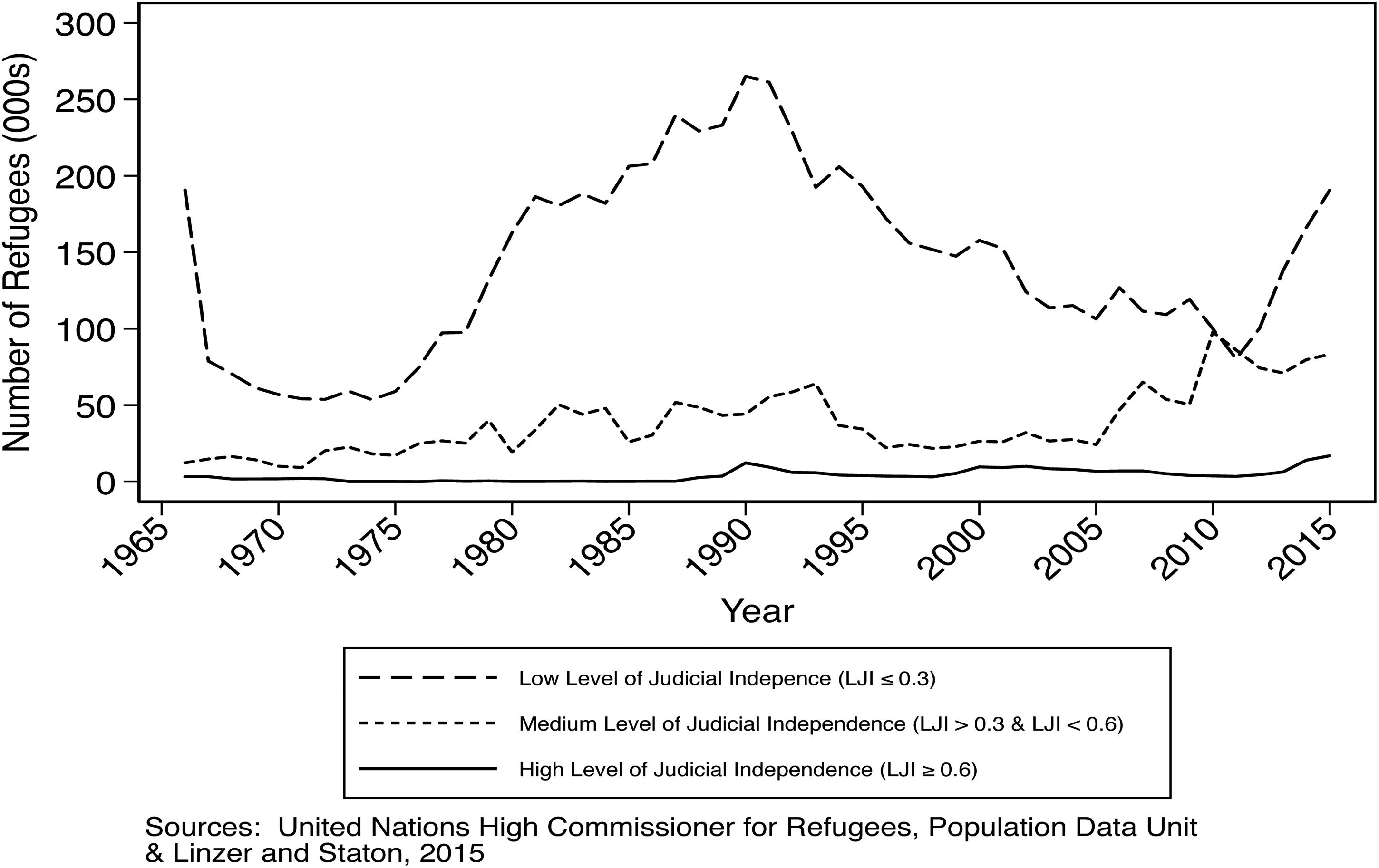
Judicial independence and refugee flights, 1965–2015.
I include a set of control variables that have been found to affect the probability of refugee migrations by the previous studies. First, extant research has discussed that autocratic countries take repressive measures including closing borders to restrict freedom of citizens to leave while democracies do not limit emigration (Zolberg et al., 1989). In my estimations, I, therefore, control for the effect of regime type based on two dummy variables, Democracy and Autocracy, created using the Polity IV dataset (Marshall et al., 2019). The Polity index ranges from +10 to −10, with +10 representing highly democratic countries and −10 representing the least democratic countries. Democracy is coded 1 for values of 6 and above on the 21-point Polity scale while Autocracy is coded 1 for values of −6 and below. 4
Following the recent research showing that civil conflicts and interventions increase the number of refugees (Davenport et al., 2003; Moore and Shellman, 2004; Schmeidl, 1997), I also include two variables, Civil Conflict and Intervention. To measure whether or not states engaged in a civil conflict in a given year, I use the Uppsala Conflict Data Program/Peace Research Institute Oslo Armed Conflict Dataset (Gleditsch et al., 2002; Pettersson et al., 2019). Civil Conflict is a dichotomous variable that takes a value of 1 when there is a confrontation between government and one or more internal opposition groups, with at least 25 military fatalities in a given year, and 0 otherwise. Based on the same dataset, I also add a variable, Intervention, indicating conflicts between governments and domestic opposition groups, intervened in by other states. This variable takes a value of 1 if any third party state supports any side in a civil war, and 0 otherwise.
Furthermore, previous studies find evidence that human rights violations are significantly associated with refugee movements (Davenport et al., 2003; Moore and Shellman, 2004; Schmeidl, 1997). I employ the Political Terror Scale (Gibney et al., 2019; Gibney and Dalton, 1996; PTS) to control the likelihood that poor human rights records increase the size of refugee populations. Covering a time period from 1976 to 2018, the latest PTS dataset provides three indicators: one coded based on the annual Amnesty International country reports (PTS-A), one coded based on the annual Human Rights Watch reports (PTS-H), and the last one coded based on the US State Department reports of cross-national human rights practices (PTS-S). I employ the PTS-S scores to measure human rights violations in a given year because it includes more observations over the time period being coded than its alternatives. 5 It ranges from 1 to 5 where higher values represent higher levels of physical integrity abuse within a given country-year.
Finally, there is a possibility that states with less economic opportunity and resources generate more refugees. To account for this effect, I employ two different indicators. First, based on the argument that refugee flights might be driven by a low level of economic development (Davenport et al., 2003; Moore and Shellman, 2004; Schmeidl, 1997; Zolberg et al., 1989), I add GDP as the indicator of economic capacity of the states. Additionally, previous studies have suggested that countries with large populations produce more refugees (Davenport et al., 2003; Moore and Shellman, 2004; Schmeidl, 1997). To control this effect, I include the variable Population. Data for both variables coming from the World Bank's World Development Indicators (World Bank, 2019) cover a period from 1960 to 2018. Both variables are logged to balance out the skewed distribution.
Model specification
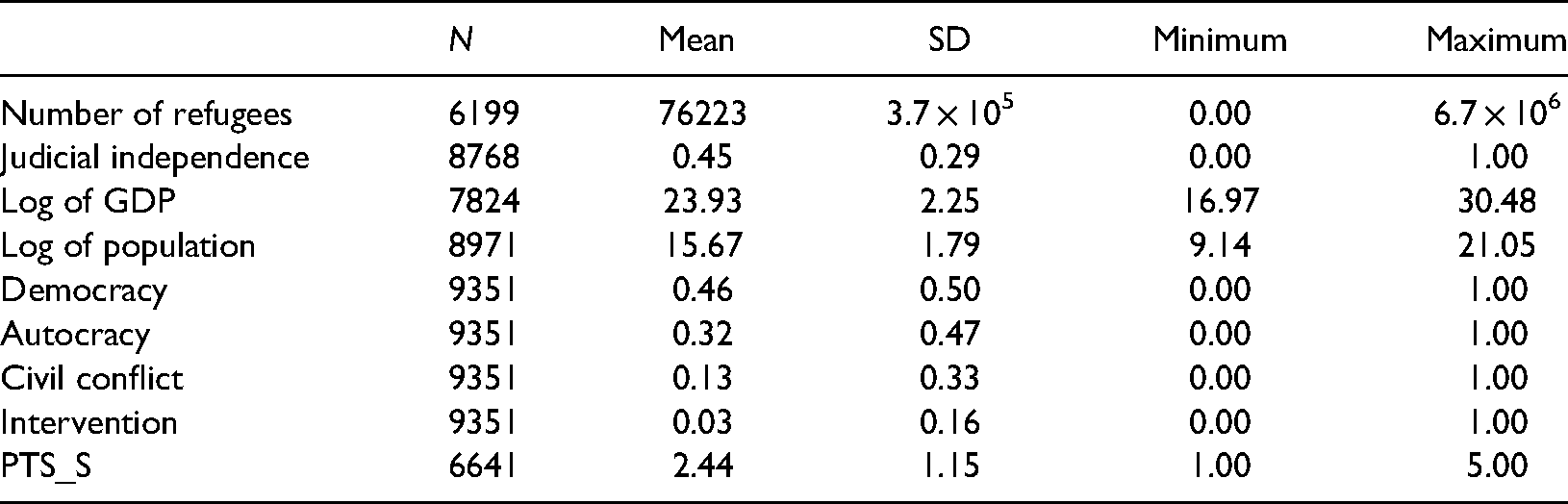
In order to test my hypothesis, I employ negative binomial model given the specific features of the dependent variable. First, it indicates the number of people who flee a country in a given year so that it cannot take on negative values. Additionally, the data are overdispersed, with the result that the variance of the dependent variable (1.33 × 10¹¹) exceeds the mean (76,223) of it. It would not be appropriate to use the Poisson regression model because it imposes the restrictive assumption that the conditional mean of the dependent variable equals the conditional variance. Negative binomial regression, on the other hand, addresses this problem by allowing the conditional variance to exceed the conditional mean. To deal with issues of correlation of errors within countries, and heteroscedasticity between countries, standard errors are clustered at the country level. The empirical model in this study to examine the impact of judicial independence on refugee flights is the following:

Summary statistics.
Results
Table 2 displays the results of negative binomial regressions. For each model, I report the incidence rate ratio (IRR), which demonstrates the increase or decrease in the expected count of refugees given a one-unit change in the independent variable, holding all others constant. Therefore, an IRR of 1.0 represents no change in the expected count of refugees while an IRR greater than 1.0 indicates an increase in the expected count, and an IRR lower than 1.0 indicates a decrease in the expected count. The first two columns in Table 2 show the findings from the model without the main independent variable in this study. As expected, I find that economic wealth and population have statistically significant relationships with the size of refugee populations. While prosperous countries produce fewer refugees, more populous states generate larger numbers of refugees. Congruent with the extant literature, civil conflict, intervention and human rights violations significantly increase the number of refugees. On the other hand, the results in the first two columns in Table 2 demonstrate that regime type (either Democracy or Autocracy) does not have a significant effect on the creation of refugee populations.
Judicial independence and refugee flights, 1976–2015.
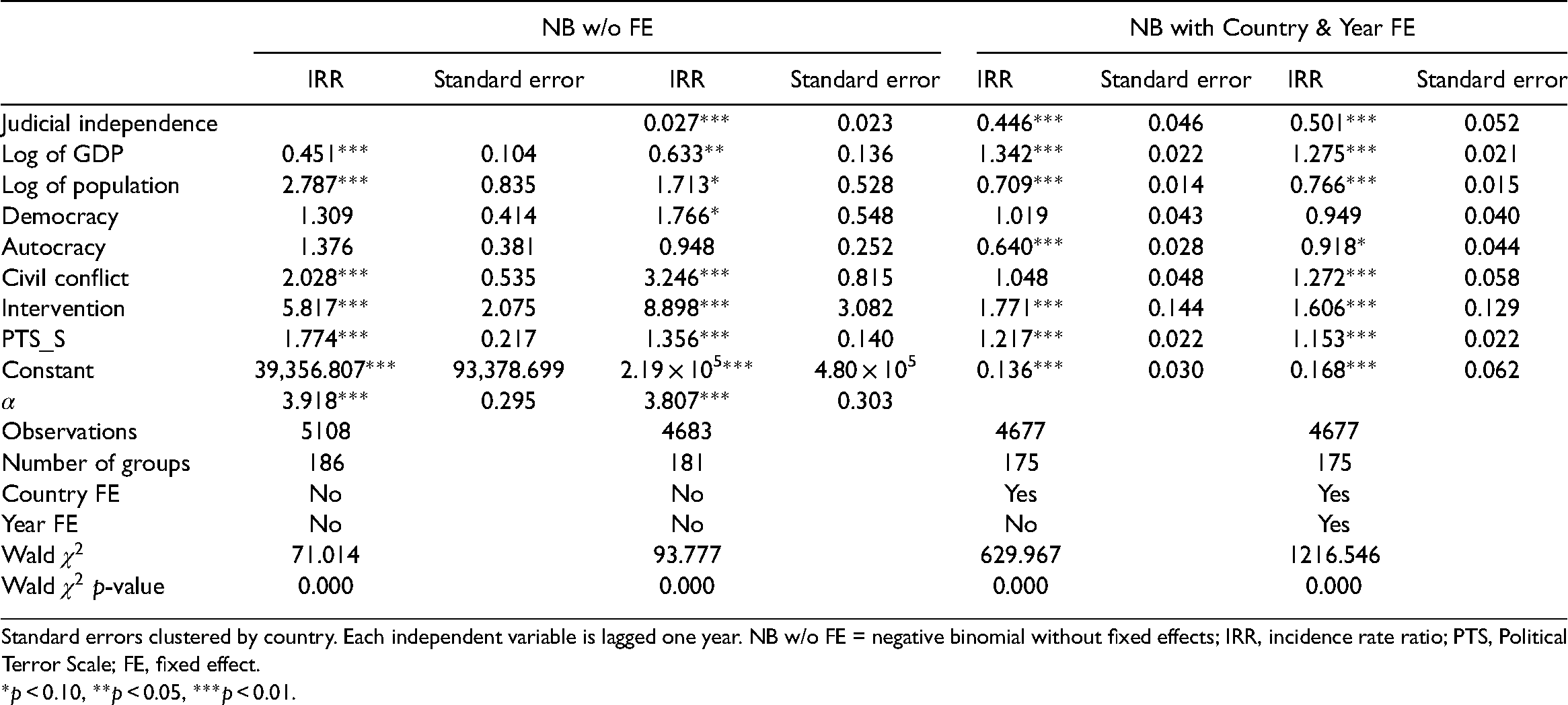
Standard errors clustered by country. Each independent variable is lagged one year. NB w/o FE = negative binomial without fixed effects; IRR, incidence rate ratio; PTS, Political Terror Scale; FE, fixed effect.
*p < 0.10, **p < 0.05, ***p < 0.01.
Next, I add the main explanatory variable in this study, Judicial Independence, to the model. The results reported in the second two columns in Table 2 show that Judicial Independence has a statistically significant negative effect on the size of refugee populations. This result is consistent with my hypothesis and indicates that countries with effective judicial institutions produce fewer refugees than others. According to the findings reported in the second two columns in Table 2, a one unit increase in judicial independence leads to a 97% decrease in the incident rate of the number of refugees. These results provide strong support for my argument.
The results for the control variables are consistent with the findings of previous research. The second two columns in Table 2 show that more populous states create larger numbers of people who seek safety abroad. Moreover, economic prosperity has a statistically significant negative effect on the size of refugee populations. Interestingly, once I add the main independent variable, Judicial Independence, into the analysis, the relationship between refugee flights and Democracy becomes significant. According to the results reported in the second two columns of Table 2, being a Democracy has a statistically significant positive effect on refugee exodus while being an Autocracy has a statistically insignificant negative effect on the size of refugee populations. These results on regime types are consistent with the previous studies arguing that autocracies usually constrain migration while democracies are more likely to impose restrictions on entry than exit (Zolberg et al., 1989). Finally, civil conflicts, interventions and human rights violations still have significant positive effects on refugee flights from countries, providing support for the extant research.
Furthermore, I run additional negative binomial models with the country and year fixed effects to eliminate the possibility of omitted country- and time-specific features. The last four columns in Table 2 display the results. After adding the year and country fixed effects, Judicial Independence keeps its sign and significance. As expected, Judicial Independence has a statistically significant negative association with the size of refugee populations. Unexpectedly, after adding time and country fixed effects, the impact of economic wealth on the number of refugees that a country produces becomes positive and the effect of population becomes negative as both effects are still significant. While the effects of intervention and human rights violations on the size of refugees are still positive and statistically significant, the impact of civil conflict is only significant when time and country fixed effects are added together. Interestingly, the negative effect of being an autocracy on the number of refugees sent abroad becomes significant after including year and country fixed effects whereas the effect of being a democracy becomes insignificant and inconclusive.
Figure 3 illustrates the predicted number of refugees over the latent judicial independence scores based on the main model reported in the second two columns of Table 2. Confirming the main results, Figure 3 shows that fewer people are expected to flee their home countries as latent judicial independence scores increase. When latent judicial independence scores take the lowest value (0), approximately 70,170 people are expected to flee. On the other hand, the expected number of refugees becomes about 1888 as judicial independence scores have the highest value (1).
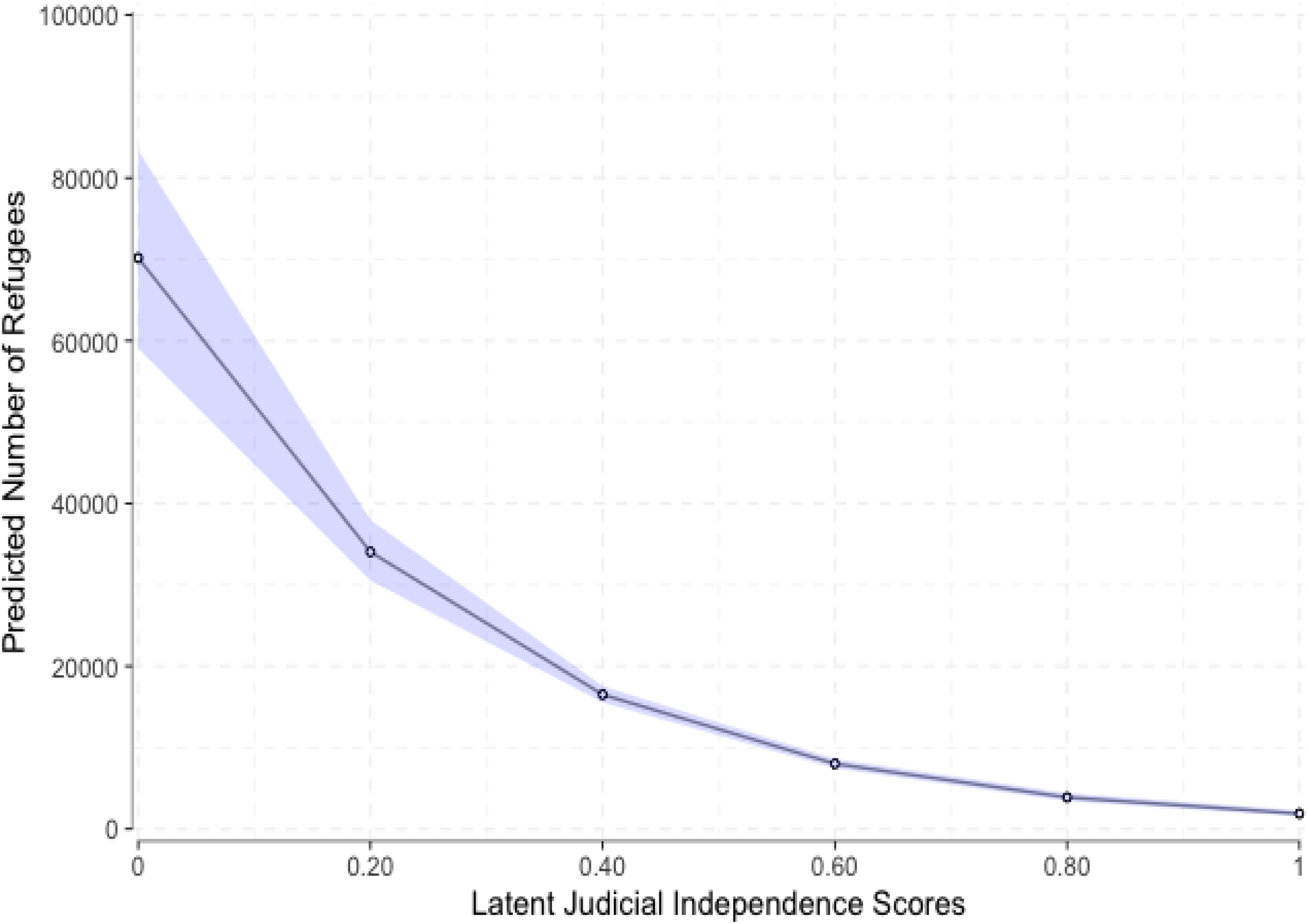
Predicted number of refugees with latent judicial independence scores.
To sum up, the results of negative binomial regressions with and without country and year fixed effects reported in Table 2 support my argument that the existence of independent judicial institutions has a statistically significant negative relationship with the number of refugees that countries produce.
Robustness checks
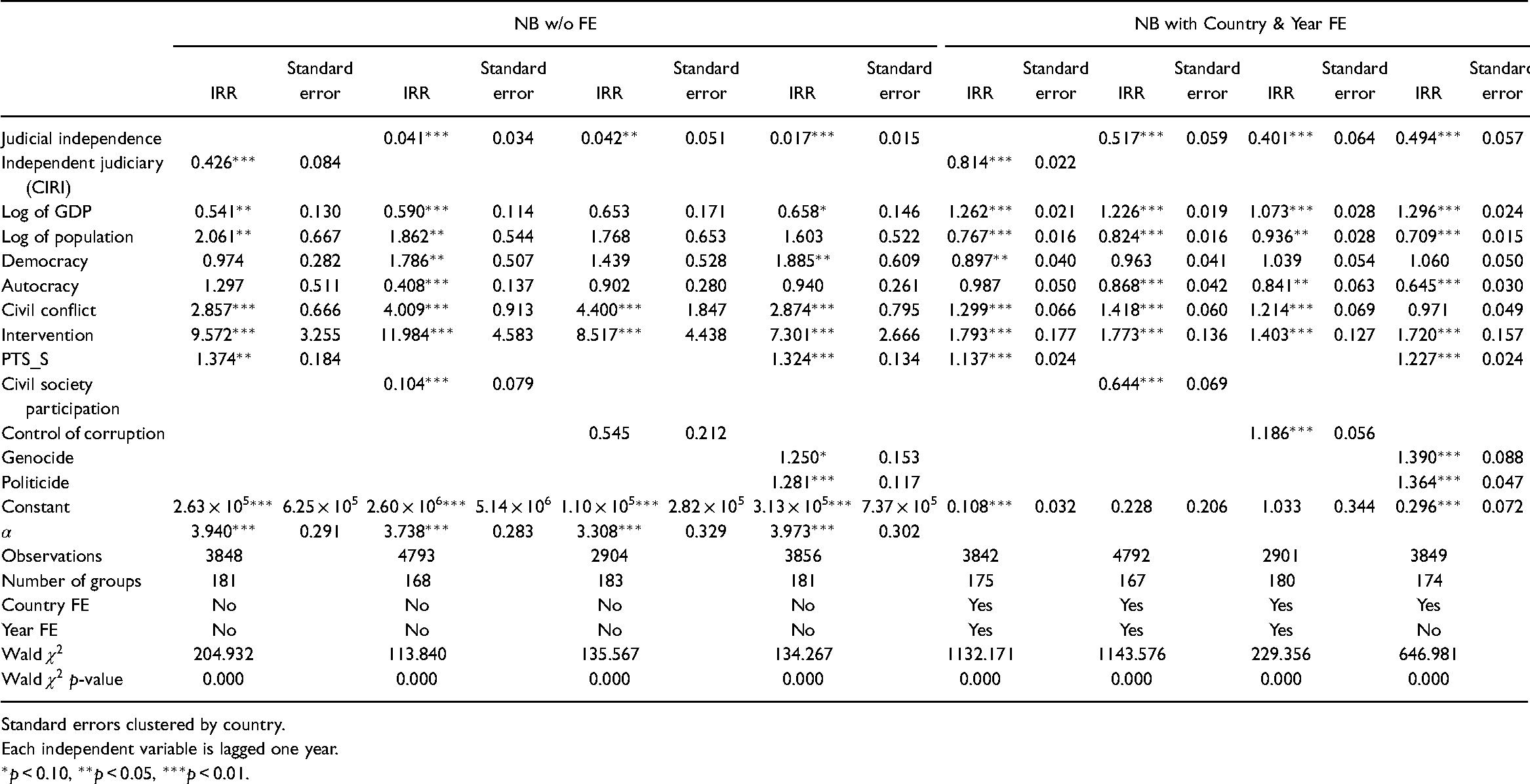
The results reported in Table 2 present evidence that independent judiciaries decrease the number of refugees from states. To ensure that the results are robust to different model specifications, I include a further set of control variables. First, in place of the latent judicial independence scores (Linzer and Staton, 2015; Staton et al., 2019), I use another measure of judicial independence, Independent Judiciary (CIRI), from the CIRI dataset (Cingranelli and Richards, 2010; Cingranelli et al., 2014). This variable indicates the extent to which the judiciary is independent of control from other sources, such as another branch of the government or the military. A score of 0 indicates “not independent”, a score of 1 indicates “partially independent” and a score of 2 indicates “generally independent”. The first two columns of Table 3 show the findings from this model. As expected, the effect of Independent Judiciary (CIRI) on refugee flights is negative and statistically significant.
Judicial Independence and refugee Flights, 1976–2015 (robustness checks with additional variables).
Standard errors clustered by country.
Each independent variable is lagged one year.
*p < 0.10, **p < 0.05, ***p < 0.01.
Second, I add a variable, Civil Society Participation, 6 into the analysis to test whether countries with weak citizen involvement in civil society organizations send more refugees than others. The data for this variable come from the V-Dem dataset (Coppedge et al., 2020). This indicator ranges from 0 to 1, with low values indicating a low level of citizen involvement in civil society organizations and high values indicating a high level of civil society participation. Results reported in the second two columns of Table 3 present evidence that countries with weak civil society participation produce more refugees than others while the effect of Judicial Independence is still negative and statistically significant.
Third, in order to account for the possible effect of corruption on refugee movements, I add Control of Corruption 6 into the analysis. The data for this variable come from the World Bank's Governance Indicators that capture governance perceptions in more than 200 countries since 1996 (World Bank, 2019). The index of control of corruption reflects the public view on the abuse of public power for private gains. The index ranges from −2.5 to 2.5, with higher numbers indicating better governance performance such as less corruption. The results of this analysis are shown in the third two columns of Table 3. While the effect of Control of Corruption is negative but insignificant, Judicial Independence still has a statistically significant negative relationship with refugee exodus.
I conduct additional statistical tests with two significant variables broadly discussed in the political violence literature. One argument in the quantitative forced migration research posits that mass killings increase the number of forced migrants (Auvinen and Nafziger, 1999; Davenport et al., 2003; Moore and Shellman, 2004; Rubin and Moore, 2007; Schmeidl, 1997; Uzonyi, 2014). In order to account for the effects of mass killings on refugee displacements, I include Genocide and Politicide into my analysis. The data for these variables come from Uzonyi (2014), primarily sourced from (Marshall et al., 2009). Genocide describes mass killings committed by governments in order to destroy, in whole or in part, a national, ethnic, racial or religious group while Politicide describes cases of mass killings committed against opponents of the state, regardless of national, ethnic, racial or religious groups (Marshall et al., 2009; Uzonyi, 2014). Both variables range from 0 to 5, with higher values indicating more civilians killed each year. According to the results reported in the fourth two columns of Table 3, the main independent variable in this study, Judicial Independence, still has a statistically significant negative relationship with refugee exodus. Conforming expectations, Politicide produces statistically significant levels of refugees. Similarly, Genocide has a positive and significant effect on creating refugees.
The last eight columns of Table 3 report the incident rate ratios and standard errors from negative binomial regressions with the country and/or year fixed effects. The results of the models provide support for my theoretical framework. The negative effects of Judicial Independence and Civil Society Participation on generating refugees are still statistically significant. Similarly, the effect of Independent Judiciary (CIRI) is also negative and significant once both country and year fixed effects are added to the analysis. The effect of Control of Corruption becomes positive and statistically significant while both Genocide and Politicide keep their signs and significance after country and year fixed effects are included in the analysis. 7
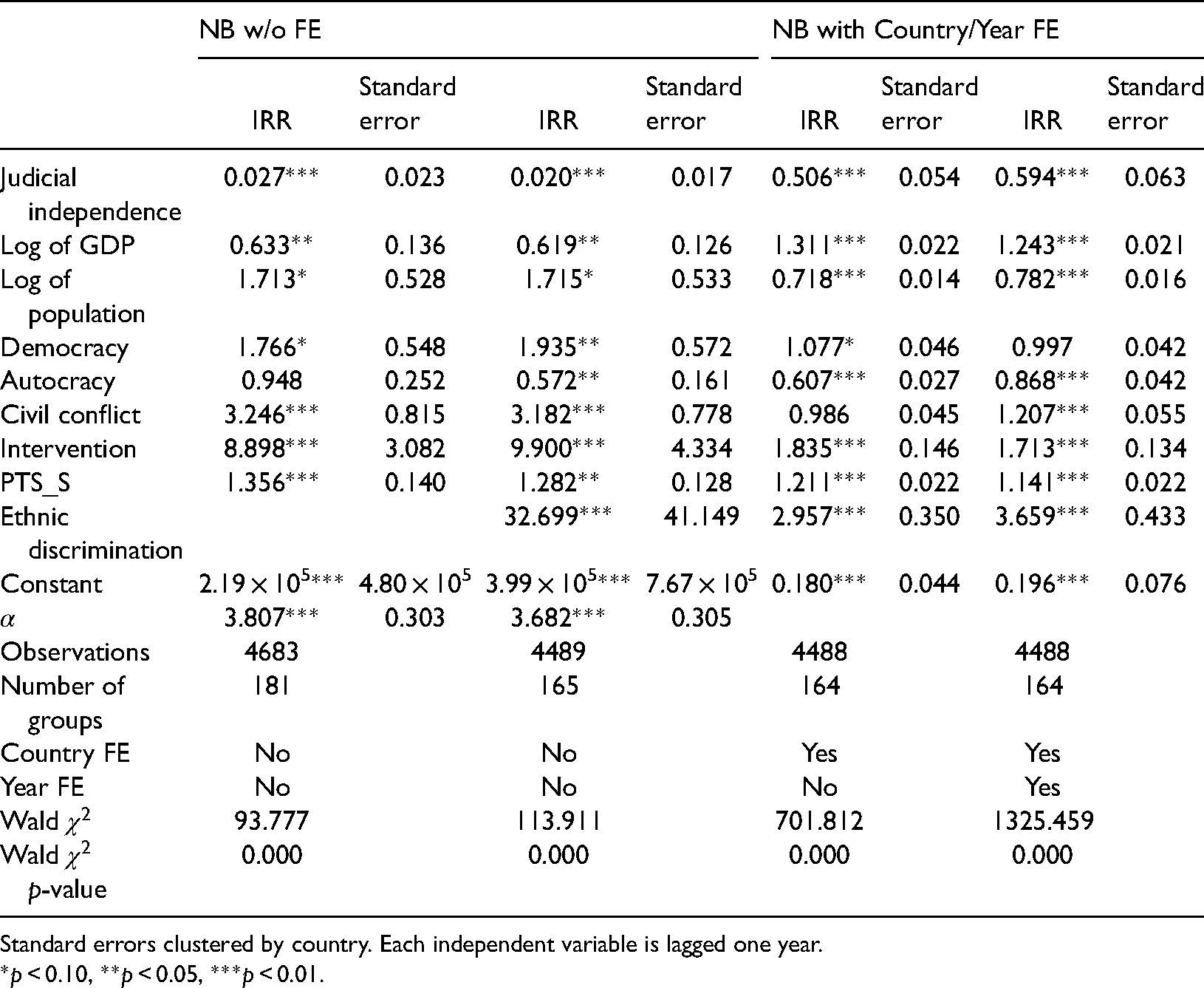
Additionally, I include Ethnic Discrimination 6 , measuring the size of the discriminated ethnic groups in a country in order to control the possibility that ethnic discrimination increases the number of refugees from states. For this variable, I use the Ethnic Power Relations dataset, providing information on politically relevant ethnic groups and the level of their access to state power from 1946 to 2017 (Cederman et al., 2010; Vogt et al., 2015). Politically relevant groups are defined as minorities and majorities that are either excluded or included in state apparatus, “from a total dominance on government to a total exclusion from it” (Wimmer, Cederman and Min, 2009: 317). According to the coding of the Ethnic Power Relations dataset, politically included groups have monopoly or dominant status in the executive or share power as senior or junior partners regardless of group size while politically excluded groups are unable to access to executive-level state power (powerless) (Cederman, Wimmer and Min, 2010). Discrimination occurs when members of ethnic groups are explicitly and deliberately discriminated against and excluded from regional and national power (Cederman et al., 2010). Ethnic Discrimination indicates the share of the discriminated population among the total politically relevant population. The measure is continuous and bounded between the values of 0 and 1. As values come closer to 1, the share of the discriminated population increases. As seen in Table 4, the effect of judicial independence is still negative and significant after controlling the impact of Ethnic Discrimination.
Judicial independence and refugee flights, 1976–2015 (robustness checks with additional variables) .
Standard errors clustered by country. Each independent variable is lagged one year.
*p < 0.10, **p < 0.05, ***p < 0.01.
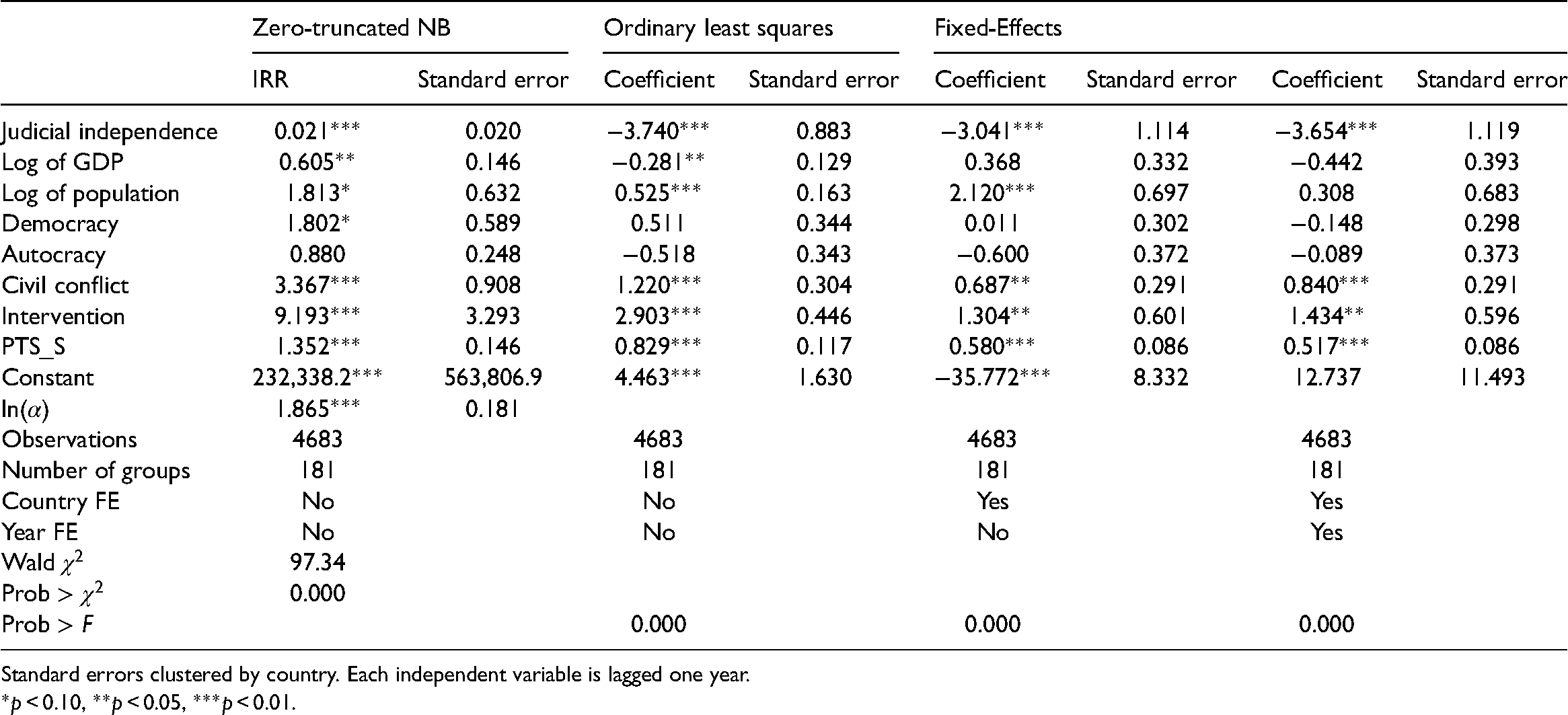
Finally, I use three alternative estimation techniques to ensure that the main results in this study are robust. Since the refugee data is highly skewed, I first run a zero-truncated negative binomial model. Then, taking the natural log value of the number of refugees in order to render its distribution less skewed, I run ordinary least squares (OLS) and fixed-effect regressions. The results presented in Table 5 confirm the main findings reported in Table 2. After using three different estimation techniques, the effect of judicial independence is still negative as its effect is significant at the 1% level.
Judicial independence and refugee flights, 1976–2015 (robustness checks with alternative estimators).
Standard errors clustered by country. Each independent variable is lagged one year.
*p < 0.10, **p < 0.05, ***p < 0.01.
In sum, the main results are robust to the inclusion of both additional covariates and alternative estimators. The robustness of the findings substantiates that judicial independence is important to explain refugee migration from states.
Illustrative case: Venezuela
This section discusses an illustrative example that underscores the theorized causal connection between judicial independence and refugee movements. Venezuela under the Chávez administration offers an example of my theory that a lack of judicial independence increases the number of people fleeing their home country because they perceive that ineffective judiciaries are unable to protect them against the abuse of power and violation of their rights.
After being described as one of the most stable democracies in Latin America from 1958 to 1989, Venezuela experienced severe economic and political crises, which contributed to the decline of electoral support for the two main parties (Democratic Action and the Social Christian Party) and facilitated the election of Hugo Chávez as president in 1998 with the support of a majority of Venezuelans who felt ignored by the established political parties (Human Rights Watch, 2008, 2012). Following his inauguration, Chávez called a referendum to convene a National Constituent Assembly in order to draft a new Constitution, which was approved in December 1999 and entered into force in March 2000 (Human Rights Watch, 2008, 2012). Although Chávez had promised to improve democracy, after election, he took serious steps to concentrate power by seizing control of the Supreme Court.
In May 2004, Chávez signed the new Organic Law of the Supreme Court that maintained political control over the judiciary and significantly undermined the independence of the country's judicial branch. The new law increased the number of Supreme Court justices from 20 to 32 while it authorized the National Assembly to appoint new justices with the approval of a simple majority, allowing the governing coalition in the National Assembly to change the balance of power in the country's highest court (Human Rights Watch, 2008, 2012). Although the impeachment of justices still necessitated a two-thirds majority vote, the law generated two new mechanisms for firing justices: one of these mechanisms was suspension of justices awaiting an impeachment vote and the other was revoking their appointments (Human Rights Watch, 2008, 2012). Through the new mechanisms, the three justices responsible for a controversial ruling that there was not enough evidence to criminally investigate four generals who allegedly participated in the 2002 failed coup against Chávez were removed from the Supreme Court (Human Rights Watch, 2008, 2012). Furthermore, the Judicial Commission under the Supreme Court, which was authorized for the appointment and removal of the country's lower court judges, controlled by Chávez's allies, fired many of lower court judges from their posts (Human Rights Watch, 2008, 2012).
After these interventions, the judiciary in Venezuela lost its role as a check on the executive power to the extent that the members of Supreme Court pledged their loyalty to Chávez's policies (Human Rights Watch, 2012). The government used criminal prosecution and processes to persecute persons in opposition, and those who acted independently of the government's pressure faced the risk not only of losing their jobs but also of prosecution for carrying out the law (Human Rights Watch, 2012). After Judge María Lourdes Afiuni ordered a conditional release for a businessman Eligio Cedeno, who was a critic of Chávez and had been in pre-trial detention for almost three years, citing that he was held in custody for longer than the time allowed under Venezuelan law, Chavez called her a “bandit” and demanded her imprisonment for 30 years (Human Rights Watch, 2012). Shortly after issuing the decision, María Lourdes Afiuni was accused of taking bribes to free Cedeno by a provisional judge who publicly declared his loyalty to Chávez and placed her in pre-trial detention in a prison (Human Rights Watch, 2012). After her arrest, Eligio Cedeno fled Venezuela and took refuge in the US.
The ineffective judicial system in Venezuela also failed to prevent government interference in union elections, which was a violation of workers’ right to elect their representatives (Human Rights Watch, 2008, 2012). In December 2000, the Chávez government called a national referendum to decide whether all workers’ federations and confederations will renew their executive committees under elections supervised and certified by a state institution, the National Electoral Council. The resolution passed despite the low turnout at around 23% (Human Rights Watch, 2008). Running against Aristóbulo Istúriz, who was endorsed by the government, in the elections held in October 2001, Carlos Ortega was elected as the president of Venezuela's largest labour organization with over one million members, Venezuelan Workers Confederation (CTV; Human Rights Watch, 2008). However, the National Electoral Council refused to certify the results based on the lack of documentation to investigate alleged election fraud claimed by the government (Human Rights Watch, 2008). The Chávez administration, denouncing the newly elected CTV executive committee, did not recognize the election results. Under Ortega's leadership, the CTV called a general strike against the government's policies, which resulted in the shutdown of the economy in December 2002. In March 2003, Ortega fled to Costa Rica after a criminal court convicted him on charges of initiating a civil rebellion in connection with his role in the strike and in the coup attempt of April 2002.
In the absence of credible judicial oversight, Chávez frequently threatened his opponents with criminal prosecution and imprisonment. Manuel Rosales, who served as the governor of Zulia, the largest state in Venezuela, from 2000 to 2008, resigned his post to run against incumbent President Hugo Chávez in the 2006 presidential election. While he was the leading opponent of Chávez, he was defeated. In the 2008 Venezuelan regional elections, Rosales ran for the Mayor of Maracaibo in Zulia, Venezuela's second largest city. During the election campaign, Chávez threatened to arrest Rosales, accusing him of corruption and planning an assassination (BBC, 2009). After being elected mayor of the city of Maracaibo, Manuel Rosales was charged by the Venezuelan Attorney General with corruption by accusing him of misusing public funds during his term as Governor of Zulia (BBC, 2009). He denied corruption allegations and fled to Peru in 2009, claiming that the accusations were politically motivated. Similarly, Eduardo Lapi, who was governor of Yaracuy from 1995 to 2004 and an outspoken critic of Chávez, ran against and lost to the government's candidate Carlos Gimenez in the 2004 Venezuelan regional elections. In 2006, Lapi was arrested on corruption charges while he claimed that the charges against him were politically motivated. He escaped from jail in 2007 (BBC, 2007) and fled to Peru.
Moreover, critics of Chávez's government were targeted for criminal prosecution on dubious charges, and the courts’ lack of independence diminished the probability of them receiving a fair trial (Human Rights Watch, 2008, 2012). In March 2010, Oswaldo Álvarez Paz, a former governor of Zulia state and member of an opposition political party, was arrested after criticizing the Chávez administration on TV and stating high-level government officials’ involvement in drug trafficking and terrorism (Human Rights Watch, 2012). In March 2011, he was sentenced to serve two years in prison for dissemination of false information. In a similar case, Guillermo Zuloaga and Nelson Mezerhane, the owners of an opposition television station, Globovision, fled to the US in 2010 after being briefly arrested for doubtful reasons (Human Rights Watch, 2012).
Illustrated by these examples, Chávez's efforts prevented the judiciary from serving as a check on arbitrary state action. The judiciary failed to protect fundamental rights such as freedom of express or peaceful protests and thus critics of the government faced financial or legal penalties. In line with my theory, the lack of judicial independence led people in Venezuela to leave their home countries because they perceived that they would not have access to justice against abuse of state power or violation of their rights. Accordingly, Figure 4 shows that the number of refugees fleeing Venezuela increased dramatically after 2003 while latent judicial independence scores decreased over time.
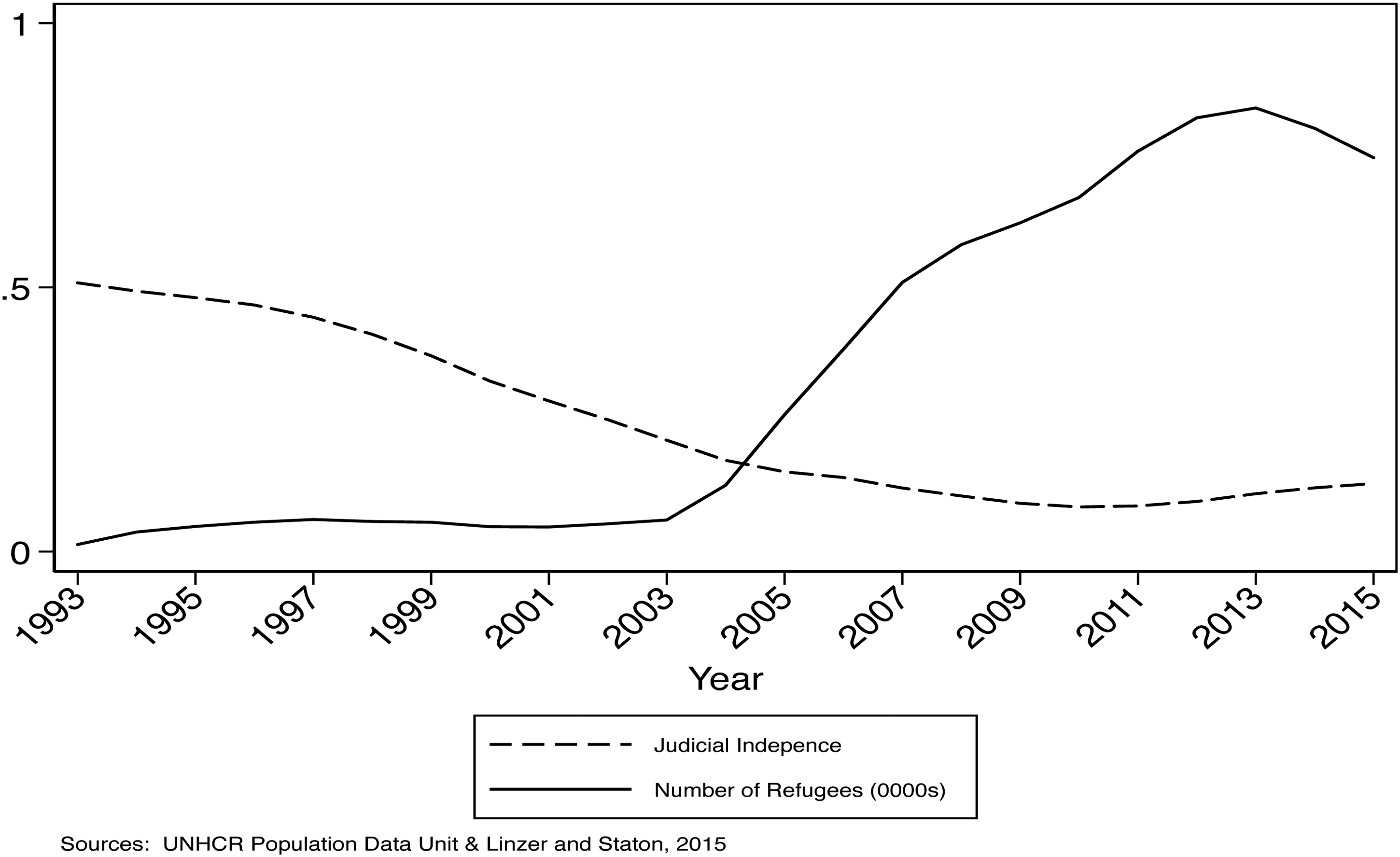
Judicial independence and the number of refugees from Venezuela.
Conclusion
The number of people who seek safety abroad has increased dramatically in recent years (UNHCR, 2020). Accordingly, this upsurge has led scholars to investigate why people flee their home countries. Recent large-n analyses examining poverty, population, regime type and political violence establish that the physical threat to life is a significant determinant of displacement (Davenport et al., 2003; Moore and Shellman, 2004; Rubin and Moore, 2007; Schmeidl, 1997; Uzonyi, 2014). Studies conducted at micro-level (Adhikari, 2012, 2013; Czaika and Kis-Katos, 2009; Engel and Ibáñez, 2007) confirm the significant effect of violence on the decisions of people fleeing their homes as they also find evidence that socioeconomic factors play an important role in explaining this decision. While previous analyses have established the link between threats to individuals’ lives and refugee displacements, judicial independence, which is broadly discussed in the political violence literature, has received little attention.
In this paper, I examine the effect of judicial independence on refugee flights, arguing that countries with independent judiciaries generate fewer refugees than others. My theory predicts that the lack of independent judiciaries causes people to feel threatened in their home countries since ineffective judiciaries are unable to credibly constrain the executive from using state power arbitrarily, particularly against its critics. However, in countries with independent judiciaries, people feel secure against aggression from the government or its allies and stay in their home countries rather than seeking safety abroad. A time-series cross-sectional data analysis on 181 countries for a time period from 1976 to 2015 presents evidence for my argument. The results show that judicial independence has a statistically significant association with refugee migration from states in the expected direction. The results are robust to a number of different modelling specifications, including alternative variables as well as the country and year fixed effects.
Ultimately, this paper aims to contribute to the literature on forced migration. Yet there are still other questions that are outside the scope of this study and may attract attention. Future research might benefit from further examining the determinants of different types of forced migration. For example, a possible venue for future quantitative research is to investigate whether or not there is a significant relationship between judicial independence and statelessness. Examination of the causes of different types of forced migration can provide us with a better understanding of this phenomenon. Therefore, we may be able to better predict the future displacement crises.
Alongside the need for future research, the findings of this paper also provide important implications for both national and international policy makers. The findings imply that the existence of credible judicial institutions mitigates further refugee crises. National and international policymakers should observe this predictor to create early warning systems for future crises. Otherwise, refugee movements lead to humanitarian crises that will eventually create security implications.
Supplemental Material
sj-pdf-1-cmp-10.1177_07388942211072433 - Supplemental material for Judicial independence and refugee flights
Supplemental material, sj-pdf-1-cmp-10.1177_07388942211072433 for Judicial independence and refugee flights by Saadet Ulasoglu Imamoglu in Conflict Management and Peace Science
Supplemental Material
sj-zip-2-cmp-10.1177_07388942211072433 - Supplemental material for Judicial independence and refugee flights
Supplemental material, sj-zip-2-cmp-10.1177_07388942211072433 for Judicial independence and refugee flights by Saadet Ulasoglu Imamoglu in Conflict Management and Peace Science
Supplemental Material
sj-zip-3-cmp-10.1177_07388942211072433 - Supplemental material for Judicial independence and refugee flights
Supplemental material, sj-zip-3-cmp-10.1177_07388942211072433 for Judicial independence and refugee flights by Saadet Ulasoglu Imamoglu in Conflict Management and Peace Science
Footnotes
Declaration of conflicting interests
The author declared no potential conflicts of interest with respect to the research, authorship, and/or publication of this article.
Funding
The author received no financial support for the research, authorship and/or publication of this article.

Supplemental material
Supplemental material for this article is available online.
Notes
References
Supplementary Material
Please find the following supplemental material available below.
For Open Access articles published under a Creative Commons License, all supplemental material carries the same license as the article it is associated with.
For non-Open Access articles published, all supplemental material carries a non-exclusive license, and permission requests for re-use of supplemental material or any part of supplemental material shall be sent directly to the copyright owner as specified in the copyright notice associated with the article.
