



Abstract
Why do some civil wars turn into interstate wars? I analyze an asymmetric information model of civil war onset, rebel-sided intervention, and interstate retaliation with endogenous stakes. Interstate war occurs when rebels believe that the threat of intervention will compel the government to acquiesce, the third party believes that the government will tolerate an intervention, but they both underestimate the government's resolve. The model also has implications for civil wars. Retaliation can deter intervention and rebellion, but intervention can compel the government to give up power, so predicting civil war requires accounting for this triadic interaction.
Introduction
Why do some civil wars turn into interstate wars, while others remain localized? Foreign states intervene on the side of rebels in roughly 45% of civil wars (Högbladh, 2011), yet only some governments retaliate and launch an interstate war. South Africa fought both Angola and Mozambique during the 1970s and 1980s in response to their support for the African National Congress rebels. Egypt, military superiority notwithstanding, tolerated Sudanese support for the terrorist group al-Gama’a al-Islamiyya, which killed hundreds of Egyptian police and soldiers from 1992 to 1998. Both these militarily superior states faced foreign intervention, yet one retaliated while the other did not. Why?
I argue that war expansion depends on uncertainty over whether the domestic government is willing to fight, which can encourage costly fighting at any distribution of power (Powell, 1999: ch. 2). Rebels fight based on expectations of external support (e.g. Cetinyan, 2002; Thyne, 2006; Kuperman, 2008; Cunningham, 2016), and intervention increases the risk of interstate war (Gleditsch et al., 2008). Expectations over retaliation should therefore affect both intervention and rebellion. However, theories of retaliation focus on interstate relations (e.g. Schultz, 2010; Maoz and San-Akca, 2012), even though both the rebels and the third party are facing the same strategic problem: they do not know the domestic government's resolve for fighting. A theory linking civil and interstate war can then explain why two uninformed actors decide to risk war, and when these decisions result in interstate war.
The basis for a theory of war expansion is the connection between domestic and international stakes. Civil wars are nested within an international context, and conflicts that involve multiple actors can have varying stakes depending on who is fighting (Gartner and Siverson, 1996; Werner, 2000). When governments retaliate against external rebel supporters, they raise the potential benefits of fighting to include the third party's territory, which means they might prefer an interstate war over a local conflict, depending on escalation costs. 1 The varying stakes of these conflicts link the decisions to rebel, intervene, and retaliate.
My model of civil war onset, rebel-sided intervention, and interstate retaliation has three key features. First, the domestic government has private information about its subjective costs for fighting, or resolve, so its degrees of willingness to fight a civil war and an interstate war are correlated. Second, the domestic government can raise the stakes by retaliating and expanding the war. Third, if there is intervention but not retaliation, the rebels pay some autonomy costs while the third party gains some influence if the rebels win, because the rebels must consider the intervener's preferences in any post-war order.
In equilibrium, civil wars expand when rebels and third parties underestimate the government's resolve. Rebels challenge the government because they believe that the threat of intervention will compel the government to give up power, and the third party intervenes once fighting starts because it believes that the government will not retaliate. Three factors condition the information problem. First, the size of the local stakes relative to the international stakes determines the risk of intervention and retaliation. When the local stakes are sufficiently large, the domestic government has little to gain from expansion, while the third party has much to gain from intervening. Because larger local stakes make it less likely that the domestic government will acquiesce in the first place, increased local stakes raise the risk of internationalized civil war relative to civil war and interstate war. Second, the third party's benefit from a rebel victory depends on its affinity for the rebels, so it only risks retaliation when a new rebel-controlled government will be sufficiently aligned politically. Third, the rebels lose some autonomy if the third party helps them win, so they only accept support when they can resist foreign influence.
My theory explains the above cases. One reason why Egypt did not retaliate against Sudan is that it had little to gain from war expansion. Egypt had a substantially larger economy, so the costs of escalation outweighed the benefits. However, ideological competition can affect the stakes at hand. While South Africa was richer than Angola and Mozambique, the transnational conflict between African nationalism and white supremacy meant that each side had something to gain from an expanded war. Angola and Mozambique could defeat a powerful adversary and promote Black liberation, whereas the apartheid regime could end an existential threat to its system. In effect, the ideological competition balanced out the local and international stakes. South Africa thus failed to deter rebel support, but preferred retaliating to tolerating intervention.
The model also has implications for civil wars. Some rebels challenge because intervention will happen, but the costs of external support determine whether conflicts stay local or not. Relatedly, some civil wars do not occur because the threat of intervention compels the domestic government to concede, so incredible threats of retaliation can explain both governments giving up power and internationalized civil wars. Predicting the onset of civil war therefore requires accounting for this triadic interaction.
Lastly, my theory shows how domestic and international orders are co-constituted. Interstate war happens when third parties have a sufficiently strong interest in the domestic politics of another state, so changes to existing political order depend in part on whether state sovereignty is limited. Because war expansion happens when the domestic government is willing to remake international order, the type of war that occurs in equilibrium therefore depends on the constellation of interests in a region. While my theory focuses on one particular constellation, these insights can be generalized to a broader set of models.
Explanations for intervention and retaliation
In this section I show how onset, intervention, and retaliation are interdependent. When potential rebels decide to challenge the government, risking civil war, they do so in the shadow of intervention. Rebel-sided intervention can embolden rebels (Thyne, 2006; Kuperman, 2008), while government-sided intervention deters rebellion (Cunningham 2016). 2 Furthermore, the risk of rebellion depends on how rebel and third-party preferences interact. While third parties prefer to support strong rebels (Salehyan et al., 2011: 711), some groups are wary of receiving support, because it means giving up autonomy (Salehyan, 2010: 507).
The third party's decision to support the rebels depends on the potential benefits and risks of intervention. States intervene in civil wars to affect the outcome (Regan, 1996), defeat rivals (Findley and Teo, 2006; Maoz and San-Akca, 2012), promote their ideology (Choi, 2013: 128–129), support co-ethnics (Gleditsch, 2007: 298), and ensure access to markets (Aydin, 2012). But these interventions are not without risks. Support can embolden rebels and cause the third party to lose control (Salehyan, 2010; Bapat, 2012), or cause refugee flows (Salehyan and Gleditsch, 2006: 344–347). The most severe risk, however, is that the domestic government retaliates against the intervener. Such a threat can deter intervention, which affects which civil wars we observe. For example, few interstate wars expand beyond their original participants because initiators pick targets unlikely to receive external support (Gartner and Siverson, 1996: 5). If we apply this logic to civil wars, we should expect that intervention can encourage rebellion, while the threat of retaliation can deter intervention.
We still observe both intervention and retaliation, so the question is why we observe two-sided deterrence failure. Maoz and San-Akca (2012: 724) argue that retaliation happens when both states are dissatisfied, so the third party thinks it might as well support the rebels if an interstate conflict is coming. However, their theory does not specify rebel preferences over intervention, so it does not distinguish between deterring intervention and deterring civil war onset. As such, it is a model of interstate conflict, rather than civil war expansion. Similarly, Schultz (2010, 286) argues that retaliation occurs because domestic governments cannot perfectly observe whether third parties support rebels, so sometimes third parties “cheat,” hoping to go undetected, and sometimes this results in retaliation. But the model cannot explain why civil wars start (Schultz, 2010: 296).
To explain war expansion, we have to consider domestic conflicts nested inside an international context. Models of onset and intervention imply that war is driven by a third party's or the rebels’ wish to remake a domestic political order, so we should consider what war expansion entails for the domestic government. Conflicts between three actors imply different stakes (Gartner and Siverson, 1996; Werner, 2000). With civil wars, retaliation means increasing the stakes of a conflict. Rather than fighting for the status quo, the government forces the third party's territory or resources into the conflict by launching an interstate war. War expansion thus increases the domestic government's potential gains from fighting. Endogenous stakes, however, only explain why retaliation happens, not why the third party intervenes.
Three-actor models offer some insights into how private information shapes behavior. Smith (1996) shows how expectations over intervention cause war, but assumes that the third party has private information about its resolve, and so rebellion hinges on likelihood of support. In the context of civil war, potential allies should be better informed about their respective preferences than about their adversary's preferences. 3 Instead, the rebels and the third party are facing the same strategic problem: they do not know whether the domestic government will fight or not. Wolford (2020) models intervention where the third party is uninformed about the other state's resolve. However, its only stake in the crisis is information about the informed actor's future behavior. Civil wars are different, because third parties care about the civil war today and the threat of interstate war tomorrow. Otherwise, there would be no reason for them to risk retaliation. Private information and relative stakes are thus necessary for explaining why rebels challenge and why third parties intervene.
Modeling onset, intervention, and retaliation
In this section I specify an exploratory model of civil war expansion with three actors: domestic government D and opposition group R in Country A, and third-party state T that may support R.
4
First, I assume that D has private information about its resolve, so its willingness to fight an interstate war is correlated with its willingness to fight a civil war. I define resolve as the government's ability to endure fighting and suffer loses while staying in power. Governments vary in how much they internalize the costs of war. Some can insulate themselves by moving fighting away from government resources, while others can insulate themselves from the political costs of losses by appealing to nationalism or repressing opposition groups. Second, the actors can fight over a local set of stakes, or they fight over the local stakes plus an international set of stakes (combined, I refer to them as the total stakes). The local stakes
The game starts with nature drawing D's costs for war from the uniform distribution
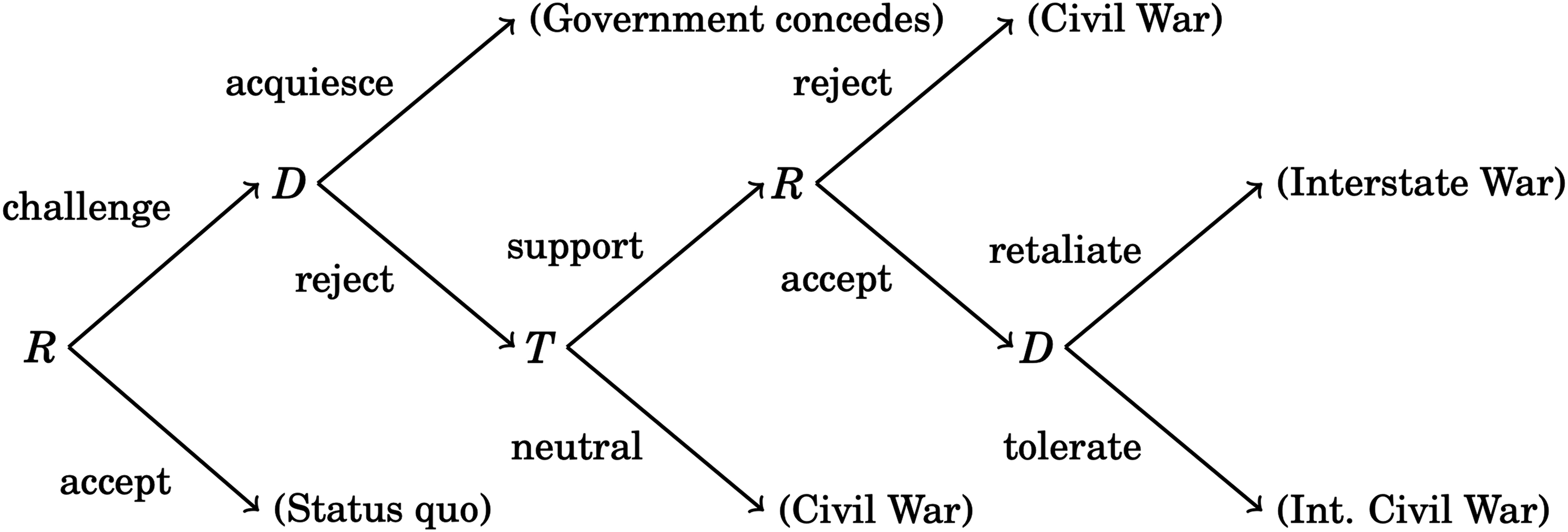
The sequence of the game after nature draws D's type.
Once nature draws D’s type, R challenges D for the local stakes (
The value of the local stakes can depend on material or non-material concerns. While countries consider a wide range of benefits to defeating an opponent, they often care about the wealth of their opponents—whether it be to capture their resources or deny them the ability to pose a threat in the future. We can therefore think of
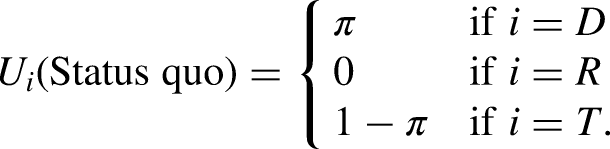

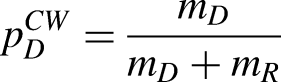

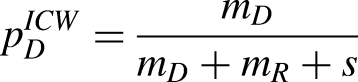
For T, intervention is costly, but also promises influence over the rebels, so its payoff from an internationalized civil war is a function of its affinity (

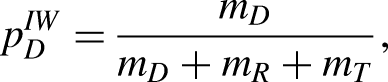
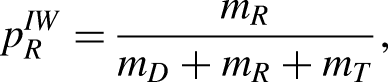

I also simplify the onset of war. My model abstracts away from varying demands (Werner, 2000), because it would not affect T’s decision to intervene other than change posterior beliefs about D's type. Relatedly, I simplify the onset of war so the challenger (R) cannot back down once a challenge has been issued, unlike many crisis bargaining models (Fearon, 1997). Doing otherwise would merely add another layer of screening, without changing why R challenges. Furthermore, I do not model the efficacy of threats in domestic crises. D either fights or acquiesces in order to isolate the relationship between the threat of retaliation and intervention.
Unlike many models of intervention that allow a third party to conduct unbiased intervention or choose a side (e.g. Gent, 2008; Favretto, 2009; Kydd and Straus, 2013; Spaniel, 2018), I restrict mine to rebel-sided intervention. Whereas these models focus on perverse incentives of peacemaking, my model seeks to explain when and why actors fight over control of the state(s). As for allowing third parties to choose sides, rebels could under some circumstances retaliate against external government supporters, but retaliation by rebels would imply a different mechanism of war expansion, focused on when groups are constrained by international borders.
Analysis
I analyze three Perfect Bayesian Equilibria (PBE) where civil war occurs in two, and internationalized civil war and interstate war occur in the third. Civil wars expand into interstate wars when: (1) R thinks D will acquiesce because of the threat of intervention; and (2) T thinks D will tolerate intervention despite rejecting R's challenge.
To explain why interstate war happens, I start by describing D's strategies, because they condition the decisions of the uninformed parties. Next I describe equilibria in terms of R's and T's strategies and beliefs about D's type. Interstate war can only occur if T offers support and R accepts, so I first describe two PBE where T's and R's preferences for fighting together do not align, but R nonetheless challenges D. These equilibria show how a third party can shape the risk of civil war, even when intervention does not happen. I then describe the PBE where R challenges D, T offers support, and R accepts.
The domestic government's strategies
Private information about D's resolve causes war in this model, because R and T do not know D's type, and this uncertainty looms over their decisions to challenge and intervene, respectively. However, R and T know that D's type is distributed
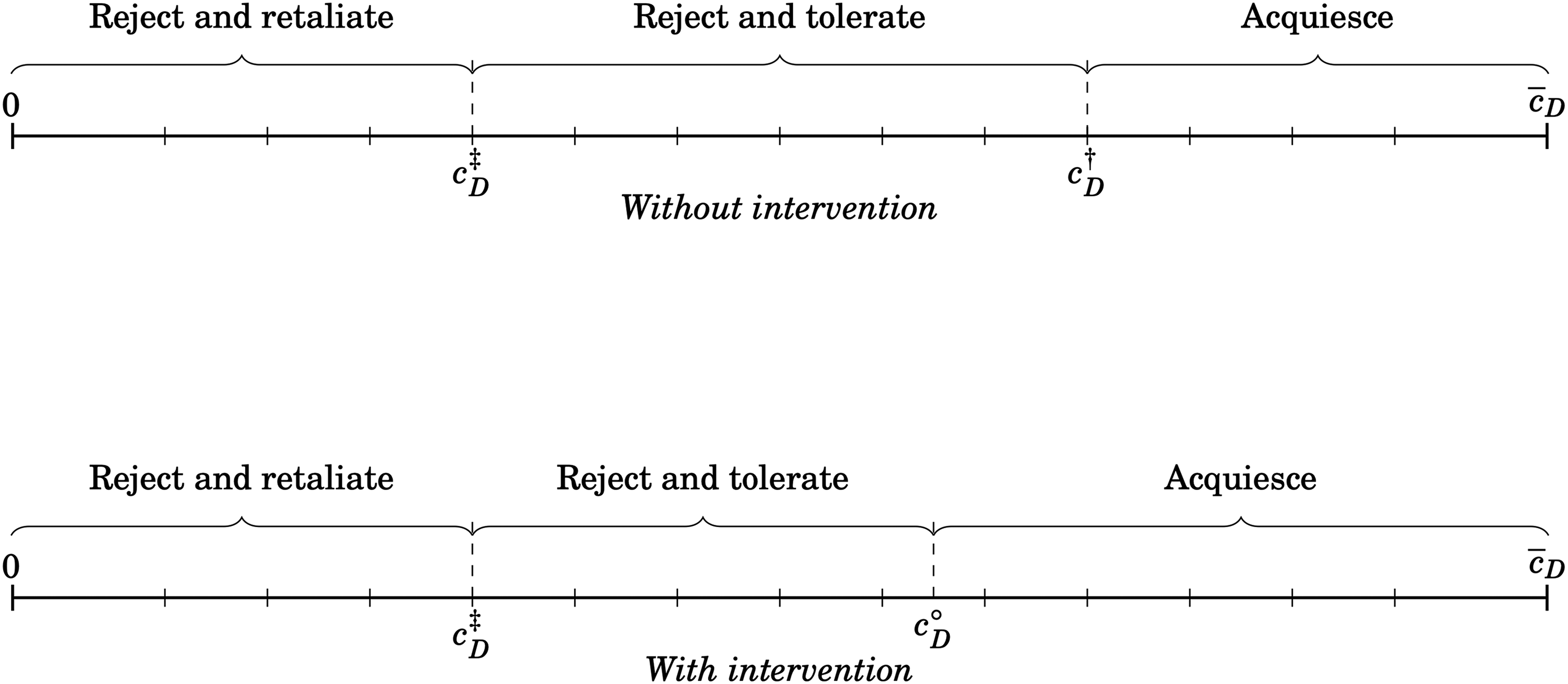
The domestic government's cutpoint strategies.
D is indifferent between tolerating intervention and retaliating at
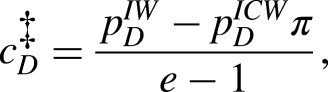
Equilibria
I start by describing two PBE where R challenges D without support from T. I then contrast these civil war-only PBE with another PBE where T intervenes, and retaliation happens with some probability. 12 These equilibria account for all outcomes of the model, and explain how the decisions to challenge and intervene interact in the shadow of retaliation.
When T prefers to stay out, it observes a rejection and believes that D is a type that will retaliate with probability


Without prospects of external support, a challenge means D fights with probability When R challenges. D rejects and retaliates when If D rejects, T believes that If D rejects and T offers support, R believes that When D rejects and retaliates when If D rejects, T believes that If D rejects and T offers support, R believes that
Civil wars also stay local when T wants to help, but R prefers to fight alone. Such a PBE exists when T has strong affinity for R (
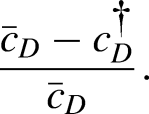
Propositions 1 and 2 show that uncertainty over the government's resolve can cause the onset of a civil war, but the presence of a third party and potential retaliation determine the conditions under which civil war occurs. Besides the chances of domestic victory, rebels must consider the costs and benefits of external support, the latter of which is partly a function of what a third party can lose. Civil war then hinges on whether R's and T's incentives for fighting are sufficiently aligned. When they are not, wars stay local.
For interstate war to occur in equilibrium, T has to offer support and R has to accept it. I identify a PBE where T intervenes following a challenge, where there is some probability of D retaliating. Following a rejection, T believes that D is a type that will retaliate with probability


If T will offer support, R prefers help to fighting alone when doing so is not too costly
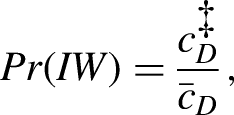
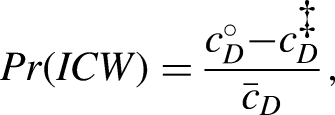
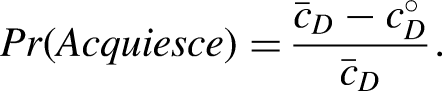
Since D giving up power is R's best outcome, R challenges when it is sufficiently optimistic that the threat of intervention will compel D to acquiesce ( When R challenges. D rejects and retaliates when If D fights, T believes that If D rejects and T offers support, R believes that
Proposition 3 shows why interstate war can happen in equilibrium, despite the costs of war expansion. D retaliates when it has enough to gain from expanding the conflict, but deterrence nevertheless fails because the benefits of influencing a new rebel government outweigh the risks of T losing its holdings. Whether this deterrence failure encourages R to challenge or not depends on several factors, which I discuss below.
Comparative statics
So far I have focused on why war occurs, but not when different types of war are more or less likely. Taking comparative statics on the probability of war (D rejecting a challenge) and the equilibrium constraints on R’s and T's strategies produces several implications. For the equilibria without intervention, the probability of civil war is


The local stakes play a key role in the probability of war, and the kind of war that occurs in equilibrium. Equations 6 and 7 show that the probabilities of war are increasing in π, regardless of intervention. The more valuable it is to stay in power, the less likely the government is to give up power. However, increased local stakes make D less likely to retaliate, because there is less to gain from defeating T. The local stakes thus shape T's and R's decisions in two ways: they affect the probabilities of acquiescence and retaliation, while also affecting the potential benefits of winning the civil war. 14
The larger the local stakes are relative to T's holdings, the more likely intervention is. The reason why is straightforward: the larger π is, the more T has to gain by supporting R, and the less likely D is to retaliate. Increases in π increase the likelihood of internationalized civil war relative to interstate war. One example is the Soviet invasion of Afghanistan in 1979. Intervention on the side of the Kabul government made rebel-sided intervention more attractive to third parties such as the United States, because the conflict now implicated the Soviet empire and made the conflict a vehicle to punish the superpower. Similarly, the presence of US troops in Iraq post-2003 bolstered the Iraqi government's military strength, but also made the conflict attractive to Iran, because rebel victory meant taking Baghdad and defeating a superpower. Rebel victory would humiliate the United States, but also raising the expected costs of future wars in the region. While the United States possessed the capabilities to retaliate, the Bush and Obama administrations concluded that the costs of escalation outweighed the benefits (Filkins, 2013).
Increased local stakes relative to the international stakes makes intervention more likely and retaliation less likely.
The local stakes play a less straightforward role in R’s decision to challenge. In the non-intervention equilibria, R is strictly less likely to challenge the higher π is, because D is more likely to reject. In the intervention equilibrium, however, the relationship is concave. When π is small, R becomes more likely to challenge as π increases, because the benefits of winning the local stakes outweigh the likelihood of war. But when the local stakes are particularly high, increased local stakes deter R from challenging because the relative gains of fighting over larger stakes diminish. We should therefore not expect to see wars of any kind when the local stakes are either very small or very large.
Rebellion is most likely when the local stakes and the international stakes are of similar size.
These results imply that interstate war is uniquely likely when π is in an intermediary range. Under such conditions, T and D have enough to gain from fighting, while R can challenge with some probability of T coercing D into acquiescence.
The threat of intervention can be a double-edged sword for the rebels. It can force D into giving up power, but it can also result in loss of autonomy if the challenge fails. Comparative statics show that R's autonomy costs play a crucial role in determining what kind of war occurs in equilibrium. Autonomy costs do not factor into R's decision-making when T stays out or R declines support, but they affect the conditions under which the three PBEs exist. Higher autonomy costs make the local-only civil war PBE more likely relative to the internationalized civil war/interstate war PBE. We should therefore see more civil wars with intervention than without when the opposition has small autonomy costs. Groups like the Provisional Irish Republican Army and the Palestine Liberation Organization have certain characteristics that prevent them from being dominated by external supporters. They comprise political and military wings and often enjoy strong local support, so they should be more likely to receive support.
15
If civil war occurs, intervention is more likely the smaller the rebels’ autonomy costs are.
Since autonomy costs only affect R's decision to challenge, and only when T will intervene, we should also expect more civil wars expand into interstate wars when a is low.
If civil war occurs, war expansion is more likely the smaller the rebels’ autonomy costs are.
Results 4.4 and 4.5 hinge on the assumption that T has no preferences over R's susceptibility to external domination, which might be an overly strong assumption. T might prefer to support groups that it can dominate, in which case their incentives for fighting are at odds, so intervention and retaliation would occur when autonomy costs are in an intermediary range (see the Online Appendix). But third parties might not prefer poorly institutionalized rebels, because they will be less capable of governing and thus implementing the third parties’ preferred policies.
Escalation costs play a less straightforward role in R’s decision to challenge and T's decision to intervene. In the intervention PBE, costly interstate war makes R more likely to challenge when R is sufficiently weak but T offers substantial support. Higher escalation costs thus deter retaliation but not challenge when R is more likely to win an internationalized civil war. But escalation costs may or may not make intervention more likely, depending on whether they lower the risk of retaliation more than raise T's costs of fighting an interstate war. Higher escalation costs deter intervention when R is strong and affinity is low, because T has little to gain from either outcome. As such, T is concerned with both the potential actions of D and whether R can exploit a larger conflict.
Increased escalation costs make third parties less likely to intervene when the rebels are strong.
War expansion vignettes
I now turn to cases of expansion and non-expansion to illustrate what this strategic interaction looks like in practice. The American Civil War is an example of how a credible threat of retaliation depends on what the domestic government can gain from expanding the war, which in turn can deter intervention. During the Afghan Civil War in the 1980s, however, increased local stakes encouraged intervention while reducing the risk of retaliation. Lastly, the wars in Southern Africa show how transnational ideological competition meant that both sides had something to gain from fighting, resulting in interstate war.
I take this empirical approach because the model is general and exploratory, relying on insights from a wide range of theories to explain a broad phenomenon. Formal models should be evaluated by their usefulness rather than their realism (Clarke and Primo, 2012), so these vignettes are empirical existence proofs meant to demonstrate the empirical relevance of the model (Goertz, 2017: 178), and I focus on how a set of variables affect an outcome rather than whether they do (Goemans and Spaniel, 2016). As such, I take a cartographic–epistemological approach to theory development with the intention of understanding existing conflicts better rather than generating predictions for positivist hypothesis testing (Gunitsky, 2019). The model is appropriate for understanding these cases because the structure of the interaction and the actors’ payoffs resemble the dilemmas faced by the decision-makers in these conflicts. The relative size of the local stakes (π) plays a crucial part in determining the actors’ preferences, as do the third party's affinity for the rebels (see Table 1).
Cases and parameter values.

The American Civil War
When the local stakes are relatively low, the third party believes that retaliation is likely, because the domestic government would rather expand the conflict than tolerate intervention. During the American Civil War, Great Britain considered intervening on the side of the Confederacy, but it remained neutral in large part because intervention could have triggered an interstate war. In fall 1861, Prime Minister Palmerston declared that British policy should be to “keep quite clear of the conflict” to avoid war (Carroll, 2012: 94). The so-called Trent Affair in 1861, when the two countries came close to war over a naval dispute, illustrates British thinking about the costs of intervening.
Britain traded with both sides, and its North American territory was at risk. Canada was particularly vulnerable to a US invasion because of the long border, superior American resources and a weak Canadian militia (Bourne, 1961: 609–611). The British thought that war against the United States would be won at sea, because Britain enjoyed naval superiority, but even at sea, the war could endanger British colonies (Bourne, 1961: 621–628). While the British government was willing to go to war over the Trent Affair (Bourne, 1961: 629), the United States both initiated and defused the crisis. British concerns over losing its territories (1 − π), and its hesitance in escalating the crisis, suggests that Great Britain would be less willing to risk retaliation by intervening in the local conflict. In this particular case, retaliation also entailed opportunity costs. The ongoing Taiping Rebellion threatened British access to Chinese markets (Platt, 2012: 233), and if it were bogged down in an American war, the British ability to intervene in China would be diminished.
After the naval dispute was resolved, the British government remained apprehensive. Even as the conflict intensified in 1862 and the United States suffered significant losses, the British maintained neutrality. It wanted to end a destructive war before it spread, rather than come to the defense of slavery (Jones, 2010: 185). British Foreign Secretary John Russell hoped to facilitate mediation. However, the Lincoln administration did not distinguish between mediation and recognition of the Confederacy (Jones, 2010: ch. 6). It took a hardline stance on any British involvement, seemingly meant to deter intervention. 16 Thus, the British government kept waiting for developments on the ground to force the parties to the bargaining table, but the Confederacy never strung together enough victories to justify its claim to independence (Jones, 2010: 219).
The American case therefore suggests that the threat of retaliation affects decisions to intervene through a combination of political variables and the balance of power, as Results 4.2 and 4.6 predict. Because of the risk of interstate war and the low affinity for the Confederacy, the British government was only willing to intervene directly if the rebels were successful enough on the battlefield, but that moment never came.
The Afghan Civil War
When the local stakes are particularly high, a third party can intervene unmolested, even when the domestic government (and its partners) enjoy military supremacy. The Afghan Civil War attracted outside attention early on, but it only experienced extensive intervention on the side of the rebels after the Soviet invasion of December 1979. Per the model, the Soviet state functionally became the domestic government because it occupied Afghanistan and had the capability to retaliate against third parties. 17 Despite this strengthening of the government, the United States, Pakistan and Saudi Arabia in the early 1980s formed an intervention coalition, and over the next decade provided billions of dollars in arms and money to the Mujahideen. They did so despite fears that the Soviets would retaliate against Pakistan, which handled the logistics of the supply operation. 18
There are three reasons why these coalition partners were not deterred from intervening. First, the United States and Saudi Arabia provided the funds, while Pakistan provided territorial access, so the coalition lowered the countries’ costs of intervening. 19 Second, and more importantly, the Soviet occupation made Afghanistan an attractive target, because rebel victory meant inflicting a defeat on a superpower rival—despite the Afghan Mujahideen being given a slim chance of winning. 20 Lastly, after Ronald Reagan took office, there were also increased doubts about Soviet resolve. The Soviet Union signaled early on, in public and private, that it was willing to negotiate a withdrawal. 21 The Reagan administration came to see the Kremlin as weak on Afghanistan and concerned about the war's effect on renewing detente. 22
Their expectations bore out. The Kabul government and the Soviet occupying force only conducted sporadic operations against Pakistan, restricted to shelling border stations and various covert operations inside Pakistan. 23 The lack of retaliation encouraged increased US involvement in the conflict. During the 1980s, the United States expanded its goals in the conflict, 24 drastically increased aid to the Mujahideen, 25 and even supplied advanced weaponry, such as Stinger antiaircraft missiles, in the fight against the Soviet forces (Kuperman, 1999; Lundberg, 2009). 26
Why was a stronger domestic government unable to deter intervention? My model suggests that the Soviet invasion increased the local stakes relative to the international stakes, in line with Result 4.2. With the Soviets in charge, intervention became more attractive to third parties, despite increased escalation costs owing to the Soviet military presence. Concurrently, the increased local stakes meant that the Soviet occupying power had less to gain from defeating Pakistan than Kabul had prior to the invasion. This case shows that increases in the local stakes can encourage rebel-sided intervention, while reducing the risk of war expansion.
Wars in Southern Africa
The model predicts that interstate war occurs when the local and international stakes are relatively equal. The wars in Southern Africa show how transnational competition led to war expansion because both sides had enough to gain in an interstate war. In the late 1970s and throughout the 1980s, Angola and Mozambique supported the African National Congress in South Africa and SWAPO in Namibia, which was under de facto South African rule. Angola and Mozambique gained their independence in 1975, and South Africa was a threat to these new governments. It had already intervened on the losing side in Angola's war of independence and subsequent civil war in 1975−1976, so majority rule in South Africa and liberation of Namibia would eliminate an existential threat against the new states.
The threat of retaliation loomed over Angola and Mozambique. After losing in Angola, South Africa built up its military capabilities (Minter, 1994: 38). Despite being militarily disadvantaged, the Angolan and Mozambican governments thought that any retaliation would be limited to cross-border operations, and both governments deemed these risks acceptable in the pursuit of African liberation (Minter, 1994: 27–28). They limited their rebel support at first so as not to provoke South Africa too much, and Mozambique only gave practical support to the rebels in Zimbabwe. However, both SWAPO and the African National Congress had bases in Angola, and the latter also depended on clandestine networks passing through Mozambique (Minter, 1994: 39).
South Africa did not tolerate intervention, nor did it limit its retaliation to small incursions. It conducted a wide range of military operations against Angola and Mozambique, including invading Angola on several occasions. South Africa also supported the Angolan and Mozambican rebel groups UNITA and RENAMO, which kept the civil wars in those countries running for years. Political developments on the subcontinent explain South Africa's strong response. The new governments of Angola and Mozambique represented the rise of African nationalism and liberation, and in 1980, they and four other neighboring countries coordinated diplomatic policy on liberation in the region. 27 Coupled with Robert Mugabe's ascent to power in Zimbabwe, these developments meant that South Africa’s “protective shield of friendly states” had disappeared (Minter, 1994: 38). African nationalism threatened the apartheid regime's survival, so it had much to gain from stemming the revolutionary tide in Southern Africa by expanding its local conflict.
The model helps explain why the newly formed states intervened against South Africa, and why South Africa retaliated. South Africa was wealthier than its neighbors, so defeating its neighbors meant relatively less material gains, but the ideological nature of the interstate conflict balanced out the stakes by giving each side the opportunity to defeat an existential threat. African nationalism threatened the apartheid regime's power and way of life. Because the movement was transnational, it encouraged coalition building, which suggested a long-term supply of rebel support. While ideology thus raised the risk of retaliation, it also meant that Angola and Mozambique had much to gain from helping the rebels defeat the primary obstacle to liberation on the continent. The combination of ideologically aligned rebels fighting over moderately sized stakes meant that intervention was worth the risk of retaliation.
Conclusion
In this paper I have presented a model of civil war onset, rebel-sided intervention, and interstate retaliation. The model explains when and why civil wars expand into interstate wars. Civil wars start and third parties intervene when the rebels are optimistic about the domestic government backing down from a challenge, external support is cheap, and the third party likes the rebels. Retaliation depends on the relative size of the local stakes. The more the government has to gain from war expansion, the more likely it is to retaliate. However, intervention is less likely the smaller the local stakes are, so interstate war is most likely when both sides have something to gain. The model thus helps us understand several cases of (potential) war expansion better than when focusing on the balance of power exclusively. It shows how the threat of retaliation can deter third parties, and also why some strong governments forego retaliation.
The model explains several linked features of civil war decision-making. It shows how the threat of retaliation can deter intervention, which can deter rebellion. However, intervention also hinges on the rebels’ and the third party's incentives for fighting being sufficiently aligned. When the rebels are vulnerable to external influence, they prefer to keep the fighting local. Yet if the rebels want help, and the third party is willing, intervention compels some domestic governments to acquiesce. These results show that making predictions about the onset of civil wars necessitates accounting for the threat of retaliation, as well as the preferences of the rebels and the third party. For instance, models of civil war duration include international factors or third-party goals on the right-hand side (e.g. Balch-Lindsay and Enterline, 2000; Cunningham, 2010), but intervention depends on relative stakes between the two states, which in turn can affect duration through retaliation.
The model also shows how domestic and international orders are co-constituted. Third parties can intervene to remake domestic political arrangements, while domestic governments can retaliate and remake international borders. What links these decisions together is limits to sovereignty and states’ interest in other's domestic politics. If a third party cannot credibly commit to intervene in a civil war, its presence can generate a civil war, with potentially intervention and retaliation to follow. The model shows that different types of war can follow from the same process, and which type of war occurs in equilibrium depends on the constellation of interests amongst the actors. While I have focused on one constellation here, the insights of the model can be extended to other situations, for instance with a third-party government supporter.
Supplemental Material
sj-pdf-1-cmp-10.1177_07388942221129050 - Supplemental material for Intervention, war expansion, and the international sources of civil war
Supplemental material, sj-pdf-1-cmp-10.1177_07388942221129050 for Intervention, war expansion, and the international sources of civil war by Hans-Inge Langø in Conflict Management and Peace Science
Footnotes
Acknowledgement
The author wishes to thank Terrence Chapman, Megan Farrell, Michael Findley, Jesse C. Johnson, Brandon J. Kinne, Patrick McDonald, Julianne Phillips, D. Cale Reeves, Idean Salehyan, and Scott Wolford for thoughtful comments, critique, and suggestions. This paper was presented at the annual meetings of the Texas Triangle (2017), the International Studies Association (2018), the American Political Science Association (2019), and the Peace Science Society (2019).
Funding
The author(s) received no financial support for the research, authorship, and/or publication of this article.

Supplemental material
Supplemental material for this article is available online.
Notes
References
Supplementary Material
Please find the following supplemental material available below.
For Open Access articles published under a Creative Commons License, all supplemental material carries the same license as the article it is associated with.
For non-Open Access articles published, all supplemental material carries a non-exclusive license, and permission requests for re-use of supplemental material or any part of supplemental material shall be sent directly to the copyright owner as specified in the copyright notice associated with the article.
