




Abstract
Greater safety is a primary benefit garnered by black public housing residents participating in housing mobility programs. Whether similar outcomes are arising from the recent exurbanization of nonsubsidized families is unclear. Using the migration of 130,000 African Americans into the Los Angeles exurbs as a case study, this research combines evidence from mover interviews and crime and census data to show that the region has enabled families’ safety over time—a finding that calls for planners’ consideration of racial equity in responding to urban sprawl.
A growing body of research examines the role of public housing deconcentration policy in offering low-income African Americans access to safer and potentially socioeconomic mobility-enabling neighborhoods (Turner and Briggs 2008; Engdahl 2009; Orr et al. 2003; Rubinowitz and Rosenbaum 2000). Relatively little is known about how current urban fringe growth has affected the safety of African American movers living in nonsubsidized housing, an important issue given recent analyses identifying black migration to exurbs as a nationwide trend (e.g., Crawford and Young 2011; Richman 2011). Suburban stratification theory suggests that movers’ safety gains are marked by a distinct “window of opportunity,” meaning that initially safe communities suffer from crime and other threats as they undergo inevitable racial and economic segregation (Cashin 2004; Orfield 2002; Alba, Logan, and Bellair 1994). Yet virtually no empirical research exists on whether these trends are playing out in exurbs, where tract home development out of former farmland and open space may produce different outcomes.
This article uses the growth of Los Angeles’s exurban Inland Empire, which encompasses the counties of Riverside and San Bernardino on its eastern border, as a case study to test the effect of urban fringe development on blacks’ sense of safety and experience of crime. Between 1980 and 2007, there was a net migration of about 130,000 African Americans into the area, with most moving from inner city Los Angeles in search of “peace of mind.” Through interviews with seventy movers and an analysis of census and Federal Bureau of Investigation (FBI) Uniform Crime Reports data, this research shows that Los Angeles exurban development has enabled African Americans to live in safer communities less oppressed by gangs. Yet these advantages are coupled with an increased exposure to police racial profiling, which has tempered the well-being of young men in particular.
The discussion proceeds as follows. First, I address the expectations that arise from the housing mobility and suburban stratification literatures for African American outcomes in exurbs. I then present the research methodology, followed by a brief review of the key determinants of black flight to the Los Angeles exurbs. The bulk of the article assesses the safety gains and costs that African American movers to the Inland Empire have experienced. I conclude by showing that trends uncovered in the Los Angeles exurbs may apply more broadly and draw out three key insights from these findings for planners addressing exurban growth.
Sprawling to Opportunity or Slumurbia? Expectations from Housing Mobility and Suburban Stratification Literatures
Over the past three decades, a seismic shift has occurred in the racial geography of U.S. metropolitan regions—black flight from the urban core and inner-ring suburbs to outer-ring suburbs or exurbs, the new, fast-growing communities on the urban fringe. During the 2000s, the majority of the nation’s largest and oldest African American population and cultural centers, places like Detroit, Chicago, New York, Los Angeles, and Atlanta, experienced black population decline, an acceleration of trends from the 1990s and 1980s (Frey 2011, 8). Simultaneously, virtually all of the one hundred largest metropolitan areas exhibited black suburban growth, with populations of the Atlanta, Houston, Washington, and Dallas suburbs increasing by close to or more than 200,000 each and those of Indianapolis, Des Moines, Phoenix, Minneapolis, and Allentown, Pennsylvania, more than doubling (Frey 2011, 11). Anecdotal evidence reported in the media suggests that the desires to live as home owners and in safer, more affordable communities are key reasons for African American families’ exurban migration—factors that also drove their postwar migration to inner-ring suburbs (Wiese 2004). But the recent foreclosure crisis, in the context of waning demand for exurban living, is transforming the tract home frontiers of yesterday into the concentrated poverty, disadvantaged communities of tomorrow, or “slumurbia” (Keen 2011; Crawford and Young 2011; Richman 2011; Kuruvila 2011; Economist 2008; Wiese 2004; Leinberger 2008; Egan 2010; Semuels 2010).
While an established literature details how suburban sprawl reproduces racial inequality from the perspective of inner-city and older suburban minority communities left behind (powell 2002), few articles examine effects from the perspective of recent minority movers. Early research using large survey datasets shows that African Americans living in lower density suburban areas are more likely to own their homes, consume housing more similarly to whites, and live in more economically diverse neighborhoods (Pendall 2005; Kahn 2001). Attention to effects on quality of life, particularly sense of safety and experience of crime, also is warranted. The housing mobility and suburban stratification literatures predict the safety outcomes that African American movers should experience. While the former illustrates immediate and dramatic reductions in exposure to violent crime and stress for families that move from the poor, segregated inner city to more integrated and lower poverty suburbs, the latter predicts that gains will diminish over time.
Evaluations of housing mobility initiatives, such as the Gautreaux, Moving to Opportunity, and Baltimore Housing Mobility programs, demonstrate the role that federal subsidized housing policy plays in fulfilling inner-city African Americans’ desire to live in safer, lower poverty communities (Turner and Briggs 2008; Orr et al. 2003; Rubinowitz and Rosenbaum 2000; Engdahl 2009). 1 While 75 percent of the Gautreaux movers perceived that their former, inner-city neighborhoods were unsafe during the day, only 10 percent felt so about their suburban neighborhoods (Rubinowitz and Rosenbaum 2000, 94). Similarly, although the Moving to Opportunity experiment had mixed effects on recipients’ socioeconomic status, its safety effects were clear—residents who moved into low-poverty neighborhoods experienced a 30-percentage point increase in perceived safety, with the greatest gains for young women and their mothers, who felt less fear of harassment and resulting anxiety (Orr et al. 2003, 65; Turner and Briggs 2008, 5; Popkin, Leventhal, and Weismann 2008). Close to 80 percent of the Baltimore Housing Mobility Program participants felt safer and less worried about crime after their move (Engdahl 2009, 28).
Relatively less attention has been paid to how recent suburban growth has affected the safety of families living in nonsubsidized housing. Research conducted on the effect of postwar suburban development on African Americans’ outcomes suggests that families have migrated to declining communities within an increasingly segregated inner-ring suburbia—a pattern driven by housing discrimination, white middle-class avoidance of growing minority housing markets, and persistent racial wealth gaps, among other factors (Cashin 2004; Wiese 2004; Orfield 2002; Pattillo-McCoy 2000; Alba, Logan, and Bellair 1994; Logan and Alba 1993; Massey and Denton 1988). Greater exposure to poverty concentration and to crime are key inequalities that black suburbanites experience across income levels (Alba, Logan, and Bellair 1994). Part of the explanation is spatial—African Americans may move out of poor communities, but they rarely move far away; the encroachment of poverty from continued black migration, downward socioeconomic mobility, and proximity to disadvantaged communities are constant threats (Pattillo-McCoy 2000). Thus, in the long run, African American suburbanites’ sense of safety and exposure to violent crime should exhibit a “window of opportunity,” with short-term gains eventually transforming into the same problems of concentrated poverty and gang violence present in the inner-city communities many left behind (Cashin 2007; Pattillo-McCoy 2000).
Little is known about whether recent African American migration to exurbs is leading to similar outcomes. There is an ongoing debate about whether exurbs are merely an extension of the suburbs or a “new urban form” (Berube et al. 2006; Nelson 1992; Davis and Nelson 1994; Nelson and Sanchez 1999). Nelson and Sanchez’s (1999, 692) claim that “life in exurbia really isn’t much different from life in suburbia” suggests that similar racial inequalities in access to safe communities are playing out in these places as well.
Several conditions of exurbs, however, may lead to long-term safety gains for African American movers. For one, they are farther away from historically black inner-city communities that have been long plagued by gang violence, among other ills; thus, exurban movers, particularly upwardly mobile, middle-class families, may be more able to distance themselves from these places than their inner-ring suburban peers, possibly preventing “the constant reincorporation of black middle class neighborhoods within the black ghetto” (Pattillo-McCoy 2000, 225). In turn, exurbs’ rapid new, low-density housing construction in the context of fair housing law and growing white racial tolerance may lead to less racial segmentation in the housing market, as predicted by the housing availability model (Farley and Frey 1994; South and Crowder 1998). There is less of a history of who lives where based on race in these places, with new housing tracts constructed out of farmland and other open space areas and families moving in without knowing what the eventual racial mix will be. There is evidence that Los Angeles exurban developers, eager to turn a quick profit in the unstable exurban market, may value families’ buying power over their race, ethnicity, or other characteristics, and lower down payment and other financial requirements to capture the broadest possible consumer base, indirectly enabling access among diverse groups—a condition that may apply to other exurban regions. 2 Such accidental neighborhood diversity may mean African Americans are less likely than in the past to live in (or adjacent to) concentrated poverty, high-crime communities. Finally, there is evidence that exurbanites and middle-class black suburbanites have lower tolerance for quality-of-life disruptions, including crime (Nelson and Sanchez 1997; Cashin 2001). This implies that African American exurban movers, possibly driven to relocate to escape neighborhood gangs and other violence, are less tolerant of crime when it occurs, which renders their communities safer.
Method
This research contributes to knowledge on the relationship between exurban housing growth and African Americans’ safety through a case study of the drivers and impacts of black migration from Los Angeles County to the Inland Empire, an adjacent metropolitan area that consistently has ranked among the fastest growing over the past three decades, gaining about 400,000 units during the 1990s and 2000s alone (H. P. Johnson, Reed, and Hayes 2008; Downs 2005; U.S. Census Bureau 1990a, 2000a, 2010). Between 1980 and 2007, an estimated 130,000 African Americans moved to the region, with most coming from Los Angeles County—a shift that some have labeled black flight (State of California 2005, 2007, 2009; McMillan 1987; Johnson and Roseman 1990). Why families have left Los Angeles County en masse and whether they are getting what they want, particularly safety, are pressing questions.
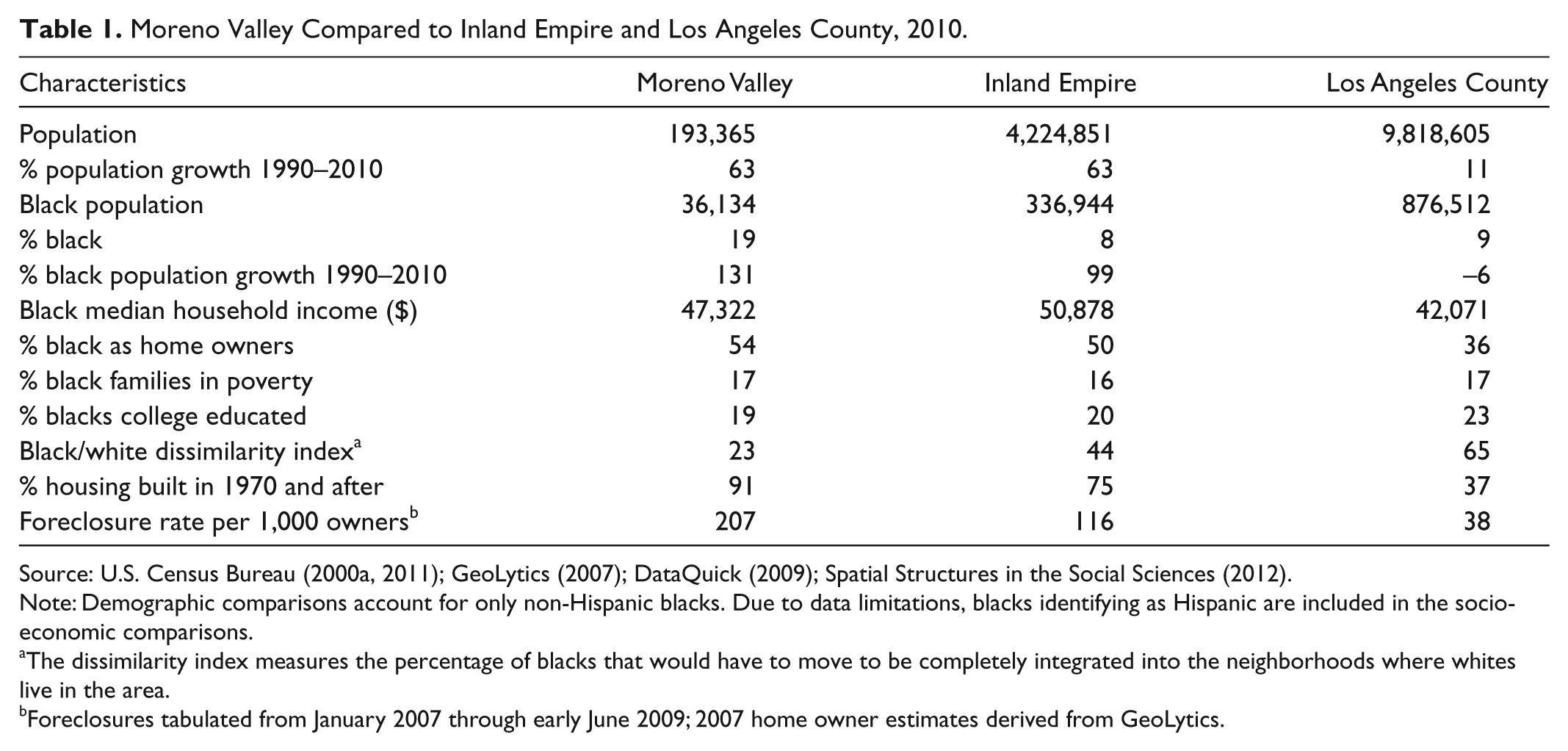
I used a mixed-method approach, combining interviews with seventy African Americans who moved from Los Angeles County to the Inland Empire and a statistical analysis of average local violent crime rates faced by black households by income in the two regions. Individuals who moved, henceforth called “movers,” primarily were recruited from Riverside County’s city of Moreno Valley. Moreno Valley was selected for two reasons. First, it has been one of the fastest growing places in the country over the past three decades, earning recognition as the fastest growing city in 1991 and one of the top twenty-five in the early 2000s (Los Angeles Times 1989; Chi 1997; Murillo 2004). Over 90 percent of its housing stock was constructed after the 1968 Fair Housing Act (see Table 1). Second, it has been one of the most popular destinations among Los Angeles African Americans, particularly those from South Los Angeles (Corwin 1992). Currently, about 36,000 African Americans live in the city, representing 19 percent of the population and over 10 percent of the black population in the region (Spatial Structures in the Social Sciences 2012). Thus, Moreno Valley represents not only the black experience in a fast growing exurb built in the post–Civil Rights era but also a primary destination of Los Angeles black flight. It is an ideal case study to test the applicability of suburban stratification and housing mobility theories to movers’ safety outcomes.
Moreno Valley Compared to Inland Empire and Los Angeles County, 2010.
Source: U.S. Census Bureau (2000a, 2011); GeoLytics (2007); DataQuick (2009); Spatial Structures in the Social Sciences (2012).
Note: Demographic comparisons account for only non-Hispanic blacks. Due to data limitations, blacks identifying as Hispanic are included in the socioeconomic comparisons.
The dissimilarity index measures the percentage of blacks that would have to move to be completely integrated into the neighborhoods where whites live in the area.
Foreclosures tabulated from January 2007 through early June 2009; 2007 home owner estimates derived from GeoLytics.
On average, Moreno Valley’s black population resembles the Inland Empire and Los Angeles County’s black population in socioeconomic status, with little variation in median household income and family poverty and college education rates (see Table 1). Yet the neighborhood and housing market dynamics that its residents experience depart somewhat from the region and dramatically from Los Angeles County. Over half of African American households own their homes in Moreno Valley and the Inland Empire, compared to just over one-third in Los Angeles County. In turn, Moreno Valley has one of the highest neighborhood foreclosure rates in a region that quickly became an epicenter of the recent nationwide mortgage crisis (Neff and Krueger 2009). At the same time, the city is known for its diversity, which is regularly showcased by the local media (Chi 1997; Churchill 2002; Olson and Miller 2011). 3 While about 44 percent of blacks would have to switch neighborhoods to be completely integrated with whites in the Inland Empire, only 23 percent would have to do so in Moreno Valley—rates that pale to Los Angeles County’s 65 percent (Spatial Structures in the Social Sciences 2012).
Selection of the interviewees was based on a hybrid approach (some random and others nonrandom). The eight sample Moreno Valley neighborhoods were selected from a list of all of the city’s block groups based on the 2000 U.S. census boundaries using a random number generator. Recruitment fliers were distributed to every third house in the neighborhoods between May and July 2010. About one thousand fliers were distributed and twenty-four movers were recruited, producing an extremely low response rate of about 2 percent—an outcome due not only to a lack of interest but also foreclosure-induced vacancies and neighborhood diversity, with only an average of one out of every four households identifying as African American in the sampled places (U.S. Census Bureau 2011). Higher response rates occurred in communities with relatively lower black poverty rates, while the lowest rates occurred in places with large gated apartment communities (see Table 2). Early participants were given fliers to distribute to others whom they knew living in the city, which led to an additional thirty-three respondents living in sixteen other block groups.
Sample Neighborhood Characteristics, 2010.

Note: Census tract identities removed to preserve participants’ confidentiality. Due to changes in census tract definitions in the 2010 U.S. census, one of the fliered block groups is now split into two different tracts (B and G).
The resulting sample draws from about half of Moreno Valley’s census tracts, with participants coming from places with extremely low to high poverty rates, predominately renting to owning households, and no to almost half of African American adults with college education. Over half of the interviewed movers came from majority Latino communities, often with similar black and white proportions. Only two came from majority white communities. Thirteen movers living in other cities in the Inland Empire also were recruited through snowball sampling prior to and after the fliering to account for place-based differences in perspectives, for a total of seventy respondents. 4
The interviewed movers are diverse based on place of origin, tenure, length of tenure, and socioeconomic status (see Table 3). Just over half moved from predominately black and brown, high-poverty, inner-city South Los Angeles communities such as Watts, Compton, Inglewood, and South Central. Close to half were currently renters. Of the remainder, one-quarter were home owners and the other quarter lived with family. Twenty-six had lived in the Inland Empire for a decade or less, while forty-four had been in the region for over a decade. Fifteen of the respondents had college degrees or higher; thirteen were high school dropouts. It is important to understand that the sample neither controls for self-selection bias nor fully represents the black population in the Inland Empire or Moreno Valley. Rather, it includes a variety of characteristics contained within the cohort motivated to move from Los Angeles County between 1980 and 2010. This enables the comparison of perspectives, experiences, and outcomes across a diversity of movers.
Respondent Characteristics.

Source: Resident interviews.
The interviews, which were conducted in person or over the phone between February and August 2010, focused on the persons’ reason for moving and how their safety, among other conditions, varied between the two regions. Sessions were transcribed and analyzed in Atlas.ti using codes derived from the housing mobility and suburban stratification literatures and new concepts that emerged in the interviews. 5
Using U.S. census, FBI Uniform Crime Reports, and Los Angeles Police Department (LAPD) data, weighted averages were conducted to assess how Inland Empire and Los Angeles County African American households’ local violent crime rates have compared by income over time. Local violent crime rates were obtained from the RAND California database, while census tract level violent crime data for South Los Angeles were obtained from John Hipp at the University of California, Irvine (RAND California 2011; Hipp 2011). The formula used for calculating weighted averages is as follows:

where “x-” is the average local violent crime rate for a particular household income group in a region, “w” is the local population for that group, and “x” is the local violent crime rate. Finally, an analysis of related newspaper articles provided a broader scope on the drivers and outcomes of black migration, particularly in terms of families’ safety.
Black Flight to Exurbs as a Search for Safety
Similar to their postwar suburbanization, African American migration to the Inland Empire is product of their desire to get “more housing for less” and for personal and neighborhood safety (Pfeiffer 2012). While all racial groups share the former, the latter is a direct outcome of African Americans’ greater likelihood of moving from urban, hyper-segregated, and high-poverty communities (Wiese 2004; Massey and Denton 1993).
The Inland Empire, due to its rapid housing construction and more open land, has much lower housing values than the rest of Southern California. Single-family home prices were 25 percent less than Los Angeles County in the early 1980s and over 40 percent less by the end of the decade (Security Pacific National Bank 1986, 13; Myers 1989). The gap persisted into the height of the housing market in 2005, when median prices were between 21 percent and 33 percent lower in Riverside and San Bernardino County, respectively (Downs 2005, 10). These conditions have attracted an economically diverse group of African American residents, with the Inland Empire having equal proportions (20 percent) of black households earning under $20,000 and over $100,000, compared to proportions of 26 percent and 16 percent in Los Angeles County, respectively (U.S. Census Bureau 2011). Thirty-one of the seventy participants cited the Inland Empire’s greater housing affordability as a reason for moving, with disproportionate representation among those who had moved earlier than 1996 and initially to Moreno Valley.
Black exurbanization in the Los Angeles region, however, is different from that of other groups in that African Americans, across income, are more likely to make moves from urban, concentrated poverty communities, giving greater urgency to the need to move to a safer environment (Massey and Denton 1993; Pattillo-McCoy 2000). Historically expressed by postwar black suburbanites, the search for personal and neighborhood safety has been a primary, long-term factor motivating African Americans’ suburbanization in the Los Angeles region (De Graaf 2001; Wiese 2004). Violent crime rates have been historically higher in Los Angeles County than the Inland Empire, although dramatic decreases in violent crime in the former have narrowed the gap over time (see Figure 1). The proliferation and militarization of South Los Angeles gangs, like the Bloods and Crips, have contributed to growth in violent crime. By the mid-2000s, Los Angeles County had over one thousand gangs with between 80,000 to 85,000 members—close to 1 percent of the population (Barrett 2004). Watts alone had sixty-five gangs with 15,000 members, exposing its residents to a 1 in 250 chance of being killed, much higher than the nationwide likelihood of 1 in 18,000 (Landesman 2007). Police violence also put Los Angeles African Americans at risk, with LAPD officers in particular having a long history of using questionable, violent tactics in apprehending black suspects. The 1992 Los Angeles uprising, which was sparked by police brutality, further compounded families’ wariness about living in the inner city (Horne 2001). African Americans’ perceptions of the LAPD improved in the 2000s after the city entered into a consent decree with the U.S. Department of Justice that necessitated reform. But by 2009, close to one in five still felt that officers generally disrespected them—much higher than the proportion of whites and Asians and slightly higher than the proportion of Latinos who felt this way (Stone, Foglesong, and Cole 2009, 51).
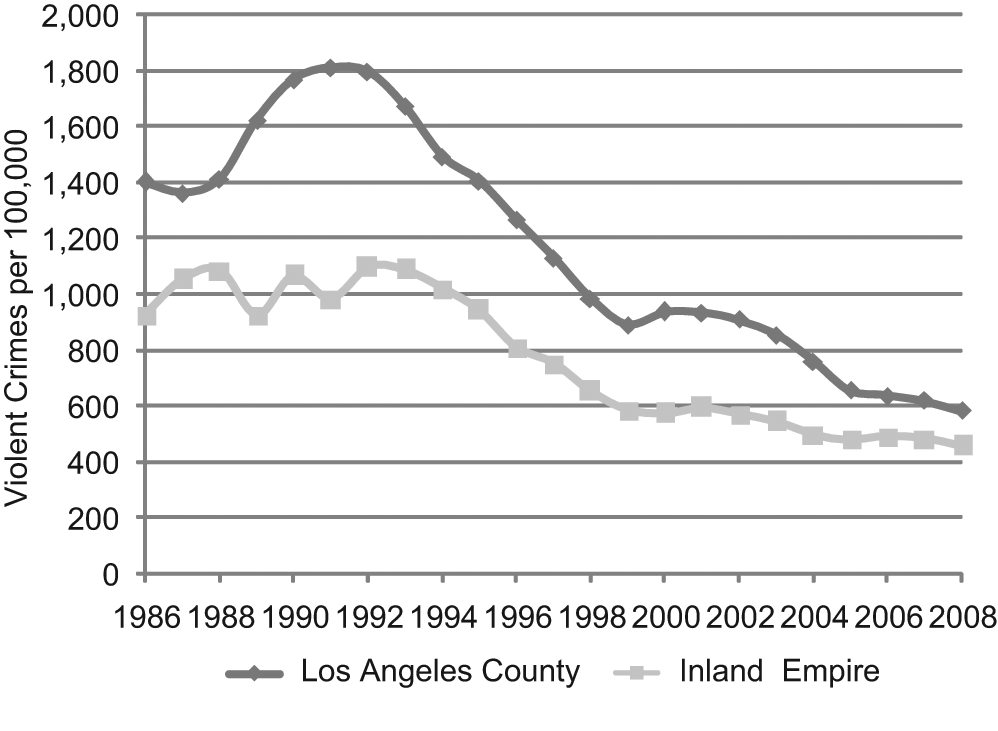
Violent crimes per 100,000 persons, 1986–2008.
The desire to live in a safer community was the most often cited reason for moving to the Inland Empire, contributing to just over half of the participants’ residency decisions and remaining a primary factor between 1980 and 2010. Safety was an especially compelling factor for parents with young boys and young men involved in gangs, as well as those from South Los Angeles and Long Beach. While parents seek to protect their children from gang harassment and associations because of living in a particular community, gang members are looking for a way out of the seemingly inevitable cycles of violence and imprisonment that structure their lives. Both seek relief from the exhaustion that comes from living in an urban, high-poverty neighborhood.
Feelings of the inevitability of their children’s victimization by area gangs, both in their neighborhoods and at school, shaped twenty-five parents’ decision to move. Since young black men living in South Los Angeles are associated with gangs just by virtue of where they grow up, a primary goal for their caretakers is to sever this connection. The main reason that Trina’s mom moved her family from Compton to Moreno Valley in 1989 was that her brothers were getting older, which in their area meant they were soon to become associated with the local gang, the Tree Top Pirus, even if they never officially became members. 6 Trina explained, “You don’t have a choice . . . if you walk out of that neighborhood, people associate you.”
One of the most harrowing stories of gang harassment came from Candice, who recounted the endless persecution that she and her son endured during the 1990s in Compton. When she moved into their house, she thought they lived on “a nice quiet street.” Working nights as a nurse rendered her oblivious to the area’s gang violence until it was too late, or as she put it, they were “a fly caught in the spider web.” When her son started high school, he was soon targeted by neighborhood gangs and relentlessly victimized. Little relief came from meeting with the school’s staff or police. A star baseball player who piqued the interest of major league teams, her son ended up quitting the team to escape gang members’ harassment and was later diagnosed with posttraumatic stress disorder due in part to his experiences living in Compton. Candice lamented not moving to Moreno Valley sooner, while her son was still in high school. “Until this very day, my son is still suffering the side effects of that school,” she explained. “I feel like we failed him, that we should have done better.”
A handful of participants had lost family members to gang violence. Carl grew up during the 1970s and 1980s in Compton, “the generation when drive-bys started and gangbanging really was active.” A big impetus for him moving to Riverside in 1992 was his brother getting shot. “I didn’t want my kids to have to see and lose their friends and stuff like I was losing mine, like my sons end up killed on the streets because of what color he got on, what sign.”
Just as moving to the Inland Empire was a way for victims such as Candice and Carl to escape the growing threat of gang-infested South Los Angeles, so too was it a way for those who were involved in gangs to rid themselves of their ties and life-threatening encounters, including their vulnerability to California’s three-strikes law. Clinton, who grew up in South Central and described himself as “the co-founder of my ’hood,” had just been released after thirteen years in the penitentiary in the early 2000s when neighborhood altercations soon rendered him vulnerable to death or future imprisonment. He recalled, “I was getting caught up. Getting in confrontations, bringing pistols home. Getting back into that old rut.” Being hospitalized after one fight was a life changing moment—when he was released, he called his brother living in Moreno Valley and asked if he could move in. He summarized, “It was too close for comfort . . . I was still a three-strike candidate. So I had to get to a better environment.”
For both interviewed victims and gang members, moving to the Inland Empire often was preceded by feelings of deep anxiety and exhaustion, with some comparing the experience of day-to-day life in South Central, Compton, and other epicenters of gang violence to living through a war. Charlotte was a twenty-six-year-old mother of three living in Inglewood in 1986, a time when “people was getting killed on corners and ran over and kids getting beat up and people getting robbed.” She admits, “I was scared every day when I woke up in the morning. I was scared to come out of my house.” John, a mailman who grew up in South Central in the 1970s just as the Crips and Bloods were consolidating their territory, felt similarly panicked and anxious before moving to Moreno Valley in the late 1980s. “Between the gangs, the drugs, and the LAPD, man, I had had it. I was tired. I needed to get away. . . . I’ve never been in the military, but Afghanistan and Iraq couldn’t be much worse than my block.”
Movers’ Safety Outcomes
Given the importance of safety in compelling respondents’ moves, a key question is whether or not they got what they wanted, namely, relief from the anxiety and risks associated with living in or nearby urban communities with concentrated poverty. The short answer is, at least initially, yes—the majority of the interviewed movers felt safer after moving to the Inland Empire, an outcome explored in detail below (see Table 4). Only ten felt less safe, the majority of whom came from South Los Angeles or Long Beach. Four of these who had moved from gang-demarcated areas in South Los Angeles claimed that it was because they did not “know the rules.” Clinton now laughs about how he initially felt unsafe when he moved into his brother’s home in Moreno Valley because there were no bars on the windows or doors. He explained, “I was from South Central. I wasn’t used to this suburb living, no doors locked.” The region’s greater racial diversity contributed to others’ feelings of discomfort. Desmond, who moved in the late 1980s from South Central to Perris, just south of Moreno Valley, explained, “In LA, you knew everybody pretty much. If you didn’t know them, you knew you weren’t supposed to be around them. But out here . . . you got so many people . . . black people, white people, Mexican people, all from different places. . . . You never know who you dealing with.”
Change in Respondents’ Sense of Safety after Moving to the Inland Empire.

Source: Resident interviews.
Greater safety meant primarily three things to the interviewed movers: (1) a lower likelihood of being the victim of a violent crime, (2) a sense of freedom from the inevitability of gang violence and the mobility constraints that came from living in demarcated territory, and (3) feelings of peace of mind or a release from the stress of living in an urban community with concentrated poverty—benefits also expressed by subsidized movers in the housing mobility literature. Yet moving from higher to lower poverty and from more black and brown to integrated communities also imposed safety costs on the interviewed movers, namely, a switch in victimization from black-on-black to authority crime, or police racial profiling. In turn, consistent with suburban stratification theory, twenty-nine of the seventy participants observed a window of opportunity of safety that is closing, or a diminishing of gains over time.
Lower Victimization Rates
A primary reason that participants felt safer in the Inland Empire is that they felt like they were less likely to be the victim of a violent crime. This was especially true for people coming from South Los Angeles and surrounding cities. While twenty-five of the seventy respondents had household members who were victims of violent crime in Los Angeles County (with eighteen coming from South Los Angeles), only nine were victims in the Inland Empire. Notably, sixteen of the seventeen households who moved for safety reasons and were victims of Los Angeles County violent crimes were not victims in the Inland Empire. Darrell, whose windows got shot after he beat up his ex-girlfriend’s new boyfriend, who accused him of treating her badly, was the lone exception.
Five of the nine respondents who experienced violent crime in the Inland Empire were young men. Two of these were the victims of hate crimes perpetrated by Latinos in Perris or Moreno Valley, where Latinos have become the majority. 7 Michael was jumped and almost shot by a group of Latinos in Perris after they called him the “n-word.” Rashan was hit over the head by a Latino man on a Moreno Valley street with antiblack graffiti and spent three days in a coma.
That such lower violent crime victimization rates and greater sense of safety likely apply to others in the region is evident by comparing the average city violent crime rates per 100,000 people experienced by Los Angeles County and Inland Empire African American households by income from 1990 to 2008 (see Table 5). Based on the census and FBI Uniform Crime Reports, the data show that over time and at all income levels, Inland Empire African Americans have lived in less violent cities, with the greatest gains accruing to those who moved to the region early on. For instance, while the average middle-income black household ($50,000–$99,999 in 2000 dollars) living in Los Angeles County in 1990 lived in a city where 2,100 out of every 100,000 people were victims of violent crime, the average household living in the Inland Empire lived in a place where only about 1,200 per 100,000 were victims—a reduction of about 900 violent crimes per 100,000. By 2008, this gain had narrowed to just over 150 violent crimes per 100,000. Notably, African Americans’ gains in safety in exurbs have diminished the fastest for lower income households.
Average City Violent Crime Rate per 100,000 Persons for Inland Empire and Los Angeles County African American Households by Income 1990–2008.

Source: U.S. Census Bureau (1990b, 2000b, 2010); RAND California (2011).
Note: Income given in 2000 dollars. Middle income bracket in 1990 dollars: $37,950–$75,899; 2007 dollars: $60,203–$120,406. Census brackets used were $35,000–$75,000 and $60,000–$125,000, respectively. Weighted averages for 2008 calculated using the household estimates from the 2005–9 American Community Survey. Only cities were included in the analysis; unincorporated places were not included. Black households excluded in 1990 represented 12 percent and 14 percent of all households in Los Angeles County and the Inland Empire, respectively. In 2000, 11 percent of black households in Los Angeles County and the Inland Empire were excluded. In 2005–9, these values were 10 percent and 13 percent in Los Angeles County and the Inland Empire, respectively.
Since these data are reported at the city level, important neighborhood differences in violent crime rates are obscured, particularly in the city of Los Angeles. To get a closer glimpse at sublevel differences in violent crime rates experienced, data from South Los Angeles and Moreno Valley—movers’ most common place of origin and destination— were compared (see Figure 2). Even though Moreno Valley has had more violent crimes than the typical city in the Inland Empire, it consistently has had much fewer violent crimes than South Los Angeles, with about 1,000 fewer per 100,000 between 2000 and 2002. Recently, the gap between the two places has narrowed dramatically, from 714 fewer crimes per 100,000 in 2005 to only 421 fewer in 2007. Despite this promising drop in crime in South Los Angeles, Moreno Valley is still a much safer place to live.

Violent crimes per 100,000 people in Moreno Valley and South LA, 2000–2002 and 2005–7.
Freedom from Gangs
A feeling of release from the inevitability of gang violence is a key benefit that the interviewed movers to the Inland Empire experience over time, particularly those coming from South Los Angeles. Of the seventy participants, forty-one confirmed this, with a handful of men admitting that the move likely prolonged their life. Tyrell, who is associated with a Los Angeles Crips gang, thought there was a “1 out of 10 chance” that he would be shot while running an errand in Los Angeles, “because you could be mistaken easily for somebody else out there.” Anonymity made most interviewed past gang members immediately better off; they were no longer at risk of being shot at by members of an opposing gang or picked up by the police for committing a crime, which in Clinton’s case could have meant his third strike, putting him in jail for twenty-five years to life.
Another improvement was that the rules governing what color you wore and where you wore it no longer applied in the Inland Empire. When Damon moved to Redlands from Hawthorne in the early 2000s, for instance, he realized, “I didn’t have to like look over my shoulder. I didn’t have to worry about like wearing red or wearing blue.” Respondents explained that they no longer had to prepare for the risk of victimization by carrying concealed weapons or avoiding public spaces, such as parks. Removed from crime-infested neighborhoods like South Central, three men also felt less likely to have to enact retribution for a crime committed against a family member or friend, which puts them at risk for victimization or imprisonment. Overall, the energy that they expended navigating gang-demarcated territory in Los Angeles could now be directed to other pursuits. Two men experienced major lifestyle changes—Clinton became a devout Muslim, and Deangelo stopped dealing drugs.
Freed from the rules governing gang territory, half of the forty respondents from South Los Angeles—both gang victims and members—experienced improvements in mobility after moving to the Inland Empire, particularly women and their children, whose living space was broadened beyond the home. After moving to Moreno Valley, Patricia said, “I could let my two small kids go in the front yard . . . and play. And I could leave them out there, and I could be in the house.” Being able to exercise nearby, not having to drive miles to a gym or a safer neighborhood across town to go for a run, was also mentioned by one-fourth of the South Los Angeles respondents. Overall, four of the six participants who moved as teenagers from South Los Angeles felt that the lack of gang rules made it easier to come of age in the Inland Empire. Thinking back to her first years in Moreno Valley, Trina explained,
It allowed us to kind of explore and not be constrained to whatever our environment made us. We were able to kind of come out of us, you know, come out and do certain things. That environment [in South Los Angeles] is extremely controlling, because you don’t realize it, you’re not free to explore you. You have to be whatever the rules are there, and you think you’re just being you, because you’re going with the flow. This out here was much different.
Peace of Mind
Greater “peace of mind” was one of the most frequently mentioned initial benefits of moving to the Inland Empire, experienced by forty of the seventy respondents. Peace of mind entails a relief from the mental stress of living in or near a high-crime and poverty urban area, a nighttime quietness and a lack of harassment, as well as a reorientation from the home to the broader community. It is defined by a sense of calmness, comfort, and security.
Being able to finally fall asleep at night is a major outcome of living in a more peaceful environment, even though three respondents experienced initial problems sleeping without the ubiquitous cacophony of a high-poverty inner-city community. Carol, who moved from South Central in the mid-1990s, admitted that it took her “a while to adjust” to the evening quiet in her Fontana neighborhood. She explained, “There was no helicopters, no police, no gang activity, no drugs, no people screaming, no people staying out late at night, cars screeching. None of that. People went to bed.” John, who grew up going to bed to the drone of the “ghetto birds” in South Central, on the other hand, had no trouble sleeping in the Inland Empire. Rather, going from a “carceral state” to the open “comfortability” of Moreno Valley was deeply calming.
One-fifth of the respondents reported a change from their homes being closed in Los Angeles County, a barricade against a chaotic outside environment, to open in the Inland Empire, a conduit to commune with and enjoy the natural environment and broader community. “In LA,” John explained, “you was calling the man to come put wrought iron gates on your doors and jailhouse bars on all the windows around your house. You felt like you was in a cage. You was locking yourself in.” In Moreno Valley, however, he and his parents would sleep with the “whole house . . . open.” The immense sense of security that participants felt is evident in the stories that eleven told about no longer locking their doors. Living in Inglewood in the early 1990s, Kalela remembered, “It was to the point where you don’t even go out at night. You lock everything up, and you just come in and stay in.” In Upland, however, she quickly became used to a different routine: “I could go to sleep, and I could leave my car unlocked and forget about it and nothing would happen . . . I just felt that secure.” Feelings of openness extended to the broader space of the community. Experiencing carjacking and armed robbery as a teenager in South Los Angeles changed Terri’s perception of her environment. “It always made me . . . very cautious . . . about what’s going on around me.” Moving to the Inland Empire, however, made her feel comfortable in public space once again. “Now that I live out here,” she explained, “I got a little bit of it back, that serenity and that peace. I don’t feel threatened.”
All but four of the seventy respondents still traveled back to Los Angeles County for work, to visit family or friends, or to attend cultural events. The radical change that the Inland Empire has on African Americans’ awareness of and comfort in space was evident in the mental shift that close to one in five described experiencing on the freeway going to and from Los Angeles. Rowena explained, “Even now when I go to LA, I switch. It’s like as soon as I get to downtown, I know, ok, you gotta make sure your door is locked, make sure your purse can’t be visibly seen. Make sure you’re kind of aware of what’s going on around you, that kind of thing. And as soon as I hit the [interstate coming back] I find myself like exhaling and having a sense of ‘Ok . . . I can rest and relax.’”
From Black-on-Black to Authority Crime
Participants’ initial experiences in the Inland Empire were by no means all positive—forty-five of the seventy felt worse off in at least one way, with the greatest proportion missing friends and family, feeling bored, or experiencing racism or unemployment. For just under half of the interviewed men, moving to the Inland Empire entailed the replacement of one evil in their lives, gangs, by another, the police, who challenged their newfound greater mobility. Present in Los Angeles (most infamously through the early 1990s Rodney King beating and trial), racial profiling was felt to be more pervasive by the majority of the participants in the Inland Empire. While only four of the respondents reported having household members who were racially profiled by the police in Los Angeles County, twenty-two had members profiled in the Inland Empire. Notably, all but one of the respondents who had been racially profiled in the Inland Empire had lived at some point in Moreno Valley. Of the twenty-two, seventeen moved from South Los Angeles or Long Beach and were of generally lower socioeconomic status, with just under half having household members who had been to prison.
For Michael, being harassed by police while walking around Moreno Valley has become a normal part of daily life. “There’s an uncountable amount of times,” he said, “where I could tell you I was just walking down the street, going to the store, I see something going on at the store with the police, I turn around. I don’t want to have nothing to do with it. They pull up on me . . . they jump out the car and say, ‘You know what to do.’” Being pulled over for driving a luxury or embellished car was a common experience for the interviewed men and women’s brothers, boyfriends and spouses, and fathers, almost a rite of passage. When John bought a Cadillac, a Moreno Valley cop pulled him over, looked over his identification, and—certain that he had arrested him before—grilled him about where he got the car. In turn, Trina’s boyfriend’s car “always fit a profile of a car that was involved in a crime.”
Racial profiling had the most damaging effects when it resulted in wrongful search, arrest, and conviction. Leticia’s house was illegally searched when her teenage son was profiled by an undercover officer while walking through a nearby park on his way home from visiting a friend. Although the police left empty-handed, the incident made Leticia feel angry and humiliated and her son a “nervous wreck.” Trina and her brother were wrongfully arrested for a crime that she was trying to report, during which her brother was put in a chokehold. The charges were dropped, but her mother filed an incident report, which became important evidence ten years later when one of the officers involved was suspected of abuse. Respondents who had been arrested described the pressure that Riverside law officials—from police officers to public defenders—exert to get a guilty plea. Rashan, who has been arrested three times but never incarcerated, described the typical sequence of events: “The police pump you up . . . like you about to go to jail for so long, so long. So once you go to court, the DA gives you a deal. And it sounds so good, like say that you’re a strike and three-year probation, and you go home. You just took a deal for something you didn’t do just to get out of jail, just to not fight them.”
A handful of the respondents endured lasting psychological damage from repeated police harassment. Michael has been stopped so many times by the Moreno Valley police that now whenever he is walking around he has his ID ready. He described the trick police use of driving their car up to you really fast to see if you will run. “I thought I was going to have a heart attack [at an] early age due to the police,” he explained. “I’d be driving in the car, and I’ll just see them out of the corner of my eye, and I’d go ughhh [grabs at his heart]. . . . So I hate the police for that.”
Instances of police racism against Inland Empire African Americans—which included everything from traffic stops to unlawful home entry to murder—were frequently reported in the news media during the study period (e.g., Anderson 1998; Palmer 1999). Events most often occurred in Riverside, San Bernardino, Fontana, Adelanto, Perris and Moreno Valley—places with historic or fast-growing black communities. In 1996, PoliceWatch, a California civil rights organization that monitors police racism, received over two hundred complaints from the Inland Empire—the highest number in the state (Anderson 1998, A1). In 1999, only 25 percent of surveyed black residents in the region thought that all people were treated fairly by the police, compared to 55 percent of Latinos and 57 percent of whites (Brown 2000, A1).
What explains African Americans’ greater experience of racial profiling in the Inland Empire? Most felt that their minority status, in the context of a predominately white, culturally insensitive police force, made them more likely to get targeted. African Americans were underrepresented among Inland Empire officers during this period. For example, by December 2005, only 8 percent of San Bernardino police were black—far short of their close to 20 percent representation in the population (Rogers 2006). A racially hostile work environment possibly deterred African American employment, with incidents occurring in San Bernardino and Riverside precincts (O’Connor 1999; Anderson 2004).
Eleven respondents felt that police officers were directed to target African Americans as a way of bringing in revenue to an often financially strapped region. Indeed, dependency on developer fee revenues led Moreno Valley to experience a serious budget deficit during the early 1990s recession (Gorman 1994)—an outcome that may be playing out in the current crisis. When Jocelyn recently met with local officials in Moreno Valley to discuss racial profiling, a police executive described his role as “to hook them and book them,” a type of policing that he described as “economically . . . good for us.” Respondents gave three examples of such “fiscal policing” at work in Moreno Valley: impounding cars for expired tags or licenses, ticketing for frivolous infractions, and arresting as a strategy to boost demand for law enforcement jobs. The former was most frequently mentioned—at $70 to $100 a day, an impounded car can quickly become irrecoverable. The latter incited the most ire. “Honestly, I think out here, it’s more about money,” Deshaun said. “Like they need to put people in jail and get people out and then put more people. They need to get money.”
A Safety “Window of Opportunity”
The expectation that African American movers will experience a safety “window of opportunity” is strong in the suburban stratification literature, and there is some evidence that the current recession may be causing the window to close in the Inland Empire (Orfield 2002; Cashin 2004). In 2007, for instance, the region had the fourth highest foreclosure rate nationwide (Los Angeles Times 2008). Of the seventy movers, twenty-nine expressed that while the Inland Empire was once much safer than Los Angeles County, it has become increasingly less safe over time. Participants who moved between the mid-1980s and mid-1990s from South Los Angeles or Long Beach were disproportionately likely to feel this way. Just under half attributed this to a change in movers’ composition from more stable, working- and middle-class families to single-parent, poorer families with teenage children who are already involved in Los Angeles–area gangs when they come out—a transition possibly accelerated by the conversion of foreclosures to rentals. John, for instance, has noticed that the same gangs that were in his South Central neighborhood twenty-two years ago are now in Moreno Valley. Evidence of the region’s increasing Los Angeles gang presence is apparent in regional news articles from the studied period, with Moreno Valley having an estimated two thousand racially diverse gang-affiliated residents by 1996 (e.g., Sahagun 1988; Duran 1996, B1; Edwards and Gill 2010).
Four claimed that the depressed economy provided incentives to commit robbery and other crimes. Perceiving the region becoming less safe, four have reverted back to their cautious Los Angeles ways of conceiving of and using their homes and public space, namely, by being more vigilant about locking their doors. One, however, saw the foreclosure crisis as “weeding out” the region’s most unstable inhabitants—a process that may result in safer communities down the road. Sean, a small business owner who moved from South Central to Perris in the late 1980s, explained, “Everything is settling . . . the communities that were stable, working class and all that, they’re sustained, and it shows. But the ones that were kind of iffy, they’re dislocated. It’s sad, but the ones that can maintain it right now? Oh, it’s going to be beautiful, because it’s going to be a quality neighborhood.”
It is important to understand, however, that despite issues with racial profiling and fears of a safety window of opportunity closing, half of the respondents felt that African Americans are flat out better off living in the Inland Empire than Los Angeles County over time—a sentiment driven primarily by the safer environment the region affords. Strikingly, only six felt that African Americans were flat out worse off in the region, and half of these six had negative experiences with the police.
Racial Equity in Exurbs?
To what extent are the safety gains and costs that African Americans experienced in the Los Angeles exurbs generalizable to other regions and minority racial groups? A short exercise illustrates that these trends may apply more broadly. The American Community Survey (ACS) enables the periodic monitoring of the effect of exurban growth on a variety of conditions, such as home ownership and housing affordability, employment and income, educational attainment, and exposure to concentrated poverty at the neighborhood level. Given that the latter is highly correlated with crime, assessing differences in racial groups’ average neighborhood poverty rates between inner cities and suburbs and fast-growing exurbs by household income estimates the extent to which such growth is not only forging greater safety within groups but also narrowing gaps in safety outcomes.
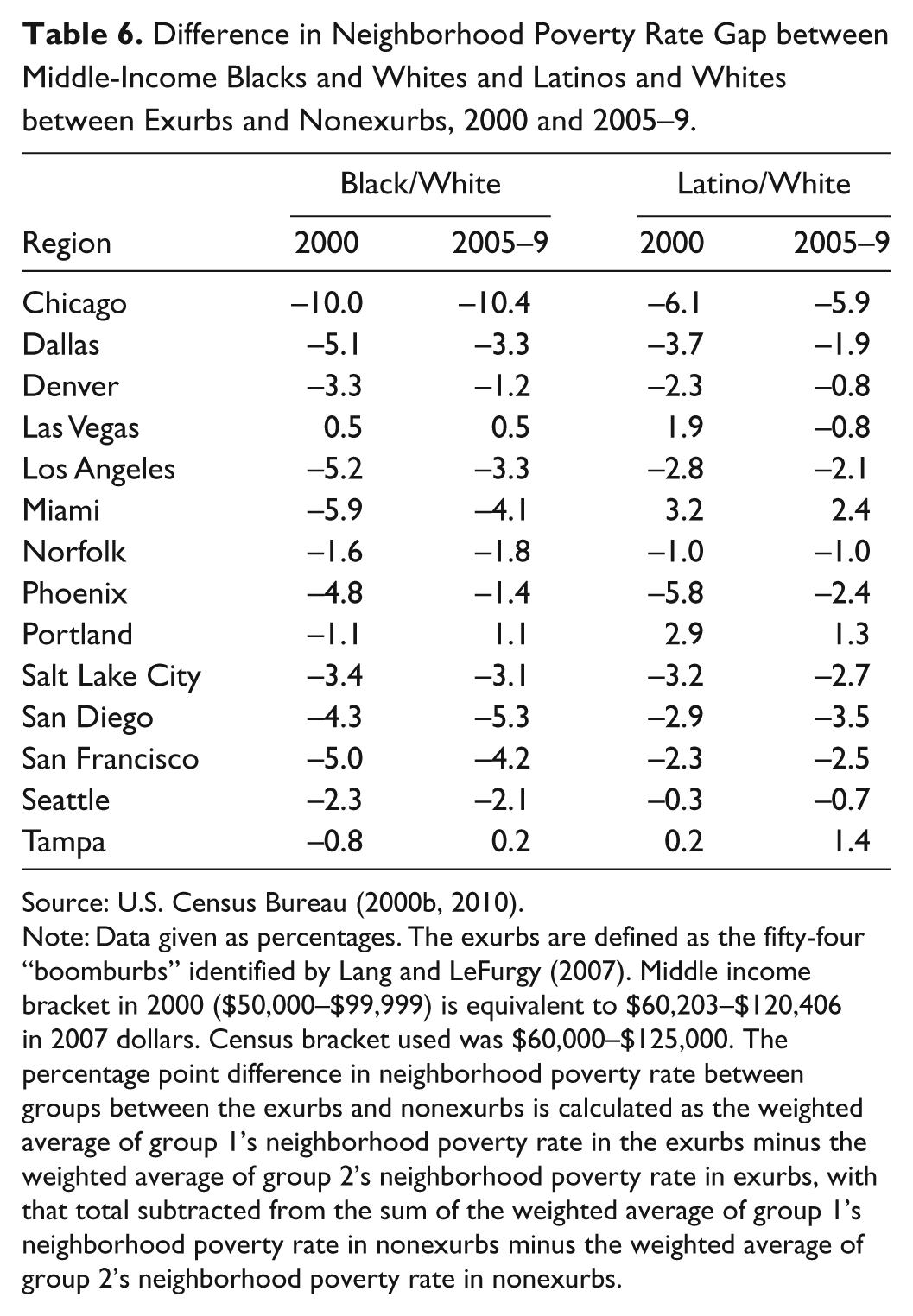
To accomplish this, I used the formula for weighted averages given in the methodology section and approximated exurbs as the fifty-four “boomburbs” identified by Lang and LeFurgy (2007), which are places that have populations greater than 100,000, have maintained long-term double-digit growth rates, and are not the biggest city in their metropolitan areas. To assess where exurban growth has enabled greater racial equity in access to low-poverty communities over time, I compared differences in the weighted averages of middle-income African American, Latino, and non-Hispanic white households’ neighborhood family poverty rates in exurbs and nonexurbs of fourteen metropolitan areas nationwide (see Table 6). 8 Regions with differences in groups’ neighborhood poverty rates of less than zero have more equal conditions in exurbs, while those with differences at or above zero do not. For instance, using the Los Angeles region as an example, middle-income African Americans and whites living in nonexurban neighborhoods in 2000 experienced average poverty rates of 15.1 percent and 6.8 percent respectively (a gap of 8.3 percentage points), while those living in exurban neighborhoods experienced rates of 10.2 percent and 7.1 percent, respectively (a gap of 3. 1 percentage points). Thus, the difference in the black/white neighborhood poverty rate gap between the region’s exurbs and nonexurbs was −5.2 percent (3.1 – 8.3), indicating that Los Angeles exurban growth has forged greater equity in blacks’ and whites’ neighborhood poverty.
Difference in Neighborhood Poverty Rate Gap between Middle-Income Blacks and Whites and Latinos and Whites between Exurbs and Nonexurbs, 2000 and 2005–9.
Source: U.S. Census Bureau (2000b, 2010).
Note: Data given as percentages. The exurbs are defined as the fifty-four “boomburbs” identified by Lang and LeFurgy (2007). Middle income bracket in 2000 ($50,000–$99,999) is equivalent to $60,203–$120,406 in 2007 dollars. Census bracket used was $60,000–$125,000. The percentage point difference in neighborhood poverty rate between groups between the exurbs and nonexurbs is calculated as the weighted average of group 1’s neighborhood poverty rate in the exurbs minus the weighted average of group 2’s neighborhood poverty rate in exurbs, with that total subtracted from the sum of the weighted average of group 1’s neighborhood poverty rate in nonexurbs minus the weighted average of group 2’s neighborhood poverty rate in nonexurbs.
Ten of the fourteen regions had more equal conditions between blacks and whites and Latinos and whites in their exurbs in 2000 and 2005–9. Exurban growth may be forging greater racial equity in neighborhood safety in these places. Gains in exurban neighborhood conditions, however, generally narrowed in most regions during the 2000s—a product of actual changes or statistical sampling error, given the ACS’s large margins of errors in some communities. Yet there was substantial variation. African American and Latino exurbanites’ gains narrowed only slightly or increased in Chicago, Norfolk, Salt Lake City, San Diego, San Francisco, and Seattle during the 2000s, while they narrowed dramatically or reversed in Dallas, Denver, Los Angeles, Phoenix, and Tampa, possibly an outcome of the current foreclosure crisis. In turn, conditions in exurbs became more equitable for Latinos but not for African Americans in Las Vegas, Miami, and Portland. I explore the implications of these trends further below.
Discussion
Drawing from a mix of on-the-ground and aggregate evidence, this article contributes to the debate on the relationship between urban sprawl and racial equity by showing that exurban growth in the Los Angeles region has enabled the safety of African Americans living in inner-city communities with concentrated poverty. Large-scale tract development produced cheap housing far from inner-city gangs, allowing economically diverse families to distance themselves from these conditions. Many experienced intense feelings of peace of mind on arriving and a reduced exposure to violent crime over time. Gains, however, were gendered in that men also felt more affected by racial profiling. In turn, the current recession has sparked respondents’ fears of a safety “window of opportunity” at work in the region. Finally, an analysis of differences in neighborhood poverty rates by race for middle-income households living in exurbs and nonexurbs nationwide suggests that these trends may apply more broadly.
These findings contain three key insights for planners addressing exurban growth. The first is that exurban expansion may provide a needed opportunity for African Americans to live in safer communities, thus contributing to greater racial equity in neighborhood conditions. This complicates the profession’s recent adoption of urban sustainability, which in part entails redirecting resources from new construction on the urban fringe to intensifying uses in existing suburbs and cities (Gunder 2006; Jabareen 2006). There is promising evidence that more compact development reduces black–white segregation and slows the increase of socioeconomic disparities within regions (Nelson, Sanchez, and Dawkins 2004; Lee 2011). Yet examining the missed gains of suburban expansion for racial equity is also an important task. Urban fringe growth propelled whites into the middle class in the mid-twentieth century (Oliver and Shapiro 2006; Jackson 1985), and minority socioeconomic mobility in the early twenty-first century may depend in part on its continuation. This may be especially the case in built-out regions like Los Angeles, where high housing costs and persistent racial wealth gaps exclude African Americans and Latinos from living in the highest quality neighborhoods, and NIMBYism, among other barriers, segregates subsidized housing into higher poverty communities with poorly performing schools (Taylor et al. 2011; Pfeiffer 2009).
The second insight is that the safety gains of exurban growth appear to vary by period, region, and racial group. Close to half of the respondents felt that their communities were becoming less safe over time, which the majority attributed to recent movers’ declining socioeconomic status. This trend is also apparent in the analysis of racial gaps in exurban and nonexurban middle-income households’ neighborhood poverty rates. One cause may be the current foreclosure crisis, which has disproportionately affected exurbs and minorities (Reid 2010; Bocian, Li, and Ernst 2010). Concentrated vacancies, speculation, and conversions to rentals may be causing rapid socioeconomic and demographic change in minority exurban communities. Combined with employment instability, these conditions may be increasing minorities’ neighborhood poverty rates and widening gaps among middle-income racial groups living in exurbs.
Yet all regions did not experience initial gains or recently lose them, and African Americans and Latinos did not always share gains equally. Regional demographic, segregation, and housing market conditions may help explain this variation. Exurban areas with lower minority populations and faster housing growth, for instance, may have greater neighborhood racial integration and narrower neighborhood poverty rate gaps relative to the rest of their metropolitan areas, according to racial segregation and housing availability theory (Marshall and Jiobu 1975; South and Crowder 1998). Better understanding of why exurban growth is leading to greater racial equity in access to low-poverty communities in some regions and for some racial groups more than others and why gains are narrowing over time is a critical future research direction. In the meantime, such variation suggests that searching for a “one-size-fits-all” racial equity approach to urban sprawl will be a futile effort. Rather, further exploring variation in exurban gains could result in the development of typologies that allow for the tailoring of responses to specific types of places and people.
The third insight is that racist policing may be undermining African American movers’ safety gains, particularly for men. Police harassment is perceived as a nuisance to be endured by some but as a chief racial injustice by others. Whether residents are actually safer living in exurbs when profiling is taken into account or whether they are trading one ill for another is a central issue. This research provides evidence that, on balance, victims of profiling are still safer living in exurbs than inner cities with violent gangs. Of the twenty-two respondents who experienced profiling, fourteen felt safer in the Inland Empire, while only four felt less safe. Just over half felt that African Americans were flat out better off living there over time, while only three felt they were flat out worse off. These perceptions do not diminish the injustice of racial profiling in the region, and combating it should be a priority. Certainly diversity hiring, sensitivity training, and community policing can help overcome effects arising from officers’ racism and cultural incompetency. Yet police harassment also may be a strategy to bolster the local revenue base. To what extent these practices are happening in other cash-strapped, foreclosure-inundated exurbs receiving families of color is an issue worthy of further investigation.
Footnotes
Acknowledgements
The author thanks John Hipp at the University of California, Irvine for sharing census tract-level crime data and three anonymous reviewers and Weiping Wu for their insightful comments and edits, which improved the article substantially.
Declaration of Conflicting Interests
The author(s) declared no potential conflicts of interest with respect to the research, authorship, and/or publication of this article.
Funding
The author(s) disclosed receipt of the following financial support for the research, authorship, and/or publication of this article: This research was supported by the Haynes Foundation and the UCLA Institute of American Cultures and Bunche Center for African American Studies.