




Abstract
Many planners work at private consulting firms, and many local governments use their services, but we have little idea of how consultant involvement affects plans. Analyzing data from a survey of local officials who engage planning consultants, we find that while engaging consultants does not appear to nudge local officials in a policy direction different from their preferences, it does appear to yield plans with a policy focus more oriented toward smart growth. This raises questions about the kind and degree of consultants’ impact on the legitimacy of the planning process.
Introduction
As local public planning processes have become more sophisticated, and local government planning budgets have become leaner, public officials and planners have come to rely heavily on planning consultants to increase capacity, both in terms of time and expertise (Sokolow 1997; McCann 2001; Norton 2005; Grijzen 2010). Yet there have been few studies of planning processes that have analyzed the role of consultants. As far as we know, none have addressed directly the influence of consultants on the policy content of local plans or on the corresponding legitimacy of the local planning endeavor (i.e., in terms of whether the plan genuinely reflects the policy preferences of the community). To the extent that researchers have addressed the use of consultants, they have tended either to exclude consultants explicitly from studies of planning practice (Garde 2008) or to lump them together with staff planners (Howe, Abbott, and Adler 2004; Deyle and Schively Slotterback 2009). Given this lack of attention, we do not have a good understanding of the nature of consultants’ impact on the plans they help produce. While we do have some evidence that planners in public agencies and planners in private practice in fact have very similar professional values (Loh and Norton 2013), we are also intrigued by anecdotal evidence suggesting that the use of planning consultants may question the legitimacy of the local planning endeavor by affecting the policy content of local plans in systematic ways. Focusing on the goal-setting function of the local planning endeavor, we ask in this article whether the involvement of planning consultants produces a demonstrable effect on the policy focus of local comprehensive plans, and if so, whether consultants promote a particular policy focus of their own rather than merely helping localities achieve their own policy goals.
Building on the limited work that has been conducted in the planning literature on planning consultants, and adapting principal–agent theory as developed more prominently in the political science and public policy literatures, we investigate these questions employing data from a 2010 national survey of local government officials. We first test for the effect of consultant involvement on plan content. For those localities engaging consultants, we then ask questions about local officials’ own level of commitment to selected policy goals and their consultants’ commitment to those same goals, the locality’s criteria for selecting consultants, the degree to which the local official believes he or she and the community’s consultants are committed to contemporary best plan-making practices, and the policy content of the locality’s comprehensive plan. We find that consultant involvement—along with professional planning staff capacity and officials’ commitment to planning—does appear to have a significant effect on the policy focus of plans, primarily by prompting local officials to adopt more strongly developed smart growth–oriented plans than they likely would have adopted otherwise. We conclude by discussing the implications of these findings in terms of the policy-setting function of planning and the tensions they highlight with regard to tenets of the planning profession and community goal setting.
Background and Conceptual Framework
Conceptualizing the Potential Effects of Planning Consultants on Planning and Plans
While a few studies mention the presence of consultants in passing (e.g., Birch 1980; Canan and Hennessy 1985; Punter 2003; Schively 2007, 86; Reardon et al. 2009, 393), the planning literature offers only a few hints here and there of the significance of the consultant’s role and hypotheses about how consultants might influence planning processes and outcomes. Some, for example, find that consultants increase local government capacity, extending and supplementing staff expertise (Moe 1984; Sokolow 1997; Norton 2005). This is an important finding since increased capacity in general is known to lead to higher quality plans from a technical or standards-based perspective, as well as higher levels of implementation and effectiveness (Burby and Dalton 1994; Brody, Carrasco, and Highfield 2006; Brody, Kang, and Bernhardt 2010).
Others raise concerns, however, that consultants may undermine the legitimacy of the local planning endeavor by prompting plans that advance a consultant’s goals, or community leaders’ goals, rather than the goals or policy preferences of the larger community. Consultants may offer a “cookie cutter” product that is easily produced but insufficiently tailored to individual clients, for example (Silver 1996, 79; Norton 2005, 61; Carr and Servon 2009). Or local officials may choose consultants based on the consultants’ reputation for producing a particular type of product to satisfy political goals other than engaging in “best-practice” local planning, such as complying nominally with state-mandated planning goals (Norton 2005). Or consultants may bring a technocratic bias to the planning process, emphasizing expertise and efficiency over collaborative approaches, thus allowing local decision makers to cloak unpopular political decisions in “objective” analysis (Dalton 1986, p. 149). McCann (2001) expresses concerns that the privatization of so many formerly public planning functions leaves them more vulnerable to domination by elites, while Grijzen (2010) goes so far as to question the validity of planning carried out by private actors, since planning’s legitimacy ultimately comes from the state. In addition, over time, the use of consultants might undermine the social learning or local capacity-building benefits of engaging in a community planning effort (e.g., Friedmann 1987; Innes and Booher 2010; Margerum 2011), for example, to the extent that the consultants do all of the work and accrue all of the benefits, resulting in a plan that is disconnected from its constituents. For this study, though, we focus on the potential for the use of consultants to threaten the legitimacy of the comprehensive planning process by inappropriately influencing plan goals.
We evaluate the potential for the use of consultants to influence plan goals using a principal–agent framework. While not employed much in the planning literature, researchers in public policy and political science have explored extensively the principal–agent model, where one party, the principal, “seeks to fulfill specific policy goals through the actions of his or her agents” (Stein 1990). The primary benefit of establishing a principal–agent relationship is generally taken to be the increased capacity that the agent provides for the purpose of advancing the principal’s goals. The greatest potential drawback to the relationship is the risk that the principal’s and agent’s interests—particularly regarding the appropriate level of effort to be engaged—are not aligned, leading to opportunities for moral hazard and shirking on the part of the agent (Holmstrom 1979).
Originally, most of the work on principal–agent relationships dealt exclusively with government bureaucracies in which supervisors (principals) needed their subordinates (agents) to complete particular tasks. More recently, government agencies have increasingly relied on outsourcing arrangements with contractors to complete tasks agency staff would once have performed (Saint-Martin 1998), as “policymakers have often embraced [indirect government] in a belief, often unsupported, that nongovernmental actors can deliver public services more efficiently than government agencies ever can” (Kettl 2002, 491). In either case, principal–agent models have typically assumed a situation of information asymmetry, where the agent has more information about what he or she is doing than the principal does (Waterman and Meier 1998, 173), and those models have been employed mostly to evaluate the potential for the agent to shirk (Brehm and Gates 1997, 19).
In this study, we employ principal–agent theory to evaluate a different, but related, attribute of the principal–agent relationship that has not been addressed much in the political science or public policy literatures: the potential for the involvement of planning consultants to undermine the legitimacy of the community goal-setting function that planning provides in terms of the development of public policies to be adopted through a local comprehensive plan—specifically by promoting the adoption of policies or goals the consultant holds but that do not comport with the larger community’s goals. Specifically, given that public principals no longer have as much direct control over planning processes or outcomes when engaging “indirect” government through the use of consultants, this practice exacerbates issues of accountability, which “involves the means by which public agencies and their workers manage the diverse expectations generated within and outside the organization” (Romzek and Dubnick 1987, 228). As Forsyth explains, “This problem of accountability and representation is part of a wider scenario in which experts are simultaneously trained to have a sophisticated view of issues and of the voting and nonvoting publics affected by those issues, yet are removed from direct oversight by the voting public” (1999, 9). While not specifically commenting on consultants, she is concerned that any structure or process that “lengthens the chain of accountability to the general public . . . undermines democracy,” presumably by allowing the agent-consultant to advance her own goals rather than those truly held by the principal-community (Forsyth 1999, 9).
Planners have long viewed the legitimacy of planning as coming from the direct engagement of the public in the planning process for the purpose of promoting the public interest, rather than through the mediating participation of public officials alone (e.g., Alterman and MacRae 1983). Yet, while not expressly referencing principal–agent theory, planners have also long recognized the principal–agent relationships that exist between these actors (i.e., elected public officials acting as agent to the public as principal, planners acting as agent to elected public officials as principal), as well as the corresponding need for planners to be responsive to those public decision makers (Alterman and MacRae 1983, 208). Beyond Dalton’s concerns that planners may undermine planning’s legitimacy by imbuing a technocratic-rationalistic bias into public policy decision making, McCann’s and Grijzen’s concerns appear to be that the use of consultants further threatens the legitimacy of that public policy-making function because their participation inserts yet another principal–agent relationship into the mix, further reducing the transparency of the decisions being made, further extending the “chain of accountability” between decision maker and the public, and potentially further facilitating advancement of the consultant’s rather than the community’s goals.
Conceptualizing the Policy Focus of Contemporary Local Comprehensive Plans
Representative democracy is not perfect, and the policy preferences of elected or appointed public decision makers may not entirely reflect the policy preferences of the general public. Nonetheless, we accept the proposition that the accountability those officials have to their constituents (the public) serves to align their preferences with public preferences as closely as possible in a representative government. Given that proposition, one way to test whether the use of planning consultants somehow systematically threatens the legitimacy of the community’s policy-making or goal-setting efforts through planning is to ask whether local comprehensive plans produced by less-accountable planning consultants systematically differ in terms of policy focus from plans produced by more-accountable public officials alone (i.e., without the use of consultants). We set out to evaluate, therefore, the influence of using planning consultants on the policy focus of local comprehensive plans. To do that, it was first necessary to establish a reasonable way to characterize the policy focus of a contemporary local comprehensive plan.
In the last decade or so, the principles of smart growth have become a widely accepted plan policy orientation, both by academics and practitioners, departing from a conventional twentieth-century policy focus on a more single-use, separated, buffered, and auto-dependent landscape vision. Smart growth has also become a frequent metric in studies of plan quality (Brody, Carrasco, and Highfield 2006; Berke and Godschalk 2009; Lyles and Stevens 2014). We understand that smart growth principles, as a set of planning goals, represent but one potential ideal for the planning endeavor, and that they are incomplete, especially in regard to addressing potential exclusionary effects from a reduced supply of buildable land (Danielsen, Lang, and Fulton 1999) and incorporating resiliency to natural hazards (Berke and Campanella 2006). Nonetheless, we view them as a widely understood array of policies that can reasonably be used to characterize plan policy focus, conceptualizing that substantive dimension of the plan as distinguishable from its analytical quality (Norton 2008). Therefore, we use the conventionally accepted set of smart growth principles taken together, described more below, as a proxy of plan policy focus for our analysis.
How planning consultants might influence local plan policy focus outcomes
Planning outcomes, including plan policy focus, depend on officials’ awareness of issues, commitment to dealing with them, and capacity to do so (Norton 2008; Berke and Godschalk 2009; Laurian et al. 2010). We reason that given that the pace of implementation of smart growth ideas has been slow (Talen and Knaap 2003; Downs 2005), actual adoption of such a policy focus in a local plan would require commitment and some professional expertise on the part of the locality; that is, the default is to not have a smart growth–oriented plan absent some knowledge, commitment, and capacity on the part of the locality to advance such a plan. We further reason that the involvement of planning consultants may increase awareness of issues, such as those encompassed by smart growth, among their clients, and, through their expertise, add capacity to advance those principles.
If consultant-written plans systematically reflect a policy focus in terms of smart growth principles different from plans written without the use of consultants—especially if consultant-written plans reflect a stronger smart growth focus given the reasoning noted above—this may preliminarily indicate that consultants are able to “nudge” their clients in that particular policy direction and produce official plans with a policy focus that diverges from the policy preferences of the local officials, thereby weakening the link between constituent goals and policy outcomes. If, on the other hand, the smart growth orientation of the plans is not systematically related to the involvement of consultants, this would suggest that consultants are having little if any discernable influence on their clients’ plan policy making, at least in terms of changing the substantive policy focus of the plans being adopted in the context of smart growth.
Hypotheses
While we are interested in the full range of ways in which the planning client–consultant relationship might affect local plan-making activities and outputs, we focus here primarily on the ways in which the use of planning consultants (acting as agents) affects the policy choices made by localities (their principals), as reflected through the policy focus of the plans produced. Building on the above, we present two hypotheses about the effects that consultant involvement might have on the policy focus of local comprehensive plans, along with a third hypothesis speaking to the relationship between commitment to best plan-making practice and the policy orientation of the plan.
First, we hypothesize that the mere involvement of a planning consultant increases the plan’s policy orientation toward smart growth. Consultants have the potential to increase a plan’s orientation toward smart growth by disseminating current planning ideas and best practices among the citizens and officials of a given client community (in which case consultants’ and officials’ policy preferences would be aligned). For example, many rural communities do not have professional planners on staff, so consultants are responsible for bringing innovation in planning into the community. It is also possible, however, that the consultant’s effect on plan orientation is negligible, and that other client-locality qualities are more predictive.
Second, we hypothesize that a plan produced in a community that chooses consultants known for providing objective and independent analysis (i.e., “independent” planning consultants), rather than choosing consultants known for focusing primarily on satisfying a client’s plan-making and political goals (i.e., “responsive” planning consultants), is more likely to have a policy focus aligned with smart growth principles. Certain communities may choose a consultant known for providing objective analysis, conducted within the framework of current thinking on the most appropriate policies to advance (i.e., “best planning practice” with regard to best planning policy). Other communities may choose consultants for other reasons, such as selecting consultants known for writing plans that are politically expedient for nominally satisfying non-local goals like state planning mandates (see Norton 2005, 61). Here we posit that the typical consultant subscribes to the idea that smart growth principles should be incorporated into plans, since by and large consultants are professionals with formal planning education, and, as we note above, smart growth has become a widely accepted paradigm in planning. Communities selecting consultants known to advance objective and independent local planning analysis—which we label “independent consultants,” are thus more likely to systematically produce plans that have a stronger smart growth focus than communities selecting consultants known primarily for being especially responsive to officials’ more politically oriented goals, which we label “responsive consultants.”
Finally, we hypothesize that local officials’ commitment to the use of contemporary best plan-making processes (i.e., “best planning practice” in terms of plan-making) tends to increase the policy focus of the plans produced toward smart growth, presuming a coherence in contemporary theories linking plan-making practice and planning outcomes (Talen and Knaap 2003; Kelly 2004; Porter 2007), where engaging in “best planning practice” refers to the use of public participation and high-quality data, for example (discussed in terms of concept measurement below). We similarly hypothesize that the consultants’ commitment to best planning practices tends to increase the smart growth orientation of the plan, although we have no a priori basis to expect that effect to be greater or lesser than the effect of local officials’ commitment.
Methodology
Survey
The survey for this study was one of a pair we conducted in late 2010 and early 2011. We sent the survey to local government planners and officials—people who are likely to hire and work with planning consultants. We drew our sample from two APA Division email lists, the City Planning and Management Division and the Small Town and Rural Planning Division. We also sent the survey via email to the top appointed official, top elected official, and planning director (or planner/zoning administrator if there was no planning director) of each municipality in Michigan, Maryland, and Oregon. We chose these states to vary the regulatory environment and level of state leadership around planning. According to Burby and May (1997, 9), and conventional wisdom, Oregon has particularly strong state leadership and a strong regulatory environment around land use planning, Michigan is particularly weak on both counts, and Maryland is somewhere in between. This two-pronged sampling approach assured us some geographic and institutional diversity in our sample, as well as some depth in the positions of local public official respondents (i.e., not just planners).
Although we did not gather geographic information from the APA email list respondents, we did check for state-level differences in both consultant use and plan orientation among the 353 respondents for whom we knew their location. One-way analysis of variance (ANOVA) tests turned up no significant differences between the three states in either variable. We also tested for differences between types of officials (elected officials, appointed officials, planning directors, and all others) both in terms of their commitment to best practices and their view of their locality’s consultants’ commitment to best practices; in neither case were there significant differences.
In addition, we tested for population size bias in our survey responses by comparing the reported population size of the respondent communities in Maryland, Michigan, and Oregon to the distribution of all county subdivision sizes in the three states. We found that our sample had more medium-sized cities (10,001–50,000) and fewer small cities (1,001–10,000) than the universe (see Table 1). The overall distribution of the categories is similar, however, and does not show any clear omissions of community types or suggest significant representational bias. Because of the lack of indications of sampling bias, and given the small size of the overall sample, our model does not attempt to make any conclusions based on geography or job type.
Population Sizes of Sample Communities versus Total in Maryland, Michigan, and Oregon.

See Table 2 for a breakdown of the two sample groups and response rates. The response rate for those we contacted directly was considerably higher than that for the list servers. While the overall response rate, 19 percent, was low, it is not unusual for an exclusively internet-based survey (Kaplowitz, Hadlock, and Levine 2004).
Response Rates.
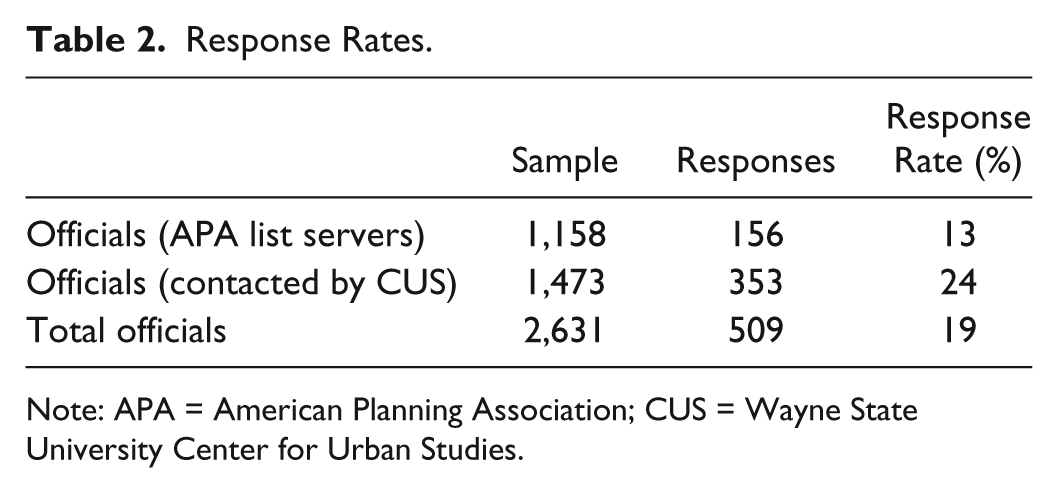
Note: APA = American Planning Association; CUS = Wayne State University Center for Urban Studies.
Because we relied on a single survey of local public officials to assess a number of key variables (i.e., plan policy content, local officials’ perspectives on their consultant-selection criteria, local officials’ perspectives on their own levels of commitment to plan policies and planning practice, and local officials’ perspectives on their planning consultants’ commitment to best plan-making practice), we organized the survey questions to minimize leading respondents toward giving responses that are cognitively consistent rather than necessarily accurate. More importantly, we did not ask respondents to report on their commitment to specific, widely accepted smart growth policies and then ask for their assessment of the incorporation of those same smart growth policies within their locality’s plan. Rather, we asked the officials questions first of their perception of their own commitment to several selected policies that parallel but are not identical to smart growth principles, along with their commitment to selected contemporary best plan-making processes (both described in more detail below), as well as their perception of their consultants’ degree of commitment to those same policies and processes. We then asked for their assessment of whether their current plans incorporate selected smart growth–oriented policies. Although independent assessment of the locality plan policy focus correlated with a survey of local officials’ perceptions would have yielded a more robust assessment, we did not undertake that resource-intensive approach for this research effort.
Analysis
We analyzed the data for purposes here using ordinary least squares regression analysis. Table 3 details the variable concepts and constructs we used for this analysis. The regression models attempt to discern the impact of the use of consultants on the policy focus of a locality’s comprehensive plan.
Variable Descriptions.
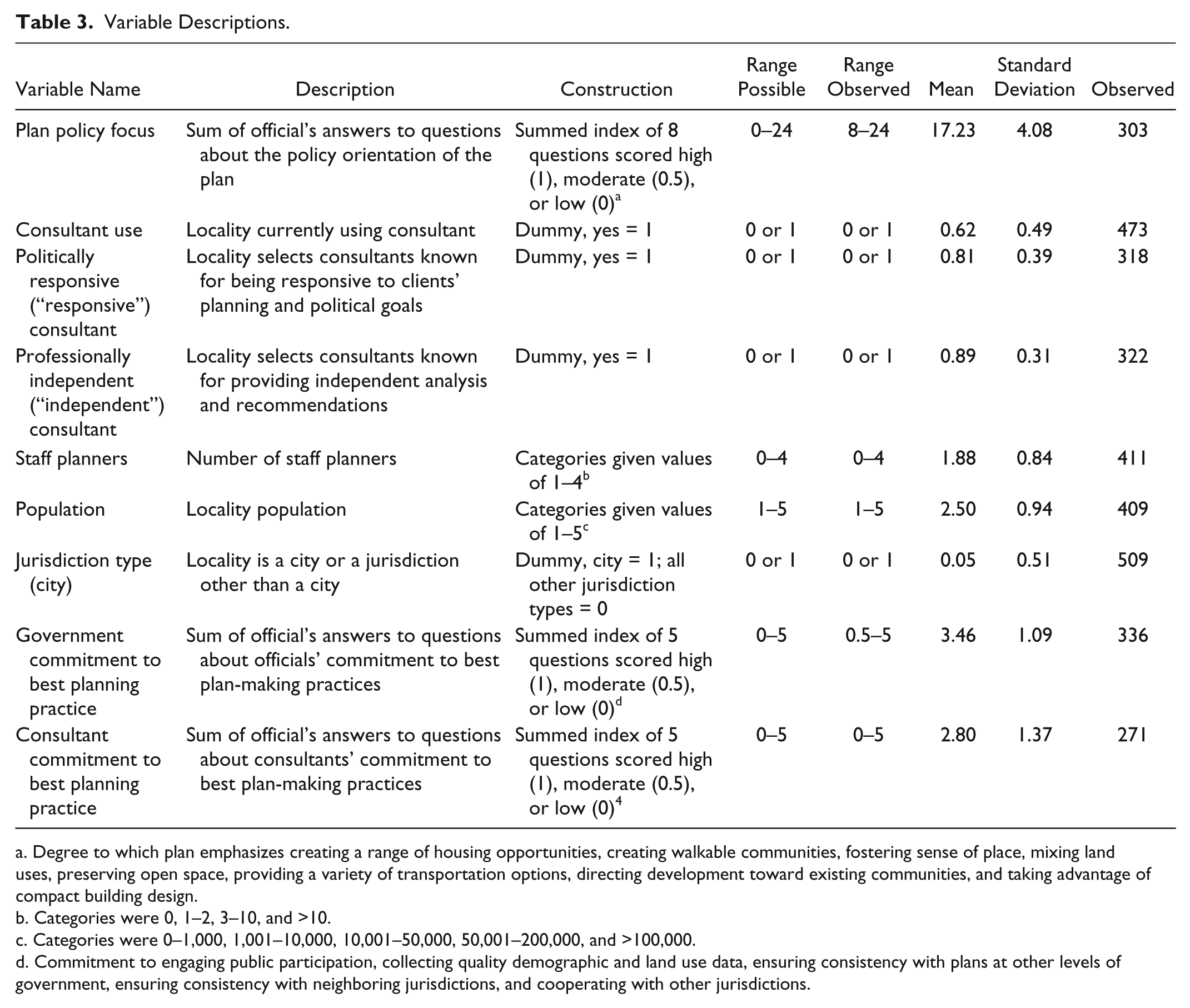
Degree to which plan emphasizes creating a range of housing opportunities, creating walkable communities, fostering sense of place, mixing land uses, preserving open space, providing a variety of transportation options, directing development toward existing communities, and taking advantage of compact building design.
Categories were 0, 1–2, 3–10, and >10.
Categories were 0–1,000, 1,001–10,000, 10,001–50,000, 50,001–200,000, and >100,000.
Commitment to engaging public participation, collecting quality demographic and land use data, ensuring consistency with plans at other levels of government, ensuring consistency with neighboring jurisdictions, and cooperating with other jurisdictions.
For our dependent variable, plan policy focus, we asked survey respondents about their plan’s degree of emphasis on ten smart growth principles, including the following (Environmental Protection Agency 2011):
Mix land uses
Take advantage of compact building design
Create a range of housing opportunities and choices
Create walkable neighborhoods
Foster distinctive, attractive communities with a strong sense of place
Preserve open space, farmland, natural beauty, and critical environmental areas
Strengthen and direct development towards existing communities
Provide a variety of transportation choices
Make development decisions predictable, fair, and cost effective
Encourage community and stakeholder collaboration in development decisions
Although there are many metrics along which to measure the policy content of plans, we chose to ask respondents about their plans’ adherence to the smart growth principles both because there is a “remarkable consensus” among planners that plans ought to incorporate these elements (Talen and Knaap 2003, 345), as discussed above, and because we thought respondents would be able to accurately answer these questions in the course of completing the survey given current attention to this formulation. We constructed the actual variable, plan policy focus, by recording the number of smart growth elements that a respondent reported as being included in his or her locality’s plan (see Table 2 for more details).
Our measure of consultant involvement was whether the respondent’s locality currently contracts with a planning firm for planning services. We included two variables that reflect respondents’ values when choosing consultants. The first, responsive consultant, reflects how much the respondent’s locality tries to choose a consultant known for responsiveness to client communities’ planning and political goals. The second, independent consultant, reflects how much the respondent’s locality tries to choose a planning consultant known for providing independent analysis and recommendations (i.e., independent of the political vagaries in a given locality at a given time). 1
We use the label “best plan-making practices” to refer to practices designed to produce a higher quality plan in terms of its political legitimacy, its use of data, its potential effectiveness in implementation, and so on, rather than in terms of its particular policy focus (i.e., not conceptualizing the measure to incorporate adherence to smart growth principles). So we asked officials to rate how much importance they and their consultants placed on public participation, collecting quality data on which to base decisions, vertical and horizontal consistency, and cooperation with other jurisdictions. From these answers, we developed a composite variable for each group, officials’ commitment and consultants’ commitment, to reflect the respondent’s and consultant’s level of commitment to best plan-making practices (as reported by the public official respondent), effectively testing whether increased commitment on the part of either corresponds to a plan policy focus more oriented toward smart growth.
Finally, we thought that certain locality characteristics might influence the degree to which the plan adhered to smart growth principles and incorporated them essentially as control variables. We included the number of full-time planners on staff, and also locality population, to reflect capacity. We included a dummy variable for jurisdiction type, identifying cities versus other forms of government (towns, townships, and counties), since we thought more rural areas, having more open space and more development potential, might differ from cities in their view of smart growth and growth management.
To explore the relationships between each of these various factors on planning outcomes while controlling for other factors, we regressed the independent variables described above in a series of models on plan policy focus. Diagnostics on the regression models detected no evidence of multicollinearity or heteroscedasticity for any of the models, leading us to conclude that the correlations between some of the variables do not unduly influence the models.
Findings
Of the localities surveyed, 62 percent indicated that they were currently employing one or more planning consultants, the majority of which (53 percent) engaged the consultants to assist with the preparation of long-range comprehensive plans. Of those communities where consultants were involved in plan preparation, 59 percent of respondents reported that the consultant prepared the entire plan, while 41 percent said that the consultant prepared background materials or completed certain specific tasks but did not prepare the entire plan. Respondents reported that planning consultants were most commonly hired either by an elected legislative body (36 percent) or by an appointed executive such as a city manager (20 percent), followed by in-house planning staff (18 percent). Consultants spent most of their time interacting with in-house planning staff (58 percent) or an appointed executive (28 percent).
Table 4 presents the results of the regression analyses, organized into four models. Each of these models includes locality characteristics as controls. Model 1 also includes consultant use. Models 2 through 4 include questions that were asked only of those respondents who indicated that their communities did use consultants, so we drop consultant use from those models. Model 2 adds consultant selection criteria. Model 3 drops consultant selection criteria and adds the client and consultant commitment variables. Model 4 incorporates both selection criteria and commitment variables.
Regressions on Plan Policy Focus.

Note: ns = not significant.
p < .1, **p < .05, ***p < .01. For all models, probability > F = 0.000.
The results of Model 1 (using overall consultant involvement as an independent variable) indicate that there are several important predictors of a local comprehensive plan’s adherence to the smart growth principles. Based on these results, our first hypothesis that the mere involvement of planning consultants increases the plan’s policy orientation toward smart growth is supported. The involvement of a consultant in the overall planning process appears to be positive and highly statistically significant, indicating that use of a consultant is notably correlated with a plan policy focus more associated with smart growth principles. In this model, as in all of the models, the number of staff planners in the locality is also positive and highly significant, suggesting that an increase in the number of regular planning staff is similarly correlated with a smart growth–oriented plan policy focus. In this model, neither population size nor jurisdiction type is significant.
Our second hypothesis, that plans in communities that choose consultants known for objective and independent analysis are more likely to have a plan policy focus aligned with smart growth principles, is supported by the results of Model 2. The variable independent consultant was positively associated with a smart growth–focused plan, while the importance placed on hiring a consultant known for responsiveness to local political goals (responsive consultant) was not significant. Staff planners is again highly significant in this model, but population size and jurisdiction type are not.
Our third hypothesis, that local officials’ commitment to the use of contemporary best plan-making practice processes tends to increase the plan’s policy orientation toward smart growth, is supported by the analysis in Model 3. In this model, staff planners is again significant, as are both officials’ and consultants’ commitment. Officials’ commitment is more significant and has a higher coefficient, however.
Model 4 is the full model, with both the consultant selection criteria and commitment variables included. Here, staff planners and officials’ commitment are both highly significant; professional consultant and consultants’ commitment are significant but less so, and responsive consultant, population size, and jurisdiction type are not significant.
Discussion
We set out to determine whether there is a demonstrable effect of consultant involvement on the policy focus of local comprehensive plans, reasoning that if consultant-produced plans have a plan policy focus with regard to smart growth orientation systematically different from nonconsultant plans, then use of consultants may be systematically undermining the policy-making legitimacy of the planning process. The short answer is that our models do show evidence of a consultant-related effect on plan policy focus: plans written by consultants tend to include more smart growth principles than plans written without consultants. We also found evidence supporting the other hypotheses we specified, along with findings we did not anticipate, however, suggesting that the appropriate conclusions to draw from this analysis are not so straightforward.
Taken altogether, our findings suggest that the factors that appear to have the greatest effect in terms of yielding plans that are more smart growth–oriented include, in decreasing order of importance: engagement of a planning consultant; the number of planning staff employed; emphasis placed by a locality on hiring a reputedly independent consultant (i.e., as opposed to a more reputedly responsive consultant); local officials’ commitment to best plan-making practices; and the consultant’s commitment to best plan-making practices.
The key theme that appears to connect all of these findings is the degree of adherence to contemporary planning profession norms evident in the government’s efforts (i.e., the planning profession’s focus on smart growth as a preferred paradigm), where the greater that focus and the greater the capacity to advance that focus is (i.e., either in the form of in-house planners or consulting planners), the more smart growth oriented the local comprehensive plan is. From this perspective, it is the use of a planning consultant operating expressly within the contemporary paradigm of what makes for good planning that appears to influence plan policy outcomes.
A second key theme is that, behind only professional planning capacity, local officials’ commitment to best plan-making practices in particular is significantly correlated with a smart growth plan-policy orientation. This finding, coupled with the high degree of correlation between local officials’ and consultants’ commitment to best plan-making practice, suggests that local commitment to planning and professional planning capacity are moving in the same direction (i.e., toward more smart growth–oriented plans) or, at the very least, are not working at cross purposes. These latter results in particular suggest that public and private sector planners are both committed to the same professional norms and standards, working to produce plans that incorporate the focus areas currently agreed upon as important by the profession.
Taken altogether, these findings could suggest that producing smart growth–oriented plans is simply a function of having more capacity to carry out planning tasks. Or, it could be that hiring a consultant or additional staff could simply signify the locality’s commitment to planning, as Hanna’s (2005) work suggests. Or, speculating further, it could be that local officials’ commitment to their own particular vision of planning may be driving everything (i.e., their hiring practices regarding both planning staff and consultants, and their attention to smart growth policies), and that they are engaging consultants to serve merely as faithful agents in advancing their principals’ policy-setting goals.
A difficulty with these interpretations, however, and the latter interpretation in particular, is that there is no apparent correlation with local officials’ commitment to best plan-making practice and the number of staff planners they employ, based on a simple pairwise correlation between those to variables (r = .04, p = .44). Similarly, the influence of a preference for selecting “independent” consultants on plan policy outcomes is consistently and significantly greater than a preference for selecting “responsive” consultants. The more conservative and reasonable conclusion to draw, therefore, is that while the use of consultants does not appear to nudge local officials in a policy direction altogether different from one they are inclined to follow, it does appear to yield plans with a policy focus more strongly oriented toward smart growth than they would likely otherwise have. Moreover, to the extent local officials are using consultants to advance a smart growth–oriented approach to plan making rather than some other approach, they appear to be doing so indirectly by engaging consultants known for their independent analyses and recommendations, rather than doing so directly by engaging consultants known for responsively advancing clients’ particular policy goals.
Conclusion
Planning scholars have offered anecdotal observations, or in some cases conclusions drawn from analyses ancillary to their primary topic of study, raising the concern that the use of consultants might undermine the legitimacy of the public planning endeavor by prompting plans that advance the goals or interests of the consultants more so than those of the community. Adapting principal–agent theory, we focused our analysis on the public policy making functions that planning provides, hypothesizing that if plans produced with the assistance of less-accountable consultants (i.e., using consultants as agents) differ systematically in terms of policy focus from plans produced by more-accountable public officials alone (i.e., without the aid of consultants as agents), then the use of consultants may indeed be undermining the policy-making legitimacy of the local planning endeavor. We used adherence to contemporary smart growth principles as a proxy measure of plan policy focus.
As we originally conceived our analysis, we expected that if consultants are improvidently distorting local plan policy making, evidence would show itself through plans apparently at odds with local officials’ underlying preferences (measured here primarily in terms of their commitment to best plan-making practice and their use of criteria for selecting consultants). We found that while using consultants does indeed appear to have a substantial effect on the policy focus of plans, however, that effect appears to be more of degree than kind. Rather than tending to push localities in a policy direction at odds with where they might be inclined to go, it appears that consultants tend to push them further down a road they were already on, particularly by prompting localities already inclined to adopt smart growth–oriented plans to do so, but in a way more strongly focused on smart growth than would otherwise be the case.
The key factor that appears to explain this outcome is the level of emphasis on engaging contemporary professional planning norms that is infused into the plan-making process, especially through the involvement of staff planners and independent planning consultants, rather than the use of consultants per se. If this is true, then like Dalton’s concern that professional planners might imbue a “technical-rationalistic” bias into the local planning endeavor, it might also be the case that professional planners similarly infuse a set of policy preferences aligned with contemporary notions of best planning practice into local planning—in this case smart growth. The use of planning consultants might exacerbate this phenomenon, especially if consultants on the whole have more professional training than do their public staff planner counterparts (something we did not measure), but it is not an outcome attributable to the use of consultants alone.
In the end, therefore, the real questions the findings from this study raise are more philosophical and twofold. First, does the fact that use of either professional planning staff or planning consultants in the plan-making process tends to significantly heighten the adoption of smart growth–like policies within local comprehensive plans imply that the legitimacy of the planning endeavor has been undermined, to the extent that those policies are more prevalent than they might have been otherwise? Second, to the extent that use of “independent” planning consultants further heightens the adoption of more smart growth–like policies, does the influence of those consultants in and of itself undermine the policy-making legitimacy of the local planning process by further extending the chain of transparency and accountability between the public and the decision makers? We raise these more philosophical questions here as important questions to be addressed, but we leave their resolution to further deliberation.
Footnotes
Acknowledgements
We gratefully acknowledge the assistance of Ramona Mullahey, Dave Gattis, and Margo Wheeler of APA in distributing the survey, and the staff of the Wayne State Center for Urban Studies in formatting and conducting the survey.
Declaration of Conflicting Interests
The author(s) declared no potential conflicts of interest with respect to the research, authorship, and/or publication of this article.
Funding
The author(s) disclosed receipt of the following financial support for the research, authorship, and/or publication of this article: Support for conducting the survey came from the Wayne State University College of Liberal Arts and Sciences.