



Abstract
Scholars and practitioners in the United States have paid significant attention to the need for consistency in urban planning documents. However, consistency between general plans (GPs) and capital improvement plans (CIPs) has received little attention. Aiming to fill this research gap, this article first reviews the academic and professional literature to identify the strategies that local governments use to ensure strong consistency between GPs and CIPs. Then, it reviews the GPs and CIPs of four cities and presents a framework for evaluating whether, how, and how well local governments are implementing strategies that enhance GP–CIP consistency.
Keywords
Introduction
In the United States, a comprehensive plan or general plan (GP) outlines the vision for a city’s development and identifies policies to help implement that vision. For example, cities in California must prepare a GP containing a minimum of seven elements or subsections—a land use element, a transportation or circulation element, a housing element, a conservation element, an open-space element, a noise element, and a safety element (State of California 2003). The city develops its vision for each element and then policies to implement that vision. For example, the circulation/transportation element might include an assessment of the city’s existing transportation infrastructure, an outline of the long-term vision for the city’s transportation system (such as whether the city will remain auto-oriented or develop an effective public transportation system), and a proposal for specific policies to implement the vision (e.g., a policy to expand bus coverage and frequency). A GP has a twenty- to forty-year horizon and is usually prepared by a jurisdiction’s planning department. 1
The vision and policies articulated in a GP are typically implemented through several capital projects. 2 For example, implementing a GP policy to expand a city’s park system might require several implementation projects, such as a citywide study to identify sites for new parks, identify existing parks that need improvements, and describe specific park improvement and construction projects. Such projects are often included in cities’ capital improvement plans (CIPs; Bowyer 1993). On a larger note, ideally, a CIP integrates a jurisdiction’s comprehensive planning—as reflected in its GP, master plans, 3 and other such planning documents—with fiscal planning and provides a means for setting priorities based on desired service levels, physical condition of existing assets, and available resources.
A CIP is typically a five- or six-year rolling plan (Bowyer 1993) for scheduling physical infrastructure projects. For example, a five-year CIP developed in fiscal year (FY) 2016–2017 would apply to the duration of 2016–2021 and would describe all the projects to be developed during that five-year period. 4 The local government then authorizes funds for the first year of the CIP—in this case FY 2016–2017—through an annual capital budget. The funds for the remaining years (FY 2017–2018 through 2020–2021) are included in the CIP but are not authorized. See Figure 1 for an example of such a multiyear funding schedule for a capital project. The city manager’s office, the finance department, or the public works department of a jurisdiction typically coordinates the development of a CIP.
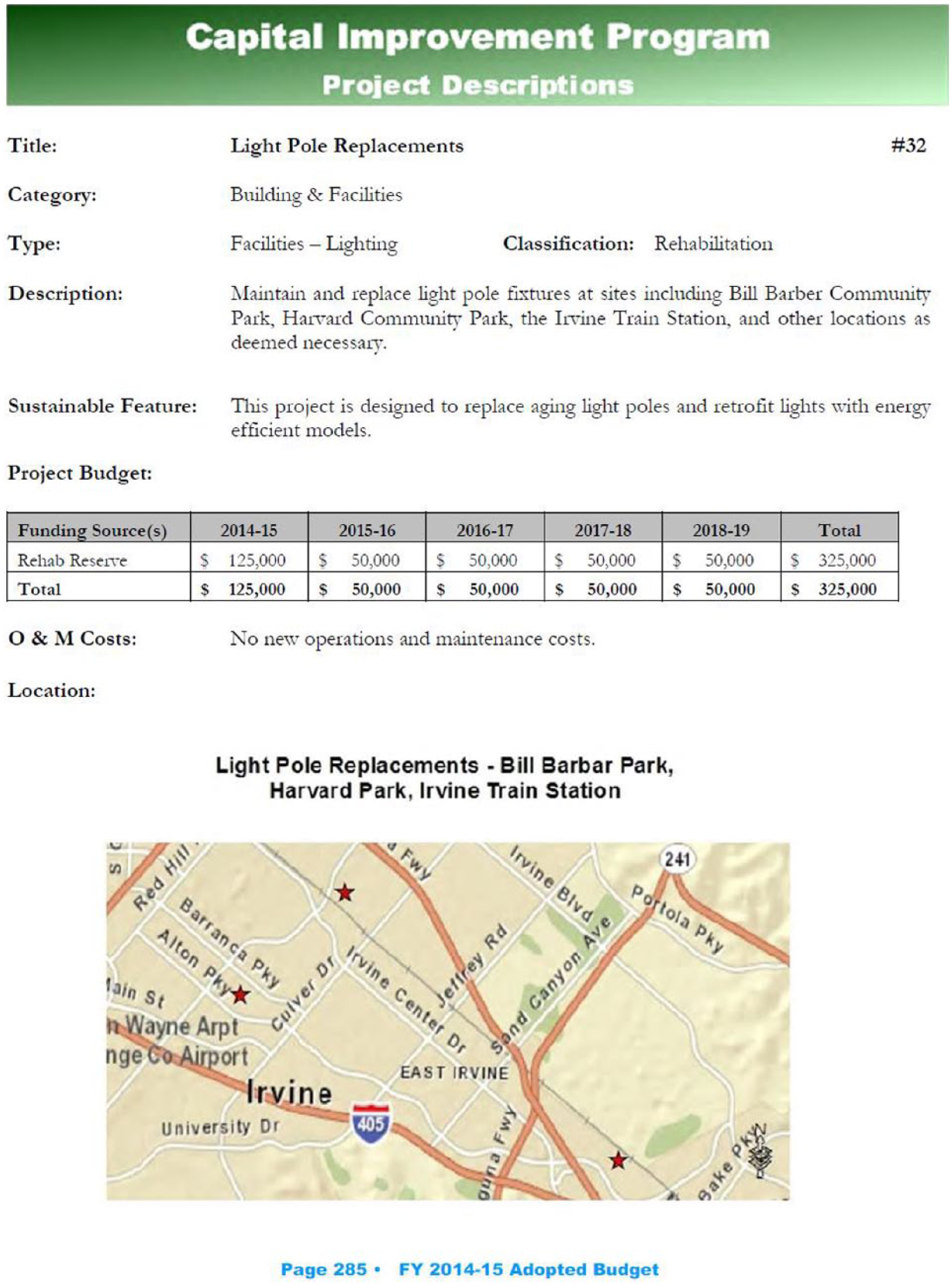
Multiyear funding schedule for a capital project.
A CIP is often a stand-alone document. However, it also can be embedded in a city’s capital budget as a separate section or chapter, or it can be interwoven within each section of the capital budget. Essentially, if projects are not included in a CIP, the vision and policies articulated in the GP are not likely to be fully implemented. Alternatively, a GP that does not articulate a concise vision and/or does not formulate a well-developed set of policies might not provide sufficient guidance to a CIP. Both these scenarios could result in a lack of linkage—or consistency—between the GP and the CIP. Both academic and professional literatures have identified this lack of consistency as an endemic problem in the field of urban development and have encouraged researchers to identify ways to address it (Elmer 2005; Elmer and Leigland 2014; Gale 1992; Kelly 1993; Vogt 2004).
Furthermore, inconsistencies between GPs and CIPs could result in GPs allowing land uses and densities that are not supported by the current or future infrastructure availability (Elmer and Leigland 2014). While consistency is important for all jurisdictions, it has a special significance in those with state or local concurrency laws or those that make extensive use of exactions and impact fees. 5
Concurrency laws require that infrastructure be developed concurrently with growth and are often enacted as components of broader growth management programs. For example, several cities and counties in Maryland have enacted Adequate Public Facilities Ordinances (APFOs). These APFOs are a key component of Maryland’s growth management program and require jurisdictions to ensure that infrastructure and services—such as public schools and water and sewer infrastructure—are adequate for the growing population (Ali 2014). These APFOs incentivize jurisdictions to prioritize infrastructure investments and to make their CIPs consistent with their GPs. Similarly, state-level growth management programs often require that various planning documents are consistent both with one another (horizontal consistency) and internally (internal consistency) (Lewis and Knaap 2012). For example, the Washington State Growth Management Act (GMA) requires jurisdictions to ensure consistency across their GPs’ land use elements, capital facilities elements, and capital facilities financing plans (Washington State Legislature 2016).
The GMA also allows jurisdictions to charge impact fees and stipulates that impact fee–generated revenues should be expended in a time-bound fashion—a requirement jurisdictions could meet by closely tracking the in- and outflow of impact fee–generated revenues and by clearly identifying the projects funded using these revenues in their capital budgets and CIPs. In the United States, an impact fee also needs to pass the “rational nexus” test, for which the following three questions should be answered (Evans-Cowley 2006):
Has the impact of new development been linked to the need for public facilities?
Is the fee proportional?
Is there a reasonable connection between the use of the fees and the benefits produced for the new development?
Strong GP–CIP consistency helps jurisdictions pass this test if the GPs/master plans outline the future nature and extent of growth and the resultant infrastructure needs, and the CIPs clearly show how the capital projects help meet these needs. In such a scenario, the impact fees adoption studies could draw upon the GPs/master plans and the CIPs to justify the fee types and amounts. For example, it is easy to justify a park impact fee when the GP emphasizes the needs for additional parks and open spaces and the CIPs include park-related capital projects.
A well-developed GP typically benefits from extensive community engagement and is therefore likely to closely reflect stakeholder values, aspirations, and needs. Such a GP also often projects a jurisdiction’s employment, population, income, housing, and land use patterns. Either the GP itself or its downstream infrastructure-specific master plans (such as a parks master plan or a sewer master plan) identify specific capital facilities required to meet the jurisdiction’s future needs or notes such needs in general terms (Marlowe, Rivenbark, and Vogt 2009). In both cases, a GP can help jurisdictions prioritize their capital project requests. Similarly, it is easier for a jurisdiction to win stakeholder acceptance for a large capital project, such as a rail-based transit project, if that project implements specific visions and policies from the GP (Bunch 2013).
On the other hand, the CIP adoption process often does not benefit from extensive community engagement. CIPs typically receive minimal public input, often including only one or two public comment opportunities, and limited number of planning commission and city council reviews. Moreover, CIPs typically must be approved and adopted by the last day of the preceding fiscal year (e.g., by June 30 for the fiscal year beginning July 1), resulting in a time-constrained community engagement process.
Indeed, both the municipal finance and the urban planning professions have underscored the importance of consistency between GPs and CIPs. In identifying best practices for government management, the Government Finance Officers Association (GFOA) notes that GPs should provide the vision for capital planning and investment and that capital projects and investments should be aligned with GPs (GFOA 2008). Similarly, Torma (2015) notes in Planning magazine that CIPs are key to linking a jurisdiction’s GP with its capital budget and that the planning commission should review CIPs in the context of the GP. Such strong support for GP–CIP consistency is noteworthy because it rightly treats a CIP as an important planning document, while, at times, it is viewed as a “wish list” by elected officials, city managers, and budget directors reluctant to commit to a long-range spending plan. 6
The Need for This Study and the Research Question
Planning scholars and practitioners have paid significant attention to the need for consistency between planning documents, particularly in states with state-level growth management programs. However, the consistency between GPs and CIPs has received little attention. The extant literature primarily highlights the need to strengthen the consistency between GPs and CIPs and provides broad guidelines for achieving this consistency. However, there has been no comprehensive synthesis of specific strategies to strengthen this, GP–CIP, consistency. Such strategies might include improving (a) the quality of GP and CIP documents by, for example, identifying the specific GP vision or policy implemented by each capital project included in the CIP and by including consistency with the GP as one of the selection criteria for capital projects or (b) the institutional processes of developing and approving CIPs by requiring that a planning commission or similar entity certify consistency between a CIP and a GP.
This article seeks to fill this research gap. It first reviews the academic and professional literature to identify strategies that local governments might use to ensure strong GP–CIP consistency. Finally, the article reviews the GPs and CIPs of four case study cities to present a framework for evaluating whether, how, and how well local governments are implementing strategies to enhance GP–CIP consistency.
Article Organization
The remainder of this article is divided into four sections. The next section describes the research methodology. Then, the article describes the key strategies identified in the extant literature to strengthen GP–CIP consistency. Next, the article provides a brief overview of the case study cities and examines whether, how, and how well the case study cities are implementing the key strategies. The last section discusses the major findings and conclusions of this research.
Research Methodology
Methodology
Review the relevant literature to identify key strategies to enhance GP–CIP consistency.
Select case study cities to demonstrate how an evaluative framework can be operationalized to determine whether, how, and how well the strategies identified in Step 1 are being implemented to enhance consistency. The following criteria are used to select the case study cities:
Case study cities must have well-developed budgets, including CIPs. I assume that cities that do not follow best practices for budget preparation are likely to have limited capacity to prepare other important city documents as well and are thus likely to demonstrate poor GP–CIP consistency. Fortunately, the GFOA annually presents Distinguished Budget Presentation Awards to public sector organizations (including cities) that produce very high quality budgets (GFOA 2016). Ninety-nine California cities won this award in 2014. The four case study cities are chosen from this set of award-winning California cities. Cities must have prepared or substantially updated their GP within the past ten years (but not too recently). GPs that do not reflect the current needs and visions of cities are often disconnected from their cities’ CIPs. Therefore, cities that have prepared or updated their GPs in the last 10 years (i.e., in 2006 or later) are considered. Similarly, GPs that were prepared or updated very recently (within the last two to three years) may not have yet had a chance to inform the CIP process. In summary, cities that prepared or updated their GPs between 2006 and 2012 are selected. GPs and CIPs must be available online. Because of time and resource constraints, only cities that provide their GPs and the last several years’ CIPs online are selected. A review of several years’ CIPs is important to assess many evaluation criteria, such as whether the CIPs clearly and consistently identify the GP’s vision/policies implemented through each capital project. Case study cities must have multiyear rolling CIPs. Because this article aims to explore consistency between CIPs and GPs over several years—and because many capital projects span multiple years—only cities that prepare multiyear rolling CIPs are considered. Cities must vary from one another in terms of population size, that is, have small, medium, and large populations. For this research to be of interest to cities of all sizes, the case study cities’ population varies widely, ranging from approximately seven thousand to slightly over one million people. The following steps are taken to ensure that a wide range of city population sizes are covered:
First, city population data are obtained from the California Department of Finance (CA DoF 2015) website for all California cities. The data provide the DoF’s population estimates for 2015. Next, the four population quartiles are calculated. The cities in the first quartile (from the 1st to the 25th percentile) have up to 11,192 people; cities in the second quartile (from the 26th to the 50th percentile) range from 11,913 to 29,963 people; cities in the third quartile (from the 51st to the 75th percentile) number 29,964 to 70,559 people; and cities in the fourth quartile (from the 76th to the 100th percentile) have populations of 79,560 or greater. Next, these quartile ranges are used to identify the population quartiles for the ninety-nine GFOA award-winning cities. Eight, seven, thirty-one, and fifty-three cities fall into the first, second, third, and fourth quartiles, respectively. Because more than half of the cities fall into the fourth quartile, and because the population range for the fourth quartile is very large (79,560 to more than 3 million people), half (two out of four) of the case study cities are chosen from the fourth quartile and the remaining two from the other quartiles.
Assess whether, how, and how well the case study cities are implementing the strategies identified in step 1. Summarize the key findings.
Strategies for Assessing Consistency between GPs and CIPs
The extant literature suggests several strategies that jurisdictions can adopt to enhance GP–CIP consistency. These strategies can be divided into two broad groups: (a) strategies to organize and write the GP and the CIP and (b) strategies to improve the institutional processes of developing and approving CIPs.
Strategies in the first group include the following:
GPs articulate a concise vision and have a detailed implementation structure that includes specific goals, policies, and actions. These strategies can ensure that a GP is not considered merely “suggestive” by budget and public works officials—the personnel usually in charge of preparing CIPs—and that the GP is detailed enough to guide the development of capital facilities (Elmer 2005; Elmer and Leigland 2014, 140; Kelly 1993);
GPs or master plans identify specific capital facilities. GPs that identify the capital facilities needed to implement GP goals and policies, or GPs that lead to the preparation of facility/master plans (e.g., a bike master plan) are more likely to be strongly linked with CIPs. Indeed, Bowyer (1993) argues that such GPs or master plans are a crucial link between planning and budgeting;
The GP is updated regularly enough to reflect shifts in a city’s needs and vision, especially those shifts that might impact the type and magnitude of the future capital facilities required (Bunch 2013; GFOA 2008);
The CIP identifies the GP vision/policy implemented by means of each capital project. Bunch (2013) argues that clearly linking each capital project with the GP helps in selecting capital projects; for example, when city council members differ on whether a project merits inclusion in a CIP. Furthermore, this strategy allows a local government to demonstrate clearly, consistently, and transparently how a GP is being implemented.
The GP informs the selection of capital projects. The CIP might list the GP as one of the capital project selection criteria or identify the GP as a source of information for preparing a CIP (Bunch 2013; GFOA 2008; Hoffmann et al. 2000; Marlowe, Rivenbark, and Vogt 2009).
If the CIPs are guided by master/facilities plans, then these master plans mirror GP land use designations (e.g., the Parks and Open Space Master Plan corresponds to Parks and Open Space land use designations) and are consistent with the GP (Elmer and Leigland 2014).
The strategies in the second group include the following:
The planning commission or similar entity reviews the CIP for consistency with the GP. A planning commission might assess the impact of the CIP on the physical development of the city and on land use and other planning goals, particularly in the context of the GP. Furthermore, the planning commission might ascertain whether the projects included in the CIP are either identified in or consistent with the GP (Bowyer 1993; Bunch 2013; Elmer 2005; Torma 2015).
Planning staff play an active role in the capital budget committee or similar group that reviews or ranks capital project requests (Elmer 2005; Elmer and Leigland 2014).
Case Study Evaluation
Brief Overview of the Case Study Cities
Two of the four case study cities—Villa Park and Irvine—are located in Southern California, and the other two—Palo Alto and San Jose—are in the San Francisco Bay Area of Northern California. All the case study cities are high-income suburban cities with median household incomes well above the state median of $61,480 (see Table 1). These cities are experiencing varying rates of population growth. The population growth rates in Villa Park and Palo Alto were slower than the national (4.1%) and state (5.1%) population growth rates for the 2010–2015 period (US Census 2016). All the cities adopted or updated their GPs in the last ten years, with Palo Alto’s being the oldest update, completed in 2007 7 (City of Palo Alto 2016).
Case Study Cities’ Key Characteristics.

Note: CIP = capital improvement plan; GP = general plan.
Population rounded up to the nearest thousand. Authors’ analysis of the State of California, Department of Finance 2015 population estimates.
Median household income for a four-person household.
Source: US Census, Quick Facts.
Evaluation
Table 2 lists the two groups of strategies identified in the preceding section and their evaluation criteria, and Table 3 provides a summary evaluation of whether, how, and how well the four case study cities employ these strategies. In this section, I delve deeper into the key findings. In particular, I highlight key aspects of the strategies, such as whether they are consistently employed by the case study cities and/or their relationships with other strategies.
Strategies and Their Evaluation Criteria.

Note: CIP = capital improvement plan; GP = general plan.
Evaluation of Consistency between Case Study Cities’ GPs and CIPs.

Note: CIP = capital improvement plan; GP = general plan.
First group of strategies
Strategy 1
The GP articulates a concise (brief, clear, and comprehensive) vision. Villa Park seeks to maintain a rural, single-family community character by means of a concise vision (City of Villa Park 2010, I-3):
The City’s small-town character, with its intrinsic unique qualities, is important to Villa Park’s identity. Key elements that characterize Villa Park’s small-town qualities are its stable, established, and friendly neighborhoods, the mixture of housing types and sizes, local award winning schools that also serve the Cities of Orange and Anaheim, one traditional architecturally controlled neighborhood shopping center, lack of street lights in residential neighborhoods to preserve the rural atmosphere, sidewalks constructed along school routes for pedestrian safety, and the presence of a citywide recreational trail system.
On the other hand, San Jose is aiming to transform itself from a suburban bedroom community into a more urban and diverse city by channeling future growth into high-density, mixed-use, transit-oriented “urban villages.” However, the city’s formally adopted vision statement is not very clear (although it is very short). It reads as follows (City of San Jose 2011, 11):
San José embodies the energy and vitality of its unique human, natural and economic resources.
This vision is undergirded by seven broad community values: innovative economy, environmental leadership, diversity and social equity, interconnected city, healthy neighborhoods, quality education and services, and vibrant arts and culture.
Palo Alto’s General Plan describes a broad vision (City of Palo Alto 1998, I-1):
We aspire to create a safe, beautiful City for ourselves, our children, and future generations. We envision a City with diverse housing opportunities, where the natural environment is protected, where excellent services are provided, and where citizens have a say in government. We aspire to create a City that is economically healthy and a good place to do business.
This vision is driven by seven major themes that are a mix of concise and broad statements. For example, while three themes—meeting housing supply challenges, reducing auto dependence, and protecting and repairing natural features—are concise, the remaining themes—maintaining and enhancing community character, building community and neighborhoods, meeting residential and commercial needs, and providing responsive governance and regional leadership—are broad (City of Palo Alto 1998, I-2–I-3).
Similar to Palo Alto, Irvine paints its vision in very broad strokes. For example, the city aims to provide “extraordinary amenities and infrastructure” and “quality and responsiveness in government.” Specifically, Irvine’s mission statement is as follows (City of Irvine 2012, 2):
The City of Irvine’s mission statement expresses a desire to maintain the highest quality of life through the following: Creative planning; Prosperous business atmosphere; Environmental quality; Unique neighborhoods connected into one community; Extraordinary amenities and infrastructure; Cultural diversity; Community involvement; Educational excellence; Quality and responsiveness in government.
Strategy 2
The GP has a detailed implementation structure. All the case study cities use a three-tier structure to implement their GPs. Villa Park’s structure is goal–policy–action program. Palo Alto uses a goals–policies–programs structure. Irvine’s structure is goals-objectives-policies. San Jose uses a goals–policies–actions structure.
While the first- and second-level implementation tools are well developed, the cities differ in the degrees of specificity of their third-level implementation tools—“action programs” in Villa Park, “programs” in Palo Alto, “policies” in Irvine, and “actions” in San Jose. For example, Villa Park’s action programs often simply repeat the policies. Similarly, San Jose’s GP often lists goals and policies but not actions, except in a few cases in which actions are specific and might translate into capital projects. For example, one GP goal is to provide “connections to promote economic development” (City of San Jose 2011, II-8). One of the policies for implementing this goal is to “support development of a transit link connecting the Mineta San Jose International Airport with light rail transit, Caltrain, and future BART” 8 (City of San Jose 2011, II-8). The action for implementing this policy is to “pursue implementation of a people-mover that serves terminals at the Mineta San Jose International Airport and provide convenient connection to light rail and future BART transit systems” (City of San Jose 2011, II-8).
Palo Alto has the most developed GP implementation structure among the four case study cities. The GP policies and programs to implement the goals are highly developed and specific. Further, each element of the GP includes an implementation plan that clearly notes the lead agency, duration, financing source, and action taken for each program. For example, the Land Use and Community Design Implementation Plan is a thirteen-page table of eighty-one programs (City of Palo Alto 2007a).
Strategy 3
The GP or master plans identify specific capital facilities. The case study cities’ GPs that consistently employ a detailed implementation structure (such as Palo Alto’s GP) are also more likely to identify specific capital facilities. For example, in its Transportation Element, Palo Alto’s GP identifies the “development of the University Avenue Multimodal Transit Station conceptual plan” (City of Palo Alto 2007b, 2). The GP’s Natural Environment Element notes the need to maintain and expand the waste recycling center (City of Palo Alto 2007c, 8).
San Jose offers an alternate approach to identifying capital facilities. In some cases, San Jose’s GP identifies specific capital projects, but in several cases it calls for preparation of infrastructure/facility master plans. For example, to implement goals and policies related to wastewater treatment and water reclamation, the action is to “prepare, maintain and implement a Master Plan(s) for the ongoing capital improvement, maintenance, and operation of the wastewater treatment and water reclamation facilities” (City of San Jose 2011, III-58). Developed in 2013, this master plan describes specific improvements needed for the waste water treatment plant (City of San Jose 2013). Similarly, an action under the Community Forest goal is to develop the Community Forest Master Plan (City of San Jose 2011, III-25).
Strategy 4
The GP is updated regularly to reflect shifts in the city’s vision and needs. Changes in several factors, including demographic, economic, environmental, and social factors, might shift a city’s vision and needs and, in turn, require updates to its GP or master plans. Among the case study cities, Villa Park’s vision of maintaining its rural single-family community character has not changed for decades. Furthermore, the city’s population has increased the least among the four case study cities. Therefore, although Villa Park’s GP was last updated in 2010, nineteen years after its previous update in 1991, it might still be considered nimble enough to meet the city’s needs, which are focused on maintaining—not expanding—infrastructure and services. Conversely, San Jose is a growing city that has created a new vision for its urban growth. Therefore, San Jose must update its GP more frequently. Indeed, San Jose has adopted two strategies to remain nimble. First, it reviews its GP every four years. Second, it relies on shorter (typically ten- to twenty-year) infrastructure and facilities master plans for capital facilities–related details. It has several master plans, including for parks, recreational facilities, and trails (called the Greenprint); for a waste water treatment plant (called the Plant Master Plan); and for the downtown streetscape and public arts. Palo Alto’s GP also encourages the creation of such master plans. Finally, San Jose has proactively updated its GPs or developed new ones. For example, the Horizon 2000 GP was updated in the early 1990s to 2020 GP, and the 2020 GP was updated to the Envision 2040 GP (San Jose’s current GP) in 2011.
Strategy 5
The CIP identifies the GP vision/policy implemented by means of each capital project. The CIPs in all the case study cities describe each capital project separately. However, only Palo Alto’s CIPs consistently and clearly note the relationship of each capital project to the GP by linking the project to the relevant GP element, section, goal, and policy. For example, Palo Alto’s FY 2015 CIP includes a “Junior Museum and Zoo Improvements” project (City of Palo Alto 2014, 88). The project description sheet clearly links this project to the GP goal, policy, and program (see Figure 2). Villa Park’s and Irvine’s CIPs clearly delineate such links in only a few cases.

Linking capital projects to the general plan.
San Jose adopts a different, master plan–based, approach to implementing its GP’s vision/policies. Its capital budget is organized into twelve City Service Areas (CSAs). Each CSA is further subdivided, for example, the “Sanitary Sewer System” subsection is within the “Environment and Utility Service” CSA section. The overview of the “Sanitary Sewer System” subsection notes that the Sanitary Sewer System CIP is guided by the GP via the Sanitary Sewer Master Plan and that the objectives and assumptions of the GP were used to develop this master plan (City of San Jose 2011). In some cases, CIPs may refer to a master plan and/or to the GP when describing individual capital projects. For example, in describing a trail, a CIP notes that the development of trails is consistent with the GP and the Greenprint (City of San Jose 2014, V-391). Similarly, the inclusion of several other trails and parks projects in the CIP is justified on the basis of their consistency with the GP. Finally, city council policy requires all projects included in the CIP to be consistent with the GP (City of San Jose 2014, IV-4)
Strategy 6
The GP informs the selection of capital projects. Those case study cities—Villa Park, Irvine, and San Jose—that are less likely to (or that are likely to inconsistently) identify GP visions/policies implemented by means of individual capital projects also do not make good use of their GPs to inform their selection of capital projects. For example, in selecting capital projects, Villa Park first focuses on the city’s short-term goals, followed by its long-term goals (City of Villa Park 2014). Indeed, the GP is not even mentioned in the entire budget document. Similarly, there is no clear recognition of the GP as a project selection criterion in either Irvine or San Jose. In Irvine, projects that impact health and safety and those that are legally mandated receive the highest priority. Other criteria include the “city’s priorities, infrastructure needs, financial capacity of the city, and impact the projects could have on the city’s operating budget” (City of Irvine 2014, 244).
Among the case study cities, Palo Alto uses this strategy best. It recognizes the GP as a source of information for preparing its capital budget and includes “studies and master plans” as capital project selection criteria (City of Palo Alto 2014, 6).
Strategy 7
Master plans mirror GP land use designations and are consistent with the GP. The case study cities’ master plans generally do not mirror GP land use designations. These plans tend to be either infrastructure-specific (such as Villa Park’s Sewer Master Plan) or location-specific (such as Palo Alto’s Baylands Master Plan). However, the master plans are largely consistent with the GPs. Indeed, San Jose explicitly recognizes them as tools for implementing the GP.
Second group of strategies
Strategy 1
The Planning Commission or a similar entity reviews the CIP for consistency with the GP. In all case study cities except for Villa Park, where no such agency exists, the Planning Commission or similar entity (e.g., the Planning and Transportation Commission in Palo Alto) reviews the CIPs for consistency with the GP. In all fairness to Villa Park, due to very small population (approximately seven thousand residents), the city has a small government staff with only four full-time employees and no agencies or boards (City of Villa Park 2016).
Strategy 2
Planning department staff play an active role in the review or ranking of capital project requests. Palo Alto demonstrates the best GP–CIP consistency and is also the only case study city in which the planning department staff are involved in reviewing capital project requests. Specifically, the General Fund CIP Committee reviews the capital budget, including the CIP. This committee includes “managers in the Public Works, Community Services, Administrative Services, and Planning & Community Environment departments” (City of Palo Alto 2014, 20). In all the other case study cities, the city manager’s office and the finance department are the lead agencies, while the planning department is not actively involved.
Findings and Conclusion
A review of the case study cities’ performance with regard to using and implementing key strategies that enhance GP–CIP consistency reveals five major and interrelated findings. Several of these findings have direct implications for the planning profession.
First, a large set of strategies must be reviewed to assess the strength of GP–CIP consistency. Piece-meal review of a small number of strategies is likely to result in incomplete and misleading assessments because cities often employ one or two strategies consistently while not employing other important strategies. For example, although cities often require the Planning Commission to review CIPs for consistency with the GP, consistency with the GP is often not a capital project selection criterion.
The second finding is related to the first. Some strategies might compensate for the failure to use other strategies. For example, Palo Alto’s GP does not articulate a very concise vision. However, the GP contains very detailed implementation plans that identify specific capital projects that are necessary to implement the GP vision and policies. Furthermore, the CIPs clearly note each capital project’s relationship with the GP’s specific element, section, goal, and policy. Therefore, the drawbacks of an imprecise vision are largely mitigated by other strategies.
Third, cities must do a better job of explicitly recognizing the GP’s importance in selecting capital projects and of actively involving the planning department staff in developing the CIPs; moreover, planning staff should be included in the capital project selection process. The two strategies—explicit recognition of the GP’s role and involvement of planning staff—are linked and might even be synergistic, as indicated by the Palo Alto case study. Among the four case study cities, only Palo Alto’s CIPs explicitly recognize the GP’s role in developing the CIPs, and Palo Alto is the only case study city to deliberately involve planning staff in its capital projects selection process.
Fourth, the lack of involvement of the planning staff in developing the CIP is worrisome on several counts. Although CIPs are products of highly political budgeting processes (Bowyer 1993), an outsized influence of the city manager’s office, the finance department, or the public works department gives the erroneous impression that a CIP is primarily a techno-financial document and not a policy document designed to implement a city’s vision and needs. This misclassification of the CIP as a techno-financial document keeps it “under the radar” and helps it avoid the higher level of public scrutiny that other city documents, such as GPs, receive. Furthermore, the lack of involvement of the planning staff makes it less likely that the city’s vision and needs (as articulated in the GP) will be realized and met.
Finally, many degree-granting urban planning programs do not teach the skills necessary to read and understand budgets, including CIPs. This lack of academic instruction deepens the lack of involvement because entry-level planners do not have the skills to read or understand budgets and CIP documents, let alone to play an active role in strengthening GP–CIP consistency.
In conclusion, while the need for consistency between various planning and policy documents has been well recognized by the planning profession and by various levels of government (e.g., consider the federal government’s push toward land use–transportation integration and the requirements for consistency, concurrency, and adequate public facilities in various state and regional growth management programs), consistency between planning and budgeting has not received similar governmental, professional, or academic attention. In particular, there has been no synthesis and evaluation of the various strategies available to local governments aiming to achieve this consistency. I hope this article is a small step toward filling this research and professional practice gap.
Footnotes
Declaration of Conflicting Interests
The author declared no potential conflicts of interest with respect to the research, authorship, and/or publication of this article.
Funding
The author(s) disclosed receipt of the following financial support for the research, authorship, and/or publication of this article: The research for this article was partially funded through the San Jose State University Academic Year 2015–2016 RSCA Award.