



Abstract
Transportation agencies are increasingly seeking private sector funding, but resulting deals have implications beyond specific projects. We analyze the broader regional and equity impacts of private funding by examining Detroit’s donation-funded streetcar. Despite potential negative consequences for transit-dependent populations, the longer-term political will forged through streetcar planning has a contingent possibility to enhance regional transit. In addition to donations, the streetcar relies on public sector funds, but we found limited public influence to ensure collective transportation benefits. A federal-level actor did mandate that a regional transit agency form, but more systematic public action is needed.
Introduction
With limited public resources, transportation agencies are turning to the private sector (US DOT 2015). Private funds still account for a small share of transportation spending, but the evolving role of the private sector is shaping public sector choices. While economic development interests have long influenced public infrastructure spending (Altshuler and Luberoff 2003), we examine a case in which businesses and foundations donated to leverage public investment for their favored streetcar project. We seek to understand how individual project donations shift the broader regional landscape for transportation equity, specifically focused on consequences for low-income, transit-dependent populations.
Our case study analysis examines the QLine, a streetcar project in Detroit, where the private sector is providing the majority of funds, but there is still substantial government funding. Transit-dependent riders could experience a localized degradation of transit service. However, they possibly could indirectly benefit in the future from envisioned regional transit investment. Such investment is now supported by the political will forged through the streetcar project, due in part to a mandate from the federal level to create a regional transit authority. We are concerned by the changing role of the private sector in public goods provision. However, since local actors are unlikely to reject large donations, we identify the need for systematic action to ensure that public dollars leveraged by private funds better support transportation equity.
The Private Sector and Public Infrastructure
The local private sector has long sought to influence public sector choices. Business interests, especially those involved in real estate, and other local elites band together as a “growth machine” to push an agenda of raising property values through encouraging growth (Logan and Molotch 2002). Thus, we do not expect that a business-backed initiative would prioritize equity. Rather, mass transit investment can be part of a downtown growth agenda (Whitt 1982), and local business leaders have wielded crucial influence across multiple levels of government to secure transportation investment (Altshuler and Luberoff 2003; Lowe, Reckhow, and Gainsborough 2016). New roles for the private sector have emerged as public–private partnerships (P3s) that span a diverse set of arrangements with direct roles for private firms in public services provision.
The private sector has become the operator of transportation assets through privatization in the form of long-term concessions and leases. For example, the City of Chicago leased its street parking meters to a multinational consortium for $1.15 billion (Farmer 2014). Because of the seventy-five-year contract’s terms, the city protects the parking supply and has paid significant fees ($61 million in 2012) when meters are out of service. Moreover, Farmer finds that protecting the supply of parking spaces constrains transportation planners. Specifically, projects that would remove parking spots for bicycle parking or bus rapid transit are too costly or impractical because of the need to maintain the parking supply, showing that P3s can have transportation planning implications beyond the parameters of a specific deal.
In addition to long-term leases of existing assets, P3s may construct and/or finance new infrastructure. Proponents of P3s assert a broad range of benefits, “promises have included reducing pressure on public sector budgets, providing better VfM [value for money] for taxpayers, reducing risk to government from projects, better accountability, better on-time and on-budget delivery, and greater innovation” (Hodge and Greve 2017, 61). Despite the popularity of P3s among policy makers, the US Government Accountability Office (2008) found public risks from P3s. Furthermore, findings on one main presumed benefit—value for money—diverge (Hodge and Greve), meaning there is no clear consensus that P3s consistently deliver the central benefit of value for money.
Siemiatycki (2010) likewise notes mixed findings on P3 benefits in his analysis of a tram extension in the United Kingdom, express toll lanes in the United States, and an urban tunnel in Australia. Through P3s, each government tapped new money without undermining systemwide planning in the short term, but the P3s all constrained future transportation options for the public sector. In addition, insufficient public participation and disclosure were common P3 problems. Sagalyn (2012) similarly identifies P3 shortcomings, expressing concern with the loss of control and oversight from the public sector in promoting broader public goals. Siemiatycki recommends that planners enhance public participation in P3s, better analyze and learn from past P3 outcomes, more critically evaluate P3s before implementation, and ensure the public sector has future flexibility (56). His framework, however, does not include criteria on the distribution of public benefits from P3s.
Miraftab (2004) raises such P3 equity implications and notes the dominance of private firms in P3s. While focused on developing nations, she finds that the local state may not have enough capacity to ensure a level playing field in P3s. She argues that the macro-level policy context—not just the details of the deal—matter for whether P3s support equity.
We likewise consider the equitable distribution of services but examine a less typical form of P3s: donations for mass transit infrastructure. In our case study, the for- and not-for-profit private sector created a private sector, nonprofit organization that built the streetcar and will operate it for ten years. Private sector donors gave just over $100 million for a 3.3-mile streetcar that serves Downtown and Midtown Detroit. These private funders do not have claims to project-based direct revenue returns. From Farmer (2014) and Siemiatycki’s (2010) research, we expect that P3 project-based actions can have implications on regional transportation choices. Given that donations as a source of funding have a lower performance along an equity criterion (Cambridge Systematics, Inc., et al. 2009) and Miraftab’s arguments, we identify a need for direct attention to social equity. Finally, like Siemiatycki, we consider how public sector actors can engage in P3s in ways that maximize public benefits.
In addition to addressing the changing role of the private sector in public infrastructure, the case study offers insights into the modern streetcar investment trend that prioritizes economic development goals with transportation funds. Streetcars were the dominant mode of mass transit at the beginning of the twentieth century before largely being dismantled and now are experiencing a resurgence at the beginning of the twenty-first century. While a streetcar can have an exclusive right of way and thus speed advantage, most new streetcars are being built in mixed lanes, which do not offer a speed advantage relative to conventional bus service. In an analysis of seven contemporary US streetcar systems, Brown (2013) found mixed performance on a number of transportation metrics and that none traveled faster than buses.
Despite lackluster transportation benefits, ten streetcars opened from 2000 to 2015 in the United States and fifteen more are slated to open between 2016 and 2024 (Culver 2017). Ramos-Santiago, Brown, and Nixon (2016) examine the rationale for streetcar popularity despite “the mode’s poor transportation performance” and find typical growth machine leaders “private actors with business and development interests in downtown . . . are the main drivers behind the streetcar resurgence” (30). King and Fischer (2016) likewise note that cities are implementing streetcars as a spatial planning strategy, rather than a transportation strategy, even though the often-cited Portland redevelopment example may have been due to factors other than the streetcar. Indeed, this focus on streetcars as downtown economic development or a spatial planning strategy is not subtle: streetcar planning documents focus on economic development, city image, and quality of life, not improved accessibility to destinations (Culver 2017). Much of the economic development benefit is the increased property values that private landholders experience (King and Fischer 2016). Thus, it is not surprising that major landholders were among the backers and donators to the Detroit streetcar. What we seek to understand, however, is the public role in enabling the project, whether the project has detrimental impacts for equity, and the larger regional and planning impacts of a donation-based P3.
Methods
We adopted a case study approach, which is appropriate for “how”-type questions and for “a contemporary phenomenon within some real-life context” (Yin 2003, 1). The use of multiple qualitative data sources allowed for the triangulation of data. Using a semistructured interview guide, we conducted eleven in-person interviews and four telephone interviews in 2016. In the case study section, interviewees are cited by number and two initials, the later correspond to the region name and interviewer (e.g., 11DK). Interviewees came from the business, governmental, nonprofit, university, and media sectors at the local, regional, state, and federal levels. Given their role in the case, business stakeholders are underrepresented among the interviewees; we did invite more to participate. We reviewed numerous plans and reports, including documentation related to the environmental impact statement study, as well as related mainstream and specialty media accounts. In the next section, we describe the metropolitan context for the streetcar before discussing the particular processes behind the investment.
Case Study
Understanding Metropolitan Detroit
The City of Detroit has experienced over a matter of decades an unusually rapid growth in prosperity followed by dramatic decline. As historian Thomas Sugrue (1996, 3) describes it, Detroit in the 1940s was “one of the nation’s fastest growing boomtowns and home to the highest-paid blue-collar workers in the United States. Today, the city is plagued by joblessness, concentrated poverty, physical decay, and racial isolation.” Detroit sits within a metropolis that underwent a highly unequal decentralization of population, resulting in a sprawling region marked by wide disparities in race and wealth. While high-wage industrial jobs brought a black population that grew at a high rate (Farley, Danziger, and Holzer 2000), the white population rapidly suburbanized and began a decline that would continue for decades. Whites made up about 60 percent of the city population in 1950 but less than 10 percent in 1990, just 40 years later (Farley, Danziger, and Holzer 2000). By 2010, Detroit’s population was 714,000, with blacks making up 83 percent of the total, and 40 percent of the city’s population living below the federally defined poverty threshold (US Bureau of the Census 2011). For the period 2010 to 2014, among residents of Detroit with no household vehicle available, 88 percent were black and 65 percent were below the federally defined poverty line (Ruggles et al. 2015).
The city forms the core of a three-county region of 3.7 million residents (US Bureau of the Census 2011). Oakland County, which shares a border with Detroit to the city’s north, is home to many thriving and prosperous suburban communities. To illustrate the contrast between city and suburbs, per capita income in Oakland County was $37,089 compared to just $14,984 (based on estimates from data from 2010 to 2014, in 2014 dollars) (US Bureau of the Census 2015). The divide between city and suburbs has its roots in a history of violent confrontations provoked by racial hostility and distrust between city government and neighborhoods. Farley, Danziger, and Holzer (2000, 10) point out that “Federal troops have been called out four times to put down black-white bloodshed: twice in the nineteenth century and twice in the twentieth. No other city has such a history.” Racial segregation is stark and was created over several decades of public and private actions, ranging from discriminatory federal housing policy, racist real estate practices, intimidation and violence from white neighborhood residents and neighborhood organizations, and police brutality (Boyle 2004; Farley, Danziger, and Holzer 2000; Sugrue 1996; Thomas 1997; Zunz 1982).
During the decade of the 2000s, the city government faced extreme challenges in delivering urban services, stemming from the fiscal crisis of deindustrialization, and was also mired in corruption. The corruption was widespread through governmental agencies and beyond, but is best exemplified by the former mayor (2002–2008) Kwame Kilpatrick, who was convicted in 2013 on twenty-four federal felony counts (Baldas and Schaefer 2013).
Also in 2013, Governor Rick Snyder, in a controversial move, appointed an emergency manager to take over city governance. Shortly after, the City of Detroit filed for bankruptcy, the largest municipal bankruptcy in the nation’s history (Davey 2014; Howes, Livengood, and Shepardson 2014). Within just sixteen months, the city would emerge from bankruptcy proceedings as a result of an $816-million deal. Diverse players, such as philanthropic foundations, the State of Michigan, labor unions, and the Detroit Institute of Arts, negotiated this unusual arrangement, which allowed the city to shed $7 billion in debt and to invest about $1.7 billion into long-neglected services and repairs.
Detroit is now experiencing substantial economic development downtown (Applebome 2016). The most prominent example comes from the founder of mortgage provider Quicken Loans, Dan Gilbert, who moved the firm’s headquarters and its seven thousand employees from suburban Farmington Hills to downtown Detroit in 2007 (Katz and Bradley 2013). Through his Bedrock Ventures Company, Gilbert has purchased and developed numerous parcels; by late 2016, Gilbert had owned or controlled more than eighty downtown properties totaling 10 million square feet (Bomey 2017). Downtown Detroit is the region’s largest employment center and also serves as the region’s hub for entertainment, including three major league sports arenas, several large-scale music and theater venues, and three major casinos.
Despite numerous failed attempts at regional transit integration (Nelles 2012), a fragmented and inadequate mass transit system reflects the geographic divisions that separate blacks from whites, poor from wealthy, and those that are jobless from employment. Detroit is the largest urban area in the nation without regional heavy or light rail transit. Many residents of Detroit experience an unusually severe lack of physical access to regional opportunities (Grengs 2010, 2012). Two transit agencies provide bus service. One serves only the central city (the Detroit Department of Transportation [DDOT]) and the other (Suburban Mobility Authority for Regional Transportation [SMART]) primarily serves the suburbs; their services are not integrated. The newly opened streetcar, called the QLine, serves a 3.3-mile corridor at the center of the region (Figure 1).
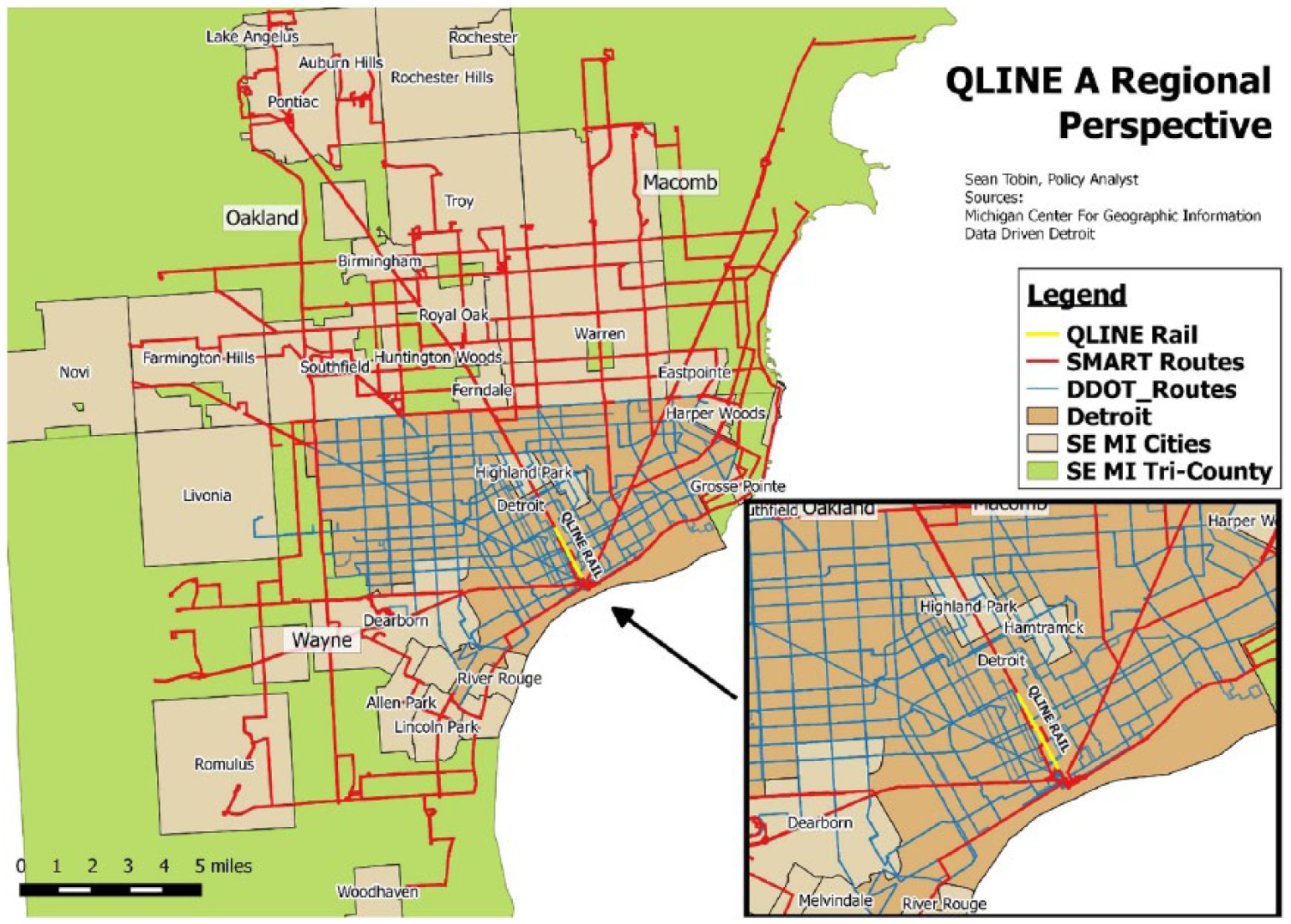
Streetcar and regional transit system, Detroit region.
As shown in Figure 2, the streetcar connects downtown with the district called New Center to the north, running through a district known as Midtown. Midtown is a corridor along Woodward Avenue that includes Wayne State University, the Detroit Medical Center, cultural attractions such as the Detroit Institute of Arts, and the recently opened Little Caesar’s Arena (the home of professional hockey and basketball teams). The neighborhood has seen significant development constructed or planned, as shown in Figure 2, and several of its residential neighborhoods have experienced substantial change in recent years. Midtown had an estimated population of 13,745 in 2014, which represents a drop of 19 percent since a population of 16,877 in 2000 (Capital Impact Partners 2016). Based on 2014 data, the residential demographics are atypical for the city, with blacks making up 59 percent of the population (compared to about 83 percent citywide) and whites making up 27 percent (compared to about 11 percent citywide).
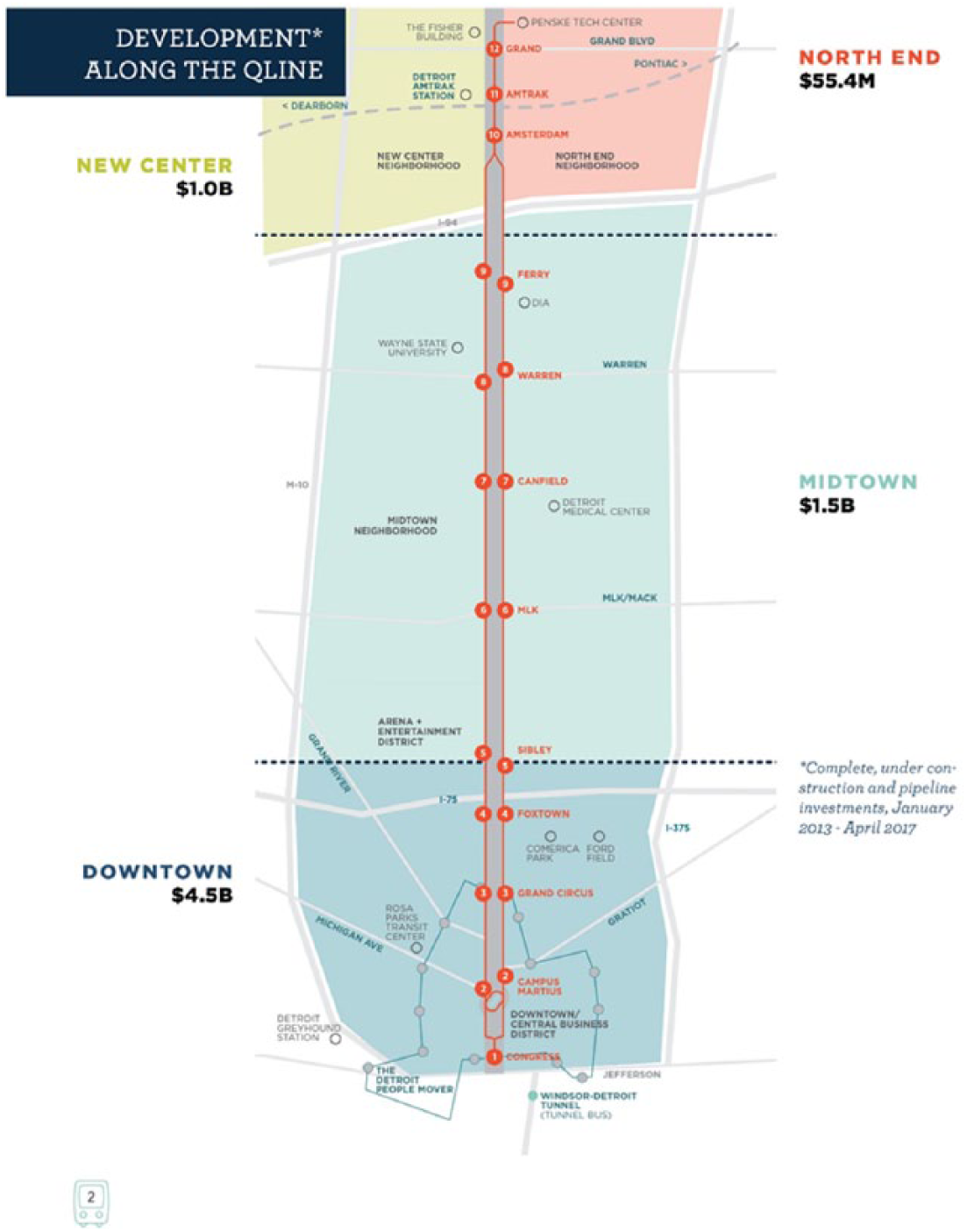
Development along the streetcar line.
Despite the economic revitalization of downtown and Midtown, the neighborhoods beyond the city’s central business districts have had little to celebrate. Some observers refer to a problem of “Two Detroits,” in reference to the contrast between an increasingly prosperous downtown and the city’s substantially poorer neighborhoods. As reported in the Free Press (Gallagher 2017b):
Detroit’s challenge is that the vast majority of its neighborhoods remain headed in the wrong direction, at least as measured by Census statistics. Of the nearly 300 Census tracts in the city, each covering several square blocks, two-thirds showed an increase in the poverty rate between 2010 and 2015, and more than two-thirds showed a decline in median household income during that time span.
Planning and Funding Rail
In a divided metropolitan region that lacks decent public transportation, and in an increasingly polarized city with growing distrust between the downtown and neighborhoods, the new streetcar is controversial. Some view the new streetcar as a service that will continue to boost the overall economy and eventually lead to strengthened regional public transit. But others see the streetcar as a project that will bring benefits only to a few and not to the neighborhoods. In the following section, we describe the process behind the streetcar’s planning and implementation, before considering its impacts on regional transit, economic development, and accessibility, as well as the tensions between private sector leadership and public priorities.
The streetcar is only the latest in a series of proposals for rail transit along Woodward Avenue, which connects Downtown Detroit with its northern suburbs. This most recent effort is tied to the 2006 Super Bowl in Detroit, which demonstrated the need for better mass transit (22DK; 25DK; https://qlinedetroit.com/about/history/). The leader of a temporary transit coordinating entity approached local elites about privately funding a short, circulator rail line along Woodward Avenue (25DK; Shea 2017a). In 2007, they formed a nonprofit organization—eventually called M-1 RAIL (2012)—to champion the project. These civic elites include Roger Penske of the Penske Corporation; Dan Gilbert of Quicken Loans; the Illitch family, owners of Little Caesars, professional sports teams, and land and arenas along Woodward Avenue; and Rip Rapson of the Kresge Foundation.
Relying only on private funding appealed to M-1 RAIL. Interviewees suggested that the City of Detroit was shut off from federal pipelines for rail investment, and the city government was seen as corrupt and without capacity. Private sector leaders also thought they could deliver a small project more quickly without federal requirements (10DJ). The original strategy was for a $35-million donation from the Kresge Foundation and for private actors donating/buying station sponsorship to fund the remainder of the project (Nichols and Walsh 2017).
M-RAIL leaders, however, later decided private funds would be insufficient. They enlisted the Michigan Department of Transportation (MDOT) as a financial surrogate for federal funds. The US Department of Transportation subsequently awarded MDOT $25 million for the project through the Transportation Investment Generating Economic Recovery (TIGER) program (US DOT 2010).
At one point, as M-1 RAIL was planning its project, the City of Detroit was also planning a longer Woodward Avenue light-rail transit (LRT) project that would travel nine miles to the city boundary (FTA and DDOT 2011). It would require substantial city and federal funds. M-1 RAIL had some reservations (Nichols and Walsh 2017) but came to cooperate with the city’s larger project for a year and half (25DK).
Concerns arose about conflicting purposes—public transit speed versus corridor walkability—as well as the capacity of and corruption in the city government. Eventually the fiscal realities of the city came to bear. The costs of the longer LRT line were significant, and the Federal Transit Administration (FTA) doubted the city’s fiscal capacity:
It was honestly a fool’s errand. . . . Even though we were pushing this 9 mile project, because we understood the transportation benefits . . . it became clear that the plan had no merit. (29DK)
In December 2011, Mayor Dave Bing (D) and Governor Rick Snyder (R) abandoned the LRT project and abruptly announced plans for a regional bus rapid transit (BRT) network, a move supported by some (Howes 2011, December 15) given the city’s fiscal situation. One interviewee explained:
The City of Detroit just didn’t have the money. . . . The Transit Administration would not give them a go ahead . . . So the Mayor of Detroit, the Governor came out and said, “We’re not going to go for that option.” (22DK)
Business leaders protested they hadn’t been included in the BRT decision (Finley 2011), and M-1 RAIL leaders returned to their original intent, a three-mile rail circulator. With their congressional delegation, M-1 RAIL asked US DOT Secretary Ray LaHood for ninety days to demonstrate the streetcar’s viability in order to secure federal support (Shepardson 2012). To satisfy US DOT, M-1 RAIL created a ten-year operating endowment (fares will not cover operating costs) and would transfer physical assets to a public agency in ten years.
After the review period, LaHood added one additional condition—the creation of a regional transit entity for metro Detroit (Livengood 2012; Fleming and Shepardson 2012). One interview explained LaHood’s position: “I don’t think he really cared about the streetcar, but he was very very gung-ho about the establishment of a regional transit authority in Southeast Michigan” (29DK). LaHood saw this as a benefit “for the people” (Batterman 2016b). LaHood suggested that M-1 RAIL’s powerful backers could ensure passage of pending legislation for a regional transit entity. The business leaders lobbied the Michigan Legislature, which then created the Regional Transit Authority of Southeast Michigan (RTA) in 2012. Nelles (2012) thus correctly predicted the promise of federal funds would lead to a regional transit authority. The RTA, however, did not replace SMART and DDOT; the agency would plan and provide new rapid transit routes with a regional scope (Livengood and Pardo 2012). LaHood subsequently announced funds for the streetcar project in January 2013 (Shepardson and Greenwood 2013). M-1 RAIL later secured $12.2 million more from US DOT to cover a funding gap (Shepardson and Fleming 2014).
The streetcar project required M-1 RAIL leaders to secure funds across a multitude of sources. The organization raised $187.3 million for $144 million in final capital costs, with the remainder designated to subsidize operating expenses (Shea 2017b). The majority of funds are from private sources, both for- and not-for-profit, as seen in Table 1. Penske’s local clout and Kresge’s lobbying were critical to securing private donations (Shea 2014). Numerous sources have donated $3 million for station naming rights, while Quicken Loans bought naming rights for the entire line. Donors will receive no other direct return on investment. Beyond US DOT TIGER funds, another source of public subsidy was a deal with investors who received New Market Tax Credits, the first instance of using these tax credits for transit (Wheeler 2014). Timed to make way for the rail project, MDOT’s reconstruction of 2.5 miles of Woodward Avenue with two overpasses cost another $59.2 million, with $51.8 million from US DOT. These roadway expenses were outside of the streetcar project’s budget and thus do not appear in Table 1 (Shea 2014). The roadway reconstruction also allowed for underground installation of a fiber optic cable infrastructure by Rocket Fiber, one of Gilbert’s family of businesses (Rafael and Irwin 2017).
M-1 RAIL Streetcar Capital and Operating Endowment Funding Sources (Source: Shea 2016).

The QLine opened for service in May 2017, with rides initially free. Amid concerns about wait time, the Kresge Foundation pledged to support extension of the free fare period until Labor Day in early September 2017. During the free period, ridership averaged around five thousand daily trips, dropping about 40 percent to three thousand in September 2017 when the $1.50 (per three hours) fare was instated (Lewis and Rahal 2017). There are plans to add signal priority, as ride times were slower than expected (Gallagher 2017a).
The Streetcar as a Catalyst for Regional Transit
Among most interviewees, there was hope that the streetcar project was building support for regional transit and enhancing economic development. Given the numerous failed attempts at rail, one interviewee maintained that the biggest benefit of the streetcar was that it was actually built:
I think the major benefit . . . is that it [streetcar] said to people, “We can do this.” The private sector had a major component of that . . . it sort of sets the stage for being able to do all of the other things. (22DK)
Another interviewee explained that getting the streetcar project implemented resulted from the private sector’s strong initiative:
The private sector brought enormous agency. They had an intolerance for delay and disdain for political processes, which tripped them up occasionally, but they had a forward mentality; get it done, get it done, get it done. When they tripped, they got up. I think in the public sector, we would have hit a barrier and we would’ve hemmed and hawed. . . . Almost certainly, you needed the private sector attitude and approach. (12DJ)
Aside from demonstrating that a new transit project can get implemented, the streetcar project has also played a role in elevating general awareness about and support for a regional transit system:
What M-1 RAIL was able to do was transform how we conceive of Detroit, investing in Detroit and public transportation as a part of that rebirth of Detroit, period. If they achieve nothing else, if it becomes a whites-only transit line, that would be terrible, but the fact is we would not have the RTA without M-1 RAIL. (12DJ)
The RTA has already increased transit service, with the potential for more improvements and integration. In September 2016, the agency added express bus service—that crosses jurisdictional boundaries—along Woodward and Gratiot Avenues. M-1 RAIL leaders were instrumental in creating the RTA and the compromise that put a millage to fund it on the ballot:
For 50 years they couldn’t get a regional transit authority approved. The heft and the muscle of the M1 team, the Penskes and Kresges and Dan Gilberts and stuff like that, allowed us to take it on. . . . Just this last couple weeks [Summer 2016] there was a breakdown with the political leadership in the region as to the approval of the plan . . . to move forward for funding requests in the November election. That same coalition of business and philanthropic leaders came back to the table and said, “Hey guys, figure it out . . . ” That was pretty unique as far as that approach and I think that that came out of this whole M1 coalition. (26DK)
Among the RTA’s first tasks were to create a regional rapid transit plan and gain financial support for it. The plan included rapid bus routes on dedicated lanes across county lines, commuter rail between Detroit and Ann Arbor, express service to the airport from four counties, and expanded local bus service for DDOT and SMART. On November 8, 2016, the residents of four counties—Macomb, Oakland, Washtenaw, and Wayne—voted on a property tax assessment that would finance the plan. The tax levy would be at a rate of 1.2 mills ($1.20 per $1,000 of taxable value) and generate about $3 billion (2010 dollars) over 20 years (RTA 2016). The ballot measure was narrowly rejected, falling short by 18,000 votes out of the 1.8 million cast (Witsil and Lawrence 2016).
The narrow defeat of the ballot measure left the RTA in disarray and its future uncertain. In March 2017, just four months after the ballot defeat, the RTA board of directors fired Chief Executive Officer Michael Ford (Fleming 2017). Although the board announced that the CEO was terminated for job performance, the ouster came shortly after the Detroit News reported improper reporting of personal expenses by the CEO. With an interim CEO in place, the board remains divided on several key issues about how to proceed to secure the electorate’s support for regional transit, including whether to go back to the voters in 2018 or 2020, whether the master plan requires modifications, and whether the RTA might reshape the size of the taxing authority by excluding rural and exurban territories (Lawrence 2017a, 2017c).
The streetcar plays a role in the uncertain future of the RTA. On the one hand, M-1 RAIL leaders have voiced support for the RTA and claim that the streetcar provides an example of success with transit that might spur broader political support among the electorate. On the other hand, because the streetcar has such a limited reach and serves only the downtown core, some suburban leaders resist supporting the RTA because the RTA is scheduled to take over the operating expenses of the streetcar after ten years (Lawrence 2017a).
The Streetcar as a Transportation Project?
Even as some interviewees hoped the project could spur investment in and support for regional transit, most emphasized the economic development benefits of the project.
[The QLine] is not transit. It is [a] very nice feature, it’s an amenity for this district. . . . In the past . . . twice a week I had a different developer in my office wanting to know where that was in relation to where the M1 stop was going to be. (24DK)
One interviewee similarly claimed that the rail line had already contributed to redevelopment:
The intent was to be a catalyst for economic development. Crain’s Communications and others have done studies of the development along the Woodward corridor since the M1/Q line has been announced. It’s already billions of dollars, with billions more planned. I think our goal to be a catalyst for economic development is paying off. (26DK)
In a report released shortly before the streetcar’s opening, M-RAIL reported more than $7 billion in investment completed or planned along the corridor from 2013 to 2017. Downtown is the site of the bulk of those investments, accounting for $4.5 billion (Nichols and Walsh 2017).
Finally, interviewees mentioned the preference of millennials for urban living and transit and the hope for attracting them. Supporters of the streetcar early on suggested that benefits were for corridor redevelopment and that rail “attracts young and educated residents” (Aguilar 2010). The development projects along the corridor appear targeted for this demographic: “Those projects range from beer bars to bakeries, hotels, housing, new skyscrapers and a dazzling new arena complex for Detroit’s pro hockey and basketball teams” (Nichols and Walsh 2017, 1). One interviewee noted the ultimate aim of building the capacity of the city through repopulation and an augmented property tax base (25DK).
Tensions between Private Goals, Public Processes, and Transportation Benefits
M-1 RAIL leaders made critical project decisions that have implications for transit service, including potential integration into a future regional system. Yet, early strategizing around the streetcar was not part of a public process and at times competed with the longer, city-led LRT. One interviewee (25DK) explained, “We were operating in this very quiet, under the radar way, because we didn’t want to promise more than we could deliver.” As noted above, the project would temporarily merge with the city-led LRT option. However, the city was not initially considered an appropriate lead agency for the streetcar, given its lack of technical capacity and corruption. An interviewee (15DJ) explained: “In Detroit we had very poor local leadership when this started. Quite honestly, we had corrupt leadership, really poor leadership. . . . If we had the stronger administration and local structure in place, I think they would have played a greater role and taken a stronger lead.”
After abandoning the LRT project for a lack of funding, Mayor Bing and Governor Snyder proposed an alternative, regional BRT system, but this too would compete with the streetcar. As the mayor and governor pushed for the regional BRT system, M-1 RAIL consistently advocated for rail, and looked to national examples and advocacy organizations for support. One interviewee explained: “They [M-1 RAIL] were told numerous times that buses are cheaper than rail. . . . I think buses aren’t sexy. Rich, white people don’t ride buses” (24DK). Portland was a model:
A group of people got on Penske’s private jet and flew to Minneapolis and Portland, one day. . . . I’ve heard from many sources that Penske personally got under one of these streetcars . . . and was really excited about the economic return on investment that Portland got from their streetcar, and said, “We need to do this.” (13DJ)
Portland’s and other cities’ investments in streetcars were influential on the group’s preference for rail, as was advice from national actors:
Our group didn’t feel and we were advised by people from the FTA, we were advised by transit planners from around the country, including Reconnecting America, Transportation for America, Smart Growth America, we were advised by all of them that improvements to existing bus service would not be enough to inspire a region that had not invested in transit for forty years to suddenly change its view. (25DK)
A critical and contentious decision was where to place the streetcar in the roadway. Transit advocates favored an exclusive right of way in a center median, because of the speed that a dedicated right of way provides (by allowing public transit to pass private vehicular traffic). Contending that center alignment would better allow for eventually serving a larger, regional rapid transit system, transit advocates gathered considerable support during the environmental review’s public comment period: “The comments were like nine to one in favor of the center-running project, and that just doesn’t usually happen on public projects” (10DJ). Of the wide-ranging comments summarized from the environmental review period in early 2013, 11 of 140 specified concerns about a side-alignment or a preference for center alignment. No comments expressed support specifically for the side, shared lane alignment (MDOT, n.d.). In addition, bicyclists supported center alignment, which would leave the right lanes free of rails that pose risk to bicyclists.
M-1 RAIL leaders were concerned that a center alignment would create a physical barrier to crossing the street and argued that a side-running right of way—in the right lane shared with regular traffic—would be better for supporting foot traffic and thus property values and local businesses. Gilbert in particular pushed for side alignment:
Dan Gilbert, who has a very strong personality and is a big backer . . . came out with some strong statements about how every place he’d ever been where you get the kind of economic development you want it side-running. Damn it, it’s going to be side-running . . . it was a conflict of purposes really. What happened when we separated them [LRT versus streetcar] we got M-1 back to being the circulator, where you didn’t need to put the fences. (25DK)
Despite strong public support for the center-alignment option, M-1 RAIL leaders insisted on the side-alignment design. That the environmental assessment review would express this preference reflects that M-1 RAIL leaders held considerable influence over decisions affecting the public, and that they understood the project as economic development, not transit improvement:
We were really baffled at why they [M-1 RAIL] were so insistent about putting it on the side . . . They were not looking for speed or reliability. Their goal was not to move people as quickly or reliably as possible . . . their number 1 goal was the boost in property values and the convenience of attracting more people to local businesses . . . The idea of moving people quickly and conveniently, or even moving people reliably, through this area was very much a secondary. (13DJ)
While some interviewees connected the streetcar to an original intent for regional transit (10DJ; 25DK; 26DK), others described a lack of regional planning and public input into process.
There really wasn’t any planning besides Dan Gilbert visiting Portland and seeing the Portland experience with a streetcar and saying, “We should have one in Detroit.” . . . After the fact planning to justify the conclusion, and I think that’s fairly typical as well but that was really check the box . . . we’re going through the motions, doing the meetings because they are required. (11DJ)
M-1 RAIL would eventually invest substantially in outreach. It operates stakeholder advisory committees, and interviewees lauded M-1 RAIL’s outreach staff members (11DJ; 13DJ; 14DJ). However, when speaking about the advisory committees, one interviewee noted: “They don’t listen to any of my advice. I think it’s giving me too much credit to say I’m actually in an advisory capacity. I certainly give advice. They never seem to take it, any of it” (24DK). Similarly, one interviewee saw limited public access to decisions:
The decisions were not made in a public process. The decisions were made very much in a private arena. . . . For the first year and a half that they were developing this, it was very secret. . . . Even the factors involved, how they weighed different factors, let alone the actual decisions, were very much made by a private board of individuals. (13DJ)
Another interviewee noted the disconnect between decisions and the public, “I feel like they [funders] might just be working behind the scenes and it’s a higher level than the common citizen can get to or is even aware of” (27DK).
Transportation Impacts and Equity
The streetcar does not improve speed for transit users. Just before the QLine launch, buses traveled Woodward Avenue frequently, every eight minutes during rush hour. Although early predictions (MDOT and FTA 2013) were that the streetcar would travel faster (14–16 minutes) than the existing bus service (15–17 minutes), during construction the streetcar’s travel was projected to be 25 minutes (Neavling 2016; Shea 2016). During the construction period, moving and poorly accessible bus stops plagued bus riders (28DK). Prior to the streetcar opening, it was anticipated that buses would travel Woodward Avenue less frequently, with some rerouting (to reduce crowding on the avenue) (14DJ). As of summer 2017, however, bus schedules show similar headways on DDOT’s website as compared to the pre-QLine schedule. Thus, there is for now an overall increase in transit service in the surrounding neighborhoods. These neighborhoods include many low-income residents and workers. Even though Midtown is gentrifying, there is still a substantial production of low-income units (Frost, Luther, and Schaeffer 2016).
The streetcar, however, provides transit-dependent populations a higher amenity trip, with new rolling stock, wifi, and upgraded stops:
There was very little taken into account for their needs [low-income residents] during the planning of the project. I do think it will be a positive. I do think for low-income people, people with disabilities, seniors, other transit-dependent populations who live or travel within this region, I think it will be a nicer way to get around. (13DJ)
One interviewee mentioned the need for outreach that communicates to existing residents that they too can benefit from the streetcar (25DK), but another interviewee speculated that bus users may not ride it (27DK):
I don’t know that they’ll [current bus riders] all of a sudden want to jump on trains. The train only goes a certain number of blocks in a straight line. The bus is connected to other bus lines. I don’t know that people are going to be so willing to switch their current mode of transportation for something that’s only this really short.
Likewise, coverage in the Michigan Chronicle, a Detroit newspaper serving the African American community, raised the question of who will ride the streetcar. The article quoted a neighborhood resident who suggested the streetcar does not meet the needs of those dependent on transit (Burgess 2015). Yet, that article also notes enthusiasm from other neighborhood stakeholders. Public comments also expressed concern about a separate system for “a certain demographic” and potential competition between the bus and streetcar for funds (MDOT, n.d.). A community activist named Yusef Bunchy Shakur argued the benefits would accrue to the affluent and white, not Detroit’s neighborhoods (Caro 2015):
“If that’s not a farce I don’t know what is a farce,” Shakur said, complaining that in a city with perhaps the country’s worst public transportation, such a limited service will connect primarily white people in downtown and Midtown. “These folks don’t care about the neighborhoods or the communities.”
Aside from the streetcar’s slow speed, some view it as failing to provide benefits to predominantly black neighborhoods because it is disconnected from regional service. One interviewee explained, “It’s a line that doesn’t really support the overall region . . . you could make the argument and people have, it would have been better to spend that money on things that really supported the region if we really are trying to create a regional transit as opposed to just another circulating line” (15DJ). In addition to its short length failing to make it regional, the streetcar comes near but is still several blocks away from the Rosa Parks Transit Center, the central bus hub. Several members of the public criticized this failure to connect to the central bus hub during the environmental assessment period (MDOT, n.d.).
Addressing how design choices like short station spacing and non-exclusive right of way might undermine a future regional system, one interviewee commented: “I don’t ever see the project being extended and it’s unfortunate because there’s such a need” (15DJ). In fact, streetcar boarding platforms may not work with BRT rolling stock (22DK).
The streetcar may also compete with other services for public subsidy after depleting its operating endowment, with annual operating costs projected to be $6.3 million when a public entity would take over operations (Lawrence 2017b) An interviewee suggested the possibility of city–suburbs conflict over the long-term funding of the streetcar project (12DJ): “[Suburban elected officials are] worried that M-1 RAIL becomes a drain on RTA resources when RTA takes over the rail.” A citizen at a public meeting likewise raised the potential of underfunding buses for rail (MDOT, n.d.). This, the streetcar’s slow speed, and the need to instead prioritize bus service increases are criticisms levied by the Detroit People’s Platform (Lawrence 2017b), which advocates for social and racial justice.
Despite its limited potential for regional integration and the threat of its draining resources from other services, private action for the streetcar has the contingent potential to aid a metropolitan shift toward increasing regional transit. If adequately funded, the RTA, enabled in part by M-1 RAIL’s political will, could enhance transit service and access to vital opportunities for transit-dependent riders. The campaign for the RTA millage included many M-1 RAIL donors (Gallagher 2016). While the federal level pushed for them to lobby for the RTA, M-1 RAIL leaders have become vocal backers of a stronger regional system. Their website now explains that the streetcar “is envisioned to be one element of a future modern, world-class regional transit system where all forms of transportation, including rail, bus, vehicle, bicycle and pedestrian, are considered and utilized to build a vibrant, walkable region that includes a thriving Downtown Detroit” (https://qlinedetroit.com/about/economic-impact/). As mentioned above, the RTA has added multijurisdictional, express service along two corridors, and there is discussion of integrating fare media across the region’s multiple transit providers. But the recent narrow defeat of a tax levy to finance the regional transit plan is a serious setback for transit supporters who advocate for a regional system from a social equity basis (Batterman 2016a).
Improving regional transit accessibility for transit-dependent Detroiters faces additional barriers. Prior to the millage vote, one interviewee suggested that racism blocks regional transit: “I feel like our biggest impediment to a strong regional transit system is racism . . . it’s less of an infrastructure problem and more of a people problem” (27DK). Future benefits for low-income residents, people of color, and transit-dependent riders will depend on securing substantial funding for the regional transit, as well as ensuring adequate investment in Detroit and that any new service does not undermine DDOT bus service. One interviewee raised these concerns while pointing to the deep divisions in the region:
We’re concerned that this regional master transit plan is just a foundation, a blueprint, or a Trojan horse for further privatization, or some would go so far as to argue [it’s] reducing its [DDOT’s] power. . . . We see this plan being tipped in the favor of metro Detroit at the expense of Detroit. (28DK)
Discussion
Private funders did not quash the city-led effort for an LRT line; rather a lack of confidence in a low-capacity government and fiscal crisis did. In this way, our findings align with the focus Hall and Jonas (2014) place on city budgetary problems and austerity. We find that private funders did, however, push forward on the shortened rail corridor and designed a system that will perform poorly on the transportation criteria of speed and reliability. Furthermore, they did sideline a BRT network for their project and were hesitant to work with the public sector on the defunct idea for more substantial LRT. In this section, we discuss donations as a P3 model with implications beyond the particular project and for equity, identify the limited role of the public and collective goals in the process, and consider realized and potential space for greater public sector leverage of its funds in donation-based P3s.
Equity and the Region
We expect that for-profit actors would fund projects that enhance property values, and in this case public sector actors and funds also supported a project that fares poorly along equity criteria. The streetcar does not improve accessibility for transit-dependent populations, who are largely black Detroit residents with needs for connections to regional jobs and opportunities. Not only will it fail to enhance accessibility, it could harm accessibility through displacing some bus service. Even as there could be economic benefits that trickle down to low-income, transit-dependent riders, we contend that transportation public spending should still enhance accessibility for transit-dependent populations and work to address racial and economic disparities in accessibility.
While private and philanthropic donations were for a specific project, like other P3s, this case study has implications beyond the specific project. Specifically, when the operating endowment expires, the streetcar service will compete with other transit services (that travel longer and more quickly) for public subsidies. On the other hand, the related formation of the RTA has already led to some limited cross-jurisdictional service and could in the future allow city residents to access suburban opportunities.
Even as the streetcar’s direct impacts fail to benefit transit-dependent populations, longer-term, indirect transportation accessibility benefits are possible but far from certain. Resulting in part from the political support of M-1 RAIL for the RTA, there is increased political will for integrated and expanded regional transit. While regional transit lacks funding and its design will impact how equitable it is, there is potential for improved access to regional opportunities. Such improvements may be contingent, indirect, and future outcomes of the political will fostered through the QLine effort and are far from guaranteed.
The formation of the RTA and its plans are subject to additional interpretations. Hall and Jonas (2014) suggest that the formation of a transit authority with revenue-raising capacity—separate from debt-laden municipalities—allows the provision of services that support profit from land use intensification. An additional critique of the RTA is that it could tilt toward suburban investments to ensure suburban support and undermine DDOT services, while leaving Detroiters behind, a concern raised by one interviewee.
The Public in P3 Decisions
While there was extensive outreach, we did not see evidence that the general public or the public sector had a meaningful impact on key decisions. The public sector at times competed with the private sector’s favored project, and the general public had limited access to and influence on critical decisions. Fiscal constraint—not private sector dominance—doomed the longer city-led LRT project, but private sector funders advocated for rail contrary to the regional BRT proposal pushed by the mayor and governor. The private sector overrode public comments, as well as a public sector goal of improved transportation-based accessibility, in a critical design decision eliminating an exclusive, center right of way for the streetcar.
Even as the M-1 RAIL used public funds, private actors steered the process. It was a federal actor who intervened to ensure a public benefit in the form of a regional transit authority from the streetcar. Thus, this case study of a donation-based P3 aligns with other more common P3 arrangements that have insufficiently meaningful public input. While economic development is often a public sector goal, much of the direct economic benefits of streetcars accrues to private property owners (King and Fischer 2016).
Public Sector Leverage
Given governmental fiscal constraints—the proponents were powerful and cities are unlikely to turn away from capital donations given the imperative for investment—city rejection of these donations was unlikely. However, public funds constitute approximately a third of the project’s funding (even when not including quasi-public authorities and a public university; see Table 1). Public sector actors face numerous constraints, but still have mechanisms to ensure publically held property (e.g., roadways) and public dollars bring transportation benefits that serve a public purpose.
In the case, one major public sector actor intervention—LaHood’s offer of federal funds on the condition of political support of the RTA—forced an action that could lead to greater collective benefits. Importantly, this action was from an extra-local public sector stakeholder, and extra-local public sector actors may be better positioned to leverage public sector power for collective benefits. However, more leveraging is possible. In this case, the right of way is state owned and MDOT acted as financial surrogate, including producing federally mandated environmental review documents. These pivotal roles could come with more requirements of public sector influence and more critical review of presumed benefits. Even as environmental review documents require some assessment of alternatives, the determination of alternatives can overlook viable alternatives (e.g., bus rapid transit) that deliver more efficient or extensive collective benefits. Like the P3 deals that Siemiatycki (2010) notes, we need more realistic review of P3 donation deals before their implementation.
While local leaders may embrace hoped-for property value increases that come with streetcars (given their reliance on property taxes), the public sector at higher levels could take a more skeptical stance on streetcars without exclusive rights of way. LaHood’s action was outside of a systematic process, and public sector actors could codify mechanisms to ensure greater and more equitable benefits for P3s, including donations. As many Detroit residents have extremely limited regional access to critical destinations (Grengs 2010, 2012), investing public funds into a streetcar is questionable given that streetcars typically perform poorly on a range of service characteristics (Brown 2013) and rarely provide service that would eventually allow for integration into a larger, regional network of rapid transit (King and Fischer 2016). King and Fischer, in fact, suggest US DOT dollars should not fund streetcars, as the presumed benefits are economic, not transportation related.
Conclusion and Policy Directions
In the case study, the private sector largely funded and steered a streetcar project, albeit with still substantial public dollars. These private sector leaders made critical choices in the project’s trajectory, but this project—rather than a light-rail project with more substantial and collective transportation benefits—advanced mostly because of a municipal fiscal crisis. A bus rapid transit regional proposal that would have generated more collective transportation benefits was sidelined by the push for the streetcar. Project proponents emphasize economic development impacts from the streetcar, which fails to directly improve accessibility for transit-dependent Detroiters. However, the political will created through the project may lead to increased regional transit service that could in turn benefit transit-dependent populations. In the planning process for the streetcar, private sector leaders made pivotal decisions that weakened direct transportation benefits, but federal requirements led to the RTA’s formation and subsequent push for its funding.
The case study shows that donations, like other transportation P3s, can impact public sector choices beyond the project (Farmer 2014; Siemiatycki 2010), and can have insufficient public oversight and process (Siemiatycki 2010). The case study also shows how a donation for transit investment can fail to improve transit service for transit-dependent populations, making it fare poorly along an equity criterion, even as public sector action ensured some contingent potential for longer-term regional accessibility improvements. We see some leveraging by the public sector in the case for collective benefits, but argue more is possible.
Given the reality of public sector budgetary constraints, we are likely to see more land value capture and private investments in transportation, but public actors could adopt a more systematic and critical lens when providing public dollars, permits, and rights of way. A need for a more critical lens in P3s does not mean an endorsement of the shift toward privatization (see Miraftab 2004 and Graham and Marvin 2001 for a discussion of distributional concerns and the connection between neoliberalization and infrastructure privatization). But, pragmatists will look for options to ensure that when public dollars combine with private funds there are more substantial and equitable collective benefits. LaHood’s insistence that elites push to create the RTA led to a regional transit plan and an attempt at funding it. We hope to see more systematic and certain mechanisms to ensure collective benefits from projects focusing on increased property value, so that collective transportation benefits are not so contingent on individual actors.
Within the realm of transit, federal funding and rules could change. Federal concerns with fiscal capacity—that led to the abandonment of the longer LRT project—have a strong rationale, but could systematically exclude some regions. In addition, the federal emphasis on capital over operating funds hurts vulnerable cities and transit authorities, many of which have substantial ridership and serve many individuals protected by environmental justice rules.
Like King and Fischer (2016), we are skeptical of streetcars as US DOT investments. Streetcars do little for and may even harm accessibility for transit-dependent populations—through bus service changes to accommodate streetcar service (see Williams 2017) and indirectly through opportunity costs and future siphoning of limited subsidies. QLine supporters argue that the project does deliver collective benefits through economic development, but the direct economic benefit will be concentrated among property owners (29DK). The potential of a streetcar’s economic benefits may be oversold, as it is difficult to separate the impact of streetcars from other factors (Parsons Brinckerhoff 2015) and other factors were vital in the much cited Portland example (King and Fischer 2016).
Ultimately, collective transit benefits in the Detroit region will hinge on operational details, the trajectory of the corridor’s development, and most crucially whether the political will engendered through the streetcar will be enough to spur investment in transit regionally. Instead of competition to attract affluent millennials, we argue that public sector officials must leverage their roles in public–private deals to ensure more spending that serves transit-dependent populations by design, not by chance. Such a refocusing can be cost-effective, sound public policy (see Taylor and Morris 2015) in addition to being more just policy.
Footnotes
Acknowledgements
We appreciate the time and insights that our interviewees shared with us. The anonymous peer reviewers provided useful feedback, as did Em Hall.
Declaration of Conflicting Interests
The author(s) declared no potential conflicts of interest with respect to the research, authorship, and/or publication of this article.
Funding
The author(s) received no financial support for the research, authorship, and/or publication of this article.