



Abstract

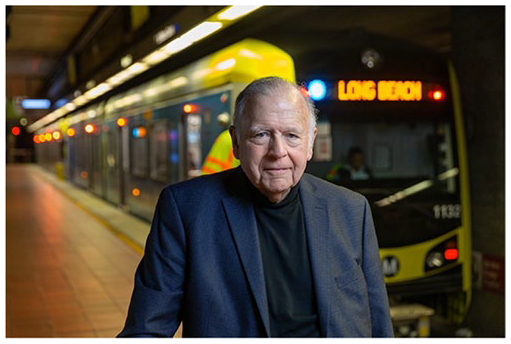
This essay is the twenty-first in a series on the recipients of the Association of Collegiate Schools of Planning Distinguished Educator Award, ACSP’s highest honor. The essays appear in the order the honorees received the award.
For people who knew Martin Wachs, California’s stately coast redwood tree may seem an unlikely metaphor to describe the man and his career. Marty, as he was known, grew up in the heart of New York City and leaned more toward watching Dodgers games than long forest hikes. (Nor was he particularly tall.) However, we can think of no more fitting metaphor to describe Marty’s scholarship, advocacy, teaching, and mentorship. Like a redwood, Marty grew to be a giant in the research community. He was a prolific scholar and steadfast advocate in the pursuit of social equity in transportation. His students and others he mentored revered Marty as a pillar in their professional development and adored him for his profound kindness, playful sense of humor, and warm chuckle.
Growing Tall
Marty was born in 1941, in the Bronx, New York, the son of an immigrant taxi driver. On taxi trips with his father, Marty marveled at iconic New York City bridges and wondered how they came to be. Marty’s early years in New York imprinted his life in other important ways too, with an inextinguishable enthusiasm for Brooklyn Dodgers baseball and a lifelong romance with Helen Pollner, his middle-school sweetheart and later wife.
A top-flight public education at the Bronx High School of Science prepared Marty to study at The City College of New York, an institution established to offer a high-caliber college education to talented children from working-class families. At City College, Marty studied civil engineering because he was interested in structures and knew engineering provided first-generation college students a promising career. Yet, during these years Marty noticed that he was more intrigued by stories about why structures were built than about how they were constructed. In a class taught by Joe Pistrang, he discovered a passion for both teaching and transportation, leading him to pursue a career that combined both. In 1963, he married Helen, and they headed to Northwestern University for his doctoral studies. In 1967, he earned his PhD in urban and regional planning, advised by renowned geographer William L. Garrison. Marty then fulfilled a two-year military service commitment as a Captain in the U.S. Army Ordnance Corps.
Marty’s academic career began with brief terms in engineering departments, first at the University of Illinois, Chicago, and then at Northwestern University. In 1971, Marty eagerly accepted an urban planning faculty position at UCLA where he could more fully pursue his interests in the social dimensions of transportation. In 1996, Marty moved to Berkeley, California, to join UC Berkeley with a joint appointment in Civil & Environmental Engineering and City & Regional Planning. In 2006, Marty moved to the RAND Corporation to head its Transportation, Space and Technology Program, and in 2011 Marty’s career came full circle when he retired from RAND and returned to UCLA to focus on his favorite parts of academia, working with students and research.
Marty’s towering stature as a transportation scholar was matched by his tireless academic and professional service. At both UCLA and UC Berkeley he directed research centers, and he chaired his UCLA department for multiple terms. He served numerous professional and civic organizations, including the American Planning Association Committee on Transportation Needs of the Disadvantaged (1974–1976), American Institute of Certified Planners Ethics Committee (1985–1994), Transportation Research Board Executive Committee (2000), Bi-Partisan Policy Center’s Commission on the Future of Transportation Policy (2007–2011), and Road-Use Charge Task Force Technical Advisory Committee to the California Transportation Commission (2014–2021). Transportation leaders turned to Marty for these roles because he offered lucid analysis and shepherded discussion respectfully toward resolution. Few transportation academics were trusted more than Marty for “even-handed advice that recognizes the other person’s value and priorities, but does not forsake analytic clarity,” explained one colleague.
Branches of Scholarship
The tall trunks of coast redwoods support numerous branches, each massive enough to be a tree itself. The trunk, or core, of Marty’s extensive scholarship examined the nexus between transportation, people’s lived experiences, and social justice. Branches of work extending from that trunk address travel behavior, forecasting, and professional ethics. Marty explored how to create and fund transportation systems and services that would deliver a high-quality user experience, contribute to a more equitable society, and reduce environmental harms.
Many branches on the Marty redwood explore how travel behaviors vary among different groups of people, with a focus on the poor and people without access to private vehicles. He documented how patterns of mobility differ across groups defined by age (Wachs 1979), gender (Wachs 1987), and income (Wachs and Taylor 1998), and considered how such discrepancies contribute to social inequality. These were radical and unfashionable topics of study in the early decades of Marty’s career, when most travel behavior research was used only for demand forecasts that informed infrastructure expansion plans.
Other branches of Marty’s scholarship investigate methods to improve planning practices. For example, Marty set out analytical approaches for bringing qualitative concerns like community cohesiveness into the quantitative assessment of transportation investments. One early publication argues for evaluating transportation investments according to how successfully they connect people to jobs and essential services (Wachs and Kumagai 1973), and other works grapple with methods to include the public in system and service planning. Marty also frequently returned to questions surrounding transit fare policy and the taxes and fees used to fund transportation (Cervero and Wachs 1982; Sciara and Wachs 2007; Wachs, King, and Agrawal 2019).
Yet other branches tackled the thorny ethical dilemmas that planners face. While Marty respected technical methods, forecasts, and models, he recognized that technical analysis was a fundamentally human enterprise relying on often subjective choices about confidence intervals, future growth assumptions, and other factors. He pushed for transparency in modeling, so that misleading or incomplete forecasts would not be mistaken for objective analysis (Wachs 1989, 2015).
Steadfast Advocate
Marty stepped into the role of advocate in several instances in his career, weathering conflicts with powerful government institutions with a redwood’s stability and structural integrity. From 1987 to 1992, Marty collaborated with the Western Center on Law and Poverty to successfully convince Los Angeles, Orange, and San Bernardino Counties to cover bus fare costs for “general relief” recipients. His contributions included teaching a class of students who surveyed low-income Angelenos about their daily travel (Hubler 1992; UCLA Graduate School of Architecture and Urban Planning 1992).
Marty also provided technical expertise to U.S. District Court Judge Thelton E. Henderson in a significant case that revealed how standard transportation modeling practice failed to adequately integrate transportation and air quality (Citizens for a Better Environment v. Deukmejian, 731 F. Supp. 1448 [N.D. Cal. 1990]). Marty helped the judge monitor compliance with the court’s 1990 decision directing the Metropolitan Transportation Commission to improve its models to accurately account for the air quality impacts of new freeway construction.
Marty’s best-known advocacy, within a 1990s civil rights lawsuit challenging the powerful Los Angeles County Metropolitan Transportation Authority (MTA), helped draw early attention to transportation issues within the growing environmental justice movement (Bullard and Johnson 2000). The plaintiffs charged the MTA with discriminating against its low-income and minority bus riders in favor of more affluent and often white rail riders (Labor/Community Strategy Center, Bus Riders Union, et al. v. Los Angeles County MTA). Marty served as a technical advisor to the NAACP Legal Defense and Education Fund and Bus Riders Union as they built their case. He also gave expert testimony showing how a planned bus fare increase would harm low-income and minority bus riders and later advised Special Master Donald Bliss, who oversaw implementation of the consent decree settling the case.
Tending the Ecosystem
A redwood supports forest growth in numerous ways, whether condensing fog onto needles to rain water on saplings or offering airy perches for spotted owls. Similarly, Marty supported his students in every possible way. In addition to his meticulously planned and lively lectures full of the latest research and personal anecdotes, students appreciated his detailed and rigorous feedback on their work, often written in his elegant hand. Marty kept alert for opportunities to draw his students’ work into the limelight, whether by recommending a junior collaborator to present research at a prestigious meeting or suggesting his students be the lead author on joint publications. Students also recount Marty’s unflagging concern for their well-being when they faced personal challenges and ethical dilemmas. Marty also freely distributed his deep social capital, asking his contacts if they would help a student find work, provide academic guidance, or show a young scholar around the libraries in foreign countries. He even gave away legions of “Marty plants” from his meticulously tended garden.
Most remarkably, Marty continued to extend this care for students and mentees decades after they had graduated. One former student recalled Marty telling her, “Your degree comes with a lifetime guarantee.” Another said that long after graduation, Marty was still “my first call when I’m trying to navigate a challenging moment.”
One measure of Marty’s impact as a mentor is the many former students who, now professors themselves, take his unwavering support as inspiration for their own interactions with students. One explained, “I try to honor his legacy daily by advising my students as whole people and being available to talk through the hard moments they face.”
A Firmly Rooted Network
Redwoods trees extend roots outward to other trees in the grove, and the resulting mesh of roots lends each tree the structural stability to stand for millennia. Marty was the central tree to such a community: he extended his roots to connect people he thought might interest or help each other. And since he took an interest in so many people, that grove grew to be enormous. Furthermore, his scholarship and advocacy connected people from diverse fields, introducing poverty advocates to transit planners, historians to practicing engineers, environmentalists to transportation funding wonks, and literary scholars to economists. Anyone interested in transportation who met Martin Wachs was welcomed into that delightful grove anchored by his roots.
Footnotes
Acknowledgements
We thank Marty’s many students and colleagues for sharing memories with us. To supplement that information, we interviewed Marty, read his published reflections about his career (Alan M. Voorhees Transportation Oral History Project and Archive 2015; Wachs 2016), and drew from hundreds of heartfelt comments shared after his death in 2021 ( ).
).
Declaration of Conflicting Interests
The author(s) declared no potential conflicts of interest with respect to the research, authorship, and/or publication of this article.
Funding
The author(s) received no financial support for the research, authorship, and/or publication of this article.