



Abstract
Metropolitan public transportation systems vary in their performance and governance, and evidence suggests linkages between these. However, such linkages remain largely untested due to the complexity of governance and the absence of reliable and valid measures of it. We develop a conceptual framework for understanding metropolitan public transportation system governance using the familiar concepts of polycentricity and fragmentation. We introduce the novel concept of governance topology to parse the complexity of the many organizational arrangements and interorganizational relationships that comprise metropolitan governance. We then propose a method of measurement using a concentration index, and apply it to the Chicagoland region.
Introduction
Metropolitan public transportation 1 systems vary greatly in their performance. Quantitative studies analyzing large samples of metropolitan statistical areas (MSAs), urbanized areas, and other regional geographies provide evidence that these systems exhibit heterogeneity in accessibility, coverage, mobility, cost per rider, and other indicators of equity, efficiency, and effectiveness (Brown and Thompson 2008; Levine et al. 2019; Ryus 2010; Thompson and Brown 2006). We also know that metropolitan public transportation systems vary in how they are governed: in the number of organizations (e.g., transit agencies and districts; metropolitan planning organizations), in the arrangement of these organizations across the metropolitan geography, and in the formal and informal connections among them (Lam and Miller 2002; Levinson and King 2019; Poister et al. 2013; Weinreich and Skuzinski 2021). As an example of this governance 2 variation, consider decisions about daily operations for fixed route transportation. Suppose in Region A these decisions are made by a single special purpose local government—typically called a transit district or transit authority—whose service area crosses the boundaries of multiple communities. This resembles, for example, how service decisions are governed in the Denver-Aurora-Lakewood MSA. The Regional Transportation District (RTD) currently operates bus and rail stops that cross the boundaries of twenty-eight municipalities and six counties. Governance scholars would consider this a highly monocentric form of regional governance. By contrast, imagine Region B, in which the decisions about daily operations are made by dozens of municipal and county public transportation departments and an array of other special purpose districts and authorities. This is similar to what we see in the San Francisco-Oakland-Hayward MSA, which has twenty-four formally independent public transportation providers serving sixty-five municipalities within five counties. The governance for decisions about daily operations in this example is much more polycentric. 3 If we also examined how the twenty-four organizations compete, coordinate, and collaborate within this polycentric structure, we could then speak to whether they are functionally fragmented or functionally integrated.
We would expect differences between these two types of region to matter to the performance of the public transportation systems, both logically and based on decades of metropolitan governance scholarship. We might hypothesize, for example, that the more monocentric Region A will exhibit a lower cost per rider (an indicator of efficiency), while the more polycentric Region B will provide superior access to lower income neighborhoods in the region (an indicator of equity). Or, we might expect the reverse to be true. The testing of such hypotheses, and others linking governance variation to systems outcomes, has simply not occurred for metropolitan public transportation systems. Such testing would require analysis of large samples of regions from which we can statistically generalize that some forms of metropolitan governance systematically produce more equitable, more efficient, and more effective systems. This research deficit extends beyond our example of daily operations governance throughout the many decisions that are part of a metropolitan public transportation system, from funding to capital planning. Addressing this deficit could have substantial policy impact: national and subnational (e.g., state, provincial, cantonal) governments can use and have used their legal authority and their spending to directly influence the governance of metropolitan regions.
A major obstacle to filling this knowledge gap is reducing the complexity of regional governance to one or more independent variables that can reliably and validly capture variation over space (e.g., among regions in several U.S. states, or among regions in multiple countries) and time. How can we best measure the difference in daily operations governance between the more monocentric Denver-Aurora-Lakewood MSA and the more polycentric San Francisco-Oakland-Hayward MSA? How do we wrestle with the fact that metropolitan public transportation systems vary in their centricity and fragmentation as one moves from the governance of daily operations to transit funding, or from fixed route bus and train services to rapidly emerging on-demand services? We pursue two goals in this article to promote better measurement of governance variation among metropolitan regions. First, we develop a conceptual framework 4 for measuring metropolitan public transportation system governance. We build our framework on familiar ground, using the language of polycentricity and fragmentation that is well-known to scholars of metropolitan governance. We also introduce to this scholarship the novel concept of governance topology 5 to help parse the complexity of the many organizations and interorganizational relationships that comprise regional governance. We describe this concept at length in the article. We then suggest a method of measurement that flows logically from our conceptual framework, and illustrate its application to three governance topologies in the Chicagoland region’s metropolitan public transportation system in the United States. Before introducing our framework and measurement method, we review the literatures on polycentricity and fragmentation in metropolitan public service delivery.
Literature Review
Two concepts are central to an understanding of variation in metropolitan governance: polycentricity and fragmentation. While these terms may seem superficially synonymous, distinguishing them can help ensure clarity in theorizing and studying metropolitan governance. We draw our definition of polycentricity from V. Ostrom, Tiebout, and Warren (1961, 831),
6
whose work was foundational to motivating metropolitan governance scholarship:
many centers of decision-making which are formally independent of each other . . . [but may] take each other into account in competitive relationships, enter into various contractual and cooperative undertakings, or have recourse to central mechanisms to resolve conflicts, [and] may function in a coherent manner with consistent and predictable patterns of interacting behavior.
The two core components of this original definition—formal independence selectively mediated by cross-boundary institutions 7 —have persisted over the last six decades (e.g., Carlisle and Gruby 2019; Heikkila and Weible 2018; McGinnis 1999). 8
Polycentricity originally arose as an effort to defend the proliferation of local governments in metropolitan areas against calls for regionalizing reforms, such as city-county consolidations (McDowell 2011; E. Ostrom 1972; V. Ostrom, Tiebout, and Warren 1961; Wright 1965). The reform movement had grown from a recognition of the potential for parochialism, exclusion, and negative externalities in metropolitan regions with many local governments (Friesema 1966; Hawley and Zimmer 1970; Lineberry and Fowler 1967; Zimmer and Hawley 1961; Zimmerman 1970, 1974). These are issues scholars have continued to highlight as the problems of localism, particularly with regard to adverse equity outcomes (Bischoff 2008; Cashin 1999; DeHoog, Lowery, and Lyons 1991; Jimenez 2014, 2016; Lyons and Lowery 1989; Weiher 1991). The responsive policy intervention is to move toward monocentricity—at the extreme, to a unitary general purpose government with boundaries matching those of the metropolitan region.
But to those following Ostrom, Tiebout, and Warren and working from the public choice perspective, 9 polycentricity allows the public to function as rational public entrepreneurs capable of choosing the optimal organizational scale at which to tackle a policy problem, and then crafting institutions to reorganize governance to match this scale (Bish and Warren 1972; Boyne 1996; V. Ostrom and Ostrom 1971). This choice process can be motivated via firms and households exercising exit and voice (Hirschman 1970; Oakerson and Parks 1988), and then implemented through the policies of public representatives at the local and state levels (McGinnis 1999; Schneider 1986). Whereas a unitary government (monocentricity) might be a poor institutional fit for some policy problems, multiple centers could selectively adjust to solve policy problems at a variety of scales through formal and informal institutions such as contracts, memoranda of understanding, intergovernmental organizations, or interpersonal norms of reciprocity. Recent work by Scott and Greer (2019; Greer and Scott 2020) provides further insights about the many less-common forms cross-boundary institutional development can take, from shared personnel to interest alignment. The interdependence in the metropolitan setting arises due to spatial overlap and proximity, with the centers having relationships that extend both vertically (e.g., the municipality functioning in response to the decisions of a county or multijurisdictional special purpose government) and horizontally (e.g., the municipality functioning in response to other municipal neighbors).
If the mechanisms of public choice are functioning properly, we should see authority vested in many small, independent local governments—municipalities, counties, districts, authorities—only where this generates systemic outcomes the public values. This is an example of fragmentation persisting within a polycentric system. We should, by contrast, see formal and informal cross-boundary institutions proliferating among these local governments only where these institutions lead to desired outcomes. This is an example of integration arising within a polycentric system. Thus, the coordinative potential in a polycentric system can vary in its expression, from the competitive to the collaborative. If we think back to the opening example describing the twenty-four public transportation providers in the San Francisco-Oakland-Hayward MSA, in the absence of careful study we simply cannot presume the degree of fragmentation that persists within that polycentricity. 10
We illustrate the concepts of polycentricity (versus monocentricity) and fragmentation (versus integration) in Figure 1. For a specific decision (or suite of decisions) within a specific public service, one would be able to locate a mode of governance somewhere within the diagram. On the left at Point A is the perfectly monocentric, unitary government, whose boundaries match those of the metropolitan region. 11 As we move to the right, the figure represents increasingly polycentric regions, with the most polycentric region being on the far right, again for a specific decision concerning a specific public service. However, polycentricity alone does not tell the whole story. In the darker gray triangle are those systems that have some degree of polycentricity but exhibit relatively low fragmentation among the centers, due to the institutional integrations described earlier in this section. In the lighter gray triangle are those systems that are polycentric but exhibit relatively high fragmentation. Along Line 2 in Figure 1 are polycentric systems with completely integrated decision-making due to formal and informal institutions; we could also refer to these as functionally monocentric. Along Line 1 are polycentric systems that are completely fragmented with no formal or informal institutional integration.
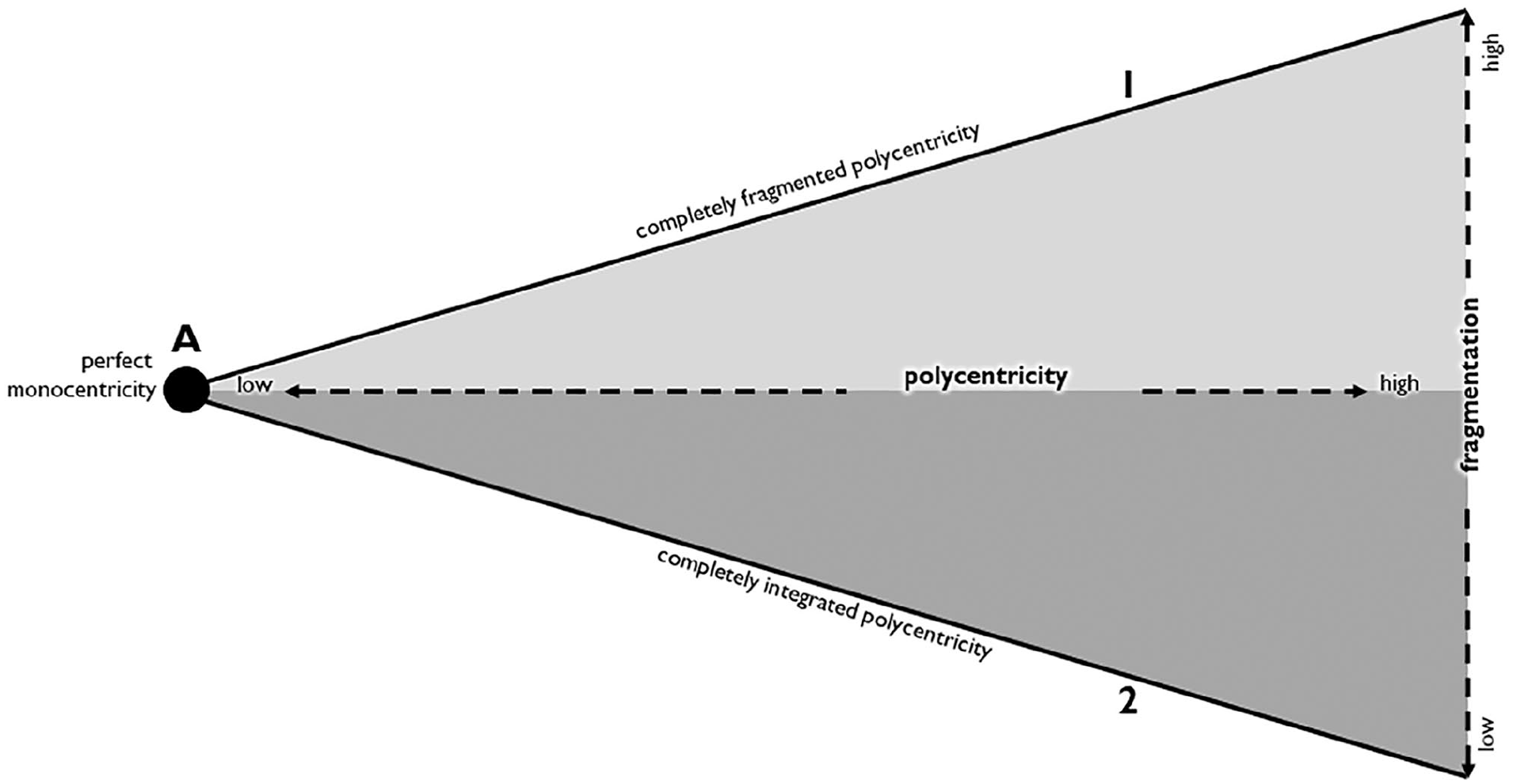
Graphic depiction of variation in metropolitan governance using polycentricity and integration.
For metropolitan public transportation systems, questions about the effects of polycentricity and fragmentation on outcomes have been considered only in a thin and scattershot way. This is surprising. Perhaps more than any other public service, public transportation embodies the tension between regional and local impulses that animates metropolitan governance scholarship. It functions under a loose mandate for regional provision and production, both from its users (J. Hansson et al. 2019; Levine, Inam, and Torng 2005; Levine et al. 1999) and from the federal government (Goldman and Deakin 2000; Taylor and Schweitzer 2005; Wolf and Farquhar 2005). 12 This extends beyond the usual indicators of efficiency and effectiveness to those that measure equity (Weinreich and Skuzinski 2021). Despite this mandate, metropolitan public transportation systems exhibit persistent underperformance on a variety of regional outcomes, often due to prioritizing local needs over regional ones (Mamun and Lownes 2011; Sanchez and Wolf 2005).
Much of the existing work on public transportation governance is descriptive in nature, highlighting—often using single metropolitan region case studies or multiple case regions from one country—the many types of cross-boundary institutions that arise within the metropolitan public transportation system. This includes studies of vertical integration in transportation policy (Hatzopoulou and Miller 2008; Hrelja et al. 2017; Hrelja, Pettersson, and Westerdahl 2016; Plotch and Nelles 2017), horizontal coordination (especially among public transportation providers, such as agencies and districts) (Chisholm 1992; Lam and Miller 2002; M. A. Miller 2004; M. A. Miller and Lam 2003; Rivasplata, Iseki, and Smith 2012), and coordination between metropolitan planning organizations and transit agencies (Deyle and Wiedenman 2014; Wells 2007). The potential for local-regional tensions in the funding of transportation using local option taxes has also been studied (Goldman 2007; Sciara and Wachs 2007; Weinreich 2016). Rounding out the governance literature that has considered the horizontal and vertical linkages among organizations are a handful of useful reflections on the processes and dynamics of regionalization in transportation (Goldman and Deakin 2000; L. Hansson 2013; Levinson and King 2019; Sciara 2017). More extensive work has been done on the processes and impacts of cross-organizational coordination of transit operators in the German context, indicating the potential for further research in this area. Unfortunately, very little of this work has been done in other national contexts or across multiple countries (Buehler et al. 2017; Homburger and Vuchic 1972). We are aware of only one study sampling a large number of metropolitan regions and connecting governance to outcomes, but it focused on one specific mode and moment of governance: the collaborative planning processes of metropolitan planning organizations (Deyle and Wiedenman 2014). The gap we highlighted in the introduction is that no studies exist from which we can statistically generalize across a suitably large sample of regions about the effects of polycentricity and fragmentation on indicators of efficiency, equity, and effectiveness.
Before leaving the literature review, we emphasize that we do not regard any mode of metropolitan governance as a panacea for the problems faced in metropolitan public service systems; in the parlance of the metropolitan governance debate, we do not identify as either polycentrists or regional reformers at this stage. We are aware each mode of governance likely has advantages and disadvantages, and that research may show variation in governance does not even have a significant bearing on system outcomes. While the limited studies on transit governance do indicate significant efficiency benefits to service integration (Buehler et al. 2017; Homburger and Vuchic 1972; Rivasplata, Iseki, and Smith 2012), such efficiencies may come at the expense of equity outcomes such as accessibility and coverage. The transaction costs associated with integration in polycentric systems can also be quite high, particularly in larger or geographically dispersed systems with extensive overlap (Berry 2008; Huitema et al. 2009; Wyborn 2015), and we have no reason to expect this is not true for public transportation. The decentralization of responsibilities in a polycentric setting, even a relatively integrated one, can make it challenging for the public to hold decision makers accountable for performance (Huitema et al. 2009; Lieberman 2011). The development of integrative institutions needed to create a highly adaptive and resilient system may not occur, and the ones that do develop are not guaranteed to be a good institutional fit that promotes system performance (Carlisle and Gruby 2019). These are but a few possibilities. The evidentiary record is simply not weighty enough for the governance of any part of the metropolitan public transportation system to claim that one mode of governance will systematically lead to inefficiencies, inequities, ineffectiveness, or unsustainability. This was true when Ostrom, Tiebout, and Warren were writing their original defense of the supposed “crazy-quilt” of local governments in U.S. metropolitan regions. Rather than assume polycentricity would be inherently superior, they observed that “[b]oth the structure and the behavior of the system need analysis before any reasonable estimate can be made of its performance in dealing with the various public problems arising in the metropolitan community” (V. Ostrom, Tiebout, and Warren 1961, 831). We embrace this openness.
Governance Topologies
We begin this section by drawing the reader’s attention back to Figure 1. In describing this diagram, we noted that we could use it to characterize governance for a specific public service and a specific decision (or suite of decisions) about that service. This importance of specificity cannot be stressed strongly enough (Schröder 2018). 13 Only in a single, purely theoretical instance, can we characterize a metropolitan region’s governance with a general measure: when the exact same spatial arrangement of governing organizations exists across all public services and all decisions concerning those services. We are unaware of this level of simplicity existing for any regions, even for those well-known for their regionalizing reforms. Rather, we tend to find variation in governance across public services and even among the various decisions within a public service. The push toward general characterization has befuddled metropolitan governance scholars, resulting in a proliferation of competing taxonomies 14 and typologies (Hajrasouliha and Hamidi 2017; D. Y. Miller and Lee 2011), and measures (for a review, see Hendrick, Jimenez, and Lal 2011 and the next section).
To emphasize our call for specificity, we develop the governance topology as our core unit of analysis. We define a governance topology as the arrangement and interrelationship of governing organizations—those with authority and responsibility for making policy decisions—in a metropolitan region with regard to a specific decision (or suite of decisions) about a specific public service. Arrangement and interrelationship allow us to connect the common definition of a topology to our earlier discussion, respectively, of polycentricity and fragmentation. The former is about the geography of the governing organizations—not just how many, but where there is concentration and overlap. At base, it examines the boundaries of the organizational governance zones within which authority can be exercised. The latter, interrelationship, is about the connections among those organizations. We already know they have coordinated interdependencies—that is, that the decision of one likely affects those of others, especially as proximity increases. But here we mean purposive institutional interdependencies through the many cross-boundary mechanisms we mentioned earlier (e.g., contracts, memoranda of understanding, handshake agreements, shared personnel, common membership on boards). These could be among the organizations themselves, or among their representatives (e.g., managers, staff, elected officials).
In the transportation policy domain, one can discern distinct governance geographies relating to decisions about selection of new capital projects, daily transit operations, revenue generation, and expenditures. Any one of these could be further narrowed into a smaller suite of decisions, or even a single decision. The same is true of any public service delivered in a metropolitan setting, with a mix of public and private organizations, given varying degrees of authority at different points in the policymaking process. Using the governance topology language, we would say that the typical metropolitan region has plural topologies both among public services and within delivery of a single public service. For example, we would expect the degrees of polycentricity (the nature of arrangement) and fragmentation (the nature of interrelationship) to differ between land use policy and economic development policy. But even here, we would need to be more specific. Consider just land use policy alone. With regard to planning—the development of comprehensive plans—we would likely find less polycentricity (and more institutions of integration amidst polycentricity) than we would for the regulation of land use in the adoption and enforcement of zoning ordinances (Bollens and Caves 1994; Briffault 2000; Nolon 1999; Sciara 2020; Skuzinski 2017). If we haphazardly assumed that all land use policy—from planning to adoption, from enforcement to appeals—followed municipal and county boundaries, we would incorrectly measure governance. And if we did want to compare select governance topologies across land use and economic development, it would only make sense to parse each into its unique set of plural topologies.
By breaking down the complexity of metropolitan governance into discrete decision-making silos and examining organizational arrangement and interrelationship within each, we can more readily identify moments of monocentricity that arise within metropolitan regions that might appear outwardly complex by more general measures, whether these occur in public transportation or other public services. By working across the full spectrum of centricity—from monocentricity to high polycentricity—we can begin to more rigorously engage the large-n, comparative research designs that would advance our understanding of how and why polycentricity matters to regional outcomes. We can go beyond centricity, too, to discern the effects of fragmentation that persists within this polycentricity. In the next section, we tackle the puzzle of how to measure a governance topology.
Measuring Governance Topologies
We followed three principles when developing a method for measuring a governance topology within a metropolitan public transportation system (or any public service). First, a measure of a given governance topology should capture variation in direction and magnitude along the horizontal polycentricity axis. Returning to our introductory examples, when considering just polycentricity a measure should sharply distinguish the topology of San Francisco-Oakland-Hayward MSA from that of Denver-Aurora-Lakewood MSA. Second, a measure should distinguish among polycentric governance topologies that vary in their degree of fragmentation. If all twenty-four public transit providers in San Francisco-Oakland-Hayward MSA had formal agreements (e.g., by integrating their fare structures or synchronizing schedules), then the measure of this governance topology should be different than if only half the providers had such agreements. Third, a measure should yield the same value for a perfectly monocentric governance topology (Point A in Figure 1) and for any completely integrated polycentric governance topology (any point along Line 2 in Figure 1). We do not mean that the perfectly monocentric region should perform the same as the completely integrated one. Rather, they should have the same measurement value of governance topology because of the theoretical argument that institutional integration can create a truly seamless system for some public services while still sustaining independence in other services among the many centers. The third principle is the most important because it is essential to ensuring our measure is valid across the full range of centricity. Fragmentation can be overcome by institutional integration in many ways, ranging from the formality of a contract with strong exit penalties to the occasional sharing of information at meetings of associations with representative members from multiple governing organizations, such as the municipal representatives on metropolitan planning organization boards. If all the governing organizations are involved in these cross-boundary institutional integrations, then public choice theory (as summarized earlier) suggests these institutions should be functionally akin to monocentricity for that public service decision. A researcher would need to determine which cross-boundary institutions suffice to consider two or more organizations as a single, integrated center.
Guided by these principles, we considered some of the existing measures of metropolitan governance, which are summarized thoroughly by others (Hendrick, Jimenez, and Lal 2011; Hendrick and Shi 2015). The most basic measure is the use of raw counts. An easy improvement requires simply normalizing by population or area, such as persons per government, number of governments per ten thousand people, square miles per government, and the like (Dolan 1990; Parks and Oakerson 1993). Both are poorly suited to dealing with both the arrangement and interrelationship of governing organizations central to our governance topology definition. These measures are typically referred to as fragmentation measures, which is something of a misnomer; they are simply a count of decision-making centers (the degree of polycentricity), rather than a consideration of how those centers interrelate (the degree of fragmentation). Some scholars have adapted the Herfindahl-Hirschman Index (HHI), a measure of market concentration, to the metropolitan context as a superior way to measure “fragmentation” (Hendrick, Jimenez, and Lal 2011; Weinstock 1982). 15 Whereas the original HHI relies on firms and market shares, the adaptation to the metropolitan public service delivery context requires the specification of the public organizations responsible for service delivery (either its production or its provision), and the dimension of the underlying metropolitan geography on which their “market shares” are calculated. 16 One researcher might regard the area within an organization’s boundaries as its most relevant market share, while another might justifiably choose the number of households or the tax base. We illustrate the HHI translation to the metropolitan context in more detail later in this section because we base our measurement technique for governance topologies on this approach. 17
To appreciate why the choice of measurement technique matters, it can be helpful to see how the various measures compare for the ten most populous MSAs (see Table 1). We used general purpose local governments (municipalities and counties) as the functional entity for measuring fragmentation because of their familiarity to most readers. The Washington-Arlington-Alexandria MSA exhibits the least polycentricity among the most populous metropolitan regions by a simple count of local governments (here, counties and municipalities) with only 96, but Los Angeles-Long Beach-Anaheim MSA—with 122—has the most persons per general purpose local government (108,197). It also has the highest measure of concentration when using area as the method for assigning market shares in the HHI-type calculation (an index value of 3,068.3, on a scale from a theoretical zero to a maximum of 10,000) and the third highest measure of concentration by population (an HHI value of 1,012.8). Houston-The Woodlands-Sugar Land MSA has the highest value on that latter measure (2,027.9). In simple terms, relative to the other regions its population is concentrated in one or a few local governments, rather than spread more evenly among suburban and exurban communities. As one would expect, the driver of this high value is the City of Houston, which has 34.5 percent of the population in the metropolitan region. By contrast, in Chicago-Naperville-Elgin MSA the relatively low indices (344.1 by population, and a mere 37.4 by area) indicate very low concentration by both population and area. Not surprisingly, City of Chicago covers just 17.5 percent of the population, and the region has nearly 600 suburban municipal governments.
Common Approaches to Measuring Governance (Ten Most Populous U.S. Metropolitan Statistical Areas).
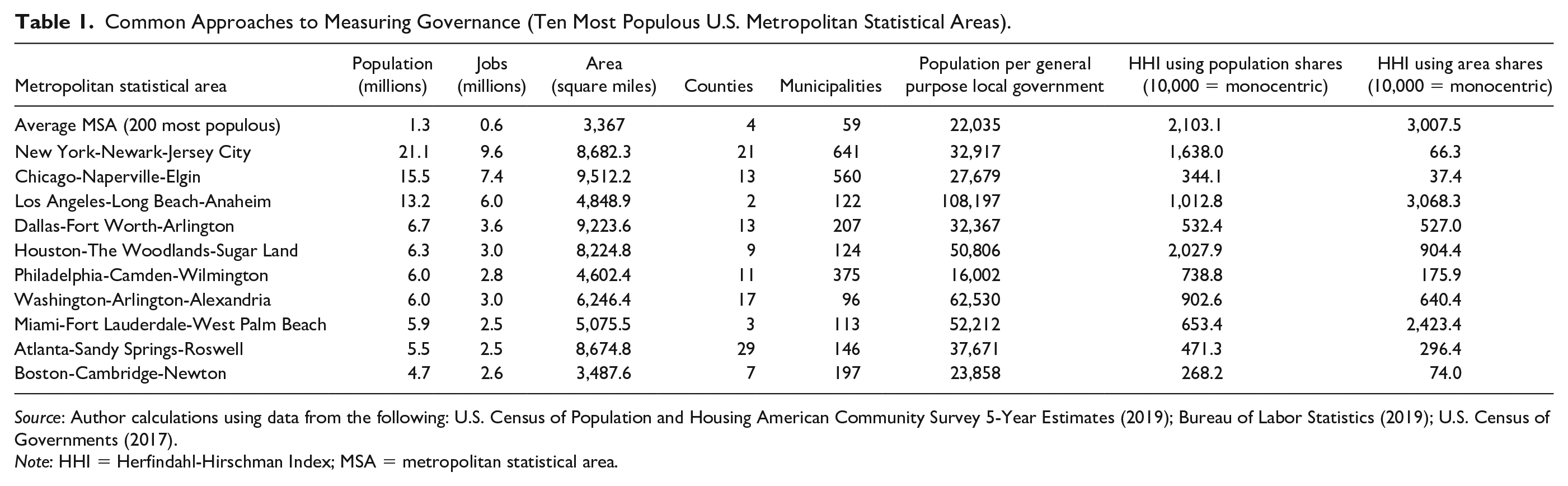
Source: Author calculations using data from the following: U.S. Census of Population and Housing American Community Survey 5-Year Estimates (2019); Bureau of Labor Statistics (2019); U.S. Census of Governments (2017).
Note: HHI = Herfindahl-Hirschman Index; MSA = metropolitan statistical area.
For an HHI measure in a metropolitan public service market, the firms are those organizations with legal authority over the decision-making processes relevant to the underlying research inquiry. Similarly, the boundaries of the market determine which organizations are included and which are excluded, and should be motivated by the research question. In choosing a boundary, the researcher is asking how to define the region within which variation in organizational concentration of decision-making is most relevant to outcomes. A common boundary specification is the MSA, which is a proxy for social and economic integration as indicated by measures of employment interchange across county lines. By choosing the MSA boundary, the researcher is signaling an interest in how variation of organizational concentration of decision-making links, if at all, to outcomes in the region as a social and economic reality. Other core-based statistical area census geographies could be used, such as micropolitan areas (if lower population regions are a focus of the research) or combined statistical areas (if the research targets socioeconomic mega-regions). If population density is highly relevant (e.g., in a study of the organization of decision-making about land use and development policy), then one could define the market as the urbanized area—a census geography that uses census tract-level population density. 18 In a measure of private market concentration, the shares—the final piece of the conceptual puzzle—are the percentage of consumers or consumer economic demand. In the metropolitan public service context, shares are often specified as the population (of individuals, households, or firms) or area served by a local government, again depending on the underlying research inquiry. One could also use tax base, number of service users, or a measure of economic activity; the choice must correspond to how variation in the organization of decision-making for a given service would manifest in variation in measurable outcomes.
The HHI abides by our three guiding principles and affords us high construct validity with regard to our governance topology concept. It can capture variation in direction and magnitude along the full breadth of the horizontal polycentricity axis. Through the specification of the firms (either structurally as independent centers or functionally according to the integrating institutions in which they engage with other centers), the HHI can also capture the underlying degree of fragmentation. And the same value for HHI—a score of ten thousand—would arise for the perfectly monocentric governance topology or for the completely integrated polycentric governance topology.
Two Transportation Governance Topologies in the Chicagoland Region
We turn now to the Chicagoland metropolitan public transportation system (see Figure 2). We choose two governance topologies to highlight that plural ones can exist within a single system and to show how the HHI method can adapt to topologies with quite different geographies. 19 Consider some of the different dimensions of governance, each of which exhibits a distinct topology—a distinct arrangement and interrelationship among the constituent governing units. For the distribution of federal funding and capital planning of major infrastructure, a single dominant organization—the Chicago Metropolitan Agency for Planning (CMAP)—is responsible for decision-making. But even here, one can find nuance around the various sources of funding and the programming flowing from them. For the Surface Transportation Block Grant program, administered under the Fixing America’s Surface Transportation (FAST) Act and inclusive of public transportation infrastructure projects, 20 the governance topology for any local programming follows the boundaries of the subregional councils within the Council of Mayors for Northeastern Illinois. We dub these governance zones: it is these spatial boundaries that allow us to determine the conceptual analog of the “market shares” usually used in an HHI calculation. We show this in Figure 3.
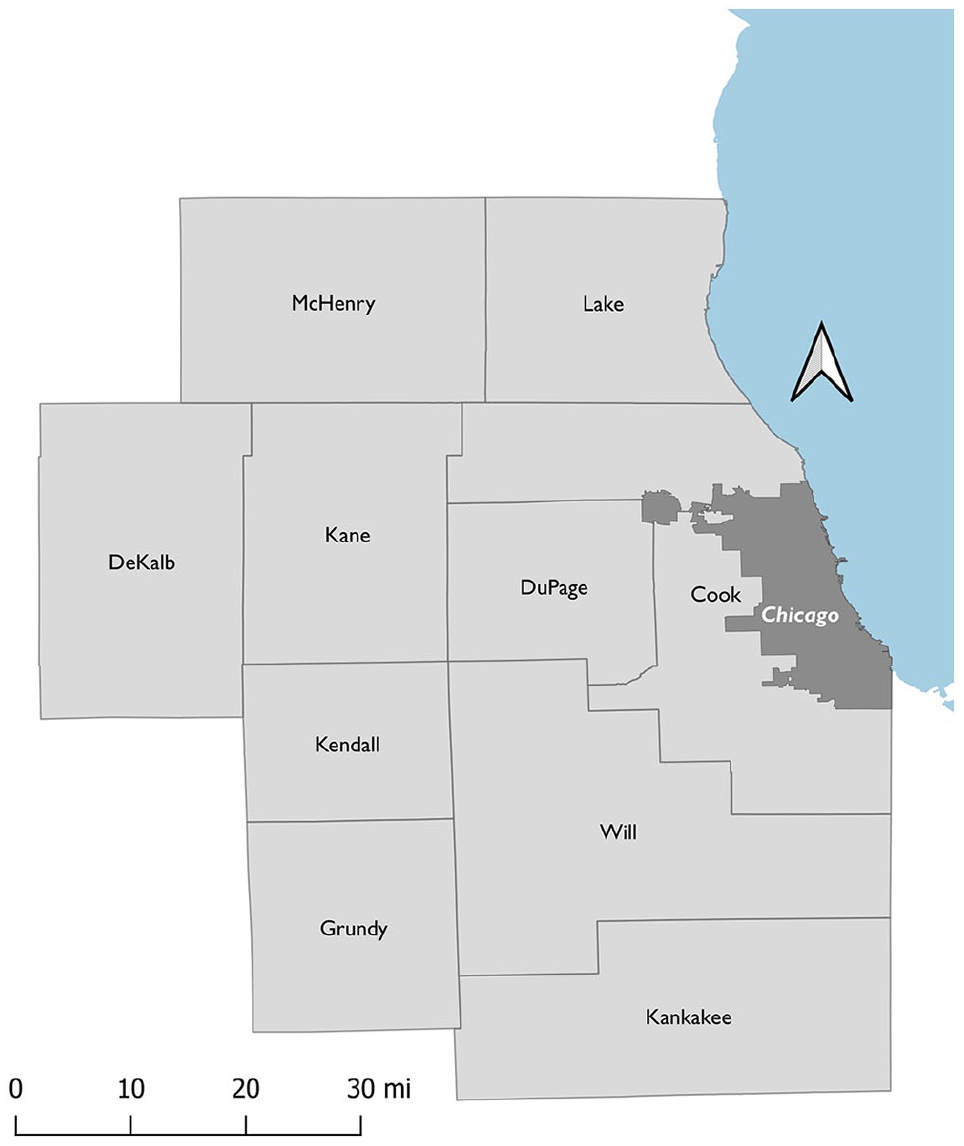
Chicagoland counties, with City of Chicago highlighted.
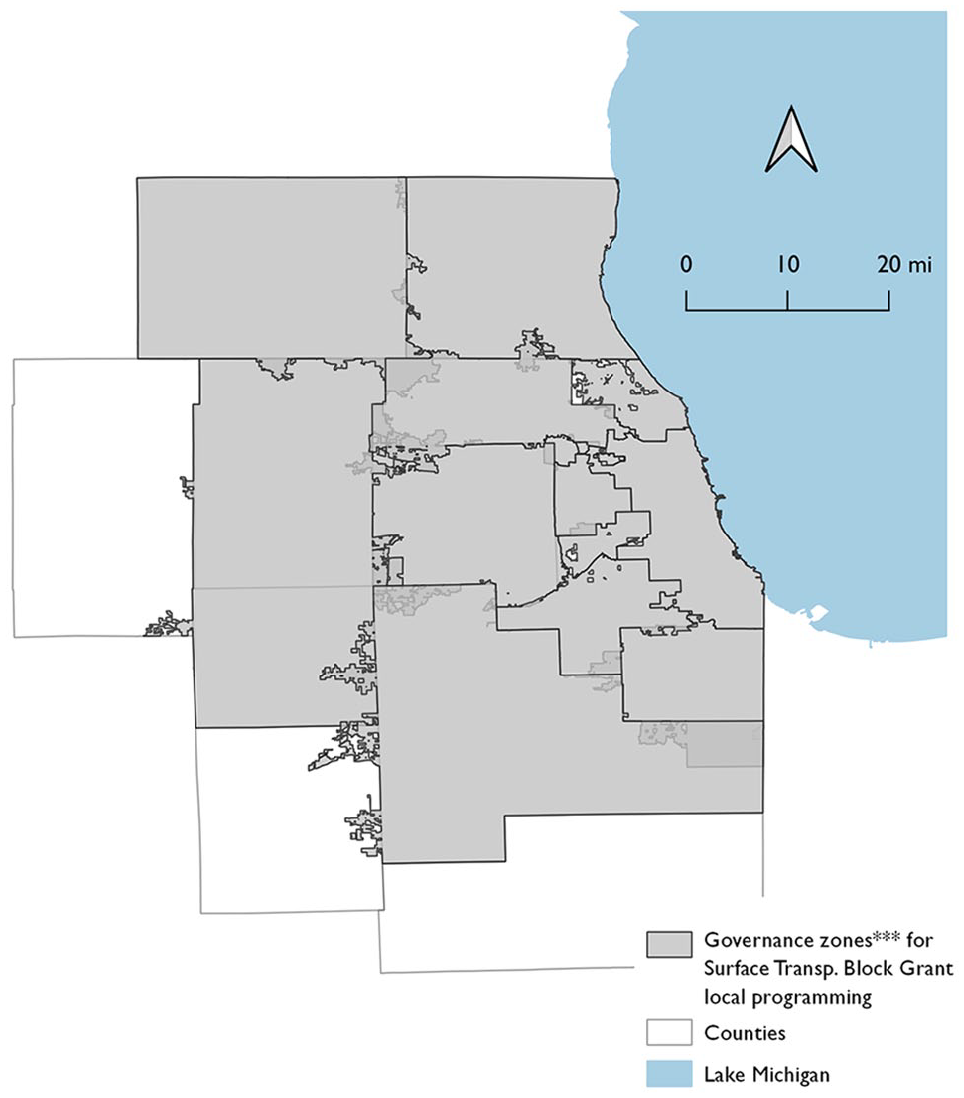
Governance topology for surface transportation local funding programming decisions (Chicagoland region).
Each of these councils could be considered an individual governing center, and the HHI calculated on that basis using population as the share allocated to each 21 is 1,462.7. This would be a valid HHI measure if the researcher were interested in the menu of projects considered for funding in a given cycle. We can presume that the subregional councils have their own project funding priorities, since large-scale regional projects that span across council boundaries are handled through other funding sources. Thus, treating this as an example of fragmented polycentric governance makes sense. However, if we were instead interested in understanding the projects that are actually funded, then we would need to scale up by treating the entire geographic area as a single governing unit because of the role CMAP plays at this stage. The HHI for that governance topology would approach ten thousand, indicating perfect monocentricity. When we emphasized earlier the importance of specificity—choosing a public service, choosing a decision or suite of decisions within it—this is what we meant. We would then need to replicate this measurement across many other regions to discern the effects on relevant outcomes, such as the types of projects that get prioritized or the socioeconomic characteristics of the neighborhoods or users they most directly benefit. We could test hypotheses about the relative efficiency, equity, and effectiveness of different modes of metropolitan governance, and speak directly to the debate we outlined in the literature review.
We next turn to decision-making about daily operations (see Figure 4). In this governance topology, the governing unit is a public transportation provider, such as an agency in a general purpose local government (a county or municipality) or a special purpose local government (a transit authority or transit district). To determine which providers are part of the metropolitan service market, we required that the provider have at least one transit stop within the ten-county Chicagoland region. Once we knew that a provider would be included in our market, specifying the boundaries that would determine that provider’s share proved difficult. In the United States, and in many non-U.S. settings, the legal boundaries of public transportation service delivery—the exclusive territory within which a provider can authoritatively make decisions about the operation of service—are not reliably available. They are not geographies maintained as shapefiles under the requirements of National Transit Database (NTD) reporting or by any federal administrative agencies. State agencies have even less reliable data. The special purpose district and authority boundaries are not often clearly specified in state law, and only sometimes map onto existing municipal or county boundaries, and even these geographies can be problematic. 22 Many states permit providers to offer services outside these boundaries, making it difficult to use them for a market share analysis. 23 In our research, we overcome these challenges by eschewing the use of state-defined legal boundaries, and using instead the General Transit Feed Specification (GTFS) data available on many public sites. The feed data identify the latitude-longitude location of transit stops, along with a host of other data. We reason that transit agencies can and do plan within a certain area around existing stops when deciding whether to move transit routes, create new lines, or offer feeder services from neighborhoods to stations such as scooter and bike share, cycling infrastructure, sidewalk infrastructure, and parking. Thus, we use the stop locations as a proxy for the transit agency’s decision-making area with regard to daily operations—that is, its governance zone. 24

Governance topology for public transportation provider daily operations decisions (Chicagoland region).
This approach has high construct validity, as it defines the governance zone in a way that is consistent with the legal service area within which transit agencies plan and implement existing and new services, including the rapidly growing on-demand and shared services to access “last mile” destinations. One methodological improvement might be the development of a governance zone with buffers that are based on the underlying road network, though this was not essential for the purpose of illustration in this article. In our analysis, we use population at the census block level—the smallest unit of census geography—as the dimension for allocating governance shares. Because we are working on the governance of operations in metropolitan public transportation systems and know that many of our outcomes of interest tie directly to system users (e.g., system cost per rider, accessibility to different subpopulations, number of transfers), using population for share allocation—as we did in the previous example about use of Surface Transportation Block Grant funding—makes sense. The index for the daily operations governance topology is best understood, therefore, as a measure of the degree to which the pool of potential system service users is divided spatially among different public transportation provider organizations.
Following this methodology, the HHI for daily operations governance in the Chicagoland region was 3566.1. This is higher than in the previous example with the block grant governance, and this is logical: fewer centers, each with a balanced share of the underlying metropolitan population. We note that the same calculations for the Denver-Aurora-Lakewood MSA (which has one dominant special purpose transit district serving nearly 80% of the population) yield an HHI of 6673.3, while the San Francisco-Oakland-Hayward MSA (with twenty-four public transportation providers, none serving more than 17% of the population) has an HHI value of 755.4. These are, of course, index measures that are meant more for conceptual illustration and that do not consider the tapestry of institutional integrations that might exist. But it is useful to note that in the Chicagoland example, the three providers—Metra, the core urban area’s Chicago Transit Authority (CTA), and the primarily suburban Pace bus system—have some authority over their own operations, but they also exist as “service boards,” within a Regional Transportation Authority (RTA) that functions as a unifying organization. Depending on the underlying research question, a researcher might regard this institutional integration as sufficient to treat this as a case of monocentricity with a governance topology measure of ten thousand. And our own ongoing study of the San Francisco-Oakland-Hayward MSA suggests that accounting for formal agreements and memoranda of understanding among transit agencies and transit districts would greatly increase the HHI. Once the researcher considers these types of integration, the same would need to be studied and included for any other regions in a broader study sample, and the result would be a different governance topology.
Other governance topologies exist within the Chicagoland metropolitan public transportation system, of course. We might consider the funding of the RTA, which relies primarily on a multicounty tax including Cook, DuPage, Kane, Lake, McHenry, and Will counties. Unlike in many metropolitan regions, the tax authorizing laws 25 do not allow any of the hundreds of municipalities in those counties to opt out (Goldman 2007; Weinreich 2016, 2017). An individual county, however, could choose to opt out from participation. For a researcher studying public transportation funding and the decisions flowing directly from it, in the Chicagoland region the county would be the appropriate geography for characterizing fragmentation. In other metropolitan regions, such as most in Texas and Michigan, the municipality would be the valid choice for identifying “firms” and bounding their “shares” (perhaps tax base or population) in the HHI calculation. These regions would have a lower HHI score, indicating more fragmented polycentricity than the Chicagoland region. What we hope the reader sees clearly is that relying on a single general measure of metropolitan governance—a common approach within the literature animating the public choice-reform debate we discussed earlier—is likely an invalid choice for investigating governance-outcomes linkages. Such reliance could lead to a researcher claiming governance variation matters when it might not, or claiming some forms of it are superior when they may be inferior. This would be true across public services, but also among the many decisions comprising delivery of a single public service. We exist not in a world of singular metropolitan governance, but in one of plural metropolitan governance topologies. Research must reflect that.
Conclusion
In this article, we have offered a foundation for studying the linkages between metropolitan governance—as it varies in terms of both polycentricity and fragmentation—and public service systems outcomes. We emphasized a clear distinction between polycentricity and fragmentation, two concepts that have become muddled together in the metropolitan governance literature. We also developed, more importantly, the concept of governance topology as a unit of analysis to push beyond general measures of metropolitan governance that have limited validity and toward highly specific measures of governance taken for a single public service and a well-articulated decision (or suite of decisions) relevant to service delivery. We focused especially on metropolitan public transportation systems, both because of the absence of a sound empirical foundation about governance-outcomes linkages for these systems and because their complexity would highlight our conceptual framework and measurement method. We advocated measurement of governance topologies using an adaptation of the Herfindahl-Hirschman market concentration index (HHI), familiar in metropolitan governance scholarship. In place of a market with firms and market shares, a researcher specifies a region with governing units and governing zones that contain population, tax base, area, or some other relevant share of the public service region. The HHI, unlike network analytic measures or count-based measures, can accommodate the full range of centricity (from monocentricity to high polycentricity) and—through the careful specification of governing units and their zones—the degree of fragmentation (or institutional integration) that exists amidst polycentricity.
We hope this article will help motivate public service research, especially regarding public transportation, that can speak more directly and forcefully—through statistical generalizability based on analyses across larger samples of regions both within and across countries—to discern whether metropolitan governance has a significant, systematic effect on public service system outcomes and, if so, which forms of metropolitan governance are better for promoting efficiency, equity, and effectiveness. As we noted earlier, we do not advocate prematurely for the superiority of one governance form over another, as each can have advantages and disadvantages. In our own research, we will first probe governance-equity linkages in metropolitan public transportation systems. Specifically, we will be testing propositions about whether daily operations and funding topologies that are more polycentric and fragmented systematically lead to poorer coverage and accessibility outcomes. But many other research paths are possible. We also hope, over the longer term, that the evidence that accumulates can have substantial policy impact. National and subnational (e.g., state, provincial, cantonal) governments can use and have used their legal authority and their spending to directly influence the governance of metropolitan regions. They can dissolve boundaries or make formation of new local governments easier. They can diminish or augment local autonomy to adopt and implement policies that shape public service delivery. They can foreclose taxing and spending possibilities or open new ones. And they can promote the formation of new multijurisdictional organizations and other cross-boundary integrating institutions. As public transportation and other public service infrastructures regain prominence amidst national and global crises, we will need more evidence about the linkages between governance and system outcomes.
Footnotes
Acknowledgements
The authors would also like to acknowledge the anonymous reviewers who provided many helpful insights into this paper.
Declaration of Conflicting Interests
The author(s) declared no potential conflicts of interest with respect to the research, authorship, and/or publication of this article.
Funding
The author(s) disclosed receipt of the following financial support for the research, authorship, and/or publication of this article: TS was supported by funding from the Division of Research and Innovation Partnerships and from the College of Liberal Arts and Sciences at Northern Illinois University. DPW was supported at Technion-Israel Institute of Technology by a Zuckerman Fellowship. Early work was conducted with a grant from the Center for Transportation Equity, Decisions and Dollars (CTEDD) at the University of Texas at Arlington, funded by the U.S. Department of Transportation.
