




Abstract
Using interview data with civic environmental stewardship groups in New York City (n = 26), we identify strategies through which civic stewards engage in transboundary environmental governance and urban climate adaptation planning. Our findings articulate the diverse ways that civic stewards engage with planning in urban socio-ecological systems, as they (1) shape physical spaces, (2) broker partnerships, (3) disrupt the status quo, (4) build civic capacity, and (5) envision new futures. We contribute to the literature by embedding civic stewardship within urban planning discourse, suggesting partnerships between civic stewards and government planners that facilitate the co-production of innovative urban climate governance efforts.
Introduction
Cities face unique social and ecological challenges exacerbated by climate change, including physical and economic recovery after extreme weather events, access to fresh food and clean water, sustainable energy generation, and compounding social vulnerabilities (Carter et al. 2015; Doherty, Klima, and Hellmann 2016). Local planning and governance are essential to prepare for and respond to climate impacts (Baker et al. 2012; Reckien et al. 2018). Adaptation entails preparing for and adjusting to future climate conditions and the wide-ranging, and geographically specific impacts of climate change (Field 2014), which will require a diverse set of public, private, and civic actors (Keenan 2018). While local government actors often take leadership roles in climate adaptation planning (Baker et al. 2012), civic stewardship groups also work to sustain and enhance urban ecosystems, manage ecosystem services, and strengthen civic capacity (Connolly et al. 2013, 2014). Civic stewardship is defined as processes led by non-governmental organizations and civic groups that conserve, manage, monitor, educate about, advocate for, and transform their local ecological and socio-economic environments (Campbell et al. 2019; Campbell and Svendsen 2008). Civic stewards are distinct from other civic groups and other third sector organizations as they make claims on specific spaces as they engage in caretaking of urban environments (Campbell et al. 2021). While not all stewardship groups work directly in climate adaptation, scholars have deemed a “culture of caretaking” a necessary element of climate work (Chazdon 2020). Stewardship has also emerged in the context of multiple forms of socio-natural disturbance, including climate-related disasters such as tornadoes, hurricanes, and pest invasions, as well as socio-political disturbances such as terrorism and uprisings (Campbell et al. 2019; Chan, DuBois, and Tidball 2015; Landau et al. 2021; Svendsen and Campbell 2010; Tidball and Krasny 2014).
Adaptation to the many challenges of and crises driven by climate change takes place on multiple scales through a variety of public, civic, and private stakeholders (Pauw and Chan 2018), and through both formal and informal institutions (Agrawal and Perrin 2009). Anguelovski and Carmin (2011, 169) define urban climate governance as “the ways in which public, private, and civil society actors and institutions articulate climate goals, exercise influence and authority, and manage urban climate planning and implementation processes.” While governments at each level play the role of coordinating the efforts of non-state actors, they also often rely on these actors for resources and expertise through government-civil society partnerships (Bauer and Steurer 2014; Harman, Taylor, and Lane 2015). Graham and Mitchell (2016) draw on the concept of “boundary organizations,” groups that connect knowledge to practice to integrate science and policy, to illustrate how these groups enhance urban climate governance efforts by disseminating knowledge, building capacity, and engaging diverse coalitions of participants in the planning process. Recent literature calls for collaborative climate planning for local adaptation and resilience efforts (Barton, Krellenberg, and Harris 2015; Broto et al. 2015; Flyen et al. 2018; Meerow and Woodruff 2020).
This research seeks to (1) embed the roles of civic stewardship groups within the broader planning discourse around urban environmental governance and (2) illustrate examples of the diverse transboundary roles civic stewardship groups play in urban socio-ecological systems that could be leveraged to advance climate adaptation planning. Here, we refer to Sternlieb et al.’s (2013) conceptualization of transboundary organizations as those that transcend social, political, economic, cultural, and ecological boundaries that are both fiat (human-demarcated) and bona fide (physical). A substantial existing body of literature addresses how planners can incorporate local communities into decision-making processes, but less work explores the capacity of civic stewards to partner with government planners in response to environmental change. Through analyzing interviews with civic stewardship organizations, we investigate the roles through which civic stewards are positioned to engage in urban climate governance efforts in partnership, and sometimes in tension, with government planners. Through analysis of in-depth interviews with civic stewardship groups, we illustrate that civic stewards engage strategically in governance efforts and act as essential partners to state planners to forge best practices in planning urban environments through community-led initiatives (Simon, Diprose, and Thomas 2020). In a study of adaptation planning in 156 U.S. cities, Shi, Chu, and Debats (2015, 191) found that while funding and political support might constrain regional planning bodies, governments can overcome these barriers by “facilitating the exchange of information, pooling and channeling resources, and providing technical assistance to local planners.” Following this finding, we examine the roles civic stewards play in urban climate governance efforts, highlighting their synergies and tensions with government-led planning contributions.
Background
Civic Engagement in Environmental & Climate Adaptation Planning
Planning processes and community engagement have emerged as a central research theme in the past thirty years of literature (Fang and Ewing 2020), prompting scholarship to develop multiple conceptualizations of the role of the public, including civic organizations, in environmental planning. This literature touches on civic environmentalism (Agyeman and Angus 2003), collaborative land use management (Mason 2007), citizen science (Macaraig 2015; Newman et al. 2020), and citizen planning (Lord et al. 2017). While substantial work has questioned what roles an active citizenry can and should play in urban environmental planning efforts, institutionalizing civic engagement has proven difficult, specifically in terms of stakeholder diversity and timing of participation (Christiansen 2015; Hum 2010). Case studies critique urban climate governance specifically as lacking civic participation that is both robust and sustained (Sarzynski 2015).
Through detailed case study research, Sarzynski (2015) identifies five elements that characterize the structure of participation in governance: who participates, when participation happens, what happens, how much participation, and why actors participate. These dimensions follow Arnstein’s theorized ladder of citizen participation, ranging from the lower levels of non-participation to the highest levels including “delegated power” and “citizen control” (Arnstein 1969). The middle rungs, characterized by “token” forms of participation, are most often problematized by scholars—when efforts to foster participation are perceived by the public as insincere, it can result in hostility and distrust instead of effective collaboration (Irvin and Stansbury 2004). Others critique civic participation as coming at the expense of efficiency, citing shortcomings including lack of participation in American public policy, lack of necessary technical expertise, and overwhelming complexity of technological and social issues (Fischer 2009). In a recent study of participatory planning in action, Legacy (2017) distinguishes between formal participatory planning channels provided by governments and citizen participation outside of these channels. Legacy proposes that when citizens perceive the parameters of formal participatory planning as narrow, residents and community-groups might feel compelled to move outside of these channels and engage in informal campaigning, protest, or advocacy of alternative plans.
To overcome barriers to successful civic participation in planning, Kasymova and Gaynor (2014) suggest ensuring involvement is promoted collaboratively, illustrating clear benefits for both civic participants and government administrators. The term “collaborative planning” emerged in planning literature in the 1990s, broadly advocating for the democratization of planning processes (Allmendinger and Tewdwr-Jones 2005). Healey’s (1997) conceptualization of collaborative planning argues for “inclusionary argumentation,” which acknowledges diverse public contributions with the goal of improving economic, social, and environmental quality in urban spaces. Healy explains that while city planners are “typically associated with technocratic ‘representative’ governance” (p. 244), stakeholders outside of government also engage in local governance. Healy’s collaborative planning model theorizes an active role for civil society based on organizing to achieve common goals.
In turn, many scholars have linked civic engagement, including the involvement of civic groups, to planning processes in the context of climate adaptation. Early studies advocate for institutional arrangements that prioritize adaptation responses that value local knowledge (Agrawal and Perrin 2009; Allen 2006). Other strands of literature explore the concept of partnerships between government and private actors to close the climate adaptation funding gap (Compas 2012; Pauw and Chan 2018). Harman, Taylor, and Lane (2015) identify five distinct types of urban partnerships that link diverse groups in efforts to adapt to climate change: public-private partnerships for infrastructure, partnerships for urban regeneration and development, partnerships for disaster risk, regional collaboratives, and local government networks. Despite increased utilization of participatory planning processes at the local level, barriers to engagement and inequitable outcomes persist (Rudge 2021). Wamsler et al. (2020) cites a lack of organizational flexibility in municipal government to effectively support meaningful civic engagement in climate adaptation efforts. In response to limited organizational flexibility across levels of government, innovative partnership models are needed to facilitate sustained civic engagement.
As urban change progresses rapidly, growing environmental and social issues demand new conceptualizations of civic engagement that capture alliances and tensions between government planners and civil society, as wicked problems like climate change require an “all hands” approach. Jabareen (2015) captures this in a framework of integrative urban governance, as diverse institutions integrate to develop new capacities. Embedded within local communities dealing with the current and future effects of climate change, we explore the potential for civic stewardship groups to strengthen the participatory processes essential for resilience (Woodruff et al. 2022).
Civic Environmental Stewardship
Fisher, Campbell, and Svendsen (2012, 28) define environmental stewards as “civic groups that conserve, manage, monitor, advocate for, and educate about a wide range of quality-of-life issues in urban areas.” A body of literature covers the activities, impacts, and functions of local stewardship groups, as well as the role civic stewards play among diverse groups of actors from private industry to state governments. Connolly et al. (2013, 76) find that civic stewards often serve as “bridge organizations between public agencies and civic organizations, working across scales and sectors to build the flexible and multi-scaled capacity needed to manage complex urban ecosystems.” Informal organizational structures and capacity for adaptability position small, community-based groups as effective collaborators (Takahashi and Smutny 2001). Bennett et al. (2018) present an analytic framework that considers the significance of actors, motivations, and capacity of civic stewards influenced by social-ecological context and change, which leads to ecological and social outcomes. Enqvist et al. (2018) link stewardship work to sustainability transformation as a “boundary object” that might push forward collaborative efforts and increased dialogue between diverse actors. They highlight the different ways in which others operationalize “stewardship” in the literature—through ethic, motivation, action, and outcome. The dimensions of care, knowledge, and agency throughout the literature link together these meanings.
Scholars theorize urban ecological stewardship as arising from social movements that express concern for environmental problems (Fisher, Campbell, and Svendsen 2012), but stewardship groups are also sometimes born out of government agencies seeking to build civic capacity (Krinsky and Simonet 2012). While primarily operating on local scales, stewardship groups vary in the activities they perform and the site types they work on, including but not limited to street and riparian corridors, vacant lots, public parks, community gardens, and green roofs (Campbell and Svendsen 2008). Civic stewards engage in conservation, management, monitoring, education, and advocacy work, and recent literature shows their capacity to transform urban environments at a systems level (Landau et al. 2019). Stating that civic stewards “transform” their environments acknowledges their role in changing ecological or social systems such as food, energy, water, waste, and social networks. More critically, other scholarship situates the volunteer work of citizens like civic stewards as a response to neoliberalization of public services and urban infrastructure, outsourcing labor that was previously a role of local government (Krinsky and Simonet 2012; Rosol 2012).
Civic stewardship groups play a wide variety of roles in socio-ecological systems, depicted by scholars as bridge organizations (Connolly et al. 2013), as being arrayed in complex networks (Romolini, Bixler, and Grove 2016), and as participating in community partnerships (Shandas and Messer 2008). Locke et al. (2014) found evidence that stewardship can lead to physical land cover change in a New York City study where neighborhoods with increased vegetation had, on average, the presence of more stewardship groups. Community forestry initiatives contribute to erosion control and shade from extreme heat (Miller, Hauer, and Werner 2015). Andersson et al. (2014, 445) found stewards critically important to Stockholm’s green infrastructure, but “land-use planning and management seldom account for their role in the generation of urban ecosystem services.” Stewardship groups often impact physical planning and engage in “DIY urban planning” (Cloutier, Papin, and Bizier 2018). Explained by Carter et al. (2015, 1) “Approaches to build adaptive capacity challenge traditional approaches to environmental and spatial planning,” and civic stewards take part in this creative process. Stewardship can strengthen place attachment, social cohesion, social networks, and knowledge exchange and diversification—all indicators of social resilience at the community level (McMillen et al. 2016). Furthermore, working in the context of cascading and compounding crises, such as COVID-19 and systemic racial injustice, civic stewards have been shown to engage in flexibility, learning, and adaptation (Landau et al. 2021).
In their work, civic environmental stewards blend the environmental with the social: Although concern for the environment remains the primary focus for many civic groups, issues related to ecological restoration and environmental protection have become embedded within larger, quality-of-life concerns for numerous organisations and informal groups representing a wide variety of sectors, scales, geographies and notions of sustainability. (Fisher, Campbell, and Svendsen 2012, 28)
Agyeman and Angus (2003) refer to groups and projects that reckon with social and economic problems in addition to the ecological as engaging in “broad focus” civic environmentalism. As opposed to scratching the surface of civic participation, “broad focus” work is characterized by power sharing, trust building, and shifting paradigms. This social-environmental understanding of the system is mirrored in recent scholarship on community participation in climate change mitigation planning (Leichenko, McDermott, and Bezborodko 2015).
Climate change can be understood as a complex environmental concern that warrants involvement from multiple sectors, including community groups (Folke et al. 2005; Sarzynski 2015). While not all stewardship groups work directly on mitigation or adaptation, stewardship actions—from increasing or improving green space to advocating for city-wide composting—improve urban resilience in the face of climate shocks and stresses (Leichenko 2011). Climate change has also been self-reported as a major influence on stewardship group practices (Landau et al. 2019). Following Superstorm Sandy, stewardship groups drew from lessons learned about place meaning, inequitable impact, and organizational response to disaster. Some leveraged post-Sandy funding to begin new stewardship and restoration projects that are ongoing today (Landau et al. 2021).
This research aims to capture the contributions of civic environmental stewardship groups to urban environments that bolster transboundary climate adaptation planning efforts and aim to foster sustainable social-ecological systems. As Bennett et al. (2018) advocate for increased scholarship on local stewardship as a means of maintaining the natural environment, we add to this call, acknowledging the work of stewards that impact local environmental and social change. We suggest exploring the work and tactics of civic stewards to better understand how stewards engage in adaptive planning efforts as transboundary actors within urban governance regimes. Here, a focus on civic stewardship strengthens calls for more democratic and collaborative planning by providing a framework that illustrates how members of the public organize to achieve shared goals around improving socio-ecological systems.
Methods
The Stewardship Mapping and Assessment Project (STEW-MAP) was started in 2007 by USDA Forest Service researchers to answer the questions of who takes care of the local environment in New York City, how these groups influence urban social-ecological systems, and how they engage in collaborative governance networks (Svendsen et al. 2016). STEW-MAP is a survey and interview-based research methodology and set of tools designed to capture the organizational characteristics, geographical territories, and social networks of civic groups that participate in environmental stewardship. Since the first survey in 2007, the project has been replicated and adapted in over fifteen locations globally, spanning urban and rural geographies (Landau et al. 2019; Svendsen et al. 2016). In 2017, the survey was repeated in the New York City region, with a total of 7,003 groups in New York City receiving the survey and 754 responses (11% response rate). Figure 1 illustrates this citywide pattern of stewardship territories and prevalent climate issues the city faces, including extreme heat and coastal flood vulnerability. These data illustrate city-specific climate impacts and highlight how civic stewardship groups work in climate-impacted spaces.

Patterns of stewardship and climate impacts in New York City: Civic stewardship territories, coastal flooding zones, and high urban heat areas.
Data for this research come from qualitative interviews conducted in Spring 2019 with a selection of STEW-MAP survey respondent groups, seeking to understand the actions and functions of urban sustainability governance networks. We used stratified random sampling to select civic stewardship groups to participate in in-depth, semi-structured interviews (Robinson 2014). The sampling design considered the size of each group’s geographic territory and level of network connectedness, following Connolly et al. (2013) to capture a range of scales and structural locations within governance networks. Groups were selected using a stratification that placed respondents into one of nine buckets based on their geographic territory size (small, mid-size, citywide or larger), and their level of social network connectivity (highly connected, named as a partner, not named as a partner). Three groups from each of those buckets were randomly selected for a total of twenty-seven selected interview groups (see Campbell et al. (2021) for more details on selection methods). Selected groups were invited to participate, and those who declined were replaced with another random selection from their same category until three per category were interviewed or until there were none left in the category. Of the twenty-seven spots, we were able to complete twenty-six interviews. The interviews were voluntary and confidential, lasted between 60 and 90 minutes, and sought to understand qualitative details and group history that could not be captured at the survey-level, as well as any changes that occurred between the 2017 survey and the 2019 interview (Rutgers IRB #E17-549). Semi-structured interviews covered a variety of topics including socio-ecological goals, impacts, and outcomes, organizational histories, organizational networks, interaction with existing and planned government policies and programs, and threats or challenges to the group (See Supplementary Appendix 1 for interview protocol). Using a semi-structured approach, interviews were conversational in nature and followed the focus and emphasis of the groups themselves, using probes and follow-up questions to further elicit linkages to transboundary urban environmental governance and climate change adaptation as part of a broad suite of strategies and tactics related to stewardship of urban social-ecological systems.
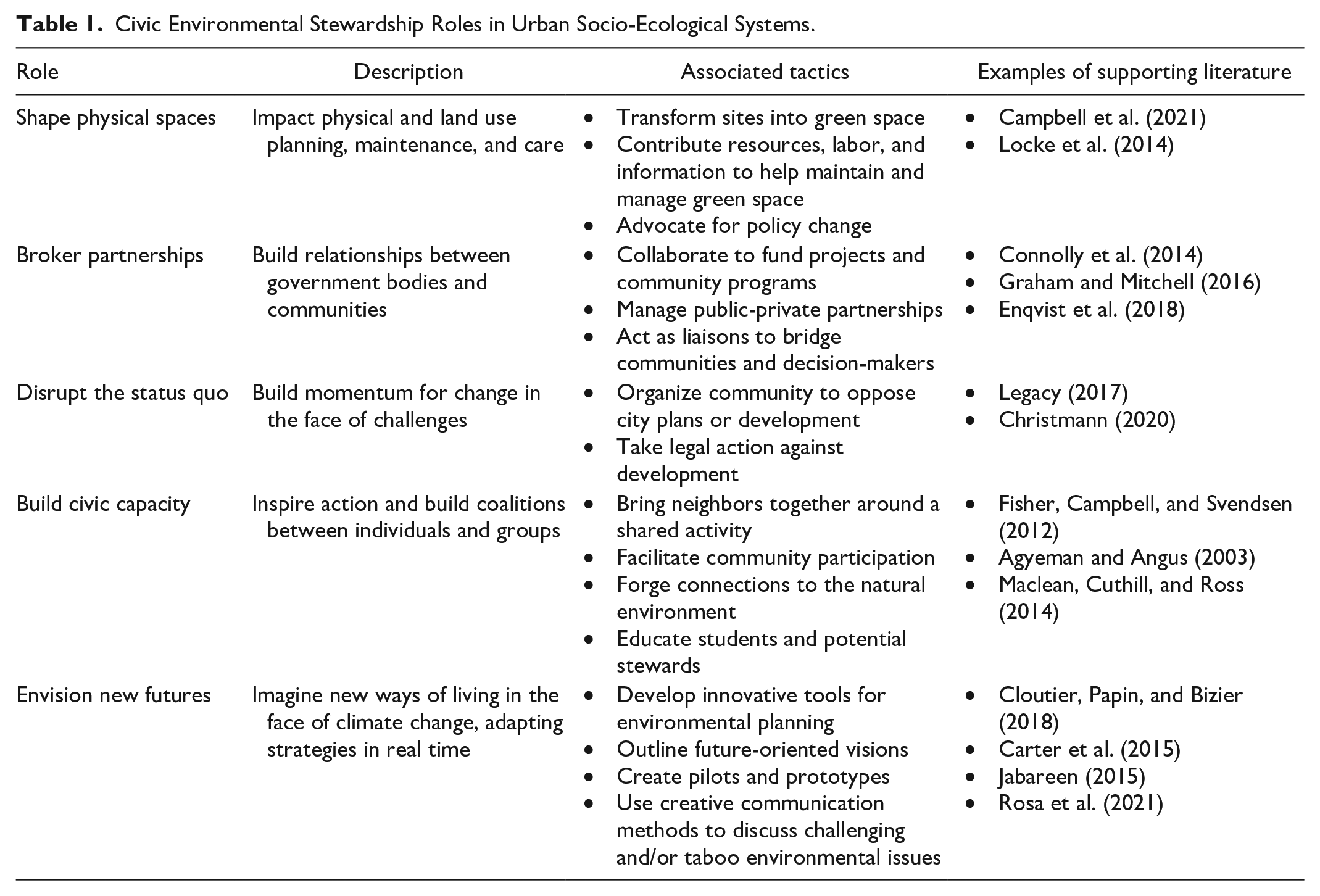
Upon transcribing the recorded interviews, we then coded transcripts for actions that each group took in response to a perceived problem, identifying a set of “tactics,” informed by grounded theory methodology (Strauss and Corbin 1994). From these interviews, we identified five roles: shaping physical spaces, brokering partnerships, disrupting the status quo, building civic capacity, and envisioning new futures. Here, we note that each group does not neatly fall into one category or another—depending on their tactics and scales, groups can (and often do) move through and between roles as they engage in transboundary urban governance.
Results
Using the literature as a framework, we identified several roles that stewardship groups play as they work to transform urban environments in the face of climate change (Table 1). While the work of respondent groups varies significantly in terms of scope and impact, the interviews illuminated the capacity of civic stewardship groups through a variety of actions and outcomes. The existence and persistence of these groups reveal a crucial source of local knowledge. These groups have vast potential as community-based partners to planners working in government and the private sector to advance climate adaptation. To demonstrate each role, we highlight a single illustrative case from our interviews. Although we write in detail about five groups as examples of the five roles, each of the twenty-six groups demonstrated at least one, and more often many, of the sixteen identified tactics that shape each role. Quotes that illustrate these tactics are presented in Table A1 (Supplementary Materials).
Civic Environmental Stewardship Roles in Urban Socio-Ecological Systems.
Shaping Physical Spaces
Stewardship groups contribute significant and direct capacity, labor, and time to the shaping and ongoing maintenance of green spaces. In addition, groups use advocacy to indirectly impact green spaces through plans and policies. Many stewardship groups commit time, personnel (including both paid and unpaid labor), and resources to ongoing care and maintenance that can have long-term benefits to the local environment.
Formed by a small group of individuals in 2008 seeking to combine existing historic districts in the face of development, one civic stewardship group successfully built a coalition that advocated for the Riverside—West End Historic District Extension 1 designated in 2012 in Manhattan. Following completion of their goal, the efforts of the group shifted to focus on the ongoing beautification and care of their neighborhood, largely through environmental actions such as street tree maintenance. They helped launch the annual “Love Your Street Tree Day,” which now attracts people from all around the city to learn about proper street tree care and take home the necessary supplies to become street tree stewards in their own communities. As current conversations shift toward the impending impacts of climate change, community tree stewardship is one local response that has not only a direct biophysical impact on the performance of the urban forest, but also the potential to inspire further local engagement and action. The street tree stewardship encouraged by Love Your Street Tree Day helps to create more permeable land to both decrease combined sewer overflow (CSO) and absorb excess rainfall (Liu et al. 2014). One group member reflected, I can’t individually fix climate change, right . . . but these little grassroots local efforts, I feel like if enough of them are happening it’s a trickle effect up . . . and it makes one feel empowered because you . . . take action and you can see improvements on the very local level and so it is empowering especially when . . . the environmental challenges seem so overwhelming. (R27)
This example illustrates a group making a direct impact on the built and biophysical environment with the goal of positive environmental change and community empowerment. While their events are partially framed as a way to improve neighborhood quality of life and even local business performance through beautification, climate change is an essential underlying motivator. The group organizers equally promote the environmental benefits of cleaner air and reduced runoff that come from healthy tree beds. Though the biophysical impacts of these acts are relatively minor in terms of greenhouse gas reductions, their stewardship efforts can also be understood as playing a role in climate change mitigation. These individual actions contribute to broader patterns of caretaking as stewards share knowledge and resources that ripple throughout communities.
Brokering Partnerships with Government and Community Residents
Brokering partnerships is an essential stewardship role as civic groups often act as key boundary spanners in relationships between government and community, or between various community stakeholders. Stewardship groups have a variety of different relationships with government, from independent groups of neighbors to traditional public–private partnerships. Larger and more professionalized stewardship groups often mediate between government agencies that serve as land managers/funders and the constituents for whom those groups serve. Here, “brokers” are defined as being highly connected civic actors that play a bipartite role in the larger governance network (Connolly et al. 2014).
In 2002, one group of civic stewards shifted away from on-the-ground stewardship in community gardens and other public spaces to become a data and research-focused organization. To ensure that their research reaches decision-makers, the group engages in extensive community outreach and advocacy while maintaining a close relationship with government, particularly the New York City Department of Parks and Recreation (NYC Parks). Much of their work focuses on advocating for an increase in the budget for NYC Parks, thus benefiting the government agency. At the same time, the group advocates for New York City residents through projects like their Report Card on Parks, which evaluates and grades parks amenities, pushing on NYC Parks to invest in improvements. This tension and duality of supporting and also pushing back on a government agency is part of what makes a group into a broker (Connolly et al. 2013). This group often plays the role of mediator between the two—bringing the concerns of residents to NYC Parks and communicating progress and limitations of government progress back to their constituents. The relationship of the stewardship group to the government agency here is as crucial as their relationship to the communities they are serving. This triangle is illustrated well in a 2019 campaign called Play Fair. The campaign, led by the civic stewardship group in partnership with the New York League of Conservation Voters, and DC-37, the Park’s Workers Union, secured $44 million of new funding in the NYC Parks budget. This funding is essential to supporting the ongoing care and maintenance of open space in New York City—space that is vitally important to the city’s ability to cope with climate change impacts. Greenspace is a key part of the city’s approach to climate resiliency, specifically dealing with flood impacts (NYC Parks 2017). Since NYC Parks, as a mayoral controlled agency, cannot advocate for itself, the civic group sees itself as the voice of the agency as well as the voice of the community members. Being an independent non-profit also allows the group to speak out about the growing concern of the changing climate in New York City. This role of the broker highlights synergies with state planners, underscored by a representative’s view of the group as “a wonky planning organization at the end of the day” (R14).
Disrupting the Status Quo
Civic stewardship often builds momentum for change even in the face of political challenges or moments of tension between government actors and community members. As activists, scientists, and policymakers have come to understand that business-as-usual models will not be enough to avert a climate crisis, groups that disrupt the status quo are essential for pushing boundaries around climate planning practices, ensuring that community voices are heard. Stewardship groups act as disruptors through community organizing, legal action, guerilla greening (unauthorized planting and care), and movement building.
One STEW-MAP respondent group stands out as disrupting the status quo. The group is a coalition of community gardens in the Lower East Side of Manhattan that advocates for permanent community gardens and increased public green space. The coalition works to unite the whole neighborhood against future garden demolition and responds to other threats to green space in the neighborhood as they arise. As one group member observed, “any green space is sort of sacred in this city ‘cause you’re never going to get it back once it’s gone and we just don’t have very much of it . . .” (R11).
Currently, one of those perceived threats is the redesign of East River Park, badly damaged in 2012 during Superstorm Sandy. Through the Rebuild by Design Effort (funded by public, civic, and private groups after Superstorm Sandy) city officials identified community groups on the Lower East Side to collaborate on the renovation. In 2018, the city announced that they would scrap the plan resulting from this process and replaced it with a different design and lengthier, pricier, process that would cover the existing park and eventually build another park on top. During that process, the fifty-eight acres of parkland would be closed and covered for at least three years, temporarily cutting off the community’s access to green and open space (Zhao 2021). The community garden coalition joined other local civic groups to express their frustration through marches and actions. A coalition of community groups spearheaded a lawsuit, East River Park Action (ERPA) et al. v City of New York, citing multiple concerns including the razing of existing green space and the loss of substantial mature tree canopy that would cause increased construction pollution in an area already vulnerable to poor air quality (https://eastriverparkaction.org/lawsuit). The petition was denied in 2020, and the denial of petition was affirmed in 2021, but a phased construction plan was adopted to keep parts of the park open during construction. Construction has since begun, with a goal of completion by 2025. Opponents are skeptical that the construction will finish in time. They worry about the interim impact on the already vulnerable neighboring communities and view the plan as a tool of green gentrification. Others, including some local NYCHA public housing residents, argue that the disruptive tactics of ERPA are delaying necessary flood protection that is too important to challenge (Helmore 2021). While highly contentious, this example shows the potentially conflicting goals of long-term climate protection and continuous community access to vital green space, particularly during the time of capital construction. Still, this case shows the power of community groups to alter construction plans and timelines significantly and to raise key questions about how climate adaptation should proceed.
Building Civic Capacity within Communities
Engaging community at the local level is essential to building the civic capacity necessary for effective climate governance. In addition to improving environmental outcomes, stewardship groups activate spaces as social infrastructure, fostering community cohesion, and building social networks (Campbell et al. 2021). STEW-MAP interview respondents reflected on a variety of social outcomes, from providing interpersonal interaction for retired residents to teaching civic engagement skills to students. In line with previous scholarship that underscores how stewardship fosters social resilience (McMillen et al. 2016), these relational outcomes compound to build social infrastructure recognized as increasingly important in the face of climate-related disasters (Klinenberg 2018).
One group that engages in the stewardship of New York City parkland was interested in how to best connect to community members to engage them in greening work. As part of a project with Hester Street Collaborative, they developed Park-as-Lab, a research collaborative that uses the natural landscape of the park as a research lab to investigate questions from community members. This project led to the development of a collaborative tool to collect ideas from individuals at community meetings on what they would be interested in learning from the researchers who work on the park. The tool allows them to share a concern or curiosity, which can then be explored by employees and local students. Rather than a training model that instructs stewards on how to care for the environment, Park-as-Lab encourages students and community members to explore their city and ask their own questions to get involved with environmental action. Reflecting on their hopes for the future of stewardship in New York City, one group member commented, I would love to see all of us in our own ways begin to take on active stewardship, whether that’s on our block or in our neighborhoods or in our city as a whole to scold and educate our friends and family when we see them littering on the street, to remind people why it’s important not to step in the tree pit, to getting them to want to have more on-the-water access, to want to go into their parks and natural areas and to get them to work together in doing so, to get them to actually build the social community by building this stewardship community. (R4)
As urban climate governance efforts struggle to achieve robust and sustained civic engagement, Park-as-Lab offers a model for community-led research that could work at many points along the planning process. This kind of community engagement plays a vital role in addressing climate change by creating pathways for climate education, supporting authentic, community-led inquiry, and promoting environmental action.
Envision New Futures
To envision new futures, civic stewardship groups act as creative forces that help imagine urban environmental and social change. This role draws on literature centering participatory foresight, as recent work highlights the importance of future-oriented citizen dialogues to define local goals and priorities (Rosa et al. 2021; van den Ende et al. 2021). Stewardship groups have a unique relationship with the places they steward, bringing local ecological knowledge and insight to the planning process. Even groups that lack the resources or power to implement their ideas often contribute novel insights to the conversation through art, publications, and public programming. Through these efforts, groups contribute to broader “civic narratives” that prioritize and make visible local scale climate adaptation (Cloutier, Papin, and Bizier 2018).
One community-based organization working to improve an industrial waterway and Superfund site that separates Brooklyn and Queens created a complete vision plan in 2018. The resulting 150-page document includes eighty-five proposed projects that support the organization’s mission of remediation, restoration, recreation, and resilience. Working with a design firm and another civic stewardship group as partners, this group created a collaborative action plan that responds to community and environmental concerns. A group member explained the future-oriented nature of the vision plan: “Those are long timelines but in 20+ years, what are other ways . . . that we want to see improvements around the area aside from just cleaning it” (R12).
Much of their vision plan focuses on climate vulnerability, due in large part to the site’s position within a flood zone. The plan proposes a series of adaptations to help absorb stormwater, reduce the impact of heatwaves, and improve air quality. Unlike government planners, however, this civic stewardship group was not commissioned by an organization with the financial and political resources to make this plan a reality. Instead, they created the plan to push forward future conversations and to offer decision-makers a template for improving the waterway. This is one example in which a civic stewardship group took steps to envision new possible futures, contributing a future-oriented perspective to inform development.
Discussion and Conclusion
This paper illustrates a diverse set of roles that embed civic stewards within urban planning and governance processes. By highlighting these distinct, yet overlapping roles, we illustrate the ways civic stewards are acting and have the capacity to further engage as key players in urban climate governance efforts. As civic stewards (1) shape physical spaces, (2) broker partnerships, (3) disrupt the status quo, (4) build civic capacity, and (5) envision new futures, these groups offer unique contributions that might integrate with the work of government planners to help adapt to growing climate impacts by strengthening participatory processes. Because we only interviewed civic groups, we acknowledge that a limitation of the study is that we do not include other actors in the governance network—neither public agencies nor private sector firms—about their perspectives on the role of and collaboration with civic groups. This remains an area for further research, but we pose that it is still a critical starting point and previously understudied area of research to analyze civic groups’ reflections on their own role in governance system.
Civic groups that shape physical spaces help to create and maintain green spaces that provide valuable ecological services. Groups that broker partnerships work together with their communities and government entities, typically on a city-wide scale, using collaboration as a tactic to reach their goals. Our interviews highlight groups that play a role in city governance, working directly with NYC Parks—the largest public land manager in the city—to achieve community goals. In building civic capacity, civic stewards leverage their community connections to valuable local knowledge and social capital. Groups that disrupt the status quo play the important role of pushing back on existing projects and plans, and often move boundaries on what government actors and professional planners see as possible. Groups that envision new futures innovate in response to disturbance in real time, often leveraging creativity to imagine and create change in response to urban problems. These roles range from more physical or “hands-on” to more social and ideological, as civic stewards engage in visioning, innovation, and trust-building within their communities. While local-scale, physical changes are necessary to adapt to the intensifying impacts of climate change, it is likely that even in aggregate they will be insufficient to mitigate the climate crisis (Salvia et al. 2021). As scholars look to more transformative pathways, reimagining urban spaces, pushing boundaries, and empowering communities become invaluable roles for stewards.
Here, we return to the potential for civic stewards to push forward urban transformations in the face of climate change. Finn, Chandrasekhar, and Xiao (2019, 3) illustrate how in response to disasters like 2012 Superstorm Sandy, planners “help coordinate among disparate stakeholders, work across professional and jurisdictional silos, and negotiate the complexity of recovery.” Civic stewards complement this existing work. We note an important distinction between government planners and civic stewards, as stewards often have greater opportunity, insider knowledge, and community roots to engage in capacity building and the leveraging of social capital. While often more equipped with funding and political resources than civic groups, government planners might face institutional barriers to innovation (Lachapelle, McCool, and Patterson 2003). Civic stewards, on the other hand, might have more freedom from bureaucracy, including opportunities to test out innovative approaches, advocate for policy and funding, or to cross defined neighborhood, borough, or city borders to work on broad systems-level issues. We see this specifically as civic stewards engage in disruption of the status quo. This may not take the form of “partnership,” instead highlighting tensions, but is often necessary to reach shared goals. Buijs et al. (2019, 53) describe this relationship between citizens and local governments as “mosaic governance” and argue for its transformative potential in building a “green, just and democratic city.” Others have acknowledged conflict in the face of social innovation as often necessary to achieve progress (Christmann 2020).
When working in partnership, government planners and civic stewardship groups are well-positioned to combat climate change by identifying existing synergies between planning goals and existing stewardship efforts, bolstering civic engagement, and sharing knowledge. As experts in the field, planners can translate ideas to action— Stults and Woodruff (2017) caution that climate adaptation plans may face challenges coming to fruition without specific implementation guidance. While civic stewards may draw inspiration from local knowledge, government planners can bolster this with evidence-based guidance and advocacy (Mitchell and Graham 2020).
The roles that civic stewards play in socio-ecological systems build flexibility and adaptiveness into existing governance arrangements (Connolly et al. 2013). While some groups may move between multiple roles and use different tactics depending on the project, others work more narrowly in a specific role. One thing these groups have in common is their potential to increase social resilience. When stewards get together to improve or defend the spaces they care about, they build social ties that play a key role in responding to environmental change (McMillen et al. 2016). Through their ability to build community trust and cohesion, civic stewards can work to build social capital in ways outside the capacity of government planners. Resilience planning in New York City currently focuses heavily on coastal adaptation and the effects of sea-level rise, but social resilience may be even more critical for adaptation to other climate events, including extreme heat days and precipitation events (Berry and Richardson 2016; Highfield, Peacock, and Van Zandt 2014). While this paper focuses on urban climate governance, civic stewards engage in roles that intersect with other community planning efforts.
In this paper, we illuminate the roles and tactics through which civic stewards can engage with local government planners to push forward efforts toward climate adaptation and resiliency. By highlighting both tensions and opportunities for partnership between the work of government planners and civic stewards, we suggest that scholars think critically about how we might continue to move beyond “token” models of participatory planning to facilitate coordination, cooperation, and eventually knowledge co-production between communities, stewards, and planners. As climate change presents numerous new problems requiring innovative solutions, civic stewards are essential actors engaged in the work of governance and urban change.
Supplemental Material
sj-docx-1-jpe-10.1177_0739456X221104010 – Supplemental material for Civic Stewardship and Urban Climate Governance: Opportunities for Transboundary Planning
Supplemental material, sj-docx-1-jpe-10.1177_0739456X221104010 for Civic Stewardship and Urban Climate Governance: Opportunities for Transboundary Planning by Holly Caggiano, Laura F. Landau, Lindsay K. Campbell, Michelle L. Johnson and Erika S. Svendsen in Journal of Planning Education and Research
Supplemental Material
sj-docx-2-jpe-10.1177_0739456X221104010 – Supplemental material for Civic Stewardship and Urban Climate Governance: Opportunities for Transboundary Planning
Supplemental material, sj-docx-2-jpe-10.1177_0739456X221104010 for Civic Stewardship and Urban Climate Governance: Opportunities for Transboundary Planning by Holly Caggiano, Laura F. Landau, Lindsay K. Campbell, Michelle L. Johnson and Erika S. Svendsen in Journal of Planning Education and Research
Footnotes
Acknowledgements
We extend our gratitude to the civic stewards who took the time to speak with us and share their insights. We also thank Keith Nislow and Beth Larry for feedback on an early version of the manuscript, the anonymous reviewers for their thorough and thoughtful reviews, and Rutgers University’s Center for Resilient Landscapes for facilitating this collaboration.
Declaration of Conflicting Interests
The author(s) declared no potential conflicts of interest with respect to the research, authorship, and/or publication of this article.
Funding
The author(s) disclosed receipt of the following financial support for the research, authorship, and/or publication of this article: This research was supported by the U.S. Department of Agriculture, Forest Service.

Supplemental Material
Supplemental material for this article is available online.
Author Biographies
References
Supplementary Material
Please find the following supplemental material available below.
For Open Access articles published under a Creative Commons License, all supplemental material carries the same license as the article it is associated with.
For non-Open Access articles published, all supplemental material carries a non-exclusive license, and permission requests for re-use of supplemental material or any part of supplemental material shall be sent directly to the copyright owner as specified in the copyright notice associated with the article.
