




Abstract
Two large-scale environmental disasters in Assam's easternmost district Tinsukia, raised great passion and held much traction in local print, electronic and social media platforms in 2020. The National Board for Wildlife (NBWL) granted post-facto approval for opencast mining in Saleki Proposed Reserved Forest (PRF) under Dehing-Patkai Elephant Reserve in Assam. Later, the public sector company, Oil India Limited (OIL) reported a gas leak in Baghjan that resulted in a major blowout resulting in deaths and displacement in the area. In this article, we argue that these events constitute a tragic outcome of decades of appropriation of natural resources by the oil, tea and coal industry all of which depend on obsolete technologies of extraction. We focus on how this is happening in a place that has several disaffected, marginalised people who once relied on agriculture for their livelihoods. We argue that these two events are not aberrations in the global narrative of inter-governmental concerns for climate change. Instead, we believe that they are part of a global template of re-colonisation that continued long after the formal transfers of power that occurred in Africa and Asia in the 20th century.
Introduction
Since the Novel Coronavirus induced lockdown in India commenced in phases around the end of March 2020, two environmental disasters in Assam's easternmost district Tinsukia raised great passion and held much traction in local print, electronic and social media platforms. On May 24, 2020 reports in local print media alluded to the National Board for Wildlife (NBWL) granting post-facto approval for opencast mining in Saleki Proposed Reserved Forest (PRF) under Dehing-Patkai Elephant Reserve in Assam. Barely three days later, on May 27, 2020 the Public Sector Undertaking (PSU) company, Oil India Limited (OIL) reported that one of their wells had developed a gas leak in Baghjan, which then resulted in a major blowout killing two firefighters and displaced thousands of villagers and workers from neighbouring tea plantations on June 9, 2020. Baghjan, one needs to mention at the outset, is perilously close to the famed Dibru-Saikhowa National Park. Since then, public anger and advocacy on these two events have resulted in the government upgrading the status of Dehing Patkai to that of a national park on December 13, 2020 and raised hopes that this will help preserve the ecological sanctity of the area.
In this article, we argue that these events constitute a tragic outcome of decades of appropriation of natural resources by the oil, tea, and coal industry all of which depend on obsolete technologies of extraction. We focus on how this is happening in a place that has several disaffected, marginalised people who once relied on agriculture for their livelihoods. As a social anthropologist (Barbora) and a geologist (Phukan), we draw on our personal and professional experiences of having lived and conducted research in the area. We have worked with workers and managements of the tea, oil, and coal industry, as well as documented human rights violations in the area since the first decade of the 21st century. We mine this experience to explain the underlying factors that have caused these events. The government's earlier acquiescence to commercial interests in allowing for opencast mining, as well the blowout in Baghjan symbolise a 19th century style environment that nurtured colonialism and capitalist expansion. It would seem at odds with growing concerns with global warming and climate change across the world.
These two events in Tinsukia are not aberrations in the global narrative of inter-governmental concerns for climate change. Instead, we believe that they are part of a global template of re-colonisation that continued long after the formal transfers of power that occurred in Africa and Asia in the 20th century.
Tinsukia district has a long history of supporting extractive industries that include tea, coal, oil, timber, and plywood. However, timber and plywood industries of the district came to a grinding halt after the Supreme Court of India's complete ban on timber logging in the year 1996. Till then it was a major industry of the district. Tinsukia town flourished around a railhead junction from where the extractive industries found its way to the other parts of the country and abroad. The biodiversity hotspots, Dibru Saikhowa and the Patkai rainforest belt, constitute a fringe part of Mizoram-Manipur-Kachin subtropical rainforest belt. Furthermore, the district has a high population density, with migrants and emigrants moving in and out in search of work and livelihoods. These three elements: (a) extractive industry, (b) ecological biodiversity, and (c) migration co-exist in an area that has been heavily militarised since the past several decades (MASS et al., 2012). With a population density of 350 persons per square kilometre and almost 35% of the district's total geographical area (3,79,000 hectares) under forest cover (Census of India, 2012), one might argue that it is one of world's most densely populated biodiversity areas. Three crucial industrial activities – tea plantations, oil drilling sites, and collieries – that epitomised 19th and 20th century colonialism, are layered into this energised landscape. In the following sections of this essay, we explain just how this history remains an integral component in any attempt to address future mitigative strategies in the area.
Tinsukia is emblematic of the kind of capitalist frontier that anthropologist Anna Lowenhaupt Tsing describes in her work on the blurring of lines between capitalist development, militarisation, and resistance in Kalimantan (Indonesia) during the height of President Suharto's rule (Tsing, 2004). As in Kalimantan in the 1980s, Tinsukia district is a place where extractive industries had tacitly encouraged structural violence to ensure the easy coexistence of capitalist profits and extra-constitutional violence. As Tsing so eloquently points out for Indonesia, big, abstract, and universalising ideas like development and progress have a debilitating impact on local ecologies and economies. This is even more pronounced in places like Tinsukia in Assam, where indigenous communities are confronted by more dominant and powerful forces. 1 But what does this do to the physical and social landscape on which such conflicts take place? How have mining and drilling played such a significant role in the devastating transformation of a landscape that some claim was fertile agricultural land inhabited by indigenous communities, while others claim was an underdeveloped frontier that was brought into the fold of global capital through a complex mix of technology and immigration?
We address these questions in four intricately connected sections, where we (a) explain how tea could be seen as a gateway crop that ushered in a period of colonisation of land and labour in the area; (b) look at the history of mining and drilling in the district, (c) describe the contentious social and political outcomes of expansion of drilling and plantations into rural paddy-growing areas, and (d) reflect on this layered history in the present day politics of Tinsukia (and by extension, large tracts of areas of the Brahmaputra valley where extractive industries continue to define lives and livelihoods of communities). While concluding, we dwell on how these events in Tinsukia are emblematic of a difficult future for a wide cross section of people in South Asia in general and India in particular.
Tea: coloniser's gateway crop
The story of tea in Assam has been well covered by historians (Griffiths, 1967; Guha, 1977; Sharma, 2011). Its founding stories have become the backdrop of many renowned novels and films about Assam. However, the narrative about Robert Bruce (a Scottish mercenary working for the East India Company) stumbling upon the plant in eastern Assam while he was raiding against the Burmese in 1823 is a problematic one. It erases the local use and consumption of the beverage among the Singpho people in eastern Assam by reproducing the idea of a pioneering European spirit of discovery. Incidentally, it was Robert's brother Charles, who later began the expansive plantation of tea around what is today the modern districts of Tinsukia and Dibrugarh a few years after the East India Company formally took control of the territory of the Ahom kings. 2 The Anglo-Burmese wars had resulted in the signing of the Treaty of Yandabu in 1826, thereby giving the Company greater control over land in the erstwhile domains of the Ahom king.
These narratives, for most part, look at the origins of the tea industry as though it was almost an accidental afterthought following the civil war in Assam and the subsequent Anglo-Burmese wars of the early 19th century. Far from it, the expansion of tea plantations in Assam was the result of concerted efforts by 19th century British merchants, mercenaries, and politicians to bring together stolen plants, colonise land, and import labour into a province they had come to control. Historians who have worked on the subject have linked the growth of Assam's tea plantations to Britain's contentious relations with imperial China, especially in the opium wars that led to large scale changes in Chinese society and the eventual colonisation of cities and ports in the eastern part of the country (Charrington-Hollins, 2020; Liu, 2010). It is therefore, difficult to uncouple this controversial history from contemporary accounts about tea, especially when the idea of theft of seeds, as well as colonisation of land and exploitation of labour is concerned.
The story of Robert Fortune, a Scottish plant hunter of the times, is an instructive one and embodies the complex political history of 19th century colonisation, industry, and contemporary anxieties about ecological threats and biopiracy. For Chinese historians of the tea trade, Fortune's stealth was one of the ways in which the British managed to take tea away from China and into India, while establishing a hierarchical control over scientific practices of the time (Fan, 2004, 2007). This has led to competing narratives about the Assam and Chinese tea, where the seemingly accidental encounter between Robert Bruce and the Singpho chief, Beesa Gam becomes an important trigger in the story of tea plantations in eastern Assam. Despite the competing claims, anthropologist Bengt Karlsson and tea scientist Bijoy Barbora reiterate that while tea might have been widely cultivated widely for centuries in China, much before it was ever grown commercially in Assam, the Assam variety of the tea plant was the one that thrived in the warmer Brahmaputra valley where it had developed autonomously from its Chinese relative (Drew, 2019; Karlsson, 2021). 3
Over the next few decades, the scramble for land to grow tea led to the expansion of colonial authority across the Brahmaputra valley. The colonial government helped European planters take control over vast tracts of land that were seemingly not cultivated by local farmers. Following its control over eastern Assam, the government enacted the Wasteland Rules on March 6, 1838 (and revised on October 23, 1854) to encourage Europeans to occupy vast swathes of land on forty-year lease, of which many were not required to pay rents for five- to twenty-five-year terms. Historian Amalendu Guha, in his classic work on Assam prior to the transfer of power in 1947, outlined the manner in which the government categorised the topography of wastelands under (a) open, (b) under reeds, and (c) forests (Guha, 1977: 12–15). This bureaucratic measure that Guha termed as ‘land grabbing’ involved extending the lease to 99 years to attract more European planters, and usurping lands that were used for seasonal swidden cultivation by indigenous communities. This was very effective in transforming the landscape in eastern Assam in the last quarter of the 19th century. It allowed planters to occupy 0.7 million acres of land, while using only 56 thousand acres – approximately 8 percent of the land allocated to them – to actually cultivate tea (Guha, 1977: 14–15).
The growing of tea in its plantation form was also a very labour-intensive affair. Historian Bodhisattva Kar writes about how the current form came to be, as individual planters decided to employ and coax indigenous tribespersons to work for them (Kar, 2016). He writes about three plantations – Namsang, Hukanjoorie, and Towrock – owned by the Assam Company in what is now Tinsukia district, where the resident planter decided that he would entice the local Naga chiefs and villagers with money and feasts to get them to work in the plantations (Kar, 2016: 49–50). While this worked for a while, allowing local indigenous communities to briefly participate in the expansion of capital and tea, Kar's reading of archival data shows how European planters and the colonial state quickly ended such practices. Instead of employing and cajoling local people to work in the plantations, the industry soon resorted to bringing in indentured labourers from other parts of the subcontinent and making them work in the plantations in completely dismal, unfree conditions that were implemented through strict penal laws and extra economic coercion (Behal, 2014).
The structure of the tea industry remained unchanged for a greater part of the 20th century. Large individual plantations were mostly worked upon by hundreds of workers – women and men – whose children did not have access to proper schools, infirmaries and hospitals. Trade unions in Assam's tea plantations were attached to political parties. The Assam Chah Mazdoor Sangha (ACMS) that represented most of the workers was affiliated to the Indian National Trade Union Congress (INTUC) that in turn was the trade union arm of the Indian National Congress party. After 1947, especially following the promulgation of Plantation Labour Act (PLA), 1951 that was meant for the welfare of the workers, ACMS was chosen as the only union that could negotiate with the immensely more powerful owners of the plantations in Assam. 4 The PLA was meant to provide some restitution as well as assure better working conditions for workers in the plantations in an effort to reverse the indignities of their indentured past. However, rather than reduce the gap between the management and workers, the trade unions for a variety of complex reasons chose to side with the management rather than the workers (Duara, 2017). From personal experience growing up in the industry in the 1980s, we were aware that some tea companies offered extraordinary benefits for a small section of managerial executives. Their children went to expensive schools and families of the managers were sent on expenses-paid holidays across the country and abroad. However, the social conditions of labourers remained in their Dickensian pre-colonial position with run down schools and little or no real social mobility.
The structure of the tea plantations in Assam began to change around the end of the 1980s, especially with the commencement of the Assam Agitation (1979–1985), when student protestors raised several issues regarding the asymmetric political and economic linkages prevalent in the industry. Assam, they pointed out, grew much of India's tea but the state did not get much revenue from the industry. The state earned very little in terms of taxes from the industry, while the bulk of the revenue went to places like Kolkata which was the headquarters of a majority of the tea companies and also the major tea auction centre in India. 5 The protestors therefore, demanded that large tea companies move their headquarters to Assam, as well as ensure that the tea auction centre in Guwahati receive more traffic in the trade of the commodity. 6 Estates that used to be seen as veritable fortresses that were out-of-bounds to non-planters and non-workers where the old colonial social lines rarely crossed, were also coming undone during this time. Local Assamese youth who had joined armed political groups were able to disrupt the existing hierarchies of the estate, commandeer material and finances from the management, and unsettle the idea that management were invincible.
This period also coincided with the growth of more confident native farmers in eastern Assam, who saw the possibility of growing tea in their homesteads as a means to enhance their income from agriculture. Since the 1990s, the Tea Board and government of Assam began to offer subsidies and agricultural income tax exemption to small tea growers who were cultivating up to 25 acres of land and employing family labour to grow tea. They were working towards a model that already existed in other countries like Kenya, where homestead farms outnumber large corporate estates at a 70:30 ratio. The situation in India currently is reversed, according to statistics from the Tea Board of India (Saha, 2020). While the idea of small tea growers had taken root among some sections of the Assamese middle class in the 1970s, it was only after external events had succeeded in dislodging the prominence of large estates in the procurement of tea leaves that others were persuaded to convert their non-paddy growing land into small tea farms. For a while, at least when the price of tea leaves was good, small tea growers did well. However, their fortunes were tied to a manufacturing process that was tilted against them. The factory owners, as well as those who packaged tea, made larger margins of profits leaving very little to those growing tea in their homesteads. By the late 2000s, the numbers of disillusioned small tea growers in eastern Assam (including Tinsukia district) had grown, leading to more social and political unrest as they held political parties responsible for not doing enough to support their enterprise. 7
Hence, the founding moment and growth of the tea industry involved the colonisation of vast tracts of land, theft of plants and seeds, and the extra economic coercion of people to work on the plantations. In contemporary terms, tea was the gateway crop that allowed for colonialism to mature in eastern Assam. In a landscape covered with forests, swamps, paddy fields, and geographically- isolated villages, tea rolled out a new regime that flattened differences and demanded greater access to land, labour, and capital. The mechanics of the industry demanded the availability of power to run the factories and transport the product from one corner of the empire to the metropolitan centres across the world. Therefore, the digging for coal and drilling for oil, were actually ancillary activities that later became autonomous to workings of the tea industry. Both digging and drilling had a profound effect on the social and geographical landscape of eastern Assam (and Tinsukia), as one can see in the subsequent section.
Mines and minerals: the story of oil and coal
The presence of coal in Assam was first reported by the British surveyor Lieutenant Wilcox in 1825. C.A. Bruce, the younger brother of Robert Bruce, explored coal in Assam as early as 1828 (Banerjee, 2005). In furthering this apocryphal occasion, one of Assam's longest serving colonial commissioners, Francis Jenkins opined, ‘It now becomes almost certain that we shall find very large supplies of this invaluable mineral on the south bank of the Brahmaputra’ (Jenkins, 1835: 704). The growing tea plantation industry created a demand for local extraction and supply of coal. The establishment of the Assam Company in 1838 enhanced the growth of the tea industry. A coal committee was set up in the year 1838 to report on actual deposit and quality of coal. Detailed geological exploration in the hilly terrains along the banks of the Burhi Dihing river was carried out by one of the early members of the Geological Survey, Henry Medlicott during 1864–1866. 8 Till then, the tea gardens mostly imported coals from Bengal to run their factories. The difficult conditions of transportation added very much to the cost of coal. The freight from Raniganj to eastern Assam raised the cost of coal more than ten times its value at the pithead (Mallet, 1876).
The Assam Company, which was engaged in the expansion and acquisition of tea plantation, began quarrying coal on their own in the Jeypore area on the banks of the Disang river as early as 1840. Major Hannay started two quarries in Jeypore area in 1847. John Berry White, a retired army brigadier and later the civil surgeon of the erstwhile Lakhimpur District, was considered to be one of the pioneers of the coal mining industry in Assam. He played a vital role in the discovery of coal in the Safrai valley (present day Tiru valley of Nagaland) in 1828 and also at Makum in 1865. He was practically the organiser of the scheme of opening a coalfield at Makum (Banerjee, 2005). The region around the present-day Margherita town was known to the British as Makum. The town grew with laying out of the railway tracts and the development of the coal mines. The coalfield around Margherita is still known as the Makum coalfield.
Like the tea industry in Assam, the coal industry around Margherita suffered from shortage of labour. The area was scantily populated and the local populations, mainly Naga communities, were not interested in working in coal mines. The British first considered tribal people of eastern and central India to be most suitable for the back-breaking work in coal mines. Many among them had already been recruited as workers in the neighbouring tea plantations. However, in the competition between the two industries, the coal lease owners finally decided to engage migrant labourers of the Gorkha or Nepali communities in the mines around Margherita (Gurung, 2003). The first contingent of Gorkha labourers was brought from Darjeeling by the Assam Railway and Trading Company without any contract as the importation of labourers from Darjeeling was prohibited by the Bengal Government of the time. They were recruited through a system known as the ‘Short Term Contract System’ under which the labourers were recruited temporarily for a period not exceeding one year. At the end of this period, they had to be repatriated at their employer's expenses. To bypass the prohibition placed on employing workers from Darjeeling, the company later recruited Gorkhas from a depot at the Indo-Nepal border at Gorakhpur, from where they were transported to the mines of Assam. Recruitment of Nepalese for coal mining stopped during the First World War and the Gorakhpur depot was closed in 1918, but resumed soon after in 1919 following an arrangement with the Government of Nepal (Sen, 2014). This infusion of people in the late 19th and early 20th centuries did not create immediate social tensions with the different communities – Moran, Ahom, Matak, Sutiya (who would self-identify as Assamese today) and Singpho – and Gorkhas in the district. However, it did lead to further search for more resources.
Lieutenant R. Wilcox, an army officer and geologist, observed the rise of petroleum from a coal seam on the Burhi Dihing riverbed at Shupkong in the year 1824. He also wrote in his reports that the neighbouring forests were full of odour of petroleum. During the construction of the Dibrugarh-Ledo railroad, oil seepages were discovered at Digboi in the year 1886. The first oil well was dug at Digboi in the year 1889. The Assam Oil Company was formed in 1899 in London and the Digboi refinery, Asia's first oil refinery was set up in the year 1901. In 1921, the Burmah Oil Company took over the management of Digboi oilfield. Oil exploration and drilling was limited to the region around Digboi during much of the colonial period. It's prospects and possibilities, though immense, were not as widely impacting as tea or coal, at least not until India gained independence in 1947. The early history of oil (and gas) exploration in the district was tied to similar ventures in Burma, where colonial authorities held out great hope for profits from both oil close ties with existing coal seams, because that was how colonial geologists sought to expand their drilling sites (Saikia, 2011).
Then, following nationalisation of oil, the Oil India Limited (OIL) was incorporated in 1959 as a joint venture between Burmah Oil Company and the Central Government of India. This joint venture resulted in the exploration and drilling two more sites in Naharkatiya and Moran, both of which are situated in the adjoining district of Dibrugarh. In 1981, OIL became a wholly-owned enterprise of government of India, which then controlled all the oilfields of Tinsukia and Dibrugarh districts. Simultaneously, government of India also created the Oil and Natural Gas Commission (ONGC) with technical support from the Soviet Union in 1956. In 1963, ONGC discovered oil and gas in Sibsagar district and established oilfields in Lakua, Gelekey, and Rudrasagar. It became public listed company in 1994.
The petroleum industry is not a labour-intensive industry like tea or coal. The growth of Assam's petroleum industry did not require importing labourers in huge numbers. Yet, unskilled locals, still not detached from the traditional agricultural practices, were not interested to work in the blue-collar jobs of oil companies, such as clearing forests and paddy fields for drilling. When ONGC initiated its operations in Sivasagar in the 1960s, they hardly found any people to engage in the blue-collar jobs. Being from the greater Sivasagar region, both of us have spent much time visiting family and friends in and around Gelekey, Namrup, and other areas where ONGC had started their work and were in need of daily wage labourers to help with clearing and mundane works. Our uncles and their friends were often called upon to help out but were not interested in doing so, since they were paddy farmers who disliked a break in the rhythm of their agricultural lives. The situation was so bad that police forces were engaged to forcefully pick youth from the surrounding villages for these jobs. These apocryphal stories were part of our youth and added to the charm of being connected to a place where big companies and their office going employees had to take the help of the police to force our elders to work for them. It diminished the status of the company and police in our eyes at the time (1990s), but the situation is quite different today as many youth are not averse to getting contracts and working for ONGC.
The oil companies did not face any significant resistance from the people people in expansion of oilfields till the 1980s. Armed movements for self-determination of the period identified the oil industry as an example of internal colonialism by the Indian state and its military and economic representatives (ULFA, 1996). Prior to this, especially after the transfer of power in 1947, many emerging middle-class Assamese saw the oil industry as a way out of their provincial existence. State funded universities in Guwahati and more specifically in Dibrugarh offered courses that were directly linked to training future engineers and geologists to join the oil industry (Barbora, 2018). During the same period, the management of the tea industry remained a largely European affair, with a small group on upper caste Indian people making an entry into middle levels of plantation management in tea. This situation changed considerably during the Assam agitation (1979–1985) and thereafter during the armed movement for self-determination, when many of the non-Assamese managers began to leave the tea industry. 9 Yet, during the same period, the management and skilled workers in the oil industry, as well as the miners of the coal industry were not as severely affected as their counterparts in tea.
OIL was long considered as an ‘Assamese PSU’ as it has its head office at Duliajan and most of its lower rank staffs have been traditionally from this region. 10 As traditional agricultural practices could no longer sustain increasing population and divided families, the youth started looking for jobs in oil companies. The spread of basic education also contributed to such aspirations. The preceding years marked the rise of Assamese nationalism manifested through some short-lived, but impactful movements like oil refinery movement and language movement, before it finally erupted violently during the Assam Agitation of the 1980s. The construction of an oil pipeline from eastern Assam to the Barauni refinery in Bihar in the 1960s and 1970s also contributed to rise of nationalistic struggles in the region. A sense of being alienated from their resources pervaded the sentiments of the youth from the Brahmaputra valley, especially in the districts where oil and gas explorations were going on at the time. People started realising that the natural resources of the state, viz., oil, tea, coal and timber were being exploited and exported from this region without any benefit to the people, thereby adding to the thesis of internal colonialism made by radical activists. Political organisations like the United Liberation Front of Assam (ULFA) took a similar view regarding the resources under public sector control of the state. In the year 1991, ULFA abducted 15 highly- ranked officials of ONGC and Coal India Limited (CIL) that included one Russian engineer named Sergei Grischenko. It resulted in the unfortunate killing of the engineer and an ONGC officer named TS Raju. This high drama ended in exchanging hostages. However, the Indian government soon started military operation in Assam (Operation Bajrang) that resulted in large-scale violations of human rights of ordinary rural people.
We segue at this stage to describe the outcome of drilling and digging around the land in the district. One needs to understand the kind of pressures that exist for large sections of the population who were engaged in subsistence agriculture and not involved in any major way in either the coal, or oil industry. As we mentioned earlier, both industries require different kinds of labour. For most of their regular operations, OIL and ONGC require skilled workers. When manual work is needed, they usually work through labour contractors who, until two decades ago, were hard to convince or come by since most had access to some cultivable land. Coal mining is also a seasonal activity that draws some numbers of unemployed youth from nearby, but again, both do not manage to employ the numbers of workers that exist in the tea plantation. Even so, the digging and drilling have had a tremendous impact on the landscape and people's livelihoods and the ongoing crisis around Baghjan has shown the same.
Expansion of drilling and digging into paddy lands: outcomes
Mining in the coalfields of Patkai Hills that border Tinsukia district is extremely difficult because of its complex geological structure. The coal seams are usually steeply inclined and fractured resulting in poor roof and floor conditions. They are extremely gassy, thereby increasing chances of disasters during mining activities. The Chief Inspector of Mines termed coalfields of Assam as being ‘where the worst natural conditions of all the coal mines in India have to be faced’ in the annual report in the year 1929. 11 In the latter part of the twentieth century, the oil and coal enterprises were incorporated into the public sector in India. However, for many middle-class commentators and political activists in Assam especially during the 1980s and thereafter, the sole purpose of these public sector entities was the continued exploitation of resources with little attention to employment and community welfare. In their search for resources, the oil enterprises started expanding exploitations into the paddy fields, reserve forests, wetlands, and rivers, flouting environmental norms, if any.
Environmental awareness among the educated people also rose during the 1980s and 1990s, a period that coincided with the Assam Agitation and autonomy movements. Many village communities and student organisations started resisting exploration and exploitation of oil. In 2016, OIL claimed that the company lost INR 50–60 crores every year due to bandh and road blockade. 12 Since then, OIL has been complaining almost every year that people's agitation programmes hampered production and exploration. It is a claim that is never substantiated with hard data that can be quantified, or even have its social underpinnings explained to a wider public. It exists like a proverbial reflex to any demand for social equity and justice. The company had to abandon the seismic survey on the bed of the river Brahmaputra only because of resistance from people in the year 2015. It was a major programme for identification of new oil reserves in the region. Most of the oil fields in eastern Assam are old now and close to being depleted. The oil companies desperately need new oilfields to sustain their expansion, which is specifically true for OIL as Assam is their traditional and main base for oil exploration and production. ONGC has huge production outside Assam in Bombay Offshore and Cambay basins. The company has been trying to scale down their activities in Assam for last several years. The central government has also begun to invite private companies to operate marginal and unprofitable oilfields of ONGC in Assam. For instance, the Canadian-registered Canoro Resources had taken 60% shares in the Amguri field (in Sivasagar district) from ONGC to set up a rig in 2006, only to leave five years later. While they were operating in Amguri, the company employed some local drivers and contractors, and rented apartments for exorbitant sums of money for the expatriate staff in neighbouring Jorhat town. In 2013, when they handed back the field to ONGC, they left behind many unemployed young men and bewildered houseowners looking to make some extra money. These new developments therefore fuel discontent and are reminiscent of the kind of disembodied, resentful societies that are left in the wake of carbon explorations here and in other parts of the world (cf. Kikon, 2019; Mitchell, 2011).
Coal India Ltd, a labour-intensive industry, employs a sizeable population of the Margherita region and did not suffer from people's resistance until it initiated surface mining in the Makum coalfield in the year 1985. Protests against surface coal mining started in the early 1980s when a group student from the Students Science Society, a Guwahati-based organisation, after fact-finding visits to the coalfield, raised concern about bad effects of opencast mines of Patkai Hills. They failed to draw mass support. However, the state government ordered an enquiry based on their report which was able to draw attention of much stronger organisations like All Assam Students Union (AASU), Asom Jatiyatabadi Yuba Chattra Parishad (AJYCP) (English: Assam Nationalist Youth and Students Council), and other local students and democratic rights organisation from eastern Assam. The Ministry of Environment and Forests of the central government also ordered enquiry. Succumbing to the pressure, the North Eastern Coalfields took some measures for eco-restoration of abandoned mine pits (Bhattacharjee, 2014).
In the year 2001, there was a massive landslide at No. 1 Malugaon near Ledo that brought down a school and several houses. Altogether, 38 families were displaced following the event. An organisation named Ledo Opencast Mining Protection Committee was formed. The resistance movement initiated by this organisation got extensive support from organisations of the indigenous communities of the area like Patkai Pahar People's Protection Committee (English: Patkai Hills Peoples Protection Committee) and Ledo Sonali Pather Porichalona Samiti (English: Ledo Bountiful Paddy Farm Management Committee). Although the movement failed to gain momentum, it helped in raising concerns of the local people against opencast mining. At the same time, the involvement of Tirap Autonomous District Council Demand Committee (TADCDC) and Patkai Pahar People's Protection Committee also widened the dimension of the movement. TADCDC has been demanding for the formation of Tirap Autonomous District Council covering areas of Tirap, Makum, Buridihing and also the adjacent places of Margherita and Digboi Legislative Assembly constituency of eastern Assam (Bhattacharjee, 2014).
Again, it needs reiteration that indigenous communities in and around the district often articulate their political demands by mobilising for greater autonomy over their territory that are otherwise controlled by national PSU (that employ very few locals) and contractors from outside the region. Encroachment of land by migrant workers of the coal mines in their traditional territory, destruction of land by opencast mining, eviction of people from their own territory to clear land for opencast mines, etc. are some major issues behind such movements. Many small and local organisations such as Tribal Student's Federation and Ledo Sonali Pather Parichalona Samiti among others have also been protesting from time to time against opencast mining in the coalfield. The AJYCP called for total halt to opencast mining in the Makum coalfield. 13 On September 20, 2016, around 700 persons staged a demonstration in front of the Sub-Divisional Officer (Civil) office at Margherita against the NEC's proposed plan to start opencast mining at Baragolai. 14 The protest was organised by the Nagarik Suraksa Samiti (English: Committee for the Protection of Citizens). They said that proposed mine would render many families homeless.
There are many instances of such protests. However, all these protests movements against opencast mining in the Makum coalfield area are rather isolated and short-lived, as activists tire or are drawn away from their campaigns against their bigger adversaries. Moreover, until recently, the distance between Tinsukia and urban centres like Guwahati, meant that these campaigns did not receive wider coverage in the media. In recent years, illegal coal mining by private parties around the Makum coalfield has raised many concerns from people as well as environmental groups. The issue of illegal coal mining had gone to an extent that the spokesperson of Assam Pradesh Congress Committee (APCC) lodged an FIR against the Officer-in-Charge of Margherita Police Station for issuing forged transit pass and facilitating movement of illegal coal-laden trucks on June 20, 2020. 15 These smaller, localised struggles have received better traction in social media in recent times, especially during the pandemic.
Outcomes of extraction in 20th century Tinsukia
As alluded to in the earlier paragraphs, Tinsukia is a relatively average-sized district when compared to the rest of India. However, its location plays a central part in understanding why it is such an important place. The district is bordered by the Brahmaputra river to the north, the foothills of the Patkai range (Arunachal Pradesh) and Sivasagar District to its south, the adjacent district of Dibrugarh to the west and the Lohit valley of Arunachal Pradesh to the east. The Dibru-Saikhowa National Park is located on the northern side, sharing a landscape that was shaped by the Brahmaputra river and Lohit river, as well as the earthquake of 1950 that raised the riverbed and changed its course. This land is prime agricultural land that is also the site of hundreds of oil wells. The Dehing-Patkai Elephant Reserve (part of the Patkai rainforest belt) is located along the southern and western axis of the district, which is roughly along the same belt as the Digboi oilfield (the oldest oilfield of Asia, and the oldest continuously producing oilfield in the world since the year 1866), collieries of Makum coalfield, and myriads of tea plantations.
There is a lot that has happened in this geologically and politically layered district. While we explored the history of digging, drilling, and plucking as essential activities of the coal, oil and tea industries respectively in the previous sections, we also wish to lay out the contentious grounds on which these industries exist today. Since the 1980s, Tinsukia has seen political mobilisation that combined elements of both class and identity politics. For media professionals, bureaucrats, and counter-insurgency experts, the district was seen as a fertile recruiting ground for independentist armed organisations, like ULFA (Routray, 2003). Others, like political scientist Sanjib Baruah described Tinsukia as a place ‘… where ULFA's thesis that natural resources are being sucked out to the rest of India in classical colonial relationship is more plausible’ (Baruah, 2007: 47).
As a testimony to the bustling economic activities that go on in Tinsukia, the town itself is full of new stores and shops that sell branded footwear, clothes, and other consumer goods. Much of the economic activity on the main road's shops are carried out by Hindi-speaking persons and their families. 16 Many of them had migrated to the town decades ago and continue to thrive. The neighbouring townships, like Makum and Digboi were also home to older migrants of Chinese origin, as well as from other parts of the world, as they came to establish the tea and oil industries. Tinsukia town still has a crumbling Chinapatty (Chinese quarter), along the Makum road. Since the 1990s, newer areas have developed adjacent to the old centre of town in order to provide housing to an emerging middle-class population (Baruah and Gogoi, 2017).
During the 1980s and 1990s, when the radical independentist movement led by ULFA was at its peak, many of the industries were forced to pay some form of tax to the organisation. This is documented in several media reports from the time, as well as events that took place thereafter. In 1990, executives of the Hindustan Level Limitedowned plantations in Doomdooma were airlifted from their homes to Calcutta with the help of the army and air force since their company had been threatened by ULFA for not having paid taxes (Hazarika, 1994). In eliciting support from the security forces, the tea company had completely sidelined the local administration in Assam. This then compelled the government of Assam to assuage the insecurities felt by the tea industry by raising a paramilitary militia called the Assam Tea Plantation Protection Force (ATPPF), who were meant to look after the security of the executives of the tea industry. The ATPPF was used as personal security guards to the managers and many were held responsible for the deaths of several workers in the plantations (MASS, 2000).
Outside the plantations, the Indian army had begun operations against ULFA and their alleged sympathisers in the villages of the district. This resulted in several documented instances of human rights violations in the district and across the state. The army was accused of conducting excesses during search operations. This included sexual violence against women, as well as torture and led to radicalisation of young people, who were already feeling left out of the activities of the extractive industries in the area (MASS, 2000). Despite the presence of many extractive industries, Tinsukia does not have too many employment opportunities for young women and men (a fact that we discuss in the third section). With oil requiring specialised skills, coal mining being regulated by the state and illegal private contractors, and the tea industry showing diminishing returns, many youth are forced to either leave as migrants or compete for the scarce employment opportunities that may arise. With incomes from farming receding every decade since the turn of the century, the situation is rife for unscrupulous politicians to play up ethnic divisions in order to garner votes and establish their foothold over communities in order to participate and win in parliamentary and state assembly elections.
In 2003, ethnic antagonisms came to fore when Hindi-speaking persons were attacked by armed vigilantes in Tinsukia and Dibrugarh districts of eastern Assam. Many Hindi-speaking persons were killed and even more took flight. However, this also elicited a predictable response from the military establishment, who began to target ethnic Assamese villages. Their campaign of terror culminated in the murder of a young man, Ajit Mahanta, in February 2006. When the people of Kakopathar area began to protest against the army's unwarranted and arbitrary murder of Ajit Mahanta, the paramilitary forces – Central Reserve Police Force – shot at and killed 10 protestors in cold blood. It is this kind of impunity that might explain the growing alienation of the local people. Tinsukia (and its adjacent district of Dibrugarh) had been the traditional base of the 28th Battalion of ULFA. It is this unit that had consistently engaged the Indian security forces in combat. However, two of the three companies of the battalion declared a unilateral ceasefire in June 2008. Their commander, Mrinal Hazarika, led them into an uneasy ceasefire that was further strengthened by the formalisation of peace initiatives by the pro-talks section of ULFA, led by its chairman Arabinda Rajkhowa in 2010 and 2011. Despite the ongoing peace talks, there is a considerable section of the local populace who are resentful of the continuing indignities that they have been subjected to (MASS et al., 2012).
In January 2012, we were part of a citizen's fact-finding team that conducted an inquiry into the deaths of three young men who were killed by the army. The three young men were Siva Moran (24) of Dighalihati village, his cousin Janak Moran (21), and Janak's friend Dhiraj Duara (21) of Motapung village, who were out on a joyride on December 26, 2011 when they were gunned down by the Maratha Light Infantry personnel operating inside neighbouring Arunachal Pradesh. 17 Most deaths caused by egregious use of armed force are passed off as encounters – a term used for extra-judicial executions by the police, paramilitary and army in India – where the state agencies claim that they were engaging counterinsurgency operations. However, as we went around the district to try and piece together why the three young men were killed, it was evident that the official narrative of an encounter was not supported by facts. Instead, one confronted an impoverished world of young men who were no longer able to stay home in order to earn a living. Instead, like Siva, they found themselves in different parts of the country – mainly in cities like Bengaluru – where they did unskilled work and when they finally returned were drawn into a world without prospects. Anthropologists Dolly Kikon and Bengt Karlsson in their nuanced research on the affective world of migrants from the region (including Tinsukia), drew a poignant picture of local exploitation and helplessness that followed young people all the way to spas and restaurants in south India and back (Kikon and Karlsson, 2019).
The security agencies and sections of the media claim that these conditions are conducive for the anti-talk faction of ULFA to mobilise support for its armed struggle. In addition, they also claim that Maoists from India have begun to mobilise among the local people, albeit with the help of the anti-talks ULFA faction. These are mere smoke screens that obscure the existing realities by encouraging baseless fear mongering. In the words of a police official who spoke to our fact-finding team team in 2012, ‘Maoists try to raise political consciousness of people’. 18 For him and his superiors, anyone who questions the status quo is suspected of being a Maoist or a member of the anti-talk faction of ULFA. It is therefore, easy for them to justify their use of violence against ordinary, hardworking, and beleaguered citizens by raising the Maoist/anti-talk ULFA threat perception that is most often amplified by certain media groups. As the deaths of the three innocent youth showed us, there is much more to such stories than meet the eye. Much of it is shrouded in bureaucratic mystery. However, for the local people of Tinsukia district, the intentions are quite obvious. A student activist of the All-Assam Moran Students Union told the team ‘(These deaths) are the result of an unholy nexus of all kinds of opportunists, led by the Indian army and sections of the civilian police, who then collude with surrendered militants to ensure that Tinsukia remains militarised’. 19 Lacking the means to investigate into the dealings of the armed forces, it would be reckless to level this accusation at them. However, there is something to be said about local perceptions, especially when those in power begin to think that they can conduct all forms of excess with absolute impunity. In such instances, the almost fantastic and improbable stories that are part of the local public sphere begin to take on a life of their own. In the absence of an impartial investigation into the incident, it is entirely possible that the three men were killed when they refused to comply with what was being demanded of them. On the other side of this narrative, lies an easy slippage into forms of violence for those who resist the extractive economy. They are, to paraphrase geographer Michael Watts's analytical description of the violence (by local communities) against large oil companies in the Niger Delta, an expression of insurgent resistance that is categorised as crime by the state, a pliant media and representatives of the extractive industries (Watts, 2007). In this case too, the court ruled against the Indian government's defence of the army's actions, stating that the killing of the young men was entirely avoidable.
Bearing the cost of Baghjan in the future
The map of Tinsukia, with its rivers, plantations, forests, coal seams and oil fields (Figure 1) actually offer a time-lapse account of an unfolding environmental disaster. In a little over 100 years, this relatively small district has become representative of a familiar cycle of extraction, exploitation, and militarisation of so-called resource frontiers. This process might be seamless from colonial conquest to current times, especially for local and transnational actors involved. In her commentary on the Baghjan blowout crisis, anthropologist Dolly Kikon alerted her readers to the poignant cost that local communities have had to bear for many decades of local, regional, and national elite's obsession with development that could only be derived from extractive industries in Assam (Kikon, 2020). We are in agreement with her assessment of the tragedies involved and see Baghjan as emblematic of a longer history of militarisation and lack of critical thinking around ecological, environmental, political, and economic concerns of local communities in Assam. In furthering this aspect, we sought to highlight certain similarities between Anna Tsing's descriptive account of 20th century capitalist expansion under authoritarian regimes in Indonesia and the ongoing contests over nature, resources, and human rights in Tinsukia district of Assam. Just as that period brought together an unlikely cast of characters to the Indonesian rainforests – some protecting, others plundering – an improbable ensemble of people, organisations, and agencies converged in the current debates about environmental concerns in Tinsukia. Since 1998 when General Suharto was forced to give up power, Indonesian politics has seen a raucous democratic transformation characterised by weaknesses in rule of law, bureaucratic corruption, and economic inequality (Tan, 2018). In the exact same period, Assam has experienced extra-judicial executions, peace negotiations between rebels and the government, frantic migration of young people from villages to cities, continued expansion of mining for oil and coal by the state and non-state contractors, and decline of incomes from farming.
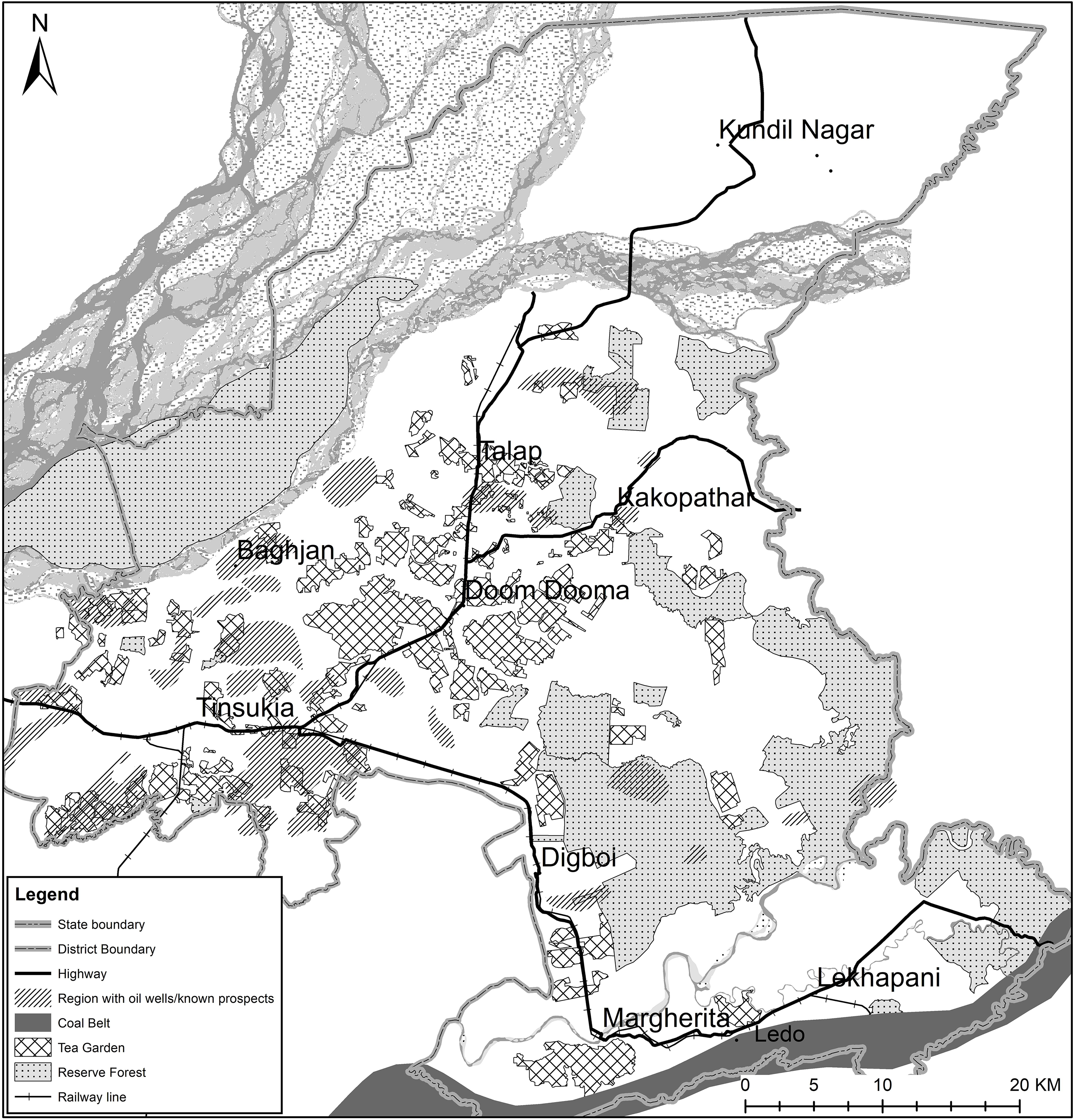
Contemporary resource map of Tinsukia (Map not to scale). © Sarat Phukan.
The pandemic of 2020 forced the time-lapse account of development to a brief halt, throwing a harsh spotlight on the incendiary context of the crisis in Tinsukia. At the heart of the matter lie entangled questions of growing social inequalities, underpinned by a long history of militarisation and feeling of dispossession by indigenous communities in the area. The government of Assam's remedial measures like announcing the formation of Dehing Patkai as a national park, as well as the legal obligations pressed upon OIL to follow through compensatory payments to those affected by the Baghjan tragedy, raise hope and despair in equal measure. Hope, because of the enormous interest raised by ordinary citizens during a time when they were atomised by pandemic-induced lockdowns, where seams of the conflict and violent history were dug out as evidence of corporate greed and governmental collusion. Despair, because none of the contentious history and complicated contemporary realities seem to have found their way into the responses of the state (including the Gauhati High Court), the public sector (OIL, ONGC and CIL), or the tea companies. The government's present response to the tragedies seem to erase this messy entanglement between extractive economic activities, growing authoritarianism of the state, and increasing helplessness of local farming communities.
Highlights
Recent ecological disasters in Tinsukia (Assam) are a result of colonial extractive policies.
Tea remains the principal extractive industry that began the 19th century transformation of the area leading to conflicts.
Environmental conflicts in Assam involve various ethnic groups, the state and tea, oil and coal industries.
Militarisation is a key factor in the persistence of extractive industries.
Footnotes
Acknowledgements
We wish to thank Dr Mabel D. Gergan for her generous comments on an earlier draft.We are grateful to Joel Rodrigues for his thorough reading of the paper, and to the three anonymous reviewers who pointed out strengths and shortcomings of earlier versions. The usual disclaimers apply.
Declaration of conflicting interests
The author declared no potential conflicts of interest with respect to the research, authorship, and/or publication of this article.
Funding
The author received no financial support for the research, authorship, and/or publication of this article.