




Abstract
Investigative reporting identifies social problems and names people in power who should be held accountable. Solutions journalism is an evidence-based reporting approach that covers credible responses to social problems. To consider these reporting approaches in tandem, this research uses a quantitative content analysis to examine both investigative and solutions reporting in an effort to determine to what extent a combined reporting approach of these two genres may already exist in journalistic practice.
Investigative reporting is enjoying a resurgence in the Trump era—and for good reason. Investigative reporters seek to use information that they have gathered through their own enterprise to draw attention to important stories—and often do so when people in power and authority have sought to keep the information hidden (Houston, 2009). The stories can be narrowly drawn—a single politician or CEO’s wrongdoing, for example—or examine the failure of systems in society—such as racial bias in law enforcement. Protess argues that investigative journalists throughout the decades have sought to hold people in power accountable, using evidence and revelation to bring about social change (in Shapiro, 2003). The resurgence of investigative reporting arrives with a renewed debate about what investigative journalists seek and should expect when it comes to generating impact or change with their work (Lowenstein, 2017).
At the same time, an increasing number of journalists and their news organizations are writing stories that illustrate how problems might be solved. In 2018, for example, The Guardian launched “The Upside” (Ciobanu, 2018), a series of stories that are “dedicated to accelerating entrepreneurial and innovative solutions to the world’s most pressing problems” (“About ‘the Upside,’” 2018). This kind of storytelling, which has ties to civic or public journalism, has various names, but in the United States, the practice is typically known as “solutions journalism”: An evidence-based reporting approach that covers credible responses to social problems (Solutions Journalism Network [SJN], 2018).
The foundation of this study is the argument that by combining an investigative and solutions reporting approach—using the rigor and techniques of investigative reporting to uncover and report on problem responses—journalism can create greater impact by putting pressure on leaders to solve problems and by showing readers that problems are not intractable. This study uses a content analysis to examine both investigative and solutions articles—a content, rather than production or effects, perspective of academic research—to determine to what extent this reporting approach of bringing together investigative reporting and solutions journalism may already exist in journalistic practice. From there, the data are used to propose a framework for a forward-thinking reporting approach that emphasizes response and accountability with the goal of generating journalistic impact through meaningful change.
Literature Review
Investigative Reporting
Kovach and Rosenstiel (2007) in their landmark work, The Elements of Journalism, argue that journalism is essential to a democracy: “The primary purpose of journalism is to provide citizens with the information they need to be free and self-governing” (p. 17). Journalism has a duty as a watchdog to call out elected leaders and others in authority and to push beyond simply exposing of problems: “Journalists must serve as an independent monitor of power” (Kovach & Rosenstiel, 2007, p. 171). Investigative reporting is, at its heart, watchdog journalism: It draws attention to social problems and wrongdoing by holding accountable people in power and authority, be they leaders in government, industry/corporations, nonprofit organizations, educational institutions, or elsewhere. Willnat and Weaver (2014), in their latest “American Journalist” survey, found that news professionals are more likely than ever before to cite investigative reporting values, such as scrutinizing government claims and analyzing complex problems, as critical journalistic values.
Investigative Reporters and Editors (IRE), a nonprofit journalism organization dedicated to fostering excellence in investigative journalism, defines the practice as “The reporting, through one’s own initiative and work product, of matters of importance to readers, viewers or listeners. In many cases, the subjects of the reporting wish the matters under scrutiny to remain undisclosed” (Awards FAQ, 2017). The definition has broadened to include reporting that reveals “the breakdown of social or justice systems” (Houston, 2009, p. v).
Investigative journalism relies on original work in the collection of evidence and on-the-ground reporting. It often pulls back the curtain, revealing information or patterns that would have otherwise remain concealed or unknown or hidden from the public (Houston, 2009). And investigative work often does so when people in power or authority seek to keep the information hidden (they may have concealed it by law or deliberately suppressed it) or when journalists have synthesized information from public records to reveal systematic problems (Abdenour, 2017).
Finally, investigative reporting must be in the public interest. Gaines (2008) shows that a common characteristic of Pulitzer prize–winning investigative stories is that they are “a matter of importance to the public well-being” (p. 2). Investigative reporting, in its watchdog role, identifies people in power or systems of authority who have failed to protect civic values, such as public health, public safety and welfare, justice, equal access, the public treasury, and the honesty and integrity of our civic leaders. Hamilton (2016) writes, “Told well, watchdog stories change public policies and lives” (p. 12).
Although a goal of investigative reporting is to produce change—and certainly many stories do just that—research also suggests that stories that point out only problems can leave readers anxious and unsure about how to respond, contributing to compassion fatigue and the sense that nothing can be done to combat the problem (see McIntyre, 2019). Recent research suggests that the constant barrage of negative news has negative psychological effects, including increased stress (Bethune & Lewan, 2017). These negative outcomes do not fit the drive of many investigative reporters to see their work have a positive impact.
At the same time, surveys show that American journalists have (Johnstone, Slawski, & Bowman, 1972; Kim & Meyer, 2005) and continue to support and value investigative reporting (Willnat & Weaver, 2014). Given the value of investigative reporting and the newsroom emphasis on the practice, discussions generating impact through investigative stories (Lowenstein, 2017) must also be examined through academic research.
Solutions Journalism
Solely uncovering problems does not fulfill the journalistic role in a democracy. Kovach and Rosenstiel (2007) argue news media have a duty to go beyond simply pointing out problems: The press should recognize where powerful institutions are working effectively as well as where they are not. How can the press purport to monitor the powerful if it does not illustrate successes as well as failures? Endless criticisms lose meaning, and the public has no basis for judging good from bad. (p. 174)
Similarly, Schudson (2011) argues that a foundational function of journalism is to investigate policies that work as well as policies that do not work.
One response to this challenge is solutions journalism. Although no academic definition of solutions journalism has emerged, recent scholarly research uses the SJN definition: A rigorous and fact-driven approach to reporting credible solutions to social problems (see, for example, Lough & McIntyre, 2018; McIntyre, 2019). Solutions stories include four attributes: a response to a well-established social problem, evidence of results, insights about why solutions work, and the limitations of success factors for possible response replication and response limitations (Thier, 2016). Solutions journalism distinguishes itself from advocacy as it does not seek to promote a particular political view or an agenda; rather, solutions reporting zeroes in on established and persistent social problems and uses traditional reporting methods to show ways in which these problems have been addressed (McIntyre, Lough, & Manzanares, 2018). Indeed, the “best” solutions journalism relies on the “rigor of investigative reporting” (Wenzel, Gerson, & Moreno, 2016, n.p.). Using investigative rigor to report on responses, “solutions journalism points out what’s right, hoping that someone can imitate it” (Benesch, 1998, p. 39). One of the earliest solutions stories was a 2001 investigative piece by Tina Rosenberg published in the New York Times Magazine about Brazil’s promising response to the AIDS crisis (Cole, 2015). Rosenberg later became a cofounder of SJN.
Recent research showed that print/online journalists themselves largely support the practice of solutions journalism (McIntyre, Dahmen, & Abdenour, 2018). A follow-up study showed that broadcast journalists also largely support the practice (Abdenour, McIntyre, & Dahmen, 2017).
The solutions reporting approach draws on previous efforts to reframe news to include solutions, thereby emphasizing journalism’s role in enhancing discourse and civic life: peace journalism of the 1960s and 1970s, which suggested conflict prevention as a news element, and civic or public journalism of the 1990s, which posited that reporters had a responsibility to help communities act on social problems (Wenzel et al., 2016). Rosen (1999) argues that the goal of this type of reporting and the civic journalism movement broadly is a news media that supports a “healthier public climate” (p. 4). Solutions journalism could be considered a form of contextual reporting, as it provides a more holistic portrayal of the world (McIntyre et al., 2018). Although solutions-focused stories “blossomed” in news coverage in the late 1990s (Benesch, 1998, p. 37), the creation of the nonprofit SJN in 2013 brought a new focus to this approach (Wenzel et al., 2016). By showcasing progress against seemingly intractable problems, solutions journalism can counter claims by officials that change is impossible. Rani (2017) outlines several examples, including (a) ongoing solutions-oriented coverage of education in Washington State by the Seattle Times through the donor-funded “Education Lab” project pushed the legislature in 2016 to pass a bill improving education for minorities, particularly in the area of discipline; (b) following a collaborative solutions-oriented project about homelessness produced by nearly 100 newsrooms, San Francisco adopted goals outlined in the series and the mayor announced a partnership with a tech CEO to end family homelessness; (c) in Minnesota, a Star Tribune solutions-journalism series about efforts to prevent the radicalization of Somali Muslim youth led the legislature to allocate US$2 million for youth programs; and (d) After a PBS Newshour segment on medical–legal partnerships, a lawyer for a major hospital chain advocated for similar programs in its hospitals nationally.
Stories that show readers the ways in which persistent, stubborn social problems can be addressed can inspire readers to spend more time with the stories, share the stories, seek out more stories on the same topic, and to feel optimistic about change and their own role in making their communities better (A. L. Curry & Hammonds, 2014; A. Curry, Stroud, & McGregor, 2016). Research also found that residents of one underresourced area, who were cynical about traditional news media coverage of their community, felt solutions-oriented stories inspired them to consider civic action (Wenzel et al., 2016). Another study found that although reading a solutions-oriented story led to more favorable feelings toward solutions to a problem, it did not affect readers’ behavioral intentions or actions (McIntyre, 2019). Although additional research about the effects of solutions journalism on audiences’ civic actions is needed, initial research suggests the potential value of solutions journalism for a functioning democracy in service of the public interest.
However, while solutions stories provide evidence of workable responses, solutions journalism does not put heat on leaders who have failed to act in the past or who need to take up solutions in the present (Benesch, 1998). As such, that can make a solutions story seem potentially overly optimistic, as if the response will simply happen on its own. In addition, many journalists worry that solutions reporting can be oversimplified or turn into puff pieces or promotional coverage (Benesch, 1998; Dyer, 2015). SJN, however, maintains that solutions stories increase accountability by “removing excuses and setting a bar for what citizens should expect from institutions or government” (SJN, 2018), but the claim has not been empirically tested.
Summary and Research Questions
Standing apart, investigative reporting and solutions journalism may seem quite different. Both investigative reporting and solutions journalism begin with a similar premise: A problem of civic consequence exists or persists, and without the heat and the light of news media attention the problem will not be resolved. The primary reason to seek to reveal in investigative reporting is to identify the ways in which people in power or authority are failing to do their jobs and that creates a meaningful consequence for individuals or communities. Although investigative reporting seeks to have impact, stories that only shine light on a problem without offering a solution can leave audiences with feeling of depression, stress, and inefficacy. Solutions journalism works off of a shared and informed understanding of the problem, thus illustrating Kovach and Rosenstiel’s (2007) argument that journalists have a duty to push beyond the exposure of problems. However, without the watchdog element of pointing fingers, a solutions story can appear overly optimistic or lack accountability. Given the value, mission, and limitations of both of these reporting methods, this study has as its overarching goal to broadly consider the ways in which investigative reporting and solutions journalism could combine to create a forward-thinking reporting approach for more effective stories in terms of rigorous reporting practices and tangible story impact. By combining an investigative and solutions reporting approach, journalism can put greater pressure on leaders to solve problems by showing readers that problems are not intractable. Specifically, this study seeks to understand the use and intersection of characteristics of investigative reporting and solutions journalism in existing news stories. Based on the exploratory nature of this study, following research questions are proposed:
Method
Sample
Study data were collected through a quantitative content analysis of 142 news articles (69 stories identified as investigative reporting and 73 stories identified as solutions journalism). Both Investigative Reporters & Editors and the SJN provide online databases of stories that they have identified as investigative reporting and solutions journalism, respectively. The IRE database lists more than 27,000 stories dating back to the 1970s (https://ire.org/resource-center/stories/). Stories from 2012 to 2016 are archived and available for IRE members to access; all stories were submitted for IRE awards (L. Grandestaff, personal communication, July 30, 2018). The SJN database lists more than 3,200 stories dating back to the 2000s (https://storytracker.solutionsjournalism.org). Stories are submitted to the database from three sources: stories from newsroom partnerships with SJN, stories submitted by members of the public, and stories found by SJN (S. McCann, personal communication, July 30, 2018).
The sample of news stories for analysis was collected from these two online resources. One hundred print/online stories from each database for the Calendar Year 2016 were selected using systematic random sampling. The researchers reviewed those stories in detail, removing stories from the sample for the following reasons: language other than English, multimedia dominant, or behind a paywall. After removing these stories, the final sample contained 142 print/online news articles (69 stories identified as investigative reporting and 73 stories identified as solutions journalism).
Coding protocol and content analysis measures
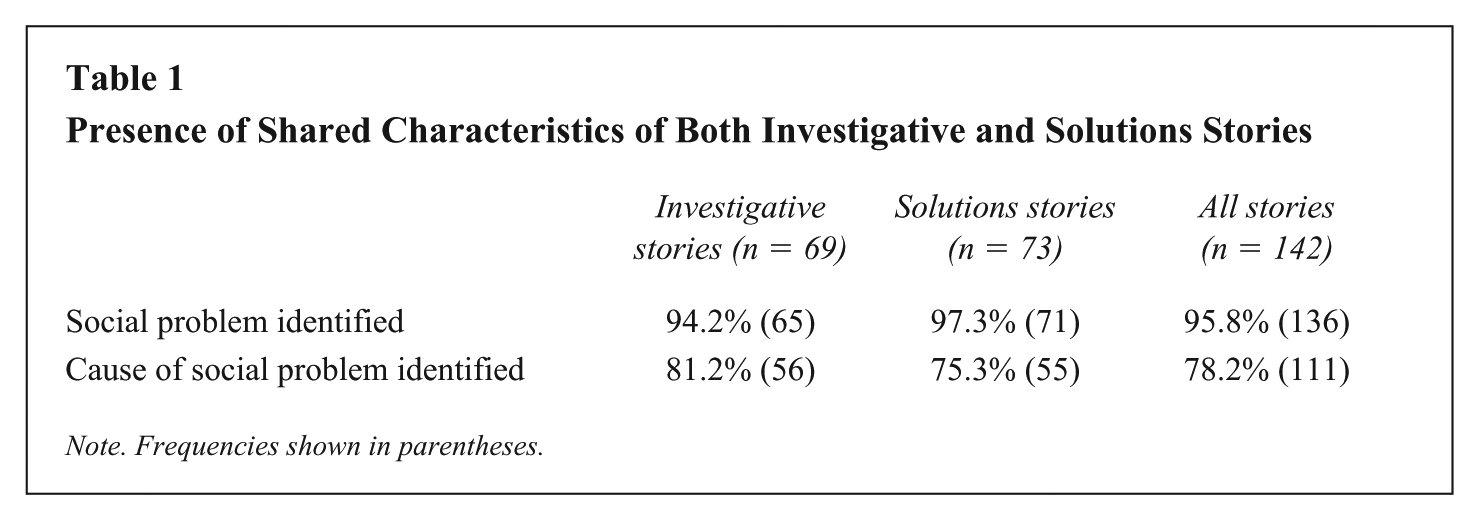
Each article represented a unit of analysis. Articles as a whole were coded for the presence or absence of specific measures. Measures were defined in a codebook; researchers developed the codebook based on academic literature and professional journalistic practice. All articles in the sample (n = 142) were coded for the presence or absence of two variables that literature showed to be relevant for both investigative reporting and solutions journalism (Houston, 2009; SJN, 2018):
Social problem identified: A social problem is defined as a problem that is generally acknowledged as an ongoing problem by most members of society, even if members disagree about causes, severity, and solutions
Cause of social problem identified: The cause is the driving force that created the problem that is affecting people in the community. Reporting must identify specific actions, decisions, or policies that directly contributed to or caused the identified problem.
Investigative reporting articles (n = 69) were coded for the presence or absence of five variables that literature showed to be the key characteristics of solutions journalism (McIntyre, 2019; SJN, 2018; Thier, 2016; Wenzel et al., 2016):
Associated response to social problem identified: Article clearly identifies not just a problem, but a specific action/plan/model that has been put in place to combat the problem.
How-to details of solution implementation: Article includes details of how specific responses actually work so that the reporting could be foundation for other communities to respond, too.
Evidence of results linked to the response: Article includes evidence, such as quantitative data from academic research, government or professional/nonprofit organizations, and/or qualitative data from the journalist’s own reporting, in the determination of what works (or does not work).
Limitations explained: Every response has caveats, limitations, and risks and the story must acknowledge these limitations.
Insight or teachable lesson: Insight addresses the “big picture” success factors, whereas the response is more detailed. The article should show the reader an insight about the solution that might be generalizable beyond the specific situation described in the story.
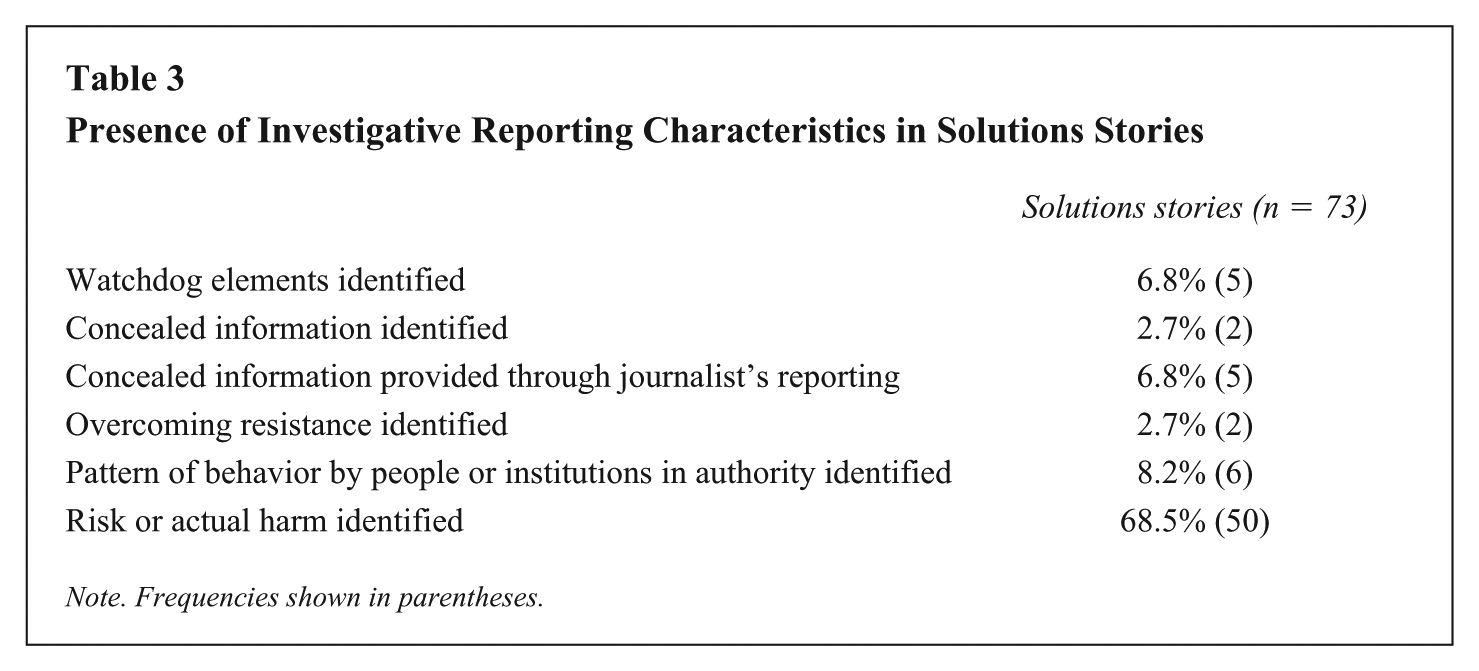
Solutions journalism articles (n = 73) were coded for the presence or absence of six variables that literature showed to be the key characteristics of investigative reporting (Abdenour, 2017; Gaines, 2008; Hamilton, 2016; Houston, 2009; Shapiro, 2003):
Watchdog elements identified: Article clearly holds people or institutions in authority accountable with specific attention to noting a failure (deliberate or otherwise) to carry out responsibilities as described in law or policy, or a lack of integrity, such as false statements, broken rules, or unkept promises.
Concealed information identified: Article includes concealed information, which is information that would otherwise be hidden from the public.
Concealed information provided through journalist’s reporting: Article shows concealed information provided through the journalist’s own work, evidence, and documentation that was previously unknown to the public or key decision makers.
Overcoming resistance identified: Article shows evidence that the journalist overcame resistance, such as people or institutions in authority denying access to documents or interview subjects; or any other effort to delay or stop the story.
Pattern of behavior by people or institutions in authority provided through journalist’s reporting: Article shows that the journalist’s original reporting revealed a previously unknown pattern of behavior by people or institutions in authority.
Risk or actual harm to civic values by a failure of people on institutions in power identified: Article illustrates risk or actual harm to civic values as a theoretical harm if action is not taken and actual harm if there is demonstrable damage to either individuals or groups.
Coder training and intercoder reliability
The study’s design followed content analysis best practices, specifically using a priori design with an independent coder (Krippendorff, 2013; Neuendorf, 2002). The researchers reviewed the training protocol with the coder in multiple training sessions using randomly selected articles from a previous year of the two databases. Following coder training, a randomly selected 10% of the sample was coded by the independent coder and one researcher. Because of the dichotomous nature of the content analysis measures and the small subset sample size, percent agreement was used to calculate intercoder reliability. After initial training, all variables except one (watchdog elements identified) resulted in an acceptable percent agreement ranging from 83.3% to 100%. Following the calculation of acceptable intercoder reliability, the independent coder completed coding the full sample. The two lead researchers reviewed the coder’s analysis of the variable that resulted in low intercoder reliability (watchdog elements identified). From there, the two lead researchers used a consensus coding approach on that variable, as it is a key study variable: It is similar to the method employed in Fink and Schudson’s (2014) research on changes in news content since 1950. As Fink and Schudson (2014) rightly note, no coding is “foolproof” (p. 12), but given the detailed variable definitions, the dichotomous nature of the variable, and the consensus coding approach, the researchers are confident in the data and subsequent findings.
Findings
A total of 142 news articles (69 stories identified as investigative reporting and 73 stories identified as solutions journalism) were content analyzed. Again, to state
Presence of Shared Characteristics of Both Investigative and Solutions Stories
Note. Frequencies shown in parentheses.
Again, to state
Presence of Solutions Journalism Characteristics in Investigative Stories

Note. Frequencies shown in parentheses.
Again, to state
Presence of Investigative Reporting Characteristics in Solutions Stories
Note. Frequencies shown in parentheses.
Conclusion
The study sought to discover how often investigative reporting and solutions journalism techniques currently cross over and share traits of one another. The findings confirm the literature that both approaches typically share key characteristics: They identify social problems and they seek the causes of these problems (Houston, 2009; Wenzel et al., 2016). The data also underscore literature that establishes that both approaches have different pathways of reporting and storytelling, and data show little crossover between them. The characteristics of solutions stories showed up in investigative stories at low rates—between 5.6% and 26.1%. Investigative characteristics showed up in solutions stories at even lower rates—between 2.7% and 8.2%.
Investigative stories devote their attention to describing aspects of social problems that have not yet been revealed, and they trace the causes of social problems to hold people in power and authority accountable—in effect, looking at the past and the present. This approach translates to much of the story devoted to presenting evidence and illustrating the experiences of people affected by the problems. The analyzed stories rarely did more than uncover the problem, potentially leaving readers unsure of how to respond. Because of their forward tilt, solutions stories often do not spend a lot of time looking back at the causes of problems, but instead focus on issues, conflicts, and concerns that are already well-known to the community. Although the stories may break new ground in how communities think about addressing the problems, study data showed that solutions stories do not explicitly hold people in power accountable. Findings contribute to academic literature on these reporting forms by showing that the articles analyzed for this study showed little crossover between these two genres of reporting.
However, one characteristic of each genre appeared relatively frequently in stories. The investigative reporting characteristic that showed up frequently in solutions stories was identifying risk or actual harm caused by the social problem (68.5%). The underlying assumption is that solutions stories often identify the risk as well as a problem response. In that way, solutions stories tend not to be adversarial toward officials, but instead toward the more abstract notions of community inaction and inertia. The one aspect of solutions journalism that showed up in investigative stories more often than others was identifying the response to problems (26.1%). There are two potential reasons for this. First, investigative stories sometimes establish the existence of social problems by pointing to past efforts (often unsuccessful ones) to address those problems. Second, some investigative stories use the possibility of solutions as another way to hold people in authority accountable. Put another way, investigative stories can document officials’ knowledge, awareness, and inaction in the face of potential solutions as yet another way to establish accountability.
However, study findings did not reveal the accountability overlap posited by SJN. Yet, the traditional aims of journalism support such an approach, as expressed by Kovach and Rosenstiel (2007): news media “should recognize where powerful institutions are working effectively as well as where they are not” (p. 174). A reporting paradigm that relies on investigative and solutions journalism could reveal the origins and causes, as well as responses to problems, to hold people in authority accountable. This opportunity for crossover between investigative and solutions journalism may deliver more impact, while creating a more meaningful experience for the reader and the community.
Limitations and Future Research
This study examined recent news stories, and the sample is not representative of all investigative or solutions reporting. The sample also included only print/online news stories, so broadcast stories (either television or radio/podcast) were not included in the sample. Individual stories were the unit of analysis; as such, individual stories may or may not have been part of a longer series. If the story was part of a series, other pieces in the series may or may not have included additional investigative/solutions characteristics. As such, it is a limitation that only one story of a series may have been examined. Future research could consider looking at an entire series if an individual article is a piece of a reporting project. Moreover, expanding the sample to all news over a longer time period could show different results. Despite these limitations, the study data present a baseline understanding that provides a foundation for the development of a new reporting approach. It also suggests the need for more research.
One important question: Why is there so little crossover between investigative reporting and solutions journalism? It is possible that journalists pursuing investigative and solutions stories pursue their missions to the exclusion of other forms of reporting and writing. Investigative journalists, for example, may fear being seen as advocates for particular outcomes, whereas reporters writing solutions stories may not see the need to rehash the cause of well-understood social problems, choosing instead to look to the future. It is also possible that many journalists have not yet seen the potential benefits of integrating qualities of both approaches. Future research should be aimed at learning more about the beliefs, mind-sets, and practices of journalists producing these stories. And future research should develop empirical measures to test for audience reactions from the proposed framework for a forward-thinking reporting approach that emphasizes response and accountability.