



Abstract
One measure of success for investigative reporting is impact: Did the story lead to any sort of outcome, from public awareness and dialogue to meaningful policy change? While investigative reporting is historically impact-oriented, there is a dearth of academic scholarship as to what journalists seek and expect when it comes to generating impact. Using data from a national survey of investigative reporters/editors, this research develops a more holistic conceptualization of journalistic impact.
Investigative reporters expose hidden truths and consequential problems, and they name those in power and authority who have failed to address them. It is journalism that “takes a comprehensive, exhaustive look at issues that have significant impact on the lives of the audience” (Aucoin, 2007, p. 2). The reporters who reveal the hidden consequences of malfeasance and misfeasance are driven by journalism’s inherent impulse for reform (Gans, 1979). Their work stakes a moral claim for those affected by the problems they uncover, and their stories seek to spark enough outrage and indignation to bring about meaningful changes in social policy (Protess, 1991). This powerful tradition often crashes into a ritual of the news business: objectivity and the demand for detachment, unadorned facts, and the absence of bias. Objectivity is seen as the separation of facts from values. Yet, investigative journalism seeks to uphold watchdog values: public health, public safety and welfare, justice, equal access, the public treasury, and the honesty and integrity of our civic leaders (Walth et al., 2019). While investigative reporting is driven by upholding consensus values and morality, the work creates tension with the long-held doctrine of journalistic objectivity. Ettema and Glasser (1988) show this tension often leads to investigative journalists disavowing their work’s drive for change and reform: “Even as investigative reporting shows us how journalism can both respect truth and engage value, it tries to deny this, its greatest virtue.”
This study uses data from a national sample of investigative reporters and editors to assess their opinions on and experiences with journalistic impact. Journalists’ experiences and opinions matter. Previous research has shown that the views of journalists can be valuable in understanding their professional values (Weaver et al., 2019). This research seeks to measure the strength with which journalists who identify as investigative reporters/editors want their stories to have impact. In addition, the survey seeks to identify how journalists define impact and to measure their views about various kinds of journalistic impact. This survey also seeks to determine how much journalists and editors discuss the potential impact of stories, and to what degree journalists worry about being labeled as advocates if they report and write stories intending to generate impact. Finally, the study examines the relationship between demographic factors and roles, and attitudes toward impact. Research findings fill a void and contribute to both newsroom practice and academic understanding.
Literature Review
Investigative Reporting and Journalistic Roles
Across the globe, journalists recognize their responsibility to monitor those in power and authority (Hanitzsch et al., 2019). This monitorial role ranges from journalists as passive recipients of information to showing journalists in their most active and engaged pursuit of surveillance and inquiry, investigative reporting (Christians et al., 2009). For decades, critics have suggested investigative journalism is nothing more than conscientious, thorough reporting (Williams, 1978). But investigative reporting’s methods, techniques, and intentions set it apart from the practices of most commonplace news reporting (Green, 1981; Williams, 1978).
Investigative reporting has existed in some form or another for centuries (Aucoin, 2007). Despite the American-centric view of the work, investigative reporting has had a long, active history across the globe, often by exposing abuses by colonial governments (Schiffrin, 2014). Modern investigative reporting in the United States has its roots in the work of progressive journalists known as the muckrakers, whose evidence-driven exposes in the first decade of the 20th century brought wide-ranging reforms to corporate monopolies and food and drug safety laws. Investigative reporting after that focused largely on exposing organized crime and municipal corruption, often at the local level (Lanosga & Houston, 2017). By the mid-1960s, several leading investigative reporters sought to collect and share their methods with other reporters in hopes of improving and characterizing the work (Aucoin, 2007). The first formal definition came from Investigative Reporters and Editors, Inc., a nonprofit founded in 1976 to provide education and training in investigative techniques: “It is the reporting, through one’s own work product and initiative, matters of importance which some persons or organizations wish to keep secret” (Green, 1981). The emphasis on originality was key: Reporters who simply published stories about investigations by police or authorities were not doing investigative work, even if the stories amounted to an expose. Over time, investigative journalists saw limitations in valuing only stories in which someone was actively trying to cover up wrongdoing. As Houston (2009) notes, “Over the years, journalists have expanded the definition to include analyzing and revealing the breakdown of social or justice systems and documenting the consequences” (p. v). Shapiro (2003) observes investigative reporting has enormous power in granting salience to long-overlooked problems. “[I]nvestigative journalism can expose social conditions or patterns of institutional conduct that are there for anyone to see but have been ignored . . . ”
American journalists have supported (Johnstone et al., 1972; Kim & Meyer, 2005) and continue to value investigative reporting (Lanosga & Houston, 2017; Weaver et al., 2019). Lanosga and Houston (2017) found continuing robust support among investigative journalists to play a populist-mobilizer role and “embrace the idea of motivating both the public and policymakers to take action based on their stories” (p. 1116). Weaver et al. (2019), in their latest “American Journalist” survey, found that news professionals are more likely than ever before to cite investigative reporting values, such as scrutinizing government claims and analyzing complex problems, as critical journalistic values. Similarly, McIntyre et al. (2018) found that journalists place a high value on the investigation of government claims, providing analysis of complex problems and alerting the public of potential threats. Related to Bro’s (2008) research on active journalists, McIntyre et al. (2018) also found that journalists highly valued the roles of acting socially responsible and contributing to society’s well-being. Both of these roles go against the traditional perception of the “neutral” journalist and share an overarching goal of creating impact with reporting. Previous research has indicated that the opinions of journalists can be valuable in understanding their professional values (Cassidy, 2005; Weaver et al., 2019). Deuze (2005) argues that scholars must examine how journalists understand and apply the core values of the profession (p. 458). Given the value of investigative reporting and the newsroom emphasis on the practice, discussions about generating impact through investigative stories (Lowenstein, 2017) must also be examined through academic research.
Journalistic Impact
Powers (2018) argues that journalistic impact matters for three key reasons. First, measuring impact can provide valid and reliable measures of the effects of journalism. Second, documenting impact helps to affirm the civic mission of journalism. And third, impact can serve as justification for return on investment at a time of increasing economic pressures. But to successfully measure journalistic impact, we need a clear definition of what we mean by journalistic impact and how we can measure it.
Journalistic impact has been defined as “content (that) helps drive policy change or movement building” (Schiffrin & Zuckerman, 2015, n.p.). Tofel argues that the impact of investigative journalism goes beyond the increased awareness or the influencing of readers’ opinions. Journalists seek signs of “real-world impact, such as ‘changes in behaviors, policies, practices, legislation or some such’” (Tofel, 2013, p. 6).
Most analysts dismiss news organizations’ claim measures of audience traffic and engagement (clicks, likes, and shares) can serve as a proxy for impact. As Lewis and Niles (2013, n.p.) put it, “[R]each reveals virtually nothing about the quality of the contact it measures, nor its impact on the audience member.” More appropriate measures can signal effects and influence on individual readers (letters to the editors, emails, and phone calls), to broader outcomes on discourse, action, and change (public deliberation and public policy) (Powers, 2018). The Center for Investigative Reporting (n.d.) developed the “impact glossary,” which sees journalistic impact across four dimensions: micro-level individual changes (knowledge, behaviors, or beliefs); meso-level changes at the group level (public debate and political discourse); macro-level institutional changes (changes in laws, policies, and institutions); and media response and amplification to the story (Green-Barber, 2014). Research about another journalism nonprofit, the International Consortium of Investigative Journalists, suggested that the organization measures impact along four dimensions: informing the public, spurring conversation, changing opinions, and changing policy (Konieczna & Powers, 2017). Powers (2018) defines journalistic impact as “outcomes of journalistic work such as increasing audience knowledge, spurring conversation, or changing policy rather than outputs such as stories produced or revenue generated” (p. 454–455).
Demographic Characteristics
The demographic characteristics of journalists—such as age, gender, and race—have been shown to affect attitudes and opinions of news, as well as news content. Female newspaper editors have been shown to run more in-depth features with “feminized” characteristics (Beam & Di Cicco, 2010, p. 403). These types of features generally contain more personal narratives and tend to emphasize the positive (Beam & Di Cicco, 2010). In addition, female journalists have been shown to prefer people-oriented stories and stories the emphasize sensitivity (Christmas, 1997; van Zoonen, 1998). Regarding race, researchers have found that story selection—which stories to report—can be affected by race (Knobloch-Westerwick et al., 2008). More recent research has shown the younger journalists and female journalists highly value contextual reporting—stories that report beyond the breaking news (McIntyre et al., 2018).
Summary and Research Questions
The existing literature makes clear that journalists care how their stories are received by readers, viewers, and listeners. Journalists want to know that their stories resonate. Journalism that has a positive impact on society—in general, providing information for a democratic society to better operate—remains a high-minded goal. So is journalism that has a measurable, visible effect—say, spurring specific change or compelling broader reforms—is often held as a value of the work. Given the exploratory nature of this examination, research questions are proposed:
Method
Data for the study were collected through a survey of journalists. In winter 2019, researchers sent a multiple-contact survey, as recommended by Dillman et al. (2009), to 1,575 journalists who identified as members of Investigative Reporters & Editors and who made their contact information available—an extensive list of journalists associated with investigative reporting/editing. Researchers sent a request for participation email with the Qualtrics online survey link, followed by two reminder emails sent in 1-week increments. Seven email addresses were invalid, so the final sample consisted of 1,568 journalists, of which 185 responded. Some respondents were eliminated from this initial response total because they spent less than 3 minutes on the questionnaire or they failed to answer a substantial number of questions. Following these removals, 164 valid responses were returned for a 10% response rate. The University of Oregon’s Institutional Review Board (IRB) approved the study.
The questionnaire first measured the extent to which respondents agreed (on a 5-point Likert-type scale from 1—strongly disagree to 5—strongly agree) with six researcher-developed statements about care for and action toward generating impact. These items were combined to create a composite variable titled impact care/action (a = .855). Then, participants rated two researcher-developed statements about level of discussions about impact on a 5-point Likert-type scale. These items were combined to create a composite variable titled impact discussion (a = .858). Next, participants rated modified versions of Powers (2018) impact measures. They were first asked to what degree they thought it was important that their reporting generated each specific impact on a 5-point Likert-type scale. These items were combined to create a composite variable titled impact measures (a = .785). Next participants rated the extent to which they had seen modified versions of Powers’s (2018) impact measures as a result of their stories. These items were combined to create a composite variable titled reporting impacts (a = .807). From there, participants rated five researcher-developed statements about what they think prevents their reporting from having more impact on a 5-point Likert-type scale. These items were combined to create a composite variable titled impact limitations (a = .708). The questionnaire concluded with standard demographic measures.
Findings
Sample participants were largely white (76%). Participants were nearly evenly split between male (48%) and female (46%). Their median age was 41, and the sample represented a wide range of newsroom experience measured in “number of years working in journalism”: (M = 18.85, SD = 11.70). Nearly 54% of respondents stated that they worked in a for-profit newsroom, with nearly 40% working in not-for-profit newsrooms. Participants also represented a range of newsroom sizes measured in circulation (less than 10,000 = 9%; 10,001–25,000 = 4%; 25,001–50,000 = 9%; 50,001–100,000 = 7%; 100,001–500,000 = 13%; 500,001–1,000,000 = 3%; more than 1,000,000 = 13%; not sure = 15%; other = 18%).
Again, RQ1 asked about the extent to which investigative reporters and editors care about and take action to generate impact with their stories. Participants rated six researcher-developed items about attitudes toward reporting impact on a 5-point Likert-type scale. Researchers combined the items to create a composite variable titled impact care/action (a = .855). Participants were not hesitant to acknowledge that they cared about the outcomes generated by their reporting and that they took action to achieve impact (M = 4.33, SD = .68). Table 1 provides the mean and standard deviation for each of the six items.
Item Mean and Standard Deviation for Each Measure of Impact Care/Action
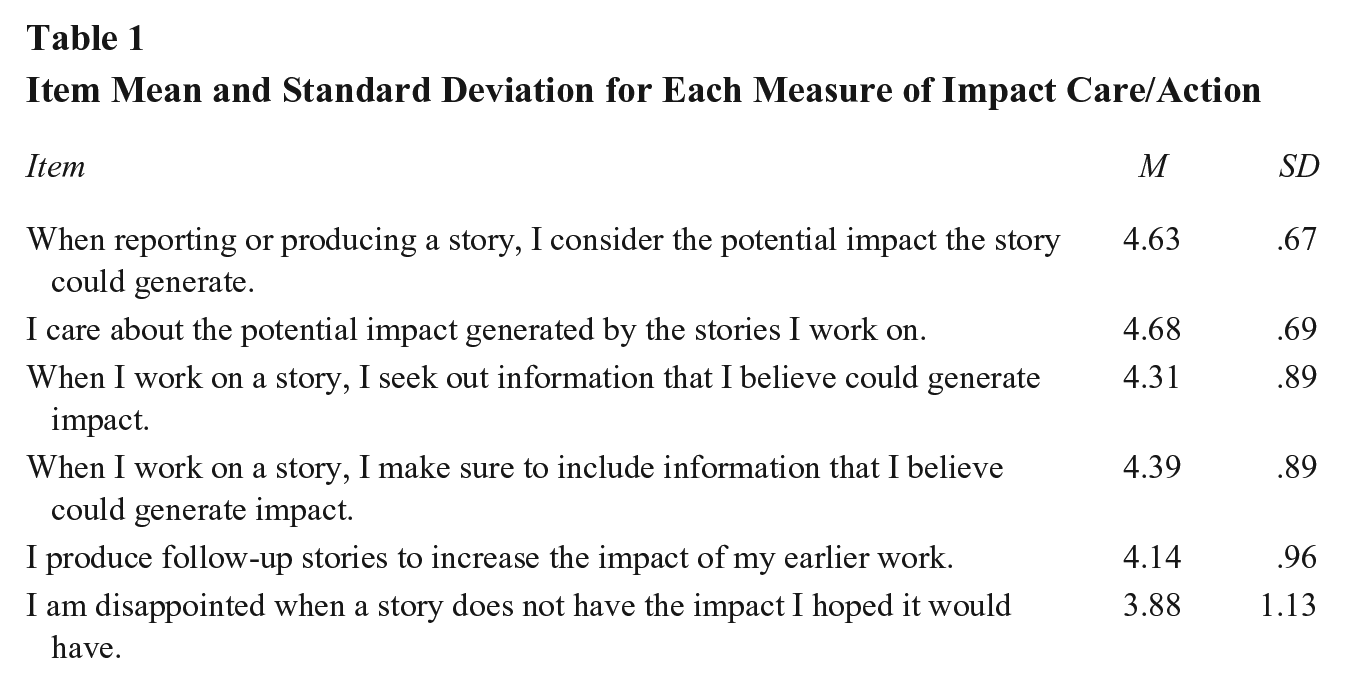
Findings show that participants place a high value on their stories generating impact with results showing that journalists think ahead of time about the potential for their stories to have impact. Moreover, they are proactive in making sure that they seek out and include information that they believe will increase the chances that their stories will have an impact. Overwhelmingly, journalists responding to this survey are often disappointed if their story does not generate impact, they are willing to stay with a story and do follow-up reporting to help increase the opportunity for future impact.
Just how open are these journalists about their hope that their stories have an impact? A great deal, according to the results. Again, RQ2 sought to determine how much journalists in the survey discuss in their newsrooms generating impact with stories. To measure impact discussions, participants rated two researcher-developed items about level of discussions about impact on a 5-point Likert-type scale. These items were combined to create a composite variable titled impact discussion (a = .858). Participants leaned toward agreeing that their newsrooms discussed impact (M = 3.77, SD = .68). Table 2 provides the mean and standard deviation for each of the two items.
Item Mean and Standard Deviation for Each Measure of Impact Discussion

The results here show that journalists who want to see their stories have impact tend to share these views with their colleagues, and they take the additional step of discussing ways they can increase the impact of their stories. But a long-standing worry among journalists is in creating the impression that they are advocates, and that appearing to push for particular outcomes might indicate a lack of impartiality in their work. The survey sought to measure this concern. Respondents were asked if they worry that their newsroom colleagues might view them as advocates because they sought to increase the impact of their stories. Participants somewhat disagreed with this statement (M = 2.25, SD = 1.244), indicating journalists responding to this survey tend not to worry about their colleagues labeling them as advocates over their concern for impact.
Turning to specific measures of impact, RQ3 asked investigative reporters and editors about the value they see in selected measures of impact. Again, participants rated modified versions of Powers (2018) impact measures. They were first asked to what degree they thought it was important that their reporting generate each specific impact on a 5-point Likert-type scale. These items were combined to create a composite variable titled impact measures (a = .782). As seen in Table 3, participants “agreed” that these reporting outcomes held value (M = 4.08), with strongest support for outcomes that led to public awareness (M = 4.81, SD = .54).
Item Mean and Standard Deviation Regarding the Value of Each Measure of Impact

The results show that journalists hold the highest value for impacts that show that their stories increase public awareness, knowledge, and understanding of an issue. The respondents also identified the end result of accountability as positive change as a highly important impact but were less concerned with more immediate and tangible responses to their stories—specifically, direct to journalists from readers through email, letters, calls, texts, or social media.
Again, RQ4 asked what types of selected measures of impact investigative reporters and editors had seen from their stories. Participants rated the extent to which they had seen specific impact measures as a result of their stories. These items were combined to create a composite variable titled reporting impacts (a = .807). As seen in Table 4, participants generally had not seen these impacts from their reporting (M = 2.69). Data show that the most common impact they had seen from their stories was awareness (M = 3.81, SD = 1.00).
Item Mean and Standard Deviation Regarding the Extent to Which Respondents Have Experienced Each Measure of Impact From Their Reporting

The results show, in general, that the kinds of impact journalists value are the most difficult to attain—namely, accountability for those in power and authority, and meaningful policy change as the result of their reporting. These two outcomes were of high value, based on the results of RQ3, but journalists perceived these were the most elusive of outcomes when it came to how often they saw them arising from their own reporting. The exception here is in public awareness: journalists both valued this outcome (M = 4.81, SD = .54) and reported (M = 3.81, SD = 1.00) that they saw this outcome often. Notably, this outcome, increased awareness, might be difficult for journalists to see as directly linked to their stories, and this suggests this finding is a candidate for further inquiry.
Researchers also wanted to learn what investigative reporters and editors think prevents their stories from having more impact. To answer RQ5, participants rated, on a 5-point Likert-type scale, five researcher-developed statements about what they think prevents their reporting from having more impact. These items were combined to create a composite variable titled impact limitations (a = .708). As seen in Table 5, participants did not necessarily express strong feelings about what prevents their reporting from having more impact (M = 2.36, SD = .23). While they were largely neutral that they lacked the time or resources to produce stories that can have an impact (M = 3.12, SD = 1.29), they did not express concern than sources (M = 1.94, SD = 1.09) or audiences (M = 2.07, SD = 1.18) would identify them as an advocate.
Item Mean and Standard Deviation Regarding the Limitations of Story Impact

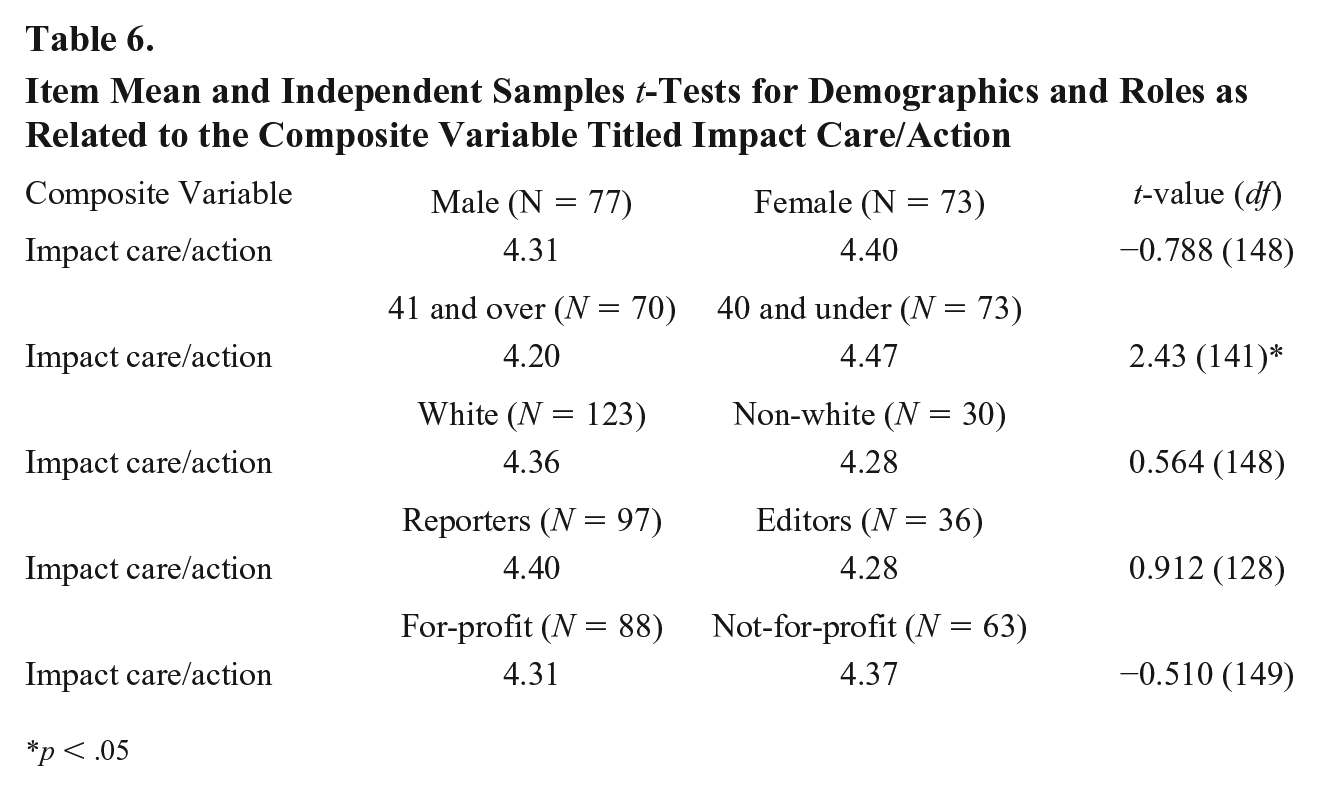
Finally, RQ6 asked about the relationship between demographics and roles of investigative reporters and editors and attitudes toward generating impact. To consider this question, researchers used independent samples t-tests to compare the demographic characteristics of gender, age, and race and the roles of job responsibility and newsroom profit status to the composite variable titled impact care/action (a = .855). See Table 6 for relevant data.
Item Mean and Independent Samples t-Tests for Demographics and Roles as Related to the Composite Variable Titled Impact Care/Action
p < .05
The only statistically meaningful difference that emerged involved the age of the respondent. Respondents aged 40 and younger placed a slightly higher value on impact (M = 4.47) than older respondents (M = 4.20). It is critical to note that gender and race of respondents did not lead to a statistically significant difference in attitude toward or care for impact. This is a critical finding as previous research has found differences in journalists’ opinions as based gender and race.
Discussion
Based on the data, journalists in this study were largely “active journalists,” as defined by Bro (2008). In addition, the results suggest that journalists see no major barriers to their stories having more impact. They see themselves as having the training and editorial support—suggesting that stories that have impact runs deeply as a value in newsrooms. A clear path for future research would be to apply these same survey questions to a wider spectrum of journalists—especially those who do not self-identify as investigative reporters—to see if the robust commitment to journalist impact is sustained, or if different patterns come to the surface.
This study has limitations, as do all research studies. First, only journalists associated with IRE could participate in the study and, even among IRE members, only some journalists choose to participate. So this study’s sample was not a random sample of all investigative reporters and editors. Second, it also is unlikely to be representative of all investigative reporters and editors and cannot be assumed even to be representative of all IRE members. Third, participating journalists will have had widely varying amounts of direct experience with investigative reporting. Future research could consider more specifically examining newsroom roles and functions as related to opinions of and experiences with impact. Fourth, responses were based on self reports: while a journalist may have reported seeing specific impacts from their work, these researchers did not see tangible evidence supporting these responses and such evidence may not exist. Future research should consider studying reporting impacts through verifiable and measurable methods.
Journalism still faces an existential struggle to remain relevant and viable. The commitment to strong civic and watchdog journalism remains high on the list of the qualities that can help sustain the industry. One possible avenue for more research is the kind of impact readers say they want most from journalism. Is it policy change and accountability, the kinds of impact that journalists here say they value most? Or is it something else, such as more engagement or relevance to their lives? Readers, however, say they do not want only revelation and expose—they want hope. Future research could pursue which kinds of impact are likely to have the most meaning for journalism as a craft, and for the industry as a whole. What journalists value most in terms of impact—measurable and lasting change, defined here as accountability and policy change—might be seen in different ways. Reporting on potential solutions, for example, can rely on the same evidence-based reporting as investigative journalism while moving the story to the next logical step: With the problem identified, what do the facts say is a potential way to solve the problems?
Key study findings show the survey participants say they care about impact—and they are not afraid to let people know it. Historically, some investigative reporting includes solutions or reporting on the next steps people in power and authority can take to address the problems uncovered in the stories. Many times, however, the stories stop at expose. U.S. journalism has often steered clear of anything that smacked of advocacy. Want to offer up answers to your community’s biggest problems? Leave that to editorial writers.
This survey, however, suggests that investigative journalists believe it is essential to stay with stories, to continue to report on them, and to seek out and include certain information, all aimed at increasing the potential impact of their work. The survey results also showed no statistically significant differences regarding role of editors and reporters in, or the business model (for-profit or nonprofit) of, the news organizations. These results suggest the drive to produce stories that have an impact moves up and down the ladder of authority within newsrooms and thrives regardless of the business model and source of revenue for the news organization. Journalists responding to this survey showed they cared most about impact that brought about real change, and not short-term responses from readers, either through personal communications or social media. Nor do journalists worry that their pursuit of stories that have impact will make them appear as advocates, either to their colleagues, their bosses, the sources or the public. An unanswered question here is why. Is that journalists disregard what readers and sources think? That is doubtful. Other possible reasons—for example, that journalists believe they can convey a sense of objectivity and fairness while pursuing more impact with their stories—could be at play here and that suggests the need for further study.
