



Abstract
The public health model of reporting calls for public health professionals and journalists to work together to provide social and environmental context, risk factors, and prevention information in news coverage of public health issues. This quantitative content analysis describes the prevalence of contextual information in Missouri newspaper coverage of the opioid crisis. Results indicate Missouri newspapers are not depicting the opioid crisis as a public health issue. The study has implications for research and practice.
Keywords
In 2020, more than 68,000 people in the United States died from drug overdoses involving opioids (Centers for Disease Control and Prevention [CDC], National Center for Health Statistics, 2021a). In addition, an estimated 2.7 million people suffer from opioid use disorder, which prevents them from fulfilling work, school, or family obligations (CDC, 2022b). Opioids are a class of drugs that reduce pain signals by binding with opioid receptors on nerve cells; opioids include doctor-prescribed medications such as oxycodone and morphine as well as illegal substances such as heroin and fentanyl (CDC, 2022b). The opioid crisis was declared a nationwide public health emergency in 2017 (HHS Press Office, 2017). As a public health issue, the opioid crisis has a range of interconnected causes, consequences, and solutions, and one of the primary ways the public comes to understand the issue is through news media coverage (Saloner et al., 2018). The way journalists cover public health stories such as the opioid crisis can directly affect how the public understands the issue and which solutions policymakers consider (Kempton & DiRusso, 2022).
A number of studies have analyzed U.S. news coverage to understand how it portrays the opioid crisis (Jay et al., 2022; McGinty et al., 2019; McGinty, Kennedy-Hendricks, Baller, et al., 2016; Netherland & Hansen, 2016; Shachar et al., 2020). A review by McGinty et al. (2019) shows that coverage has undergone a shift in focus from the illegal drug trade, individual responsibility, and criminal justice solutions in the late 1990s and early 2000s to societal causes and addiction prevention and harm reduction solutions in the past 10 years. There have been fewer studies at the state and regional level. Willis and Painter (2019, 2022) have studied the Cincinnati Enquirer’s “heroin beat” as an exemplar of public health reporting that puts the opioid crisis on the public agenda and uses thematic framing to put the crisis in a broader context. Studying a similar geographic area, Russell et al. (2019) analyzed Facebook posts from Ohio newspapers and noted most contained minimal contextual information, and user comments on those posts revealed stigmatized opinions about opioid users. However, beyond these examples, less is known about opioid news coverage at the state level.
This population gap deserves attention because research has shown that Americans trust local news more than national news (Sands, 2019), and local news coverage is an important way to increase knowledge about public health issues (Marshall, 2022; Martinson & Hindman, 2005; Young et al., 2015). In addition, part of the federal government’s plan to combat the opioid crisis is to fund state interventions (Department of Health and Human Services, 2017), meaning that most of the work to curb opioid misuse and overdose and to educate the public is falling to states (Willis & Painter, 2022). Thus, it is critical to understand how state news coverage portrays the opioid crisis. Newspapers in particular play an important role in providing health information to the public (Rains, 2007), and their portrayals of public health issues can influence the public’s perception of problems and their potential solutions (Coleman & Thorson, 2002).
The purpose of the current study is to determine if Missouri newspaper coverage depicts the opioid crisis as a public health issue. The study uses the public health model of reporting (Dorfman et al., 1997; Stevens, 1994, 1997, 1998) and framing theory (Entman, 1993; Scheufele & Tewksbury, 2007) to evaluate Missouri newspaper coverage. The study uses Missouri as its context because of the state’s high rate of opioid overdose deaths. In 2020, drug overdose was the leading cause of death among Missouri adults aged 18 to 44, and more than 70% of those deaths involved opioids such as heroin, fentanyl, methadone, morphine, oxycodone, and other prescription and non-prescription pain relievers (Missouri Department of Health & Senior Services, n.d.; Stoecker et al., 2020). Through quantitative content analysis, the study seeks to understand the following: the prevalence of information about causes, consequences, costs, and solutions; story perspective and sourcing; and depictions of opioid users. This study is part of an ongoing funded project to address the opioid crisis as a public health emergency. The results of this study have implications for theory and practice.
Theoretical Framework
News coverage is central to daily life and can influence everything from social relations to politics and policy issues (Biswas & Kim, 2020; Hodgetts & Chamberlain, 2014) as well as perceptions of public health issues such as mental illness (McGinty et al., 2015), obesity (Hawkins & Linvill, 2010; Sun et al., 2016), and smoking cessation (Kim et al., 2012). The way journalists cover public health issues is important because it can affect whether the public perceives the issues as important and what solutions the public will support (Dorfman et al., 1997).
Public health researcher Lori Dorfman and journalist Jane Stevens developed the public health model of reporting (Dorfman et al., 1997; Stevens, 1994, 1997, 1998) to change the way crime and violence are portrayed in news coverage (Coleman & Thorson, 2002). In the 1980s, public health professionals and epidemiologists began treating crime and violence as public health issues, but news coverage often framed them as criminal justice issues and portrayed them through individual episodes disconnected from broader community and societal factors (Coleman & Thorson, 2002). How problems are defined often determines which solutions are deemed feasible (Dorfman et al., 1997), and the public health model of reporting advocates for public health professionals and journalists to work together to increase information about social and environmental context, risk factors, and solutions in news coverage of health issues (Coleman et al., 2011). Although developed to address crime and violence news coverage, the model has been extended to a variety of health issues, including diabetes, obesity, immigrant health, smoking, and the opioid crisis (Coleman et al., 2011; Willis & Painter, 2019, 2022).
The public health model of reporting acknowledges that public health issues are complex, and it recognizes that the details used to communicate those issues through news coverage can influence public opinion. This premise aligns with framing theory, which states “that how an issue is characterized in news reports can have an influence on how it is understood by audiences” (Scheufele & Tewksbury, 2007, p. 11). In journalism practice, framing involves the selection and emphasis of information, and by extension, the exclusion of information, to craft a coherent description of an issue to make it understandable to audiences (Norris et al., 2003; Scheufele & Tewksbury, 2007). Frames have at least four functions: to define problems, diagnose causes, make moral judgments, and suggest solutions (Entman, 1993). The way an issue is framed, specifically its causes and consequences, can influence public perceptions of appropriate solutions for addressing the issue (Kennedy-Hendricks et al., 2016). Framing can also influence perceptions of responsibility and solutions for an issue. Iyengar (1991) defined two types of frames used in news coverage about public issues that determine how audiences attribute responsibility. Episodic news frames focus on individuals, specific episodes or instances, and their consequences, while thematic news frames consider public issues from a broader context that includes information about cultural and societal influences (Ash et al., 2023). Episodic coverage is associated with individual attribution of responsibility, i.e., the idea that individuals are solely responsible for outcomes, as well as punitive treatment (Willis & Painter, 2019). Thematic coverage is associated with increased societal attribution of responsibility and encourages public action such as policy change (Ash et al., 2023). At its essence, the public health model of reporting calls for thematic news coverage of public health issues.
The current study conceptualizes four categories of information that fit within the public health model of reporting—causes, consequences, costs, and solutions. If these categories of information are present in news coverage of the opioid crisis, then the coverage can be said to include a “public health angle.” Although a public health angle could include more categories of information, this study focuses on these because they address the public health model of reporting’s central call for contextual information and these categories have been studied in other analyses of opioid news coverage (Jay et al., 2022; McGinty et al., 2019; McGinty, Kennedy-Hendricks, Baller, et al., 2016; Rodgers & Thorson, 2001; Willis & Painter, 2019, 2022). The study additionally considers story perspective (United States vs. state) and sourcing as well as depictions of opioid users. The current study contributes to framing theory by viewing it through the lens of the public health model of reporting, which outlines specific actions that public health professionals and journalists can take to increase thematic news coverage of public health issues. This approach provides actionable recommendations that practitioners can follow to increase the public health angle in news coverage of the opioid crisis. The following sections review literature on the categories that make up the public health angle.
Literature Review
Causes of Opioid Misuse
The public health model of reporting suggests that news stories about public health issues should include information about two types of casual factors—social and environmental context and risk factors (Coleman & Thorson, 2002). Research shows there are many causes of opioid misuse, including pain reduction (which is associated with doctor prescribing) as well as relaxation, getting high, or dealing with emotions (Lipari et al., 2017). However, these individual-level factors often are influenced by social determinants of health, which include the social and environmental conditions in which people live and work (Office of Disease Prevention and Health Promotion, n.d.). For instance, Dasgupta et al. (2018) note that just considering the causes of the increased demand for pain reduction in the United States unlocks multiple interrelated structural issues, including societal pain relief expectations and an aging population that requires more (and more complex) health care procedures. News coverage about the causes of opioid misuse have changed over time, from a focus on the illegal drug trade (McGinty, Kennedy-Hendricks, Baller, et al., 2016) to physician prescribing (Jay et al., 2022).
If news coverage includes information about causes, the type of cause could influence perceptions of responsibility: External factors such as doctor prescribing could point to public policy solutions such as prescribing controls, whereas internal factors such as personal characteristics could lead to higher stigma toward opioid users and greater support for punitive policies (Kennedy-Hendricks et al., 2017). If causes are absent from news coverage, audiences are less likely to understand reasons for opioid use and less likely to recognize and support public health policies (Lawson et al., 2021). In a study comparing opioid death rates and volume of news coverage in 2018-2019, Hswen et al. (2020) found that that opioid-related deaths and news coverage were positively associated, that is, more deaths equaled more news coverage. However, most of the news coverage emanated from the urbanized Northeast United States, which has a lower prevalence of opioid misuse. “Opioid-related deaths occur most in rural areas with lower education, suggesting that these areas are being affected the most. However, our results indicate that there may be less opioid-related news reporting coming from these areas” (Hswen et al., 2020, p. 6). This could reflect less awareness of the causes of the crisis in areas that are at greater risk (Hswen et al., 2020).
Consequences and Costs of Opioid Misuse
Research has suggested that emphasizing consequences affects perceptions of the seriousness of the problem, attribution of responsibility for the problem, and potential solutions (McGinty et al., 2019). This information most often comes in the form of descriptions of outcomes or impacts of opioid misuse or addiction (i.e., addiction or dependence, death, overdose, loss of employment, or damaged relationships). Although much of the news coverage of the opioid crisis centers on the number of overdose deaths, far more people experience opioid use disorder (OUD) than die from overdose (2.7 million vs 68,630) (Centers for Disease Control and Prevention, 2022a, 2022b), and people with OUD experience a range of consequences for their health, relationships, and economic prospects (Lipari et al., 2017). McGinty, Kennedy-Hendricks, Baller, et al. (2016) found that criminal justice consequences dominated national news coverage of the opioid crisis through 2012, when health consequences started appearing more frequently. If news coverage focuses on law enforcement actions instead of health consequences, audiences might believe the issue is best addressed by the criminal justice system rather than the public health policy solutions (Willis & Painter, 2019).
Information about financial costs associated with the opioid crisis is related to consequences and might include economic expenses such as costs to individuals, communities, cities, states, or the nation. Studies have found a range of costs mentioned in news reporting, including increased costs for municipal services and losses due to worker absences and accidents (Willis & Painter, 2022), costs for increased health care services (McGinty, Kennedy-Hendricks, Baller, et al., 2016), and costs associated with criminal justice activities (McGinty et al., 2019). Costs are related to consequences, and cost information in news coverage adds context for audiences (Dorfman et al., 2001).
Solutions to Opioid Misuse
The public health model of reporting emphasizes the importance of including information about solutions to public health issues in news coverage (Coleman & Thorson, 2002). In their content analysis of national opioid news coverage from 1998 to 2012, McGinty, Stone, Kennedy-Hendricks, Baller, et al. (2016) found that law enforcement solutions were more prevalent in the early part of the study time frame, although public health solutions such as treatment and prevention were mentioned more often during the latter part of the study time frame, when coverage began emphasizing public health consequences more frequently than criminal justice consequences. In an analysis of opioid crisis solutions mentioned in the U.S. news coverage from 2013 to 2017, McGinty et al. (2019) found a 10-fold increase in mentions of solutions over the study timeframe, following the rapid upward trend in overdose deaths. The authors attribute this shift to recognition that arresting drug users was expensive and ineffective. In a study comparing news coverage of the crack cocaine and opioid epidemics, Shachar et al. (2020) noted that the shift in emphasis likely reflects the changing demographics of addiction, with prescription opioid abuse in the past decade affecting mostly white Americans. The inclusion of information about health-oriented solutions is important because it has been shown that patterns in news coverage of solutions has mirrored public attitudes about acceptable solutions (McGinty et al., 2019). Information about solutions can also be inferred from the way news coverage describes causes of opioid misuse. For instance, when news coverage attributes opioid misuse to the illegal drug trade, then the most common solutions discussed will be law enforcement solutions (McGinty, Kennedy-Hendricks, Baller, et al., 2016).
Story Perspective and Sourcing
Story perspective concerns the vantage point news stories use to make comparisons among groups of people as a means of giving audiences an understanding of potential disparities attributable to gender, ethnicity/race, or socioeconomic status. These comparisons can be made at a national or state level. This is an important category of information because local context, known as proximity, has been shown to make issues more meaningful to audiences (Ruigrok & van Atteveldt, 2007) and to increase information understanding and recall (Donnelly, 2005).
Story sources are the people who are interviewed to comment on stories about opioid misuse including experts (e.g., medical personnel, law enforcement) and non-experts (e.g., ordinary citizens). In a content analysis of news coverage of the opioid crisis in rural America, Lawson and Meyers (2020) found that medical professionals and elected officials were cited the most, and those sourcing choices were reflected in news coverage emphasis on the opioid crisis as a health issue and as a government policy issue. The sources included in a story can affect how audiences perceive the problem and the solutions (Jay et al., 2022). In their content analysis of national network evening news coverage between 2000 and 2020, Jay et al. (2022) found that the most cited sources were people experiencing opioid use disorder (OUD), medical personnel, and family members/friends of people experiencing OUD. A diversity of sources can communicate that the opioid crisis is a community issue rather than an individual issue, and the use of different sources can help increase public understanding of the issue (Willis & Painter, 2022).
Opioid User Depiction
Individual depiction refers to demographic and geographic characteristics used to describe people who are addicted to or are at high risk of being addicted to opioids or opiates (e.g., gender, race/ethnicity, age, income, occupation, and geographic locale). Many people in the United States attribute opioid misuse to individual factors and hold stigmatizing attitudes toward people with opioid use disorder (Saloner et al., 2018; Wood & Elliott, 2020), and those attitudes can erode support for public health solutions and increase support for punitive policies (Saloner et al., 2018; Tsai et al., 2019). News coverage that gives details of the individuals affected by a health problem helps to personalize the problem and evoke empathy in audiences (Lawson et al., 2021). In contrast, the absence of individual depictions can prevent audiences from identifying with the problem, leading to increased stigma, which in turn can become associated with greater public support for punitive policies and lower support for health-oriented public policies (Kennedy-Hendricks et al., 2017).
Research Questions
Based on the literature, the study seeks to answer the following research questions:
What is the prevalence of the public health angle in Missouri newspaper stories about the opioid crisis?
How is story perspective and sourcing used in Missouri newspaper stories about the opioid crisis?
How are opioid users depicted in Missouri newspaper stories about the opioid crisis?
Because news coverage includes multiple types of information, measuring co-occurrence of story elements can also help understand news coverage about the opioid crisis. Thus, the final two research questions:
What is the relationship between story perspective and sourcing and the public health angle?
What is the relationship between story perspective and sourcing and the profile of the average opioid user?
Method
To answer the research questions, the current study used quantitative content analysis to analyze Missouri newspaper coverage of the opioid crisis. Quantitative content analysis is a research method characterized by “the systematic assignment of communication content to categories according to rules, and the analysis of relationships involving those categories using statistical methods” (Riffe et al., 2019, p. 3). The method is central to theory about the influence of content, such as framing theory, because it can be used to identify patterns and relationships in content. This study focused on newspapers because they remain one of the most viewed and most influential media sources in the United States (Al Bawab et al., 2018), and they have been shown to serve as opinion leaders among media outlets (Harder et al., 2017; Su & Borah, 2019; Vonbun et al., 2016). Missouri was used as this study context because of its high rate of opioid overdose deaths (Missouri Department of Health & Senior Services, n.d.; Stoecker et al., 2020).
Sample
The sample included all stories about opioids published in Missouri newspapers between October 1, 2017, and June 30, 2019. This period was chosen for its timing just after the opioid crisis was declared a nationwide public health emergency (HHS Press Office, 2017). The timeframe included the calendar year 2018, during which Missouri had “the largest absolute and percentage increase in opioid-related overdose fatality rates per capita over the previous year . . . despite an overall decrease in U.S. opioid-related death rates in the same period” (Stoecker et al., 2020, p. 362). The sample was identified through searches of databases such as Newsbank and Factiva available at a large Midwestern university. The searches sought newspaper stories with a primary focus on opioid/opiate. Primary focus was defined as stories with the term “opioid” or “opiate” in the headline and mentions of “opioid” or “opiate” throughout the story. Stories with passing mentions of these terms were excluded. The procedure resulted in a collection of 53 stories from 15 Missouri newspapers (see Table 2). This sample size is comparable to similar studies that have considered state-level issues (Bach et al., 2013; Willis et al., 2014) and specific health issues (Epstein et al., 2013).
Measures
The authors developed a 21-item structured coding instrument to classify newspaper stories (the unit of analysis). The instrument included measures that the previously summarized literature has shown to affect public perception of health issues.
The Public Health Angle
This included information about causes, consequences, costs, and solutions that contribute to a story’s public health angle. Each variable was coded as 1 (present) or 0 (absent) removing any intermediate values to increase accuracy and consistency (Potter & Levine-Donnerstein, 1999). Definitions were as follows:
Causes of Opioid Misuse
Root causes or precipitating events that led to opioid use.
Consequences of Opioid Misuse
An outcome or impact of opioid misuse, e.g., health problems, addiction or dependence, death, overdose, loss of employment, or damaged relationships.
Costs of Opioid Misuse
Financial and non-financial expenses incurred at any level—individual, community, city, state, or nation.
Solutions to the Problem of Opioid Misuse
Solutions were divided into categories of treatment (actions taken to quit or manage opioid addiction) and prevention (actions taken to keep opioid addiction from happening).
Story Perspective
The perspective of the story refers to comparisons stories make among groups of individuals or populations. This study coded for two types: national and state. A national perspective is based on the U.S. population as a whole and a state perspective focuses on a population of a given state, in this case, Missouri. As noted, the literature has mainly focused on a national perspective. Adding a state perspective extends the literature and provides a point of comparison.
Story Sources
Consistent with previous definitions, story sources included: proximal or non-expert (e.g., people who are addicted to opioids, their friends, and family members) and professional or experts (e.g., physicians, medical personnel, law enforcement officers, government officials, and public health practitioners).
Opioid User Depiction
The opioid user depiction measured demographic and geographic characteristics of opioid users included in stories. Demographics that were coded included gender, race/ethnicity, age, income, and occupation. The geographic locale (where the opioid user lived) was also coded.
Coding and Training Procedure
The codebook underwent extensive development and pretesting, following training and intercoder reliability procedures described by Rodgers and Stemmle (2020). Coding was conducted by two students (one undergraduate and one graduate) at a large Midwestern university, and training lasted over three weeks. One of the authors coded 13 practice stories (not in the final sample) as a baseline against which to compare coders. In line with established procedures (Lacy et al., 2015), intercoder reliabilities were taken at the beginning (N = 13) and end (N = 20) of coding (see Table 1). Final Kappa alpha coefficients ranged from 0.77 to 1.00 with an average of 0.88, well within accepted standards (Riffe et al., 2019).
Intercoder Reliabilities

Note: Kappa range is .77 to 1.00 with an average of .88.
Data Analysis
Fifty-three opioid newspaper stories were coded. Every part of the story was coded, including display text such as headlines. Stories ranged from 163 words to more than 5,000 words, with an average of 842.32 (SD = 708.73) words. Most stories ran in the prominent part of the newspaper (i.e., the Main/A/News section) and were published by two main newspapers (St. Joseph News-Press and Daily Journal), suggesting Missouri readers had very few newspapers to compare different sources and perspectives (see Table 2).
Frequencies for Story Type, Newspaper Name, and Story Section

Results
The study’s findings are presented below, organized by research question:
RQ1: Prevalence of the Public Health Angle in Missouri Newspaper Coverage
The first research question asked about the prevalence of the public health angle in Missouri newspaper stories. Results show that three of the four categories of information conceptualized as part of the public health angle (causes, costs, and solutions) were omitted in at least half of the newspaper stories in the sample (see Table 3). Only consequences were present in more than half of the stories (n = 43, 81.1%), and the most cited consequence of opioid use was death.
Frequencies of Public Health Variables

Causes
Only 37.7% of stories (n = 20) mentioned causes of opioid misuse. The most frequently cited cause was physician prescriptions (n = 16, 30.2%), even though doctor prescribing is only one of many causes of opioid misuse (Lipari et al., 2017). Socioeconomic factors such as ethnicity/race and poverty were seldom identified as causes. Jay et al. (2022) found similar results in their content analysis of national network evening news coverage between 2000 and 2020. “News coverage of the causes of the opioid epidemic was limited and generally focused only on pharmaceutical companies or prescribers” (Jay et al., 2022, p. 1327). In their content analysis of opioid coverage from 1998 to 2012, McGinty, Kennedy-Hendricks, Baller, et al. (2016) found that 77% of news stories mentioned causes of opioid misuse, with the most frequently cited being illegal drug dealing and physician prescribing. By omitting causes or attributing them to physician prescribing, Missouri newspapers are providing audiences an incomplete picture of the opioid crisis (Coleman et al., 2011). This omission also has implications for policy support; audiences are less likely to support public health solutions if they are unaware of the causes of opioid misuse (Lawson et al., 2021).
Consequences and Costs
Consequences were mentioned in 81.1% of news stories (n = 43), and death was the most frequently reported consequence. In their content analysis of opioid coverage from 1998 to 2012, McGinty, Kennedy-Hendricks, Baller, et al. (2016) found that 95% of stories mentioned consequences, and stories mentioned health consequences and addiction or dependence more than death. News coverage that is overly focused on death as a consequence might not provide an accurate picture of the opioid crisis because opioid use disorder, which describes physical and psychological reliance on opioids, is a much more prevalent consequence of opioid misuse than overdose death (Centers for Disease Control and Prevention, 2022a, 2022b). As for costs, 47.2% of news stories (n = 25) included costs (financial and nonfinancial) of opioid misuse. This is a positive sign because costs are one of the consequences of opioid misuse, and providing this contextual information can help audiences understand the toll of the opioid crisis (Dorfman et al., 2001).
Solutions
For solutions to opioid addiction, 39.6% of news stories (n = 21) mentioned treatment and 49.1% of news stories (n = 26) mentioned prevention. Most stories that mentioned treatment discussed opioid addiction treatment medications such as methadone, buprenorphine, or naltrexone. Most stories that mentioned prevention discussed measures to control doctor prescribing such as prescription drug monitoring programs. In their content analysis of opioid coverage from 1998 to 2012, McGinty, Stone, Kennedy-Hendricks, Baller, et al. (2016) found a similar frequency of solutions, with 51% of their sample mentioning any solution. In a follow-up study of opioid coverage from 2013 to 2017, McGinty et al. (2019) found a 10-time increase in the volume of news coverage about solutions, and treatment and prevention solutions were among the three most frequently mentioned types of solutions. This frequency of solutions in Missouri news coverage signals that the state coverage is lagging behind national news coverage in highlighting solutions. The inclusion of information about solutions is important because it is associated with public attitudes toward solutions (McGinty et al., 2019).
RQ2: Story Perspective and Sources
The second research question asked about story perspective (United States vs. state) and story sources. Less than half of the stories (n = 23, 43.4%) took a state (Missouri) perspective, and 26.4% (n = 14) took a national perspective. The remaining stories had no discernible perspective, meaning they did not make comparisons between groups at the state or national level (see Table 4). Local context or proximity of news coverage is associated with increased information audience understanding, recall, and meaning, and when this perspective is lacking, audiences might not grasp the importance of the issue (Donnelly, 2005; Ruigrok & van Atteveldt, 2007).
Frequencies of Localization Variables
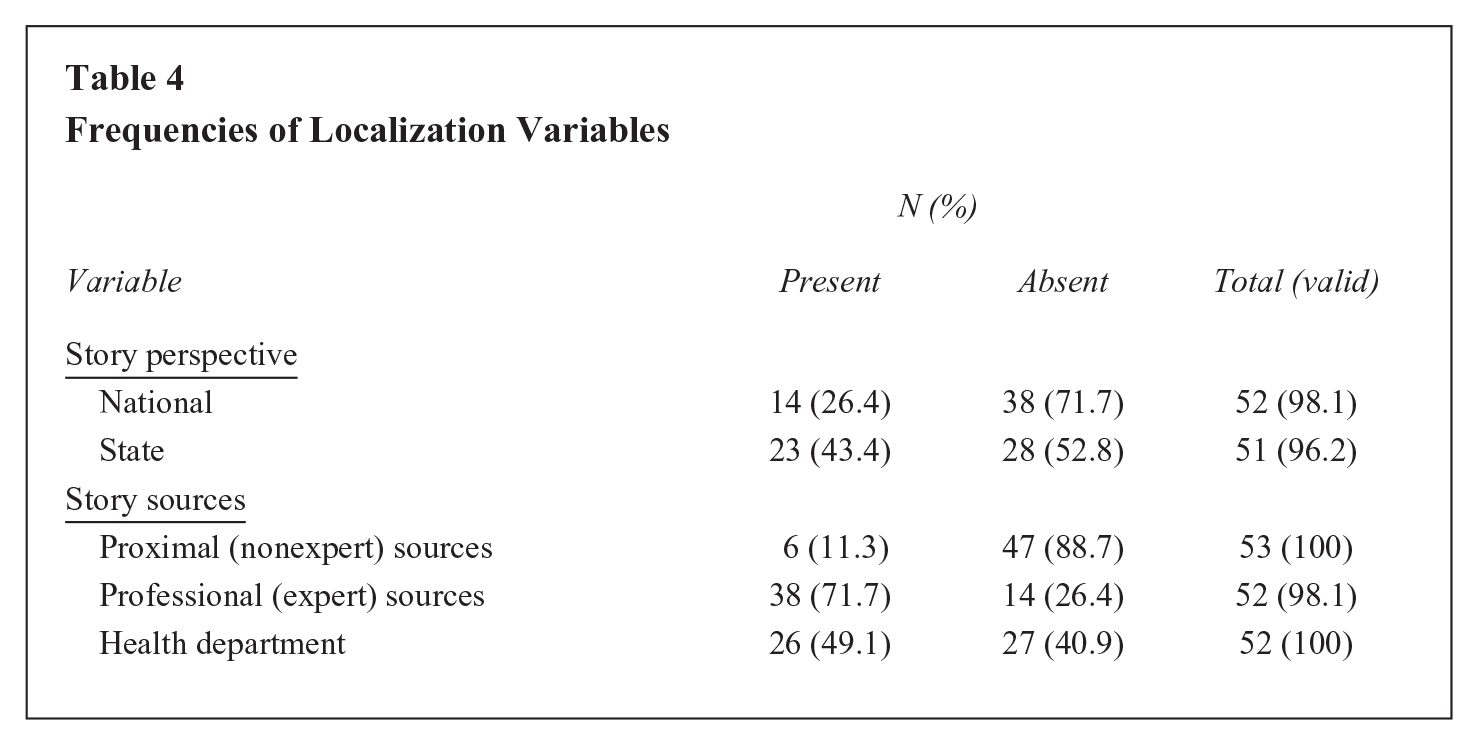
For sources, 71.7% (n = 38) included expert sources such as medical professionals. Of note, about half of stories (n = 26, 49.1%) used a public health professional as a source. Most often, these sources provided data on the opioid crisis or talked about solutions. This is an important result as it shows that selection and use of sources can affect news coverage. Lawson et al. (2021) found a similar result in their content analysis: the use of medical professionals and elected officials corresponded with the emphasis on the growth and spread of the opioid crisis in rural America. Only 11.3% (n = 6) stories include nonexpert sources. This result might also illustrate a difference between newspaper and television coverage. In their content analysis of national TV news coverage, Jay et al. (2022) found that two of the most frequently interviewed categories were nonexperts: people with opioid use disorder and their family members. They concluded that the use of these sources to relate personal stories led to episodic coverage that lacked the contextual understanding that is a hallmark of thematic coverage (Jay et al., 2022).
RQ3: Depictions of Opioid Users
The third research question asked about the profile of opioid users depicted in Missouri newspaper stories. About half of the stories (n = 25, 47.2%) included geographic information about opioid users, while only 28.3% of news stories (n = 15) included demographic information. Of the demographic information included in stories, gender (n = 11, 20.8%) and age (n = 10, 18.9%) were included most (see Table 5).
Profile of opioid users by demographic and geographic variables
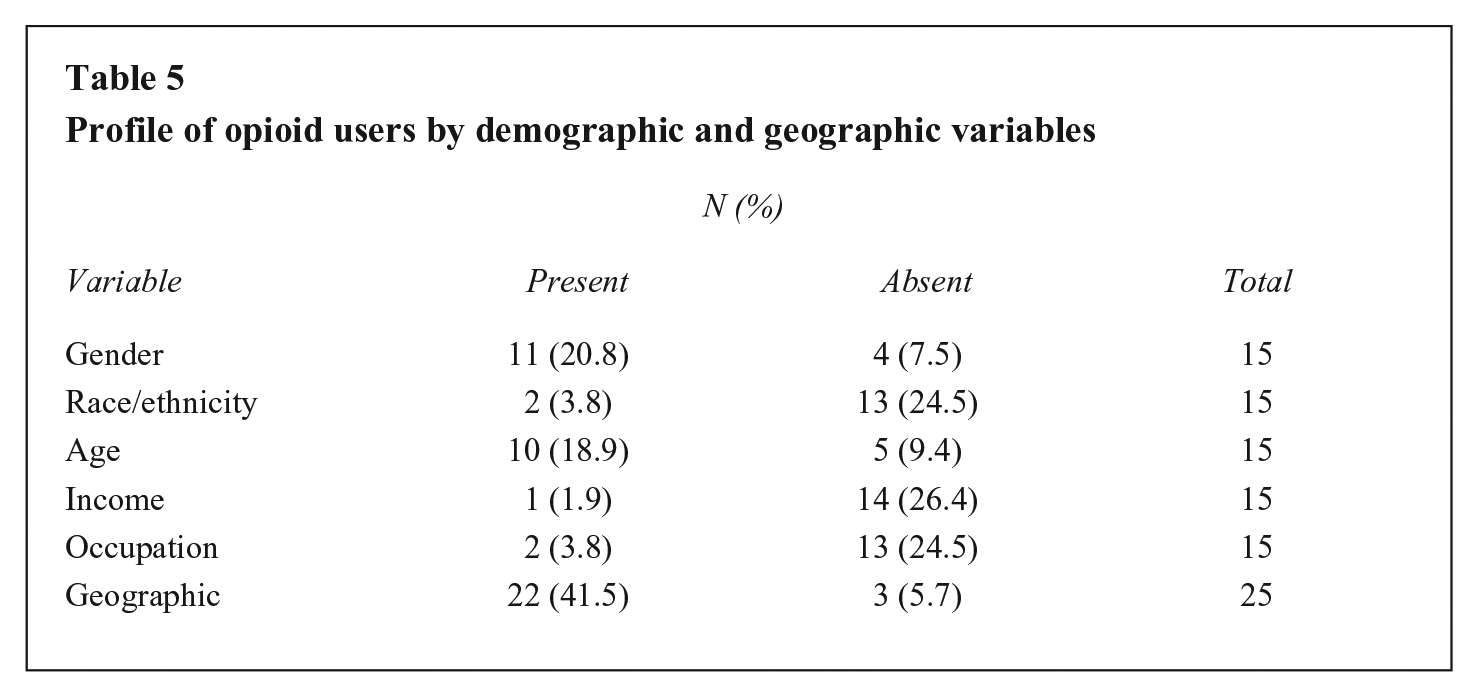
Depictions of opioid users are associated with understanding of the opioid crisis, and scholars have suggested that explaining the issue through personal stories might be the best way to reduce stigma (Lawson et al., 2021). Results of the current study show that news coverage likely doesn’t include enough information for audiences to identify with people misusing opioids, and thus might be contributing to stigmatized attitudes (Kennedy-Hendricks et al., 2017). In a content analysis of Ohio newspaper Facebook posts, Russell et al. (2019) found that the newspaper coverage lacked context, and many Facebook users who commented on the coverage used stigmatizing language to refer to the people mentioned in the stories. Facebook commenters frequently use terms such as “addict” and “relapse,” which could elicit bias and weaken support for public health policies and interventions (Russell et al., 2019).
RQ4 and RQ5: Relationships Between Variables
The final two research questions asked about the relationships between select variables. RQ4 sought to understand the relationship between the public health angle and story perspective and sourcing. Stories that made national comparisons were equally likely to include/not include death as a consequence of opioid misuse (50% vs. 50%). However, when stories made state (Missouri) comparisons, they were more likely than not to describe death as a consequence (p < .001). This may be a result of news coverage of Missouri’s overdose death rate. In 2018, the state had the largest increase in opioid-related overdose deaths per capita despite an overall decrease in the national death rate (Stoecker et al., 2020). Stories with a national perspective were also more likely to include solutions (treatment in particular; p < .05). In fact, national stories were nearly twice as likely to give treatment as a solution (64.3%) than not (35.7%). This reflects the trend toward more solutions mentioned in national news coverage (McGinty et al., 2019). Expert sources were slightly more likely to be used in stories that reported death as a consequence (92.3%) than not (66.7%; p =.071). When a public health professional was used as a story source, death was less frequently reported as a consequence (p < .05), suggesting that the presence of a public health practitioner shifted the story’s focus away from death. As the public health model of reporting would suggest, public health professionals can provide journalists the contextual perspective necessary to focus on the broader picture.
RQ5 sought to understand the relationship between opioid user depiction and story perspective and sourcing. Stories with a national (14.3%) as well as state (28.9%) perspective were more likely to describe the main character’s occupation (14.3%) than not (7.1%; p < .05). When stories used a non-expert source (i.e., everyday person), their gender (p < .05), race/ethnicity (p < .05), occupation (p < .001), and geographic locale (p < .05) were typically given. Although the total number of stories that used non-expert sources was low (n = 6, 11.3%), the inclusion of more demographic information in stories with those sources makes sense as past research has shown personal stories often are used to make the opioid crisis relatable to audiences (Jay et al., 2022).
Conclusion
The purpose of the current study was to determine if Missouri newspaper coverage depicts the opioid crisis as a public health issue. The results show that most coverage did not include the public health angle, as only one of the four categories of public health information was present in more than half of the stories in the sample. This has implications for research and practice. For research, the study extends the public health model of reporting to the analysis of statewide newspaper coverage of the opioid crisis. This is an important context as many of the solutions to the crisis are being implemented on a statewide level (Willis & Painter, 2022), making it important to understand news coverage at this same level. This study also provides evidence for the association of public health professional sources with the increased prevalence of contextual public health information in news coverage. Based on this finding, scholars should consider the presence of public health sources in news coverage as an important measure by which to evaluate the public health angle in coverage.
The study also suggests that state newspaper coverage might lag behind national news coverage in portraying the opioid crisis as a public health issue. The literature shows a trend in national coverage from a focus on the illegal drug trade, individual responsibility, and criminal justice solutions from 1998 to 2012 to societal causes and addiction prevention and harm reduction solutions from 2013 to 2017 (Kennedy-Hendricks et al., 2019; McGinty et al., 2019; McGinty, Kennedy-Hendricks, Baller, et al., 2016; Shachar et al., 2020). However, the current study’s findings show that Missouri newspaper coverage more closely resembles the earlier national news coverage, specifically with regard to causes and solutions. In addition, Missouri newspapers only published 2.56 stories per month about the opioid crisis between October 1, 2017, and June 30, 2019, despite the fact that the state saw a significant increase in opioid-related overdose deaths during this timeframe (Stoecker et al., 2020). By comparison, the Cincinnati Enquirer published 12.4 opioid stories per month in 2015, the year before it developed a beat dedicated to the opioid crisis (Willis & Painter, 2022). Our results align with Hswen et al. (2020), who noted in their analysis of online news reports in 2018-2019 that the areas hardest hit by the opioid crisis had less news coverage than other areas. Future research should evaluate frequency of state news coverage of the opioid crisis to see how it has changed over time and how it correlates to national news coverage and opioid-related overdose deaths.
For the newspaper industry, the study highlights the importance of increased collaboration between journalists and public health professionals. The shift in framing of the opioid crisis at a national level from a criminal justice issue to a public health issue is attributed to the work of public health professionals to change the conversation (McGinty, Kennedy-Hendricks, Baller, et al., 2016). News stories that include the public health angle have the potential to provide readers with a more complete understanding of the opioid crisis and to increase public support for policies that would expand treatment and prevention solutions. Public health professionals can serve as an important source to help newspaper journalists understand and explain how the crisis is affecting their communities (Lawson et al., 2021). As the study shows, Missouri newspaper journalists already are using public health professionals as sources, and when they do, death is less frequently reported as a consequence, suggesting that public health professionals provide contextual information that shifts the story’s focus away from death. This aligns with the premise of the public health model of reporting, which emphasizes collaboration between public health professionals and journalists to create more contextual information in public health news coverage. Future research should examine how public health professionals and newspaper journalists can work together to increase the prevalence of the public health angle in opioid news coverage.
Although the current study fills an important population gap in the literature by examining opioid news coverage on the statewide level, it is not without limitations. As a cross-sectional analysis of Missouri newspaper coverage, this study’s findings, although based on a comprehensive sample at the time of analysis, cannot be generalized beyond the timeframe and sources analyzed. Similarly, these results cannot speak to public views or attitudes about the opioid crisis, or to the aspects of the crisis analyzed in this study. Future research should study public attitudes about opioid newspaper coverage and the opioid crisis.
Footnotes
Authors’ Note
This work was funded by the Centers for Disease Control and Prevention through a subcontract with the Missouri Department of Health and Senior Services (COLUM_060196_00066800_V101), with the third author serving as the principal investigator. During the manuscript preparation, the first author received a scholarship from the Maxine Wilson Gregory Chair, held by the second author. The authors acknowledge Cate Enrooth, who also received a Gregory scholarship, for her assistance in identifying examples used to illustrate the results. All co-author(s) listed in the byline have agreed to the byline order and submission of the manuscript in this form.
