




Abstract
Research on core cultural values has been central to behavioral and clinical research in ethnic groups. Familismo is one such construct, theorized as the strong identification and attachment of Hispanic persons with their nuclear and extended families. Our anthropological research on this concept among Mexicans and Mexican immigrants in the United States elaborates the concept, and promotes greater complementarity between quantitative and qualitative data on the topic. Ethnographic work spanning 3 sites over four years reveal that familismo as expressed in narratives is a more contested and evocative concept than most quantitative and behavioral literatures tend to suggest. By suggesting that when familismo is used in generalizing ways, it neglects the broader significance of nostalgia or of a larger social (extra-familial) connectedness, we do not ignore the need for population-based research. Instead, we hope to forward and crystallize studies of culture change in migrants and to sustain a complementary and simultaneous conversation based on contextual and qualitative data.
In efforts to promote better understanding of ethnic groups undergoing culture change, researchers often focus on patterns of belief and behavior within these populations. Traits are bundled into “constructs” or “models” which serve as proxies in statistical tests for the complex process of acculturation (Negy & Woods, 1992). One such construct for Hispanic and Latino 1 populations has been familismo, the strong identification and attachment of persons with their nuclear and extended families (Moore, 1970; Sabogal, Marin, Otero-Sabogal, Marin, & Perez-Stable, 1987; Steidel & Contreras, 2003). First suggested as a core cultural value more than 40 years ago, familismo involves the elevation of the needs of the family (both nuclear and extended) over the needs of the individual.
A summary of social scientific and behavioral literature on familismo suggests not only great interest in this core cultural value over the past four decades, but also a broad need for summarizing concepts about key ethnic groups. The population-level interests of public and behavioral health fields, as well as the quantitative methodological strategies of psychology and clinical sciences, require statistically significant findings, generalizable to large groups of people (e.g., all Hispanics or Latinos). On the other hand, the disciplinary and methodological priorities of anthropology seek out complexity and variation, considering the instructive power of less visible or quantifiable details from much smaller, yet still instructive samples. It is from this anthropological perspective that we examine the quagmires of cultural paradigms and “isms,” bundling our own data with that of others who question the applicability of acculturation models, and call for greater sensitivity to context and informant goals in expression.
In this discussion, we elaborate upon and expand the more narrow quantitative considerations of familismo with ethnographic data from a binational study of Mexican/immigrants, 2 and to thereby promote greater complementarity between quantitative and qualitative research on migration and culture change. Over four years, we conducted ethnographic research on the concept of familismo with Mexicans and Mexican immigrants in both the United States and Mexico. Rather than adopt proxy measures or conduct a survey on beliefs associated with family-centeredness, we asked our informants directly about the relevance and meaning of family in their lives. More specifically, we asked about their experiences of migration and (dietary) culture change, and their considerations of family as they navigated these processes.
Our anthropological findings reveal that familismo as expressed in narratives is a more contested and evocative concept than most quantitative and behavioral literatures tend to suggest. To complement those studies (which we acknowledge to have a different purpose than our own), we therefore accentuate the multivocality and nostalgic elements of informants’ expressions about family. We apply anthropological lessons on the heterogeneity of transnational migration patterns, the complex and emergent decision-making of migrants, and the factors influencing experience and acculturation to an existing, robust collection of more quantitative studies on the subject (Foner, 2003; Kearney, 1986; Massey, et al., 1993; Rouse, 1992; Schiller, Basch, & Szanton-Blanc, 1992).
By suggesting that when familismo is used in generalizing ways, it neglects the broader significance of nostalgia or of a larger social (extra-familial) connectedness, we do not ignore the need for population-based research. Instead, we hope to forward and crystallize studies of culture change in migrants and to sustain a complementary and simultaneous conversation based on contextual and qualitative data.
Background: A Brief Review of Research on Family-Centeredness
Familismo is theorized as a core cultural value that requires the individual to submit to a more collective, family-based form of decision-making, and responsibility for, and obligation to ensuring the well-being of family members (both nuclear and extended). Importantly, familismo is a term more often used by social scientists than by informants themselves, though it certainly is heard in Mexican conversations about family. Moore (1970) offered a first and very general description of “familism” in her monograph on Mexican Americans. She explains, the family is “the most important facet of life for Mexican Americans in south Texas . . . It is the main focus of obligations and also a source of emotional and economic support as well as recognition for accomplishment” (p. 104).
Sabogal and colleagues (1987) clarified and expanded Moore’s work by defining the familismo value system and its basic dimensions as follows: (a) familial obligations (e.g., providing material and emotional support to family members), (b) perceived support from the family (e.g., family reliably provides help and support to solve problems), and (c) family as referents (e.g., decisions and behavior are based on conforming and consulting with family members). In placing such value on the family, group members gain social support, aid through close proximity to one another, and a means by which to form an identity.
For the purpose of this discussion, we are interested in research that considers the concept of familismo among Mexican families. These families can act as a social support system through which relatives may seek assistance in times of need, such as during periods of migration (Keefe, Padilla, & Carlos, 1979; Sabogal, et al., 1987). The family can also be a source of emotional comfort and support, improving the mental health of immigrants during the stressful periods or cycles of migration (Rumbaut & Rumbaut, 1976). Thus, familismo is linked with support and care of family members from elders (Ruiz, 2007) to pregnant women (Campos, et al., 2008) and parental involvement in the lives of their children—presented as a facet of familismo—has been seen as a positive influence. 3 The presence of familismo has even been discussed as relevant to smoking cessation (Marin, Perez-Stable, Marin, Sabogal, & Otero-Sabogal, 1990) and battered women’s support groups (Morales-Campos, Casillas, & McCurdy, 2009).
Less often considered have been the ways that family can be a source of conflict, shame, or stressful obligations for immigrants. Yet familismo is also a source of surveillance and pressure, such as regarding reproductive decisions (Maternowska, et al., 2010) and sexual identity (Hirsch, Munoz-Laboy, Nyhus, Yount, & Bauermeister, 2009). And change to the family dynamic and organization, itself a common result of migration, can obviously produce great stress and conflict (Heymann, et al., 2009; Lahaic, Hayes, Piper, & Heymann, 2009; Rafaelli & Ontai, 2001).
Finally, it is the exception, not the rule, that “the Mexican family” is described as simultaneously both a positive and negative factor in health and immigration experience. Suarez-Orozco and colleagues (2002) revealed how immigration-related separation of family members, and the stress that these experiences often cause to children, can engender mental health or educational consequences. From another perspective, exploratory research by Crockett and colleagues (Crockett, Brown, Russell, & Shen, 2007) found simply an absence of familismo in Mexican American high school students which suggests that familismo is not a cultural value present among all Hispanics. These data imply that additional factors besides acculturation to the dominant US culture may impact its presence.
Anthropologists have avoided such firm declarations about ethnic groups, eschewing simplified models of culture change or of cultural structures (e.g., the family).
4
Foner’s (1997) article on “The Immigrant Family” was among the first to map the great variability in this institution under the circumstances of change that migration provokes. She writes,
[T]he family is not simply a site where immigrants create and carry out agendas or strategies; nor are family relations and dynamics reducible to rational economic calculations. Rather, the family is seen as a place where there is a dynamic interplay between structure, culture, and agency—where creative culture-building takes place in the context of external social and economic forces as well as immigrants’ premigration cultural frameworks. (p. 961)
Foner offers a review of the many forms that “multi-local” and transnational families can take. She draws on ethnographies by Kibria (1993) and Yanagisako (1985)who expose the work of migrants in reconceptualizing their family traditions, walking tightropes between the old and the new, balancing through simultaneous participation in both (all) places, both (all) value systems, and cross-fertilizing these various settings (Rouse, 1991) as they go. These works helped propel the anthropological critique of acculturation perspectives in migration studies, a view that imagines culture change among migrants as one way toward a monolithic and homogenous “American” culture. These views being now largely recognized as overly simplistic, what remains for anthropologists and other social scientists is to consider the broader diversity of patterns in how people modify their cultural value systems, such as familismo, in response to migration and separation.
In this light, the construct of familismo offers broad guidance toward understanding Latinos and Hispanics as a whole or historically, but is less adept at describing dynamic and malleable processes of change. It is most likely for that reason that familismo enjoys so much attention in professions for which categorical data about homogenous ethnic groups are more valued than thick description of ethnic diversity and transnational identities. That said, even in clinical and public health literatures, scholars should (and sometimes do) admit that the ideal of familismo does not supply a linear or simple explanation for migrant decisions and behaviors. For that reason, we conducted ethnographic research to question the utility of the term familismo as expressed in immigrant narratives, and attempt to cross-fertilize several fields with this discussion of narrative and its meanings.
Considering the mutability of immigrant families—their boundaries, definitions, and roles—combined with the myriad ways that devotion to this group of kin might be expressed over different times and circumstances, would other terms be more accurate to describe this orientation toward kin (Foner, 1997; Hirsch, 1999; Schiller, et al., 1992)? Does familismo explain behaviors or health outcomes, or is it merely an ideal expressed by research informants who may be nostalgic for “home” (Hirsch, et al., 2009; Stewart, 1988)? Or might the devotion of one’s psychological, emotional, and economic resources to family, as well as the crafting of one’s identity around one’s family, be better understood in the broader terms of social interdependence or connectedness (Halgunseth, Ispa, & Rudy, 2006)?
Our research was inspired by the gaps between anthropological perspectives and quantitative orientations toward culture, and specifically familismo, in Mexican/immigrants. We next describe our research methods and sample, then offer a discussion of the narrative data that illuminate the context of familismo in Mexican/immigrant lives. In our discussion, we suggest how narrative data improve upon quantitative strategies and constructs for understanding culture change in this population.
Method
As an anthropological ethnography, our work produced qualitative and descriptive data on the focal questions of family-centeredness for our Mexican/immigrant informants, as well as more detailed narratives on foodways and mealtime habits. We do not offer a statistically powerful sample size but, instead, have identified thematic codes via grounded analysis and dual-blind rating of transcribed interviews. Ours was a multiyear, multisite cross-sectional ethnographic study conducted among Mexican/immigrants in Texas and among their families and community members in Guanajuato, Mexico. In particular, we employ data from semi-structured interviews and participant observation. We are concerned to elaborate on the differences between expressed ideals of familismo and actual behaviors, and to illustrate with examples—in this case, narratives about mealtimes—how ideals do not always determine behavior, and can be achieved in multiple, sometimes conflicting ways. The case data are not particularly surprising, because anthropologists have been exposing and highlighting diversity and complexity within migrant groups for decades. What has not occurred in these works has been a serious questioning of the term familismo and the implications for using such totalizing language about sentiments and orientations we know to be more complex.
The data we discuss come from a sample of Mexican immigrants in Dallas, Texas as well as Mexicans in two rural Mexican sites that were the “home” communities for many in the first phase of research. Thus, research occurred in two phases. First, Mexican immigrants interviewed in Dallas helped to identify culturally salient terms and themes on the topics of migration, diet, and meal times. A second phase of more intensive anthropological research, including cultural consensus work, semi-structured interviews (sometimes over multiple occasions and years), and long-term participant observation and immersion in two Mexican communities promoted in-depth study of practices and values.
Recruitment and Informed Consent
All informants were given a written copy of the consent form and research description. This information was explained orally in Spanish before consent was requested and signature obtained. Consent forms and interview questions were written in English at a fifth-grade reading level, and then translated into Spanish.
Sample
The Dallas/Ft. Worth metroplex and Guanajuato, Mexico were considered appropriate sites for this research because of the multigenerational history of circular and family migration between these two sites. Specifically, research began in Dallas, after which research questions were refined and taken to two sites in Guanajuato where we had identified families of several Dallas/Ft. Worth key informants. The two Mexican sites were the small, farming village of El Gusano and its principal, internal migration destination, the nearby town of Dolores Hidalgo.
A total sample of 90 informants provided semi-structured, recorded interviews as shown in the Table 1 below. Informants in Dallas were recruited through one multiservice charity and interviewed on site. Informants in El Gusano were recruited through collaboration with leadership of a local development foundation (Fundación Comunitario del Bajío), and with the help of two local Promotoras who were able to introduce us to nearly all 60 families in the village. These informants were interviewed in their homes or community locations. Recruitment in Dolores Hidalgo occurred through posted flyers, collaboration with the same foundation, and with the help of community health educators from the Universidad Tecnológica del Norte de Guanajuato. These informants were also interviewed in their homes or community locations, including the University.
Sample Description.
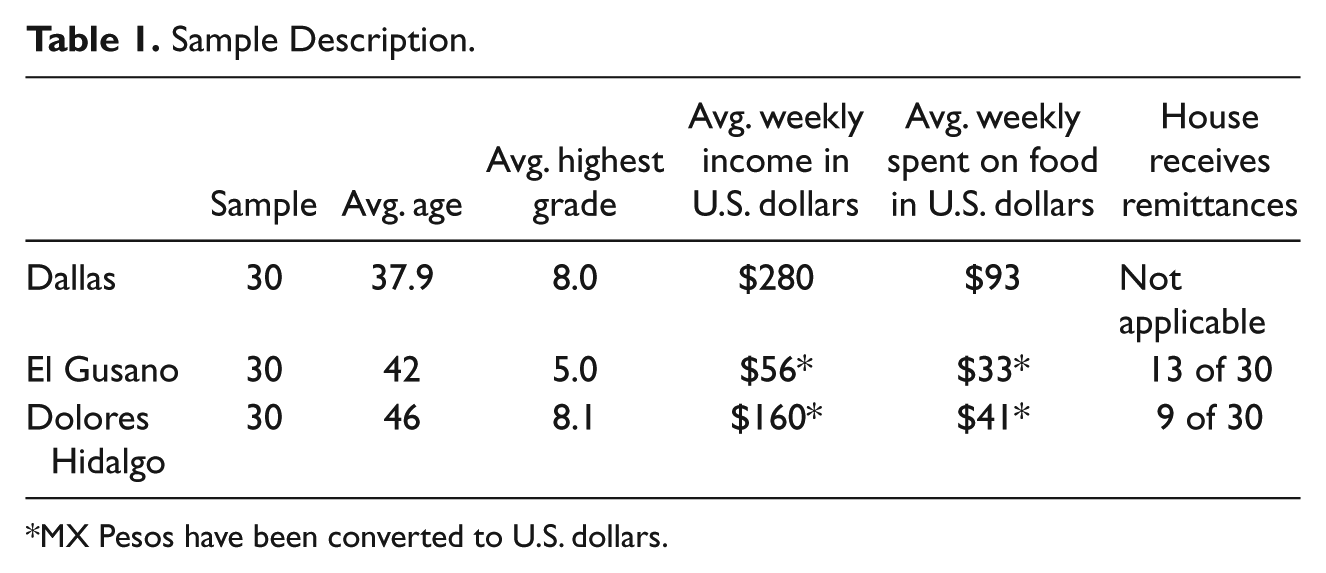
MX Pesos have been converted to U.S. dollars.
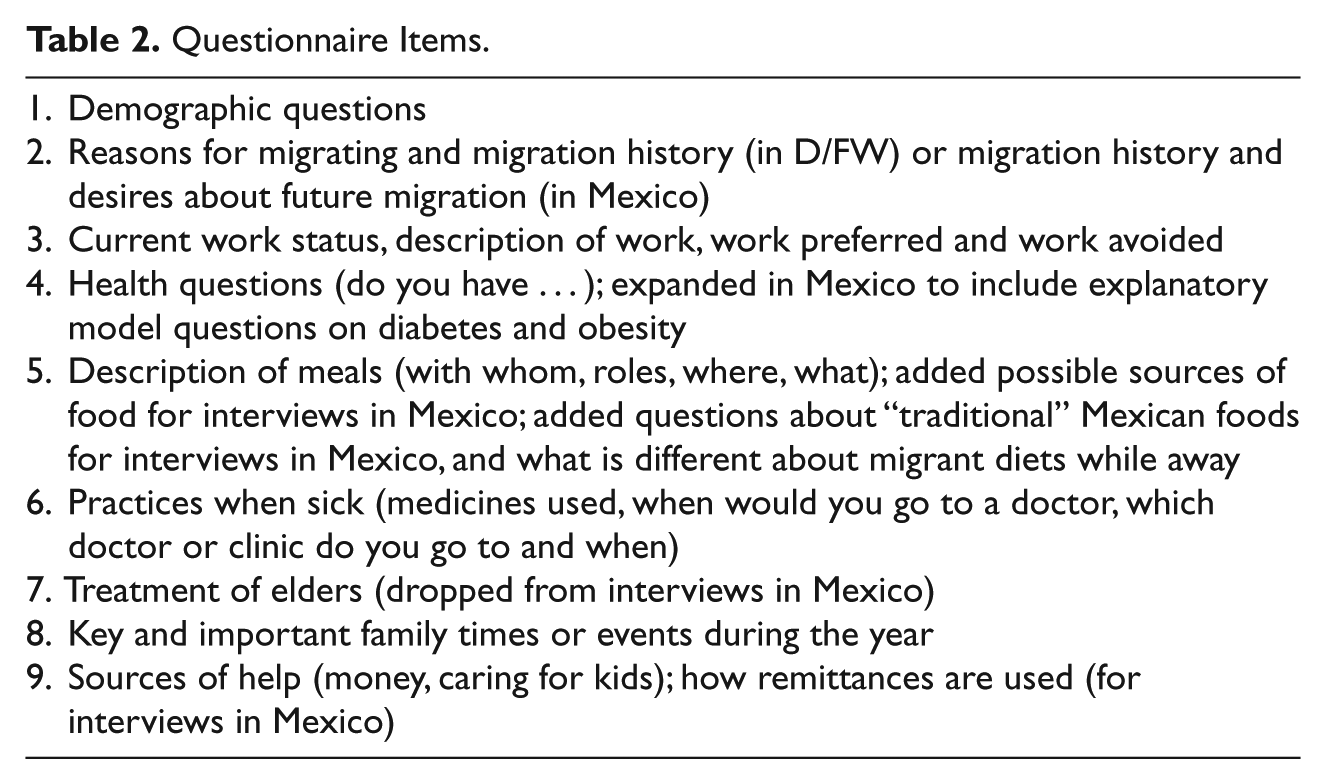
The interview guide initiated in the first phase of research was expanded in the second phase, as noted in Table 2.
Questionnaire Items.
In the first phase of study, because of characteristics of our principal recruiting site, 25 of the respondents were female. The average age of participants was 37.9 years. All but three had other family living in the United States at the time of the interview, and 14 respondents were living with one or more children. Half of respondents sent remittances to family in Mexico. Dallas participants reported a range in education level: three reported no formal education; 10 had completed some grade school; seven had finished grade school; five had finished their secondary/high school education; and four had completed some or all of a college degree. All participants reported living with a family member; none lived alone and not one lived with an unrelated person. Self-reported weekly income produced inconsistent responses. Nevertheless, the average weekly household income reported by participants was US$280.
The Mexico sample drew from two distinct communities: El Gusano, a small farming village with essentially no commercial activity beyond a handful of home-front tiendas (shops); and Dolores Hidalgo, a municipio (county) center of approximately 55,000 residents, county government offices, one university, and numerous commercial and infrastructural developments. The average age of El Gusano informants was 42 with 15 being female; in Dolores Hidalgo, the average age was 46, and 15 were female. Average years of school completed were 5.0 for El Gusano, 8.1 for Dolores Hidalgo. Average weekly income was reported at US$56 in El Gusano, US$160 in Dolores Hidalgo.
Results
Ethnographic findings are taken from grounded analysis techniques while in the field, from participant observation, and from narrative coding of recorded and transcribed data using two separate blind codings, reconciled through a consensus method (Bernard, 2006). We demonstrate the broad context and complexity of informant values of familismo by focusing on two themes. First, familismo is a core ideal expressed in informant narratives, but it is enacted and elaborated in ways that are complex and may even contradict stereotypical assumptions. Second, Mexican/immigrant gatherings at mealtimes, though considered important gatherings and central symbols of family, are very sensitive to work schedules, illustrating one way in which the cultural ideal of familismo is adapted to meet everyday priorities, and deployed by speakers to characterize both the demanding burdens of work and the importance of family in the face of its great disruption.
1. The Familismo of Migrants—Una Vida Mejor Para la Familia
Lita is one of our key informants from the small, farming village of El Gusano in the State of Guanajuato, Mexico. There, Lita rises before sunrise to grind her dry corn into meal, sew shawls for a meager, shared co-op income, and tend her chickens and pig in the areas surrounding her home. She lived what seemed a lonely life, though she had her elderly parents and a couple of female siblings nearby. Only one of her three brothers, and none of her three children remained in El Gusano, and she deeply missed them. She had always longed to see her grandchildren, of which she had only one or two photographs. In recent years, we had seen her children more often than she had, having spoken with them as part of the same research project. Even so, knowing Lita as we did, we were stunned on a visit to her children’s apartment in the United States to be greeted by Lita herself. She had, of course, made the four-day journey mostly on foot through the border region, to rejoin her children. She knew no English, nor how to drive a car, nor to write above the 6th grade level, and wearing leatherette shoes and her typical cotton dress, had obviously been in no condition to scramble across the desert for four days. When we asked her why she had finally come, she said it was not for work, but for family and “to make life easier for them” while they worked the hard jobs of illegal immigrants.
Almost three-fourths of migrants sampled in Dallas stated that work, better pay, or una vida mejor (a better life) for one’s family and children were their primary reasons for migrating to the United States. A few said it was “because I didn’t study,” to be with family here in the United States, or to have a baby or “hide a pregnancy.” When asked “who is most likely to migrate,” respondents almost unanimously agreed that young men and heads of family will migrate first, either to family already here in the United States, or in order to later bring their family from Mexico. They suggested that males will generally migrate first when they are teenagers, learning the routes from fathers or uncles, then later return to Mexico or send for any spouse or children to join him. These patterns align as generational cycles of migration present for many “sending” and “receiving” communities, where patterns are multigenerational and relatively stable within families and between paired U.S. and Mexico communities (Massey, 1987; Massey, et al., 1993; Cohen, 2001)
These generational cycles of migration have been growing for almost a century. Donato (1999) explained that communities with long histories of migration are now self-perpetuating, and that migration—legal or illegal—“has become a way of life in many communities” (p. 71) She also suggests that economic factors play less of a role in Mexico-to-US migration decisions today than they did in the 1930’s, and social mechanisms have a greater influence now than before (Massey, 1987; Massey, Alarcon, Durand, & Gonzalez, 1990). Thus, a family’s and community’s historical patterns of migration help define the vocational opportunities available to any given person through migration. Some of the poorest communities in Mexico have now come to depend on these opportunities.
The centrality of family to decision-making about migration, or familismo, was the focus of our initial interviews. Among immigrants surveyed in Dallas, migration decisions seemed strongly influenced by concerns for and factors related to the extended family. It was often the case that respondents expressed their decision to migrate or to return to their home country as dependent upon the location of the rest of their family. For example, responses to the question, “Will you return to Mexico?” were answered as follows:
In the affirmative: A woman (age 36): Yes. I have much family there. My Parents live there. My grandparents . . . A woman (age 27): Yes because my parents and siblings are there. A man (age 42): Yes, I have to go back. For my kids and my wife. In the Negative: A woman (age 42): I don’t have anyone there. A woman (age 39): Only to visit because my daughters were born here and I’m here with them. A woman (age 29): No, because . . . my family was formed here . . . I don’t have any reason to.
Asked, which types of people are more likely to return home to Mexico also yielded responses that centered on the location of family:
A woman (age 54): Those that have a lot of family in Mexico. A woman (age 27): Those that are alone here, that don’t have their family here. A woman (age 46): Those that left a wife go back. A mother. Kids. A man (age 36): To see their family that stayed.
Thus, “family” is mentioned repeatedly as either a reason to go back to Mexico or a reason to stay in the United States. In both affirmative and negative responses, we found evidence of at least two of Sabogal et al.’s (1987) criteria for familismo: family as referents, social support, and obligations. Because of the importance of family expressed by these Dallas/Ft. Worth immigrants in formal interviews, we can confirm the use of family as referents (Sabogal et al.’s (1987) third criterion) as well as obligations to family (Sabogal et al.’s (1987) first criterion). However, given the diversity of actions that this family-centeredness promotes, we also stress that the process of immigration should be understood as a continuous life possibility with varying obligations over that time (Kandel & Massey, 2002; Tilly, 2007). To wit, many respondents stated they had migrated to be with family, to create a better life for their family, or because they were brought by family when they were young.
(Question: Do you have any reason for returning to Mexico?) Only my daughter because she doesn’t cross over, and I can’t go see here. It’s been four years since I’ve seen her. Only over the phone, because my mom and brothers are here. Only my dad, my sister, and my daughter are in Mexico. (Question: Who do you think stays in the U.S. and who returns to Mexico?) The ones who come to the US and then return, are the ones that work in the fields . . . . The ones that were single when they came, and formed families here, are the ones who stay here permanently, which is what happened to me. You form your family and it’s much harder to return.
Our informants narrated historic patterns of strong and extended family bonds that provided nurturance and support (Sabogal et al.’s (1987) second criterion) . . . :
Yes, in the area we lived in [in Mexico], it’s common that the family lives in the same neighborhood . . . . There’s my mother’s siblings, they still have somebody nearby that they know. The whole block!
. . . Patterns that are not necessarily retained after migration to the United States:
It’s sad to see a lot of people already married and everything because they forget about their families, their parents. I talk to people a lot in my job . . . and I’ve talked to many people that come for 3 months, 1 month, 6 months, and they stay here. They forget they have family, a mother, a father, a wife or husband, and kids [back in Mexico].
Poor immigrant households are therefore not easily able to maintain extended kin networks, and subsequently do not have access to those networks in times of need (Kana’iaupuni, Donato, Thompson-Colon, & Stainback, 2005). Yet the tone of these narratives still would indicate a high value placed on family both as a cultural ideal and in certain explanations for migration decisions. In short, a narrative that places high value on familismo does not necessarily translate into a particular social or family support system.
Yet positive feelings toward the family were not universal. Some informants, particularly younger ones, narrated a desire to “find their own life” and work away from home. The “dream” of migrating to “success” and fortune in the United States, and away from the hard labor of the family farm and its obligations, is a steady current in the narratives, particularly for young men who migrate. Likewise, family and kin are credited or blamed for decisions to return to Mexico.
In summary, our interviews were full of indications of familismo, but a view of familismo that is different, and broader, than Sabogal et al’s (1987) construct suggests. The family is named as both a reason to migrate and a reason to stay home; a reason to seek more income, and a reason to be accessible for family gatherings; a reason to go, to stay, to be with, and to escape. Depending on the conversation, speakers may be defending, praising, reprimanding, or actively considering both pros and cons of family events and pressures, through the performance of their narrative (Mattingly & Garro, 2000). These details and nuances are not evident in a majority of the public and behavioral health literatures we’ve discussed. When familismo is measured in more abbreviated formats—proxy questions on a survey, for example—tremendous variation in the expression of this value system is ignored. These narratives of Mexican/immigrants suggest, instead, that cultural ideals—like familismo—are not static relics of a common cultural heritage, but are living value systems that speakers reference, deploy, and manipulate for multiple goals and agendas, even during interviews and surveys. The context of the data-gathering itself, must not be ignored in analyses of social scientific data.
While these narratives of “una vida mejor” do not contradict earlier research on familismo, they do point out the limited utility that broad generalizations can have in explaining or predicting behaviors in Mexican immigrants. To further explore this possibility, we took these preliminary findings into a multiyear, binational ethnographic study. We turn now to these data (a portion of our interviews and observations that focused on mealtimes) and consider the same theme: the meaning of familismo in context.
2. Mealtimes, Familismo, and the Centrality of Work
The topic of mealtimes was a productive one for interviews, not only because all our informants found it easy to talk about in detail, but because a variety of symbols, values, and priorities were indexed in food and foodways (Smith-Morris, 2006), including not only ones about family but about work and migration as well. The period of in-depth, ethnographic research totaled 8 months over 4 years. In open-ended interviews, informants explain that, at a most basic level, food is the reason for gathering the family together each day.
Male informant in Mexico—(Question: What have been the important occasions for your family?) Hmmm, well, meals. Mealtimes. Female informant in U.S.—[We ate] dinner together with the whole family, yes. The traditional food we make in our country . . . and the meals when the whole family came We, together, everybody got together at the tables.
Both U.S. and Mexico informants affirm that meals in Mexico are prepared and eaten with family, sometimes with extended family:
Female informant in U.S.—We were always a united family, we all ate together. We ate breakfast, lunch and dinner together.
For efficiency but also for social and emotional reasons, meal times are valued as appropriate and ideal times to come together as a family (Herrera, 2010; Lalonde, 1992). This line of questioning about mealtimes was used by informants to affirm their values of family-centeredness, as in the quotes above about eating together, but also in terms of sacrifices made (for the family) by workers who miss meals in order to work.
Male informant in Mexico—[The afternoon meal is] very important. . . . Look, it’s the [convivencia] relationship
5
of the family. And apart from that, well, it’s the time when we all come from work and when we see each other. Because otherwise (he laughs), otherwise we don’t see each other until the late night. We talk together on what we did in our different jobs during the day. . . and situations that came up at work. Female informant in U.S.—We ate meals together every day. Only, of course, sometimes my father could not be with us, but at dinner time, yes he was. Or Saturday and Sunday, when he was home [from work], my mom always had long tablecloths every day—meaning, she always set the table for everyone! I remember at four years old, they would put place settings at the table and we had to know how to use them. Mother was very specific in these types of situations. Male informant in Mexico—If someone can’t come to comida, (the large meal of the day), it means they’re working. Normally it’s a question of work that they can’t eat together with the family. Other than work, [there’s] no good reason [to miss it]. No reason other than work.
And so the timing of meals, and requirements for family member attendance, are made flexible, especially for work schedules. For example, if children are present and hungry, they will be fed though the spouse often waits for his/her mate to eat. In this way, no family member eats alone and the ideal of familismo is satisfied.
These flexibilities suggest that while familismo is the ideal, other contingencies (in this case work and the income it generates) hold sway. It is not only the extremely low incomes (reported above) that sustain and encourage these flexibilities. The migrant families we sampled, especially in the remote, agrarian village of El Gusano, are missing more than just one member; they are all but torn apart by migration. Few are left to gather for meals or anything else. Almost all boys above age 16, and almost all men of working age and ability have migrated away from the village. The village is a landscape of women, elderly, and the very young; something that certainly cannot be said of all places in Mexico, but which is a familiar demographic nonetheless. Men who remain spend long days in the fields caring for their crops or animals. Some seek work in towns (e.g., El Gusano men and women first target Dolores Hidalgo for work opportunities, before considering a migration to farther parts of Mexico or to the United States), but little is available to those without their high school (secondary school) diploma. Thus, mealtimes in the current economy of migration are relatively small gatherings in El Gusano, a “sending community,” and this necessitates flexibility toward cultural ideals like familismo.
As the expression and achievement of cultural ideals, such as familismo, take on new forms, Mexican/immigrants testified to the process. Their narratives exposed the process of change, and the difference between ideals and reality. They expressed sadness (but not apology), and nostalgia for mealtimes together, as in this quote from Adriana who had migrated to Dolores Hidalgo from a nearby village:
That’s why sometimes I feel bad, because sometimes I can’t be with my children . . . now, everybody does it their own way . . . three live here and three live [somewhere else].
In Adriana’s sadness, the difference between ideals and reality is laid bare. Her familismo remains intact, yet her own practices and those of her children reflect a different set of priorities. These are most impacted by income, and not by acculturation to the U.S. Nostalgia for family togetherness, and for the past in general, suggests a complicated process by which Adriana simultaneously: (a) attests to the value she places on family-centeredness; (b) describes actions, events and choices that override family togetherness for practical reasons; and (c) emits and expresses an emotion both for her psychological and social benefit as well as for her audience’s interest. Yet what this coding for familismo does not capture is also relevant, namely: (d) that she is now living with another partner, whose family is intentionally disconnected from the children of which she speaks; or (e) that “doing it their own way” is not entirely a matter of choice, because income is scarce in the village and she herself moved away from her natal home for work.
This brings our discussion, at last although only briefly, to the role of economics and expressions of familismo, regardless of location or migration status. In El Gusano, only one of 30 informants ate meals away from home. On the other hand, in Dolores Hidalgo, 10 of 30 informants ate most meals outside of the home, either at work, at street vendors, or in a restaurant. And in our Dallas sample, only 2 of 28 informants ate any meals outside of the home on a regular basis (one-two times per week). Of the US$280 average weekly salary reported in our sample of U.S. migrants, respondents reported spending an average of US$93 weekly (or 33% of their income) on groceries for an average of four people. These low amounts would be prohibitive against eating many prepared or restaurant meals. The trend from this very limited sample suggests not a continuum but a calculus including both cost and access. El Gusano residents could not “eat out” even if they had adequate income because there are no restaurants or street vendors in the immediate vicinity. In Dallas, however, where restaurants are numerous and prepared foods ubiquitous, informants refrain from eating out because of the cost (as described above). But interestingly, it is the internal Mexican migration site, Dolores Hidalgo where informants reported the greatest disruption of family mealtimes by nonwork factors such as members spending time with boyfriends or girlfriends. In the other sites, only work or the absence of family members (for work) prohibited “normal” or ideal enactment of the ideal. Of course, ethnographic samples do not offer statistical power, and we make these comments only to suggest a related, but secondary point in our argument. Familismo has a cultural context, but it also has an economic one that may be more complicated than a linear rural–urban migratory acculturation schema might suggest.
To summarize the second collection of narratives, we again affirm evidence for family as referents, support, and source of obligation in informants’ responses. Yet these references index a breadth of experience, behavior, and priorities that cannot be summarily categorized under a single term. Not all references to family indicate similar support or obligations; not all persons who use family as a referent, simultaneously consider them either a source of obligation or support (Steidel & Contreras, 2003). 6 Considered in its larger context, this consideration of familismo shows that meals are ideally a family time, but that family mealtimes are legitimately made secondary to work concerns in all 3 communities (Mexican village, Mexican town, and Dallas migration site).
Mealtimes are only one small window onto the lives of these informants, but they are a daily one with the significance and repetition that attend the most central of cultural values. The utility of cultural generalizations or stereotypes of family-centeredness for mealtimes is limited. Our data offer descriptive context for how familismo plays out in context, and for what factors influence the expression or nonexpression of these ideals.
Discussion: Migrant Narrative, Nostalgia, and Cultural-Isms
Familismo is a cultural ideal that reveals itself in complex ways. Familismo was deployed to express nostalgia for home and the past, as well as one’s values and ideals, sometimes in spite of one’s practices. Nostalgia affects one’s subjective sense of identity and familismo by creating longing among immigrants for an idealized past and home community. A past time where family not only came together at mealtimes, but also a place where community members were connected by everyday interactions and geographic proximity. Family is simultaneously a reason to go, a reason to stay, and the reason to return; family is the destination and that which was left “at home.” Exhibiting or embodying familismo can manifest itself in living alone or with strangers as a migrant in a foreign city, living among extended family who have found each other on “the other side,” or living in Mexico surrounded by kin. To suggest that only one facet of this core cultural value impacted migrant decisions oversimplifies not only the concept of familismo but also the role of culture in decision-making and, indeed, the idea of a “core cultural value” itself.
In this ethnographic, binational research, the role of family in migrant mealtimes also had double meanings. Consistently, family was mentioned as having great importance in mealtimes—whether one attends or misses meals. Only one thing was clear and consistent for our sample: that the meal has secondary importance to work. Mealtime patterns are very sensitive to work opportunities, which always override certain cultural ideals including familismo. Missing family events for work is almost universally considered a reasonable and good excuse, especially for mealtimes, however nostalgia was expressed for times past when families had been together at mealtimes.
These narrative data are heavy with nostalgia, prompting us to suggest that family-centeredness in such narratives not be overdrawn as a core or defining feature of their identity. In many of these narratives, all of which were coded as passages on familismo, the subject is one of loss associated with specific changes and experiences of migration. Many times nostalgia is expressed for the broader community as much as for family; informants narrate a need to connect, for people being around, for not being lonely, and for generally feeling connected, not isolated. Life in Mexico is populated with family and others living in close proximity, where “everyone knows if you’ve had a fight with your husband” or that you were absent from Mass or some other community event. And so, informant narratives are productive and purposeful: “mourning [for] the past establishes links with history in the present through what remains as anchors . . . ”; in other words, through their talk, migrants “negotiate the past, as well as re-imagin[e] the future” (Bille, Hastrup, & Sorenson, 2010; p. 181).
If comments about “home” and community are taken at face value, as narratives about “family” have been taken, then the broader view of a community-centered and socially immersed ways of life emerge with greater importance. 7 Certainly, the interdependent Latino, striving to conform to external standards, also has a prominent place in social scientific literatures. The core values of maintaining good interpersonal relationships, and embracing and conforming to group norms have been suggested as alternative and complementary to familismo among Latinos (Okagaki & Frensch, 1998; Oyserman, Coon, & Kemmelmeier, 2002). Yet because of the difficulty in mobilizing or influencing the broader community context for immigrants to the United States, these perspectives have not been as enthusiastically embraced or confirmed.
Several limitations to this study warrant mention. These narrative data are drawn from communities representing three different points on a Mexico–United States migration pathway. El Gusano is a small, rural village in Guanajuato, Mexico; Dolores Hidalgo is the small town closest to El Gusano, and a common internal migration destination for El Gusano residents; the Dallas/Fort Worth metroplex has been a receiving community for thousands of Guanajuato residents over many years, including those whom we interviewed. We selected these locations in order to pursue the migration networks of informants we met in preliminary research, both in Dallas and in El Gusano. By targeting these networks, we have increased the likelihood of similarities among our informants (e.g., similar cultural backgrounds), though we do not claim to have conducted a cohort study. Instead, our data offer details behind the decisions of migrants and in their ideas of culture and family. Additionally, a gender bias exists in our Dallas sample due to gender imbalance in persons attending the multiservice charity (a food distribution program) where our research occurred. This bias was corrected, however, in the El Gusano and Dolores Hidalgo sites where equal numbers of men and women were interviewed.
Certainly, these three communities will have different cultural expressions and it would be inappropriate to try to map them on an acculturation scale. Indeed, our study of familismo was conducted with Mexican informants and with predominantly unacculturated immigrants in Dallas. 8 Therefore, our study is not generalizable to Mexican heritage individuals of different generational or acculturational levels in the United States. Finally, we have not attempted in our research an application of any of the familismo scales to these informants. Instead, we have provided ethnographic evidence of the context and variation of informant values associated with familismo in order to ensure that these details remain part of professional and clinical discourse on familismo.
This research contributes to a broad and complex literature on the complexity of transnational experience, and on Mexican/immigrants in particular. We have argued that a broad consideration of familismo within migrant attitudes and behaviors requires consideration of the context in which this value is expressed. In our ethnographic data, while familismo was employed in narratives to explain certain ideas and behaviors, it was also used to explain their opposites. We have suggested alternative interpretations where relevant—for example, community-orientation and work-orientation rather than family-orientation. We also have suggested how nostalgia is a significant factor to consider in the responses of im/migrants, a point that is relevant to their narratives as well as to survey responses. The presence of multiple and competing core values expressed simultaneously merits great caution in social scientific research.
Toward that end, the familismo expressed by Mexican migrants would best be considered “a cultural practice, not a given content” (Stewart, 1988; p. 227). This distinction is particularly important for intervention settings that must demonstrate “cultural competency” for an endless diversity of populations, essentializing their ethnic qualities into digestible, diagnosable, treatable fragments. Where these summaries are helpful, they may promote such things as professional translation services or shared spaces for multiple healing modalities within clinics. But they may also “seduce” us into ignoring the context of nostalgic narratives by migrants whose goal “is not the creation of a code based on empty distinctions but the redemption of expressive images and speech” (Stewart, 1988; p 228). The summarizing and idealistic qualities of narratives, therefore, must not be employed to erase and obfuscate the greater complexity of informants’ lives.
Scholarship that tests the relationship of familismo to behaviors and health, and social outcomes should find creative ways to capture the diversity that our data have exposed. Informant narratives that reliably code for familismo were also seen as community-centered and even work-centered. A narrator’s need, inclination or desire to express devotion to either their specific family, or an abstract notion of family-centeredness, should not override our ability to see the context of their decisions, and the malleability of their family forms. As values change through exposure to new ideas and customs, the patterns of change can be quite diverse, yielding important variation relevant to all social and behavioral scientific research.
The identification of core cultural values has been central to behavioral and clinical research in ethnic groups. Familismo is a summarizing construct used by a variety of researchers to indicate family-centeredness among Hispanic and Latino populations. Use of this construct, and any generalizing model, should be made cautiously given the diversity and complexity of issues glossed by such models. Our discussion of familismo as expressed in narratives of Mexicans and Mexican immigrants to the United States suggests several features of this underlying complexity. Namely, we point to the significance of nostalgia for migrants, and of a larger social (extra-familial) value of connectedness. We also illustrate how a core value of familismo can be deployed in narrative to demonstrate and justify a very wide range of behaviors. By using these case data to highlight the complexity of core values, and how they are influential in the lives of informants, we hope to promote greater sensitivity in studies of culture change in migrants and to promote complementary of contextual and qualitative data in social scientific research.
Footnotes
Acknowledgements
The breadth and duration of this research required the support of a number of organizations, universities, and people. We enjoyed crucial support, introductions, and research assistance from the Fundación Comunitaria del Bajio, (FCB) and its director Adriana Cortez Jimenez, based in Irapuato, Guanajuato, Mexico. Through the FCB, we were able also to collaborate with the Universidad Tecnologia de Guanajuato del Norte and with the Universidad de Guanajuato (campus Leon and campus Guanajuato). We are also indebted to Central Dallas Ministries and CASA Guanajuato in Dallas, Texas who graciously hosted our inquiries and allowed us to recruit informants through their agencies. Finally, we are most indebted to the Mexican people who shared their perspectives and lives with us. Without their trust and tolerance, our work would not be possible, and we hope to repay them by ensuring the publication of these findings and dissemination of the information to clinicians and educators who can put it to use.
Declaration of Conflicting Interests
The author(s) declared no potential conflicts of interest with respect to the research, authorship, and/or publication of this article.
Funding
The author(s) disclosed receipt of the following financial support for the research, authorship, and/or publication of this article: Southern Methodist University provided funds for the project through a Ford Foundation Fellowship, and we received a stipend from the Department of Anthropology to assist in the pilot phase of research.