




Abstract
In this study, we investigate individual-level language shift in a population of Mexican origin Latinos/as aged 65 and up. By using data from the Hispanic Established Populations for the Epidemiologic Study of the Elderly, we investigate their English language use as the dependent variable in a hierarchical linear model. The microlevel independent continuous variable is their level of contact with “Anglos”; the macrolevel continuous independent variable is the percentage of Mexicans in tract of residence. After accounting for their generational status, other microlevel social and health covariates, and tract-level attributes, we found a direct relationship between contact with Anglos and a “shift” toward more English language use, where as co-ethnic concentration increases, the influence of contact with Anglos decreases. We frame this article with a discussion on language shifting, and explain how co-ethnic concentration may provide the resources for engaging in a language resistance.
Introduction
Language shift from Spanish to English has been studied in different communities in the United States (e.g., Díaz, 2011; Potowski, 2004). However, few studies have focused on the language shift of native and foreign-born (FB) aged (here defined as those whose age is 65 and beyond) Mexican origin Latinos/as (hereafter only refer to as Mexicans). Weinreich (1968) defines language shift as a situation in which the habitual use of one language is being replaced by the habitual use of another. In general, when a minority group comes into contact with a dominant host group, language shift frequently results (Portes & Hao, 1998; Wong-Fillmore, 1991)—a phenomenon that has been documented in a number of countries where minority language groups come in contact with more dominant cultural groups (Fishman, 2001). Mexicans who abandon the use of Spanish as they increase their English language usage are said to have experienced a language shift—a transition that may at times be the product of socially coercive processes. We introduce the idea of language resistance to highlight how language shift can at times be borne out of socially oppressive systems that coerce minority–language speaking members to abandon their mother tongue. We interpret the act of retaining Spanish (either in the presence or absence of learning the majority–group host language) as language resistance.
Although Mexicans in the United States have historically been relegated to a minority and disenfranchised social status (Siordia, 2011), their population will play a key role as non-Latino/a-Whites become a minority population in the next 40 years (Siordia, Panas, & Delgado, 2012). This study fills a gap in the literature by investigating how contact with the majority group influences the degree to which minority group members use English over Spanish. Our substantive contribution to the literature comes from showing how an aged Mexican’s co-ethnic context can provide the resources for language resistance.
Our study investigates individual-level (i.e., microlevel) language shift in a sample of aged Mexicans in the Southwest (see more details in the Method section). We make use of a hierarchical linear model to include a U.S. Census tract-level (i.e., macrolevel) ethnic context measure to examine how the microlevel relationship between the degree of “contact with Anglos” and English language use is affected by the percentage of Mexicans in their tract of residence. Our first research question is as follows: Does the degree of contact with Anglos influence Mexicans’ language shift? Given our review of the literature (below), we hypothesized a direct (i.e., positive) microlevel relationship between the degree of language shift and the level of contact with Anglos. In simpler terms, we expect a language shift from Spanish to English to be more evident in aged Mexicans who report having a high degree of contact with Anglos. This hypothesis follows classical research on language shift.
Our substantive contribution to the literature comes from our second research question: How does the macrolevel percentage of co-ethnic concentration moderate the microlevel relationship between English language use and contact with Anglos? After framing language use as an available instrument for hegemonic control by the dominant group (see Discussion section), we hypothesize that a tract’s level of “Mexican concentration” will significantly moderate the microlevel relationship between English language use and contact with Anglos. In particular, we expect that as the tract’s Mexican concentration level increases, the influence of “contact with Anglos” on English language use will be weakened. We posit such a hypothesis because we believe that tract-level co-ethnic concentration exerts an effect on language shift, above and beyond the effects of other microlevel attained (e.g., education) and ascribed (e.g., gender) characteristics, where geographical proximity with co-ethnic members provides the resources for choosing to abstain from English language use.
In sum, we expect that although contact with Anglos will be associated with language shift, its effect will be mediated by the area’s level of co-ethnic concentration. If this proves to be the case (e.g., we find no evidence to refute the tentative hypothesis), then we will interpret that racial-ethnic contexts have the potential for offering social resources (e.g., availability of others who speak Spanish; employment opportunities not requiring the use of English) that support language resistance. From this point of view, we argue that highly concentrated co-ethnic areas offer Mexicans an option to resist the abandonment of Spanish language use by providing them with access to economic and social rewards were English language use is not required.
Method
Our analytic sample was obtained from the Hispanic Established Populations for the Epidemiologic Study of the Elderly (HEPESE) baseline data. The HEPESE is a longitudinal study initiated in 1992 (Markides et al., 1999). The project collected data on 3,050 community-dwelling Mexican origin Latinos aged 65 years and above who resided in the five southwestern states of Arizona, California, Colorado, New Mexico, and Texas (Black, Markides, & Ray, 2003). HEPESE respondents were interviewed in-person by trained field operatives.
To investigate the cross-level interaction (CLI) between percentage of Mexicans and contact with Anglos, we used two different levels of measurement: the individual level and tract level. We begin by outlining the measures at the individual level. At “Level-1” we have our continuous dependent variable: a scale on English language use. The scale was created from seven questions in the survey. In the first three questions, individuals were asked how well they: (1) understood spoken English, (2) spoke English, and (3) read English. Their answers were recorded as 1 = not at all, 2 = not too well, 4 = pretty well, 5 = very well, or 8 = don’t know. Individuals with an “8” on any of these answers received a missing on the English Language use Scale.
In the latter four questions, participants were asked what language they usually used to speak: (4) with their spouse, (5) with friends, (6) with neighbors, and (7) at family gatherings. Their answers were recorded as: 1 = only English, 2 = mostly English, 3 = Spanish and English equally, 4 = mostly Spanish, 5 = only Spanish, 6 = not applicable, 8 = don’t know, and 9 = refused. All those answers with a 6, 8, or 9 received a missing on the English Language use Scale.
In order to have all responses running on a scale where a high number indicates more English language use, we reverse coded the last four items, so that 1 = 8, 2 = 7, 3 = 6, 4 = 5, and 5 = 4. These strict procedures produced our English Language use Scale that, as shown in Table 1, ranges from a 19 (low English language use) to 44 (language shift from Spanish to English is most present). There were other language use questions available but we decided to exclude them because of the characteristics of the sample. For example, one of the question was what language was used “at work.” Since the majority of the respondents do not work, the question was not applicable. These type of questions were omitted from entering the scale formation; as a result, we reduced the number of individuals from the analysis (total missing = 187).
Descriptive Statistics (Means, Standard Deviations, Minimum and Maximum Values)
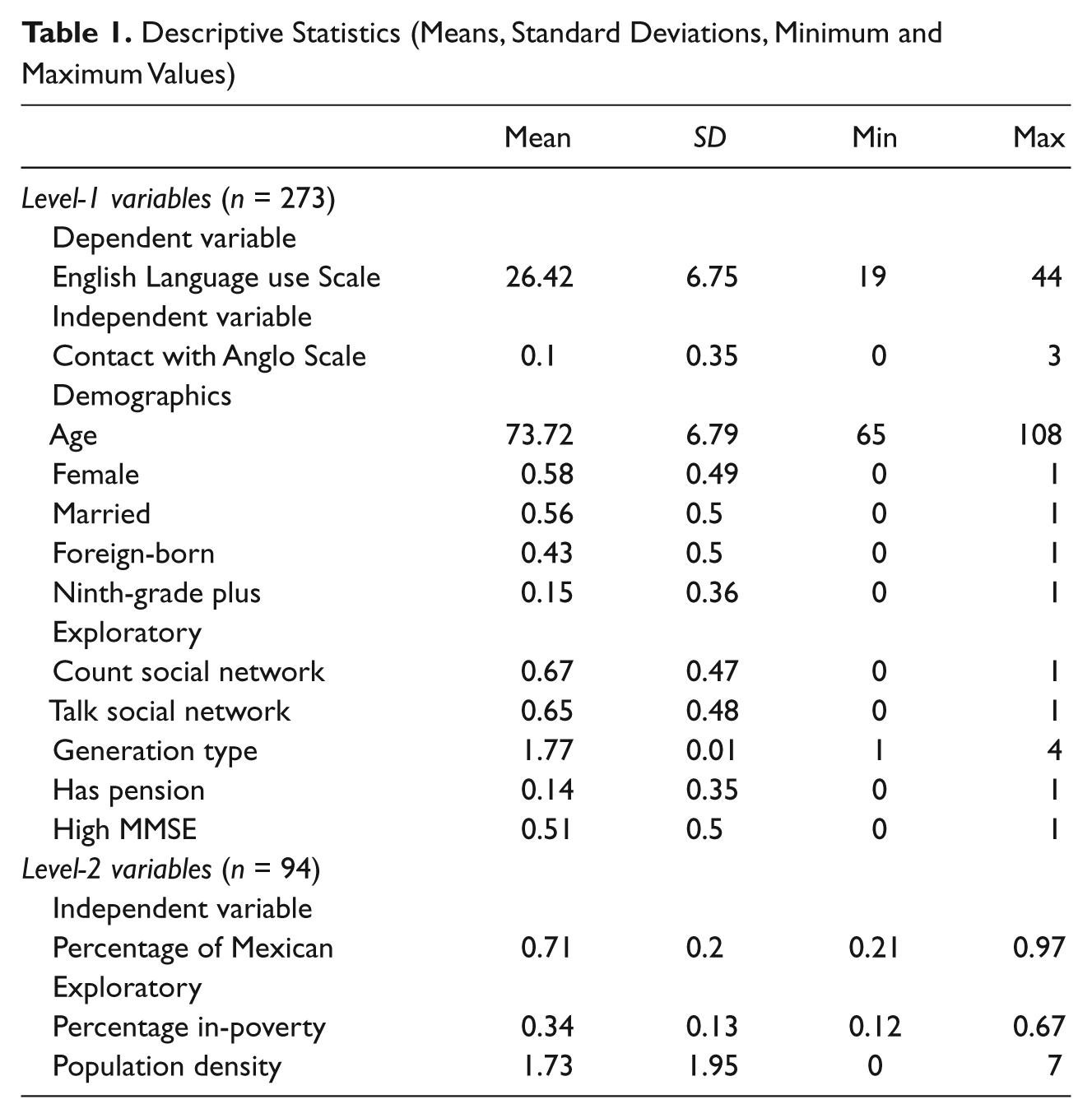
Our Level-1 continuous independent variable of interest is the “degree of contact with Anglos” an individual reported to have. In HEPESE, aged Mexicans were asked: “Throughout your adult life, have your neighbors been mostly Mexican-Americans, mostly Anglo, or about equal numbers of each?” They were also asked: “(Are/Were) the people with whom you work closely on [the job/your last job] mostly Mexican-Americans, mostly Anglo, or about equal numbers of each? And, they were lastly asked: “Throughout your adult life, have your close personal friends been mostly Mexican-Americans, mostly Anglo, or about equal numbers of each?” For these three questions, their answers were recorded as: 0= Mexican, 1 = mostly Mexican-American, 2 = mostly Anglo, 3 = about equal numbers of each, 8 = don’t know, and 9 = refused. Individuals with a “2” on these questions received a value of “1” on one of three binary variables to indicate they had mostly Anglo contact. The binary variables were then added to create the Contact with Anglo Scale, which as can be seen in Table 1, ranges from 0 (mostly no Anglo contact) to 3 (mostly had Anglo contact).
After exploring several other possible related variables (e.g., depression symptomatology) at Level-1, we settled on controlling for age, gender, marital status (married vs. not married), if they have a ninth-grade education and beyond, and whether they are FB or native born. We also include other exploratory covariates. We included their cognitive status using the Mini-Mental State Examination (MMSE; Matallana et al. 2011), in which, those with a score of 25 or greater are said to have high cognitive capacity. As a socioeconomic indicator, in addition to whether they have a high school diploma or not, we considered if they were receiving a pension.
In reference to the social network variables we assigned a “1” to those who reported most of the time when answering the following two questions: “In times of trouble, can you count on at least some of your family or friends most of the time, some of the time, or hardly ever?” and “can you talk about your deepest problems with at least some of your family or friends most of the time, some of the time, or hardly ever?” These were included as a proxy measure of the person’s social network health status.
Our article is unique because it investigates language shift in aged Mexicans while accounting for their generational status, and this HEPESE variable is being used in publication for the first time. The HEPESE generation type algorithm produces six potential categories:
Self FB; Both parents FB; Both grandparents FB
Self U.S.-born; Both parents FB; Both grandparents FB
Self U.S.-born; At least one parent U.S.-born; Both grandparents FB
Self U.S.-born; At least one parent U.S.-born; At least one grandparent U.S.-born
Self U.S.-born; Both parents U.S.-born; At least one grandparents U.S.-born
Self U.S.-born; Both parents U.S.-born; All grandparents U.S.-born
When we considered the full data, 270 have a missing value and the rest are distributed as follows: 1 = 1,239; 2 = 1,186; 3 = 107; and 4 = 248.
At “Level-2” (i.e., the tract level) we focused on the moderating macro variable of the percentage of Mexican. The percentage of Mexicans in the tract was computed using 1990 U.S. Census Bureau Summary File 1 tract-level data. Besides accounting for the in-poverty concentration in the person’s tract of residence, we control for population density—this was calculated by dividing the total population in the tract by the tract’s geographical area.
To specify our hierarchical linear model we used the HLM 6.04 software (Raudenbush, Bryk, Cheong, & Congdon, 2004). We opted to use a multilevel model to investigate the CLI because it has been convincingly argued that multilevel statistical tools provide advantage over traditional methods (Flaherty & Brown, 2010) when investigating macro on micro relationships. This software estimates equations that help explain cross-level statistical associations by accounting for the fact that tract measures are between-people dependent, a violation of classical regressions where independence is assumed. Our multilevel linear model is preferred over the classical ordinary least square regression because it does not assume that both microlevel and macrolevel factors come from simple random samples (Arnold, 1992).
Our model runs a single regression for each tract (i.e., level-2 unit) by nesting our HEPESE respondents “within-tract” equations, so that CLIs are the result of “across-tract” equations. The variance around each parameter at level-1 is taken into account in the regression at level-2 (Arnold, 1992). In short, both intra- and intertract coefficients have their own error measurements where maximum likelihood and generalized least squares estimation procedures generate HLM coefficients and variances (Poston, 2002). The use of the HLM software empowers our research by giving us the ability to understand how the microlevel contact with the Anglo factor is on average associated with English language use across and within tracts, as we control for the various microlevel and macrolevel factors included in the equation. We have 2,573 individual-level units being nested in 94 tract-level units and we interpret “population-average” coefficients with “robust standard errors” from our HLM outputs (Mass & Hox, 2004a, 2004b).
Please note that existing research making use of hierarchical models has not made it customary to reveal the minimum amount of level-2 units allowed per each level-2 unit. Since the modeling, in effect, executes a regression for each level-2 unit, having a regression slope based on one or two people may be of concern. Researchers making use of such models should be explicit with the minimum amount of units allowed per cluster. In our project, we seek to reduce the chances of making a Type-I error (i.e., finding false statistical significance) with our model and parameters, by only using observations where there are at least 10 HEPESE respondents per-tract.
Results
We begin this section by giving a brief description of the analytic sample from the descriptive statistics (Table 1). At Level-1, on the language scale, the average score is 26. The majority of the subjects have very little contact with Anglos and an average age of 74. About 58% are females, 56% are married, 43% are FB, and only a few (15%) have a ninth-grade education and beyond. Most people in our sample report having somebody they can “count on” and “talk with” within their social networks. Only 14% have a pension and 51% have a high MMSE score, which signals a high level of cognitive functioning in the sample. At Level-2, we observed that the average Census tract in our analytic sample has a high level of co-ethnic concentration (71%). On average, our tracts have a 34% in-poverty concentration and a 1.73 km2 population density.
We now turn our attention to our empirical multilevel model. To justify the need for a multilevel model, we first execute the following simple two-level random intercept model with the English Language use Scale as the dependent variable. At Level-1 of the equation we have:
As per Hox (1995), the ICC is “the proportion of the variance explained by the grouping structure in the population” (p. 15). Since ICC measures the proportions of variance in language use between-tracts, we could infer that almost one fourth in the variance of language use can be explained at the macrolevel. Since τ00 is statistically significant and the ICC is greater than 0, we conclude that a multilevel model is not only useful, but it is necessary in modeling English language use aged Mexicans.
After justifying the use of the multilevel linear model, we specified the following “full equation” at Level 1:

In the Level-1 equation, Language ij represents the predicted score on the English Language use Scale; i and j refer to the ith HEPESE person in jth tract; β0j is the intercept in jth tract; β1j through β11j are the 11 average slopes for the individual-level variables, in jth tract; and rij is the error term for the ith HEPESE person in jth tract.
At Level-2, our abbreviated equation is:


. . . and so forth until we reach β11:

In the Level-2 equation, γ00 is the “king” intercept of the full model, γ01 is the intercept of percentage of Mexican, γ02 is the intercept of population density, γk0 (kth ranging from 1 to 11) are the direct effects of the individual-level factor on the English Language use Scale, γk1 are the indirect effects of percentage of Mexican on the microlevel slope, γk2 are the indirect effects of population density on the microlevel association, and u0 is the error measurement for all intercepts. No other Taus are included, thus, CLIs are assumed to be similar across all tracts.
The “mixed” equation between Level-1 and Level-2 would look something like:
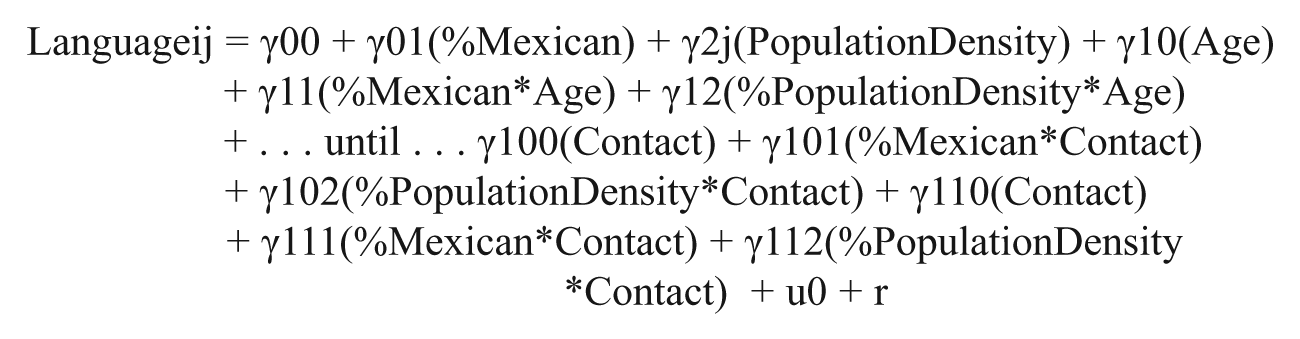
After specifying the above equation in HLM, we obtained the results displayed in Table 2. The order of variables is prioritized as per our research agenda. Please note that although much could be infer from the results, we focus our interpretations on the contact variable and the moderating effects of co-ethnic concentration.
Multilevel Linear Regression Outputs Predicting Language Shift
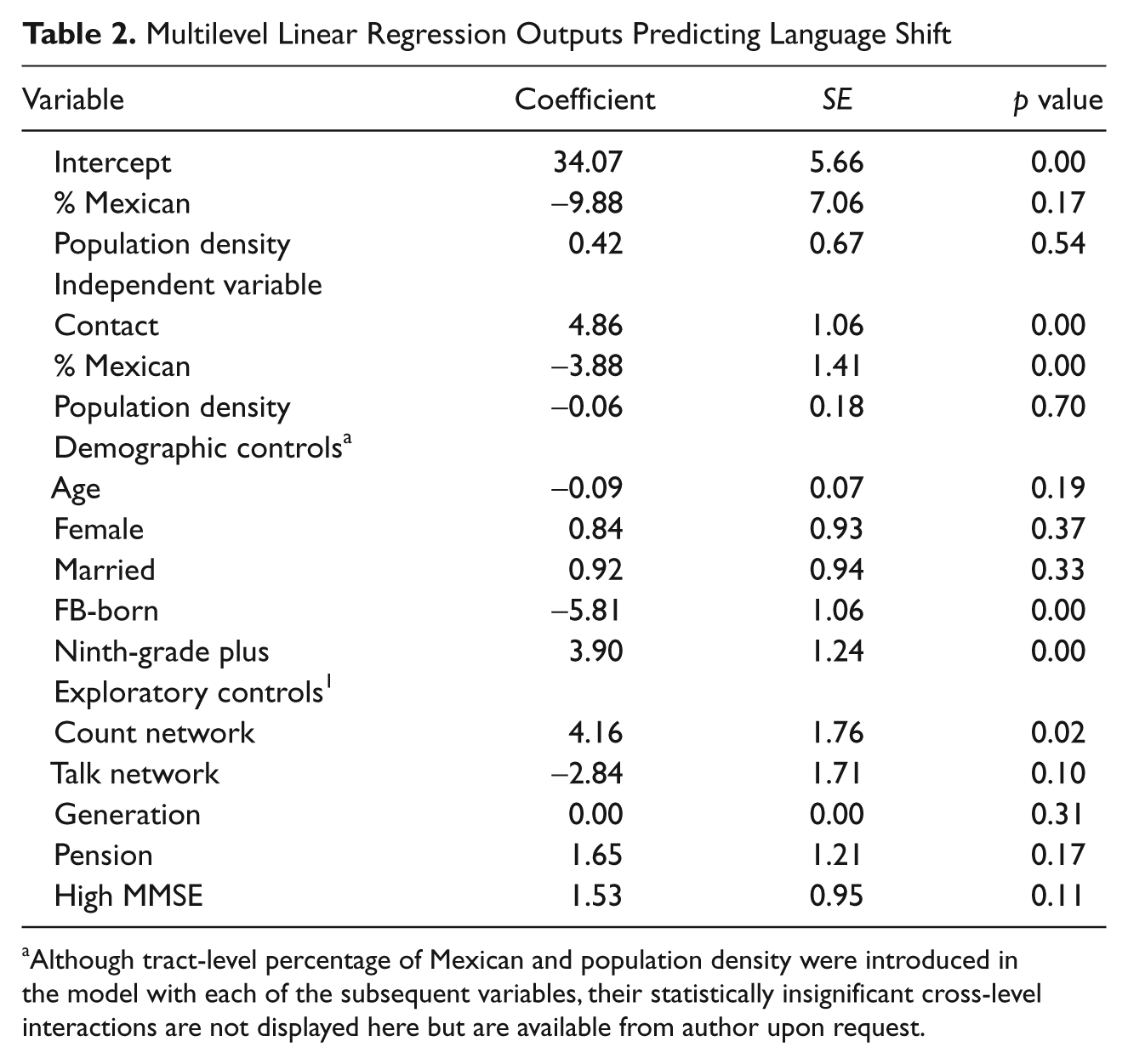
Although tract-level percentage of Mexican and population density were introduced in the model with each of the subsequent variables, their statistically insignificant cross-level interactions are not displayed here but are available from author upon request.
As expected at the microlevel, we find that as the level of contact with Anglos increases, the use of the English language is greater (γ100 = 4.86; α = 0.00). That is, Mexican Americans are more likely to experience a language shift when there is high contact with Anglos. Thus, our findings demonstrate that there is a positive microlevel relationship between the degree of language shift and the level of contact with Anglos. And, in answer to our first research question, we find that the degree of contact with Anglos does influence a Mexican’s language shift from Spanish to English.
Although the confirmation that contact with Anglos matters is important, our main focus is on understanding the effect the tract’s level of Mexican population has on the microlevel slope. We observed that, as the level of Mexican concentration increases, the effect of the contact with Anglo factor on English language use weakens (γ110= −3.88; α = 0.00). The increasing co-ethnic concentration reduces the speed by which the microlevel positive slope between contact and language rises. This finding shows that we are unable to falsify our hypothesis that a tract’s Mexican population concentration significantly diminishes the effect of contact with Anglos on English language use.
Of notable importance is our findings that being FB (γ40 = −5.81; α = 0.00) reduces English language usage, while having a ninth-grade education and above (γ60 = 3.90; α = 0.00) is related to higher levels of English language usage. The mean scores for English language usage by generation type is as follows: G1 = 23.3, G2 = 28.9, G3 = 30.8, and G4= 32.1. Although the pattern makes it clear that those who are of a latter generation on average use more English, we note generational status is not predictive of language shift (γ111 = 0.00; α = 0.31) in our model.
In sum, our findings demonstrated that the ethnic context measure has a moderating effect on the microlevel relationship between English language use and contact with Anglos. In answer to our most substantive question, we find that the macrolevel percentage of co-ethnic concentration moderates the microlevel relationship between English language use and contact with Anglos. We interpret these findings as evidence that co-ethnic contexts are capable of offering the social and economic resources for language resistance. We interpret this CLI as a signal that aged Mexican’s Spanish language capital in highly co-ethnic concentrated areas provides them with the ability of abstaining from experiencing a language shift.
Discussion
In this study, we have demonstrated that the direct relationship between the amount of contact with Anglos and aged Mexicans’ English language use is moderated by the co-ethnic concentration. As the presence of co-ethnics increases, the direct microlevel relationship weakens. The study of Spanish language use is complex, since the maintenance or shift of a language depends on different factors (e.g., Bills, Hernández-Chávez, & Hudson, 1995). In our study, we interpret the tract-level co-ethnic effect as signaling that when the social resources for retaining the mother tongue are present, many aged Mexicans, despite their level of contact with Anglos, will have the ability to resist shifting to only English language use.
Several limitations came to light during this study. In particular, we are making several assumptions on how the macrolevel percentage of Mexican is causally related to the microlevel relationship between contact with Anglos and English language use. For example, it is possible that as the numbers of Mexicans increases, the availability to learn, practice, and thus use more English is diminished. Unfortunately, the questions from our database do not directly ask why individuals use English over Spanish; thus, we were unable to dissect whether individuals are choosing to either abandon Spanish, or shift to English language use in relation to English language availability.
Another limitation is that our dependent variable only measures the participants’ self-report in English language use, and does not ask the motives or perceived causes of doing so. Therefore, future research should seek out to ascertain how minorities assigned volition factors in their language use decisions. Since the scientific accuracy of indirect and nontheory-driven tract measures remains uncertain, future research should focus on minorities’ subjective evaluation of co-ethnic cohesion in their “neighborhood.”
Notwithstanding the limitations, we believe our study is unique, insightful, and substantively contributes to the literature by providing support for the contact hypothesis and adding that co-ethnic concentration may play a role on how microlevel processes evolve in language shift. This project compliments previous work on language shift among Mexicans in the United States (e.g., Martínez, 2009) by enhancing knowledge produced from studies on young participants (Lutz, 2006; Potowski, 2004) and older adults (e.g., Burr & Mutchler, 2003). Our study helps expand scientific literature dedicated to language loss and/or maintenance among minority populations.
The investigation makes a substantive contribution to social science research by frame the research project from the point of view of those who abandon their mother tongue out of necessity and not from an inborn volition. We give voice to this underrepresented group by pointing out that socially coercive process are born when dominant groups instrumentalize the labeling of languages as either superior or inferior to retain power (Kroskrity, 2006)—making the dominant group’s hegemonic determination possible as they subjugate minority groups’ native tongue through legal and cultural means (Kachuk, 1993). By using this “conflict” theoretical position we add to academic discourse on how and why aged Mexicans resist the adoption of a new language. By using this theoretical frame, our study explores how social environments affect language resistance and advances the idea that Mexicans are not equally equipped, either at the individual and/or context level, to retain Spanish when/if they desire it.
This study is important because it gives voice to the views of those who may have felt theirs, or their ancestors’ abandonment of their mother tongue, traditions, and thus, their identity was the product of coercion (see Portes & Schauffler, 1994). Language resistance needs not be seen as a revolutionary behavior disrupting the equilibrium of a homogeneous society. Language resistance could instead be understood as one of many factors contributing toward the “heterorization” of the U.S. society—where, perhaps in the future, the desire for mono-linguism will be an archaic social value.
Footnotes
Declaration of Conflicting Interests
The author(s) declared no potential conflicts of interest with respect to the research, authorship, and/or publication of this article.
Funding
The author(s) received no financial support for the research, authorship, and/or publication of this article.