



Abstract
The Acculturation Rating Scale for Mexican Americans–II (ARSMA-II) is one of the most widely used measures of acculturation for Latinos. While the ARSMA-II is used quite often, there has been little research examining the latent factor structure of the measure. Furthermore, there has only been one prior study examining the factor structure with a sample of Latino adolescents. The primary purpose of the current study is to test three competing factor models of a brief version of the ARSMA-II in a pretreatment sample of Latino adolescents (n = 106). Results from confirmatory factor analyses supported a nine-item two-factor structure for the sample in this study. A path analysis indicated that one of the factors was predictive of depressive symptoms but was mediated by the cultural variables familism and ethnic identity. The implications of study findings and suggestions for further refinement of this measure are discussed.
Acculturation is typically assessed for ethnic minorities through the use of a specific instrument or a proxy variable, such as preferred language or generational status (see Yoon, Langrehr, & Ong, 2011). For Latinos, the Acculturation Rating Scale for Mexican Americans–II (ARSMA-II; Cuéllar, Arnold, & Maldonado, 1995) is the most commonly used instrument to measure acculturation (Yoon et al., 2011). The original version of the ARSMA (Cuéllar, Harris, & Jasso, 1980) was developed as a 20-item instrument that differentiated between levels of acculturation and was validated with a sample of Mexican American psychiatric patients (n = 88) and a non-clinical sample of adults (n = 134). The ARSMA was revised in 1995 to the ARSMA-II (see Cuéllar et al., 1995) and was validated on a sample of Mexican, Mexican American, and White non-Latino university students (n = 379). The ARSMA-II is a 48-item instrument that measures level of acculturation and is composed of two major scales: Scale 1 (30 items) assesses the general areas of integration and assimilation, and Scale 2 (18 items) assesses the areas of separation and marginality. In practice, however, the vast majority of researchers use Scale 1 of the ARSMA-II (Gutierrez, Franco, Powell, Peterson, & Reid, 2009; Yoon et al., 2011). This is most likely due, in part, to Cuéllar et al. (1995) describing Scale 2 as “experimental” (p. 283). For this reason, we will focus on Scale 1 of the ARSMA-II heretofore. Scale 1 is comprised of two subscales that measure the level of orientation one has toward Mexican (i.e., Mexican Oriented Scale [MOS]) or American culture (i.e., Anglo Oriented Scale [AOS]). In 2004, Cuéllar (as cited in Bauman, 2005) revised Scale 1 of the ARSMA-II to a 12-item version and titled it the Brief ARSMA-II that was comprised of two 6-item subscales (i.e., MOS and AOS). In a recent review article, Yoon et al. (2011) reported that the ARSMA-II and its predecessor have been used in almost 30 studies 1 since the initial development of the measure in 1980; the measure has also influenced the development of acculturation instruments for other ethnic minority groups (see Lee, Yoon, & Liu-Tom, 2006).
While a version of the ARSMA-II has been used in a number of studies, there is a dearth of information on the psychometrics of the instrument. During the psychometric testing of the ARSMA-II, Cuéllar et al. (1995) reported that an exploratory factor analysis (EFA) of Scale 1 with a sample of adults produced three and two factors for the MOS and AOS subscales, respectively. Since 1995, only five studies were located that investigated the psychometric properties of Scale 1 of the ARSMA-II; three studies were with Latino samples (Andrews, Bridges, & Gomez, 2013; Bauman, 2005; Jimenez, Gray, Cucciare, Kumbhani, & Gallagher-Thompson, 2010) and two with samples of Asian American college students (Lee et al., 2006; Miller, 2007). Of the three studies with Latinos, two were with samples of adults and one was with children and adolescents. Bauman (2005) was the only study that examined the psychometric properties of the ARSMA-II with a sample of children and adolescents. She conducted EFAs on the 12-item Brief ARSMA-II with a sample of children (n = 116) and adolescents (n = 292) for which a two-factor solution, MOS and AOS, was identified across both samples. More recently, a 14-item two-factor (i.e., MOS and AOS) version of the ARSMA-II was tested with two convenience samples (n = 77 and n = 46) of Latino adults (see Andrews et al., 2013), and acculturation scores were predictive of depressive symptoms. As can be seen from the review above, the latent factor structure of the ARSMA-II has primarily been examined in college student (Cuéllar et al., 1995; Lee et al., 2006; Miller, 2007) and adult samples (Andrews et al., 2013; German, Gonzales, & Dumka, 2009; Gutierrez et al., 2009; Jimenez et al., 2010), and there is only one existing study with a sample of adolescents (Bauman, 2005).
The purpose of this study is to investigate the latent factor structure of a brief version of the ARSMA-II via confirmatory factor analysis (CFA) with a pretreatment sample of Latino adolescents. This will be accomplished through examination of competing factor models via CFA and determining the best fit for the sample in this study. A secondary objective is to examine the predictive relation between the latent factors identified via the CFAs and a measure of psychological distress. This objective will be accomplished by conducting a path analysis that tests the predictive relation between the latent factors and depressive symptoms. For Latinos, however, the path between acculturation and psychological distress is likely mediated by other cultural factors (Umaña-Taylor & Updegraff, 2007). For example, cultural factors, such as ethnic identity and familism, may serve to buffer the stress experienced by Latino adolescents during the process of acculturation (Umaña-Taylor & Updegraff, 2007; Zeiders et al., 2013). For these reasons, we will include ethnic identity and familism as mediators in the path analysis.
Method
Description of Sample
Adolescents in this study (n = 106) were recruited as part of a larger set of studies examining the cultural accommodation of substance abuse treatment for Latino adolescents (see Burrow-Sánchez, Martinez, Hops, & Wrona, 2011; Burrow-Sánchez & Wrona, 2012). All adolescents ranged in age from 13 to 18 (M = 15.30, SD = 1.27) and self-identified as Latino; most were male (91.5%) and born in the United States (63.2%). The majority of adolescents in the sample had parents who were born in Mexico (73.6% of mothers; 81.1% of fathers). The majority of study referrals came from juvenile justice probation officers or case managers within a medium-sized city in a Mountain West state of the United States. As part of the inclusion criteria for the larger treatment studies, all adolescents were prescreened and met Diagnostic and Statistical Manual of Mental Disorders (4th ed., text rev.; DSM-IV-TR; American Psychiatric Association, 2000) diagnostic criteria for substance abuse or dependence disorder. Participant procedures for this study were approved by the Institutional Review Board at the institution of the first author.
Administration of Measures
All measures were available in English or Spanish and administered by trained bilingual research assistants to all participants. The focus of the current study is on the baseline assessment measures that were administered prior to adolescents being randomized to a treatment condition. The majority of adolescents (98%) preferred the completion of measures and verbal interactions with staff in English.
ARSMA-II
The ARSMA-II is one of the most widely used measures of acculturation for Latino adults and adolescents (Cuéllar et al., 1995). It has demonstrated good reliability and strong construct and discriminant validity in research with Mexican American samples (Cuéllar et al., 1995). The 30-item Scale 1 of the ARSMA-II was administered to participants that consists of the Anglo Oriented Subscale (AOS; 13 items) and the Mexican Oriented Subscale (MOS; 17 items); internal consistency for Scale 1 was α = .820 for this sample.
The Multi-Ethnic Identity Measure (MEIM)
The MEIM is a widely used measure of ethnic identity for adolescents (Phinney, 1992). A modified 12-item version of the MEIM was used in this study that has been validated for this sample via CFA (see Burrow-Sánchez, 2014). The items asked adolescent participants to indicate their attitudes and behaviors related to their ethnic identity group on a “1” = disagree to “5” = agree scale. Scores from the 12 items were summed and averaged for each participant with a possible range of scores from 1 to 5 and higher scores indicating higher ethnic identity achievement. The MEIM has demonstrated high internal consistency for youth (α = .81) and college student samples (α = .90; Phinney, 1992). Internal consistency for the current sample was α = .898.
Familism Scale (FS)
The FS is a 14-item instrument used to measure the construct of familism based on the factors of obligations, perceived support, and family as referents (Sabogal, Marin, Otero-Sabogal, & Marin, 1987). Participants rated their agreement to items on a scale ranging from “1” = very much in disagreement to “5” = very much in agreement. Scores from individual items were averaged to obtain a total score. Internal consistency for this sample was α = .802.
Beck Depression Inventory–II (BDI-II)
The BDI is a widely used 21-item instrument that was administered to measure the level of depressive symptoms for adolescents. Items ask participants to rate their responses to statements evaluating symptoms of depression such as level of sadness, loss of pleasure, feelings of guilt, suicidal ideation, and somatic complaints. Individual item scores were summed to obtain a total score ranging from 0 to 63, with larger scores indicating higher levels of depressive symptoms. The BDI has been used extensively with adult (Beck & Steer, 1991) and adolescent samples (Steer, Kumar, Ranieri, & Beck, 1998). Internal consistency of this measure for the current sample was α = .87.
Timeline follow back (TLFB)
Substance use for all participants was measured using the TLFB (Sobell & Sobell, 1992), which is a semi-structured interview that records substance use over a specified period of time. The TLFB utilizes a calendar format to help individuals remember their history and patterns of substance use. It has been used extensively with adolescents and appropriate psychometric properties have been established (Dennis, Funk, Godley, Godley, & Waldron, 2004; Sobell & Sobell, 2003). Alcohol and drug use data from the TLFB for 90 days prior to baseline was used for the present study.
Analytical Plan
The primary analysis consisted of testing three competing factor models via CFA for Scale 1 (MOS and AOS) of the ARSMA-II with the sample in the present study. We chose to focus on shorter versions of Scale 1 (i.e., 14 items or less) because briefer instruments can produce similar results compared with longer versions and minimize burden for adolescent participants (Stephenson, Hoyle, Palmgreen, & Slater, 2003). We tested three two-factor structure models that have been examined in prior research by Andrews et al. (2013; 14 items), Cuéllar (2004 as cited in Bauman, 2005;12 items), and Bauman (2005; 10 items). Secondary analysis was conducted to further test the construct validity of the best fitting model identified via the CFA. In particular, a path analysis was conducted to test the predictive relation between the ARSMA-II latent factors, probable cultural mediators, and depressive symptoms.
Results
Preparation of Data
Descriptive and bivariate analyses were completed using IBM SPSS Version 20 (IBM, 2011b), whereas CFA and Path Analysis were conducted with SPSS AMOS Version 20 (IBM, 2011a). Initial screening indicated that less than 0.5% of the participant ARSMA-II, MEIM, FS, and BDI data were missing. A series mean procedure was used to replace missing data so that data from all participants could be utilized for this study.
CFA
The three competing factor models tested via CFA were replicated from the two-factor 14-, 12-, and 10-item models identified by Andrews et al. (2013), Cuéllar (2004 as cited in Bauman, 2005), and Bauman (2005), respectively. The CFA models were compared based on the following fit criteria: (1) chi-square over df ratio of less than 2, (2) comparative fit index (CFI) higher than 0.95, (3) normed fit index (NFI) closer to 0.95, and (4) root mean square error of approximation (RMSEA) less than 0.08 (see Byrne, 2010). All CFA models in the present study were analyzed using maximum likelihood (ML) estimation that assumes the indicators of a measure are continuous variables. While it is a common to use ML estimation when indicators are categorical variables such as the ARSMA-II, there is disagreement about this practice in the literature (see Breckler, 1990; Byrne, 2010). The AMOS software program provides the asymptotic distribution-free (ADF) method as an alternative for estimating categorical variables; this approach is analogous to the weighted least squares method in other software programs (Byrne, 2010; Flora & Curran, 2004). The ADF method was not feasible in the current study due to the requirement of large samples based on the number of estimated parameters in the model (see Curran, West, & Finch, 1996). However, there is ample evidence to suggest that when the number of categories is four or more and the distribution does not markedly differ from normal, the use of ML estimation for categorical variables does not pose problems (Bentler & Chou, 1987; Green, Akey, Fleming, Hershberger, & Marquis, 1997). The categorical estimation issue was addressed in the current study by comparing parameter estimates for the final model generated from both ML and Bayesian methods as suggested by Byrne (2010) when using AMOS software with smaller samples. The parameter estimates for both methods indicated similarity and did not alter the substantive conclusions for the final model selected.
Model 1 was the poorest fitting based on the indices, whereas Models 2 and 3 demonstrated improved fit to the data (see Table 1). Overall, Model 3 displayed the best fit on all indices and was the most parsimonious of the three models; thus, Model 3 was chosen for continued analysis. Model 3 was examined for possible misspecification through review of modification indices (covariances), regression weights, and residual covariances. The misspecification review indicated that error terms covaried for Items 1 and 3 and Items 8 and 11 on the MOS factor. In addition, Item 15 had the lowest regression weight combined with the highest residual covariances (i.e., >1.5). After the diagnostic review, error terms for Items 1 and 3 and Items 8 and 11 were allowed to covary and Item 15 was omitted resulting in Model 3a. This revised model demonstrated an improved fit over Model 3 and the difference between their chi-square statistics provide a comparison of model fit to the data (Kline, 2005)—that is, Model 3 − Model 3a = 76.164 − 32.053 = 44.111 for 10 df, p< .001. In other words, Model 3a provided a significantly better fit to the data for this sample compared with Model 3. The MOS factor consisted of Items 1, 3, 8, 11, 12, and 17 and indicates one’s affinity for speaking, listening, reading, and thinking in Spanish. The AOS factor consisted of Items 2, 10, and 16 and indicates one’s affinity for speaking, listening, and thinking in English. The average variance extracted and construct reliability for the MOS factor were 42% and 0.81, whereas they was 34% and 0.60 for the AOS factor. There was a nonsignificant negative correlation (r = −.221, p> .05) between the MOS and AOS factors. Item content, latent factors, and factor loadings for the models tested in this analysis can be found in Table 2. The bivariate correlations computed between study variables are presented in Table 3.
Fit Indices for Models Tested.
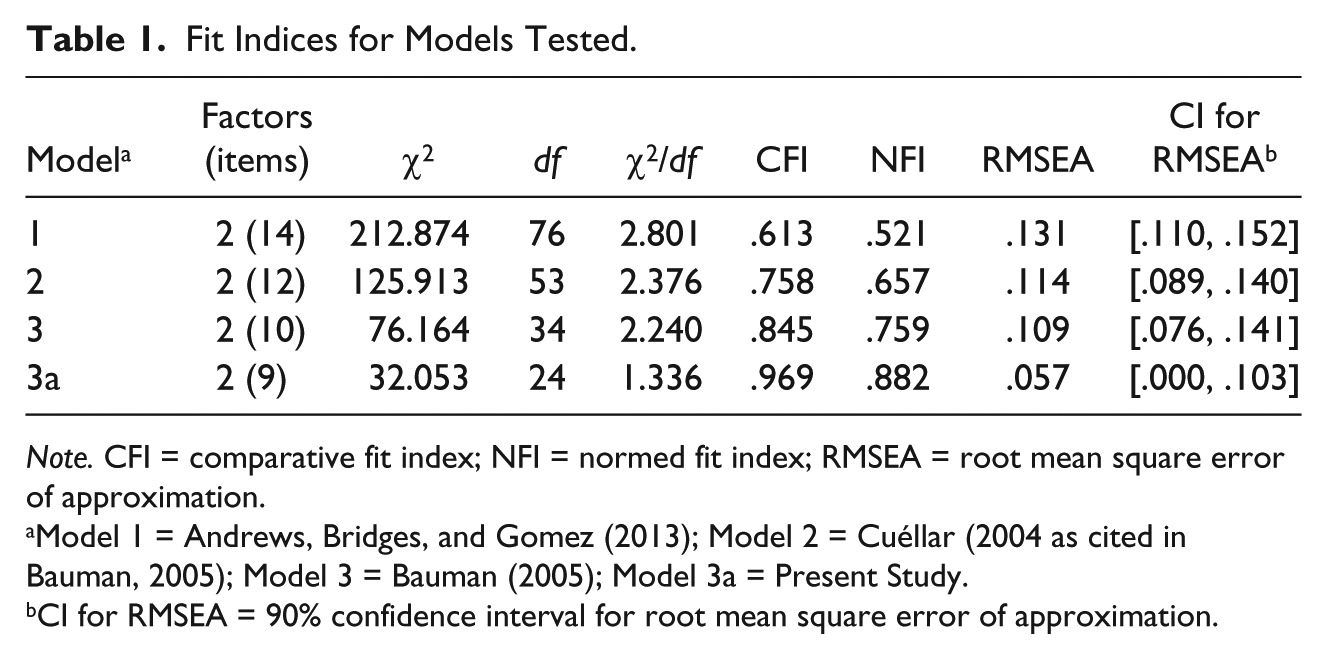
Note. CFI = comparative fit index; NFI = normed fit index; RMSEA = root mean square error of approximation.
Model 1 = Andrews, Bridges, and Gomez (2013); Model 2 = Cuéllar (2004 as cited in Bauman, 2005); Model 3 = Bauman (2005); Model 3a = Present Study.
CI for RMSEA = 90% confidence interval for root mean square error of approximation.
Item Content, Comparative Models, and Factor Loadings.
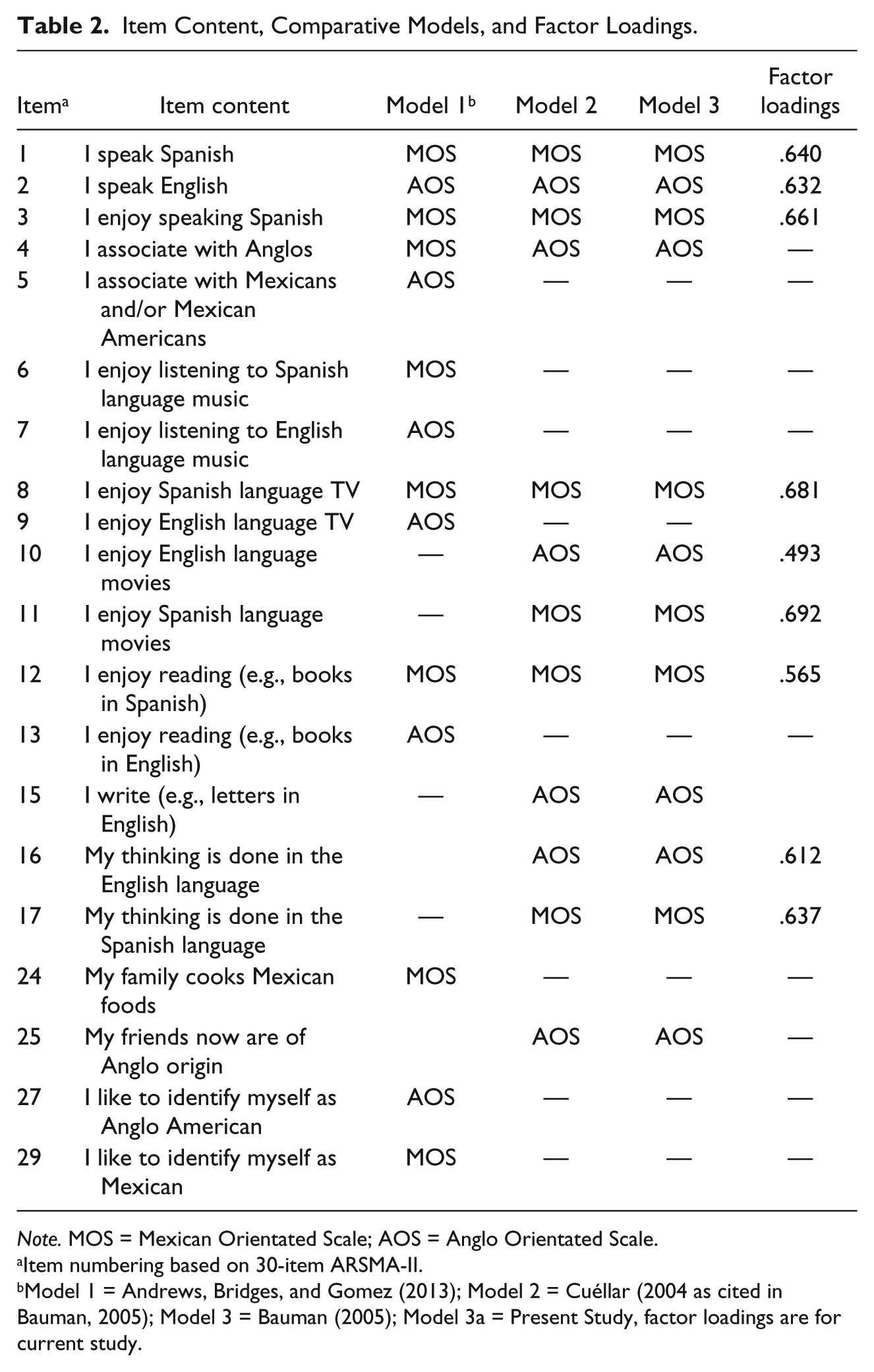
Note. MOS = Mexican Orientated Scale; AOS = Anglo Orientated Scale.
Item numbering based on 30-item ARSMA-II.
Model 1 = Andrews, Bridges, and Gomez (2013); Model 2 = Cuéllar (2004 as cited in Bauman, 2005); Model 3 = Bauman (2005); Model 3a = Present Study, factor loadings are for current study.
Bivariate Correlations Between Study Variables.

Note. BDI = Beck Depression Inventory; Drug Use = Percentage of Days Drugs Were Used in Past 90 (including alcohol, excluding tobacco)—scores were log transformed due to skew; FS = Familism Scale; MEIM = Multigroup Ethnic Identity Measure; MOS = Mexican Orientated Scale (six-item version); AOS = Anglo Orientated Scale (three-item version).
p< .05. **p< .01.
Path Analysis
The construct validity of Model 3a was further evaluated via a path analysis that tested the predictive relations between the latent factors MOS and AOS and depressive symptoms. However, we included the cultural variables ethnic identity and familism as probable moderators in the path analysis (see Figure 1). Results from the path model indicated that MOS had a significant positive direct effect on familism (β = .31, p< .001) and marginally positive direct effect on ethnic identity (β = .18, p = .064). In turn, familism had a significant negative direct effect on depressive symptoms (β = −.30, p = .001) as did ethnic identity (β = −.23, p = .010). In the model, the total indirect effect of MOS on depressive symptoms was significant and negative (β = −.193, p = .007). In contrast, none of the paths were significant for the AOS factor in the path model. Results from the path model suggest that the relation between Mexican orientation and depressive symptoms is mediated by familism and ethnic identity.
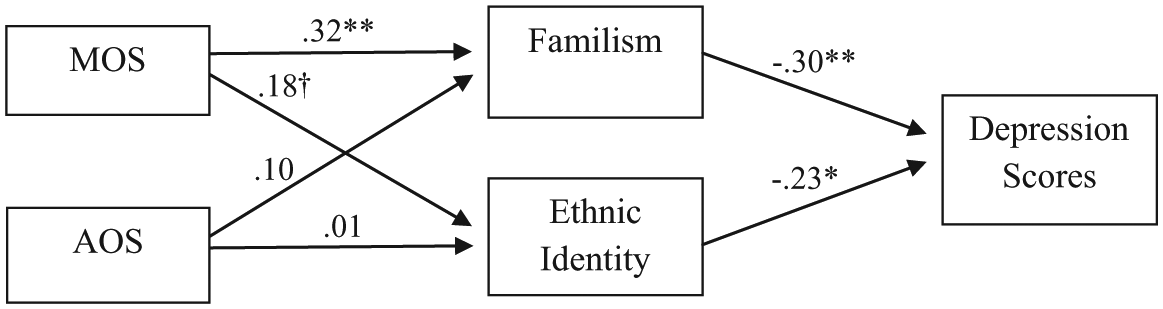
Mediational path analysis for ARSMA-II latent factors and depression score.
Discussion
In the current study, a nine-item two-factor model of Scale 1 of the ARSMA-II produced the best fit for a clinical sample of Latino adolescents. The MOS factor consisted of six items and had an average variance extracted of 42%, whereas the three-item AOS factor was 26%; construct reliability was higher for the MOS factor. Results from a path analysis indicated that the MOS factor indirectly predicted depressive symptoms, but was mediated through familism and ethnic identity.
The structure of the ARSMA-II identified in the current study was similar to what has been found in previous studies when testing brief versions of the measure (see Andrews et al., 2013; Bauman, 2005); however, there were a few deviations from the 12-item brief version of the measure. First, Items 4 and 25 of the AOS factor were eliminated from the final model. Both items contained content pertaining to the associations one had with Anglo persons (“I associate with Anglos,” “My friends are of Anglo origin”). For the Latino adolescents in the current sample, they probably found it difficult not to associate with Anglos (e.g., contact in educational or judicial systems), and thus, these items may have held less relevance for them. Second, Item 15 was also eliminated from the AOS factor and contained content regarding writing letters in English (“I write letters in English”). Due to technology, the act of writing letters may have seemed foreign or archaic to adolescents in the current study. Another possibility is that writing skills taught in the schools the adolescents attended were primarily conducted in English. Finally, the error terms for Items 1 and 3 (“I speak Spanish,” “I enjoy speaking Spanish”) and Items 8 and 11 (“I enjoy Spanish language TV,” “I enjoy Spanish language movies”) covaried on the MOS factor. The wording content of each item set was very similar and probably appeared redundant to adolescents. It is likely that the overlap in item content produced the residual correlation and suggests that each set of items could be reduced to a single item. The results suggest that the ARSMA, in its current form, could benefit from revision in order to increase its relevance for contemporary Latino adolescents and reduce redundancy between items. At the very least, results suggest that researchers using the ARSMA should closely examine the utility of the measure because its frequent appearance in the literature is not commensurate with the psychometric findings to date.
An indirect predictive relation was found between the MOS factor and depressive symptoms for adolescents, and it was mediated by the cultural variables familism and ethnic identity. Specifically, higher scores on the MOS factor predicted higher scores on the familism variable and lower depressive symptoms. This finding is consistent with the literature that suggests an orientation toward culture of origin and familism may serve as protective factors for Latino adolescents (German et al., 2009; Marsiglia, Parsai, & Kulis, 2009). In addition, higher levels of Mexican orientation and familism may protect against acculturative stress and sequelae, such as psychological distress. A similar relation was found for the mediator ethnic identity, albeit marginally significant, which suggests it may also serve as a protective factor against psychological distress and other problem behaviors consistent with prior research (Burrow-Sánchez, 2014; Burrow-Sánchez, Coralles, Jensen, & Meyers, 2014; Umaña-Taylor & Updegraff, 2007). Overall, results from the path analysis provide support for the perception that adolescent development for Latinos is a complex process and influenced by multiple cultural factors (Berry, Phinney, Sam, & Vedder, 2006; Umaña-Taylor & Updegraff, 2007).
As with any study, certain limitations exist that need to be mentioned. First, the study included a restricted sample of Latino adolescents (i.e., clinical sample, mostly male) to which generalizability may be limited. For this reason, it is suggested that future research be conducted with more gender balanced, non-clinical samples of Latino adolescents. Second, the sample size is considered small for conducting a CFA, even though our models converged without problem. However, we recommend that larger samples of Latino adolescents be recruited for future factor analytic studies of the ARSMA-II. Both of these study limitations provide fruitful avenues for additional psychometric study and will inform researchers of the utility of this instrument to measure acculturation.
The present study was the second to examine the factor structure of the ARSMA-II with a sample of Latino adolescents but the first to employ a CFA. Findings provide support for a nine-item two-factor structure of the ARSMA-II and indicate that the influence of the MOS factor on depressive symptoms is mediated by the cultural variables familism and ethnic identity. It is recommended that future research be conducted to examine the factor structure of the ARSMA-II in other Latino adolescent samples to test the generalizability of study findings.
Footnotes
Acknowledgements
The authors wish to thank all members of the Validating Interventions for Diverse Adolescents (VIDA) Research Team at the University of Utah for their assistance with this research.
Authors’ Note
The content is solely the responsibility of the authors and does not necessarily represent the official views of the National Institute on Drug Abuse or the National Institutes of Health.
Declaration of Conflicting Interests
The authors declared no potential conflicts of interest with respect to the research, authorship, and/or publication of this article.
Funding
The authors disclosed receipt of the following financial support for the research, authorship, and/or publication of this article: This research was supported by Award Number K23DA019914 from the National Institute on Drug Abuse awarded to the first author.