



Abstract
This study explores binge-drinking behaviors and attitudes among Hispanic and non-Hispanic college students. The authors surveyed students at the same large Hispanic-serving university used in a 1999 study by Bennett et al., partially replicating that earlier research. While the percentage of students who reported binge drinking in the present study did not differ significantly by ethnicity, Hispanic students showed the most dramatic decrease in binge-drinking behavior since the 1990s study. Perhaps not coincidentally, during the years between studies, the university’s substance-abuse prevention office increased its outreach and awareness programs; university policies concerning alcohol use became more stringent and more publicly promoted; and Hispanics became the largest segment of the school’s undergraduate population. At the same time, despite these contextual changes, Hispanic students in the present study were less likely than other groups to disagree with the statement “binge drinking is part of my race/culture,” while non-Hispanic White students were less likely to disagree with the statement “no one ever died as a result of binge drinking.” Recommendations for binge-drinking education and prevention campaigns explicitly targeting Hispanic students and other risk groups (students living on campus; students from rural areas) are discussed.
Introduction
High-risk drinking is a serious and pervasive problem among the U.S. college population, including Hispanic students as well as White non-Hispanic students (Knight et al., 2002; Rimal & Real, 2005; H. Wechsler & Wuethrich, 2002). National survey data show that there are variations across ethnicities in terms of alcohol consumption and abuse. While Whites have the highest rate of high-risk drinking behavior as a whole (Substance Abuse and Mental Health Services Association [SAMHSA], 2008), a higher percentage of Hispanic youth, specifically, report having consumed alcohol in their lifetime than do White or African American youth (King & Vidourek, 2010). Moreover, as noted by King and Vidourek (2010), more than one quarter of Hispanic youth reported that they had consumed alcohol before reaching age 13, a rate higher than for members of other ethnic groups.
Binge drinking is defined as the excessive use of alcohol that places the user and others at increased risk for problems that are a direct result of alcohol consumption (H. Wechsler, Davenport, Dowdall, Moeykens, & Castillo, 1994). Binge drinking is considered five drinks for men, or four drinks for women, within a short time frame, usually 2 hours. In addition, National Institute on Alcohol Abuse and Alcoholism (NIAAA) defines binge drinking as a pattern of drinking that brings blood alcohol concentration (BAC) levels to 0.08 g/dL (Centers for Disease Control, 2012; NIAAA, 2014). While approximately 38 million U.S. adults are considered binge drinkers, the highest proportion of binge drinkers are of college age (Centers for Disease Control, 2012). Binge drinking has increased among college-age students in recent years (Kerr, Greenfield, Bond, Ye, & Rehm, 2009). H. Wechsler and Wuethrich (2002) found that college students spend US$5.5 billion on alcohol annually, noting that “college binge drinkers drink to get drunk” (p. 4). Researchers have found that such behaviors are associated with particular personality types and social situations (Ham & Hope, 2003) as well as with ethnicity (Vega, Alderete, Kolody, & Aguilar-Gaxiola, 2000).
College-student alcohol abuse has both societal and individual impacts (Hingson, Heeren, Winter, & Wechsler, 2005). The Centers for Disease Control (2012) identifies various results produced by binge drinking, including automobile accidents, violence, spread of sexually transmitted infections, accidental pregnancy, and alcohol dependency. Jung, Shim, and Mantaro (2010) warn that binge drinking contributes to a host of “social, psychological, and physiological problems” such as depression and anxiety (p. 2).
Health campaigns aimed at reducing or stopping binge drinking among college students have used various approaches such as providing risk information, alcohol-related knowledge, skills to avoid alcohol abuse, motivation and personalized feedback, as well as fear/unpleasant imagery (e.g., H. W. Wechsler et al., 2002; Werch et al., 2000). It is noteworthy that these campaigns designed to prevent high-risk drinking such as binge drinking have enjoyed only limited success (Jung et al., 2010). One reason that health campaigns fail to achieve their stated goals is that they do not target their audiences on multiple levels (Freimuth & Quinn, 2004). One level typically unexamined in binge-drinking campaigns directed at college students is race/ethnicity, even though differences in binge-drinking behavior and attitudes exist. For example, Bennett, Miller, and Woodall (1999) found that Hispanic college students had higher rates of binge drinking than those of any other minority population. This finding indicates that ethnicity should be taken into account when developing health campaign messages.
As Freimuth and Quinn (2004) showed, more-targeted health campaigns can often be more effective than campaigns that address wider audiences. The current study, then, aims to take a first step in increasing the effectiveness of anti-high-risk drinking campaigns by examining the attitudinal and behavioral differences that exist between ethnicities—in this case, between Hispanic and non-Hispanic White college students. The data collected for this study come from the same large public university in the Southwestern United States that Bennett et al. (1999) used in their study examining differences between drinking attitudes and behaviors among non-Hispanic White and Hispanic college students—a university that since 2002 has had a “majority minority” undergraduate population (i.e., less than 50% non-Hispanic Whites), located in a U.S. state which is itself one of only four majority-minority states. The current study seeks to examine current alcohol-related attitudes and behaviors and see if they have changed since Bennett and her colleagues collected their data in 1994 to 1996. The campus’s proportion of Hispanic undergraduates increased each year between the time of the Bennett study and the time of data collection for the present study—culminating in 2011 when, for the first time, the university’s undergraduate Hispanic population actually surpassed that of its non-Hispanic white population, becoming the largest ethnic group on campus. In addition, beginning in the late 1990s, a new “Use of Alcohol on University Property” policy was introduced, and campuswide substance-abuse-prevention programs became more active. If no significant reduction in drinking behaviors occurred during the intervening 15 years, despite the university’s demographic shifts, policy changes, and outreach programs, developing campaign messages that would specifically target Hispanic students in ways differing from those addressing non-Hispanic White students might be indicated.
Literature Review
Drinking Behaviors
Research shows that current college students are not only drinking, but they are drinking more than previous generations of college students. Kerr et al. (2009) tracked drinking patterns of age cohorts and followed the ebb and flow of drinking habits between 1979 and 2005. They found that the cohorts of adults born between 1976 and 1985—that is, people who were 20 to 29 at the time—were drinking at a higher level than did earlier cohorts when they were in their twenties. In addition, Kerr et al. anticipated that this number would grow with future young-adult age cohorts and recommended that additional measures to control college-student binge drinking be instituted to address the problem.
Researchers have identified many factors that contribute to problem drinking behaviors among college students. First, drinking activities are embedded in the collegiate atmosphere. Drinking is prevalent within school traditions and campus social organizations, and binge drinking is considered an acceptable practice in these contexts (H. Wechsler & Wuethrich, 2002). Along the same lines, Eshbaugh (2008) suggested that students are unconcerned by the negative academic ramifications of binge drinking because bingeing is considered an integral part of the collegiate experience. This suggestion builds on the discovery by H. Wechsler et al. (1994) that when students view college parties as “important” or “very important” to the college experience, they are significantly more likely to engage in binge-drinking behaviors.
At the same time, many college students struggle to avoid drinking as they are aware that it can lead to serious consequences. Eshbaugh (2008) reported that about 25% of students sampled indicated that their drinking was problematic to some degree. These students said that their problematic drinking led to consequences such as sexual situations (abuse, sexually transmitted infections , unplanned pregnancies) or alcohol-related arrests. The same study also found that students identified as problematic drinkers were more likely to describe themselves as depressed or lonely.
Although nearly one quarter of the students surveyed by Eshbaugh (2008) reported that their drinking had negative consequences, the vast majority of the students in that study (almost 80% of the sample) claimed that their drinking was unproblematic and/or had no negative consequences. Eshbaugh noted that developing effective binge-drinking interventions can be challenging if students do not associate alcohol use with negative consequences. While student attitudes toward binge drinking are obviously one factor to consider when developing a health campaign, student personality types, lifestyle variables, and demographic characteristics—not least of which is ethnicity—are also relevant.
Drinker Characteristics
The literature indicates that binge drinking can be related to certain personality types, lifestyle variables, and demographic attributes. For example, Ham and Hope (2003) found there are two subsets of personality types that become problem drinkers: sensation-seekers and neurotic personalities. In other words, drinking can be related to risk-taking and ego boosting. In addition to personality characteristics, association with certain types of social groups or social activities can play a part in predicting drinking behavior, including alcohol abuse. H. Wechsler and Wuethrich (2002) found, for example, that 73% of fraternity members and 57% of sorority members identified as binge drinkers. Sharma and Kanekar (2008) found that sorority and fraternity members with prior abuse history were more likely to engage in regular binge drinking. H. Wechsler and Wuethrich also found that 58% of male and 47% of female college athletes binge drink.
Gender is also associated with problem drinking. Men are reported to have higher rates of alcohol consumption than women (Wilson, Pritchard, & Schaffer, 2004). In their study, Knight et al. (2002) found that these gender-related consumption differences persist after graduation from college. They found that males aged 24 or older with college-level socioeconomic status tend to have the highest rates of alcohol dependence. However, more current research indicates a narrowing disparity (Keyes, Li, & Hasin, 2011), suggesting that social/drinking norms may be shifting. Other research suggests that sexual orientation can be used to predict alcohol abuse. Jasinski and Ford (2007) showed that LGBTQ individuals might be at greater risk of alcohol abuse. At the same time, however, these scholars pointed out that it is important to examine demographic characteristics along with individual motivations for drinking when attempting to predict who will abuse alcohol.
A final demographic indicator—a main focus of this study—is race/ethnicity. As several governmental organizations devoted to the study of substance abuse have repeatedly shown, “communities of color tend to experience greater burden of mental and substance use disorders often due to poorer access to care; inappropriate care; and higher social, environmental, and economic risk factors” (SAMHSA, 2015; see also Center for Behavioral Health Statistics and Quality, 2015; National Institute on Drug Abuse, 2003; SAMHSA, 2008). It should not be surprising, then, that Hispanic college students have been found to drink at problematic levels; nevertheless, their drinking is often not studied and thus not specifically addressed in prevention campaigns (Bennett et al., 1999; Caetano, 1984; King & Vidourek, 2010; O’Hare, 1990; H. Wechsler & Issac, 1992). Bennett et al. (1999) examined drinking attitudes and behaviors at the same large Southwestern University used in the present study, a university with a large proportion of Hispanic students (around 28% at the time they collected their data). They found that Hispanic students reported higher rates of binge drinking than did other ethnic groups. They also found that Hispanic students and White non-Hispanic students were similar in their drinking behaviors, meaning that both groups exhibited problematic levels of drinking.
The current study explores student attitudes and behaviors with regard to alcohol use and binge drinking. The goal is to identify demographic, lifestyle, and attitudinal variables that are associated with problem drinking, in order to suggest ways in which health communication on this subject can be improved. Of particular interest are differences between Hispanic and White non-Hispanic students, as well as any trends or changes that have emerged during the years since the 1999 publication of the Bennett et al. study, a period during which the campus’s Hispanic population increased from roughly 28% to nearly 42% of the undergraduate total. The research questions guiding the present study are as follows:
This study is important because if statistical differences exist between Hispanic and White non-Hispanic students in regard to (a) alcohol use/binge drinking or (b) attitudes toward those behaviors, then university counseling and education programs may need to consider taking race/ethnicity into account when developing binge-drinking prevention campaigns. Furthermore, if other demographic or lifestyle variables are associated with drinking behaviors or attitudes, health communicators should take such differences into account. By developing a better understanding of student attitudes toward alcohol use, as well as student perceptions of their own behaviors, counselors and educators will be better able to co-orient with students (i.e., see the situation from the students’ point of view) and thus design more effective prevention messages.
Method
To answer the research questions posed in this study, a survey of college students was conducted during the fall 2011 semester at a large public Hispanic-serving university in the Southwestern United States. This section describes the procedures followed and the measurements used in the study.
Procedures
Because binge drinking is especially problematic on college campuses, college students were considered the most appropriate population for this study. Furthermore, because most published studies of binge drinking among college students have focused on non-Hispanic students, this study was conducted at a Hispanic-serving institution in order to compare attitudes and behaviors of Hispanic students with those of non-Hispanic students.
The researchers contacted department heads across the university to identify classes with large enrollments whose instructors might be amenable to survey participation. The researchers then contacted the identified instructors for permission to administer a pencil-and-paper survey in the instructors’ classes. When instructors agreed, the researchers went to the instructors’ classes, distributed the survey, and explained the purpose of the study to the students. Students were informed that participation was optional and that their responses would be anonymous. Those students who agreed to participate were told that their filling out the survey instrument would constitute informed consent. Using this recruitment method, a convenience sample of 458 students was collected, yielding 413 valid questionnaires.
Measures
The survey comprised 155 items and took between 30 and 45 minutes to complete. Not all of the items were relevant to the present study. The relevant items included several measures of students’ drinking behaviors, including measures of how often students used alcohol, how many drinks students usually consumed at a given time, what type of alcohol they used most often, and how they obtained their alcohol. Specific items related to binge drinking asked students if they had ever participated in binge drinking (defined as five drinks in two hours for males and four drinks in two hours for females), how often they had participated in binge drinking, and where they typically engaged in binge drinking.
Along with these measures of behavior, 17 items were used to measures students’ attitudes toward binge drinking. These items included statements such as “Binge drinking is a serious problem with college students in the U.S.” and “No one ever died as a result of binge drinking.” Each of these items was measured on a 5-point Likert-type scale (1 = strongly disagree, 5 = strongly agree). These attitudinal items were developed by the researchers based on the literature about binge/problem drinking behaviors among college-age adolescents and were pilot-tested in this study. Finally, 12 items were used to collect students’ demographic information. Items included age, gender, race, and major area of study, living situation, and so forth.
Data Screening
The surveys were screened for missing data, outliers, linearity, and normality as prescribed by Tabachnick and Fidell (2001). There were 44 cases with substantial amounts of missing data; these were dropped from the analysis. There was also one case in which a student reported his or her age as 82. This case was excluded because it did not conform to researchers’ definition of the study population. The final number of cases used for the analysis was 413.
Results
This section reports the study findings. The respondent profile is provided first, followed by the findings used to address each of the three research questions. All data analyses were performed using SPSS 21.
Respondent Profile
Demographics
Of the 413 students who completed the survey, the majority were female (61.5%, n = 254) and the median age was 21 (M = 22.71, SD = 5.24). Non-Hispanic White/Caucasian respondents made up 42.9% (n = 177) of the sample, followed by Hispanic/Latino (30%, n = 124), mixed race (12.4%, n = 51), Black/African American (4.4%, n = 18), and Native American (3.4%, n = 14). No other ethnic group represented more than 3% of the sample. 1 Students overwhelmingly listed English as their preferred language (94.4%, n = 390). More than half (58.4%, n = 241) identified themselves as upperclassmen (i.e., juniors or seniors), while 32.2% (n = 133) identified themselves as underclassmen (i.e., freshmen or sophomores). When asked what major they were pursuing, 50.1% (n = 207) of respondents indicated a major in the fine arts, social sciences, or humanities. The second most common response was a major in the medical fields (19.1%, n = 79) and the third most popular major was business (14%, n = 58). Just 7.3% (n = 30) of respondents were members of a sorority or fraternity, while 9.4% (n = 39) were college athletes. Most students were from in-state (72.9%, n = 301) and a majority had grown up in an urban area (55.9%, n = 231). The most common living situation was off-campus with roommates or significant others (41.6%, n = 172), followed by living at home with parents (27.4%, n = 113) and living in one’s own home (18.9%, n = 78).
Alcohol use
Most students (83.4%, n = 344) reported drinking alcohol, and 71.7% (n = 296) admitted to binge drinking at least once. Among students who did drink, hard liquor was the type of alcohol used most often (33.4%, n = 115), followed by regular beer (26.2%, n = 90), wine (15.1%, n = 52), and light beer (14.5%, n = 50). The median number of drinks consumed at a time was 2.5 (M = 3.32, SD = 2.26), although 32.5% (n = 111) of students who drank reported that they usually had four or more drinks at a time. Two thirds of the students who drank said they were 21 and older and bought their own alcohol (66.6%, n = 229). Another 27.9% (n = 96) of students said their friends or family bought alcohol for them. Just 0.9% (n = 3) of the students admitted to buying alcohol with a fake I.D.
Of the 296 students who had participated in binge drinking, most said they did so “rarely” (33.8%, n = 100) or “only on very special occasions” (23.6%, n = 70). However, 22.3% (n = 66) of students said they engaged in binge drinking 1 to 2 times per month, and 11.8% (n = 35) did so 1 to 2 times per week. An additional 5.4% (n = 16) reported binge drinking 3 or more times per week. A majority of students (77.4%, n = 229) said their binge drinking typically occurred while partying with others.
RQ1 Results
RQ1 asked how demographic variables were related to student alcohol use. We were particularly interested to see whether there were any significant differences in alcohol use between Hispanic and non-Hispanic students. Chi-square analysis revealed that the percentage of students who drank alcohol did not differ significantly by ethnicity, χ2(2, N = 393) = 3.98, p = .14. (See Table 1.) The percentage of students who preferred different types of alcohol (e.g., light beer, wine, hard liquor) did not differ by ethnicity, either, χ2(6, N = 297) = 5.09, p = .53. A one-way ANOVA found no significant main effect for ethnicity on the number of drinks students usually consumed at one time, F(2, 319) = 0.84, p = .43. Neither percentage of students who had participated in binge drinking, χ2(2, N = 387) = 1.05, p = .59, nor frequency with which students participated in binge drinking, differed by ethnicity, χ2(4, N = 294) = 3.59, p = .46. (See Table 1.)
Descriptive Statistics for Student Alcohol Use Compared by Ethnicity.
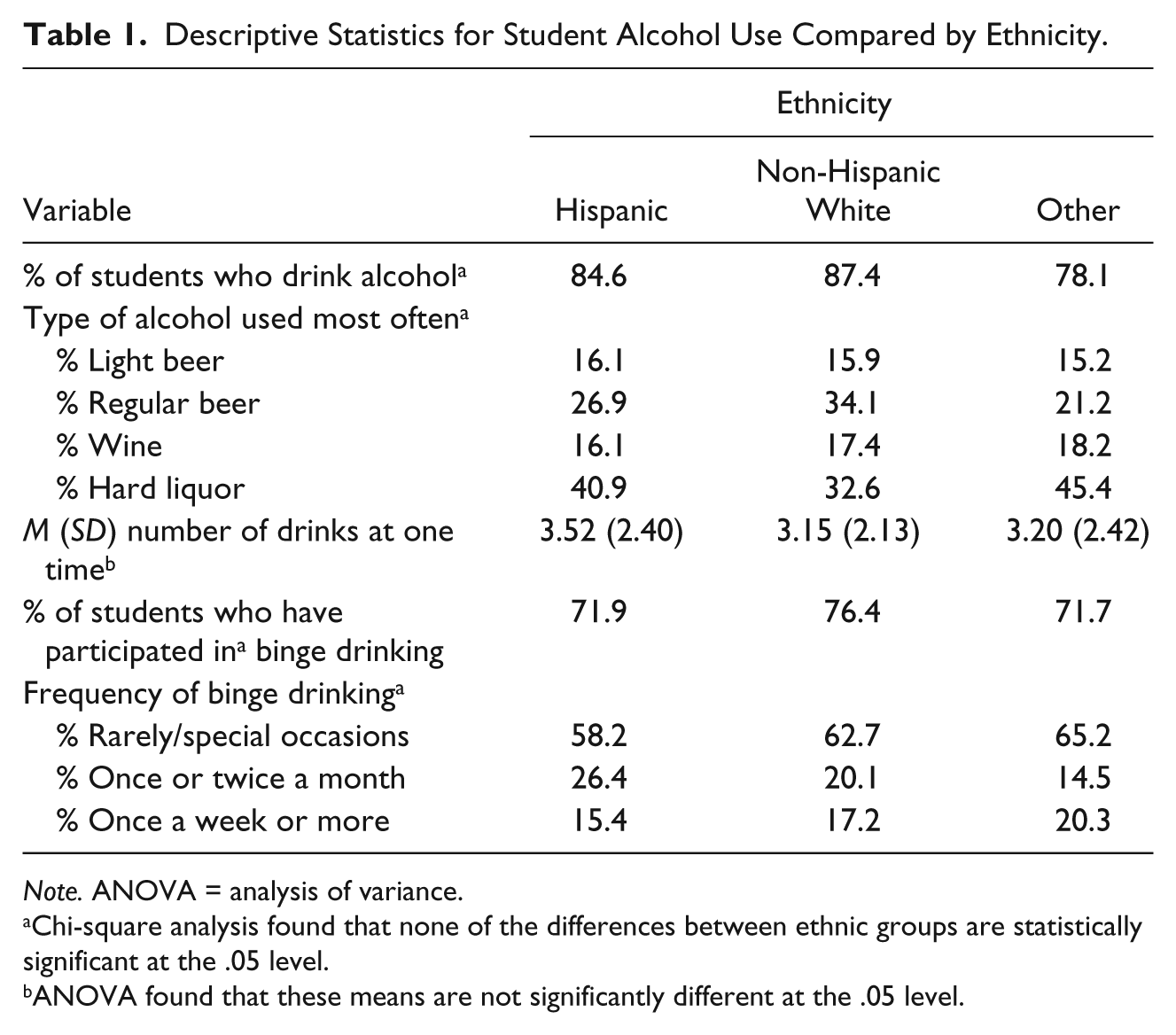
Note. ANOVA = analysis of variance.
Chi-square analysis found that none of the differences between ethnic groups are statistically significant at the .05 level.
ANOVA found that these means are not significantly different at the .05 level.
Demographic and lifestyle variables such as sexual orientation, participating in intercollegiate athletics, membership in a fraternity or sorority, and preferred language could not be analyzed with inferential statistics because the responses on these measures reflected more than 90/10% splits. However, four other variables, all demographic, were analyzed. These variables were age, gender, living situation, and rural versus urban upbringing.
A t test found no significant difference in mean age between students who drank and students who did not drink, t(387) = 1.33, p = .18. There was also no significant difference in mean age between students who had participated in binge drinking at least once and those who had not, t(381) = .95, p = .34. Furthermore, a one-way ANOVA found that the mean age of students who used alcohol did not differ significantly by ethnicity, F(2, 321) = .86, p = .42.
Chi-square analysis revealed that whether students drank alcohol differed significantly by whether they were of legal drinking age, χ2(1, N = 395) = 21.27, p ≤ .001. Whether students had ever participated in binge drinking also differed significantly by whether they were legally old enough to drink, χ2(1, N = 388) = 7.08, p ≤ .01. Cross-tabulations revealed that fewer underage students reported drinking alcohol and binge drinking than would be expected if age and drinking were unrelated.
Whether students used alcohol did not differ by gender, χ2(1, N = 405) = .16, p = .69. A higher percentage of males (78.4%) than females (69.9%) reported binge drinking. However, this difference was not statistically significant, χ2(1, N = 399) = 3.48, p = .06. The percentage of students who used alcohol did differ significantly by living situation, χ2(3, N = 395) = 19.74, p ≤ .001. The cross-tabulations revealed that more students who lived at home with their parents were non-drinkers than would be expected if drinking behavior were unrelated to living situation. Furthermore, fewer students who lived off-campus with roommates or significant others were non-drinkers than expected. A significant difference was also found in the percentage of students who had participated in binge drinking, χ2(1, N = 388) = 22.05, p ≤ .001. Fewer than the expected number of students who lived at home with parents had participated in binge drinking.
Whether students had grown up in an urban or rural setting was also related to their drinking behavior. Alcohol use differed significantly by upbringing, χ2(1, N = 374) = 5.78, p = .02, as did binge drinking, χ2(1, N = 367) = 6.48, p = .01. According to the cross-tabulations, a higher percentage of students who grew up in a rural setting used alcohol and participated in binge drinking than students who grew up in an urban setting.
RQ2 Results
RQ2 asked how attitudes toward binge drinking differed between Hispanic college students and non-Hispanic students. Students were grouped by ethnicity as either Hispanic, non-Hispanic White, or Other, and a series of one-way ANOVAs was performed. Two statistically significant main effects were found. Ethnicity had a significant main effect on students’ belief that “No one ever died as a result of binge drinking,” F(2, 390) = 3.61, p = .03. Although all groups of students tended to disagree with this statement, a Tukey post hoc test revealed that non-Hispanic White students (M = 1.28, SD = .66) disagreed significantly more than other non-Hispanic students (M = 1.56, SD = .93). Hispanic students (M = 1.45, SD = .99) did not differ significantly from the other two groups. (See Table 2.)
ANOVAs Comparing Student Attitudes Toward Binge Drinking by Ethnicity.
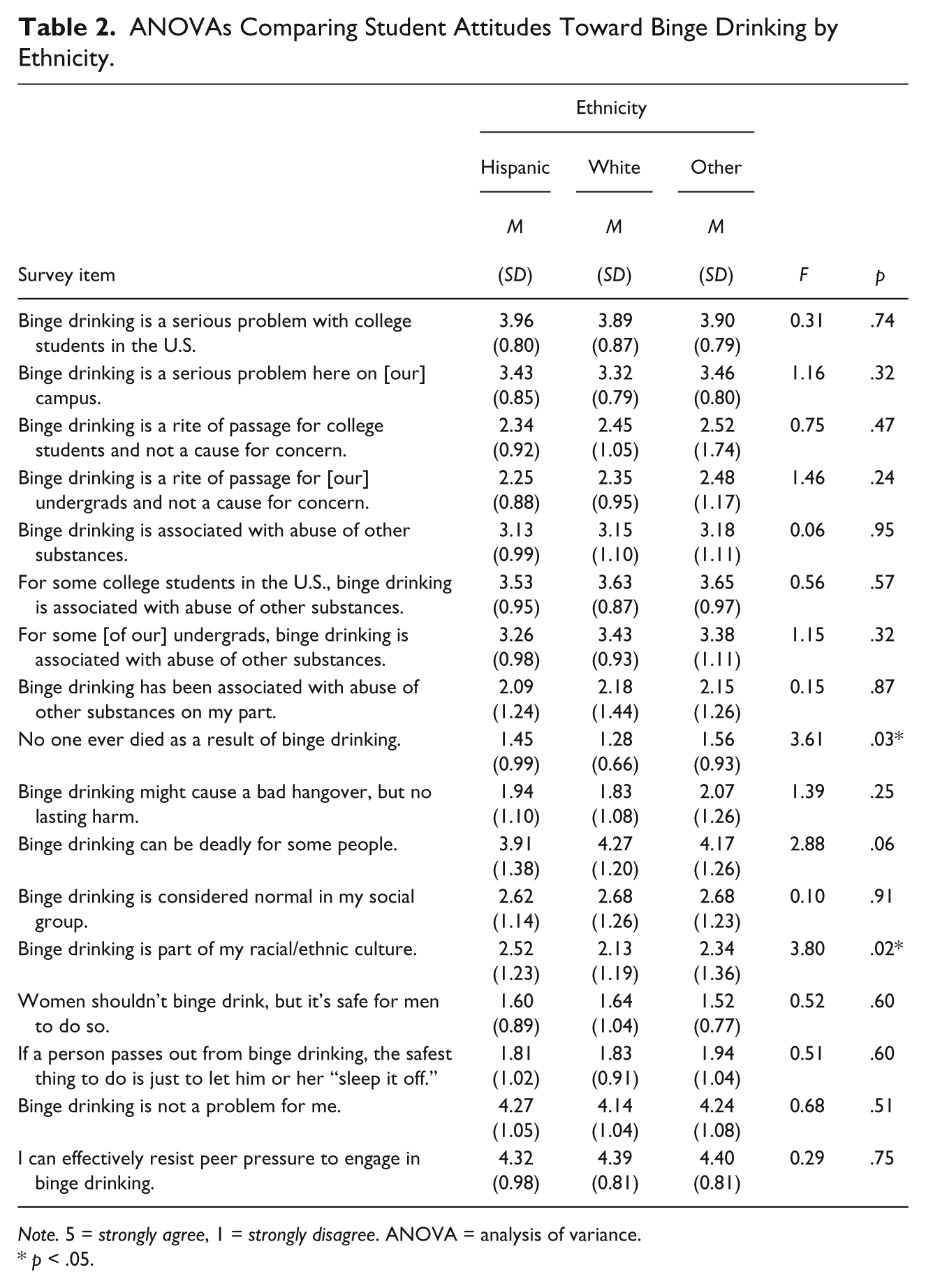
Note. 5 = strongly agree, 1 = strongly disagree. ANOVA = analysis of variance.
p < .05.
Ethnicity also had a significant main effect on students’ response to the statement, “Binge drinking is a part of my racial/ethnic culture,” F(2, 393) = 3.80, p = .02. Once again, students of all ethnic groups generally disagreed with the statement, but a Tukey post hoc test found that Hispanic students (M = 2.52, SD = 1.23) did not disagree as strongly as non-Hispanic White students (M = 2.13, SD = 1.19). Students of other ethnicities (M = 2.34, SD = 1.36) did not differ significantly from Hispanic or non-Hispanic White students. (See Table 2.)
RQ3 Results
RQ3 asked what trends in student alcohol use could be seen over time. To answer this question, the present findings, which were collected in 2011, were compared with findings reported by Bennett et al. (1999), which were based on data collected between 1994 and 1996 at the same university. On most measures, the 2011 data were quite similar to the 1996 data. (See Table 3.) Fewer students reported using alcohol in 2011 (83.4%) than in 1996 (88.6%), and binge-drinking behavior was less common for most types of students in 2011 than in 1996. Both the study by Bennett et al. and the present study defined binge drinking as having five drinks (males) or four drinks (females) in two hours. However, Bennett et al. asked students whether they had participated in binge drinking within the last two weeks, while the present study asked students whether they had ever participated in binge drinking and how often. Therefore, to provide a more appropriate comparison, the 1996 numbers were compared with the number of students in 2011 that reported binge drinking at least one to two times per month.
Descriptive Statistics Comparing Student Alcohol Use Over Time (1996-2011).
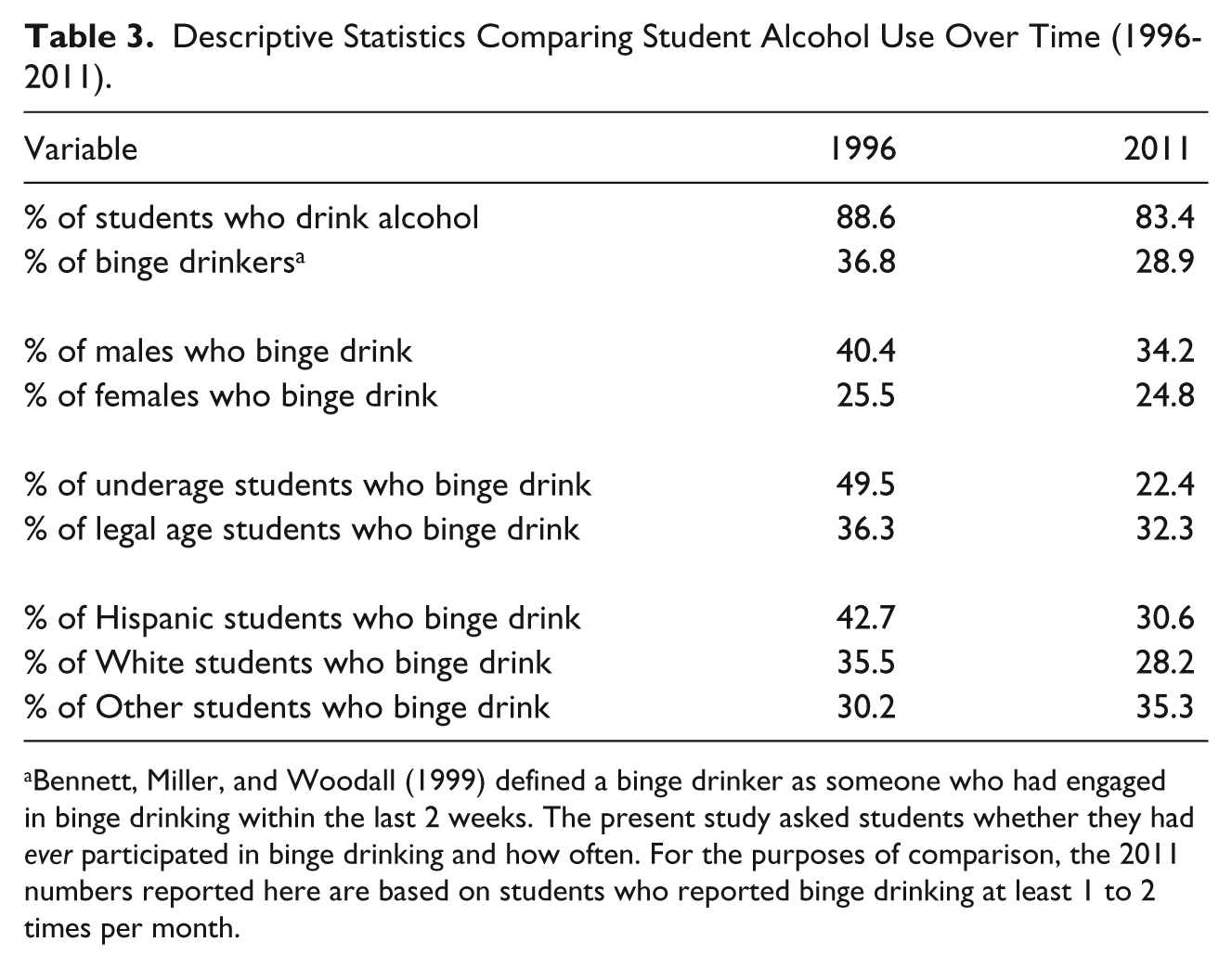
Bennett, Miller, and Woodall (1999) defined a binge drinker as someone who had engaged in binge drinking within the last 2 weeks. The present study asked students whether they had ever participated in binge drinking and how often. For the purposes of comparison, the 2011 numbers reported here are based on students who reported binge drinking at least 1 to 2 times per month.
Using this measure, 28.9% of students were classified as binge drinkers in 2011, compared with 36.8% of students in 1996. The most dramatic changes were seen in the number of underage and Hispanic students who reported binge drinking. In 1996, 49.5% of underage students had participated in binge drinking within the last two weeks, but in 2011, only 22.4% of underage students participated in binge drinking one to two times per month. Furthermore, 42.7% of Hispanic students were classified as binge drinkers in 1996, but only 30.6% in 2011. Only one category showed an increase in binge-drinking behavior. In 1996, 30.2% of students of other ethnicities (i.e., non-White, non-Hispanic) were binge drinkers. However, in 2011, the percentage of students from other ethnicities who participated in binge drinking had risen to 35.3%. (See Table 3.)
Discussion
Summary of Findings
The purpose of the present study was to explore college students’ behaviors related to alcohol use and binge drinking and to examine changes in these behaviors over time. This study also sought to measure certain attitudes that the existing literature suggested might be associated with binge drinking. Because this study was conducted at a Hispanic-serving university—and, moreover, a university whose Hispanic population increased from roughly 28% of undergraduate enrollment in the mid-1990s to almost 42% in 2011—differences between Hispanic students and those of other ethnicities were of particular interest.
Unlike the Bennett et al. (1999) study, the present study found no significant differences between Hispanic students and those of other ethnicities in terms of alcohol use or binge drinking. While we cannot claim that this leveling of alcohol-related behaviors is due primarily to the fact that the campus’s Hispanic and non-Hispanic White population sizes were nearly identical in 2011 (41.8% and 39.8%, respectively) but markedly skewed in 1994 to 1996 (roughly 28% Hispanic vs. roughly 60% non-Hispanic White), we believe that this major demographic shift was at least one important factor. We can only speculate that the continually increasing degree of representation of Hispanic students on this campus, culminating in 2011, when Hispanics actually surpassed non-Hispanic Whites in undergraduate enrollment, may have contributed to a greater sense of visibility, self-efficacy, and self-esteem—and perhaps a corresponding decrease in the desire to participate in binge drinking.
It is also worth noting that in 1997, a year after the data collection phase of the Bennett et al. (1999) study was completed, a new, rather stringent “Use of Alcohol on University Property” policy was introduced by the institution’s president and included for the first time in the student handbook. In addition, according to the director of the university’s office of substance-abuse prevention, the late 1990s and early 2000s marked the beginning of a more aggressive outreach and awareness effort on the Office’s part, including regular participation in new-student orientation and other campuswide events; among such events are those sponsored by the university’s College Enrichment Program, in which Hispanic undergraduate enrollment is slightly over-represented (J. Steiner, personal communication, September 10, 2015). These, too, may have contributed to decreases in binge-drinking behavior overall and among Hispanic students in particular. It stands to reason that new efforts to reduce binge drinking (stricter rules, better education, more regular outreach, and so on) and increased access to information about the negative results of such drinking would have a greater impact on those groups that actually do (or did) more binge drinking to begin with.
While alcohol use and binge-drinking behaviors did not differ between Hispanic and non-Hispanic White students in the present study, several other demographic variables were significantly related to these behaviors. More students of legal drinking age reported using alcohol and participating in binge drinking than did students below legal age. Fewer students who lived at home with their parents said they drank or had ever engaged in binge drinking, as compared with students in other living situations. In addition, more students from rural backgrounds than from urban backgrounds reported using alcohol and binge drinking.
Most student attitudes toward binge drinking did not vary by race/ethnicity. However, Hispanic students showed more agreement with the statement “Binge drinking is part of my race/culture” than did non-Hispanic White students. When the attitudes of binge drinkers and non-binge drinkers were compared, the students who binge drank consistently showed higher levels of acceptance toward binge drinking, less-accurate beliefs about the dangers of binge drinking, and less confidence that they could resist the temptation to engage in binge drinking.
Implications
While the results of the present study did not show the differences in race/ethnicity in terms of drinking behavior predicted by other studies (SAMHSA, 2008) or observed by Bennett et al. in 1999, nonetheless these results may prove important for those attempting to prepare health campaigns designed to prevent binge drinking by college students. First and foremost, the results of this study show binge drinking by college students remains a problem that needs to be addressed. Second, these results may be used to create messages targeting students on multiple levels, a more effective strategy than crafting messages targeting audiences on only one level (Freimuth & Quinn, 2004). For example, students who are of legal age and are from rural areas are more likely to drink and thus messages should be designed to target these students on potentially three levels—student status, age, and location of origin. Research shows that such targeted messages can be more effective than those addressing every college student on the same level (i.e., simply acknowledging their status as students). In addition, it has been documented that channels preferred by the targeted group should be used to deliver such messages.
Based on the results obtained in this study, the authors recommend that messages should be developed to target and to use channels preferred by (a) students living either on campus or in off-campus housing away from family members (e.g., in-dorm or entertainment-venue interventions), (b) students originating from rural areas, and (c) Hispanic students’ erroneous beliefs about binge drinking, such as “no one has ever died from binge drinking” and “binge drinking is part of my racial/ethnic culture” (e.g., use of ethnic vernacular/media). In addition to using traditional intervention campaign materials such as posters and media public service announcements, the authors suggest use of guerrilla marketing approaches such as peer advocates “planted” at campus events, particularly those events popular among Hispanic students, or in dorms to advocate responsible drinking behaviors.
Limitations
While the current study has important findings that can help campaign designers prevent or mitigate alcohol abuse, some limitations should be considered. The first limitation is the social desirability of particular alcohol-related behaviors and attitudes. For example, those of legal age were more likely to admit to drinking, perhaps because students know that underage drinking is illegal and thus did not want to reveal their own illegal activity, despite the anonymity promised by the survey. Thus, findings that may be affected by social desirability should be examined as possibly underrepresented.
Another potential limitation that should be considered when reviewing these results is the fact that the data were collected from a majority-minority campus; that is, a campus where ethnic/racial minorities outnumber non-minorities—and in this case, a university that since 2011 has had an undergraduate population comprising more Hispanic than White non-Hispanic students. The distinctive demographic nature of the campus may itself influence any given group’s drinking attitudes and behaviors. It may be that when minority-group students comprise a mathematical majority of a campus population, they do not drink as much. It may also be the case that students of other ethnicities follow their lead and thus drinking rates across ethnicities equalize.
These implications and limitations suggest future directions. First, more work should be done to examine drinking behavior at majority-minority campuses before it can be assumed that the results of the present study differ from those of other studies. The growing number of majority-minority campuses in the United States underscores the importance of learning how drinking rates differ based on ethnic composition, and therefore the importance of designing target-appropriate health campaigns. In addition, the findings of this study should be used to create health campaign messages to be tested on college campuses. Before these messages are tested, however, future studies should examine additional “targeting levels” such as students’ preferences for appeal type (e.g., fear, anger, factual, etc.) and channel type (e.g. Twitter, poster, TV, etc.). This additional tailoring of the campaign messages should improve their effectiveness (Freimuth & Quinn, 2004).
In sum, this study revealed important information, including the fact that there may not always be a difference between Hispanic and non-Hispanic students’ drinking behaviors—perhaps, especially, when Hispanic students find themselves representing the largest ethnic group on a campus rather than one occupying a distant second-place position and, correspondingly, become the target for increased substance-abuse prevention outreach and education efforts. Other factors may impact such behaviors, and message designers should consider such factors when developing tailored messages to reduce college students’ high-risk drinking behaviors.
Footnotes
Acknowledgements
The authors acknowledge the invaluable assistance in survey instrument formulation and data collection of John Steiner, Director, University of New Mexico Campus Office for Substance Abuse Prevention; Shannon Guess, 2011 Masters Degree Graduate, Communication and Journalism, University of New Mexico; University of New Mexico graduate students Lori Ann Loera, Elizabeth Rivers, Adriana Sanchez, and Camille Velarde; and University of New Mexico undergraduate student Amber Lavail.
Declaration of Conflicting Interests
The authors declared no potential conflicts of interest with respect to the research, authorship, and/or publication of this article.
Funding
The authors received no financial support for the research, authorship, and/or publication of this article.