




Abstract
The purpose of our study was to identify contributors underlying the intention to engage in leisure-time physical activity (LTPA) among Latinas. A sample of Latinas was recruited from North Texas (N = 405). Sequential multiple regression analysis was used to assess the association between sociodemographics, the role of Latino culture (i.e., fatalism, a cultural belief that may be related to LTPA intention), and theoretical constructs drawn from the Integrative Model (i.e., self-efficacy, attitude, and subjective norm) in relation to LTPA intention in Latinas. Self-efficacy (β = .29, p < .001), attitude (β = .26, p < .001), and subjective norm (β = .17, p < .001), but not fatalism, significantly predicted intention to engage in LTPA. To increase LTPA intention among Latinas, it is recommended that physical activity interventions consider enhancing self-efficacy, fostering favorable attitudes toward LTPA, and modifying participant norms on LTPA.
Introduction
Physical activity has been shown to help delay, prevent, or manage chronic conditions, such as cardiovascular disease (Ahmed, Blaha, Nasir, Rivera, & Blumenthal, 2012). Despite the benefits linked to being physically active, Latinos are less active (Neighbors, Marquez, & Marcus, 2008) and less likely to engage in recommended levels of physical activity, compared with their non-Latino counterparts (Carlson, Fulton, Schoenborn, & Loustalot, 2010). Specifically within the Latino population, men are more active than women (Arredondo et al., 2016). Previous research has identified factors such as lack of social support, family obligations, and lack of time as barriers to engaging in leisure-time physical activity (LTPA) (Larsen, Pekmezi, Marquez, Benitez, & Marcus, 2013). Cultural factors such as fatalism or the belief that fate determines the events that occur in an individual’s life has also been shown to deter Latinas from engaging in preventive health behaviors, including LTPA (Niederdeppe & Levy, 2007). Examining how cultural and psychosocial factors relate to intention may provide insight into the pathway between cultural factors and psychosocial factors, and ultimately how they may influence the performance of LTPA in Latinas.
Based on the Integrative Model (IM), attitude, norms, and self-efficacy predict intentions, which immediately precede behavior (Fishbein, 2009). In our study, we developed a conceptual model that included constructs from the IM (i.e., self-efficacy, subjective norm, and attitude) and accounted for the role of Latino culture in LTPA outcomes (i.e., fatalism), to examine factors related to intention to participate in LTPA. Although the findings on the relationship between intention and behavior have been inconsistent (Hagger, Chatzisarantis, Culverhouse, & Biddle, 2003; Webb & Sheeran, 2006), most previous research has focused on non-Latino populations. Furthermore, limited research has examined self-efficacy, subjective norm, and attitude, and accounted for Latino culture (i.e., fatalism) in relation to intention to perform LTPA among Latinas.
Given the paucity of research on the intention to engage in LTPA among Latinas and the disproportionately high prevalence of physical inactivity in this population, the purpose of our study was to examine constructs from the IM (i.e., self-efficacy, subjective norm, and attitude) as contributing factors to LTPA intention in Latinas. Our study is unique in its use of theoretical constructs drawn from the IM, while accounting for the role of Latino culture (i.e., fatalism), to understand the intention to engage in LTPA in Latinas. Findings from this study could help inform the development of culturally tailored physical activity interventions in Latinas.
Method
Sample
For our cross-sectional study, we recruited Latinas 18 years of age and older from Latino-serving organizations (e.g., churches and community centers) in North Texas. Individuals were eligible to participate in the study if they were 18 years of age or older and self-identified as Hispanic or Latina. The Institutional Review Board (IRB) at Indiana University approved this study.
Measures
An anonymous bilingual questionnaire was administered to participants. The questionnaire assessed information related to demographics, acculturation, psychosocial attributes that may be related to LTPA, and intention to engage in LTPA. Specifically, the measures on self-efficacy asked how sure each respondent was that they could adhere to their exercise programs given various situations. To assess subjective norm with regard to their LTPA participation, participants were asked, (a) “My family thinks I should do some LTPA”; (b) “My friends think I should do some LTPA”; and (c) “My church thinks I should do some LTPA.” To assess attitude toward engaging in LTPA, participants were asked, (a) “I will reduce my risk of developing a disease”; (b) “I will feel good about myself”; (c) “I will control my weight”; (d) “I will reduce my stress”; and (e) “My participation in leisure-time physical activity almost everyday is” (response options ranged from extremely bad to extremely good; extremely unenjoyable to extremely enjoyable). Two items were used to measure the intention to participate in LTPA almost every day with 5-point Likert-type response options. Fatalism was measured based on three items assessing whether participants disagreed or agreed with statements regarding fatalistic beliefs. Self-reported sociodemographic covariates included age, income, ethnicity, language, number of people in the household, family obligations, and nativity.
Analysis
Only Latinas with complete data on variables of interest (i.e., psychosocial variables, fatalism, intention) were included in the analyses (N = 405). Two-step sequential multiple regression analysis was employed to determine if self-efficacy, subjective norm, and attitude could predict intention to engage in LTPA, controlling for sociodemographics and fatalism. In the first step, the regression included eight covariates (i.e., age, income, ethnicity, language, number of people in the household, fatalism, family obligations, and nativity). In the second step, self-efficacy, subjective norm, and attitude were entered into the model. Data were analyzed using the statistical program SPSS 24 (SPSS, Inc., Chicago, IL).
Results
The mean age of the sample was 38.5 years (SD = 14.3) and largely comprised of Mexican or Mexican American women (81.2%). Those who did not identify as Mexican or Mexican American included women who identified as Puerto Rican, Honduran, Salvadorian, Cuban, or Guatemalan. About half of the participants reported speaking Spanish and English about equally (42.7%) and more than half were foreign-born (63.5%). Of the foreign-born respondents, 20.2% had lived in the United States less than 10 years. About 60% of the women reported an annual household income less than US$35,000. Fifty-five percent of the women said they were “not quite” or “extremely likely” to intend to perform LTPA almost every day.
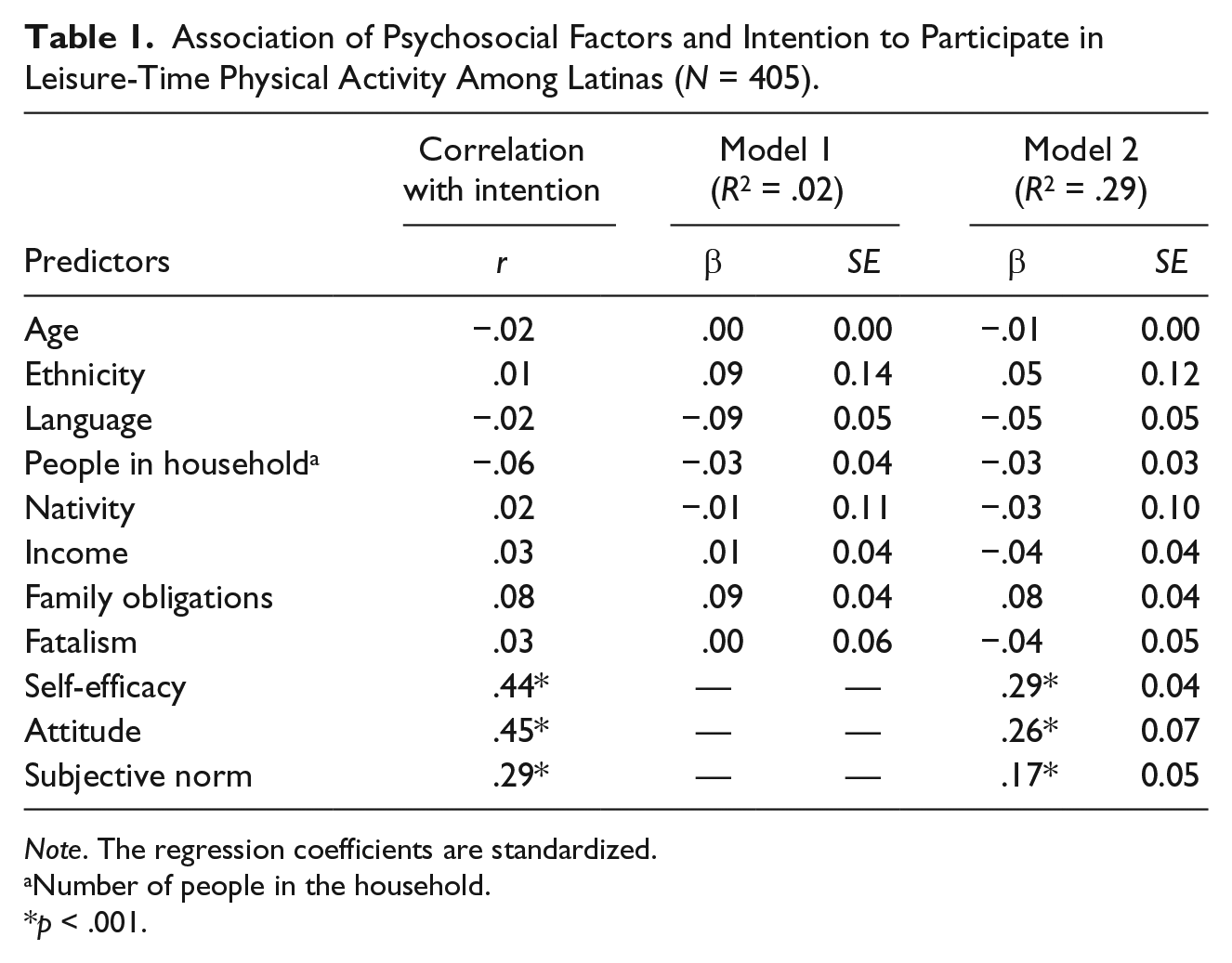
The results from the sequential multiple regression analysis predicting intention to engage in LTPA are displayed in Table 1. At Step 1, sociodemographics and fatalism were entered (R2 = .02). At Step 2, self-efficacy, subjective norm, and attitude were entered into the model. The results indicated that there was a significant increase in the prediction of intention (R2 = .29) from Step 1 to Step 2, F(11, 376) =13.83, p < .001. The regression results revealed that self-efficacy, subjective norm, and attitude were significant predictors for LTPA intention, controlling for sociodemographics and fatalism. Self-efficacy had the largest standardized coefficient (β = .29, SE = 0.04, p < .001) followed by attitude toward LTPA (β = .26, SE = 0.07, p < .001) and subjective norm (β = .17, SE = 0.05, p < .001).
Association of Psychosocial Factors and Intention to Participate in Leisure-Time Physical Activity Among Latinas (N = 405).
Note. The regression coefficients are standardized.
Number of people in the household.
p < .001.
Discussion
This is one of the first studies to investigate the role of self-efficacy, subjective norm, attitude, and fatalism in the intention to engage in LTPA among Latinas. Based on the results, all of the theoretical constructs from the IM (i.e., self-efficacy, subjective norm, and attitude) were significantly associated with intention, even after controlling for demographics and fatalism. However, our findings showed that fatalism was not associated with intention to engage in LTPA.
Our findings suggest that constructs from the IM are useful for understanding how Latinas make decisions to engage in LTPA. Self-efficacy had the highest statistically significant weight in predicting LTPA among the three constructs, which is consistent with previous literature that has cited self-efficacy as one of the most salient determinants of physical activity, including LTPA, among Latinos (Marquez & McAuley, 2006). Previous findings have suggested that Latinos who report their LTPA at high levels tend to have significantly higher confidence in their ability to engage in exercise (Marquez & McAuley, 2006). This indicates that self-efficacy is important not only in their actual performance of LTPA but also in the intention involved in their decision making that precedes the actual performance of the LTPA. Attitude toward LTPA was also statistically significant in predicting LTPA intention, in line with other studies reporting attitude as one of the constructs most commonly predicting intentions (Hagger, Chatzisarantis, & Biddle, 2002). It is plausible that their unfavorable attitude toward LTPA may be related to their belief that engaging in LTPA is unpleasant or that they may experience discomfort based on their experience when engaging in occupational or household physical activity. Alternatively, they may believe they gain enough physical activity through occupational or household physical activity (Marquez & McAuley, 2006), hence seeing no need to further engage in LTPA.
Given the fatalistic beliefs sometimes shared among Latinas (Larsen et al., 2013), one might speculate that fatalism or other cultural factors might explain low levels of LTPA within this population. Fatalism, or a sense of belief that fate determines events such as the development of chronic illnesses, is an important factor to consider because it could hinder efforts to engage in preventive behaviors (Niederdeppe & Levy, 2007). However, our study suggests that fatalism is not correlated to intentions to perform LTPA among Latinas. It is possible that other Latino culture-related factors not measured in our study contribute to intentions to engage in LTPA. Further research is warranted examining how other cultural factors such as familism and marianismo may relate to intention to engage in LTPA among Latinas.
Our study sought to make a contribution to the literature on LTPA in Latinas and interpretation of these findings should be made in light of the following limitations. First, we used variables based on self-reported responses. Thus, recall bias might have confounded study findings. Second, due to the cross-sectional nature of this study, causality cannot be inferred. Lastly, most of the women identified as Mexican or Mexican American, limiting the generalizability of the findings to women from other Latino background groups.
The low levels of activity in Latinas, relative to Latinos, and other non-Latino subgroups warrant further research on factors that contribute to the performance of LTPA in Latinas and that could inform the development of interventions aimed at promoting LTPA. Given that findings on the intention–physical activity relationship have been inconsistent, future research should consider examining mediating factors (e.g., environmental factors) of the intention–physical activity relationship, in addition to cultural factors and psychosocial factors as they relate to intention, to obtain further insight into the pathway between cultural factors and psychosocial factors and performance of LTPA in Latinas. Future research should also consider investigating how to enhance self-efficacy, foster favorable attitudes toward LTPA, and modify participant norms related to intention to engage in LTPA among Latinas through culturally relevant strategies and messaging.
Footnotes
Declaration of Conflicting Interests
The authors declared no potential conflicts of interest with respect to the research, authorship, and/or publication of this article.
Funding
The authors received no financial support for the research, authorship, and/or publication of this article.