




Abstract
On June 21, 2017, the fields of Latinx Psychology, Chicana/o-Latina/o Studies, and education lost a trailblazing researcher, teacher, and mentor. Dr. Raymond Buriel made significant contributions to the study of acculturation and adjustment of Mexican immigrant families, with a special emphasis on the characteristics of immigrant students that are conducive to academic success. His seminal and widely cited publications on the psychological development of children who serve as language and cultural brokers for their families were among the first to illustrate the myriad of developmental assets of immigrant students. Buriel’s reputation as a mentor and advocate for countless undergraduate students, graduate students, and early career scholars was legendary. Affectionately referred to as “Papa Buri” by his Latinx undergraduate students, his legacy will continue to be felt in psychology and education. Many of his students now hold academic, research, policy, and administrative positions in major institutions and are leaders in their fields.
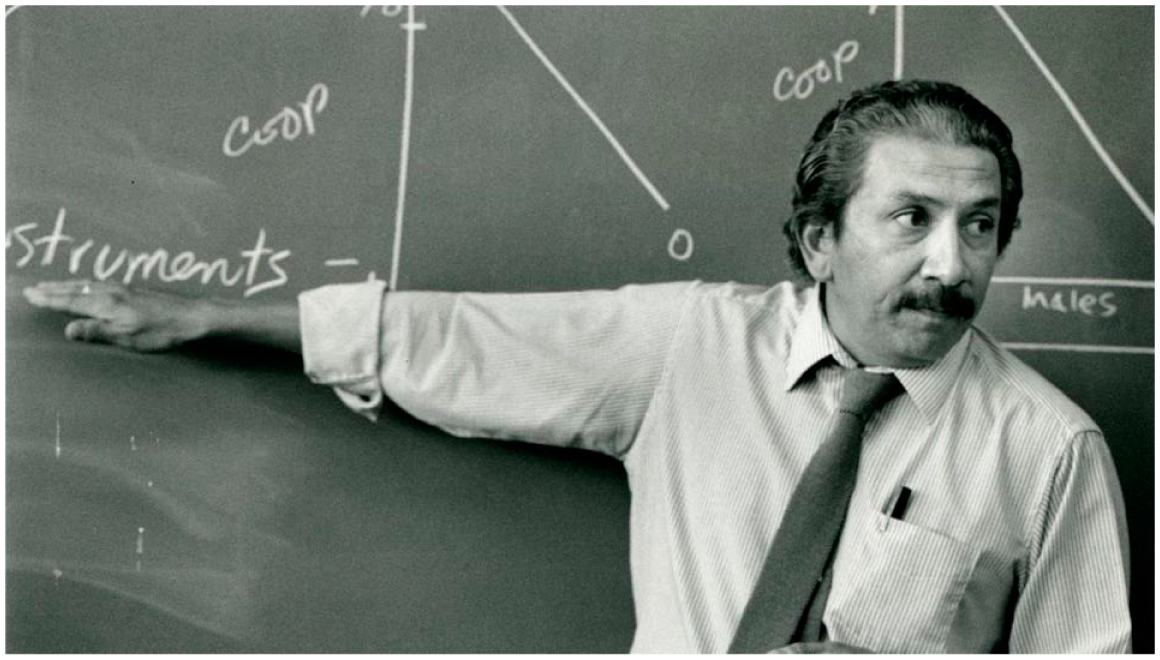
Raymond Buriel (1948-2017).
The fields of Latinx Psychology, Chicana/o-Latina/o Studies, and Education lost a trailblazing researcher, teacher, and mentor with the passing of Raymond “Ray” Buriel on June 21, 2017. He was the Harry S. and Madge Rice Thatcher professor of psychology at Pomona College where he taught for 39 years. A native and lifelong resident of Riverside, California, he served in the U.S. Marine Corps from 1967 to 1969 and was honorably discharged in 1973. He obtained his AA degree at Riverside Community College in 1971 and graduated with high honors with a BA in psychology from University of California, Riverside (UCR) in 1973. He continued his graduate studies at UCR and received his PhD in psychology in 1977. He was a two-time recipient of the National Academies of Science Ford Foundation fellowships, first as a doctoral student in 1973, and again as a postdoctoral fellow in 1987.
UCR was the ideal training site for Buriel for a variety of personal and professional reasons. In an interview conducted in 2010, he explained, “Manuel Ramirez, Alfredo Castaneda, Spencer Kagan, Raymond Garza, were all there at UC Riverside so I knew that I would be able to work on the topics that I was most interested in” (R. Buriel, personal communication, July 20, 2010). UCR was also close to the Eastside Riverside barrio where Buriel grew up that has a long history of U.S.–Mexico circular migration and intergenerational ties. In 1998, historian Vicki Ruiz included the oral history of Ray Buriel’s family in her seminal book, From Out of the Shadows: Mexican Women in Twentieth Century America (Ruiz, 1998). In describing the Riverside, California, neighborhood where the Buriel family lived, she stated,
Through chain and circular migrations of families, community and kin networks intertwined. In Riverside, California, for example, the Eastside barrio by the 1960s had so many members of a single extended family that Ray Buriel recalled how he and his friends had to venture into the rival barrio Casa Blanca to get dates. (Ruiz, 1998, p. 7)
According to Ruiz (1998), Ray Buriel’s parents met in that same Eastside Riverside Barrio when his father Federico Buriel kept going to the movies held every Sunday night at Our Lady of Guadalupe Shrine so he could chat with the pretty ticket seller who would eventually become his mother, Eusebia Vasquez. Originally, from Sinaloa, Guanajuato, the Vasquez family settled in Riverside after years migrating from one boxcar colonia to another across Arizona, New Mexico, Iowa, Kansas, and Illinois. Eusebia’s father had been recruited in 1907 by railroad labor contractors who traveled to the interior of Mexico to recruit workers by promising high wages, free transportation, and housing (Ruiz, 1998).
Ray Buriel was initially hired in 1977 as a visiting assistant professor of Chicano Studies at the Claremont Colleges, a consortium of five undergraduate colleges that includes, Scripps College, Pitzer College, Harvey Mudd College, Claremont McKenna College, and Pomona College. Two years later, he became the first tenure-track Mexican American faculty member of the Pomona College psychology department. In 1981, as a young assistant professor, he became the founding chair of the Intercollegiate Department of Chicana/o-Latina/o Studies at the Claremont Colleges, the nation’s second oldest Chicana/o-Latina/o Studies program. He chaired the department for 23 of his 39 years as a faculty member. He made many other contributions to the profession throughout his career as well. In 2005, he was a founding member of the Latino Caucus of the Society for Research on Child Development.
Contributions to the Body of Research on Chicana/o-Latina/o Studies and Latinx Psychology
Buriel’s childhood experiences growing up in a working-class Mexican American immigrant enclave had a profound impact on his scholarship. Throughout his career, he felt that as a scholar, it was critical to remain immersed in the communities that he studied. In 2010, one of my graduate students interviewed him for a study on faculty of color where he said,
You have to learn not to lose touch with “la gente [your people].” At least I feel like I have to do that. That’s one of the reasons why I still live in Riverside. I couldn’t live in Claremont, I think it would change me, and not in ways I would like. I’d still be writing about cultural things but not with the insight of knowing people I’m writing about first hand. I always tell my students, stay grounded. (R. Buriel, personal communication, July 20, 2010)
Informed by the community context he lived in all his life, Buriel made significant contributions to the study of acculturation and adjustment of Mexican immigrant families, with a special emphasis on the characteristics of immigrant students that are conducive to academic success. His work (Buriel, 1984; Kagan & Buriel, 1977) appeared in the first and second edition of the seminal edited book, Chicano Psychology (Martinez & Mendoza, 1984; Martinez, 1977). His research was also published in the highest-ranked scholarly journals in psychology and education including Child Development, Journal of Marriage and the Family, the American Educational Research Journal (AERJ), and the Hispanic Journal of Behavioral Sciences (HJBS). Several of the studies which he authored or coauthored rank among the most cited in the journals they were published. According to the Web of Science Citation Index (WSCI), out of the 876 articles on the topic of family published in Child Development, two of his coauthored publications on Mexican American family socialization (Harrison, Wilson, Pine, Chan, & Buriel, 1990; Parke et al., 2004) rank in top 15% of most cited articles (2016 WSCI, 2017). Out of 438 publications on the topic of academic achievement in AERJ, his article on the sociocultural correlates of achievement among Mexican American students (Buriel & Cardoza, 1988) ranks in the top 34% of most cited articles (2016 WSCI, 2017). Out of 1,725 publications on the topic of family in the Journal of Marriage and the Family, his article on the child-rearing practices of Mexican American families (Buriel, 1993) ranks in the top 14% of most cited articles (2016 WSCI, 2017).
Buriel’s research on immigrant students was greatly influenced by his lifelong commitment to remain connected to the immigrant experience. In 2010, he described his efforts to connect with his immigrant undergraduate students. He said,
I think immigrant students connect with me more, especially when I talk about my family background. For example, my father was a gardener, so with this one student we talked about growing up and helping our dads with their gardening jobs so we connected in that way . . . with many of these students it becomes a lifelong relationship. I know their kids, they know my kids. I like talking to them because I can lapse into Spanish, we can talk about things that nobody outside that first-generation immigrant experience would know about, and it keeps me grounded. (R. Buriel, personal communication, July 20, 2010)
Buriel’s regular interactions with multilingual immigrant students were the catalyst for his influential and widely cited publications on the psychological development of children who serve as language and cultural brokers for their families. They were among the first to illustrate the myriad of developmental assets of immigrant students. According to WSCI, his first publication on language brokers (Buriel, Perez, De Ment, Chavez, & Moran, 1998) is the most cited among all publications on language brokering (2016 WSCI, 2017). Similarly, Google Scholar has the same study cited 296 times, the most among 221 studies on language brokering. His last publication before his passing was a book chapter we coauthored that is the first published study on language brokering across three languages among Mexican indigenous immigrant students in U.S. schools who speak English, Spanish, and one of three indigenous languages; Mixtec, Zapotec, or Purepecha (Perez, Vasquez, & Buriel, 2016).
A contributing factor to the establishment of Latinx Psychology was the HJBS (Padilla, 2003). Since its founding, HJBS has published many of the leading research and most cited articles on Latinx psychology and mental health (Padilla & Olmedo, 2009). Buriel served on the HJBS editorial board for 35 years. He also published seven studies in HJBS, the most of any journal in which he published. According to WSCI, four of his seven publications (Buriel, Calzada, & Vasquez, 1982; Buriel et al., 1998; Love & Buriel, 2007; Rueschenberg & Buriel, 1989) rank among top 5% (six in top 20%) most cited of the 1,279 articles published in HJBS (2016 WSCI, 2017).
Teaching and Mentoring
As an undergraduate and graduate student, Ray Buriel was trained and mentored by two historically important scholars who contributed to the creation of Chicana/o-Latina/o Atudies and the professional development of Latina/o psychologists, Alfredo Castaneda and Manuel Ramirez III (Padilla & Olmedo, 2009). Castaneda was one of the most cited and prolific child psychology researchers from the 1950s to the 1970s. He was the first Latino to serve on the editorial board of the prestigious journal of Child Development. In 1971, Manuel Ramirez III along with Amado Padilla and several other Latina/o psychologists participated in the first symposium ever held at the annual meetings of the American Psychological Association. The symposium was organized by Edward Casavantes and was sponsored by Division 9: Society for the Psychological Study of Social Issues.
In 1973, Castaneda and Ramirez obtained funding from the National Institute of Mental Health (NIMH) to convene the first professional gathering of Chicano psychologists titled, “Increasing Educational Opportunities for Chicanos in Psychology.” Buriel participated in this conference as a first-year doctoral student (Padilla & Olmedo, 2009). Soon after he enrolled as an undergraduate student at UCR, Manuel Ramirez took him under his wing. In 2010, Buriel described the influence Manuel Ramirez had on him from the first time they met during his first year as an undergraduate student:
I made an appointment to talk to Manuel—I didn’t know him, I didn’t know anything about his reputation or anything. When we met, I told him I wanted to study people like me but there was nothing in the books about people like me . . . He started talking about his research project in Rancho Cucamonga on the relationship between culture and learning and he asked if I wanted to work for him. I said, “Yes!” As an undergraduate I drove from Riverside to Rancho Cucamonga 3 times a week to take notes, meet with him, administer tests, and I thought, this is what I really enjoy doing. I thought, wow, I can get paid for talking to people about their experiences, sure I want to do this! He encouraged me to apply to graduate school. (R. Buriel, personal communication, July 20, 2010)
Following the example of his early academic mentors, Ray Buriel developed a legendary reputation as an inspiring mentor and role model. His Latinx undergraduate students affectionately referred to him as “Papa Buri.” He was particularly concerned about the educational success of his immigrant students. In 2010 he said, “I do generally enjoy working with students from immigrant backgrounds. I just want to make sure that those students who work so hard and whose families have sacrificed so much make it, so that they can then give back” (R. Buriel, personal communication, July 20, 2010). Buriel was a two-time recipient of the Pomona College Wig Distinguished Professorship Award for Excellence in Teaching in 1991 and 2007. Many of the students who nominated him for the award indicated that he altered their career paths with his inspirational teaching style that fundamentally changed the way they thought about issues of diversity and social inequality. He inspired those students to dedicate their life to changing the status quo (“In Memoriam: Ray Buriel,” 2017). In his interview, Ray stated,
It’s gratifying to know that I’m in such an elite place where these students over the years changed the mentality of the [Pomona College] administration . . . Now we’re getting white students [alumni] who I was their psychology advisor coming back years after they graduated to tell the administration to make Chicano studies a requirement for all students. One alum who is now a medical doctor in Galveston, Texas working with only Latinos told the college administration that he’s better at his job because he took my Chicano studies courses. (R. Buriel, personal communication, July 20, 2010)
I first met Ray Buriel as an undergraduate student at Pomona College in 1995 when I enrolled in one of his psychology/Chicano studies courses. As an undocumented Salvadoran American adolescent, growing up in Pomona, California, I resented being called “Mexican.” I did not relate to the “Chicana/o” identity label. All that changed when I took Buriel’s course titled, “Psychology of the Chicano.” His influential course changed my identity and allowed me to develop a sense of solidarity with all Latinx communities in the United States by helping me understand our shared histories and experiences of marginalization. After I took his class, Ray graciously agreed to serve as my undergraduate thesis adviser and a few years later as a member of my doctoral dissertation committee at Stanford University.
Throughout his career, Buriel was a mentor and role model for countless undergraduate students, graduate students, and early career scholars of color. In 2010, he vividly described how his relationship with Ramirez and Castaneda profoundly influenced his efforts to mentor early career scholars of color:
I had role models. Manuel Ramirez, who was one of the few Latino psychology professors in the United States when I was a graduate student, he was my role model. He showed me how to fight the battles in graduate school. He would stand up to those other professors on my behalf . . . I learned how to protect myself as an academic from him. For my students that go into academia I give them the same advice he gave me. My parents didn’t go to college. They couldn’t tell me what to expect, but they always told me to find good people, and Manuel was a good person. His mentor, Alfredo Castaneda, mentored him and he mentored me and I’ve mentored other students since then. There’s so few of us that we need the mentoring of people who are in our field that have gone before us. (R. Buriel, personal communication, July 20, 2010)
Ray was a consistent, steadying presence in my life as a mentor and role model for 22 years. He always offered advice and guidance with humility and respect. He was always generous, patient, and understanding. Following the example of his mentors Manuel Ramirez and Alfredo Castaneda, he trained me to combine psychology with both professional excellence and community involvement. He encouraged me to become a public intellectual by engaging social problems, not in academic isolation, but in conversation with the community. It has been one of the great honors of my scholarly career to have had the privilege to collaborate on research and publish with Dr. Raymond Buriel.
Footnotes
Declaration of Conflicting Interests
The author declared no potential conflicts of interest with respect to the research, authorship, and/or publication of this article.
Funding
The author received no financial support for the research, authorship, and/or publication of this article.