



Abstract
The purpose of this systematic review was to investigate previously published literature that examined the impact of acculturative stress on health in Spanish-speaking populations. The database search yielded a final count of 32 eligible articles for inclusion in this review. Age, acculturative stress measure, and study results were analyzed. Overall, 81.2% of studies investigated the impacts of acculturative stress on mental health with the majority concluding that increased acculturative stress had a significant relationship with greater mental health issues, such as depression, anxiety, and psychological stress. Other studies in this review examined impacts on physical health and health behaviors, but yielded inconclusive results indicating that these are areas for future research.
Introduction
The Hispanic 1 population accounts for 52% of the United States’ (U.S.) population growth between 2010 and 2019 and represents the second largest racial or ethnic group in the U.S. (Noe-Bustamante et al., 2020). Additionally, in 2015, 34.4% of Hispanics in the U.S. were foreign born (Flores, 2017) meaning that they were born in a Spanish-speaking country and immigrated to the U.S. Immigration has been shown to be a stressful process (Caplan, 2007; Golding & Burnam, 1990; Whitehead et al., 2020) particularly as immigrants leave behind their home country and acculturate to a new country and culture. The stress associated with acculturation is known as acculturative stress, which is defined as “stressors …identified as having their source in the process of acculturation” (Berry et al., 1987, p. 492). Furthermore, acculturative stress represents a set of stress behaviors including “lowered mental health status (specifically confusion, anxiety, depression), feelings of marginality and alienation, heightened psychosomatic symptom level, and identity confusion” (Berry et al., 1987, pp. 492–493). As acculturative stress is a common phenomenon experienced by immigrant groups, it is important to understand how this particular stress impacts health in these populations. This study reviewed the current literature to investigate the relationship between acculturative stress and health in Spanish-speaking populations living in the U.S.
Methods
Eligibility Criteria and Search Strategy
To gather current literature that examined the interaction of acculturative stress on health, the following databases were searched: The Cumulative Index of Nursing and Allied Health Literature (CINAHL), PubMed, ProQuest, PsycARTICLES, and Health Reference Center. The following terms were searched consistently through all databases: [accultur*, stress, hispan*, AND health] and [accultur*, stress, latin*, AND health]. The asterisk used within the terms was to ensure all variations of the word, such as “hispanic,” “hispanics,” “hispano,” “hispana,” “latina,” “latino,” “latinas,” “latinos,” and “latinx,” were included.
To be eligible for inclusion in this review, studies must have been (a) peer-reviewed journal articles; (b) published between May 1, 2009 and May 31, 2020; (c) included participants from Spanish-speaking, Latin American countries; (d) been cross-sectional in nature; (e) analyzed data quantitatively; (f) measured acculturative stress; and (g) examined the effects of acculturative stress and health.
Results
Search Results
The database searches followed Preferred Reporting Items for Systematic Reviews and Meta-Analyses (PRISMA) guidelines (Moher et al., 2009). A total of 488 articles were found after searching each database (Figure 1). There were 96 records in CINAHL, 136 in PubMed, 162 in ProQuest, 27 in PsychARTICLES, and 67 in HealthRefCenter. Duplicates (n = 313) were removed, and abstracts were read. Another 107 records were excluded as they did not meet eligibility requirements. The remaining 68 were examined in full text. An additional 36 studies did not meet eligibility criteria leaving a total of 32 articles for the systematic review. Table 1 describes the 32 studies included in this review.
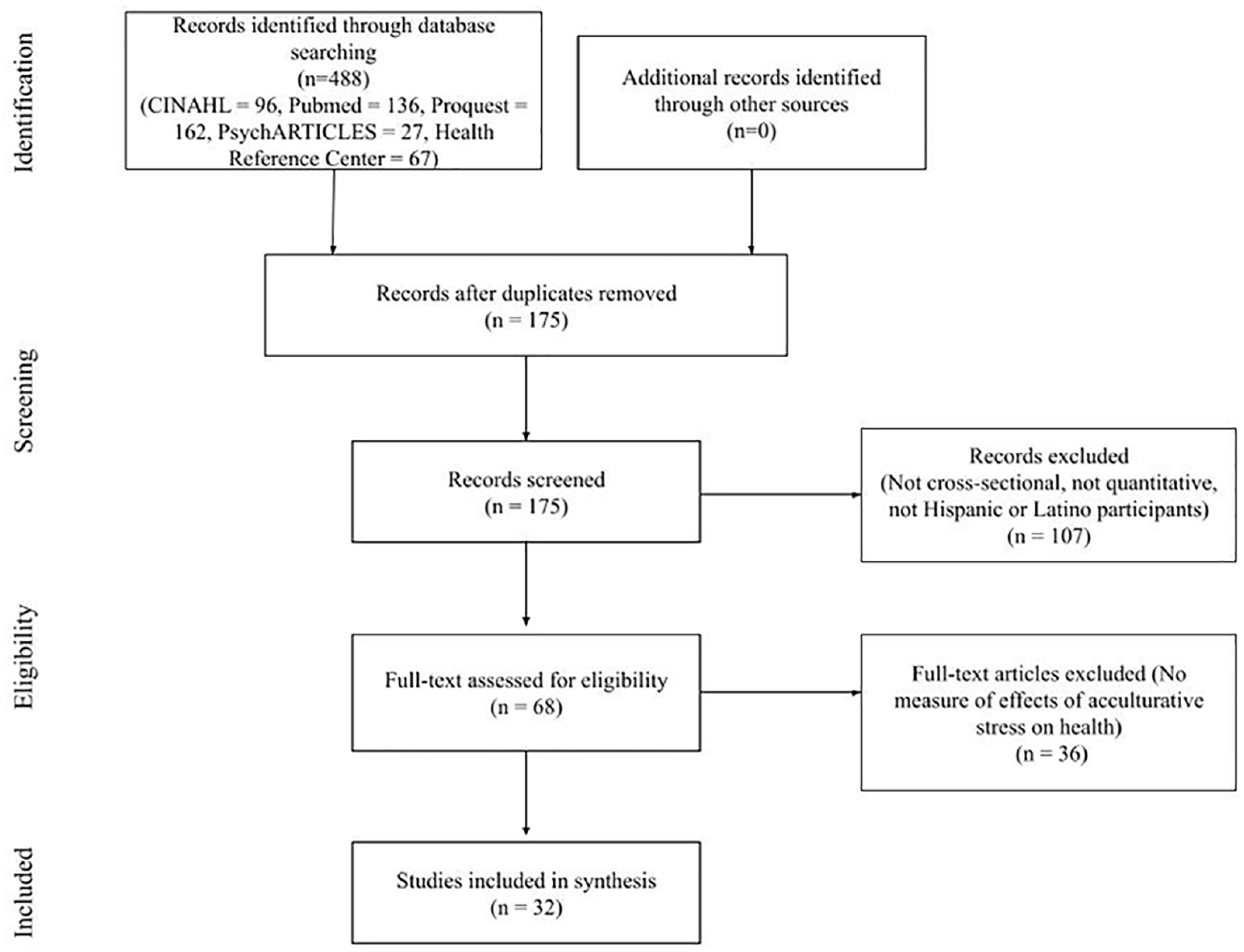
Search Process for Systematic Review.
Summary Table of Included Studies in Review.

Participant Characteristics
The sample sizes from the 32 articles ranged from 70 (Salgado et al., 2012) to 5,313 participants (Alcántara et al., 2017) with a mean of 1,270 participants per study. Thirty studies provided a mean age of their participants, which was 30.7, and ranged from 12 years old (Perreira et al., 2019) to 56.7 years old (Muñoz et al., 2019).
Of the 32 articles, 23 referred to the participants as “Latino” (Bakhshaie et al., 2018; Castillo et al., 2015; Corona et al., 2017; Ertl et al., 2018; Gutierrez-Vazquez et al., 2018; Hill et al., 2019; Leong et al., 2013; Maldonado et al., 2018; Mayorga et al., 2018; Panchang et al., 2016; Paulus et al., 2019; Ramos et al., 2015; Rivera et al., 2015; Rogers-Sirin, 2013; Salgado et al., 2012; Sanchez et al., 2016; Savage & Mezuk, 2014; Schachter et al., 2012; Torres et al., 2012; Viana et al., 2020; Waldman et al., 2019; Zvolensky et al., 2018, 2020). There were two studies that referred to the sample population as “Hispanic” (Cervantes et al., 2013; Zvolensky et al., 2016). Additionally, four articles referred to the studied population as “Hispanic/Latino” (Alcántara et al., 2017, 2019; Cervantes et al., 2019; Muñoz et al., 2019; Perreira et al., 2019). Two articles indicated the country of origin as the participant characteristic in their study such as “Puerto Rican” (Capielo et al., 2015) and “Mexican” (Kiang et al., 2010).
Acculturative Stress Measures
Out of the 32 articles, the Social, Attitudinal, Familial, and Environmental Scale (SAFE) was used in 11 studies (Bakhshaie et al., 2018; Capielo et al., 2015; Ertl et al., 2018; Kiang et al., 2010; Maldonado et al., 2018; Mayorga et al., 2018; Paulus et al., 2019; Rogers-Sirin, 2013; Viana et al., 2020; Zvolensky et al., 2016, 2018). A version of the Hispanic Stress Inventory (HSI) was implemented in seven articles (Alcántara et al., 2017, 2019; Cervantes et al., 2013, 2019; Muñoz et al., 2019; Salgado et al., 2012; Sanchez et al., 2016); a series of nine questions that were part of the National Latino and Asian American Study (NLAAS) were used in five articles (Leong et al., 2013; Panchang et al., 2016; Savage & Mezuk, 2014; Schachter et al., 2012; Waldman et al., 2019). The Multidimensional Acculturative Stress Inventory (MASI) was tested in three articles (Castillo et al., 2015; Rivera et al., 2015; Torres et al., 2012). The Mexican Farm Worker Stress Inventory (MFWSI) was reported in two studies (Hill et al., 2019; Ramos et al., 2015); the Riverside Acculturative Stress Inventory (RASI) and the Mexican American Prevalence and Services Studies were implemented in one report each (Corona et al., 2017; Zvolensky et al., 2020—respectively). A 9-item acculturative stress index was used in Perreira et al. (2019), and multiple measures including sex-related living arrangements, English speaking proficiency, time spent in the U.S. was used to measure acculturative stress in Gutierrez-Vazquez et al. (2018).
The Effects of Acculturative Stress on Health
Acculturative stress was found to impact mental and physical health, health behaviors, and cognitive functioning. The specific influences can be found below.
Mental health
Of the reviewed articles, 81.2% investigated the interaction of acculturative stress on mental health (Bakhshaie et al., 2018; Capielo et al., 2015; Castillo et al., 2015; Cervantes et al., 2013, 2019; Corona et al., 2017; Gutierrez-Vazquez et al., 2018; Hill et al., 2019; Kiang et al., 2010; Leong et al., 2013; Maldonado et al., 2018; Mayorga et al., 2018; Panchang et al., 2016; Paulus et al., 2019; Perreira et al., 2019; Ramos et al., 2015; Rivera et al., 2015; Rogers-Sirin, 2013; Salgado et al., 2012; Schachter et al., 2012; Torres et al., 2012; Viana et al., 2020; Zvolensky et al., 2016, 2018, 2020). Most of these studies found that increased acculturative stress led to increased depression, anxiety, and psychological stress (Capielo et al., 2015; Castillo et al., 2015; Cervantes et al., 2013, 2019; Corona et al., 2017; Gutierrez-Vazquez et al., 2018; Hill et al., 2019; Kiang et al., 2010; Leong et al., 2013; Maldonado et al., 2018; Mayorga et al., 2018; Muñoz et al., 2019; Paulus et al., 2019; Perreira et al., 2019; Rogers-Sirin, 2013; Torres et al., 2012; Zvolensky et al., 2016, 2018, 2020), while another study indicated that acculturative stress was an indirect effect on anxiety and mood disorders (Bakhshaie et al., 2018). An additional article indicated that emotion dysregulation was impacted by acculturative stress (Paulus et al., 2019).
The remaining three studies reported opposite results stating no association between acculturative stress and self-rated mental health (Panchang et al., 2016; Schachter et al., 2012) or depression (Ramos et al., 2015).
Physical health
Four studies examined the effects of acculturative stress on physical health. All four articles used self-reported physical health measures, in which two reported no relationship between acculturative stress and self-rated physical health (Panchang et al., 2016; Schachter et al., 2012). Another two studies found that higher acculturative stress was associated with lower self-rated health (Ramos et al., 2015; Salgado et al., 2012).
Health behaviors
Acculturative stress also affected health behaviors. The various behaviors analyzed in the articles in this review included alcohol and drug use, smoking, sleep, and sexual risk-taking.
Alcohol use was analyzed in five articles (Ertl et al., 2018; Paulus et al., 2019; Perreira et al., 2019; Sanchez et al., 2016; Savage & Mezuk, 2014). Of the five articles, three agreed that increased acculturative stress indicated increased frequency of alcohol use (Ertl et al., 2018; Paulus et al., 2019; Perreira et al., 2019). Two studies found that acculturative stress was not related to alcohol use (Sanchez et al., 2016; Savage & Mezuk, 2014) or DUI-related behavior (Sanchez et al., 2016).
Drug use was tested in one study (Savage & Mezuk, 2014) in which no association between acculturative stress and drug use was found.
Smoking was examined in two articles in which increased acculturative stress led to increased frequency of smoking (Perreira et al., 2019), cigarette dependence, and barriers to cessation (Zvolensky et al., 2020).
Sleep was studied in two articles in which results indicated that increased acculturative stress led to increased insomnia (Alcántara et al., 2017) and daytime sleepiness (Alcántara et al., 2019), but no effect was found between acculturative stress and sleep duration (Alcántara et al., 2019).
Sexual risk-taking was measured in one study (Rivera et al., 2015) and was defined as condom or other birth control usage, substance use during sex, and number of sexual partners. The results of this study found that increased acculturative stress led to an increase in general sexual risk-taking behavior.
Cognitive functioning
Two studies examined cognitive functioning and found that increased acculturative stress was associated with low neurocognitive tasks in the form of verbal learning and memory, word fluency, and psychomotor speed (Muñoz et al., 2019). The other article found that higher acculturative stress was related to a higher endorsement of impairments in self-care and higher cognitive impairment, mobility impairment, time out of role, and difficulties with social interactions (Waldman et al., 2019).
Discussion
This systematic review sought to identify studies that explored the impacts of acculturative stress on health in Spanish-speaking populations. Results of this systematic review indicate that acculturative stress impacts health in three areas in particular, which are mental health, physical health, and health behaviors. Overall, the studies indicated that acculturative stress was positively associated with mental health disorders such as depression and anxiety. There were four studies that indicated contradictory results saying that there was an inverse relationship between acculturative stress and mental health or no relationship between the two. When further examining these studies, it was found that Panchang et al. (2016) and Schachter et al. (2012) both used the NLAAS 9-item questionnaire to assess acculturative stress and used the populations available from this national survey, which were Cuban, Mexican, Puerto Rican, and Other. Using the same questionnaire and population would account for similar results; however, another study included in this review also used the same NLAAS questionnaire and population to examine the effects on mental health, and they found that there was a relationship between acculturative stress and mental health issues (Leong et al., 2013). It is unknown as to why there would be these differing results, which warrants further investigation.
In terms of physical health, the results are inconclusive. Only four articles examined the effects of acculturative stress on physical health, and some studies indicated that there was an association between acculturative stress and physical health, while others found no relationship. Due to the limited studies found to explore this particular area of health, it is difficult to say, with any certainty, any impact acculturative stress may have on physical health.
Acculturative stress also impacted health behaviors, but again the results are inconclusive. This can be accounted for by the low number of studies in this review that actually examined different health behaviors. For example, only one article discussed sexual risk-taking; one considered drug use; and two explored smoking. Five articles studied the effects of acculturative stress on alcohol use, but there were differing results. As such, it is difficult to say with any degree of certainty what effect, if any, acculturative stress has on health behaviors, and this should be an area for future research.
The two studies that investigated effects on cognition found similar results in that participants with high acculturative stress seemed to have cognitive impairments such as low rates of verbal learning and word fluency as well as mobility impairment (Muñoz et al., 2019; Waldman et al., 2019).
Nine different measures of acculturative stress were used across the 32 studies in this review, all of which examined different elements of acculturative stress. The MFWSI focused on migrant farm workers’ stress and stressors while the SAFE looked at stress and coping (Hiott et al., 2008; Mena et al., 1987). Therefore, it is difficult to truly compare outcomes based on a variety of measures; however, it should be noted that while many measures were used to study mental health, the overwhelming majority of articles indicated that there was a relationship between acculturative stress and the prevalence of mental health disorders.
Additionally, the majority of articles included in this review grouped nationalities of Spanish-speakers together. As previous research has shown, it is important to separate Spanish-speakers by country of origin when examining health and acculturation as each population has distinct characteristics, and there is a high risk of improper assumptions that can be made when combining Spanish-speakers into one group (Miller De Rutté & Barrie, in press; Rodriguez et al., 2012; Taylor et al., 2012).
Limitations
There were some limitations of this review. First, it is possible that some articles relevant to this review may have not been identified in the search due to indexing in the searched databases. Second, the mean age of participants found in this review was 30.7 with a range of 12 to 56.7 years, and the articles in this review may not represent all age groups. Finally, due to the limited number of studies existing on acculturative stress and physical health and health behaviors, it is difficult to draw many conclusions on these areas, and future research should further investigate the relationship between acculturative stress and these outcomes.
Conclusion
This review focuses on the intersection of acculturative stress and health in Spanish-speaking populations. Results indicate acculturative stress impacted health through mental health, physical health, and health behaviors. The majority of the articles indicated that previous research has investigated the impacts of acculturative stress and mental health with a particular focus on anxiety and depression. As acculturative stress is a type of stress that occurs during the process of acculturation and particularly has been shown to lower mental health status through anxiety and depression (Berry et al., 1987), the results of this study support previous research. However, as stress has also been shown to have bodily manifestations (Block et al., 2009; Dallman, 2009; Dallman et al., 2003; Geiker et al., 2018; Sinha, 2018; Tomiyama, 2019), there is a need for future research in this area. Furthermore, the impact of healthcare in the United States among the Spanish-speaking population should be investigated to further analyze the effects of immigrating to live in a new culture and the stresses that are associated with immigration.
Footnotes
Declaration of Conflicting Interests
The author(s) declared no potential conflicts of interest with respect to the research, authorship, and/or publication of this article.
Funding
The author(s) disclosed receipt of the following financial support for the research, authorship, and/or publication of this article: We would like to thank The University of Tampa’s Office of Undergraduate Research and Inquiry for funding this project.
