



Abstract
Dimensions of acculturative stress and their implications for school belonging and achievement were examined among 199 Latino middle-school students. The proposed model hypothesized that school belonging would mediate the association between acculturative stress dimensions and low school achievement. Eighty percent youth of the sample were immigrants, 73% had Mexican origins, 57% were girls, and the mean age of the participants was 13.6 years. A factor analysis yielded two dimensions of acculturative stress: discrimination stress and immigration-related stress. Immigration-related stress was associated with age of immigration, but discrimination stress was not. Findings supported the hypothesis that lack of school belonging may be a mechanism by which discrimination stress, but not immigration-related stress, decreases school performance among Latino youth.
Acculturative stress is a prominent construct in the literature on adjustment among Latinos/as, but the meaning and utility of acculturative stress has been the subject of significant debate in recent years. It has been suggested that acculturative stress, defined as the tension experienced when a minority group member acculturates to a dominant culture (Berry, 1997), is often confounded with ethnic minority stress and poverty stress in literature on adults (Rodriguez, Myers, Mira, Flores, & Garcia-Hernandez, 2002). Emerging literature on youth has begun to examine these nuances in acculturative stress, with findings supporting a distinction between stressors related to discrimination and those related to the process of immigration (Suarez-Morales, Dillon, & Szapocznik, 2007). However, studies of acculturative stress among youth have typically not collected or reported data regarding the percentage of youth who were born in the United States versus immigrated or the age at immigration (Hawley, Chavez, & Romain, 2007; Suarez-Morales et al., 2007). For Latino youth, acculturative stress has also typically been studied in areas of the United States with established Latino communities such as Los Angeles and Miami (Rodriguez et al., 2002; Suarez-Morales et al., 2007).
The present study sought to examine the construct of acculturative stress in a sample of Latino youth in a new immigrant community in the Southeastern United States. This study asked whether the distinct dimensions found by Suarez-Morales and colleagues (2007) would also appear in this sample of youth in immigrant families and how these dimensions may be associated with age of immigration and country of origin. In addition, the present research explored whether and how dimensions of acculturative stress are associated with academic achievement among Latino youth, whose high school drop-out rate is more than double the U.S. average (26% vs. 11% (National Center for Education Statistics, 2005). Specifically, this study sought to expand on Ibañez et al.’s (2001) findings that school belonging mediates the association between acculturative stress and school achievement by exploring how this process is replicated in a middle-school setting with attention to different dimensions of acculturative stress.
Acculturative Stress
Research has shown that following immigration, there is typically a significant amount of stress resulting from individual, social, and cultural changes (Berry, 1997). According to Berry, the acculturation process often involves feelings of confusion, anxiety, depression, marginality, alienation, psychosomatic symptoms, and identity confusion associated with attempts to resolve cultural differences. This set of experiences have collectively been called “acculturative stress” (Mena, Padilla, & Maldonado, 1987).
Academic Achievement
Although research on the academic implications of acculturative stress among Latino youth is still an emerging topic of study, findings thus far suggest that Latino students facing high levels of acculturative stress tend to underperform in school (Mena et al., 1987). In one sample of Latino high school students from immigrant families in the Southeast, higher levels of acculturative stress were associated with lower levels of school belonging, which were in turn associated with lower school grades (Ibañez et al., 2001). The present study sought to replicate these findings in a middle-school sample and to expand on this model to determine whether school belonging mediates the association between different dimensions of acculturative stress and school achievement.
Although acculturative stress has been shown to affect Latino youth at varying levels of acculturation to mainstream American norms (Ibañez et al., 2001), the specific nature of acculturative stressors is likely to differ for immigrant as compared to U.S.-born Latinos. Stresses related to acculturation and adaptation to a new host society may be most salient for recent immigrants (Berry, 1997), but stresses related to discrimination may be more salient for U.S.-born youth (Stanton-Salazar, 1997; Suarez-Morales et al., 2007). Following Suarez-Morales and colleagues, therefore, the present study examined two components of acculturative stress: distress related to immigration and distress related to discrimination experiences. It was hypothesized that these dimensions of acculturative stress may have differential associations with academic achievement. For example, whereas longtime U.S. residents may believe that discrimination is a sign that trying hard in school is hopeless because Latinos/as cannot achieve higher-paid jobs, immigrant Latino youth may believe that discrimination will end when they learn English, or they may maintain hope by acknowledging the improvement in economic quality of life and believing that their economic situation will continue to improve (Fuligni, 1997; Ogbu, 1991; Suárez-Orozco, Suárez-Orozco, & Todorova, 2004).
Discrimination
Kao and Tienda (1998) have proposed that experiencing discrimination may reduce students’ capacity for academic achievement by reducing opportunities, creating an unpleasant school environment and higher stress levels. According to Kao and Tienda, disadvantaged youth may face daily discrimination in school and on the streets, which in turn reduces their motivation to achieve in school. They also found that many of the Hispanic students with whom they spoke were surprisingly uninformed of opportunities for college and financial aid, perhaps representing a more subtle form of discrimination.
Aviles, Guerrero, Howarth, and Glenn (1999) found that for the Latino youth in their sample, discrimination was an important factor in students’ decisions to drop out of school. The students in their study described racial name-calling that would lead to fights in which teachers called the police but only reported the Latino students. They also described Americans as fearful that any group of Latino youth gathered in public was a dangerous gang. DeBlassie and DeBlassie (1996) point out that discrimination may lead indirectly to lower academic achievement because it may result in family poverty, which is related to school failure.
School Belonging
There is a growing body of evidence that school belonging, defined as the extent to which a student feels he or she is an important member of the school, is related to positive academic outcomes for youth. Goodenow (1993) studied sense of school belonging in two multiethnic samples of urban junior high school students, which included a significant minority of Latino students, and found that sense of school belonging was strongly related to self-reported school motivation and moderately related to grades. Sense of school belonging has also been found to be related to perceived academic competence and to higher academic expectations and aspirations for Latino high school students in a southeastern city (Ibañez, Kuperminc, Jurkovic, & Perilla, 2004).
A qualitative study of Latino youth who had dropped out of school cited lack of school belonging as an influential factor contributing to their decision to stop school (Aviles et al., 1999). The youth in Aviles et al.’s study also reported difficulty participating in school activities due to both economic and racial barriers and discussed feeling outside the mainstream school culture because of widespread transfer of Latino students into remedial and alternative education programs. In addition, these youth reported that they lacked a sense of school belonging because there were no Latino personnel in their schools. The understaffing of Latino employees may have limited students’ access to same-ethnicity role models, resulting in a reduced sense of belonging to the school for Latino students.
The Current Study
In summary, research on acculturative stress among Latinos/as has seen recent advances that warrant further exploration. This study sought to extend current research on dimensions of acculturative stress by exploring discrimination and immigration-related stress in a population of predominantly immigrant young adolescents. The first goal was to determine whether we could replicate the two acculturative stress dimensions in this age range. The second goal of this study was to examine how, for immigrant youth, age of immigration may be associated with acculturative stress dimensions. It was hypothesized that more newly arrived youth would report more immigration-related stress, whereas U.S.-born and U.S.-reared youth would report more discrimination stress. The third and final goal of this study was to explore a mechanism for the impact of acculturative stress on academic achievement. Specifically, we proposed a model whereby school belonging would mediate the association between acculturative stress dimensions and student grades.
Method
Participants
Participants were 199 Mexican, Mexican-American, and other Latino students recruited from a middle school in a metropolitan area of the Southeast. Of these participants, students born in Mexico represented 61% of the sample, 10% of students were born in Central America, 5% were born in South America, and 4% were born in the Caribbean. In this sample, 20% of students were Latinos born in the United States. Among U.S.-born students, 69% reported that their mother was born in Mexico. Across all 199 participants, 73% had family origins that were Mexican, and the remaining 27% had origins that were characterized as “other Latino” for the purposes of subsequent comparability analyses. For immigrants, family origin was determined by country of birth. For U.S.-born participants, those whose parents were from two different countries were classified based on their mother’s country of birth, following Warikoo’s (2005) research indicating that mothers are the primary passers down of culture.
The middle school from which participants were recruited is ethnically diverse, consisting of 54% Latino students, 24% African American students, 14% Asian, 8% White, and <1% Native American. Participants were either in seventh grade (52%) or eighth grade (48%), and 57% of participants were female. The average age for the sample participants was 13.6 years.
Procedure
Participants were recruited at their middle school by researchers who visited classrooms during school to explain the study. Students were invited to take part if they identified themselves as Latino/a or Hispanic, and it was explained that they could participate regardless of whether they spoke Spanish or where they were born. Participants were also recruited at an information table in the school cafeteria. Students were surveyed in Spanish and in English, and parent consent forms were provided in Spanish and English. Students were offered a movie ticket as an incentive for participation.
Members of the research team administered the questionnaire by reading each question aloud to aid in reading comprehension. Spanish translations of all measures were created using a process of initial translation, back translation, and centering (Barona & Barona, 2000). The questionnaire assessed participants’ perceptions of and level of functioning in a variety of domains, including school, neighborhood, family, peer group, and emotional functioning. For the purposes of this study, data assessing perceptions of school belonging, neighborhood social capital, and acculturative stress were used. Demographic information such as age of immigration, gender, and grade level was also collected through self-report, and students’ grades were obtained from school records. Printouts of the-end-of-year report cards of the students in the study were obtained from their school. GPA was computed from core academic courses: English language arts, math, science, and social studies. Letter grades were converted to GPA on a 4.0 scale (A = 4.0, B = 3.0, etc.). Numeric grades were then averaged to compute an overall GPA for each student.
Measures
Acculturative stress
Participants completed the Societal Attitudinal, Familial, and Environmental, Acculturative Stress Scale (SAFE; Mena et al., 1987), which assesses immigration-related stresses and perceptions of stereotypes that are maintained by the majority group in relation to immigrant populations. The adult version was chosen because the child version is validated through age 12. This scale includes items that assess distress resulting from racial discrimination as well as stress associated with immigrating and adapting to a new environment. Participants rated items on a 4-point Likert-type scale, from not at all true to very true. An example of an item assessing discrimination-related stress states, “Many people have stereotypes about Latinos and treat me as if those things are true.” An example of an item assessing adaptation-related stress is, “It’s hard to be away from the country that my family is from.” High scores on the Acculturative Stress Scale indicate high levels of perceived stress related to adaptation and discrimination-related stress. The scale was developed on a sample of Latino young adults. The overall scale has adequate internal consistency, alpha = .84.
School belonging
Participants completed the Psychological Sense of School Membership Scale (Goodenow, 1993), which assesses students’ satisfaction with the support they receive from teachers and students and their sense of being active members of their school community. Participants rated 18 items on a 4-point Likert-type scale, from not at all true to very true. An example item is, “I feel I am a part of my school.” High scores indicate a positive sense of school belonging. This scale was developed using a large, multiethnic sample with a significant minority of Latino students (Goodenow, 1993), and it has shown strong evidence of reliability and validity in studies of school-related attitudes and behaviors among Latino students (Ibañez, 2002). Internal consistency in this sample was alpha = .82.
Immigration age
Following Portes and Rumbaut (2001), the present study classified Latino adolescents into the following four groups: (1) U.S.-born students, (2) U.S.-reared students (immigrated before age 5), (3) child immigrants (immigrated between ages 5 and 12), and (4) adolescent immigrants (immigrated after age 12).
Results
Acculturative Stress Factor Analysis
The first goal of this study was to determine whether we could replicate the two acculturative stress dimensions found by Suarez-Morales et al., 2007 in an age range of older youth (early adolescents). This study, therefore, conducted a factor analysis using the same parameters used by Suarez-Morales et al. A principal axis extraction factor analysis with varimax rotation with kaiser normalization forcing a two-factor solution was performed on the 24 items of the adult SAFE acculturative stress questionnaire (in contrast to the child version of the questionnaire used by Suarez-Morales et al.). This analysis yielded results similar to those found by Suarez-Morales et al. in that two distinct factors arose: discrimination stress and immigration-related stress. This two-factor solution explained 35% of the variance and produced the most interpretable result. Eighteen items, loading greater than 0.30 on any one factor, were retained (Comrey & Lee, 1992).
Thirteen items had high loadings (>.31) on the first factor and assessed perceptions of discrimination, such as “Because I’m Latino (a), I feel that others don’t include me in their activities.” Items loading on that factor were summed to create a unit-weighted scale that showed high internal consistency, alpha = .79. Five other items had substantial loadings (>0.45) on the second factor and assessed immigration and adaptation difficulties, such as, “It’s hard to be away from the country that my family is from.” Items loading on the second factor were summed to create a unit-weighted scale that showed strong internal consistency, alpha = .75.
One item initially met criteria for inclusion but was omitted after it demonstrated high cross-loadings across the two factors. This item was, “People look down on my Latino customs.” Another item loaded just above the cutoff on the first factor (0.31) but had a high loading on the second factor (0.51) and was, therefore, retained for the second factor: “I don’t feel at home in the US.” The following five items were deleted because they did not load above 0.30 on either factor: “It bothers me that my family does not understand my new American values”; “It bothers me to think that so many people use drugs”; “It bothers me that some of my family does not live near me”; “It bothers me that I have an accent”; “I feel at home here in [Southeastern US state].” The principal axis factor analysis item loadings and communality coefficients for the final 18 items are presented in Table 1.
Factor Loadings and Communalities for the SAFE Acculturative Stress Scale
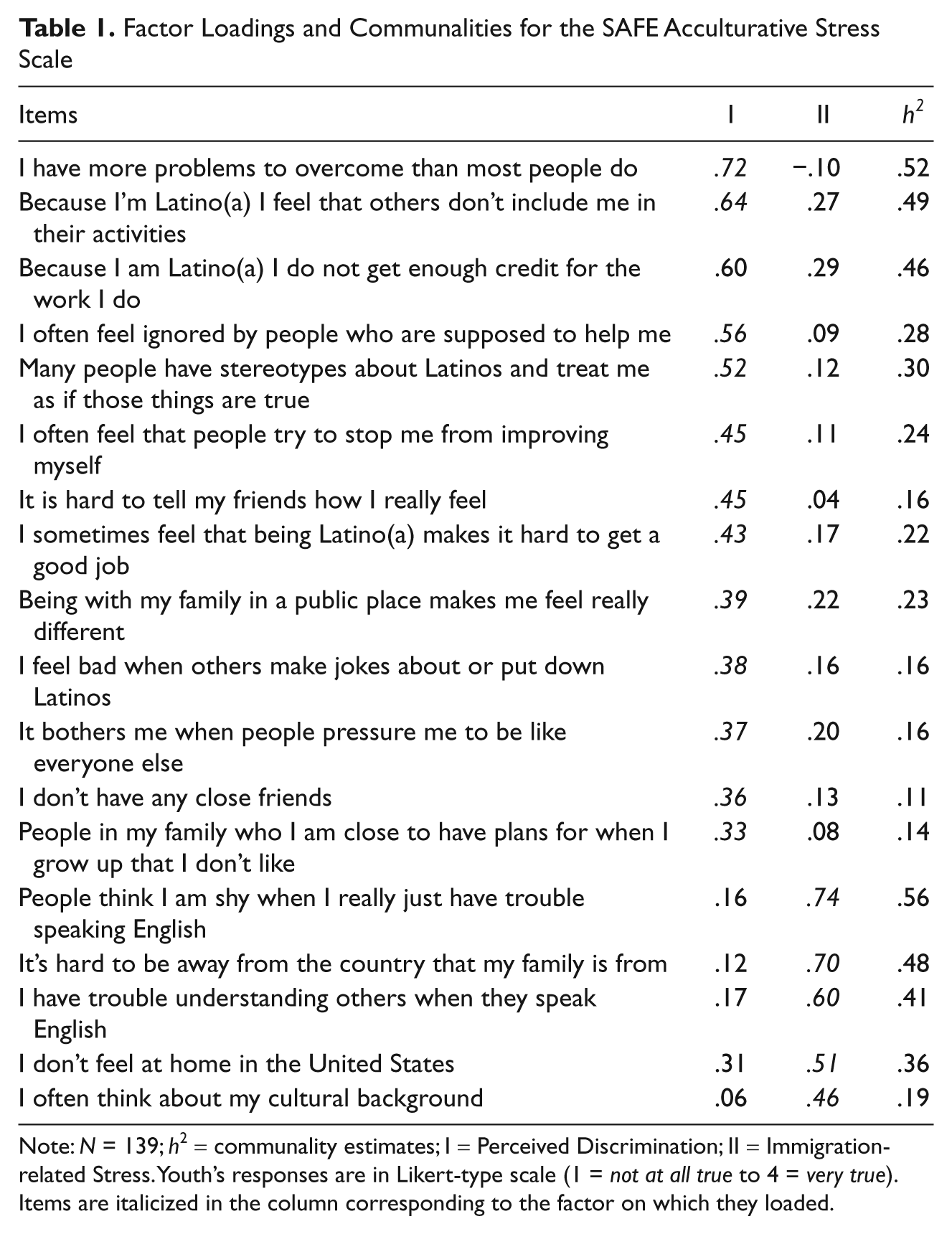
Note: N = 139; h2 = communality estimates; I = Perceived Discrimination; II = Immigration-related Stress. Youth’s responses are in Likert-type scale (1 = not at all true to 4 = very true). Items are italicized in the column corresponding to the factor on which they loaded.
Immigration Age and Acculturative Stress
The second goal of this study was to examine how, for youth in immigrant families, age of immigration may be associated with acculturative stress dimensions. It was hypothesized that more newly arrived youth would report more immigration-related stress, whereas U.S.-born and U.S.-reared youth would report more discrimination stress. First, a Pearson chi-square analysis was conducted to examine immigration age differences on country of origin (Mexican vs. other Latino origin). There were no statistically significant differences among groups in the proportion of participants who were of Mexican origin (Pearson chi-square value = 1.34, df = 3, p = .72). As shown in Table 2, the percentage of students of Mexican origin ranged from 69% to 78% across the 4 immigration age groups. Therefore, Mexican-origin and other Latino youth were combined for the following analysis.
Immigration Age Differences on GPA, the Independent Variables, and Mexican Origin
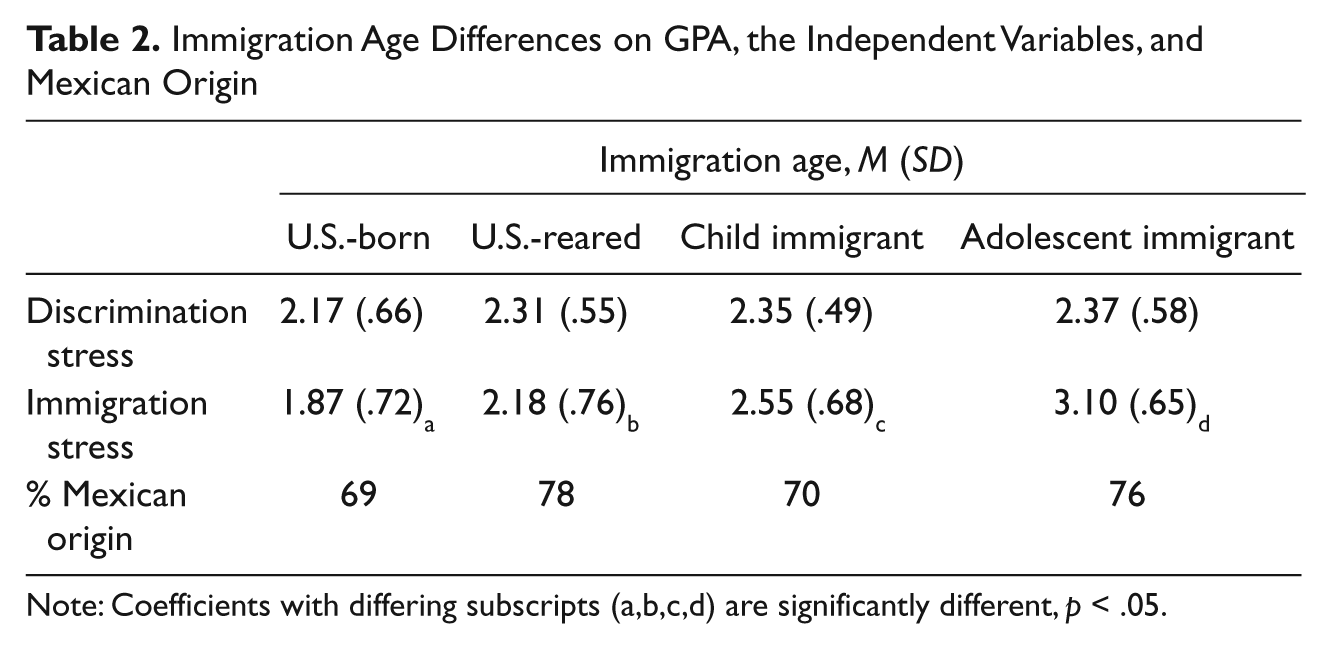
Note: Coefficients with differing subscripts (a,b,c,d) are significantly different, p < .05.
An analysis of variance (ANOVA) was used to examine immigration age differences on GPA and the independent variables. As shown in Table 2, there were significant mean differences in immigration stress among the immigration age groups. Post hoc analyses using Duncan’s multiple-range test revealed group differences on immigration stress such that the more recently students had arrived, the more immigration stress they reported. Each immigration age group reported successively higher immigration stress, with U.S.-born youth reporting the least and adolescent immigrants reporting the most immigration stress. Notably, there were no group differences on discrimination stress. Thus, whereas immigration age was associated with immigration stress, it was not associated with discrimination stress in this sample.
School Belonging as Mediator
The third and final goal of this study was to explore a mechanism for the impact of acculturative stress on academic achievement. Specifically, we proposed a model whereby school belonging would mediate the association between acculturative stress dimensions and student grades.
Preliminary analyses
Prior to testing this mediation model, correlations of continuous variables were examined. The two dimensions of acculturative stress (discrimination and immigration stress) were moderately correlated with each other (.40, p < .01), lending further support to the notion that these constructs are overlapping but distinct. As expected, discrimination stress was negatively correlated with both school belonging (–.34, p < .01) and with GPA (–.25, p < .01). However, immigration stress neither correlated with school belonging nor with GPA. As expected, there was also a positive correlation between school belonging and GPA (.29, p < .01).
In addition, one-way analyses of variance (ANOVAs) were used to examine gender- and grade-level differences on GPA, school belonging, and acculturative stress. Differences on those variables were also examined for youth with family origins in Mexico (Mexicans) as compared to youth with family origins in other Latin American countries (other Latinos). The following differences were statistically significant at p < .05: Girls had higher grades than boys, Mexicans had lower levels of school belonging than other Latinos/as, and seventh graders had higher grades and higher levels of immigration stress than eighth graders. The effect sizes for these differences were moderate; partial eta2 ranged from .02 to .07. These covariates were therefore included in the final analyses.
Mediation test
Preacher and Hayes’ (2008) bootstrap approach was used to test the hypothesis that school belonging mediates the association between acculturative stress dimensions and grades. This method was used because it increases power in smaller samples compared to Baron and Kenny’s (1986) approach. The bootstrap approach also avoids a problematic assumption inherent in the Sobel test that the distribution of the indirect effect is normal (Preacher & Hayes, 2004). This normality assumption is often violated, especially in small samples, yielding underpowered tests of mediation (Preacher & Hayes, 2004). In addition, although Baron and Kenny’s (1986) definition of mediation requires a significant direct effect, Preacher and Hayes (2004) disputed whether the direct effect is a necessary prerequisite for testing indirect effects.
In this study, the bootstrap approach provided a point estimate of the indirect effect ab by computing the mean of ab taken over 1,000 bootstrap samples (sampling with replacement). For the 95% confidence interval of this effect, the 1,000 estimates were sorted from low to high, and the lower limit was the 25th score, whereas the upper limit was the 976th score in the distribution. As noted above, gender, grade level, and country of origin were included as covariates in the bootstrap analyses.
For discrimination stress, the bootstrap analysis revealed a statistically significant regression coefficient for the indirect effect, indicating a significant mediation effect (ab point estimate = –.10, 95% CI = −0.21 to −0.02). Thus, 27% of the total effect of discrimination stress on grades was mediated by school belonging. Figure 1 and Table 3 illustrate this finding. Bootstrap results with immigration stress revealed that the indirect effect of immigration stress on grades via school belonging was not statistically significant.
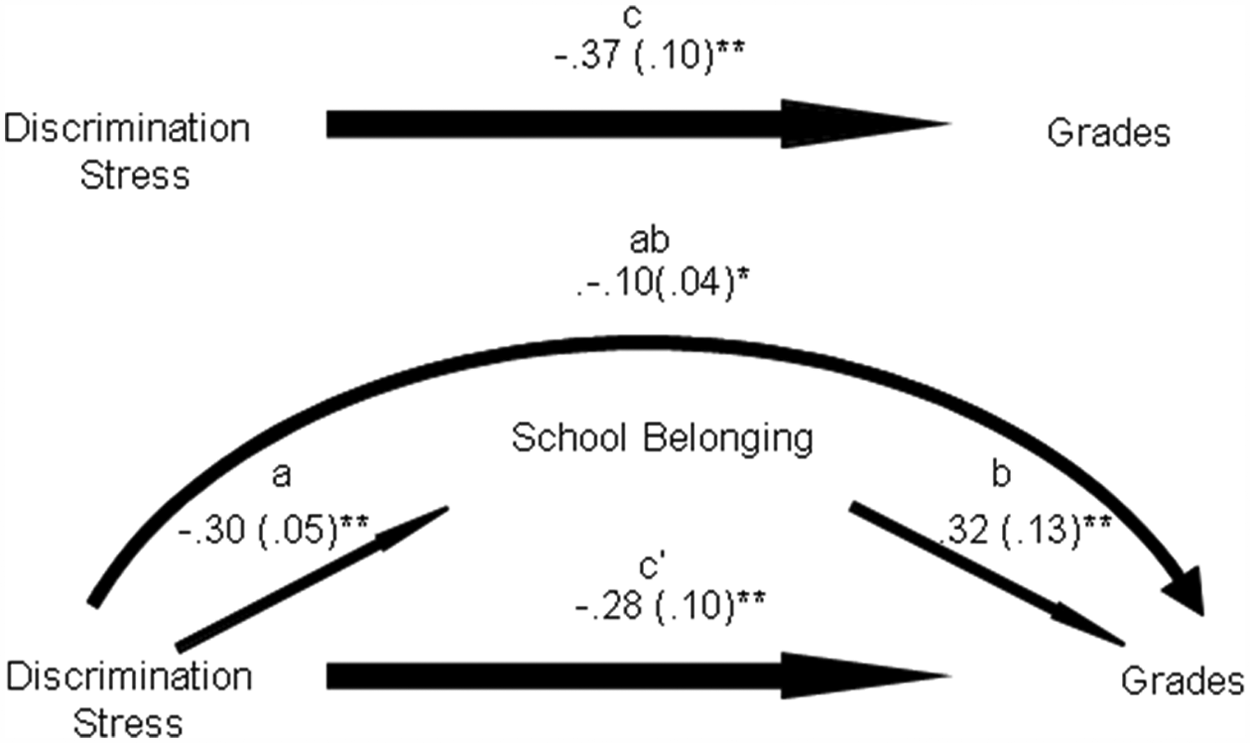
School belonging mediates the association between discrimination stress and grades
School Belonging Mediates the Association Between Discrimination Stress and Grades
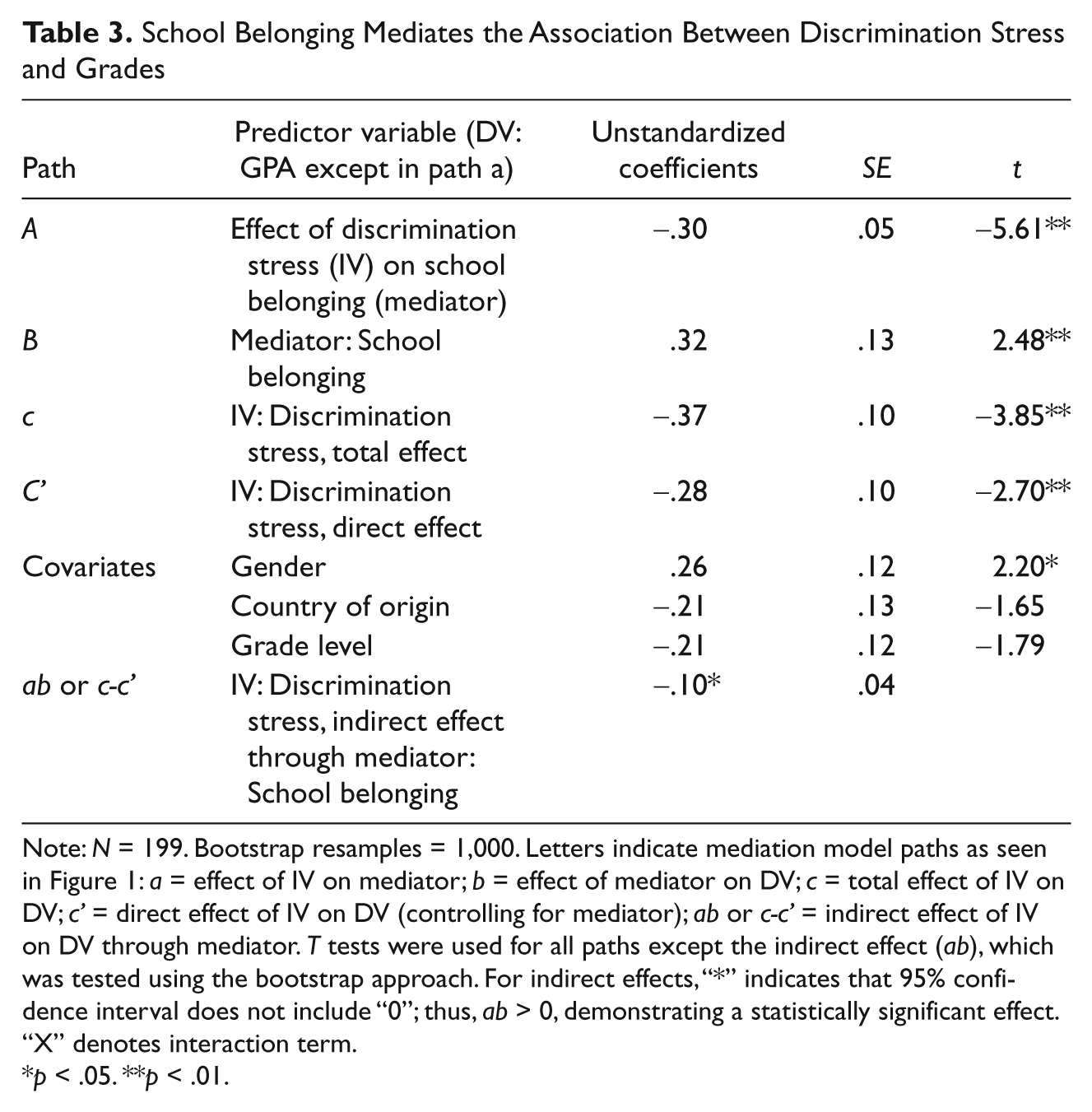
Note: N = 199. Bootstrap resamples = 1,000. Letters indicate mediation model paths as seen in Figure 1: a = effect of IV on mediator; b = effect of mediator on DV; c = total effect of IV on DV; c’ = direct effect of IV on DV (controlling for mediator); ab or c-c’ = indirect effect of IV on DV through mediator. T tests were used for all paths except the indirect effect (ab), which was tested using the bootstrap approach. For indirect effects, “*” indicates that 95% confidence interval does not include “0”; thus, ab > 0, demonstrating a statistically significant effect. “X” denotes interaction term.
p < .05. **p < .01.
Discussion
The first goal of this study was to replicate the two acculturative stress dimensions (discrimination stress and immigration-related stress) found in child and adult samples in a population of adolescents. These findings were indeed replicated to a large extent, offering further support for the notion that acculturative stress consists of two distinct dimensions for Latinos/as: discrimination stress and immigration-related stress.
The second goal of this study was to examine how, for immigrant youth, age of immigration may be associated with acculturative stress dimensions. Findings revealed that the longer youth had spent in the United States, the less immigration stress they reported. However, levels of discrimination stress did not vary based on age of immigration. The fact that immigration stress was related to immigration age but discrimination stress was not further validates the notion that these are distinct processes within acculturative stress. These differences have intervention implications as well. For example, it appears that recently arrived youth may benefit from support regarding immigration-related stress such as homesickness and adjustment difficulties. However, it appears that Latino youth are affected by discrimination stress regardless of immigration age, and efforts to end discrimination should, therefore, be targeted to support all Latino youth.
The third and final goal of this study was to examine school belonging as a mechanism for the association between acculturative stress dimensions and academic achievement. In this study, school belonging partially mediated the association between discrimination stress and grades. This pathway is intriguing and warrants further exploration in longitudinal samples to determine whether school belonging is a pathway by which discrimination lowers school performance. Such a finding would point to interventions that reduce discrimination in the school environment and enhance school belonging in order to improve grades among Latino youth, an important goal in addressing national education disparities.
Strengths and Limitations
This study contributes to knowledge about acculturative stress by examining its dimensions among predominantly immigrant youth, an understudied population. This sample allowed us to examine dimensions of acculturative stress more closely by comparing youth who arrived in the United States at varying ages. The study was also unusual in its focus on the academic achievement implications of acculturative stress, which has typically been explored with regard to mental health implications. The primary limitation of this study is its cross-sectional design, which limits conclusions regarding the direction of causality. Longitudinal studies of acculturative stress and its association with academic achievement should be conducted to enrich our understanding of mechanisms by which acculturative stress dimensions affect school performance.
Future Directions
These findings suggest that increasing a sense of school belonging and minimizing experiences of discrimination are important in the promotion of academic achievement among Latino youth. They also suggest that immigrating in early childhood may buffer students from immigration-related stress. Although we did not find differences for Mexicans versus other Latinos, there was relatively little power to detect variations for the small number of non-Mexicans in our sample. Future research including adequate numbers of participants from other Latin American countries would permit more sensitive examination of variations in these processes. Similarly, future research with a larger sample should explore whether school belonging is a mechanism for the association between discrimination and achievement for both immigrants and U.S.-born youth.
In sum, this study replicated other research in finding two distinct dimensions of acculturative stress for Latinos/as: discrimination stress and immigration-related stress. This finding represents an important extension of previous work with adults and children to a youth sample. It was also important to explore these distinct dimensions among immigrant youth since most research has typically looked at samples of first-, second-, and third-generation Latinos/as without closely examining differences among immigrants based on age of immigration. Indeed, the finding that immigration-related stress increases incrementally with how recently youth arrived in the United States but discrimination stress is constant across all immigration ages lends support to the validity of the distinction between these two types of acculturative stress.
Finally, the finding that low school belonging may be a mechanism for the association of discrimination stress and lower academic achievement suggests the importance of efforts to end discriminatory behavior and increase sense of belonging for Latino students in the school community. Future research should explore school system changes that increase school belonging and minimize discrimination experiences for all Latino youth.