



Abstract
The purpose of this study was to examine Mexican-origin parent’s generational status and cultural orientation in relation to supportive and undermining coparenting behavior. Mothers and father from 126 Mexican-origin families (8% of mothers and 12% of fathers born in Mexico) with a preschool age child (M = 38.80 months old; 60 boys, 66 girls) completed questionnaires assessing their generational status and cultural orientation. Mother-father-child triads were observed for supportive and undermining coparenting behavior. Both mothers and fathers of later generational status (i.e., who had lived longer in the US) had higher levels of undermining coparenting behavior. Mothers and fathers with greater Mexican cultural orientation had higher supportive coparenting behavior. Among Mexican-origin two-parent families, fathers of more recent generational status (i.e., who had immigrated to the US or had parents who immigrated to the US) and greater cultural orientation demonstrated more supportive and less undermining coparenting behavior. The results of this study suggest that both researchers and clinicians should make it a regular practice to conduct independent assessments of generational status and cultural orientation when focusing on contributing factors to the quality of co-parenting in Mexican-origin families.
Keywords
Family Systems Theory (Minuchin, 1985) identifies coparenting as a key family relationship subsystem that links marriage and parenting experiences, emerging at the unique juncture of family life where spousal roles and parenting roles meet (McHale et al., 2000). Building upon a Family Systems perspective, researchers have identified the way that mothers and fathers coordinate their parental roles, support one another in the performance of childrearing duties, reach agreements and work together harmoniously to raise a child, and evaluate each other’s contribution to parenting as fundamental characteristics of the coparenting relationship (Caldera & Lindsey, 2006; Solmeyer et al., 2011). Family practitioners adhering to Family Systems Theory have identified the coparenting relationship as an important target of intervention that integrates two areas of family functioning, parenting and the marital relationship (Adler-Baeder et al., 2018; Barton et al., 2018). Empirical evaluation of specific coparenting programs targeting exclusively heterosexual and predominately European American, non-divorced, two-parent families has resulted in mixed findings, with some researchers reporting minimal evidence of effectiveness (Barton et al., 2018; Epstein et al., 2015), whereas others report moderate to high effectiveness (Adler-Baeder et al., 2018; McHale et al., 2000) at enhancing the quality of coparenting. The mixed results of current intervention efforts suggest a need for more research to identify factors that are related to coparenting quality to better inform intervention programs targeting the coparenting relationship. This line of inquiry has also largely excluded same sex parents and racial and ethnic minoritized parents, resulting in a need for more research with underrepresented parent groups.
The limited empirical focus on families of different cultural backgrounds raises questions concerning how well coparenting interventions address the unique needs of families of color (Adler-Baeder et al., 2018; McHale et al., 2000). Efforts to address this gap in the knowledge base have focused on coparenting processes within Mexican-origin families. This focus stems from demographic data concerning changes in the United States population, indicating that from 2000 to 2015 Latinx groups accounted for over half (54%) of total United States population growth, with individuals of Mexican-origin representing the largest subgroup of the Latinx population (Stepler & López, 2016). In 2015 specifically, 48% of the 16.2 million Hispanic family households in the United States were composed of married couples, and 58% of those households had at least one child under the age of 18 (US Census Bureau, 2016). Given these demographic patterns, researchers have begun to assess the proximal family context characteristics that are related to coparenting quality in predominately two-parent Mexican-origin families with young children.
Principles of Ecological Systems Theory have been used in conjunction with Family Systems Theory to consider broader interconnected contextual ecosystems, such as place, culture, or norms, that influence family systems (Bronfenbrenner, 1986). Ecological Systems Theory has been employed to develop and explore models concerning the correlates of coparenting (Feinberg, 2003; Lindsey et al., 2005). In such models, the family is viewed as a subsystem located within a broader social and cultural context made up of multiple subsystems that reciprocally interact (Bronfenbrenner, 1986; von Bertalanffy, 1968). Ecological Systems Theory stipulates that patterns of coparenting may vary by race and ethnic group membership (Derlan et al., 2015; Feinberg, 2003). One way that ethnicity is viewed by Ecological Systems Theory to influence coparenting, and other family subsystems, is through social position and social stratification domains of the larger societal system in which families are embedded.
One social position characteristic particularly relevant to Mexican-origin families is variability in the generational status of parents. Individuals of Mexican descent living in the United States are typically characterized as belonging to one of three generational groups: (a) having been born in Mexico, (b) having been born in the United States of Mexican born parents, and (c) having been born in the United States of Mexican-origin parents who were born in the United States (Esteinou, 2007). To date, to the best of my knowledge, there has been only one study to consider generational status in relation to coparenting in Mexican-origin families. Pinto and Coltrane (2009) examined patterns of household division of labor among 194 Mexican-origin and 199 Anglo families. The authors found that among Mexican-origin families, first generation mothers reported more gatekeeping, a form of unsupportive and interfering coparenting behavior, than second and third generation Mexican-origin mothers. In addition, both mothers and fathers in Mexican-origin families reported more maternal gatekeeping than European American mothers and fathers. The findings of Pinto and Coltrane (2009) suggest that generational status accounts for differences in coparenting behavior in Mexican-origin families, with less supportive coparenting reported by mothers in families of more recent immigrant status. However, given the lack of research on connections between generational status and coparenting quality in Mexican-origin families additional studies are needed.
It also is important to recognize that, independent of generational status, within Mexican-origin families there is a high degree of variability across individual family members in their “cultural orientation,” the extent to which a person adheres to the values, traditions, and customs of their cultural of origin (Knight et al., 2018). For example, Formoso et al. (2007), in a sample of 115 two parent Mexican-origin families, found that fathers who spoke predominately Spanish, interpreted as an indicator that they were more oriented toward their Mexican heritage, reported more coparenting support. Cabrera et al. (2009), found that in a sample of 735 Mexican-origin two-parent families when fathers spoke less Spanish, interpreted as an indicator that they were less oriented toward their Mexican heritage, mothers indicated there was more coparenting conflict. Together these findings indicate that Mexican-origin families with fathers who are less oriented toward their cultural heritage tend to be characterized by more positive and less negative coparenting quality. However, the limited scope of these studies and the reliance on self-report measures of coparenting quality suggest that additional research is needed to further explicate the role of Mexican-origin parents’ cultural orientation in coparenting quality. Calls have also been made to adopt an expanded view of cultural orientation that moves away from reliance on measures of parent’s English proficiency or time of residence in the United States (Keefe & Padilla, 1987; Padilla & Perez, 2003), and gives attention to domains of cultural orientation such as cultural awareness, the fundamental knowledge that individuals have of their culture of origin, and ethnic loyalty, the preference for one culture or ethnic group (Rodriguez et al., 2007).
The purpose of the present study was to examine the role that generational status and cultural orientation play in the manifestation of supportive and undermining coparenting in two-parent Mexican-origin families. Two key limitations in past research were addressed. First, observational assessments of coparenting quality were used rather than self-report measures. Second, a multidimensional self-reported assessment of cultural orientation was used, rather than a measure of English language usage. Generational status was assessed based on the standard approach of using parents’ self-report of their own country of birth, and their parents’ and grandparent’s country of birth. The hypotheses guiding this study were that (a) parents of more recent generational status (i.e., who themselves had migrated to the US or whose parents had migrated to the US) would display more supportive and less undermining coparenting behavior and (b) parents with greater cultural orientation would display more supportive and less undermining coparenting behavior. The study also examines whether generational status and cultural orientation interact in their association with supportive and undermining coparenting behavior.
Method
Participants
A total of 126 Mexican-origin, heterosexual, two parent families with a firstborn preschool-age child were recruited from a mid-sized city in the Northeast US. In 105 (83%) families, parents were married, with the remaining 21 (17%) families having parents who were unmarried and cohabitating. Mothers’ mean age was 26.71 (SD = 4.7), fathers’ mean age was 29.53 (SD = 4.5), and families had an average of 1.42 children in the home (SD = 1.4). Sixty-nine (55%) mothers and 77 (61%) fathers had a high school education or less, 18 mothers (27%) and 16 (24%) fathers had some college, 34 mothers (17%) and 19 (15%) had a bachelor’s degree, and five mothers had a graduate degree. Annual household incomes ranged from $8,500 to $87,000 (M = $48,175, SD = 14,477). Seventy-three (58%) children were singletons, 34 (27%) had one younger sibling, and 19 (15%) had two younger siblings. Firstborn children, who were the target of this investigation, averaged 38.80 months of age (SD = 11.32; range 36.63–54.34) and there were 60 boys and 66 girls.
Twenty-nine (23%) mothers emigrated from Mexico to the US before the age of 15, 18 mothers (14%) emigrated from Mexico after age 15, and 79 (63%) mothers were born in the US. Thirty-four (27%) fathers emigrated from Mexico to the US before the age 15, 26 (21%) fathers immigrated to the US after the age of 15, and 66 (52%) fathers were born in the US. Among immigrant parents, mothers had lived in the US for an average of 17.52 years (SD = 11.61) and fathers had lived in the US for an average of 22.47 years (SD = 10.08). Among non-immigrant parents (n = 79 mothers and 66 fathers), 38 (48%) mothers and 43 (65%) fathers had one or both parents who were born in Mexico, whereas the remaining 41 mothers and 23 fathers had parents who were also born in the United States. All of the children were born in the United States.
Procedure
Data were collected during a 2-hr home visit during which parents completed a variety of self-report instruments and were videotaped with their child as a triad while playing for 15 min with toys provided by researchers. A triadic interaction context was chosen based on theoretical models that stipulate coparenting quality can only be observed in situations where mother and father are interacting together with their child (Feinberg, 2003; McHale et al., 2000). Triadic interaction sessions of comparable length and structure have been widely used in previous research to assess the quality of coparenting (e.g., McHale et al., 2000; Schoppe-Sullivan et al., 2004). At the end of the home visit parents were given a $40 gift card.
Measures
All survey instruments for parents were available in English and Spanish. Only two families elected to be interviewed in Spanish.
Demographic Characteristics
Following procedures used in a previous study (Lindsey et al., 2005), during the home interview parents provided demographic information, including their age, their own and their child’s ethnicity and race, their country of birth, the country of birth for their mother, father, and grandparents, the number of years they have lived in the US, years of education completed, annual household income, marital status, and number of children living in the home. An income-to-needs ratio was created by dividing reported family income by the U.S. Census Bureau poverty threshold data for the family’s household size as a measure of family income with higher scores indicating greater household financial resources.
Generational Status
Following procedures used in previous research with Mexican-origin families (Derlan et al., 2015; Formoso et al., 2007), participant’s responses to questions about their own birthplace, the birthplace of their parents, and the birthplace of their grandparents were used to identify their generational status as one of four categories: (1) first generation—the participant, one or more of their parents, and one or more of their grandparents were born in Mexico (n = 47 mothers, 60 fathers), (2) second generation—the participant was born in the US, one or more of the parents was born in Mexico, and one or more of their grandparents were born in Mexico (n = 38 mothers, 43 fathers), (3) third generation—the participant was born in the US, both parents were born in the US, and one or more of their grandparents were born in Mexico (n = 23 mothers, 16 fathers), and (4) fourth generation—the participant, both parents, and both grandparents were born in the U.S (n = 18 mothers, 7 fathers). Generational Status was standardized into z scores prior to analyses.
Cultural Orientation
Parents completed the Cultural Awareness (CA) and Ethnic Loyalty (EL) questionnaire (Keefe & Padilla, 1987), containing 136 items designed to measure the strength of their orientation toward the Mexican culture. The questionnaire is made up of eight scales: (a) Respondent’s cultural heritage (RCH; e.g., “How many years have you lived in the US?”), (b) Language preference (LP; e.g., “Do you carry on conversations in Spanish every day?”), (c) Spouse’s cultural heritage (SCH; e.g., “How many years has your spouse lived in the US?”), (d) Parent’s cultural heritage (PCH; “How many years has your mother lived in the US?”), (e) Cultural identification (CI; e.g., “How would you prefer to be known, at the present time, by other people of Mexican descent?”), (f) Perceived discrimination (PD; e.g., “In this town people of Mexican descent have to work a lot harder to get ahead than Anglos.”), (g) Ethnic social orientation (ESO; e.g., “At the present time are your friends mostly of Mexican or Anglo descent?”), and (h) Ethnic pride and affiliation (EPA; e.g., “How many times have you visited Mexico beyond the border cities in the last five years?”). Responses to all items were assigned values so that high scores were in the direction of Mexican cultural awareness and ethnic identity. For example, the question “At the present time are your friends mostly of Mexican or Anglo descent?” was scored 1 = “mostly Anglo descent,” 2 = “a mix of Anglo descent and Mexican descent,” and 3 = “mostly Mexican descent.” The range of scores varied across items, and some items represent a count (e.g., “What is the number of your children who speak Spanish?”; “At what age did you move to the US from Mexico?”). Keefe and Padilla (1987) reported internal consistency reliabilities for the subscales of the questionnaire ranging from 0.76 to 0.97 with a sample of 340 Mexican Americans from Southern California.
Principal components factor analysis with varimax rotation revealed support for the eight factor structure of the questionnaire, accounting for 46% and 43% of variance for mothers and fathers, respectively. Eigenvalues for the eight factors ranged from 3.87 to 5.51 (M = 4.65) for mothers, and 3.82 to 5.60 (M = 4.61) for fathers, with all items loading above 0.55. The internal consistency reliability coefficients for the eight scales ranged from 0.71 to 0.93, M = 0.82, SD = 0.11.
A second-order factor analysis revealed that seven of the scales had high loadings on a single factor (RCH, 0.87; SCH, 0.78; PCH, 0.75; LP, 0.90; CI, 0.70; ESO, 63; EPA, 0.55), and the PD scale loaded on a single factor (PD, 0.59). To reduce the number of variables used in analyses and increase power (McClelland, 2000), a Cultural Orientation score was created for both mother and father by summing the scores on the RCH, SCH, PCH, LP, CI, ESO, and EPA subscales (α .91 and .85, for mothers and fathers, respectively). The PD subscale was not included in analyses.
Triadic Interaction Session
Observational Measures of Coparenting Interaction
Video recordings of the triadic free play session were coded using a detailed behaviorally anchored rating system (see Caldera & Lindsey, 2006, for a detailed description). Prior to use in the present study, the coding system was evaluated in pilot testing with six Mexican-origin families to assess validity of the codes for use with Mexican-origin parents. Three graduate student research assistants and one Ph.D. level researcher of Mexican-origin used the coding system to score the six pilot families and evaluated the system’s applicability to Mexican-origin families. The coders achieved consensus in judging that the rating system was valid for assessing co-parenting quality in Mexican-origin families and acceptable reliability was found in the application of the rating system, κ = .75, .73, .76, and .71 (Cohen, 1960).
A total of eight research assistants who were blind to all other information about the families received 15 hr of training using the coding system prior to coding the videos (see Lindsey, 2018, for details about training procedure). Reliability was calculated by computing Kappas between the ratings of two coders on 25% of the videotapes. In previous research with a sample of 80 Mexican-origin coparent dyads (Lindsey, 2018) the coding system demonstrated good interrater reliability and construct validity, with scores significantly correlated to self-report measures of interparental agreement.
A 5-point likert scale was used to rate each coparenting behavior dimension, with (1) indicating “uncharacteristic of interaction” and (5) indicating “highly characteristic of interaction.” The scales included: (1) Active cooperation (M = 3.02, SD = 0.88; parents are working toward a goal of enhancing play), (2) Active competition (M = 1.71, SD = 0.51; parents attempt to engage the child in different activities at the same time and appear to vie for the child’s attention); (3) Verbal sparring (M = 1.86, SD = 0.91; disagreements between parents, expression of sarcasm, use of verbal insults); and (4) Coparental support (M = 3.17, SD = 0.81; amount of warmth, positivity, enjoyment of each other’s company, and humor between parents). Reliability for these four variables was κ = .77, .70, .72, and .75, meeting the criteria for acceptable levels of reliability (Cohen, 1960).
Following procedures used in a previous study (Lindsey, 2018) the active cooperation and coparental support scales, which were highly correlated, r = .78, p < .001, were averaged to create a Supportive Coparenting variable with high scores reflecting parents’ effort to collaborate during interaction with their child and to engage in supportive coparenting behavior. Similarly, the active competition and verbal sparring scales, which were highly correlated, r = .65, p < .001, were averaged to create an Undermining Coparenting variable with high scores reflecting efforts by parents to dominate the interaction with their child and engage in one-upmanship in the coparenting relationship.
Analysis Strategy
Care was taken in the data collection process to ensure that all participants had complete data by reviewing questionnaires and following-up with participants who may have not answered specific questions. The data were checked for potential violations of assumptions required for regression analyses. It was found that no bivariate correlation was higher than .75, all VIF values were between 1 and 10, and all tolerance values were higher than 0.10, indicating that the data met acceptable parameters for no multicollinearity (Hair et al., 1998). In addition, examination of Quantile-Quantile (QQ) plots and residual plots, univariate histograms, simple scatterplots, and univariate QQ plots that revealed no evidence of violations of normality in the data.
First described is couples’ socio-demographic characteristics, parental generational status, cultural orientation, and coparenting behavior, including correlations among these variables (See Table 1). Next, the study hypotheses were tested using hierarchical multiple regression. Hierarchical multiple regressions were performed using family income, mother and father generational status and cultural orientation, and their interaction, as predictors of observed coparenting behavior. Given the significant positive correlation between mother and father education and family income, in order to reduce the number of variables used in analyses, only family income was included in the regression equations as an indicator of family SES. To address the research question regarding the predictors of coparenting quality, analyses examine the unique and combined contributions of parents’ generational status and cultural orientation to coparenting support and undermining behavior over and above control variables (i.e., parents’ education, employment, family income) (Table 2). Tests for moderation followed Baron and Kenny’s (1986) recommendations to first create interaction terms by multiplying the generational status variable by the cultural orientation variable. The variables were centered prior to computing interaction terms (Aiken & West, 1991). Then, in the fourth step of each hierarchical regression model interaction terms were entered. In the analyses a significant interaction term indicates that the association between the predictor (generational status) and outcome (coparenting quality) variable differs at higher level of cultural orientation than at a lower level of cultural orientation. In order to probe significant interactions procedures outlined by Aiken and West (1991) were used to calculate simple intercepts and simple slopes using centered variables representing the relations between the predictor and outcome at lower (1 SD) and higher (+1 SD) levels of the moderator. For those interactions that were significant, the Johnson-Neyman statistical approach was used to examine the regions of significant confidence intervals (Preacher et al., 2006).
Correlation and Descriptive Analysis of Demographic Characteristics, Parent Generational Status, Cultural Orientation, and Coparenting Behavior.

p < .05. **p < .01. ***p < .001.
Regression Analysis Predicting Supportive and Undermining Coparenting Behavior.

Note. M = mother; F = father; gen. = generational status.
p < .05. **p < .01.
Results
In order to examine differences across parent generational status groups (first, second, third, and fourth generation), a series of ANOVAs were conducted separately for mothers and fathers. There was a significant difference in cultural orientation based on generational status, F(3, 125) = 6.51, p = .007, ηp2 = .052, with the difference accounted for by significantly higher scores among first generation fathers (M = 59.16, SD = 8.69) and mothers (M = 59.27, SD = 8.97) compared to fourth generation fathers (M = 49.12, SD = 8.65) and mothers (M = 47.83, SD = 8.45). There were no differences across generational status groups in supportive coparenting, F(3, 125) = 1.32, ns, and F(3, 125) = 1.41, ns, for mothers and fathers respectively, or for undermining coparenting, F(3, 125) = 0.93, ns and F(3, 125) = 1.28, ns, for mothers and fathers, respectively.
Bivariate correlations among the demographic variables, parent education and family income, and predictor variables, generational status and cultural orientation are presented in Table 1. In the primary analysis using hierarchical multiple regressions, family income was entered in the first step to control for its effect, mother and father generational status were entered in the second step, mother and father cultural orientation were entered in the third step, and in the final step the interaction terms for generational status and cultural orientation were entered. The unique and joint contributions of control variables and predictors of the final regression models are presented in Table 2. The predictors and control variables explained 30% of the variance in supportive coparenting support, and 39% of the variance in undermining coparenting.
Supportive Coparenting
In Step 1, family income was not significantly associated with supportive coparenting. In Step 2, neither mother nor father generational status was significantly associated with supportive coparenting. In Step 3, mother and father cultural orientation was significantly positively associated with high levels of supportive coparenting. Step 4 revealed no significant associations between the interaction terms for generational status and cultural orientation and supportive coparenting.
Undermining Coparenting
In Step 1, family income was associated with high levels of undermining coparenting. In Step 2, mother and father generational status were significantly positively associated with high levels of undermining coparenting. The positive regression coefficient indicates that mothers and fathers of who had lived longer in the US displayed higher levels of undermining coparenting behavior. In Step 3, likewise both father and mother cultural orientation were significantly associated with high levels of undermining coparenting. The negative regression coefficient indicates that mothers and fathers of who reported greater cultural orientation displayed lower undermining coparenting behavior. Step 4 revealed that the interaction term between father generational status and father cultural orientation was significant.
Results of follow-up regression analysis probing the significant interaction between father cultural orientation and father generational status on undermining coparenting are depicted in Figure 1. The Figure shows that fathers whose family of origin had lived longer in the United States (i.e., were of higher generational status) were in families with more undermining coparenting. Simple slopes analyses revealed that when fathers of higher generational status also have low cultural orientation scores there is more undermining coparenting in the family, compared to fathers of higher generational status who have high cultural orientation scores, β = .31, F(1, 125) = 5.76, p < .01, or fathers of lower (i.e., more recent) generational status, β = .11, F(1, 125) = 1.65, ns. Analysis of regions of significance of the data revealed that the slope between fathers’ generational status and undermining coparenting was significant when father cultural orientation was lower than 46.31 (i.e., shaded area in Figure 1), representing 9.8% of the sample, with no significant differences emerging above this value.
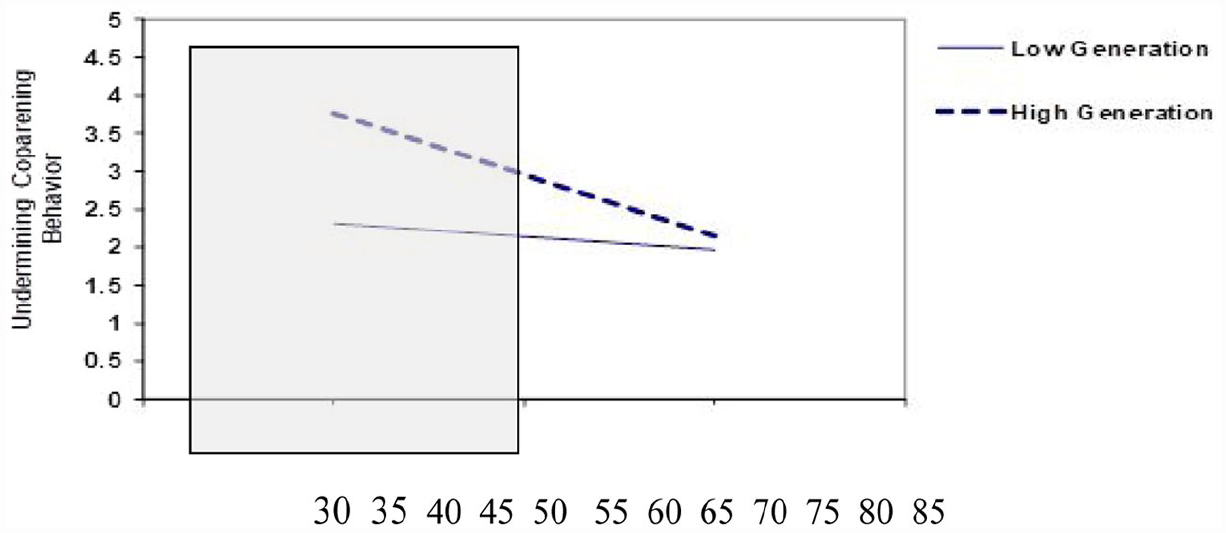
The interaction of father generational status (i.e., length of time family of origin has lived in the United States) and cultural orientation in predicting undermining coparenting behavior.
Discussion
The purpose of this study was to address the notable gap in understanding coparenting in Mexican-origin families by examining how generational status and cultural orientation relate to coparenting quality. The results indicated that parents who were descendants of people who had migrated to the United States displayed higher levels of competition and interfering behavior in a brief mother-father-child interaction session compared to parents of more recent Mexican migrant origins. One explanation for this finding may be underlying differences in values held by Mexican-origin parents of different generational backgrounds (Solmeyer et al., 2011). Specifically, Mexican-origin parents who have lived longer in the United States may be more likely to endorse individualistic values reflective of the United States culture, whereas Mexican-origin parents who have lived for fewer years in the United States tend to adhere to values of collectivism and family solidarity that characterize the Mexican culture (Hofstede, 2001; Shkodriani & Gibbons, 1995). Thus, Mexican-origin parents who have lived in the United States longer could be expected to display a more individualistic approach to coparenting, where each parent follows their own childrearing agenda in such a way that they appear to undermine one another, relative to parents whose ancestry is closer to their Mexican cultural origins. These findings suggest that to better inform practice, future research is needed to examine the role of cultural values in connections between generational status and coparenting quality in Mexican-origin families.
In the present study, a measure of cultural orientation was used to capture parent’s level of awareness of Mexican culture, level of identification with Mexican culture, and their sense of pride in their Mexican heritage. Analyses revealed that both mothers and fathers who reported higher scores on cultural orientation were characterized by higher levels of supportive coparenting behavior and lower levels of undermining coparenting behavior. This finding is consistent with the results of Formoso et al. (2007) who found in a sample of 115 two-parent Mexican-origin families that fathers who spoke predominately Spanish reported more coparenting support. The findings also are consistent with those of Cabrera et al. (2009) who reported that in Mexican-origin two-parent families with fathers who were less orientated toward their Mexican cultural heritage, as indicated by higher levels of English proficiency, mothers reported more coparenting conflict.
Although based on different approaches to assess cultural orientation, the present study joins with these past studies to suggest that parents who have a stronger orientation toward their Mexican heritage may strive more to support and avoid undermining each other in childrearing. It may be that cultural orientation contributes to higher levels of social support from outside of the family, which in turn contributes to less parenting stress, increasing the likelihood of supportive coparenting and decreasing the likelihood of undermining coparenting within the family. Cultural orientation may also contribute to a sense of life satisfaction and happiness that elevates parent’s mood and makes supportive coparenting more likely and undermining coparenting less likely. The findings suggest that coparenting interventions used with Mexican-origin families should include an assessment of mother’s and father’s cultural orientation. Information from the assessment can be used to increase parents’ awareness of how their cultural beliefs may be shaping the quality of their coparenting relationship.
The results of the present study join a growing body of research to suggest that it is worthwhile to distinguish between generational status and cultural orientation in the experiences of Mexican-origin families (Rodriguez et al., 2007; Schwartz et al., 2010). Cultural orientation made an independent contribution to coparenting quality relative to generational status. This suggests that, beyond the simple fact of length of exposure to the United States culture, the level of psychosocial commitment to one’s culture of origin is related to more supportive and less intrusive coparenting behavior. Thus, it appears that among Mexican-origin parents who are more distant in time from their cultural heritage there remains an adherence to cultural norms and traditions that influence coparenting.
Results also point to interactive effects between generational status and cultural orientation in predicting coparenting quality. Specifically, among fathers of later generational status, those who reported greater cultural orientation displayed lower levels of undermining coparenting behavior than those who reported less cultural orientation. Thus, cultural orientation appears to play a modifying role in the link between generational status and coparenting quality, a finding that aligns with research on biculturality, and the processes by which individuals attain new patterns of beliefs and behavior from their host culture, while retaining some beliefs and behavior from their culture of origin (Phinney & Flores, 2002). Such interactive effects can only be understood if researchers conduct independent assessments of generational status and cultural orientation. The findings serve as a further call for practitioners to be sensitive to the complexity of biculturality when working with families of Mexican-origin.
Several additional limitations of the present study should be noted. First, the structured nature and limited duration of the coparenting interaction session provided a limited assessment of coparenting quality. Although observations took place in the home, they occurred in a context created by the researchers, which may not have mirrored situations of day-to-day mother-father-child interaction. Triadic free play sessions similar to that used in the current study have been employed to assess coparenting quality in families with preschool age children (Schoppe-Sullivan et al., 2004) and coparenting measures derived from observations of mother-father-child triadic play have been linked in consistent ways with parental self-reports of coparenting quality (McHale et al., 2000). Moreover, the observational procedure and coding scheme used in the current study has been used previously with a sample of Mexican-origin families and has shown good reliability and evidence of validity (Caldera & Lindsey, 2006; Lindsey, 2018). However, it remains unclear if the observational approach used is an ecologically valid context to assess coparenting quality in Mexican-origin families. Given this limitation, additional research is needed to examine the validity of the triadic free play session for use in assessing coparenting quality among Mexican-origin families, and the findings of this study should be interpreted with caution.
Second, the characteristics of the sample limit the generalizability of the results. Namely, the exclusive focus on parents of Mexican origin means that the findings cannot be interpreted to apply to other Latinx groups. Additional research on co-parenting is needed that includes samples from multiple Latinx groups to better understand the heterogeneity that may exist across parents of different ethnic backgrounds. In addition, the sample focused exclusively on heterosexual parents so that findings cannot be generalized to same-sex coparenting. The sample also was relatively homogenous in educational background, having predominately a high-school education or higher, which limits the generalizability to parents with less education. Furthermore, because each generational status category contained a small and unequal number of participants, results of analyses comparing groups are limited. Consequently, the findings pertaining to generational status need to be replicated with larger and more heterogenous samples before giving significant weight to them. Finally, the current study investigated cultural factors that are common themes in the literature on Latinx families, however, it is unclear whether the results would generalize to other ethnic-racial groups.
Despite the methodological limitations, the present study provides noteworthy information on coparenting behavior in Mexican-origin families with preschool age children, which has received little empirical attention. As one of the first studies to investigate within group variation in Mexican-origin parents’ coparenting behavior, the findings provide an important start to understanding the role that individual differences in sociocultural characteristics have in the quality of coparenting within Mexican-origin families. The relationship between generational status, cultural orientation, and coparenting quality offers an important perspective on the cultural framework of Mexican-origin families. Generational status and cultural orientation were positively related to each other, while both were related in different ways to coparenting quality, suggesting that parents who are close to their culture of origin and value their ethnic heritage are more likely to engage in higher quality coparenting. This is especially important because it refutes popular negative representations of Mexican-origin cultural norms (Saenz & Morales, 2015). Interactions revealed that mothers and fathers who are descendants of people who migrated to the US and who have low cultural orientation were most vulnerable to undermining coparenting.
Footnotes
Acknowledgements
I am grateful for the help of the families who participated in this research and to Marquia Anderson, Felicia Herder, Brenna Lauer, Tiffany Miller, and Samuel Warrick for their assistance with the study.
Author Note
Institutions at which work was performed: All work for this study was carried out at Penn State University Berks Campus, Reading, Pennsylvania.
Declaration of Conflicting Interests
The author(s) declared no potential conflicts of interest with respect to the research, authorship, and/or publication of this article.
Funding
The author(s) disclosed receipt of the following financial support for the research, authorship, and/or publication of this article: This investigation was part of a project supported by a faculty development grant from Penn State University Berks campus. The author expresses appreciation to Tiffany Miller, Samuel Warrick, and the undergraduate research assistants who worked on this study.
