



Abstract
Genre has long been used by Writing Studies ethnographers as a theoretical orientation and analytical tool to bridge text and context. This article describes how genre-based ethnographies as methodology might get taken up at the level of method. Drawing on a genre-based ethnographic study as an example and guide, this article presents a process of data collection that builds ethnographic sites from genre by emergently identifying chains of data sources and collection techniques emanating from starting genres. Applying a genre orientation at the level of method centers inquiry on writing and mitigates the need to define site boundaries. By articulating how a genre orientation might shape ethnography at the level of method, this article encourages a stronger articulation between research methodologies and methods across the field of Writing Studies. Further, this article can be used as a guide for researchers conducting genre-based ethnographies.
The role of writing within the larger social interactions and cultural beliefs of a social group has often been explored through ethnographic studies. Ethnography has especially been used by writing researchers to uncover—and often critique—those tacit literacy practices and beliefs that everyone knows but rarely thinks about (Heath & Street, 2008). Ethnography as methodology has been more specifically theorized within different areas of Writing Studies, including but not limited to literacy studies (Barton, 2013; Street & Lefstein, 2007), academic writing research (Curry & Lillis, 2010; Lillis, 2008; Paltridge et al., 2016), professional and technical writing (Read & Swarts, 2015; Spinuzzi, 2003), and composition studies (Brown & Dobrin, 2004). In adapting this methodology from anthropology and other social sciences, writing researchers have rightly wrestled with fundamental questions of what it means to conduct ethnography in this field (Bishop, 1999; Chiseri-Strater, 2012; Cintron, 1993; Moss, 1992; Sheridan, 2012). To better capture what it means to conduct an ethnography whose questions and data are primarily concerned with writing, even the term ethnography has seen adjustments such as “topic-oriented ethnography” (Moss, 1992), “textography” (Swales, 1998), “situated inquiry” (Blakeslee et al., 1998), “psychography” (Rhodes, 1997), and “text-ethnographic study” (Curry & Lillis, 2010).
Looking across these adaptations reveals a fundamental tension for ethnographers in Writing Studies: centering writing among the larger repertoires of social actors, tools, and rituals—what Gee (1989) might call “capital-D discourses”—that constitute activities and that an ethnographic approach could uncover. How do researchers plunge into a “web of shared meanings that constitut[e] reality within a particular social group” (Smart, 2006, p. 10) while still ensuring their inquiry exposes the role of written texts specifically? Some ethnographers deal with this tension by collecting data on the spoken and/or written discourses they encounter (e.g., Cintron, 1997; Heath, 1983; Lindquist, 2002; Moss, 2003). Another move to center writing has been to adopt sociologist Dorothy Smith’s institutional ethnography (Lafrance, 2020), in which “texts and documents are seen as essential to the very existence of institutions and large-scale organizations” (Smith & Schryer, 2008, p. 121). However, many Writing Studies ethnographers have turned to genre theory in order to center written texts in their inquiry while still connecting those texts to other Discourses (e.g., Berkenkotter, 2001; Paré, 1993; Prior, 1998; Schryer, 1993, 2000; Smart, 2006; Spinuzzi, 2003; Starfield et al., 2014; Swales, 1998; Winsor, 1996). In Miller’s (1984) wide-reaching characterization, genres as “typified rhetorical actions based in recurrent situations” (p. 159) are the patterned ways in which social groups accomplish their work, distribute cognition, and make meaning. Or as Berkenkotter (2001) puts it, genre is the bridge between text and context that still allows ethnographic researchers to foreground the “discursively salient” (p. 330).
While many Writing Studies researchers have developed genre as a theoretical orientation and analytical tool to shape their ethnographic methodologies, less has been said about what it means to conduct genre-based ethnographies at the level of method. To clarify the distinction, a methodology can be understood as “the underlying theory and analysis of how research does or should proceed,” while a method can be understood as “a technique or way of proceeding in gathering evidence” (Kirsch & Sullivan, 1992, p. 2). Sheridan (2012) lists some typical data collection techniques for Writing Studies ethnographers: Researchers may “gather extensive qualitative and quantitative data from multiple perspectives via practices as diverse as writing field notes, activity logs, or maps (of space or interaction clusters); collecting artifacts, histories, and statistics; engaging in informal conversations, formal interviews, and focus groups; conducting surveys; making recordings (photos, video, audio)” (p. 76). With this wide range of data sources and collection techniques that are meant to be reiteratively engaged and triangulated, it is crucial that we have a strong sense of how our chosen methods reflect our methodologies. To this point, Smagorinsky (2008) not only argues for more detail about sources, techniques, and limitations of data collection in our published work, but he also argues for a stronger connection—and articulation of the connection—between methodology and method. For example, when Smagorinsky’s framing theory shifted halfway through one of his qualitative projects, he acknowledged that the theory shift “obligated [him] to account for [his] decisions in data collection so that they were aligned with [his] motivating theory” (p. 396). As an example of this articulation for which Smagorinsky argues, Geisler (2018) explores how one’s method of language coding—which could be seen as a relatively neutral task given technological realities—in fact reflects different methodological commitments with each selection and workflow of coding tools. Similar to Smagorinsky, then, Geisler worries that we often employ methods “whose commitments we do not fully appreciate and whose exploration entails significant cost” (p. 217).
For ethnography specifically, Lillis (2008) distinguishes between (1) ethnography as method, (2) ethnography as methodology, and (3) ethnography as deep-theorizing. Lillis argues for the intertwined nature of these levels, concluding that ethnography as methodology invites “a broad range of data in collection and analysis” (p. 382). Likewise, Prior (1998) ends an extensive appendix that—rather vulnerably—explores his classroom-based ethnography by wondering “how inadequate references to conventional research tools (e.g., semi-structured interview, discourse-based interview, intertextual analysis, process tracing) may be” (p. 306). Prior instead urges us to see all research practices as “situated and mediated activity” (p. 307). For both Prior and Lillis, then, methods are far from being immutable or generalizable: They are instead the concrete realization of our theories, our worldviews, and our research questions. It follows that the emergent and ordered identification of data sources, techniques for data collection, and boundaries of data collection must be infused by our methodological orientations. This view is clearly shared by other scholars in the field whose recent work explicates and systematizes data collection tools (e.g., Lauer et al., 2013; Olinger, 2020; Thieme & Makmillen, 2017; Van Waes et al., 2021) and/or analytical techniques (e.g., Anson et al., 2019; Dyehouse, 2007; Madden & Tarabochia, 2021; Oddo, 2013; Römer & Wulff, 2010; Rose & Klonis, 2020; VanDerHeide & Newell, 2013).
It is my goal to join and extend the work of these scholars by bringing explicit attention to matters of method so we may continue to refine our knowledge-making practices throughout all their complex phases. Specifically, this article explicates genre-based ethnographic methods that reflect (but still make logistically possible) genre-based ethnographic methodologies. I first establish how genre works as a theoretical orientation and analytical tool for ethnographic inquiry; I then review the challenges this genre-based approach presents at the level of method. In response to these challenges, I draw on one of my own ethnographic studies to present a process of data collection that—as opposed to exploring genres within ethnographic sites—builds ethnographic sites from genre. This process involves emergently identifying chains of data sources and collection techniques emanating from starting genres. Ultimately, my aim for this article is twofold: Primarily, I articulate how a genre orientation might shape ethnographic methods and thus model the critical attention ethnography at the level of method deserves across theories in Writing Studies. Second, I encourage Writing Studies researchers to use this article as guide for their genre-based ethnographies.
Genre-Based Ethnographies as Methodology
Genre theories have long been used to bridge, and even question, any perceived gap between text and context. As Dias et al. (1999) explain, “The term [genre] is limiting because the theory is not just an account of genres but is also, more generally, a situated account of writing per se. . . . It ties the textual to the social [and] sees texts as action and texts as in dialogue with each other” (p. 18). Genres are the patterned ways in which social groups accomplish their work, distribute cognition, and make meaning. Thus, genres may be “the ways in which people ‘get things done’” (Johns et al., 2006, p. 235), but they in turn shape what people perceive as things that could or should be done. Drawing on Anthony Giddens’s structuration theory, Schryer (2011) refers to genres as “structured structures that structure” (p. 37): In other words, genres both enable and constrain actions—and the flow of those actions—for any social group. By entering ethnographic inquiry at the level of genre, writing researchers are not only studying written texts but they are also studying the patterns of activity that make the group work.
Part of what makes genre theory so generative for ethnographic inquiry is that genre, in Devitt’s (2004) definition, is a “nexus between an individual’s actions and a socially defined context” (p. 31). She positions genre at a level of mediation between an individual’s actions; surrounding social structures and groups; and contexts of culture, other genres, and situations. On the micro side of genre, one finds an individual’s actions. A person’s actions are always shaped by their various social repertoires (including genre) and emergent contexts, but genre does not necessarily determine a person’s actions. Agency—even though it is often predictably unequal across individuals and groups—exists in whether an individual chooses to engage a genre or not, as well as any individual iteration of a genre, which is always unique. Furthermore, these individual iterations in turn shape the genre’s evolution over time (see Bazerman, 1988; Berkenkotter, 2008; Miller, 2016; Yates & Orlikowski, 1994). Alongside genre at the mediation level, genre works with and among other social structures and groups. Genre, of course, draws on an intersection of many Discourses and can especially carry significant weight among other social structures in writing-intensive settings (see Starke-Meyerring et al., 2011; Russell, 1995). While groups are most often organized by their goals, these goals are realized, at least in part, by genre as social action.
On the macro side of genre, Devitt (2004) describes contexts of culture, other genres, and situations. Genres always reflect larger power dynamics, identities, and ideologies that can seem as normal as the genres themselves. These power dynamics, identities, and ideologies can usually only be seen “through the chinks that develop when a genre’s façade of normalcy is cracked by resistance, inappropriate deployment, unfamiliarity, or critical analysis” (Paré, 2002, p. 60). As one example, Paré (1993) uncovers ideologies about what kind of evidence is admissible in a juvenile court system, as well as what kind of juvenile characteristics are deemed relevant, by studying its genres. As another example, Schryer (1993) highlights the values baked into a veterinary record-keeping system when one group of faculty and clinicians admires it and another group rejects it. These studies use genre as a window into the overarching context of culture as well as the localized context of situation.
Yet, genres never exist or work in isolation. The context of other genres thus becomes relevant: Genres run in intergeneric sets (Devitt, 1993), systems (Bazerman, 1995), repertoires (Orlikowski & Yates, 1994), and ecologies (Spinuzzi & Zachry, 2003). (See Spinuzzi, 2004, for comparative definitions of these frameworks.) According to Freadman (2002), this bidirectional, intergeneric relation that holds genres together can be described as uptake. In Bawarshi and Reiff’s (2010) estimation, uptake “helps us understand how systematic, normalized relations between genres coordinate complex forms of social action—how and why genres get taken up in certain ways and not others, and what gets done and not done as a result” (pp. 85–86). In other words, uptake and these additional frameworks for understanding intergeneric relationships uncover what happens at the edge of any one genre’s social action to coordinate activity.
The mediated position of genre between individual actions and social contexts makes it a beneficial orientation for ethnographers in the field of Writing Studies. With a genre orientation, writing researchers position themselves at the level of mediation from which they can rotate their gaze between the individual; surrounding social structures and groups; and contexts of culture, genres, and situations. Spinuzzi (2003) describes this view that genre offers ethnographers as an “integrated research scope” across levels of activity. These include the following:
Macroscopic: genre as social memory, genre as shaping and shaped by sustained disciplinary activity, genre as social action
Mesoscopic: genre as tool-in-use, genre as constellations of strategies, genres as tactics
Microscopic: genre as a coherent collection of habits, genre as operational rules, genre as structuring work, genre as distributed cognition (p. 45)
These categories are by no means static or even discrete; they overlap and blend into one another as social groups go about their work and individuals move between their various settings. But this mediated position is perhaps why so many writing ethnographers use genre to explore social groups while still centering their inquiry around writing. In other words, genre reduces any perceived gap between text and context while positioning researchers to rotate their gaze between micro- and macro-level scales of activity that are mediated by writing.
Genre-Based Ethnographies as Method: Challenges
The very qualities that make genre so generative for Writing Studies ethnographies at the level of methodology are perhaps what make genre so challenging at the level of method. As an integrated research scope across macro-, meso-, and microscopic activities, genres encapsulate much more than any one textual artifact to be collected or even asked about. For example, Paré and Smart (1994) attempt to tease out the complex dimensions of genre for which we need a range of methods to study:
Regularities in textual features—“repeated patterns in the structure, rhetorical moves and style of texts” (p. 147)
Regularity in social roles—“an organization’s drama of interaction, the interpersonal dynamics that surround and support certain texts” (p. 149)
Regularities in the composing process—“the wide range of factors that end in the finished text, including but not limited to the initiating event, information gathering, analysis of information, individual writing and rewriting, collaborative activities, and the technology of production” (p. 150)
Regularities in reading practices—“what usually happens with the text after it is composed, such as the way a reader approaches a text, how a reader negotiates their way through a text, how the reader constructs knowledge from the text, and how the reader uses the resulting knowledge” (p. 152)
These dimensions of genre perhaps confirm why many genre studies are qualitative—and often ethnographic—in nature: It takes a deep dive into a social group, community, or setting to fully observe the work of genre across these dimensions. Moreover, Berkenkotter (2001) expands what Paré and Smart might call the regularity in social roles to “structures of social and institutional relations,” which must be expansive enough to include “(a) actor + goal (object), (b) tools (including technology and symbolic systems) and their affordances, (c) constitutive rules, and (d) traces of historical cultural practices (i.e., how these goals have been accomplished in the past)” (pp. 330-331). These researchers confirm that studying genre invites a wide range of data sources and data collection techniques to get at genre’s varied dimensions across activity levels.
Given this variety, a main challenge for writing researchers conducting ethnographic studies with a genre orientation lies in two questions that might be thought of as two sides of a single coin: Where does inquiry begin? Where does inquiry end? At face value, these two questions seem like they exist in different realms, to be answered separately, but I would argue that one can’t be answered without the other when it comes to methods for studying writing. An ethnographer must have a sense of their project’s conclusion—its boundaries and scope—to make a beginning. I don’t mean to say those boundaries are inflexible, but a general sense of boundaries creates spaces to explore and allows a plan for the progression of data sources and collection. This sense of boundaries is perhaps even more salient when it comes to genre-based ethnographies: If genre can be used to bridge text and context, what is the “context” that demands immersion, participant-observation, reciprocity? And how can our methods fully explore that “context” through genre as mediational nexus—both to center writing and integrate research scope?
Genre-based ethnographies have employed a number of contextual frameworks to define their research sites, although it is not always clear whether these frameworks sort out methods or are primarily applied to data after the fact as an interpretive tool. For example, Dias et al. (1999) draw on Lave and Wenger’s “communities of practice” to describe mirrored contexts between school and workplaces: “public administration courses and Federal government institutions; management courses and corresponding work settings; architecture courses and a firm of architects; social work courses and social work agencies” (p. 12). (Notice how discreet those sites are!) A similar move can be seen in Smart’s (2006) use of Cole and Engeström’s “activity systems” for his study of the Bank of Canada. With or without these analytical frameworks, others have followed in naming a timeframe with/in a discreet organization as their site, such as Schryer’s (1993) seven months at a veterinary school, Pare’s (2002) social work writing course with 13 Inuit women, or Seawright’s (2017) six years with the Jackson Police Department. Most of these ethnographies end up discussing a range of genres and genre systems within that organization, or in Smart’s words, the “repertoire of shared symbolic resources” (p. 9). For me as a writing researcher, these studies often generate questions at the level of method: Where did these ethnographers start collecting data? How did these ethnographers wind their way through data sources? How did they pursue data sources that kept writing at the center of inquiry? Did investigating out to the far boundaries of these organizations take researchers into unproductive directions? And did staying within the boundaries of these organizations keep researchers from pursuing productive directions?
Because methods can receive little treatment in many of our academic genres, readers are often left with these questions. However, in those genre-based ethnographies where methods happen to be discussed more extensively, I found that these ethnographers are not necessarily collecting data throughout the entirety of their named site, or staying within their organizational name, or pursuing data sources that aren’t grounded in writing. As a primary example, in his textography, Swales (1998) defines his research sites by the floors of a campus building (although he is careful to hedge their existence as “discourse communities”). He immediately shows that, at the level of method, those contextual boundaries were not necessarily as helpful as they might seem: What should my occasional research assistants and I be looking at? Official documents, publicity material, publications, correspondence, manuscripts, pictures of the wall, books on the shelves? What should we be hearing, or overhearing? Life histories, staff meetings, collaborative editing session, and other text-talk interactions, unit-specific jokes, gossip? And who should we be looking at? The professors, the lecturers, the professional and administrative staff, the secretaries, the janitors, the student-users? For a mid-level administrator with a modest research grant, “All of the above” were not possible answers to these questions. (p. 24)
This paragraph nicely encapsulates what I mean when I say that two questions—“Where does inquiry begin? Where does inquiry end?”—are two sides of the same coin that must be answered through the methods we deploy and write about in our scholarship. Here, Swales is wrestling with how genre might help integrate research scope at the level of method. To logistically address this challenge, he ultimately obtained a CV from seven individuals across the three floors, collected some of their publications from that CV, and then interviewed those individuals about the publications (p. 24). I find Swales’s methods here to be a creative solution toward logistically collectable and comparable data sets; I wish to extend this thinking by exploring what methods might bring us closer to reflecting as much methodological complexity that genre has to offer as possible.
I would like to particularly highlight two genre-based ethnographies that give us further clues as to how their methods realize a genre orientation as methodology. The first is Spinuzzi’s (2003) realization of his own “genre tracing” methodology. Interestingly, Spinuzzi does not define his context for data collection by an organization, but an activity: the location and analysis of traffic accidents, which happen across a variety of offices, actors, materials, and tools covering a whole state. One could think that this expanded “site” makes methods—the unfurling how, when, and where of data sources and collection—even less logistically possible. However, Spinuzzi counteracts the overwhelming possibilities by starting his inquiry with just one genre (or cluster of genres, if you will): the accident analysis software. He begins by distributing questionnaires to participants that were known to use the software, and then he adds data sources and collection techniques, including interviews, observations, and further artifact collection, based on their responses (p. 122). In other words, by allowing his ethnographic “site” to be realized through emergent data collection emanating from a key genre, Spinuzzi uncovers how this activity is accomplished with writing that works across social actors, materials, events, technologies, texts, etc. over stretched space and time.
We likewise see hints of this approach in Berkenkotter’s (2001) ethnographic study of a mental health clinic—well, not a mental health clinic per se but the genre system that shapes and makes possible the work of a mental health clinic and the larger activity of nosology, which expands far beyond any particular clinical space. Similar to Spinuzzi, Berkenkotter must navigate movement from “the largest notions of activity or genre system, to the specific historically evolved system of nosology and related practices, to the specific institutional system of one clinic” (p. 342). This was ultimately made possible by starting with just one genre—a therapist’s session notes—which Berkenkotter describes as “a local act that is linked to other sites of representational activity” (p. 342). Berkenkotter thus opens her ethnographic site seemingly simply: by observing this genre being composed in a 55-minute therapy session. From there, Berkenkotter adds data sources and collection techniques that followed the activity outward into its larger systems.
The ethnographic studies reviewed above highlight the challenges in deploying a genre orientation at the level of method, but they also hint at creative solutions. Drawing on these studies, I detail an approach that begins with salient or pivotal genres to then emergently identify chains of data sources and collection techniques. This approach especially centers inquiry around writing, and it also mitigates the need to bound or define one’s context from the outset. Instead, this approach allows contextual boundaries to emerge throughout a project. In other words, this approach to methods builds ethnographic sites from genre.
Genre-Based Ethnographies as Method: An Example
In this section, I further develop this approach of starting with a salient or pivotal genre from which to emergently identify chains of data sources and collection techniques. By providing an in-depth example of one of my own ethnographies, I present how a genre orientation at the level of methodology might be realized by a genre orientation at the level of method. This example can be used as a guide for other genre-based ethnographers, or it can be used as a general model for thinking through how to logistically align research methodologies and methods.
The ethnographic study that I discuss in the rest of this article began by questioning the relationship between writing and access. Take a genre like the petition as an example: Knowing the genre exists, composing an effective iteration, and circulating that iteration with technology seem to be required to access all that a petition does in the world. My hypothesis followed that, if genre is social action, then a person who has the opportunity or power to engage genre has access to its social action. Likewise, if genres coordinate activity that denotes membership, then a person who has the opportunity or power to engage those genres has access to that community. And on the flip side, if someone does not have the power or opportunity to engage certain genres, they do not have access to those actions and/or communities. I therefore asked the following research questions:
How does the power and opportunity to engage genres include or exclude people from particular actions and/or communities?
Who is allowed to engage genre, under what conditions, and to what ends?
Who and/or what controls how people engage genre?
Ethnography seemed the obvious methodological choice here: Uncovering writing’s role in forming and maintaining these actions or communities takes a deep dive into those tacit cultural and ideological practices that ethnography exposes. Genre theory especially provided the methodological orientation to center writing in my inquiry since writing is but one social repertoire at play when it comes to access: Myriad factors shape inclusion and exclusion; structures of power and control have diverse consequences; and movement between boundaries stem from a variety of emergent micro- and macro-forces.
I was considering local government (and particularly a Parks & Recreation Department) as a potential site to dig into this relationship between writing and access since local government is a highly textual endeavor, the actions of which result in widespread material consequences. But where would I draw boundaries? Limiting my ethnographic site to a particular department, program, or event within local government would constrain my ability to explore access, which implies movement across the levels of government, various departments, and into publics. What’s more, limiting my ethnographic site would limit my ability to understand the wide-reaching effects of genre across micro-, meso-, and macro- levels of activity. On the flip side, demarcating the entire city government and their publics—which could link even further out to national and global boundaries—as my site of inquiry was not a researchable site at all. I needed a named entity to make a beginning, but that named entity had to come with open possibilities for expansion and movement—all centered around writing.
I may have seen the Parks & Recreation Department as the general group I wanted to study, but I did not go to their administrative offices, or their organizational chart, or their regular events to define that site. Instead, I went to their genres to open the site. Instead of bounding my ethnographic site to explore genres “inside” of it, I started with three salient genres out of which my ethnographic site emerged by tracking chains of data sources and collection techniques from them. This meant my site emerged and formed around writing: Because data were collected based on their connection with written texts and practices, there was less wading through irrelevant or extraneous data, or at least less tricky determinations of whether data were irrelevant or extraneous. Additionally, because data were collected in chains of data sources and collection techniques (described below), my analysis was poised to cover the roles of both humans and nonhumans (i.e., data sources pointed to a range of social actors, materials, events, technologies, texts, etc.). From here, I elaborate on the logistical details of this approach at the level of method as a guide for genre-based ethnographers.
Choosing Starting Genres
When it comes to deciding what genre or genres might be productive for building one’s ethnographic site, it makes little sense (and is indeed impossible) to choose out of the proverbial void. Researchers cannot start with nothing, and we cannot rid ourselves of every vestige of preconceived boundaries for social groups or settings. In fact, not defining social groups or settings can be just as complicated and fraught as defining them. I suggest using one’s fuzzy-edged understanding of sites to identify salient genres. Then, what becomes the realized site can be built outward with as much movement and boundary-crossing as the genres reveal. Once I had these starting genres, I could sketch my ethnographic site from them and let any preconceived boundaries fall away throughout data collection. I did not need to purge my initial view of the Parks & Recreation Department as a bounded unit—in fact, I used it to find my key genres—but I did not need to overly define or stabilize those boundaries, either.
One’s starting genres will no doubt depend on the research questions at hand. All genres operate at a mediating level between the individual; surrounding social structures and groups; and contexts of culture, genres, and situations. They all perform social actions in context and are embedded in larger patterns of activity. Basically, any genre can serve as a generative starting point to begin tracing data sources. It is possible, though, that some genres by nature of their social actions may more obviously illuminate one’s research questions. This is where insider knowledge of these genres can be most helpful to select which genres are most salient or pivotal. For example, as an outsider to the Parks & Recreation Department and to the local government (besides my citizenship), I could not say from the outset of my study which genres might best demonstrate the relationship between writing and access I was interested in exploring. Thus, after some preliminary searches of publicly available texts across the city’s website, I turned to the Parks & Recreation administrators for their suggestions. I went into our conversation with a long list of possibilities, but the administrators quickly picked up on my research questions and strongly pointed me toward three genres (one of which was not even on my list):
Activity Guides—Magazine-type booklets composed twice per year for the public that list all of the Parks & Recreation classes, programs, and events
Master Plans—Massive reports that assess department needs and make recommendations to guide project prioritization for 10+ years
Staff Reports—Cover memos and supporting attachments that departments submit to receive City Commission approval for a recommended action
While any of the genres on my list of possibilities could have been generative starting points for this project, this upfront insider knowledge meant I started with genres that especially helped me respond to my specific research questions.
Starting with genre is perhaps not as cut-and-dry as it sounds since genres are more than texts and, in fact, bake in dimensions across textual features, social roles, composing processes, and reading practices. As we saw in previous examples, Spinuzzi (2003) began his genre exploration with the dimension of reading practices: He distributed questionnaires to those who used the accident analysis software. Meanwhile, Berkenkotter (2001) began her genre exploration with the dimension of composing processes: She observed the therapy session in which a therapist’s notes were written. A dependable strategy may be starting with textual regularities by collecting and examining as many textual iterations as possible of a genre since the written text is often the most visible and logistically accessible dimension of a genre. For my study, I did begin with textual artifact collection of these genres, but my initial meeting with the Parks & Recreation Department’s administrative team gave me a bundle of starting dimensions for each genre beyond the textual regularities alone. I found that this insider knowledge past the text itself was essential because, for many of these public-facing documents, the organization stands in as author, occluding the composing process and social roles of the genre; meanwhile, the reading practices were highly distributed across the city’s publics. Figures 1 to 3 establish the beginning cluster of data sources and collection techniques that these genres invited.

Initial data sources and collection techniques for Activity Guides.

Initial data sources and collection techniques for Master Plans.
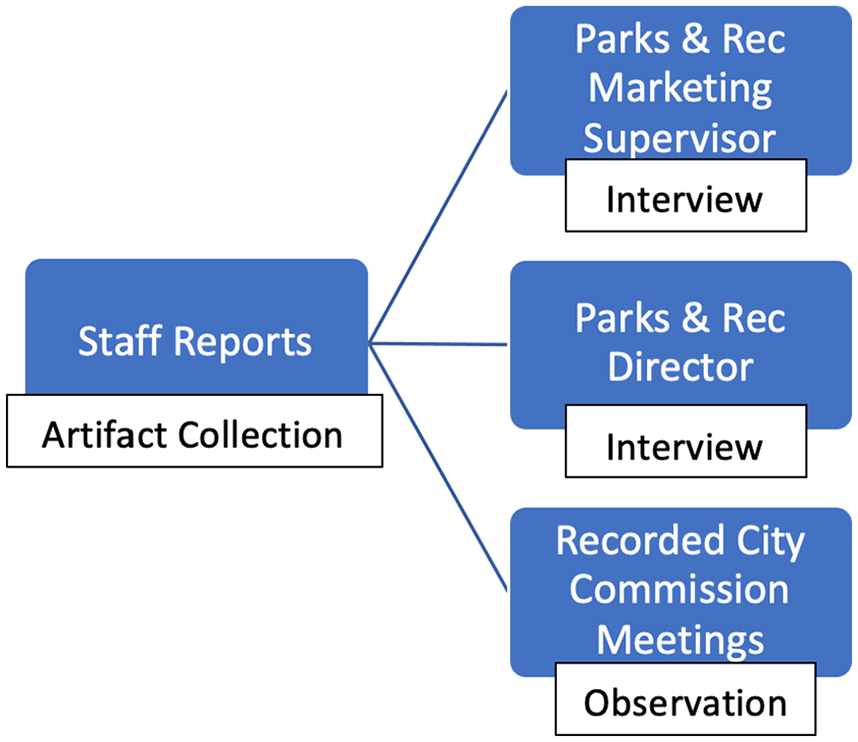
Initial data sources and collection techniques for Staff Reports.
For the Activity Guide (Figure 1), I collected and examined a year’s worth of back-issues, but the administrators clued me in to the primary author, the Parks & Rec Marketing Supervisor, and the fact that the Marketing Team was currently composing the next issue in its offices. Starting with this genre, then, also included interviewing the Marketing Supervisor and observing the Marketing Team while they composed. As the Master Plan (Figure 2) had been written a couple of years previously and was not regularly reproduced, I could not observe the composing process. Instead, I collected and examined the department’s last two Master Plans (the only two that were available since they are written once every 10 years or so), and I set up an interview with the consultant that oversaw the entire composition process, who was named in the latest textual iteration itself. What was not named in that text was that the Marketing Supervisor played a huge but officially unacknowledged role in the Master Plan’s composition, and so he was also one of my starting sources with this genre once the administrators let me in on that secret. For the Staff Reports (Figure 3), I likewise collected and examined every textual iteration from the previous past year, and only two people were ever identified as the authors in the texts: the Parks & Rec Director and the Parks & Rec Marketing Supervisor. Moreover, this genre had much more concrete reading practices than the other two genres with their widely distributed publics: Staff Reports were presented, discussed, and voted on in City Commission meetings. Thus, I also observed archived of City Commission meetings where each of the Staff Reports I had collected were taken up.
While the dimensions for each starting genre were different, they all provided concrete data sources to begin investigation, and they all brought me into a “context” directly tied to texts. Three starting genres is by no means the magic number here. Project scope and research questions will most likely be the biggest factors in deciding how many genres might open one’s ethnographic site. Because this entire approach is emergent in nature, one can always add more genres as they are unveiled to sketch the ethnographic site into various directions that would further answer one’s research questions. And because genres always exist in sets and systems, there will no doubt be multiple genres laced into the chains of data sources.
Building Chains of Data Sources and Collection Techniques
Regardless of what dimension (or dimensions) of a genre are logistically accessible or relevant for one’s start, a researcher can then comb each data source for clues to the next data source, and they can likewise allow each data source to shape the data collection techniques over time. Over my study, each interview, observation, or collected artifact revealed additional data sources across these genres’ textual regularities, social roles, composing processes, and reading practices. Each identified data source could then be collected, which in turn could reveal even further data sources. Thus, my ethnographic site continued to emerge over the months I had allotted for data collection. And perhaps most importantly, following data sources along these unfurling chains kept writing at the center of inquiry and removed boundary-setting—all while providing concrete paths for data collection.
The figures below indicate the full flow of data collection emanating from my starting genres, Activity Guides (Figure 4), Master Plans (Figure 5), and Staff Reports (Figure 6). I have arranged the flow of data collection from left to right to represent the linearity of literal time—how data sources followed one another. However, in an attempt to clearly show how each data source revealed new data sources, much of the messiness of this process is lost, especially in terms of timing. Just because a data source appears on a vertical level next to another data source does not mean I necessarily collected that data around the same time. In these figures, the lateral lines represent the flow of data collection from source to source; the various levels show how I juggled simultaneous chains both within and across these data sources; and this collection of back-to-back graphics reveal an aggregation of data that represents my ethnographic site as a whole—one that could only be “defined” now by looking back over an emergent process. And notice the range of source types that constitute this site: The site is not defined by a social group, or a physical location, or an organization. It is instead a messy collection of interconnected social actors, materials, events, technologies, and texts that exist within, across, and between various social groups.

Chains of data sources and collection techniques for Activity Guides.

Chains of data sources and collection techniques for Master Plans.

Chains of data sources and collection techniques for Staff Reports.
One strategy for researchers managing these unfurling chains of data sources and techniques includes writing more pointed (and perhaps more frequent) field memos. As Bishop (1999) describes them, field memos are ways “to conduct ongoing field analysis while generating data” and “modify and refocus your research questions and/or directions” (p. 79). While building out the ethnographic site, researchers can use the field memos to identify the chains of data sources and consider the ways in which those new data sources interact with existing protocols or research questions. For example, in addition to ongoing field analysis, I included a specific section in each of my frequent field memos to strategically identify new data sources that had been revealed in previous data sources. Figure 7 is an excerpt from one of these field memos where one can see my internal thought process in deciding and listing which further sources to pursue (or not). Notice that the complement to regularly composing field memos is regularly submitting Institutional Review Board (IRB) addendums and/or modifications. One’s initial IRB application may only include protocols for the initial data sources and collection techniques, and that was in fact the case with my initial IRB application; thus, regular updates were required.

Field memo excerpt.
Perhaps an obvious pitfall here would be cherry-picking data sources (although to pretend we do not pursue data based on perceived usefulness in all our research methodologies is rather naïve). However, one can aim to be as systematic and as transparent as possible. In tracking these chains, researchers must recognize all of the possible data sources that a current data source reveals and carefully consider whether to pursue it. For example, in Figure 7, one can see the final outcome of a longer memo that considers whether I should pursue internal emails, which were pointed to frequently across my other data sources. Gaining access to city employees’ emails was possible, but I would have had to submit formal documentation to the City Clerk’s office for specifically identified emails, and the number of emails relevant to my three genres would have outweighed the rest of my data combined. I thus asked many of my interview participants to summarize certain email communications to me, and they did so gratefully since it made them rather nervous to think of me collecting their emails for close analysis. In this case, then, maintaining trust with my participants was more important than the logistically nightmarish path of going through the City Clerk’s office, and I still was able to get an overview of the role of internal email communication through other methods.
Evolving protocols can be seen as both an advantage and a limitation of this highly emergent approach since each data source is inevitably situated by its previous data source. One advantage is that observation notes, interview scripts, and other protocols can be closely tailored to expand and follow up on previous data points. For example, I would often draft interview questions that explicitly drew on previous data (e.g., “Recently, City Commission suggested the Parks & Rec Advisory Board expand from 5 members to 9 members. Can you tell me a little bit about why?”). On the flip side, researchers must be careful not to tailor or limit their view by what came before so much that they would miss valuable data. Thus, in addition to tailored protocols, researchers may also seek to maintain fairly standard protocols across methods. As an example, I was led to observe a Parks & Rec Advisory Board meeting by a document called the “Action Plan Progress Report.” I attended the meeting solely to see the progress report presented. However, by keeping a standard double-entry observation notebook for the whole of the meeting, I ended up with ample data relevant to my research questions that I could not have anticipated, much more than if I had stayed focused on the “Action Plan Progress Report” alone.
Here, we must contend with the issue of timing. If protocols get expanded and tailored based on previous data, then early data sources may not be as thoroughly—or perhaps as pointedly—investigated as later data sources. For example, an interview with a City Commissioner about the Master Plan led me to archived recordings of specific City Commission meetings during which the Master Plan was discussed and voted on. Once I had viewed these recordings, though, I had many more questions to ask the City Commissioner given he was a prominent figure in these recordings. This means researchers may need to return to sources after their initial data collection, whether that means asking more interview questions, expanding observation times, revisiting artifacts, etc., as new sources become implicated in later data sources or even in adjacent chains. Thus, an ongoing rapport and relationship with study participants is as essential to this approach as with any ethnography.
Another essential relationship is that with the IRB office. I could end up revising my interview protocols several times between scheduling an interview and actually completing the interview to account for new information and questions that were being generated from other emerging data sources. So while the figures show the linear discovery of data sources in the order they were initially followed, they do not take into account the circling back, the crossing over, and the overlaps between the genres’ various data chains. Furthermore, in examining my aggregated site (Figures 4–6), it is clear that each of these starting genres had many overlapping data sources. For example, all three genres led me in one way or another to the Parks & Rec Marketing Supervisor and the Parks & Rec Director. And further, Activity Guides and Staff Reports are part of the Master Plan chains. These overlapping sources can work to the researcher’s advantage: For example, I had a single interview with the Parks & Rec Director that touched on all three genres, whereas I interviewed the Marketing Supervisor on three different occasions, each focusing on a different genre. And even though a textual artifact, the “City Strategic Plan,” came to my attention while investigating Staff Reports, it actually became an essential aspect of understanding the Master Plan.
However, this brings us to one of the more challenging aspects of an emergent ethnographic site from genre: Knowing when to stop tracking data sources outward. In Figures 4 to 6, the right-most vertical level represents where I ended the unfurling chains of data sources merely because I stopped collecting data, not because there were no more sources that could be pursued. The answer of when to conclude may not always be clear. What I offer here are three considerations that researchers can use to develop systematic and transparent approaches to conclude their research (or at least a single project):
Saturation. As Creswell (2014) describes it, saturation is “when gathering fresh data no longer sparks new insights or reveals new properties” (p. 189). Saturation is a typical factor for data collection in ethnography, and I found it mapped onto this emergent genre-based approach, as well. For example, many of my later interviews mentioned the same sources as the earlier interviews, so I’d already followed through with collecting that data. I stopped pursuing many chains when data sources mostly pointed backwards toward already-collected data sources.
Logistics. A highly significant factor of data collection that we perhaps do not talk openly about enough is logistics. What data are accessible and/or possible to pursue? What time constraints is the researcher working under? These logistical issues will obviously play a role in when a researcher stops tracking data sources. As an example, one promising data source that the Parks & Recreation Director mentioned in relation to the Activity Guide was the statewide Parks & Recreation Conference: He talked extensively of collecting other cities’ Activity Guides, attending forums focused on Activity Guide publications, and discussing Activity Guides with other department directors across the state. This was a data source I was highly interested in and seemed relevant for my study, but the conference only took place once a year, would not take place during the time frame of my project’s data collection, would require me to travel across the state, and would require me to receive special permission to attend. Thus, I did not pursue that data source. If I had, it would have inevitably led to many other data sources that were increasingly spread across the state, which would have needed their own judgment calls for pursuit.
Research Questions. As with most ethnographies, which lines of data a researcher chooses to follow also depends on the research questions guiding the data collection. Since I was most interested in studying the relationship between writing and access, I prioritized following data sources that seemed to demonstrate or point to that relationship. For example, one data source that pointed to a multiplicity of other data sources was my interview with the City Director of Communications; however, most of these data sources were relevant to the City Director of Communications daily workflow and did not seem to be implicated in matters of access for the Activity Guide. Thus, as Figure 4 shows, the only data source I pursued from that interview was collecting the “City Identity Guidelines.” However, I did dedicate another section of my field memos to inventory these further data sources that I was choosing not to pursue and to brainstorm further research questions for future projects.
Overall, this combination of saturation, logistics, and research questions can guide researchers in deciding when their ethnographic site is complete enough. I cannot help but turn to Latour’s (1996) words: “Stick to the actors. If they drift, we’ll drift along with them. . . . And that’s how it works: you keep on drifting until you have a sentence, a project, that makes sense” (pp. 94–95).
Ultimately, these aggregated chains of data sources and collection techniques emanating from Activity Guides, Master Plans, and Staff Reports represent a process of emergent data collection. They could thus be different on a different day, or with a different researcher, or with different logistical priorities. Researchers must acknowledge that in moving to new data points only from existing data points, they could be missing data that are not as obviously connected. A key technology could be omitted in an interview because of its ubiquity, or an influential mentor may not be named because of her unofficial capacity. These constraints mean we must present our ethnographic sites as experiences, ones that need frequent retreading. On the flip side, there are multiple sources across these chains that may not have been discovered or pursued without the close movement from data source to data source beyond any preconceived boundaries. This emergent data collection carried me across different departments within the local government; up the organizational charts all the way to the Mayor; out to members of the city publics; across a wide range of print and digital texts; among multiple public and private meetings and events; and to physical spaces as varied as government buildings, coffee shops, and personal homes. By the end of data collection, I was left with a robust, messy, and writing-centered sketch of these genres acting as a nexus between individual actions; surrounding social structures and groups; and contexts of culture, genres, and situation. In this way, my ethnographic site emerged by following a genre’s unfurling chains of data sources, and this site also presented writing as a centering repertoire.
Discussion and Conclusion
I recently found myself describing my research projects to a colleague in Sociology, and she was surprised to hear that we do ethnography in Writing Studies. When I attempted to explain that to study writing often means studying its role among the larger fabric of social repertoires and cultures, I ended up describing ethnography in Writing Studies as “ethnography lite.” I was taken aback at my own choice of words here. Clearly, speaking to a Sociologist about ethnography tapped into debates I had long internalized about whether what writing researchers do “counts” as ethnography since its centers inquiry around writing. Of course, ethnographers across fields have come to accept that whole “cultures” and “social groups” are not fully definable or knowable (Keller, 2004), which perhaps lessens our need to hedge the ethnography we do in Writing Studies as narrow or somehow inadequate. But if we see genre as a theoretical orientation to make sense of the relationship between text and context—and consequently what it might mean to conduct ethnographies in Writing Studies—then that thoughtful intentionality must seep all the way through to the level of method. To me, this is an essential move in realizing Sheridan’s (2012) urge “to continue to define and develop our own ethnographic research tradition”—to “mak[e] ethnography our own” (p. 82).
To infuse genre-based ethnographies at the level of method with more of the richness they provide at the level of methodology, I’ve presented a process of data collection that builds ethnographic sites from genre. This process provides a systematic approach for pursuing data sources and collection techniques that centers writing and open boundaries while still maintaining the emergent messiness we have come to expect from ethnographic inquiry. One of the most exciting benefits of this approach is that it provides Writing Studies’ ethnographers with a logistically accessible starting point for ethnographic inquiry. Because writing exists in genre sets and systems—and because it is often representing distributed cognition—translating research questions about writing to literal locations or data sources can be daunting. By starting with genre, writing researchers are positioned at the nexus of a person’s actions; social structures and groups; and contexts of culture, other genres, and situations. Moreover, genres reflect and inscribe ideologies, power dynamics, and identities, and they perform in patterns among other genres and social repertoires. Thus, starting with genre means that writing researchers are diving into mediated actions, values, and patterns, but there’s still a clear data point for developing the space. To put it another way, while genre is an effective conceptual starting point for ethnographic inquiry, it is also an effective literal starting point for ethnographic inquiry. The literal starting point may be whatever dimension of genre (i.e., textual regularities, social roles, composing processes, or reading practices) is most accessible or visible.
Further, starting with genres and building chains of data sources and collection techniques can allow the writing research to map complex and often overlapping aggregates that work to define their ethnographic site through data collection as opposed to prior to data collection. This prevents writing researchers from struggling to fit their ethnographic sites into frameworks for defining a social group or context; instead, writing researchers are freed up to move within, between, and across boundaries as their site evolves. This need for researchers to move within, between, and across boundaries is beginning to gain attention in Writing Studies, but more so to follow individual writers and their development over time and across settings (see Dippre & Phillips, 2020; Smith & Prior, 2020). Additionally, this approach offers fluidity to study how written genres act within and across—and therefore become part of creating and maintaining—complex social groups. Some recent areas in Writing Studies that might especially benefit from this fluid approach include public writing and online writing, both of which resist easy definitions of groups, settings, or time.
Finally, I’ll end by echoing Smagorinsky’s (2008) sentiment in encouraging researchers across Writing Studies to explicitly, and even vulnerably, engage with method. When Lillis (2008) brought our attention to the distinctions between ethnography as method, methodology, and deep-theorizing, she was primarily concerned that Writing Studies researchers were not fully developing the latter two, methodology and deep theorizing. Informed by this thinking, I would encourage researchers to return the rich orientations developed at the level of methodology and deep-theorizing back to the level of method. Methods are knowledge-making in action. As such, they are more than generalizable techniques that can be applied to any data source in any project. Instead, method as knowledge-making exists in the identification and progression of data sources; the way the collection techniques and associated protocols change (or do not change) over time; the pivots that are made, required, or forced due to any range of factors, from the epistemological to the logistical; and how research questions drive, turn, or evolve from data source to data source. This complex description of method perhaps is not news to any experienced ethnographer who has grappled with their shifting research design, emergent data sources, iterative collection techniques, and evolving protocols as they wade through their gradually thickened descriptions. But if we see methods as more than generalizable techniques, that means the unfurling where, when, and why of methods invites theorization, engagement, and intentionality.
Of course, one reason methods may not be discussed fully in the context of academic publication is because there is little room in many of our academic genres to do so; data sources and collection techniques are often reduced to a tidy table, a quick list, or a slightly longer list relegated to an appendix. In the digital age, perhaps editors in Writing Studies can take advantage of the increased space offered by online platforms to publish longer or supplemental explanations of method that may have previously been prohibited by printing restrictions. Moreover, special journal issues, edited collections, or other publications expressly dedicated to method are as crucial to publish as our findings (e.g., Haas & Bakke, 2013; Lockett et al., 2021; Nickoson & Sheridan, 2012; Schlitz, 2010; see also the “Research Notes” section of The Journal of Writing Analytics). For this article, I’ve articulated how genre as a theoretical orientation for ethnographic methodologies might apply to ethnographic methods. This emergent—yet logistically possible—approach maintains genre as a bridge between text and context at the level of method: It centers data collection around writing and mitigates the need for overly rigid boundary-setting. Going forward, I encourage this critical alignment between methodology and method across the wide range of research approaches in Writing Studies. Whether digging into the archives, investigating the classroom, developing case studies, or dissecting discourses, Writing Studies researchers would do well to explore how their theoretical orientations might permeate through methodologies all the way to methods.
Footnotes
Acknowledgements
I would like to thank Amy Devitt and Peter Grund for their invaluable input toward developing these ideas in early drafts. I would also like to thank the two anonymous reviewers and Chad Wickman for their generous and thoughtful feedback.
Declaration of Conflicting Interests
The author declared no potential conflicts of interest with respect to the research, authorship, and/or publication of this article.
Funding
The author received no financial support for the research, authorship, and/or publication of this article.