



Abstract
Many genre scholars have focused on how individuals might build genre knowledge, generally understood as the enculturation processes, gradual stages, or ingredients that lead to one’s facility with a genre in context. While genre knowledge describes whether people can engage genres, it does not describe the various factors that shape how people may engage genres. By consolidating scholarship across Rhetorical Genre Studies (RGS), this article characterizes genre access as the power, opportunity, permission, and/or right to engage genre. Furthermore, this article integrates Network Gatekeeping Theory to develop a micro-level analytical approach for explicitly describing genre access. The author demonstrates and develops genre access as a concept and analytical approach with an illustrative example from a larger ethnographic project. Specifically, this illustrative example explores genre access for the Staff Report, a common genre in local government that proposes recommendations from individual departments to their elected City Commissioners for voted approval. Overall, the purpose of this article is (1) to consolidate and extend RGS’s exploration of the power, opportunity, permission, and/or right to engage genres; (2) to identify and name genre access as a fundamental aspect of how genres work; and (3) to provide a micro-level analytical language for researchers to tease out the various factors the shape genre access.
As explored by decades of work in Rhetorical Genre Studies, genres allow us to act socially across time and space by responding to and constructing situations (see Miller & Devitt, 2019; Schryer, 2011). Since genre is so essential for modern social action and participation (Bazerman, 2013), many genre scholars have explored how individuals learn genres, or how those individuals build genre knowledge (Bawarshi & Reiff, 2010; Berkenkotter & Huckin, 1995; Prior, 1999; Tardy, 2004; Tardy et al., 2020).
1
But even among this scholarship that describes genre knowledge and its acquisition, there is still the question of the opportunity to develop genre knowledge. Tardy et al. (2020) evoke this question when, near the end of building an impressive model of genre knowledge, they consider how such knowledge might realistically be gained given the “numerous influences” it must include: opportunities for authentic (and guided) genre practice; participation in discourse communities and their activities; access to those communities and their expert members; the power dynamics of a community and of individual interactions; mentoring; collaboration; classroom or nonclassroom instructional support; encounters with relevant texts; individual agency; and the complex development, shifts, and tensions of writers’ identities. (p. 313)
Here, Tardy et al. draw out a variety of power relations, material realities, and evolving identities that shape how and when genre knowledge develops. Similarly, Artemeva (2009) describes genre knowledge ingredients, some of which might be expected (e.g., domain content expertise), but she also adds ingredients such as agency, cultural capital, formal education, and private intention. These latter “ingredients” are matters of opportunity, and they are matters of power. In other words, genre knowledge might describe how people can engage genre, but it does not necessarily describe how people may engage genre.
To explicitly describe how people may engage genre, I propose the concept of genre access. In contrast to genre knowledge, which describes enculturation processes, gradual stages, or ingredients that lead to one’s facility with a genre in context, genre access describes the various factors that shape how fully and in what ways people may engage a genre (regardless of their genre knowledge). I specifically speak of “engaging” a genre because genre access is relevant across the dimensions and lifecycle of a genre—from textual regularities to social roles, composing processes to reading practices. Genre access, then, complements and extends our understanding of genre knowledge, and genre knowledge becomes one factor of genre access.
In this article, I characterize genre access as the power, opportunity, permission, and/or right to engage genre. 2 I first establish theoretical orientations across Rhetorical Genre Studies (RGS) that focus on issues of power and opportunity with genre engagement, and I also integrate Network Gatekeeping Theory (NGT) for a micro-level analytical language that can be applied to myriad phenomena to tease out the various factors of access. To apply NGT to the phenomenon of genre, I present an illustrative example from a larger ethnographic study of a local Parks and Recreation Department’s writing practices. This illustrative example explores the Staff Report, a common genre in local government that proposes recommendations from individual departments to their elected City Commissioners for voted approval. As hired professionals, the Parks and Recreation Department staff has autonomy over much of their work, but some actions require an additional vote by elected officials if those actions have larger policy or budgetary implications, such as major building projects or expenditures exceeding a certain dollar amount. The only way to bring these actions forward for a vote is by composing a one to two-page Staff Report that lists the recommended action and makes a case for why it is necessary. City Commissioners read dozens of these Staff Reports from across the city departments every weekend in preparation to discuss and vote on them in a Tuesday evening meeting. With this example, I develop and demonstrate how we might articulate genre access and its contributing factors at a micro level of analysis. Overall, the purpose of this article is (1) to consolidate and extend RGS’s exploration of the power, opportunity, permission, and/or right to engage genres; (2) to identify and name genre access as a fundamental aspect of how genres work; and (3) to provide a micro-level analytical language for researchers to tease out the various factors the shape genre access.
Theoretical Orientations
As a concept, genre access integrates a wide range of scholarship in RGS that explores how one’s engagement with genre might be the result of one’s power, opportunity, permission, and/or right. By reviewing RGS scholarship, I show that genre access is not necessarily a new phenomenon, but it is not one that has yet been consolidated with an explicit name. Specifically, I consolidate genre access by drawing on scholarship that investigates social roles, activity systems, and capital. Furthermore, I add Network Gatekeeping Theory for a micro-level analytical language that specifically describes the various factors of access.
Access: Power, Opportunity, Permission, and/or Right
One set of RGS approaches that explore the power, opportunity, permission, and/or right to engage genre show how genres work in and for social groups, often characterized as “discourse communities” (Swales, 1990) or “communities of practice” (Dias et al., 1999). These communities mean that social roles are embedded in genre actions, along with the associated power dynamics, relationships, and institutional authorities. Whether official or unofficial, these social roles are what make it possible for genres to distribute cognition and accomplish social actions, but they also cast readers and writers into playing particular characters for any single genre and within the larger genre system. Those characters may have more or less influence over when and how the genres (and which genres) are engaged. For example, Paré (1993) observed how a genre in the Quebec juvenile court system works at the intersection of social relationships between social workers, adolescents, families, judges, and lawyers. This intersection of social relationships means the genre inherently holds tensions that can ultimately prioritize some parties’ goals or identities over others. As another example, Schryer (1993) found that record-keeping genres in a veterinary hospital become a site of charged power struggles because different forms of record-keeping reflect the values of various actors—the most powerful of whom seem to prevail. As abstractions, then, genres present a constellation of strategies, rules, and routines that both respond to and construct rhetorical situations, but these strategies and rules are not absolute; they are selected and enacted flexibly by social actors who constantly move between motives, discourses, and communities. 3
Another analytical approach that further clarifies one’s opportunity, permission, and/or right to engage genre is activity systems (Engeström, 1987, 1999). Activity systems are characterized as subjects using mediational means (i.e., tools) to accomplish an object/motive toward outcomes. In this model, context is constantly re-created by social actors using shared tools toward their goals, with plenty of consensus and dissensus along the way. By synthesizing activity theory with genre theory, Russell (1997) describes genres as tools-in-use. Written genres are one social repertoire among many and are implicated in some systems more than others, but they tend to be an especially key social structure in literacy-based institutions (Bazerman, 2009). Genres provide recurrent recognition, shared values, and long-term durability—and thus stability—within an activity system, even if their required micro-level re-creation means they are only ever “stabilized-for-now” (Schryer, 1993, p. 204). These stabilized-for-now tools are always working within and re-creating:
Rules/norms: “the explicit and implicit regulations, norms, and conventions that constrain actions and interactions with the activity system”;
Community: “multiple individuals and/or sub-groups who share the same general object and who construct themselves as distinct from other communities”; and
Division of labor: “both the horizontal division of tasks between the members of the community and the vertical division of power and status” (Engeström, 1987, p. 78).
These fundamental aspects of activity systems are laced with notions of inclusion/exclusion. Russell (1997) makes it clear that power is not an indefinable source of mysterious force, nor can it necessarily be located in individual genres, but “some people (and some tools) have greater and lesser influence than others because of their dynamic position(s) in the tool-mediated systems of networks” (p. 10). Studies that use an activity systems approach, then, help us see how genres reflect and inscribe power, and thus their engagement is always implicated in power arrangements (e.g., Berkenkotter, 2001; Smart, 2006; Spinuzzi, 2003; Winsor, 1996).
Perhaps the most explicit discussion of the power, opportunity, permission, and/or right to engage genre is cast in terms of Bourdieu’s (1986) three forms of capital: economic (material wealth), cultural (knowledge or skills), and social (accumulated prestige or honor). These three forms of capital heighten one’s ability to engage and shape a field (loosely understood as organizations, communities, or systems). Each of our unique confluence of fields further shapes our “habitus,” (Bourdieu & Wacquant, 1992, p. 16), which can be characterized as a way of perceiving and experiencing the world. It is in the interaction between field and habitus that genres exist as a set of “regulated, improvisational strategies” (Schryer, 2002, p. 74): Genres allow us to appropriately respond to situations (and, in turn, create those situations) by aligning habitus and field. The manner and extent of that alignment, though, depends on one’s capital. RGS scholars have studied how individuals negotiate and leverage these forms of capital as they engage genres such as insurance letters (Schryer, 2002), police reports (Seawright, 2017), and zoning codes (Dryer, 2008). For example, Dryer (2008) describes how a citizen who simply wants to know if she can hold community meetings in her home must navigate specialized language, multiple technologies, time constraints, legalese, and affective exhaustion: Economic capital might afford her the time to invest in the zoning code genres, while cultural capital might afford her the literacies needed to read and respond to them. And of course, social capital might allow her to question or change the zoning codes. And so how we experience the world is not only filtered through genres, but their engagement often upholds power relations through recognized forms of capital. 4
Synthesizing these various approaches leads to genre access, which I characterize as the power, opportunity, permission, and/or right to engage genre. While RGS scholarship confirms this essential aspect of how genres work, I am attempting to shift the conversation from a macro-level analysis of systemic power to a micro-level analysis of moments of control over individual use. While some models, among them activity systems and genre tracing (Spinuzzi, 2003), allow researchers to move across macro-, meso-, and micro-level analyses, I take Devitt’s (2004) point that “the attempt to fuse the macro and micro may in fact disguise too much the impact of each” (p. 26). I thus turn to gatekeeping theories for a language to investigate the various micro-level factors that contribute to genre access.
Network Gatekeeping Theory
Gatekeeping theories generally describe the exertion of power and control that shape access to any variety of actions or materials. As a psychologist and “the father of gatekeeping theory” (DeIuliis, 2015, p. 4), Lewin’s initial gatekeeping premise was that individuals move through theoretical gates, or passage points, controlled by gatekeepers and influenced by various forces. Lewin was primarily interested in how a gatekeeping theory could be instrumental in implementing large-scale social change; for example, he hypothesizes that understanding where gates exist, who controls the gates, and how forces act on either side of the gates could allow individuals to make alternate choices or could allow those in power to set up different channels for individuals to move through. This premise has been adapted by a variety of disciplines: In Journalism, gatekeeping refers to what messages out of the billions of possibilities end up reaching a person on any given day (Shoemaker, 1991); in Higher Education, gatekeeping refers to the evaluation, selection, and retention of students (Gibbs & Blakely, 2000; Posselt, 2016); and in Sociology, gates are moments of transition in an individual’s life course (Heinz, 1992). In other words, gatekeeping theories can be adapted to center any variety of social repertoires, actants, materials, or activities to study power, opportunities, permissions, and/or rights for different contextual scopes.
In her critical review of gatekeeping theories, Barzilai-Nahon (2009) offers up Network Gatekeeping Theory (NGT) to “serve as a meta-theory, as an umbrella for future theory and model building processes” (p. 469). While Barzilai-Nahon, as an Information Scientist, is primarily interested in this theory as a means to study information control (especially in digital spaces), NGT has already been applied to practices outside of this realm, including operating room nurses (Riley & Manias, 2009) and supplier-retailer business networks in the food industry (Olsen et al., 2014). NGT operationalizes a set of terms “to bridg[e] the vocabulary gaps that prevent the transfer and transformation of concepts from one field to another” (Barzilai-Nahon, 2009, p. 467). Terms as applied to the phenomenon of genre include the following:
○ Regularities in textual features: “repeated patterns in the structure, rhetorical moves and style of texts” (p. 147). ○ Regularities in social roles: “an organization’s drama of interaction, the interpersonal dynamics that surround and support certain texts” (p. 149). ○ Regularities in the composing process: the wide range of factors that end in the finished text, including but not limited to the initiating event, information gathering, analysis of information, individual writing and rewriting, collaborative activities, and the technology of production (p. 150). ○ Regularities in reading practices: the way a reader approaches a text, how a reader negotiates their way through a text, how the reader constructs knowledge from the text, and how the reader uses the resulting knowledge (p. 152).
5
Importantly, NGT does not see gatekeeping practices as static, confined to singular locations, or easily pinned down. Instead, these practices are always in flux as individuals and information move between different realms. As Barzilai-Nahon (2009) explains, “dynamism is important to represent an environment where the interests and goals of the stakeholders constantly change, as do their gatekeeping and gated roles” (p. 468). The “network” dimension of NGT, then, locates social actors and practices within their dynamic contexts.
With the terminology from NGT, genre access encourages us to unpack and describe the various factors that shape who gets to engage genre, under what conditions, and to what ends. In the next section, I present methods for the illustrative example that I use to further develop and demonstrate this concept.
Methods
The illustrative example discussed in this article is part of a larger ethnographic project of the “City” Parks and Recreation Department (CPRD) (University of Kansas IRB Study 00143407). Ethnography and genre theory often converge because genre requires one to “see the full range of implicit practice” (Bazerman, 2004, p. 325). Many Writing Studies ethnographers use genre theory to, in Berkenkotter’s (2001) formulation, bridge text and context while still foregrounding the “discursively salient” (p. 330) (e.g., Paré, 1993; Prior, 1999; Schryer, 1993, 2002; Smart, 2006; Spinuzzi, 2003; Starfield et al., 2014; Swales, 1998; Winsor, 1996). These genre-based ethnographies seek to develop “thick description” (Geertz, 1974) through pluralistic methods that “explore and represent the web of shared meanings that constitutes reality within a particular social group” (Smart, 2006, p. 10). For this project, I sought to explore the relationship between writing and access in local government—a highly textual endeavor that operates at the intersection of professional and public spheres.
Genre-based ethnographies use a number of frameworks to define their site and, therefore, relevant data sets, including communities of practice (e.g., Dias et al., 1999), activity theory (e.g., Smart, 2006), and discourse communities (e.g., Swales, 1990). For this project, limiting my ethnographic site to a particular department, program, or event within local government would constrain my ability to explore access, i.e., movement across the levels of government, various departments, and into publics. Conversely, demarcating the entire city government and their publics—which could link even further out to national and global boundaries—as my site of inquiry was not feasible. Thus, I identified the CPRD as the general group I wanted to study, and I went to their genres to open the ethnographic site: I met with the CPRD administrators so they might suggest which genres might best demonstrate the relationship between writing and access. With their recommended genres as starting points, I emergently tracked data sources and collection techniques to sketch my ethnographic site (for a full detailing of this method, see Russell, 2022b).
Data Collection and Analysis
“City” is a Midwestern city with a population of about 98,000 at the time of data collection. Over 6 months of data collection, this emergent approach carried me across different departments within the local government; up the organizational charts to the City’s mayor; out to members of the city publics; across a wide range of print and digital texts; among multiple public and private meetings and events; and to physical spaces as varied as government buildings, coffee shops, and personal homes. In a previous article, Figure 1 appears alongside two similar figures with different starting genres (Activity Guides and Master Plans)—all three of which represent the full aggregated site of this study (Russell, 2022b). I reproduce this figure to show the emergent flow of data sources and collection techniques emanating from the Staff Report. As each data source revealed the next data source(s), I oscillated among observations, interviews, and artifact collection.
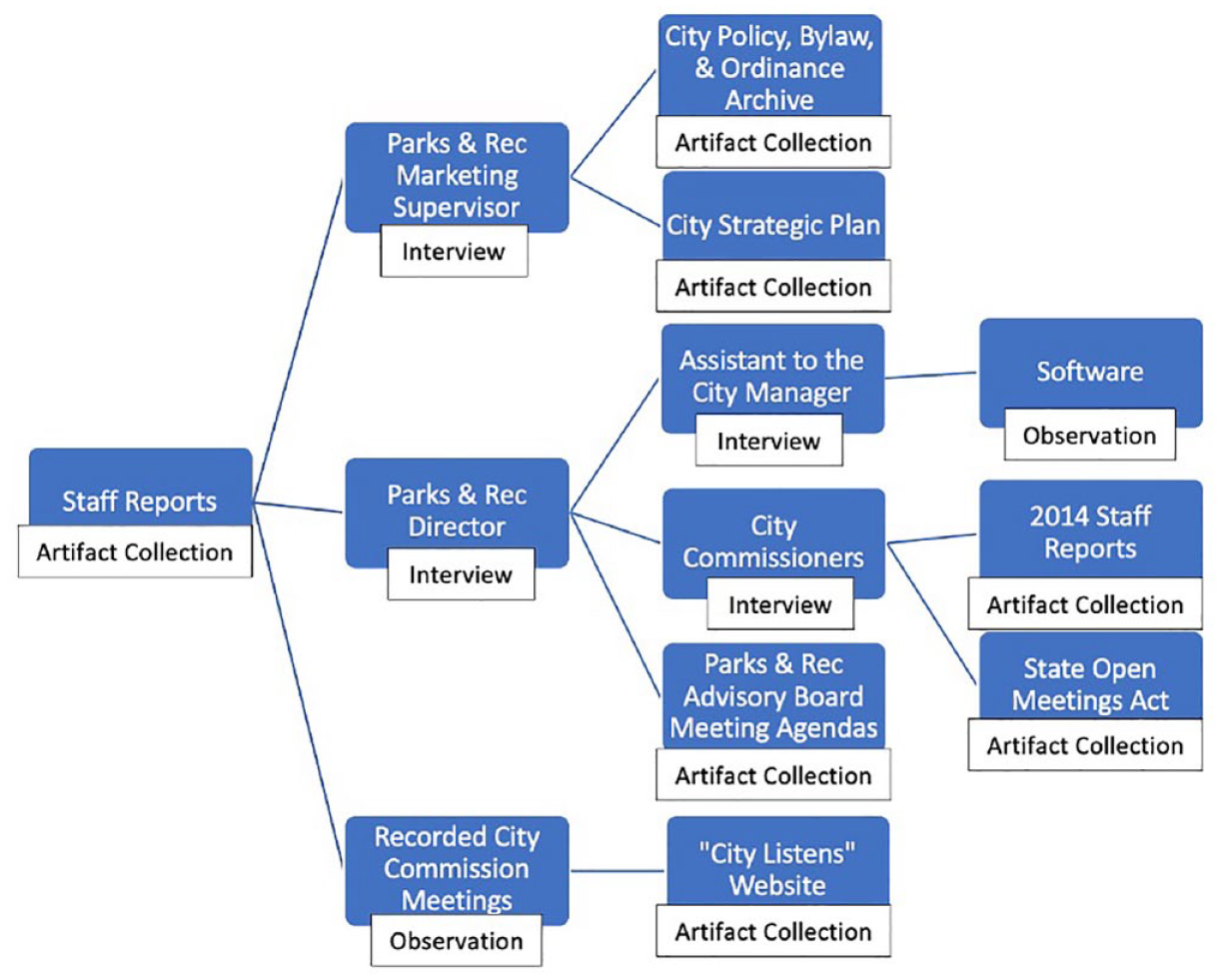
Data sources and collection techniques for Staff Reports.
Observations
Most of my in-person observations occurred in the “City” administrative building. These observations gave me a sense of how genres were composed and read as people went about their work. These in-person observations, totaling 15 hours and 53 minutes, were kept in an electronic double-entry notebook. I also back-observed and spot-transcribed 5 hours and 10 minutes worth of video-recorded City Commission meetings in which genres selected for this study were read, discussed, and used.
Interviews
I conducted 13 hours and 4 minutes of semistructured interviews, which were audio-recorded and transcribed, with 12 participants. I shaped each interview script to ask about the individual’s engagement with these genres and to follow up on information I had gathered from previous data sources.
Artifact Collection
Since genres occur in sets and systems, I ended up collecting 191 textual documents. Some of these were picked up or taken as photographs (e.g., handwritten notes) during my observations; others were collected through subscription services like the CPRD listserv and social media accounts. About 75% of my textual artifacts, though, were collected electronically from publicly accessible City web pages.
My data analysis combined deductive and inductive approaches, per Bishop’s (1999) suggestion, across all of my data sets. Using NVivo 12 software, I enacted protocol coding, “the collection and, in particular, the coding of qualitative data according to a pre-established, recommended, standardized, or prescribed system” (Saladaña, 2009, p. 130), for the major terms of NGT—gatekeeping, gatekeeper, gated, and gatekeeping mechanisms. However, I additionally enacted descriptive coding, “summariz[ing] in a word or short phrase—most often as a noun—the basic topic of passage of qualitative data” (p. 70), to describe how these gatekeeping factors operate in genre use. After coding, I was able to rebuild narratives of each genre to describe the various factors of genre access.
Results
I begin my results with the story of a particular Staff Report that the CPRD submitted, but all Staff Reports across government departments follow a similar journey. Again, Staff Reports are one-to-two-page documents that individual departments, like the CPRD, write when they need to bring a recommended action before City Commission for voted approval. Figure 2 shows a textual iteration of this short but complex genre, in which the CPRD recommends hiring a contractor to paint their Indoor Aquatic Center; the CPRD cannot move forward with that action until the five City Commissioners read the Staff Report and a majority of commissioners vote in favor of the recommendation at a Tuesday evening City Commission meeting. The story of this Staff Report describes the various dimensions—the textual regularities, the social roles, the composing processes, and the reading practices—of this key genre for local government. Afterward, I apply the NGT framework to recast these dimensions in terms of genre access.
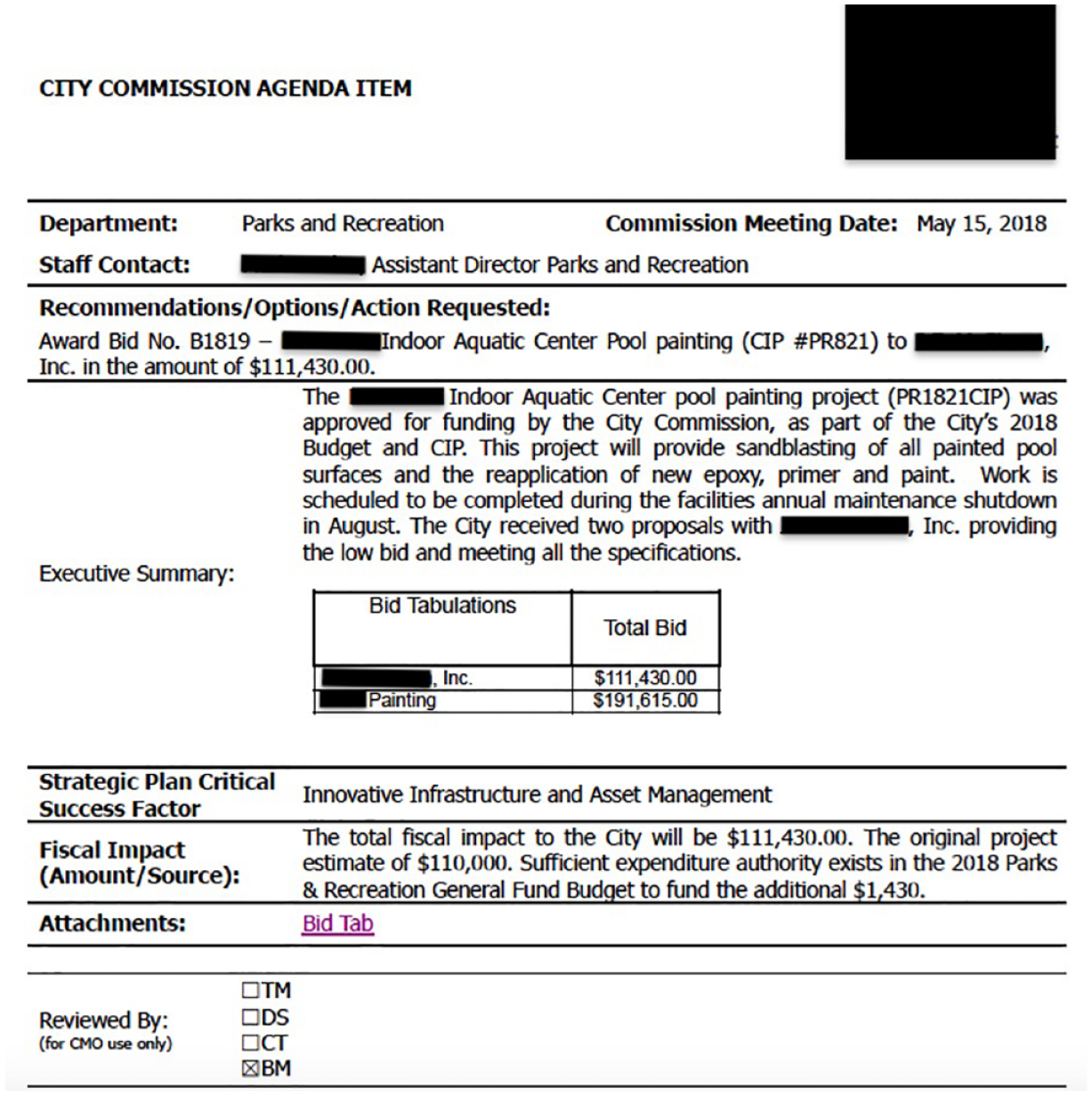
Final draft of a Staff Report based on template and feedback.
The Life of a Staff Report
The life of any one Staff Report usually begins with other genres in the system. In the case of this Staff Report, CPRD Director Robert 7 consulted the City’s Capital Improvement Plan, which prioritized funding to repaint the City’s Indoor Aquatic Center Pool. However, a separate purchasing policy dictated that—since the project would exceed $100,000—Robert must still receive voted approval from City Commission to move forward with his recommendations for this project. The only way to bring a recommendation before the City Commission for a vote is a Staff Report. As a result, to prepare this Staff Report, Robert first widely advertised a call for proposals that listed the specifications for the painting project, and two companies submitted bids for the contract. Once Robert had the bids, he determined the bid that best met the specifications with the best price, and then it was time to bring that recommendation forward to the City Commission.
In order to include this Staff Report on a City Commission meeting agenda, CPRD Director Robert informed the City Manager in their weekly Wednesday meeting that the recommendation was ready to be drafted into a Staff Report that could then be voted on by the City Commissioners. The City Manager consulted the City Commission meeting schedule and, considering the wide range of other Staff Reports from other departments, selected a date: May 15, 2018 (all City Commission meetings happen on Tuesday evenings). The City Manager also decided this Staff Report would go on the Consent Agenda, which is a portion of City Commission meetings in which numerous recommendations are voted on all at once. (In contrast, the Regular Agenda portion discusses and votes on each individual Staff Reportas individual items.)
With the date set, CPRD Director Robert was now working on a deadline: The Staff Report had to be finalized by the meeting’s preceding Thursday, which is when the full agenda would be assembled, disseminated to the City Commissioners, and made available to the public online. But even before that, Staff Report drafts must go through the City Manager’s office for feedback and approval. To get started, Robert opened the template file for Staff Reports that was created by the City Manager in 2016. Robert filled out the required sections, as can be seen in Figure 2: Recommendations/Options/Actions Requested, Executive Summary, Strategic Plan Critical Success Factor, Fiscal Impact (Amount/Source), and Attachments. In the Attachments, Robert included the Bid Tab for the painting project to further support his recommendation. He then ran the Staff Report by his Marketing Supervisor to double-check the style, grammar, and accuracy. With the Marketing Supervisor’s okay, Robert emailed the draft Staff Report to his liaison in the City Manager’s office, City Manager Matthew. Matthew reviewed the document and used Word’s track changes for some minor edits. If he had had more extensive comments or concerns about the recommendation or how it was written up, Matthew would have called Robert on the phone to discuss changes. When Robert submitted a second draft with the track changes accepted, Matthew X-ed his initials at the bottom of the document to confirm that he reviewed it, and he sent the Staff Report to the City Clerk.
The City Clerk, in consultation with the City Manager, organized all of the department Staff Reports and other agenda items using a specialized software, posted the agenda online, and sent it to the City Commissioners (Figure 3). The City Commissioners spent the weekend reading the dozens of Staff Reports for the upcoming meeting. If they had clarifying questions, they emailed or called the City Managers. In a City Management form of government, it is inappropriate for the City Commissioners to speak to the City’s department employees; all communication must happen through the City Manager (Figure 4). Members of the public may also ask questions of the City Managers about the various Staff Report recommendations, or they can reach out to their City Commissioners to encourage them to vote in certain ways.
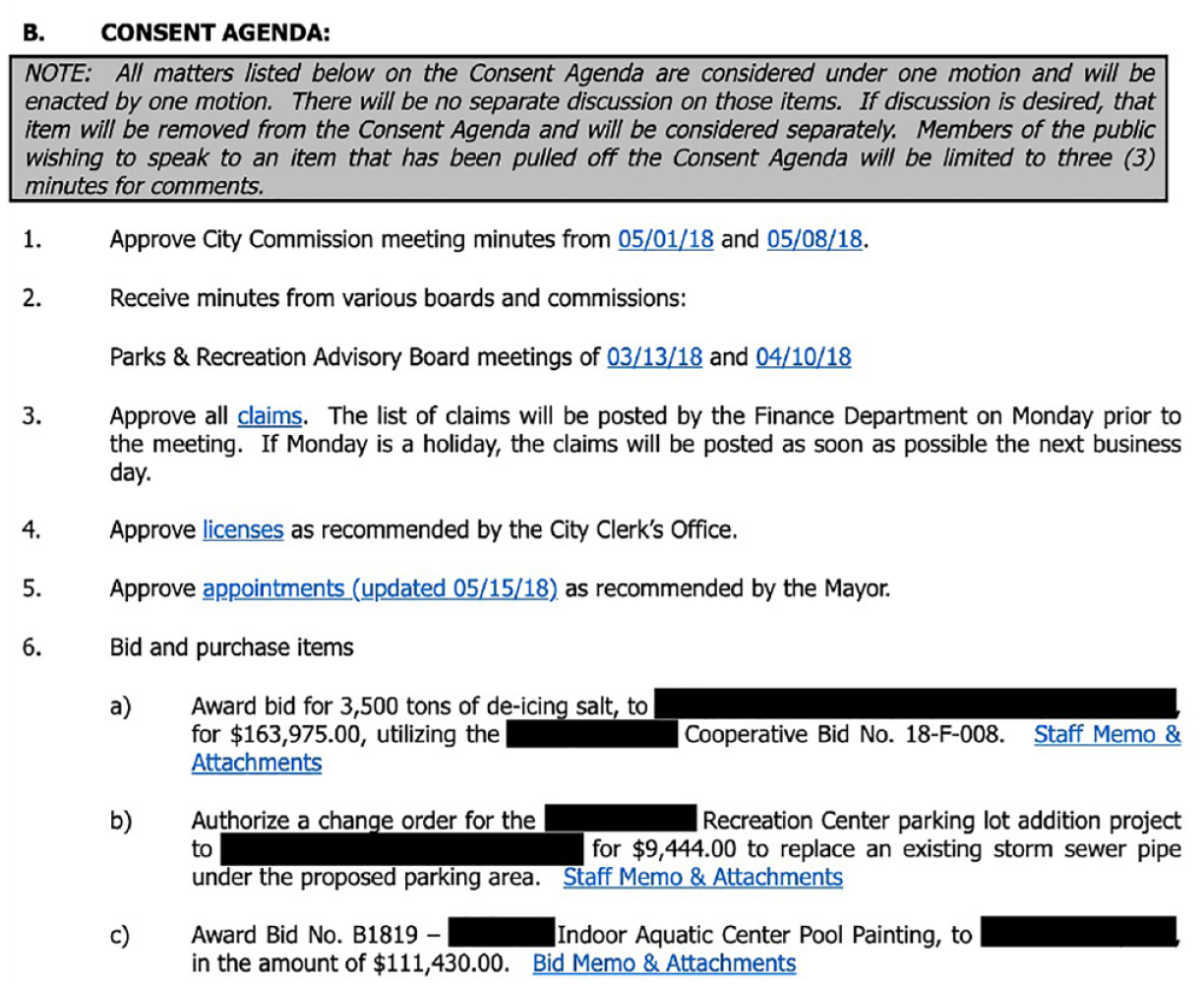
Excerpt of consent agenda for May 15, 2018, city commission meeting. The CPRD Staff Report is item 6C.
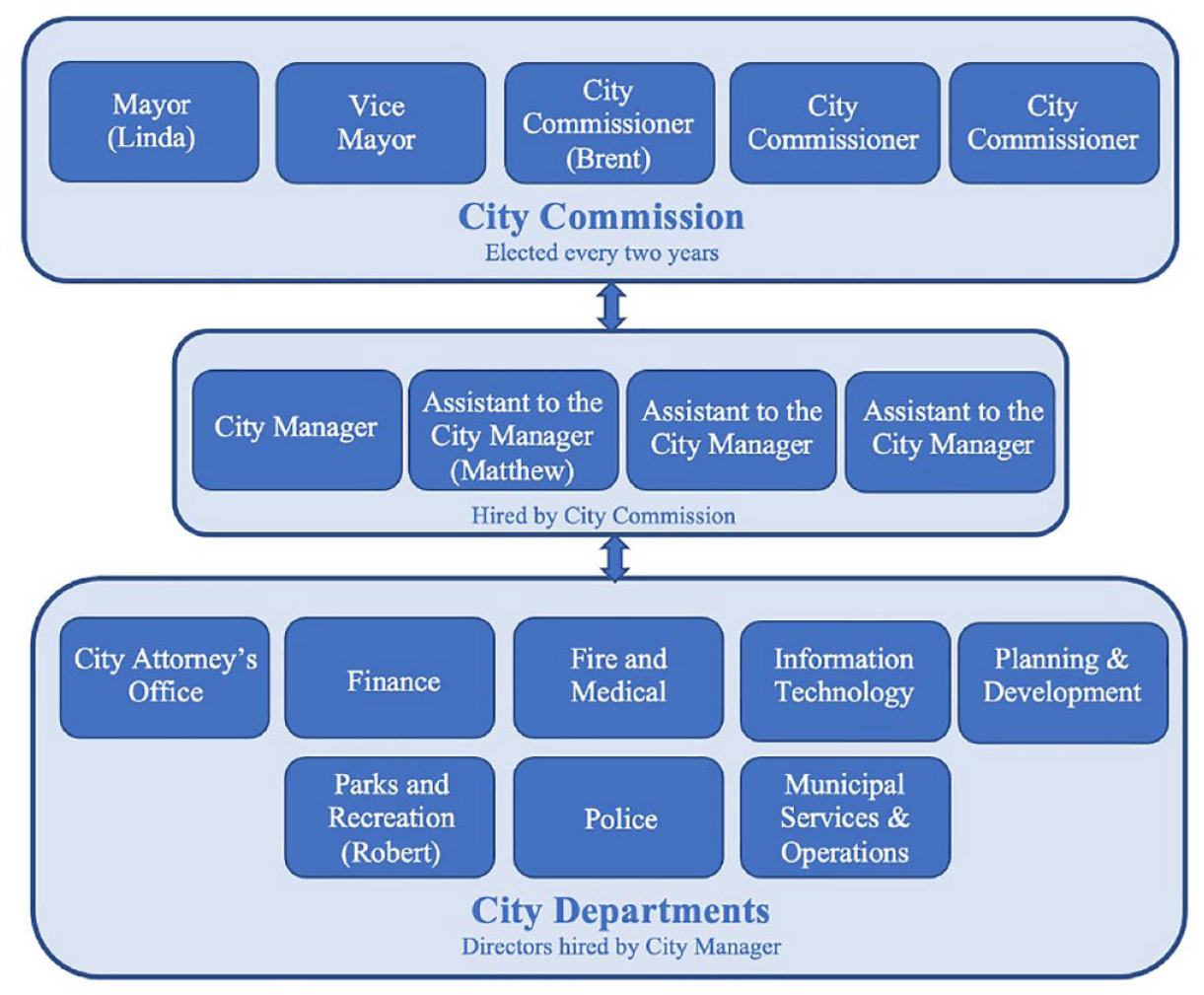
City management form of government as employed in “City.”
Even though this Staff Report was on the Consent Agenda for a Tuesday night meeting, CPRD Director Robert was still required to attend the City Hall chambers where the City Commission meetings took place in case a Commissioner or member of the public “pulled” the Staff Report for discussion. To Robert’s relief, the Staff Report was not pulled, but was instead approved with the overarching Consent Agenda vote. Afterward, the meeting minutes reflected that the recommendation was approved, and the Staff Report continues to stand in the agenda archives on the City’s website. The next morning, CPRD Director Robert could go to work on hiring the contractors for the pool painting project.
Now, I will recast this narrative using terms from NGT to describe genre access. Just as the concept of genre knowledge encompasses the varied factors that contribute to one’s expertise with genres, the concept of genre access encompasses the varied factors that contribute to one’s power, opportunity, permission, and/or right to engage genres. Also like genre knowledge, genre access is never stagnant nor complete; it seems unlikely that someone either fully “has it” or not. Instead, genre access for any individual is always in flux, subject to being enhanced or limited for various parties throughout a genre’s life cycle.
Who: Gatekeepers and Gated
Genre access—the power, opportunity, permission, and/or right to engage genre—is fundamentally shaped by a genre’s inherent and surrounding social roles. In activity systems, social roles are created through ongoing micro-level interactions, and they are largely stabilized through the rules/norms, community, and division of labor that makes it possible for activity systems to work toward shared outcomes. However, any individual is more than their social role within a given activity system: Russell (1997) describes individual identity as “an intersection of a person’s history of involvements among activity systems in combination with idiosyncratic features” (para. 14), and thus motivations can be multiple: “Dissensus, resistance, conflicts, and deep contradictions are constantly produced in activity systems” (para. 16). Turning to NGT explicitly casts these social roles in terms of access: Gatekeepers are those who exert control (gatekeeping processes) over genres and/or people’s engagement with that genre, while the gated are those who are subject to a gatekeeper’s controlling actions.
For Staff Reports, the gatekeeper-gated relations are largely institutionalized by the City Management form of government (Figure 4). The City Manager Matthew, thus, describes the Staff Reports as “the conduit from the professional staff to the policy makers, which is the governing body” (line 23). He further describes why recommendations must come from department staff up to the City Commissioners: The professional staff are the hands-on part of the operation. And we have people who are credentialed and certified and licensed and educated and trained to perform their function, whatever that is. And so the City Manager, us general managers, and then the City Commission depends on the professional staff to provide good recommendations, good actions—to do the analysis on issues and then make a recommendation that’s both professionally sound and of public interest. And so that’s the purpose of those agenda reports—to synthesize all the work that’s gone in to get it to the point where it’s ready for action or decision by the City Commission. (lines 33-35)
The social roles along his vertical division of labor positions different parties as gatekeepers at different times throughout the life cycle of this genre. For example, the City Manager ultimately decides which Staff Reports are allowed to be brought forward at which City Commission meeting as well as which Staff Reports will appear on a Consent Agenda or the Regular Agenda. Some of the decisions about what Staff Reports go forward to City Commission are dictated by ordinances and policy documents, such as the $100,000+ purchasing policy. Other decisions, though, are based on what the City Manager believes the City Commission should be informed about, as well as what the City publics should have an option to comment on for the sake of transparency (Matthew Interview, line 128; Robert Interview, line 218). For example, Robert described one Staff Report that recommended using a particular funding source to update workout equipment in a recreation center: That funding source had already been approved for that purpose in the Capital Improvement Plan, so the Staff Report was not actually required by policy. However, Robert and the City Manager believed they should still bring forward the Staff Report so the City Commissioners and the public would be aware of how the funding was being used. In this manner, the City Manager acts as a gatekeeper to both the CPRD Staff and to the City Commissioners by deciding which Staff Reports may be brought forward and in what manner, even though he is in the “middle” of the vertical division of labor.
Additionally, the City Manager acts as gatekeeper because he dictates when Staff Reports are ready for the City Commission. City Manager Matthew explained that he hopes that each department has an “internal process” to prepare and review their Staff Reports, and he expects the reports to be “agenda-ready” when they come to him: “I don’t wanna work through typos and numbers that don’t add up and those sorts of things. Grammar, punctuation, flow” (Matthew Interview, lines 52-53). As a result, CPRD Director Robert usually checks his Staff Reports with his Marketing Supervisor first. By the time a Staff Report reaches him, Matthew may provide feedback that enhances support for the recommendation, considers the full extent of the policy implications, and anticipates any questions the City Commissioners or even members of the public may have. Matthew provides this feedback for as many drafts as needed, and of course, CPRD Director Robert describes the worst-case scenario: “Or [the City Managers] will mark it up and say, ‘No. Do over’” (line 301).
By providing feedback, Matthew acts as a gatekeeper to CPRD Director Robert: His comments are not usually available for collaborative discussion or questioning. Indeed, Matthew must literally sign-off on a Staff Report before it appears on a City Commission meeting agenda. Thus, Robert’s genre access for Staff Reports is shaped by the City Manager’s interpretation of, interaction with, and ultimate decision about these texts. The preparation of any one Staff Report further demonstrates the distributed, fractured, and collaborative nature of genre knowledge—and why genre access is needed to fully describe how people may engage a genre. For example, CPRD Director Robert is the one with the Parks & Recreation expertise to make sound recommendations; the head City Manager dictates the textual regularities with the Staff Report template; and City Manager Matthew has technical knowledge of the City Commissioners and policy implications to understand how a Staff Report might be received and fit into the overall work of the City. As a consequence, genre knowledge alone does not describe how any one of these parties is able to engage this genre: Instead, one’s engagement occurs through the push and pull of these institutional social roles, divisions of labor, and power dynamics.
The vertical division of labor complicates how the City Manager acts as gatekeeper to the CPRD. While the City Manager is described as a liaison between the CPRD and the City Commission, he is not positioned above those two parties, in the organization. Instead, the City Commission acts as the City Manager’s “boss,” and is in fact the body that hires and fires for the role. So while the City Manager acts as gatekeeper to the CPRD Staff by dictating when, which, and how Staff Reports can come forward, those decisions are heavily influenced by his power relation to the City Commission. CPRD Director Robert perhaps describes this power relation in the following scenario: I’m the City Manager. Let’s say I’m going into a busy commission night—let’s say I’ve got 10-15 [Staff Reports]. Does the City Manager have time to review 10-15 [reports] for 100% accuracy? If he did, that’s all he would do. He has to trust that the departments are giving him accurate information. So for a City Manager, that’s the Superbowl. Every Tuesday night’s the Superbowl. [It’s] very strategic: You have to think about how things will play out, what questions are gonna come up, what’s gonna be the public interaction, what’s the commission gonna ask about. . . . Let’s say he has three [Staff Reports] in a night that aren’t 100%. The Public Works got their [report] a little off, so they’re losing some credibility there on some road repairs. And you can tell this was off; Parks and Rec was off; Planning had a bad night on their [report]. Each of those departments loses a little bit of credibility with that City Manager. Each one of those that’s wrong eats at his credibility [with City Commission]. And it’s only—he’s like all of us. He’s got a score sheet, and he needs to keep that credibility high, especially with that commission. (lines 153-158)
Ultimately, then, the City Manager’s gatekeeping processes are a result of his own position as gated by the City Commission. When the Staff Reports are “off,” there are consequences for the City Manager, the most severe of which would be losing his job. The City Manager’s engagement with Staff Reports affect his standing and perceived competency by his gatekeeper, City the Commission. Genre access for Staff Reports, then, is shaped by each layer of these cascading power relations—solidified by institutional social roles and influenced by quality of work—down the vertical division of labor.
As another thread in this web of gatekeepers and gated, City publics are a gatekeeper of the City Commission because they vote for Commission seats every two years; however, but this power is largely diluted in the week-to-week engagement with Staff Reports. Of course, City publics can comment on Staff Reports, either before meetings or during meetings. The City Commissioners almost always note these public comments and thank the commenter. They can also quote from members of the public if doing so supports their position. These interactions show that City publics’ genre access for Staff Reports is uneven: They must work within the systems set up by the City Manager to engage the genre, and their comments may or may not be meaningfully taken up by City Commissioners. However, they can exercise their vote every two years to ensure their gatekeepers are the City Commissioners who will engage with Staff Reports in ways that align with their own values. This variability in the City publics’ gatekeeper or gated status emphasizes that gatekeeper-gated relations are emergent—only existing as individuals enact them—and can shift.
Why: Symbolic Capital
Tracing gatekeepers and gated reveal that genre access—one’s power, opportunity, permission, and/or right to engage genre—is not a mysterious process, but directly rooted in the actions and interactions of individuals. In this section, I look more closely at why people—whether as gatekeepers or gated—are able to shape genre access, for others and for themselves. Not all gatekeepers and/or gated have equal genre access: Some are able to exert more influence than others based on their capital. Bourdieu (1991) speaks of capital as a persistent force, one that can take a while to accumulate but is rather lasting once it does. He names three forms of capital, which have evolved in their theoretical application:
Economic—originally described as money and property rights; currently understood as any material wealth
Cultural—originally described as educational qualifications; currently understood as any range of knowledge or skills
Social—originally described as social obligations (or “connections”) and nobility; currently understood as accumulated prestige or honor
For example, the previous section mostly describes how gatekeepers’ and gateds’ institutional positions act as social or cultural capital that shape their genre access. However, the forms of capital that contribute to genre access for the Staff Report go beyond institutional roles.
For the Staff Report, one form of cultural capital that shapes genre access is people’s knowledge of relevant genre sets and systems (see Bazerman, 1995; Devitt, 1993). As I explored previously, genre knowledge does not automatically equate to genre access; however, genre knowledge can be leveraged into cultural capital that enhances an individual’s genre access, whether in the role of gatekeeper or gated. For the Staff Report, it takes knowledge of relevant genre sets and systems to know whether Staff Reports need to be written in the first place. A wide range of city policies, ordinances, statutes, and codes dictate what kind of department actions need approval from City Commission (Matthew Interview, lines 42-44). When I asked CPRD Director Robert where all these policies, ordinances, statutes, and codes live, he replied: They are on the web. Good luck trying to find them. I would talk to [my Marketing Supervisor. He] and I have been discussing. . . . The city is trying to do a better job of getting the most current policies (a) up-to-date. So we go back to ’81. I was looking at that the other day. And (2) to get them where the public can find them—if it’s an administrative policy procedure that the public needs to be concerned with. There’s administrative policies and procedures that the public really doesn’t need to see. Because if they do, you’re just going to get them confused, and they’re going to go around in a circle and go “Oh yeah, I get it.” (lines 32-35)
Knowledge of these sprawling genre systems, then, acts as cultural capital: CPRD Director Robert relies heavily on his marketing supervisor to know whether and how to draft Staff Reports because of his accumulated knowledge over 16 years in the position. So while the marketing supervisor does not have any institutional claim to engage Staff Reports, his knowledge of relevant genre sets and systems makes him a key player. We also see that CPRD Director Robert is perhaps torn over whether City publics should have this cultural capital since they may use this knowledge toward their own causes, some of which may be decontextualized from the full working of the department and City.
Additionally, knowledge of relevant genre sets and systems acts as cultural capital in drafting successful Staff Reports since these other genres are part of the Staff Report’s textual regularities as the attachments portion. There are no guidelines about how many or what kinds of attachments are deemed necessary for a successful Staff Report. Mayor Linda posits that more information is better than less information: “If those attachments don’t answer all the questions I have, then I ask for more information" (line 20). Thus, CPRD Director Robert usually tries to reference as many relevant texts as possible to support his case. For example, when the CPRD submitted a Staff Report to raise pool fees, Robert explains, “So basically to get something passed through a City Commission, I need to prove the case that we did a market analysis of all the swimming pools around here: This is what they’re charging. This is how much tax dollars require to support our aquatics program” (line 172). But for another Staff Report that proposed restoring a historical cemetery vault, Robert “took the data clear back to 1865 when the cemetery was built” (line 255). Because these various genre sets and systems are part of the Staff Report’s textual regularities, those who are well versed in these genres can leverage that knowledge into cultural capital to improve their genre access.
The reason I say genre knowledge must be leveraged into cultural capital to improve genre access is because gatekeepers get to decide what genre knowledge acts as cultural capital. Genre knowledge, on its own, is not enough to describe how this genre actually works: We need genre access to describe how gatekeepers acknowledge or value genre knowledge. For example, CPRD Director Robert must recognize and invite the marketing supervisor into his drafting process, while the City Commissioners must validate CPRD Director Robert’s choice of attachments with their vote. Capital, then, is not absolute in the why of genre access; it is usually another facet of the relationship between gatekeepers and gated. Yet, some forms of capital are so strong and widely accepted that they loom over gatekeepers and gated alike. As the City Communications Director explains, “You know, actually the person who has the most say over [the Staff Reports] is the City Attorney. Because we do have real legal requirements that we do for City Commission meetings” (line 206). To this point, CPRD Director Robert describes the nerve-wracking push of “trying to get legal to review” the city laws in time for a Staff Report recommending a vehicle charging station at one of the community buildings (line 285). The City’s legal team, then, has the cultural capital (intimate knowledge of City laws) to shape their and others’ engagement with the Staff Report—and usually in a way that overrides trumps others’ capital because of the immutability of the law.
The City publics may be largely gated for Staff Reports, but that does not mean they cannot leverage their resources, knowledge, and standing into capital that affects how their gatekeepers— the City Commissioners—might vote on recommendations. City Manager Matthew describes “sources of power” in the community as certain businesses, neighborhood associations, and advocacy groups that hold significant sway over certain the City Commissioners (line 128). He explains that the City Commissioners often voice questions about Staff Reports before or during meetings, but he wonders, “Who’s asking the question? It’s coming from the commissioner, but who asked them the question?” (line 131). Members of the public can further comment on any Staff Report during designated segments (with time limits) of the City Commission meetings, and those who speak as representatives of organizations usually have more capital than those representing themselves as a single taxpayer. In these cases, the City publics are using their economic, social, and cultural capital to shape their genre access for Staff Reports, even if the final decision is still determined by their gatekeepers. Moreover, the publics’ engagement with this genre is restricted to the reading practices/uptake dimension of genre, as opposed to the textual regularities. The gated, then, are not passive or powerless for genre access; it’s just that their power, opportunity, permission, and/or right to engage a genre is dictated or directly influenced by the gatekeeper’s processes.
How: Gatekeeping Mechanisms
So far, I have shown how genre access for the Staff Reports can be described in reciprocal layers of gatekeepers and gated, both of which leverage their capital to shape their own and others’ power, opportunity, permission, and/or right to engage the genre. While these descriptions get at the who and why of genre access, there is still the how: the tools, technologies, or methodologies that gatekeepers use to carry out their gatekeeping processes, which Barzilai-Nahon (2008) calls gatekeeping mechanisms. Gatekeeping mechanisms can range across material and nonmaterial structures, all of which factor into genre access. In Activity Systems terms, these gatekeeping mechanisms usually operate as seemingly neutral norms and regulations “that constrain actions and interactions with the activity system” (Engeström, 1987, p. 78).
For example, I draw out some of the gatekeeping mechanisms that have been described in my narrative of the Staff Report:
The gatekeeping mechanism that dictates how the City Commission meeting agendas are assembled is a combination of an
The City publics are able to comment on Staff Reports after they are posted online through designated channels: (1) phone calls, (2) emails, and/or (3) speaking at the podium during the public comment section of the City Commission meetings. These
Various policies and ordinances dictate whether a Staff Report should be written, but the
The City Managers must sign off on Staff Reports before they can be presented to the City Commissioners: The
Another gatekeeping mechanism is
Each of these examples describes the tools, technologies, or methodologies that gatekeepers use to carry out their gatekeeping processes and shape genre access.
One of the major gatekeeping mechanisms for the Staff Report that I would like to explore further in this section is a

Cover memo composed in 2014, before the implementation of a template.
Since its introduction in 2016, this template-as-gatekeeping-mechanism has been overwhelming positively received by its gated parties. City Commissioner Brent calls it “a major improvement” (line 80), especially since there’s “a lot to review, and it’s very useful to have that succinct analysis or summary of it and then where to go to get more information” (line 17). Even though the previous cover memos included more text, they could still leave out key information, like the budget sources, and thus the cover memo template has cut down on the number of clarifying questions City Commissioners ask. City Commissioner Brent and Mayor Linda both mentioned how helpful it is to have “a good idea of where the funding is . . . that’s right on the front” (line 254). Likewise, department staff have also responded enthusiastically to this template. CPRD Director Robert explained that drafting a Staff Report can be “painful” and “scary” (line 176; line 368), but he expressed his excitement over the cover memo template when it was first introduced: “I’m like, ‘Yes!’ This is going to standardize our process, and we’re going to be able to hopefully have more effective, accurate, and efficient memos” (line 339). Based on these comments, it seems the template has improved genre access for both City Commissioners as readers and department staff as writers.
However, I also discovered implicit expectations for Staff Reports that are not part of the template. For example, the template is meant to make the proposed recommendation very concise, but the City Commissioners and the City Manager still expect the cover memo and attachments to give a sense of history to the recommendation; as the City Manager Matthew explains, “We’ve been around for 150 years, and we’ll be around for another 150, so where are we at in point of time that prompts this action by the commission?” (line 74). Another implicit expectation for Staff Reports is grammar and style: “It’s gonna drive [Brent] crazy—and other commissioners, as well, as it very well should—if the writing doesn’t come at a certain caliber” (line 78). He names Strunk and White’s The Elements of Style as the kind of “professional presentation” that Staff Reports should reflect so it isn’t “discredited” by “grammatical or punctuation issues” (lines 62-67). But these textual regularities are not standardized by the template, and thus department staff may struggle with them if they believe the template removes any implicit expectations. In this way, the template-as-gatekeeping-mechanism simultaneously enhances and limits genre access. This is true of most gatekeeping mechanisms: They can simultaneously enhance and limit genre access, or they can enhance genre access for some parties and limit it for others.
Discussion and Conclusion
Through this illustrative example, I have attempted to develop and demonstrate what might be gained by explicitly naming the phenomenon of genre access. Language from NGT allows us to parse the various factors of genre access at a micro level of analysis: Casting actors as gatekeepers (those who make controlling decisions over genres) and gated (those who are subject to a gatekeeper’s controlling decisions over genre) allows us to realize who shapes genre access. To what extent people have the power, opportunity, permission, and/or right to engage with a genre is shaped by the reciprocal, dynamic relationship between those who make decisions over a genre and those who are subject to those decisions. These gatekeeper-gated relations are emergent—only existing as individuals enact them—meaning these roles can shift and flip as people go about their work. Genre access is always shaped by individuals navigating these power relations, and forms of capital (economic, cultural, and/or social) are often the greatest leverage to gain influence in this navigation. For both gatekeepers and gated, genre knowledge can be significantly leveraged into cultural capital to shape genre access. However, both gatekeepers and gated must also contend with gatekeeping mechanisms, which are the tools, technologies, or methodologies that gatekeepers use to carry out their gatekeeping processes. These can range from the material to the nonmaterial, and they can both enhance and/or limit genre access for different gated groups.
I want to acknowledge that the term “gatekeeper” can evoke rather negative associations, such as power-hungry, controlling, or even malicious overlords. In contrast, gatekeepers are usually managing complex processes and a range of expectations for the best of all involved. People will always make decisions about genres that affect how others engage them; thus, there will always be gatekeepers and gated. These relations are as normative as genres themselves. Improving genre access is not a matter, then, of eliminating gatekeepers, but of gatekeepers acting responsibly and ethically toward those they gate. It would be easy to assume that any form of gatekeeping must automatically worsen genre access, but many gatekeeping processes improve genre access, if unevenly across different gated groups. Gatekeepers are also usually not a single individual: Most gatekeepers are part of a group, gated to other layers of gatekeepers above them, and/or only gatekeeper for a few decisions among a wide range. Even if one acts as gatekeeper, those controlling decisions are often directly or indirectly influenced by the gated, emphasizing that the gated are hardly ever passive or powerless. In fact, the gated often leverage whatever capital they have to influence their gatekeepers. Thus, gatekeepers and the gated exist in a give-and-take relationship, constantly (re-)produced by their social roles, power dynamics, and divisions of labor. In the end, this characterization of genre access is meant to illuminate—as opposed to flatten—the complexities of genre access while still providing a language to break the various factors down at a micro-level analysis.
One exciting implication of this micro-level analytical approach is that researcher-activists might collaborate with genre users to improve their genre access. As both a genre scholar and a researcher-activist, I have often felt overwhelmed when faced with how I might collaborate with genre users to increase their access with and through writing. Genre scholars have long recognized that genres reflect and inscribe identities, ideologies, and cultures—as such, they reproduce larger systemic biases. How can I collaborate to improve access if a fundamental quality of genre—indeed what makes it work as a social construct—is also what implicates it in excluding marginalized groups? With the formulation of genre access articulated in this article, researchers are brought to a micro level of analysis: We are pinpointing specific controlling actions (gatekeeping processes) that those in power (gatekeepers) enact over others (gated) with particular tools, technologies, or methodologies (gatekeeping mechanisms). To that end, I created a recommendation report with curated resources for the CPRD at this study’s end that may enhance genre access for those involved.
In one of my recommendations for the Staff Report, I described how the gatekeeping mechanism of the template can both clarify and occlude the expectations gatekeepers might have for individual departments drafting these texts. Based on my interviews, I created a list of implicit expectations that the City Managers and the City Commissioners still have for Staff Reports that are not communicated by the template, such as “If this recommendation or a similar recommendation has come before City Commission in the past, briefly sketch this history in the Executive Summary and attach the past Staff Report(s) or a more robust history.” I also recommended that the City Manager discuss any template explicitly with the department directors, perhaps in their Wednesday morning meeting, that explains what each section is meant to do and highlights what might not be communicated by the template (instead of merely emailing out the template without explanation or discussion). This intervention of making all textual expectations explicit hopefully improves genre access for the CPRD staff because they will be able to get their Staff Reports through a vote without as many questions or confusion; based on my interviews, I believe this intervention might also improve genre access for the City Commissioners and City publics because they will have fewer questions or less confusion in reading, commenting, and voting.
However, I’m not sure any engagement with genre can enhance genre access for all parties. For example, some City Commissioners or members of the City publics may be overwhelmed by more attachments, and they may not have the time to read the full history, and thus their genre access may be limited. Similarly, perhaps the CPRD has a recommendation that they do not want associated with a past vote that did not go their way, so this textual regularity would limit their genre access in that case. As another example of how genre access is often in flux between parties, one recommendation I would make for the City publics to increase their genre access would be for individual members who want to engage with Staff Reports to align themselves with their neighborhood associations. These neighborhood associations hold enormous social capital with both the City Managers and City Commissioners, and one would have more power to shape how Staff Reports are engaged if speaking from one of those neighborhood associations instead of as a single taxpayer. If I were to make this recommendation to City publics, though, I may be limiting the CPRD’s genre access since they often find it frustrating that neighborhood associations advocate only for their own agendas without the full understanding of the department and its limited resources. And reflecting as a researcher, does encouraging people to align themselves with those in power reify power dynamics that need to be challenged? And what about those who are unable to connect with the more powerful neighborhood associations, either because of their geographic location, their time constraints, their social standing, etc.? Should I instead be alerting the City Manager and City Commissioners to the finding that these neighborhood associations are given considerations that are not given to other individuals and groups?
I note these complications to once again underscore how complex genre access is, as well as how necessary it is to understand how people may (or may not) engage genres. I also note these complications to show that there are limits to what a researcher can do—there’s no such thing as “fixing” genre access. Genre access is a description of an emergent and enduring phenomenon of the who, why, and how of whether people have the power, opportunity, permission, and/or right to engage genre; it can only be enhanced or limited, often simultaneously for different stakeholders. But what a researcher can do is make explicit the various factors of genre access so individuals can make more purposeful choices. An awareness of how all these moving pieces shape one’s engagement with genre—and thus how they know and act in their worlds—can at least open the door for individuals to understand what choices are before them and why.
Future research should continue to develop and refine genre access as a concept and analytical approach by investigating how it works with different genres stes and systems in a variety of settings. I, thus, encourage researchers to collectively engage in what Smart (2003) describes as the “theory-data-theory cycle” (p. 18): Each study that explores genre access in all its contextually dependent richness will further clarify and complicate this fundamental facet of how genres work in our worlds, and I encourage future researchers to use this micro-level analytical approach in concert with macro-level analytical approaches that theorize culture, identity, and power. I further encourage genre scholars to continue exploring the relationship between genre knowledge and genre access: In what ways does genre knowledge factor into genre access, and how might genre access shape how we conceive of genre knowledge? If genre knowledge is not the whole story of how people may engage genres, how might we account for factors of genre access in how we integrate and teach genres in our classrooms? I especially encourage researcher-activists to use the explicit name and language of genre access to collaborate toward finding and improving the gaps, shortcomings, or injustices in genre engagement across contexts.
Footnotes
Acknowledgements
I am endlessly grateful to Amy Devitt, Mary Jo Reiff, Peter Grund, and Dana Comi for helping me develop early drafts of this piece. A heartfelt thank-you to the two anonymous reviewers for their careful engagement and generative feedback, and thanks especially to coeditor Dylan Dryer for going above and beyond with additional feedback and direction.
Declaration of Conflicting Interests
The author declared no potential conflicts of interest with respect to the research, authorship, and/or publication of this article.
Funding
The author received no financial support for the research, authorship, and/or publication of this article.
