



Abstract
This article explores genres as recurrent acts of positioning that contribute to associating particular positions with the genre users as social actors. As an illustration, the study investigates the positioning of Chinese university presidents in their published opening convocation speeches. By combining rhetorical move analysis with the positioning triangle framework, this study demystifies three positions conventionally used by university presidents in the genre: guiding educator, morale builder, and university representative. These positions, legitimized by the role of the university president, establish specific types of social relations between the president and the students, which function as channels for the transmission of values, particularly collective values, to address relevant social expectations in Chinese society. This study suggests that the genre-based positioning analysis can offer valuable genre knowledge to novice practitioners, enabling them to familiarize themselves with adequate positionings that adhere to the code of conduct within a discourse community, thereby facilitating effective genre realization.
Keywords
This study attempts to introduce an approach that interprets genres as acts of positioning, that is, the “discursive production of oneself” (Davies & Harré, 1990, p. 61). These acts, which tend to be recurrently used, contribute to associating particular positions to genre users and to constructing specific social relations within a given discourse community. These users are understood as social actors who perform their roles in the community through genre, which is understood as social action motivated by conventionalized social need or social “exigence” (Miller, 1984). As a “conventional category of discourse based in large-scale typification of rhetorical action” (Miller, 1984, p. 163), a genre is often characterized by conventional and predictable structures realized by a set of rhetorical moves. These moves, defined as “discoursal or rhetorical units performing coherent communicative functions in texts” (Swales, 2004, pp. 228–229), fulfill specific communitive purposes recognized by the members of a discourse community (Swales, 1990). As they tend to be regularly used, these moves contribute to establishing recurrent storylines, “strips of life unfold according to narrative conventions” (Harré & Dedaic, 2012, p. 46), and to typifying positions associated with the genre user and the receiver (Davies & Harré, 1990). In this way, a genre shapes and reshapes specific patterns of social relations in the given discourse community, since positions are by nature relational, “in that for one to be positioned as powerful others must be positioned as powerless” (Harré & Van Langenhove, 1999a, pp. 2–3). As an illustration, scholars may use the lecture, a primarily instructional genre (Deroey & Taverniers, 2011), to regularly perform the act of instruction to maintain and strengthen their positions as instructors and the listeners’ positions as learners, thus contributing to the establishment of the general teacher-student relation within the higher education discourse community. Consider, for example, what would happen to the traditional higher education system if its central instructional genre of lectures were abolished. In this perspective, genre can be understood as a tool used by humans to construct and sustain conventional types of relations between individuals or social groups, which contribute to establishing a relatively stable social structure.
To elucidate the patterns of social relations within the discourse community that routinely practices a genre, this study introduces a framework for genre-based positioning analysis, offering it as a means to unveil the positions established within the given genre. The framework draws from positioning theory (Davies & Harré, 1990; Harré & Van Langenhove, 1999a; Van Langenhove & Harré, 1999) and two main strands of genre theories: the analytical approach of rhetorical move analysis developed within the English for Specific Purposes (ESP) tradition of genre analysis (Bhatia, 1993; Swales, 1981, 1990) and the conceptualization of genre as social action rooted in the tradition of Rhetorical Genre Studies (RGS) (Miller, 1984). Using corpus tools to unveil regular language patterns, this approach aims to uncover what positions are conventionally used by the writers or speakers to address the social exigence that motivates the genre. From a pedagogical perspective, as “genres serve as keys to understanding how to participate in the actions of a community” (Miller, 1984, p. 165), understanding the conventional positions associated with a genre can assist novices in familiarizing themselves with the established code of conduct within the discourse community.
To illustrate the approach, this study investigates the genre of university president opening convocation speeches (henceforth, UPOCS), a typical “written speech genre” that is often well scripted before being delivered orally and then published in written form after the oral presentation. UPOCS is a key communicative event where Chinese university presidents engage directly with students and indirectly with the broader public. In general, the role of university presidents is associated with multiple positions, ranging from leader, educator, mediator (Kerr, 1963) to representative, morale-builder, and mentor (Mao & Xing, 2018). Then, how do Chinese university presidents position themselves in relation to students, in the context of public speeches? This study uses a corpus-assisted analysis to delve into the conventional positions that university presidents typically establish in the UPOCS genre, taking into consideration the social expectations placed on the president’s role and the genre.
Integrating Genre Analysis With Positioning Theory
In the 1990s, Harré and his colleagues developed positioning theory to study the relationship between discourse and social phenomena (Davies & Harré, 1990; Harré & Van Langenhove, 1999a). Positioning theory is rooted in the perspective of social constructionism (Berger & Luckmann, 1966) and considers social phenomena to be generated in and through discursive activities (Harré & Van Langenhove, 1999a). It allows us to capture the ways speakers and hearers are constituted in discursive practices (Harré & Van Langenhove, 1999a). According to this theory, discursive acts contribute to positionings for “the assignment of fluid ‘parts’ or ‘roles’ to speakers in the discursive construction of personal stories” (Van Langenhove & Harré, 1999, p. 14). Accordingly, a primary task of positioning analysis is to explore how the fluid parts, or positions, of the participants are constituted and negotiated through discursive practices (Davies & Harré, 1990).
Positioning studies have traditionally focused on conversations, a form of social interaction that unfolds the fluid positioning of the interlocutors. Daily conversation, characterized by a casual and informal register, tends to be loosely structured. It is viewed by genre analysts as a pre-generic “form of life” (Swales, 1990, p. 59). Genres, on the other hand, often exhibit “conventionalized and standardized organization” (Bhatia, 1993, p. 32), where a set of rhetorical moves, or discursive acts, recur and shape particular positionings. The regular use of a genre implies that it could be a discourse medium wherein specific positioning acts are recurrently used to shape patterns of social relations. Hence, this study suggests that integrating a genre-based perspective into positioning analysis can provide valuable insights into the social relations that typically characterize the discourse community using the genre.
Indeed, genre is not simply a formal entity. It is viewed by RGS scholars as a form of social action (Miller, 1984) and a cultural category that helps to constitute society (Miller, 2015, p. 57). To understand genre as social action is not just seeing genre as “a method of achieving our own ends,” but also implies learning “what ends we may have” (Miller, 1984, p. 165). When we learn that we can eulogize, apologize, or instruct with a genre, we also learn that we can position ourselves, in relation to others, as eulogizers, apologizers, or instructors.
The RGS view of genre as social practice finds resonance in ESP genre theory, a shared ground that has prompted scholars to unify the two approaches in recent genre research and pedagogy (cf. Artemeva & Myles, 2015; Tardy, 2012; see Artemeva & Freedman, 2015, for more details). ESP conceives of genres as “communicative vehicles for the achievement of goals” and places “the primary determinant of genre-membership on shared purpose rather than on similarities of form” (Swales, 1990, p. 46). Genres, as intersubjective social constructs, are supposed to embody communicative purposes that are shared, recognized, and mutually understood by members of the given discourse community (Swales, 1990, p. 58).
For a genre widely used within a discourse community, what is shared and recognized by its members involves not only its purposes but also the positions associated with the role of the genre users. Taking the example of the instructional genre of lectures again, when students as members of the higher education community recognize that lectures are “means of transmitting knowledge” (Deroey & Taverniers, 2011, p. 5), they consciously or subconsciously recognize their position as novice and the lecturer’s position as expert. The recognized purposes of lectures and their underlying positionings form a mutual construal of interests among members and maintain the teacher-student relation in the community. In addition, receivers’ recognition and acceptance of specific purposes and positionings associated with a genre constitute the premises for a legitimate use of the genre. For example, one may refuse to receive business promotional letters if one does not accept to be positioned as a potential buyer. Drawing on the notion of positioning (Davies & Harré, 1990) as a point of convergence for ESP and RGS genre theories, this study conceives of genres as recurrent social actions motivated by social needs with the goal of achieving a set of communicative purposes that shape, reproduce, and strengthen specific positions and social relations that are intersubjectively recognized in a given society.
It should be noted, however, that not all genres are suitable for positioning analysis. Positioning, as the discursive production of selves (Davies & Harré, 1990), is an act made by persons or personlike entities (such as corporations). It might not be used in genres representing nonhuman entities. The genre of constitutional law, for example, is not typically used for positioning, as it does not address social relations between persons but is used to “reinforce communication between nations and peoples” (Berūkštienė, 2016, p. 91). However, analysts may also metaphorically consider the nation as a personlike entity to analyze how the genre of law positions the nation and its people as ruler-follower or protector-protégé.
Genres that are typically represented by persons or personlike entities, on the other hand, are often encoded with positioning acts. Genres such as political speeches delivered by politicians, letters issued by CEOs, or corporate profiles representing companies serve as tools to negotiate social relations through the positioning of selves and others. When examined with a critical perspective, certain genres might be revealed to be recurring mediums where “social-power abuse and inequality are enacted, reproduced, legitimated and resisted” (Van Dijk, 2015, p. 466). One example is the genre of 休书 xiushu, or divorce letters, which was used in ancient China by husbands to divorce their wives. From the Zhou Dynasty (1046 BC–256 BC) to the Qing Dynasty (AD 1636–AD 1912), one of the most common forms of marriage dissolution was divorce based on 七出 qichu, which refers to seven reasons for divorcing a wife: disobedience to parents-in-law, infertility, adultery, jealousy, serious illness, excessive talking, and theft (Fan, 2011). If a wife committed any of these offenses, the husband had the right to divorce her by writing a xiushu without requiring official examination or approval. However, in general, wives were not authorized by laws to initiate a divorce, regardless of the severity of the husband’s misconduct. According to the ancient text of Baihutongyi, 1 the wife was likened to the earth, while the husband was likened to the sky: the earth cannot escape beyond the sky (see Fan, 2011, for more details). By positioning the husband as the owner and the wife as a passive possession, the genre of xiushu constructed and reinforced the inequal relation between men and women in that male-dominated society.
When investigating social relations through the genre-based positioning analysis, questions to be asked may include the following: What are the major genres that constitute a given discourse community? What discursive acts are recurrently used in these genres? What positions are invoked by these discursive acts? How do these positions conform to the social exigence that motivates the genre? Are these positions the only choices for the genre? Do the positioning acts contribute to specific patterning of social relations? Do the patterns of social relations indicate relations of power, dominance, or inequality? Is it possible to undertake new positions if inequal social relations exist, such as in the genre of xiushu? The next section will introduce a method that can hopefully be used to address some of these questions.
Toward a Framework for Genre-Based Positioning Analysis
This study attempts to develop a framework for genre-based positioning analysis by combining rhetorical move analysis (Bhatia, 1993; Swales, 1981, 1990) with positioning triangle analysis, which focuses on analyzing the social force of discursive acts, position, and storyline (Van Langenhove & Harré, 1999). It proposes an analytical procedure involving a preparatory stage of situating the genre, two core stages focusing on the identification of moves and analysis of moves as positioning acts, and a complementary corpus-assisted stage of move annotation. Details are provided as follows.
Situating the Genre
Genre “acquires meaning from situation and from the social context in which that situation arose” (Miller, 1984, p. 163). Therefore, the understanding of a genre “entails understanding a rhetorical situation and its social context” (Devitt, 2004, p. 13). Contextual factors that help understand a genre include at least the immediate context (e.g., situation-type, participants, medium, mode), the discursive context (e.g., contributory genres, system of genres, generic norms), and the disciplinary context (e.g., origins and development of the genre, institutional constraints) (D. Yu, 2022, pp. 34–36). However, it is not feasible to consider in a single study all the contextual factors constraining a genre. In this research, particular emphasis is placed on “exigence,” a key notion in Miller’s (1984) conceptualization of genre as social action.
Exigence is viewed as an “objectified social need,” that is, “a mutual construing of objects, events, interests, and purposes that not only links them but also makes them what they are” (Miller, 1984, p. 157). It is the driving force behind the genre and at the same time a determining factor for the rhetor’s positionings in the genre. Positioning theory suggests that “the quality of the persona and the cluster of behaviour is different, given the different exigencies of the social situation” (Harré & Van Langenhove, 1999a, p. 9). The positioning act, heavily dependent on one’s “knowledge of social structures,” is influenced by external expectations and institutional conventions (Davies & Harré, 1990, p. 52). Therefore, the interpretation of positionings in a genre requires a grasp of social exigence. Exigence, as a form of shared social knowledge (Miller, 1984), can be understood through two levels of social expectations: (a) those associated with the role of the genre user and (b) those placed on the genre itself. Exigence shapes these expectations as an intersubjective recognition and an “objectified” social motive (Miller, 2020, p. 134) that “provides the rhetor with a socially recognizable way to make his or her intentions known” (Miller, 1984, p. 158; emphasis added). To gain insights into the objectified intersubjective phenomena that constitute the genre recognition, one can consider various sources reflecting the expectations associated with the genre and the rhetor.
Identification of Moves
Move analysis is a text analytical method that aims at identifying rhetorical moves that are conventionally used in a genre. The demarcation of textual boundaries of moves, which “may vary in size from a clause to a paragraph or upwards” (Tardy & Swales, 2014, p. 168), depends on the research design and the textual dimension of the genre under investigation. While formal hints such as linguistic clues (Biber et al., 2007) or nonlinguistic features (e.g., layout features, textual positions) (D. Yu & Bondi, 2017) can aid in identifying moves, the key aspect to consider is the communicative function that determines a move.
In this study, which has a focus on positioning analysis, the understanding of the communicative function of a move is informed by the concepts of “speech act,” “illocutionary force,” and “perlocutionary object” proposed by Austin (1959). Moves are regarded as speech acts with specific illocutionary forces that together realize the genre, which is viewed as a macro-speech act (Miller, 1984, 2015). This perspective aligns with positioning theory, which locates its origins in speech act theory (Austin, 1959) and views discourse as a structured asset of speech acts (Davies & Harré, 1990), sometimes loosely referred to as “discursive acts” (e.g., Van Langenhove & Harré, 1999). The social (illocutionary) force of a speech act is considered an essential element that determines both the position and the storyline and is determined by them.
In the identification of a move, it is important to understand the difference between the illocutionary act and its perlocutionary object: the former determines the denomination of the move, while the latter indicates its social force, which determines the position it intends to achieve. According to speech act theory, the illocutionary act has a certain force in saying something (e.g., informing, commanding, warning), while the perlocutionary act refers to the achievement of certain effects by saying something (e.g., convincing, deterring, alarming) (Austin, 1959). The perlocutionary effect, or “perlocutionary sequel” in Austin’s terms, does not always correspond with the intended perlocutionary object of the illocutionary act. As an illustration, when we say, “I attempted to convince you by informing you, but I humiliated you,” we mean that the illocutionary act of informing had the perlocutionary object of convincing but achieved the perlocutionary sequel of humiliating. This distinction has been recognized by Harré and his colleagues, although it has not been explicitly articulated in their works. They note that a speech act is open to further negotiation and can crystallize as a relatively determinate speech act only when it is tied to a specific storyline (Davies & Harré, 1990). This connection is important because the illocutionary force of the speech act is partially determined by the hearer’s beliefs about the speaker’s position (Van Langenhove & Harré, 1994). In one of their pioneering analyses, Harré and his colleagues demonstrated how the speaker’s speech act of commiseration was perceived by the hearer as an act of condescension (Davies & Harré, 1990). In effect, the speech act has the perlocutionary object of showing empathy and care for the hearer, but its perlocutionary sequel turned out to be humiliating, thus transforming the speech act into condescension. When analyzing the illocutionary force of a move, it is not feasible to predict its actual perlocutionary sequel. However, it is possible to identify its perlocutionary object, which is characterized by a certain degree of conventionality in a specific genre context. For example, in the context of university president speeches, the illocutionary act of presenting the university presumably has the perlocutionary object of promoting a positive university image among students. To sum up, in this proposed framework for genre-based positioning analysis, move identification is supposed to focus on the illocutionary act of a textual segment, while the perlocutionary object of the move is to be analyzed in terms of social force.
Analysis of Moves as Positioning Acts
The analysis of positioning underlying a move uses the framework of the positioning triangle, which proposes three mutually determining elements in discourse: social force of discursive acts, position, and storyline (Van Langenhove & Harré, 1999).
The starting point is to analyze moves in terms of their social force. It seems that Davies and Harré (1990) use the term “social force” to refer to either the perlocutionary object or the perlocutionary sequel of a speech act. As discussed earlier, it is impractical to identify the perlocutionary sequel of a move in a genre that stands alone without reader response (though it is feasible for conversational situations). Therefore, in this genre-based study, social force is conceived of as the perlocutionary object. It is related to the communicative purpose that renders a speech act social (i.e., pointing to interpersonal interaction), thus endowing the act with specific social force. For example, the act of presenting the university in itself does not possess social force, which can emerge when the act is used in a social situation to achieve perlocutionary objects, such as promoting a positive university image. The social forces of discursive acts determine and are determined by positions and storylines.
A position differs from a role, which is a notion pertaining to static, formal, and ritualistic aspects. The notion of position, on the other hand, is related to the dynamic aspects of encounters (Davies & Harré, 1990) and represents “a complex cluster of generic personal attributes” (Harré & Van Langenhove, 1999a, p. 1), spanning physical and psychological attributes, as well as characterological and cognitive attributes (Harré & Van Langenhove, 1999b). One can self-position as powerful or powerless, knowledgeable or ignorant, caring or indifferent, and so on.
A rhetorical move, with its particular illocutionary force and perlocutionary object, often contributes to a particular position that represents personal attributes and engenders specific rights, duties, and obligations. Taking the classical CARS model for research article introductions as an example (Swales, 1990), the fundamental move “Establishing a niche” (realized by “counter-claiming,” “indicating a gap,” “question-raising” or “continuing a tradition”) positions the researcher as a scholar proficient in a specific field of study, thereby granting them the right to expand upon existing knowledge within that field. Further personal attributes can be revealed by investigating the lexicogrammatical realization of the move. For example, examining the degree of modal probability (e.g., probably, certainly) may assist in determining whether the researcher exhibits confidence or caution.
Storylines and positions can be analyzed simultaneously. Storylines dynamically construct positions and are shaped by them. The process of a discursive event may develop along multiple storylines, which are tied to various positions perceived by the speaker and the hearer. In their seminal paper on positioning theory, Davies and Harré (1990) identified multiple storylines (e.g., medical treatment, feminist protest) and positions embedded in a conversation, which were then presented in the formula of “[storyline] with associated positions of speaker = [position] and hearer = [position],” which simultaneously identifies the storyline and the positions. Similar to daily conversations, a genre may also incorporate various storylines, each constructed by a move or a set of moves that have similar or interrelated perlocutionary objects.
Annotation of Moves
The move scheme established in the stage of move identification can serve as a codebook for annotating moves in a corpus. Using the approach of corpus-based move analysis (Biber et al., 2007; Upton & Cohen, 2009), it is possible to identify the conventional and unconventional positions used by the rhetor in a genre. The degree of conventionality of a position reflects whether it is normally or unusually associated with a social role. Conventional positions associated with such a social role align closely with the expectations of the members of the given discourse community. Unconventional positions, on the other hand, are less closely linked to that role and may exhibit originality and out-of-the-box thinking.
The conventionality degree of a position can be measured by the statistical distribution of moves that are used to construct it. Two parameters reflecting move distribution are the frequency of a move and its extensiveness in the corpus. frequency indicates the percentage of texts containing a move in the given sample. It is often used by genre analysts to distinguish obligatory from optional moves (e.g., Henry & Roseberry, 2001; Jung, 2020; Nodoushan & Khakbaz, 2011). For example, Jung (2020) considers a move as obligatory if it appears in all text samples; otherwise, it will be categorized as optional. Nodoushan and Khakbaz (2011), on the other hand, define optional moves as those with a frequency of less than 66%, while those occupying a frequency from 66% to 99% are considered as conventional moves. Following Nodoushan and Khakbaz (2011), this study defines conventional positions as those constructed through obligatory and conventional moves, while unconventional positions refer to those constructed by optional moves.
The other parameter, that is, extensiveness of a move, has been less used by genre analysts. It refers to the proportion of words dedicated to a specific move within a text set (D. Yu, 2022). In other words, it indicates the amount of discourse resources used to realize a move, which can reflect its textual weight in the genre. While the frequency indicates the level of conventionality of a position, extensiveness reflects its degree of prominence in the genre. A position can be considered prominent if the moves used to evoke it are discursively extensive in the corpus under investigation.
A Case Study of Chinese University President Speeches
The present case study aims to demystify the rhetorical realization of the UPOCS genre by investigating its positioning strategies. These strategies contribute to establishing various types of relations between the speaker and the hearer that align with social exigence.
The UPOCS Genre as a Social Action
In China, collectivism is considered a fundamental principle of socialist morality, which aims to promote the long-term interests of the collective (Zhu, 2023). In this context, Chinese higher education institutions are expected to foster collectivist values among students (Luo, 2013), while the institutional leaders are expected to serve as collectivist stewards who prioritize collective interests over personal gain (Hou, 2022), and as socialist educators committed to nurturing constructors and successors of socialism (Wu, 2000). In discourse practice, how do Chinese university presidents position themselves in response to these expectations? One way to understand their self-positioning in society is to examine their regular use of specific genres, especially those that establish a connection between themselves and students, who are key stakeholders for higher education institutions. Two recurring social episodes that establish such connections are the opening convocation speeches, that is, the UPOCS genre, and the commencement speeches. This study specifically focuses on the UPOCS genre, which originated during the Republic of China period (1912-1949) and has since become an integral component of the Chinese university system.
Social expectations for the UPOCS genre encompass at least three aspects. Firstly, as a ceremonial genre, it is expected to consistently serve the social functions of a ceremony (Su, 2011) in strengthening a shared sense of collective identity and responsibility (Durkheim, 1912). Secondly, it is typically regarded as a first lecture for incoming students in the Chinese higher education context (Zhang, 2017). Thirdly, it is also considered an important means for motivating students, particularly as they navigate a new learning environment and seek to clarify their purposes (X. Yu & Zheng, 2019). Although the genre takes the form of a speech delivered on campus, it is often published in various media outlets, thereby becoming open to scrutiny and observation by a broader range of stakeholders. To explore how university presidents position themselves in the genre to meet social expectations, this study addresses the following research questions:
Which rhetorical moves are used by Chinese university presidents in the UPOCS genre?
Which positions and storylines are evoked through these moves?
What are the conventional positions that are frequently and extensively constructed in the genre?
Corpus and Methods
Corpus
The corpus under investigation is composed of 30 opening convocation speeches delivered by presidents of top-ranking universities in China, as determined by the QS World University Rankings 2021, in the period of 2017–2020. The speeches were published in Chinese. Selected excerpts from the corpus were translated into English by the author. The corpus comprises a total of 32,142 words, with an average length of approximately 1,071 words per speech. This moderate textual size allows for a sentence-based textual analysis in terms of illocutionary functions in order to identify the moves used in the genre.
Identification of moves
To identify the moves within the corpus, a detailed analysis was conducted on a sample of 10 texts. This process involved labeling, sorting, merging, grouping, and relabeling the moves. Subsequently, an intrarater reliability check was performed to assess the reproducibility of the identified moves and make any necessary revisions. Minor revisions were made during the annotation process, resulting in the establishment of a comprehensive scheme consisting of 13 moves. Each move was denominated according to its specific illocutionary function, such as the move of “Presenting the university.”
Analysis of moves as positioning acts
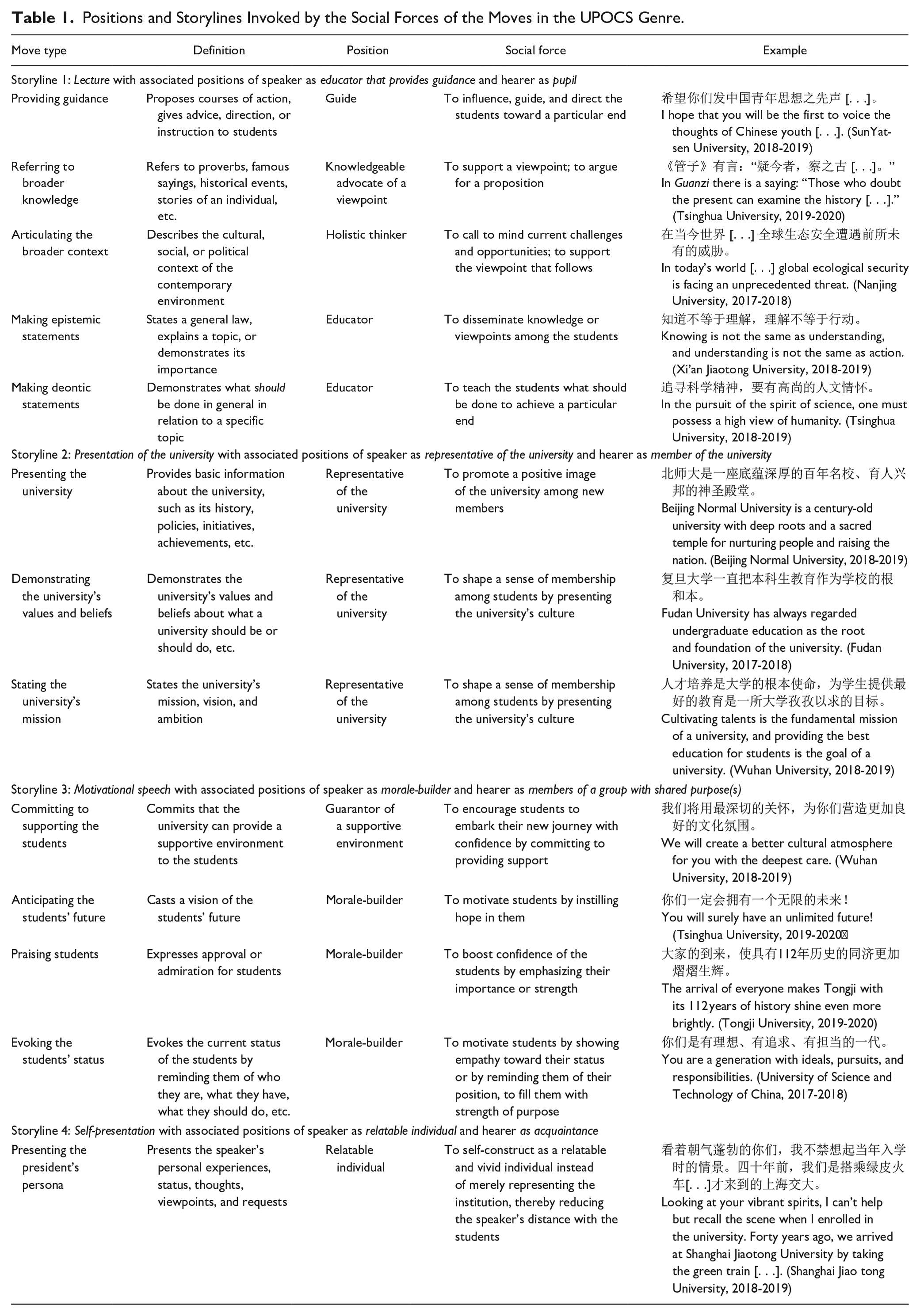
Following the identification of moves within the corpus, the illocutionary function of each move was analyzed to identify the position that it constructs through the realization of its perlocutionary object(s), which represent the social force exerted. For example, the move “Providing guidance” has the social force of guiding the students toward a particular objective, thereby constructing the position of guide. These identified positions were then analyzed to uncover the storylines that unfold in the narrative of the genre. A storyline might be constituted by one or more move types. As an illustration, the positions of guide, knowledgeable advocate (evoked by the move “Referring to broader knowledge”), and educator (evoked by the move “Making epistemic statements”) contribute together to the development of a lecture storyline.
Annotation of moves
The established move scheme was used as a codebook to annotate by the author and three other coders, who annotated the whole corpus using NoteTab Light. Two rounds of intercoder reliability checks were performed on a randomly selected sample of four texts. In the first round, two coders independently annotated two texts each. Any minor inconsistencies that emerged during this process were discussed among the four coders, including the Author, to fine-tune the move scheme. The second round of reliability checking was conducted on the remaining two texts and yielded an agreement percentage of 90%, indicating that the coding scheme was relatively reliable. The scheme was then applied by the four coders in annotating all 30 speeches in the corpus. Finally, the annotated corpus was analyzed using WordSmith Tools 7.0 to calculate the statistical distribution of the identified moves.
Findings
Moves, positions, and storylines in the UPOCS genre
This study reveals that the UPOCS genre contains multiple positions and storylines. Table 1 presents the 13 rhetorical moves identified in the genre, along with their associated social forces and the corresponding invoked positions. Positions that are interrelated and mutually supportive come together to enact a shared storyline. The analysis uncovers four storylines unfolding in the narrative of the genre: (a) lecture, where the president self-positions as guide, educator, knowledgeable advocate of a viewpoint, and thought leader with a holistic perspective; (b) presentation of the university, where the president assumes the position of representative of the university; (c) motivational speech, where the president self-positions as morale-builder, evaluator, and guarantor of a supportive environment; and (d) self-presentation, where the president self-constructs as a relatable person. The main positions dominating these storylines are, respectively, educator providing guidance, representative of the university, morale-builder, and relatable individual.
Positions and Storylines Invoked by the Social Forces of the Moves in the UPOCS Genre.
Distribution of positions
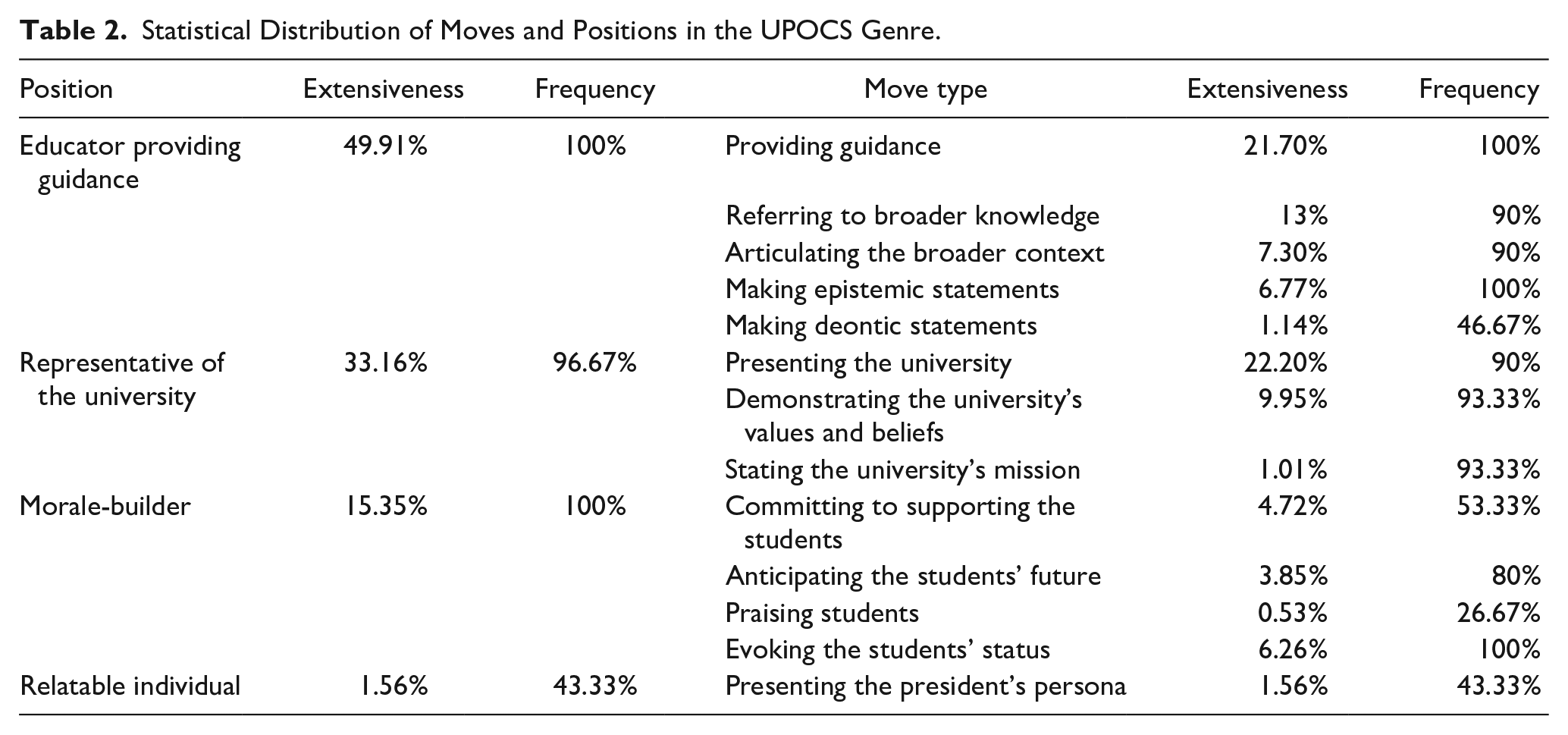
The analysis of the annotated data reveals the extensiveness and frequency of moves and positions in the UPOCS genre. As shown in Table 2, the conventional positions associated with the rhetor are educator providing guidance (frequency = 100%), representative of the university (frequency = 96.67%), and morale-builder (frequency = 100%). They differ in terms of prominence: the two most prominent positions are educator (extensiveness = 49.91%) and representative (extensiveness = 33.16%), while the conventional position of morale-builder (extensiveness = 15.35%) is relatively less extensive. The conventionality and textual dominance of these positions indicate that the main communicative purposes of the UPOCS genre are to provide guidance to incoming students, to inspire them, and to present the university to its new members. The position of relatable individual, on the other hand, is much less used (frequency = 43.33%; extensiveness = 1.56%), indicating that it is an unconventional rhetorical choice made by the speaker. The recurrence of the conventional positions indicates a certain degree of stability of positioning in the UPOCS genre.
Statistical Distribution of Moves and Positions in the UPOCS Genre.
The position of educator
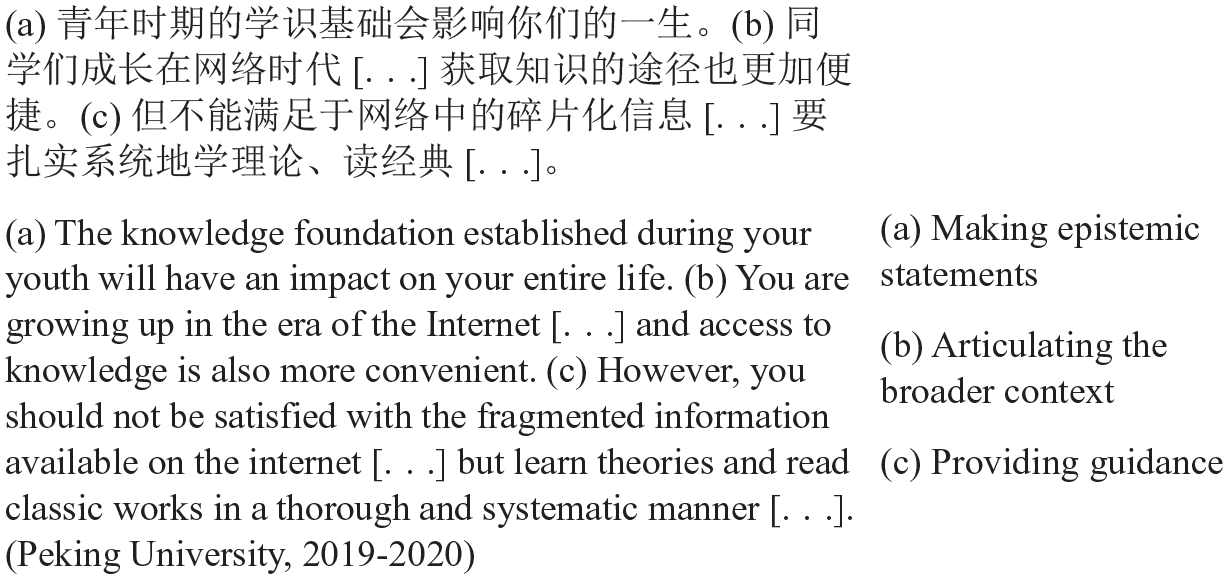
The storyline of the lecture is primarily established by the extensive obligatory move “Providing guidance” (extensiveness = 21.7%; frequency = 100%), which constructs the president as an educator. A certain degree of fluidity of positioning is observed in the internal realization of the storyline, where the position of educator is fostered by several supporting positions realized by other moves used in a flexible manner. The moves “Referring to broader knowledge” and “Articulating the broader context” contribute to portraying the speaker as a knowledgeable educator with a holistic perspective, while the moves “Making epistemic statements” and “Making deontic statements” enhance the didactic tone of the guidance-providing act. Consider, for example: Example (1)
Furthermore, an examination of the lexicogrammatical choices made in the advising move reveals attitudinal attributes associated with the position of guiding educator. Some presidents self-position as authoritative guides by using explicit deontic markers such as 要求 yaoqiu “request” and 必须 bixu “must,” while the choice of expressions like 和同学们作几点分享 hetongxuemenzuojidianfenxiang “share some viewpoints with you” mitigates the coercive tone of the guidance-providing act.
Besides, an investigation of the frequently used thematic words in the move “Providing guidance” sheds light on the primary concerns of the educator. The analysis shows that the guidance-providing move frequently uses two sets of words: (a) words related to the topic of study, such as 学习 xuexi “study,” 学会 xuehui “learn,” 知识 zhishi “knowledge,” and (b) words related to the topic of social development, such as 社会 shehui “society,” 中国 zhongguo “China,” 国家 guojia “country,” 民族 minzu “nation,” 复兴 fuxin “rejuvenation,” 发展 fazhan “development.” Consider, for example: Example (2) 要为 To contribute to
In Example (2), the president urges the students to engage in studying, which is regarded by society as a primary mission of university students. This act conforms to the main function of a higher education institution, which is to impart knowledge, skills, and competencies to students in various fields. Moreover, by referring to the prosperity of the country, the development of the nation, and the progress of human society, the president self-positions as an educator concerned with collectivist goals.
The position of representative
Speeches serve as parts of ceremonial rituals that aim to unite people and foster a sense of collective identity, belonging, and responsibility (Durkheim, 1912). The president’s speech, as a crucial component of the opening convocation ceremony marking the beginning of students’ college journey, serves to unite students as members of the institution. This ceremonial exigence justifies the storyline of university presentation, wherein the president self-positions as the representative of the university and positions the incoming students as new members, who are expected to assimilate into the culture of the community by familiarizing themselves with its history, policies, values, and missions. In this storyline, collectivist values are recursively invoked and associated with the students’ membership of the university. This positioning responds to the social expectations placed on Chinese higher education institutions in terms of the dissemination of collectivist values among students (Luo, 2013). For example: Example (3) 中科大人历来以实现 The people of USTC have always taken it as their mission to achieve
The position of morale-builder
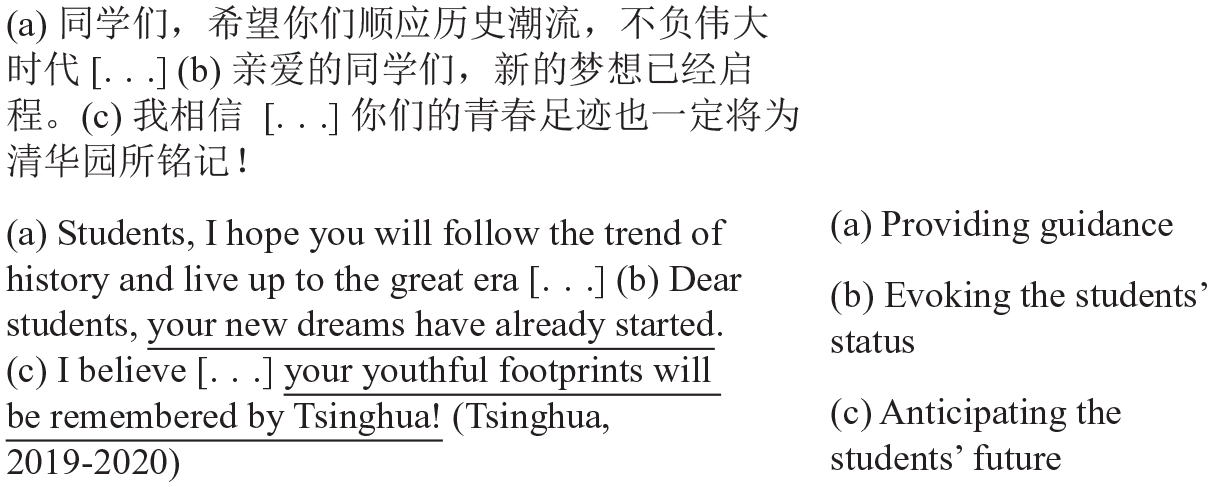
The UPOCS genre is socially expected to serve as a source of inspiration for incoming students who are striving to define their goals and aspirations (X. Yu & Zheng, 2019). This expectation is met by the position of morale-builder, which uplifts the morale, motivation, and spirit of the students. Unlike the educator position, which may threaten the negative face of the audience, the morale-builder position adopts a less didactic tone. It focuses on energizing and inspiring students by committing to support them, casting a vision of their promising future, expressing admiration for them, and evoking their identities and significance in order to instill a sense of purpose. Overall, the morale-builder position supports the educator position, contributing to a motivational storyline within the genre. Example (4) presents the final remarks of a speech that not only provide guidance but also incorporate motivational elements that emphasize the students’ positive status and present an inspiring vision of their promising future.
Example (4)
The position of relatable individual
While the storylines of lecture, presentation of the university, and motivational speech are conventionally evoked in the genre, the storyline of self-presentation appears to be unconventional. In a few instances, the president self-positions as a relatable individual, momentarily stepping away from the role of an authority representing the institution. This positioning act contributes to reducing the distance between the speaker and the students and fostering solidarity with them, which can add some personal charms to the president’s image. However, it is rarely used in the genre, suggesting that the position of relatable individual is not widely expected to be associated with the role of university president in China.
On the Effectiveness of Genres as Positioning Acts
This study proposes a new perspective on genres, viewing them as positioning acts. Swalesian genre theory, originally applied in the writing pedagogy, aimed to orientate students toward membership of a discourse community through the “effective use of established genres within that community” (Swales, 1990, p. 81). But how can a genre be effectively used? One way to help students “appreciate the constraints and choices that many genres inculcate” is rhetorical move analysis (Swales, 2019, p. 77). However, this method has been criticized for being “heavy on description, but light on interpretation and explanation” regarding the underlying reasons for the specific shapes and forms that moves take (Swales, 2019, p. 77).
This study goes beyond solely examining the rhetorical structure of a genre to investigating the rhetor’s positionings that drive the choice of moves. By uncovering the positions taken by a rhetor, this study aims to reveal “the explicit and implicit patterns of reasoning that are realized in the ways that people act towards others” (Harré et al., 2009, p. 5). These positions serve to shape and reshape social relations that conform to specific social exigence. Adopting this perspective, the present study suggests that the effectiveness of a genre as an act of positioning largely depends on the successful establishment of targeted social relations. These relations can be understood as channels that enable the exchange of information, values, and emotions between communicators. Their successful establishment hinges on whether the position(s) constructed by the sender are accepted by the receiver.
The relation between the acceptability of specific position(s) and the effectiveness of a genre is evidenced by Kotthoff’s (2015) observations of positionings in scholarship applications to German institutions. She points out the inappropriateness of the position of a lover of German literature, which was adopted by a few applicants from former Soviet republics in their scholarship applications. Instead, she suggests that applicants are expected to position themselves “in the institutionally expectable identity of a future scientist” (Kotthoff, 2015, p. 8), in order to make effective scholarship applications. In this scene, genres serve as mediums for assessments that determine whether the person taking up that role embodies the expected positionings in the given society. When an individual’s words or actions cannot be logically integrated into a socially recognized framework of expected behaviors that define a persona, she or he “is bound to be treated with reserve or even suspicion” (Harré & Van Langenhove, 1999a, p. 8). Thus, improper positionings may reduce or even destroy the effectiveness of a genre.
In this study, the genre instances under investigation can be considered as being effective, as the three main positions undertaken by the rhetor—educator, morale-builder, and university representative—which are legitimized by the institutional authority of the president’s role, seem to be conventionally recognized and accepted by the public. If they had not been recognized and accepted, these genre instances would not have been publicly released in written forms. Therefore, the repertoire of positions and the corresponding rhetorical strategies proposed in this study can hopefully serve as useful references for novice practitioners of the genre.
The degree of effectiveness of a genre instance, however, depends on the extent to which the audience accepts and recognizes the positionings that it uses. For example, although the educator-pupil relationship is already legitimized by the president’s authority, it can still be further strengthened by other factors. One such factor is charismatic leadership, which is seen as a way to bring about social change (Fiol et al., 1999). Charismatic leaders can increase the impact of their discourse by appealing to students’ emotions rather than just to their own authority. For example, the position of relatable individual, though rare in the sample, could be a strategy that reinforces the educative act that prevails in the genre and improves its effectiveness.
The alignment between individual positionings and actual social expectations poses a challenge for writing pedagogy. In real-world scenarios, practitioners of a genre would consider using appropriate positionings to act in line with the expectations of the social actors involved. However, in a writing classroom, students may prioritize aligning with the expectations of assessors, rather than acting in line with real social expectations placed on the assigned genre. As established assessment scales may underrepresent what makes the writing a social action in a specific sociocultural context (Dryer, 2013), an assignment considering only assessment criteria may become a product of inappropriate positionings. This study suggests that assessment criteria could include an examination of whether the positionings within a written assignment align with real-world expectations, to raise awareness among students of the social effectiveness of the assigned genre.
Conclusion
This article presents an approach that combines genre analysis with positioning theory to analyze genre as a macro act of positioning that is composed of micro positioning acts realized through rhetorical moves. As an illustration, the case study investigated the UPOCS genre, unveiling the positions regularly used by Chinese university presidents. Each of these positions, varying in prominence, is discursively manifested by a set of rhetorical moves. The recurrent use of these moves and the corresponding positions shape and maintain three pairs of relations between the president and the students—educator/pupils, institutional representative/members, and morale-builder/members—that function as pathways for transmitting values, especially collective values, that conform to the exigence that motivates the UPOCS genre in China. The identified positions provide insights into the “institutional order” (Berger & Luckmann, 1966, p. 82) represented by the role of the university president. These insights could be used by university presidents to effectively use the genre within the Chinese higher education context, on the condition that the previous circumstances in which the examined genre sample was produced remain unchanged. This genre knowledge constitutes part of the “social stock of knowledge” (Berger & Luckmann, 1966, p. 56) through which institutional leaders position themselves in the given social system and deserves to be further scrutinized within the genre ecology of leadership statements to which the UPOCS genre belongs.
The theoretical implications of this study are twofold. Firstly, it proposes an analytical approach where ESP and RGS genre theories resonate by conceiving of genre as a social act of positionings that are realized through a set of purposive rhetorical moves motivated by social exigence. By doing so, as advocated by Swales (2019), it advances move analysis toward a “thick” description in Geertz’s (1973) sense. Secondly, the genre-based approach attempts to explore positionings that are conventionally employed in a genre. Positioning theory conceptualizes positionings as fluid and unstable acts used by people to “cope with the situation they usually find themselves in,” as opposed to static roles (Van Langenhove & Harré, 1999, p. 17). Although such fluidity is typically observed in daily conversations held in informal settings, conventionally established genres tend to exhibit a certain degree of stability in the use of main positions and their corresponding storylines, while allowing for a fluid use of supporting positions in the internal realization of a storyline. In general, genres are designed to fulfill regular purposes and thus tend to evoke regular use of specific positions, as demonstrated in this study. These positions, unlike those that portray individual traits, serve as shared markers of membership within a discourse community.
It is important to emphasize that the genre knowledge proposed in this study does not intend to be prescriptive or result in the construction of stereotypes of Chinese university presidential speeches. It is important to note that the case study was limited to the analysis of only 30 presidential speeches from top-ranking Chinese universities, which represent only a fraction of the total 3013 higher education institutions in China. In its practical application, however, the genre-based positioning analysis is a new perspective that helps understand the complex reality of genre production, providing insights into writing pedagogy. It helps to demystify the positions used by experienced writers in a genre. These positions, being conventionally accepted by readers, can serve as useful references for students to effectively integrate into the discourse community they are writing for. The question of whether the writer can effectively perform these positions in a genre is related to the extent to which they understand and accept these positions, which are meant to be integrated within their “ongoingly produced self” (Davies & Harré, 1990, p. 48) through the practice of the genre. In L2 writing, the acceptance of certain positions may be influenced by their compatibility with those conventionally evoked in the original culture of the L2 writer. Future research could delve into positionings within genres from a cross-cultural perspective.
Footnotes
Acknowledgements
I would like to thank Dylan Dryer, Mya Poe, and two anonymous reviewers for their insightful and stimulating comments on earlier drafts of this article. Your generous input has strengthened the article in numerous ways and has prompted me to think deeper in this area. Any remaining flaws are mine.
Declaration of Conflicting Interests
The author declared no potential conflicts of interest with respect to the research, authorship, and/or publication of this article.
Funding
The author received no financial support for the research, authorship, and/or publication of this article.
