



Abstract
Transformative learning theory is applied in a variety of fields, including archaeology, religious studies, health care, the physical sciences, environmental studies, and natural resource management. Given the breadth of the theory’s application, it needs to be adaptable to broad contexts. This article shares insights gained from applying the theory’s learning domains in the analysis of learning experiences outside the classroom. The discussion is based on empirical qualitative research exploring how individual learning emerges from the intersection of faith and the pursuit of sustainability within faith-based organizations operating in Kenya. Data were gathered through semistructured interviews and participant observation. Chronicling our analysis process, problems encountered, and solutions adopted, we introduce a new introspective domain and explore the interactions among learning domains.
Keywords
Introduction
Transformative learning theory (TLT) is a frequently cited theory in the field of adult education (Taylor, 2007; Tisdell, 2003). It has been lauded as “the most elaborate and intellectually the most solid conceptualisation of adult learning” (Finger & Asún, 2001, p. 54). Developed within the adult education discipline by Jack Mezirow (1978), TLT is applied in a variety of fields, including archaeology, religious studies, health care, and the physical sciences (Taylor & Snyder, 2012). Within the sciences, application of TLT has been fruitful for environmental sustainability and natural resource management (e.g., Clover, 2002; Duveskog, Friis-Hansen, & Taylor, 2011; Lange, 2004). Various educational programs promoting sustainability have employed TLT in their evaluation (e.g., Bush-Gibson & Rinfret, 2010; D’Amato & Krasny, 2011; Fenstein, 2004). Its application has also extended beyond the realm of education to examine personal commitments to sustainability (e.g., Kovan & Dirkx, 2003; McDonald, Cervero, & Courtenay, 1999; Quinn & Sinclair, 2015) and to explore the learning outcomes of participatory processes such as environmental assessment (Sinclair & Diduck, 2001; Sinclair, Diduck, & Fitzpatrick, 2008) and participatory resource management programs (Marschke & Sinclair, 2009; Percy, 2005; Sims & Sinclair, 2008; Wilner et al., 2012). One locus of this work is the Natural Resources Institute at the University of Manitoba, where TLT is applied to participatory and educational natural resource management programs and initiatives (e.g., Kerton & Sinclair, 2010; Moyer, Sinclair, & Diduck, 2014; Sinclair, Collins, & Spaling, 2011).
Given the breadth of its applications, TLT needs to be adaptable as it is still a theory in process (Taylor & Cranton, 2013; Taylor, 2007). The foundation provided by its basic tenets functions as a springboard for continued debate, dialogue, and modification, an exercise that Mezirow encouraged (e.g., Dirkx, Mezirow, & Cranton, 2006). Based on research that explored how individual learning emerges from the intersection of faith and the pursuit of sustainability within faith-based organizations (FBOs) working in Kenya, the purpose of this article is to share insights gained from applying TLT’s learning domains for analysis in this cross-cultural and practical context. We describe aspects of our analysis process including decisions we made in interpreting the theory, problems we encountered, solutions we adopted, and dialogues with the literature that we engaged. Responding to Taylor and Cranton’s (2013) call to probe source TLT material and push TLT as a theory in progress, we view these as tentative solutions that were applicable in our particular context but that likely have broader relevance and will help to stimulate conversation. Our thoughts on TLT are grounded in our work with the empirical data, which we provide in summary, indicating where more detailed treatments can be found.
Transformative Learning Theory
TLT describes learning as the process through which adults make meaning of their experiences, reevaluating meaning structures developed through childhood, and subsequent socialization when these assumptions conflict with realities they confront (Cranton, 2006; Mezirow, 1991; Taylor, 2007). In our applications of TLT, we employed Mezirow’s description of learning processes and domains as key analytical categories. The process of evaluating meaning structures, according to Mezirow (1998, 2003), occurs through critical reflection and rational discourse. These mechanisms are applied within three distinct but interrelated domains of learning (Mezirow, 1981), developed from the work of Jürgen Habermas (1971). Instrumental learning is task-oriented, and facilitates the prediction, manipulation, and control of events and environments (Cranton & Roy, 2003; Mezirow, 1991). Communicative learning involves understanding others and making oneself understood, by navigating language, values, beliefs, and feelings (Cranton & Roy, 2003; Mezirow, 1991, 1997). Finally, transformative learning is the modification of premises, assumptions, and deep meaning structures that result from evaluating the outcomes of instrumental and communicative learning, which ideally should result in a transformation of action and behavior (Cranton, 2006; Mezirow, 1991).
The descriptions of the domains in the literature appear straightforward, but when applied in the analysis process, we found some areas of inconsistency and imprecision. For example, many learning experiences contain elements of both instrumental and communicative learning, making it difficult to parse them into categories, a problem also flagged by Cranton (2006) and Taylor, Duveskog, and Friis-Hansen (2012). Furthermore, it is not clear whether these domains refer to the process through which learning occurs or the learning outcomes that result (Cranton & Kasl, 2012). Finally, we discovered in applying the domains to our data that some learning outcomes did not correspond with either the instrumental or the communicative categories. In particular, we struggled to place self-reflection about beliefs and values that is not at the profound and transformative level and that does not involve communicating with others.
Method
The empirical data on which we base our theoretical reflections were gathered during two field visits to Kenya. After an initial research phase focused on developing a profile of FBOs doing environmental and development work in Kenya (Moyer, Sinclair, & Spaling, 2012), two case study organizations were selected to study learning within the FBO context. Selection criteria included a self-defined faith basis, engagement in environmental or development work, and variety in type of faith affiliation, ethnic, or cultural composition, and area of sustainability work. These criteria led to the selection of: A Rocha Kenya (ARK), a nondenominational Christian conservation organization working on bird and habitat conservation, environmental education, and community conservation; and the Rural Service Programme (RSP) of the East Africa Yearly Meeting of Friends, a Quaker organization doing rural development with a focus on agriculture, community health, and microfinance. Moyer (2015) presents detailed descriptions of the organizations, considering the influences of their faith affiliations and organizational cultures on the learning outcomes documented.
The lead author spent 3 months with each organization, living and developing relationships with the communities. Data were collected through semistructured interviews with staff and volunteers involved in leadership and programs. We selected interview participants to reflect the range of sustainability programs within each organization. Each interview was conducted in two segments, first detailing the participants’ personal backgrounds and work lives, and then exploring their learning experiences through their work. After developing a list of learning experiences in the first interview, the second interview delved into what they learned, how they learned it, how they acted on their learning, and barriers that may have prevented action for specific learning experiences. Participant observation of FBO programs and daily operations, and document review (e.g., meeting minutes; strategic plans, and policies) supplemented the interview data. The data were coded for patterns and themes using NVivo software©. Data were coded first for grounded categories, then using the categories provided by the theory. Other studies referenced in support of some of the data presented, and involving the second author, also followed a case study strategy of inquiry and used qualitative methods, such as interviews and focus groups (e.g., Diduck, Pratap, Sinclair, & Deane, 2013; Sims & Sinclair, 2008; Sinclair et al., 2011).
Data Analysis and Key Empirical Findings
The study findings highlighted the importance of instrumental learning through embodied processes for the FBO workers. These types of learning were rooted both in Kenyan culture and in the activities of sustainability work on the land (Moyer, 2015; Moyer et al., 2014). The consideration of FBOs in sustainability work also underscored the appropriateness of faith-based approaches in Kenya, where they have particular strengths in accessing and influencing communities (Moyer et al., 2012).
Within natural resource and environmental management circles, Mezirow’s domains are commonly used to describe and analyze learning experiences (e.g., Diduck & Mitchell, 2003; Marschke & Sinclair, 2009; Percy, 2005; Taylor et al., 2012). Tables 1 and 2 summarize the learning data collected and analyzed in this manner, for which Moyer et al. (2014) provides a more detailed presentation. Table 1 outlines the primary grounded categories for learning outcomes and learning processes. Table 2 shows the learning domains and highlights examples of learning outcomes associated with each domain. All categories, subcategories, and domains are listed in order by approximate frequency.
Learning Categories Grounded in the Data.
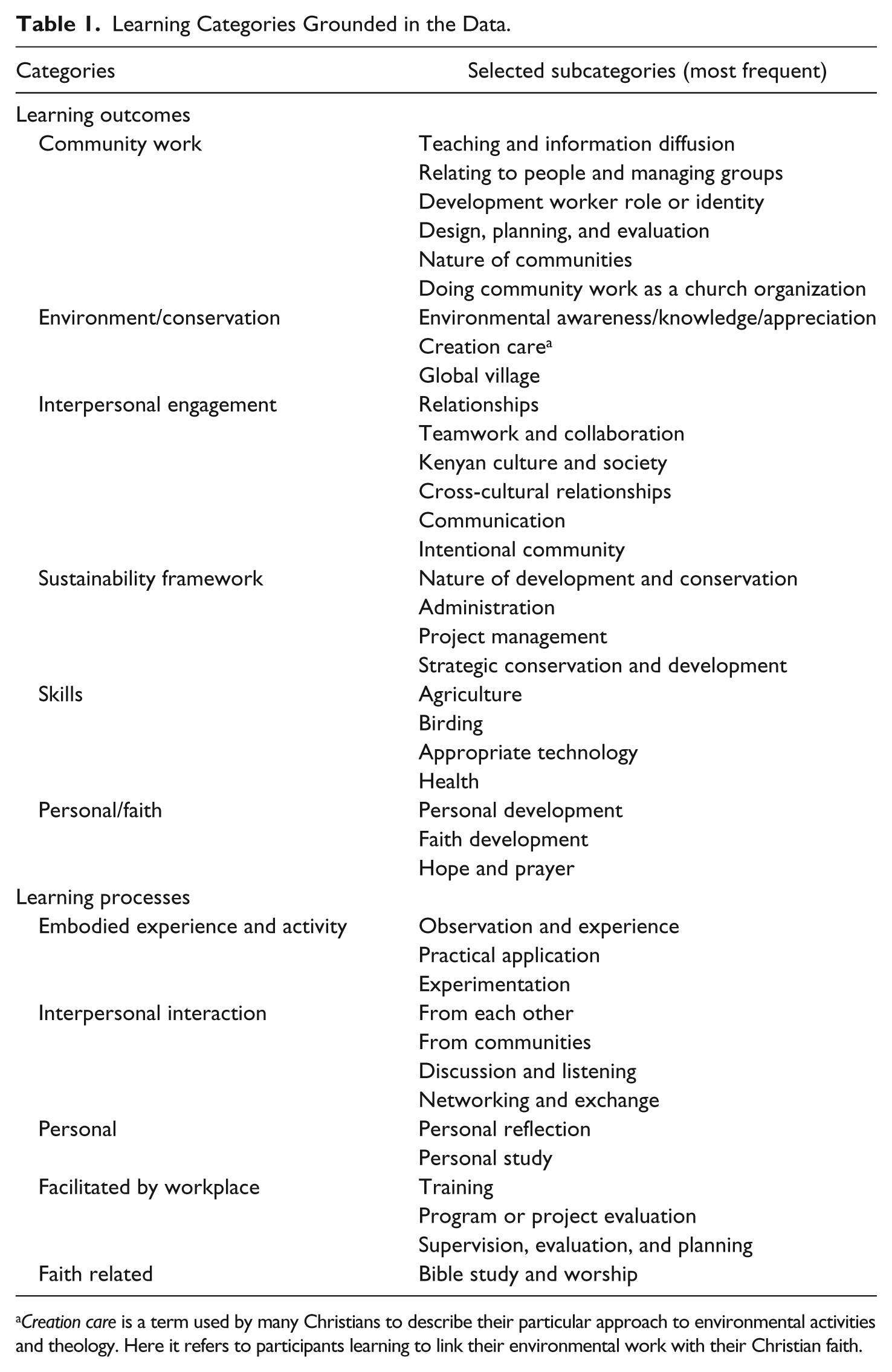
Creation care is a term used by many Christians to describe their particular approach to environmental activities and theology. Here it refers to participants learning to link their environmental work with their Christian faith.
Learning Domains With Grounded Learning Categories.

As noted above, it is not clear in the theory whether the learning domains refer to outcome (i.e., a learning experience that was about communicating and negotiating meaning with others) or process (i.e., a learning experience that occurred through negotiating meaning with others). While these can be one and the same, sometimes learning about instrumental outcomes occurs through communicative processes and vice versa. Because the theory contains categories that are clearly related to process—critical reflection and rational discourse—we assumed in the analysis process that domains are learning outcomes categories. Therefore, when considering into which domain a learning experience should be coded, we tried to consider only what was learned, not how it was learned. This distinction, however, did become somewhat fuzzy when working with the communicative domain, since learning through communication and learning about communication can easily become confused. We found no clear indication in other studies how researchers addressed this issue.
We also developed criteria to determine what kind of learning fit into which domain. We designated learning as instrumental when it involved empirical knowledge, cause and effect relationships, problem solving, and predicting observable events (Table 2). Understanding a state of reality, learning how something works, and learning how to do something were also considered instrumental learning. In keeping with similar studies, we considered these criteria as logical extensions of the definition necessary to accommodate the range of data collected. Grounded categories defined as instrumental learning in related studies include new information and skills (Marschke & Sinclair, 2009; Sinclair et al., 2011), determining cause and effect relationships, task-oriented problem solving (Sims & Sinclair, 2008), scientific/technical knowledge, legal/administrative knowledge, and potential risks and impacts (Sinclair et al., 2008).
Learning was categorized as communicative when it developed understanding or communication with others through incorporating language, expressing and negotiating purposes, beliefs, feelings and intentions, and resolving conflict. Accordingly, communicative learning encompassed understanding others or making oneself understood in the communicative domain (Table 2). This conforms in part to the work of others who defined communicative categories as follows: understanding others’ points of view, insight into the interests of others, communication strategies and methods, and social mobilization (Marschke & Sinclair, 2009; Sims & Sinclair, 2008; Sinclair et al., 2008). Conversely, it deviates from other studies that have included personal, internal negotiation of values and beliefs, such as insight into one’s own interests (Sinclair et al., 2008), personal understanding of values and normative concepts, (Sims & Sinclair, 2008), and changing attitudes (Sinclair et al., 2011), in the communicative domain. This difference in approach will be discussed further below.
Learning within deep meaning structures that brought about a profound change in the individual’s perception of self and the world, and that resulted in profound change in meaning structures and behavior, was considered transformative. Determining what learning was transformative was the least precise of the analytical decisions and depended to a degree on the researchers’ intuitive understanding of the participants and their learning outcomes. Because transformative learning is understood to flow from communicative and instrumental learning, all transformative learning was also assigned to one of the other domains (including the new domain introduced below, which is not included in Table 2).
The coding of instrumental learning was fairly straightforward and presented few difficulties. Communicative learning, according to the parameters we assigned it, was also fairly easy to identify, but this left a number of learning outcomes that did not fit into either domain (Table 3). These included learning related to environmental awareness, knowledge, and appreciation, creation care, some aspects of community work, personal development, faith development, and hope and prayer. Many of the quotations in Table 3 exhibit aspects of either instrumental or communicative learning, but also contain a personal element that is unique from either, whether they were insights about personal identity, beliefs, values, and attitudes, or personal experiences of spirituality.
Learning Outcomes Outside the Domain Parameters.
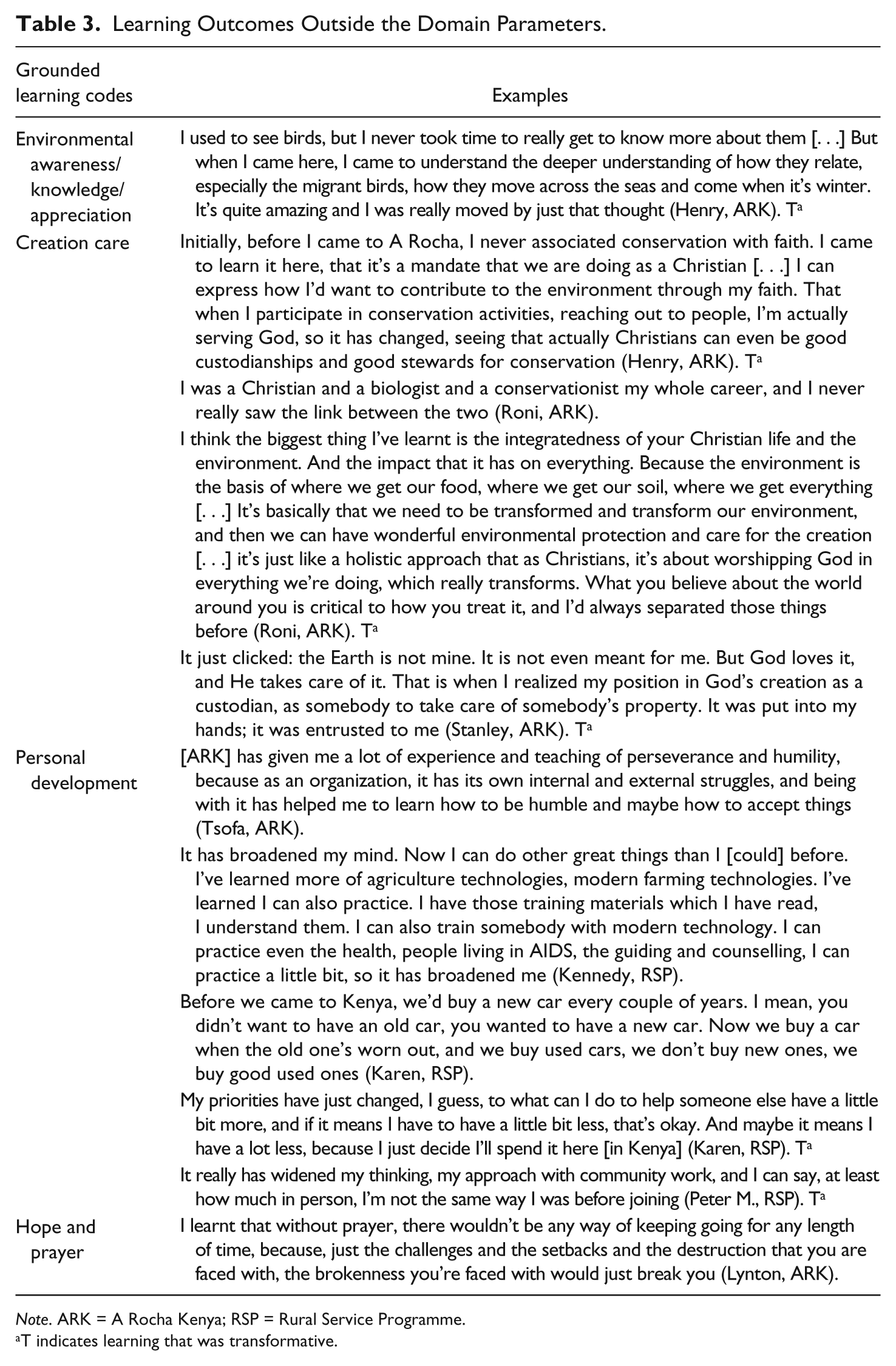
Note. ARK = A Rocha Kenya; RSP = Rural Service Programme.
T indicates learning that was transformative.
Stoking the Dialogue on Domains
Proposing a New Domain
Faced with learning experiences that did not fit the existing domains, we developed the idea of a new “introspective” domain. Here we describe our process of reasoning and formation for this domain, beginning with some contextual factors that contributed to its genesis.
Spirituality and faith are ubiquitous and highly valued in sub-Saharan Africa (Mbiti, 1991; Ntseane, 2011), and we observed their prominence frequently in the Kenyan context (Moyer et al., 2012). Our study built on this cultural characteristic, focusing specifically on faith-based engagement in environmental and development work among FBOs. Faith-related activities such as prayer and worship were evident in the daily lives of the organizations studied (e.g., Field Notes, 2010-11-22, 2011-02-23), and the project participants expressed their faith commitments in their work activities and in our interviews. The faith context also sometimes served to facilitate learning. For instance, at ARK, staff and volunteers participated in regular Bible study and worship times, which provided an opportunity to discuss theological and other topics relating to their work and to reflect, both individually and collectively, on how their faith and work connected. At both FBOs, field officers used biblical principles and stories to teach about development and creation care in communities, and these interactions also stimulated learning. Furthermore, spiritual disciplines, such as prayer, involve a kind of reflection that may lead to learning.
Similar to Merriam and Ntseane’s (2008) findings in Botswana, it was no surprise to find faith integrated into participants’ learning experiences in this context. Spirituality, which is related though not identical to faith, has long been recognized as foundational in adult learning (e.g., English & Mayo, 2012; Taylor, 2008; Tisdell, 2003). While some still question the appropriateness of including spirituality in learning (e.g., Newman, 2012), numerous scholars have worked to integrate spirituality into TLT (e.g., Charaniya, 2012; Dirkx et al., 2006). This work often focuses on the process side of learning, however, and we found that the domains in TLT did not accommodate faith-related learning experiences.
In arriving at this point, we did consider several ways in which these faith-related learning experiences, as well as those that related to personal identity and development, might have been included into the existing TLT domains. For example, in some of the early iterations of the theory, Mezirow (1981) describes an emancipatory or self-reflective domain that
involves an interest in self-knowledge, that is, the knowledge of self-reflection, including interest in the way one’s history and biography has expressed itself in the way one sees oneself, one’s roles and social expectations. (p. 5)
This is promising, but Mezirow (1981) specified that this self-reflection was undertaken to address the power dynamics in social existence and to liberate ourselves “from libidinal, institutional or environmental forces which limit our options and rational control over our lives but have been taken for granted as beyond human control” (p. 5). Thus, this domain does not encompass more general self-reflection that involves knowing and understanding oneself, in terms of values, beliefs, and self-perception (Table 3). Furthermore, in his later writing, Mezirow dropped the emancipatory domain, folding it into the transformative domain, which is described as resulting from evaluating and refining learning outcomes from the other two domains (Mezirow, 2008). Even though some may still employ this domain (Taylor, 2008), its focus on emancipation is too limiting to encompass the learning experiences we encountered.
Additionally, it is likely that many of the learning outcomes presented in Table 3 would be designated by some as communicative. They were, in a sense, about the things that one is learning to communicate to others and to understand in others, but they were also unique in that they focused inward rather than outward. Those that did focus outward were oriented to the metaphysical rather than fellow human beings.
The definition and use of communicative learning in this regard is not consistent within the literature. In his seminal book, Transformative Dimensions of Adult Learning, Mezirow (1991) defines communicative learning as
Learning to understand what others mean and to make ourselves understood as we attempt to share ideas through speech, the written word, plays, moving pictures, television, and art. (p. 75).
It involves intentions, values, ideals, moral issues, and social, political, philosophy, psychology, and education concepts, feelings, and reasons. Most of the literature is clear that it engages these phenomena at the social level, where social norms are negotiated, which is the sense in which Habermas developed the concept (Finlayson, 2005; Mezirow, 1981, 1997, 2008). By these definitions, the learning outcomes regarding personal beliefs about the environment and faith, and regarding changes in self-perception and identity, were not communicative because they were personal or metaphysical, and focused inward, not outward.
Others, such as Cranton (2002), do include this personal self-discovery as communicative learning, defining it as “the understanding of ourselves, others, and the social norms of the community or society in which we live” (p. 64, italics added). Similarly, in some empirical applications of TLT, such personal learning outcomes have been designated as communicative learning. A review of applications of TLT in natural resource and environmental management contexts revealed a wide variety of learning outcomes from empirical research that were considered as communicative learning because people learned through discourse with others, including “insight into one’s own values and interests” and increased self-confidence (Diduck et al., 2013, p. 8). We refrained from coding these personal learning outcomes to the communicative domain because we now question such a broad application of the domain. Much of the literature is clear in denoting the social component of the communicative domain, and we maintain that understanding oneself, communicating that understanding, and understanding others communicating about themselves, are related but distinct types of learning. In a sense, the former could be described as communicative learning with oneself, which is not the same as communicating with others.
For these reasons, and building on the work of others (e.g., Dirkx et al., 2006; Ntseane, 2011; Tisdell, 2003), we suggest the need for another learning domain, or at least a subdomain. Based on the data in this research, this “introspective” domain comprises learning that is personal and internal, and that discovers, develops, and defines one’s self-understanding (Table 3) in several areas: worldviews and beliefs (Vidal, 2008), values and attitudes (Dietz, Fitzgerald, & Shwom, 2005), personal identity and self-image, and faith, in terms of one’s deepest commitment or “ultimate concern” (Fowler, 1981, p. 14). Introspective learning can occur through reflection, discourse, and embodied experience, as well as reading, skill-building, and many other activities. The domain does overlap somewhat with Newman’s (2012) “interpretive” aspect of learning, described as “help[ing] us understand what makes us tick. We identify our prejudices and predilections, our doubts and certainties, and our weaknesses and qualities” (p. 51). Baird, Plummer, Haug, and Huitema (2014) also have a similar category in their learning typology, which they call “normative learning,” that encompasses “changes in norms; change in values; change in paradigms; convergence of group opinion” (p. 53). These interpretations support our contention that a new domain is needed, though their parameters are somewhat different from ours.
The proportion of learning items within the whole body of our research data that corresponds with this domain was quite small. We considered this small group of experiences to be worthy of attention because most of the learning that was transformative included an introspective element. For example, at ARK, much of the transformative learning related to creation care. As illustrated in Table 3, participants described how developing a holistic understanding of conservation as a biblical mandate that fits within their larger faith convictions affected them deeply. At the same time, most of the transformative learning at RSP encompassed personal development. Through staff training and work experiences, staff developed new understandings of their capacity and potential, profoundly transforming their sense of personal identity.
These findings highlight the importance of internally focused reflective learning and of considering why we are doing what we are doing in any enterprise. TLT emphasizes reflection on worldviews, beliefs, and values, but from our perspective, the existing domains do not provide a clear space for such learning outcomes in a personal, internal fashion. While the faith-based context of this study may have contributed to showcasing this aspect of learning, such exercises are necessary in secular settings as well. In natural resource and environmental management, technical approaches are often favored, but many recognize that the heart of the problem sits within the realms of philosophy, ethics, and religion (DeWitt, 1995; Grim, 2011; Lamm, 2006). Thus, the inclusion of an introspective domain can help to facilitate engagement with these components of resource and sustainability dilemmas.
Interaction Between Domains
The term domain suggests a clearly delineated territory, but in many cases the instrumental and communicative domains interact or work in tandem (e.g., Marschke & Sinclair, 2009; Percy, 2005; Taylor et al., 2012). This aspect of learning was prominent in our findings. In the case of some learning experiences, the two domains were so deeply interconnected, it was almost impossible to disentangle them and identify which component of the experience belonged to which domain. For instance, learning communication skills involves both learning how to do something and gaining insight into the meaning structures of others. To shed light on this phenomenon, we created a coding category to capture learning experiences in which domains overlapped or interwove. Within our findings, the learning outcomes that were coded to this category were mostly about community work and communication and occurred somewhat more frequently among RSP participants.
The need for an “interwoven/overlapping” category raises some interesting points about the nature of learning domains as analytical categories. Learning communication and teaching skills, which many RSP participants described in detail, involves instrumental aspects such as understanding particular teaching tools, for example, visual aids and learning to speak loudly and slowly enough. At the same time, it also requires building a connection with the students, understanding their backgrounds and related beliefs and values, and developing sensitivity to their emotional and cognitive conditions—an ability to read their reactions—which are communicative elements.
The learning a few ARK participants shared about the global village provides another example of the relationship between the two domains. Through cross-cultural interaction and learning about each other’s ideas and experiences (communicative learning), they developed a broader understanding of the state of the world, and the way that environmental problems relate to each other on the planet (instrumental learning). They then shared this change in perspective with others, continuing the communicative learning process.
This interaction between instrumental and communicative learning was also found in investigations of participatory resource management in Costa Rica (Sims & Sinclair, 2008) and Cambodia (Marschke & Sinclair, 2009). As well, in their study of Farmer Field Schools in Kenya, Duveskog et al. (2011) and Taylor et al. (2012) observed interactions between instrumental and communicative learning, as participants gathered observation data from field plots, and then discussed them in cooperative learning groups:
Interestingly, it is these technical experiences, imbued with instrumental learning, where farmers are regularly collecting data in the field on different crop varieties, growth rates and insect damage, that implicitly provide a medium for communicative learning—creating opportunities for them to question cultural norms. (Taylor et al., 2012, p. 734)
While we are not suggesting the creation of another new domain, we want to emphasize with these examples the importance of recognizing that learning frequently occurs through the interaction of more than one domain simultaneously when real-life learning experiences are considered. Perhaps learning studies should also include hyphenated domains (e.g., instrumental-communicative or communicative-introspective) to fully describe the learning experiences that participants describe. Furthermore, the term domain may be misleading in its suggestion of independence and mutual exclusivity. Other terms, such as dimensions (Illeris, 2004) or aspects (Newman, 2012) may reflect the reality of learning experiences more accurately.
In wrestling with these issues, we considered how the interaction between the domains might be illustrated visually. In an early iteration, created before data collection, this was depicted through a twisting motion in the learning line (Figure 1). Having considered this relationship more thoroughly during the collection and analysis of our data, we developed Figure 2. This figure shows that almost all learning will have aspects of instrumental and communicative learning, but some learning may be more one than the other. In the inner rectangle, learning is depicted as a horizontal line that can occur at different points on the vertical axis. Thus, if the learning line is in the middle of the rectangle, instrumental and communicative aspects exist in equal measure, while learning that occurs at the top is primarily instrumental. The dashed line marking the outside of the rectangle demonstrates that learning from either of these domains can flow out into the wider transformative domain. In Figure 2, we did not attempt to include the introspective domain category that arose from the data because it is a newer idea and requires more data and consideration; however, we would conceive it as a parallel or subset to communicative learning.
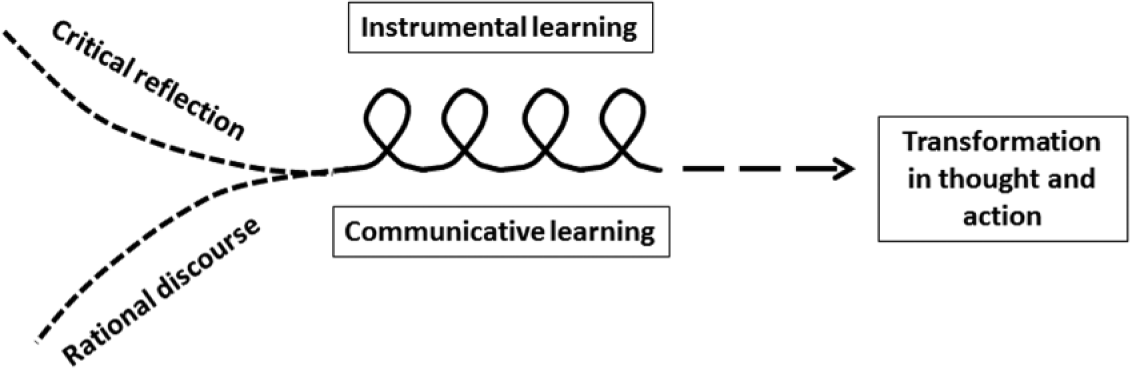
The learning process.
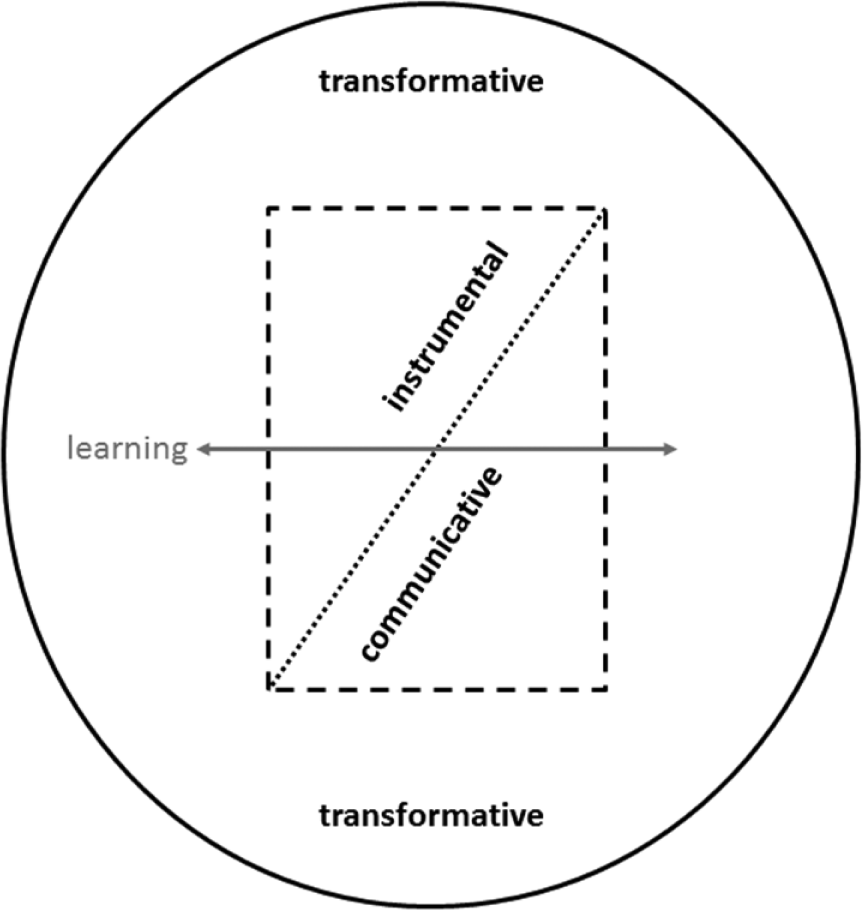
Learning domains reconceived.
Toward a More Comprehensive Learning Framework?
As TLT has been considered and applied over time, and in various fields outside formal adult education, new insights and perspectives have been added (Taylor & Snyder, 2012). This study investigated learning for sustainability within FBOs conducting environmental and development work in Kenya, grounded within a scholarly community with a growing tradition of applying TLT. The empirical findings of this study highlighted some gaps within the theory relating to the learning domains. To address these gaps, we created the introspective domain (or subdomain), to capture personal learning about beliefs, values, and identity and explored the interrelated nature of the domains.
These are exploratory solutions to problems arising from the grounded data of a particular research project in a specific context, but were reflective of issues raised in other research situations (e.g., Marschke & Sinclair, 2009; Percy, 2005; Taylor et al., 2012). Our decision to distinguish between learning processes and learning domains may seem somewhat arbitrary and can complicate analysis since these phenomena are interrelated. Yet in our context, making such distinctions is helpful, because we attend to both what is learned and how learning occurs in our explorations of learning in natural resource management. We consider potential learning platforms, such as organizations or environmental assessment programs, to determine whether the activities and circumstances involved facilitate learning. We also examine if what people are learning leads to more sustainable ways of thinking and acting and to discover what kinds of learning promote these personal and societal changes.
In creating our introspective domain, we recognize the possibility that a wider range of domains need to be documented. Habermas (1971, 1984) defined the areas of human interest on which the domains were based as part of his quest to incorporate rationality into his social theory, serving his broader goal of creating social order and promoting deliberative democracy. He wanted to demonstrate that rationality can be employed in different forms, some of which can be oppressive if allowed to dominate society, and some, such as communicative rationality, which can lead to greater social cohesion and order (Finlayson, 2005). It is unfair, therefore, to assume that he was working to compose a comprehensive typology of knowledge or learning and to assume that these two categories must be definitive for all human experience of knowledge and learning.
A comprehensive framework of learning dimensions might extend far beyond the small changes we have proposed. Other studies provide examples of how the scope of possible learning types could be expanded. Baird et al. (2014) developed a typology that closely parallels ours, dividing learning into cognitive, normative, and relational categories. They also emphatically distinguished between normative (introspective) and relational (communicative) learning. Similarly, Illeris (2004) identified three dimensions of learning: cognitive, emotional, and social. In his seminal work on multiple intelligences, Gardner (1985, 2006), identified eight intelligences: musical, bodily kinesthetic, logical-mathematical, linguistic, spatial, interpersonal, intrapersonal, and naturalist. While we do not assume that there must be a direct correlation between intelligences, domains, knowledge, and learning, these findings do suggest that dividing learning into only two categories might be limiting. Newman (2012), for instance, proposed nine different aspects of learning: instrumental, communicative, affective, interpretive, essential, critical, political, passionate, and moral.
The inclusion of an interwoven category in our coding framework highlights the interconnected nature of the learning process. Various TLT scholars have worked to build a more holistic theory (e.g., Cranton & Roy, 2003; Kasl & Yorks, 2012; Kovan & Dirkx, 2003; Taylor, 2007) and attending to the relationships among the components within the whole is part of this process. While separating concepts into categories and themes is a valuable analytical exercise, as researchers, we need to remember that these categories are constructed and can sometimes obscure the reality of the whole learning experience.
Finally, we view the thinking in this article as a process of applying transformative learning to TLT (Taylor & Cranton, 2013) by questioning assumptions and attending to mismatches between our frameworks and the realities that we encounter. Our experience highlights the messiness of applying theory to empirical data and trying to make theory fit in a concrete way to complex experiences. Some of our problems and solutions may also illustrate differences between applying theory to facilitate learning in a classroom and to understand learning that has already occurred in real-life situations outside of the classroom. In different contexts, different elements of the theory may be more useful. We are not tied to the solutions presented here, but rather view them as experimental ideas to fuel discussion. We hope that in the process we are contributing to making TLT, and the domains it describes, more reliable, permeable, reflective, and inclusive (Mezirow, 2008).
Footnotes
Acknowledgements
The authors wish to thank the organizations that participated in the research. Comments provided by Glen Hostetler and the anonymous reviewers sparked fruitful debate and helped to sharpen the manuscript.
Declaration of Conflicting Interests
The author(s) declared no potential conflicts of interest with respect to the research, authorship, and/or publication of this article.
Funding
The author(s) disclosed receipt of the following financial support for the research, authorship, and/or publication of this article: This work was supported by the Social Sciences and Humanities Research Council of Canada.