



Abstract
This study deals with key determinants of participation in the nonformal education (NFE) of adults in the Czech Republic (CZE). Our results are based on a secondary analysis of two Adult Education Surveys carried out in the CZE in 2011 (n = 10,190) and 2016 (n = 12,272). Determinants of participation are modelled through logistic regression and decision tree algorithm. The results show that the recent trend of participation in NFE has significantly increased to nearly 40% of adults. In this regard, we argue that this increase is an outcome of the higher investments of employers into NFE in the past 5 years, which has led to a higher proportion of low-skilled workers included in job-related training. Nevertheless, this does not mean that inequality in Czech NFE is decreasing, as the main predictors of participation in NFE remain the same: (a) current employment status, (b) active attitude to learning opportunities, and (c) educational attainment.
Keywords
No other research in adult education probably meets the criteria of a “strong scientific program” (Lakatos, 1978) or “crucial political agenda” (Commission of the European Communities [CEC], 2012) as much as the study of adult participation in various forms of lifelong learning, especially nonformal education (NFE). This is evident from both the interest of scholars (Blossfeld, Kilpi-Jakonen, Vono de Vilhena, & Buchholz, 2014; Blossfeld, Roßbch, & Maurice, 2011; Desjardins, 2017; Hiemstra, 2002; Rubenson, 2018) as well as from international strategic documents in which NFE is viewed as a means of socioeconomic growth, skill development, and social inclusion (Organisation for Economic Co-operation and Development [OECD], 2015).
In this study, NFE is understood in line with international documents (CEC, 2000, p. 8) and the contemporary standard conceptualization (Roosmaa & Saar, 2010; Rubenson, 2018) as all organized educational activities for adults (aged 18+ years) which take place outside the formal educational system. More specifically, NFE has been defined as an intentional and planned learning activity undertaken by adults to increase the knowledge and skills useful in their daily life both in and outside the labor market (Roosmaa & Saar, 2010; Rubenson, 2018).
Participation in NFE, or more broadly, lifelong learning, has been a much-researched field of adult education since the early 1990s (Beinart & Smith, 1998; Desjardins, 2011, 2017; Sargant, 1990). According to Desjardins (2011, p. 205), current research in NFE is focused primarily on the following three questions: (a) What is the scope of NFE? (b) Who are the participants in NFE? (c) Why do certain groups participate in NFE more than others? In this context, we directly address the first and the last question by focusing on (a) What are main trends today regarding participation in NFE in the Czech Republic and (b) what are the main sociodemographic determinants of participation in this country?
Our study draws on extensive international research (Kilpi-Jakonen, Vono de Vilhena, & Blossfeld, 2015; McGivney, 2001; Roosmaa & Saar, 2017; White, 2012) which has focused on key factors contributing to the participation or nonparticipation of various groups of adults in NFE. The philosophical basis of the concept of lifelong learning presupposes the democratic access of all adults to NFE (Hefler, 2012; UNESCO, 2016), which first of all requires the identification of the main restrictive factors. Following this process, a more focused social and educational policy can be formulated to deal with inequalities in access to NFE. In the past decade, research in the field of NFE has led to a number of findings regarding trends in NFE participation along with mechanisms that influence participation. According to several authors (Desjardins, 2015, 2017; Rubenson, 2018), two key trends of adult participation in NFE can be traced from 1994 to 2012: a gradual increase in participation and a stronger orientation of NFE toward labor market requirements.
In terms of determinants regarding adult participation in NFE, socioeconomic factors at the micro-level have been studied. The motivation of adults to seek out learning opportunities appears to be one of the important factors affecting the initial stage of the participation (Desjardins, Rubenson, & Milana, 2006; Keller, 2010). Similarly, several studies indicate that psychological obstacles such as negative attitudes and dispositions toward adult education are by far the strongest deterring factors (Rubenson, 2007).
In terms of the well-grounded factors that differentiate the participation of adults in NFE, four socioeconomic factors that tend to create inequality have emerged in most of the countries examined. These are as follows:
Education level achieved. Following the classic theories of Merton (1976) and Bourdieu (1984), researchers (Boeren, 2017; Rubenson, 2018) have referred to the so-called “Matthew effect,” according to which individuals who have achieved a higher level of education tend to seek or be more apt to learn even more. These learners have stronger predispositions toward learning gained from their previous studies, and consequently, they profit more greatly from additional training or instruction. According to Rubenson (2018, p. 348), the educational attainment of parents also plays a role which is intergenerationally reflected in their children’s attitudes to further education. According to researchers, the higher the parent’s education is, the higher the chances of participation in NFE are.
Integration into the labor market. With a strong focus of lifelong learning toward labor market requirements, it is logical that one of the main factors affecting adult participation is occupational status. According to the expert literature (Desjardins, 2015), working persons are much more likely to participate in NFE than the unemployed, pensioners, or those on parental leave.
The class position given by the nature of the work. Adults who work in high-skill or high-management positions have a higher propensity toward participating in NFE than persons in low-skilled jobs or those at the lower level of the organization hierarchy (Kalenda, 2015b; Rabušicová & Rabušic, 2006; Roosmaa & Saar, 2017; Saar & Räis, 2017).
Age. There is a “sensitive period” between 30 and 50 years of age in which adults participate most often in NFE (Boeren, 2016). Before and especially after this stage, the participation of adults in NFE declines sharply, a drop-off due to the fact that a large number of people younger than the age of 30 years are still participating in the formal education system, as well as the fact that the work motivation of older populations and the prospect of the use of knowledge and skills at work decrease over time.
Nevertheless, we should add that these four factors do not operate in all countries in the same manner and with the same consequences, but differ from each other on the basis of the institutional characteristics of each country—especially the welfare state regime, labor market, and education system itself. Several theoretical concepts have been put forth in this regard (Boeren, 2017; Roosmaa & Saar, 2017; Rubenson & Desjardins, 2009; Saar & Räis, 2017), which refer to classic studies of institutional economics and comparative politics (see Esping-Andersen, 1990; Hall & Soskice, 2001). These concepts attempt to explain how these institutional features increase or decrease the chances of adults participating in NFE despite the socioeconomic mechanisms described above.
The best-known and most influential of these theoretical models is undoubtedly the bounded agency model of Rubenson and Desjardins (2009; Desjardins & Rubenson, 2013), which emphasizes the findings that countries with strong welfare state institutions, such as the Scandinavian countries, not only introduce more measures that eliminate situational barriers for the participation of adults in NFE but also create better conditions for supporting participation in NFE, thereby largely removing a number of barriers to involvement in NFE. Thus, the major difference to be found in these countries is not that barriers to participation do not exist, but that conditions have been instituted that aid potential participants in overcoming these obstacles. Such tendencies demonstrate the contextual effects on barriers to adult learning within individual countries (Roosmaa & Saar, 2017).
Various critics (e.g., Rees, 2013) oppose this approach, however, arguing that it is not possible to equate welfare state institutions and the participation of adults in NFE, as the forms of welfare state vary widely throughout the world and thus overall projections cannot be made based on the systems of a few ideal countries. We believe that examples from Central Europe show that a number of these assumptions do not hold for all countries.
NFE in Central Europe
The classification offered by Rubenson and Desjardins (2009) does not hold true for Central European states (Poland, Slovakia, Czech Republic, Hungary, and Slovenia). These are postcommunist countries in which the welfare state and labor market institutions only began to rebuild after 1990, giving them a much shorter history than the welfare state models found in Scandinavia and Western Europe. On the other hand, unlike other postcommunist countries in Eastern Europe, these five states were among the first to enter the EU after 2000, which resulted in a substantial interconnection of their economies with the rest of Western Europe and led to the acceptance of a transnational agenda for shaping social and educational policies. For these reasons, the adult education system in these countries manifests unique characteristics. According to some authors (Nölke & Vligenthart, 2009; Saar & Räis, 2017), what these states have in common is a dependent market economy, that is, one in which employers favor importing technologies which do not have high requirements for education and training, and thus employees are not forced into innovation-relevant skills. For this reason, vocational training lies mainly outside the private sphere and NFE is not widely used by companies for their development of human resources.
Despite these socioeconomic preconditions, more than two thirds of all NFE in Central European countries are job-oriented. Only a minor portion of NFE focuses on nonvocational education and training, in which the primary learning activities consist of languages, information and communication technology skills, and personal development. Education in the areas of active citizenship, environmental topics, health, and art play a much smaller role.
We suppose that from a more detailed perspective the countries of Central Europe cannot be considered as a single “Central European,” “postcommunist,” or dependent market economy model of adult education, as individual countries differ significantly in both the participation in NFE and the trends thereof (see Table 1). While Hungary experienced an extreme increase in the number of new participants in NFE between 2011 and 2016, Poland saw stagnation in the same period. On the other hand, after stagnation in 2007-2011, the Czech Republic, Slovenia, and Slovakia saw significant growth, although not as steep as in Hungary. There are also other differences among Central European educational systems (Scott, 2007) and welfare-state regimes (Vanhuysee, 2006), as well as in the dynamic of each national economy (Drahokoupil & Myant, 2013). These differences create greatly varying effects in the dependent market economy of each country.
Long-Term Participation in NFE in the Central Europe According Adult Education Surveys.
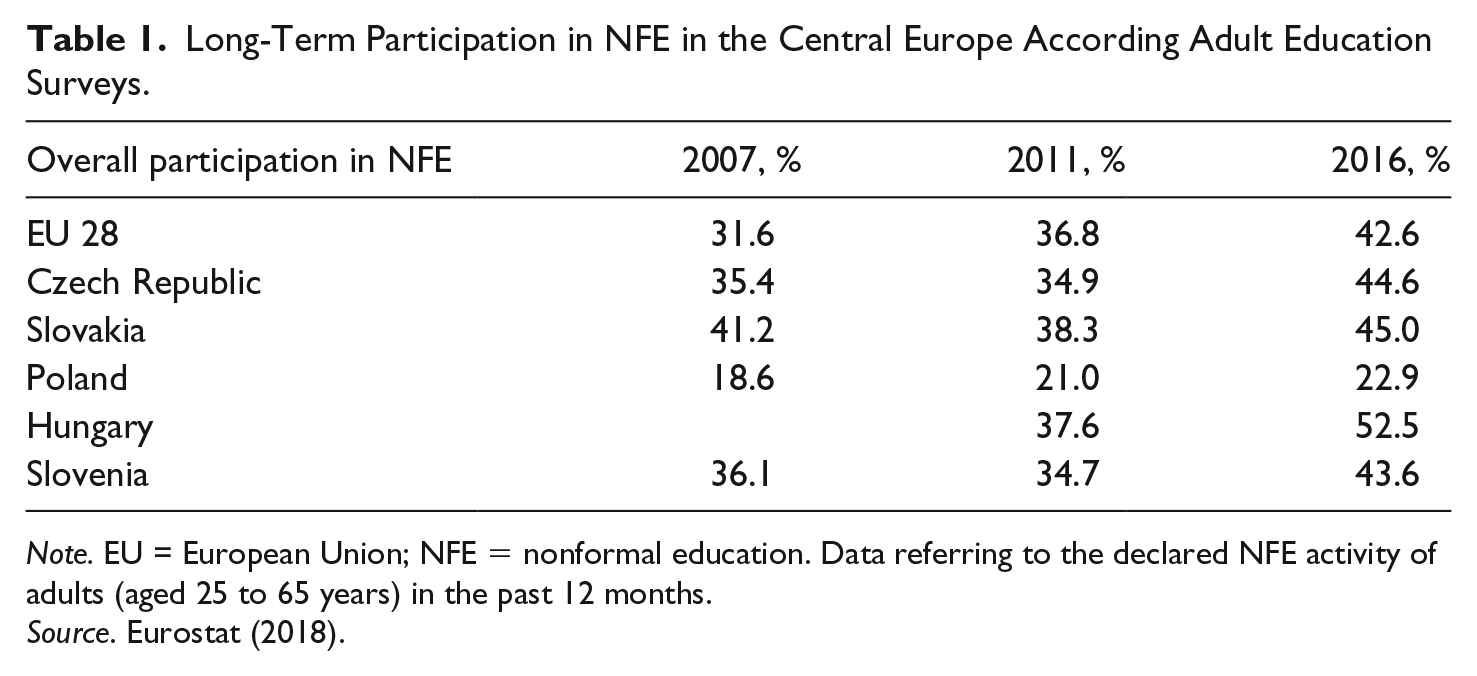
Note. EU = European Union; NFE = nonformal education. Data referring to the declared NFE activity of adults (aged 25 to 65 years) in the past 12 months.
Source. Eurostat (2018).
In connection with this problem, we want to focus on the context between the development of NFE participation and the factors affecting NFE participation in one of the Central European countries, the Czech Republic.
NFE in the Czech Republic
Regarding NFE in the Czech Republic, there are two main institutional features—the welfare system and the skill formation regime (Roosmaa & Saar, 2017). First, the role of adult education in the educational system remains underdeveloped. In the postcommunist era adult education was initially approached as a reaction to increasing unemployment in the late 1990s. Although NFE was understood and defined as one of the active social policy instruments, the state never transformed NFE into a system of certification recognized by employers in the Czech Republic. Because of this, NFE remained fragmented and only partially regulated by the state. It developed after 2008 through discontinuous financial incentives from EU funds focusing on the support for employers (Kalenda, 2015a; Kopecký & Šerák, 2015). The state educational policy has been primarily aimed at youth-education and the formal education of adults related to professional education (Simonová & Hamplová, 2016).
Second, the Czech Republic ranks among the countries with a skill formation regime without a strong demand for high-skill work power. The labor market is closed, with minimal international migration, and a prominent role is played by small companies with less than 50 employees (OECD, 2016). These are conditions which do not favor the extensive and systematic training of adults. Another essential element, foreign capital, is only involved in 40% of companies (Czech Statistical Office [CSO], 2016).
The closed labor market and the lack of foreign capital investment have an impact on the existing pattern of distribution in NFE. The participation in NFE in the Czech Republic was never very high. The statistics in international and national surveys show that participation rates have only slightly fluctuated: around 30% of adults between 1997 and 2011 (see Table 2), or around 9% if data according to the Eurostat methodology are used. 1 Based on these rates, the Czech Republic is usually classified as a country with above-average participation (see Desjardins, 2011, 2015, 2017).
Long-Term Participation in NFE in the CZE.

Note. NFE = nonformal education; CZE = Czech Republic. Data referring to the declared NFE activity of adults (aged 18 to 69 years) in the past 12 months.
Source. AES (2011, 2016), IALS (2000), Kalenda (2015b), and Rabušicová and Rabušic (2006).
The level of participation is heavily influenced by (a) the strong orientation of the Czech formal education system toward formal vocational training and the lack of a fully developed and institutionalized adult learning system, as well as by (b) the skill formation regime and the fact that the labor market does not favor high-skill labor. The position of the Czech Republic on the map of NFE participation is hybrid-like, as is its production (Saar, Ure, & Desjardins, 2013) and welfare regime (Vanhuysee, 2006). In other words, institutional features have oscillated between those of the Western countries (e.g., Germany, Austria, and Belgium) and those of the Eastern postcommunist countries (Slovakia, Poland, Hungary, and Slovenia).
The Purpose of the Study
The aim was to explore trends in the development of NFE along with individual sociodemographic determinants in the contemporary Czech Republic. The following two research questions were put forth:
Method
Participants
The data from the Eurostat Adult Education Survey (AES) 2 collected in 2011 and 2016, which focused on the critical micro-level aspects of participation in formal, nonformal, and informal adult education in the European countries, were used to address the research questions. In both cases, the surveys formed a representative sample of the Czech adult population from 18 to 69 years. In the case of AES (2011), we worked with a data set of 10,190 respondents of the average age of 42.9 years (SD = 14.7). The AES (2016) had 12,272 respondents of the average age of 44.3 years (SD = 14.5). The reference period for participation in adult learning activities used in this research was 12 months before the survey.
Data Analysis
The analysis was carried out with the use of IBM SPSS version 24. To compare the primary results of the AES (2011) and AES (2016) data sets, descriptive statistics in the form of absolute and relative frequencies and their differences were applied. To analyze the impact of individual characteristics on the probability of participation in NFE, separate binary logistic regressions (Wuensch, 2014) were carried out for AES (2011) and AES (2016). Subsequently, a decision tree analysis (Ritschard, 2013) was included. The analysis was conducted at the level of statistical significance .01.
In the analysis, we applied weights implemented to the data set by CSO, which balance the data set for the purpose of its representativeness of the Czech population. Nevertheless, our results and results previously published by CSO could slightly differ due to the rounding off or differentiation of other specific groups.
Results
Description of the Participation in NFE
The descriptive results show that 32% of respondents participated in at least one NFE activity in 2011. In 2016, participation rose to 39%. These basic descriptive findings are substantively significant, as for the first time the number of adults participating in NFE in the Czech Republic rose close to 40% (see Table 2).
Although the data allow us to work with a number of educational activities per year, we decided to work only with the binomial variable: participant and nonparticipant in NFE. We justify this strategy by the fact that the number of educational activities can be misleading because of the various types, lengths, and difficulties involved. Moreover, a clear majority of participants (64% in 2011 and 63% in 2016) reported just one activity in the past 12 months.
The next table (Table 3) shows the overall participation in NFE in 2011 and 2016 according to theory-based micro-social factors. In summary, participation in NFE has increased almost in all presented subcategories of the respondents except the unemployed, participants in formal education, and members of the age group 18 to 29 years (the difference between 2011 and 2016 in percentage points can be found in the last column of Table 3).
Comparison of Participation in NFE in the CZE According to Micro Social Factors.

Note. NFE = nonformal education; CZE = Czech Republic; ISCED = International Standard Classification of Education.
Or the male guardian’s highest education.
Or the female guardian’s highest education.
Looking more closely, we can trace several interesting trends in participation between 2011 and 2016. As for gender, the percentage of men participating in NFE increased, rising from 32% to 41%. These findings are probably the results of the higher integration of men in the local labor market, a factor also reported in the European Working Condition Survey (2015).
While in the past, the participation of adults older than 50 years of age in NFE was low in the Czech Republic (Kalenda, 2015b; Rabušicová & Rabušic, 2006; Simonová & Hamplová, 2016), the data from 2016 show a slowly changing trend in comparison to 2011. The age of the participants increased (average age rising from 39 to 41 years) and more employees were recruited from age categories older than 50 years.
As for educational attainment, most newly participating adults were shown to be persons with a higher secondary level of education (ISCED 3).
The results also show a substantial increase in full-time worker participation by 10%. Regarding occupational status, NFE primarily remains the domain of white collar workers (managers, professionals, technicians, and associate professionals). However, more interesting is that the percentage of blue collar employees (craftsmen and related trade workers, as well as plant and machine operators) increased much more dramatically (by 11%, respectively, to 13%). Our findings indicate an increasing proportion of low-skilled workers in NFE.
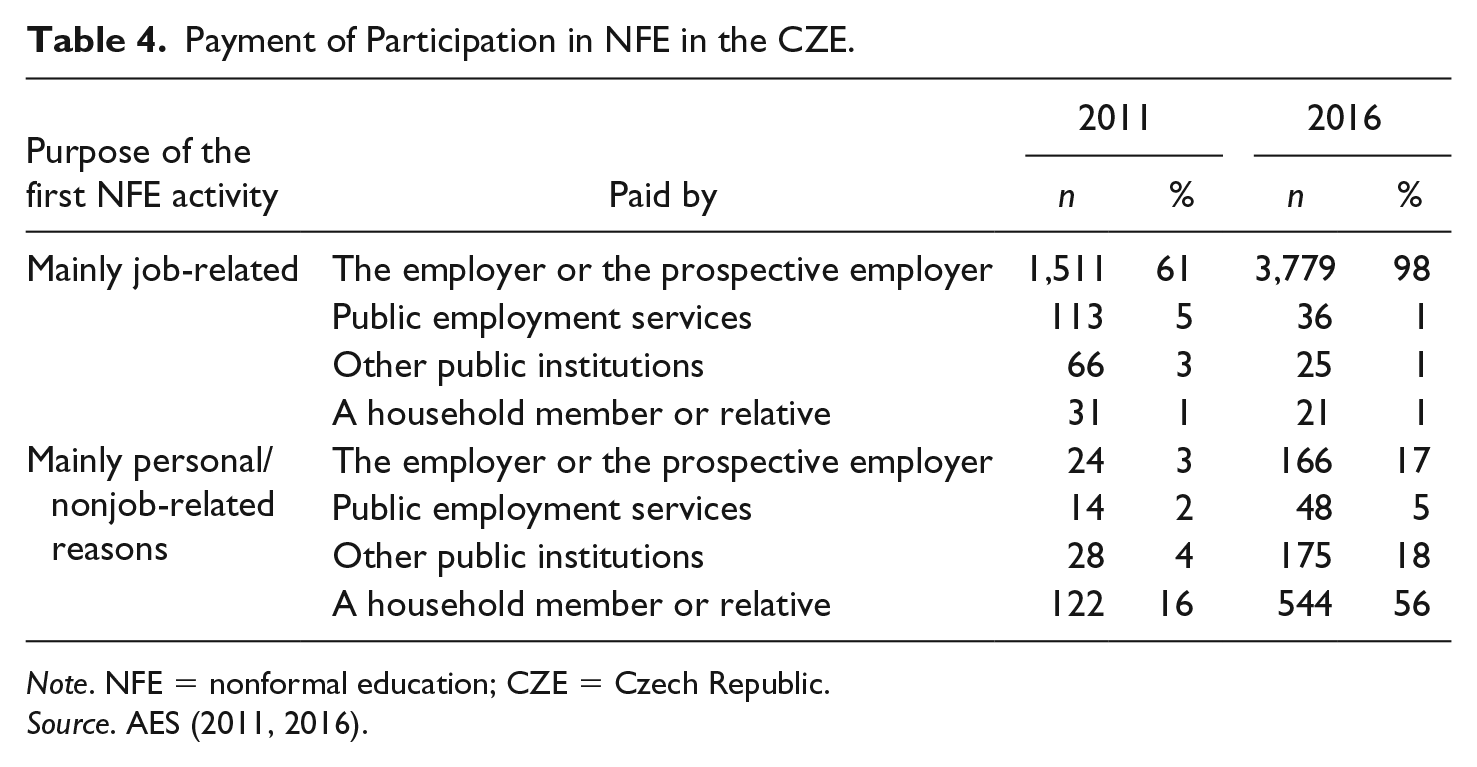
A probable explanation for these shifts lays in the transformation of sources of payment for participation in NFE during the investigated period (see Table 4). In this regard, most people in the Czech Republic participated in job-related training (76% in 2011 and 80% in 2016), while this training is increasingly sponsored by companies. While 61% of participants in job-related NFE declared financial support from their employers in 2011, 5 years later, it was 98%. NFE in the Czech Republic is thus being transformed into an activity which is mainly job-oriented and financed by employers. What should also be noted is that NFE which is not directly job-oriented is also more greatly supported by employers. While only around 3% of adults reported this kind of support in 2011, the rate was 17% in 2016.
Payment of Participation in NFE in the CZE.
Note. NFE = nonformal education; CZE = Czech Republic.
Regarding nonjob-related education, despite the new role of employers, self-paid financing by employees still plays a crucial role (16% in 2011, 56% in 2016).
Influence of Individual Characteristics on Participation in NFE
In the following section, we present results of the models regarding the impact of theory-based individual sociodemographic characteristics on the likelihood of participation in NFE in the Czech Republic. For this purpose, we used a binary logistic regression in which participation in NFE figured as a binary dependent variable. Using the “Enter” method, we uploaded/eliminated independent variables preidentified as potential determinants of participation in NFE.
Our aim was to define the main micro-level sociodemographic determinants of participation in NFE in the Czech Republic. Therefore, during modelling we did not focus on the richness of the models, but rather on their simplicity. We searched for a minimum of determinants that would explain the maximum range of participation in NFE.
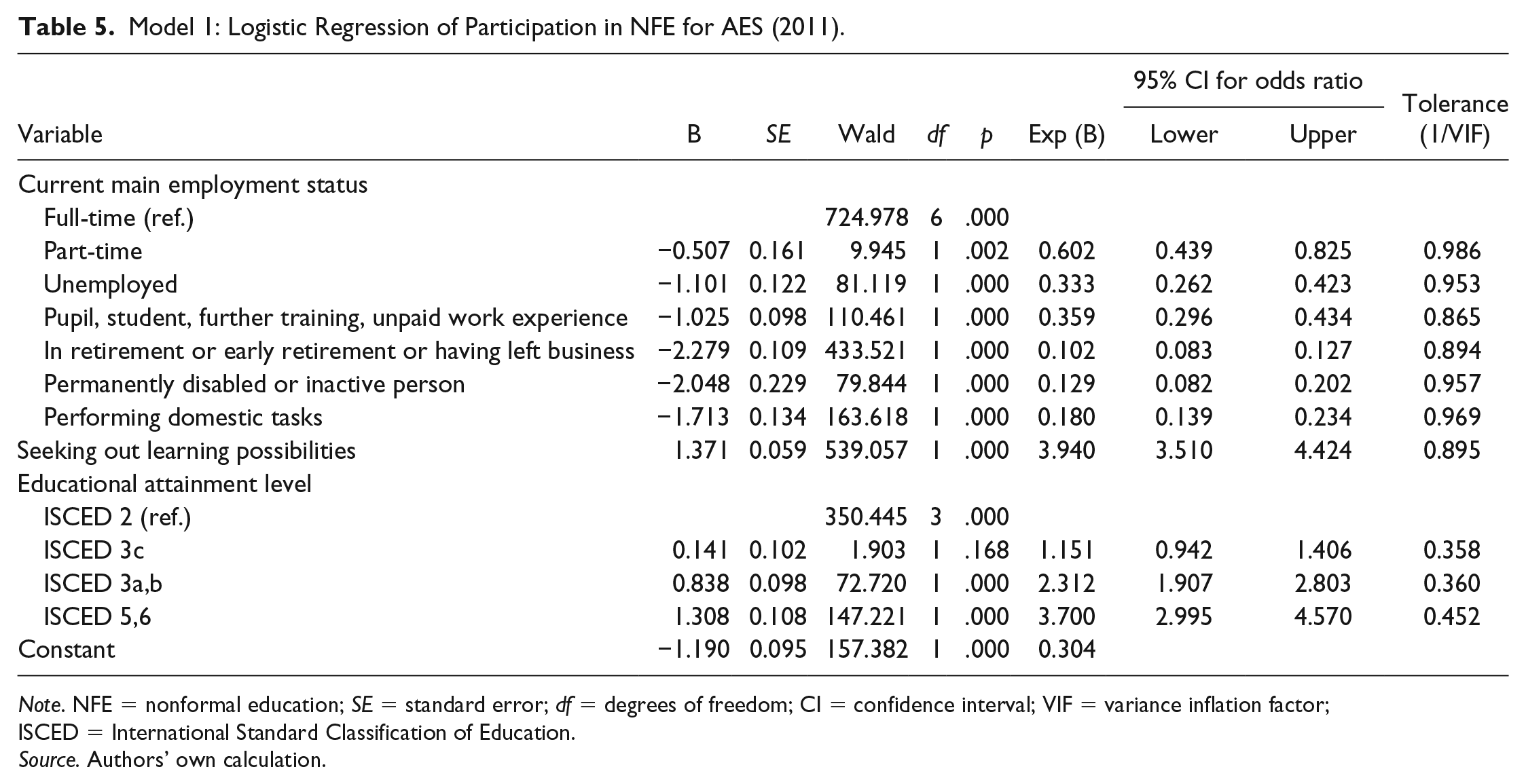
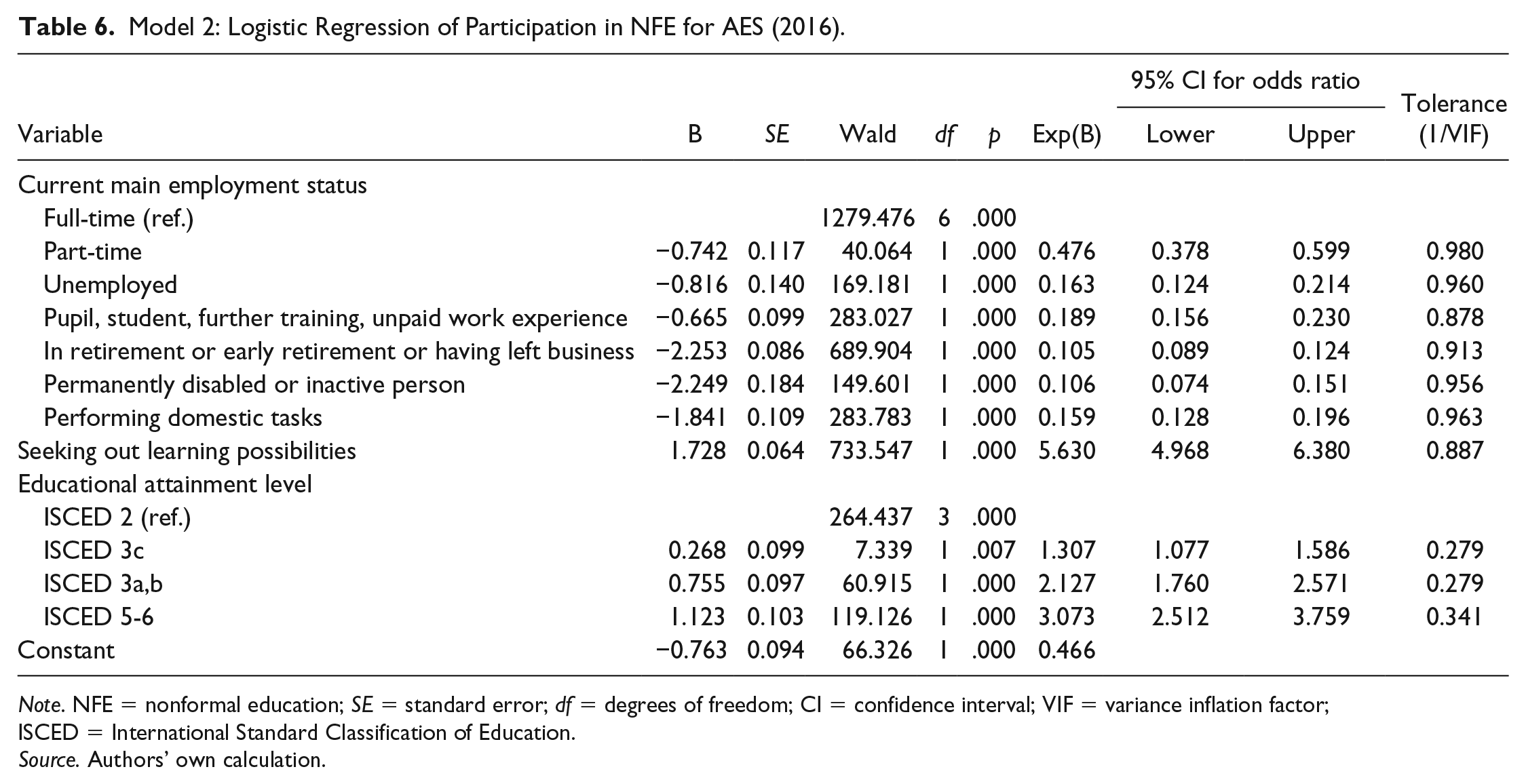
Multicollinearity diagnostics was realized for both regression models. This problem can be excluded as all values of tolerance (1/VIF) are >.2 (see the last column of the Tables 5 and 6).
Model 1: Logistic Regression of Participation in NFE for AES (2011).
Note. NFE = nonformal education; SE = standard error; df = degrees of freedom; CI = confidence interval; VIF = variance inflation factor; ISCED = International Standard Classification of Education.
Source. Authors’ own calculation.
Model 2: Logistic Regression of Participation in NFE for AES (2016).
Note. NFE = nonformal education; SE = standard error; df = degrees of freedom; CI = confidence interval; VIF = variance inflation factor; ISCED = International Standard Classification of Education.
Source. Authors’ own calculation.
Model 1 reached statistical significance χ2(10, n = 10,167) = 2465.032, p < .001; Cox and Snell R2 = 0.22; Nagelkerke R2 = 0.30; it correctly classified 74% of cases with improvement from 68% to 74% (see Table 5). Out of the tested variables, the current main employment status, seeking out learning possibilities as well as educational attainment level, were the strongest substantively significant predictors of participation in NFE. As shown in Table 5, only one category of educational attainment (level ISCED 3c) did not make a unique statistically significant contribution to the model.
Model 1 shows that the crucial parameter for participation in NFE in 2011 was main employment status, a variable which presented the highest odds ratios of participation of full-time working individuals. Another essential component which rapidly increased the chance of participation was the active attitude to learning opportunities, followed by each educational level higher than elementary education.
Model 2 reached statistical significance χ2(10, n = 12,242) = 3318.542, p < .001; Cox and Snell R2 = 0.24; Nagelkerke R2 = 0.32; it correctly classified 70% of cases with improvement from 61% to 70% (see Table 6). The same variables were again the strongest substantively significant predictors of participation in NFE.
Based on this analysis, we can conclude that identical variables play similar roles in both models, but their influence varies. In general, in 2016 (Model 2) full-time workers were more likely to be educated in 2016 as compared with 2011. The significance of whether people are actively seeking information on education also increased in 2016. In the case of educational attainment, we found a slight reduction of its impact on participation in NFE in 2016.
Although a large number of variables were featured in both surveys, the correct classification of the models is not greater than 74% of the cases for 2011 and 70% for 2016 when combined. Adding other variables to the models did not lead to a significant improvement.
Application of a Decision Tree Algorithm
In the last part of our analysis, we focused on previously identified key variables (current employment status, active attitude to learning opportunities, and educational attainment) and how combinations of these change the percentage of participation in NFE. For this purpose, we used the Decision Tree Analysis, which clusters results in a progressively branching chart. We applied the CHAID (Chi-squared Automatic Interaction Detection) method, which orders independent variables according to their influence on the dependent variable. CHAID combines categories of individual variables unless they are statistically significantly different. We primarily focused on the participants in NFE (not nonparticipants). Validation was carried out using the Cross-Validation Method (10 sample folds). We set a minimal number of cases to 200 for Parent Node, and 100 for Child Node. This analysis allows a different view of our results (Tables 5 and 6), and we also consider it their validation. We must point out that it is not possible to apply weights during the classification tree procedure, as it would lead to slight differences compared to previously presented results.
Shown in Figure 1, the analysis for 2011 correctly classifies 75% of cases. The graph is gradually split from top to bottom according to 3 previously identified determinants of participation in NFE.
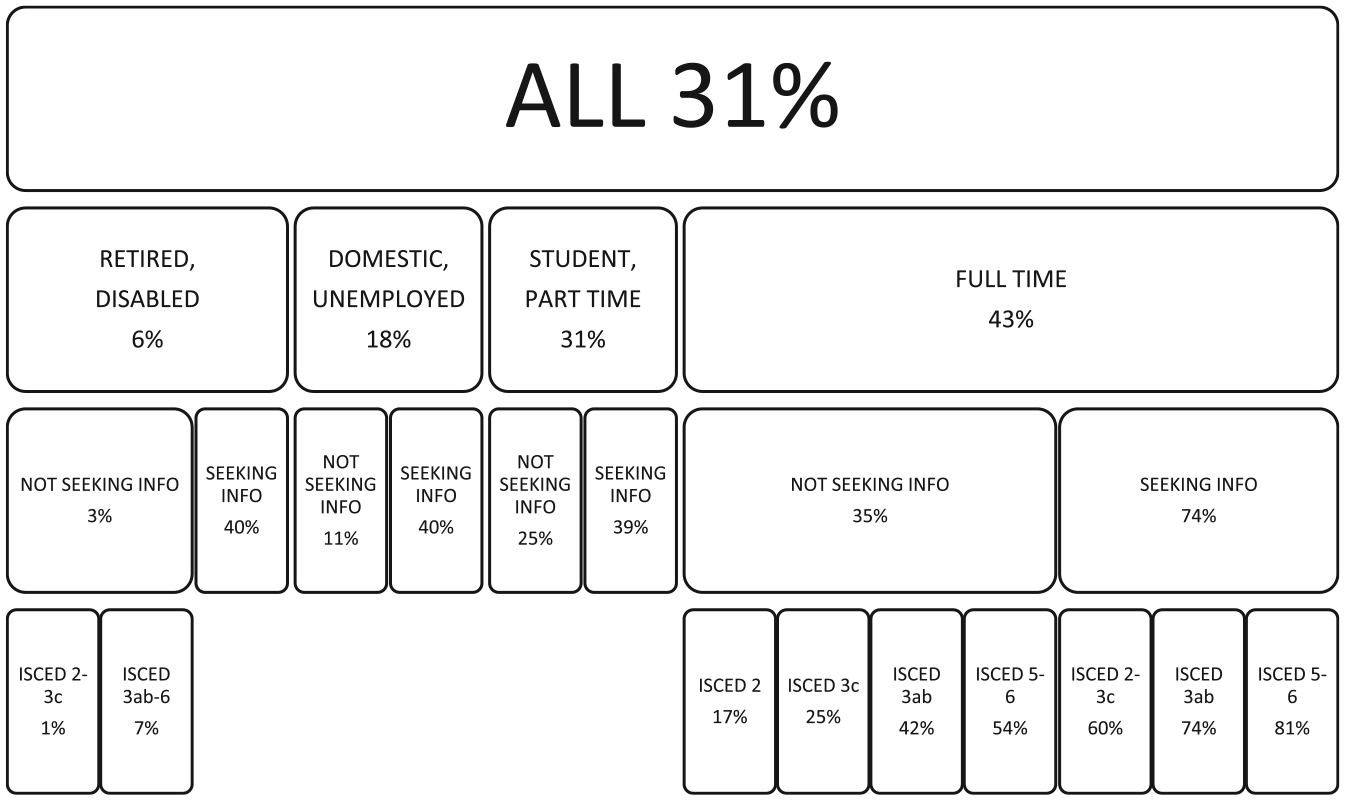
Decision tree for participation in NFE for AES (2011). 1
According to the CHAID analysis, current main employment status has the most significant effect on participation in NFE. At the second level is seeking out information about learning possibilities, followed by educational attainment. In the chart (Figure 1), we can find statistically significant different categories concerning the percentage of the NFE participants. On the one hand, the lowest participation (1%) was among retired/disabled people who did not seek out information about education, and who have a primary or secondary level of education without passing a final state exam (ISCED 2,3c). On the other hand, most participants (81%) are full-time working adults who seek out information about learning and have a higher education.
Figure 2 shows results for 2016. The analysis correctly classifies 72% of cases and shows very similar results to 2011.
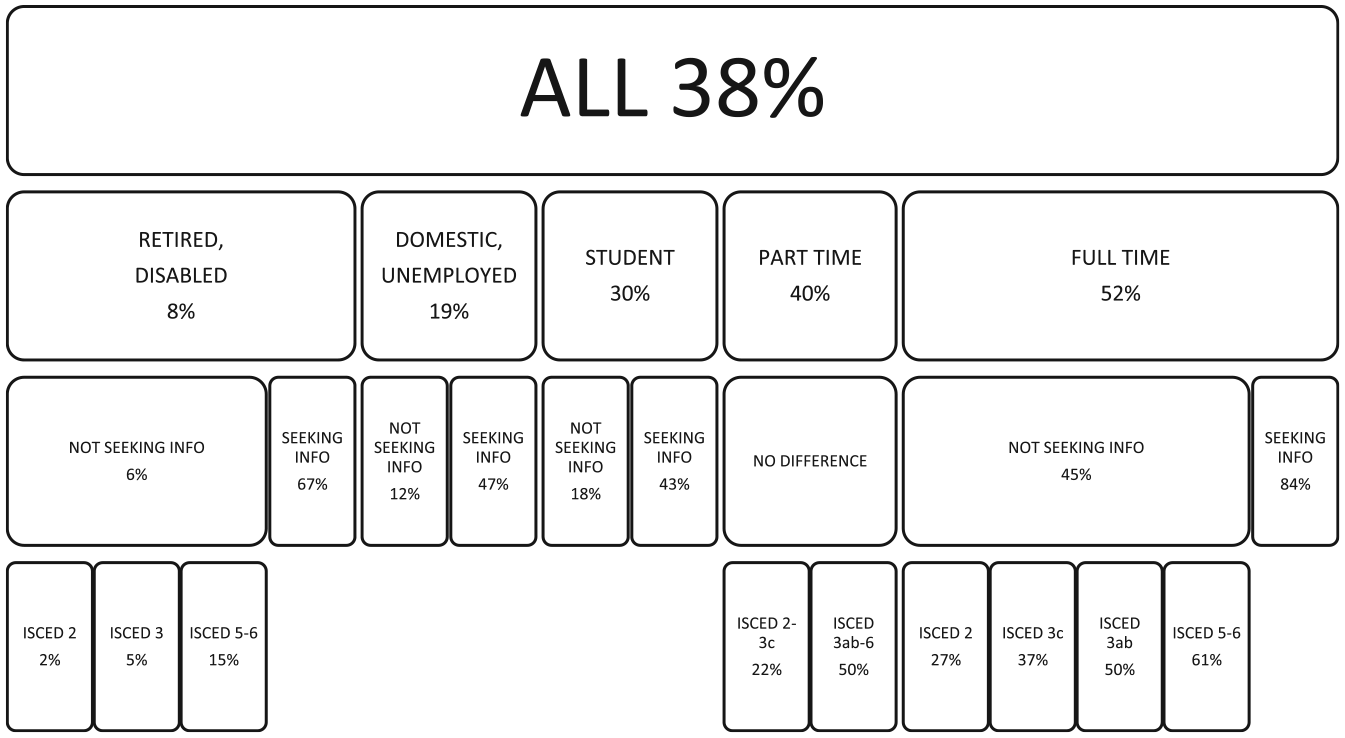
Decision tree for participation in NFE for AES (2016).
Discussion
Theoretical Implications
If we compare our results with the current knowledge regarding participation in NFE, we find similar trends in the Czech Republic as in other countries. First, there is a significant increase in the participation of adults in NFE, and second, participation is much more oriented toward the labor market. Both trends are even more intense in the case of NFE in the Czech Republic in 2011-2016 than those described by Desjardins (2017, p. 113) and Rubenson (2018, p. 344) for countries of West Europe and North America in 1994-2012. In other words, many more individuals participate in NFE than ever before, but it is predominantly for work reasons (see Table 4). All other forms of NFE are significantly downplayed, which makes NFE very much subject to market forces and employers’ interests.
In a deeper analysis of individual socioeconomic factors, we find that the strongest predictor of participation in NFE in the Czech Republic is employment status, with being employed playing a more important role in the participation in education and training than any other factor. If we compare our results with Rubenson, Desjardins, and Yoon (2008), according to which the employed have on average 1.5 times higher chances of being educated, in the Czech Republic these chances are higher compared with other categories of employment status. In addition, they increased even further between 2011 and 2016 (see Tables 5 and 6).
The importance of this factor is then manifested in yet another aspect which forms a key link between the increase in the overall NFE participation (see Table 3) and the factors affecting it (see Tables 5 and 6). With the expansion of the job-oriented NFE paid by employers (see Table 4), the role of employment status as a starting point for NFE participation has also increased. In other words, the growing interest of employers in educating their employees due to the revival of overall economic growth, and the transformation of the economy was in turn reinforced by employee need to participate in NFE.
The second strongest predictor of adult participation in NFE in the Czech Republic stems from an active approach to finding out information about educational opportunities. In this case, the present data from the Czech Republic correspond to the findings of both current international (Desjardins et al., 2006; Keller, 2010) and national research (Kalenda, 2015b; Rabušicová & Rabušic, 2006).
The third most important predictor of participation in NFE is the respondents’ level of education. According to our findings, NFE in the Czech Republic exhibits the aforementioned Matthew effect (Boeren, 2016, 2017; Rubenson, 2018). However, compared with the period between 2005 and 2011, which has been mapped out by previous research (Rabušicová & Rabušic, 2006; Simonová & Hamplová, 2016), its importance is decreasing. We should also add that the highest level of education achieved by parents affects the participation in NFE only secondarily. Therefore, participation in NFE is not fundamentally associated with the adult family background in the case of the Czech Republic.
Our analysis did not show any significant role of class position given by the nature of the work, nor the age of the adults involved as other key predictors of participation in NFE. Both of these factors are “overshadowed” by employment status, which is a much more important/general predictor.
When dividing workers into high-skill and low-skill workers (Desjardins, 2015; Kalenda, 2015b; Rabušicová & Rabušic, 2006; Roosmaa & Saar, 2017; Saar & Räis, 2017), we can see a higher tendency toward participation in NFE in the case of high-skill workers. However, in 2016, we see a more rapid increase in participation in NFE in the case of low-skill workers (Table 3), so the differences between these groups are shrinking. Based on data from the PIAAC survey of Czech skill formation from 2011 to 2012, Saar and Räis (2017, p. 545) conclude that there has been a shift in the prevailing opinion that the local labor force has no need of training. We assume that the increase in educational activities would not have been possible without the investment of companies in job-related training as compared to 2011 (see Table 4), as most low-skilled workers declared financial reasons as the main constraint of their lifelong learning activities (Kalenda & Kočvarová, 2017) in addition to the uselessness of NFE for their jobs (Simonová & Hamplová, 2016).
We can conclude that the increase of participation in NFE in the Czech Republic is not primarily influenced by building a strong welfare state or by effective social policy, as might be inferred from the bounded agency model (Rubenson & Desjardins, 2009), but on the contrary by the significant neoliberalization of NFE and employer involvement as key factors in the adult education system. The revival of economic growth accompanied with an intensive transformation of the economy after 2013, along with a closed labor market with a limited labor capacity resulted in high demand for work-oriented education, which has made employment status the pivotal determinant of participation in NFE and has decreased the impact of the other traditional socioeconomic variables of age, class, and the highest educational attainment of parents.
Practical Implications
In terms of practical implications, the transformations which have taken place in the Czech Republic have at present had several important consequences. In the first place, inequalities in access to NFE no longer follow the lines given by class status, educational attainment or age, but can rather be explained in terms of integration into the labor market. Social groups excluded from the labor market (e.g., pensioners, the unemployed and those on parental leave) therefore have more difficult access to NFE. Educational policy instruments should therefore focus more on the situation of these target groups. Above all, they should include financial support in the form of training vouchers, together with support for child care and other family-related services and information on the available training offers for the target groups.
Second, the changes described above place increased demands on employers organizing and financing the vast majority of NFE. Policy makers should consider new financial support instruments (e.g., tax exemptions) for employers, especially in professions that are undergoing the most significant transformation and that have increased demands for workforce training.
Limitations
In relation to the AES, the survey provides data on the participation in adult learning from the individuals’ perspective, carrying with it the known limitations of self-reporting. Another weakness of the AES is the reference period of 12 months. Many countries reported that it was very difficult for respondents to recall all learning activities they participated in during the reference period in such a detail as required by the AES. Furthermore, analyses of the available data show that results of the adults’ participation gathered from the AES are higher than results from other surveys in lifelong learning mainly because of the mentioned differences in the reference periods and the coverage of learning activities particularly oriented toward job training.
From the statistical point of view, in such large data sets even relatively weak results are statistically significant, which is why we focused primarily on substantively important predictors of NFE participation. We therefore excluded other statistically significant variables which did not increase the quality of the models. We should also mention differences in the data sets from 2011 to 2016 as well as missing values. Taking this into account, the analysis we made included primarily the variables that appeared to be relevant in previous research and were also available for the vast majority of respondents in both data sets.
Recommendations for Future Research
Further research into the participation in NFE should examine other relevant factors—macrosocial (e.g., public policy, welfare system) as well as mesosocial (e.g., learning providers, workplace as learning environment)—as highlighted in theoretical models of understanding participation in lifelong learning (Boeren, 2016, 2017; Saar & Räis, 2017).
Footnotes
Declaration of Conflicting Interests
The author(s) declared no potential conflicts of interest with respect to the research, authorship, and/or publication of this article.
Funding
The author(s) disclosed receipt of the following financial support for the research and/or authorship of this article: The article was written with the kind support of the Czech Science Foundation through the project Blind Spots of Nonformal Education in the Czech Republic: Nonparticipants and their Social Worlds, GA_19-00987S.
