




Abstract
This study presents the first comprehensive examination of disadvantaged adults’ participation in Nonformal Education and Training (NFE) across 30 European countries. It investigates how disadvantaged participants differ from their nonparticipating peers within the same social groups, the influence of multi-level factors on their participation, and the specific characteristics of their participation in NFE. Drawing on data from the 2022 Adult Education Survey, the study yields three key findings. First, their participation is shaped by a multilayered structure of age, education, labor market, and country-level variables. Second, their likelihood of participation varies significantly between national adult learning systems. Third, patterns of engagement differ with respect to the type of NFE, mode of delivery, learning initiation, and the provision of guidance. These findings underscore the enduring structural inequalities in NFE and point to the urgent need for policy frameworks that address the multilayered nature of factors influencing participation among disadvantaged adults.
Keywords
Introduction
Nonformal education and training (NFE), which includes educational courses, workshops, individual lectures, and guided on-the-job training (CLA, 2016), plays a crucial role in adult learning and skill development. However, its accessibility remains significantly unequal. While—based on data from the Eurostat Adult Education Survey—an average of 44% of adults aged 25–64 participated in the last 12 months in NFE across European Union (EU) countries in 2022, only 23% of individuals with the lowest levels of educational attainment took part. Similar findings can be observed among individuals with the lowest occupational status and those older (Eurostat, 2024). As a result, participation in NFE continues to be disproportionately concentrated among the already advantaged—individuals with higher educational attainment, included in the labor market, and with higher occupational status (Boeren, 2016; Boyadjieva & Ilieva-Trichkova, 2021). This persistent inequality raises fundamental questions about the factors that prevent adults from disadvantaged social backgrounds from accessing these key learning opportunities, as well as factors that enable them to overcome these socioeconomic barriers, considering their educational background, occupational status, and age, that is, that help them participate “against all odds.”
This is more important than ever, as the current landscape of adult learning and education is characterized by a paradox: while skill development becomes increasingly crucial in a rapidly evolving knowledge economy (Draghi, 2024; OECD, 2023), the most vulnerable populations remain systematically excluded from NFE learning pathways. Recent data from the second wave of the PIAAC survey (OECD, 2024) indicate that one-fifth of adults in advanced postindustrial countries possess very low skill levels. Despite policy efforts to bridge this gap, participation in organized adult education has consistently fallen short of expectations across most European countries over the past two decades (Holford, 2023). As the current EU policy aims to raise participation rates among low-qualified adults from 18% to 30% by 2025, dependent on the country in which they live, and to 45% by 2030 (European Commission, 2025), there is an urgent need to better understand factors that influence the participation of socially disadvantaged adults.
While current research has examined various mechanisms underpinning these inequalities—such as sociodemographic and socioeconomic factors (Dämmrich et al., 2015; Lee & Desjardins, 2019; Roosmaa & Saar, 2012, 2017) and behavioral factors related to participation like motivation, perception of barriers, and attitudes to adult education and learning (Broek et al., 2025; Cabus et al., 2020; Ioannidou & Parma, 2022; Kalenda et al., 2023; Mertens et al., 2025; Pieńkosz et al., 2025; Van Nieuwenhove & De Wever, 2024)—comparatively little attention has been given to the factors that enable the most disadvantaged adults to break these patterns and engage in NFE, and to what extent these patterns vary across distinct European countries. Although a recent German study by Floiger et al. (2025) examines the factors associated with unexpected upward intergenerational educational mobility within the initial education system among students from disadvantaged educational backgrounds, comparable analyses in adult learning and education remain scarce.
Therefore, this study addresses a critical gap in existing research on participation in adult learning and education: the limited understanding of how the most disadvantaged adults manage to participate in NFE “against all odds.” In line with previous literature (Boeren, 2016; Desjardins et al., 2006, pp. 74–75), we define this group on the intersection of two sociodemographic and two socioeconomic characteristics:
a low level of formal education attainment, which precludes direct entry into higher education (ISCED 1–3c); an older age range (45–64 years); exclusion from the labor market as an indicator of economic status; low occupational status for those who are employed, that is, working as manual labor workers or low-skilled service workers (ISCO 5, 8, 9).
By utilizing a multilayered theoretical framework (Boeren, 2016; Cabus et al., 2020; see also Figure 1) that emphasizes the influence of various factors on participation in organized adult learning across different social levels (micro, meso, and macro), this research aims to challenge conventional narratives of educational participation. It seeks to shed light on the intricate processes that enable skill development among individuals who are typically excluded from NFE opportunities and face the intersection of individual factors stated above that work against their participation.
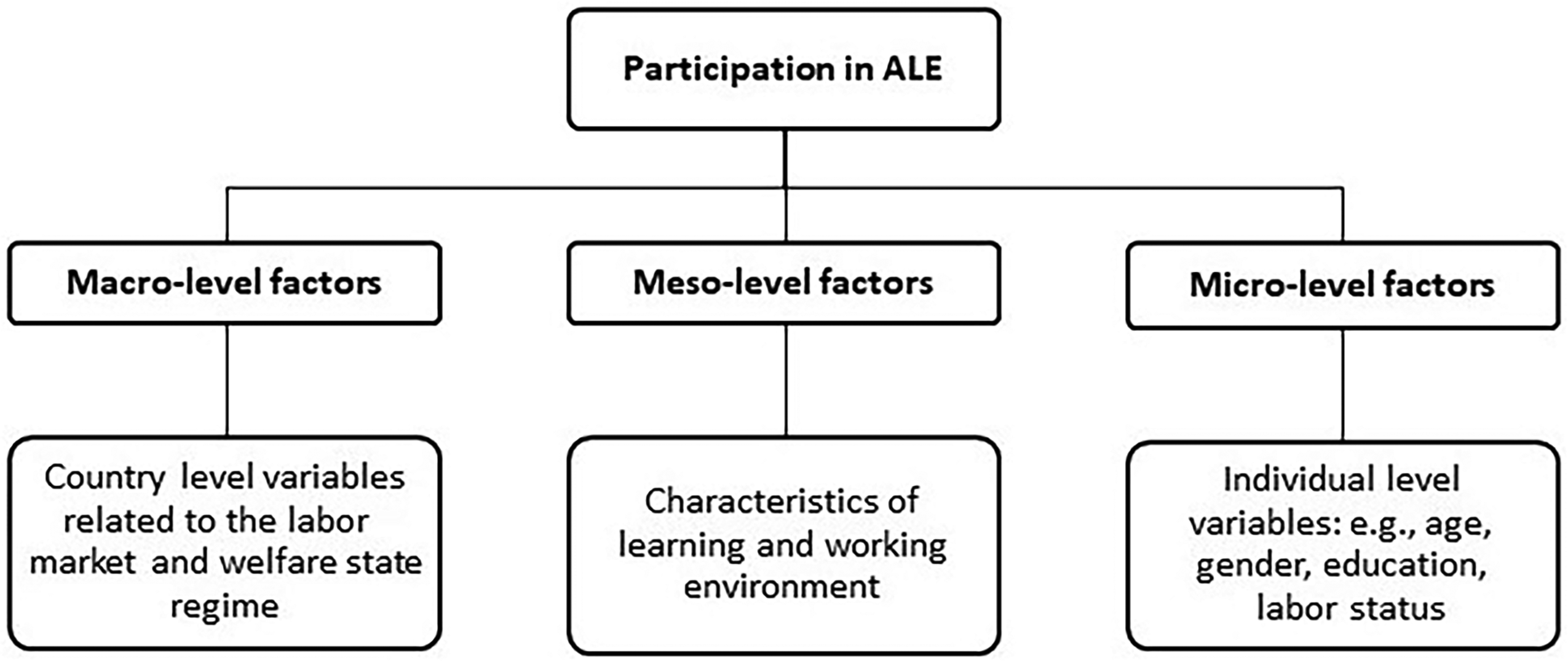
Overview of the multilayered framework used in the article.
Following this objective, the article aims to address the following two interrelated research questions:
To address these two research questions, we first present the current state of knowledge in the field related to them. Next, we examine the methodology employed for a secondary data analysis of the Adult Education Survey (AES) 2022. We then direct our attention to the results corresponding to each research question. The final section of the article is dedicated to a discussion of our findings, an acknowledgment of the limitations of our analysis, and an outline of directions for future research.
State of the Art
The Current Micro-Level Insights on Participation
Over the past three decades, research into participation in adult education and learning has gathered substantial evidence on the factors that primarily contribute to inequality in NFE on the national level. Four key factors have consistently emerged as the most significant and persistent determinants of this participation inequality at individual level: (a) highest level of education attained; (b) age; (c) economic status; and (d) occupational status (Boeren, 2016; Boyadjieva & Ilieva-Trichkova, 2017; Lee & Desjardins, 2019).
The mechanisms behind them usually explain that individuals with lower levels of education, lower levels of occupational status, older age, and outside of the labor market have both lower supply and demand of educational opportunities. On one hand, they have fewer opportunities and receive less support for organized learning, both within the workplace and in their environment. On the other hand, they often encounter dispositional barriers, such as low motivation, negative past experiences with the educational system, or are unable to translate acquired skills into meaningful improvements in their life circumstances (Boeren, 2016; Cabus et al., 2020). As a result, their willingness to engage in NFE is significantly diminished.
While additional sociodemographic and socioeconomic factors such as gender, ethnicity, sector of the economy where individuals work, or employment contract type also contribute to inequality in NFE participation (Dämmrich et al., 2015), the four above-mentioned social characteristics have been identified as the most consistent and widespread predictors of individual participation. Other factors tend to produce more ambiguous results at the population level or exert a weaker influence on participation rates (Desjardins et al., 2006; Lee & Desjardins, 2019).
Despite efforts in some countries to democratize access to NFE, inequality persists. While data from IALS, AES, and the PIAAC show that participation rates among adults with lower education levels or occupational status have increased in the 2010s compared to the 1990s and early 2000s, groups with a low level of education and occupational status and older age continue to participate with the lowest chances (Eurostat, 2024; OECD, 2023, 2024).
When studying the participation of disadvantaged adults, research typically focuses on their nonparticipation (Boyadjieva & Ilieva-Trichkova, 2017; Cabus et al., 2020; Ioannidou & Parma, 2022; Kalenda et al., 2023). Only a handful of studies examine the participation of adults from disadvantaged backgrounds, and these tend to emphasize their motivation and behavioral drivers of learning, primarily employing qualitative and mixed-method approaches (Broek et al., 2025; Mertens et al., 2025; Van Nieuwenhove & De Wever, 2024). They rarely investigate the micro-social factors that influence the conditions under which even the most disadvantaged individuals might participate and their international patterns or focus on adults who experience intersectionality across all four key sources of inequality in NFE (i.e., education, age, economic, and occupational status).
However, such insights are crucial for developing evidence-based policies targeted at improving participation rates of the most marginalized groups and understanding their current cross-country variability. To address this gap, we leverage the extensive dataset provided by the AES to conduct an in-depth analysis, incorporating additional microsocial and microeconomic characteristics that may influence participation in NFE within our target group. Specifically, following other key factors detailed in the multilayer theory of participation (Boeren, 2016), we examine the roles of (a) gender, (b) more nuanced age- and (c) education-related variables within the group of our interest, distinguishing between ISCED 01, 02 and ISCED 3c category, and (d) levels of urbanization. Additionally, we also consider more detailed economic and labor market factors such as the (e) type of job contracts, (f) employment status, and (g) economic sector.
The Macro-Level: International Patterns of Participation
The international comparative research on adult education and skills has identified multiple typologies of lifelong learning and adult learning systems (Desjardins, 2017; Green, 2006; Saar & Ure, 2013; Saar et al., 2013). These theories not only describe institutional (macro-social) characteristics that influence the overall volume of adult education and training within a country but also shape the extent of inequality in participation, which is in the spotlight of this study.
There is a consensus that the effect of sociodemographic and socioeconomic factors on participation inequality, as outlined above, can be mitigated through various institutional interventions on the macro-level of the country (Boeren, 2016; Cabus et al., 2020; Desjardins, 2017; Ioannidou & Parma, 2022; Lee & Desjardins, 2019). For example, these include legal mandates requiring a minimum number of training hours for employees, or tax incentives for companies that invest in workforce training. Furthermore, state-led initiatives—such as active labor market policies that provide courses through public institutions or distribute training vouchers—could play a crucial role in promoting equitable access to NFE.
Among several competing typologies that try to explain differences among countries, the most widely utilized for comparative research within the European area is a typology of adult learning systems by Ellu Saar et al. (2013; Saar & Ure, 2013). This typology conceptualizes differences among countries as variations in institutional clusters responsible for the labor market, vocational education system, and welfare system. Drawing from the political economy frameworks of the Varieties of Capitalism (Hall & Soskice, 2001) and Welfare-State Regimes (Esping-Andersen, 1998), this typology identifies three major categories with seven models of European adult learning systems. The overview of these models, related countries included in our empirical analysis, core characteristics of NFE provision, and participation patterns is presented in Table 1.
Typology of Adult Learning System (ALS).

Note. NFE = Nonformal Education and Training.
Countries included in the empirical analysis.
Source. Adopted from Saar and Ure (2013) and Saar et al. (2013).
According to this typology, countries operating within Coordinated Market Economies with a social democratic welfare model should exhibit the highest participation levels and the lowest inequality in NFE participation among the most disadvantaged adults (Saar & Ure, 2013; Saar et al., 2013). These countries have the most developed support structures for this target group, along with strong stakeholder coordination. Through active state involvement and collaboration with key stakeholders, they are able to address disparities in access to NFE opportunities while also stimulating demand by implementing measures such as the recognition of prior learning and personalized counseling (Desjardins, 2017). On the contrary, especially countries in the Continental Southern Model, and various postsocialist models should expect to have a higher inequality among the most disadvantaged adults as a result of lower demand for upskilling of the population, as well as lower support by the welfare state (for more details, see the last column of Table 1). Overall, the extent of welfare-state correction emerges as the key factor shaping equity and inclusion within adult learning systems across different regime types.
Although the validity of this typology has recently been questioned in explaining overall participation rates and engagement among specific target groups in adult education—particularly based on data from the 2010s (Ioannidou & Parma, 2022; Kalenda, 2024)—it has not yet been tested against the latest large-scale international data from the most recent wave of the AES. Therefore, the examination of country-level (macro-) factors influencing the participation of disadvantaged adults (RQ1) adheres to the core assumptions of Saar et al.'s (2013) original framework (Saar & Ure, 2013).
The Meso-Level: Nature of Participation in NFE Activities
Compared to research that examines inequalities in participation in NFE at micro- and macro-levels, the investigation of the nature and characteristics of participation in NFE activities remains underdeveloped in the field. Only a handful of studies (Karger et al., 2024; Tuijman & Boudard, 2001) have addressed differences in the nature of participation based on various types of NFE (e.g., courses vs. individual lessons), different organizational settings (online/offline), initiation (whether by the employer or the learner), and training volume (number of NFE activities and hours of training).
Even when such studies exist, they do not focus on disadvantaged learners and rarely compare the most disadvantaged participants with traditional adult learners who have higher levels of education and occupational status (for an exception, see Tuijman & Boudard, 2001). In line with our multilayered approach (Boeren, 2016), there is a need for more systematic research that explores the interplay between individual characteristics and structural conditions that shape different forms of NFE participation, which could potentially influence participation rates as well as the provision of accessible NFE activities in terms of its intensity, individualization and form of delivery. For instance, the type of activity (e.g., a course versus an individual lesson) or mode of delivery (offline vs. online) could pose a barrier for some participants, particularly those from disadvantaged backgrounds, if the training requires a significant amount of time to participate (e.g., in the case of courses), or if they are not accustomed to online learning.
Method
Analytical Framework
Guided by the multilayer theory of participation (Boeren, 2016), this analysis integrates variables across three analytical levels: micro (individual sociodemographic factors), meso (organizational and workplace characteristics), and macro (country-level regime types and key macro-level indicators). This framework forms the foundation for all subsequent methodological steps and model specifications.
To address our research questions (RQ1 and RQ2), we draw on data from the fourth wave of the AES, conducted between July 2022 and March 2023, which encompassed 30 European countries. Although the AES 2022 sample covers individuals aged 18 to 69, we restricted our analysis to adults aged 45 to 64 (see sampling description below). This age group represents those at mid-to-late career stages, where participation in learning tends to decline most markedly and where cumulative labor-market and learning disadvantages are most evident (Desjardins, 2017; OECD, 2024). Furthermore, we distinguish economically active and inactive disadvantaged adults to capture potential variation in access channels to NFE—labor-market-related versus nonjob-based provision. This distinction allows us to assess whether employment mediates participation within disadvantaged groups.
Analytical Sample
The analytical sample derives from the AES dataset. We did not conduct primary sampling; rather, we applied inclusion criteria to define the population of interest related to RQ1 and RQ2. All target groups included in our analysis are presented in Table 2. The first two columns illustrate the samples used in the multilevel modeling of factors influencing participation in NFE among the most disadvantaged adults (RQ1). For this purpose, we defined two primary groups: (a) Sample I—disadvantaged adults aged 45–64 who are economically inactive and possess low levels of formal education (ISCED levels 0–3c); (b) Sample II—economically active disadvantaged adults in the same age range who are economically active and employed in low-skilled manual occupations or service roles, categorized under ISCO groups 5, 8, and 9. These distinctions allow analysis of how employment status mediates participation in NFE.
Sampling for the Study.
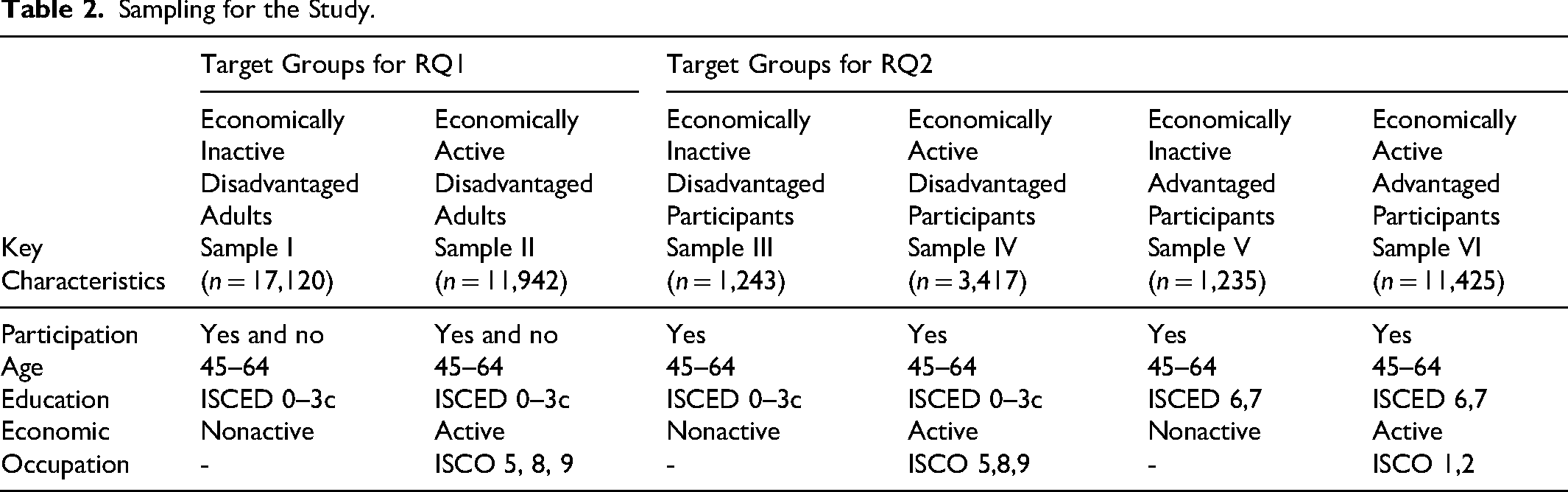
For RQ2, the analysis focused exclusively on NFE participants, categorized into two matched pairs of respondent groups. First, disadvantaged participants that are divided into: (a) Sample III—economically inactive individuals aged 45–64 with low educational attainment (ISCED 3c or below); (b) Sample IV—economically active individuals aged 45–64, also with lower levels of education (ISCED 3c or below), employed in medium- and low-skilled roles classified under ISCO categories 5, 8, and 9. Second, advantaged participants that are grouped into: (a) Sample V—nonworking adults aged 45–64 with high educational attainment (ISCED levels 6 and 7); (b) Sample VI—economically active adults in the same age range, with higher education qualifications and employed in high-skilled, white-collar professions corresponding to ISCO groups 1 and 2. According to the literature (Boeren, 2016; Boyadjieva & Ilieva-Trichkova, 2021; Desjardins et al., 2006), individuals from these socially advantaged groups have the highest levels of participation in NFE.
The overview of all analytical samples for the countries included in our analysis is presented in the Appendix (Supplemental Table S1). It classifies countries according to different types of European Adult Learning Systems, overall participation rates in NFE, and the proportion of disadvantaged participants (samples III and IV) among all participants.
Variables
The dependent variable is participation in NFE (1 = participated in at least one activity in the past 12 months; 0 = no participation). Independent variables include micro-level predictors (gender, age group, education, urbanization, employment type, contract type), meso-level predictors (company size, economic sector) for those who are economically active, and macro-level predictors, such as adult learning system type by Saar and Ure (2013) and Saar et al. (2013), as well as three additional control macro-level indicators related to economic development (gross domestic product [GDP] per capita), and general welfare policy (public spending on the labor market as a percentage of GDP) and targeted welfare policy (public spending on training programs as a percentage of GDP). Each categorical variable related to respondents was coded according to Eurostat AES conventions; the detailed coding is presented in the Appendix (Supplemental Table S2).
To examine differences in the nature of NFE participation between advantaged and disadvantaged adults (RQ2), we employed variables from the AES that capture meso-level participation characteristics. These include the type of NFE (e.g., workshop, guided on-the-job training, etc.), mode of delivery, initiation of participation, use of counseling services, and volume of learning, measured by the number of hours spent training. The Supplemental Material also provides a detailed description of these variables.
Analytical Strategy
For RQ1, hierarchical logistic regression models were estimated separately using Enter method for economically inactive and active disadvantaged adults (see Table 4). Model 1 included micro-level variables only, while Model 3 added meso-level variables for those economically active disadvantage adults. Models 2 and 4 included all levels (micro–meso–macro) predictors incrementally, with evaluation of each of the independent variables based on the odds ratios and the statistical significance values. Cases with less than 5% missing data, relative to the total number of cases in the samples, were treated as missing at random, implying that the likelihood of missingness was independent of the values of other variables (Tabachnick & Fidell, 2007).
For RQ2, descriptive comparisons between disadvantaged and advantaged groups of participants were conducted using differences in percentage points, Pearson's chi-square tests for goodness of fit for categorical variables, and independent-samples t-tests for metric variables to determine the statistical significance of differences.
Results
RQ1: What are the major Factors—Controlling Simultaneously for Micro, Meso and Macro Factors—That Influence Participation in NFE Among Most Disadvantaged Adults?
The findings addressing RQ1 are presented in Table 3. Model 1 includes only micro-level variables, while Models 2, 3, and 4 additionally incorporate meso- and macro-level predictors. Models 1 and 2 apply to economically inactive disadvantaged adults, whereas Models 3 and 4 pertain to economically active disadvantaged adults. As meso-level variables can be measured only for the economically active population, they are included exclusively in Models 3 and 4.
Odds Ratios of Binary Logistic Regression Models for Participation in NFE Among Disadvantaged Adults.
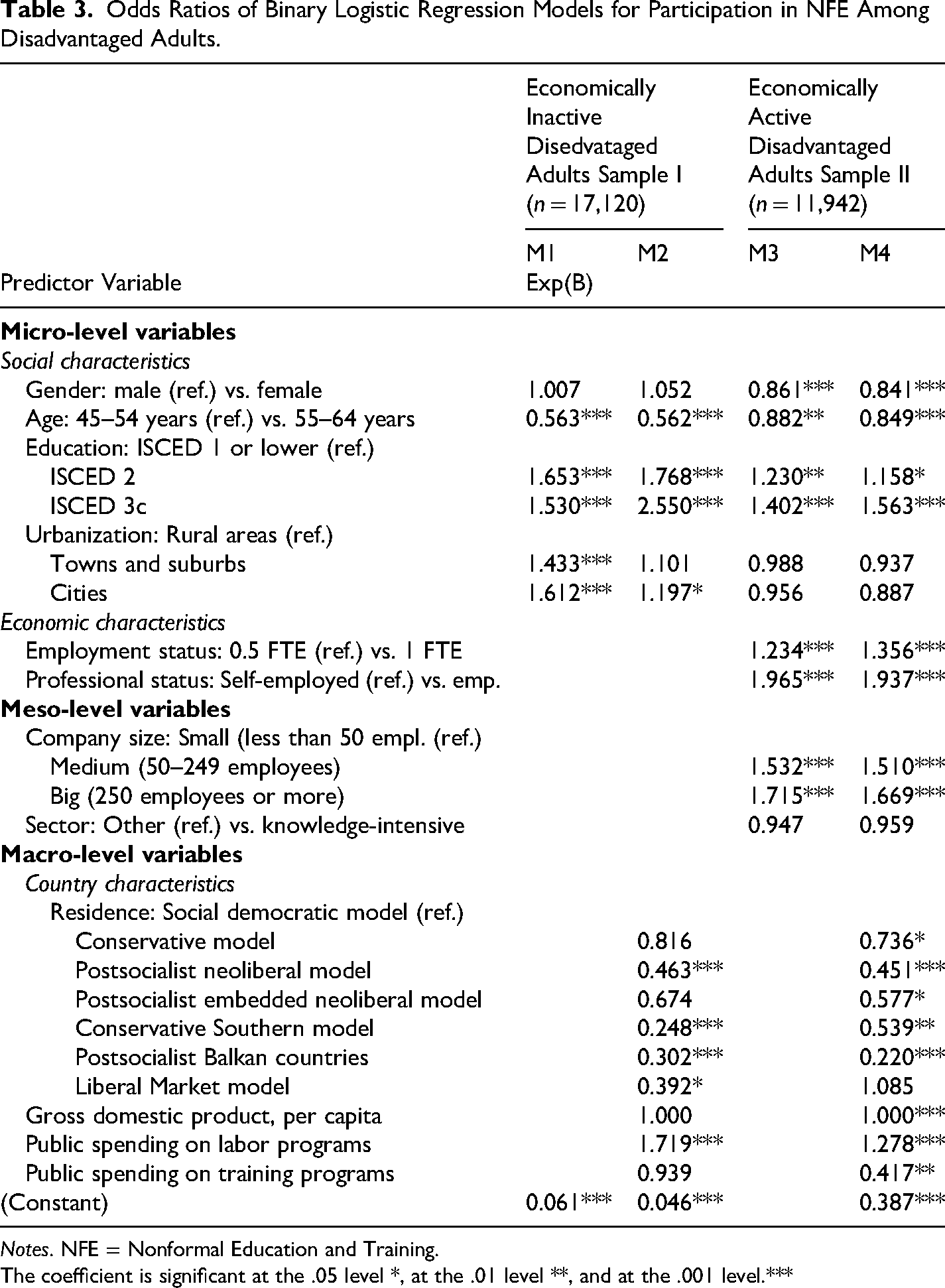
Notes. NFE = Nonformal Education and Training.
The coefficient is significant at the .05 level *, at the .01 level **, and at the .001 level.***
A hierarchical logistic regression analysis was conducted to examine whether the effects of variables, introduced in predefined blocks, remained stable or were moderated by interactions with other variables. Pearson's chi-square goodness-of-fit tests indicated that all models were statistically significant, with classification accuracies ranging from 70.8% to 80.4%. A comprehensive summary of the model performance indicators is provided in the Supplemental Material.
Regarding the impact of predictor variables introduced in the first block on participation (see Table 3), gender emerged as a significant factor, particularly among economically active individuals (Models 3 and 4). On average, women from disadvantaged backgrounds were less likely to participate in NFE than men, controlling for all other factors in the model. This trend remained statistically significant when including country-related characteristics (Model 4); however, gender did not emerge as a significant predictor in Models 1 and 2, in the case of women outside of the labor market.
Across all models, age was a consistent predictor, with older adults (aged 55 and above) being less likely to participate in NFE than their younger counterparts (45–54 years old). On average, the odds of older adults engaging in NFE were 29% lower compared to younger adults. This trend persisted even after accounting for other predictors, including economic activity and the type of adult learning system accompanied by GDP, and general or targeted welfare macro-level indicators. However, once these factors were considered, the effect of age was smaller.
Educational background significantly influenced participation in NFE. While the ISCED 3c level is often used as a threshold to identify low-educated adults, our findings reveal notable differences in NFE participation across all lower educational categories, irrespective of individuals’ economic circumstances. Specifically, adults with lower secondary education (ISCED 2) were, on average, 1.5 times higher chance to engage in NFE compared to those with only primary education or less (ISCED 1 or below). Likewise, adults with upper secondary education (ISCED 3c) were, on average, 1.8 times higher odds to participate.
The degree of urbanization of an individual's usual residence was a significant predictor in Models 1 and 2. On average, economically nonactive disadvantaged adults residing in towns, suburbs, or cities had higher odds of participating in NFE compared to those in rural areas. However, this effect lost significance when the sample was restricted to economically active individuals.
Models 3 and 4 incorporated economic and workplace learning-related characteristics. Employed adults had about a 1.9 times higher chance to participate in NFE than self-employed individuals. Higher participation rates were confirmed among employees of larger companies. Those who work at least in medium-sized companies with more than 49 employees have 1.5 to 1.7 times a higher chance to be involved in organized adult learning. Similarly, full-time workers had about a 1.3 times higher odds to engage in NFE than part-time employees, even after adjusting for all other factors. However, the employment sector did not emerge as a significant predictor.
The characteristics of adult learning systems, introduced in the second block of variables, demonstrated a clear influence in both Models 2 and 4, with a somewhat stronger effect observed among economically inactive adults compared to their economically active counterparts. The lowest participation rates in NFE among disadvantaged adults were found in the Postsocialist Balkan countries and within the Conservative Southern model—on average, with chances of participation 74% and 61% lower than in Social-democratic countries. In contrast, the highest levels of participation were recorded in countries with Social-democratic adult learning systems, followed by those with a Conservative model, which scored 26% lower chance of participation in Model 4.
Finally, the results indicate that GDP per capita has a modest yet statistically significant positive effect in Model 4, suggesting that participation in NFE among economically disadvantaged adults is slightly higher in more economically developed contexts. Public expenditure on labor market programs demonstrates a strong and consistent positive association with NFE participation across both samples, with the effect being particularly pronounced among economically inactive disadvantaged adults. In contrast, public spending on training programs shows no significant relationship among economically inactive adults, and a significant negative association among economically active disadvantaged adults.
RQ2: How Does the Nature of Participation in NFE Differ Between Participants From Disadvantaged Versus Advantaged Backgrounds?
The assessment of participation patterns of disadvantaged and advantaged participants reveals significant differences in the nature of NFE undertaken over the past 12 months (see Table 4, column “difference in percentage points”). First, Table 4 shows that there is a clear trend indicating that disadvantaged participants engage less frequently in workshops or seminars (−16 and −40 p.p.), courses and programs (−13 p.p.), and private lessons (−10 and −6 p.p.). Conversely, they are more likely to participate in guided on-the-job training (+11 p.p.) in case of economically active disadvantaged participants than economically inactive advantaged NFE participants.
Results of Descriptive Analysis Among Participants From the Disadvantaged and the Advantaged Background.

Notes. NFE = Nonformal Education and Training.
Type of NFE represents multiple-choice question. Volume corresponds to number of NFE activities/hours attended for the first randomly selected NFE activity during the last 12 months. Significant differences are highlighted in bold.
Second, the mode of NFE delivery also varies significantly. Disadvantaged participants are more often engaged in programs that are predominantly or entirely offline (+23 and +34 p.p.). Disadvantaged economically active participants initiated by their employer (+24 p.p.), and conducted without access to counseling or guidance on learning opportunities (+15 p.p.). This includes support for information-seeking and assistance with applications to learning programs, which these participants were less likely to receive in the past 12 months.
Regarding the volume of NFE activities reported by respondents over the last year, the average number of NFE engagements ranged between two and three across all participants. Advantaged participants reported a higher number of NFE activities compared to their nontraditional counterparts. The volume of training was the highest in the case of economically inactive disadvantaged participants and the lowest in the case of economically active disadvantaged participants.
Discussion
In this study, we examine the main factors that affect participation in NFE among the most disadvantaged adults (RQ1). The findings highlight that disadvantaged adults who managed to participate in NFE “against all odds” differ significantly from their nonparticipating counterparts in several key sociodemographic and socioeconomic aspects. Specifically, our modeling provides further evidence that participation in NFE among disadvantaged adults is shaped by a specific combination of individual (micro), organizational (meso), and country-specific (macro) factors, highlighting the relevance of the multi-layer theory of participation (Boeren, 2016) for the understanding of inequality among disadvantaged learners.
At the micro-level, economic activity, gender, age, and educational attainment significantly influence participation patterns. The primary factor affecting the participation of disadvantaged adults in NFE is their economic status. Once individuals from this group exit or do not enter the labor market, their likelihood of engaging in any form of NFE declines significantly. This finding not only reinforces recent research highlighting the critical role of employment in NFE participation (Kalenda & Kočvarová, 2022; Lee & Desjardins, 2019), but also underscores that this factor is particularly decisive for those facing compounded social disadvantages, such as low levels of educational attainment and advancing age.
In accordance with earlier research on gender inequality in adult education and training (Dämmrich et al., 2015; Vaculíková et al., 2021), economically active women from disadvantaged backgrounds demonstrate a slightly lower likelihood of participating in NFE compared to men. This outcome may be attributable, in part, to a lack of training opportunities during the ages of 35–44, a period often impacted by the so-called “motherhood penalty” (Zoch, 2023). Conversely, this trend was the opposite, demonstrating a lightly higher likelihood of economically inactive women to participate in NFE compared to men. However, the results did not reach significance. Additionally, this pattern may also reflect a limitation in our modeling, which does not differentiate between job-related and nonjob-related forms of NFE. Notably, employer-sponsored, job-related NFE remains more accessible to men (Dämmrich et al., 2015), often constituting a less visible form of gender-based inequality (Vaculíková et al., 2021), which goes beyond participation rates.
While the influence of education on participation in NFE is well established (Pieńkosz et al., 2025; Roosmaa & Saar, 2012), it is noteworthy that even a modest increase in educational attainment markedly enhances the likelihood of NFE engagement within our target group. Among the economically inactive, completing lower secondary education more than doubles the probability of engaging in NFE. Consequently, one of the fundamental prerequisites for improving participation rates among the most disadvantaged is to ensure their attainment of at least primary (ISCED 02) and lower secondary education (ISCED 03c). This is a notable finding that underlines the cumulative nature of education participation.
Beyond that, our findings underscore the influence of urbanization on the participation of disadvantaged adults who are outside the labor market—an aspect that remains underexplored in the existing literature on participation. Disadvantaged adults residing in rural areas exhibit slightly lower rates of engagement compared to those living in towns and cities. However, this disparity largely disappears once employment status is accounted for. We hypothesize that this may be attributed to a more limited supply of educational opportunities outside of employment in rural areas relative to urban centers for those with a low level of attained education.
Among employment-related characteristics, the likelihood of participating in NFE is almost twice as high for full-time employees as for part-time employees. This finding aligns with (Kalenda & Kočvarová, 2022), which found higher odds of training participation among full-time workers in 2016. Taken together, these results indicate that full-time employment remains a salient predictor of NFE participation, retaining much the same explanatory weight almost a decade later. This may be due to the fact that the prevalence of part-time contracts in Europe has remained largely stable since 2016 (Eurostat, 2025).
At the meso-level, employment in larger firms is positively associated with participation in NFE. This indicates that company resources and a culture of organizational learning play a pivotal role in supporting adult education, particularly among economically disadvantaged adults in work. Larger companies tend to offer regular training opportunities, including for lower-skilled employees, more frequently than smaller enterprises (Boeren, 2016). However, we found no evidence that the economic sector itself significantly influences participation within our target group. This may be attributed to the predominantly low-skilled nature of work performed by disadvantaged adults—typically classified under ISCO categories 5, 8, and 9—which appears to have a more significant effect on training access than the employer's sector of activity.
At the macro-level, the findings reaffirm the enduring strength of the Social Democratic model (Rubenson, 2006) in promoting participation in NFE among disadvantaged adults, extending into the early 2020s. While recent scholarship has questioned the explanatory value of the seven-model typology of European adult learning systems for overall participation rates and engagement in job-related training (Ioannidou & Parma, 2022; Kalenda, 2024), our findings suggest that the typology remains a robust predictor of inequalities in participation among the most marginalized groups. The Social Democratic model of lifelong learning continues to lead, consistently outperforming other adult education systems in promoting equity access. By contrast, the Post-Socialist Balkan and Conservative Southern models exhibit the lowest probabilities of participation, underscoring persistent disparities in access to NFE, despite the relatively high proportion of disadvantaged individuals within their populations (Cedefop, 2022).
Turning to the three macro-social indicators, the results provide clear evidence that broader economic and policy contexts exert a discernible influence on participation in NFE among economically active disadvantaged adults. Higher GDP per capita is modestly yet positively associated with NFE participation, indicating that more economically developed countries tend to offer slightly greater access to learning opportunities for disadvantaged adults. More notably, public expenditure on labor market programs demonstrates a strong and consistent positive effect across both economically active and inactive disadvantaged adults, with the latter group benefiting most. This pattern suggests that active labor market policies not only foster employability but also open crucial pathways into learning for individuals otherwise excluded from education and training systems. In contrast, higher public spending on training programs shows either no significant association or a negative relationship with NFE participation—particularly among economically active disadvantaged adults—implying that such investments may focus on different target groups—like young adults, those with higher levels of education (ISCED 3a and 3b) or other specific target groups (e.g., migrants).
Regarding differences in the nature of participation in NFE between participants from disadvantaged and advantaged backgrounds (RQ2), the study reveals significant differences in how disadvantaged learners engage in NFE compared to advantaged participants. The economically disadvantaged learners are significantly more likely to participate in employer-initiated, offline, and guided on-the-job training programs. Conversely, they are less likely to engage in workshops, private lessons, and structured courses with online delivery, which are more commonly attended by advantaged participants.
These findings underscore the role of workplace learning as a crucial entry point for disadvantaged adults into NFE. However, they also expose potential limitations in learning autonomy (Knowles, 1980). Since most disadvantaged learners participate in employer-initiated programs, they may have limited agency in selecting learning topics aligned with their goals, which could potentially lower their motivation and the effects of their learning.
Moreover, online delivery of NFE as a tool for improving flexibility and affordability of NFE (OECD, 2023), does not yet seem to be highly utilized in the case of disadvantaged adult learners. As a result, NFE of disadvantaged adults in Europe has a very specific organizational pattern and represents a different mode of adult education than in the case of traditional participants of NFE. Lastly, the significantly lower engagement in counseling services indicates that disadvantaged learners receive less support in navigating available learning opportunities.
Recommendations for Policy and Practice
Our comprehensive findings allow us to formulate recommendations for European adult learning policies to enhance participation rates among disadvantaged adults.
Firstly, our data show the need to prioritize active labor market policies that create job opportunities for all. Without their integration into the labor market, the likelihood of disadvantaged adults to receive training is likely to remain low.
Secondly, small gains in educational attainment at lower ISCED levels were found to accelerate participation rates. It is thus vital to improve access to basic education and lower secondary education for all to improve socially disadvantaged adults’ readiness to participate in learning throughout life.
Thirdly, policymakers are urged to investigate and adapt their approaches to guidance and counseling as disadvantaged adults are underrepresented within these services. It is recommended to align counseling in line with disadvantaged adults’ needs, and to actively target them through outreach activities.
Fourthly, our data revealed that disadvantaged adults with part-time or limited job contracts, and those in small enterprises are less likely to participate. It is recommended to accelerate initiatives of employer support through, for example, tax reliefs and grants.
Finally, we recommend that policymakers further investigate opportunities to increase participation in rural areas, especially for those outside of the job market. In line with our multilayered framework, participation can only be achieved in case suitable meso-level opportunities are available to the citizens in the area.
Limitations and Future Research Directions
While this study provides unique insights into the participation of disadvantaged adults in NFE, it has limitations. First, the reliance on cross-sectional survey data restricts the ability to infer causal relationships. Future research should employ longitudinal designs to track changes in participation patterns over time, included its long-term outcomes, and ideally link them with other sources of administrative data. Second, the comparative perspective is constrained by the article's predominant focus on Europe and by the fact that the sample includes only one adult learning system classified as liberal, namely, Ireland. A more comprehensive understanding of how liberal adult learning system models affect the most disadvantaged learners requires further examination, ideally drawing on data from the second cycle of PIAAC, which encompasses additional liberal countries such as the United States, Canada, and the United Kingdom. Third, while the study accounts for key socioeconomic factors, more research is needed to explore personal motivations and dispositional barriers in greater depth. Fourth, this study does not assess various psychological and behavioral factors—such as personality traits, self-regulation skills, or attitudes—that could potentially directly influence participation in NFE or mediate the effect of age or attained education. Future research on disadvantaged adults could greatly benefit from including these constructs alongside the traditional sociodemographic and socioeconomic variables. Finally, the study does not differentiate between participation in NFE for job-related reasons and nonjob-related reasons. Therefore, future research should examine whether the factors influencing participation in these two types of NFE have similar effects.
Supplemental Material
sj-docx-1-aeq-10.1177_07417136261438401 - Supplemental material for Against All Odds: Participation of Disadvantaged Adults in Nonformal Education and Training Across Europe
Supplemental material, sj-docx-1-aeq-10.1177_07417136261438401 for Against All Odds: Participation of Disadvantaged Adults in Nonformal Education and Training Across Europe by Jan Kalenda, Jitka Vaculíková and Ellen Boeren in Adult Education Quarterly
Footnotes

Funding
The authors disclosed receipt of the following financial support for the research, authorship, and/or publication of this article: This work was supported by the Tomas Bata University in Zlín (Grant No. RO60251013025) and was made possible by Eurostat providing data from AES 2022-2023 under the micro-data agreement RPP 61/2024-AES.
Declaration of Conflicting Interests
The authors declared no potential conflicts of interest with respect to the research, authorship, and/or publication of this article.
Supplemental Material
Supplemental material for this article is available online.
Author Biographies
References
Supplementary Material
Please find the following supplemental material available below.
For Open Access articles published under a Creative Commons License, all supplemental material carries the same license as the article it is associated with.
For non-Open Access articles published, all supplemental material carries a non-exclusive license, and permission requests for re-use of supplemental material or any part of supplemental material shall be sent directly to the copyright owner as specified in the copyright notice associated with the article.
