




Abstract
Bullying is a common occurrence in U.S.’s schools and is currently at the forefront of national attention. Unfortunately, students with disabilities are frequently the targets of peer-on-peer bullying. The purpose of this article is to examine the legal ramifications when students with disabilities are bullied in school settings. We address court cases, state educational agency decisions, Office of Special Education Programs (OSEP) guidance, and Office of Civil Rights (OCR) rulings that have held that bullying may violate Section 504 of the Rehabilitation Act of 1973 and the Individuals With Disabilities Education Act. School personnel must address the bullying of students with disabilities in a quick and efficient manner. In fact, these decisions show that when bullying is not stopped, school district officials and personnel may be subjecting their school districts to legal risks. We end by proposing how school district officials can develop legally sound policies for identifying, investigating, and responding to incidences of bullying of students with disabilities.
In recent years, disability status has emerged as a notable risk factor, within the bullying dynamic (Rose, Monda-Amaya, & Espelage, 2011). The Centers for Disease Control defines bullying as “any unwanted aggressive behavior(s) by another youth or group of youths who are not siblings or current dating partners that involves an observed or perceived power imbalance and is repeated multiple times or is highly likely to be repeated” (Gladden, Vivolo-Kantor, Hamburger, & Lumpkin, 2014, p. 7). Blake, Lund, Zhou, Kwok, and Benz (2012) reported that students with disabilities were significantly more likely to experience victimization when compared with their peers without disabilities, with rates ranging from 24.5% of elementary to 34.1% of middle school youth with disabilities. Rose, Espelage, and Monda-Amaya (2009) extended these findings by suggesting that in addition to victimization, students with disabilities engage in greater rates of proactive (i.e., bullying) and reactive (i.e., fighting) aggression. Unfortunately, this disproportionate representation may result in more detrimental outcomes for students with disabilities, as escalated rates of victimization is associated with more physical and emotional harm and psychological distress when compared with peers without disabilities (Hartley, Bauman, Nixon, & Davis, 2015).
Scholars are beginning to recognize the diagnostic correlates associated with this disproportionate representation. Specifically, it has been argued that disability, as a static indicator, may not serve as a risk factor. Rose and Espelage (2012) contended that bullying involvement for students with disabilities may be associated characteristics associated with specific disabilities. For example, students with behavior-oriented disabilities tend to engage in higher rates of proactive and reactive aggression (Rose & Espelage, 2012; Swearer, Wang, Maag, Siebecker, & Frerichs, 2012), where this aggression could be associated with the diagnostic criteria of behavioral disorders (Individuals With Disabilities Education Act [IDEA], 2004). On the contrary, students with autism spectrum disorders (ASD) are at escalated risk for victimization (Zablotsky, Bradshaw, Anderson, & Law, 2014), where deficits in social and communication skills, a common characteristic of ASD (IDEA, 2004), may be associated with the escalated victimization rates. Therefore, this population of students is at escalated risk of bullying involvement, often as a function of their disability, which warrants direct intervention and supports.
According to the Office of Civil Rights (OCR) in the U.S. Department of Education, although
there is broad consensus that bulling is wrong and cannot be tolerated in our schools, the sad reality is that bullying persists in our schools today, and especially so for students with disabilities who are frequently the targets of bullying. (U.S. Department of Education, OCR, 2010, p. 1)
Students with disabilities have specific rights under Section 504 of the Rehabilitation Act of 1973 (hereafter Section 504), Title II of the Americans With Disabilities Act (ADA), and the IDEA, and school personnel have a responsibility to these students. When students with disabilities are bullied and school personnel fail to prevent and address the bullying, they may be in violation of Section 504 and the IDEA.
Both OCR and the Office of Special Education and Rehabilitative Services (OSERS) have issued guidance documents in the form of dear colleague letters (DCLs) that inform school district officials, administrators, and teachers of their responsibilities when students with disabilities are bullied. Courts have ruled on cases in which students with disabilities have been bullied, and the bullying has violated a student’s educational rights under Section 504 or the IDEA. These decisions strongly point to the importance of school personnel addressing bullying of students with disabilities quickly and efficiently. Students are not the only ones at risk when bullying is not stopped; school district officials and personnel also subject their school districts, and perhaps themselves, to legal risks.
The purpose of this article is to (a) describe administrative guidance from the U.S. Department of Education that addresses bullying in the schools, (b) explain how bullying of students with disabilities may violate the rights of students with disabilities under Section 504 and the IDEA, and (c) offer suggestions regarding ways is which school district administrators and teachers, Individualized Education Program (IEP) team members, and Section 504 teams should address bullying. Prior to our discussion of the court cases and guidance documents, we provide information regarding DCLs and courts to assist the readers to interpret this information.
Interpreting DCLs and Court Cases
In this article, we address two federal laws, Section 504 and the IDEA, and how bullying of students with disabilities may violate a students’ rights under these laws. In addition, we discuss guidance from the federal government through the DCLs and litigation in which bullying has resulted in the violation of a law, usually the IDEA. This litigation includes state-level hearings, federal district court cases, and federal appellate court cases. Thus far, the U.S. Supreme Court has not addressed a case involving the bullying of students with disabilities; however, the Court did rule on a bullying case that involved sexual harassment, Davis v. Monroe County Board of Education (1999).
DCLs
Officials in federal agencies frequently provide guidance in areas of importance in their respective areas. The guidance is often issued as a public document that provides information to officials on meeting their responsibilities under a particular law and offers members of the public information about their rights under the laws that the agency enforces. Sometimes this guidance takes the form of an open letter, often addressed to “Dear Colleague.” DCLs do not create law, neither do DCLs add requirements to existing law, rather, DCLs inform recipients about how agencies will evaluate the compliance of covered entities (e.g., school districts) to its legal obligations under the law.
Litigation
In this article, we use the term litigation to refer to court cases heard at the U.S. district court level, the U.S. court of appeals level, and the U.S. Supreme Court. The litigation at these levels represents an important source of legal influence on the education of students with disabilities. We also address rulings of state educational agencies (SEAs) in bullying cases. These rulings are due process hearings and have not yet reached the courts, and likely will not. They involve disputes between parents and school districts and the rulings of hearing officers that only directly affect a school district and the parents who requested the hearing. Either party may appeal to a federal court. These rulings are also an important source of information because they are interpretations of the law at the state level. A few rulings by OCR are mentioned. These decisions represent rulings on matters of law by the federal government.
Federal Laws
Although there are currently no federal laws on bullying in schools, three federal laws may be violated when bullying involves students with disabilities: the ADA, Section 504, and the IDEA. All the DCLs and litigation we review in this article involved alleged violations of one or more of these three laws.
Section 504 and the ADA are civil rights laws for persons with disabilities. Like other civil rights laws, such as Title VI of the Civil Rights Act of 1964, which prohibits discrimination based on race, color, or national origin, and Title IX of the Education Amendments of 1972, which prohibits discrimination based on sex, Section 504 and the ADA prohibit discrimination based on disability.
When applied to students with disabilities in public schools, Section 504 requires that school districts prohibit discrimination by ensuring that students with disabilities have an equal opportunity to participate in and benefit from educational opportunities provided by the school. When students with disabilities are bullied in schools, it is most likely that Section 504 will be violated when the bullying is based on a student’s disability (i.e., disability-based bullying). Moreover, bullying of a student may be a violation of the free appropriate public education (FAPE) requirement of Section 504 even when the bullying is not disability based.
Another federal law that may be violated when students with disabilities are bullied in school is the IDEA. When students with disabilities are determined to be eligible under the IDEA, the school district is charged with providing them with a FAPE. Our review of the litigation clearly shows that if (a) students with disabilities are bullied, (b) the bullying negatively affects their education, and (c) school personnel do not act to prevent and remedy the bullying, the result may be a denial of FAPE and violation of the IDEA.
State Laws
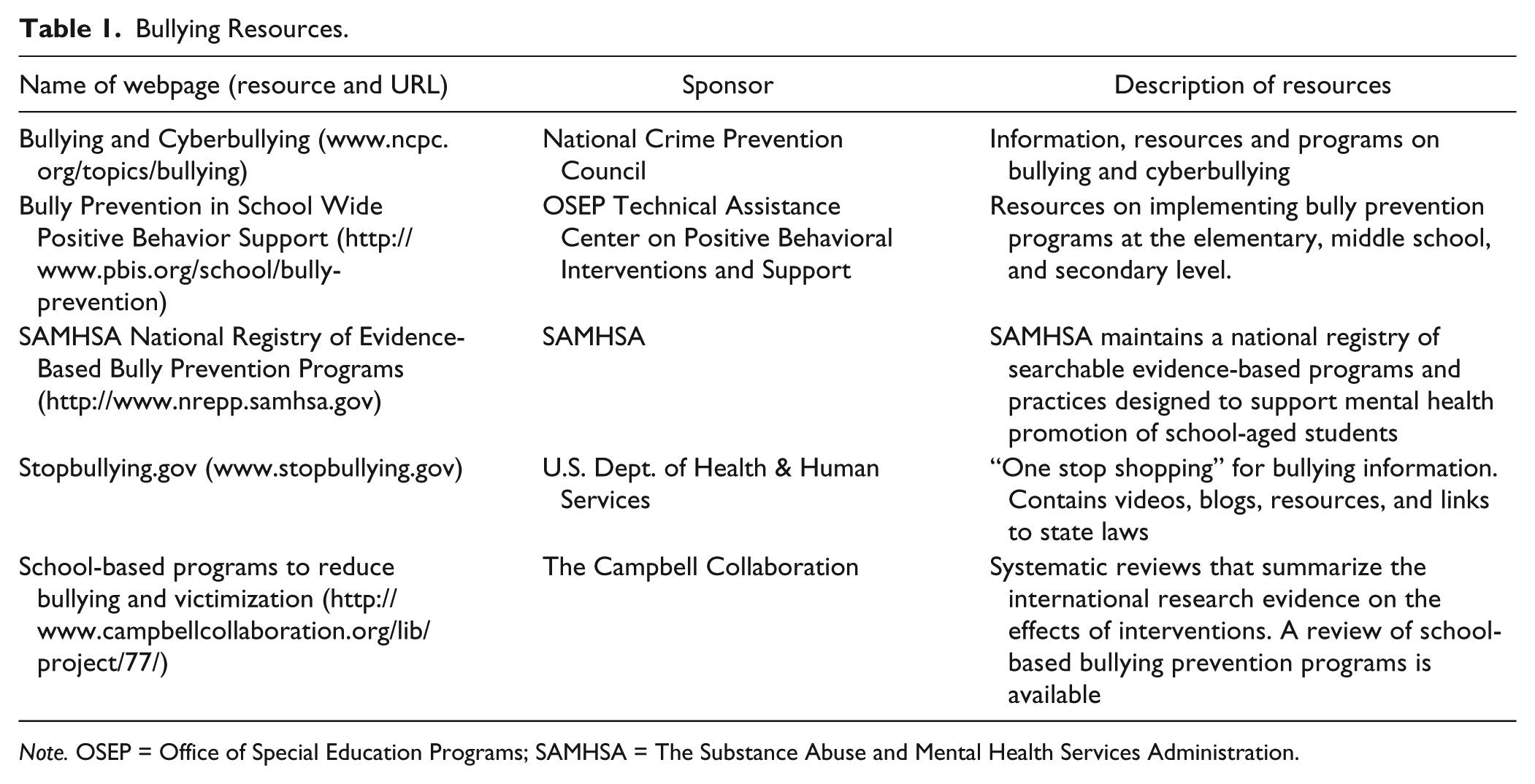
All 50 states and the District of Columbia have enacted anti-bullying legislation (www.stopbulling.gov). The majority (84%) of these states have a statutory definition of bullying with related policies that can be used by school districts (Sacco, Silbaugh, Corredor, Casey, & Doherty, 2012; www.bullypolice.org; www.stopbullying.gov). The remaining states allow the Department of Education or local school district to define bullying. Approximately 33% of states include creed or religion, disability, gender or sex, nationality or national origin, race, and sexual orientation in their definitions. A majority (80%) of states include cyberbullying or electronic acts in their definition. Cyberbullying refers to bullying that occurs via the Internet, cell phones, or other devices when users text or post images with the intention of harming or embarrassing another person (National Crime Prevention Council, 2015). As so many states include cyberbullying in their anti-bullying laws, educators must investigate and respond to incidences of cyberbullying as they would respond to any other type of bullying (see Table 1 for resources on bullying).
Bullying Resources.
Note. OSEP = Office of Special Education Programs; SAMHSA = The Substance Abuse and Mental Health Services Administration.
Anti-bullying procedures differ substantially from state to state (Sacco et al., 2012; www.stopbullying.gov; www.bullypolice.org). Approximately 71% of states require school districts to indicate potential consequences (expulsion, suspension, classroom or school reassignment), whereas only 4% indicate the actions must be balanced with education and 10% specify a need to consider the age of those involved. Approximately 82% require some consideration of prevention or bullying education; the exact type of education provision (e.g., character education, evidence-based practices, social and emotional curriculum) varies substantially from state to state. Only about 33% states require their staff to receive professional development related to bullying prevention and/or bullying policies while almost all states require schools to notify parents of their bullying policies. About 18% of states require parental education on bullying. For the most part, state bully legislation is an unfunded mandate with only about 22% identifying a funding source that school districts can use to pay for bully-related obligations. Suggested funding sources vary from new appropriates, private donations, or other existing budget lines. Unfortunately, most state anti-bullying laws are not particularly strong because they lack both incentives and sanctions, thereby leaving implementation and enforcement in question and certainly falling short of evidence-based standards (Kueny & Zirkel, 2012). Nonetheless, educators should know what their state’s laws require with respect to reporting and responding to bullying. Readers may access information on the bullying laws in their states at www.stopbullying.gov and www.bullypolice.org.
Bullying As a Violation of Section 504
DCLs on Bullying and Harassment From OCR
On July 25, 2000, OCR and OSERS issued a joint DCL on bullying and harassment of students with disabilities (U.S. Department of Education, OCR, 2000). The impetus for issuing this letter was the steady increase of allegations involving disability harassment 1 in elementary and secondary schools, colleges, and universities. The purpose of the DCL was to (a) develop greater awareness of bullying in the schools, (b) remind school personnel that they have legal and educational responsibilities to prevent and appropriately respond to disability harassment, and (c) suggest measures that school officials could take to address bullying.
According to OCR and Office of Special Education Programs (OSEP), disability-based harassment is a form of discrimination against students with disabilities. In the DCL, OCR and OSERS defined harassment as including verbal acts and name-calling, as well as nonverbal behavior, such as graphic and written statements, or conduct that is physically threatening, harmful, or humiliating. OCR and OSERS provide the following examples on disability-based harassment: (a) A student repeatedly places classroom furniture or other objects in the path of a classmate who uses a wheelchair, (b) a teacher subjects a student to inappropriate physical restraint for behavior related to the student’s disability, and (c) an administrator denies access to lunch, field trips, assemblies, and extracurricular activities as punishment for taking time off from school related to the student’s disability. If such acts are committed against students with disabilities and the bullying targets students because of their disability that is discrimination under Section 504.
School district administrators and educators have a responsibility under Section 504, Title II of the ADA, and the IDEA to ensure that students are provided a FAPE. Bullying or harassment, whether based on a student’s disability or not, which is severe, persistent, or pervasive creates a hostile educational environment, thus negatively affecting a student’s education. The creation of a hostile environment may effectively deny the bullied student a FAPE, violating the IDE and Section 504, and an opportunity to participate in or benefit from his or her educational program, violate Section 504. School officials, therefore, must take immediate steps to effectively address bullying when it occurs and take steps to prevent it from recurring. In addition to addressing bullying on an individual student basis, school district officials should take district wide actions such developing anti-bullying policies and procedures, conducting professional development activities regarding the problem of bullying, warning signs, and reporting procedures when bullying occurs. Moreover, district officials should also establish grievance procedures. The 2000 DCL is available at http://www2.ed.gov/about/offices/list/ocr/docs/disabharassltr.html.
On October 26, 2010, a second DCL on bullying was issued by OCR to serve as a reminder that student misconduct that falls under a school’s anti-bullying policy also may trigger responsibilities under one or more of the federal antidiscrimination laws enforced by OCR, which includes Title IV of the Civil Rights Act of 1964, Title IX of the Education Amendments of 1972, and Section 504 and Title II of the ADA. In such cases, simply addressing the misconduct is not considered an adequate response. Instead, school officials are obligated to examine the nature of the misconduct itself for possible civil rights violations and determine whether the harassment interferes with a student’s participation in and benefits from educational services, activities, or opportunities. When bullying occurs, schools must take steps to eliminate any hostile environment and prevent further occurrence. Such steps may include (a) separating the accused harasser and the target, (b) providing counseling for the target and harasser, (c) taking disciplinary action against the harasser, (d) providing training or other interventions not only for the perpetrators but also for the larger school community, and (e) taking steps to stop further harassment and prevent any retaliation against the person (e.g., ensure prompt reposting of any additional incidents, follow up inquiry). The DCL ends with hypothetical case studies for Title VI (race-based harassment), Title IX (sexual- or gender-based harassment), and Section 504 and Title II of ADA (disability-based harassment). This DCL is available at http://www2.ed.gov/about/offices/list/ocr/letters/colleague-201010.pdf.
A third DCL was issued by OCR on October 21, 2014 (U.S. Department of Education, OCR, 2014). The DCL began by noting that the unfortunate reality in public schools is that even though awareness regarding bullying issues has increased, this serious problem persists in U.S.’s school, especially for students with disabilities. In the DCL, OCR and OSERS reiterated school district officials’ responsibility to address disability-based harassment. In fact, OCR noted that if school administrators or educators know or should have known about the bullying and did not respond appropriately, it is likely a violation of Section 504.
The 2014 DCL was different from the 2000 and 2010 DCLs on bullying because in it, OCR officials wrote, “bullying of a student with a disability on any basis can similarly result in a denial of FAPE under Section 504 that must be remedied” (U.S. Department of Education, OCR, 2014, p. 2). OCR officials also wrote that when a student is bullied, his or her IEP team or 504 team should address any denial of FAPE by reconvening the team and examining the IEP or 504 plan to determine whether it still provides FAPE. The DCL also included several hypothetical case studies addressing both disability-based and non-disability–based harassment. This DCL is available at http://www2.ed.gov/about/offices/list/ocr/letters/colleague-bullying-201410.pdf.
The DCL also detailed the relevant facts that OCR officials will seek to determine when OCR receives a complaint regarding bullying of students with disabilities. Investigators will attempt to determine the following: (a) Did the bullying of a student with disabilities occur; (b) was the bullying sufficiently severe, pervasive, or persistent, as to create a hostile educational environment; (c) did the hostile environment interfere with or limit a student’s opportunity to participate; and (d) did school personnel know or reasonably should have known about the bullying but did not act to prevent and address the bullying? If officials at OCR answer yes to all of these questions, it is likely that OCR will rule that the school district violated Section 504.
A number of OCR rulings on complaint violations have relied on the issues that these DCLs addressed. For example, in Fairfield-Suisun (CA) Unified School District (2008), a complaint was filed with OCR indicating that the school district failed to respond to a case of bullying. OCR agreed, finding that the district’s response to the bullying was lackluster and that district officials failed to investigate and respond to the bullying. Similarly, in Philadelphia (PA) School District (2006), OCR cited the district for failing to (a) investigate a case of bullying, (b) inform the student’s parents of any findings, and (c) address the negative effects the bullying had on the student. In Santa Monica-Malibu (CA) Unified School District (2010), OCR found that a school district had violated Section 504 when the district made changes to the student’s IEP in an effort to respond to the bullying but failed to implement these measures. In Williamson (MI) County Schools (2010), OCR ruled against a school district even though the parents of a student did not file a written complaint against students who bullied their child. According to OCR, failing to file a complaint did not excuse the school district’s failure to investigate those incidences when district officials knew or should have known about the harassment. OCR has also found against school districts in which teachers were accused of bullying or harassing students with disabilities but the district failed to adequately investigate to promptly respond to these complaints (see Yucaipa-Calimesea (CA) Joint Unified School District, 2006).
OCR investigations of bullying have been decided in favor of school districts when school officials have investigated quickly and efficiently (Caverna (KY) Independent Schools, 2006) and responded promptly and effectively to the bullying and taken actions to prevent the bullying from recurring (Greenport (NY) Union Free School District, 2008).
Litigation on Bullying Students With Disabilities and Section 504
In 1999, the U.S. Supreme Court heard a case that involved sexual harassment: Davis v. Monroe County Board of Education (hereafter Davis). Although the case did not involve bullying and students with disabilities, courts have adopted the Supreme Court’s reasoning when ruling on bullying and possible violations of Section 504. In Davis, a fifth grade public school student, LaShonda Davis, was repeatedly sexually harassed while she was at school. In one period of over 5 months, the girl’s mother had complained to her child’s teachers about the misconduct. The girl’s grades suffered but her teachers took no actions to address the sexual harassment. At the end of the school year, the mother reported the actions to the school’s principal. Unfortunately, he did not act to resolve the problem either.
The girl’s mother, Aurelia Davis, filed a lawsuit against the Monroe County School District seeking injunctive relief and monetary damages under Title IX (monetary damages may be available for violations of civil rights under Title VI, Title IX, Section 504, and the ADA). Mrs. Davis contended that the failure of school officials to address the bullying created an abusive environment that deprived her daughter of her educational benefits under Title IX. The Davis’ lost at the U.S. District Court and then U.S. Circuit Court of Appeals for the 11th Circuit. Both courts held that there was no private damage action available when a school failed to respond to reports of student-on-student sexual harassment.
Mrs. Davis then filed an appeal with the U.S. Supreme Court. The question before the Court was could a school board be held responsible under Title IX for student-on-student sexual harassment. The court decided to hear the cases, and in a 5 to 4 decision, overturned the lower courts and ruled that a school could be liable for damages in a harassment case when school personnel acted with deliberate indifference to acts of harassment that were so severe, pervasive, and objectively offensive that the acts effectively barred the victim’s access to educational opportunity or benefit. School district attorneys had argued that the school district could not be liable for the actions of a third party. Justice Sandra Day O’Conner, writing for the majority, rejected this argument and focused on the liability of school district personnel for the failure to take action. In addition, the Court noted that to find a district liable, the alleged harasser must be under some form of control by the school. Because the perpetrator in the Davis case was a student in the school and had committed the harassment while at school, he clearly was under the school’s control. It should be noted that in the Davis decision, the school district was not held liable for the actions of the harassing student; rather, the district was held responsible for its own inaction and lack of response to the harassment. The standard established in the Davis decision is referred to as the deliberate indifference test. According to this standard, (a) the harassment must be severe, pervasive, or persistent; (b) the harassment must have a concrete, negative effect on the student; (c) school district personnel must have had knowledge of the harassment; and (d) school district personnel were deliberatively indifferent to the harassment and failed to respond adequately to the situation.
A number of federal courts have found that an inadequate school district response to disability discrimination was actionable under Section 504 and the ADA. These cases include C.L. v. Leander Independent School District (2013), Estate of Lance v. Lewisville Independent School District (2011), K.M. ex rel. D.G. v. Hyde Park Central School District (2005), J.B. v. Mead School District No. 354 (2010), and M.P. v. Independent School District No. 721 (2003). When administrators and educators fail to respond to reports of bullying, they may be found to have acted with bad faith, gross misjudgment, or deliberate indifference (Jacobs, 2012).
The eighth circuit court in the M.P. v. Independent School District No. 721 (2003) ruling did not actually discuss the Davis standard; rather, the court used a general prima facie standard for determining whether disability discrimination occurred that was actionable under Section 504 (Kriha, 2010). A prima facie standard means after initially examining the facts of the case, the facts appear to be true and are considered to be accurate unless proven otherwise. According to the prima facie test, a court must determine whether (a) the student has a disability, (b) the student is denied the benefits of a program or activity of a public entity, and (c) the student was discriminated against because of his or her disability. When the Davis test and the prima facie tests are put together, they provide a good standard for determining whether bullying has violated Section 504 and whether a school is potentially liable (Boyce & Manna, 2011) (see Figure 1).

Five-part test for imposing liability.
Courts in two of the above cases, K.M. ex rel. D.G. v. Hyde Park Central School District (2005) and Estate of Lance v. Lewisville Independent School District (2011), noted that school districts might have a greater duty to prevent bullying when a student with disabilities is involved. This is because students with disabilities may be more vulnerable to abuse, and a school district should anticipate the bullying and work harder to prevent it.
Patterson v. Hudson Area Schools (2009) was brought under Title IX and did not involve a student with disabilities. Nevertheless, because the case involved a civil rights law, it has important implications for situations in which a student protected under Section 504 is bullied. In this case, school administrators were aware that a student was being bullied and they responded by warning the perpetrators. Unfortunately, the warnings did not work; however, the administrators merely warned the perpetrators again. When the school district was sued for damages, the court found the school district liable under Title IX because administrators continued to use the same procedures that they knew were not effective.
Any person suing a school district for damages faces a difficult burden in establishing that a district is liable (Norlin, 2014). When school district personnel had no reason to suspect that bullying was occurring or when administrators and teachers act quickly and effectively to prevent and respond to the incidences of bullying in an appropriate manner, violations of Section 504 will most likely not be found. Thus, when school district officials become aware of bullying, they should (a) investigate promptly and thoroughly, (b) respond effectively to incidences of bullying, and (c) act to prevent future occurrences of bullying.
Bullying As a Violation of the IDEA
DCLs on Bullying and Harassment From OSERS
On August 20, 2013, OSERS issued a DCL on bullying (U.S. Department of Education, OSERS, 2013). The purpose of the letter was to remind school district officials of their duty to ensure that students with disabilities who are subject to bullying continue to receive a FAPE under the IDEA. In the DCL, OSERS suggested that IEPs/504 plans were the appropriate forums for determining specialized approaches for preventing and responding to bullying and to provide additional supports and services to students with disabilities. It was suggested that school personnel should convene the IEP/504 team to determine whether, as a result of the effects of the bullying, the student’s needs had changed in ways that resulted in the IEP/504 plan not conferred a FAPE. When determining whether bullying has denied a student with disabilities a FAPE, under either the IDEA or Section 504 (see OCR DCL of 2014), it does not matter whether the bullying was disability based or not. If FAPE is denied, the student’s IEP/504 team must revise the student’s IEP/504 plan by determining additional services necessary to again provide a FAPE.
The 2013 DCL also included an enclosure on effective evidence-based practices for preventing and addressing bullying. The section identified practices such as (a) using comprehensive multi-tiered behavioral framework, (b) teaching appropriate behaviors, (c) responding appropriately to bullying, (d) providing active adult supervision, (e) providing ongoing support for staff and students, (f) developing and implementing clear policies to address bullying, (g) monitoring and tracking bullying behaviors, (h) notifying parents when bullying occurs, and (i) sustaining bullying prevention efforts over time. The DCL is available at https://www2.ed.gov/policy/speced/guid/idea/memosdcltrs/bullyingdcl-8-20-13.pdf and the evidence-based practices enclosure is available at https://www2.ed.gov/policy/speced/guid/idea/memosdcltrs/bullyingdcl-enclosure-8-20-13.pdf.
Litigation on Bullying Students With Disabilities and the IDEA
Litigation in the U.S. district courts and the U.S. courts of appeals has resulted in rulings that that bullying can deny FAPE, and needs to be quickly and effectively addressed by school officials. When a student in special education is bullied, and as a result school performance suffers, the special education program may not confer educational benefit. In such situations, FAPE may not be provided unless school administrators and educators act quickly to address the bullying. A good example of a case regarding bullying and FAPE occurred in T.K. v. New York City Department of Education (2011). This was a U.S. district court case that involved a 12-year-old girl with a learning disability, called L.K., whose peers ostracized and ridiculed her on a daily basis. The repeated bullying resulted in emotional withdrawal and a very negative educational environment for the girl. L.K.’s parents repeatedly complained, verbally and in writing, to the principal of the school who apparently ignored their complaints and refused to take any action. In fact, the principal kept no records of the incidences. In one instance, L.K.’s parents accompanied L.K. to school and asked to have a meeting with the principal. The principal agreed to meet but asked that L.K. not be included in the meeting. When the parents continued to discuss the matter with L.K. in her office, the principal threatened to call security. There were no further meetings and no action was taken to investigate the bullying.
The principal returned the student to the same school during the next school year. The child’s parents objected and enrolled their child in a private school and requested a due process hearing alleging a deprivation of FAPE. A hearing officer and review officer concluded that the district provided FAPE so the parents sued in federal court. The district court found that the bullying caused a denial of FAPE, even though the student’s IEP offered the needed programs and services. Moreover, the court noted that to deny a student a FAPE because of bullying did not require that the bullying be based on a student’s disability; rather, bullying for any reason could result in the denial of a FAPE if it resulted in adverse effects to a student’s education. In addition, it was not necessary that the parents prove that the bullying deprived the students of all educational benefit or that the students regressed; the parents only needed to show that the bullying was likely to affect the student’s opportunity to receive an appropriate education. The court cited the 2010 DCL from OCR in the decision and asserted that a school district had to take prompt and appropriate action to address the bullying.
Cases involving bullying in which school districts have prevailed include P.R v. Metro School District of Washington (2010), in which a school district investigated each incident of bullying, kept the parents informed, and disciplined the perpetrators, and Doe v. Big Walnut Local School District Board of Education (2011) in which the school district had investigated and responded appropriately to the bullying. When school personnel investigate instances of bullying as soon as they suspect bullying has occurred and then respond appropriately to ensure repeated bullying does not occur, they are more likely to defeat claims of denial of a FAPE.
Liability and School District’s Failure to Address Bullying
In 2010, Darcy L. Kirby of the Franczek Radelet law firm delivered a presentation at the Tri-State Regional Special Education Conference on how courts were ruling in cases involving bullying and students with disabilities. He titled his presentation “Stop Bullying or Start Paying.” The increasing number of lawsuits against school districts by parents of students with disabilities who allege that the district discriminated or denied a FAPE because they did not investigate nor respond appropriately to bullying makes it likely that his title was prescient.
Examining the total financial ramifications of these bullying cases is beyond the scope of this article. A brief review of damages under Section 504 and the IDEA, however, will assist readers to understand the possible monetary implications of these cases. The IDEA authorizes courts to provide relief (i.e., remedies) to the prevailing party. Determination of what constitutes appropriate relief is mostly up to the discretion of the courts. Relief that has been granted includes attorneys’ fees, injunctive relief (i.e., court orders to stop a certain practice, court orders to require specified changes in a student’s program), compensatory education, and tuition reimbursement. Courts have uniformly disallowed punitive damages under the IDEA.
Relief under Section 504 is similar to the types of damages available as those under the IDEA, including injunctions, attorney’s fees, compensatory damages, and tuition reimbursement. Punitive damages may be available under Section 504 and the other civil rights laws.
Damage awards, especially punitive damages, tuition reimbursement, and attorneys’ fees, can be very costly to school districts. For example, Kriha (2010) reported a jury award in Tampa, Florida, to parents of a student with disabilities who was bullied while at school. The total award cost the Florida school district US$4 million. With the increasing amount of litigation and OCR investigations, it is likely that damage awards for incidences of bullying will increase.
Implications for School Districts
Bullying and harassment of students with disabilities is an extraordinarily serious problem. When bullying occurs, or school personnel suspect bullying is occurring, they must immediately begin an investigation and, if bullying is taking place, take effective steps to address the problem and prevent its reoccurrence. The following guidelines for school districts are extrapolated from the administrative guidance, and court cases are adopted from Yell (2016).
Recommendation 1: Develop, Publicize, and Implement School District Policy for Preventing and Addressing Bullying
School districts need to adopt strong policies for preventing and addressing bullying. There are a number of common characteristics that are seen in the most effective discipline policies, such as (a) statements of purpose; (b) scope of the policy; (b) the behaviors that the policy prohibits; (c) specific procedures for reporting complaints, investigating complaints, and documenting actions taken; and (d) consequences for the offending student and actions directed to the bully victim (e.g., counseling). It is important that school district policies are publicized through methods such as email or voice mail blasts, posters, letter to parents, public service announcements, and that discussions about the policy with parents, teachers, students, and school staff take place. Special education directors, Section 504 coordinators, other officials (e.g., Title IX coordinator), teachers, parents, and community members must be involved in developing such policies.
Recommendation 2: Adopt a Research-Based Bullying Program
School district officials should adopt a research-based bullying prevention programs (Table 1 includes website of research-based bully prevention programs).
In addition, there is a growing body of research on effective anti-bullying programs (e.g., Rose, Swearer, & Espelage, 2012). If school districts’ use a program that has evidence of success and the program is communicated, publicized, and implemented with fidelity, school district’s will be more likely to prevent bullying rather than having to only deal with effects of bullying.
The U.S. Department of Education issued a practice guide on evidence-based practices for preventing and addressing bullying (https://www2.ed.gov/policy/speced/guid/idea/memosdcltrs/bullyingdcl-enclosure-8-20-13.pdf). According to the document, efforts to address bullying behavior must be embedded within a comprehensive, multi-tiered behavioral framework. Moreover, schools should (a) establish a positive school environment, (b) set high academic and behavioral standards, and (c) guide delivery of evidence-based instruction and interventions that address the needs of all students, including those with disabilities.
Recommendation 3: Provide Professional Development on Bullying
School district officials must ensure that administrators, principals, teachers, staff, and the larger school community have up-to-date professional development training so they understand their responsibilities to investigate and respond to incidences of bullying. Professional development activities should also include familiarizing staff with the requirements of the IDEA, Section 504, Title IV of the Civil Rights Act, and Title IX of the Education Amendments and may be conducting using methods such as subsidizing teacher and staff attendance at conferences, formalized training presentations, webinars, small group discussions, and assigning readings. If school districts have adopted a research-based bullying program, which they should, officials should ensure that thorough training for staff is provided to ensure that the program or intervention is used with fidelity.
Recommendation 4: Be on the Lookout for Incidences of Bullying
It is extremely important that administrators, teachers, and staff detect bullying when it first occurs and alert school officials. When there is a complaint from a student’s parents, peers, or teachers, administrators must quickly look into the potential problem. School officials should develop an environment where students feel safe reporting bullying that involves them or that they hear about. For example, school officials could use the following procedures: (a) maintain an anonymous drop box or mailbox available to students to encourage reporting, (b) conduct school-wide assemblies or programs on bullying and the importance of reporting bullying when it occurs, (c) sending out surveys or conducting online surveys, and (d) provide an anonymous bully reporting 800 like phone number or a bully report folder on the school’s website.
School districts should have user-friendly investigation forms. According to Kriha (2010), investigation forms should include the following information: (a) the name of the complainant, (b) a description of the incident, (c) note of the steps taken in the investigation, (d) the outcome of the investigation, and (e) signatures or the principal, teacher, and parents. Separate forms should be filled out for the perpetrator and the victim.
Recommendation 5: Respond to Bullying Quickly and Effectively
When an investigation reveals that a student with disabilities is being bullied, school administrators need to respond quickly and effectively. Even if the bullying cannot be verified, school administrations should take action to ensure that bullying does not take place in the future. Such actions may include (a) disciplining the offender, (b) eliminating the hostile environment, (c) addressing the needs of the victim (e.g., counseling), and (d) taking steps to ensure that the bullying does not reoccur.
If the students being bullied are in special education, their IEP teams should meet to determine whether the IEPs still provide a FAPE, and if they do not, then the team should modify the IEP. Similarly, if students with disabilities have a Section 504 plan, than 504 teams should meet to determine whether the plan still offers a FAPE.
Recommendation 6: Document All Investigations and District Responses and Keep All Parties Informed of Investigations and Responses to Incidences of Bullying
School personnel must document all actions taken when investigating and responding to bullying. Moreover, the parents of the victim and perpetrator should be kept abreast of actions taken in response to the bullying. Figure 2 depicts a form for documentation of bullying incidences and a school personnel’s responses.
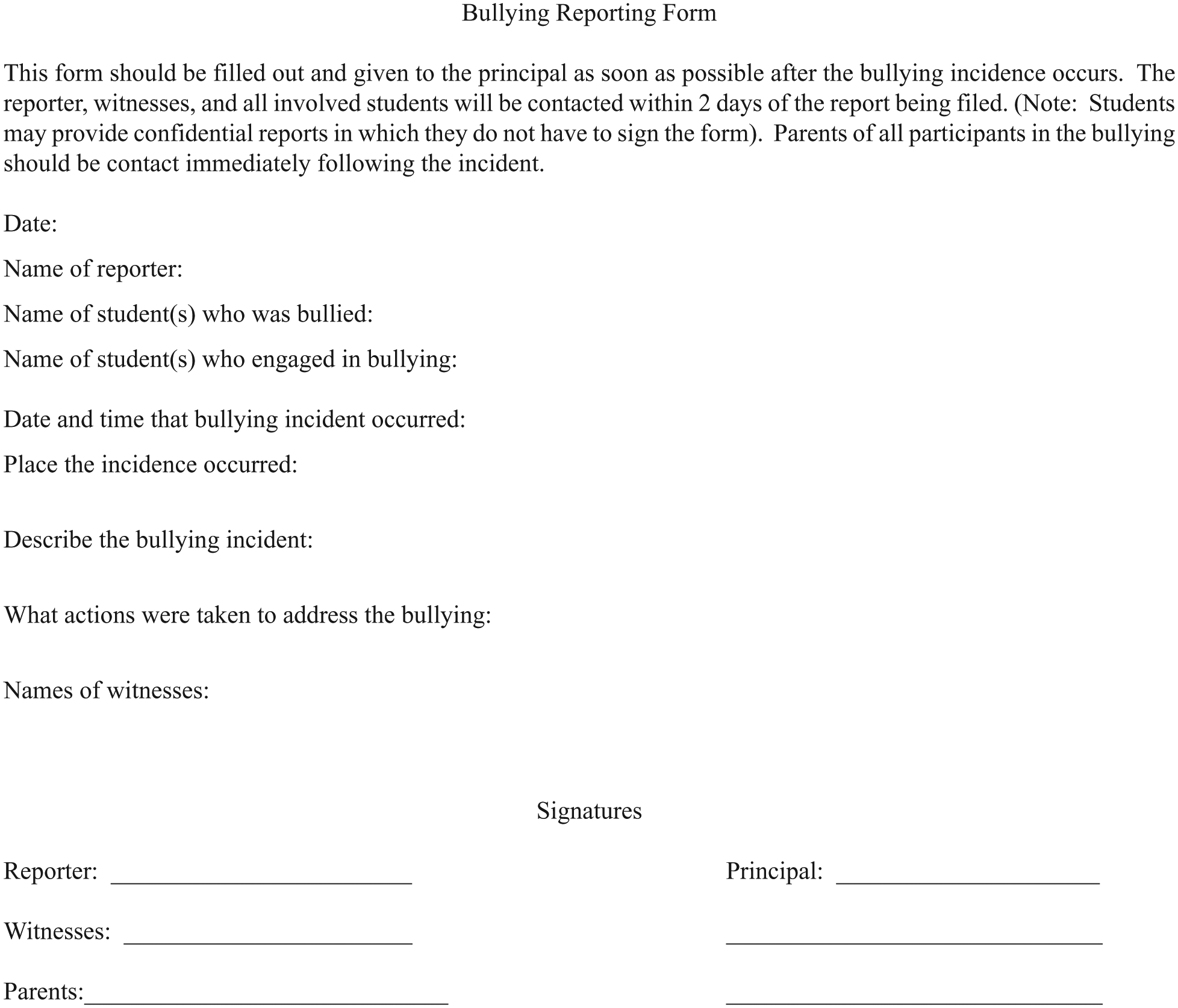
Bullying reporting form.
Summary of Bullying and Harassment of Students With Disabilities
Bullying is a common occurrence in U.S.’s schools and is currently at the forefront of national attention. The bullying and harassment of students with disabilities has been a major concern to the U.S. Department of Education. In fact, officials in OCR and OSERS have issued four DCLs on bullying. There have been a number of court cases and administrative rulings regarding school district’s responses to incidences of bullying. The DCLs and court cases show the importance of school district officials and personnel investigating and reacting promptly and effectively when students with disabilities are bullied.
Footnotes
Declaration of Conflicting Interests
The author(s) declared no potential conflicts of interest with respect to the research, authorship, and/or publication of this article.
Funding
The author(s) received no financial support for the research, authorship, and/or publication of this article.