




Abstract
Using the least restrictive environments (LRE) data from annual Reports to Congress, this study examined national trends in placement between 2000 and 2014 for school-aged students considered to have significant disabilities from among the categories of autism (ASD), intellectual disability (ID), multiple disabilities (MD), and deaf-blindness (DB). Educational placement trends were calculated using a log ratio index, and students with significant disabilities were compared with groups of students from the other disability groups. Results confirmed that access to general education settings is lacking for this group of students. Implications for policies and practices as well as suggested future research are provided.
Keywords
Trends in where students with disabilities are educated using data associated with the least restrictive environment (LRE) have been tracked for more than three decades. Existing research documents a steady increase in the percentage of time spent in general education classrooms for students with high incidence disabilities, including learning disabilities, other health impairments, and emotional behavioral disorders (Danielson & Bellamy, 1989; McLeskey, Hoppey, Williamson, & Rentz, 2004). Recently, McLeskey, Landers, Williamson, and Hoppey (2012) examined the 1990–2008 LRE data, finding a 93% increase of students with high-incidence disabilities placed in general education 80% or more of the day. In another study, Williamson, McLeskey, and Rentz (2006) examined LRE data for students with intellectual disability (ID) during the decade from 1990 to 2000 and found increasing trends, albeit less substantial than for other disability groups. In addition, they noted that increased rates appeared to plateau between 1997 and 2000, indicating a dropping off of general education placement after initial growth. An interesting finding in their study was the variability across states, which has also been documented in other studies for students with ID (Katsiyannis, Zhang, & Archwmety, 2002) and autism (Kurth, 2015). Furthermore, Brock and Schaefer (2015) identified a single state’s differences in educational placement for students with significant disabilities, suggesting urban and urban-fringe districts were least likely to place students in general education 80% or more of the day. Broadly speaking, continued improvements for students with high-incidence disabilities toward greater access to general education have been found. However, the extent to which this holds true for students with significant disabilities (i.e., intellectual disability, autism, multiple disabilities, deaf blindness) has not been thoroughly examined.
The IDEA mandates accountability requirements focus on ensuring that students with disabilities participate in the general education curriculum. The LRE regulations stipulate to the maximum extent appropriate, children with disabilities are educated with children who are not disabled, and that their removal from general education occurs only when the nature or severity of the disability is such that education in regular classes with the use of supplementary aids and services cannot be achieved satisfactorily (Individuals with Disabilities Education Improvement Act, 2004). Importantly, IDEA emphasizes students with disabilities participation in state accountability measures (Gartland, 2004).
Although the least restrictive environment in principle is universally accepted, there continue to be concerns regarding how it is interpreted and operationalized (McLeskey, 2007). Individual education program (IEP) teams are required to plan for special education services as well as determine the setting in which services are to be delivered. Some advocate that the IEP team should first consider how to support students within general education settings prior to determining more restrictive educational placements (Ryndak, Jackson, & White, 2013). However, for students with significant disabilities, IEP teams may be more likely to decide student placement based on existing specialized programs (Dymond, Gilson, & Myran, 2007). Factors identified as influencing IEP team placement decisions include severity of disability (Harris & Handleman, 2000), social skills deficits (Lyons, Cappadocia, & Weiss, 2011), communication deficits (White, Scahill, Klin, Koenig, & Volkmar, 2007), and extensiveness of behavior problems (Lauderdale-Littin, Howell, & Blacher, 2013). Other factors may play a role, such as teacher training (Moreno, Aguilera, & Saldana, 2008) and availability of service providers (Dymond et al., 2007). It has been suggested that classroom size and ability to attend school with siblings influence parental decisions (Ajuwon & Oyinlade, 2008).
Given limited national research associated with LRE for students with significant disabilities, the purpose of this study was to analyze the most currently available LRE data (2000–2014) to understand placement trends for students with significant disabilities from among the IDEA categories of autism (ASD), intellectual disability (ID), multiple disabilities (MD), and deaf-blindness (DB).The first research aim was to descriptively examine national data for trends across the four most common LRE placements: (a) at least 80% of the school day (≥80%), (b) 40% to 79% of the school day (40%–79%), (c) less than 40% (<40%) of the school day, or (d) in a separate public school. The second aim was to compare trends toward access using the three LRE placements most closely aligned with and likely to affect general education access trends (≥80%, 40%–79%, <40%) among students with significant disabilities as compared with other groups of students with disabilities.
Method
Data Sources
This investigation examined data collected annually from states by the U.S. Department of Education (USDOE), Office of Special Education Programs (OSEP) as required by Section 618 of IDEA. We used the most recently available data, extending our scope beyond what has been published previously (i.e., McLeskey et al., 2012). The purpose of federal data collection is to monitor state compliance with the LRE mandate of IDEA. These data are reported annually in the Reports to Congress (USDOE, 2014). Almost 15 years of the most currently available data from 2000 to 2001 and through 2014–2015 were used. We focused on data from 2000 and onward as most current, with the least amount of overlap with previously reported data. The data account for education placements among students within the 13 disability categories and across the age ranges including 3 to 5, 6 to 11, 12 to 17, 18 to 21, and 6 to 21 years old. States are required to report the numbers of students with disabilities who are in a school’s general education classroom for (a) ≥80% of the school day, (b) 40% to 79% of the school day, (c) less than 40% of the school day, or (d) in a separate public school settings serving only students with disabilities. States are also required to report placement in residential settings, home/hospital, private schools, and correctional facilities. Because of the extremely low rates of placement in the most restrictive settings (i.e., separate public school settings and home/hospital, private schools, correctional facilities), as well as results from recent research examining such placements (see Kurth, Morningstar, & Kozleski, 2014), we were interested in examining placement categories pertaining to students with disabilities placed within the most commonly described educational settings; thereby aligning with previous work for high-incidence disabilities (McLeskey et al., 2012) and intellectual disability (Williamson et al., 2006). It is important to note that prior to 2006, states were required to report the percentage of time students with disabilities spent outside of general education; however, OSEP changed certain reporting metrics in an effort to improve the reliability of the data. Notwithstanding concerns of LRE reporting practices, these data have long been viewed as the most valid national placement data available (Danielson & Bellamy, 1989; McLeskey et al., 2012) and continue to be used to examine the extent to which states are in compliance with LRE mandates.
Selection of certain demographic variables (e.g., age, ethnicity, gender) was considered for this study, but the publicly available LRE data set did not disaggregate such demographics by disability category. Furthermore, to protect the privacy of students, state data were suppressed for certain low-incidence disability populations (e.g., deaf-blindness) within a particular age band, especially in less-populated states. As a result, the most comprehensive set of data available was used, which is the age range between 6 and 21 years. IDEA permits students with disabilities to continue to receive special education services through age 21 if the nature of their disability and needs require this extended service. Students with significant disabilities typically do continue to receive special education services until age 21 (or older in some states).
Data Analysis
Data used for this investigation included placement settings for school-aged students with disabilities (ages = 6–21) from the 50 states and the District of Columbia for 2000–2001 through the 2014–2015 academic years. The extant placement data were analyzed for disability categories typically included when considering special education programs and services for students with significant disabilities (i.e., ASD, ID, MD, and DB). For comparison, we examined educational placement rates among all other categories of disabilities.
For the first research aim, we used descriptive statistics including visual representations of the percentage of students with significant disabilities (ASD, ID, DB, MD) placed within each of four educational settings: (a) at least 80% or more of the day in general education (≥80%), (b) between 40% and 79% of day in general education (40%–79%), (c) less than 40% of day in general education (<40%), and (d) separate schools. We were interested in examining LRE placement rates for each of the four disability groups and to examine within disability placement rates; therefore, we calculated percentages using placement by the total number of students within each disability group across the four LRE settings.
For the second research aim, we were interested in comparing placement trends among groups. To do this, we summarized changes in LRE placement by calculating an LRE index using two ratios: (a) the ratio of the number of students in general education ≥80% (
By calculating two ratios, we understood that if students are assigned in equal proportions, ratios would equal 1, yet variations would range from 0 to infinity. Because observed variations of ratios are asymmetric, we corrected for symmetry by applying the natural logarithm to each ratio (Aitchison, 1986). Using an additive log ratio analysis, we took two values (

Theoretically, the two logged ratios scale between negative and positive infinity; for example, if the ratio of the proportions is 1, then proportions assigned to (

The LRE index conceptualizes change in the follow manner: If students are assigned in equal proportions among the three settings, then the LRE index is equal to zero. When students shift from one placement category into another, the LRE index changes using an understandable metric (with a center of 0, and change most likely occurring between +2 and −2). Meaning, if students move out of (
For this study, because of the much smaller prevalence rates among the low-incidence disability categories, we did not replicate previous studies using the cumulative placement rate metrics (CPR, McLeskey et al., 2012). We found the LRE Index more sensitive to variations within low population disability groups and achieved the research aim of examining trends in access to general education settings (≥80%, 40%–79%, <40%). Finally, unlike the CPR, which uses the total school population in its calculation, the LRE index offers an approach to examine change across time for each disability group and is not affected by fluctuations in the population of students without disabilities, thereby reducing distortion vulnerabilities arising from variations in the estimate of the total school population.
Results
Preliminary Prevalence Rates Among Students With Disabilities
It is noteworthy that students within each of the disability categories we examined as having a significant disability across four placements (≥80%, 40%–79%, <40%, students served in separate classroom or school settings all of the day [SS]), showed changes in prevalence patterns. Most interesting, students with ASD increased substantially from about 80,000 in 2000 to approximately 513,500 in 2014, an increase of almost 540%. Over the past decade, students with ID saw a decrease of almost 32% (from 612,523 in 2000 to 415,060 in 2014). Students with MD remained relatively stable, with only 2% growth over the past decade, and students with DB, the smallest group by far, exhibited a decrease of 6%, but showed considerable fluctuations over the 14-year period of time. During this same period, the overall identification rates for all students with disabilities did not show substantial change, but with a 3% increase in overall identification over time (5,780,651 in 2000 to 5,939,578 in 2014). A table representing prevalence rates is available upon request, however, due to page limits, was not included.
Educational Placements Among Students With Significant Disabilities
Descriptive results explored trends across the four LRE placements of interest revealed that differences existed among the categories associated with significant disabilities. For the most part, the percentage of students placed in general education ≥80% or more of the day, between 40% and 79%, <40%, or in separate schools showed changes over time (see Figure 1). In examining percentages among the four disability groups in Table 1, the most prevalent setting for students with ID and MD was separate special education classrooms (<40% of day in general education), with close to half of students in both groups served in this LRE placement. This far exceeded placement in general education ≥80% (in 2014, 17% for ID and 14% for MD). Students with DB showed a slight increase in placement ≥80% of their day between 2000 and 2014 (from 22% in 2000 to 26% in 2014); however, placement rates fluctuated.

Percentage of students with ASD, ID, DB, and MD aged 6 to 21 placed in educational settings between 2000 and 2014.
Percentage of Time in Educational Placements for Students With Significant Disabilities.
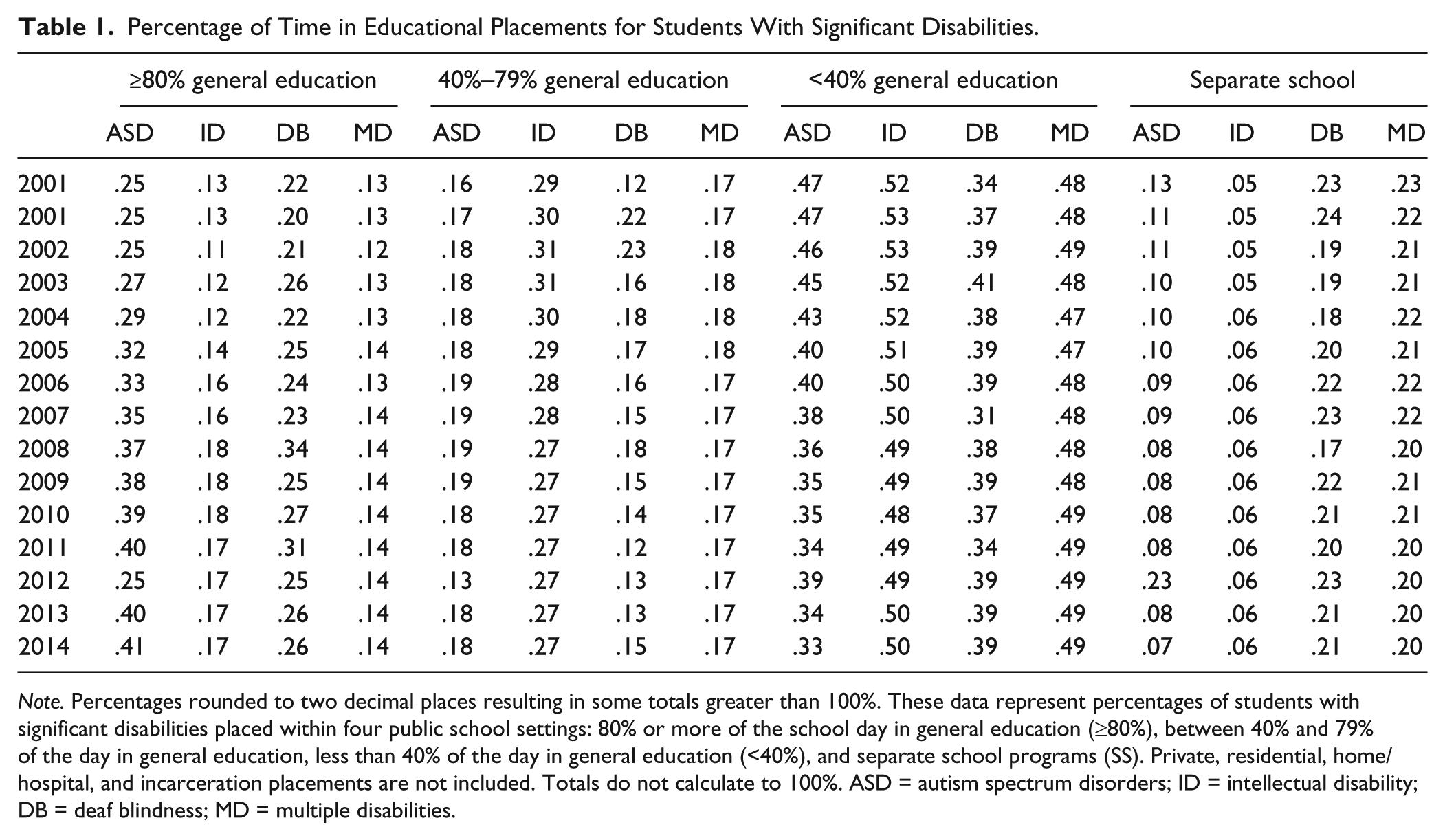
Note. Percentages rounded to two decimal places resulting in some totals greater than 100%. These data represent percentages of students with significant disabilities placed within four public school settings: 80% or more of the school day in general education (≥80%), between 40% and 79% of the day in general education, less than 40% of the day in general education (<40%), and separate school programs (SS). Private, residential, home/hospital, and incarceration placements are not included. Totals do not calculate to 100%. ASD = autism spectrum disorders; ID = intellectual disability; DB = deaf blindness; MD = multiple disabilities.
Little change was seen within the placement 40% to 79% time in general education, with some differences, albeit small, within certain disability groups; most notably, students with ASD exhibited a very slight upward trend between 2000 and 2014 (from 16% to 18%), and students with ID showing minor downward trends (from 29% to 27%). In general, little change was seen over time among most students within the 40% to 79% placement category.
Students with ASD were the only group in which placement in general education for less than 40% of the day steadily decreased (from 47% to 33%). For the other three groups, their rates of change over time remained relatively stable, with about half of all students identified with ID and MD placed in the <40% LRE placement category, and about 40% of students with DB being served in this LRE placement.
Trends in LRE Placement
To examine trends and make comparisons among groups of students with disabilities, we calculated a LRE index using the proportions of students in general education ≥80% (
LRE Index Among Students With Significant Disabilities.
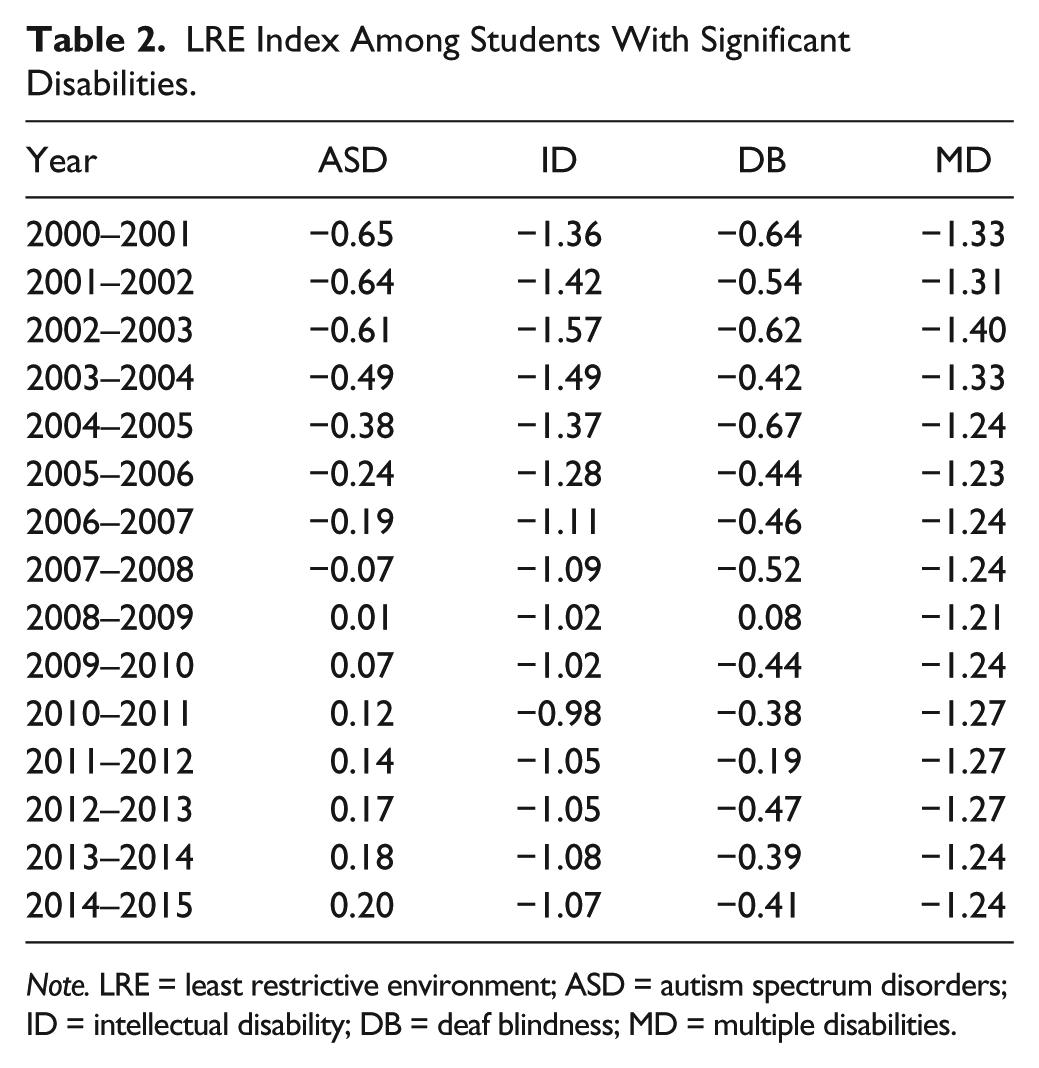
Note. LRE = least restrictive environment; ASD = autism spectrum disorders; ID = intellectual disability; DB = deaf blindness; MD = multiple disabilities.
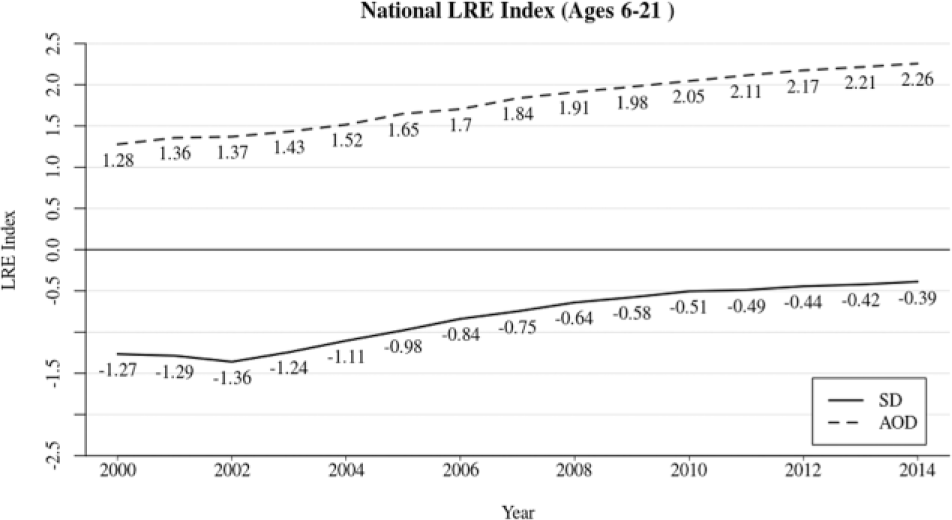
LRE index among students with SD and AOD.
For students with significant disabilities, the LRE index from the 2000–2001 year was −1.27, indicating students were much more likely to be placed in separate settings (i.e., <40% of day in general education). While growth in the LRE index for students with significant disabilities mirrors overall progress for all students with disabilities over the past 14 years, the LRE index of −0.39 calculated in 2014–2015 means students with significant disabilities are still spending the majority of their day in separate settings (<40%), having yet to cross over the central point of zero (i.e., where half of the students would be included (≥80% and half would be placed <40%). Thus, progress is occurring for all students but at substantially slower rates for some, leaving students with significant disabilities predominantly in separate classrooms for the majority of their day.
Discussion
Federal guidance, monitoring, and enforcement for implementing the least restrictive environment (LRE) mandates have long been authorized under the Individuals With Disabilities Education Act (IDEA). Reauthorization of IDEA in 2004 established procedural mandates and accountability requirements ensuring all students with disabilities participate and progress in general education curriculum. Broadly speaking, improvements toward greater access to general education have been found for many students with disabilities (McLeskey et al., 2012). However, the extent to which such findings extend to students with significant disabilities has been found to be much less true; thereby confirming state and regional findings (Brock & Schaefer, 2015; Kleinert et al., 2015). By examining trends over almost 15 years, this study offers further evidence of the disparities among groups of students with disabilities in relationship to LRE. The implications will be considered for policies and practices, along with suggested future research
Limitations
It is important to acknowledge the limitations of the LRE data set as specifying only time spent in an educational setting and therefore, does not allow a more nuanced examination of critical aspects educational practices. However, LRE data offer an opportunity to examine broad questions associated with general education placements of students with significant disabilities as compared with other groups of students with disabilities. As discussed earlier, LRE data have been widely used to examine educational placements among certain disability groups (e.g., McLeskey et al., 2004) and therefore, examining LRE placements for students with significant disabilities is warranted.
Second, in terms of the LRE data set, limitations were present including missing data related to age, severity of disability, gender, and ethnicity. In addition, LRE data use the IDEA disability categories and do not express severity of disability within a category. Given the often wide range of skills and abilities found within the four disability categories examined herein, this limitation warrants caution when interpreting results. Certain disability categories examined in this study may be potentially influenced by greater proportions of higher functioning students, such as those found in the autism spectrum disorder category. This important distinction requires additional and new research to better understand the implications of severity of disabilities as well as individual learning strengths and support needs when investigating LRE placements. Finally, we were not able to examine LRE trends for the disability groups by gender or ethnicity. The public access data sets historically only report gender and ethnicity for the total population of students with disabilities and do not disaggregate by the IDEA disability categories.
Implications for Policy and Practice
Our analyses indicate certain groups of students (i.e., high-incidence disabilities) have shown positive trends toward access to general education settings for the majority of the school day. In contrast, students with significant disabilities remain more likely to spend most of their school day in separate settings. While access to general education has been steady and substantial for students with high-incidence disabilities, improvements for students with significant disability have been modest, and for certain groups (e.g., multiple disabilities) have remained unchanged over the past decade. Collectively, these findings highlight several critical needs related to policy and practice.
Policy implications
Improved data are needed to accurately report school placements, practices, and associated student outcomes. Clearly, present data systems are limited to evidence of physical placement in general education (LRE). The results of this study lend credence for collecting more sophisticated national data to better understand not only placement rates, but to ascertain the range, intensity, and quality of instruction and learning for individual students. Expanding state reporting to include variables associated with implementation of evidence-based and effective practices would be a substantial improvement toward improving the educational experiences of students with disabilities.
The notion that certain students require more intensive supports that are best met in separate settings is a recurring rationale for maintaining restrictive settings (Kauffman, Landrum, Mock, Sayeski, & Sayeski, 2005; Mayton, Carter, Zhang, & Wheeler, 2014). However, new research reveals a substantial lack of benefit when students remain in separate classrooms and schools specifically because of the scarcity of intensive and individualized instruction (Causton & Theoharis, 2014; Kurth, Born, & Love, 2016). In fact, Kleinert et al. (2015) found that across 15 states, placement in general education classrooms substantially increased outcomes as compared with more restrictive special education settings for almost 40,000 students with significant disabilities identified as needing the alternative academic assessment.
In our investigation, the only group making significant progress toward more time spent in general education settings was ASD. One possible explanation for this is the heterogeneous nature of students with ASD. Recent research suggests only 30% of children with ASD have concomitant intellectual disability (Baio, 2014) and 24% with limited communication skills (Anderson, Klassen, & Georgiou, 2007). This implies the support needs of this population are extremely variable, with perhaps large numbers of “high functioning” ASD skewing the LRE data toward general education placement. A second reason may be related to the rapid expansion of students identified as ASD. With little overall change in total numbers of students identified as having a disability between 2000 (5,780,651) and 2014 (5,939,578), it is highly likely students with ASD are being re-diagnosed from other high-incidence categories (e.g., Learning disabilities [LD], emotional disabilities [ED], other health impaired [OHI]) where they were already included in general education. Because IDEA data do not include factors associated with intensity of support needs for the 13 disability categories, it is not possible to determine how many students within a disability category truly have significant disabilities. Given such constraints, refocusing policy guidance to collect explicit indicators of levels of support needs would substantially strengthen LRE policies.
Recently, Morningstar and Kurth (in press) argued that with the reauthorization of IDEA, opportunities for strengthening and expanding reporting systems are needed to support states to go beyond LRE and include evidence of the types of specialized services and supports provided to students and track student learning and long-term outcomes linked to educational placements. National data are needed not only for tracking placement rates but also for examining the range, intensity, and quality of instruction found within placement categories. Expanding data reporting to include variables associated with evidence-based and effective practices would be a substantial improvement for ensuring equitable and high-quality educational experiences leading to improved educational and adult outcomes.
Furthermore, student outcome data are largely restricted to student proficiency toward general or alternative academic achievement standards (Ryndak et al., 2013). Given that assessment scores are collected separate from LRE placement data, national data associated with achievement cannot be correlated with placement. In addition, current national data fail to adequately describe student progress toward essential skills needed to ensure post-school success such as self-determination, social communication, and college and career readiness (Hughes, 2008; Morningstar, Lombardi, Fowler, & Test, 2015). More attention is needed to understand how national data associated with LRE and achievement can be strengthened to ensure federal progress monitoring of the essential skills needed to ensure post-school success. This perspective is emerging within the OSEP results-driven accountability initiatives requiring states to report on systems leading to improved results (USDOE, OSEP, n.d.). However, the roll out of this approach is slow and requires states to focus on a single area of concern, while continuing to report historical indicator data. Stronger emphasis is still needed related to policies that articulate general education as the starting point for placement decisions regardless of the student’s disability (Marx et al., 2014) and to ensure necessary supports and services are provided in such contexts.
Implications for placement practices
As a group, students with significant disabilities are primarily served in separate special education settings, and therefore, practitioners have not sufficiently confronted the myriad of challenges to supporting full access to general education. A persistent barrier is the uncertainty of IEP teams regarding the appropriateness of general education for certain groups of students (Ruppar & Gaffney, 2011). Concerns have been raised that skills needed for functional independence for students with more significant disabilities are incompatible with general education content and instruction (Ayres, Douglas, Lowrey, & Sievers, 2011). Others have argued against such misperceptions of mutual exclusivity (Hunt, McDonnell, & Crockett, 2012). Practitioners would benefit from professional development targeting how to (a) identify and remove barriers to general education for all learners (Pivik, McComas, & LaFlamme, 2002); (b) implement instructional strategies, supports, and assessments (Meo, 2008); and (c) embed essential non-academic and functional skills associated with college and career readiness (Morningstar, Shogren, Lee, & Born, 2015).
Given limited information about benefits and consequences of placement, IEP teams may over rely on established programs (i.e., separate classrooms and schools) serving students with significant disabilities (Dymond et al., 2007). This practice contradicts emerging guidance to first consider general education as a starting point and then deem how specialized services can be provided to students in general education (Marx et al., 2014). Although child-specific needs are frequently cited as influencing team placement decisions (White et al., 2007), recent research suggests that availability of established separate programs is more influential (Kurth & Mastergeorge, 2012).
Strategies guiding IEP teams to consider legal, ethical, and instructional issues associated with educational placement have been described, including developing a set of questions to determine types of services and supports provided in appropriate settings (Marx et al., 2014). This approach can support IEP teams to consider general education as the beginning point and operationalize special education as a service rather than a location (Yell & Katsiyannis, 2004). Guidance and professional development for ensuring IEP placement decision making is an essential practice that must be expanded to improve educational experiences for all students with disabilities, and especially those with significant disabilities. Given the paucity of research regarding placement decisions, more systematic research is needed to further understand how and why IEP teams make decisions regarding where students learn and how teams consider the allocation of services and supports for students.
Future Research
Research has identified general education settings for students with significant disabilities as advantageous over special education settings for offering: (a) highly qualified teachers possessing content and pedagogical expertise (Jimenez, Browder, Spooner, & Dibiase, 2012), (b) age- and learner-appropriate instructional materials (Hunt et al., 2012), and (c) opportunities to learn alongside peers without disabilities (Carter, Sisco, Chung, & Stanton-Chapman, 2010). However, other researchers maintain the importance of specialized instruction taking place in more restrictive settings (Ayres et al., 2011). Still others have found less conclusive results related to achievement of functional behaviors and academics for students with intellectual disabilities in general as compared with special education classrooms (Dessemontet, Bless, & Morin, 2012).
Future research is needed to conceptualize special education as a continuum of specialized services provided within general education settings, rather than a continuum of specific locations. Such research should focus specifically on the dimensions of the supports and services needed for students with disabilities to be successful in general education settings. Recent examinations of classroom approaches found in highly inclusive schools lend support to special education and related services pushed into general education classrooms (Morningstar, Shogren, et al., 2015). These researchers found two broad categories of services and supports are utilized in inclusive classrooms: (a) participation supports (e.g., instructional staffing, formats, peer supported learning, adult engagement, access to academic content) and (b) support for engaging in learning (e.g., universal design for learning, behavioral interventions, individualized accommodations and modifications). In addition, special education services and individualized instruction has been observed as effectively provided in general education settings for students with significant disabilities (Kurth, Lyon, & Shogren, 2015). Research examining educational outcomes offers evidence of the positive influence of general education on academic achievement (Cosier, Causton-Theoharis, & Theoharis, 2013), adaptive behavior (Dessemontet & Bless, 2013), self-determination (Hughes, Agran, Cosgriff, & Washington, 2013), and social problem solving and engagement (Carter & Hughes, 2005). The findings of our current study suggest there is a need for additional research on how students with significant disabilities are placed in one educational setting versus another and the best approaches to ensure support.
The low rates of progress toward moving students with significant disabilities from separate to more integrated settings contrasts with more optimistic findings for students with milder disability (McLeskey et al., 2012). It is important that research continues to document trends in placement over time, disability categories, and patterns across states and regions. A fuller understanding of national trends is necessary to better inform policy and practice, particularly to learn from those states making progress toward improving LRE for students with significant disabilities. Current research such as the study reported herein, has relied on IDEA placement data as they are currently available. Clearly, more intensive examinations of parent, teacher, and administrative insight into how placement decisions are made and how critical support factors are considered continue to be needed.
In terms of predicting educational and post-school outcomes, more specific research focusing on educational placement and instruction across the school years (i.e., elementary, middle, and high school) is needed. The approach of educators of young children may initially focus on remediating disability as is evident with the implementation of response to intervention (RTI) for elementary students (Vaughn & Fletcher, 2012). Although RTI is intended for general education settings, providing intensive interventions often results in students being separated (e.g., Kauffman, Landrum, Mock, Sayeski, & Sayeski, 2005). In contrast, students with disabilities in secondary schools may be more likely to participate in the array of non-academic classes, thus affecting LRE reporting trends. Students with significant disabilities may also be more likely to access general education when predictable schedules and routines are in place (McLeskey, Waldron, & Redd, 2014). Further research is needed, however, to test these hypotheses and examine how to best support students with significant disabilities in general education elementary and secondary classrooms while promoting necessary college and career readiness skills for the transition to adulthood.
Conclusion
The aim of this research was to examine and perhaps confirm long-held notions among researchers and practitioners working with students with significant disabilities of limited access to general education settings. The results of the present study confirm that for the 14 years examined, irrespective of increased research and federal investments, students with significant disabilities are most often served in separate classrooms and schools. Emergent research suggests that placement does make a difference in the types of curriculum and instruction students with significant disabilities experience, and it has been noted that students are more likely to receive effective instruction relevant to long-term outcomes in general education classrooms (Carter et al., 2010; Jimenez et al., 2012; Ryndak et al., 2013). Some have argued that ideology as well as entrenched service systems drive placement decisions, and recommendations for comparative studies examining the impacts of placement on student academic, social/communication, and postschool outcomes are warranted (Kauffman & Lloyd, 2011; Ryndak et al., 2014). Given the vulnerability of students with significant disabilities for separate placements that may not provide the intended intensity of specialized educational experiences (Causton & Theoharis, 2014; Kurth et al., 2016), systematically examining the influence of educational placement is necessary and appropriate.
Footnotes
Declaration of Conflicting Interests
The author(s) declared no potential conflicts of interest with respect to the research, authorship, and/or publication of this article.
Funding
The author(s) received no financial support for the research, authorship, and/or publication of this article.