



Abstract
Although the orthographic processing skill of recognizing and producing letters and letter patterns has been established as an important skill for developing spelling, a majority of the research focus has been on early orthographic intervention that did not progress beyond the unit of the letter. The purpose of this article is to provide a best evidence synthesis of current high-quality, peer-reviewed, experimental or control studies on spelling interventions with a focus on orthographic patterns (N = 5). This small synthesis revealed that spelling interventions with an orthographic pattern focus appear to contribute to the significant improvement of spelling skills in kindergarten through ninth-grade students with and at risk for reading disabilities. Several intervention approaches with varying methods to improve orthographic pattern knowledge were considered and were related to moderate to large effect sizes on standardized measures of spelling. Thus, the reviewed interventions appear to reflect educationally significant changes in orthographic pattern knowledge that transferred beyond that of taught spelling words.
Keywords
For students with reading disabilities, learning to spell and read may be a daunting task; one that requires the coordination of linguistic processes that are likely in deficit. Both spelling and reading draw heavily upon multiple linguistic skills such as the awareness of sounds in words (phonological awareness), understanding of meaning relationships among base words and their inflectional and derivational forms (morphological awareness), and knowledge of letters and spelling patterns (orthographic knowledge; Berninger, Abbott, Abbott, Graham, & Richards, 2002; National Institute of Child Health and Human Development, 2000). Students who are able to readily recognize the connections between sounds in words, associated orthographic letter patterns, and related meanings not only spell well but also decode and identify words more accurately while reading (Berninger et al., 2002). As an expressive production skill, linguistically focused spelling instruction helps to facilitate both spelling accuracy and reading recognition, whereas reading instruction does not necessarily improve students’ spelling abilities as well (Shahar-Yames & Share, 2008). In addition, spelling ability is positively linked to compositional writing success and students are more readily able to express themselves through writing when they are good spellers (Berninger et al., 2002; Graham & Harris, 2005). Thus, linguistically focused spelling interventions appear to be important for overall literacy success and should be specifically considered when working with students with literacy deficits.
Interventions focused on areas of linguistic awareness such as phonological and morphological awareness have been well-studied, and systematic reviews revealed significant overall improvement for spelling and reading skills for students with and without deficits in literacy (Bowers, Kirby, & Deacon, 2010; Ehri et al., 2001; Goodwin & Ahn, 2010; Reed, 2008; Treiman, 2004). Significantly fewer reviews, however, have been conducted with a focus on orthographic knowledge related to spelling success. Reviews conducted by Wanzek et al. (2006) and Weiser and Mathes (2011) found that orthographically based spelling interventions were effective in improving spelling performance in elementary students with and without literacy deficits. However, these syntheses concentrated mainly on early orthographic spelling interventions that reflected a specific focus on orthographic knowledge of single sound to letter, or phoneme–grapheme correspondence. Thus, the purpose of this best evidence synthesis is to extend upon the aforementioned reviews and examine the influence of advanced orthographic knowledge intervention focused on additional spelling patterns (i.e., instruction on orthographic units larger than single grapheme–phoneme correspondences) on overall spelling performance in school-age students with reading disabilities.
We chose to conduct a best evidence synthesis to review this research base for several reasons. First, other researchers used this method of review to focus on early orthographic knowledge of phoneme–grapheme correspondence (Wanzek et al., 2006; Weiser & Mathes, 2011), and one goal of this article was to complete a consistent and parallel review on a more advanced intervention. In addition, this method uses specific inclusion criteria related to internal and external validity such that only the highest quality studies (i.e., best evidence) are considered when examining the effectiveness of an instructional practice (Slavin, 1986). Finally, practical classroom effectiveness can be considered because effect sizes, not results of statistical significance, are used as a common quantitative metric and thus allow researchers to consider qualitative issues such as methodology and substantive topics in the individual studies (Slavin, 1986).
Orthographic Knowledge Defined and Development
It is important to operationally define orthographic knowledge because this term is associated with a range of orthographic foci in the literature. In this article, we use the term orthographic knowledge in a way that is consistent with researchers such as Apel (2011) and encompasses both the reciprocal ability to develop and access mental representations of written words in memory and the application of knowledge about word patterns or rules. Early acquisition of basic orthographic knowledge involves mapping individual sounds (phonemes) to letters (graphemes). For example, the word cat is spelled with three letters—one representing the /k/ sound, the short vowel a in the medial position, and the /t/ sound at the end. This is sometimes referred to as the alphabetic principle in the literature. More advanced orthographic knowledge includes the mapping of pronunciations of sound combinations to larger units of letter combinations (e.g., the sound combination of /aud/ may be spelled -oud as in cloud, loud, proud; Sayeski, 2011). Gradually, as connections in memory are made between letters and/or sequences of letters and pronunciations, solid mental representations of written words or word parts are developed (Ehri, 2000). These mental representations of words, sometimes referred to as Mental Graphemic Representations (MGRs; Apel, Wolter, & Masterson, 2012; Wolter & Apel, 2010), may be directly and thus quickly accessed for accurate spelling and are especially important for learning to spell phonetically irregular words that commonly appear in children’s literature (e.g., there, what).
In addition to the development of MGRs, orthographic knowledge includes the awareness of allowable letter combinations in a language as well as the understanding and use of general spelling rules or orthographic patterns (Apel, 2011). As students are exposed to words and/or explicitly taught the rules for how to spell, knowledge about orthographic patterns is developed. Repeated exposure to spelling patterns or rules (e.g., long vs. short vowel spellings) may likely result in quicker recognition of the spelling patterns or rules and better application of these patterns when writing (Rayner, Foorman, Perfetti, Pesetsky, & Seidenberg, 2001). In addition, with repeated exposure to orthography comes the understanding that there are constraints or orthotactic rules that govern the positions, combinations, and resulting pronunciations of letters within words. For example, the letters ck do not begin an English word and the nonword lutsmare is pronounceable, whereas lxym is not (O’Brien, Wolf, Miller, Lovett, & Morris, 2011).
As students develop a repertoire of spelling patterns and a sensitivity to orthographic regularities, they become more adept at processing units larger than that of the phoneme–grapheme unit thus resulting in improved encoding speed, retention, and accuracy (Ehri, Cardoso-Martins, & Carroll, 2013). By applying the strategy of making connections out of familiar spelling patterns, the number of units to be processed in a word is reduced. For example, in the word compliment three graphosyllabic units (com, pli, ment) could be processed rather than 10 graphophonemic units (c-o-m-p-l-i-m-e-n-t). In addition, short- and long-term memory storage can be enhanced as organized word-pattern associations are made (e.g., storing the word cat with the words of associated orthographic patterns such as pat, mat, and rat). Finally, an awareness of orthotactic regularities may help to refine spelling skills, specifically in cases where a sound–letter correspondence strategy may be limited. For example, a sensitivity to patterns of vowel adjacency will aid in the accurate spelling of the /a/ phoneme because the sound is typically spelled with an -a when preceded by a w- (e.g., wand) but spelled with an -o with other consonants such as f- (e.g., fond). Thus, advanced orthographic pattern knowledge beyond that of the alphabetic principle appears to be an increasingly important skill related to spelling success as students progress through school (Treiman & Kessler, 2006).
For poor readers, however, orthographic development may not progress at the same rate as their typically developing peers and appears to be commensurate with their overall level of spelling (Kamhi & Hinton, 2000). For those students with literacy deficits, the development of MGRs may be incomplete and are significantly related to short- and long-term spelling success (Wolter & Apel, 2010; Wolter, Self, & Apel, 2011). Indeed, in a large-scale review, Hammill (2004) found print-related tasks, including the awareness of orthographic patterns, to be the best predictor of student’s spelling success.
Spelling Intervention and the Orthographic Focus
In theory, spelling interventions that assist students in anchoring verbal information through MGRs in a sequential, pattern-based manner may enable students with reading disabilities to develop spelling skills that are on par with their peers (Byrne et al., 2008). Graham (1999) studied a wide variety of evidence-based spelling interventions with, but not limited to, a focus on orthographic patterns and noted the importance of systematic and explicit spelling intervention when working with students with learning disabilities. This was further supported by a synthesis of spelling interventions conducted by Wanzek et al. (2006) who found orthographic spelling interventions that were explicit with multiple practice opportunities improved literacy outcomes for students with learning disabilities in kindergarten through 12th grade. Wanzek et al. reviewed 19 studies between 1995 and 2003, six of which were treatment-comparison studies. The majority of studied interventions included those with a focus on sound–letter correspondence, and two of the controlled studies included an intervention focus on orthographic patterns or spelling rules (e.g., long and short vowel patterns). Overall, small but significant effect sizes reflective of improved spelling abilities were found across studies. Despite the promising results of this synthesis, the interpretability or transferability of literacy skills is limited as only two of the studies included in Wanzek et al.’s review included reliable and valid standardized measures that were not researcher-developed. Slavin (2008) noted that researcher-developed outcome measures are often biased toward experimental treatments and larger effect sizes are found than in studies where standardized measures are used.
Recently, Weiser and Mathes (2011) completed a best evidence synthesis of 11 controlled interventions that focused on how early orthographic interventions incorporating the early developing skill of phoneme–grapheme correspondence, or alphabetic knowledge, improved reading and spelling in kindergarten through third-grade students or those with learning disabilities reading below a third-grade level. This synthesis revealed explicit orthographic intervention, with a concentration on the alphabetic principle, resulted in robust effect sizes for kindergarten through third-grade students in the area of spelling. The majority of study outcomes included standardized or untrained spelling measures and, as such, provided evidence to support the transfer effect of early orthographic instruction on improved overall spelling.
Purpose of Synthesis
This best evidence synthesis expands upon previous syntheses of orthographic intervention and examines the spelling outcomes of interventions in students with reading disabilities focused on advanced orthographic knowledge concentrated on orthographic patterns larger than single sound-to-letter units. We were committed to exploring interventions and setting inclusionary parameters consistent with Apel’s (2011) established definition of orthographic knowledge and thus included interventions focused on the development of MGRs and/or orthographic patterns. Consistent with the results of Weiser and Mathes (2011) and Wanzek et al. (2006), we hypothesized that those interventions with a systematic and explicit focus on the development of orthographic knowledge would improve the spelling abilities in students with reading disability.
Method
Search Procedure
To identify relevant studies, a systematic, single-author, electronic search was conducted of ERIC, PsychINFO, and Academic Search Premier databases. Descriptors included the following words in various combinations: orthograph*, intervention, dyslexia, school, phonological, morpholog*, word study, spelling, alphabetic, and learning disability/ies. Although the focus of this review is on orthographic interventions, the descriptors of phonological and morphological were included to ensure no studies were overlooked where interventions focused on the orthographic unit but were perhaps labeled differently. In addition, as was done in previous research (Gajria, Jitendra, Sood, & Gabriel, 2007), an ancestral search was conducted and references of selected articles were searched to identify additional papers that might meet the study criteria. Overall, the search resulted in 2,304 hits. After consulting the abstracts, 115 articles were identified for further evaluation and consideration for inclusion given our inclusionary criteria.
Selection Criteria
Consistent with Weiser and Mathes’ (2011) and Slavin’s (1986, 2008) best evidence synthesis standards, when selecting articles to be included in this review, studies needed to meet all of the following criteria:
Consistent with best evidence synthesis models such as the Best Evidence Encyclopedia (n.d.) of the Center for Data-Driven Reform in Education, The Campbell Collaboration (2014), and What Works Clearinghouse of the Institute of Education Sciences (2014), studies were only included that were consistent with suggestive or compelling evidence. As a way to systematically document levels of evidence, factors of external and internal validity were considered consistent with research appraisal frameworks developed by Gersten et al. (2005) and Gillam and Gillam (2006). These frameworks were chosen because their validity indicators not only reflected established research principles but also included the consideration of research factors consistent/important to clinical application (e.g., inclusion of effect sizes for determining functional importance). In addition, because there is often situational variability in the ability of researchers to implement all noted framework factors, as a way to allow for the inclusion of high-quality research that did not meet the strictest of standards, we required that studies meet at least six of eight indicators to be included in the review. The eight indicators included (a) the use of a comparison control group(s) or treatment group(s); (b) the random assignment of participants to treatment or control group(s); (c) the establishment of baseline equivalence between groups; (d) the inclusion of sufficient information regarding the participant sample for study replication, including age and disability of students; (e) the use of standardized measures; (f) enough information to calculate effect sizes; (g) the report of the fidelity of treatment; and (h) the use of blind evaluators. Each study was given an overall rating of evidence based on the number of evident aforementioned indicators. The maximum quality score was 8. Studies that received a score of 7 or 8 were considered compelling. Studies receiving a score of 6 were labeled suggestive, and studies scoring a 5 or lower were equivocal. Following this method, three studies were assigned a rating of compelling and two were rated suggestive. We did not include any study that received an equivocal rating of 5 or lower. See Table 1 for ratings of indicators of internal and external validity for the included studies.
To allow for clear interpretation of results, studies must be reported in English and include participants who were native English speakers.
To examine the effects of orthographic intervention on those students with literacy deficits, studies needed to focus on school-age participants (kindergarten through 12th grade) who were diagnosed as at risk for a reading disability, reading disabled, or identified as having a learning disability in a linguistic area (i.e., spelling) as determined by the study investigators. If studies included both typically developing and students with a reading disability, findings from the group with the disability had to be disaggregated. One study was eliminated because although participants with reading disabilities were included, their results were not parceled out from the typically developing participants.
Given the goal of this study to expand upon previous syntheses focused on the early developing orthographic skill of the alphabetic principle, studies needed to not only implement an orthographic spelling intervention consistent with our operational definition of orthographic knowledge (Apel, 2011), but they also had to focus on orthographic units or patterns in words beyond that of the letter unit (i.e., applying common spelling patterns and rules). Thus, studies such as all those in Weiser and Mathes (2011) were eliminated because they did not include a focus beyond basic phoneme–grapheme correspondence.
To allow for generalizability, studies were only included that employed a group treatment comparison or control. Multiple studies were excluded because they employed only a single-subject design.
Given the importance of spelling for overall literacy success, interventions needed to have a spelling focus. Thus, studies were only included if they had at least one spelling outcome as a dependent measure and comparisons needed to be made between pre- and postintervention performance.
To further control for study quality, we included only studies published in peer-reviewed journals.
Ratings of Indicators of Internal and External Validity for Reviewed Studies.
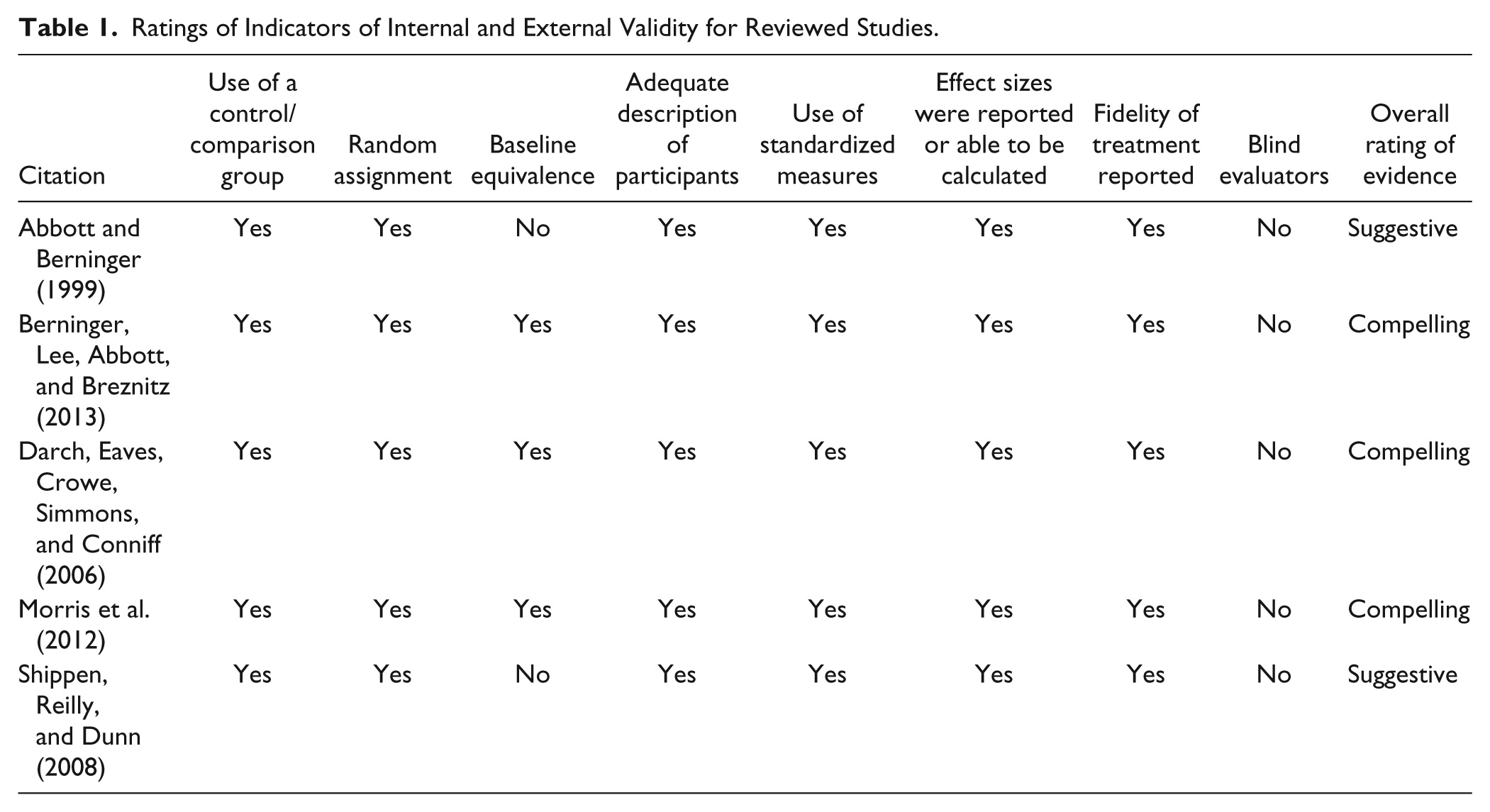
Once studies meeting these criteria were identified, the articles were then read in their entirety. A total of five studies met the inclusion criteria to be included in this review and appear in the reference list with an asterisk. Seven articles neared inclusion, but because they did not meet at least six of the quality indicators, they were not selected for further consideration.
Coding Procedures
For all five studies, information was recorded regarding the description of participants, dependent measures used, type of orthographic intervention used, findings pertinent to spelling outcomes, and the presence of eight indicators of high-quality research. The first author initially coded all of the studies. Next, the second author independently recoded all of the five studies to establish intercoder reliability. Average agreement across the criteria coding was 100%.
Effect Sizes
Cohen’s d effect sizes were calculated for experimental and control/comparison group(s). These were calculated as an important metric for describing the quantitative relationship between an intervention and treatment outcome (Turner & Bernard, 2006), and thus essential to interpreting the practical significance of orthographic knowledge intervention on the spelling outcomes for those with reading disabilities. The effect sizes were calculated using the traditional Cohen’s d formula (Cohen, 1988), or the difference between the mean posttest score of the treatment and comparison group divided by the pooled standard deviation, and computed by a web-based calculator (Wilson, 2013). Practical significance for Cohen’s d can be interpreted on a scale where 0.2 is a small effect, 0.5 is a moderate effect, and 0.8 is a large effect (Cohen, 1988). Cohen’s d was chosen as the index for effects because the reviewed studies measured outcomes on a continuous scale and lent themselves to causal interpretation (Turner & Bernard, 2006). Moreover, this index was consistent with the methods of Weiser and Mathes (2011) and thus would lend itself to the research extension to those early developmental findings.
Results
Study Characteristics
Following the aforementioned methods and stated inclusionary and exclusionary criteria, the resulting studies chosen for review included the interventions (a) word study, (b) the Spelling Mastery program, and (c) multiple linguistic interventions such as the Retrieval, Automaticity, Vocabulary, Engagement with language, and Orthography (RAVE-O) program (Wolf, Miller, & Donnelly, 2000). Details regarding these interventions will be described in further detail in the following sections. Two studies included students at risk for a reading disability (Abbott & Berninger, 1999; Shippen, Reilly, & Dunn, 2008), one study involved participants identified as having dyslexia (Berninger, Lee, Abbott, & Breznitz, 2013), in one study the students were identified as having a reading disability (Morris et al., 2012), and one study included students identified with a learning disability in a linguistic area (i.e., spelling; Darch, Eaves, Crowe, Simmons, & Conniff, 2006). A total of 404 students spanning the ages of 6 years through 14 years participated in the studies. Table 2 provides information on each study’s spelling outcome measures and quantitative spelling results.
Measures and Primary Findings of Studies Included in Review.
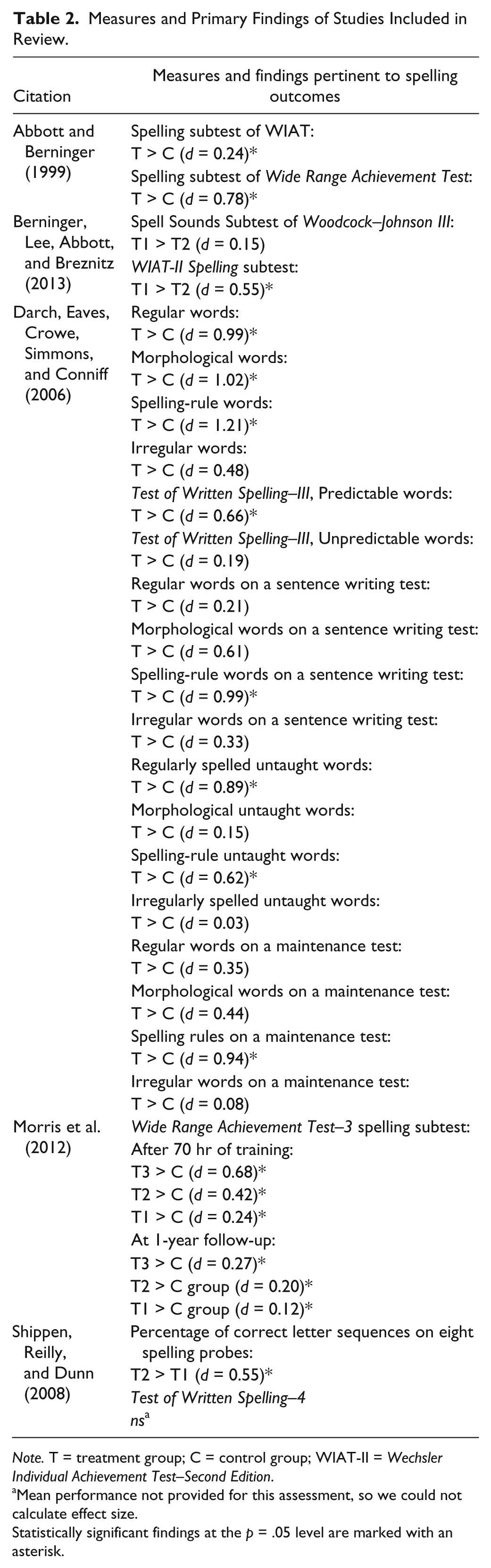
Note. T = treatment group; C = control group; WIAT-II = Wechsler Individual Achievement Test–Second Edition.
Mean performance not provided for this assessment, so we could not calculate effect size.
Statistically significant findings at the p = .05 level are marked with an asterisk.
Word Study Interventions
In two reviewed studies, researchers examined how word study interventions influenced the spelling of students with learning disabilities (Abbott & Berninger, 1999; Berninger et al., 2013). Abbott and Berninger (1999) conducted a randomized control trial with 20 students between the ages of 9 and 13 diagnosed as low achieving in reading. Students were divided into a structural analysis group (treatment) or a study skills group (control) for 16 weeks of individual tutoring sessions for 1 hr a week. While both groups received treatment in phonological awareness, phonological decoding, oral reading of connected text, and orthographic skills, only the students in the treatment group were encouraged to apply their knowledge of syllable structure and morpheme patterns during the phonological activities. Students in the treatment group received explicit intervention of morphological awareness (morpheme patterns based on word origins) and structural analysis of syllable types (dividing words into syllables, sounding out the grapheme–phoneme correspondences within syllables, and blending the syllables to form the entire word). When students in the treatment group made an error in oral reading, they were provided syllable and morpheme information to figure out the correct pronunciations. In contrast, the students in the study skills group were not given any direct instruction or feedback. They received basic skills instruction in phonological awareness, phonological decoding, oral reading, and orthographic skills. In the orthographic training component, the interventionist wrote a word from the story on a board, swept her finger under the word, and directed the student to look at the word. After the student looked at the word, it was covered, and the student was asked to spell the word. If the student misspelled the word, the interventionist pointed out the missed letters and then repeated the procedure. Beyond this basic instruction, the students were provided with study skills training that included activities such as note taking, outlining, writing paragraphs, and using an index. Results of two standardized measures were used to assess spelling outcomes and students in the treatment group experienced a moderate treatment effect (d = 0.78, p < .001) on the spelling subtest of the Wide Range Achievement Test–3 (WRAT-3, Wilkinson, 1993) with a small treatment effect (d = 0.24, p = .001) on the spelling subtest of the Wechsler Individual Achievement Test (WIAT, The Psychological Corporation, 1992). In 16 weeks, substantial improvements in spelling were noted with the WRAT-3, and although the effect size was much smaller, significant changes were also observed on the WIAT. Thus, for 9- to 13-year-old students who were at risk for reading difficulties, the intervention that included direct instruction in word patterns such as the orthographic knowledge in structural analysis of syllables units and the morphological awareness focus based on word origins appeared to improve spelling.
More recently, Berninger et al. (2013) investigated whether a treatment program consisting of 30 1-hr sessions (twice a week over 5 months) would improve word decoding and spelling in 24 students with dyslexia in Grades 4 through 9. Students were divided into two treatment groups (i.e., Treatment Groups A and B). Twelve students were randomly assigned to each treatment group, and the interventions consisted of four steps described in the following paragraphs. Following each step, students in both treatment groups were tested using standardized measures of spelling to determine whether there were any between-participant effects due to the nature of the intervention.
For Treatment Group A, Steps 1 and 2 focused on alphabetic knowledge. Step 1 involved training the strategy of identifying grapheme–phoneme correspondences during oral reading that focused on automatizing procedural knowledge by touching a grapheme and quickly saying the corresponding phoneme. Students then participated in teacher-guided oral reading and discussion of a story. Step 2 continued the training of grapheme–phoneme correspondence for oral reading and added the encoding spelling component of focusing on translating phonemes to graphemes.
For Step 3, students in Treatment Group A received additional training that included a Rapid Accelerated Reading Program (RAP; Breznitz & Nevat, 2004). This computer-training program involved text presentation at a controlled rate with subsequent comprehension questions. Rate of text presentation was increased following the correct reading comprehension responses, thereby facilitating the efficiency of working memory while training silent reading comprehension accuracy and fluency. Moreover, in Step 3, Group A received training in the additional orthographic knowledge skill of MGR development through two strategies. The first was a six-step strategy called the Photographic Leprechaun. This strategy involved (a) carefully examining a word, (b) naming each letter in the written word in a left to right direction, (c) taking a “mental photograph” of the word, (d) naming the letters in designated word positions, (e) checking the target word on the list to find out whether the correct letters were identified in the spelling, and (f) listening to teacher feedback regarding the spelling. The second strategy was labeled the Proofreaders’ Trick and involved a three-step process. In this strategy, similar to the Photographic Leprechaun, students studied the written word carefully, held the word in the “mind’s eye” while spelling it silently backward, and then opened their eyes to check the backward spelling against the forward spelling of the target word. Finally, in Step 4, students continued to receive the RAP training and also began receiving training in morphological strategies and sorted words into suffixes.
Treatment Group B also participated in four steps of intervention. Step 1 was the same as that for Treatment Group A, and participants received grapheme–phoneme correspondence training for oral reading. During the second step, unlike Group A that began the step of encoding phonemes to corresponding grapheme, students in Group B received continued intervention in identifying grapheme–phoneme correspondence (touching a grapheme and saying the corresponding phoneme), and an additional phonological awareness intervention was added. Activities to increase phonological awareness included clapping the number of syllables in a word and counting the number of phonemes in a syllable. Comparing treatment groups at this step allowed identification of the effects of alphabetic principle training in both oral reading identification and spelling encoding contrasted to oral reading plus phonological awareness training.
At Step 3, Treatment Group B continued their Step 2 training and did not receive the added orthographic training strategies of Photographic Leprechaun or the Proofreaders Trick. Comparing the two treatment groups at this step allowed for comparisons between the additional orthographic knowledge training and grapheme–phoneme correspondence training for oral reading and spelling versus the phonological awareness training and grapheme–phoneme correspondence training for oral reading. For Step 4, Treatment Group B received orthographic spelling strategy training without the focus on morphological awareness. Comparisons of the two groups at this step allowed for distinctions to be made between morphological strategy training and orthographic knowledge strategy training.
Two different standardized spelling measures were administered to participants of each group directly following each intervention step. First, pseudoword spelling ability was measured with the Woodcock–Johnson III Spell Sounds subtest (Woodcock, McGrew, & Mather, 2001). Second, real word dictated spelling was measured with the Wechsler Individual Achievement Test, 2nd Edition Spelling subtest (WIAT-II; The Psychological Corporation, 2001).
Results of this study revealed that students in Treatment Group A improved moderately better from pre- to posttest in their real word spelling performance compared with Treatment Group B (d = 0.55, p = .015), but pseudoword spelling improvement was small for both groups and did not differ between groups (d = 0.15, p = .12). In addition, no treatment-specific significant effect was found for either spelling measure. Considering this intervention lasted a month longer than the one conducted by Abbott and Berninger, it was surprising that a similar significant change did not occur. However, although standardized measures were used, the real word measure was an updated assessment (the second edition of the WIAT) and the pseudoword measure was completely different from the WRAT-3 used by Abbott and Berninger. This finding indicates that that the students with dyslexia appeared to be able to learn to spell words using MGRs; however, instruction on the development of MGRs did not appear to generalize to application with novel or new words.
Spelling Mastery
Spelling Mastery (Dixon, Engelmann, & Bauer, 1990), a spelling intervention curriculum that incorporates an orthographic knowledge component and is commonly used in the schools, was directly assessed by Shippen et al. (2008) and Darch et al. (2006). Shippen et al. conducted a study that measured performance on standardized and curriculum-based spelling probes in two groups of elementary students aged 6 to 11 years at risk for reading disabilities. One group received one lesson per day in Spelling Mastery, a program that focuses on phonology tied to orthographic patterns, morphological awareness, and MGRs in words. The phonology/orthographic pattern component emphasized sounds and sound-symbol correspondence with an additional concentration on patterns in words that make up word families. The morphemic awareness intervention focused on teaching prefixes, suffixes, and base words and applying grammatical rules to multisyllabic words. The whole-word component required students to memorize irregularly spelled words as a whole unit instead of trying to match sounds and symbols. As such this orthographic strategy appeared to be focused on establishing MGRs. The age-matched group received two lessons per day in the same Spelling Mastery program. Following the 4-week intervention, the researchers did not find a significant difference between the two groups on the Test of Written Spelling–4 (TWS-4; Larsen, Hammill, & Moats, 1999). On curriculum-based probes, however, significant, moderate within-participant main effects were found for time and a time by age interaction. Participants who received two lessons a day performed significantly better than the comparison group (d = 0.55, p < .01) and also performed significantly better with age and additional lessons (d = 0.48, p < .01). The curriculum-based probes may have been a more sensitive indicator of change than the standardized spelling test, given that the intervention only last for 1 month. These findings suggest that the Spelling Mastery program was effective, and additional doses of the program appeared to assist students 6 to 11 years old at risk for reading disabilities in performing higher on curriculum-based measures than their peers who only received one dose per day.
Darch et al. (2006) also studied the Spelling Mastery program in students between the ages of 8 and 12 with language-based learning disabilities. This was the only study included in this review in which spelling was examined not only at the word level but also in contextual writing. The treatment group was compared with a group receiving traditional spelling instruction in which targeted words were introduced in context, and students were asked to define these words, write sentences using the words, and provided associated dictionary skill training to spell and define unknown words. Each group received daily instruction lasting 30 min for 4 weeks. Dependent measures included tests of trained and untrained words, the standardized Test of Written Spelling–III (TWS-III; Larsen & Hammill, 1994), and sentences that included taught spelling words. Spelling words were divided into four categories: phonetically regular words, morphologically complex words, words that followed a specific spelling rule (i.e., when to drop the final e), and irregular words.
Overall, those students in the Spelling Mastery program outperformed those in the control group on measures of spelling. For trained words, the group that received the Spelling Mastery program performed significantly higher than the traditional instruction group on spelling regular words (d = 0.99, p < .01), morphological words (d = 1.02, p < .01), and spelling-rule words (d = 1.21, p < .01). No significant difference was found between groups on irregular words (d = 0.48, p = .13). However, the Spelling Mastery participants outperformed the control group on predictable words on a standardized measure, the TWS-III (d = 0.66, p = .04), but no difference was found between the groups on the unpredictable words from the same test (d = 0.19, p = .16). Like the Shippen et al. study, this intervention took place over a short period of time. It is not unusual for standardized tests to not pick up on change in only a few weeks time. The moderate, significant effect on the predictable words subtest of the TWS-III suggests that the students were applying their newly learned skills in a substantial way. Moreover, the Spelling Mastery participants performed significantly higher than the control group on spelling-rule words on the sentence writing test (d = 0.99, p ≤ .001), but there was no difference between groups on the regular words (d = 0.21, p = .51), morphological words (d = 0.61, p = .06), or irregular words (d = 0.33, p = .30) on the same test. The Spelling Mastery group also significantly outperformed the traditional instruction group on regularly spelled untaught words (d = 0.89, p ≤ .001) and spelling-rule words (d = 0.62, p = .05), but no difference was found between groups on morphological (d = 0.15, p = .67) or irregularly spelled untaught words (d = 0.03, p = .91). Finally, students in the Spelling Mastery program outperformed students in the traditional instruction program on words that followed the spelling rule on a maintenance test (d = 0.94, p ≤ .001), and thus appeared to retain the spellings longer than their counterparts who received traditional instruction. No difference was found, however, between the groups on maintenance tests of regular (d = 0.35, p = .27), morphological (d = 0.44, p = .16), or irregular words (d = 0.08, p = .13).
In this study, Spelling Mastery was shown to have a significant effect on trained spelling regular words, morphological words, and words that followed spelling rules and generalized to untaught regularly spelled word and untaught words that followed the spelling rules. Moreover, these 8- to 12-year-old students who had a learning disability in spelling maintained their progress on words that followed spelling rules, suggesting that the Spelling Mastery was effective in teaching students to pay attention to the patterns that occur in words. However, there was a lack of significant findings and smaller effects for irregular words at both posttest and maintenance.
Intervention With Multiple Linguistic Foci
The RAVE-O program (Wolf et al., 2000) was one of several different treatment packages that concurrently focused on the interrelated linguistic skills in students included in Morris et al.’s (2012) recent intervention study of elementary (first–second grade) students diagnosed with a reading disability. Morris et al. included three treatment groups and one control group in this study. The active control group received math instruction and classroom survival skills that included training in etiquette, life skills, and organizational strategies. One treatment group received phonological awareness intervention that involved phoneme analysis, segmentation, and blending skills and additional classroom survival skills. The second treatment group received the phonological awareness intervention along with the RAVE-O program (Wolf et al., 2000). The RAVE-O program is based on the theory that word learning focused in multiple modes with many language and literacy perspectives improves the ability to encode and decode a word. The orthographic component includes a focus on analyzing patterns of the internal structure of words into common sublexical (e.g., syllables) units. The researchers hypothesized that any differences between the phonological awareness intervention plus survival skills group and the phonological awareness intervention plus RAVE-O group could be attributed to the RAVE-O component of the program. Finally, the third intervention group received phonological awareness intervention plus a strategy-based intervention that included the orthographic focus of using the strategy of analogy to identify unknown words and the application of sorting words by familiar or unfamiliar orthographic patterns. Each intervention lasted 70 hr and was completed in parallel schedules for all students.
As expected, the results revealed that the control group with the math instruction did not perform as well on the WRAT-3–Spelling (Wilkinson, 1993) compared with those groups receiving the aforementioned literacy-focused intervention. Students who received phonological awareness plus strategy intervention experienced the largest effect (d = 0.68) followed by students in the phonological awareness intervention plus RAVE-0 intervention (d = 0.42) who performed better than those students who received phonological awareness intervention plus classroom survival skills (d = 0.24). These effect sizes were all statistically significant with p < .05. At a 1-year follow-up, the trend continued, although the effect sizes were much smaller. The phonological awareness intervention plus strategy treatment group had an effect size of d = 0.27, phonological awareness intervention plus RAVE-O had an effect size of .20, and phonological awareness intervention plus the classroom survival skills had an effect of d = 0.12. These results suggest that the orthographic component of intervention did increase the students’ spelling abilities, and the more explicit strategy training in orthographic patterns elicited better results than providing traditional phonological awareness intervention alone. Treatment effects, however, were not well maintained a year later, suggesting that the 70 hr of provided intervention may not have been enough to create lasting effects. In summary, the intervention that consisted of phonological awareness training in conjunction with an explicit focus on an orthographic knowledge strategy of using analogies and patterns to identify unknown words had a significant and large effect on a standardized spelling assessment for first- and second-grade learners with a reading disability.
Discussion
This review investigated the effects of spelling intervention with an explicit and systematic focus on advanced orthographic pattern knowledge on the spelling outcomes in school-age students with reading disabilities. It was hypothesized that orthographic spelling interventions with a focus on orthographic patterns would effectively facilitate spelling success in school-age students with reading deficits. Two recent syntheses of orthographic interventions focused on the alphabetic principle revealed positive effects for spelling success in early school-age students with learning disabilities (Wanzek et al., 2006; Weiser & Mathes, 2011). The current synthesis expands upon that research and included five moderate- to high-quality intervention studies that included an orthographic knowledge focus beyond alphabetic principle to enhance the spelling skills of students with reading disabilities, at risk for reading disabilities, or diagnosed with a learning disability in spelling.
Consistent with previous reviews (Wanzek et al., 2006; Weiser & Mathes, 2011), the results indicated that spelling interventions that included a systematic and explicit focus on the development of orthographic knowledge appeared to significantly and effectively improve the spelling skills of students in grades kindergarten through ninth grade with reading disabilities. Although these results are based only on five studies, they did include more than 400 students ages 6 to 14 years and lend support to the idea that classroom instruction should focus on the “spelling-is-taught” approach as opposed to “spelling-is-caught” (Graham et al., 2008, p. 800). That is, in the commonly used spelling-is-caught approach, it is assumed that students will pick up spelling through passive exposure and thus the focus may be on assessing, rather than instructing, and the only attention to spelling is the weekly spelling tests (Graham et al., 2008). Conversely, the spelling-is-taught method, in which spelling instruction is directly and explicitly provided, appears to be effective in improving literacy success.
Explicit instruction appears to be effective when it includes linguistically based spelling instruction where students are required to actively reflect on orthographic patterns and produce the spellings themselves. A majority of the studies in this synthesis revealed effective results with moderate to large effect sizes in spelling. Multiple methods of teaching orthographic knowledge were considered, and students receiving intervention with active reflection and inclusion of a focus on orthographic patterns either significantly outperformed the control group or at least improved their own spelling performance. This strategy of considering the patterns within words at the syllable and rime-onset level appears to be beneficial in helping students to encode words when spelling. Across the studies, control and comparison treatments received interventions focused on multiple strategies beyond that of orthographic patterns, however, the inclusion of an orthographic-pattern-based approach appeared to be the only common strategy across all approaches that significantly improved spelling performance. Specifically, control and comparison groups learned linguistically applied strategies such as phonological awareness (Abbott & Berninger, 1999; Berninger et al., 2013; Morris et al., 2012; Shippen et al., 2008), morphological awareness (Morris et al., 2012; Shippen et al., 2008), and the application of semantic context (Darch et al., 2006; Morris et al., 2012), and these strategies were also applied within the experimental conditions in ways unique to these studies. Yet, one linguistic strategy uniquely applied across all treatment conditions that was effective in improving spelling was that of orthographic pattern analysis and application. Thus, it appears this skill is an important factor when considering and applying effective spelling intervention.
Spelling interventions that incorporated a focus on orthographic knowledge in programs that included a prominent problem solving and word study component revealed strong to robust effect sizes in spelling. Moreover, these strong effect sizes appeared associated with a generalization or transfer of learning as they were found on standardized measures for untaught words and were not found in control contexts that that did not focus on the recognition of orthographic patterns. This is consistent with research findings that active reflection on patterns of words in a meaningful manner with an element of student facilitated problem solving or self-discovery appears to be beneficial for spelling (Bowers et al., 2010; Wolter, 2009; Wolter & Dilworth, 2013).
One studied intervention (Berninger et al., 2013) included an explicit intervention focus on the development of MGRs (i.e., strategies of Photographic Leprechaun or the Proofreaders Trick) in addition to a focus on orthographic patterns, however, this intervention knowledge appeared to transfer only to the spelling of real words and not pseudowords. This could be because the development of MGRs is often word specific and interventions focused on memorizing the “picture” of the word did not focus on strategies to transfer this knowledge to other words. At this time, the reviewed research is not conclusive regarding best practices for the development and application of MGR strategies.
In addition, although the reviewed interventions that included a systematic focus on orthographic knowledge improved overall spelling outcomes, results of this study need to be interpreted with caution. First, the term orthographic knowledge intervention is broad and has been operationalized and defined specifically to the consideration of orthographic patterns and MGRs (Apel, 2011); as such, the results of this current study do not potentially reflect all valid research that may define orthographic knowledge differently. In addition, associated treatment factors may have significantly influenced results in the current review separate from that of an orthographic focus alone. Conditions and factors such as (a) use of specific strategies, (b) developmental appropriateness or progression, (c) dosage, and (d) the amount of simultaneous focus on other linguistic targets (phonological and morphological awareness) need to be further studied to determine whether and how much these variables influence treatment outcomes.
Importance of Multiple Linguistic Intervention
As noted previously, it should be highlighted that the multiple linguistic factors of phonological awareness, morphological awareness, and orthographic knowledge are all important in spelling development and instruction. The current review was initiated because, unlike the areas of phonological awareness and morphological awareness, syntheses of orthographically focused interventions for students with literacy deficits have been limited. Despite the findings of the current review indicating spelling intervention with a focus on orthographic knowledge appears to effectively improve spelling in school-age students with reading disabilities, this intervention was not provided in a linguistically isolated manner. That is, in four of the five reviewed studies, a focus on relations between letter units and sounds (phonology) and meaning (morphology) was included in addition to the focus on orthographic knowledge. Thus, one limitation of the current research is the inability to truly isolate the influence of orthographic knowledge intervention on student’s spelling success. The purpose of many of these studies was not to test the influence of orthographic knowledge alone but the effects of the overall intervention program that included an orthographic pattern application component. Future research might be conducted to systematically test and determine whether specific linguistic factors add value to an overall multilinguistic intervention. Thus, this synthesis indicates that spelling intervention with a focus on linguistic units of not only letter–sound units but also that of syllables and letter patterns appears to facilitate spelling success when integrated with the multiple linguistic factors such as that of phonology and morphology.
Educational Implications
When considered with evidence from previous syntheses (Wanzek et al., 2006; Weiser & Mathes, 2011), this systematic review revealed noteworthy trends. First, spelling interventions with a purposeful and systematic focus on the explicit awareness of patterns appear to facilitate spelling acquisition. Although there were only five studies included in this synthesis, over 400 students were included. Given the number of participants and the relative strength of the effect sizes, teachers may consider adopting curricula and classroom activities that require students to actively reflect on and identify orthographic patterns (e.g., word families with similar rules). Second, an opportunity to explicitly link orthographic knowledge to associated phonological pronunciations (e.g., short -a pronunciation in word past vs. long -a paste) and, when possible, morphological meanings (e.g., spelling of -ed, meaning past tense, pronounced /t/ in popped, /d/ in pinned) also appears to improve overall spelling success. As mentioned earlier, it is difficult to isolate just orthographic knowledge without including phonological and morphological awareness. Many of the reviewed studies (Abbott & Berninger, 1999; Berninger et al., 2013; Darch et al., 2006; Shippen et al., 2008) incorporated all three areas. An example of a reviewed intervention activity that requires students to actively reflect on the orthographic patterns within and between words is word sorts (Bear, Invernizzi, Templeton, & Johnston, 2004). In a word sort activity, students are required to differentiate word categories often by a salient orthographic pattern or feature (e.g., sorting words patch, notch in one category vs. peach, coach in the other category) and reflect on how that orthographic pattern influences change.
Finally, in addition to developing an awareness of orthographic patterns and regularities, students appear to benefit from intervention that enables them to focus on all letters within a word to form clear and complete MGRs. Establishment of MGRs is facilitated by the provision of immediate feedback and the encouragement and repetition of correct spellings though visualization strategies such as Photographic Leprechaun and Proofreaders Trick studied by Berninger et al. (2013) and described in this article. It is through establishing these MGRs that students are able to form pictures of irregular words and recall them for spelling (e.g., they, what, who).
Limitations
In addition to the aforementioned limitations of not being able to isolate the influence of orthographic interventions in spelling success and having a narrow definition of orthographic knowledge intervention, we realize there are other limitations to this study. We recognize some relevant research may have been excluded in this study because it did not fit within the limited scope of this best evidence synthesis. This includes studies that did not contain at least six of the eight quality indicators, studies without adequate comparison or control groups, and studies that involved participants with different primary diagnoses (e.g., language impairment). In addition, studies of related linguistic interventions that did not include a spelling intervention component were excluded. Moreover, we chose to eliminate studies in which researcher-developed outcomes were the only assessments included to show spelling improvements. Although our final selection of five studies was independently rated by two people, the original search through the databases was only conducted by one person. This single-author search introduces the possibility of human error. Finally, with such a limited scope, potential intervention approaches to teaching orthographic knowledge, such as using an analogy approach (Gaskins, Ehri, Cress, O’Hara, & Donnelly, 1996–1997), were not included.
Conclusion
In summary, spelling is a skill integrally linked to reading and expressive writing success, and a focus on orthographic patterns and knowledge appears to improve spelling in students with reading disabilities. The current review expands upon previous research syntheses and documents the positive effects of an explicit orthographic intervention on spelling, where there is a focus on orthographic patterns beyond that of the alphabetic principle for students with and at risk for reading disabilities. Spelling is a critical skill for all students to achieve academic success; as such a spelling intervention with an explicit and systematic orthographic focus appears to be a promising tool to facilitate spelling success for those who are at risk for school failure.
Footnotes
Declaration of Conflicting Interests
The author(s) declared no potential conflicts of interest with respect to the research, authorship, and/or publication of this article.
Funding
The author(s) received no financial support for the research, authorship, and/or publication of this article.