




Abstract
Using data from the 2015 Dane County Youth Assessment (n = 12,886 students, 22 high schools), we identified disparities between students with Individualized Education Programs (IEP) and without IEPs across multiple post–high school aspirations. We identified significant IEP status × grades earned interactions in predicting students’ reported likelihood of pursuing post–high school placements. Higher reported average grades earned were more strongly associated with students’ greater reported likelihood of attending college/university for students without IEPs than for students with IEPs. Also, higher grades were associated with less likelihood of foregoing postsecondary education and only looking for a job for students without IEPs whereas this association was not significant for students with IEPs. Implications for research and practice are discussed.
The transition from high school to postsecondary settings is a critical juncture that all students encounter. This transition can be especially critical for students with disabilities (e.g., students who receive services through an Individualized Education Program [IEP] under the Individuals with Disability Education Act [IDEA] or Section 504 of the Rehabilitation Act of 1973), as they experience unique challenges and barriers in addition to those faced by students without disabilities. The challenges that students with disabilities face socially, behaviorally, and academically have led researchers to design interventions and implement policies (e.g., Positive Behavior Interventions and Supports and Response to Intervention) to support students’ in-school success in preparation for positive post-school outcomes (see www.pbis.org, www.intensiveintervention.org, and www.transitionta.org). Disparities between students with and without disabilities in their post–high school aspirations and attainments (e.g., attending college) have been highlighted (Newman, Wagner, Cameto, & Knokey, 2009). Yet, the same assumptions and data limitations have been faced across studies, as researchers have had to rely on a few limited sources of data, much of which were collected decades ago (e.g., National Education Longitudinal Study [NELS] of 1988). In addition, previous studies noted limitations regarding disability label accuracy across time points (e.g., Rojewski, 1996) and using data to discuss post–high school aspirations with a sample of all high school graduates (Murray, Goldstein, Nourse, & Edgar, 2000), which could have biased results. Last, little is known about aspirations of students in education beyond students with learning disabilities, which has been a narrower focus of previous research (e.g., Kortering, Braziel, & McClannon, 2010). We address these limitations in the current study by utilizing more recent data from a large-scale sample of high school students with and without disabilities. We also consider greater nuance in post–high school aspiration disparities by considering several factors that could enhance or attenuate their size.
Disparities Between Youth With and Without Disabilities
Youth with disabilities continue to experience poorer post–high school outcomes than their peers without disabilities (Newman et al., 2009). These inequities range across all major areas, including employment, postsecondary education, and independent living (Newman et al., 2009; Sanford et al., 2011). For example, students with disabilities are more likely to drop out of high school and less likely to complete a college degree than students without disabilities (Chapman, Laird, Ifill, & KewalRamani, 2011). The seriousness of these disparities is underscored by the fact that completing high school and a postsecondary degree are highly associated with job obtainment and the amount an individual is projected to earn over the lifespan (U.S. Bureau of Labor Statistics, 2016).
Earlier studies revealed through interviews of 123 students with learning disabilities that students with disabilities were less likely to indicate aspirations for postsecondary education or graduate education than students without disabilities (Kortering & Braziel, 2000; Rojewski, 1996). Furthermore, students with learning disabilities were more likely to attend training or community college rather than a 4-year university than students without learning disabilities, which was disclosed by high school graduates in interviews over a 5-year period (Murray et al., 2000). In addition, students with learning disabilities were less likely to indicate aspirations for higher prestige occupations (e.g., physicians, lawyers, computer scientists) and more likely to indicate interest in entry-level occupations (Kortering & Braziel, 2000; Rojewski, 1996).
Later studies based on data from the early 2000s identified similar post–high school aspiration disparities. A 2002 student survey on post–high school plans revealed that students with learning disabilities were more likely to indicate they would move directly into working than attending a 4-year university, while the contrary was true for students without learning disabilities (Kortering et al., 2010). Furthermore, students with disabilities indicated that they intended to obtain jobs that required less education while their peers without disabilities indicated they would obtain jobs that required postsecondary education (Kortering et al., 2010).
Academic achievement (e.g., grades earned) and the types of courses that students take are also considered important indicators of post–high school success for students with or without a disability. One difference is, students without disabilities are more likely to take more coursework and credits focused on academic content, while students with disabilities are more likely to take courses in vocational education (Newman et al., 2009). Depending on the youth’s post–high school plans, achievement in all courses as well as which courses a youth has taken could have an effect on meeting the prerequisites for college. Furthermore, students who report earning higher grades also have reported higher level college aspirations (Akos, Lambie, Milsom, & Gilbert, 2007; Feller, 2003; Hill et al., 2004; Hill & Wang, 2015; Irvin, Meece, Byun, Farmer, & Hutchins, 2011). Course of study and achievement (e.g., grades earned) have been identified by the College and Career Readiness and Success Center and by the National Technical Assistance Center on Transition as important indicators for success post-high school along with postsecondary aspirations (Hein, Smerdon, & Sambolt, 2013).
In combination, these areas of research have revealed disability-based disparities on aspirations, and have inferred that academic achievement could relate to aspirations. Nevertheless, there is a dearth of research that has examined the moderating effects of certain variables on these aspiration disparities. Testing for moderated differences is critical because they could capture when or where even more concerted intervention efforts should be made to counter these disparities.
Grades Earned as a Moderator of Aspirational Disparities
Several vocational theories have considered the impact social positions in society (e.g., marginalization) have on an individual’s career aspirations (Blustein, 2006). In her theory of circumscription and compromise, Gottfredson (1981) remarked that, as adolescents become more aware of their current circumstances as well as their own interests and abilities, some youth relinquish their preferred occupations for those that might be less compatible but more accessible. For instance, access to more desirable occupations could be hindered by lower academic achievement (e.g., reflected in grades earned). Rojewski, Lee, Gregg, and Gemici (2012) also speculated that lower aspirations among students with high incidence disabilities could be due to the academic difficulties they may have experienced during middle and high school. This is an important point, as students with disabilities often experience academic deficits, and may perform below grade level in core content areas such as reading and math (Lane, Carter, Pierson, & Glaeser, 2006).
At the same time, even students with disabilities who are highly qualified for certain post–high school aspirations (e.g., those with high grades could attain college entrance) may come to realize certain barriers to their original post-school aspirations and, thus, rule them out. For instance, students with disabilities may express lower academic self-efficacy and believe their intelligence is “fixed,” creating a schema that their academic abilities are limited to their functional academic state (Baird, Scott, Dearing, & Hamill, 2009), which could impact future academic and career decisions.
Although a theoretical framework such as circumscription and compromise has been developed and used to provide some understanding about the general nature of individual aspirations for the future, students with disabilities have been largely absent in the accompanying empirical research. Yet, as noted, students with disabilities may experience unique challenges to their career aspirations during their high school years. Consequently, whereas past studies have shown a positive correlation between higher grades earned and stronger aspirations to attend college among samples of students predominantly without disabilities (e.g., Eccles, Vida, & Barber, 2004), this association may be weaker for students with disabilities.
Current Study
It is clear that there are disparities between students with and without disabilities regarding post–high school aspirations and expectations. Still, there is relatively little research that has utilized more recently available data (extant literature has continued to rely on data 30 years old; NELS, 1988), and there is an absence of studies examining how some factors, such as grades earned, may moderate post–high school aspiration disparities. To address these limitations, the current study applies a career development framework to produce a more contemporary and nuanced understanding of post–high school aspirations of students with and without disabilities.
We focus on grades earned as a moderator of post–high school aspiration disparities for students with and without IEPs. We hypothesized significant IEP status × grades earned interactions in predicting students’ reported likelihood of pursuing several post–high school placements. Specifically, we hypothesized that earning higher grades would be associated with a stronger reported likelihood of graduating high school and going to a college or university, while we hypothesized that higher grades would be associated with a weaker reported likelihood of foregoing any postsecondary education and, instead, getting a job. We expected the size of these respective positive and negative associations to be significantly stronger for students without IEPs than for students with IEPs. To provide a more refined estimate of these interaction effects, we controlled for a number of confounding variables that could also account for variability in students’ post–high school aspirations.
Method
Participants and Data Source
We analyzed data from the 2015 Dane County Youth Assessment (DCYA), collected in Dane County, Wisconsin. The DCYA is comparable with the CDC Youth Risk Behavior Survey (YRBS; Centers for Disease Control and Prevention [CDC], 2009). Participants were 13,905 students (50.7% male; 75.4% White, non-Hispanic; Mage = 15.87, SD = 1.21) in 22 high schools. In consultation with the administrators of the DCYA, we excluded students who either reported their height as over 7 feet or who reported their weight as less than 80 pounds or more than 400 pounds to reduce the potential of including untruthful or unreliable respondents. This approach has been used in other studies using the DCYA (Poteat, Scheer, & Chong, 2016) and led to the exclusion of 247 students. Finally, we excluded students who did not know whether or not they currently received special education support or had an IEP (n = 772), for a final sample size of 12,886 students. Table 1 includes participants’ demographic information. Dane County is geographically diverse and includes small farming areas, suburban areas, and a city (Madison, Wisconsin). All students in Grades 9 to 12 in all districts were invited to participate if their parents had not denied them permission to complete the survey, except the Madison district; given the size of Madison schools, a random sample of 50% of youth in these schools was invited to participate. The data from Madison schools were then weighted by age, grade, sex, and race/ethnicity to be representative of the district. The demographic representation of students who participated in the other schools mirrored the National Center for Educational Statistics (NCES) reports for those schools. Students with severe cognitive or physical disabilities were generally unable to take the survey due to concerns such as comprehension of certain items or because certain accommodations would no longer preserve the confidentiality of responses. However, students with less severe disabilities were offered accommodations to complete the survey (e.g., extended time, individual aids to read questions to participants). Student participation rates were more than 85% across all schools. Students completed the survey independently online in school computer labs.
Participant Demographic Information.

Note. IEP = individualized education program.
Measures
Demographic and social covariates
Students reported their gender, race/ethnicity, sexual orientation, grade level, and whether they qualified for free or reduced-price lunch at school. Because of the limited number of youth within specific sexual orientation and racial/ethnic categories, we dichotomized race/ethnicity (0 = White; 1 = racial/ethnic minority) and sexual orientation (0 = heterosexual; 1 = lesbian, gay, bisexual, questioning, other [LGBQO]) in our analyses. We also dichotomized the free or reduced-price lunch item (0 = no/don’t know; 1 = yes).
Truancy was assessed with the item, “In the past 30 days, how often have you skipped or cut classes (absent without permission)” (never, 1–2 times, 3–4 times, or 5 or more times). Because of the distribution of responses, we dichotomized the responses (0 = never; 1 = truant at least once).
Students reported their smoking, drinking, or marijuana use on the following items: “During the past 30 days, on how many days did you smoke cigarettes” (0 days, 1 or 2 days, 3 to 5 days, 6 to 9 days, 10 to 19 days, 20 to 29 days, or All 30 days), “In the past 12 months, how many times did you use marijuana” (never, less than 1 time per month, or 1 time per month or more), and “In the past 12 months, how many times did you drink alcohol (more than a few sips)” (never, less than 1 time per month, or 1 time per month or more). Because of the distribution of responses, we dichotomized them as either never having used the substance within that time frame or as having used that substance within that time frame. We then created a single dichotomized score to indicate whether students had not used any of these substances within the time frame or that they had used at least one of these substances within the time frame (0 = has not used any of the substances; 1 = used at least one substance at least once).
The 4-item University of Illinois Victimization Scale (Espelage & Holt, 2001) assessed frequency of peer victimization in the past 30 days (e.g., “Other students made fun of me”; response options were never, 1 or 2 times, 3 or 4 times, 5 or more times, scaled 1–4). Higher average scale scores represent more frequently experiencing peer victimization. The reliability coefficient for the current study was α = .86.
Students responded to an item assessing their difficulty with completing their homework, “I struggle getting my homework done” (strongly disagree, disagree, agree, or strongly agree; scaled 1–4).
Finally, students reported their perceived sense of school belonging using the Psychological Sense of School Membership Scale (5 items; Bosworth, Espelage, & Simon, 1999; e.g., “I feel like I belong at this school”; response options were strongly disagree to strongly agree, scaled 1–4). Higher average scale scores represent a stronger sense of school belonging. The reliability coefficient for the current study was α = .86.
Special education or IEP status
Students responded to the following question about whether they received special education or had an IEP, “Do you currently receive special education support or have an IEP?” Response options were yes, no, or don’t know. For our analyses, we excluded participants who responded don’t know. However, we also ran our analyses in which we included these participants with those who responded no, and we documented nearly identical results for the significant disparities in future academic aspirations and interaction effects with earned grades.
Average grades
Students reported their average grades with an item and response options identical to the item used in the CDC YRBS survey, “What grades do you usually get on your report card” (mostly D’s or below, half C’s and half D’s, mostly C’s, half B’s and half C’s, mostly B’s, half A’s and half B’s, or mostly A’s; scaled 1–7). Higher scores represent higher average grades students reported typically receiving on their report card.
Future academic aspirations
Students responded to 3 items that assessed their potential future academic aspirations. The preceding stem was, “Think about how you see your future. What are the chances that you will . . . ” (a) Finish high school; (b) Go to a college or university; and (c) Not attend college or tech school and look for a job. Response options for each item were very low, low, about 50/50, high, or very high (scaled 1–5).
Analytic Strategy
To address our primary research questions, we constructed and tested several models using multilevel analyses with Hierarchical and Linear and Nonlinear Modeling (HLM 7.0) with restricted maximum likelihood (REML) estimation to account for the nesting of students within schools. We report the deviance statistic for each model as an indication of the relative improvement in fit of each model when including our set of specific independent variables, and we report the pseudo R2 based on the inclusion of these independent variables. We tested three models for the interaction between IEP status and grades earned in predicting students’ (a) intent to graduate high school, (b) attend college, and (c) forego any postsecondary education and, instead, seek employment. In each of our models, we included our 10 control variables: gender, sexual orientation, race/ethnicity, free/reduced-price lunch status, grade level, truancy, substance use, victimization, homework completion difficulty, and school belonging. In addition, we included the main effects of IEP status and the centered variable of grades earned, as well as their interaction term formed from the dichotomized IEP status variable and the centered variable of grades earned to reduce the potential effects of multicollinearity. In our models for attending college and foregoing any postsecondary education, we also included students’ reported intent to graduate high school as an additional covariate.
Results
Preliminary Analyses and Basic Disparities
Bivariate correlations are presented in Table 2, with associations in conceptually consistent directions. We focus on these correlations in greater detail in our moderation analyses. We also tested for basic group differences between students based on IEP status. Results from ANOVAs indicated significant differences on all three academic aspirations (see Table 3). As hypothesized, compared with students without an IEP, students with an IEP reported, on average, that they would be less likely to graduate high school or go to a college or university, and more likely to forego postsecondary education and, instead, seek employment.
Correlations Among the Measures.

Note. Finish HS = students’ reported likelihood of finishing high school; Attend college = students’ reported likelihood of attending college or university; No secondary ed. = students’ reported likelihood of not pursuing any postsecondary education and instead seeking employment; Grade level = students’ current grade level in school; Avg. grades = students’ reported average grades earned; S. belong = sense of school belonging; Truancy = whether students had been truant in the past 30 days; Sub. use = whether students had reported any amount of smoking, drinking, or marijuana use; Victim = students’ reported level of victimization from peers in the past 30 days; HW difficulty = extent to which students reported difficulty in completing their homework.
p < .001.
Students With an IEP-Based Differences on Academic Aspirations.

Note. Values represent the means and standard deviations (in parentheses) of scores for each group. IEP = individualized education program.
p < .001.
Interaction Between IEP Status and Grades Earned
The unconditional null models for our three dependent variables indicated that there was a small but statistically significant amount of variance across schools in students’ reported academic aspirations. The intraclass correlation coefficient indicated that 5.6% of the total variance in students’ reported intent to graduate from high school was across schools (Level 1 variance: 0.2272; Level 2 variance: 0.0134; χ2 = 372.47, p < .001, deviance = 17592.61); 5.4% of the total variance in students’ reported intent to attend college was across schools (Level 1 variance: 0.9384; Level 2 variance: 0.0537; χ2 = 440.32, p < .001, deviance = 35745.72); and 3.9% of the total variance in students’ reported likelihood of foregoing any postsecondary education and, instead, seeking employment was across schools (Level 1 variance: 1.1121; Level 2 variance: 0.0452; χ2 = 508.59, p < .001, deviance = 37344.41). The results of each model with all independent variables included in them are presented in Table 4. The IEP × grades earned interaction effect was not significant in predicting students’ reported likelihood of graduating high school (b = 0.02, p = .21), although students with an IEP still reported significantly less likelihood of graduating high school than those without an IEP even when accounting for the other covariates. The model accounted for 23.8% of the variance at the individual level (i.e., Level 1). The IEP × grades earned interaction was significant, however, in predicting students’ reported likelihood of attending college (b = −0.08, p < .01). The model accounted for 18.3% of the variance at the individual level. Similarly, the IEP × grades earned interaction was significant in predicting students’ reported likelihood of foregoing any postsecondary education and, instead, seeking employment (b = 0.10, p < .01). The model accounted for 18.0% of the variance at the individual level.
Models Predicting Academic Aspirations.
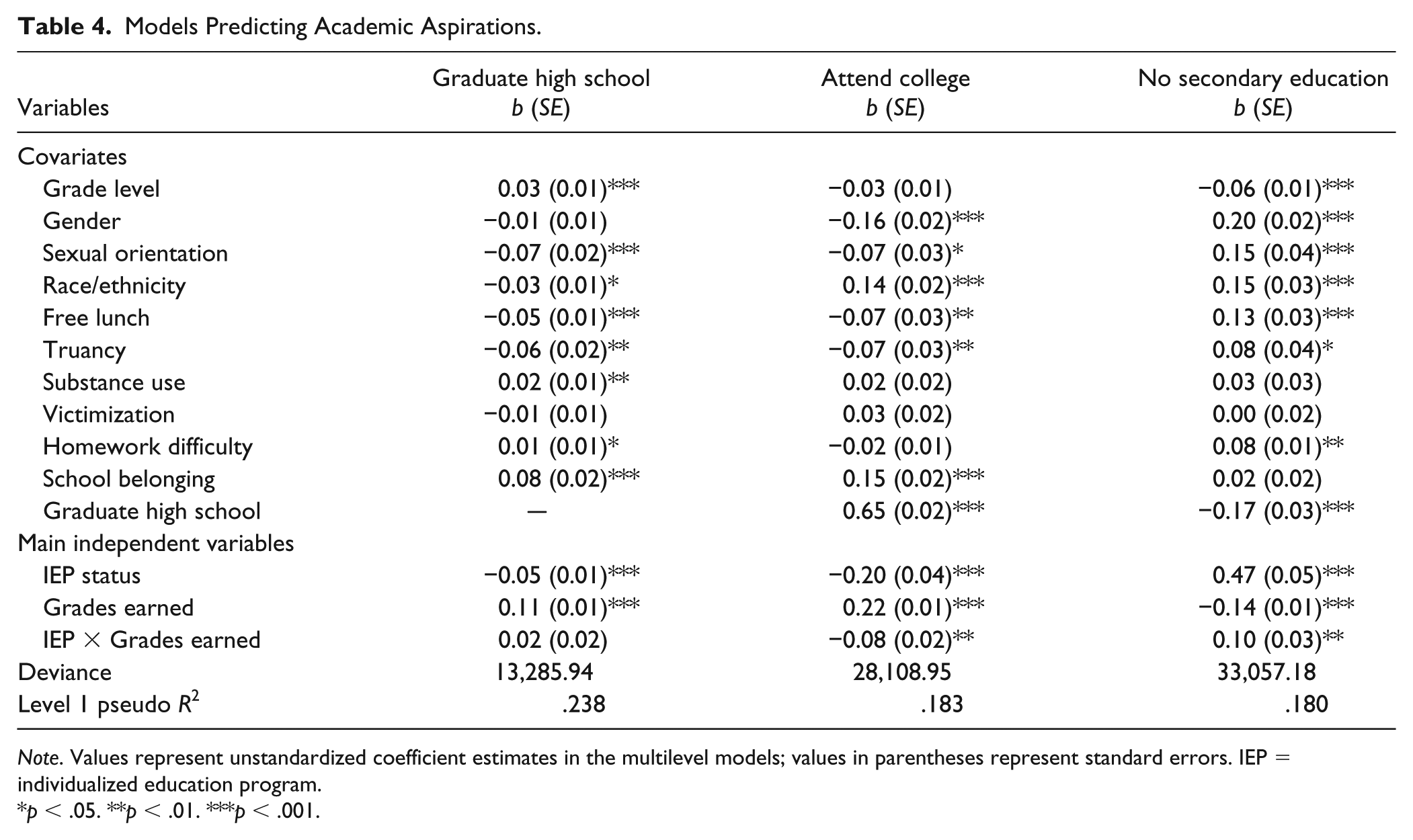
Note. Values represent unstandardized coefficient estimates in the multilevel models; values in parentheses represent standard errors. IEP = individualized education program.
p < .05. **p < .01. ***p < .001.
We conducted follow-up simple slopes tests separately for students based on disability status to inform the significant interaction effects. First, earning higher grades predicted a greater likelihood of attending college more strongly for students without an IEP (b = 0.22, p < .001) than for students with an IEP (b = 0.16, p < .001). Second, whereas earning higher grades significantly predicted a lesser likelihood of foregoing postsecondary education for students without an IEP (b = −0.14, p < .001), it was not a significant predictor for students with an IEP (b = −0.01, p = .86).
Discussion
Post–high school aspirations provide insights into students’ current understanding of what they perceive that they can pursue or achieve in the future and, thus, carry significant implications for students’ long-term career opportunities. As hypothesized, our results showed significant overall disparities between students with and without disabilities on such aspirations. Differences of occupational and postsecondary education aspirations have been demonstrated in prior research (e.g., Fisher & Harnisch, 1989; Rojewski, 1996, 1999; Rojewski et al., 2012); findings from this study provide an updated acknowledgement (i.e., using current student self-report from 2015) that these aspirational disparities still exist. In addition, this study expanded prior research by addressing calls to look at academic achievement as a variable that could relate to student aspirations (Rojewski et al., 2012).
In support of our main hypotheses, we found significant IEP × grades earned interactions in relation to post–high school aspirations. Essentially, higher grades earned were more strongly associated with post–high school aspirations—whether in a positive direction (e.g., for attending college) or negative direction (e.g., foregoing postsecondary education and pursuing a job)—for students without IEPs than for students with IEPs.
Differential Grades Earned Associations Based on IEP Status
As outlined in the theory of circumscription and compromise, students may start to compromise their post–high school options based on what is accessible and attainable when taking into account their current realities (Gottfredson, 1981). As one relevant factor in this process, students may use their earned grades as a reference for post–high school options (Khattab, 2015). Yet, as shown in our results, this appeared to apply differentially to students with and without IEPs. It is important to apply and evaluate the applicability of different vocational theories across diverse populations, including to students with disabilities. In this case, it may be important for researchers to consider factors uniquely experienced among marginalized populations (e.g., discrimination) that shape their postsecondary education aspirations that have been less studied in the general educational and vocational literature and less emphasized in vocational theories. Identifying factors that could affect a student’s post-school aspirations would be critical to understanding the necessary supports that must be provided to ensure equitable outcomes for students with and without disabilities.
Adding nuance to this framework and building on prior empirical findings, we identified, as hypothesized, higher earned grades had stronger associations with expectations to attend college/university for students without IEPs than for students with IEPs. Thus, extant empirical findings on the role of students’ earned grades in relation to college aspirations (Akos et al., 2007) seem to apply more to students without IEPs and less to students with IEPs. Students with IEPs with higher grades than their other peers with IEPs might see college or university as more of an option; yet, in comparison to their peers without disabilities, they may feel less confident in pursuing this option due to barriers that have a more sizable impact on their aspirations to attend college (e.g., supports for students with disabilities at the college level, independent living skills, social skills deficits; Getzel & Webb, 2012).
As alternatives to college attendance, students without IEPs who reported higher earned grades were less likely to indicate that they would solely pursue a job without any postsecondary education. In contrast, this association did not apply to students with IEPs. Students without IEPs continue to aspire for higher prestige jobs that would require high education rather than lower prestige jobs, the latter of which were aspired to more among students with disabilities (Fisher & Harnisch, 1989; Rojewski, 1996). It is possible that students without disabilities with higher grades may be given more opportunities or encouragement to learn about and be directed toward college. However, for high-achieving students with disabilities, school personnel (e.g., special education teachers, guidance counselors) may still continue to discuss other alternative pursuits with them, thereby attenuating the association between higher earned grades and any particular post–high school aspiration.
Interestingly, there was no relation found between graduating high school and the interaction between IEP status and grades earned. Potentially, this can be influenced by multiple factors including the proximal nature of the variable in which students expect themselves to graduate, the positive overall national and state trends of high school completion, and/or multiple diploma options that exist to facilitate graduation. Yet, the overarching pattern of findings for students with IEPs suggests that grades earned have less connection to their post–high school aspirations. Given the high emphasis placed on grades as one of several key determinants of college entry and, thus, opportunities for future career advancement (Akos et al., 2007; Irvin et al., 2011), these findings are quite concerning for students with disabilities who, indeed, report earning high grades yet do not foresee college pursuits to the same degree as their peers without disabilities with similarly high grades.
Strengths and Limitations
The current study carries several strengths in building on the extant empirical literature. First, our findings are based on much more recent data of contemporary youth compared with most extant studies that have had to rely on data from several decades in the past. Second, beyond documenting basic disability-based disparities, we considered nuance to this based on the factor of grades earned. Third, we utilized a large sample of youth from a general student population.
We also note several limitations to the current study. First, although our sample was large, this was not a nationally representative sample. Thus, future studies should consider the generalizability of our findings to school districts in other geographic regions and states. Second, the data were cross-sectional and correlational and, therefore, we cannot make causal attributions. Also underscoring the need for longitudinal data, the current data cannot account for students who may have dropped out during high school. Thus, results may be skewed toward aspirations for youth who are higher achieving or youth with more supports during high school, whether they are students with or without disabilities. Longitudinal data on disability-based disparities remain rare. Given the patterns that we documented, it would be beneficial for future studies to consider changes in students’ aspirations over time, how they may coincide with changes in their grades earned, and how this may differ for students based on disability status. Third, the DCYA did not ask students to report specific categories of disabilities and, therefore, we had to consider students with an IEP as a single broad-based group for our comparisons to students without an IEP. In addition, accommodations were provided for individuals with less severe cognitive or physical disabilities, but students with severe cognitive or physical disabilities were not represented within the sample. Although we still documented significant main and moderating effects in our sample, it would be important for future research to consider even greater nuance in these disparities and moderating effects based on IEP status and specific disability category as documents on the IEP. Likewise, it would be beneficial for future research to use official school records of students’ IEP status (vs. their self-reported status as in the current study) to better ensure the accuracy of students’ IEP status and specific disability category. Fourth, we examined students’ self-reported average grades earned with an item identical to the one used in the CDC YRBS survey. Thus, we considered students’ average grades earned as opposed to their grade-point average (GPA) or standardized test scores from official school records, which could not be linked to the current data due to the anonymous nature of the survey. Future research should consider these additional indicators of student academic performance.
Implications
To close the disparity gap between students with and without disabilities, supports for students in high school must be in place to ensure a positive transition into post–high school settings. As our results imply, grades do factor into a student’s post–high school goals. Students who do not meet the minimum GPA criterion for acceptance into universities may automatically have to change their goals and reevaluate their options. As the discrepancies show from our results, students who have an IEP (even students with an IEP who had higher grades) were less likely to aspire to attend college than their peers without an IEP. This suggests that it continues to be critical for practitioners to support student’s academic success, with awareness that grades are one gatekeeper to some postsecondary educational institutions, so students can make an unrestricted decision about their future plans.
In addition, student aspirations may also vary depending on their exposure to different activities that promote awareness of post–high school options (see www.transitionta.org). Schools play a critical role in helping students plan for post–high school life. For example, schools can begin assessing a student’s aspirations and post–high school goals from the moment they begin high school. Educational and transition planning can then begin focusing on the students’ aspirations, interest, and strengths (Rowe, Mazzotti, Hirano, & Alverson, 2015). Students with disabilities who participate in a rigorous course of study have been found to have more positive employment outcomes than those who do not (Shandra & Hogan, 2008; Test et al., 2009). Furthermore, students with disabilities who have higher rates of inclusion within general education have more positive post–high school outcomes in education and employment than students who do not (Lombardi, Gau, Doren, & Lindstrom, 2013; Rojewski, Lee, & Gregg, 2015). Both of these school structural components have considerable relation to potential grades earned and options for post–high school opportunities. If students do not participate in a rigorous course of study, they may not meet course requirements for some postsecondary education institutions. Schools should also provide students the mandated supports, as described on the student’s IEP, to not only access classes that align with their goals and strengths, but to help students succeed academically in those classes as well.
Schools, teachers, and families can also supplement academic-focused transition practices with traditionally nonacademic coursework and experiences. For example, in addition to academic coursework, students may also be able to participate in occupational coursework and community and work experiences where they can gain high school credits. Both occupational courses and community and work experiences are additional predictors of positive employment and post–high school educational outcomes (Carter, Austin, & Trainor, 2012; Halpern, Yovanoff, Doren, & Benz, 1995). By doing well in occupational courses or getting credits for community and work experiences, students can gain valuable employment skills and sustain a higher GPA. By attending to both (GPA and employment skills), students can work toward being college and career ready. Furthermore, teachers can build, in addition, nonacademic skill development throughout their academic coursework to also support students’ post–high school outcomes (Rowe, Mazzotti, & Sinclair, 2015). It is important that students, including those with disabilities, have a chance to develop traditionally nonacademic skills such as self-advocacy and self-determination (Wehman, 2011). Last, family involvement and expectations influence students post–high school decision-making and are a predictor of post-school success (Mazzotti et al., 2016; Oymak, 2018; Test et al., 2009). Building upon our results, schools personnel and teachers should be encouraged to collaborate with families and their student on identifying a program of study that supports their academic success and is aligned to their student’s career and educational goals.
When working with students with disabilities, special education teachers and the school psychologist should be mindful of student strengths in transition planning (Mazzotti et al., 2009) and find nontraditional opportunities for students to achieve their aspirations. Providing students with opportunities to visit college campuses and meet individuals in the support services offices may be one way to begin to bridge students’ understandings of what academic and social supports are available to them in higher education. This may provide students a sense of comfort to continue their aspirations of attending college. The use of strategic IEP transition goals (see Bateman & Herr, 2006 for examples of measurable IEP goals) can help students identify and set goals in high school that can help them overcome barriers they might experience post-high school. To help encourage aspirations and goal attainment, transition goals can be focused on career awareness, work study opportunities, or additional vocational education, all of which are significant predictors of post-school success.
Conclusion
It is not assumed that all students go to college, yet students with disabilities should be encouraged to explore a range of post–high school opportunities, including college attendance, and establish an appropriate path with high expectations of reaching their goals. Our findings establish a pattern that students with disabilities are continuing to aspire to less prestigious post–high school outcomes including postsecondary educational options, even though many current employment opportunities expect college-educated applicants. Schools should be prepared to support students with disabilities early on in their high school tenure. Early planning can ensure students’ aspirations are given full consideration and their transition plans are aligned to meet the criteria to obtain their aspirations.
Footnotes
Associate Editor: Nicholas Gage
Declaration of Conflicting Interests
The author(s) declared no potential conflicts of interest with respect to the research, authorship, and/or publication of this article.
Funding
The author(s) received no financial support for the research, authorship, and/or publication of this article.