



Abstract
Special educators at an inclusive career-technical high school created a model to support annually increasing expectations for self-determination and levels of student participation in Individualized Education Program (IEP) planning and implementation. The grade-specific components of the model and supporting context are described. Students were observed to gain confidence in IEP participation and extend their self-advocacy into the classroom, within a model that reinforced a schoolwide focus on successful school–to–adult life transitions. Elements of the model that can be applied in other school settings are discussed.
At Clearview Technical High School, the goal was to have students exit high school with an academic diploma and a career certificate, regardless of their special education status. Equally important, they should leave with knowledge and awareness of their strengths and needs related to their identified disabilities. Students must learn the skills they need to successfully advocate for themselves in postsecondary education and the workforce. These attributes are part of being self-determined, and being more self-determined supports improved postschool outcomes (Martin, Zhang, & Test, 2012; Uphold & Hudson, 2012; Wehmeyer, Field, & Thoma, 2012). Students can practice self-determined behaviors, such as self-awareness, choice making, goal setting, and self-advocacy, by learning to lead the Individualized Education Program (IEP) process (Martin et al., 2006; Woods, Sylvester, & Martin, 2010). Further, student involvement can encourage teams to include meaningful transition goals (Griffin, 2011; Test et al., 2004). (See Note 1.)
Working in an inclusive school with no separate special education classes, special educators at Clearview were challenged to find the time to provide extra instruction and supports students may need to develop the awareness and skills associated with self-determination and become active participants in the whole IEP process. The solution was threefold: (a) Build upon successful models for student-led IEPs (see, for example, Hawbaker, 2007; McGahee, Mason, Wallace, & Jones, 2001), (b) make a sustained sequential effort from 9th through 12th grade because self-determination is a developmental process (Wehmeyer, Palmer, Shogren, Williams-Diehm, & Soukup, 2010), and (c) use multiple methods to promote self-determination because self-determination itself is multifaceted (Cobb, Lehmann, Newman-Gonchar, & Alwell, 2009). The result was called the HAWK Highway, a strategic, vertical (i.e., 9th through 12th grade) model that infused learning support and expectations for developing self-determination into the fabric of school and helped students to develop the skills needed to understand their disability, take more responsibility each year for their IEP, and own their educational success.
This article shares an authentic example of how an important transition practice was incorporated into an inclusive high school’s regular activities. First, brief information about the school context is provided. Second, the HAWK Highway model is described, specifically, how student IEP involvement and special education learning support work together at each grade level and build upon each other. Finally, observations are shared regarding how the model benefited students, reinforced a schoolwide focus on successful school–to–adult life transitions, and might be applied to other settings.
HAWK Highway Context
At the time the model was implemented, Clearview (a pseudonym; see Note 1) was a full-day, career-technical school with approximately 1,000 students from urban, suburban, and rural communities in a single county. Students with IEPs had the same curriculum and were in the same classrooms as their peers, including a 9th-grade Career and Transition (CAT) Academy, before beginning their career studies in a specific occupational field in 10th grade. About 10% of the school’s students had IEPs, and a few had 504 plans. Students’ disability labels included specific learning disabilities, physical disabilities, Asperger syndrome, mild intellectual disability, and other health impairments. Approximately 28% of the school’s students identified themselves as low income and 37% as having minority racial or ethnic backgrounds. The special education staff included both novice and experienced teachers, who used the title “learning support coaches.” As coaches, they worked directly with students and general educators across multiple academic and career classrooms. They worked collaboratively with general education colleagues to create a flexible schedule of in-class assistance and occasional co-instruction to ensure that instructional supports were delivered when and where needed. (For information, see Eisenman, Pleet, Wandry, & McGinley, 2011.)
HAWK Highway Components
The HAWK Highway model explicitly incorporated imagery associated with the school mascot of a hawk, which represented honor, achievement, work ethic, and knowledge. The school mascot was frequently used by staff at the school to convey positive messages about expectations for student behaviors, similar to practices encouraged in schoolwide positive behavior support models (Flannery, Guest, & Horner, 2010). The coaches purposefully linked the model to the social culture of the school as a way to capitalize on accepted positive images of belonging. The image also was symbolic of maturation. For example, students were told that they would go from “being a fledgling” to “soaring to new heights.” The highway represented a metaphorical journey to graduation and beyond with the IEP as the itinerary. For example, in a ninth-grade workshop, students were told, “Your IEP enables you to plan your trip to get to your destination in the following ways: Write your own goals; know your accommodations and ask for them; lead your own IEP meeting.” The model was implemented through a combination of (a) individualized learning support coaching that was embedded in the school day and (b) brief, explicit small-group and individual instruction related to developing goals and leading an IEP meeting. The focus of both was transition toward independence. Table 1 highlights key elements at each grade level.
HAWK Highway Components.

Note: IEP = Individualized Education Program.
Ninth Grade: Hawk Fledglings
In the summer before ninth grade, students were enlisted as essential IEP team members. Students with IEPs and their families received a visit from a learning support coach, who explained the school’s inclusive approach and expectations for student involvement. Students were given an IEP script that included the major dialogue elements of an IEP meeting with blanks where the student was expected to provide information, such as strengths and weaknesses, long-term goals, and annual goals. A coach reviewed the script with the student and family and assisted the student to identify preliminary goals for the beginning of the ninth-grade program of study.
Throughout the year, coaches acted as mentors to the students, ensuring that they made a successful transition from middle into high school. Especially during the first marking period, coaches frequently joined the general education teachers and students in the ninth-grade CAT introductory class, where the primary focus was on helping students to understand academic and behavioral expectations and establish a strong work ethic. Also, coaches helped students to recognize when they needed to ask for assistance and how to get support. The coaches regularly communicated with families about student performance and collaborated on ideas for enhancing student support. Families were encouraged to frequently log in to the school’s website to view the student’s grades for classwork, major assignments, and tests/quizzes.
About midyear, the coaches held a 90-min workshop for all ninth graders who had IEPs. Students learned about people with disabilities who have become famous through their achievements. The highlight of the workshop was a mock cap-and-gown ceremony. Students were invited to envision themselves as high school graduates as they tried on a mortarboard cap and walked across the room to shake hands and receive recognition for their accomplishments. During the workshop, they were told about the importance of becoming self-advocates who understood their disability, strengths, and weaknesses; learned how to get the help they need; and developed self-regulation skills to support their learning. They were instructed on how to write and monitor academic and career goals and were informed that they would become the authors of their own IEPs. Then, in the spring, students worked individually with a learning support coach to prepare updated scripts for their IEP meetings. Students were responsible for reading the script to members of the IEP team at the formal meetings. (See Figure 1; additional materials available upon request.)
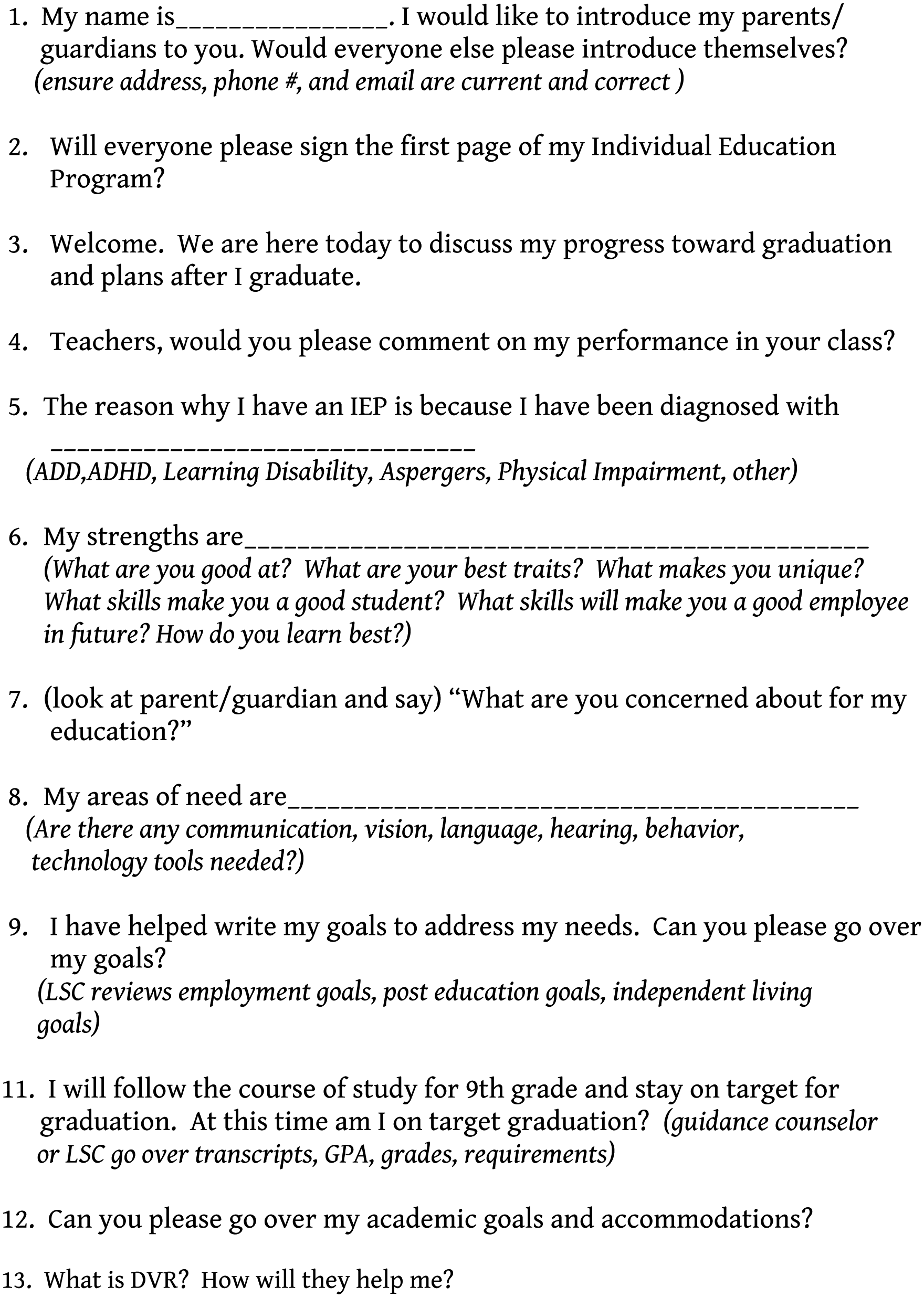
Ninth-grade spring Individualized Education Program script. LSC = learning support coach.
10th Grade: Strengthening Your Inner Hawk
In 10th grade, the coaches continued to serve as academic mentors and to provide instructional supports. Students were encouraged to be proactive about practicing the self-advocacy skills they had been learning, aware that a learning support coach was always available as a safety net. Coaches also encouraged students to use all of the accommodations to which they were entitled but also to explore which accommodations were most helpful to them. Accommodations were described to students as supports that helped them to build up their inner strength. Through brief activity-specific interactions in homeroom or classes, coaches continued to teach and emphasize the value of practicing time management and organizational skills.
In the 10th-grade HAWK Highway workshop, the learning support coaches worked with small groups of students who had IEPs to discuss and reinforce the focus on taking more responsibility for actions, developing skills for independence, and seeking out needed supports. Students prepared for their IEPs during the workshop by discussing their strengths and weaknesses in academics, employability, and self-efficacy skills. They learned about the difference between short- and long-term goals and how to write goals that were reasonable, measurable, and achievable. They reviewed the 10th-grade IEP script, which now required them to provide information to the team about their strengths, weaknesses, annual goals, transition goals, some steps they needed to take to reach their goals, and a brief explanation of their disability label. They discussed how to balance new responsibilities, such as driving, with school assignments, part-time work, and extracurricular activities. Being an integral part of the IEP team became more of a concrete reality.
11th Grade: The Road to Independence
The major change in 11th grade was to place a greater emphasis on independence and problem solving. As self-advocates, students knew that coaches would not hunt them down and pressure them to get the help they needed. Similar to postschool settings of college and work, students needed to approach the appropriate avenues to get support. When students came to a learning support coach with academic problems, questioning tactics were used to support them in identifying the specific nature of the problem, options for responding, and creating a plan of action. The coaches counseled and probed so that students came up with solutions on their own and took responsibility for successful outcomes. The goal was to instill confidence in the students based on the beliefs that they were capable and did not need a coach to make things better for them. General education teacher colleagues agreed that the students exuded confidence that they would either succeed or fail based on the level of effort they had put into preparing. Comments such as “I’m just not good at math” were not entertained; a growth mind-set (Dweck, 2006) was fostered.
Frequent communication with families continued. They received ongoing updates of student performance from the coaches so that it was never too late to adjust the student’s services. Students’ accountability for their IEPs was reinforced through brief meetings during homeroom or at other times during the day when students examined their quarterly benchmark evaluation of progress on their annual IEP goals and set new quarterly targets. In preparation for their IEP meeting, students reviewed the academic and transition goals that they set in 10th grade and reflected on how they had grown. If they had not reached a goal, the coaches helped them to look at why. If they had reached a goal, the bar was set higher. Coaches and students explicitly discussed grades and how student performance in the future would influence access to scholarships and cooperative work experience placements. The script for the IEP meeting was now very brief, with most of the meeting structured as a conversation led by the student. In the meeting, the focus was on the student’s identified postsecondary goals and mapping a senior schedule accordingly.
12th Grade: Soaring to New Heights
Coaching during 12th grade reinforced the message about increasing independence in preparation for the transition to post–high school employment and college. During the senior workshop, students considered “what you have done before” and “what you will do this year” across a variety of topics, such as self-awareness, self-advocacy, transition services, and professionalism. In preparation for their final IEP meeting, they were encouraged to raise expectations for their personal performance as they examined their progress toward graduation and updated their goals. Students continued to work one-on-one with a learning support coach to develop IEP goals that were focused upon completing the high school academic and career program requirements related to their postschool plans. They were assisted with connecting in person to a vocational rehabilitation counselor and preparing college applications. By 12th grade, the IEP script had transformed into an outline of key points to be addressed during the IEP meeting. Students were expected to lead the meeting, moving the team through the agenda and sharing information about performance, progress, goals, and final transition plans.
HAWK Highway Impact
Over time, students were observed to gain confidence as self-advocates in school. One 10th grader offered this example: “My English teacher, she’ll help you if you really need it . . . and you need to ask—she’ll wait for you to ask—she can’t just know if I need help.” They became more comfortable with requesting accommodations and acknowledging why they needed supports. A common theme was that students described themselves as maturing. Echoing the model’s emphasis on personal growth and responsibility, a senior, who had planned to drop out, explained her newly found determination to complete school.
I think it was just a matter of me growing up and choosing my decisions. Because, before I just didn’t care or whatever, but now I realize [it’s up to me]. I can’t mess up. I have one rule—get over it and just study.
Parents appreciated the emphasis on students’ taking greater responsibility for their IEPs. As one student’s mother explained, by him asking and stating the questions and the responses [during the IEP meeting], that helps him get a better understanding of what exactly is going on as opposed to all the adults sitting around saying this is it, this is what we’re going to do, [and] why.
The HAWK Highway model both complemented and reinforced the school’s inclusive, transition-focused school culture. By creating a vertical perspective on developing student self-determination, the school’s broader focus on successful transitions from high school to college and career was reinforced. General education colleagues, especially the career-technical teachers, had already bought into the idea that each year students should master new knowledge and skills as they moved closer to assuming postsecondary, adult roles. The idea that knowledge and skills of a self-determined adult also could be developed each year was a small conceptual leap.
An unexpected benefit was the beginning of a cultural shift in how Clearview’s teachers and administrators thought about inclusion. That is, inclusion was not just about succeeding in a general education classroom; it was about going to college, getting a career, and becoming a competent adult. The HAWK Highway helped to make this message more visible to students and school staff alike. The principal described the model as “the vision [for inclusion] coming to fruition.” She summed up the message this way: “The goal is for you to fly the coop! That really is the goal . . . getting kids prepared to go out into the work world and also go out into college.”
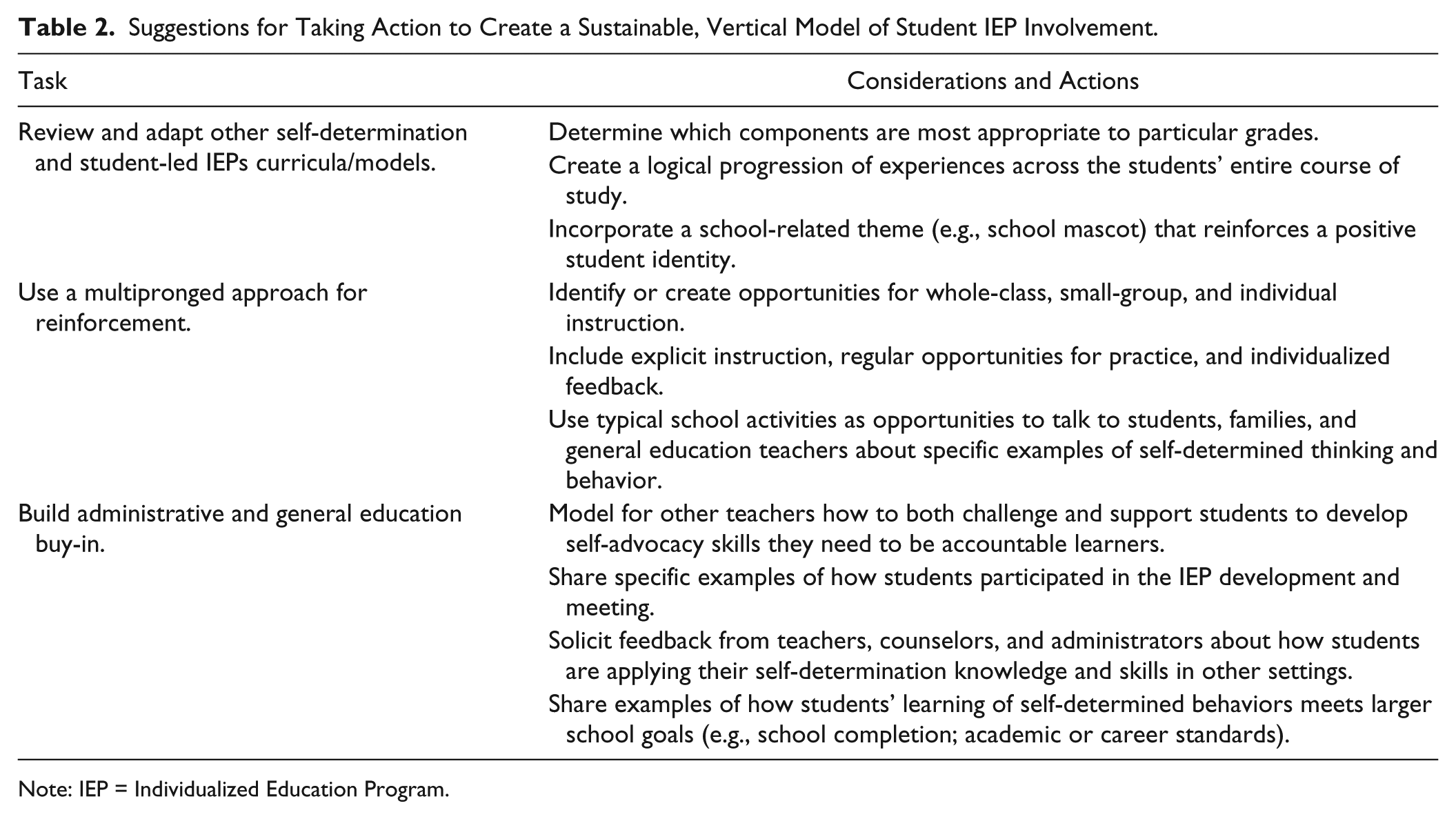
Although the model capitalizes on a specific school context, the elements can be adapted to other high school settings. Table 2 provides suggestions for developing a vertical approach to meaningful student participation in the IEP process that promotes sustainability of an important transition practice (Benz, Lindstrom, Unruh, & Waintrup, 2004).
Suggestions for Taking Action to Create a Sustainable, Vertical Model of Student IEP Involvement.
Note: IEP = Individualized Education Program.
Footnotes
Declaration of Conflicting Interests
The author(s) declared no potential conflicts of interest with respect to the research, authorship, and/or publication of this article.
Funding
The author(s) received no financial support for the research, authorship, and/or publication of this article.