




Abstract
A systematic literature review was conducted to examine the evidence for peer network interventions for students with intellectual and developmental disabilities (IDD). Fifteen studies were identified and evaluated for methodological rigor using the quality indicators published by the Council for Exceptional Children (CEC) and by examining the risk of bias. Relying only on the guidelines from the CEC, peer network interventions are an evidence-based practice for increasing the communication and interaction of students with IDD with their peers without disabilities. However, risk of bias assessment revealed several methodological issues, outcome measurement was generally restricted to being context-bound rather than generalized, and there is a need for further research at the middle school level, with students with intellectual disability who do not have an autism diagnosis, and with students who use augmentative and alternative communication (AAC). Implications are provided about training and supporting school personnel to implement peer network interventions.
Keywords
Peer interactions and relationships are critical to well-being and development. Across childhood and adolescence, positive peer relationships lead to numerous benefits for students with and without disabilities, including personal adjustment, attitudes about school, language and interpersonal skills, and overall well-being (Rubin et al., 2015). Furthermore, positive peer relationships—such as reciprocal friendships—can have a protective force against bullying and peer victimization (Wentzel et al., 2004). Peer interactions and relationships also change over the course of child development. In early childhood, peer relationships are defined primarily by shared activity and interaction rather than intimacy, but they are still an important source of companionship that fosters children’s social, communicative, linguistic, and cognitive development (Shonkoff & Phillips, 2000). As children move into middle childhood and then adolescence, peer relationships gradually take on aspects of intimacy—such as understanding, trust, reciprocal influence, and relational commitment (Feldman, 2010). These friendships provide security and social grounding, acting as a buffer to help students cope with challenges they encounter, further develop social skills, and experience a sense of belonging (Biggs & Carter, 2017; Hamm & Faircloth, 2005). Although clearly important from childhood to adolescence, students with intellectual and developmental disabilities (IDD) often experience difficulties navigating social interactions and building strong relationships with peers (Carter et al., 2008; Chung et al., 2012; Locke et al., 2010).
IDD has been defined in many different ways but generally refers to disorders or disabilities present at birth that have significant effects on the developmental trajectory, which can include intellectual disability or other developmental disability such as autism (Schalock et al., 2019). The term IDD is used in this review to include students with intellectual disability or a developmental disability such as autism, including students with multiple disabilities or diagnoses. It is also important to note that although deficit-based models of disability have historically dominated the field, understandings of IDD are increasingly influenced by the social–ecological model of disability. Instead of defining disability based on a person’s limitations or needs, the social–ecological model involves a multidimensional understanding of human functioning and disability as a function of the fit between a person’s competencies and their environmental demands (Shogren et al., 2017).
The social–ecological model of disability drives strengths-based approaches to supporting students with IDD at school. Instead of being concerned only with strategies to remediate or address student deficits (e.g., social skills training), strengths-based approaches focus on identifying supports needed to maximize students’ growth and participation in natural environments, including changes to the environment (Shogren et al., 2017). This is not to say that promoting students’ social or communication development is unimportant; instead, a strengths-based model recognizes that powerful ways to promote students’ social interactions and relationships with peers include focusing not only on student skills but also on promoting the right environment to support these outcomes (e.g., environmental factors, peers’ attitudes and ways of interacting; Biggs & Carter, 2017). For example, whether and how well students with and without disabilities interact and become friends at school may depend on the opportunities that students have to get to know one another and spend time together, the attitudes toward and comfort of peers with classmates with disabilities, and the attitudes and actions of teachers or other school personnel.
Without such interventions, descriptive research shows that students with and without disabilities rarely interact with one another, even when they are physically present together in the same classrooms, playgrounds, cafeterias, hallways, and other settings. Carter et al. (2008) observed middle and high school students with IDD in general education classrooms, finding that interactions with peers were variable but infrequent and that students went entire class periods without interacting with any classmates without disabilities in nearly one quarter (23.5%) of observations. Other research has focused more specifically on students with autism. During playground observations, Locke et al. (2016) found that children with autism spent only about 40% of recess time jointly engaged with their peers, as compared with 70% for children without autism. At a secondary level, Locke and colleagues (2010) found that being present in general education classrooms was not by itself sufficient to lead to social inclusion, with adolescents with autism reporting significantly more loneliness, poorer friendship quality, and lower social network status than that of their peers.
Peer interactions and relationships may be even more difficult and infrequent for students with complex communication needs who utilize aided or unaided augmentative and alternative communication (AAC). For example, Chung et al. (2012) found that elementary and middle school students who used AAC interacted almost entirely with adults rather than peers, even when they were present in general education classrooms. The findings of Andzik and colleagues (2016) were similar, indicating that only 3% of the interactions of elementary-age students who used aided AAC were with their peers. Furthermore, more than one-third of the students never interacted with their peers, even across multiple observations over several days.
The findings from these studies underscore just how important it is that educators be equipped with ways to support students’ interactions and relationships with peers. Toward this end, it is critical to evaluate research evidence and determine whether particular interventions are evidence-based— and if so, for whom, for what outcomes, and under what conditions. The aim of this review was to provide an evidence-based appraisal of an intervention approach called a peer network. Peer network interventions are socially focused interventions designed to improve interaction and relationships for students with IDD with their peers by supporting greater integration into social environments (Carter et al., 2013). Although intervention components vary across examples in the literature, peer network interventions share several core features: (a) a focus on enhancing social-related outcomes with peers by (b) forming a cohesive group of peers with a student with a disability (i.e., typically 2–6 peers and the student with the disability) and (c) establishing repeated opportunities for social support and interaction through shared activities across structured and/or nonstructured environments, while (d) providing adult support to all students in the network. The primary focus of peer network interventions tends to be on enhancing environmental factors that influence social outcomes for students with IDD (e.g., promoting shared activities with peers and supporting peer attitudes and behaviors); however, some innovations have included embedding instruction on specific social or communication skills for students with disabilities themselves (e.g., Kamps et al., 2015). Although peer network interventions have been evaluated in other reviews that look broadly at peer-mediated interventions (e.g., Watkins et al., 2015), to our knowledge, researchers have yet to conduct a specific evidence-based appraisal for peer network interventions.
As interest in classifying evidence-based practices has increased, so also has the number of options for evaluating the methodological rigor of individual studies and larger bodies of literature. Within the special education field, the Council for Exceptional Children (CEC) outlined standards for evidence-based practices (Council for Exceptional Children [CEC], 2014). The intention of CEC’s standards is to act as a framework to determine whether studies in a body of literature meet a minimum set of methodological requirements to merit confidence in their findings. Although useful to have a tool specific to the special education field and that addresses both group and single-case design, the quality indicators set by the CEC are less rigorous than those of other tools such as the Version 2 of the Cochrane Risk of Bias Tool (RoB 2; Sterne et al., 2019), the Single-Case Design Risk of Bias tool (SCD RoB; Reichow et al., 2018), or the What Works Clearinghouse standards (What Works Clearinghouse, 2020). Therefore, using multiple tools can allow researchers to capitalize on their strengths and minimize the risk of drawing poor conclusions.
As a further consideration, researchers have called attention to two critical dimensions of outcome variables: The first is boundedness, which addresses whether the outcome reflects change that extends beyond the immediate context of the intervention. The second is proximity, which addresses whether the outcome reflects learning or development in areas that are distal to or extend beyond the exact targets of an intervention (Sandbank et al., 2020; Yoder et al., 2018). Whether or not a peer network intervention effects change that (a) generalizes beyond the immediate context of the peer network itself and (b) is broader than immediately targeted skills are questions of great importance—both for research and practice. From a research perspective, theoretical and empirical evidence indicate that researchers are more likely to find larger effects for proximal and context-bound outcomes than for distal and generalized ones (Yoder et al., 2013). From a practice perspective, it is important that educators understand the likely impact an intervention will have on their students. For example, educators may be interested in knowing whether peer network interventions can lead to more social interaction among students with and without disabilities during specific settings at school such as lunch or recess; however, this is an altogether different outcome than if the intervention leads to skill development, such as improved social communication skills for the student with IDD.
Given these needs in the literature, we conducted a systematic review focused on two research questions:
Method
Inclusion Criteria
To be included, studies had to meet three inclusion criteria. First, researchers must have tested the effects of a school-based peer network intervention as the independent variable on one or more social-related dependent variables. Because there is not currently a consistent definition of a peer network intervention, we defined a peer network as an intervention that: (a) focuses on improving social-related outcomes (e.g., interaction with peers, friendships) by (b) forming a cohesive group that (c) meets regularly and (d) involves adult support given to the student and peers in the network. We excluded studies when interventions involved some but not all of these components, such as in peer training interventions (i.e., when an adult provides training only to peers without disabilities), or if the intervention did not involve a consistent group of peers. Second, the effects of the intervention had to be evaluated for students with IDD. We defined this as being elementary or secondary students with a diagnosis or special education eligibility category of intellectual disability, autism spectrum disorder, or multiple disabilities. Studies focused on preschool or post-secondary-age students were excluded. Third, researchers must have utilized an experimental design that meets CEC’s design standards (CEC, 2014) as (a) a group design comparing groups that did and did not receive the intervention or (b) a single-case design with three or more opportunities for demonstration of effects. We focused on studies published in English in peer-reviewed journals.
Search and Selection Procedures
To identify studies, we conducted a search using four electronic databases: ERIC, Education Full Text, Pub Med, and PsycINFO. We first conducted the search in October 2018 and then updated it by replicating the exact same search procedures in October 2020. We included all articles published prior to October 2020 that met inclusion criteria. Because terminology about peer network interventions is inconsistent in the literature, we used the following string search to identify a broad group of peer intervention studies, screening this large set of studies with our specific inclusion criteria: peer AND (intellectual disabilit*, mental retardation, ASD, autism, autistic, developmental delay, developmental disabilit*, multiple disabilit*, severe disabilit*) AND (intervention, treatment, effect*, efficacy, increase). Combining the initial and the updated search, database searching yielded 4,149 nonduplicative citations (see Figure 1). The first author trained three special education graduate students to screen studies, including the second author. The team conducted two rounds of screening. In Round 1, screeners used information in the title and abstract to exclude articles that contained no original data, did not evaluate the effects of a school-based intervention involving peers, and/or did not involve students with IDD. Across both the initial and updated search, a total of 3,867 citations were excluded and 282 citations were retained for full-text review. In Round 2, the full text of these 282 articles was examined to identify studies meeting all inclusion criteria, and then the research team conducted additional hand searches by examining references and forward citations of included articles. A total of 15 studies were identified meeting all criteria, which included 13 from the initial search and two from the updated search in 2020.

Search and screening flow diagram for studies of peer network interventions with students with IDD.
The first author served as a secondary independent screener to assess reliability during both rounds of screening. Random numbers were used to select a minimum of 20% of citations at the title/abstract level and 30% at the full-text level, and interrater agreement was calculated as the number of agreements divided by the number of agreements plus disagreements, times 100. Interrater agreement was 97.4% in Round 1 (Title/Abstract) and 98.8% in Round 2 (Full-text). Disagreements were resolved through consensus.
Coding Procedures
Study design and rigor
We coded each study’s design as single-case or group, categorizing studies as being a demonstration study (i.e., evaluating the effect of one intervention relative to a no-treatment control or baseline), a comparison study (i.e., comparing two or more interventions), or a component analysis (i.e., investigating relative effectiveness when adding one or more components). To address methodological rigor, we chose to use a combination of tools: the CEC standards for evidence-based practices (CEC, 2014) and two risk of bias tools—RoB 2 for group designs (Sterne et al., 2019) and SCD RoB for single-case designs (Reichow et al., 2018). The CEC standards include 22 quality indicators for single-case design studies and 24 indicators for experimental group-design studies, focused on: reporting of the context and setting, reporting of participants, reporting of intervention agents, description of procedures and materials, implementation fidelity, internal validity, outcome measures, and data analysis. We coded each indicator dichotomously as either meeting or not meeting the minimum standard. Both risk of bias tools utilize domain-based evaluation so that critical assessments are made separate for different domains. Based on the guidelines for each respective tool, ratings included low, unclear, or high risk of bias for domains in single-case design studies (Reichow et al., 2018) and low, some concerns, or high risk of bias for domains in group design studies (Sterne et al., 2019).
Characteristics of students with disabilities and peers
We recorded the number of participants who were students with IDD and then categorized these students by school level and disability category. We identified each participant’s mode of communication as being verbal speech, speech and AAC, or AAC without verbal speech. AAC included unaided and aided AAC. We also recorded information about each participant’s sex and race/ethnicity. For peers, we recorded the total number of peers who participated and the minimum and maximum number in each peer network meeting. We recorded information about each peer’s sex and race/ethnicity, and we iteratively developed definitions and applied codes based on the literature to describe the ways study authors reported identifying or recruiting peers.
Setting, intervention components, and dosage
Related to setting, we developed and applied codes to describe the intervention context based on location in the school (e.g., general education classroom, empty classroom, or therapy room) and time of day (e.g., lunch, recess, advisory period). We also iteratively developed and applied codes to describe how study authors described each intervention component. Related to dosage, we extracted data related to session length, session frequency, total number of intervention sessions, and total duration or length of the intervention.
Intervention facilitators and implementation practices
We coded the roles of intervention facilitators who implemented the peer network intervention, and we addressed implementation practices by extracting data about the total length of training provided before the intervention began. We also used the term concurrent support to address any type of support that the facilitator received during the intervention (e.g., coaching and follow-up support) and coded concurrent support as either the number of times a trainer provided support or as “ongoing support,” depending on the descriptions of study authors. We developed and applied codes to describe specific instructional strategies used across training and concurrent support (e.g., oral instruction, printed materials, and performance feedback). We also coded whether researchers measured and reported the fidelity of implementation practices as another measure of quality beyond the CEC quality indicators (i.e., fidelity of the procedures used to train, coach, or otherwise support school personnel who were implementing the intervention).
Outcome characteristics and study effects
We categorized primary and secondary outcomes variables in each study based on type of outcome. To be considered a primary outcome, a dependent variable had to be assessed with experimental control and described by the study authors as being a primary outcome of interest. All other dependent variables were coded as secondary. Each primary outcome was also categorized related to boundedness and proximity/distality based on the decision trees used in the meta-analysis by Sandbank et al. (2020). Related to boundedness, outcomes were coded either as (a) context-bound if they were measured within the context of the intervention or under circumstances very close to the context of the intervention or (b) generalized if they were measured in a context that differed in multiple ways from the context of the intervention (e.g., interaction partners, materials, setting, and interaction style). Related to proximity/distality, outcomes were coded either as (a) proximal if they addressed skills or behaviors that were directly taught, modeled, or prompted during the intervention or (b) distal if they addressed other outcomes.
To address study effects for single-case design studies, we used visual analysis to calculate a success estimate for the primary dependent variable (Reichow & Volkmar, 2010). First suggested by Reichow and Volkmar, the use of success estimates have been replicated in additional reviews (e.g., Brock & Huber, 2017), and these indicators summarize visual analysis of single-case design data as a ratio of the number of times an experimental effect was demonstrated (the numerator) over the total number of opportunities for demonstration of effect (the denominator). For group design studies, we coded information about study effects using Cohen’s d as an effect size, unless an effect size was not reported by study authors or could not be calculated with available data.
Social validity
We coded whether or not the study authors reported measurement of social validity as a dichotomous “reported” or “not reported.” When authors reported social validity, we described findings and categorized the methods as involving (a) questionnaires with rating scales, (b) oral interviews and/or open-ended written questions, and/or (c) peer or normative comparison. When social validity assessment involved eliciting the perspectives of specific individuals through questionnaires or interviews, we coded who was asked (i.e., focus students, peers, intervention facilitators, and other stakeholders). We also coded the focus of the social validity assessment as addressing intervention goals, procedures, and/or outcomes.
Reliability of Coding
The first author trained two graduate students (i.e., the second author and one of the screeners) to extract study data along with the first author. The training process involved first discussing a coding manual and then iteratively coding and recoding a randomly selected subset of articles until consensus, which also served to fully operationalize definitions for each variable. Then, each remaining article (n = 9, 60%) was coded independently by two team members for reliability (i.e., the first author and one of the graduate students). Point-by-point agreement was calculated for each variable by taking the number of exact agreements divided by the number of agreements plus disagreements, multiplied by 100. Overall interrater agreement was 92.0%. Within categories of coded variables, the agreement was 94.4% for study purpose and design, 97.5% for CEC quality indicators, 92.1% for RoB in single-case design studies, 95.2% for RoB in group design studies, 94.1% for characteristics of students with disabilities, 88.9% for setting and context, 90.7% for characteristics and identification of peers, 85.6% for intervention components and dosage, 87.8% for intervention facilitators and implementation procedures, 89.5% for outcome characteristics and study effects, and 96.3% for social validity. All disagreements were resolved through discussion until consensus.
Results
What Are the Similarities and Variations in Components of Peer Network Interventions?
Of the 15 included studies, 7 (46.7%) occurred in elementary schools and 8 (53.3%) in high schools, with no studies in middle schools. Peer network interventions involved the same four intervention components in all of the studies but varied somewhat widely in their incorporation of other components. As shown in Table 1, these four core intervention components were: (a) establishing a group of two to six peers and the focus student with a disability, (b) holding regular peer network sessions at least 1 time each week, (c) promoting student and peer engagement in a shared social activity during network sessions, and (d) providing adult facilitation to the group. Shared activities were varied and at elementary levels often included play-based activities such as board games, puzzles, crafts, or other toys. At secondary levels social activities often included eating lunch, playing games, and using technology or technology-based games. Across elementary and high school levels, adult facilitation consisted of similar strategies, such as teaching peers specific interaction techniques, prompting interactions, facilitating group dynamics, and providing social praise.
Peer Network Intervention Components and Dosage by Study.
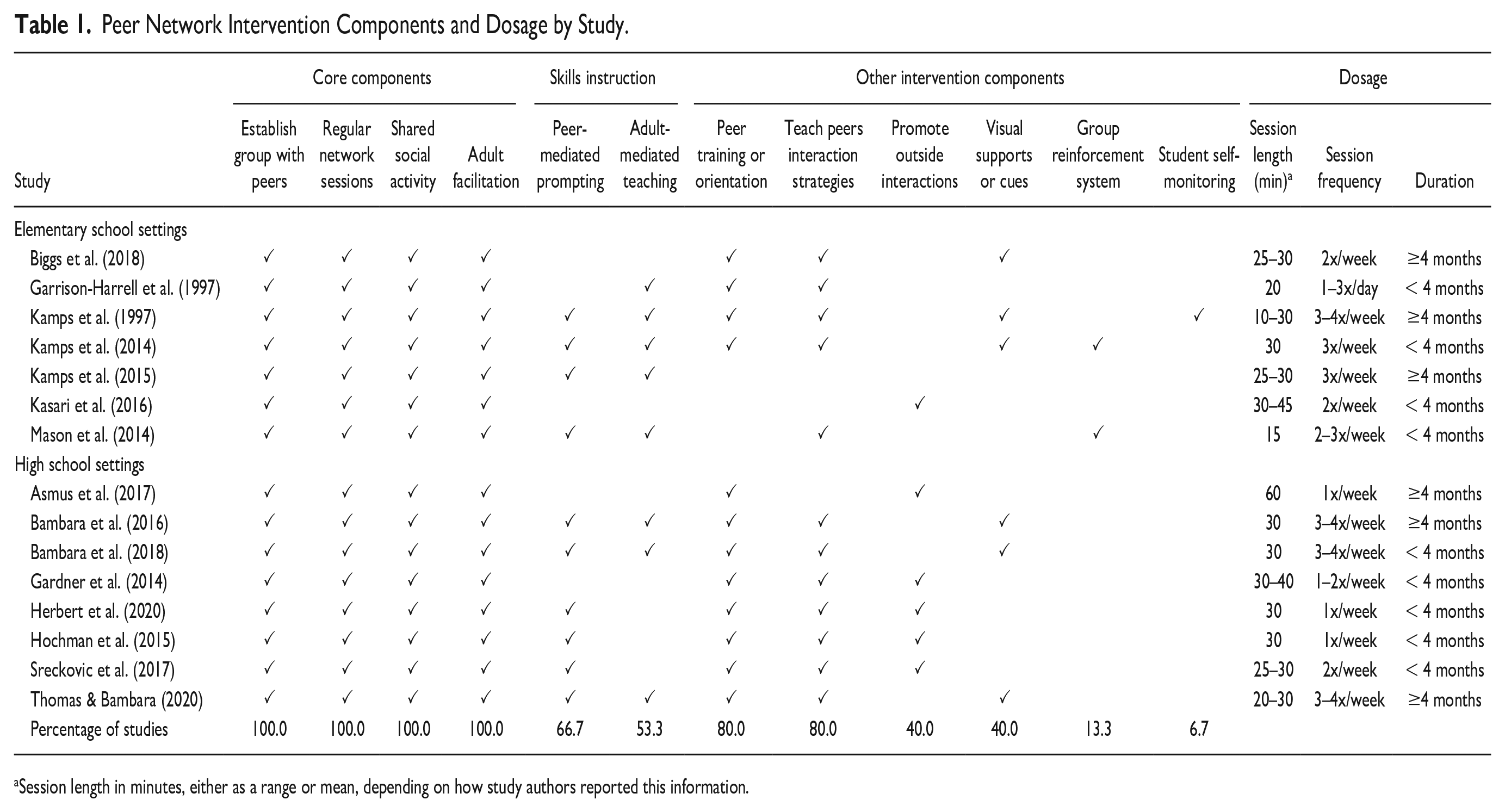
Session length in minutes, either as a range or mean, depending on how study authors reported this information.
We identified eight other intervention components across studies (see Table 1). The most frequently reported additional component included training or orientation for peers (57.1% of studies at an elementary level, 100.0% at a high school level), teaching peers specific interaction strategies (e.g., initiating interactions, modeling AAC; 71.4% elementary, 100.0% high school), peer-mediated prompting of specific social or communication skills (57.1% elementary, 75.0% high school), and adult-mediated direct instruction on communication and/or social skills (71.4% elementary, 37.5% high school). These variations in intervention components suggested two somewhat different approaches to peer networks: (a) that involved skills-focused instruction for the students with IDD (i.e., targeted specific social skills through peer- or adult-mediated prompting and systematic teaching) or (b) that were more focused on arranging the environment and supporting peers to provide more naturalistic supports, without embedding skills-focused instruction through prompting or systematic teaching. As shown in Table 1, interventions in 11 (73.3%) studies involved skills-focused instruction delivered by an adult, by peers, or by both peers and an adult. Most involved an adult and peers, but three studies incorporated only peer-mediated prompting (i.e., Herbert et al., 2020; Hochman et al., 2015; Sreckovic et al., 2017). Garrison-Harrell et al. reported systematic teaching of AAC-related communication skills only by adults.
Are Peer Network Interventions Evidence-Based?
Study design and CEC quality indicators
Table 2 displays information about study design. Three studies were randomized-controlled trials (Asmus et al., 2017; Kamps et al., 2015; Kasari et al., 2016), and 12 were experimental single-case designs. Most were demonstration studies (n = 11). Three studies were component analyses (Biggs et al., 2018; Bambara et al., 2016, 2017), and Kasari et al., (2016) was the only comparison study, which compared outcomes of (a) a peer network intervention, titled ENGAGE groups by the study authors and (b) a social skills group with other students with autism, titled SKILLS groups by the study authors. Eleven of the 15 studies met all the CEC (2014) quality indicators. Four studies (i.e., Garrison-Harrell et al., 1997; Herbert et al., 2020; Kamps et al., 1997; Thomas & Bambara, 2020) met most but not all quality indicators. Each of these four studies failed to describe what training or qualifications are required to implement the intervention and whether the interventionist had achieved them. Furthermore, Garrison-Harrell et al. did not assess and report intervention fidelity.
Study Design, Participants, and Primary Experimental Effects of Studies Included in the Review.

Note. SCD = single-case design; ASD = autism spectrum disorder; ID = intellectual disability, MD = multiple disability, DD = other developmental disability; RCT = randomized control trial.
Demonstration study unless otherwise marked as a component analysis or a comparison design. bDenotes social communication dependent variable was defined as only verbal speech (i.e., Bambara et al., 2016, 2018; Mason et al., 2014); The dependent variable definitions in the other five studies included any mode of communication accompanied by behavioral indicators of being intentional; significant effects in Kamps et al. (2015) were for initiations, not responses or total communication. cCohen’s d or another standardized effect size was not reported; Indicates statistically significant positive effects in growth in initiations to peers during non-treatment social probes and generalization probes in natural settings than the comparison group. dCohen’s d or another standardized effect size was not reported; Indicates no statistically significant differential effects between the two intervention groups in the comparison design (i.e., ENGAGE and SKILL).
Risk of bias
Figures displaying the results from the risk of bias evaluation summaries for group and single-case design studies are provided in the Supplementary Materials; figures were created using robvis, a risk-of-bias visualization tool (McGuinness & Higgins, 2021). Weaknesses of single-case design studies in terms of risk of bias domains were related to (a) not utilizing random sequence generation (100% of studies were rated as high risk of bias; n = 12 studies), (b) not blinding participants and personnel to study condition (100% were rated as high risk of bias; n = 12 studies), and (c) not blinding research team members who were assessing outcome data (91.7% were rated as high risk of bias; n = 11 studies). Risk of bias related to procedural fidelity was unclear for a majority of studies because fidelity tended to be measured and reported only for the intervention condition, not baseline; for this reason, only one study (Biggs et al., 2018) was rated as low risk of bias related to fidelity. Related to dependent variable reliability, three studies were rated as high risk of bias (25% of studies; i.e., Garrison-Harrell et al., 1997; Kamps et al., 1997, 2014). Strengths included that nearly all studies used appropriate participant selection procedures (n = 91.7% of studies were rated as low risk of bias; n = 11), outcome reporting procedures (91.7% of studies were rated as low risk of bias; n = 11), and data sampling procedures (83.3% of studies were rated as low risk of bias; n = 10).
For group design studies, only Kasari et al. (2016) had an overall rating of low risk of bias, whereas both other group designs had an overall rating of some concerns. Asmus et al. (2017) had a rating of some concerns related to potential bias in the measurement of the outcome because educators providing information about students’ social contacts and friendships were likely aware of intervention condition. Kamps et al. (2015) had a rating of some concerns related to potential bias due to missing outcome data for some participants.
Characteristics of students with IDD
Table 2 displays data related to the school level and disability categories of the 224 focus students with IDD across the 15 included studies. Most participants were male (n = 172; 76.8%) and were described as having a diagnosis of or being served under the special education eligibility category of autism (n = 186; 83.0%). Additionally, 22 students were described as having an intellectual disability (9.8%), 14 as having both autism and an intellectual disability (6.3%), one with multiple disabilities (0.4%), and one with other developmental disability (0.4%). When reported by study authors, students with IDD were primarily White and non-Hispanic or Latino (59.9%), with small percentages across other races and ethnicities: Hispanic or Latino (12.6%), Asian (8.6%), Black or African American (8.1%), and other or multiple races (4.1%). Information about student race/ethnicity was not reported for nine students who participated across three studies (i.e., Garrison-Harrell et al., 1997; Kamps et al., 1997; Mason et al., 2014). Very few focus students (n = 11; 4.5%) were described to have complex communication needs or use aided or unaided AAC.
Identification and characteristics of peers
Across studies, the number of peers in each network varied from two to six (see Table 3). Not all studies reported the exact number of peers who participated, including two of the group design studies (Kamps et al., 2015; Kasari et al., 2016); however, in the studies reporting information about peer characteristics (n = 8), 71.7% of peers were female and 65.8% were White and non-Hispanic or Latino. Smaller numbers of peers were described as Black or African American (11.7%), Hispanic or Latino (10.5%), Asian (6.4%), and other or multiple races (5.6%). Across studies, the most common reason cited for selecting peers was because they were viewed as being a role model and/or having strong social and communication skills (69.2% of studies). However, nearly all studies identified multiple criteria for selecting peers, varying across studies (see Table 3). Of note, only three studies indicated criteria involving the preferences of the student with IDD (Asmus et al., 2017; Biggs et al., 2018; Hochman et al., 2015).
Characteristics of Peers and Basis for Peer Recruitment as Reported by Researchers.
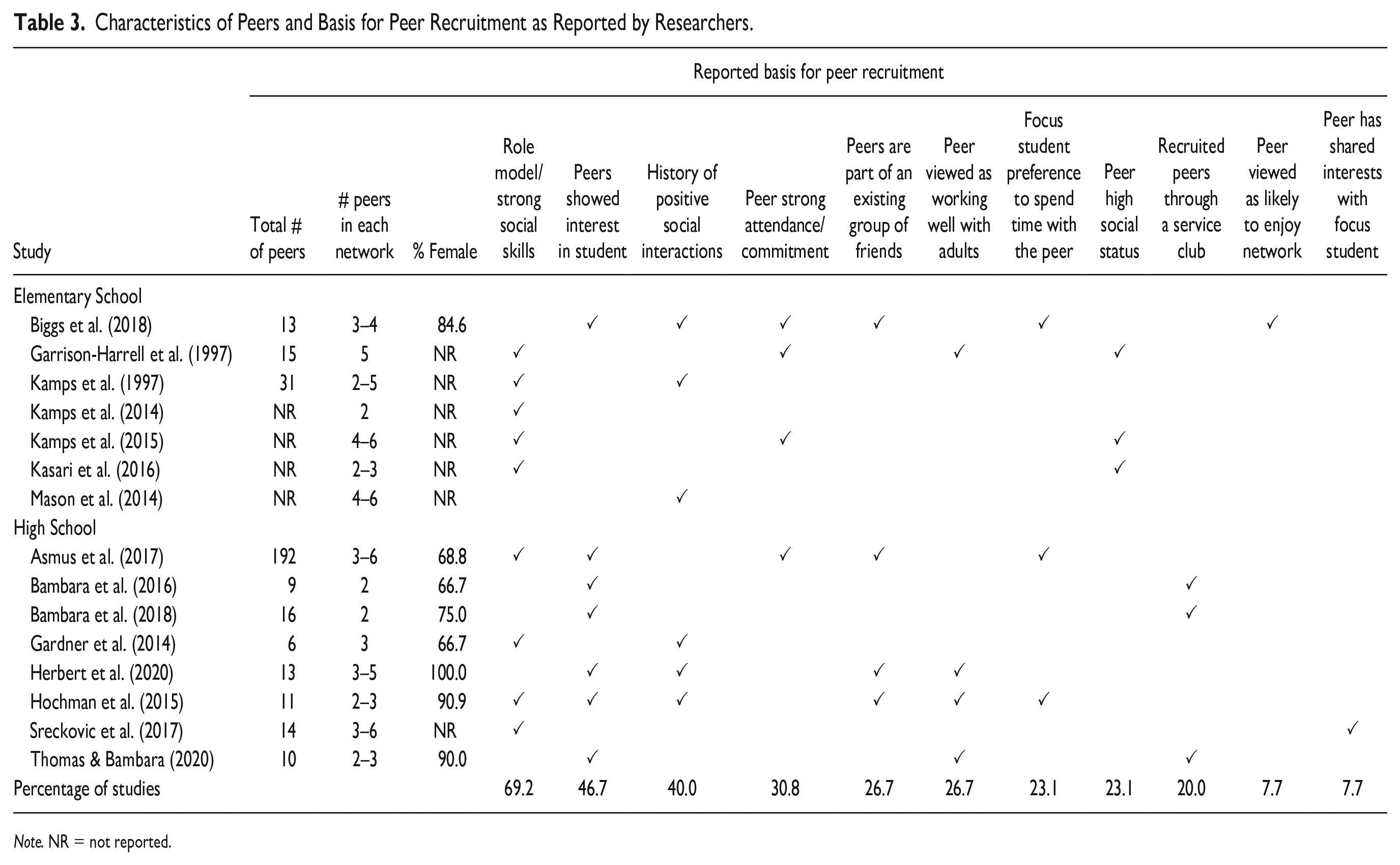
Note. NR = not reported.
Settings and dosage
Peer network interventions took place during lunch or breakfast (n = 10 studies), recess (n = 5), and advisory periods (n = 2), with some studies reporting different times for different participants. Locations varied, including general education classrooms, empty therapy or special education classrooms, cafeterias, playgrounds, and other school spaces (e.g., gym and school coffee shop). The frequency of intervention sessions also varied, ranging from 1 to 4 times per week. Peer network sessions on average were about 25 min, ranging from 15 to 60 min. About half of the studies reported the peer network lasting less than a semester (about 4 months), and the other half reported interventions that lasted longer than a semester (see Table 1).
Implementation practices
A researcher acted as the intervention facilitator in more than half of the studies (n = 7; 46.7%), although in one of these studies the researcher was also a paraprofessional at the school (Herbert et al., 2020). In the other eight studies, school personnel who implemented interventions included paraprofessionals (n = 8 studies), special education teachers (n = 5 studies), speech-language pathologists (n = 3 studies), general education teachers (n = 2 studies), and school counselors (n = 2 studies). Asmus et al. (2017) also reported other school personnel, including job coaches, club leaders, social workers, and school psychologists. Seven studies reported information about implementation practices used to train and support school personnel (i.e., all studies with natural implementation agents except Kamps et al., 1997). In studies reporting information, training ranged from 1 to 3 hr, averaging about 2 hr. In addition to training before beginning the intervention, all study authors reported providing other concurrent support, which ranged from two to four formal visits (at minimum) to ongoing support throughout the duration of the intervention. All study authors reported using (a) oral instruction, (b) printed materials, (c) modeling, and (d) performance feedback during training and/or coaching. In addition, other strategies for equipping school personnel included incorporating discussion with question-and-answer times (n = 5 studies), self-monitoring (n = 3 studies), collaborative and individualized planning (n = 1 study), skill rehearsal with feedback (n = 1 study), and breaking into “chunks” to teach (n = 1 study). Only three studies reported measuring fidelity of implementation practices (Asmus et al., 2017; Biggs et al., 2018; Hochman et al., 2015).
Social validity
Social validity was addressed in all but two studies (Garrison-Harrell et al., 1997; Kasari et al., 2016) and included addressing the perspectives of students with disabilities (n = 9 studies), peers (n = 9 studies), school personnel who were implementing the interventions (n = 7 studies), and other stakeholders such as parents or classroom teachers (n = 8 studies). All studies that measured social validity did so using rating scales. Just more than half (n = 8 studies) also used approaches such as oral or written open-ended questions, although none described qualitative analysis of in-depth interviews. In addition, Sreckovic et al. (2017) used normative comparison with peers without disabilities. Study authors were more likely to focus on the social validity of the procedures and outcomes, rather than goals. Across the studies that measured social validity, the focus students, peers, school staff, and parents generally viewed the peer network interventions as being beneficial and feasible, indicating they would want the peer networks to continue and/or would recommend them for other students. In two studies, peers noted that the prompting which was a part of the intervention was difficult to learn and that they felt awkward at times (Bambara et al., 2016; Thomas & Bambara, 2020).
Study effects
Table 2 displays information about the effects of peer network interventions for primary dependent variables. In the 12 single-case design studies, researchers demonstrated experimental effects in 72 of 79 opportunities across five different outcome variables (e.g., student communication to peers), all of which were proximal and context-bound. Consistent effects were generally demonstrated for all participants or tiers, with the exception of mixed effects (success estimate 4/9) for communication to peers in Garrison-Harrell et al. (1997) and mixed effects (success estimate 10/12) for social engagement in Kamps et al. (1997). It is appropriate to note that Garrison-Harrell et al. failed to report intervention fidelity, making it impossible to know whether mixed results are a result of the intervention, of poor fidelity, or both.
Looking at the three group design studies, Asmus et al. (2017) reported statistically significant differences for the peer network intervention in friendship gains, with a large effect (d = 1.39). Kamps et al. (2015) involved nested data and did not report a standardized effect size, but did report statistically significant effects for student communication measured as initiations to peers, as compared to a control group. This included significant effects both (a) during non-intervention play sessions with peers who were in the network and (b) during non-structured social times (e.g., recess, lunch, centers) with any peers (trained or untrained) who were in that setting at the time. Kasari et al. (2016) found that both interventions (i.e., the peer network-type intervention called ENGAGE and a social skills group intervention called SKILLS) were associated with modest changes in social network salience, but failed to find any significant differences based on intervention group. Social network salience refers to a child’s social prominence within his or her general education classroom based on how peers report connection for “who hangs out together.”
Evidence-based determination and considerations
If relying only on CEC’s (2014) guidelines, peer network interventions would be considered an evidence-based practice for students with IDD, specifically for increasing student’s communicative interaction with their peers. The criteria from CEC state that a practice is evidence-based if there is (a) at least one methodologically sound group comparison study with at least 30 participants randomly assigned and (b) at least three methodologically sound single-case design studies with at least 10 participants and positive effects (CEC). Looking just at studies that evaluated student communication to peers as the primary dependent variable, the evidence base for peer networks exceeds this criterion with one randomized controlled trial with 95 participants (56 in the intervention group) and 7 single-case design studies with a combined 23 participants.
However, there are at least three important qualifications to this determination. The first is related to substantial differences in how methodological rigor and risk of bias are considered in different quality appraisal tools (i.e., CEC quality indicators and the Cochrane group and single-case RoB tools). It is important to recognize that although a sufficient body of literature has amassed to meet the criteria outlined by the CEC, assessment of the same studies using the risk of bias tools raised many different methodological issues that introduce concerning risk of bias, particularly for single-case designs. Second, of studies measuring communication to peers as the primary dependent variable, only the group design study (Kamps et al., 2015) demonstrated generalized effects on student communication to peers outside the intervention condition; all other researchers measured student communication as a context-bound variable. This is an important qualification signaling that little is known about whether positive changes in the frequency of student communication toward peers extends beyond the context of the peer network itself. Third, the evidence-based determination changes if looking more narrowly at specific populations within this broader group of students with IDD. There was limited representation of students who did not have an autism diagnosis, as only 24 participants had diagnoses or special education eligibility labels of intellectual disability or multiple disabilities without autism. Similarly, there is not sufficient research to determine whether peer networks are evidence-based for students who have complex communication needs, as only 11 participants were reported to use unaided or aided AAC (including 10 who were described as using both verbal speech and AAC). Fourth, looking at school levels narrows the scope of evidence, particularly given that no studies could be located at a middle school level.
Discussion
Educators need information about evidence-based interventions that promote the inclusion and social flourishing of elementary and secondary-age students with IDD. Research highlights that social interaction, mutual relationships, and even close friendships among students with and without IDD are possible (Biggs & Snodgrass, 2020), but these indicators of inclusion are not seen often enough in schools (Andzik et al., 2016; Carter et al., 2008; Chung et al., 2012; Locke et al., 2010, 2016). This review (a) mapped the literature related to peer networks, including variations and similarities in intervention components and (b) found that the determination of whether or not peer networks are evidence-based depends on the tools used for the appraisal. Although peer networks can be considered an evidence-based practice for increasing how often students with IDD communicate with their peers based on the CEC quality indicators, there are important qualifications—first, concerns about risk of bias; second, considerations about the boundedness of the outcomes evaluated in the majority of studies; and third, the reality that there is limited available evidence when looking at specific populations within the broader group of students with IDD. In addition to addressing the evidence base for peer networks, this review also extends prior knowledge by providing insight into implementation practices that might be used to support school personnel in implementing peer network interventions successfully.
First, the findings of this review revealed that peer network interventions share several core components but are varied in other important ways, particularly whether they target specific social skills through peer- or adult-mediated instruction. The emphasis on addressing environmental factors impacting peer interaction and relationships is in line with strengths-based approaches to educational supports for students with IDD (Shogren et al., 2017). Although many studies focused only on arranging the environment to promote opportunities for social interaction and on equipping peers (e.g., Asmus et al., 2017; Gardner et al., 2014; Kasari et al., 2016), other researchers incorporated the use of peer-mediated prompting and teaching within peer networks (e.g., Herbert et al., 2020; Hochman et al., 2015; Sreckovic et al., 2017). Furthermore, Kamps et al. (2015) incorporated direct instruction by teaching social skills to students with and without autism together in group play, which they rationalized would allow for more opportunities for practice, natural feedback, and social reinforcement from peers. Although it is not clear from the available evidence whether embedding a focus on social or communication skills instruction offers additional advantage, an important consideration for researchers and practitioners is that interventions promote reciprocal social interactions, equal-status roles, and mutual relationships and friendships among students with and without IDD, rather than asking or teaching peers to take on roles that might inadvertently create or reinforce predominately “helping” relationships (Biggs & Snodgrass, 2020). Instead of one approach to peer networks being clearly more advantageous, it is likely that these different approaches simply have slightly different foci, which offer school personnel options for selecting specific models of peer network interventions that align with student needs and their goals.
Second, with the evidence-based determination using the guidelines from the CEC (2014), it is important to understand what is and is not known about the effects of peer network interventions. Appraisal of the studies in this body of literature revealed several areas of methodological concerns that introduce a substantial risk of bias. Thus, further research is needed that demonstrates greater consideration of these critical issues, including judicious use of randomization for sequence generation within single-case designs (e.g., randomly allocating participants to the intervention condition if all tiers are stable within a multiple baseline design), blinding to study condition any research team members charged with collecting and coding outcome data, strong assessment of procedural fidelity across all conditions (including baseline), and adequate demonstration of dependent variable reliability (Reichow et al., 2018).
The CEC standards assert that identifying evidence-based interventions is more complicated than a mere dichotomous distinction and that many promising or potentially evidence-based practices may also guide educators to provide high-quality educational services. Beyond students’ communicative interaction with peers, researchers evaluated the effects of peer networks on many different primary and secondary outcomes, such as interaction quality, performance on individualized social-related goals, peer acceptance, peer engagement on the playground, friendship gains, and decreasing student-reported bully victimization. However, the available research is insufficient to draw conclusions about the utility and effectiveness of peer networks for improving these outcomes due to the relative scarcity of studies evaluating each outcome and because many were evaluated as secondary variables without experimental control. Thus, further research is needed in these areas.
Another critical qualification is that nearly all researchers evaluated the effects of peer networks on proximal and context-bound dependent variables, and therefore little is known about the effects on more generalized and distal outcomes such as: peer interaction outside of the immediate intervention context; the making, sustaining, and deepening of friendships; and the social network salience of students with IDD. This is not to say that proximal outcomes, or even changes within the immediate intervention context, are unimportant. Given the evidence that many students with IDD appear to go most or all of the school day experiencing very few or even no positive social interactions with their peers without disabilities (Andzik et al., 2016; Carter et al., 2008), it is important to identify simple interventions that can change this—even if they do not have an impact on broader developmental outcomes. However, more research is needed to understand whether and how peer network interventions might also be able to impact broader and more generalized social and developmental outcomes for students with IDD, including their own social and communication skills which could generalize to other interactions and relationships.
It is also clear that further research is needed to better understand the effects of peer network interventions for specific subgroups of students within the broader IDD label. This includes a need to more closely examine peer networks at different school or grade levels (i.e., middle school), for students with intellectual disability who do not have an autism diagnosis, and for students with complex communication needs who use AAC. Some researchers have begun to explore innovations to peer network interventions that might benefit children learning to use aided AAC, such as teaching peers without disabilities to use aided AAC as a shared means of communication during their own interactions with the student with complex communication needs (e.g., Biggs et al., 2018). However, a clear need for the future is a greater focus on these students who have the greatest needs for social and communication supports.
In addition, relatively little is known about the impact of peer network interventions for peers without disabilities. Teachers, administrators, or parents may be concerned that participating in peer-mediated interventions might negatively impact peers, either socially or academically. Although no studies in this review measured the impact on peers as a primary outcome, many did evaluate peers’ experiences and perspectives through social validity assessments, which suggested peers enjoyed participating in peer networks, learned new things that were valuable to them, and would recommend peer networks for other students in the future (e.g., Bambara et al., 2018; Biggs et al., 2018; Gardner et al., 2014; Sreckovic et al., 2017). It is also important to recognize that there is no evidence in the broader literature that participating in peer-mediated interventions negatively impacts peers. For example, Locke et al. (2012) found that peers without disabilities who participated in a different peer-mediated social skills intervention maintained a high, positive social status throughout and after the intervention. In a review of the literature, Travers and Carter (2021) found evidence for positive outcomes for peers without disabilities, including the development of friendships; more positive views of individuals with disabilities; new or continued goals of getting to know, supporting, or working with individuals with disabilities in the future; positive academic impact; and the development of personal qualities (e.g., understanding, patience).
Finally, critical insight was gleaned into the training and supports that appear to be appropriate for paraprofessionals, teachers, service providers, and other school personnel to implement peer network interventions successfully. It is important to note that all researchers provided school personnel high-quality training (e.g., instruction, printed materials, modeling of strategies) and also incorporated observations of each intervention facilitator, with targeted coaching and performance feedback. A few researchers also incorporated self-monitoring checklists to help school personnel remember and reflect on their use of facilitation strategies (i.e., Asmus et al., 2017; Gardner et al., 2014; Herbert et al., 2020). These studies provide valuable information for steps to promote effective implementation of peer network interventions in practice. However, research is still needed to generate knowledge of supporting implementation at scale. For example, many schools and teachers may find it valuable to implement peer networks for multiple students, requiring multiple school personnel be trained simultaneously. Future research on (a) contextual determinants for implementation and (b) on innovative practices to support implementation at scale (e.g., within a whole school, district, or state) would fill important needs.
Limitations
These findings should be considered in light of some limitations about this review. First, we chose to use success estimates because standard meta-analytical methods could not be applied because (a) inconsistent outcome measure(s) were used across studies and (b) there is a lack of consensus for how to best synthesize results from single-case studies, and the literature on peer network interventions includes a predominance of single-case designs. Prior reviews have also used success estimates (e.g., Brock & Huber, 2017), and it is appropriately aligned with the guidelines in the CEC standards for evidence-based practices (2014). However, critical limitations to such a “vote counting” approach are that it does not provide information about the magnitude of effects, does not account for differences in the relative sizes of the studies, and may be likely to overestimate intervention effectiveness, particularly when taking into account publication bias from reliance on published studies (Higgins et al., 2021). Therefore, this limitation of our review adds to other previously discussed qualifications for considering peer networks to be an evidence-based practice. Furthermore, despite the fact that agreement between researchers regarding success estimates was strong, and that visual analysis is considered the gold standard for single-case analysis (Ledford & Gast, 2018), visual analysis is still inherently subjective. Second, the first author of this review was an author on some of the reviewed studies, which raises concerns of bias. We took steps to reduce this risk and promote objectivity, including having two independent coders when extracting data for the review.
Implications for Practice
The findings of this review highlight the promise of peer network interventions for increasing students’ communicative interaction with peers within specific settings such as lunch, recess, or advisory periods; and, results suggest that these interventions are generally viewed as being feasible, useful, and beneficial. Given how important social interactions and relationships with peers are for development and well-being, it is crucial that special and general education teachers, service providers, and other school personnel have what they need to implement effective interventions to promote positive social outcomes. The considerations related to the different quality appraisal tools in this review may cause confusion for educators about the quality of this body of evidence. Are peer networks evidence-based or not? And, should teachers or service providers use this practice with students who would benefit from increased opportunities and supports to interact more with their peers? Although many evidence-based practices have been established in the field of special education, there is still a crucial need for more and more rigorous research for many practices, including peer networks. Something that makes this challenging is the reality that real-world, applied research in schools maximizes the potential that the results will be relevant to the setting, but this type of research is also inherently “messy” (Locke et al., 2019). It is often more complicated and more costly to conduct scientifically rigorous and real-world research as compared with intervention research in highly controlled clinical settings. Thus, the special education field must invest in and incentivize the production of high-quality and real-world evidence. However, teachers and other school personnel cannot just wait for such research to amass; they need reliable ways to approach their own practice now in evidence-based ways.
Although researchers within the special education field have often referred to practices as being evidence-based or not based only on external scientific evidence, the concept of “evidence-based practice” may best be considered a multifaceted concept, praticularly when referring to practice in the sense of what practitioners do, rather than a specific intervention practice. For example, in the field of speech-language pathology, Higginbotham and Satchidanand (2019) emphasize that practitioners use four components to drive their own evidence-based practice: first, practitioners weigh the best external scientific evidence available; second and third, practitioners consider student/caregiver perspectives and clinical judgment; and fourth, practitioners gather and utilize internal evidence (e.g., graphed student outcome data) to make data-based, evidence-informed decisions. The findings of this review indicate that peer networks hold considerable promise to increase interactions among students with and without IDD, and that evidence was not found contraindicating this practice based on negative effects or concerns regarding poor social validity. However, there are methodological concerns that need to be addressed in future research, available research evidence is weaker for some student populations within this broader group, and there is insufficient research to know the impact of peer networks on generalized outcomes (e.g., peer interaction and relationships outside the context of the peer network, student social or communication skills). Taking all of this together, we would assert the most important take-away for educators is (a) that they consider peer networks as a practical and promising tool to promote peer interaction, but (b) when implementing peer networks, that they are careful to evaluate the effects of the practice on intended outcomes for the students involved (i.e., a student with IDD and peers), as well as any potential unintended outcomes. Educators can do this by carefully gathering both objective and subjective data—such as by graphing the frequency of peer interactions over time, while also gathering the perspectives of everyone involved, such as students with IDD, peers, and their family members and educators. Collaboration across educational team members to gather and evaluate this practice-based evidence can also improve its quality and utility for making data-driven decisions.
Another secondary implication for practice relates to paraprofessionals and implementation of peer networks. Given the predominate utilization of paraprofessionals to support teachers and students with IDD, it is important to recognize that paraprofessionals were successful implementing peer network interventions in all of the studies that utilized natural school personnel (i.e., Asmus et al., 2017; Biggs et al., 2018; Gardner et al., 2014; Herbert et al., 2020; Hochman et al., 2015; Kamps et al., 1997, 2014, 2015; Mason et al., 2014). Providing training and support for paraprofessionals to implement peer network interventions may be a valuable way to use paraprofessional support to improve social-related outcomes for students with IDD. However, we would emphasize that paraprofessionals are far too often tasked with providing supports to students with IDD without the support, collaboration, and supervision that they need and that is required by law (Biggs et al., 2016; Massafra et al., 2020). Paraprofessional implementation should be supported by close collaboration and supervision from others on the educational team, such as special education teachers.
Supplemental Material
sj-pdf-1-rse-10.1177_07419325221075013 – Supplemental material for Review of the Evidence Base for Peer Network Interventions for Students With Intellectual and Developmental Disabilities
Supplemental material, sj-pdf-1-rse-10.1177_07419325221075013 for Review of the Evidence Base for Peer Network Interventions for Students With Intellectual and Developmental Disabilities by Elizabeth E. Biggs and Sarah E. Robison in Remedial and Special Education
Footnotes
Declaration of Conflicting Interests
The author(s) declared no potential conflicts of interest with respect to the research, authorship, and/or publication of this article.
Funding
Preparation of this manuscript was supported in part by U S Department of Education Grant H325D160006.

Supplemental Material
Supplemental material is available on the Remedial and Special Education webpage with the online version of the article.
References
Supplementary Material
Please find the following supplemental material available below.
For Open Access articles published under a Creative Commons License, all supplemental material carries the same license as the article it is associated with.
For non-Open Access articles published, all supplemental material carries a non-exclusive license, and permission requests for re-use of supplemental material or any part of supplemental material shall be sent directly to the copyright owner as specified in the copyright notice associated with the article.
