



Abstract
Peer support arrangements are an evidence-based practice for increasing interactions between students with severe disabilities and their peers in general education classrooms, but it is unclear how interactions vary across instructional formats or generalize outside the classroom. In this single-case design study, we tested the efficacy of peer support arrangements with three middle school students with severe disabilities, and focused on variability across instructional formats and generalization to the cafeteria and recess yard. We replicated previous findings of increased interactions and extended the literature by demonstrating positive effects across instructional formats with the largest gains during small group instruction and independent work time. We found no evidence of generalization; interactions only increased in nonclassroom settings after we directly targeted those settings. We recommend educators to implement peer support arrangements in general education classrooms, increase opportunities for small group instruction when appropriate, and purposefully target social interactions across settings.
Keywords
Social relationships with peers are critical to any child’s quality of life and well-being. Unfortunately, students with severe disabilities often struggle to form these relationships (Carter, Sisco, Chung, & Stanton-Chapman, 2010). Data from the Special Education Elementary Longitudinal Study (SEELS, 2006) show that only 44.3% of students with intellectual disability (ID) and 43.2% of students with autism spectrum disorder (ASD) report socializing with peers outside of school. Data from the National Longitudinal Transitions Study-2 (NLTS2, 2009) provide additional evidence that individuals with severe disabilities have poorer long-term social outcomes than adults with milder or no disabilities. For example, only 58.1% of individuals with ID and 48.2% with ASD reported seeing friends socially outside of work or school on a regular basis (Newman et al., 2011). Many (49.6% with ID and 62.5% with ASD) reported not feeling cared about a lot by friends, and just 70.3% with ID and 38.8% with ASD reported feeling confident in their ability to make friends (Wagner, Newman, Cameto, Levine, & Marder, 2007).
Two major barriers make it difficult for middle and high school students with severe disabilities to interact and develop friendships with their peers. First, many students with severe disabilities spend relatively little time in general education classrooms. According to the U.S. Department of Education (2015), only 16.7% of students with ID and 39.7% of students with ASD spend at least 80% of the school day in a general education classroom. Moreover, 56.7% of students with ID and 42.1% of students with ASD either spend less than 40% of their day in the general education classroom or are in an alternative placement (e.g., separate campus, residential facilities). Second, even when students with severe disabilities are placed in general education classrooms, they may rarely interact with their peers. Carter, Sisco, Brown, Brickham, and Al-Khabbaz (2008) observed 23 middle and high school students with developmental disabilities across 10 weeks in general education classes. In 23.5% of observations, students with disabilities did not interact even once with a peer during a class period. Similarly, Chung, Carter, and Sisco (2012) observed 16 middle school and high students with severe disabilities who used augmentative and alternative communication modes and found that the students with disabilities only interacted with their peers less than 5% of the time on average.
One approach for overcoming these barriers is peer support arrangements. Peer support arrangements are an evidence-based practice for increasing social interactions between students with severe disabilities and their peers (Brock, Biggs, Carter, Cattey, & Raley, 2016; Brock & Carter, 2016; Carter et al., 2016; Carter, Moss, Hoffman, Chung, & Sisco, 2011). This strategy involves a facilitator recruiting peers without disabilities in the general education classroom and training those peers to support the socialization and participation of a classmate with a disability. A peer support arrangement begins with an adult—usually a teacher or paraprofessional—who identifies and invites one or more peers without disabilities to participate in the peer support arrangement for a student with a disability. This facilitator develops a peer support plan that outlines specific ways that peers can provide support in different kinds of classroom activities and shares this plan with peers during an orientation meeting. Plans typically include social supports like greeting the student with disabilities, socializing before class begins, and introducing the student to other peers. Academically, plans often include suggestions such as peers encouraging the student’s engagement in class and praising the student when he or she participates in activities and discussions. Academic supports might also include peers helping the student with tasks related to class, such as discussing assignments, brainstorming ideas before beginning an activity, or scribing the student’s responses for written tasks. After the group has met and implemented the plan in the classroom, the facilitator continues to observe the group, offer occasional feedback, and help peers problem solve issues that arise (Carter et al., 2011).
Although peer support arrangements have a strong evidence base, there are a number of practically important questions that remain unanswered. First, researchers have noted in previous studies that when peer support arrangements are implemented, interactions between students with severe disabilities and their peers are often variable. Although researchers have suggested that this variability might in part be explained by changes in the classroom context (e.g., structure and format of instruction), researchers have not actually examined the impact of these factors. Better understanding the relative efficacy of peer support arrangements during different instructional formats may enable teachers to design classroom activities that are more conducive to facilitating peer interactions. Second, although researchers have demonstrated that peer support arrangements produce positive outcomes in the general education classrooms where they are implemented, it remains unclear whether these outcomes extend outside of this setting. Better understanding the degree to which social interactions generalize beyond the classroom would help guide recommendations about whether and how to supplement peer support arrangements with other supports. Third, researchers have reported mixed findings regarding the impact of peer support arrangements on academic engagement. Although overall positive effects were reported in a randomized controlled trial (Carter et al., 2016), results in single-case designs have been mixed (e.g., Brock & Carter, 2016; Carter et al., 2011). Further replication could lead to recommendations about how to design peer supports that improve academic outcomes.
The aim of this research study is to address these important and unanswered research questions. Specifically, we (a) tested the efficacy of peer support arrangements to improve social interactions and academic engagement for students with severe disabilities, (b) examined the degree to which instructional format impacts the efficacy of peer support arrangements, and (c) measured the degree to which interactions in the classroom generalized to other environments.
Method
Participants and Setting
The first author, a graduate student in special education, implemented all the study procedures. After receiving the approval of the university’s Institutional Review Board, we worked with a special education teacher to identify three middle students with severe disabilities (i.e., having a diagnosis of intellectual or developmental disability and meeting eligibility criteria for their state’s alternate assessment) who attended at least one general education class and might benefit from peer support. We identified two peers for each target student who (a) were enrolled in the same class as the student with a severe disability, (b) shared time in another less structured setting (e.g., cafeteria) with the student with a severe disability, (c) were reported by the teacher as having good attendance, and (d) were reported by the teacher as working well with adults.
Each general education classroom had a general education teacher as well as a paraprofessional specifically assigned to support students with disabilities in the class. All the participants attended a middle school (Grades 6–8) in a Midwestern suburban school district serving roughly 7,200 students. In the school building, 61.3% of the students were White, 22.6% were African American, 6.5% were Hispanic, and 6.2% were multiracial. Overall, 18% of students had disabilities and 47.1% were economically disadvantaged.
Adrian, Alex, and Andre
Adrian was a 14-year-old White male with ASD who primarily communicated with verbal speech. All formal assessment scores were taken from participants’ most recent Evaluation Team Report, each of which had been conducted within the last 2 years. Adrian scored 63 for general intellectual ability on the Woodcock–Johnson Test of Cognitive Abilities, Third Edition. On the Woodcock–Johnson Tests of Achievement, Third Edition (WJ-ACH; Woodcock, McGrew, & Mather, 2001), his broad reading, writing, and math scores all fell below the 10th percentile in the very low range. On the Vineland Adaptive Behavior Scales (VABS; Sparrow, Balla, & Cicchetti, 2005), he earned an adaptive behavior composite score of 61, which placed him in the low range. We recruited two peers from this class, Alex (a 13-year-old White male) and Andre (a 13-year-old African American male), to support Adrian. Both peers reported that they had never participated in a peer support program and did not previously know Adrian well.
Mrs. Jones, a general education teacher with 23 years of experience, led Adrian’s science class. She was supported by Mr. Castle, a paraprofessional with 2 years of experience. Adrian’s science class had 27 seventh-grade students total, and he was the only student in the class with a severe disability. The class covered topics in earth sciences (e.g., biomes, the water cycle, phases of the moon). Students were arranged in groups of four to five around lab tables.
Phillip, Samiir, and Gloria
Phillip was a 13-year-old White male with fragile X syndrome and epilepsy. Although he primarily communicated with verbal speech, his limited verbal repertoire (e.g., consistent use of repetitive phrases), fast rate of speech, and poor articulation presented challenges to his social communication. He scored 50 for general intellectual ability on the Kaufman Assessment Battery for Children, Second Edition (KABC-II; Singer, Lichtenberger, Kaufman, Kaufman, & Kaufman, 2012), placing him below the 10th percentile in the lower extreme category. Phillip earned a composite score of 25 for adaptive behavior on the Behavior Assessment System for Children, Second Edition (BASC-II; Reynolds & Kamphaus, 2002), placing him in the extremely low range. On the WJ-ACH, his broad reading, writing, and math scores all fell in the very low range. We recruited two peers from this class, Gloria (an 11-year-old Hispanic female) and Samiir (a 12-year-old Somali American male), to support Phillip. Gloria reported that she had previously participated in a school-based peer support program; Samiir reported he had not. Neither peer knew Phillip well prior to the study.
Ms. Grey, a general education teacher with 3 years of experience, led Phillips’s social studies class. Ms. Grey was supported by Mr. McCoy, a paraprofessional with 11 years of experience. Phillip’s class had 25 sixth-grade students total. One other student in the class had severe intellectual or developmental disability (IDD). The class covered topics in world history (e.g., ancient Egypt, ancient India). Students were arranged in groups of four to five in clusters of desks.
Scotty, Brody, and Jaime
Scotty was a 13-year-old White male with ID and a mild bilateral hearing impairment. Although Scotty primarily communicated with verbal speech, his articulation was very poor. Individuals, even familiar staff, talking to Scotty often had to ask him to repeat himself. He scored 52 for general intellectual ability on the KABC-II, placing him below the 10th percentile in the lower extreme category. On the VABS, he earned an adaptive behavior composite score of 75, which placed him in the moderately low range. On the WJ-ACH, his broad reading, writing, and math scores all fell in the very low range. We recruited two peers from this class, Brody (a 13-year-old White male) and Jaime (a 13-year-old Hispanic male), to support Scotty. Brody reported that he had previously participated in a school-based peer support program; Jaime reported he had not. Both peers reported that they knew of Scotty from class but neither reported that they knew him well.
Mr. Banner, a general education teacher with 5 years of experience, led Scotty’s social studies class. Mrs. Munroe, a paraprofessional with 1 year of experience, supported the class. Scotty’s class had 28 sixth-grade students total. One other student in the class had severe IDD. The class covered topics in physical science (e.g., classifying minerals, chemical reactions). Students were arranged in groups of four to five in clusters of desks.
Generalization setting
To assess the extent to which interactions between target students and their peers generalized to novel and less structured school environments, we observed each of the target students during their lunchtime. Students ate lunch by grade level (e.g., all sixth graders ate lunch at the same time) in a single open cafeteria. Students chose seats, but once seated were discouraged from getting up to socialize with other tables. Lunch was served for roughly the first 20 min, then for the remainder of the period students were dismissed either outside or to the gymnasium during inclement weather.
Dependent Measures and Measurement
For the primary dependent variable, we defined interactions as a verbal or nonverbal (e.g., gesturing) communicative behavior from or toward the target student. Across phases and settings, we used a partial interval recording system rotating through 15 s of observation and 15 s of recording time. To track how much each communication partner was contributing (see Table 1), we recorded who directed the interactions to whom (i.e., target student to trained or untrained peer; trained or untrained peer to target student). From that we derived the total intervals in which peers or target students were directing communicative behavior toward each other (see Figure 1). To evaluate the role of classroom context (see Table 2), we recorded the instructional format being used in the classroom for the majority of each interval (i.e., 8 or more s). Categories included independent work (i.e., students directed to work on an activity on their own), group work (i.e., students were grouped into pairs or small groups to complete a task), class discussion (i.e., the entire class engaged in a discussion of a topic), lecture (i.e., the teacher gave spoken instruction), and no instruction (i.e., no instructional demand was in place).
Percentages of Intervals With Interactions and Academic Engagement by Participant and Phases in the Classroom Setting.
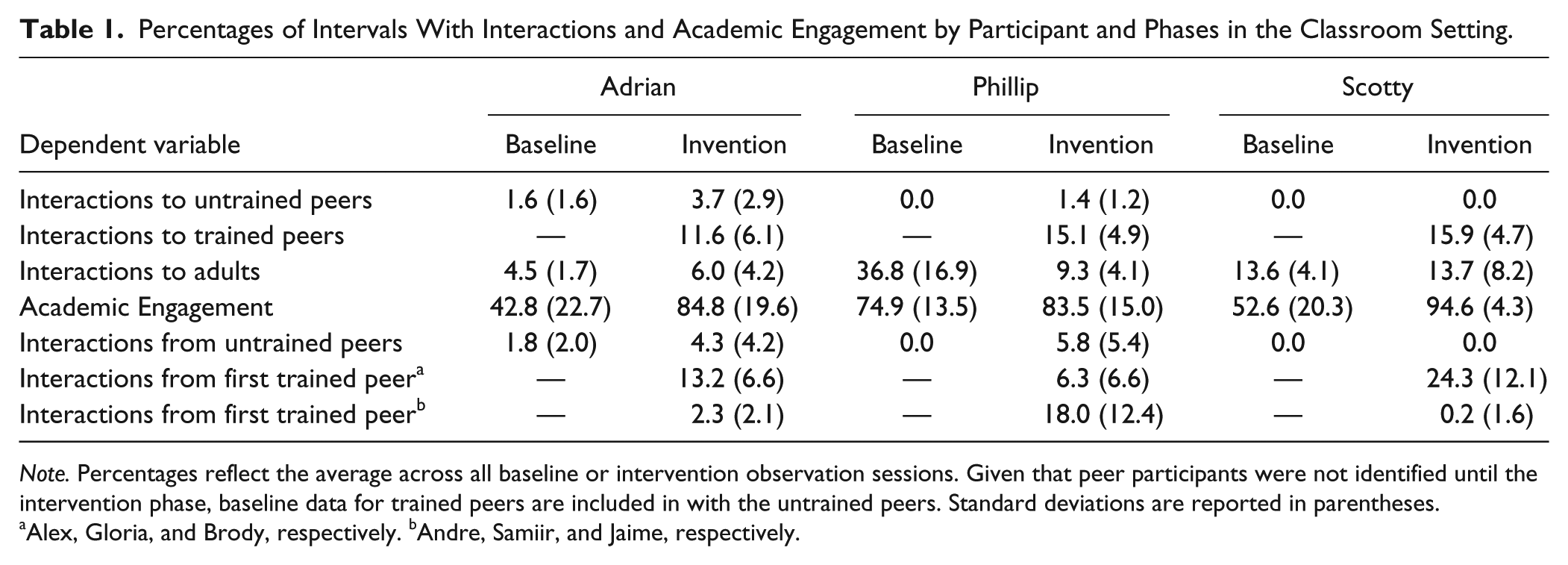
Note. Percentages reflect the average across all baseline or intervention observation sessions. Given that peer participants were not identified until the intervention phase, baseline data for trained peers are included in with the untrained peers. Standard deviations are reported in parentheses.
Alex, Gloria, and Brody, respectively. bAndre, Samiir, and Jaime, respectively.

Closed circles represent interactions between students with severe disabilities and their peers in their general education classroom. Open circles represent their interactions at lunch and recess. Triangles represent engagement of the student with severe disabilities.
Interactions and Academic Engagement by Instructional Format.

Note. First number indicates average proportion of total intervals that the behavior was observed out of the total intervals that the given instructional format was observed; number in parentheses indicates standard deviation.
The secondary dependent variable was the percentage of intervals in which the target student was academically engaged, defined as, (a) the student orientating toward the teacher during instruction, another student while discussing content, or instructional materials; (b) following class directions; and (c) lack of off-task behavior. For example, during teacher-directed instruction, engagement consisted of behaviors like visually attending while the teacher talked, taking notes, asking peers relevant questions (e.g., asking for clarification or for the peer to repeat a talking point). During group work, engagement consisted of behaviors like sitting with the group, writing on materials relevant to the academic task, discussing the task with peers in the group, and attending to a peer who was reading to the group. We did not record the student as academically engaged if they were talking about off-topic subjects (e.g., social conversation), had their head down, or were looking at materials other than the class materials (e.g., magazines). We recorded all variables from the time the target student entered to the time the target student left the classroom (M = 38.5 min, range = 27.5–41.0).
Research Design
This study used a multiple probe across participants’ single-subject research design (Gast, Lloyd, & Ledford, 2014) that included three phases: (a) baseline, (b) intervention in the general education classroom, and (c) intervention in the generalization setting. We staggered implementation of the peer support arrangement across participants. Before implementing the intervention in the second tier, data for the primary dependent variable (i.e., interactions between the target student and their peers) in the first tier had to double from average baseline levels to meet our criterion (Gast et al., 2014, p. 284), and so on.
Reliability and Implementation Fidelity
A second trained data collector independently coded 27.3% of the observations distributed across phases and participants. We calculated agreement using point-by-point agreement, which is a calculation of intervals coders agreed upon (i.e., coded exactly the same events) divided by intervals where coders agree plus intervals in which they did not agree (Ayres & Ledford, 2014). Given a potential to overestimate or underestimate agreement when using partial interval recording, Ayres and Ledford (2014) also suggested supplementing point-by-point agreement by calculating occurrence (i.e., agreements/agreements + disagreements only for intervals in which an event was recorded by one coder) and nonoccurrence (i.e., agreements/agreements + disagreements only for intervals in which no event was recorded by one coder) agreement, which we also calculated for the primary dependent measures. Calculations resulted in an overall mean agreement of 98.2% (occurrence = 90.3%, nonoccurrence = 98.2%) for interactions of the target student to trained peers, 99.6% (occurrence = 92.5%, nonoccurrence = 99.5%) for interactions of the target student to untrained peers, 99.3% (occurrence = 94.5%, nonoccurrence = 99.2%) for interactions of target student to adults, 98.5% (occurrence = 90.7%, nonoccurrence = 98.4%) for interactions of the trained peers to the target student, and 99.6% (occurrence = 96.3%, nonoccurrence = 99.2%) for interactions of untrained peers to the target student. Reliability assessment for secondary dependent measures resulted in an overall mean agreement of 94.5% for the target student’s engagement and 99.0% for instructional format.
To assess the researcher’s fidelity of the initial training portion of the intervention, the second data collector also attended each of the initial peer training meetings and recorded whether sequential steps were completed on a fidelity checklist. Implementation fidelity was 100% for each of the three peer trainings. To assess the peers’ use of the goal-setting strategy, we recorded whether or not the peers wrote down at least one goal for each intervention or generalization session. Peers wrote at least one goal before 94.0% of observations.
Procedures
Baseline phase
No changes were made in the general education classrooms or generalization setting during the baseline phase. Because peer participants had not been identified, all peer interactions were recorded as untrained peers.
Intervention phase in the general education classroom
We designed an individualized peer support plan for each student (Carter et al., 2016). Then we conducted an initial 25-min training with both peers that consisted of (a) discussing the purpose for peer support arrangements, (b) orienting peers to their new roles, (c) sharing background information about the target student, (d) discussing general ideas about specific support strategies (from the support plan), (e) modeling and role playing strategies with coaching and feedback, (f) discussing when and how to seek adult help, (g) discussing confidentiality and respectful language, (h) introducing peers to a goal-setting and reflection strategy, and (i) inviting questions from peers. The peer support plans also defined the roles of the facilitating adults and specified support behaviors (e.g., prompting and praising peers’ support behaviors).
For the goal-setting strategy, we gave the peers a small three-ring binder with sheets of paper to write their daily goals in a text box labeled “Peer Support-Daily Goals” and a writing prompt inside the box that said “Today, I will . . .” We gave the peers a description and several models of potential goals. Goals were described as focusing on specific content or actions rather than setting a numeric goal for frequency of interactions. Peers came up with novel goals for each day rather than choosing from a list or copying the original models. Examples of goals that peers set include, “I am going to ask Scotty to be in our group for the review game today and ask him if he knows the answer to some questions,” and “I will help Adrian make sure his pyramid [referring to a worksheet] is all filled out right for tomorrow.” We invited the special education teacher and paraprofessional assigned who supported the target student to the initial training session so they could observe the process and continue implementation after the study.
After each observation, the researcher met with peers briefly (i.e., 5–10 min). During these postobservation meetings, we would record and respond to their use of the goal-setting strategy, provide feedback on their performance, ask the peers whether they had any comments or concerns, and respond to the peers’ questions. These meetings continued until we detected a clear and consistent change in the rate of interactions (e.g., at least five consecutive data points with increased responding), and they were then faded to every other observation.
Intervention phase in the generalization setting
Throughout the study, we measured interactions in the lunchroom and at recess to assess generalization. After generalization did not occur, we directly intervened in this setting. This involved meeting with the peers a second time to discuss how to they could provide the target student social supports in the generalization setting similar to how they were doing in the general education classroom. Using the same goal-setting strategy described above, peers were directed to set and track goals related to interactions with the target student in the cafeteria and at recess. Neither the general education teachers nor paraprofessionals were present in the cafeteria; therefore, no adult facilitator was involved in coaching peers in the generalization setting.
Social Validity
To further assess the acceptability and perceived efficacy of the intervention, the first author and special education teacher conducted structured interviews (see Table 3) with all the participants after the conclusion of the study. Interviews consisted of four open-ended questions and five questions that used a Likert-type scale (i.e., 1 = not at all, 2 = not very much, 3 = neutral, 4 = somewhat, and 5 = very much). Participants with disabilities were only asked to respond to the open-ended questions.
Results of Social Validity Interviews.
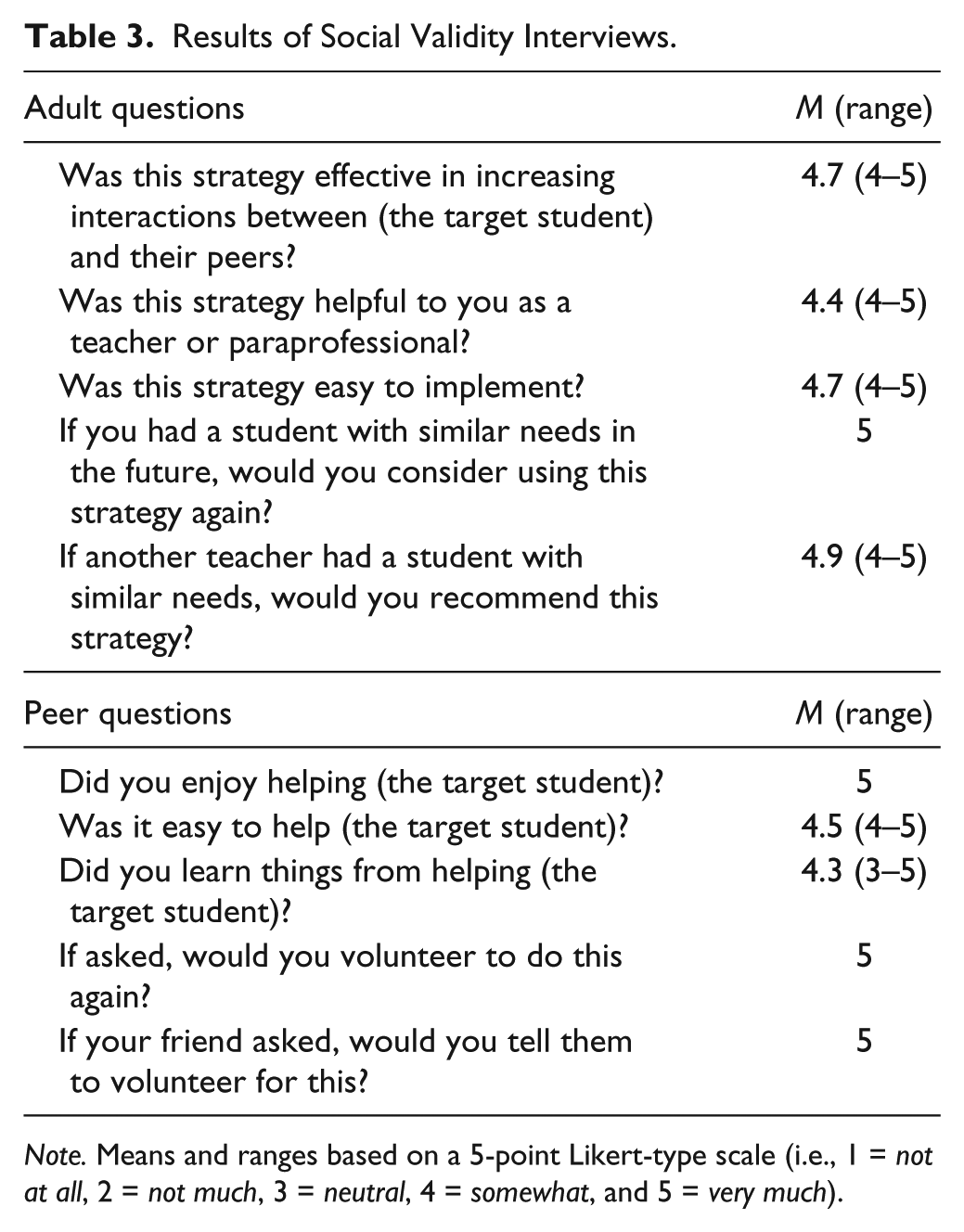
Note. Means and ranges based on a 5-point Likert-type scale (i.e., 1 = not at all, 2 = not much, 3 = neutral, 4 = somewhat, and 5 = very much).
Results
Effects on Peer Interactions in the General Education Classroom
Interactions in the general education classroom across phases for each participant are displayed in Figure 1. To supplement the visual display and analysis, we calculated means and standard deviations for the component variables (i.e., interactions by specific initiators) that are provided in Table 1. We also report dependent measures by instructional format in Table 2. The data contained in these tables are not intended to demonstrate an experimental effect rather to provide a more in-depth description of the participants’ behavior, to help illustrate differences in individual participants’ responding, and to help parse out the impact instructional format had on the dependent measures. Using visual analysis, effects were demonstrated and replicated across all participants, demonstrating a functional relation between peer support arrangements and interactions. Interactions increased across all instructional formats. An analysis of each participant’s data in terms of level, trend, and variability is described below.
During baseline, Adrian and his peers demonstrated low levels of interaction (M = 1.6%, range = 0%–5%) with a small amount of variability. After implementation of peer support arrangements, interactions increased immediately and substantially. Alex increased his interactions to a much higher level than Andre; however, the means for both individual peer participants remained above the baseline aggregate peers’ level (see Table 2). Despite some variability, the interactions for both Adrian and his peers remained steadily higher than baseline levels through the last observation (i.e., Day 42). Interactions increased across instructional formats. As shown in Table 1, participants demonstrated the largest increases in group activities, no instruction, and independent work.
Through seven baseline observations, we recorded no interactions between Phillip and his peers. After implementation of peer support arrangements, interactions increased immediately and substantially. As shown in Table 2, one trained peer (i.e., Samiir) increased his interactions to a higher level than the other trained peer (i.e., Gloria) similar to the previous triad. Similarly, the means for both individual peer participants remained above the baseline aggregate peers’ level. Interactions from each of the participants continued steadily above baseline levels with some variability until the last observation. As shown in Table 1, this triad demonstrated the greatest increase in interactions during independent work and group activities.
Scotty only interacted with his peers during one baseline session. After implementation of the peer support arrangement, interactions increased immediately. Interactions with Brody were much at higher levels than for Jaime, although both exceeded baseline levels (see Table 2). The data trended upward and peaked at Day 40, before slightly trending downward until the final observation. As shown in Table 1, interactions increased most during group activities, no instruction, and independent work.
Effects on Academic Engagement
Academic engagement in the general education classroom for each student with a severe disability is displayed in Figure 1. Means and standard deviations for these same variables are provided in Table 1 and summarized by instructional format in Table 2. Due to overlap and a high degree of variability, the data did not demonstrate a functional relation between the implementation of the intervention and the target students’ academic engagement. We recorded some promising gains in engagement across all instructional formats for some participants after implementation of peer support arrangements. Visual analysis of each participant’s data in terms of level, trend, and variability is described below.
Adrian demonstrated relatively low levels of academic engagement during baseline (M = 42.8, SD = 22.7). After implementation of peer support, the data demonstrated a clear upward trend, leveling out at a high percentage of engagement with less variability than in baseline (M = 84.8, SD = 19.6). Examining the data by instructional format, Adrian displayed large gains in engagement in each format with the exception of class discussion that remained the same and accounted for less than 2% of the intervals overall. Group activities provided the highest level of engagement with the least variability (M = 97.9, SD = 4.1).
Phillip demonstrated the highest levels of engagement during baseline (M = 74.9, SD = 13.5) and the most moderate gains during intervention (M = 83.5, SD = 15.0). Immediately after implementation of peer support, Phillip’s engagement increased and established a steady trend despite considerable variability that caused some overlap with his baseline data. Phillip demonstrated moderate gains in engagement across each of the instructional formats with independent work providing the highest level and lowest variability (M = 100, SD = 0).
Scotty displayed the greatest amount of variability during baseline (M = 52.6, SD = 20.3) and no overlap between baseline and intervention phases. Immediately after implementation of the peer support arrangement, Scotty’s engagement increased substantially and maintained with very little variability (M = 94.6, SD = 4.3). With the exception of engagement during class discussion, Scotty demonstrated increases across instructional formats. Engagement was highest with the least variability during group activities (M = 100, SD = 0).
Effects of Intervention in the Generalization Setting
Figure 1 presents results for each participant across baseline, implementation of the intervention in the general education classroom, and implementation of the intervention in the generalization setting (i.e., at lunch and recess). When peer support arrangements were implemented in the general education classroom, they did not produce a discernable effect in the generalization setting. When we extended the intervention to the cafeteria and recess yard, we observed immediate increases in interactions for each of the three target students, although these increases were not as large as in the classroom setting. Together, these effects demonstrate a functional relation between the extended intervention and interactions in nonclassroom settings.
Social Validation
Adult and peer participants rated the acceptability and perceived effectiveness of the intervention on a 5-point scale (see Table 3). All participants also answered several open-ended questions about their experience with the intervention. In response to open-ended questions, the adults talked about the target student interacting with everyone more often, and the target student becoming more engaged, interested, and involved in the class as a whole. For example, several of the adults talked about how the target students were more likely to volunteer to answer questions in front of the class and more likely to recruit help and attention after the intervention was implemented. Adult participants also discussed how the target students became more independent and required less adult oversight as the peers began to offer more embedded supports. For instance, one paraprofessional said that the target student was more likely to do something (e.g., raise his hand to answer a teacher’s questions, participate in a discussion) if prompted by peers than if prompted by the paraprofessional. All three of the general education teachers and one of the paraprofessionals admitted that they were skeptical at first and were concerned that integrating the target students more fully would require a lot more effort. However, each adult participant said that, once implemented, the peer support arrangement made supporting the target student easier. As Mr. Banner put it, “keeping Scotty’s attention on the subject has been hard, but working with his group really helps him stay on track.”
Many of the peers commented on similar changes in the targets students’ behavior (i.e., increased willingness to volunteer, increased recruiting assistance). On average, the peers rated the intervention as easy to implement and all peers indicated that they enjoyed the experience. For example, several peers indicated that they enjoyed “getting to know [the target student] better,” and that they “enjoyed being helpful and helping someone.” Several peers also said that they learned from the experience, for instance, Samiir said, “I am really surprised that [Phillip] is so social.” Then he added, “he is really just like anyone in class, but I guess I didn’t think about it before.”
Each of the participants with a severe disability indicated that they enjoyed working with the peers and enjoyed being more involved with the class. Phillip said that “sitting with friends makes social studies class more fun.” Adrian indicated that he thought he was doing better in the class and felt like the class was easier after intervention. All three target students indicated that they would like to sit in groups with those peers again in future classes.
Discussion
Researchers have demonstrated that peer support arrangements are an evidence-based practice for increasing interactions between students with severe disabilities and their peers in general education classrooms (Carter et al., 2016). In some cases, effects have also been demonstrated on academic engagement. However, it is unclear whether and how instructional format impacts peer interactions and whether interactions with peers generalize to outside of the classroom. In this single-case design study, we implemented peer support arrangements for three middle school participants with severe disabilities. We tracked interactions by instructional format in the classroom, and we measured interactions outside of the classroom (i.e., during lunch and recess). Implementation of peer support arrangements coincided with increased interactions for all three students in the general education classroom. In some cases, students also increased their academic engagement. Effects did not generalize to the lunchroom, but introducing a goal-setting strategy during lunch resulted in increased interactions. Findings from this study extend the literature in a number of ways.
First, we replicated findings from previous studies that peer support arrangements are an effective means to promote increased interactions in general education settings,and extended the literature by measuring differences in interactions across instructional contexts. Although peer support arrangements tended to be effective across any instructional format, students tended to experience the greatest increases in interaction during group activities, individual work, or when there was no instruction. We suspect that these instructional formats may, for different reasons, provide especially rich contexts for interactions. During group activities, students are typically expected to interact with each other to complete a cooperative task. Students with disabilities required the most support during individual work times, so it is unsurprising that they might interact often with peers providing support during this time. Times when there were no instructional expectations (e.g., beginning or end of class; break between activities) provided natural opportunities for social interaction that was unrelated to academic work. During other contexts (e.g., lecture), interactions increased to a lesser degree—likely due to the nature of the activity and the expectation for students to listen to the teacher, rather than interacting with their classmates. Although peers did provide supports during lectures, support provided in this context involved more sporadic interaction or interaction only after the lecture was complete (e.g., sharing notes, paraphrasing, or expanding on points in the teacher’s instruction).
Given that the specific classrooms included in this study did not utilize class discussion in a meaningful proportion of intervals (M = 2.2%, range = 0%–32.9%), we did not have sufficient evidence to evaluate its effects. No instruction also represented a very small proportion of our observations (M = 3.4%, range = 0%–13.0%); therefore, the subsequent increase in the target behaviors seen during these times should be interpreted with caution.
Second, in previous studies, researchers have reported mixed or inconclusive findings regarding the impact of peer support arrangements on academic engagement (e.g., Brock & Carter, 2016; Carter et al., 2016). In these cases, student engagement was collected as a secondary variable and was often very high and/or variable in the baseline condition—making it difficult to demonstrate a clear and consistent improvement in the intervention condition. Each participant with a severe disability was consistently supported by a paraprofessional in the general education classroom. Indeed, it is not surprising that this individual adult support might result in high academic engagement but low rates of peer interaction. However, when participants have low engagement at baseline, peer support arrangements have been associated with an increase in engagement (e.g., Carter et al., 2011). Our findings provide additional evidence that peer support arrangements may promote increased engagement for some students with low engagement at baseline,but falls short of demonstrating a clear functional relation.
Third, our findings demonstrate that a simple and feasible goal-setting strategy can promote improved outcomes beyond the classroom. This is critically important given that peer support arrangements alone did not generalize to improved social outcomes in other settings. There may be several explanations for this lack of generalization. Drawing from the feedback from peers involved in this study, the cause may be as simple as the competing contingencies of socializing with other general education peers. For instance, many peers indicated that they typically chose to sit with their established friend groups (e.g., other peers from sports teams, peers who live in their neighborhood, peers they know from elementary school). Interacting with other general education peers with longer common histories may be more immediately reinforcing. In addition, interacting with students with limited communication repertoires and/or deficits in social skills may simply take more response effort from the peers. Several peers commented on how the target students were difficult to understand at times or that some target students used repetitive phrases frequently.
It is also possible that different environments, like less structured environments, have different social reinforcing and punishing consequences contingent on peer interactions than are present in the classroom. Anecdotally, we recorded numerous times that peers were praised by the adult facilitator in the classroom for interacting well with the student with a severe disability, where that third party social reinforcement did not occur in the lunchroom or in the recess yard. Likewise, although we did not observe evidence of this, it is possible that other general education peers could actively punish for interacting with students with severe disabilities. It is also possible that peers could avoid interactions out of a perceived threat of social punishment.
Finally, this study extends the literature by evaluating a peer support arrangement with the addition of a goal-setting strategy. This goal-setting component may have promoted maintenance and generalization of outcomes. Previous peer support arrangement studies (e.g., Brock & Carter, 2016) produced data with a substantial immediate increase at intervention followed by a slight downward trend over time. Participants in this study appeared to maintain more consistently high levels of interactions across time, which may be partially the results of the daily reminder and reorientation provided by using the goal-setting strategy. The specific goals that peers set varied between individuals and did not appear to affect the frequency of interaction at all. For example, in the general education classroom some peers set goals to talk about specific subjects, revisit conversations, or offer help with specific tasks.
Similarly, the goal-setting strategy provided a simple and feasible means to extend increasing interactions to nonclassroom environments. Directing peers to use the same goal-setting strategy they had already used in the classroom took relatively little time but produced clear effects. In the cafeteria, goals more commonly included inviting target students into specific activities, carrying on a conversation from the general education classroom, or asking about events outside of school. As with the effects on maintenance, it is likely that daily reorientation to the purpose of the intervention and to their role as a supportive peer affected their behavior regardless of the quality of the goals.
Implications for Practice
Our findings have two important implications for special and general education teachers collaborating to support students with severe disabilities in a range of inclusive settings throughout the school day. First, given the lack of generalization of peer behavior outside of the intervention environment, teams planning to support inclusion for students with severe disabilities should use strategies to promote generalization to other nonclassroom settings. This could entail implementing a peer support arrangement—like that utilized in this study—in each of the target student’s general education classrooms and supplementing that in-class support with additional strategies in less structured environments. Second, practitioners most effectively promote peer interactions by simultaneously designing instruction that features more group activities and by introducing peer support arrangements. After establishing how much of each instructional format occurs, purposely modifying instructional planning to devote more time to partner and small group collaborative work and less time to a lecture format may enhance the efficacy of a peer support arrangement. This recommendation must be balanced with the teacher’s preference and the demands of the subject matter. We are not suggesting that teachers eliminate all lectures, because our finding indicates that peer support arrangements can lead to increased interactions in this format.
Limitations and Future Directions for Research
There are several limitations that merit discussion and suggest avenues for future research. First, we only evaluated generalization in one nonclassroom setting. Although interactions increased in the lunchroom and recess, the degree of increase was relatively small compared with the classroom setting. Peer support arrangements were designed for and have been evaluated in general education classroom settings. The components that make peer support arrangements effective in the classroom may, due contextual differences, be unavailable or simply less effective in less structured settings (e.g., cafeteria). For example, the support of an adult facilitator was not available in the cafeteria. The goal-setting and self-reflection addition seemed to lead to some increase in interactions; however, these were not nearly as robust as the full peer support arrangement in the classroom. Future peer support arrangement studies might test the generalization of interactions to other, more similar, classroom environments. In addition, future researchers might test supplemental strategies to produce a greater increase of interactions in nonclassroom settings (e.g., peer networks; Hochman, Carter, Bottema-Beutel, Harvey, & Gustafson, 2015). This would likely require planning and collaboration by multiple professionals working throughout the school. Future research that includes a goal-setting component might also want to study the participant’s implementation fidelity and quality of the goals written and self-reflection component.
Second, we recruited the three target students from the same school, and the characteristics of the students and classrooms might not be representative of all classrooms. In future studies, researchers might seek to replicate these findings with students with severe disabilities who have different profiles and attend different kinds of general education classes.
Third, we chose to specifically measure frequency of interactions using a partial interval recording system. We recognize that there are multiple dimensions of social interaction that merit measurement (e.g., duration of conversations, topic of conversation, quality of interaction). Future studies should continue to explore these other approaches to provide insight into different aspects of these interactions.
Fourth, the inability of this study to establish a clear functional relation between peer support arrangements and the academic engagement of students with severe disabilities may be in part due to our design. Future researcher who wishes to examine this question may want to track engagement as a primary variable, attempt to identify and minimize sources of variability, and introduce the intervention only after a stable baseline pattern has been established.
Finally, to minimize the reactivity of the students with disabilities to the researchers, the special education teacher was responsible for asking for the students’ assent in the beginning of the study and conducting the social validity interview at the end of the study. Based on her recommendation, we did not ask the participants with disabilities the social validity questions that required assigning a numerical rating. As an interviewer, the special education teacher was able to get more unbiased reactions to open questions from these participants; however, future researchers may want to use identical data collection methods for participants with and without disabilities to allow for a more direct comparison.
Conclusion
Students with severe disabilities often struggle to interact and form relationships with peers. Our findings underscore the importance of purposeful planning and intervention to address social outcomes across settings. Results from previous studies demonstrate that peer support arrangements can improve social outcomes in the classroom, and our findings show that one can extend these interactions to outside the classroom by directing peers to use a simple and feasible goal-setting strategy. It is exciting to envision how scaling up this strategy across other settings—including other general education classrooms, after-school clubs, sports teams, or faith communities—might impact the quality of life for individuals with severe disabilities.
Footnotes
Declaration of Conflicting Interests
The author(s) declared no potential conflicts of interest with respect to the research, authorship, and/or publication of this article.
Funding
The author(s) received no financial support for the research, authorship, and/or publication of this article.