



Abstract
Group mentoring is an increasingly popular intervention, but is still under-studied. This article reports findings from a qualitative study of the Young Women Leaders Program (YWLP), a combined group and one-on-one mentoring program for early adolescent girls. Protégés (n = 113) were interviewed post-program about changes they made as a result of the program and mechanisms of those changes. Girls reported making changes in four major domains as a result of YWLP: (a) Academics (e.g., study habits), (b) Relational Development (e.g., trusting people), (c) Self-Regulation (e.g., thinking before acting), and (d) Self-Understanding (e.g., being yourself). Relational development and self-understanding were the most frequently reported types of change. Protégés reported mentors as contributing to changes in academics more often than the mentoring group. They reported the mentoring group as the change mechanism more often than mentors for relational development. Protégés reported the mentors and mentoring groups about equally as the mechanisms of change for self-regulation and self-understanding. The findings support prior research on group mentoring and suggest that social and relational skills are a developmental domain in which group-based mentoring programs for early adolescent girls may be particularly effective at intervening.
Youth mentoring is increasingly occurring in group formats, wherein multiple youth interact and form relationships with one or more adults (Kuperminc & Thomason, 2013). Despite critiques of group-based interventions due to potential contagion effects (Dishion & Tipsord, 2011), the limited research on group mentoring demonstrates some positive outcomes (Kuperminc & Thomason, 2013). This article examines adolescent girls’ own perceived outcomes of the Young Women Leaders Program (YWLP), a combined group and one-on-one mentoring program for adolescent girls (Lawrence, Levy, Martin, & Strother-Taylor, 2008).
Combined Group and One-on-One Mentoring as a Developmental Intervention
Given the important roles of both peers (Gardner & Steinberg, 2005) and non-parental adults (Scales & Gibbons, 1996) in adolescent development, we believe that combining one-on-one mentoring with a group component that includes youth’s peers may be developmentally appropriate for early adolescents. We posit that such a model may amplify the mentoring processes identified by Rhodes (2005) by capitalizing on sociocultural activity (Rogoff, 2003) engaged in with peers and mentors in mentoring groups to foster youth development and meet protégés’ individual developmental needs (see Figure 1).

Pathways of combined one-on-one and group mentoring’s influence on individual development.
Mentoring Outcomes and Processes
Youth mentoring has been linked with small, but positive, effects (DuBois, Holloway, Valentine, & Cooper, 2002; DuBois, Portillo, Rhodes, Silverthorn, & Valentine, 2011) on academic achievement (Herrera, Grossman, Kauh, Feldman, & McMaken, 2007; Portwood, Ayers, Kinnison, Waris, & Wise, 2005), social skills (De Wit et al., 2007), self-esteem, peer connections (Karcher, 2008), and various risk behaviors (Aseltine, Dupre, & Lamlein, 2000; Barnoski, 2002; Bouffard & Bergseth, 2008). Rhodes’ (2002, 2005; Rhodes, Spencer, Keller, Liang, & Noam, 2006) model of mentoring suggests that positive outcomes result from processes that support social-emotional, cognitive, and identity (role modeling and identification) development. Rhodes proposes that these processes are fostered within mentor-protégé relationships characterized by mutuality, trust, and empathy and that outcomes are mediated by improvements in youth’s other relationships. Recent research finds that mentors’ provision of emotional and instrumental support and guidance may also contribute to academic, relational, and self-concept outcomes in youth (Schwartz, Rhodes, Spencer, & Grossman, 2013).
Group Mentoring Outcomes and Processes
Group mentoring is increasingly popular (Kuperminc & Thomason, 2013), yet less is known about its outcomes or mechanisms. Research on group mentoring’s effects has been mixed and limited by small samples and a lack of comparison of program components (Kuperminc & Thomason, 2013). One study of a school-based group program showed no academic effects (Cummings, 2010), but the few experimental or quasi-experimental studies show some positive academic and behavioral outcomes (Kuperminc & Thomason, 2013). The most consistent outcomes associated with group mentoring are psychosocial ones, a contrast with one-on-one mentoring, in which academic and other effects tend to be larger (DuBois et al., 2011). Herrera, Vang, and Gale (2002) found that the most commonly reported change associated with group mentoring was improvements in social skills with peers. They postulated that the group component may strengthen peer relationships and support the development of social skills more than one-on-one mentoring alone. Weiler, Zimmerman, Haddock, and Krafchick (2014) found that both mentors and protégés reported that protégés experienced positive developmental growth in areas such as empathy, self-regulation, and social competence. Protégés felt this growth resulted from watching the mentors in the groups act as role models as well as from interactions with peers and mentors in the group.
Group contexts may be beneficial in mentoring due to the presence of multiple peers (Herrera et al., 2002; House, Kuperminc, & Lapidus, 2005 as cited in Rhodes & DuBois, 2006) as well as the opportunity for collaboration between multiple adults (Hirsch, Deutsch, & DuBois, 2011). The group may help sustain one-on-one relationships by allowing mentors to observe other relationships and realize that episodes of disconnection with their protégé are normal and can be repaired (Comstock, Duffey, & St. George, 2002). Weiler and colleagues (2014) found that mentors reported that mentoring groups provided them with support and supervision; both mentors and protégés described the groups as a place to “belong,” where they felt safe and comfortable. As Kuperminc and Thomason (2013) suggest, group mentoring allows for closeness, cohesion, and mutual support at both the dyadic and group levels, providing two pathways for youth outcomes.
We view mentoring groups as settings for engagement in the sociocultural activity that Rogoff (2003) posits promotes individual development. According to Rogoff, Baker-Sennett, Lacasa, and Goldsmith (1995), “individuals change through their involvement in one or another activity, in the process becoming prepared for subsequent involvement in related activities” (p. 46). In group mentoring, youth engage in activities and relationships with other protégés and adults. We suggest that the group may foster social processes that (a) promote the development of mutuality, trust, and empathy, and (b) cultivate social-emotional, cognitive, and identity development (see Figure 1). Using Rogoff’s theory as a lens, as youth participate in mentoring groups they change, in part to be able to contribute to the activity of the group. These changes then facilitate their participation in other social or relational activities (e.g., peer interactions outside their mentoring groups). Thus, social skills may be developed in the group, which support the mechanisms through which Rhodes (2005) suggests mentoring has effects (i.e., improvement in other relationships). Such relational sociocultural activity may be particularly appropriate for early adolescents.
Group and One-on-One Mentoring for Adolescent Girls
During adolescence, youth are increasingly concerned with interpersonal relationships and how others view them (Rhodes, 2002). Adolescents’ social relationships also shift, as peers become more salient and adults become less prevalent (Darling, 2005). Relationships with peers, and anxiety over potential social isolation or betrayal, becomes of increasing psychological importance for both boys (Way, 2011) and girls (Gilligan, 1982; Underwood, 2003). Peer relationships also influence adolescents’ behavior in a variety of domains including academics (Ryan, 2001), prosocial behavior (Barry & Wentzel, 2006), and externalizing problems (Criss, Pettit, Bates, Dodge, & Lapp, 2002; Lansford, Criss, Pettit, Dodge, & Bates, 2003). The presence of both peers and adults in mentoring groups may capitalize on the power of peer relationships for adolescents while minimizing contagion effects (Kuperminc & Thomason, 2013).
The presence of peers may also support certain youth outcomes. Westhues, Clarke, Watton, and Claire-Smith (2001) compared combined group and one-on-one mentoring with one-on-one mentoring alone and found significant gains in protégé self-esteem for girls in the combined condition. They conclude that the group component allowed girls, who ranged in age from Grade 3 to Grade 12, to forge new friendships and normalized many of their experiences, potentially influencing self-esteem. This is important due to the documented drop in girls’ self-esteem during adolescence (Eccles, Barber, Jozefowicz, Malenchuk, & Vida, 1999).
One concern for mentoring programs serving adolescent girls is that girls who are referred to mentoring tend to have “lower levels of communication, trust, and intimacy with their mothers” (Rhodes, 2002, p. 49). Thus, these girls may have difficulty forming the close youth-adult relationship on which mentoring is predicated (Bogat & Liang, 2005; Rhodes, Lowe, Litchfield, & Walsh-Samp, 2008). Liang and Grossman (2007), thereby, suggest that girls may benefit from more relational approaches to mentoring. The presence of a group may help by decreasing the relational intensity of mentoring (Rhodes, 2002) for girls who are struggling with parental relationships. However, Bayer, Grossman, and DuBois (2015) found that large group settings may impede protégé-mentor closeness. Yet, peer interactions in the group may also motivate protégés to continue with the program, even if their one-on-one relationship is not entirely satisfying (Herrera et al., 2002).
We posit that combining group and one-on-one approaches may provide distinctive relational support, from adults and peers, that may compliment each other and meet adolescents’ needs more effectively than either alone. Yet further study of combined one-on-one and group mentoring is needed to more definitively identify outcomes and understand what program components promote outcomes. Given the discrepancies in findings between group and one-on-one programs, examining what protégés perceive to be the benefits of group and one-on-one mentoring, and what mechanisms they think account for their changes, is warranted.
The YWLP
The YWLP (Lawrence et al., 2008) is a combined group and one-on-one mentoring program that pairs seventh-grade girls with college women mentors. Participants meet weekly at the protégés’ schools in groups of eight to 10 mentor-protégé pairs. Each group has a facilitator, who may also be a mentor. The groups follow a curriculum addressing developmental issues such as relational aggression, dating, and body image (Lawrence, Sovik-Johnston, Roberts, & Thorndike, 2011). Mentors and protégés spend at least 4 hours a month of one-on-one time outside of group in activities they choose (e.g., studying together, attending sports events, watching movies). Protégés are nominated to participate by school personnel, who are asked to select girls facing academic, social, or emotional risk and who are not receiving other services. Mentors apply to the program through their university and take a special service-learning course. In the first semester, the course covers youth engagement strategies, adolescent development, cultural competence, and mentor training activities and includes group planning time. In the second semester, the course provides training and support to mentors and facilitators related to program activities and relationship development and maintenance. Mentors and protégés come from diverse ethnic backgrounds. The majority of protégés receive free or reduced lunch, whereas the majority of mentors come from higher socioeconomic status (SES) backgrounds. The program has a higher than average retention rate (at least 75% across the past 5 years) and has been replicated at a number of sites nationally and internationally (e.g., see McGill, Adler-Baeder, Sollie, & Kerpelman, 2015, for report on mentor outcomes at another YWLP site).
Results from a quantitative evaluation of YWLP suggest attenuated declines in some academic and self-esteem domains for participants as compared with a control group, but no significant changes in social domains (Deutsch, Williams, Henneberger, Reitz-Krueger, Futch, & Lawrence, 2012; Henneberger, Deutsch, Lawrence & Sovik-Johnston, 2013). Given research on the importance of social relationships for girls (e.g., Underwood, 2003) and prior findings of social gains associated with group mentoring (Herrera et al., 2002), the lack of program effects in the social domain was surprising. The authors speculate that the measures used to assess outcomes may not have captured the nuances of differing academic, social, and emotional outcomes for middle school girls. Because the program serves a heterogeneous group of girls (i.e., girls with different levels and types of behavioral, academic, or social-emotional risk), it is also possible that quantitative group-level comparisons may not capture individualized patterns of change, with mean scores washing out subgroup differences.
This Study
The current study uses qualitative methods to examine girls’ own perceptions and reports of changes made as a result of participation in YWLP. We examine outcomes and processes across the domains of academic, social, and emotional functioning and seek to understand how participation in the mentoring group may promote processes and interactions that facilitate development (Rhodes, 2005; Rogoff, 2003). Two research questions guide our study:
We examine qualitative data on self-perceived change from two of the three cohorts of YWLP protégés represented in the previously discussed quantitative studies of YWLP (only two cohorts are included because we received funding for the qualitative study in the second year of the impact study). Using a qualitative approach to study outcomes of youth programs is an established and effective approach, as it allows for understanding of program effects that youth find salient (e.g., Habermas & Bluck, 2000, as cited in Wood, Larson, & Brown, 2009). Qualitative approaches also help researchers to understand programs from the perspective of developing youth, thereby better targeting measures to appropriate constructs and domains, and witness the activity of development as it occurs within settings (Rogoff, 2003). Asking about how those changes occurred also provides opportunity for insight into youth’s perceptions and experiences of program components and processes that contribute to change (see McGill et al., 2015; Spencer, 2007; Weiler et al., 2014, for examples of how qualitative methods have been used to understand mentoring processes and outcomes).
Method
Participants
All girls who consented to take part in the YWLP research during the 2 years of the study (n = 148) were invited to participate in interviews. Seventy-six percent of girls completed interviews (n = 113). There were no significant differences between the overall sample and the interview sample on any demographic variables. All participants were in seventh grade (M age 12). Nearly two thirds of participants reported receiving free or reduced lunch and the majority of girls identified as either African American or Multiracial (see Table 1). Reasons for not participating in interviews appeared to mostly be related to difficulties with scheduling.
Interview Sample Demographics.
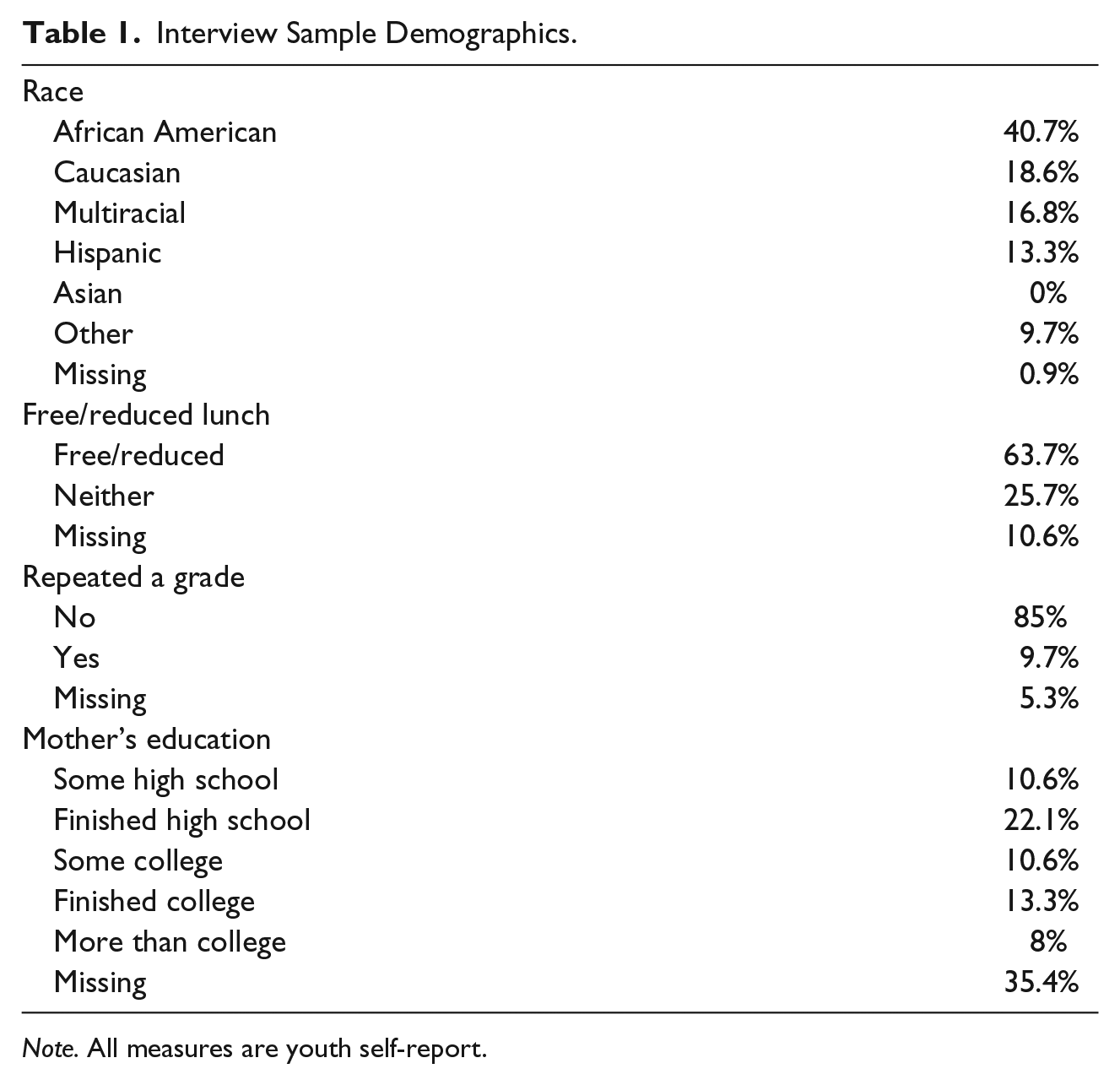
Note. All measures are youth self-report.
Data Collection
Interviews were conducted at the girls’ schools during lunch or after-school by trained, female researchers and were audio-recorded, transcribed, and uploaded into NVivo, a qualitative data analysis software program. Interviews were semi-structured and took anywhere from 18 to 45 minutes, with most lasting around 25 to 30 minutes. Girls were asked early in the interview about how, if at all, they had changed over the course of seventh grade and what they thought had led to those changes. Later in the interview, they were asked specifically whether they thought that being in YWLP had changed them in any way, whether or not they had indicated YWLP as a source of change in response to the earlier question. Reponses to both questions were included in the data used for this study in order to address potential response bias.
Analysis
Interview data were thematically coded using a combination of open and structured multi-level coding (Yin, 2011) for changes the girls felt they had made over the past year, whether or not they attributed that change to YWLP. We began with broad themes from Rhodes’ (2005) mentoring model: socioemotional development, cognitive development, and identity development. Research team members then individually read through a sample of the data for emergent themes. Through discussion in research team meetings and combining of conceptually similar themes, we divided reported changes into four more specified domains: Academics (changes related to school, grades, homework), Relational Development (changes related to one’s relationships with other people and social skills), Self-Regulation (changes regarding ability to control one’s actions and emotions), and Self-Understanding (changes related to self-awareness and how one views oneself, including future/possible selves). Whereas these domains share some conceptual content with Rhodes’s (2005) identified developmental domains (e.g., self-understanding is related to identification, relational development is related to socioemotional development), there were some distinctions within and overlaps between categories in our data that led us to specify the domains in this manner. We then content coded select samples of data using emergent micro codes and, through a process of comparing and discussing codes, we refined code definitions and combined and split codes until we had a final set of codes, including a number of micro codes within the four domains. These included respecting others, trust, and making friends within relational development; goal setting, behavior, and attitude within self-regulation, and; being yourself, becoming less shy, and new social roles in self-understanding (for complete list of codes and examples, see Table 2). Segments could be multiply coded, as some responses represent multiple domains of change (e.g., reporting on thinking before one speaks because you now realize what you say might hurt someone’s feelings would be coded as both self-regulation and relational development). The first four authors checked inter-coder agreement on a subset of the data. Once satisfactory agreement was reached 1 and there were no disagreements on the application of the codes, the data were divided among three of the authors who each coded a set of the data for the four domains and their micro codes as well as for whether or not the girl attributed the change to YWLP and, if so, if she talked about a specific aspect of the program (e.g., relationship with mentor, group experiences, curriculum). These aspects constitute the sociocultural activity of the program, and we refer to this activity herein as mechanisms of change, as we view them as the processes that promote development (per Rhodes, 2005 and Rogoff, 2003). Finally, the first four authors each took data from one of the four domains and read through the data corpus for that domain to conceptually cluster micro codes and identify common themes across the domain. The first author also read through every coded excerpt to confirm coding consistency.
Types and Mechanisms of Changes Reported by Protégés (Total n = 113).

Note. YWLP = Young Women Leaders Program.
Percentage in “total” column is calculated based on the total number of girls interviewed (n = 113).
Percentage in the “non-YWLP” and “YWLP” columns is calculated based on the total number of girls who mentioned that type of change (n varies and can be found in the “total” column for each row).
Percentages can exceed or be less than 100% because girls could attribute changes to more than one mechanism, including discussing reasons both unrelated and related to YWLP, or to no mechanism at all.
Percentage calculated based on the number of girls who reported that change and attributed it to YWLP. Percentages do not add up to 100% because girls could name more than one mechanism and some girls did not name any specific aspect of YWLP as the mechanism of change.
Results
Relational development and self-understanding were the changes most frequently reported by protégés, both generally (88% and 87% of protégés) and attributed to YWLP (85% and 77% of protégés who reported change in that domain). Within the academic domain, more girls attributed changes to their mentors (39%) than to the groups (20%). Within the relational domain, however, more girls attributed changes to their groups (52%) than to their mentors (28%). Protégés reported the group and mentors as about equally influential in the realms of self-regulation (27% group and 35% mentors) and self-understanding (39% for both group and mentors; see Table 2). Below we discuss the changes protégés reported making in each domain and how they saw their participation in YWLP as promoting those changes.
Academics
Thirty-six percent of protégés (n = 41) reported making changes in the academic domain as a result of YWLP. One of the most striking themes that emerged from the data was an increased sense of how life and career goals were dependent on doing well in school.
[YWLP] taught me that school’s important. They’re like don’t slack off in your classes and whatever . . . at least graduate, and then you wanna go to college, do stuff like that, so seeing [my mentor] in college, she’s really trying or whatever, so studying and all that stuff, so it changed pretty easy . . . [And did you think that way before?] Huh uh . . . I used to not do my homework at all . . . I brought up most of my grades.
The protégé suggests both the mentoring group and her mentor influenced her change, reporting that “they” taught her about the importance of school and referring to her mentor as a role model.
Girls reported caring more about grades and realizing how much grades matter for the future. They also acknowledged that the future may not be easy, a theme which related to self-understanding. Girls talked about YWLP preparing them to have realistic expectations for college and the future. Whereas girls reported caring about grades more, they also talked about recognizing they had to put in effort. For example, one girl said, “Well, I used to think that you could just fly by college and get the job you want. Now I know you have to put in effort and you have to do the work.” The girls seemed to most often report this awareness stemming from their relationship with their mentor or exposure to the other mentors in the group.
Protégés also reported academic changes from skills learned in YWLP and/or help from a mentor. They often referred to the YWLP curriculum activity, “Goal Setting,” in which girls work with their mentors to set incremental goals related to their long-term goals. Goal setting is also an example of self-regulation, discussed below. Here, goal setting was applied to academics.
. . . I really wanted to get a B in math and I was doing kind of bad in math so I set a goal to get a B in math and then I started studying more and I (laugh) got it. The next semester I got a B . . . I studied more. I participated more in class . . . I asked a lot of questions.
Other girls mentioned skills their mentors taught them (e.g., not waiting until the last minute to study, making flash cards). There were also examples of mentors helping their protégés to do homework, not procrastinate, and focus more on work. Finally, there were some girls who reported previously being too shy or uncomfortable to participate in class. These girls said that YWLP helped them be more active learners.
Relational Development
Seventy-five percent of protégés (n = 85) reported changes in the relational domain (e.g., relationships, social skills) as a result of YWLP. A major context of relational development was girls’ friendships. These changes appeared to involve both expanding their peer networks through making new friends as well as becoming closer to people they already knew.
. . . last year one of the girls in my group, me and her actually were kinda like fighting, but for no reason though really; and but actually we’re really good friends now . . . I guess that we figured out like . . . well, we didn’t really have anything [to] fight for and actually we’re really similar if you were to look at it . . . . and then some of my friends, we’ve gotten closer doing [YWLP].
Per Rogoff (Rogoff et al., 1995), participating in the social activity of YWLP necessitated interacting, and often deepening relationships, with diverse girls from both within and outside of participants’ existing friendship networks. This appeared to then prepare the girls to continue these types of relational activities beyond the mentoring group. When discussing growing closer to friends, girls described moving from just “saying hi” to “talking” and “hugging.” These actions appeared to be both a vehicle for forming a relationship (e.g., we started talking more) and a metaphor for the relationship itself (e.g., we hug now).
Respecting others was a key theme that emerged in the relational domain. This included interactional skills such as being polite as well as being nice and caring for others. These are skills that were supported by and needed to participate effectively in the YWLP group. Girls indicated how learning respect for others facilitated relationships. This included respecting differences that in the past may have prevented friendships from developing.
Usually if I meet somebody [who] don’t like stuff that I like, I wouldn’t talk to them. But now if I meet somebody, like I find a way to work with them . . . ’Cause talking to girls that act different from me, I realized that just because you don’t like this one thing that I do don’t mean we don’t have plenty of other stuff in common.
Respecting others also included not gossiping, one of the most common themes in relational development and a skill specifically addressed in the YWLP curriculum.
The [skill taught by YWLP] that I took to the most was the gossip one, because, um, I don’t like it when rumors get spread around about me, so I don’t think anybody does . . . So like I try to stop as many as possible that got around to me. [Can you give me an example?] Yeah . . . there was this rumor going around that [my friend] kissed this guy when she was dating a different guy and it wasn’t true. So every time it got around to me I would go that’s not true . . . and then . . . there was a rumor going around that [another friend] had, um, sexual intercourse with this guy when it wasn’t true at all . . . And so like every time I’d hear somebody talking about her, like I would butt in and stuff.
Within girls’ discussions of friendships and respecting others, there appeared to be a shift from being relationally passive (ignoring gossip or someone who needs help) to becoming relationally proactive (intervening, talking to, etc.), as in the quote above. This often appeared to be related to taking another person’s perspective. For example,
I used, when people would tell me stuff I would go off and tell everybody, and after being in [YWLP] I haven’t done it anymore . . . Because it could affect somebody that you know or that you are close to and they can get really upset.
Trust was an important theme in the relational domain. Girls reported growing to trust the mentors and peers in their YWLP group through the shared activity of the group. They also reported developing closer relationships with peers and adults outside the group as a result of trusting others more through YWLP, thereby transferring trust to interactions beyond the group.
I can talk more and express myself more with other people . . . at first me and my mom didn’t like to talk that much to each other. And after YWLP me and my mom shares more like secrets and stuff and um when I express myself um I can like, like be the person I want to be instead of like trying to be somebody else . . . because [YWLP] shows me how I can talk more and be safe at the same time . . . at first [my friends and I] didn’t trust each other but now since we’ve been in YWLP we can trust each other more often.
Thus, the activity of YWLP facilitated trust within the group and prepared the girls to be more trusting in other interactions and relationships as well, reflecting the overlap of processes identified by Rhodes (2005) and Rogoff and colleagues (1995).
Girls talked about how the group served as a safe space for talking with others, that people did not judge or spread what was said in group. Indeed, as noted earlier, 52% of the girls who attributed a relational change to YWLP attributed that change to the group (vs. 28% to their mentors). Yet girls also talked about the mentors as relational models, particularly for modeling how you can open up to adults, including parents. Thus, both the group and the one-on-one relationships served as important mechanisms for relational development although the group appeared to play a particularly salient role in this domain.
Self-Regulation
Two thirds of protégés (n = 75) reported making changes in their self-regulation as a result of YWLP. Self-regulation encompassed four major sub-categories: attitude, behavior, goal setting, and speech. Across these categories, a number of types of self-regulation were reported: recognizing what is a big issue and what is not, avoidance of situations that could cause problems, recognizing and prioritizing the needs of others, embodied regulation (e.g., stopping to take a breath when upset), improved academic focus and classroom strategies (e.g., do not talk; be nice to the teacher), and speech (both limiting what one says and speaking up/out). Categories often overlapped in girls’ descriptions of how YWLP helped them self-regulate.
Before . . . I would choose a wrong decision instead of the right decision, and I would always get, like, into arguments, and I was always arguing and stuff with my dad. Now, it seems that, like, [YWLP] groups happened, I don’t really, like, argue that much with my dad. Me and my dad get along now, and . . . when I was starting to argue and stuff . . . I know when to stop, and, like, I make my own decisions now, and I choose better friends.
Sometimes the change was one of degree, however, such as yelling rather than hitting.
Girls reported two valences of self-regulation: self-regulation to decrease negative behaviors and self-regulation to increase positive behaviors. Likewise, self-regulation involves a shift from “reaction” (to a situation) to “process” (to work through a situation). Problem solving, something addressed directly through the YWLP curriculum and activities, was often the mechanism for this shift from reacting to processing.
[Has being in YWLP changed the way you think about things or act?] Yeah, like [pause] it depends on like what you’re looking at. Like, if you’re looking at like how to handle stuff with friends and stuff, I mean, yeah, it’s changed me. Like, I don’t go straight to like [pause] like I’m mad at you because you did this, and this, and this . . . Like, I would go talk to them about it first. Then, I plan out what I’m gonna do. Then, like I go talk to them about it and then try to resolve it, but academics [pause] no.
Girls also talked about gaining perspective on their own actions. This came in part from getting the “long view” of things from their mentors and gaining an understanding that short-term gains often came with long-term consequences. Self-regulation also included awareness of how other people can influence one’s choices, such as choosing not to hang out with certain friends because of the choices those friends made.
The girls attributed changes in self-regulation about equally to their mentors (35%), the group (27%), and the curriculum (39%). Role-playing, a part of many YWLP activities, seemed to allow opportunities for trying out different self-regulatory actions. Furthermore, the newly identified role of “leader,” through their nomination to YWLP, appeared to sometimes provoke a desire to behave like a leader, which included regulating one’s reactions. This leader role will be discussed more in self-understanding. In addition, girls talked about goal setting, recognizing that other people were going through the same things, and getting feedback on their behaviors.
. . . YWLP helped me to relax and think about what’s going on and just walk away and stuff. [What about it helped you do that, do you think?] Just because some people were going through the same thing, so we talked about it for a while and then we moved on.
Finally, they talked about how the mentors communicated with them in a way they could hear.
[Tell me something you think you learned from your mentor] . . . Hmm. I learned how to calm myself down way more. ’Cause I really don’t do that when other people tell that. But when I looked at how she was saying it, I liked it, so, yeah. [Okay, so why was it different when your mentor told you it?] Because like she was, she said it like the right way. She was like, all right, yeah, if they’re going to do this, yes, of course you’re going to get mad. Yeah, you’re going to want to hit them. You know she made it like real life. They was just like, well, don’t hit them. You know things like that. I liked how she said it.
Self-regulation as described by the girls is social and interpersonal. In just over half (n = 42) of the interviews in which changes in self-regulation were mentioned, the self-regulation code overlapped with the relational development code. Self-regulation as described by these girls involves responding to the needs of others but is also reinforced by other girls and mentors in the program. At the same time, there are important personal components. The type of self-regulatory change that seems effective is not one that stems from oppression or control, but from the girl herself choosing how to act. Self-regulation appears to be self-motivating, as girls report that they began to do things without being told. Thus, self-regulation is linked to self-understanding.
Self-Understanding
Two thirds of protégés reported changes in their self-understanding as a result of YWLP, mentioning both their mentors (39%) and the groups (39%) as influential. Self-understanding included changes in self-concept, social roles, confidence, awareness, and expectations.
Becoming less shy was a pronounced theme in self-understanding. This is related to relational development; 63% (n = 62) of segments coded for self-understanding were also coded for relational development. Some girls reported being less shy with their mentors (and to a lesser extent with the YWLP group), as well as with peers and adults outside YWLP, suggesting that group participation led to individual development that transferred to activities and relationships beyond the group. Some girls reported that mutual sharing of personal information helped them be less shy with their mentor and seemed to allow them to grow more comfortable with and trust their mentor. When girls talked about becoming less shy in general, they often cited the group experience as a way to find their voice or practice speaking up in a safe environment.
. . . I was so shy. I wouldn’t raise my hand to answer a question that I knew the answer for. [So how are you different now?] I’m not shy no more. I’m a little bit, but yeah, I raise my hand. I talk to people I didn’t talk with before. [So what do you think made you change that?] The [YWLP] group helped me because they didn’t say anything. When I answer something, they just listen to me.
Other girls mentioned that getting to know more school peers through YWLP made them feel more comfortable speaking up and being social outside of group, including speaking up and answering questions in classes. This reflects Rogoff’s (2003; Rogoff et al., 1995) assertion that participating in one social activity can facilitate personal change that prepares youth for participation in other activities. Indeed, as one girl noted, “I mean, it gives me, like, courage to actually be in other groups.” Finally, a few girls mentioned their mentors’ encouragement, tips, or modeling as a way in which they became less shy with others.
Becoming less shy was often related to confidence. Some girls reported gains in confidence as a result of encouragement from mentors or their group as well as from observing their mentors. A consistent theme was learning to be yourself and not care what others think.
I can just say that YWLP changed my life kind of. [Pause] [My mentor] was talking about life changes, and she said just to be yourself and all. When I started out the year, I wasn’t being myself. I would hang out with the wrong people. I wasn’t the person I was last year . . . I think I changed a lot from the beginning of this year, when I started.
Girls talked about doing what they wanted, rather than following friends who may be doing things that they do not want to do, often attributing changes to advice from mentors or others in the group. This connects to perspective taking and self-regulation, discussed above, but more explicitly brings in self-awareness, as it relates to pressures they might experience from others.
Descriptions of changing behavior to do what they “wanna do” was frequently linked to changing social roles. Often, changing social roles referred specifically to becoming a “leader.”
Well, usually kids would tell me to do this or that, do something bad and I would listen to them. But since I was in YWLP, they told me not to listen to what everybody else said. Not to be a follower but be a leader . . . Being the leader and not a follower, is telling me to be—how to be a woman and not, say like a child.
Several girls defined being a leader as thinking for themselves and not blindly following others. A few spoke about qualities embodied by leaders that they felt they had gained, such as being a better communicator, being nicer, being mature, and standing up for oneself. This seemed to primarily occur in the context of helping peers problem-solve or standing up to peers.
Finally, some girls reported that being in YWLP helped them think about possible future selves. This was largely through exposure to new career options. Relatedly, a number of girls talked about how YWLP helped them see the steps necessary to having a career that they wanted (e.g., getting better grades, working hard). This reflects some of the themes discussed in the academics section but links more directly to girls’ images of who they want to be in the future.
Discussion
Our results suggest that, per Rhodes (2002, 2005) model of mentoring, a mentoring group can serve as a context in which relational processes that support individual development are fostered. Participation in the activities and multi-level (e.g., mentor-protégé, protégé-protégé) interpersonal interactions in the groups may promote individual development that girls transfer to contexts outside the group (Rogoff, 2003; Rogoff et al., 1995). The prevalence of reported changes in relational development, self-regulation, and self-understanding, and the less frequent mention of academic changes, differs from quantitative studies of YWLP (Deutsch, et al, 2012; Henneberger, Lawrence, & Deutsch, 2013) as well as from prior studies that have found the effects of mentoring on psychosocial outcomes to be smaller than academics (DuBois et al., 2002). Yet they reflect work on group mentoring suggesting the group format may better address social issues, particularly those with peers (Herrera et al., 2007). They further support models of youth development positing that participation in sociocultural activity fosters individual development (Rogoff, 2003) through both direct and relationally mediated pathways (Rhodes, 2005).
Academics
Academic change was the least frequently mentioned type of change. It is possible that although earlier quantitative studies revealed academic effects, these are not the most salient changes for middle school girls. Given their developmental stage, issues such as friendships, self-esteem, and behavioral and emotional self-control may be more prominent in their daily lives, and therefore more likely to be mentioned in interviews.
That mentors were the most frequently mentioned mechanism of change for academics supports prior research on mentor influence (Grossman, Chan, Schwartz, & Rhodes, 2012; Herrera, Grossman, Kauh, & McMaken, 2011). Rhodes et al. (2006) have enumerated ways in which involvement with a mentor may promote academic improvement. Protégés may be exposed to new or more frequent opportunities for learning and intellectual engagement. This may be particularly salient in programs such as YWLP where mentors are college students. Mentors are also in a position to provide scaffolding for their protégés, both supporting and challenging them intellectually. Finally, mentors may indirectly affect academic outcomes by promoting positive attitudes toward school, or offer more direct assistance with schoolwork or other academic issues. All of these processes were reported by the protégés in this study as important mechanisms of their academic changes.
Relational Development
Changes in the middle school girls’ relational development, including outcomes such as forming new friendships, improving social skills, and learning to trust people more, were the most frequently mentioned type of change. Relational changes were the type of change most likely to be attributed to the girls’ mentoring groups, highlighting how participation in group activity can promote intrapersonal change (Rogoff et al., 1995). This mirrors findings on outcomes for emerging adult mentors at another YWLP site, in which the mentors reported changes in relational areas (McGill et al., 2015). It also reflects findings from a study of “mentor families,” a format very similar to that of YWLP, in which protégés were reported to increase social competence through the group activities (Weiler et al., 2014). In our findings, relational development frequently co-occurred with other types of change, perhaps reflecting the importance of relationships to adolescent girls (Gilligan, 1982). Our findings expand the literature linking group mentoring and the development of social skills (e.g., Herrera et al., 2002). They also reflect prior research in which middle school girls reported changes in their interpersonal skills as a result of participation in a leadership program (Conner & Strobel, 2007).
It appears that the group contributed to relational changes through a variety of mechanisms, including direct feedback and role modeling. Through participating in group activities, girls reported being able to “try out” strategies for responding to relational issues, especially those related to peers, and get feedback to see how peers and mentors would respond to similar situations. Trust was a major theme in these narratives of relational development, serving as both an outcome and a mechanism of change. This suggests that the inclusion of a group component in youth mentoring programs may provide a broader context than just one-on-one mentoring for the developmental mechanisms of change articulated by Rhodes (2002, 2005). Per both Rhodes (2005) and Rogoff (2003), girls in YWLP were able to develop mutuality, trust, and empathy with peers and mentors within the mentoring groups, which they reported led to improvements in other peer and parental relationships. This also supports Kuperminc and Thomason’s (2013) proposal that connectedness and cohesiveness are key in group programs, suggesting these factors may promote relational growth for protégés.
Self-Regulation
Self-regulation emerged as an unexpected outcome of YWLP. Changes in self-regulation included learning to control speech, behaviors, and attitudes as well as setting goals. Girls talked about factors such as coming to recognize what is and is not a “big deal,” thinking before speaking or acting, taking the perspective of others, and slowing down their emotional reactions to events. Despite being an important aspect of youth development, self-regulation has not been a major focus of mentoring research. Yet a prior study of “mentor families” also found self-regulation as an area of change for participating protégés (Weiler et al., 2014). Although that study did not look at program components in relation to outcomes, the researchers did find that mentors and protégés both reported that girls grew in a variety of ways, including self-regulation, through both active participation with others in the group (per Rogoff et al., 1995) and through viewing the mentors as role models (per Rhodes, 2005). In addition, one school-based mentoring program reported positive impacts on self-regulated learning for seventh graders (Nunez, Rosario, Vallejo, & Gonzalez-Pienda, 2013). In that program, as in YWLP, the mentors are guided by a structured curriculum; such structure may help facilitate mentors’ focus on this area. Indeed, this was the only area for which girls talked equally about all three components of the program, mentors, groups, and the curriculum, as contributing to change.
Both one-on-one and group mentoring may offer mechanisms for growth in self-regulation. For example, girls reported benefiting from getting feedback from their peers and mentors about how their behavior might make other people feel, feedback that could help girls change the way they think about and react to stimuli in their environment. This was especially true in terms of how they reacted to other people (peers and adults). They were able to rehearse behaviors or reactions in the group and their mentors could model specific skills.
Self-Understanding
Finally, this study underscores changes in self-understanding as a mentoring outcome. Changes in self-awareness ranged from becoming less shy, to considering new possible future selves, to taking on new social roles. This is an outcome that is difficult to capture quantitatively as it is not experienced in the same way across people. Yet it may be an important domain on which mentoring programs for early adolescents should intentionally focus. Both the group and the one-on-one mentoring components were reported as influencing the girls’ self-understanding. Opportunities to identify with adults and to explore their identities with peers and mentors may be particularly useful for youth in this stage of development. The theme of seeing oneself as a leader and feeling supported to “take my own road” is related to prior findings on how adolescents’ self-conceptions change when they are given the opportunity to serve as role models to younger youth at after-school programs (Deutsch, 2008). It also reflects findings on how the informal roles that youth take on in youth programs can foster a sense of responsibility in youth (Wood et al., 2009). Finally, “becoming less shy” was also a major theme of growth in the previously discussed study of “mentor families” (Weiler et al., 2014), suggesting that the mentoring group may provide a “safe space” for youth who need support in building both one-on-one mentor and peer relationships.
Implications and Future Directions
This study provides a number of implications for practice and future research. First, the addition of a group component to traditional one-on-one mentoring may be particularly well suited for the developmental needs of adolescents. Participating in the groups may allow youth to develop skills that they can transfer to other relationships (per Rhodes, 2005) and other relational activities (per Rogoff, 2003) beyond the program. Given the context of middle school and adolescents’ developmental needs (e.g., salience of peers, gossiping; Eccles et al., 1993; Gardner & Steinberg, 2005; Gilligan, 1982), combining group and one-on-one mentoring may be a good fit. Per Rogoff (2003; Rogoff et al., 1995), through participating in the sociocultural activity of the group adolescents may develop in ways that both engage them further in the program and allow them to transfer their skills to new contexts. Importantly, YWLP includes both group and one-on-one time, which may counteract potential risks of college-age mentors and large group formats reported in prior research (Bayer et al., 2015).
Second, peers may be an important resource for group mentoring programs. The presence of peers may promote caretaking and trust, aspects of group functioning that are important (Deutsch, Wiggins, Henneberger, & Lawrence, 2013). Trust was both a salient outcome and mechanism of change for girls, particularly with their peers. Furthermore, peers may provide both modeling and feedback around emotional responses and affective regulation. An important topic for future research is to examine the social processes that promote youth change while minimizing negative peer contagion (Dishion & Tipsord, 2011) and maximizing positive peer influence (e.g., Barry & Wentzel, 2006). As Kuperminc and Thomason (2013) point out, there are multiple types of interactions that occur within group mentoring; youth have the potential to learn from both direct interactions and observations of other mentors’ and peers’ interactions. Given the importance of both individual- and group-level relationships in adolescence, a program that combines these two relational contexts may provide optimal opportunities for youth to learn and explore both types of relational skills and, perhaps, to even test out skills from one domain in the other.
Third, a curriculum may be important for helping provide mentoring groups with needed structure and scaffolding. The combination of role-playing and skill building provided by the YWLP curriculum appeared to provide important support for girls in working through relational issues and developing self-regulation. The YWLP curriculum specifically incorporates cognitive and behavioral techniques such as skill-building activities related to reducing emotional reactivity, setting and achieving goals, and problem solving (Lawrence et al., 2011). Many of the group activities support the girls’ use of techniques found in cognitive-behavioral therapy interventions, such as “modeling, building cognitive coping skills . . . rehearsing appropriate behavior, [and] affective education” (Sukhodolsky, Kassinove, & Gorman, 2004, p. 249). It may be useful for programs to include structured activities to address social and self-regulation skills and self-understanding, but to do so within a context that prioritizes relationships.
Finally, the findings point to the importance of using mixed methods to study program outcomes. Our findings suggest that qualitative evaluations may provide a unique perspective on the nuances of relational outcomes for mentored youth. Based on the types of changes reported by girls in this study, measures that capture protégés’ feelings of trust in relationships, friendship networks, and attitudes toward other people’s feelings and experiences (e.g., respect) may be more appropriate for assessing the types of social changes that early adolescents experience from mentoring. Quantitative measures of outcomes may miss some domains of change. Adding qualitative assessments may help uncover new areas for measurement. Qualitative methods may also capture nuanced changes within heterogeneous groups of youth, where individualized needs are being met in different ways through program participation (Rogoff et al., 1995).
Limitations
We studied a single, girls-only program in one community, limiting generalizability. We rely on self-report of change immediately following the program, so social desirability may have influenced responses. Yet, before being asked about YWLP, 31 girls (27%) spontaneously mentioned YWLP when asked about how they had changed during seventh grade. Many girls gave concrete examples of how they had changed, providing specific examples of behaviors and interactions. Furthermore, we were interested in what girls themselves perceived as the benefits of the program (Wood et al., 2009). Yet follow-up studies of longitudinal outcomes are needed. Although protégés in YWLP come from diverse backgrounds, we do not examine differential experiences of girls from different ethnic or cultural backgrounds. While that is an important topic, and individualized experiences and development is an important aspect of our theoretical models, specific analysis by racial, ethnic, or SES differences is beyond the scope of this article. We also do not know whether or how these findings would generalize to boys’ programs, although given increasing evidence on the importance of friendships to boys (e.g., Way, 2011), we believe that the findings may be relevant for both boys and girls. A final limitation is the lack of a calculated effect size for the changes the girls reported. It may be that while a majority reported changes as a result of YWLP, these changes would not be perceived by others as resulting in behavior that was significantly different from pre-mentoring behavior.
Conclusion
Girls in this study reported making changes in academics, relational development, self-regulation, and self-understanding as a result of participating in YWLP, a combined group and one-on-one mentoring program. The findings support other research on group mentoring reporting that group programs have a greater influence on peer relations and social outcomes than one-on-one mentoring (Herrera et al., 2002; Weiler et al., 2014). Given that YWLP includes a group component, in which girls interact with multiple mentors and peers, it is not surprising that social and relational skills were a major area of change. Whereas one-on-one mentoring is theorized to operate in part through improvements in relationships with parents and peers (Rhodes, 2002; Rhodes et al., 2006), it may be that the activity of participating in the multiple types of relationships in YWLP allows youth to develop skills that are transferable to other relational settings (Rhodes, 2005; Rogoff et al., 1995). Alternatively, improvements in and feedback from peer relationships may be a more salient mechanism of change in group mentoring. It should be noted that many of the changes girls reported in self-regulation and self-awareness (e.g., thinking before speaking, controlling one’s behavior, becoming less shy), were discussed in the realm of peer relations. Peer relations are extremely important to early adolescents (Gardner & Steinberg, 2005). Programs that draw on and promote the strengths of those relationships in the context of relationships with older mentors may be developmentally well suited for early adolescents. Indeed, as theorized by others (Kuperminc & Thomason, 2013), such an approach may draw on the potential strengths of group interventions and peer mentoring while minimizing the potential risks through the presence of multiple adult mentors. These findings also underscore the added value that focusing on protégés’ perceptions of their change as a function of mentoring and the mechanisms they believe promote these changes can contribute to our understanding of mentoring outcomes and processes more generally.
Footnotes
Acknowledgements
We would also like to thank Chanel Rutland, Lashay Newman, and Rakinya Raveendran who assisted with initial coding of the data.
Authors’ Note
The opinions expressed are those of the authors and do not represent views of the U.S. Department of Education or any other funding agency.
Declaration of Conflicting Interests
The author(s) declared no potential conflicts of interest with respect to the research, authorship, and/or publication of this article.
Funding
The author(s) disclosed receipt of the following financial support for the research, authorship, and/or publication of this article: The authors would like to thank the William T. Grant Foundation (GF11922), the U.S. Department of Education Office of Safe and Drug-Free Schools (Q184B070479), the Institute of Education Sciences, U.S. Department of Education (R305B090002 to the University of Virginia), and Youth-Nex: The University of Virginia Center to Promote Effective Youth Development, which is supported by a grant from Phillip Morris USA, an Altria Company, for their support of this research.