



Abstract
In a mixed-design narrative study, we explore how adolescent boys and girls represent experiences of anger and how their narrations are linked to self-esteem and anxiety. Polish teens from three nonurban public schools (N = 101, 55% female, Mage = 15.5) wrote narrative accounts of their typical anger experience. We use a thematic analysis framework to analyze the patterns in these narratives. Boys and girls told stories within school, family, and relationship contexts. However, boys provided more stories that focused on the theme of everyday incidental instances of anger, whereas girls provided more stories focused on the theme of negative inner experiences. In-depth analysis resulted in the emergence of two complex narrative patterns: Anger as Outburst and Anger as Burden. Anger as Outburst described heated anger related to difficulties in self-control and aggression and was more characteristic of boys. Anger as Burden contained stories of prolonged anger related to negative self-evaluation and was more characteristic of girls. Anger as Burden was also related to higher anxiety and lower self-esteem. We conclude that in the given cultural context, adolescents lack positive narratives to frame their anger adaptively.
There is an idiom Polish girls are likely to have heard when openly expressing their anger in a school or a family setting: “Don’t be angry; anger detracts from beauty.” Traditionally, this phrase is only directed at women or girls and is likely aimed at discouraging women from expressing the “unfeminine” emotion of anger. As a straightforward invalidation of emotional experience, this phrase belongs to a repertoire of linguistic ways of devaluing female anger. Derogatory and stereotyping elements are abound in many languages and exist for both genders, especially against people who break gender norms (e.g., Moss-Racusin, Phelan, & Rudman, 2010; Pascoe, 2011). In the present study, we explore how adolescent boys and girls represent their anger experiences in a narrative form and how those representations are linked to (quantitatively assessed) self-esteem and anxiety. It is in emotion narratives where gender, individual experience, self-understanding, and culture interact in a complex way (Averill, 1983; Bruner, 1991). We track this interplay to identify narrative patterns and their link to the everyday functioning of young people.
The cultural narratives found in society and in mass media stereotype women as more emotional than men with respect to every emotion except anger (Shields, 2013). Through the history of Western societies, anger was connected to the male gender role. It was viewed as appropriate for those who held power in society, such as rulers or heroes (Averill, 1983; Potegal & Novaco, 2010). For example, the first verses of Homer’s Iliad praise “Achilles’ rage.” At the same time, anger was seen as less appropriate in those without power, such as women and slaves (Potegal & Novaco, 2010). Cultural descriptions of female anger portray it as dangerous and disruptive to social order (Morrissey, 2003). Women were historically encouraged to suppress anger in order to fit into subordinate roles and meet standards of feminine ideals (Potegal & Novaco, 2010). This type of cultural imagery persists until today and is found in popular narratives, such as in mainstream cinema (Starzyńska & Budziszewska, 2018).
The psychological literature corresponded at times with such popular representations and endorsed the notion of anger as a specifically male emotion (Lerner, 1980; Sanford & Donovan, 1984). For example, drawing from clinical samples, Lerner (1980) noted that men are generally not comfortable with expressing emotions except anger. In her conception, women’s anger is inherently different from men’s because of different biological and cultural settings for both genders and a greater affiliation need in women (Lerner, 1980). In early conceptions, clinicians considered the consequences of gendered anger expression to be negative (Lerner, 1980; Sanford & Donovan, 1984). Lerner (1980) observed that typically women tend to be overly inhibited in expressing anger, whereas men are not inhibited enough, and recommended addressing this issue in psychotherapy.
In contrast to popular stereotypes and assertions made in classic clinical literature, quantitative researchers have rarely found differences in the self-reported experience of anger between adult men and women. In his classic book on anger and aggression, Averill (1983) stated that self-reported anger experiences do not differ between genders regarding their frequency, intensity, and duration. This early finding has since been supported by contemporary meta-analyses, which also did not find gender differences in self-reported anger (Archer, 2004). The analyses did show, however, persistent differences in direct physical aggression. Physical aggression was, independent of age and culture, more common in men. Indirect aggression was slightly more frequent in women, but only during childhood and adolescence (Archer, 2004; Card, Stucky, Sawalani, & Little, 2008).
Thus, self-report methodology has not supported the putative gender difference in anger experience. However, the notion that men experience anger more than women persists in dominant representations of masculinity and femininity and was even shown to influence scientific research (Shields, 2013). Feminist approaches explicitly aim to challenge this view. Instead of focusing on alleged gender differences in experienced emotions, feminist authors propose focusing on the ways society produces beliefs about gender and emotions (e.g., Brody, 2009; Kim, 2015; Morrissey, 2003). Those beliefs feature, for example, the conviction that women are more emotional generally, with the exception of anger, and that anger and aggression are signs of masculinity. Beliefs about emotions constitute part of gender ideologies, which help to uphold power structures of society (Brown, 1999; Galasiński, 2004; Shields, 2002). Prohibitions against women’s expressions of anger result from the subordinate role of women in many societies and at the same time help to reproduce those roles (Brown, 1999). Thus, female (Brown, 1999) and also male (Kimmel, 2017) anger can be seen as a political issue, as it influences power balance in society. Feminist approaches also highlight the inherent variability within gender groups. It is argued that the variability of anger experience and expression within gender is greater than between genders because people and their anger expressions differ also on other dimensions such as social class, race, sexual preferences, or age (Shields, 2013).
As different people may experience anger differently, there is a need for not only quantitative but also qualitative research to understand the complex interplay of gender, culture, identity, and social class in individual experiences of anger. We propose that analysis of self-narratives about anger offers a privileged research strategy for that purpose. The way people describe emotional experiences via narratives reflects their understanding of emotions and experiences. It also shows the existing gendered cultural schemata and scripts used to talk about emotions (Kitayama & Markus, 1994). It is in narratives that the individual and the societal levels meet (Bruner, 1991). People tell individual experiences using preexisting language and preexisting master narratives. These, in turn, make some experiences easier than others to be accepted as a part of the self (Bruner, 1991). Emotional narratives can also be used to challenge dominant patterns; they can be a form of resistance (Brown, 1991). Individuals can retell dominant master narratives about their emotional life, but they can also search for their own voice and create counternarratives that challenge the existing order.
It is important to see narratives as a separate and unique area of study. Narratives are a linguistic product and are not the same as traits or behaviors. They are accounts of events, but simultaneously they are interpretations of those events. People style, create, misremember, or even invent elements of their narratives, often unconsciously (Bruner, 1991). Narratives are also not the same as the actual phenomenological experience. The act of finding words and phrasing something that is so deeply felt and embodied as an emotion is already a form of distancing from the direct experience (Greenberg, & Pascual-Leone, 2006). Narratives are communications, ways to share experience with others. They also—and maybe most importantly—communicate people’s identities, including gender identities. Emotional narratives show others who we are, what is important to us, and what motivational goals we hold (McLean & Breen, 2009).
The period of adolescence offers a good opportunity for the observation of emotional narratives in an interplay with gender identity development. Teenage years are crucial in the development of identity, in probing new societal roles, and in redefining relationships within family and peers. With the onset of puberty and early adolescence, negative feelings of anger, hurt, and worry may arise more intensely than earlier in life (Colten & Gore, 1991). At the same time, teenagers are entering into new adult gender roles and learn gender-typed rules of emotional behavior (Pascoe, 2011). For example, in one study, adolescents and young adults from the United States were more likely to mention anger as a reaction to emotional problems than older participants (Birditt & Fingerman, 2003). In another study, young women rated their distress while angry as more severe than young men did (Birditt & Fingerman, 2003). Anger-regulating skills typically come with age and are learned over the entire life span, contributing to diminished anger and enhanced well-being in older adults as compared with young adults (Phillips, Henry, Hosie, & Milne, 2006). Therefore, in adolescence, both gender identity and emotional regulation are undergoing intense development, influencing each other at the same time (Brown & Gilligan, 1993).
There is one more reason for our interest in narrative patterns of anger. Researchers (Brody, 2009; Kim, 2015; Shields, 2002) and clinicians (Lerner, 1980; Sanford & Donovan, 1984) have hypothesized that some narrative patterns could be less adaptive than others. For example, instead of using the anger as a healthy signal and learning from it, women could suppress, mislabel, and censor their anger to fit within ideals of gentle femininity or to protect their relationships. Jack (1991) labeled this tendency self-silencing. She demonstrated that consequential denial of authentic feelings, including anger, led to depression in her female interviewees.
In their widely discussed paper, Brown and Gilligan (1993) showed that as girls enter adolescence, they gradually lose their voices to conform to societal norms and expectations. Teenage participants in this qualitative longitudinal study experienced a relational impasse at the time of adolescence: They began struggling to take their feelings and thoughts seriously. The authors suggest that in adolescence young women begin to feel silenced, not listened to, and as a result they silence themselves in relationships, including suppressing their anger.
The dominant anger narrative has not only led to girls having problems appropriately dealing with anger but has also negatively affected boys. On the verge of adolescence, especially in school and in peer settings, boys are expected to fit within a framework of dominant heterosexual masculinity (Pascoe, 2011). This type of masculinity ideology is characterized by a sense of entitlement, including open displays of anger and aggression, at the cost of silencing other emotions (Kim, 2015; Kimmel, 2017). Thus, emotional self-silencing affects also men, even if in a different form than women, and has been shown to contribute to depressive symptoms also in men (Kim, 2015).
Anger patterns were indeed often linked to psychopathology. In a Polish study, anger suppression was shown to be connected to depressive symptoms, especially if it leads to inconsistency between desired and actual behavior (Zajenkowska, Ulatowska, Prusik, & Budziszewska, 2017). Cox, Stabb, and Hulgus (2000) reported that in adolescence, girls are more prone to suppress anger, but the link to depression remained unclear in their study, calling for more research to be done in this area. Different emotional styles in coping with anger have consequences for adolescents’ psychological, mental, and physical health. Internalizing style (suppressing, avoiding anger), and to a smaller extent externalizing style (aggression, hostility), was, for example, connected to various negative health outcomes for both genders (Bridewell & Chang, 1997; Brody, 2009).
Based on their Polish studies, Maciantowicz and Zajenkowski (2018) proposed that neuroticism might be the personality base for high levels of trait anger, especially if combined with vulnerable self-esteem, narcissism, or grandiose narcissism. Research in the United States has also shown similar results: People with high levels of trait anger are characterized by high levels of anxiety, unstable self-esteem, defensiveness, and a sense of insecurity (Miller et al., 2010). Among adolescents, low self-esteem and anxiety are associated with poor anger regulation (e.g., Byrne, 2000; Silk, Steinberg, & Morris, 2003). Anxiety and low self-esteem could be both antecedents and consequences of poor anger coping.
To sum up, popular culture, clinical experiences, and qualitative and quantitative studies have produced a set of inconsistent predictions about the nature and extent of gender differences in anger. It has also been hypothesized that some anger patterns are nonadaptive and could lead to psychopathology via different gendered pathways. We propose that emotional self-narratives in a developmentally important period of adolescence could offer a useful window into all these processes. As reported in this article, we explored the potential gender differences in anger expression and interpretation by conducting a study of adolescents’ narratives about their typical anger experiences. Especially in the light of conflicting predictions from the literature, we collected the narratives in a standardized form that excludes the possibility that researchers’ expectations could influence participants’ behavior. Once these narratives were collected, we compared them inductively and systematically, with the purpose of identifying both gender similarities and differences in experiencing anger.
Current Research
The purpose of the present mixed qualitative and quantitative study (Tashakkori & Teddlie, 2010) was to look at how adolescents represent and define their anger and what are the most prevalent patterns in their narratives about anger. Furthermore, we analyzed how the anger stories of adolescent girls and boys were similar and different regarding their structure and content. The qualitative part of the study aimed to provide a rich, contextual description of anger narratives in the context of gender and adolescence. Because of the conflicting findings and their theoretical interpretations, we decided to pursue an inductive, bottom-up approach to narrative analysis. Narrative analysis allows taking several simple features of the text (e.g., time, text structure, plot, use of different types of verbs) into account (Murray, 2015). The inductive strategy was aimed at systematizing the analysis on a textual level, taking advantage of the standardized method we used to collect written narratives. Most studies up to date were based on interviews and used a theoretical interpretative framework. With a larger sample, more objective data collection strategy, but still a fully open question allowing participants to express what they wish in their own words, our study offers a chance to extend the previous knowledge using a different method.
In the quantitative part of the study, we establish the gender differences in using different narrative patterns (created in the qualitative part) and examine whether these narrative patterns are associated with self-esteem and anxiety levels in adolescents. Because the categories of the qualitative analysis were developed inductively from the qualitative data, both parts of the study have an exploratory character. However, we still had some cautious predictions as we expected that, should some negative and dysfunctional patterns in anger narratives be found, they will likely be connected to higher levels of anxiety and lower levels of self-esteem.
Method
Participants
As we were interested in studying gender differences in adolescents’ narratives about anger, we recruited a sample with similar gender proportions. In the study, 101 adolescents participated; 55% of them were girls (Mage = 15.5, SDage = 1.6). 1 To allow participants to identify their gender as they wished, this information was collected via a text entry box. None identified as nonbinary. We were interested in more general anger narrative patterns than those attainable from a convenience sample in a large city with high rates of education, such as where our university is located. We decided to gather data in one small-town community and one rural community in Eastern Poland, an economically distressed region of Poland. To obtain participants in mid- to late adolescence, we recruited from two public junior high schools (N = 78, age range = 14-17) and one public high school (N = 23, age range = 18-19). We recruited them from different schools to diversify the sampling. All were native Poles and were therefore representative of the ethnically homogeneous demographics of Poland.
Overview and Procedure
Research procedures followed ethical guidelines for psychological research and were approved by an ethics committee prior to conducting the study. The study took place during school hours, and participation was voluntary and anonymous. On prepared sheets, participants wrote personal narratives describing a recent event that angered them and provided their own definitions of anger. The time used for the writing task was about 30 to 40 minutes. After writing the narratives, participants completed two short scales and basic demographics.
Measures
Narrative writing task
Participants were asked to provide a recent personal story about their typical experience of anger. The task was elicited by a written prompt. In order to encourage participants to be more open about this stigmatized topic (anger experience), the prompt emphasized that emotions like anger are a common experience and that people differ in how they experience them. After completing the narrative-writing task, participants were asked to write their own definitions of anger. Those definitions were later analyzed together with the rest of the narrative data as they were often related to stories, shedding further light on participants’ views of their anger.
Questionnaires
To assess self-esteem, we used the 10-item Rosenberg’s Self-Esteem Scale (SES; Rosenberg, Schooler, & Schoenbach, 1989). To assess anxiety as a trait, we used the 20-item trait subscale of Spielberger’s State-Trait Anxiety Inventory (STAI X-2; Spielberger & Sydeman, 1994). The validity of both instruments has been established in adolescent samples. Responses to each of the scales are usually summed. On the SES scale, scores can range from 10 to 40 (high score = high self-esteem) and on the STAI X-2 can range from 20 to 80 (high score = high anxiety). There were no missing data on these scales. The internal consistency in our study was satisfactory for both the STAI-X2 (Cronbach’s α = .77) and the SES (α = .71).
Analytic Approach
We conducted a systematic narrative and thematic content analysis on the utterances, using the guidelines proposed by Clarke, Braun, and Hayfield (2015) and Murray (2015). In the inductive form of analysis, the coding process is characterized by the active role of the researcher and the circular process of category building (Clarke et al., 2015).
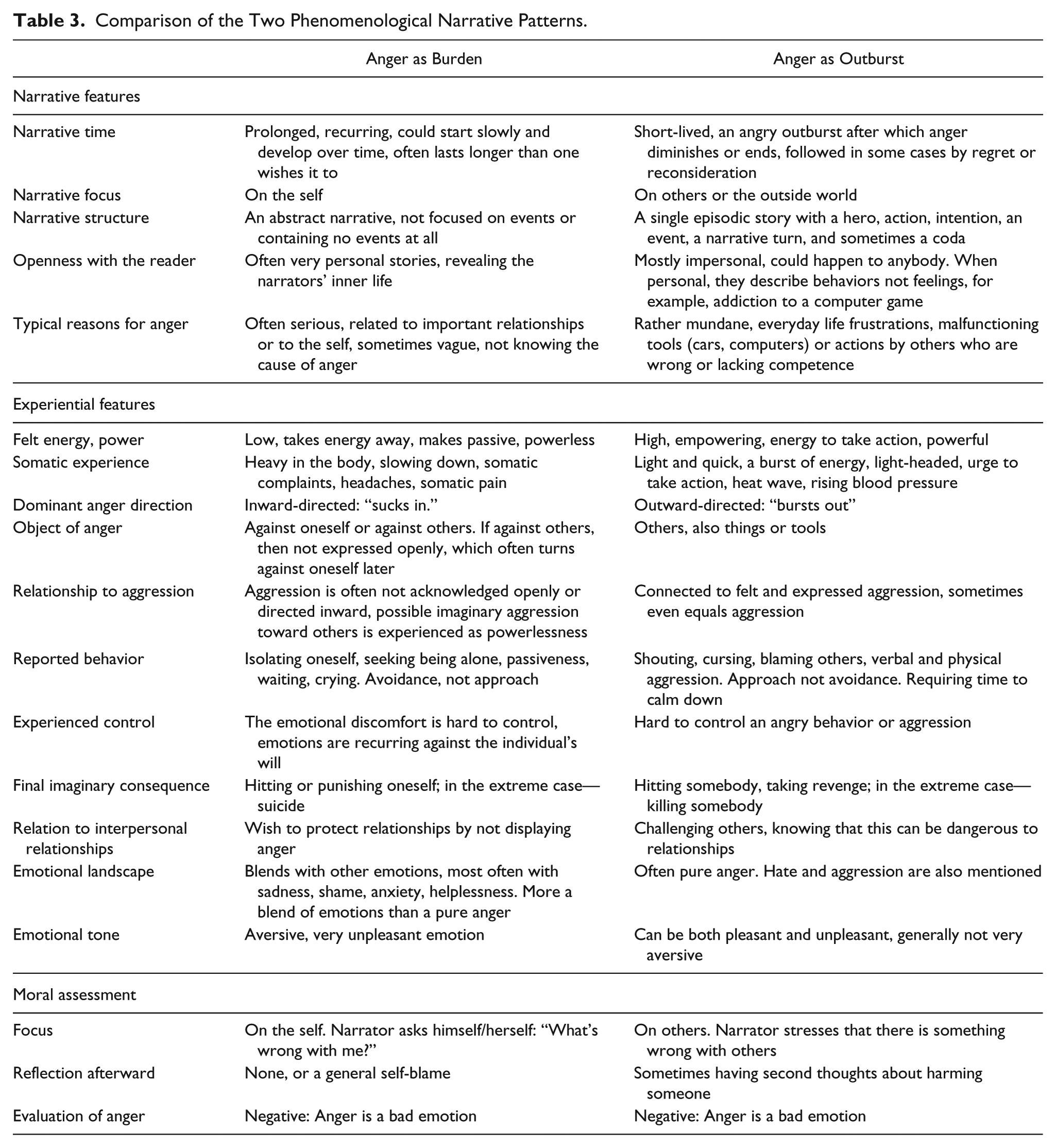
Specifically, after the familiarization phase, following a bottom-up approach to data analysis, the first author created a set of analytic categories developed from the narrative material. The following key features of narratives were taken into account during this process: situational and interpersonal context, named emotions, cognitions, bodily experience, temporal and phenomenological aspects of experience, psychological meaning-making, and text structure. A full list of narrative features examined can be found in Table 3. The resulting set consisted of six simple thematic categories and two complex phenomenological ones. The first six categories described the thematic range of adolescent anger narratives. The two phenomenological categories showed narrative patterns of how adolescents write about their experience of anger.
After all the final categories were created, two coders conducted an independent coding of all texts for their presence (1) or absence (0). The coders were not told the narrator’s gender, but in some cases they could not be blind to it as the Polish language is a grammatical gender language and gender information can be embedded in nouns, verbs, or other parts of speech (Budziszewska, Hansen, & Bilewicz, 2014; Stahlberg, Braun, Irmen, & Sczesny, 2007). The coding was needed to include earlier created categories as variables in the quantitative part of the study. The unit of analysis was the whole utterance, and categories could co-occur in the same story. This happened, for example, if the same narrator wrote in the same utterance about more than one event, happening in more than one thematic domain, or used more than one type of narrative pattern.
Reliability of Coding
The numeric coding was done by the first author and a second independent rater. The second rater was a research assistant and had not otherwise participated in the project, but was instructed about the coding categories and trained in using them. Interrater agreement scores were good for all categories (Cohen’s κ between .84 and .98). A few cases of divergent coding were resolved by discussion.
Results
Our analytic approach in this research included both qualitative and quantitative methods. When discussing quantitative results, we focus mainly on statistically significant differences, but we also note that large differences, that are likely due to a relatively small sample size, did not reach significance in this study, but may in future studies with larger sample sizes.
Themes in Anger Narratives
The first six analytic categories, which describe thematic domains of anger stories, are presented in Table 1. They answer the question, What is this story about? Four of them encompass important areas of adolescent life: family relationships, peer relationships, romantic relationships, and school. The two remaining categories are distinct. Stories in the Emotional Difficulties category do not provide much of the external context in the narrative but instead focus on the self and inner experiences. Teenagers describe emotional struggles and give insight into their internal dialogue and self-evaluation. Material in this category is in all instances negative and characterized by reports of severe distress. The last category, Singular Episodes, is also distinctive in that it is typically of short stories describing trivial anger instances of everyday life (e.g., anger after a bike broke or after losing in a computer game). Those stories were not related to any repeatable or serious problems, but instead described commonplace incidents that could happen to anybody. In this thematic category, the focus was mainly, and often exclusively, on the outside world that provoked the anger.
Thematic Categories in Adolescent Anger Narratives.
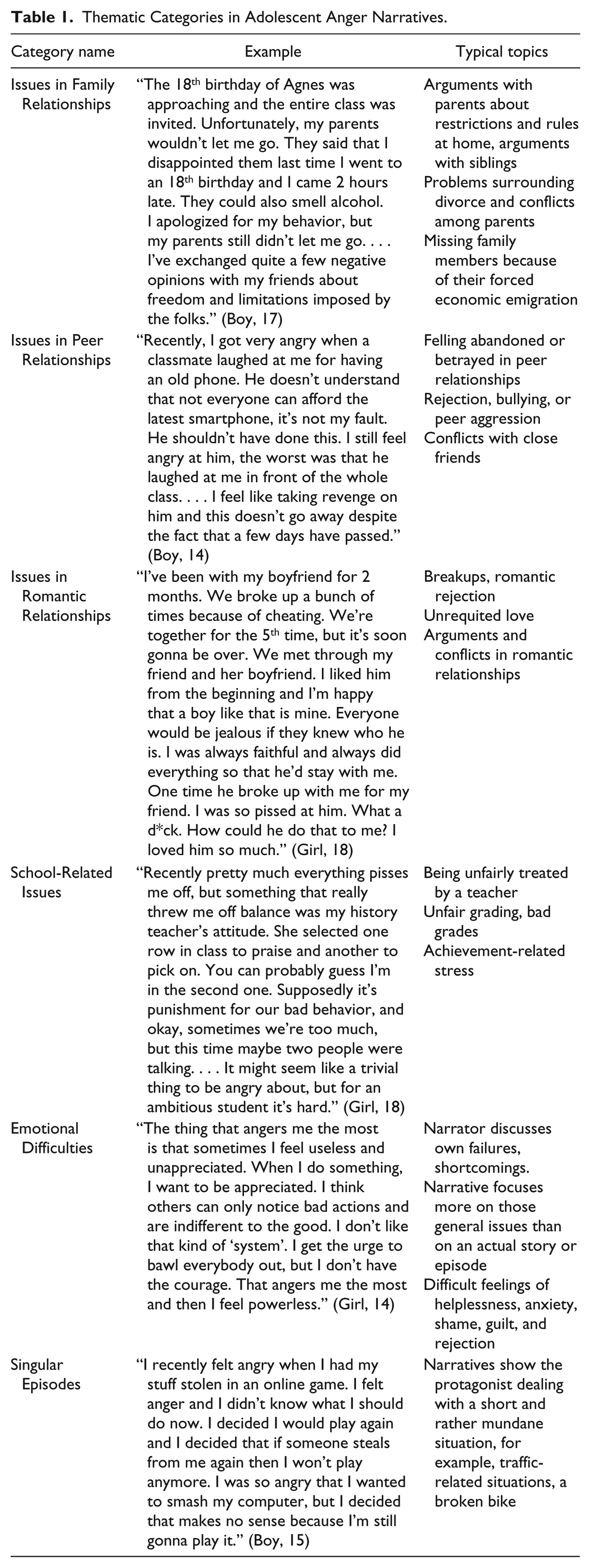
In terms of gender differences in the themes, girls wrote slightly more about relationships, especially romantic relationships, and also family relationships; boys wrote slightly more about school. The differences in boys’ and girls’ frequency of choosing family, peer, romantic, and school context for stories presenting their anger were not significant, but this could be partly due to a small number of stories in some of the categories (Table 2). However, two gender differences were not only significant but also large. First, boys wrote more stories that fell into the Singular Episodes category than did girls. This category comprises everyday stories that are more about a single, and often not serious, incident that provoked anger. They show anger as a singular, situational reaction to an incident in the external world. As much as 65% of boy’s narratives belonged to this category compared with only 7% of girl’s narratives. Second, girls wrote more stories that fell within the Emotional Difficulties category than did boys. These descriptions had a very different linguistic and thematic structure from the episodic ones: They were much more focused on the self and emotions rather than on the external events. Furthermore, their affective weight was different. Specifically, these stories portrayed severe problems and intense distress. Narratives in this category were also longer and more evaluative, abstract, and complex. As much as 44% of girls’ narratives belonged to this category, compared with only 6% of boys’ narratives.
Thematic Categories in Narratives Divided by Gender.
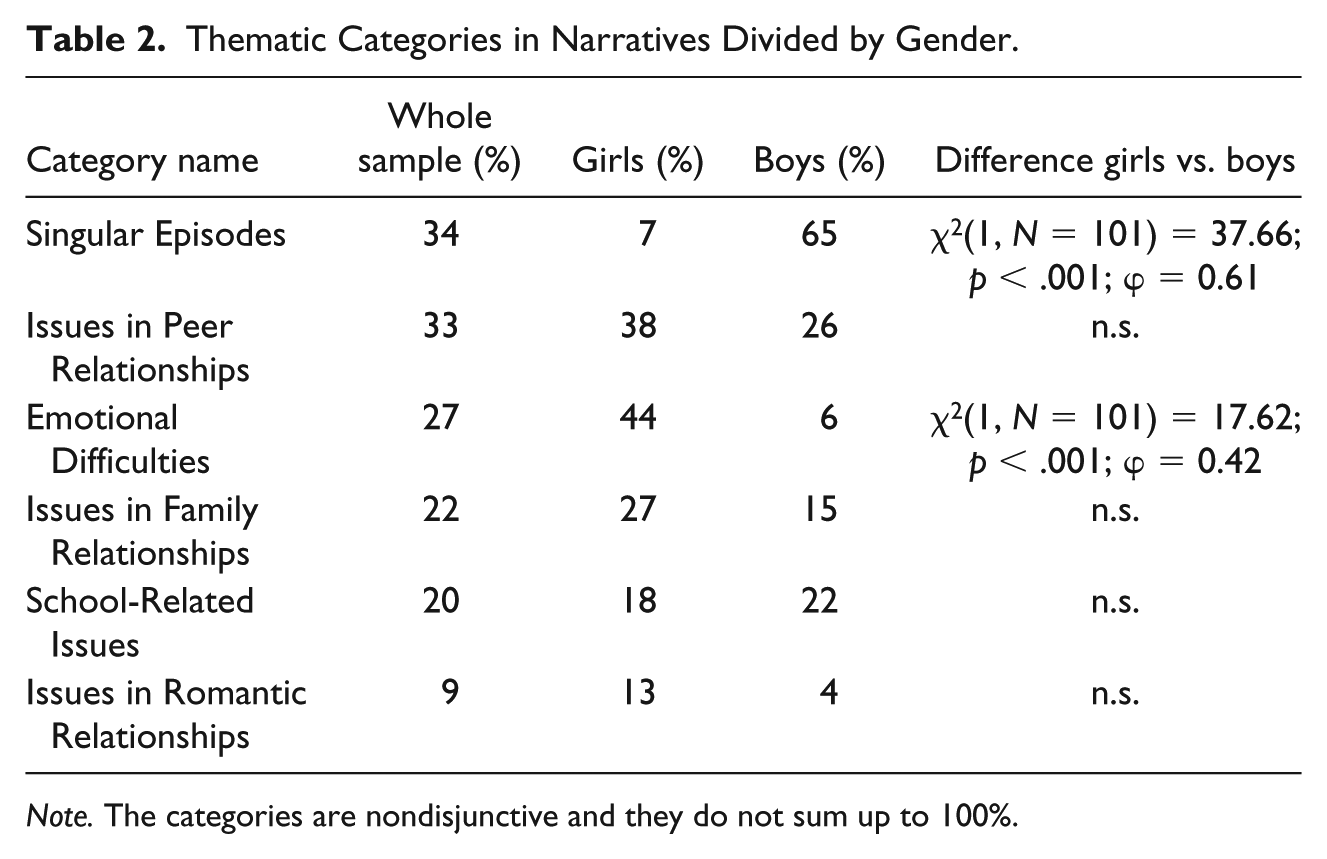
Note. The categories are nondisjunctive and they do not sum up to 100%.
Two Narrative Patterns of Anger Experience
The two phenomenological categories described here are the result of an in-depth analysis and were created inductively by clustering many co-occurring qualities of anger narratives. These categories are conceptually different from the previous six because they go beyond simple themes. They take multiple features of text such as narrative time, narrative focus, and experiential features (e.g., emotional tone; see Table 3) simultaneously into account. Distinguishing complex patterns was aimed to capture the global style of experiencing and narrating anger by the adolescents and the how aspect together with thematic content of the stories. The Anger as Burden pattern features inward-oriented prolonged anger narratives. The Anger as Outburst pattern features situational, outward-oriented anger narratives.
Comparison of the Two Phenomenological Narrative Patterns.
Anger as Burden
In this category, anger was characterized by one or more of the following features: First, the anger was directed or focused inward (e.g., being angry at someone, but not expressing it and instead ruminating internally about negative situations and self), contained self-blaming, and was connected to feelings of low self-esteem, weakness, powerlessness, and helplessness. Second, the anger experience was prolonged. This was the case whether it started slowly and developed over time, or began as an intense feeling that lasted longer than desired. Participants often ruminated about it. Moreover, it was seen as an aversive emotion and was accompanied by sadness, fear, hopelessness, or shame. It was reminiscent of a blend of emotions, rather than a “pure” anger emotion. The reader could sometimes have the feeling that the narrative was not actually about anger, but something else, like helplessness or anxiety. Described behaviors included isolating from others and crying. Somatic events included pain (e.g., headaches). Here, anger was experientially seen as a “heavy” and difficult emotion; the participant describing it had little energy, felt weak, or weighted down by anger. The causes of anger were vague, internal, and sometimes very general (life situation). The narrative focus was on the self and participants’ inner experiences.
The following narrative of an adolescent woman illustrates well the combination of internal and not clearly defined causes, focus on the self, negative evaluation of the self, recurrent character, blending of anger with other emotions, and a general feeling of powerlessness: In most people anger causes a release of feelings, memories, resentments, and negative experiences, flowing out beyond the limits of body and spirit, what undeniably brings relief and a sense of guilt. But with me it’s the opposite. Anger sucks everything into my inside, sensitizes me to every gesture and every glance, and, moreover, attacks every single one of my weak points. I bask in anger and close myself in, so that I can peacefully bombard myself with my own hopelessness, powerlessness, and memories . . . . Eventually, I realize I deserve the way I’m treated since I can’t change myself. . . . Anger consumes you piece by piece, and once it leaves you, you’re weak and all you can do is regret, but you can’t do anything more. (Girl, age 17)
Note that in this story, as is characteristic for those in the Anger as Burden category, the manifest text structure is argumentative. It is a description of enduring personal qualities and it contains abstract reasoning (e.g., comparing self with others). The author does not write about any particular event in the outside world. Anger here is not described as a spontaneous reaction to some frustrating events, but as a long-term and debilitating condition, something burdening, and difficult to resolve.
Experientially, Anger as Burden seems to be a difficult feeling and is associated with being powerless. Another young woman tells her anger story this way: Sometimes I feel a strange anger, but for no particular reason. I guess I’m angry at life, maybe that something didn’t go as planned, or that I’d like to be doing something different. Then I’m overwhelmed with anger and maybe sadness. I feel that I’m powerless, weak, and I can’t break myself out of this situation. (Girl, age 17)
This kind of anger is an experiential bodily quality of being heavy, passive, and powerless; it is rather an obstacle to successful actions than an energy to such: Anger is a feeling that’s not pleasant for anyone. We’re filled with sadness, don’t think rationally, and nothing goes our way. It’s a really difficult state. (Girl, age 18) Emotion that comes in moments of powerlessness, helplessness. When we act against ourselves. (Girl, age 18)
Narratives in this Anger as Burden category seldom described pure anger. Instead, anger co-occurred and blended with many different emotions. One adolescent girl describes her school struggle with a variety of emotional expressions to conclude that this is how her anger feels like: Every day when I came home from school and sat down to do homework I felt anger because despite all this time I spend on it, my grades aren’t good. I felt anger. I felt psychologically exhausted, tired, terrified. Fear that I won’t get into a good school. On top of that, this information overload at school, constant studying, wouldn’t let me rest. As if it’s not enough that I felt miserable because nothing went my way, on top of it I couldn’t get along with others, fights, crying, fear—my anger. (Girl, age 14)
Another girl describes anger as a prolonged state connected to self-doubt: When I end up doing something not how I intended, when it doesn’t go how I wanted, I get angry. Oftentimes I give up too quickly, I think I can’t or don’t know how to do it right. I’m not confident, I don’t know my true capacity or potential, my opinion of myself changes quickly. Oftentimes I think that no one needs me. I can’t deal with my feelings, and that’s when I’m angry at myself, but also at anyone who’s trying to help me. Because of my behavior or problems, I’m fighting with my family pretty much all the time, and that drives me even more mad. (Girl, age 14)
A sense of hopelessness can also accompany anger: Anger is a state, in which we’re fed up with everything and we think that life is pointless. (Girl, age 18)
Anger as Burden is associated with failure. Some adolescents stated that the core of anger is their own failure: Anger is a feeling that accompanies us in times of failure. (Girl, age 18) An emotion that causes irritation, you feel like nothing is going your way, things aren’t working out. (Girl, age 15)
Somatic problems and isolation seem to be consequences of this type of anger. A young woman angry at her boyfriend for letting her down describes expression of her anger as passive, expressed mostly alone in her room, in her thoughts, and in her body: But in that period when I was so angry at him, I would sit in my room and my head was seriously aching from all this. And sometimes I even wanted to cry. (Girl, age 18)
Another girl states, I’m never angry. Instead I cry a lot. (Girl, age 15)
Anger can be turned against oneself. Intense anger was even described as an emotion of hate toward oneself. One of the boys tells his anger story this way: Recently my class team and I again didn’t manage to win the soccer game on the school field. I was embarrassed that the other class would see I’m a klutz. I didn’t say much because I was sad and I wanted to practice, so I could improve and win the next game. But the next day we lost again. I was disappointed in myself, I hated myself. I felt really sad again. (Boy, age 15)
The final, symbolic consequence of this powerlessness, turned-inward anger, would be an act of self-aggression, as one of the adolescent girls describes: Anger isn’t good because then we get stupid thoughts. Sometimes anger even makes you think of death. (Girl, age 15)
Some adolescents who do not describe their anger with this level of emotional intensity still choose for their narrative situations of being angry with oneself rather than with others. This could be a more desirable or at least acceptable form of self-presentation for women, as only few of the boys in this sample told an instance of being angry at themselves.
Adolescent girls, but not boys, expressed also a concern over losing or endangering important interpersonal relationships as a result of expressing anger, and therefore wishing to suppress anger: I get angry when I get into conflicts with the people closest to me. It’s very hard for me. I try to maintain positive relations with everyone I care about, I want everyone to get along with me. (Girl, age 18) Anger is a bad trait. Through anger we can lose people who are important to us. (Girl, age 15)
Anger as Outburst
In the narratives belonging to our second overarching narrative category, Anger as Outburst, anger was immediately and openly directed toward an outside target, most often another person. Narrative focus was on a situation or on people perceived as flawed, mistaken, and deserving of blame. The focus was on the external world, not on the self. The behavioral expressions were often strong, outward-oriented, impulsive, accompanied by an outburst of energy (e.g., shouting, cursing others, blaming others), and/or physical aggression. The described actual behavior itself did not need to be actively aggressive for a story to be coded into this category; it could be an openly expressed mental wish for aggression, hurting the other, or taking revenge. The experiential and bodily felt quality of anger was hot, impulsive, connected to a rising energy level, light, quick, with an excess of strength, and like a tension striving for release. An important motif was having or lacking control over oneself during this kind of anger. The temporal duration was rather short, it began rapidly and diminished with time, and had an “explosive” quality that was intense, but short-lived. This category is well illustrated by the following narrative: (Teacher returns a quiz to a junior high school student.) I was sitting at my desk and I felt so pissed, like I was about to explode, if I could I would’ve thrown everything off my desk and torn up and burned the test. . . . That moment was the worst anger ever, I wanted to swear and leave the classroom. (Boy, age 14)
Characteristic of this category was the external focus of anger and its description (someone or something causing anger). The anger was accompanied with hostile intentions or actions. In this type of narratives, anger often merged with aggression or even equaled aggression: Anger is an aggression and being pissed at someone or something. (Boy, age 14) Anger is an aggression caused by different human behaviors (aggravation can often be severe). Only later do we realize what we should have done in a given situation. (Boy, age 14)
Also losing control was here a defining quality of anger: Anger is your blood pressure rising and you losing control. (Girl, age 15)
In narratives and definitions in this category, anger was labeled explicitly as something negative, a “bad” feeling, something connected to evil or hatred. In the current sample, none of the participants indicated a positive function of anger or evaluated it as an emotion that could also be positive: Anger is thinking about something bad, wanting to do the worst things. (Boy, age 15) Anger is a bad feeling that often leads to a disaster. (Girl, age 18) Anger is the accumulation of negative emotions, when we’re ruled by an unstoppable fury and desire to do evil. (Boy, age 14)
A small subset of the boys in the sample (but none of the girls) described moral reflection following their anger: It was not long ago, we were playing soccer, but this loser, I won’t mention him by name, couldn’t score on an empty goal. Any normal person would get pissed at him, but he had so many of these situations that I can’t even count them. Everyone laughed at him, and so did I, but this loser was on my team, so I felt anger, but not only. Now, that I think about it, he’s got crooked legs and probably doesn’t see too well. (Boy, age 15) One day when I was coming home from school I called my friend a Krusman [author’s note: regional neologism meaning redneck or hillbilly] and he got really mad. He wanted to fight me, but he was smaller, so he couldn’t beat me. Since then, we’re not friends anymore and he doesn’t talk to me. I met new friends, much bigger and nicer than him. But whenever I remember that event, to this day my blood pressure still goes up and I don’t wanna have a heart attack this young. I feel really bad about it, because I could have not offended that friend. Now I would certainly apologize to him and understand what he felt. I’m really sorry that I offended him like that. I hope that if I met him now, I’d definitely apologize and not act like I did. (Boy, age 16)
A final systematic comparison between the two experiential anger categories is presented in Table 3. This comparison and descriptions should be understood as conceptual ideal types (Kluge, 2000). Not all empirical narratives had to have all of those features simultaneously, but they co-occurred empirically and conceptually.
Gender Differences
We coded all the material for the presence (1) or absence (0) of the two above-mentioned narrative patterns. This way, we could quantitatively assess the gender differences, as well as their relationship to anxiety and self-esteem. Results for gender differences are presented in Table 4.
Gender Differences in the Frequency of the Two Narrative Patterns.
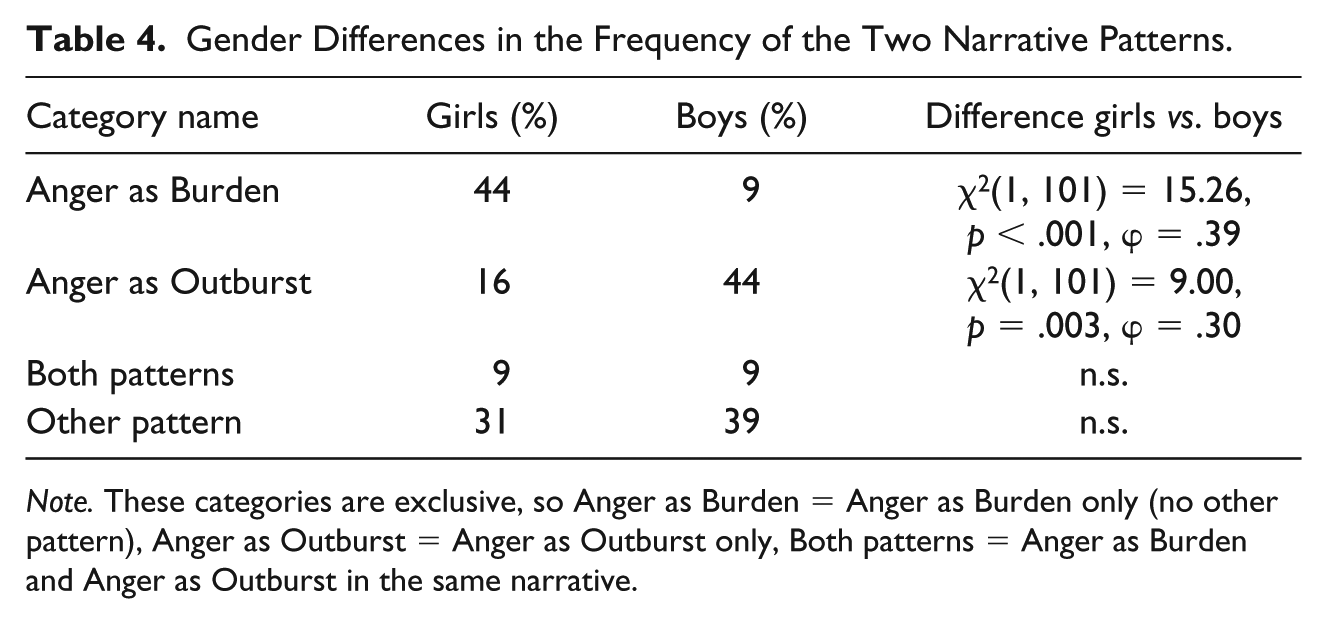
Note. These categories are exclusive, so Anger as Burden = Anger as Burden only (no other pattern), Anger as Outburst = Anger as Outburst only, Both patterns = Anger as Burden and Anger as Outburst in the same narrative.
Girls’ narratives belonged to the Anger as Burden category more than 4 times as often as did boys’ narratives (44% vs. 9%). By contrast, boys’ narratives belonged to the Anger as Outburst category 3 times more than did girls’ narratives (44% vs. 16%). Please note that the categories of Burden and Outburst represent two characteristic and negative patterns of anger, but not every story belonged to one of them. Around one third of the narratives in our sample featured none of those negative patterns, and there were no gender differences in this regard: Similarly many girls’ (31%) and boys’ (39%) narratives belonged to neither Anger nor Outburst category. The stories that were neither categorized as Burden nor Outburst were highly heterogeneous and tended to include more neutral stories. Moreover, the Burden and Outburst categories are based on anger narratives and not fixed personal traits or mutually excluding patterns of behavior. The two categories can co-occur even in one (usually longer) narrative. However, only a small number of stories were categorized as both Anger as Burden and Anger as Outburst, and girls were as likely (9%) as boys (9%) to produce these mixed-category narratives.
Anxiety and Self-esteem
We also examined the relationship between the narrative patterns and anxiety and self-esteem. As Table 4 shows, there were four possible pattern configurations: Anger as Burden, Anger as Outburst, both, or neither. As the “both” category had few occurrences, we did not include it in the analysis. We conducted a 2 (gender: male vs. female) × 3 (Anger as Burden vs. Anger as Outburst vs. none) between-subjects analyses of variance (ANOVAs) with anxiety and self-esteem separately (Figure 1). As there were only a few boys who wrote an Anger as Burden narrative and only a few girls who wrote an Anger as Outburst narrative, we could not reliably compare the effects split both for the type of narrative and for gender. Thus, we concentrated only on the main effects, but did not analyze interactions.
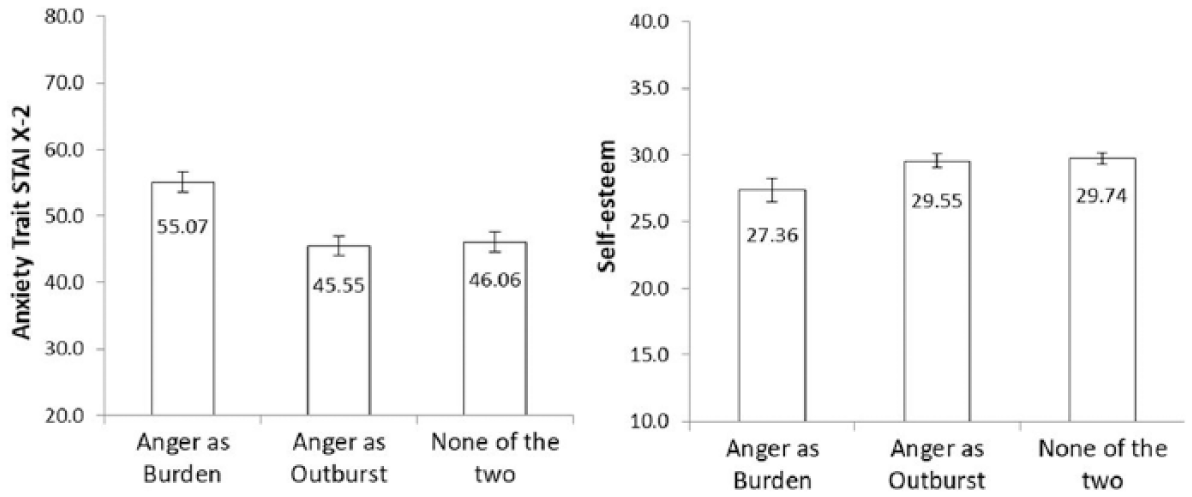
Mean anxiety as a trait (STAI X-2, left) and self-esteem (right) in each type of the anger narratives. Error bars represent standard errors of the mean.
Results showed significant differences in the trait anxiety levels measured with STAI X-2 between the types of narratives, F(2, 91) = 5.04, p = .009,
There was also a marginally significant effect of the type of narrative on the self-esteem, F(2, 91) = 2.76, p = .07,
Discussion
In the current research, Polish adolescents narrated different stories about their anger experiences. In terms of themes, both girls and boys told stories about family and peer relationships, school, and romantic love. However, boys almost exclusively told stories about single, incidental instances of anger, whereas girls almost exclusively told stories about emotional difficulties, including low self-esteem, sense of guilt, and powerlessness. In terms of deeper and more complex narrative patterns, boys more often wrote Anger as Outburst stories, whereas girls mainly wrote Anger as Burden stories.
Gender differences in anger narratives found in this study showed a very clear pattern. Boys and girls provided dramatically different anger narratives. Specifically, whereas the majority of girl’s stories represented Anger as Burden, the majority of boy’s accounts exemplified Anger as Outburst. Those dysfunctional patterns resemble an early form of what has been described as negative patterns of anger for adult women—self-silencing, guilt, excessive internalization (Jack, 1991; Kim, 2015)—and for adult men—aggression and excessive externalization (Kimmel, 2017).
A developmental lens can be used to shed light on these results. Research linking girls’ development to women’s psychology suggests adolescence as a time when girls gradually “lose their voice” and begin self-silencing (Brown & Gilligan, 1993; Cox et al., 2000). Furthermore, whereas anger suppression is related to the adoption of a traditional female gender role (Shields, 2002), open anger expression is linked to the traditional male gender role (Potegal & Novaco, 2010). In adolescence, with the onset of puberty, gender roles and gender expression undergo intense development. At the same time, cultural pressures put on adolescents to conform to dominant gender roles become stronger. Adolescents may lack sufficient experience, maturity, or resources to resist dominant patterns and build a more independent identity. Autonomy, less dependence on others, differentiation of own feelings and emotions, responsibility for oneself (including the skill of self-definition), understanding of how society works—those are all skills that are important for dealing with own anger, but they develop with age (Brown, 1991; Brown & Gilligan, 1993).
While not a focus of inquiry in this study, given the extensive literature on peer influences in gender development, influence of peers could also explain our results. Anger is connected to different prescriptive rules for men and women. These rules are dictating how to display it and even how to feel it (Thomas, 1993). The so-called display rules and feeling rules are learned from early years from parents and other family members (Brody, 2009). In adolescence, peer pressure reinforces this gender role socialization (Pascoe, 2011). Adolescents who behave in gender stereotype–concordant ways are more likely to be popular among peers and to succeed at school (Brody, 2009). In an in-depth qualitative inquiry based on conversations with adolescent boys, Oransky and Marecek (2009) reported that boys purposefully use emotional practices to enhance their peers’ masculinity, to act tough, and to discourage unwanted emotions such as sadness and vulnerability. Those who violate culturally held stereotypes of how and when emotions should be felt and expressed may be punished more in the adolescent peer context than adult contexts (Moss-Racusin et al., 2010).
The pronounced gender differences found in our study may also have been affected by the study context. Despite the rapid westernization of Poland following the fall of communism in the 1990s, which included an increased adoption of egalitarian norms generally in Polish society and feminism specifically, the spread of these ideologies was stronger in some regions than the others. Many areas of Poland may have been virtually unaffected by (and, in some cases, resistant to) changes in gender roles. The sample examined for this research was drawn from an area that is likely to have been relatively unchanged with regard to gender norms. In general, in Poland discrimination against women and sexism persist, and feminism is met with strong opposition from the conservative part of the society and from the Catholic Church. A study on a representative sample of Polish adolescents has shown that particularly boys show negative attitudes to feminism (Winiewski et al., 2016). In a recent European Commission (2018) report on stereotypes and equality between men and women, 77% of Poles believed that the most important role of a women is to take care of her home and family, as opposed to the European average of 44%, and 11% in Sweden. The sample in the present study comes from a relatively poor, nonurban area close to the eastern border of Poland. It offers a possibility to study gender development in a community that is homogeneous, traditional, and conservative.
Results from our study are in contrast to Brown’s (1999) studies on the politics of girls’ anger. Her interviewees, girls from working class, were often aware and critical of society and inequalities that contribute to their distress. This was not the case in our sample. Young women reacted to distress in their life by feeling overwhelmed and blaming themselves, not by being critical of the society.
Generally speaking, boys in our studies presented themselves as prone to angry outburst and aggression. They blamed others in anger situations and asserted themselves as in the right. This bears a resemblance to studies from the adult men in the United States on toxic masculinity (Kimmel, 2017; see also Kim, 2015). Based on in-depth conversations with Polish adult men, Galasiński (2004) proposes to balance this picture. He demonstrates that, given appropriate context, men can speak about a variety of emotion with the same depth and as articulately as women do. Galasiński (2004) proposes to understand men’s emotional expressivity as something deeply contextual and explains emotions within context and a conversation rather than seeing it only through a gender lens.
Results from our study on adolescents can also be compared with qualitative studies on adults’ anger. A worrying feature of both boys’ and girls’ narratives in the present study was the general lack of representations of positive, assertive, or justified anger. A core conviction in many therapeutic approaches, including Gestalt therapy or emotion-focused therapy, is that all emotions can be adaptive and can serve positive functions (Greenberg, & Pascual-Leone, 2006). The role of anger is, for example, to protect oneself against violations and injustice, to assert own rights, and also, as in the case of moral anger, to fight against injustice toward others (Greenberg, & Pascual-Leone, 2006). Adults anger narratives tend to include this positive side. For example, in a study on narratives of everyday anger told by adult women in Germany, Habermass (2011) highlights that anger is a self-conscious emotion, and the core of it is a sense of defending the moral order, including the sense of personal and societal justice. Similarly, Thomas (2003) found that, for adult middle-class men in the United States, themes of right versus wrong were important in narrating their anger. In contrast to that nuanced view of anger, the most worrying aspect of the present study is that adolescents narrated about anger as a purely negative and destructive emotion. In almost all narratives, anger was a “bad” feeling, either because it was understood as very close to or as equaling aggression, or because it was seen as burdensome.
Finally, the two narrative patterns found in the present study resemble, to some extent, the theoretical concept of anger-in and anger-out styles as conceptualized in popular measures of anger (Spielberger & Sydeman, 1994). There is surely some similarity between them, but the anger expression subscales of Spielberger’s STAXI (Spielberger & Sydeman, 1994) describe the self-rated tendency to express or suppress anger. By contrast, our analytic categories describe features of personal narratives and self-understanding and are much more complex. Future studies could explore the correspondence between narrative self-understanding and self-rated behavior in more detail.
Limitations and Future Directions
Similarities between narratives in our study and qualitative studies from other countries in the world (Brody, 2009; Thomas, 1993) show that some socializing patterns are common between different cultural contexts. Our results, however, are coming from a specific qualitative sample and should not be broadly generalized to other populations. More studies featuring a variety of cultural and socioeconomic contexts are needed. A comparison between individualistic and more collectivistic cultures, between urban and rural environments, and between older and newer generations could be a direction for future research.
The narratives in the current study were written, not spoken, and were written in response to an identical narrative prompt. This made them more comparable to each other, but also less naturalistic. Future studies could include other forms of data collection, especially interviews with adolescents. It would also be interesting to investigate relatively unstructured conversations between adolescents and same- and other-gender peers, or to adults, on the topic of anger experiences. It would be also useful to explore differences in anger narratives in early and late adolescence.
It was our plan for this study to compare narratives of personal experiences with a more abstract anger understanding. We asked participants to provide their own anger definitions, but writing personal narratives was a demanding, time-consuming task that worked as a prime. As a result, the definitions we finally obtained were usually short and often commented on previously written stories, for example, they provided a moral or a summary of the story. Therefore, personal narratives and personal definitions were analyzed together. Future research could explore the differences between abstract and personal narratives about anger using, for example, counterbalancing where one group of participants would write their personal story first and the other group a definition of anger first.
Practical Recommendations
Several practical recommendations result from the current research. It seems that regarding anger, at least in this Polish sample, both adolescent men and women have been poorly served by the gender and emotion socialization they have received. Socialization practices seem to have failed to provide (a) an understanding of the distinction (conceptually and practically) between anger and aggression, (b) strategies for constructive anger expression, and (c) an appreciation of the empowering potential of anger for asserting own rights and defending others. These elements should be a focus in emotional education.
In her early work on self-silencing, Jack (2003) argues that the lived experiences of women’s sadness include an unusual number of reports of prolonged anger. She argues that women too often use anger against themselves via self-silencing, what she calls “anger of despair.” However, women can also use anger for empowerment, which Jack terms “anger of hope.” Providing frames, examples, and narratives of positive anger should be one of the goals of emotional education directed toward adolescents. This is not to say that anger always has a positive side, but narrative approaches to psychotherapy propose that flexibility and diversity of possible narratives to choose from support emotional development (Greenberg, & Pascual-Leone, 2006). Providing young people with narratives that model more adaptive and diverse emotional coping would be helpful for their personal development. Literature, film, culture, school-based psychological education, and family conversations offer opportunities for this.
School-based programs teaching about emotions and strengthening social skills usually yield good results (Cohen, 2001). They should be included more often in educational curriculum in Poland (none of the schools that participated in this project had one) and also beyond school. Moreover, these programs should not only concentrate on preventing aggression, which is often the primary focus, but also on showing the positive aspect of anger and the potential intra- and interindividual diversity in experiencing it.
Footnotes
Acknowledgements
This research was supported by Polish public research funds awarded to M.B. We thank Ewelina Antosiewicz for her help in data collection, and the editor and two anonymous reviewers for their helpful comments on a previous version of this manuscript, as well as Nicholas Santascoy and Jan Babiuch for linguistic help.
Declaration of Conflicting Interests
The author(s) declared no potential conflicts of interest with respect to the research, authorship, and/or publication of this article.
Funding
The author(s) received no financial support for the research, authorship, and/or publication of this article.
