



Abstract
Puerto Rican students are a growing population in U.S. mainland schools, yet few recent studies have focused on the school contextual and identity-based experiences of Puerto Rican youth. Using stage-environment fit and LatCrit theories, this qualitative study examined seven Puerto Rican adolescent students’ perspectives on domains of school context, along with prominent aspects of how they defined “being Puerto Rican,” in two urban middle schools. Based on qualitative analyses of student interview and focus groups, findings revealed that students’ experiences with teachers, ethnic-racial climate, and sense of belonging were fundamentally contradictory, where examples of purported “equal treatment” were tempered by racialized experiences marked by stereotypes and the suppression of Spanish, especially among male students. However, dimensions of identity-based resiliency such as ethnic pride, sense of familismo with other Puerto Rican students, and being bilingual emerged as sources of strength. We discuss school-based possibilities for the delivery of critically conscious support and ethnic affirmation for students during this critical developmental period, based on our exploratory findings.
Puerto Ricans are the second largest subgroup of the growing Latinx population in the United States, and the number of stateside Puerto Ricans now exceeds the number of Puerto Ricans on the island (Wang & Rayer, 2018). Although this growth points to the need to prioritize high quality educational experiences for Puerto Rican students in mainland United States’ schools, making good on this initiative has proven to be elusive. Despite the fact that Puerto Ricans hold United States citizenship and have, in fact, resided on the mainland for over 100 years, they are among the most undereducated ethnic groups in the United States with regard to formal schooling (Irizarry & Antrop-González, 2013; Meléndez & Vargas-Ramos, 2017). Within the context of their colonial status, deficit-oriented, highly racialized perceptions or stereotypes of Puerto Ricans in the larger society (see Cornelius, 2009) may exert a particular psychological toll on youth that can dampen successful outcomes across ecological contexts.
From a developmental perspective, the impact of stereotypes and perceptions of discrimination become particularly activated during the early adolescent period (Niwa et al., 2014; Szalacha et al., 2003). Applied to students’ experiences in educational settings, ethnically-based stereotypes may be reproduced within the school context. Graham (2006, 2018) defines school context as the school’s sociocultural milieu, which includes broad factors such as social and behavioral norms and expectations, as well as the overall climate of the school. Salient aspects of school context such as ethnic-racial diversity, teacher support, sense of belonging, and an affirming academic, social, and ethnic-racial 1 climate have been shown to be powerful indices of fit and engagement for students (Graham, 2018). Studies with Puerto Rican students in high school suggest that negative experiences with dimensions of school context, such as low teacher expectations, outright discrimination, and lack of cultural affirmation have contributed to their feelings of marginalization and resultant disengagement from school (Irizarry & Antrop-González, 2007; Nieto, 2004).
Taking all of the abovementioned factors into account, Puerto Rican students may be particularly vulnerable to internalized racism and feelings of exclusion that can undermine their success and engagement in middle school. In addition, we contend ethnic-racial identity (ERI) constructions are also relevant as Puerto Rican students navigate their school settings in early adolescence. Umaña-Taylor et al. (2014) define ERI as a multidimensional construct that reflects an individuals’ beliefs and attitudes about their ethnic-racial group membership. Placed in context, while the persistence of systemic racism in the United States increases the salience of ERI for all youth (Umaña-Taylor et al., 2018), its pernicious impact on the health and psyche of Black and Brown youth, in particular, cannot be underscored (Trent et al., 2019).
Very few recent studies have focused on the school contextual and identity-based experiences of Puerto Rican students during this critical developmental period. Using stage-environment fit theory (Eccles & Midgley, 1989) and Latina/o critical race theory (LatCrit; Davila & Aviles, 2010) as theoretical frameworks, this exploratory study seeks to address this gap by examining the perspectives of Puerto Rican middle school students on key dimensions of their school context and climate. We focus in particular on the content and ways that ERI is present in their narratives, using qualitative interview and focus group methods with students in two urban middle schools.
Stage-Environment Fit Theory
Stage-environment fit theory, developed by Eccles and Midgley (1989), posits that the unique transitional nature of early adolescence is a function of the developing person and the settings in which they are embedded. The early adolescent period is a time of rapid change across developmental domains and emerging capabilities; essentially a time of both enormous potential and vulnerability during an important period of brain development (Gutman & Eccles, 2007; Steinberg, 2015). Adolescents whose contexts do not provide a fit for their changing needs (e.g., autonomy, affirmation) are more likely to experience difficulties (e.g., lack of motivation), while those who receive more optimal support experience more positive outcomes. As such, contextual factors within the school may well exert a powerful influence on students’ overall engagement and success, particularly during the middle school years, when early adolescents are experiencing newfound responsibilities and deepening relationships with peers and adults (Roeser & Eccles, 1998).
As a historically marginalized group in U.S. schools (see Irizarry & Antrop-González, 2013; Nieto, 2004), Puerto Rican students may experience particular sociocultural and identity-based challenges of school fit that are worthy of attention during this developmental period. To adequately address this, we buttress our developmental framework with a critical race perspective, whereby the salience of race and ethnicity in mediating students’ experiences and perceptions is made explicit, allowing for an examination of “the ways in which educational structures, processes, and discourse support and promote racial subordination” (Solórzano & Delgado Bernal, 2001, pp. 314, 315).
Latina/o Critical Race Theory (LatCrit)
From the perspective of critical race theory (CRT), school settings cannot be considered outside the broader historical and political context of education in the United States, whereby racism and whiteness have been both institutionalized and normalized (Davila & Aviles, 2010; Kohli et al., 2017). With its roots in legal scholarship and advocacy (see Crenshaw et al., 1995), CRT is an evolving paradigm and framework that examines the relationship between racism and power in historical context, thereby exposing its hegemonic and unchallenged role in the maintenance of inequitable societal institutions, practices, and ideologies (Solórzano & Yosso, 2002). In particular, CRT aims to deconstruct the ideology of color-blindness, whereby the salience of race as a factor in the lives of individuals is minimized, in favor of presumably “equal” opportunities (Bonilla Silva, 2018). Applied to schools, CRT frameworks in education seek to deconstruct claims of color-blindness, objectivity, and meritocracy that often characterize the school experiences of students of color (Ladson-Billings, 2004).
As an extension to CRT, Latina/o critical theory (LatCrit) moves beyond the primarily White/Black binary discussion regarding racial oppression, and examines intersectional experiences unique to the Latinx community such as those associated with language, immigration status, ethnicity, culture, and phenotype (Bernal, 2002). In fact, as noted by Solórzano and Yosso (2002), what differentiates LatCrit from CRT is its focus on the complex identities involved with the term “Latino.” As an exemplar case, Puerto Ricans are a multiracial people, based on the fact that a significant number of Puerto Rican individuals share ancestry derived from multiple racial groups, and are represented in socially differentiated categories on U.S. Census data (Meléndez & Vargas-Ramos, 2017). Such ethnic-racial complexity may be challenging for Puerto Rican students to navigate in middle school, especially in White, Eurocentric school contexts. Prominent examples of Eurocentrism in schools is reflected in curricular content, English language hegemony, discourse and interactional styles, and lack of ethnic-racial representation among educators (Gay, 2018; Kohli et al., 2017)
The Salience of School Context and ERI for Puerto Rican Youth
Although empirical studies have documented the salience of school context to the experiences and relative success of Latinx youth (see Brown & Tam, 2019; Espinoza & Juvonen, 2011; Morales-Chicas & Graham, 2016; Roche & Kuperminc, 2012), fewer studies have examined the experiences and engagement of Puerto Rican adolescents, in particular. Garrett et al. (2010) conducted a case study of three high-achieving Puerto Rican male high school students to identify factors associated with their school success. They found that at the school level, caring, sincere, and relational teacher and staff support were instrumental.
In terms of Puerto Rican students’ perceptions of school belonging, Rolón-Dow (2007) and Sokolowski et al. (2010) found that middle and high school students, respectively, frequently experienced limited opportunities to be meaningfully engaged in rigorous academic activities. Equally important, they often suffered from what they perceived as both cultural and linguistic hostility, in that their cultural identity was marginalized by an overwhelmingly colonial, Eurocentric perspective that neglected their Puerto Rican history. Put another way, their school experiences lacked the opportunities for what Nieto (2004) describes as “cultural commuting,” or the varied ways that teachers center cultural identity in the classroom, especially for students who do not inhabit the dominant cultural space. Indeed, schools are sites where dimensions of identity are constructed, legitimized, or rejected (Rolón-Dow, 2007), an issue to which we now turn.
Decades ago, Erikson (1968) theorized the development of identity across domains (e.g., occupational and personal) as the premier psychosocial task of the adolescent period. Recently, in light of the increasing ethnic-racial diversity of U.S. youth (Hussar & Bailey, 2017), identity scholars have increasingly focused on ERI as a critical aspect of normative development among youth in the United States (Santos & Umaña-Taylor, 2015). ERI has been shown to have both protective and promotive effects on psychosocial, health, and academic outcomes (e.g., Neblett et al., 2012; Rivas-Drake et al., 2014), and to buffer the negative effects of structural inequalities in schools (see Umaña-Taylor, 2016).
Nieto (2004) argued that the development of cultural identity is highly salient to Puerto Rican youth, and in fact, that students are “bombarded with the message that they need to change their identity” (p. 48) from their earliest school years. In a qualitative study with continental U.S. and island-born middle and high school Puerto Rican students, Ariza (2010) found that while students had a strong desire to maintain their Puerto Rican identity, they also felt the need to “Americanize,” in order to be academically and professionally successful on the mainland. Phenotypic variability marked by colorism, or skin tone discrimination that favors lightness, has also been examined in the literature as a social factor that influences both intra and inter-group differences between Puerto Ricans and other groups with regard to employment opportunities and health (see Visser, 2019), as well as in educational settings (see Fergus, 2009). These findings illustrate some of the unique ways that Puerto Rican identity is still complicated by what Johnson (2000) called a “crisis of citizenship” (p. 111); that is, birthright citizenship that is marked by limited membership rights on the island, and perpetual outsider status on the mainland. From the perspective of LatCrit, we argue that this has important implications for Puerto Rican youths’ identity constructions, as well as their feelings of school belonging, even as early as middle school.
To date, the research literature documenting the school experiences of Puerto Rican students is limited in several important ways. First, the majority of studies have neglected the middle school period, where strategic interventions can improve school fit and take hold during a period of rapid growth (Gutman & Eccles, 2007). Second, as noted by Morales-Chicas and Graham (2016), stage-environment fit studies have rarely addressed “mismatches” within the school environment that might be challenging for ethnic-racial minority youth—Puerto Rican or otherwise. LatCrit provides an ideal framework for naming such challenges.
The Present Study and Research Questions
To address the above-mentioned gaps in the literature, we sought to examine the school contextual experiences and identity-based cognitions of a small sample of Puerto Rican students in the present study. All students were part of a larger qualitative study (N = 17) on the impact of school climate and ethnic-racial context on early adolescents’ experiences in middle school. Two exploratory research questions guided our present analyses: (1) in what ways are key aspects of the school context in middle school present in the narratives of Puerto Rican students? (2) what are prominent dimensions of students’ descriptions of “being Puerto Rican?” Employing LatCrit theory to our interpretive process allowed for a more nuanced investigation of the unique experiences of Puerto Rican students given both historic (e.g., colonization) and current sociocultural (e.g., language hegemony) circumstances, as well as the salience of phenotypic characteristics to their identity-based experiences and interactions with others (Fergus, 2009; Irizarry & Antrop-González, 2007).
Method
School Sites and Participants
Two schools (School A and School B) located in two metropolitan cities in Massachusetts served as sites for data collection for the larger study, and were chosen because the first author had prior collaborations and relationships with both schools that permitted respectful access. As well, each middle school was engaged in work around improving school climate and student engagement. Each served students in grades 6 to 8, and contained relatively similar percentages of students who were characterized as economically disadvantaged 2 (60.4% in School A and 64.2% in School B). Although Latinx students were the largest ethnic group in both schools (63.7% in School A and 44.2% in School B), their demographic characteristics differed in two significant ways. Specifically, although White students were a minority in both schools, this was especially the case in School A (.5% of the student population). As well, the total school enrollment at School A (432 students) was considerably smaller in size than School B (791 students). Data regarding teachers’ racial backgrounds at each school was not available, but both school principals confirmed that it was their understanding that the majority of teachers were White.
Student recruitment in the larger study
Time was spent at both school sites prior to study implementation that would allow some initial familiarity between the first author and students, in preparation for student interviews. In School A, the first author was invited to visit several classrooms to talk with students about the project. Study access to students in School B was through multiple visits to a large afterschool program for early adolescent boys of color (enrolled at School B) that was implemented by a local, university-based institute. 3 An informational flyer and written informed consent forms (in both English and Spanish) were sent to the homes of all children identified as Latinx in both schools. In both sites, all students who returned signed consent forms (including their own signed consent) were allowed to participate in the study, and no students who did so were excluded. The complete protocol and research design for the study received approval from a college institutional review board.
Participants in the present study
The present investigation utilizes interview data from all Puerto Rican students who were part of the larger study. Specifically, seven students (five self-identified as boys, two as girls) comprise the analytic sample. Demographic information is provided in Table 1. Students were aged 12 to 15, with 13 being the modal age. All students self-identified as Puerto Rican; five were born on the island, and all but one had been living on the U.S. mainland for the majority of their childhood years (M = 8.5). Based on their own assessments, four students were fully bilingual in Spanish and English; one student described himself as somewhat fluent in Spanish (i.e., speaking Spanish with some family members) and two described themselves as speaking little to no Spanish. To provide examples of our participants’ unique voices, we also provide their abbreviated responses to the first question in the interview protocol (i.e., “what should I know about this school?”) in Table 1.
Demographic Characteristics and Initial School Reflections of Study Participants.
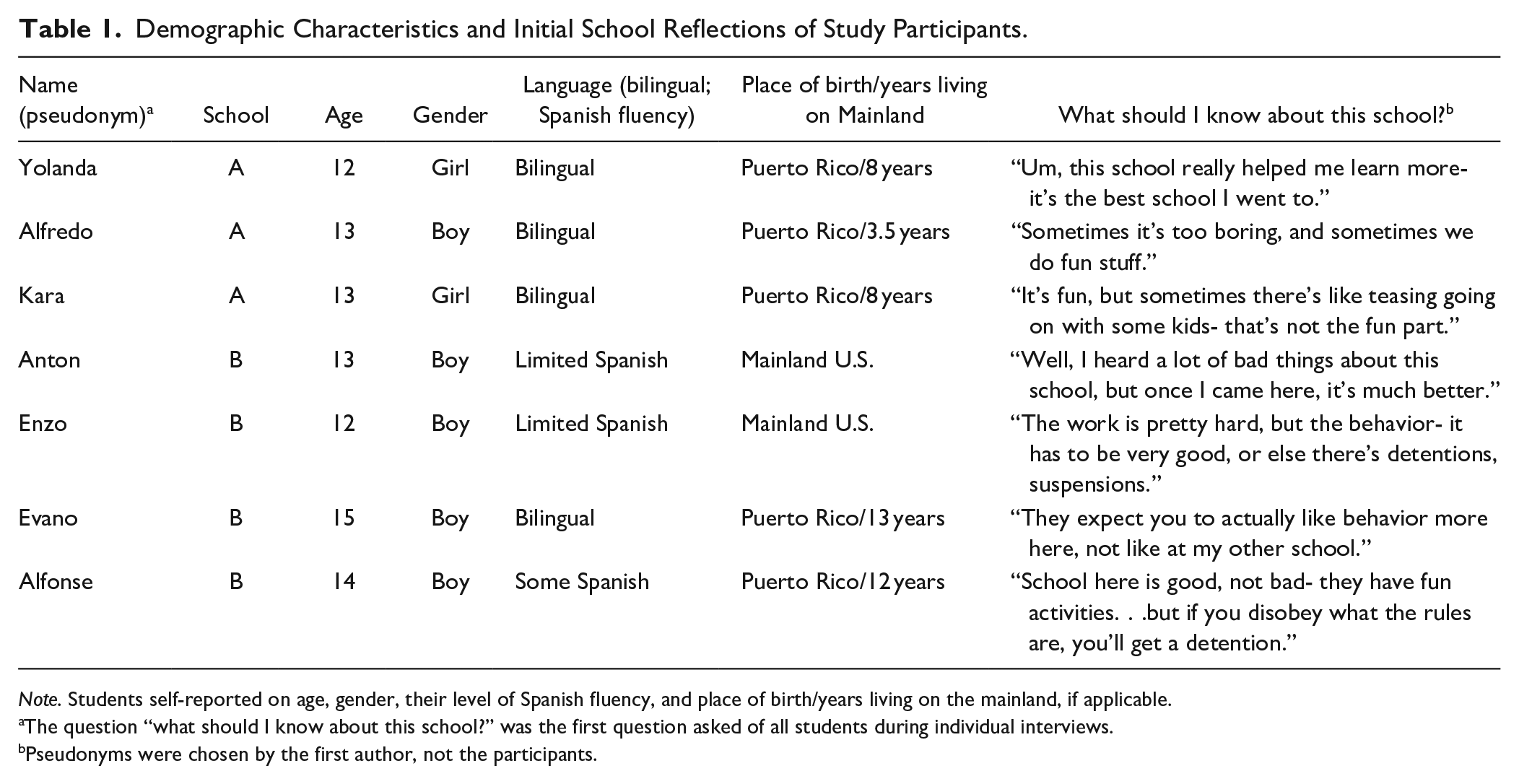
Note. Students self-reported on age, gender, their level of Spanish fluency, and place of birth/years living on the mainland, if applicable.
The question “what should I know about this school?” was the first question asked of all students during individual interviews.
Pseudonyms were chosen by the first author, not the participants.
Procedures
Interviews
All seven students participated in individual, one-on-one interviews with the first author during the school year. Interviews were semi-structured and addressed salient dimensions of school context in middle school: academic, social, and ethnic-racial climate (“do you think ethnicity-race are things kids think about at school?”), sense of belonging and importance (e.g., “do you feel like you belong and are an important part of this school?”), teacher support (“do teachers care about students/how do they show this?”), and ERI (e.g., “is being Puerto Rican important at this school?”). Students were also asked to discuss their overall opinions about the school, and their perspectives on the factors that promoted their academic success.
Interviews were conducted face-to-face, in a designated quiet space in each respective school building either during or after the school day. Although students had the opportunity to indicate (on the signed consent form) whether they desired to be interviewed in Spanish, all students in the present analytic sample chose to participate in the interviews in English. Interviews lasted between 22 and 58 minutes, with the average interview time 32 minutes, resulting in a total of 112 pages of text. All interviews were audio-recorded with verbal consent at the time of interview, and transcribed verbatim.
Focus groups
Four of the seven students in the present study sample participated in one focus group conversation, also with the first author (e.g., two students in School A and two students in School B, respectively). School absences precluded the ability for all students who had been interviewed to participate, and both sites discouraged rescheduling. Despite the small focus group size at each site, it was reasoned that the interactive dynamic (Morgan, 2010) that emerges in focus group or shared conversation would still be a meaningful way to further examine students’ views and provide some validation of individual interview responses, especially regarding the salience of Puerto Rican identity (e.g., “does being Puerto Rican mean anything to you/what does it mean?”). The first author facilitated both focus groups; sessions were 18 and 51 minutes, respectively, resulting in 113 pages of text. All sessions were audio-recorded after verbal assent and transcribed verbatim, with the exception of individual names, which were replaced in the transcripts with conventions (e.g., S1 and S2) as appropriate, so as to identify individual speakers and shifts in the conversation.
Researcher Reflexivity and Positionality
Reflexivity is the process of reflecting critically on the self in research; it demands that we analyze interpretations of truth and issues of power in the research process, and on the meaning we make and present from the experience (Charmaz, 2014). During the data collection process, the first author continually reflected on the obvious differences in power and positionality between herself, a White, female, academic researcher, and the early adolescent student participants, especially with regard to their candor and/or positive response bias. Notwithstanding the challenges that this dynamic might have brought forth, interactions with students were greatly mediated by components of self that were salient to the first author. First, her many years of teaching in both public school and at a small teaching college scaffolded a strong ability to develop rapport with students. Second, her own personal and professional work and study on ethnic-racial identity and whiteness, CRT, and critical multiculturalism strengthened the ability to facilitate the interviews with sensitivity, humility, and a deep sense of respect.
Detailed notes were written after each respective interview and focus group session to serve as a mechanism for examining potential biases and assumptions. Reflexivity was further enhanced during the collaborative coding process. Specifically, the second author identifies as Latina, and did not participate in the data collection. As such, she was able to read the transcripts with a fresh perspective, yet also contribute important sensitizing concepts, or initial ideas or directions to pursue in the coding process that are informed by prior research (Charmaz, 2014). For example, “conditional belonging” was one suggested concept that became prominent in our analyses. As well, she was able to offer key insights on the ways that aspects of students’ narratives (such as conditional belonging) were reflected in her own past experiences in public school, as a Latina student.
Overview of Coding and Analysis
We employed several qualitative approaches to code individual and focus group data, using both deductive and inductive methods. To address the first research question regarding students’ perceptions of the school context, coding began with individual interviews. We selected three prominent dimensions of school context that have been associated with school fit in middle school as a deductive framework for the coding process: teacher support (Wentzel et al., 2010), ethnic-racial climate (Morales-Chicas & Graham, 2016), and belonging and importance (Goodenow & Grady, 1993). Each case was examined separately with respect to each dimension, using initial coding with gerunds to focus on participant’s actions (Charmaz, 2014). Next, during focused coding, codes were refined and collapsed using constant comparative analysis (Corbin & Strauss, 2007). Discrete concepts were determined to be higher-level categories, while the processes that supported that category were separated into subcategories. In the final stage of analysis, what Charmaz (2014) refers to as theoretical coding was conducted. This resulted in three final, empirically-driven themes to illustrate what we found to be contradictory dimensions of students’ experiences within each category of school context. These dimensions, categories, and their interrelations are depicted in Figure 1, which also includes representative text segments.
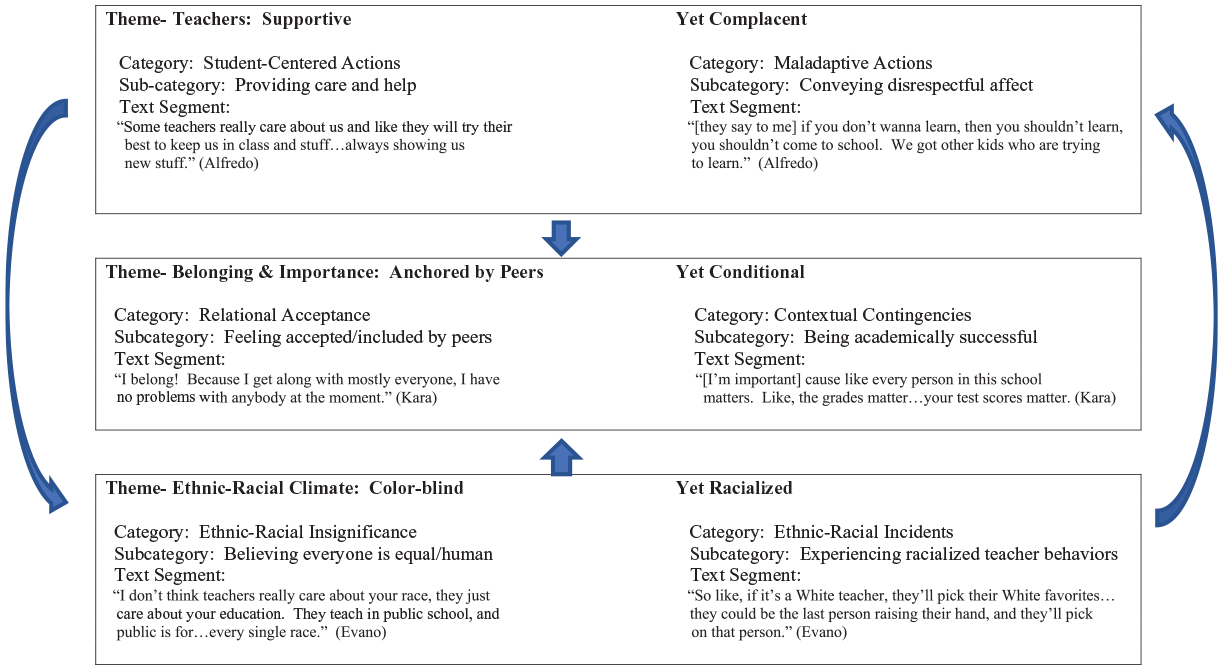
Themes and categories illustrating contradictory dimensions of school context and their interrelations.
Subsequently, both interview and focus group data were coded to answer the second research question regarding students’ identity constructions on “being Puerto Rican.” Each author first independently coded all seven transcripts, using open coding with gerunds. Next, focused coding was completed jointly through constant comparison, discussion, and consensus, resulting in two higher-level categories that reflected self-focused aspects of “being Puerto Rican.” Both focus groups were then coded using the same processes, and revealed two, more relational dimensions of Puerto Rican identity that were not identified in individual interviews.
Findings
Our findings provide unique insights into the contradictory nature of students’ experiences and interactions with three prominent dimensions of school context (RQ#1). All seven students evidenced contradictions in their understandings and perceptions of teachers, as well as in their feelings of belonging and importance, respectively. Six students reflected contradictions in their experiences of ethnic-racial climate (i.e., only one student reflected a purely colorblind stance). As illustrated in Figure 1, the dimensions of teacher behaviors and ethnic racial climate contribute uniquely to students’ sense of belonging in school. In our presentation of the findings, we address each dimension separately, first addressing teacher behaviors and ethnic racial climate, respectively, and sense of belonging in the final section. In each section, we highlight the ways that students’ contradictory experiences in each dimension may have been racialized according to their Puerto Rican ethnicity, using LatCrit as our interpretive lens. This allowed us to provide a rich synthesis of the data and our interpretations in our presentation of the findings (Sandelowski & Barroso, 2003).
Teachers: Supportive Yet Complacent
The presence of supportive teachers who showed an orientation to students’ learning, and whose actions were highly student-centered, was a key dimension of all students’ positive experiences in school. Students described teachers as integral to their success, articulating the ways they encouraged them to do their best work, helped them to solve problems, and provided help for learning. Yolanda described how teachers’ commitment to student learning rendered her school the “best one” she had ever attended: Um, this school really helped me to learn more, and I think of the other schools that I went to, this is the best school I went to. Because in the other schools I kind of learned, but didn’t understand, and I feel like in this school, the teachers explain more, and they help me learn more, and things that I don’t know.
Good teachers were also described as caring individuals who were generous with their time, and were both relatable and relational. This is strikingly illustrated in Alfonse’s comment that a good teacher “treats you like you’re his son. Like he makes you feel kind of special. He connects with you.” This is good news, and is similar to earlier work by Rolón-Dow (2005), who found that Puerto Rican middle school girls’ perceptions of teacher caring were defined by relational and culturally respectful interactions and support.
The frequency of students’ positive appraisals of their teachers, however, were tempered by their descriptions of teacher behaviors that reflected a sense of complacency about their academic performance, as has been documented in other work on teachers’ racialized expectations for achievement (see Gershenson et al., 2016). Despite an admittance by Alfredo that a good teacher should “push me, push me a lot,” only two other students discussed similar academic press from teachers; rather, the majority of students described an environment where just passing work in, irrespective of its quality, was good enough. This is clearly illustrated in a comment by Evano, who was our oldest participant, as he described teachers’ expectations; “they [teachers] expect your work to be at least done- like pass it in. They don’t really care if it’s like wrong or good.”
A second dimension of teacher complacency that was illustrated in students’ narratives regarded what they perceived as negative or disrespectful affect toward students. In contrast to both female students, male students often described such disrespectful attitudes as targeted at them, personally, as Alfredo’s comment in Figure 1 illustrates. Importantly, these kinds of affective teacher behaviors had a racialized tone for four out of the five male participants. Alfonse, who had a very dark phenotypic complexion, offered the following striking example: . . .my math teacher- he might think- well people say I got that face of looking like a criminal, or got, like I did something bad. But. . .my teacher will be like “people probably say that because they don’t really know you. They think you might do that because you’re that person, you look like it. But really, on the inside, you’re just different.
Several of Alfonse’s statements above are telling. First, they suggest that he is aware of society’s attributions of what a “criminal” should look like (namely, that [darker] “face”). Second, although it is couched in a supportive comment (“on the inside, you’re just different”), the teacher actually affirms this perception, noting that others might assume him likely to engage in bad behavior because “you look like it [a criminal].”
Although we acknowledge that there were no other examples of students’ referencing their phenotypic characteristics in exactly this way, using the lens of LatCrit, this seems a powerful and noteworthy example of the way that colorism can mediate (negatively) Puerto Rican students’ interactions in school that must be named. The textual example of Alfonse’s interaction noted above illustrates an expectation by a teacher that is racially coded (i.e., “they think you might do that because you’re that person, you look like it [a criminal].” As will be shown in the next category, such examples of teacher affect map on to vivid examples of more explicitly racialized behaviors among teachers.
Ethnic-Racial Climate: Color-Blind, Yet Racialized
Each student drew upon the school’s ethnic-racial diversity to justify the ethnic climate as positive, where everyone was important, opportunities were equal, and one’s effort determined success. In response to questions about their peer context, students insisted that being Puerto Rican, or ones’ ethnicity-race more generally, did not matter, and were in fact subordinate to what students believed were universal aspects of being “a human being.” Such sentiments were prominent across all narratives, as illustrated by Anton in the following segment, after being asked whether he felt “less than anyone because you are Puerto Rican at this school”: No. I'm fine. I'm a human being. It's just like. . . It's like M&Ms, there's just so many different ones, so what's the difference between one and the other? Nothing. . .I think about, I'm, I don't see what's different from me and the next person next to me. . .there's nothing different between us, you know? We're all human beings. It's really just how we are and how we act and sort of like what, how we are.
Perceptions of equal treatment regardless of ethnicity-race was a key aspect of students’ feelings of acceptance within the school environment, as our subsequent discussion of the Belonging and Importance category will illustrate. This was especially the case with regard to perceptions of teacher behaviors. For example, when asked to clarify the importance of being Puerto Rican at her school, Kara first noted that it was important, because there were “a lot of Latinos” enrolled. When asked to elaborate further, she equivocated, struggling to articulate its salience for teachers, in particular: “I’m not kind of like that sure if it’s that important. “Cause like I don’t think they [teachers] like, unless [sigh]- I’m not trying to say that like they don’t care, I’m just saying like, they’re not like paying that big attention to like your race.”
Despite the frequency of comments that attested to the insignificance of ethnicity-race, all but one student referenced differential, racialized treatment of students in their social interactions on at least one occasion, as noted earlier. Such racialized incidents occurred with both teachers and peers, but varied according to students’ gender. Specifically, for both girls, racialized treatment was perceived exclusively within their peer group in the form of teasing. For example, Kara noted the way ethnicity-race often constrained students’ perceptions of each other, but cast this in Black/White terms in commenting that students often warn each other, “oh, you’re White, you can’t do this. . .you’re Black, you’re not supposed to do that.” Yolanda noted an example of when her Puerto Rican ethnicity, in particular, was perceived negatively, in response to the question of whether ethnicity or race were important when thinking about friend groups at school: Because like for example at the beginning of the year they [peers] don't wanna hang out with you. . .at first, they be like, "Oh no, she's Puerto Rican, I don't like her; I don't wanna. [Interviewer: Is it easy or hard to make friends from other ethnic-racial groups?]. Um, for me sometimes hard but easy sometimes. Like I have Puerto Rican and Dominican friends, and ones from here [mainland United States]. But sometimes it’s hard because like you have nothing in common and like you don't have anything to talk about.
Yolanda’s comment also implies that the salience of ethnicity within the peer group is nuanced, however; her statement attesting to her friends “from here” (Yolanda was born in Puerto Rico) that is quickly followed by her admittance that “sometimes it’s hard,” may imply that Puerto Rican and other Latinx ethnicities afforded more potential for commonality, from her point of view.
Although only two of the five boys provided an example of racialized interactions with peers, four of the five discussed examples of racialized behavior from teachers that were distinct (yet connected) from the affective dimension of teacher complacency highlighted earlier. While Evano’s comment in Figure 1 illustrates his perception that teachers more readily call on White students as their “favorites,” a comment regarding racialized teacher behaviors by Alfredo is more overt: “we got some teachers that might be racist. . .screaming at Black kids more than White kids, or smart kids and stupid kids. . .”
LatCrit challenges binary notions of racial phenomena. In this regard, we find the students’ tendency to describe racialized interactions in the above examples using a Black/White binary noteworthy, as it regards their Puerto Rican ethnicity. First, all three student comments may well suggest that they have internalized the widely-held tendency to view race relations in terms of a Black/White dichotomy. This begs the question of how Puerto Rican early adolescents conceptualize their own racialized experiences or positionality with regard to the color line, since Puerto Ricans are a racially diverse group. In her qualitative work on race and belonging among U.S.-born Latinx millennials, Flores-González (2017) found that the majority of her young adult participants actively resisted binary notions of the U.S. racial order, articulating instead a complex “racial middle” that varied according to individual characteristics, such as phenotype, but also included factors such as proximity to other racial groups in terms of cultural affinity, social class, and racialized experiences. Our findings suggest that students in middle school have not yet reached this level of sophistication, highlighting an area that they would benefit from discussion and support in.
Another way that teacher behaviors were racialized as described by students centered on language, specifically regarding their reactions to hearing Spanish spoken in the classroom. From the perspective of LatCrit, the practice of maligning Spanish in schools devalues cultural expression and native speech for Latinx students and their families. The comment by Alfredo below illustrates the way being a native speaker of Spanish still mastering academic English might position many Puerto Rican students in this regard: Like for a Spanish [speaking] kid it's too hard because most of the teachers don't, don't, don't care if you speak Spanish because, well, you need- you know like, some kids in my class will ask me what- what are they saying? And the teachers don't care, and they tell me to shut up because I can, uh, I can explain what, uh, do I need to say. So, it's rough for, uh, for the other kids to not speak Spanish.
In the selection above, it is striking that Alfredo perceives the teacher as unsympathetic to native Spanish speakers, which might be implied in his comments that teachers “don’t care,” and in being told to “shut up.” In point of fact, we found no evidence for the affirmation of Spanish language by teachers in students’ narratives. Instead, our data reflect evidence of linguistic hegemony and English monolingualism in both schools, despite the fact that Latinx students constituted the majority in each. Several students described being discouraged from speaking Spanish, and as illustrated in the segment above, were sometimes maligned by teachers when they did so. The internalization of English as superior may also be present in a comment by Enzo, himself a limited Spanish speaker, in a comment where he “problematizes” Spanish; Enzo noted that his peers of color were not judged in school, even if “they have a Spanish problem.” Indeed, the way that Spanish is maligned in the above examples can serve as a powerful threat to belonging and identity for Puerto Rican students, regardless of whether Spanish is their heritage language or not (Irizarry & Antrop-González, 2013; Nieto, 2004).
A final dimension of the way that ethnic-racial incidents in the school environment were prominent in student narratives regarded the presence of ethnically-based stereotypes about Puerto Ricans, the nature of which again varied by gender. Specifically, although both girls admitted that sometimes other students “call Puerto Ricans names,” or “say stuff” about Puerto Ricans (Yolanda and Kara, respectively), neither specified their content. However, three of the five boys spontaneously articulated stereotypes about Puerto Ricans, all of which were decidedly negative. Such stereotypes appeared to us as generalized beliefs that were internalized by students, but emerged in their descriptions of the school context. Yet, they also informed their personal evaluations of being Puerto Rican (i.e., private regard), as well as their perceptions of how others viewed them (i.e., public regard). Alfredo’s explanation of whether being Puerto Rican influenced his experiences in school is a striking description of what he sees as dominant behavioral features of his ethnic group: I don't follow the rules and I wanna do whatever I want. And people from other countries, it's like, they're- I'm not saying like they're not like us [Puerto Ricans] but, I think, like, we're more, like, intense because, you know, we don't follow nobody's rule. . .Like, some people from other countries, they like to follow the rules. But we Puerto Ricans just like do crazy stuff and. . . sometimes they might go bad, like, shooting.
Both Alfonse and Evano also reflected an awareness of the perception of Puerto Ricans as violent (what Alfredo’s comment about “crazy stuff” seems to imply). Several times during his interview, Alfonse lamented that both teachers and adults in the community often “put names on us [Puerto Rican males], like ‘oh, they’re thugs’, they do this and that.” Similarly, Evano clearly names the perception that Puerto Ricans will “kill someone” as a prominent stereotype among his peers, after being asked about what other kids at school think about Puerto Ricans: Like they [peers] would think. . .I don't know 'cause like, there's like a stereotype of, like, all Puerto Ricans- like, you'll see them- they'll always kill someone or something. . .not a lot of White people will kill but, like, most Puerto Ricans and Blacks do. They'll treat you a little different 'cause of it.
The negative stereotypes about Puerto Ricans as violent or criminals that found in the narratives of our male participants map on to extant cultural stereotypes in the U.S. that associate being Black or Latino, and male, with dangerousness and threat (Benner et al., 2018). From the perspective of LatCrit, then, it is not unreasonable to conclude that these examples of negative valence toward Puerto Ricans—whether located in generalized teasing or overtly racialized stereotypes of Puerto Ricans as “violent”—have the potential to undermine students’ school adjustment across domains, including the extent to which they see themselves as having a sense of place within their school environment.
Belonging and Importance: Anchored by Peers, Yet Conditional
The category of Belonging and Importance was largely generated as a function of both teacher support and the ethnic climate; that is, the elements of both categories were essential and contributed uniquely to students’ sense of belonging and importance in school. Although positive relationships with both peers and teachers were integral to students’ sense of belonging, acceptance within the peer group was a more frequent contingency. Specifically, all but one student responded to the direct questions of whether they belonged and were important at school by stating the relevance of peers, as clearly explained by Anton: “I think it’s [belonging] really my friends and how they are. I sort of think it’s my friends. It’s like 75 percent my friends and 25 percent teachers.” Hence, “getting along with everyone” and having friends provided students with both psychological and academic support, encouragement, and camaraderie; Alfredo likened having friends and helping one another to “being allies.”
Regarding teachers, while students’ most frequent descriptions of teachers centered on the ways they provided them with support and encouragement, their ability to treat students fairly—most often defined as being treated “the same,” was an important component of their sense of acceptance and belonging in school. In fact, every student described their school as a place where teachers did not explicitly acknowledge their ethnicity-race; as we noted earlier, this was viewed as a necessary component of their ability to provide equitable instruction. Despite this, the relation between Puerto Rican ethnicity and equal treatment was touched upon in a more nuanced way by two students. In response to the question of how she felt about being Puerto Rican, Yolanda answered: [being Puerto Rican] is important to me, personally, because I wanna be like- I’m Puerto Rican, but I want to be treated the same way that people- other people are treated no matter who they are.
Although somewhat interpretive, the link Yolanda makes between the importance of being Puerto Rican and being treated “the same way” as others might suggest that she has knowledge or experience that this is not always the case (i.e., being Puerto Rican elicits differential treatment). Enzo’s description of the presumed insignificance of Puerto Rican ethnicity contains similar ambiguity, along with the internalization of English language hegemony we commented on earlier: It [Puerto Rican ethnicity] doesn’t [matter]. It doesn’t. Well, it doesn't matter because no one's judging anyone. . . Um, no one's either like pushing people to. . .to do stuff because they're this color or, ‘oh since you have a Spanish problem then you have to do this,’ or, you know, ‘you have a speaking problem so don't talk to me.’
Despite the aforementioned ways that peer and teachers’ equal treatment contributed to students’ feelings of belonging and importance, there was an important “contextual contingency” to belonging that was located in a belief that their academic competence or performance greatly mattered in this regard. Specifically, five students referred to the success with which they managed their grades or test scores in response to the direct questions of whether they belonged or were important at school, as illustrated by the example in Figure 1. In another example, Yolanda vividly equated her own perceptions of importance at school as dependent upon ways in which she contributed to the school environment, or “[made] this school better”: Well, sometimes I feel like I’m an important part of the school because sometimes I feel like I make this school better, and with my grades, and in how I treat people. [Interviewer: are there times when you feel like you aren’t an important part?] When I give up and don’t try my best.
While aspects of Yolanda’s comment are certainly positive, the implications of her conclusion that her importance at school is contingent upon her motivation should be considered carefully. Indeed, there is great variability in students’ academic motivation during the middle school transition (Roeser & Eccles, 1998). Although it is reasonable to conclude that all students internalize the belief that their academic performance and positive contributions matter, LatCrit helps us to interrogate the ways that Latinx students’ ethnic-racial positioning renders such beliefs as adaptive or not with regard to sense of belonging in the school environment. For White students, their motivation to put forth their best efforts unfold within school spaces that are not racially neutral, but fundamentally White in tone (Durand & Tavaras, 2021), derived from the monocultural (i.e., White, Eurocentric) and assimilationist ideology that has fueled the institution of schooling in America since its inception (Ladson-Billings, 2018). From this perspective, White students as a racial group will likely feel an inherent sense of belonging in U.S. schools. This, we argue, provides a sense of psychological safety for White students that not only supports their desire to succeed, but buffers some of the pressures associated with having to “perform” well in school.
For students of color and Puerto Rican ethnics, in particular, the situation is fundamentally different. Because of the subordinate status of Latinx peoples in the racial hierarchy within the U.S., sense of belonging and importance is undoubtedly a complicated issue that cannot be taken for granted in any context, especially among young people. This is illustrated in the aforementioned work on race and belonging by Flores-González (2017). Based on interviews with nearly 100 Latinx youth, she found that their narratives reflected a persistent sense of racial exclusion in the U.S. Although phenotypic or linguistic features that marked them as Latinx contributed to this, participants referred often to the ways that their (Latinx) exclusion from conventional U.S. racial categories eroded their sense of belonging that coalesced in their feelings of being “citizens” but not “Americans.”
This outsider status may be uniquely complicated for Puerto Rican ethnics when viewed in terms of their birthright citizenry that is itself a marker of the colonial relationship between the island and the mainland U.S. Hence, viewed through the lens of LatCrit, we argue that the feelings of conditional belonging among students that we uncovered in our analyses are concerning, and worthy of particular attention by schools and teachers during this developmental period.
Puerto Rican Identity: “It’s Part of You”
In our final section below, we present the findings of our separate analyses of the content of what “being Puerto Rican” meant to students (RQ#2), which provided insights into how they described and experienced their Puerto Rican identities in the school context. Two unique category dimensions of the way students constructed their Puerto Rican identity were extracted from individual interviews, subsequent to our analyses of dimensions of school climate. Analyses of focus group data revealed two additional, more relational aspects of students’ constructions of Puerto Rican identity that offer additional nuance to their identity constructions.
Dimension of Self
Students saw ethnicity as something that everyone had, and as an important dimension of self that could not be changed, because “it’s part of you,” as Kara explained. In this way, ethnicity had a kind of deterministic quality for students, as suggested by Alfredo’s musing that “you need to be the person from your country.” Although students spoke of ethnicity as something that distinguished people and should be a source of pride, several were careful to note that such an understanding did not make one “better” than anyone else, as illustrated by Anton: You should never find a reason to make- be- try to be more than anybody else, and especially for like ethnicity or race. You should never be able to be able to do anything like that or say ‘I'm better than you because of that’. . .But like at the same time you want to be proud of who you are and how you are, but you don't want to do it so that you make other people feel bad or tear somebody down.
Previous studies have found that a strong Puerto Rican identity is a factor in academic success for high-achieving Puerto Rican youth in high school (e.g., Flores-González, 2002; Garrett et al., 2010; Rolón, 2000). Hence, students’ articulation of ethnicity as an important component of their emerging sense of self found in our data is consistent with other work that attests to its salience among ethnic minority youth in early adolescence (Way et al., 2013). Students’ inability to claim the importance of their ethnic background without equivocation might speak to its more burgeoning quality during this period, but also suggests that they would benefit from increased opportunities to explore dimensions of ERI within trusted peer and adult groups.
Spanish Language and Bilingualism
Spanish language was a salient dimension of Puerto Rican identity for four out of five bilingual students. The impact of language was articulated in two ways: as something that marked them as different within an English-speaking school community, yet was a positive asset in both their present and future contexts. For example, Alfredo elaborated on the primacy of language multiple times, linking a lack of English fluency with a reduced sense of belonging within the school, as evidenced in one of his earlier comments about things being “too hard” for “Spanish kids. Yet being a native Spanish speaker was also integral to his Puerto Rican identity: Nobody can change the way you are, or from where you are. If you wanna speak Spanish, you can speak Spanish, but nobody needs to force you to speak English. In the classroom, in ELL, we always speak Spanish.
Building on what Nieto (2004) would consider an adaptive strength of Alfredo’s—his resistance to being “forced” to speak English—two students also described the ways that being bilingual Spanish speakers afforded them skills and resources that they were proud of. In response to questions regarding the importance of being Puerto Rican, Evano and Alfonse immediately mentioned language, respectively, each commenting that their ability to communicate with different groups of people was something that allowed them to be “helpful” in school. In addition to communicative skills, Evano also acknowledged that being bilingual was important because it allowed him to “multi-task” better. Overall, Spanish language and bilingualism was a concrete dimension of their ethnicity that students discussed with both immediacy and pride.
Hence, despite the strong focus on English language competency in both school settings, for bilingual students, maintaining fluency in Spanish language was considered an asset that allowed them to contribute in unique and helpful ways in and out of school. This is consistent with Zavala’s (2000) research that points to the primacy of language in identity construction for Puerto Rican adolescents, whereby youth viewed Spanish as a way to express Puerto Rican ethnic pride and share family traditions.
Ingroup Connection and Affinity
While sometimes (but not always) buttressed by shared Spanish language, another feature of students’ conceptions of their ERI was a sense of connection and affinity toward other Puerto Rican students in their school. In both focus groups, this was discussed in terms of having a natural kinship and respect for one another that was rooted in ethnic heritage and geography, as when Yolanda noted during her conversation with Alfredo that being Puerto Rican meant that “we should treat each other like we’re family, because we’re like from the same place.” In the second focus group, this ingroup connection was described in terms of the sense of psychological support and comfort that having Puerto Rican friends offered. During this particular point in the conversation, Anton and Enzo
4
reflected on what it would be like as Puerto Rican students in a majority-White school. The exchange below illustrates the feelings of connection and comfort they derive from being in the presence of other Puerto Rican students, alternately described as “mates” and “family”: If there was a school with different people than us [Puerto Ricans], I would love to go, but I’m just going to say that sometimes it might be too overwhelming. . .you might just want to keep staying with your friends because you think they’re family, because you think they came from the same country, so you want to stay with them. . .you can forget about everything else, and you just want to stick with your, your mates. (Enzo) They feel family with others. (Anton) Family with people who look like them, who are Puerto Rican like them? (Interviewer) Definitely. (Anton)
It is noteworthy that Yolanda, Enzo, and Anton spontaneously use the word “family” in their descriptions of the connection they feel to other Puerto Rican students and friends. This finding may be reflective the cultural belief in familismo—the valuing of family ties and relationships—that is highly endorsed among Latinx ethnics (Halgunseth et al., 2006). In work that examined Puerto Rican adolescents’ evaluative judgements of autonomy vs familismo values, Villalobos Solís et al. (2017) found a stronger orientation to the latter in students’ interpretation of hypothetical scenarios. Our finding here brings forth the possibility that this cultural value might contribute to adolescents’ emerging identity constructions as well.
Ethnic Pride in Shared History
Similar to the way that the salience of being Puerto Rican was linked to having an ethnic ingroup with which to identify, students in both focus groups acknowledged that knowing aspects of their ethnic history was linked to their understanding of themselves as Puerto Rican. Pride in ethnic history was particularly evident in an exchange between Alfredo and Yolanda, who were born and had lived several years on the island: You know, like some Puerto Ricans have a lot of history. You know, like boxers, baseball players, are sometimes Spanish. (Alfredo) And why should you know about them? (Interviewer) Because, they’re like, Puerto Ricans, Puerto Rico’s heroes, you know? They show that Puerto Rico is like, alive. (Alfredo) Do you learn about Puerto Rico in school here? (Interviewer) No. (Alfredo) It’s like Alfredo said. We should learn about our heroes, and things about places there we’ve never been before. (Yolanda)
The brief exchange above is heartening, since a knowledge of ethnic history and pride in one’s heritage have been shown to have both promotive and protective influences on the emergence of ERI in early adolescence (Neblett et al., 2012). This holds significance for the education of Puerto Rican students. As noted by Berson et al. (2019), mainland U.S. students receive very little instruction on the history of Puerto Rico over and above geography. Berson et al. (2019) assert that challenging simplistic representations of the island that render its people as merely colonized subjects is integral to the civic engagement of Puerto Rican students. As key socializing contexts, schools have an integral role to play in this endeavor.
Discussion
Framed within stage-environment fit theory, one goal of this study was to examine the ways that Puerto Rican early adolescent students discuss aspects of the school context in the domains of teacher support, ethnic-racial climate, and belonging and importance, during the pivotal middle school transition. Because this transition may be an important encounter period during which students’ ethnic consciousness is raised (Umaña-Taylor et al., 2014), our second study goal was to examine students’ ERI constructions around being Puerto Rican. Our study builds on work that attests to the links between school climate and ERI in middle school (see Camacho et al., 2018), and brings a level of specificity regarding the content of Puerto Rican students’ understandings of themselves and their school context that has not been documented in recent studies.
With regard to the dimensions of school context examined here, we found that students’ experiences were fundamentally contradictory, where examples of teacher support, purported colorblind ethnic-racial climate, and sense of belonging were tempered by racialized experiences in each. Our use of LatCrit provided an interpretive framework for illuminating the ways that students experienced such contradictions in ways that might be unique to their Puerto Rican ethnicity; specifically, via phenotypic differences (i.e., dark complexion), the suppression of Spanish, negative stereotypes about Puerto Ricans, or neglect of Puerto Rican history. Overall, the particular ways our participants were racialized in their interactions illustrates how affective and institutional features over which students have no control have the potential to create hostile spaces for Puerto Rican students in school (Irizarry & Antrop-González, 2013).
We found that students’ perceptions of both their teachers and the ethnic-racial climate contributed to their sense of belonging and importance in school. Despite this, the fact that students’ expressed feelings of belonging and importance in school were often not automatic, but contingent upon their achievement or contributions, must be considered alongside the particular import sense of belonging may have for Puerto Ricans in the U.S. Puerto Rican ethnics must grapple with the sociocultural complexities of birthright citizenship alongside marginalized status (Acosta-Belén & Santiago, 2018; Johnson, 2000). According to Szalacha et al. (2003), Puerto Rican early adolescents are sensitized to the racialized context of belonging (e.g., perceived discrimination and othering) in the larger society. Hence, having to “prove” that they belong in school in the context of this larger societal context seems to us an undue burden that Puerto Rican youth must bear.
Our study has several limitations that must be considered. First, our investigation of students’ experiences in dimensions of the school context, in particular, is limited by our exclusive use of single interview and focus group data. Although we believe our interview data were rich in content, triangulation of data collection methods that included classroom observations, experience sampling methods (ESM), or teacher interviews would have been beneficial. Second, our small number of participants (mostly male) warrants caution; although small samples are more customary in qualitative studies, a larger corpus of text affords more overall flexibility and depth in the analytic process (Creswell, 2015). Relatedly, one of our participants (Evano) was 15-years old, which is outside the bounds of what is typically considered the early adolescent period. From a developmental perspective, we might expect to find age-related changes in the depth and complexity of students’ descriptive and evaluative responses about their school experiences (identity or otherwise). We were not able to examine this systematically in our analyses here.
Although there were similarities in the demographic characteristics of both schools, there were some differences in what Graham (2018) calls the balance of power of ethnic groups in each school; specifically, Puerto Ricans constituted a much larger ethnic majority in School B, and were a minority ethnic group in School A. These and other contextual differences between schools (e.g., school size, school policies, and instructional practices) are likely associated with differences in students’ perceptions and experiences that did not emerge in any systematic way from our small number of participants. Hence, although our study was exploratory, it paves the way for future studies that utilize larger samples and mixed methods to explore these contextual factors.
Notwithstanding these limitations, both stage-environment and LatCrit theories provide a framework for the delivery of more culturally affirming support for Puerto Rican students during a period when exciting changes in students’ conceptual understandings are underway, and when they are particularly sensitized to environmental influences (Steinberg, 2015). In early adolescence, Puerto Rican students can begin to articulate the ways their experiences are racialized in the school context (e.g., suppression of Spanish, stereotypic attributions by others), and grapple with the complexity of their Puerto Rican identity in earnest. In this regard, while our data suggest that male students, in particular, may struggle with positive identity constructions, our findings overall provide stronger evidence of identity-based resiliency that we see as places of possibility in the education of Puerto Rican students. Such resilience can be enhanced by the development of a critical consciousness around the salience of ethnicity, race, and other sociocultural factors (Clark & Seider, 2017), but students require support and guidance from trusted adults to do so during this developmental period. Using the lens of LatCrit, we offer a set of recommendations for teachers, schools, and youth developers for the delivery of critically conscious support for Puerto Rican students, based on our exploratory findings.
Addressing Contradictions: From Colorblind to “Cultural Commuting”
In the context of preparing Puerto Rican students to thrive as informed citizens in a society where ethnicity-race shape one’s life experiences, interactions, and outcomes (Sue, 2015), the contradictions in students’ perceptions of their school environment in this study are important for schools to consider. In particular, similar to other work we have done with students of color in middle school (see Durand, 2020) the ideology of color-blindness was woven throughout students’ narratives. Using the term color-blind racial ideology (CBRI), Neville et al. (2013) provide more specificity to this construct, delineating the strategies of color-evasion (i.e., denying racial difference and emphasizing sameness) and power-evasion (emphasizing meritocratic beliefs and equal opportunity) as core dimensions upon which CBRI is manifested. Students’ claims that “we’re all human,” that teachers “didn’t pay attention” to their ethnicity-race and treated them “equally” (in the face of examples where they described the opposite), and that they did not belong when they did not “try hard,” fit within these dimensions. This may suggest that students have already internalized the core features of CBRI, and are using them to understand their school experiences and potential for success.
In order to reconcile presumed dissonance between their own lived experiences in school and the color-blind narratives they hear, students require conceptual knowledge on systemic forms of inequality in society, and an understanding of the historical and contemporary significance of race and racism in peoples’ lives (Neville et al., 2013). For example, while students in our sample expressed interest in learning more about their heritage and Puerto Rican history, they acknowledged that their schools did not teach them about Puerto Rico. For Puerto Rican students, an examination of the colonial relationship between the mainland and the island that does not neglect the powerful history of oppression, resistance, and political advocacy among both island and mainland Puerto Ricans is necessary, and early adolescence is a critical time for this learning to occur (Irizarry & Antrop-González, 2013). These conversations and instruction can be built into curricular content in middle schools and out-of-school youth programs using a critical multicultural approach (see Durand & Tavaras, 2021). Such an approach requires racial literacy among teachers (Rogers & Mosley, 2008), whereby they have developed the knowledge, skills, and dispositions to examine the relationship between race and power, and the ways that social, economic, and political advantages for Whites are maintained in institutions, including schools.
A striking and relevant example of racially literate pedagogy in action is Tucker-Raymond et al.’s (2011) work with middle school Puerto Rican students, which illustrates the powerful ways one after school-based arts program challenged their “ahistorical” treatment by schools, thereby increasing their sense of agency, unity, and sense of place. Offering these kinds of activities to Puerto Rican adolescents engages them in the process of examining historical systems of power, and provides a legitimization of their culture. Such opportunities for cultural commuting among Puerto Rican students (see Nieto, 2004) can challenge the racialized, assimilationist school experiences that were described among our participants, and facilitate a more authentic sense of belonging in school.
Nurturing Possibilities: Identity-Based Resiliency
As our findings suggest, both teachers and peers serve an important role in validating (or invalidating) Puerto Rican students’ ERI; this, in turn, is linked with students’ ability to identify in a positive way with teachers, and consequently, with schools and learning (Nieto, 2004). Hence, teachers should allow for student-led discussions regarding identity and what identity means to them (Vedder & van Geel, 2017). For example, a promising school intervention, the Identity Project, provides an 8-week curriculum designed to promote ERI exploration for youth from any ethnic-racial minority and majority background (Umaña-Taylor et al., 2018). This evidence-based curriculum is currently being implemented in the U.S. in several states, and offers opportunities for students to build self-confidence in exploring identity, gain knowledge about ethnicity-race in society, generate critical questions, and improve classroom community (see https://umana-taylorlab.gse.harvard.edu/identity-project).
How would such a curriculum be tailored for Puerto Rican students in middle school? Our findings point to several areas upon which to focus. First, students might begin to examine the inadequacy of the Black/White binary in reflecting their diverse experiences and cultural backgrounds as Puerto Ricans, and begin to grapple with what Flores-González (2017) theorizes as a “racial middle” positioning that legitimizes the roles both race and ethnicity play in how Latinx form self-understandings. Acknowledging and “claiming” this unique and separate position in the U.S. racial structure is a form of resistance and critical consciousness by which Latinx youth “stake claims of belonging” (Flores-González, 2017, p. 154) that can be especially powerful for Puerto Rican students, in particular. Understanding the way that colorism operates as a stratifying mechanism (Monk, 2021) for Puerto Ricans not just on the mainland and the island, but globally, can guard against the internalization of oppressive beliefs by providing students with a broader, more systemic perspective, and build resilience.
Notwithstanding this, since stereotypes are a lens through which one views and evaluates the self, we find it imperative that dominant stereotypes about Puerto Ricans are addressed directly with students. Middle school teachers and youth programming curricula are ideally positioned to capitalize on early adolescents’ emerging capacity for more abstract reasoning to guide them in analyzing the fallacy of the kinds of stereotypes that were revealed in our participants’ narratives. The use of counter-storytelling (Perry et al., 2004; Sleeter & Delgado Bernal, 2004) can greatly enhance such efforts; that is, providing opportunities for other Puerto Rican adult models (e.g., family and community members, clergy) to share their lived experiences with success, adaptation, resistance, and belonging in America that disrupts hegemonic, deficit-oriented views of Puerto Ricans in the larger society.
It was clear from several students’ narratives that the use of Spanish language was a source of both pride and potential, and a salient aspect of their identity. Teachers, schools, and youth developers must affirm heritage language and the benefits of bilingualism for Puerto Rican students—regardless of state, local, and school language policies—since language is indeed “the skin that we speak” (Delpit & Kilgour Dowdy, 2008). Indeed, the linguistic repertoire of Puerto Ricans that includes many lexical fusions (e.g., drawn from Taino, Spanish, English, mainland, and island vernaculars) should be viewed as a cultural strength. This linguistic facility among Puerto Ricans is at once a manifestation of successful adaptation and integration into new communities, as well as resistance to English hegemony (Zentella, 2009). The concept of translanguaging (see García & Lin, 2017) provides a framework for teachers to consider these kinds of metalinguistic and contextual adaptations in language form and usage, and to provide students with classroom opportunities to examine this in creative ways. For example, relations between language and identity may be influenced by Puerto Rican students’ ability to travel freely between the island and the mainland. Although alluded to by only two of our participants, the transnational consciousness that often results from such circular migratory experiences could be a point of discussion for students, framed as an adaptive skill that contributes to their ability to be global citizens.
Building on bilingualism as a cultural asset, other strengths-based dimensions of “being Puerto Rican” identified by students, such as having affinity and a sense of familismo (Halgunseth et al., 2006) with other Puerto Rican students, as well as ethnic pride, seem to us exciting examples of psychological resilience in students upon which to capitalize during this pivotal developmental period of growth and change. Community can be built around these factors in the classroom and in youth development spaces. Importantly, however, despite such cultural commonalities that might exist, students must be provided the opportunity to discuss dimensions of diversity in the Puerto Rican experience as a result of variables such as geographic location, social class, gender, language, and skin color, to name a few. Helping students to consider these intersectional factors guards against essentialized notions of what it means to be Puerto Rican, and empowers them to embark upon issues of identity as young adolescents with fluidity, choice, and affirmation.
Conclusion
Since the middle school transition is a pivotal time for growth and learning, a responsive school context is critical to the success of Puerto Rican students. Our findings suggest that supportive relationships and an affirming ethnic-racial climate contribute importantly to school belonging, but from the lens of LatCrit, are not without complexity for students. At the same time, our study illuminates the exciting potential for Puerto Rican identity to serve as a source of resiliency and strength as students navigate such complexity. Schools and youth organizations who commit to teaching for social justice with an intentional, equity-oriented focus have the potential to be places of possibility for Puerto Rican students. As a population of youth who are intricately woven into the fabric of our nation, they deserve nothing less.
Footnotes
Declaration of Conflicting Interests
The author(s) declared no potential conflicts of interest with respect to the research, authorship, and/or publication of this article.
Funding
The author(s) received no financial support for the research, authorship, and/or publication of this article.
