



Abstract
In Quebec, school psychology is alive and well. This article outlines current challenges and opportunities related to the practice of psychology in Quebec English schools. Changes to the practice of psychology in Quebec over the last decade have had an impact on the delivery of psychological services in schools. Modifications of the admission criteria to the Order of Psychologists and the passage of Bill 21 have affected the profession both positively and negatively. For the English-speaking educational community, school psychology remains highly valued, particularly in light of the overall paucity of services in the province for these youth.
At the turn of the millennium, school psychology in Quebec was described as “very vibrant” (Gardner, 2001). Fifteen years later, the intersection of education and psychology in Quebec schools remains an important and active domain. This article will offer a perspective on the current challenges and opportunities faced by Quebec English schools with respect to the practice of school psychology. Although the regulatory aspects related to the psychology profession in Quebec are standard irrespective of language, there are particularities within English-speaking communities that will be highlighted in this article.
The Quebec Education System: The Anglophone and Francophone Divide
In Quebec, there are 72 public school boards that provide educational services to both youth and adults. The youth sector offers services from prekindergarten (age 4) to Grade 11. The adult sector offers general adult education and vocational training programs. Since 1998, school boards in Quebec have been organized along linguistic lines; presently there are 60 French-speaking school boards, nine English-speaking school boards, and three special status school boards covering the northern region of the province.
The majority of Quebec’s citizens are French speaking; approximately 10% to 12% of the population identifies English as their mother tongue. In a province governed by long-standing language laws aimed at protecting the French language, only students who have been granted eligibility for English instruction may register in a public English-language school. At the present time, there are just under 100,000 students attending a public English-language school in Quebec. Even the term English school is a misnomer as all of the nine English School Boards offer programs and services that are best described more as bilingual rather unilingual in nature, operating in both English and French to varying degrees.
Regardless of the linguistic status of a school board, psychology is considered a complementary educational service that must be provided by all school boards, as prescribed by the Quebec Education Act (Gouvernement du Québec, 2002). The basic school regulation governing the provision of educational services for preschool, elementary, and secondary education outlines 12 mandatory complementary educational services aimed at facilitating students’ academic and social learning. Consequently, school boards are charged with hiring qualified, non-teaching professionals to ensure that these services are provided to students. Psychology and psycho-educational services are two of the 12 required complementary educational services.
Among the English-speaking population, these mandatory complementary educational services take on an added importance. As a minority language group within Quebec, anglophones often face the reality that fewer health and social services are available in English. This is particularly true outside of larger metropolitan regions where English communities are smaller and more isolated from each other. However, Canadian constitutional protections for minority populations (e.g., francophones outside of Quebec and anglophones within Quebec) ensure that educational services are available in the language of the minority group. This means that the psychological services that are provided in English schools are especially critical as English-speaking families may not have access to psychological services that would otherwise be available through the health and social services network or from private clinicians.
In a recent brief prepared by the Advisory Board on English Education (2012), a group that advises the Minister of Education on educational matters affecting the anglophone community, the importance of these complementary educational services was highlighted and deemed to be critical for student success, particularly for students who struggle in school. In particular, the report recommended that the government undertake efforts to ensure that psychological services in schools are provided to English-speaking students in a timely manner and in a more proactive fashion with an emphasis on prevention and early intervention. Despite the recognized need for such services, various training and practice issues present obstacles to achieving this goal.
Current Training and Practice Issues
Psychology is one of 54 professions that are overseen by the Professional Code of Quebec. Legal use of the title psychologist requires membership with the Order of Psychologists, known as l’Ordre des psychologues du Quebec (OPQ). According to its website, admission to the OPQ requires that candidates meet three criteria:
hold a doctoral degree in psychology (or its training equivalent);
complete a professional ethics course of at least 45 hr in length, as recognized by the Order; and
possess appropriate knowledge of the French language as specified in the Professional Code.
Admission procedures vary slightly depending on a candidate’s specific program of study; graduates from a recognized doctoral psychology program within Quebec may automatically apply for admittance to the Order on graduation, provided they meet the two other admission criteria. However, graduates from a doctoral psychology program outside of Quebec are required to demonstrate training equivalence. They must apply for admission through a separate process that requires a systematic review of the candidate’s undergraduate and graduate credits as well as practical training experiences. There is also a separate admission procedure for psychologists already licensed in another Canadian province or territory who are seeking to practice in Quebec.
Three significant changes have occurred within the last decade with respect to the practice of psychology in Quebec, all of which have had an impact on the delivery of psychological services in schools. The first change happened in 2006 when the OPQ modified its admission criteria; prior to that time, a master’s degree was the minimum level of training required to become a psychologist. The impact of this change has been positive for the most part, as novice school psychologists are now entering the profession with advanced training in assessment, consultation, intervention, and research methods. However, in another sense this has posed a challenge for employers such as school boards as there is a shortage of qualified personnel since it takes longer and costs more to train doctoral level psychologists.
Two other significant changes occurred in 2012 with the passage of Bill 21. This legislation modified the Professional Code of Quebec by redefining the scope of practice for various healthcare professions, including psychology, in two important ways. First, a framework for the practice of psychotherapy was defined for the first time, with the title of psychotherapist being restricted to physicians, psychologists, and members of other orders (e.g., guidance counselors or social workers) who hold a permit issued by the OPQ to practice psychotherapy. Second, Bill 21 delineates a number of reserved activities specifically related to the field of mental health and human relations (Office des Professions du Québec, 2013). In all, 13 different activities are now restricted to members of particular orders; the majority of these activities pertain to evaluations required to identify mental or neuropsychological disorders or to protect vulnerable groups such as those with mental disorders and students with special needs. Table 1 specifies the reserved activities outlined in Bill 21 that now fall within a psychologist’s scope of practice.
Summary of the Restricted Activities as Prescribed by Bill 21 as They Relate to the Practice of School Psychology in Quebec.
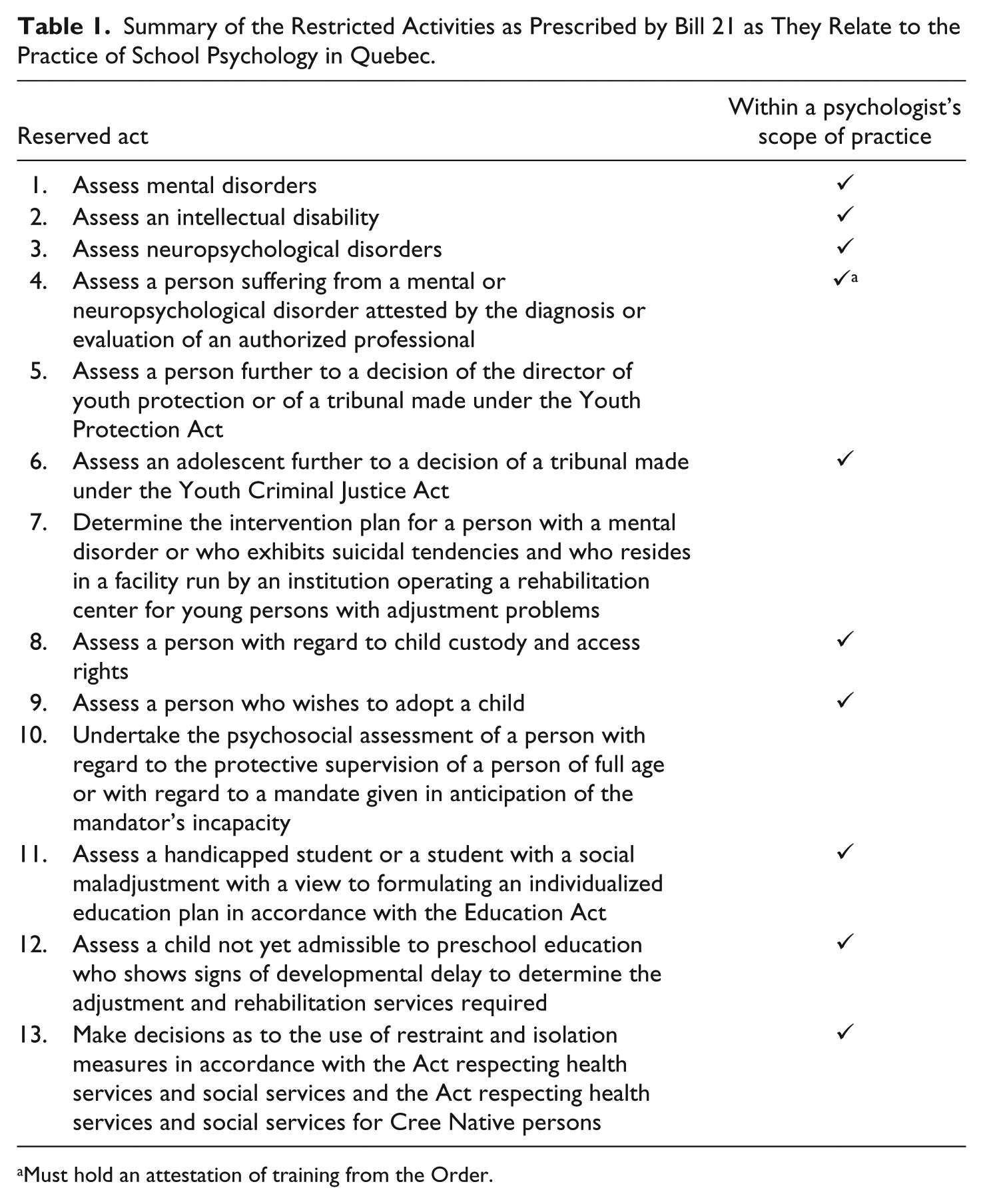
Must hold an attestation of training from the Order.
Although licensure is now required to use the title of psychologist and to practice restricted activities, there are no specific regulations governing the practice of school psychology in Quebec. School psychology is listed on the OPQ website as one of several fields of practice within psychology, and each year Quebec psychologists are asked to indicate up to two such fields of practice in which they work. However, the OPQ does not publish any official data regarding the practice of school psychology. According to data available on the Office des Professions website, in 2015, there were 8,692 licensed psychologists in Quebec. However, no statistics are provided as to how many of these psychologists work in educational settings or identify as a school psychologist.
Various psychological associations exist in Quebec that are specific to particular fields of practice. One such association is the Association Québécoise des Psychologues Scolaires (AQPS), the history of which was outlined in a previous article on school psychology in Quebec (Gardner, 2001). Psychologists may opt to join this association and participate in their professional development activities that are geared specifically to the practice of psychology in schools. According to the AQPS website, they have almost 500 members. However, it is difficult to ascertain how many English-speaking school psychologists hold membership in this association, as no such information is provided on the AQPS website. Similarly, there do not appear to be any data available as to whether psychologists working in schools were trained in specifically in school psychology or the types of duties they carry out in this role.
Although there are no certification requirements regarding the practice of school psychology, there have been efforts to recognize the unique role of school psychologists. In 2007, the OPQ, in collaboration with the AQPS, published a document seeking to clarify various practice issues for psychologists working in schools (Ordre des psychologues du Québec, 2007). This document situates the professional and legal context in which school psychologists work, provides an overview of the varied duties of psychologists working in schools, and discusses some of the ethical considerations around working with multiple client groups such as parents, teachers, and students. The issue of “Who is my client?” is a unique issue facing school psychologists who, with one referral, are charged with assessing a student, providing feedback to parents, and consulting with teachers. It is laudable that the OPQ has worked to better define the scope of practice for school psychologists.
Where do these changes to the profession leave anglophone schools? In an effort to paint a picture of the current situation of school psychology in English-speaking Quebec, an informal survey was carried out with the nine educational administrators who oversee the delivery of complementary educational services in the Quebec English school boards. Although by no means scientific, this information will permit some commentary on the state of school psychology in Quebec English schools.
There are psychologists employed by all of the nine English school boards. This is not surprising, given that psychology is one of the 12 essential complementary educational services required by law. However, what is surprising is that the numbers of psychologists employed by the English school boards vary considerably from board to board, ranging from one psychologist on contract to over 20 full-time psychologists. Much of this variability can be explained as a function of the size of a school board’s student population and its geographical territory. In Quebec, there is an inverse relationship between size of a school board and the geography it covers. Presently, English school boards range in population from approximately 1,000 to 20,000 students. School boards with smaller student populations are found in more rural regions of the province that also cover a large territory that means there are several small schools spread throughout rural Quebec. Psychologists working in rural English schools face a daunting assignment as they must travel considerable distances from community to community to service all schools. It is difficult to find psychologists willing to work under these conditions, and those who do accept such assignments often will quickly move on to other employment opportunities. Consequently, the recruitment and retention of school psychologists working in rural regions is a constant challenge.
Although the situation is more pronounced in the rural areas, all English school boards report difficulties in finding and retaining school psychologists. Over the last several years, the provincial government has put in place action plans and provided funding to school boards with a goal to increase the number of professionals assisting students who struggle in school (Gouvernement du Québec, 2009). However, a chronic shortage of professionals such as psychologists and speech and language pathologists has made this undertaking difficult for English school boards, for a few different reasons.
With respect to training, language issues again play a role in understanding the Quebec context. Quebec has an extensive university system, and most universities offer graduate programs in psychology. However, only three of these universities offer programs of study in English: Concordia, McGill, and Bishop’s. Both McGill and Concordia offer graduate programs in clinical psychology; only McGill University offers graduate training specifically in school psychology. The other universities use French as the language for teaching and learning.
This is important to point out as psychologists working in Quebec English schools must demonstrate proficiency in both French and English. An understanding of oral and written French is required for two reasons. First, as indicated previously, knowledge of French is a basic admission requirement for licensure with the OPQ. Second, as noted above, many English-language school boards have bilingual or early French immersion programs and so a working knowledge of French is helpful in assessing students’ academic functioning, consulting with French teachers, and communicating with families who may be more comfortable in French. However, knowledge of English is also crucial as most students served in English schools are native English speakers and the majority of the services provided by school psychologists (e.g., assessment, intervention) are in English.
In essence, school psychologists in anglophone school boards must be functionally bilingual. This de facto requirement is a conundrum for English school boards. Many of the psychologists trained in French-language universities do not speak and write English to the degree required to function in a largely English working environment; although they are licensed to practice, school boards are reluctant to hire psychologists who cannot work competently with an English-speaking clientele. Seeking English-speaking psychologists is a challenge because many who study psychology in English either within or outside of Quebec do not have the required proficiency in French that will permit admission to the Order. This language requirement is a fixture for all professional orders in Quebec and is quite stringent. It is not uncommon for recent English-speaking psychology graduates to have to delay their application to the OPQ because they lack the necessary French skills to pass the mandatory language exams.
The advent of Bill 21 has had both positive and negative consequences on school psychology in Quebec. The reserved acts described in Bill 21 are largely related to who is qualified to conduct clinical evaluations of conditions such as mental disorders, intellectual disabilities, and neuropsychological disorders. Psychologists are now recognized as being among a limited group of professionals who can carry out these evaluative duties. It is important for a profession to safeguard vulnerable clienteles; from this standpoint, defining the scope of practice for psychologists and restricting these activities to only the most qualified personnel are ultimately of benefit for the entire profession.
Bill 21 also had a positive, albeit indirect impact on special needs education in Quebec schools. For many years, special education funding for certain categories of exceptionality such as autism, depression, or anxiety was contingent on a diagnosis rendered by a physician, usually a child psychiatrist. This often resulted in children and youth being on long waiting lists at hospitals and clinics in to be seen by medical personnel for a diagnosis despite the fact that the school psychologist’s assessment had already identified the nature of the student’s difficulties and suggested recommendations for intervention. The Quebec Ministry of Education now recognizes the right of psychologists to assess these disorders that enables school boards to more readily apply for the necessary special educational funding to support these students; Bill 21 now stipulates that psychologists are among a limited group of professionals who are capable of carrying out the required assessments that result in special needs identification and the establishment of individual education plans.
However, the passage of this legislation also had the unintended consequence of exacerbating the chronic shortage of professionals who work in schools to support students. In the past, school boards could hire professionals who had the requisite training in psychology but did not hold the title of psychologist due to their inability to meet the French language requirement of the OPQ. Prior to 2012, there were no activities exclusively limiting the practice of psychology, and so many school boards hired qualified and competent personnel such as psychometricians or psycho-educational consultants to carry out the necessary referrals for assessment, intervention, and consultation. The implementation of Bill 21 has greatly reduced school boards’ ability to continue this practice as psychology has now become a profession of both restricted title and practice. Two of the activities now reserved for psychologists concern the assessment of individuals with a diagnosed mental disorder or a student following an Individualized Education Plan (IEP). This means that only psychologists can carry out psycho-educational assessments of students who require special education services due to a handicapping condition or by virtue of having an IEP in place. In a field already plagued by a shortage of professionals, the situation has only worsened with the passage of Bill 21.
The paucity of school psychologists comes at a time when the services provided by these professionals are in greater and greater demand. In the words of an administrator overseeing psychological services in one English school board, there is “an increase in the demands and not enough psychologists for the amount of work. The cases are more and more complex.” There is clearly a desire for psychologists to go beyond the traditional role of evaluator and engage in more intervention, consultation, and research activities to help students succeed. However, paradoxically, psychologists are increasingly asked to carry out more assessments and complete paperwork specifically tied to special education identification and funding. Quebec’s procedures for identifying students with handicapping conditions such as autism, intellectual disabilities, sensory impairments, language disorders, motor impairments, and psychological disorders are quite cumbersome and require that psychologists devote countless hours to documenting the nature of the student’s disability, its impact on social and academic functioning, and the services required at school. According to the administrators surveyed, this has the effect of limiting the role that school psychologists can play when the need for intervention services is great. This was summed up by one administrator who stated that there is “too much administration, not enough time for counselling . . . testing backlogs, and too many schools per psychologist.”
One of the ways in which school boards are attempting to address some of these challenges is to offer practicum and internship opportunities to prospective school psychologists. All of the school boards indicated a willingness to serve as training sites and many reported very positive past experiences in having graduate students work in schools under the supervision of a school psychologist. Another strategy has been to strengthen the relationships between the school boards and the three Quebec English universities. For example, the Ministry of Education offers special education and innovation grants that make it possible for school psychologists and university researchers to experiment with new strategies and approaches to help inform teaching and learning in schools. School boards are also concerned with the ongoing need for professional development for school psychologists and are reaching out to university partners in this regard.
Although the challenges facing school psychology in English-speaking Quebec are many, so too are the opportunities. School boards recognize the value of psychological services in schools, and there is a willingness to have more of these professionals available to meet the needs of students. This bodes well for the future of school psychology in Quebec English schools.
Footnotes
Declaration of Conflicting Interests
The author(s) declared no potential conflicts of interest with respect to the research, authorship, and/or publication of this article.
Funding
The author(s) received no financial support for the research, authorship, and/or publication of this article.