




Abstract
School Psychologists regularly conduct Functional Behavior Assessment (FBA), though, most FBA are completed using indirect procedures, which are inadequate for creating function-based interventions relative to experimental measures, such as functional analysis (FA). However, traditional FA may be considered arduous in the school setting. Alternative procedures like brief functional analysis (BFA) and interview informed synthesized contingency analysis (IISCA), may be as effective and more efficient than FA. Limited research exploring the correspondence of these procedures exists. The current study used an alternating treatment design across eight school aged children to compare control and test conditions for each measure. A within subjects approach was also used to compare the results of BFA and IISCA. Correspondence across the two measures was 54.17%. With average correspondence yielding just over half, the results indicate the two FA methods did not reliably identify the same function. Implications for practice are discussed.
Keywords
Functional behavior assessment (FBA) has become a significant component of school psychological practice and training (Sullivan et al., 2011). FBA results facilitate the development of function-based interventions, which have been shown to be effective in treating a variety of behavioral problems (e.g., Beavers et al., 2013; Patterson et al., 2010) and have been deemed an evidence-based practice for children classified as having an emotional-behavioral disorder and who engage in challenging behavior (U.S. Department of Education, 2016). The purpose of FBA is to corroborate or falsify a hypothesized functional (i.e., causal) relationship between the environment and a given behavior (Shriver et al., 2001) and encompasses a number of different strategies that vary in method and purpose (Bijou et al., 1968; Rooker et al., 2015; Shriver et al., 2001).
The majority of school psychologists (Anderson et al., 2015) and behavior analysts (Oliver et al., 2015; Roscoe et al., 2015) primarily use indirect (e.g., interview and rating scales) and descriptive (e.g., observational) techniques; however, indirect assessments alone lack adequate reliability and researchers have demonstrated poor convergent validity with functional analysis (FA; Alter et al., 2008) the “gold standard” for corroborating functional hypotheses. Descriptive data are necessary, but do not provide functional information (Bijou et al., 1968; Rooker et al., 2015; St. Peter et al., 2005). Rooker et al. (2015) go on to delineate additional potential challenges with descriptive data such as reactivity, inadequate sampling, inadequate collection methodologies, and insufficient data analysis strategies. Data from indirect and descriptive strategies may be useful in defining the problem, developing hypotheses about the functional relationship, and in obtaining a baseline to which later performance can be compared (Rooker et al., 2015; Shriver et al., 2001), but they cannot corroborate or falsify a functional hypothesis.
Psychologists and educational professionals have a responsibility to use reliable and valid assessment procedures (American Educational Research Association [AERA] et al., 2014). Given the primary purpose of FBA is to develop effective function-based interventions via determination of a functional relation (Shriver et al., 2001), consequence-based validity (Messick, 1995) is perhaps the most crucial type of validity evidence for this type of assessment. Given the limitations of indirect (e.g., Iwata et al., 2013) and descriptive (e.g., Rooker et al., 2015) procedures, FA should be considered for standard practice for high intensity problem behavior (Lloyd et al., 2016; Solnick & Ardoin, 2010).
There are a number of barriers to FA implementation in practice (Lloyd et al., 2016; Oliver et al., 2015) including the significant time commitment and personnel resources necessary to implement FA (Beavers et al., 2013). However, other types of FA, such as brief functional analysis (BFA; Northup et al., 1991) have been proposed which can significantly minimize the resources required. Hanley (2012) proposed a number of strategies to reduce time and personnel requirements including the use of individualized conditions based upon the results of an interview. Subsequently, Hanley and his research group developed interview-informed synthesized contingency analysis (IISCA; Hanley et al., 2014) which uses open-ended interviews (as recommended in Hanley, 2012) to develop synthesized—or multiple-function—conditions.
BFA
Northup et al. (1991) examined BFA with shorter conditions (e.g., 5–10 minutes) across only three functions: tangible, attention, and escape. To maintain rigor, a contingency reversal was used to test the hypothesized function. Since Northup et al.’s (1991) seminal paper, the procedure has taken many forms in the literature with and without the use of a contingency reversal. Regardless of variation, the conceptual relationship between BFA and traditional FA is very strong as a single, isolated function is identified as the primary maintaining variable.
Kahng and Iwata (1999) compared traditional FA methods to a BFA method. The FA methodology involved trials for the attention, escape, toy play (control), and tangible conditions as outlined by Iwata et al. (1982/1994). Overall session averages of the target behavior from the first session were obtained for the BFA (Kahng & Iwata, 1999). Correspondence percentages between FA methodologies are calculated by dividing the agreements, determined by visual analysis and consensus between seven and eight behavior analysts, by the sum of agreements and disagreements; the result is then multiplied by 100. This comparison indicated 66% correspondence between FA and BFA on 50 sets of assessments (Kahng & Iwata, 1999). However, they also reported that the single point methodology was more likely to provide a false-positive result in comparison to the traditional methods.
An advantage of BFA is it offers less complex data collection procedures that require recording the presence or absence of a behavior (LaRue et al., 2010). Researchers have exposed participants to both the traditional and BFAs and compared the findings of each (Kahng & Iwata, 1999; LaRue et al., 2010; Tincani et al., 1999). Results from these studies have indicated that in most cases, the results of BFA correspond to the results of the traditional FA (Kahng & Iwata, 1999; LaRue et al., 2010; Tincani et al., 1999). Taken together, these findings suggest that BFA is sufficient to identify the function of a problem behavior.
IISCA
Another potential alternative to traditional FA is the IISCA (Hanley et al., 2014). In contrast to FA, instead of having conditions designed to isolate functions, the IISCA is comprised of only a test and a control condition (Hanley et al., 2014). Information collected during a pre-assessment interview is used to develop a multiple-function (i.e., synthesized) test condition. The test condition is compared to a control condition, with the synthesized function endorsed only when behaviors are captured by the test condition and do not occur during the control condition. This is achieved by establishing reinforcers contingent on problem behavior in the test condition while the same reinforcers are readily available throughout the control condition (Hanley et al., 2014). Hanley et al. (2014) argue that extensive FAs are time-consuming, require more resources, can be unsafe, require more extensive training for the clinician, and often the same interventions are selected regardless. It also requires the use of four or five conditions, whereas IISCA only requires two conditions. Hanley et al. (2014) contend that IISCA has an increased level of efficiency as compared to the traditional FA while maintaining scientific rigor; however, it does not distinguish between the functions in synthesized conditions.
In an effort to explore the generalizability of IISCA procedures to non-clinic settings, Santiago et al. (2016) led teacher- and parent-conducted IISCA in a classroom and in a home setting. Most importantly, the results of the IISCA led to treatment development which meaningfully reduced the problem behavior and increased compliance in both children. Despite the reported efficiency (Hanley et al., 2014), generalizability of findings, and social validity (Santiago et al., 2016), it is unclear whether assessment of synthesized conditions prior to the evaluation of isolated functions is adequate for determining that a behavior is multiply-maintained (Fisher et al., 2016; Greer et al., 2020). Fisher et al. compared IISCA and traditional FA methodologies and found that IISCA was not more accurate than nor did it correspond with the results of traditional FA. Recently, Greer and colleagues extended the findings of Fisher et al. (2016) by comparing traditional FA methodologies, IISCA, and a standardized-synthesized contingency analysis (SSCA), which was modeled after IISCA test condition procedures but instead used a consistent test condition that synthesized three commonly identified functions of behavior. They found IISCA and SSCA to produce results yielding false positive and negative errors, while FA reliably identified the function in 91.7% of cases (Greer et al., 2020). Despite their findings, Fisher et al. (2016) and Greer et al. (2020) suggest that future studies should continue to compare IISCA with traditional methods of FAs.
Are BFA and IISCA Comparable?
Resource limitations are primary obstacles to conducting experimental assessments of functional relations in schools and other related settings (Lloyd et al., 2016) but alternative methods such as BFA (Northup et al., 1991) and IISCA (Hanley et al., 2014) have been developed to reduce resource needs and to increase assessment efficiency. Similarly, both BFA (e.g., Cihak et al., 2007) and IISCA (e.g., Santiago et al., 2016; Taylor et al., 2018) have been successful in school settings. However, selecting between the BFA and IISCA is not an arbitrary decision as we do not know that they are equivalent procedures. Given that both BFA and IISCA seek to establish a functional relation and that there seems to be a strong potential for disagreement due to differing test conditions, research evaluating correspondence between these two types of FA is needed to better understand each procedure’s correspondence.
Current Study
The primary goal of the current study was to compare data collected from BFA (Northup et al., 1991) with data from IISCA (Hanley et al., 2014). First, we sought to determine the average correspondence between BFA and IISCA data. Second, we wished to determine the correspondence between the two procedures by potential function (i.e., tangible vs. attention vs. escape). Finally, we sought to investigate whether the assessment sequence (e.g., BFA before IISCA) influenced correspondence.
Method
Participants and Setting
Participants of this study were eight children (one female) receiving behavioral psychology services at a university-based clinic. The children ranged in age from 4 to 10 years-old and presented with a variety of disabilities including, but not limited to, Global Developmental Delay, Autism Spectrum Disorder, Oppositional Defiance Disorder, and Attention Deficit Hyperactivity Disorder. A detailed breakdown of participants can be found in Table 1. Pseudonyms were used throughout. Both BFA and IISCA analyses for each child were conducted in clinic treatment rooms. Each room contained a table and appropriately sized chairs for analysts and children to sit.
Client Demographics, Diagnoses, and Presenting Problem Behaviors.
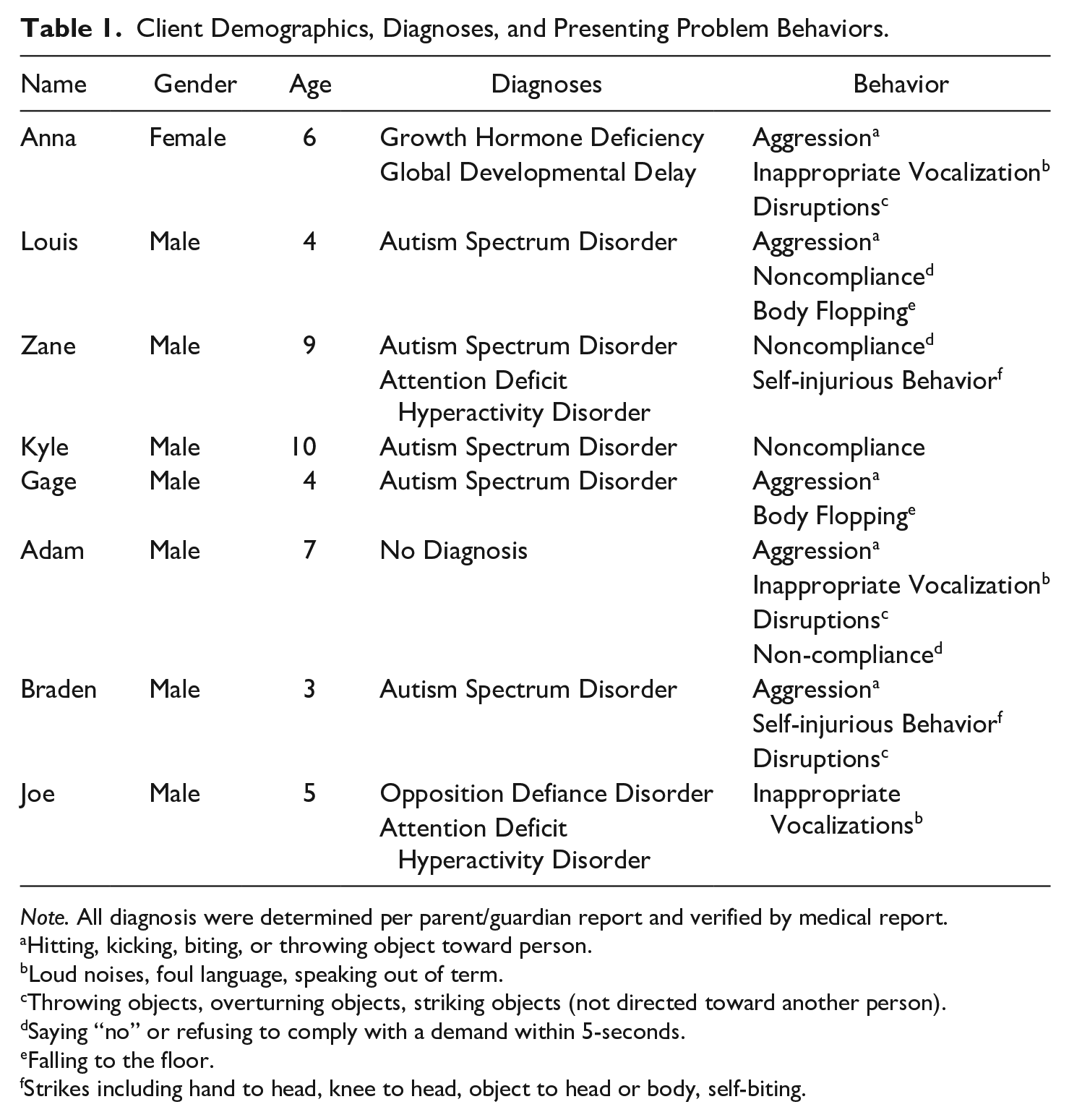
Note. All diagnosis were determined per parent/guardian report and verified by medical report.
Hitting, kicking, biting, or throwing object toward person.
Loud noises, foul language, speaking out of term.
Throwing objects, overturning objects, striking objects (not directed toward another person).
Saying “no” or refusing to comply with a demand within 5-seconds.
Falling to the floor.
Strikes including hand to head, knee to head, object to head or body, self-biting.
Dependent Variable
The primary dependent variable was combined problem behaviors (CBP) per minute. Problem behaviors included aggression (e.g., hitting), self-injury (e.g., hand-to-head), disruptions (e.g., chair flip), non-compliance (e.g., saying “no” following a demand), flopping (i.e., falling to the floor), and inappropriate vocalization (e.g., talking out of turn). Table 1 includes additional details matching participants to target behaviors. To calculate CBP per minute, a frequency count of the total problem behaviors observed during a given condition was divided by the total duration of the condition in minutes (Carr et al., 2018).
Procedures
Prior to the start of analyses, a preference assessment and an anecdotal narrative observation, noting antecedents, behaviors, consequences, and potential functions, were conducted by the researchers. All conditions were 5 minutes in length.
BFA procedures
The BFA included the following conditions: social attention, escape, tangible, and toy play (control). BFA trials were similar to those described by Kahng and Iwata (1999) focusing on single-point analyses. However, in order to minimize the potential of false positives, following the suggestion of Cooper et al. (1992), replication analyses were conducted following one round of BFA conditions by implementing the test condition with the highest level of differentiation of problem behaviors compared to a control condition.
Social attention
The social attention condition began with a 2-minute period prior to data collection in which the child had free access to high quality social attention from the analyst. Following this period, the analyst would state, “Okay, I have to go do some work now.” During this time, the child had access to a low-to-mid preferred tangible, indicated by the preference assessment. When target behaviors occurred, the analyst reprimanded the behavior (e.g., “Don’t do that!”), which served as social attention. All other behaviors were ignored.
Escape
During the escape condition, the analyst would issue a demand every 15-seconds. Demands ranged from simple tasks (e.g., touch your nose) to math problems depending on the child’s developmental level. When target behaviors occurred, the analyst would state, “Okay you don’t have to” and would allow a 30-second escape from the demand. If the child did not comply with the demand and noncompliance was not a target behavior, the analyst would issue another prompt every 10-seconds in a least-to-most intrusive prompting hierarchy; otherwise, noncompliance led to 30-second escape. At the end of the 30-second escape, a new demand was issued.
Tangible
The tangible condition began with a 2-minute period prior to data collection when the child was allowed free access to their most preferred item. Following this period, the analyst would state, “Okay, my turn,” and play with the toy out of reach of the child. During this time, a low-to-mid preferred tangible was available in the room. When target behaviors occurred, the analyst would state, “Okay, you can have it back” and return the preferred tangible. After 30 seconds of access to the tangible, the analyst would state, “Okay my turn again,” and take back the item. All other behaviors were ignored.
Free play (control)
Due to safety concerns, a free play condition replaced an alone condition. During this condition, the child was allowed free access to a highly preferred tangible. The analyst would offer praise every 15 seconds (i.e., “Nice job sitting!”) as long as a target behavior had not occurred within the last 5 seconds.
IISCA procedures
IISCA procedures were implemented as outlined by Hanley et al. (2014). Before conducting analogue assessment procedures, the Open-Ended Functional Assessment Interview was administered to the child’s parent to identify target behaviors; define target behaviors; and obtain information regarding antecedents, consequences, and hypotheses surrounding the target behaviors. Responses from the interviews were used to determine synthesized conditions for analysis during the IISCA. The structured observation was conducted to aid in development of operational definitions prior to the implementation of IISCA assessment and was conducted as described by Hanley et al. (2014).
Synthesized condition (test)
Synthesized conditions were based upon the hypotheses suggested from the parent interview and structured observation. Possible combinations for the synthesized conditions were Social Attention/Tangible, Social Attention/Escape, Escape/Tangible, or Social Attention/Tangible/Escape. All synthesized conditions were conducted during this study with the exception of the Social Attention/Escape condition. Condition procedures were determined based upon which conditions were synthesized; for example, in the Social Attention/Tangible condition, when target behaviors occurred, the analyst would deliver the preferred item back to the child for 30 seconds of access and would simultaneously offer social attention (e.g., “We don’t hit people!”). Condition-specific procedures resembled those from the BFA as closely as possible.
Control
The control condition was similar to the Free Play condition described during the BFA. The child was provided with non-contingent access to identified reinforcers during the condition. These were the same reinforcers used during the child’s particular test condition. For example, if access to tangibles and attention was identified and used during the test condition contingent on target behavior, these same reinforcers were available throughout the control conditions.
Design and Data Analysis
For both IISCA and BFA, a brief alternating treatment design was used to assess differentiation between control and test conditions. A within-subject approach was used to compare the results of the BFA and IISCA for all children. Children were randomly assigned which FA methodology would be implemented first to minimize order effects across conditions. Visual analysis was used to determine in which condition the CPBs were most elevated.
Correspondence was calculated across analysis procedures based on the presentation of CPB. First, the hypothesized functions that were synthesized for the IISCA were noted. Then, the BFA was evaluated to determine if those conditions were elevated in isolation. All agreements between BFA and the IISCA were coded as “1” and disagreements were coded as “0.” Agreements were then divided by total possible agreements (i.e., 3) for total correspondence. Correspondence was then averaged across all children. For example, if the hypothesized functions were attention and demand for the IISCA, the test condition was created to synthesize these two functions. That being said, it would be expected for only the attention and escape conditions to be elevated in the BFA while the tangible condition should be at zero rates of behavior. In this example, the elevation of behavior in the attention condition and the escape condition of the BFA would be coded as an agreement with the IISCA. Additionally, the absence of behavior in the tangible condition of the BFA would be coded as an agreement with the IISCA. To produce a percentage agreement, the total number of disagreements would be divided by 3 (i.e., the total number of possible agreements) and multiplied by 100. Correspondence across all three possible functions would result in 100% agreement.
Interobserver Agreement and Treatment Fidelity
Third and fourth year school psychology graduate students completed in-vivo Interobserver Agreement (IOA) and treatment integrity training with the primary author. Agreements were divided by agreements plus disagreements and multiplied by 100. IOA data were collected for 33% of all conditions across all participants. Average IOA across participants was 99% (range = 80%–100%). A secondary observer collected treatment integrity across 33% of all conditions across all participants. The research assistant also had access to a protocol to ensure greater treatment fidelity. Average treatment integrity across all participants was 100%.
Results
Correspondence Between BFA and IISCA Outcomes
Correspondence was calculated for each child across BFA and IISCA procedures. As seen in Table 2, results indicated at least partial correspondence across the two procedures. Average correspondence across each child was 54.17% (range = 33.33%–66.67%). Anna, Zane, Gage, Kyle, and Adam’s assessments all yielded 66.67% correspondence between BFA and IISCA procedures. While the data indicate these participants have the highest rates of correspondence, the remaining 33.33% accounts for disagreement between the two analysis procedures. As such, even in the highest corresponding participants, target behaviors being measured occurred at non-zero rates in BFA conditions that were not tested in the IISCA, or an absence of the target behavior was observed during a BFA test condition that was included in the synthesized test condition during the IISCA.
Correspondence Rates Across Hypothesized IISCA Functions and BFA Conditions.
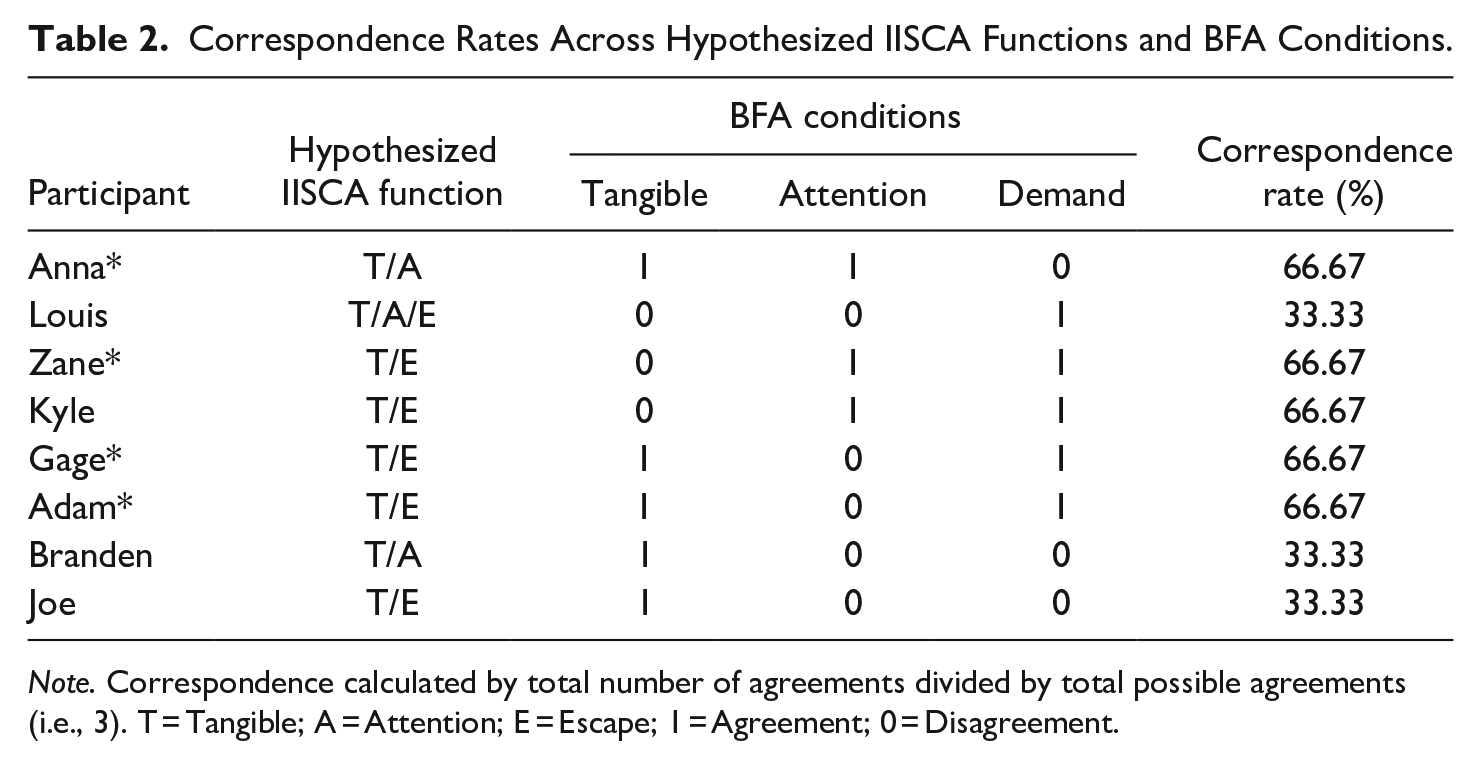
Note. Correspondence calculated by total number of agreements divided by total possible agreements (i.e., 3). T = Tangible; A = Attention; E = Escape; 1 = Agreement; 0 = Disagreement.
Correspondence Between BFA and IISCA by Function
The researchers also evaluated correspondence per function tested. Considering all participants, the average correspondence for tangible, attention, and escape conditions were 62.50%, 37.50%, and 62.50%, respectively. As such, attention conditions showed the highest rate of disagreement by function.
Correspondence Between BFA and IISCA by Assessment Sequence
Finally, results were analyzed considering the order of analysis procedure (i.e., IISCA first vs. BFA first). When IISCA occurred first, the average correspondence was 66.67% (range = 66.67%–66.67%) and when BFA occurred first, the average correspondence was 41.67% (range = 25%–50%). Combining the sequencing correspondence rates with correspondence rates between functions, when the IISCA was completed first, the average correspondence was 75% (tangible), 50% (attention), and 75% (escape). When BFA was first, average correspondence dropped to 50% (tangible), 25% (attention), and 50% (escape).
Discussion
The primary goal of the current study was to evaluate the correspondence rate between BFA and IISCA procedures. Also, we were interested in exploring any differences in correspondence given the order of the two assessments. Finally, we considered correspondence per condition. In general, BFA and IISCA only agreed approximately half of the time and was greater when IISCA procedures were completed first. Correspondence was best across the tangible and demand conditions, with attention having correspondence across the two assessments at best below 50% of the time.
The low-to-moderate correspondence between BFA and IISCA results in this study demonstrates divergence in the identified function—that is, based on these results, it is not clear that BFA and IISCA reliably lead to the same data. There are a number of potential reasons for the observed correspondence rate between BFA and IISCA results. At surface level, the type of condition (i.e., isolated function vs. multiple functions) used in BFA and IISCA is different. However, given elevations are possible for multiple conditions in BFA, this is likely too simple an explanation for results this discrepant. A more nuanced consideration might be that these assessments, while broadly measuring functional relations, are measuring different aspects of the construct. Broadly, FA conditions are designed to serve as an establishing operation that (a) increases the value of a particular reinforcer and (b) evokes behavior that has resulted in access to that same reinforcer in the past. For example, the withdrawal of analyst attention at the beginning of an attention condition (a) increases the value of social-attention for the client and (b) evokes behaviors that have resulted in social-attention in the past. If an individual’s problem behavior is maintained in the natural environment by an isolated function (e.g., escape), then the use of synthesized conditions (e.g., escape and attention) introduces construct-irrelevant variance. However, if the opposite is true and an individual’s behavior is maintained in the natural environment by multiple functions (e.g., escape and attention), then traditional FAs such as BFA may suffer from construct underrepresentation. Fisher et al. (2016) argue that, just like in group design research, interaction effects like those targeted by IISCA should not be targeted if isolated functions have not been ruled out. Additionally, the finding that BFA and IISCA corresponded less frequently when attention was a predicted maintaining variable during IISCA conditions is consistent with previous findings that caregivers often give false positive endorsements for an attention function on indirect measures (Thompson & Iwata, 2001).
It is less clear why the correspondence rate was higher when IISCA preceded BFA; however, one potential explanation worth further research is that synthesized conditions pair reinforcers, effectively training students to respond with problem behavior when denied access to the secondary stimulus (Fisher, 2018). More simply, the IISCA may teach students to engage in problem behavior in order to access a reinforcer type for which they have never exhibited in the past, which primes them to respond to isolated conditions during the BFA that they may not have initially.
Relevance to the Practice of School Psychology
School psychologists have a professional obligation to use assessment procedures that are both reliable and valid (AERA et al., 2014). When completing an FBA, this ethical obligation is at odds with the reliance on indirect and descriptive measures to develop function-based interventions; measures that are inherently limited in providing reliable or valid information (Iwata et al., 2013; Rooker et al., 2015). As a result, we should consider efficient FA procedures in the school setting (Lloyd et al., 2016; Santiago et al., 2016), which we contend would lead to more reliable and valid data. FBAs are often conducted after a student is already exhibiting behavioral difficulties. This backdrop for FBA only enhances the need for ethically and legally defensible practice by school psychologists. Additionally, school psychology programs should address ethical concerns of FBA in training and ensure students are competent to engage in FA practices as part of their standard behavioral evaluation battery.
That being said, it is essential that we continue to rigorously evaluate, compare, and analyze indirect, direct, and experimental FBA methods in the literature. This line of research is necessary to better understand how and when to implement specific procedures. Although it is beyond the scope of our data to make sweeping claims as to the superiority of either BFA or IISCA, their poor correspondence with one another suggests that they may be measuring different things—or potentially, answering related but different questions. Given Fisher et al.’ (2016) reservations regarding IISCA, it may be reasonable to use IISCA in an iterative fashion after ruling out isolated functions via traditional FA (i.e., in the case of undifferentiated results) as opposed to using it in isolation. This sequencing of assessment procedures—from more parsimonious to more complex—maps on well to the basic logic of multi-tiered systems of supports (MTSS) and the scientific model in general. Regardless of the assessment choices, practitioners should work with school staff to closely progress monitor the outcomes associated with interventions and make changes based on additional information when appropriate either through MTSS or by entering a consultative relationship with staff responsible for implementing interventions and collecting data on their efficacy.
Limitations and Future Directions
There are several limitations of the current design. First, and most notably, an intervention component was not included in the procedures. The primary focus of the study was assessment topography and correspondence but adding an intervention component would have allowed researchers to better confirm the accuracy of the results by permitting an evaluation of treatment utility. This would have permitted the researchers to better evaluate the effectiveness of each procedure. When comparing IISCA and traditional FA, Fisher et al. (2016) did not include intervention or contingency reversal conditions as their goal was to strictly compare the assessment outcomes. While IISCA has been repeatedly evaluated in the literature (e.g., Jessel et al., 2016), the use of synthesized conditions remains a topic of debate (e.g., Fisher et al., 2016). We have posited that the use of IISCA procedures as a follow-up to more traditional FA rather than as a standalone assessment may result in higher FBA success rates. Future research should investigate the incremental validity of adding synthesized conditions following undifferentiated FA results.
Another limitation is the impact of order effects. Although we were interested in whether the order of assessment affected correspondence, it is possible the variance can solely be attributed to the order, not the assessment procedures themselves. This could have been remedied by having more participants with counterbalanced presentations or using a single subject reversal design across assessments. Fisher et al. (2016) compared IISCA to traditional FA using such a design, counterbalancing IISCA against traditional FA. Future researchers should consider running the assessments another round, each, and evaluating the correspondence.
While both BFA and IISCA are idiographic technologies, future research may want to capitalize on comparative statistical approaches for single-case design (e.g., hierarchical linear modeling or single-case meta-analysis). By using a larger sample of students who received intervention following both BFA and IISCA, researchers could compare assessments while adjusting for variance attributable to individual and treatment characteristics. By contrast, a notable limitation of this study is that we are limited in our generalization from our current sample in the absence of further replication.
The current study was completed in a university-clinic setting, which is more analogous to a controlled experimental setting as opposed to a school environment. It could be argued the internal validity of the results is greater given the controlled nature of the study; however, it is quite possible the outcome data would look different in a school setting, completed by school personnel. The BFA has been evaluated in the school setting numerous times (e.g., Beavers et al., 2013) and the IISCA was recently evaluated in the school setting (i.e., Santiago et al., 2016), and both were found effective. Nevertheless, additional school-based research on the use of experimental FA procedures should be conducted. Particularly, research is needed that includes school-based practitioners as the assessors instead of researchers or research assistants. Finally, simply investigating the overall feasibility of training and FA implementation by school-based practitioners is imperative.
Footnotes
Declaration of Conflicting Interests
The author(s) declared no potential conflicts of interest with respect to the research, authorship, and/or publication of this article.
Funding
The author(s) received no financial support for the research, authorship, and/or publication of this article.
